World

Turkey dreams of far-fetched gas pipeline with Israel

Turkey is ready for energy cooperation with Israel after years of enmity, reviving a project to pipe Israeli gas to Europe as Ankara seeks to reduce its dependence on Russia.

But the plan faces Israeli scepticism over past diplomatic tensions and seems a pipe dream in the eyes of experts due to its logistical complexity and cost.

President Recep Tayyip Erdogan has voiced readiness to “cooperate (with Israel) in energy and energy security projects” with the prospect of shipping Israeli gas to Europe through Turkey as the conflict in Ukraine triggers supply fears.

“Turkey has the experience and capacity to implement such projects. The recent developments in our region has shown once again the importance of energy security,” he said in March.

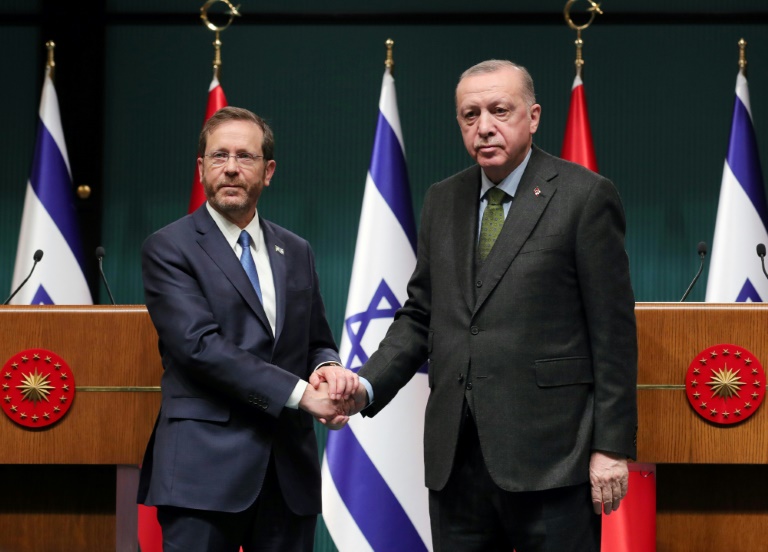
Israeli President Isaac Herzog made a landmark visit to Ankara in March to build relations with his Turkish counterpart when both leaders proclaimed a new era following more than a decade of diplomatic rupture.

Turkish Foreign Minister Mevlut Cavusoglu will visit Israel on Wednesday. Energy Minister Fatih Donmez is also expected to travel but it was not immediately clear if he will accompany Cavusoglu. 

But according to some experts, there is little Israeli interest in energy cooperation with Turkey.

– ‘Erdogan an untrustworthy party’ –

“Energy relations are forged by cooperative, trusting states — certainly not how one would describe the current dynamics between the two countries,” Gabi Mitchell, policy fellow at the Mitvim Institute in Israel, told AFP.

“There are those in Israel who argue that Erdogan is an untrustworthy party,” he said.

The Turkish leader is known for his angry outbursts at the Jewish state, especially over its policy towards the Palestinians.

In 2009, he stormed out of a Davos panel after a heated exchange with the then Israeli president, Shimon Peres. 

NATO member Turkey had been Israel’s key ally in the Muslim world until a 2010 crisis where 10 civilians died in an Israeli raid on a ship seeking to breach a blockade on the Gaza Strip.

In 2016, the two countries agreed to start examining the feasibility of an undersea pipeline to pump Israeli gas to Turkish consumers and on to Europe.

But no progress has been made amid the tension between the two sides, with Erdogan seeing himself as a champion of the Palestinian cause and a strong backer of Hamas.

Yet Erdogan has been muted in his criticism in recent months and only voiced sadness over the Israeli-Palestinian violence at the flashpoint Al-Aqsa mosque compound, in a phone call with Herzog in April.

The pipeline project runs through controversial waters in the eastern Mediterranean, where Turkey and EU members Cyprus and Greece are often at odds.

Mitchell said: “This isn’t something Israel is interested in pursuing as it would damage relations” with Cyprus, Greece and the European Union.

“I’ve never thought the project feasible,” the Foreign Policy Research Institute’s Middle East Program director Aaron Stein told AFP. 

“The idea of the project comes back every time there is a thaw but the logistics needed to take it from a dream to reality is complicated and expensive,” he said. 

The pipeline from Israeli fields to Turkey could cost $1.5 billion, according to some media reports.  

– ‘Difficult but reasonable’ –

Ankara is hugely dependent on Russia for its energy imports, with 45 percent of its gas demand last year met by Russian sources, and is keen to diversify supplies, with a close eye on Israel’s developing resources.

Turkey imports natural gas through pipelines from Russia, Azerbaijan and Iran. It also buys liquefied natural gas (LNG) from suppliers including Qatar, Nigeria, Algeria and the United States.

“A gas pipeline crossing the south of Turkey in theory makes sense,” said energy expert Necdet Pamir of Cyprus International University. 

Turkey consumed 48 billion cubic metres of gas in 2020. This reached 60 billion in 2021 and is estimated to be 62-63 billion this year, he said.

“We need alternative gas supplies and new agreements are in Turkey’s interests as long as the circumstances including the financing are ripe,” Pamir added.

The Turkish option has reappeared on the agenda especially after the United States snubbed an eastern Mediterranean pipeline aimed at transferring natural gas from Israeli waters to Europe via Cyprus and Greece. That project excluded Turkey.

Turkey sees the gas project with Israel as more feasible than the EastMed pipeline despite the challenges. 

“It is not a project that begins today and ends tomorrow,” a Turkish official told AFP. 

“It’s difficult but it’s reasonable and feasible, especially compared to the Greece-led EastMed,” the official, who wished to remain anonymous, said.

With the basic economics of the Turkey-Israel pipeline still being questioned, some experts indicate LNG is a desirable, cheaper option.

“Beyond the politics, and the issue of Cyprus, land-based LNG terminals make more sense,” Stein said. “Financially, and it’s easier politically.”
'This is an atrocity': fears grow that Russian blockade may unleash famine

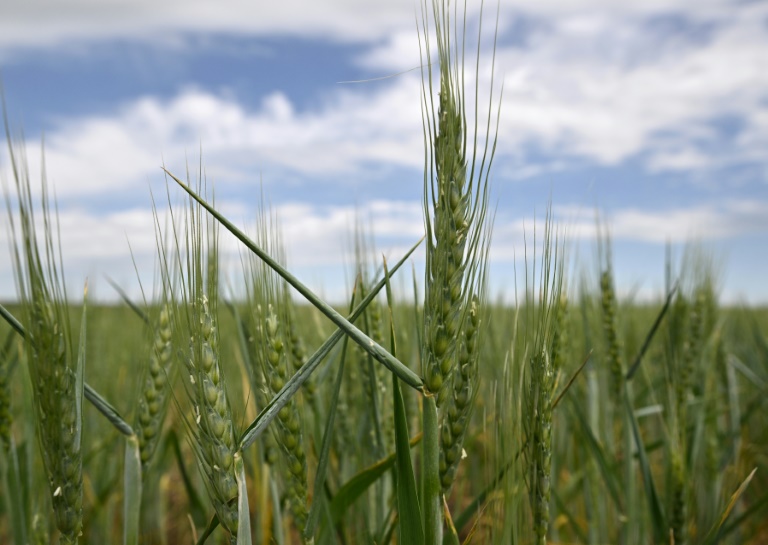
Staring out over Ukraine’s seemingly endless wheat fields near Odessa, Dmitriy Matulyak has a difficult time imagining that so many people may starve soon as another bountiful harvest nears. 

The war has been hard on the 62-year-old farmer.

On the first day of invasion, an airstrike hit one of his warehouses, incinerating over 400 tonnes of animal feed as Russian troops fanned out from their bases in the Crimean Peninsula and seized large chunks of southern Ukraine.

“My voice trembles and tears come to my eyes because of how many people I know that have already died, how many relatives are suffering and how many have gone abroad,” he tells AFP.

But worse may still lie ahead. 

The Russians never stormed the beaches in the nearby port of Odessa as feared, but their ongoing blockade of the Black Sea has been ruinous — unleashing economic devastation in Ukraine and threatening famine elsewhere.

Silos and ports across Ukraine are now brimming with millions of tonnes of grain with nowhere to go as the country is slowly suffocated by the siege. 

In Ukraine’s balmy south, the summer harvest is set to begin in the coming weeks, but few know where exactly they will put this season’s wheat, stirring fears that large portions of the grain and other food products will be left to rot. 

“It’s savagery for one country to have food spoiling like this and for other people to be left poor and hungry,” says Matulyak. “This is an atrocity. It’s savagery. There is no other way to put it.”

– ‘Malnutrition, mass hunger and famine’ –

While much of the war’s focus remains on the grinding battle of attrition in eastern Ukraine, the Black Sea blockade may trigger the most wide ranging consequences from the conflict yet, with experts issuing increasingly dire warnings about surging food prices and potential famine.

Before the Russian invasion, Ukraine served as one of the world’s leading breadbaskets — exporting roughly 4.5 million tonnes of agricultural produce per month through its ports, including 12 percent of the planet’s wheat, 15 percent of its corn, and half of its sunflower oil.

The war and its ongoing blockade has largely brought the trade to a halt, with alternative routes by rail and truck unable to tackle the enormous logistical and financial hurdles needed to move so much produce to international markets. 

The United Nations Secretary-General Antonio Guterres has been unequivocal on the matter, saying last week that the war “threatens to tip tens of millions of people over the edge into food insecurity”.

What might follow would be “malnutrition, mass hunger and famine, in a crisis that could last for years”, he warned. 

To date, over 20 million tonnes of food products remain stuck in Ukraine, according to Ukrainian authorities. 

In southern Odessa, the crisis can be felt acutely. The port remains idle with nothing coming in or going out for months now. 

For generations, the economic might of Eastern Europe’s fertile agricultural heartlands were largely marshalled in Odessa, with its sprawling port and rail hub connecting the region’s wheat fields to the coast.

That centuries-old link has now been severed.

The city’s port and warehouses are currently holding more than four million tonnes of grain, all of which came from the last harvest. 

“We won’t be able to store this new harvest in any way, that’s the problem,” says Odessa mayor Gennady Trukhanov. 

“People will simply die of hunger,” he says if the blockade continues.

– ‘Relevant weapons’ –

Ukraine’s economy has also been ravaged as a result, with World Bank estimates predicting the war and crippling naval siege would likely trigger a 45 percent decline in the country’s GDP this year.

And while Ukraine’s land forces have proven resilient against a larger, better armed enemy, the Russians continue to enjoy almost complete superiority at sea. 

“Unfortunately, Ukraine has traditionally overlooked the issue of maritime security,” explained the country’s former defence minister Andriy Zagorodnyuk in a paper published by the Atlantic Council. 

“While the democratic world has taken up the challenge of arming Ukraine to resist Russian aggression on land, international involvement in the war at sea has been more limited.”

Over the weekend, Ukrainian President Volodymyr Zelensky called on the world to intervene, begging for the “relevant weapons” that could help bring the Russians to heel and end the blockade. 

“It will create a food crisis if we do not unblock the routes for Ukraine, do not help the countries of Africa, Europe, Asia, which need these food products,” the president argued. 

But even if given the needed arms, it could take months or longer to kickstart trade again if the war rages on, with shipping companies unlikely to send their fleets into an active conflict zone.

For farmers like Matulyak who were born in the Soviet Union and once enjoyed “brotherly” ties to Russia, the ongoing conflict and its fallout is hard to swallow. 

“Of course it would be good if all these issues could be resolved by some diplomatic peaceful means,” he says. “But we have already seen that Russia does not understand the normal values people hold.”

UN human rights chief to begin contentious China visit

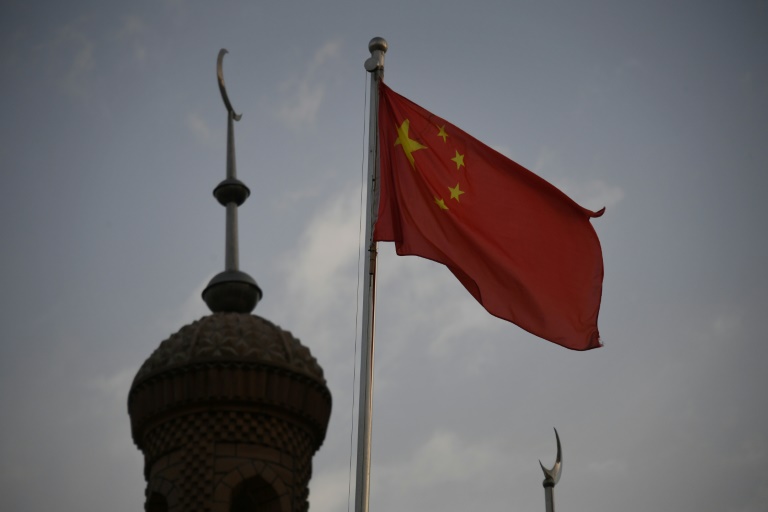
The UN human rights chief was Monday due to begin a six-day trip to China that takes in the remote Xinjiang region, stirring fears over access and the propaganda value the visit offers to the Chinese Communist Party.

The tour by Michelle Bachelet marks the first by the UN’s top rights official in nearly two decades and comes as Beijing stands accused of widespread abuses of Muslims in far-western Xinjiang.

The ruling Communist Party is alleged to have detained over one million Uyghurs and other Muslim minorities there under a years-long security crackdown the United States calls a “genocide”.

China vociferously denies the accusations, calling them “the lie of the century”.

Bachelet is due to virtually meet with the heads of around 70 diplomatic missions in China on Monday, according to a diplomatic source in Beijing.

Later in the week she is due to travel to the Xinjiang cities of Urumqi and Kashgar as well as the southern city of Guangzhou.

The former president of Chile will meet “a number of high-level officials” as well as “civil society organisations, business representatives (and) academics”, her office said before the trip.

UN officials have been locked in negotiations with the Chinese government since 2018 in a bid to secure “unfettered, meaningful access” to Xinjiang.

But fears have swirled of a whitewash offering a tightly-controlled glimpse into life in the province, which China says it has pacified with “re-education centres” and uplifted with an economic rejuvenation drive.

– Access or cover up? –

The United States led the criticism ahead of her trip, saying it was “deeply concerned” Bachelet had failed to secure guarantees on what she can see.

“We have no expectation that the PRC will grant the necessary access required to conduct a complete, unmanipulated assessment of the human rights environment in Xinjiang,” State Department spokesman Ned Price told reporters, using the acronym for the People’s Republic of China.

Instead of a thorough probe into alleged abuses, rights advocates also fear Bachelet is in store for a stage-managed tour.

Her visit will be “a running battle against Chinese government efforts to cover up the truth,” said Agnes Callamard, secretary general of Amnesty International.

“The UN must take steps to mitigate against this and resist being used to support blatant propaganda.”

The last such visit, in 2005, came when Beijing was keen to soften its global image as it prepared to host the 2008 Olympic Games — but much has changed since then.

President Xi Jinping has become the most authoritarian Chinese leader in a generation and is working on securing an unprecedented third term at the end of this year.

In addition to mass detentions, Chinese authorities have waged a campaign of forced labour, coerced sterilisation and the destruction of Uyghur cultural heritage in Xinjiang, researchers and campaigners say.s

Chinese state media has given muted coverage of the visit so far.

But an article on Sunday by state news agency Xinhua lauded the country’s “remarkable achievements in respecting and protecting human rights”.

A more combative article on CGTN — the English-language arm of China’s state broadcaster — blasted what it called the West’s “false Xinjiang narrative” and questioned the basis of the allegations.

War crimes verdict looms as Russian offensive intensifies

With a verdict due Monday in the conflict’s first war crimes trial, Moscow’s offensive in eastern Ukraine is only intensifying, with the city of Severodonetsk under “round-the-clock” bombardment as Russian troops attempt its encirclement.

The trial in Kyiv — seen as a public test of the Ukrainian judicial system’s independence — comes as international institutions conduct their own investigations into alleged abuses that have turned cities like Bucha and Mariupol into watchwords for destruction.

Polish President Andrzej Duda, whose country is a vital staging area for Western arms shipments and host to millions of the war’s refugees, pointed to the devastation in those cities as a reason for why “business as usual” with Russia was no longer possible.

“An honest world cannot return to business as usual while forgetting the crimes, the aggression, the fundamental rights that have been trampled on,” he told Ukraine’s parliament Sunday.

Three months after launching an invasion that failed in its initial goal of capturing Kyiv, Moscow’s forces are now squarely focused on securing and expanding their gains in the Donbas region and on Ukraine’s southern coast.

But as its relentless offensive continues, Russia’s lead negotiator said Sunday that Moscow was willing to resume negotiations with Ukraine, which it blames for “freezing” earlier talks. 

Any talks, however, will not include concessions of land, according to Ukrainian President Volodymyr Zelensky’s chief of staff Andriy Yermak, who tweeted the war must end with “complete restoration of (Ukraine’s) territorial integrity”.

– First war crimes trial –

On Monday, Zelensky will continue his drive to rally Western support for his country’s cause, targeting the world’s political and business elite gathering in the Swiss mountain resort of Davos for the World Economic Forum. 

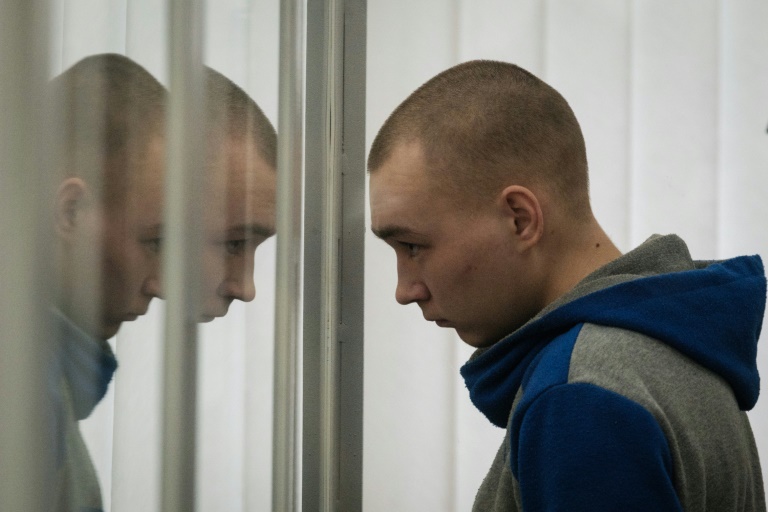
As Ukraine’s president addresses the forum’s attendees via videoconference, a panel of judges in Kyiv will be determining the fate of Russian Sergeant Vadim Shishimarin in the conflict’s first war crimes trial.

The shaven-headed 21-year-old from Siberia has admitted to killing a 62-year-old civilian in the early stages of the invasion, but told the court he was pressured into an act for which he was “truly sorry”.

“I was nervous about what was going on. I didn’t want to kill,” he said from the glass defence box, wearing a grey and blue hoodie, as the trial concluded Friday.

Shishimarin’s lawyer has argued for an acquittal, saying his client was carrying out what he perceived to be a direct order that he initially disobeyed.

Prosecutors, who have asked for a life sentence, said he was “well aware” he was executing a “criminal order”.

– ‘Scorched-earth tactics’ –

In the eastern city of Severodonetsk, a focus of recent fighting, regional governor Sergiy Gaiday said Russian forces attempting its encirclement were “using scorched-earth tactics, deliberately destroying” the city.

Gaiday said Russia was drawing forces from a vast area — those withdrawn from the Kharkiv region, others involved in Mariupol’s siege, pro-Russian separatist militias, and even troops freshly mobilised from Siberia — and concentrating their firepower on the Donetsk and Lugansk regions. 

At least seven civilians were killed and eight others wounded in Sunday’s bombardment of the Donetsk region, according to the Ukrainian army’s Facebook page.

Shelling and missile strikes also continued to pound Kharkiv in the north, as well as Mykolaiv and Zaporizhzhia in the south, Ukrainian officials said.

With the nation under relentless assault, Ukraine’s parliament on Sunday voted to extend martial law through August 23.

Millions of ordinary Ukrainians, meanwhile, face a daily struggle to survive.

“There is no work, no food, no water,” said Angela Kopytsa, 52, breaking down into tears as she spoke to AFP reporters on a Russian-organised tour of captured Mariupol.

Kopytsa said her home had been destroyed during the fighting in the port and that “children at maternity wards were dying of hunger”. 

Once-bustling Mariupol, which has been without electricity since early March, has now been reduced to a wasteland of charred buildings

– Davos snubs Moscow –

Thousands of miles away, Monday’s meeting in Davos is expected to be dominated by the political and economic fallout from Russia’s invasion of Ukraine. 

Russian business and political leaders, who once participated in debates and mingled with other A-listers at champagne parties, have been barred from this year’s gathering — dubbed “History at a Turning Point” — over the war.

Zelensky is due to confer with Davos delegates via videoconference to mark the opening of the Ukraine House Davos, a forum for Kyiv and its international backers.

And a strong Ukrainian contingent, including the foreign minister, has made the journey to plead their case.

“The major request to the whole world here is: do not stop backing Ukraine,” Ukrainian lawmaker Ivanna Klympush-Tsintsadze told reporters on the eve of the summit.

More than 50 heads of state or government will be among the 2,500 delegates, ranging from business leaders to academics and civil society figures.

burs-dc/har/bbk/sw/caw/cwl/dhc

Asian markets mixed as inflation fears weigh

Asian stocks were mixed Monday as inflation fears and concerns about low economic growth weighed on markets.

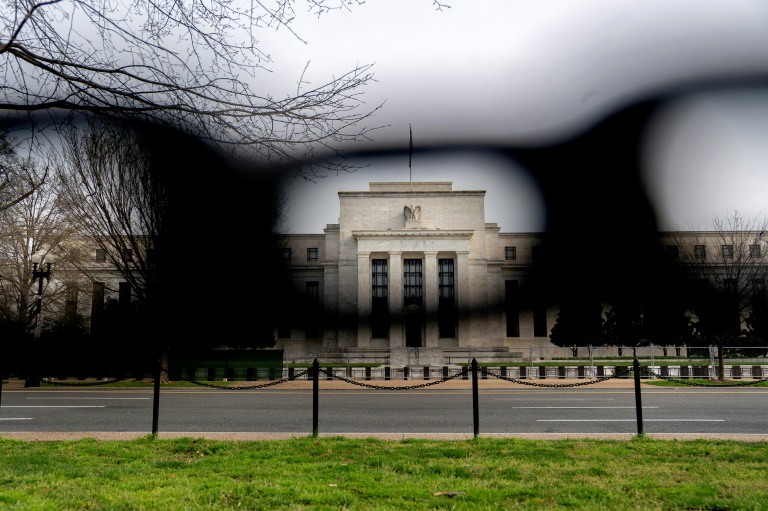
Investors will be looking to the release on Wednesday of notes from the latest Federal Reserve committee meeting for clues on further rate hikes by the US central bank.

Wall Street ended the week essentially flat after the S&P 500 had briefly dipped into a bear market, with the index down about 19 percent from its January high.

A Chinese interest rate cut did little to cheer Asian markets, with investors concerned about continuing Covid restrictions that are hurting the world’s second-largest economy and snarling international supply chains.

Downcast earning reports from retailers have also heightened market uncertainty at a time of rising interest rates, surging energy prices and Russia’s ongoing war on Ukraine, which is driving commodity prices higher.

“As macro-economic concerns stemming from aggressive monetary tightening, the Russia-Ukraine conflict and China’s stringent Covid lockdowns persist, we anticipate great volatility in the market,” Louise Dudley, portfolio manager global equities at Federated Hermes, said in a note, Bloomberg News reported.

In Asian trade Monday, Tokyo climbed 1.3 percent while Hong Kong slipped 1.5 percent and Shanghai was down 0.5 percent.

Seoul, Kuala Lumpur and Bangkok were higher while Singapore and Manila were down and Sydney was flat following a weekend election that saw the centre-left Labor party end a decade of conservative rule.

The new government of Prime Minister Anthony Albanese is expected to undertake some policy shifts, particularly on climate change, but economists said they were unlikely to upset growth forecasts.

“In our view there was little proposed by the incoming government during the election campaign that at this stage requires us to revisit our economic forecasts,” Commonwealth Bank of Australia economists said in a note.

“Put another way, our economic forecasts and call on the (Australian central bank) are unchanged despite the change of national leadership.”

Oil was higher, with US crude benchmark WTI up 0.5 percent and Brent gaining 0.7 percent.

The invasion of Ukraine has shaken up the global market and the outlook for key producer Russia, which has been largely shunned by Western countries.

– Key figures at around 0300 GMT –

Tokyo – Nikkei 225: UP 1.3 percent at 26,872.01 (break)

Hong Kong – Hang Seng Index: DOWN 1.5 percent at 20,416.04

Shanghai – Composite: DOWN 0.5 percent at 3,131.23

Dollar/yen: DOWN at 127.30 from 127.86 yen on Friday

Euro/dollar: UP at $1.0592 from $1.0564

Pound/dollar: UP at $1.2543 from $1.2497

Euro/pound: DOWN at 84.45 from 84.50 pence

West Texas Intermediate: UP 0.5 percent at $110.81 per barrel

Brent North Sea crude: UP 0.7 percent at $113.29 per barrel

New York – Dow: FLAT at 31,261.90 (close)

London – FTSE 100: UP 1.2 percent at 7,389.98 (close)

New Australian PM heads to Tokyo with climate message

Australia’s Prime Minister Anthony Albanese took the oath of office Monday and immediately flew to a Tokyo summit with a “message to the world” that his country is ready to engage on climate change.

The 59-year-old centre-left Labor Party leader was sworn in during a brief televised ceremony at Government House in Canberra.

In a hurried post-election schedule, he flew out of the country shortly afterwards to join a Tokyo summit with the US, Japanese and Indian leaders, known as the Quad.

Albanese said he would meet one-on-one with each leader in Japan. 

But he singled out the United States as Australia’s “most important partner” and noted that President Joe Biden called him the previous evening for a “fruitful” conversation.

The Tokyo talks will be “a good way to send a message to the world that there’s a new government in Australia”, Albanese said in his first news conference as prime minister.

“It’s a government that represents a change in terms of the way that we deal with the world on issues like climate change.”

On China, Albanese said the relationship with Beijing would “remain a difficult one”. 

The two countries have not held ministerial-level talks in two years, and China’s government has hit a range of Australian goods with politically tinged sanctions.

“It is China that has changed, not Australia, and Australia should always stand up for our values,” he said.

But he also vowed not to “play politics” with national security, a common ploy by the outgoing conservative government that helped fray ties with Beijing further.

– ‘Optimism and hope’ –

Albanese has frequently reflected on his personal journey towards the nation’s highest office after being brought up by his struggling single mother in Sydney public housing.

The new leader says he wants to transform his country, too.

In recent years, images of smouldering eucalypt forests, smog-enveloped cities and blanched-out coral reefs have made Australia a poster child for climate-fuelled destruction.

Under conservative leadership, the country — already one of the world’s largest gas and coal exporters — has also become synonymous with playing the spoiler at international climate talks.

That record allowed a score of independent candidates — mostly women offering climate and anti-corruption measures — to plunder once-safe conservative Liberal Party urban seats.

Albanese has vowed to adopt more ambitious emissions reduction targets and make the sun-kissed continent-nation a renewable energy superpower.

He set out a string of other goals, too: setting up a national anti-corruption commission, giving indigenous people a constitutional right to be consulted about policies that affect them, and offering affordable childcare to allow more women to work.

“I look forward to leading a government that makes Australians proud, that does not seek to divide,” he added.

“People do have conflict fatigue.”

– ‘Down to business’ –

Official results showed Labor was expected to win in 75 seats — almost within reach of the 76 required for a majority in the 151-seat lower house. A handful of other races are still too close to call. 

Albanese said a Labor majority “looks most likely”. But he had already secured support from five independent and small party members to ensure Labor can govern.

After the meetings with Quad leaders on Tuesday, Albanese said he would return to Australia the following day and convene a meeting of his ministers next week.

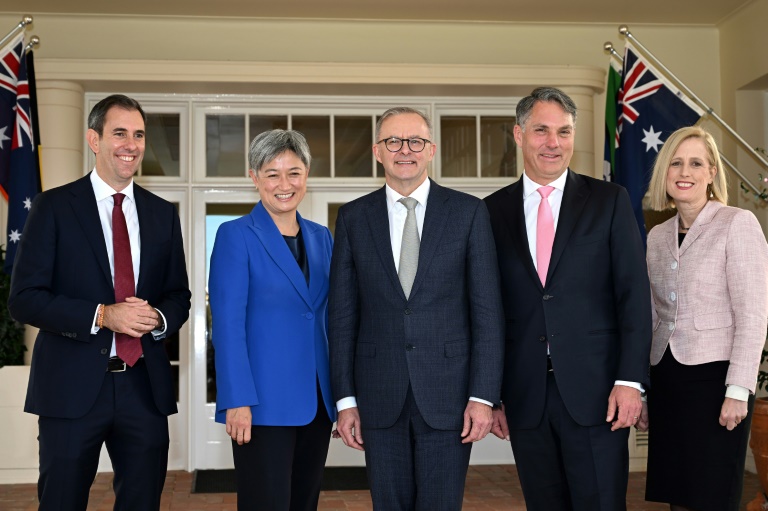
His top team include Foreign Minister Penny Wong, who will join the prime minister in Tokyo, Treasurer Jim Chalmers and Finance Minister Katy Gallagher — all sworn in Monday.

Notable among the foreign leaders who have welcomed Albanese’s election are the ones from Australia’s Pacific Island neighbours, whose very existence is threatened by rising sea levels.

“Of your many promises to support the Pacific, none is more welcome than your plan to put the climate first –– our people’s shared future depends on it,” said Fijian Prime Minister Frank Bainimarama.

It is already clear that the vote was a political earthquake in Australia. 

For many Australians, the election was a referendum on polarising former prime minister Scott Morrison.

Voters responded at the ballot box with a sharp rebuke of his Liberal-National coalition — ousting top ministers from parliament and virtually expelling the party from major cities.

For Morrison’s conservative allies, the defeat is already spurring a battle for the soul of the party.

A leadership contest is informally underway, with moderates blaming the loss on a drift to the right.

Biden reinforces Japan ties, unveils Asia trade initiative

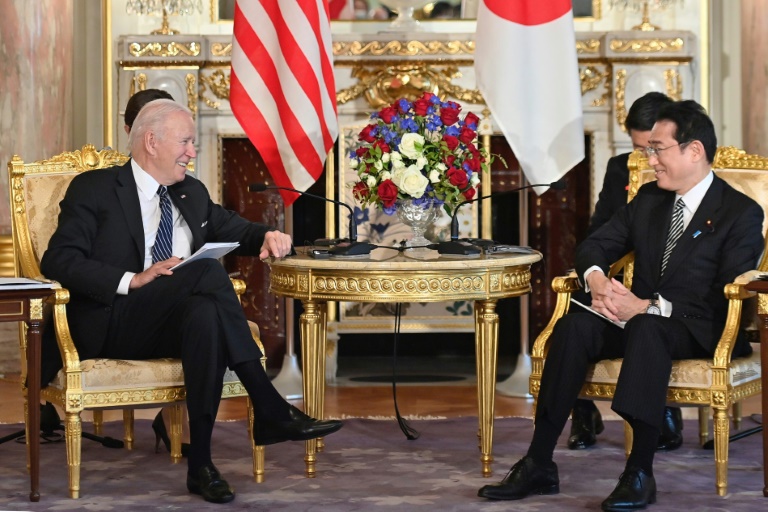
President Joe Biden met Japanese Prime Minister Fumio Kishida in Tokyo ahead of the unveiling of a multinational trade initiative Monday as part of his push to reinvigorate US strategic power across Asia.

Fresh from a three-day visit to another key US ally, South Korea, Biden praised Tokyo as a “key global leader” for joining US-led pressure on Russia over its invasion of Ukraine.

“The US-Japanese alliance has long been a cornerstone of peace and prosperity in the Indo-Pacific and the United States remains fully committed to Japan’s defence,” Biden said after discussions with Kishida.

“We will face the challenges today and in the future together.”

US officials describe Japan and South Korea as linchpins in Washington’s pushback against rising Chinese commercial and military power, as well as partners in a Western-led alliance to isolate Russia over its invasion of Ukraine.

Washington is keen to show it has not been distracted by the Ukraine crisis, and Kishida welcomed Biden’s visit despite the ongoing war.

“Your visit to Japan at this time illustrates that whatever the situation is, the United States will continue to strengthen its engagement in the Indo-Pacific region,” the Japanese leader said.

– North Korea ignores Biden –

Hanging over every step of Biden’s Asia tour is fear that unpredictable North Korea will test a nuclear-capable missile or a bomb.

Speculation that this might even happen while Biden was just across the border in Seoul did not materialise over the weekend.

But US National Security Advisor Jake Sullivan told reporters that the threat remains and said that the dictatorship has a choice.

“If North Korea acts, we’ll be prepared to respond. If North Korea doesn’t act, North Korea has the opportunity, as we’ve said repeatedly, to come to the table,” he said. 

Pyongyang has so far declined to answer the United States’ appeals for dialogue, officials say, even ignoring offers of help to combat a sudden mass outbreak of Covid-19, according to Biden.

The situation will be on the agenda for the Biden-Kishida talks, the White House said, as well as their “shared vision for a free and open Indo-Pacific” — US diplomatic code for maintaining the status quo with a rising China.

The pair are expected to make a statement on the need for “stability” in the Taiwan Strait, as concern rises about Chinese pressure on the island.

And in a sign of Japan’s worry about regional tensions, Kishida is expected to announce plans for increased defence spending, a sensitive issue in a country whose constitution limits the military to defence.

– Trade initiative –

After holding a joint press conference with Kishida, Biden will unveil a long-awaited trade initiative — also meant to cement the US presence in the region — dubbed the Indo-Pacific Economic Framework for Prosperity, or IPEF.

IPEF is being touted by Washington as a framework for what will ultimately become a tight-knit group of trading nations.

Unlike traditional trade blocs there is no plan for IPEF members to negotiate tariffs and ease market access — a tool that has become increasingly unpopular among American voters fearful of undermining domestic manufacturing.

Instead, the programme foresees integrating the trading partners with agreed standards in four main areas: the digital economy, supply chains, clean energy infrastructure and anti-corruption measures.

The White House has so far been tight-lipped about how many countries are signing up and it faces questions over how agreed standards of behaviour between the partners can be enforced.

However, there is no political appetite within the United States for returning to a binding Asian trade deal following Trump’s 2017 withdrawal from the Trans-Pacific Partnership.

That huge trading bloc was revived, without US membership, in 2018 as the Comprehensive and Progressive Agreement for Trans-Pacific Partnership.

On Tuesday, Biden will be reinforcing the theme of American leadership in the Asia-Pacific by joining the prime ministers of Australia, India and Japan for a summit of the Quad group.

Seven killed after fire engulfs Philippine ferry

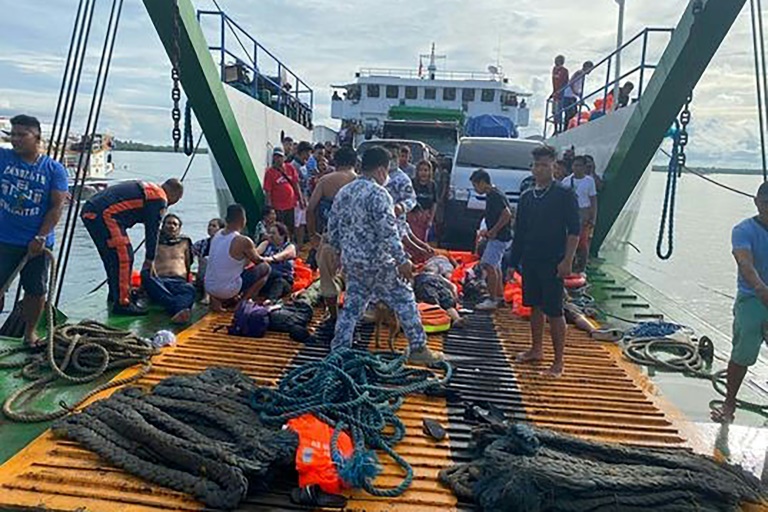
At least seven people were killed and scores plucked to safety in the Philippines Monday after a fire ripped through a ferry and forced passengers to jump overboard, the coast guard and witnesses said.

The blaze broke out on the Mercraft 2 at around 6:30 am (2230 GMT Sunday) as it carried 134 passengers and crew from Polillo Island to Real in Quezon province on the main island of Luzon.

Seven people died and 120 have been rescued so far, Philippine Coast Guard spokesman Commodore Armando Balilo said.

Another seven were missing and a search operation was ongoing.

The boat had a 186-person capacity. 

“We heard an explosion,” said Kycel Pineda, 18, who was travelling on another ferry.

“When we saw the boat, it was already engulfed by fire and passengers were already floating in the sea,” the high school student added.

Thick black smoke billowed from the Mercraft as flames tore through the entire vessel, photos shared by the coast guard showed.

People with life rings and life vests were in the water. Some were rescued by other ferries or clambered into inflatable boats.

The fire appears to have started in the engine room, Balilo said. A team of investigators was preparing to look into the cause.  

“We were able to rescue 40 survivors. We have two fatalities,” said Captain Brunette Azagra, whose passenger vessel was 500 metres from the Mercraft when the fire broke out.

“They were lucky because we also came from Polillo. They overtook us, but we were just nearby,” Azagra told a local radio station, describing sea conditions as “quite good”.

At least 23 people were injured, including the captain of the ferry, according to the coast guard.

The ship was around seven kilometres (four miles) away from port, Real town disaster officer Ricky Poblete said.

Speaking from the hospital where the injured were being treated, Poblete said the seven dead had drowned.

Photos posted on the coast guard’s Facebook page showed a survivor laying on a stretcher being carried off a ferry.

Another lay on the deck of a boat and appeared to be receiving treatment.

The Philippines, an archipelago of more than 7,000 islands, is plagued by poor sea transport, with its badly regulated boats and ships prone to overcrowding and accidents. 

The fire on the Mercraft was under control and the burned-out wreckage towed to shore.

More than 100 million people forcibly displaced: UN

Russia’s war in Ukraine has pushed the number of forcibly displaced people around the world above 100 million for the first time ever, the United Nations said Monday.

“The number of people forced to flee conflict, violence, human rights violations and persecution has now crossed the staggering milestone of 100 million for the first time on record, propelled by the war in Ukraine and other deadly conflicts,” said UNHCR, the UN Refugee Agency.

The “alarming” figure must shake the world into ending the conflicts forcing record numbers to flee their own homes, the UNHCR said in a statement.

UNHCR said the numbers of forcibly displaced people rose towards 90 million by the end of 2021, spurred by violence in Ethiopia, Burkina Faso, Myanmar, Nigeria, Afghanistan and the Democratic Republic of the Congo.

Russia invaded Ukraine on February 24 and since then, more than eight million people have been displaced within the country, while more than six million refugees have fled across the borders.

– ‘Wake-up call’ –

“One hundred million is a stark figure — sobering and alarming in equal measure. It’s a record that should never have been set,” said UNHCR chief Filippo Grandi.

“This must serve as a wake-up call to resolve and prevent destructive conflicts, end persecution, and address the underlying causes that force innocent people to flee their homes.”

The 100 million figure amounts to more than one percent of the global population, while only 13 countries have a bigger population than the number of forcibly displaced people in the world.

The figures combine refugees, asylum-seekers, as well as more than 50 million people displaced inside their own countries.

“The international response to people fleeing war in Ukraine has been overwhelmingly positive,” said Grandi.

“Compassion is alive and we need a similar mobilisation for all crises around the world. But ultimately, humanitarian aid is a palliative, not a cure.

“To reverse this trend, the only answer is peace and stability so that innocent people are not forced to gamble between acute danger at home or precarious flight and exile.”

UNHCR will outline the full data on forced displacement in 2021 in its annual Global Trends Report, due for release on June 16.

– ‘Never been as bad’ –

More than two years on since the start of the Covid-19 pandemic, at least 20 countries still deny access to asylum for people fleeing conflict, violence, and persecution based on measures to clamp down on the virus.

Grandi called Friday for those countries to lift any remaining pandemic-related asylum restrictions, saying they contravene a fundamental human right.

“I am worried that measures enacted on the pretext of responding to Covid-19 are being used as cover to exclude and deny asylum to people fleeing violence and persecution,” he said.

A joint report last week by the Internal Displacement Monitoring Centre (IDMC) and the Norwegian Refugee Council (NRC) said around 38 million new internal displacements were reported in 2021. Some of those were by people forced to flee multiple times during the year.

The figure marks the second-highest annual number of new internal displacements in a decade after 2020, which saw record-breaking movement due to a string of natural disasters.

Last year, new internal displacements specifically from conflict surged to 14.4 million — marking a 50-percent jump from 2020, the report showed.

“It has never been as bad as this,” NRC chief Jan Egeland told reporters.

“The world is falling apart.”

Natural disasters continued to account for most new internal displacement, spurring 23.7 million such movements in 2021.

'Undeniably unsettling' Aussie cop drama disturbs Cannes

In two of the most intense performances to grip the Cannes Film Festival, award-winning actors Joel Edgerton and Sean Harris face off in a dark undercover cop story from Australia.

“The Stranger” is based on the real-life effort to ensnare a child murderer that takes a terrible toll on the officers charged with ingratiating themselves with the suspect. 

Edgerton, known from films such as “Loving”, “The Great Gatsby” and TV series “The Underground Railroad”, praised the officers who risked their lives and psychological well-being in the case. 

“These are all people that we’ll never get to meet. I don’t even know the real name of the person I’m playing,” he told AFP. 

“That job has such a weight and takes such a toll,” he said.

His target is played by Sean Harris, who has established himself as one of the most visceral presences in cinema — from the bad guy in the most recent “Mission: Impossible” films to a ruthless killer in “The Borgias” and his BAFTA-winning role in British series “Southcliffe”. 

Edgerton praised his ability to balance vulnerability with menace. 

“There’s something about Sean… there’s a vibration that’s undeniably unsettling and terrifying and that’s a rare gift,” he said.

Harris credited his year-long preparation for the role for his blistering performance. 

“When I got over to Australia, that’s when it started to kick in, the intensity — you turn up the dial. All the work I’d done started to flow through me,” he told AFP. 

– ‘A schizophrenic experience’ –

Director Thomas M Wright, also known as an actor in TV series “Top of the Lake”, said it was a strange experience presenting such a dark piece of work amid the sunshine, champagne and paparazzi of Cannes. 

“It’s almost a schizophrenic experience,” he said. 

“You’ve gone to this incredibly personal place to make this, it’s difficult subject matter, it’s left a mark on us.

“And then we’re at Cannes, which is like a film you’ve been watching your whole life and suddenly you’re in the middle of it.”

Edgerton said it was particularly tricky given that the undercover officers must remain anonymous. 

“We get to celebrate ourselves by making a fictional version of a story. These guys will never be celebrated,” he said.

“The Stranger”, which is playing in the festival’s Un Certain Regard section, received a long standing ovation at its premiere on Friday, with critics singling out the central performances. 

Wright said he separated Edgerton and Harris — who knew each other from previous films “The King” and “The Green Knight” — during filming.

“They were kept completely separate,” Wright said. “I wanted them to conduct their research entirely separately. 

“We can’t actually talk about what that research entailed. We certainly went to some very deep places with the making of this film. It wasn’t a film we just walked away from at the end,” he added.

Australia has a history of bleak but brilliantly-made true-crime dramas, from “The Snowtown Murders” and “Nitram”, to “Animal Kingdom” which also starred Edgerton. 

“We’re in a landscape that was formed through violence and defined by violence. We can’t see it, we don’t understand it,” said Wright. 

“You look at the great Australian artists… there’s a darkness there. We’re surrounded by an image of sunshine and beaches but it’s a complex country.”

Close Bitnami banner
Bitnami