World

China's Xinjiang crackdown under scrutiny ahead of UN rights chief visit

China’s crackdown on Muslim minorities in the remote region of Xinjiang will return to the spotlight next week when Beijing hosts the United Nations human rights chief for the first time in nearly two decades.

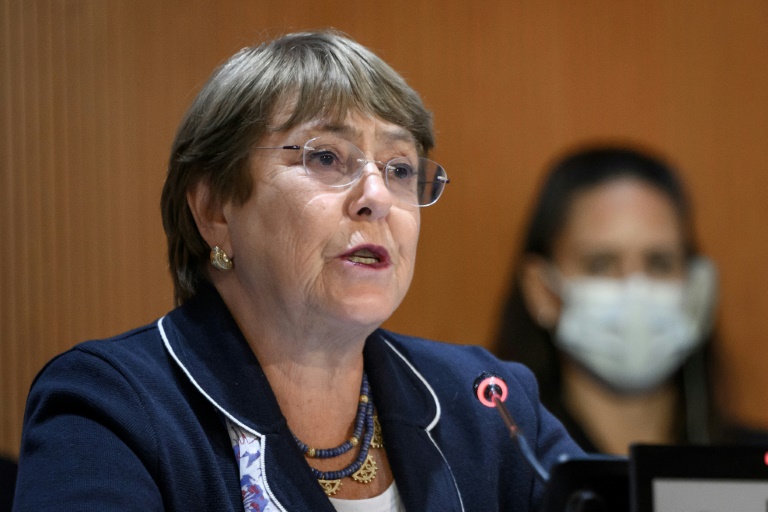
The highly scrutinised six-day trip by High Commissioner Michelle Bachelet will begin Monday, with stops in the cities of Urumqi and Kashgar in Xinjiang, as well as Guangzhou in southern China, the UN announced Friday. 

Bachelet will meet “a number of high-level officials”, her office said, adding that she would “also meet with civil society organisations, business representatives, academics, and deliver a lecture to students at Guangzhou University”.

But hopes of a thorough investigation into rights abuses have given way to concern among rights advocates that the ruling Communist Party will use the visit to whitewash its alleged atrocities.

China is accused of incarcerating one million Uyghurs and other Muslim minorities in detention camps in the far-western region in a years-long security crackdown that the United States and other countries have called a “genocide”.

Beijing has vociferously denied genocide allegations, calling them the “lie of the century” and arguing that its policies have countered extremism and improved livelihoods.

Bachelet will meet virtually with heads of foreign missions on Monday before visiting Xinjiang on Tuesday and Wednesday, according to diplomatic sources in Beijing.

The visit to China is the first by the UN’s top human rights official since 2005, when Beijing was keen to soften its global image as it prepared to host the 2008 Olympics.

Since 2018, UN officials have been locked in negotiations with the Chinese government to secure “unfettered, meaningful access” to Xinjiang before the trip was announced in March.

Instead, campaigners fear that Bachelet will get a stage-managed tour that sidelines key issues.

– Lack of access –

With hundreds of thousands in detention and many mosques closed or destroyed, authorities in Xinjiang appear to have pivoted in recent years to focusing on economic development, according to scholars and Uyghurs based outside China.

“Now there’s not much visible evidence of repression,” said Peter Irwin of the Uyghur Human Rights Project.

Rights groups have warned that pervasive state surveillance and fear of retaliation will prevent Uyghurs on the ground from speaking freely to the UN team.

“We fear the visit will be manipulated by the Chinese government to whitewash the severe abuses in Xinjiang,” said Maya Wang, senior China researcher at Human Rights Watch.

Campaigners have questioned why Bachelet — a former president of Chile and a torture survivor — has not been more outspoken about Xinjiang.

The United States warned Friday that Bachelet’s “continued silence in the face of indisputable evidence of atrocities in Xinjiang” was “deeply concerning”.

Her reluctance to criticise may reflect Beijing’s powerful influence at the UN, which puts officials “under a lot of constraints”, Irwin said.

– Last hope –

Rights groups have been dismayed by the stalled release of Bachelet’s long-awaited report on Xinjiang, believed to have been completed in September.

Once published, the report could provide “political cover” for countries normally afraid to criticise China’s rights record, added Irwin. 

A spokeswoman for Bachelet said Tuesday that it would not be released before her trip and there was no clear timing for making it public.

Hundreds of overseas Uyghurs and Kazakhs — another Muslim minority in Xinjiang — have staged rallies in recent weeks to urge Bachelet to visit detained relatives.

Tursan Can Heyit, 31, joined a demonstration in Istanbul after unsuccessfully petitioning Chinese authorities for years for information about his parents and sister, who vanished in 2017 and 2018.

The Uyghur PhD student has since learned that his sister was sent to a “re-education” camp in 2018, but his parents’ whereabouts remain unknown.

“The UN must raise the concerns of relatives of Uyghur concentration camp victims in meetings with high-level Chinese officials,” he told AFP from Istanbul.

“I’ve tried asking through all the available channels, but now I’m increasingly disappointed.”
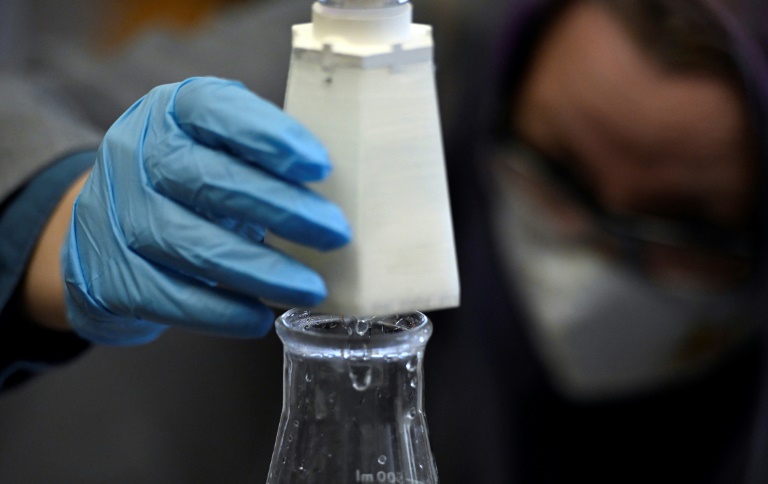
US high schoolers design low-cost filter to remove lead from water

When the pandemic forced schools into remote learning, Washington-area science teacher Rebecca Bushway set her students an ambitious task: design and build a low-cost lead filter that fixes to faucets and removes the toxic metal.

Using 3D printing and high-school level chemistry, the team now has a working prototype — a three-inch (7.5 centimeter) tall filter housing made of biodegradable plastic, which they hope to eventually bring to market for $1 apiece.

“The science is straightforward,” Bushway told AFP on a recent visit to the Barrie Middle and Upper School in suburban Maryland, where she demonstrated the filter in action. 

“I thought, ‘We have these 3D printers. What if we make something like this?'” 

Bushway has presented the prototype at four conferences, including the prestigious spring meeting of the American Chemistry Society, and plans to move forward with a paper in a peer-reviewed journal.

Up to 10 million US homes still receive water through lead pipes, with exposure particularly harmful during childhood. 

The metal, which evades a key defense of the body known as the blood-brain-barrier, can cause permanent loss of cognitive abilities and contribute to psychological problems that aggravate enduring cycles of poverty.

A serious contamination problem uncovered in Flint, Michigan in 2014 is perhaps the most famous recent disaster — but lead poisoning is widespread and disproportionately impacts African Americans and other minorities, explained Barrie team member Nia Frederick.

“And I think that’s something we can help with,” she said.

The harms of lead poisoning have been known for decades, but lobbying by the lead industry prevented meaningful action until recent decades.

President Joe Biden’s administration has pledged billions of dollars from an infrastructure law to fund the removal of all the nation’s lead pipes over the coming years — but until that happens, people need solutions now.

– A clever trick – 

Bushway’s idea was to use the same chemical reaction used to restore contaminated soil: the exposure of dissolved lead to calcium phosphate powder produces a solid lead phosphate that stays inside the filter, along with harmless free calcium.

The filter has a clever trick up its sleeve: under the calcium phosphate, there’s a reservoir of a chemical called potassium iodide. 

When the calcium phosphate is used up, dissolved lead will react with potassium iodide, turning the water yellow – a sign it is time to replace the filter.

Student Wathon Maung spent months designing the housing on 3D printing software, going through many prototypes.

“What’s great about it was that it’s kind of this little puzzle that I had to figure out,” he said. 

Calcium phosphate was clumping inside the filter, slowing the reaction. But Maung found that by incorporating hexagonal bevels he could ensure the flow of water and prevent clumping. 

The result is a flow rate of two gallons (nine liters) per minute, the normal rate at which water flows out a tap.

Next, the Barrie team would like to incorporate an instrument called a spectrophotometer that will detect the yellowing of the water even before it is visible to the human eye and then turn on a little LED warning light.

Paul Frail, a chemical engineer who was not involved in the work, said the group “deserves an incredible amount of credit” for its work, combining general chemistry concepts with 3D printing to design a novel product.

He added, however, that the filter would need further testing with ion chromatography instruments that are generally available in universities or research labs — as well as market research to determine the demand.

Bushway is confident there is a niche. Reverse osmosis systems that fulfill the same role cost hundreds to thousands of dollars, while carbon block filters available for around $20 have to be replaced every few months, which is more often than her group’s filter.

“I am over-the-Moon proud of these students,” Bushway said, adding that the group hoped to work with partners to finalize the design and produce it at scale.

Kharkiv digs in against a new Russian assault

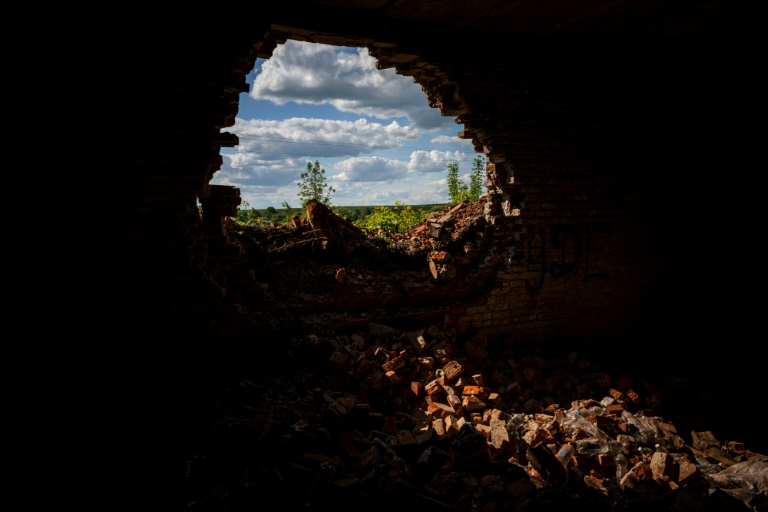
New trenches, concrete blocks, sandbags and numerous checkpoints appear to be everywhere around Kharkiv, which has pushed back one Russian assault on Ukraine’s second city, and is preparing to defend against another.

A pink stuffed toy marks the entrance to one freshly dug trench in the regional capital.

The cut earth is still soft and black and the soldiers are down to their vests, soaking up the sun.

Tensions have eased in this northeastern corner of Ukraine, but Kharkiv, just 50 kilometres (30 miles) from the Russian border, remains under permanent threat, and a second line of defence has been organised behind the first.

“When we were here on the 24th of February there were no positions at all,” says “Doctor”, a medic with the National Guard, referring to the day the Russian invaded. 

“Our warriors were laying by the road behind hills and were shooting, we had fire contacts,” he explains.

“But now when we have trenches, we have well protected zones, so for them, it would be impossibly hard to capture (this position), adds the nurse who agreed to give a guided tour of just a few dozen metres of the site, which falls under military secrecy rules.

Nearby stands a car daubed with the inscription “Skill to kill”.

Directly to the east of Kharkiv, a recently built trench runs from a house that was bombed and burnt out during the first Russian attack.

The trench line heads off to the south in a zigzag intended to limit the destruction a shell would cause.

The fortifications double back like a maze, which the army refuses to allow reporters to visit. Further down, bunker positions can nonetheless be seen, built up higher on concrete blocks.

Wooden crates line the ground so people can walk around without sinking into the mud when it rains.

“Now our armed forces of Ukraine are in counter-offensive, repelling the enemy from our own territories,” Doctor says in English.

“Sometimes we could be under the shelling as well, but we are here and do not let anybody capture the city.”

– ‘We have a problem’ –

Kharkiv lies well within the Russians’ range, and every night shells hit the town where the remaining population has learned to live with the boom of artillery from both sides.

One woman, who has lived in the city’s metro since the fighting started, says Ukraine is waiting for Western aid to arrive, and particularly “American armaments which will help us win” the war.

On the roads leading out of the city — some of which have been closed off — men and women civilians help soldiers to fill sandbags for the checkpoints.

“We have a problem, we are at war,” jokes a soldier as he checks a vehicle and turns it back.

“Doctor”, who is a nurse, voices confidence the Russians will not be in the region much longer.

“They use drones to see our position,” he says.

“We know where they are, and our armed forces know where they are and very soon, they will not be there where they are now.”

And yet, he knows there may be plenty more fighting to do.

They have been holding the position for nearly three months, he points out.

“Everyone is ready, we all have fighting spirit,” which he knows from talking to people every day, he says.

“Nobody is going to run or retreat. We are the national guards, and we are going to hold our place and our city till the end.”

Court ruling leaves migrants in limbo at Mexican-US border

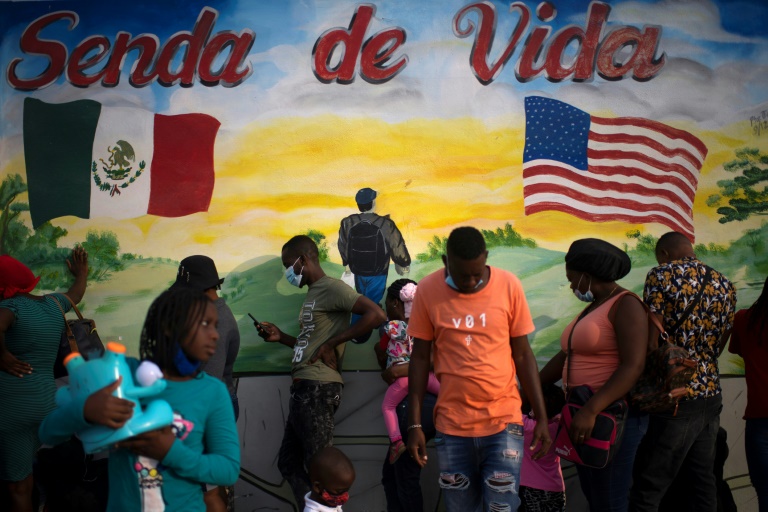
Asylum seekers in the dusty, violence-plagued Mexican border city of Reynosa were back to playing an uncertain waiting game Saturday, their dreams of entering the United States frustrated anew by a health rule imposed during the Covid-19 pandemic.

“They say they’re going to open the border today. Do you think that’s true?” asked Michelle, a 26-year-old Haitian who had come to the pedestrian bridge crossing the Rio Grande hoping for good news.

She was left disappointed, however.

A federal judge ruled Friday that the rule known as Title 42 — meant to stem the spread of Covid, it can effectively prevent anyone without a visa from entering the United States, even to claim asylum — must remain in effect.

Using social media, migrants in Reynosa have followed the legal showdown between the White House, which wants to lift the rule, and Republican governors of more than 20 states, who argue that relaxing it would spur a huge and inadequately controlled influx of migrants.

On Friday, Judge Robert Summerhays issued an injunction siding with those Republican-led states in support of the rule, first imposed under President Donald Trump.

“The Plaintiff States contend that the Termination Order will result in a surge of border crossings, and that this surge will result in an increase in illegal immigrants residing in the states,” the ruling said.

“The court finds that the plaintiff states have satisfied each of the requirements for a preliminary injunction.” 

The White House said it would abide by the ruling, but that the Department of Justice would appeal.

“The authority to set public health policy nationally should rest with the Centers for Disease Control, not with a single district court,” a statement said.

– Uncertainty, confusion –

Reynosa, across the border from the Texan city of McAllen, lies in one of Mexico’s most violent regions and has been shaken by turf wars between rival drug cartels in recent years.

Last year the medical aid group Doctors Without Borders (MSF) warned that migrants deported to Reynosa under Title 42 were at risk of kidnapping and violence.

Those stranded in the Mexican city face a host of additional concerns, including housing, healthcare, food and their children’s well-being.

Lifting Title 42 would have a sting in the tail. Migrants deported to Mexico under its terms can now try to enter the United States as many times as they want. But if deported to their home country, they would face another long and potentially dangerous journey back to the border.

“If they lift it (Title 42), the United States will deport more people. It’s better for us that they extend it,” said Sarah Jimenez, from the Dominican Republic, who is traveling with her Haitian husband.

“There’s a lot of uncertainty and little official information,” said Anayeli Flores, an aid worker with MSF. “People are confused.

Meantime, migrants keep flowing into Reynosa.

In early May, the authorities moved nearly 2,000 of them, including women and children, out of a square in the city center where they had camped for months.

Some sleep on the streets, while the more fortunate rent apartments for 1,500 to 2,000 pesos a month ($75 to $100).

“My wife wanted to go home. Not me, because as soon as you cross the river, it’s glory — the dream of many, not just me,” said a Honduran migrant.

Pastor Hector Silva runs a shelter, but it is now out of room, and with migrants continuing to arrive, frustration levels are growing. 

“You have to do your part, too,” he told a group of migrants. 

“You have to go find a job, you have to find a home for your wife, to protect your child from the sun.”

Biden, Yoon signal expanded military drills due to N. Korea 'threat'

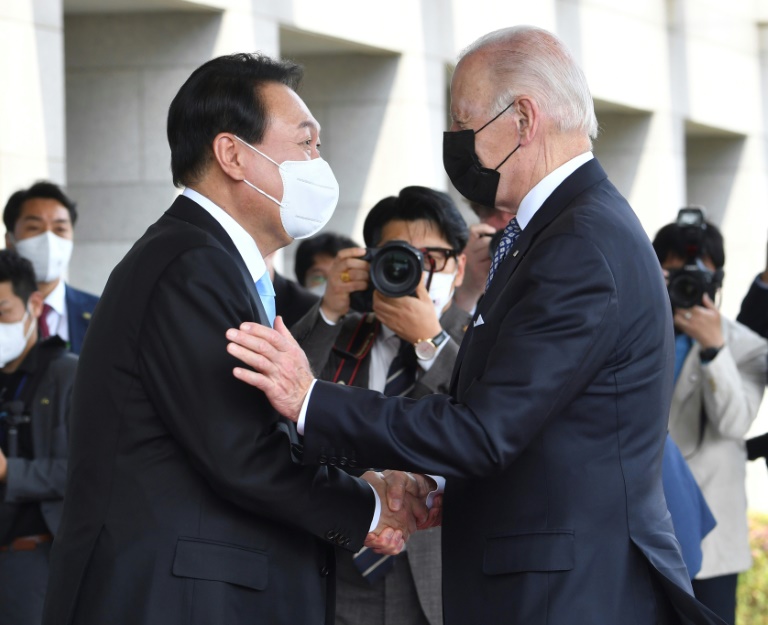
US President Joe Biden and South Korea’s new President Yoon Suk-yeol signalled Saturday an expanded military presence in response to the “threat” from North Korea, while also offering to help the isolated regime face a Covid-19 outbreak.

After meeting in Seoul on Biden’s first trip to Asia as president, the two leaders said in a statement that “considering the evolving threat posed by” North Korea, they “agree to initiate discussions to expand the scope and scale of combined military exercises and training on and around the Korean peninsula”.

The possible beefing up of joint exercises comes in response to North Korea’s growing belligerance, with a blitz of sanctions-busting weapons tests this year as fears grow that Kim Jong Un will order a nuclear test while Biden is in Asia.

Biden and Yoon also extended an offer of help to Pyongyang, which has recently announced it is in the midst of a Covid-19 outbreak, a rare admission of internal troubles.

The US-South Korea statement said the two presidents “express concern over the recent Covid-19 outbreak” and “are willing to work with the international community to provide assistance” to North Korea to help fight the virus.

On Saturday, North Korean state media reported nearly 2.5 million people had been sick with “fever” with 66 deaths as the country “intensified” its anti-epidemic campaign.

Biden, while adding that he would not exclude a meeting with Kim if he were “sincere”, indicated the difficulty of dealing with the unpredictable dictator.

“We’ve offered vaccines, not only to North Korea but to China as well and we’re prepared to do that immediately,” Biden said at a press conference with Yoon. “We’ve got no response.”

For his part, Yoon stressed that the offer of Covid aid was according to “humanitarian principles, separate from political and military issues”.

Elected on a strongly pro-US message, Yoon emphasised the need to reinforce South Korea’s defences.

According to Yoon, he and Biden “discussed whether we’d need to come up with various types of joint drills to prepare for a nuclear attack”.

Talks are also ongoing on ways to “coordinate with the US on the timely deployment of strategic assets when needed”, he said, reaffirming commitment to North Korea’s “complete denuclearization”.

The strategic assets should include “fighter jets and missiles in a departure from the past when we only thought about the nuclear umbrella for deterrence”, he said.

Any such deployments, or a ramping up of US-South Korea joint military exercises, is likely to enrage Pyongyang, which views the drills as rehearsals for invasion.

– Biden-Yoon ‘personal relationship’ –

Biden began his day by paying respects at Seoul National Cemetery, where soldiers killed defending South Korea, including many who fought alongside US troops in the Korean War, are buried.

He then held closed-door talks with Yoon ahead of the joint press conference and a state dinner.

A US official said that in addition to tensions over North Korea and the US-led campaign to punish Russia for invading Ukraine, Biden’s main focus Saturday was establishing “a strong personal relationship” with Yoon, who is less than two weeks into his presidency.

Like Japan, where Biden flies on Sunday, South Korea is seen as a key player in US strategy to contain China and maintain what Washington calls the “free and open Indo-Pacific”.

Biden’s Asia trip “is about demonstrating unity and resolve and strengthening the coordination between our closest allies”, a senior US official told reporters on condition of anonymity. 

In Japan, Biden will meet with Prime Minister Fumio Kishida and the emperor.

On Monday, he will unveil a major new US initiative for regional trade, the Indo-Pacific Economic Framework for Prosperity. A day later, he will join a regional summit of the Quad — a grouping of Australia, India, Japan and the United States.

– Cutting-edge investments –

On arrival Friday in South Korea, Biden accompanied Yoon on a tour of a massive Samsung semiconductor factory.

The microchips are a vital component in almost every piece of sophisticated modern technology, and South Korea and the United States need to work to “keep our supply chains resilient, reliable and secure”, Biden said.

For the US leader, whose Democratic Party fears a possible trouncing in midterm elections in November, snarled supply chains are an acute domestic political challenge, with Americans increasingly frustrated over rising prices and setbacks in the post-Covid pandemic recovery.

Biden emphasised Samsung’s decision to build a new semiconductor plant in Texas, opening in 2024.

In the southern US state of Georgia, the governor on Friday announced that South Korean auto giant Hyundai will build a $5.5 billion plant to produce electric vehicles and batteries.

Ukraine warns only talks can end war as Russia cuts Finland gas

Ukraine’s President Volodymyr Zelensky warned Saturday that only a diplomatic breakthrough rather than an outright military victory could end Russia’s war on his country, as Moscow cut gas supplies to Finland.

“There are things that can only be reached at the negotiating table,” Zelensky said, just as Russia claimed its long-range missiles had destroyed a shipment of Western arms destined for Ukraine’s troops.

Zelensky also appealed for more military aid, even as US President Joe Biden formally signed off on a $40-billion package of aid for the Ukrainian war effort.  

And the Ukrainian leader insisted his war-ravaged country should be a full candidate to join the European Union, rejecting a suggestion from France’s President Emmanuel Macron and some other EU leaders that a sort of associated political community be created as a waiting zone for a membership bid.   

“We don’t need such compromises,” Zelensky said during a joint press conference with visiting Portuguese Prime Minister Antonio Costa. 

“Because, believe me, it will not be compromise with Ukraine in Europe, it will be another compromise between Europe and Russia. I am absolutely sure of that,” he warned.

After just over 12 weeks of fierce fighting, Ukrainian forces have halted Russian attempts to seize Kyiv and the northern city of Kharkiv, but are under renewed and intense pressure in the eastern Donbas region.

Moscow’s army have flattened and seized the southeastern port city of Mariupol and subjected Ukrainian troops and towns in the east to a remorseless ground and artillery attacks.

Zelensky’s Western allies have shipped modern weaponry to his forces and imposed sweeping sanctions on the Russian economy and President Vladimir Putin’s inner circle.  

But the Kremlin has responded by disrupting European energy supplies, and on Saturday cut off gas shipments to Finland, which angered Moscow by applying to join the NATO alliance. 

– ‘It will be bloody’ –

Against this backdrop, Zelensky told Ukrainian television the war would end “through diplomacy”.

The conflict, he warned, “will be bloody, there will be fighting but will only definitively end through diplomacy” — promising only that the result would be “fair” for Ukraine.

“Discussions between Ukraine and Russia will decidedly take place. Under what format I don’t know — with intermediaries, without them, in a broader group, at presidential level,” he said.

In order to side-step financial sanctions and force European energy clients to prop up his central bank, Putin has demanded that importers from “unfriendly countries” pay for gas in rubles.

Russian energy giant Gazprom said it had halted supplies to neighbouring Finland as it had not received ruble payments from Finland’s state-owned energy company Gasum by the end of Friday.

Gazprom supplied 1.49 billion cubic metres of natural gas to Finland in 2021, about two thirds of the country’s gas consumption but only eight percent of its total energy use. 

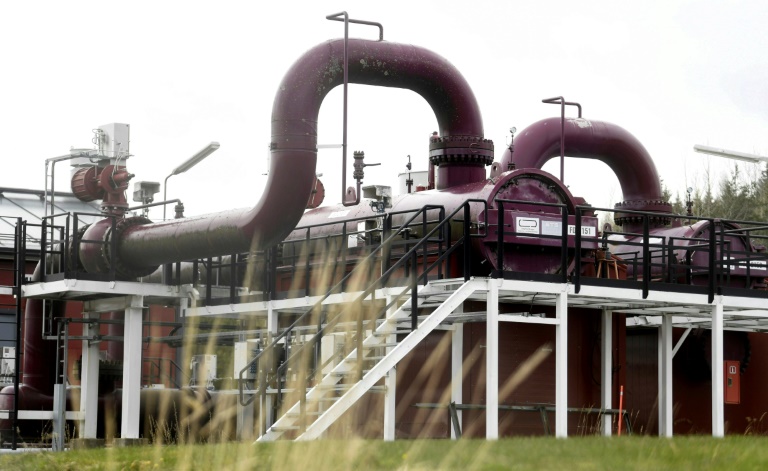
Gasum said it would make up for the shortfall from other sources, through the Balticconnector pipeline, which links Finland to Estonia, a fellow European Union member.

Moscow cut off gas to Poland and Bulgaria last month in a move the European Union described as “blackmail”, but importers in some other EU countries more dependent on Russian gas plan to open ruble accounts with Gazprom’s bank.

Finland and neighbouring Sweden this week broke their historical military non-alignment and applied to join NATO, after public support for the alliance soared following Russia’s invasion of Ukraine.

– ‘Grave mistake’ –

Moscow has warned Finland that joining NATO would be “a grave mistake with far-reaching consequences” and Defence Minister Sergei Shoigu said it would respond by building military bases in western Russia.

But both Finland and Sweden are now apparently on the fast track to join the military alliance, with US President Joe Biden this week offering “full, total, complete backing” to their bids.

All 30 existing NATO members must agree on any new entrants, and Turkey has condemned Sweden’s alleged tolerance for the presence of exiled Kurdistan Workers’ Party (PKK) militants, but diplomats are confident of avoiding a veto.

Turkish President Recep Tayyip Erdogan urged Swedish and Finnish leaders to abandon financial and political support for what he called “terrorist” groups.

Erdogan told Swedish Prime Minister Magdalena Andersson that “Sweden’s political, financial and weapon support to terrorist organisations must end,” his office said. 

Russia’s foreign ministry on Saturday imposed travel bans on 26 Canadians “in response to the latest anti-Russian sanctions announced by Canadian authorities”.

Among the new additions is Sophie Trudeau, the wife of Canada’s Prime Minister Justin Trudeau.

Moscow has now imposed travel bans on 963 people, according to a foreign ministry list released Saturday, including Biden and Hollywood actor Morgan Freeman.

On the ground in Ukraine, the fighting is fiercest in the eastern region of Donbas, a Russian-speaking area that has been partially controlled by pro-Kremlin separatists since 2014.

In Severodonetsk, a frontline city now at risk of encirclement, 12 people were killed and another 40 wounded by Russian shelling, the regional governor said.

And in the neighbouring Donetsk region, according to Ukraine’s interior ministry, Russian fire hit a church sheltering scores of civilians, including children and clergy. At least 60 people were rescued, and the final casualty toll was not immediately clear. 

– Dogged resistance –

The Russian defence ministry, meanwhile, claimed it had destroyed a large shipment of US and European weapons in a long-range missile strike targeting the Malin railway station west of Kyiv in the Zhytomyr region. 

There was no Ukrainian or independent confirmation of the success of the strike. 

On Friday, Moscow said the battle for the Azovstal steelworks in Mariupol — a symbol of Ukraine’s dogged resistance since Putin launched the invasion on February 24 — was now over.

Russian defence ministry spokesman Igor Konashenko said 2,439 Ukrainian personnel had surrendered at the steelworks since May 16, the final 500 on Friday.

Ukraine hopes to exchange the surrendering Azovstal soldiers for Russian prisoners. But in Donetsk, pro-Kremlin authorities are threatening to put some of them on trial. 

Biden has cast the Ukraine war as part of a US-led struggle pitting democracy against authoritarianism.

The US Congress this week approved a $40-billion (38-billion-euro) aid package, including funds to enhance Ukraine’s armoured vehicle fleet and air defence system — and Biden signed it into law on Saturday.

burs-dc/ah

Russia targets Ukraine's last link to besieged east

The wounded coal miner peered through his shrapnel-splayed windshield and tried to ignore the flopping noises coming from his blown tyres as he drove along Ukraine’s last link with the besieged east.

The cars around him had just screeched to a halt because of a sudden burst of fire from somewhere in the overhanging forest.

But Sergiy Tokarev seemed impervious to the danger after being shelled on his way back to the frontline village of Zolote to rescue his stranded neighbours.

The 60-year-old ended up turning his van around and spending the night on an open road that has turned into the latest target of Russian forces advancing from the east.

White smoke from burning fields shrouded the debris of charred buildings smouldering behind him.

Tokarev glanced out his window and grumbled about the headache he will have finding new tyres nearly three months into Russia’s invasion of its pro-Western neighbour.

“There are grandmothers and grandfathers stranded back there,” he said, edging his van down the road at a crawl.

His dented and screeching wheel rims looked long past the point at which they should have fallen off.

His right thigh was bandaged after being grazed by shrapnel that came flying at him on the outskirts of his hometown.

“If I am fated to die here, I will die here,” the coal miner shrugged.

“But if not, I will keep pulling people out.”

– ‘They are here’ –

A bumpy road running through fields filled with sunflowers and hamlets has turned into one of the most important fronts of the entire war.

Ukraine’s outgunned forces have been trying to keep the Russians from encircling the once-bustling cities of Lysychansk and Severodonetsk at the road’s northeastern end.

The two ruined coal and chemical manufacturing centres form the last pocket of Ukrainian resistance in the smaller of the two regions comprising the Donbas war zone.

The road slowly pursued by Tokarev in his battered van has become the last means for Ukraine to send in reinforcements — and for rescuers to pull stranded civilians out.

Russia is now trying and cut it off about 50 kilometres (30 miles) southwest of Lysychansk by first pounding it with artillery and then moving in with force.

Ruffled mounds of black earth expose spots where Russian shells have smashed into sides of the two-lane route.

Lightly armed Ukrainian soldiers try to shield themselves in dune-like reinforcements erected in ditches and ravines.

Buildings housing troops and equipment burn from precision strikes launched from invisible positions.

“They have reached us,” a soldier who uses the nom de guerre Tadzhik said near the twisted body of one of his fallen comrades in arms.

“We can’t see them but they are here.”

– Last road out –

The road’s importance could not be greater for construction worker Dmytro Mosur.

The 32-year-old had his twin toddlers in his arms and tears in his eyes after losing his wife in one of the ceaseless shellings engulfing Severodonetsk.

He now stood on an exposed square in Lysychansk waiting to learn if rumours that rescuers could take him and his daughters out to safer ground were true.

“I thought something like this might happen,” Mosur said of the day his wife died after briefly leaving her bunker to cook a meal over an open flame in the yard.

Neither city has gas or power and up to 20,000 of each one’s original 100,000 residents spend most of their time hiding underground.

Those who step outside in Severodonetsk to tend to wood-fired stoves brave artillery battles raging across northern and eastern stretches of the ghost city.

“We discussed leaving earlier but I was unable to convince her. We even got into a fight over it,” the father said.

“As soon as this tragedy struck, I immediately decide to get out. I had no more doubts.”

– Staying behind –

Natalia Ryazantseva also has no doubts.

The 57-year-old businesswoman watched her daughter move to the French Riviera and her son settle in Poland when the east became engulfed by an eight-year insurgency that the Kremlin backed prior to its invasion.

Both panicked after Ryazantseva told them how she barely escaped with her life from a shell that smashed through her bedroom ceiling earlier this month.

“They told me to leave immediately,” she said cheerfully in the rose garden of a detached home on the leafy edge of Lysychansk.

The whistles of artillery fire seemed distant and Ryazantseva appeared relaxed while describing the pain of life without electricity or running water.

“How can I leave?” she asked. “We are old people now. At my age, a woman wants the quiet and comfort of her own home. So we decided to stay.”

Albanese claims victory as Australian right falls to climate backlash

Centre-left leader Anthony Albanese claimed victory in Australia’s general election Saturday, as voters angered by climate inaction pulled the plug on a decade of conservative rule.

“The Australian people have voted for change” said the 59-year-old Labor leader, promising a less pugilistic form of leadership and a raft of reforms to make the country fairer and greener.

With almost two-thirds of the votes counted, Albanese was set to lead the largest party in parliament, but had yet to secure an outright majority.

The election was a stinging rebuke for Prime Minister Scott Morrison, who admitted it was a “difficult” and “humbling” night for his conservative coalition.

His Liberals lost seats to Labor across the country, but they suffered the most painful defeat at the hands of climate-focused independent candidates in a string of once ultra-safe conservative urban seats.

The so-called “teals” — mostly women — ran on pro-environment, anti-corruption and pro-gender equality tickets.

“What we have achieved here is extraordinary,” said Zoe Daniels, an independent who claimed victory in a once safe Liberal seat in Melbourne. 

The teals tapped into deep seated anger in wealthy suburbs of Sydney and Melbourne at Morrison’s unbridled support for the coal industry, despite three years of climate-worsened bushfires, drought and floods that upended life for millions.

Treasurer Josh Frydenberg was in danger of becoming their biggest scalp — all but conceding as his seat in Melbourne was projected to fall to teal independent Monique Ryan.

– ‘Fires and floods’ –

“People are saying the climate crisis is something they want action on,” said an elated Australian Greens leader Adam Bandt.

“We have just had three years of drought, and then fires and now floods and then floods again. And people can see it, that this is happening and it’s unfolding.”

Albanese has vowed to end Australia’s “climate wars”, adopt more ambitious emissions targets, introduce a federal corruption watchdog and extend to indigenous people a constitutional right to be heard on national policy-making.

He vowed to transform the country a renewable energy “superpower”.

But he has refused calls to phase out coal use, or to block the opening of new coal mines.

He may now have to cut deals with independents demanding deeper commitments that would risk the ire of the pro-coal and mining union factions of his party.

Albanese said he was “humbled” by victory.

Official projections indicated Labor had won 72 of the 76 seats it needs for a majority. With many votes still to be counted, it could yet secure a majority on its own.

“It says a lot about our great country that that a son of a single mum who was a disability pensioner, who grew up in public housing… can stand before you tonight as prime minister,” Albanese said.

“My mother dreamt of a better life for me. And I hope that my journey in life inspires Australians to reach for the stars,” Albanese said, before trying to calm some of his more exuberant fans.

“I didn’t think we’d get here tonight,” said Joan O’Donnell, a Labor member for 21 years, embracing her fellow branch members. 

“The right wing has had power for too long.”

– ‘Fair dinkum’ –

Earlier Saturday, Albanese asked voters to give his centre-left party a “crack” at running the country, and urged people to spurn a “divisive” prime minister.

Australians “want someone who is fair dinkum, someone who will ‘fess up if they make a mistake,” said the Labor leader.

Albanese often notes he would be the first Australian with a non-Anglo or Celtic surname to be prime minister.

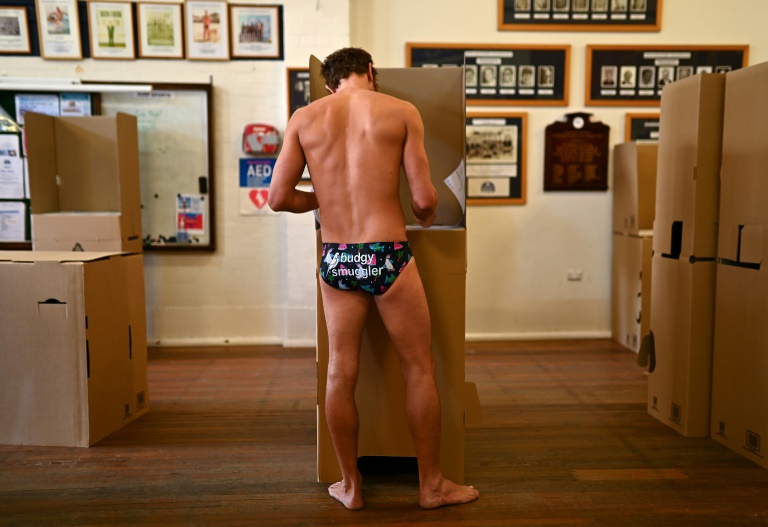
Voting in Australia  is compulsory, enforced with a Aus$20 (US$14) fine but also rewarded at many booths that fired up barbecues to offer people a “democracy sausage”.

The election decides who controls the House of Representatives, the Senate and who lives in the prime minister’s “Lodge”.

One killed in Germany storm

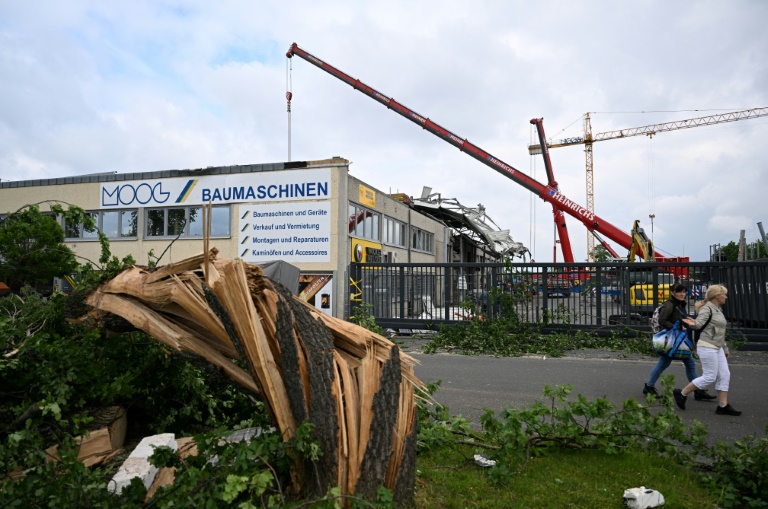
A storm that swept through western Germany on Friday has killed at least one person and injured dozens, local authorities said Saturday.

In Rhineland-Palatinate state, a 38-year-old man died after he was electrocuted when he entered his flooded basement, the police in the city of Koblenz said.

In North Rhine-Westphalia state, authorities said a “tornado” wrecked the city of Paderborn, injuring 43 people, including 13 seriously, the city’s mayor said Saturday.

Images posted on social media showed the tornado column progressing towards homes, sweeping away trees and parts of buildings.

Police estimated the damage caused by the tornado at “several million” euros.

The storm followed abnormally high temperatures for the time of year.

Thousands mark late Yugoslav leader Tito's birth anniversary

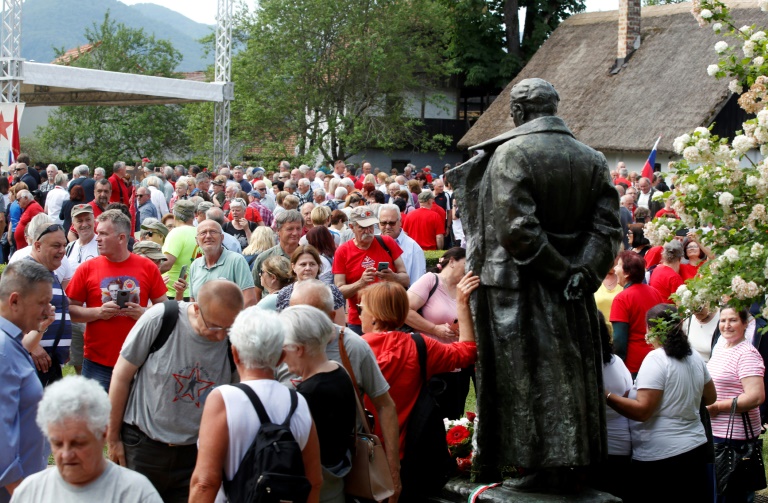
Several thousand fans of former Yugoslav leader Josip Broz Tito marked the 130th anniversary of his birth on Saturday in the Croatian village where he was born.

Admirers of the late communist leader gathered in front of the house where he was born in 1892, now a museum in Kumrovec, northern Croatia

They had come from all over the former Yugoslav federation to celebrate Tito’s achievements, notably leading the partisan fighters who drove out the Nazi German occupying forces in World War II, standing up to Soviet leader Joseph Stalin and founding the Non-Aligned Movement.

“The reason (for gathering) is the remembrance, not only of the past, but of the time in which we lived both richer and safer,” said Jovan Vejnovic, head of an association of Tito supporters.

Many of Tito’s admirers waved former Yugoslavia flags and were dressed in T-shirts bearing the former leader’s image.

Tito ruled Yugoslavia from the end of WWII until his death in 1980.

A decade later, the federation collapsed in a series of bloody wars that claimed more than 100,000 lives.

Under Tito’s rule, Yugoslavia remained independent of the then Soviet Union and became one of the most prosperous communist nations.

Tito remains a controversial figure in the countries that emerged after Yugoslavia’s collapse — Bosnia and Herzegovnia, Croatia, Kosovo, Macedonia, Montenegro, Serbia and Slovenia — adored by some but considered a dictator by others.

Close Bitnami banner
Bitnami