World

Counting begins in Australia's nail-biter election

The first polls closed and counting was under way on Saturday in Australia’s fiercely fought national election that could end a decade of unbroken conservative rule.

Election frontrunner Anthony Albanese asked voters to give his centre-left party a “crack” at running the country, and urged people to spurn “divisive” Prime Minister Scott Morrison.

Albanese, the 59-year-old Labor Party leader, said he was “very positive” about the outcome as Australians went to the polls in their millions.

The long and often bitter campaign has focused on the character of the two leaders, with policy largely put on the back burner.

Morrison — behind in the pre-election polls — has been buoyed by a resurgent post-lockdown economy and a 48-year-low jobless rate.

He has painted his rival as a “loose unit” who is unfit to steer the economy, but has been plagued by low personal approval ratings, accusations of dishonesty and of putting spin before substance.

Albanese — who himself has been described as bland and uninspiring — focused heavily on Morrison’s alleged failings in the final days of the campaign.

Australians “want someone who is fair dinkum, someone who will ‘fess up if they make a mistake” said the Labor leader.

After three years marked by punishing bushfires, drought, floods and the pandemic, Morrison will have to beat the odds to emerge victorious.

The 54-year-old has not led in the polls for months, and entered election day with a duo of surveys putting his Liberal National Party coalition six points behind Labor, well outside the margin of error.

Young Australians are increasingly angry at the government’s pro-coal policies and a housing market that is largely out of reach.

“I grew up in a community that’s been really heavily affected by the fires and the floods over the past five years,” first-time voter Jordan Neville said in Melbourne.

“To see something be done about that and stop that happening again would be amazing.”

But Morrison has defied the pundits before. Three years ago he was behind in the polls but emerged with what he himself called a “miracle election win”.

This time, though, the gap is a little wider.

– ‘We have plans’ –

“I believe we have the wind at our back, and I’m very positive about a good outcome,” Albanese said after casting his vote at a town hall in the Sydney suburb of Marrickville with his son Nathan, partner Jodie Haydon and pet dog Toto.

“I’m in it to change the country and that’s what I intend to do,” he said.

Albanese has pledged to end Australia’s foot-dragging on climate change, help people struggling with soaring prices, and hold a referendum on giving indigenous people an institutional voice in national policymaking. 

“Give Labor a crack. We have plans for this country,” Albanese said as the day began.

Speaking in Adelaide during a four-state election-eve blitz, Albanese welled up as he reflected on his personal journey — from the son of a single mum living in Sydney public housing to the threshold of the highest office in the land.

“It says a lot about this country,” he said Friday, voice cracking with emotion. “That someone from those beginnings… can stand before you today, hoping to be elected prime minister of this country tomorrow.”

If elected, Albanese notes he would be the first Australian with a non-Anglo or Celtic surname to be prime minister.

Voting is compulsory, enforced with a Aus$20 (US$14) fine but also rewarded at many booths that fired up barbecues to offer people a “democracy sausage”.

The election will decide who controls the House of Representatives, the Senate and who lives in the prime minister’s “Lodge”.

More than seven million people cast early or postal ballots, according to the Australian Electoral Commission, almost half the electorate.

– ‘Humility’ –

Children greeted Morrison excitedly as he arrived with his wife and two daughters to cast a vote at a school in Sydney’s Lilli Pilli suburb.

Asked how he wanted to be remembered if he lost the election, the prime minister told reporters: “That will be for others to determine.”

Morrison said he approached his job with a “great sense of humility” and respect for Australians “and that is the same spirit in which I continue to seek to do their job.”

On Saturday his party launched a last gasp bid to win votes by mass-messaging voters in several election battlegrounds with news that an “illegal boat” had been from Sri Lanka had been intercepted on its way to Australia.

Labor called the move “desperate and shameless”.

Both sides are trying to woo voters fretting about the rising cost of living, with annual inflation shooting up to 5.1 percent and wages failing to keep up in real terms.

– ‘Least fair-dinkum’ –

In wealthy suburban areas, many voters are being wooed by a band of more than 20 independent candidates, mostly women, offering conservative policies coupled with strong action on climate change.

Morrison has resisted calls to cut carbon emissions faster by 2030 and supports mining and burning coal into the distant future to boost the economy.

Albanese has also promised action on corruption — after Morrison failed to deliver a promised federal anti-graft watchdog. 

An Ipsos poll released late Thursday and a YouGov/Newspoll released Friday gave Labor a 53-47 percent lead over the coalition on a two-party preferred basis.
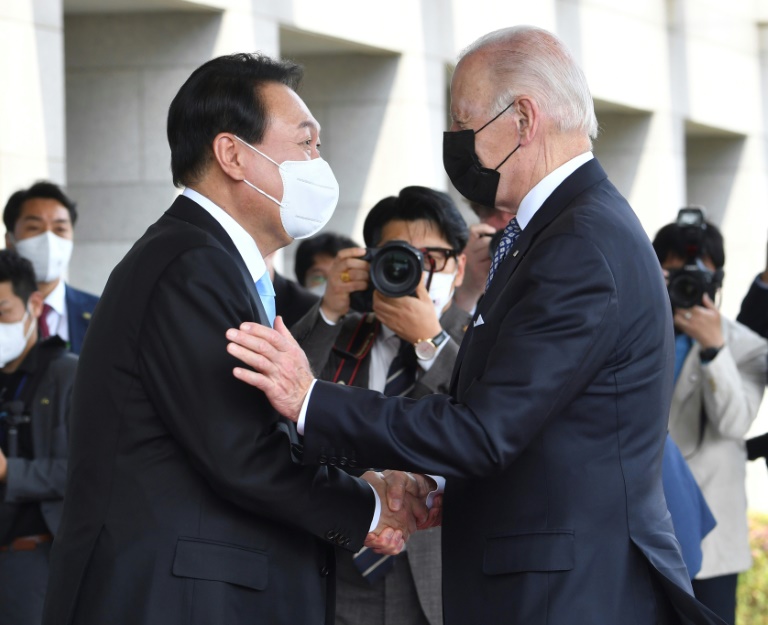

Biden, Yoon consider ramping up military drills in response to N. Korea threat

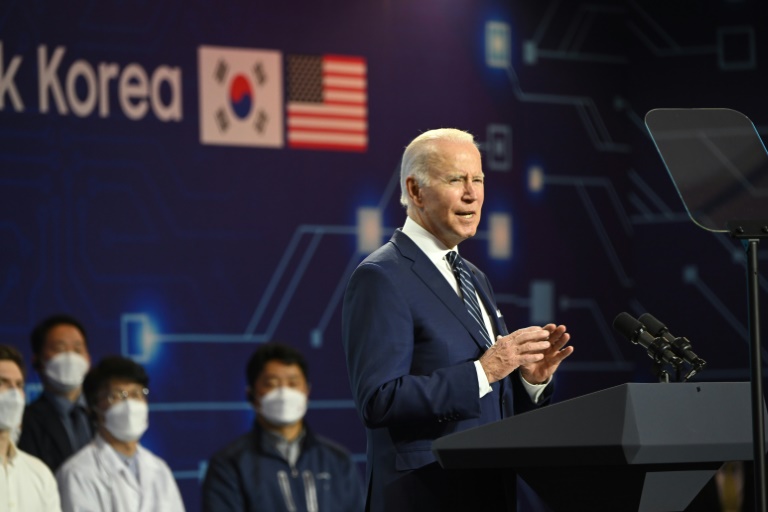
US President Joe Biden and South Korea’s newly sworn-in President Yoon Suk-yeol said Saturday they will consider stepping up joint military exercises in response to the “threat” from North Korea, while also offering to help the isolated dictatorship face down a Covid-19 outbreak.

After meeting in Seoul on Biden’s first trip to Asia as president, the two leaders said in a statement that “considering the evolving threat posed by” North Korea, they “agree to initiate discussions to expand the scope and scale of combined military exercises and training on and around the Korean peninsula.”

Reaching out to Pyongyang, the statement said the two leaders also “express concern over the recent Covid-19 outbreak” there and “are willing to work with the international community to provide assistance” to North Korea to help fight the virus.

Yoon said the offer of Covid aid was being made according to “humanitarian principles, separate from political and military issues” with Pyongyang.

The two presidents are committed to North Korea’s “complete denuclerisation”, he said, adding that “nothing is more important than a strong deterrence against the North”.

Biden began his day by paying respects at Seoul National Cemetery, where soldiers killed defending South Korea, including many who fought alongside US troops in the Korean War, are buried.

He then held closed-door talks with Yoon ahead of a joint press conference and state dinner.

On Sunday, Biden travels to another key US ally, Japan.

A US official said that in addition to tensions over North Korea and the US-led campaign to punish Russia for invading Ukraine, Biden’s main focus Saturday was establishing “a strong personal relationship” with Yoon, who is less than two weeks into his presidency.

Like Japan, South Korea is seen as a key player in US strategy to contain China and maintain what Washington calls the “free and open Indo-Pacific”.

Biden’s Asia trip “is about demonstrating unity and resolve and strengthening the coordination between our closest allies”, the official told reporters on condition of anonymity. 

However, the visit is overshadowed by what the US official called “sabre-rattling” across the heavily fortified border in North Korea, which the White House believes might test either a nuclear-capable missile or explosive to take advantage of the high-profile moment.

– Cutting-edge investments –

On arrival Friday, Biden accompanied Yoon on a tour of a massive Samsung semiconductor factory. Relations between the two leaders “got off to a very good start,” the US official said, speaking on condition of anonymity.

Biden called the US-South Korean alliance “a linchpin of peace, stability and prosperity” and highlighted the Samsung plant’s role in maintaining the fragile global supply chain for semiconductors.

The chips are a vital component in almost every piece of sophisticated modern technology, and South Korea and the United States need to work to “keep our supply chains resilient, reliable and secure”, Biden said.

For the US leader, whose Democratic Party fears a possible trouncing in midterm elections in November, snarled supply chains are an acute domestic political challenge, with Americans increasingly frustrated over rising prices and setbacks in the post-Covid pandemic recovery.

Biden emphasised Samsung’s decision to build a new semiconductor plant in Texas, opening in 2024.

In the southern US state of Georgia, the governor on Friday announced that South Korean auto giant Hyundai will build a $5.5 billion plant to produce electric vehicles and batteries — another big priority in Biden’s vision for putting cutting-edge technology at the heart of US industrial strategy.

– US leadership –

Adding to the uncertainty about what is happening in North Korea, the country has admitted it is going through a major outbreak of Covid-19.

On Saturday, North Korean state media reported nearly 2.5 million people had been sick with “fever” with 66 deaths as the country “intensified” its anti-epidemic campaign.

How that crisis might impact Kim Jong Un’s decision on nuclear tests is one of the many unknowns that US and South Korean officials are weighing.

Former CIA analyst Soo Kim told AFP that North Korea’s next step will help steer the US-South Korean relationship under Yoon.

“Should Kim proceed with a test during Biden’s visit, he will effectively be helping the two countries find greater justification to work together on the North Korea issue,” she said.

In Japan, Biden will meet with Prime Minister Fumio Kishida and the emperor.

On Monday, he will unveil a major new US initiative for regional trade, the Indo-Pacific Economic Framework for Prosperity. A day later, he will join a regional summit of the Quad — a grouping of Australia, India, Japan and the United States.

Sicily judge to weigh trial of migrant rescue NGOs

Charities running migrant rescue ships in the Mediterranean face a pre-trial hearing in Sicily Saturday over alleged collusion with people traffickers after a controversial probe that involved mass wiretapping.

Twenty-one suspects, including crew members of Doctors Without Borders (MSF), Save the Children and German NGO Jugend Rettet rescue ships, are accused of “aiding and abetting unauthorised entry into Italy” in 2016 and 2017.

“Our crews rescued over 14,000 people in distress from unseaworthy and overcrowded boats… and are now facing 20 years in prison,” Kathrin Schmidt, who sailed with Jugend Rettet’s ship Iuventa, said ahead of the hearing.

Trapani judge Samuele Corso must rule whether or not to proceed to trial after a five-year investigation mired in controversy for the mass wiretapping of charity workers, lawyers and journalists in what critics say is a politically-motivated bid to stop sea rescues.

Italy has long been on the front line of seaborne migration from Africa to Europe, with a record 180,000 arrivals in 2016, dropping to 120,000 in 2017.

It has registered some 17,000 arrivals so far this year, according to the interior ministry.

Prosecutor Brunella Sardoni told AFP she expected the preliminary hearings process to last “several months, considering the complexity” of a case file with some 30,000 pages and hundreds of CDs.

The charities are accused of coordinating their actions with smugglers just off Libya, returning inflatable dinghies and boats to them to be reused, and picking up people whose lives had not been in danger.

– ‘World’s deadliest’ crossing –

The rescuers say anyone attempting the Central Mediterranean crossing to Europe — the “world’s deadliest” according to the UN — on rickety boats or unseaworthy dinghies is at risk, and should be saved.

At least 12,000 people have drowned on this route since 2014. Many shipwrecks go unrecorded.

The charities also deny ever communicating with smugglers, who are sometimes armed and can be spotted loitering near rescues in the hope of retrieving valuable engines from migrant boats.

Save the Children told AFP it “strongly rejects” the accusations, as did MSF, which slammed a “period of criminalisation of humanitarian aid” it hoped would soon end.

The Iuventa was impounded in 2017 shortly after Jugend Rettet and others refused to sign a new and contentious interior ministry “code of conduct” accord, and as the European Union scaled up surveillance and policing in the Mediterranean.

“Despite the fact that mobile phones and computers were seized and analysed, not a single contact with Libyan smugglers… has been found,” said Nicola Canestrini, lawyer for the Iuventa crew members.

Pre-trial hearings are held behind closed doors, but representatives from the European Court of Human Rights (ECHR) and Amnesty International have requested the judge allow them to sit in for transparency.

ECHR senior legal advisor Allison West has condemned “improper investigative practices” in the investigation, led by a prosecutors’ office more used to exposing Mafia crimes.

– Ex-cop sent allegations –

The probe was launched after ex-policeman Pietro Gallo, working as a security contractor on Save the Children’s Vos Hestia ship, sent allegations against the charities in October 2016 to Italy’s secret services, Canestrini told AFP.

He and a fellow ex-policeman also sent them to the head of the anti-immigration League party, Matteo Salvini, before reporting their suspicions to the police.

Gallo has since said in an interview that he regrets it. Asked if he ever saw any contact between the charities and traffickers, he replied “no, never”.

The damage was done. Police placed an undercover agent on the Vos Hestia in May 2017, who would provide information including elements used to charge the four Iuventa crew members, Canestrini said. Those included alleged hand signals between the crew and smugglers.

Iuventa’s case has been studied by Forensic Architecture, an agency based at Goldsmiths, University of London, which uses advanced reconstruction techniques to investigate police, military and state facts.

It discredited the police theories for all three Iuventa rescues in question.

Russia says Mariupol battle at end as Ukrainian defenders surrender

Russia has declared victory in its months-long operation to capture the strategic port of Mariupol after Ukraine ordered the last of its troops holed up in the city’s Azovstal steelworks to lay down their arms.

Moscow’s flattening of Mariupol has drawn multiple accusations of war crimes, including over a deadly attack on a maternity ward, and Ukraine has begun a legal reckoning for captured Russian troops.

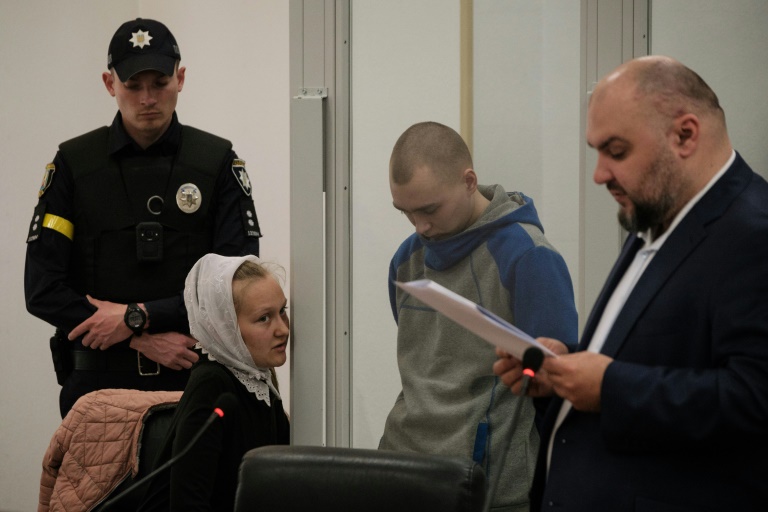
The first post-invasion trial of a Russian soldier for war crimes neared its climax in Kyiv on Friday, after 21-year-old sergeant Vadim Shishimarin admitted to killing an unarmed civilian early in the offensive. The verdict is due Monday.

Shishimarin told the court he was “truly sorry”. But his lawyer said in closing arguments that the young soldier was “not guilty” of premeditated murder and war crimes.

Since Ukrainian forces fended off the Russian offensive around Kyiv both eastern Ukraine and Mariupol in the south have borne the brunt of a remorseless ground and artillery attack.

The fighting is fiercest in the eastern region of Donbas, a Russian-speaking area that has been partially controlled by pro-Kremlin separatists since 2014.

“Attempts to attack Donbas continue. They completely ruined Rubizhne, Vonokvakha, just as Mariupol,” President Volodymyr Zelensky said in his nightly video address late Friday, adding the Russians were “trying to do the same with Severodonetsk and many other cities”.

In the eastern city of Severodonetsk, 12 people were killed and another 40 wounded by Russian shelling, the regional governor said.

– ‘End of the operation’ –

Zelensky described the bombardment of Severodonetsk as “brutal and absolutely pointless”, as residents cowering in basements described an unending ordeal of terror.

The city forms part of the last pocket of Ukrainian resistance in Lugansk, which along with the neighbouring region of Donetsk comprises the Donbas war zone.

Moscow on Friday said the battle for the Azovstal steelworks — a symbol of Ukraine’s dogged resistance since Russian President Vladimir Putin launched the invasion on February 24 — was now over.

Russian defence ministry spokesman Igor Konashenko said 2,439 Ukrainian personnel had surrendered at the steelworks since May 16, the final 500 on Friday.

Defence Minister Sergei Shoigu had informed Putin of “the end of the operation and the complete liberation of the (Azovstal) industrial complex and the city of Mariupol”, Konashenko added.

Ukraine hopes to exchange the surrendering Azovstal soldiers for Russian prisoners. But in Donetsk, pro-Kremlin authorities are threatening to put some of them on trial. 

In Washington, Pentagon spokesman John Kirby said all prisoners of war should “be treated in accordance with the Geneva Convention and the law of war”.

President Joe Biden has cast the Ukraine war as part of a US-led struggle pitting democracy against authoritarianism.

The US Congress this week approved a $40-billion (38-billion-euro) aid package, including funds to enhance Ukraine’s armoured vehicle fleet and air defence system.

And meeting in Germany, G7 industrialised nations pledged $19.8 billion to shore up Ukraine’s shattered public finances.

– Finland’s price –

The war’s economic repercussions continued to expand on Saturday, as Russia cut off its supply of natural gas to neighbouring Finland.

“Natural gas supplies to Finland under Gasum’s supply contract have been cut off,” Finnish state energy company Gasum said in a statement, adding that gas would instead be supplied from other sources via the Balticconnector pipeline, which connects Finland to Estonia.

Gasum a day earlier revealed the tap would be turned off when its contract with Russia’s Gazprom ended at 7:00 am (0400 GMT) Saturday.

The move, which Russia has blamed on the Nordic country’s refusal to pay in rubles, comes days after Finland and Sweden submitted a joint application for NATO membership. 

Moscow has repeatedly warned historically non-aligned Finland that applying for membership would be “a grave mistake with far-reaching consequences.” 

Both Finland and Sweden are seemingly on the fast track to joining the defence alliance, with Biden offering “full, total, complete backing” to their bids.

But all 30 existing NATO members must agree on any new entrants, and Turkey has condemned the Nordic neighbours’ alleged toleration of Kurdish militants.

Shoigu has said the Kremlin would respond to any NATO expansion by creating more military bases in western Russia.

Saturday’s halt to gas shipments follows Moscow cutting off Poland and Bulgaria last month in a move the EU described as “blackmail”.

– Underground living –

While the invasion that sparked the potential NATO expansion has ebbed around the northeastern city of Kharkiv, it remains in Russian artillery range, and hundreds of people are refusing to leave the relative safety of its metro system.

“We’re tired. You can see what home comforts that we have,” said Kateryna Talpa, 35, pointing to mattresses and sheets on the ground, and some food in a cardboard box.

She and her husband Yuriy are doing their best to cope in the Soviet-era station called “Heroes of Labour”, alongside their cats Marek and Sima.

“They got used to it,” Talpa said.

In the town of Lozova, at least eight people, including a child, were wounded Friday when a powerful Russian missile strike gutted a newly repaired cultural centre, the largest in the region.

Kharkiv regional governor Oleg Sinegubov said all eight had been struck by shrapnel after three Russian missiles had been fired towards the 1,000-capacity building.

burs-jit/wd/bgs/cwl/mtp

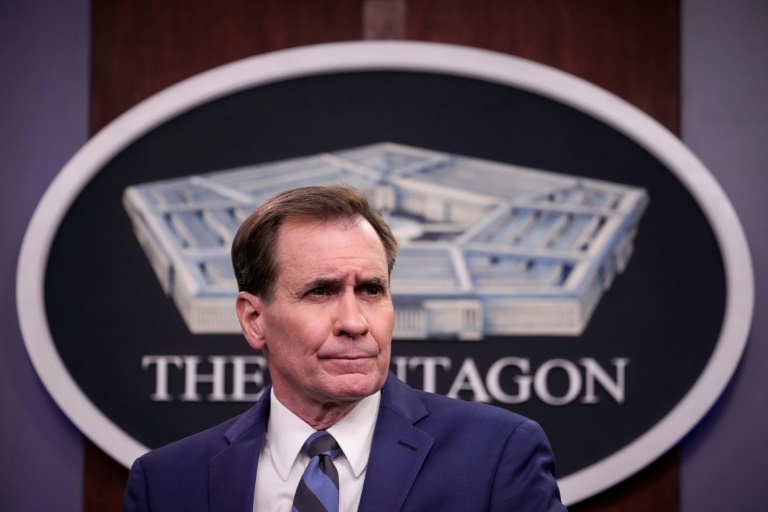
Pentagon spokesman Kirby named to White House post

US Pentagon press secretary John Kirby will join the National Security Council as coordinator for strategic communications, the Biden administration announced on Friday. 

A retired admiral, Kirby’s new role will see him “coordinate interagency efforts to explain United States policy and (serve) as a senior administration voice on related matters,” a White House statement said. 

“John understands the complexities of US foreign and defense policy, and he will ably represent the Administration on important national security issues,” President Joe Biden said in the statement.

Kirby is a veteran public affairs official, having served in various roles at the Pentagon and US State department, notably as the latter’s spokesperson during the Obama administration.  

He worked as a military and diplomatic affairs analyst on CNN during the presidency of Donald Trump.

Kirby has gained prominence within the Biden administration since Russia’s invasion of Ukraine in February, mainly due to his daily press briefings, which were broadcast live.

“There is simply no other communicator like him, anywhere,” his now former boss, US Defense Secretary Lloyd Austin, said in a statement.

The National Security Council advises the American president on foreign policy.

Russia says Mariupol battle at end as Ukrainian defenders surrender

Russia has declared victory in its months-long operation to capture the strategic port of Mariupol after Ukraine ordered the last of its troops holed up in the city’s Azovstal steelworks to lay down their arms.

Moscow’s flattening of Mariupol has drawn multiple accusations of war crimes, including over a deadly attack on a maternity ward, and Ukraine has begun a legal reckoning for captured Russian troops.

The first post-invasion trial of a Russian soldier for war crimes neared its climax in Kyiv on Friday, after 21-year-old sergeant Vadim Shishimarin admitted to killing an unarmed civilian early in the offensive. The verdict is due Monday.

Shishimarin told the court he was “truly sorry”. But his lawyer said in closing arguments that the young soldier was “not guilty” of premeditated murder and war crimes.

Since Ukrainian forces fended off the Russian offensive around Kyiv both eastern Ukraine and Mariupol in the south have borne the brunt of a remorseless ground and artillery attack.

The fighting is fiercest in the eastern region of Donbas, a Russian-speaking area that has been partially controlled by pro-Kremlin separatists since 2014.

“Attempts to attack Donbas continue. They completely ruined Rubizhne, Vonokvakha, just as Mariupol,” President Volodymyr Zelensky said in his nightly video address late Friday, adding the Russians were “trying to do the same with Severodonetsk and many other cities”.

In the eastern city of Severodonetsk, 12 people were killed and another 40 wounded by Russian shelling, the regional governor said.

– ‘End of the operation’ –

Zelensky described the bombardment of Severodonetsk as “brutal and absolutely pointless”, as residents cowering in basements described an unending ordeal of terror.

The city forms part of the last pocket of Ukrainian resistance in Lugansk, which along with the neighbouring region of Donetsk comprises the Donbas war zone.

Moscow on Friday said the battle for the Azovstal steelworks — a symbol of Ukraine’s dogged resistance since Russian President Vladimir Putin launched the invasion on February 24 — was now over.

Russian defence ministry spokesman Igor Konashenko said 2,439 Ukrainian personnel had surrendered at the steelworks since May 16, the final 500 on Friday.

Defence Minister Sergei Shoigu had informed Putin of “the end of the operation and the complete liberation of the (Azovstal) industrial complex and the city of Mariupol”, Konashenko added.

Ukraine hopes to exchange the surrendering Azovstal soldiers for Russian prisoners. But in Donetsk, pro-Kremlin authorities are threatening to put some of them on trial. 

In Washington, Pentagon spokesman John Kirby said all prisoners of war should “be treated in accordance with the Geneva Convention and the law of war”.

President Joe Biden has cast the Ukraine war as part of a US-led struggle pitting democracy against authoritarianism.

The US Congress this week approved a $40-billion (38-billion-euro) aid package, including funds to enhance Ukraine’s armoured vehicle fleet and air defence system.

And meeting in Germany, G7 industrialised nations pledged $19.8 billion to shore up Ukraine’s shattered public finances.

– Finland’s price –

The war’s economic repercussions were set to expand Saturday, with Russia expected to cut off its supply of natural gas to Finland.

Finnish state energy firm Gasum said the taps would be turned off when its contract with Russia’s Gazprom ended at 7:00 am (0400 GMT).

The move, which Russia has blamed on the Nordic country’s refusal to pay in rubles, comes days after Finland and Sweden submitted a joint application for NATO membership. 

Moscow has repeatedly warned historically non-aligned Finland that applying for membership would be “a grave mistake with far-reaching consequences.” 

Both Finland and Sweden are seemingly on the fast track to joining the defence alliance, with Biden offering “full, total, complete backing” to their bids.

But all 30 existing NATO members must agree on any new entrants, and Turkey has condemned the Nordic neighbours’ alleged toleration of Kurdish militants.

Shoigu has said the Kremlin would respond to any NATO expansion by creating more military bases in western Russia.

Saturday’s expected halt to gas shipments follows Moscow cutting off Poland and Bulgaria last month in a move the EU described as “blackmail”.

– Underground living –

While the invasion that sparked the potential NATO expansion has ebbed around the northeastern city of Kharkiv, it remains in Russian artillery range, and hundreds of people are refusing to leave the relative safety of its metro system.

“We’re tired. You can see what home comforts that we have,” said Kateryna Talpa, 35, pointing to mattresses and sheets on the ground, and some food in a cardboard box.

She and her husband Yuriy are doing their best to cope in the Soviet-era station called “Heroes of Labour”, alongside their cats Marek and Sima.

“They got used to it,” Talpa said.

In the town of Lozova, at least eight people, including a child, were wounded Friday when a powerful Russian missile strike gutted a newly repaired cultural centre, the largest in the region.

Kharkiv regional governor Oleg Sinegubov said all eight had been struck by shrapnel after three Russian missiles had been fired towards the 1,000-capacity building.

burs-jit/wd/bgs/cwl/mtp

For desperate migrants, hope is in breach at US border wall

Gladys Martinez’s voice is almost lost in the crackling midday heat of Arizona as she steps onto US soil.

“We come seeking asylum,” she whispers as she thrusts forward pictures she says show her murdered daughter.

Martinez, a Honduran, is one of dozens of people who arrive daily in Yuma, a small city on the Mexican border where there are gaps in the wall that separate the two countries.

She has travelled more than 4,000 kilometers (2500 miles), some of it on foot, from her native Colon, fleeing violence and poverty, desperately hoping she will be given sanctuary in the world’s wealthiest country.

She has nothing but the clothes she stands up in and some documents in a small backpack.

“Here are the papers, look! look!” she says, pointing to some grisly photographs that show the lifeless face of a young woman.

“They killed my daughter, they choked her to death with a pillow and a bag,” she sobs.

– Wall –

The wall that separates the United States from Mexico crosses dunes and hills as it snakes its way from the Gulf of Mexico to the Pacific Ocean.

Despite the promises of politicians, it is not solid or insurmountable. 

In some places it is 30 feet (nine meters) high, but desperate migrants still climb it. 

Some of them fall. Some die.

In other places, like in Yuma, there are gaps large enough just to walk through.

US border officers say — off the record — a gate should have been built here to allow for official access but work was halted when President Joe Biden took office.

Most of the people who arrive at the wall have come from Central or Southern America.

Many fly to Mexico or Nicaragua and then continue overland, often paying a coyote — a human trafficker — to get them there.

The stories they tell of their journeys are all different, but all contain the same phrase: “It is very painful”. 

– ‘We don’t like questions’ –

On the Mexican side, a few meters from the opening, hardscrabble plants cling to life in shifting sand as the hot desert sun beats down.

Every few minutes, vehicles pull up on the roadside, and migrants spill out, most just carrying a small backpack.

They are guided through the blistering landscape by men and women who melt away as they near the wall.

“Everyone has their own routes here, and no one likes it when one gets in the way of the other,” says one man who has paused in the shade of a tree.

He and his companion say vaguely they work in “commerce”, but the conversation gets gradually less friendly as it becomes clear they are talking to a reporter.

“We don’t like people asking questions here,” the older man says.

“If I ask him to make you disappear, he makes you disappear,” he says, pointing to his snarling younger colleague.

– ‘Mommy, I want to go’ –

Back on the US side, border patrol officers offer water to the thirsty migrants, a moment of humanity for people who have seen little of it for weeks or months.

Miguel, from Peru, arrived with his daughters and his wife, who was bleeding from a head wound.

“Someone threw a rock at her, this is her blood,” he says, pointing to the bright red stain on her t-shirt as paramedics tend to the injury.

“Mommy, I want to go,” cries a young daughter, as she hugs one of the huge steel bars that make up the wall.

“They probably got in someone’s way,” says a police officer, who asks not to be identified because he is not authorized to speak to the media.

On the ground nearby lie discarded pieces of clothing, half-eaten packets of cookies, plastic bottles, torn airline tickets and scraps of paper with phone numbers for people identified only as “gringo (foreigner) whatsapp” or “cousin Luis.” 

“Those who are not discovered by the border patrol leave everything they can to continue traveling as light as possible,” says the same officer. 

Under a health rule imposed by then-president Donald Trump in March 2020, border patrol officers can ignore an application for asylum.

Title 42 allows for the immediate expulsion of anyone not holding a valid visa.

The rule, ostensibly instituted to prevent people with Covid-19 from getting into the country, was supposed to lapse on Monday, but on Friday a judge ruled that it should persist.

For Carlos Escalante Barrera, a 38-year-old Honduran who arrived with his family, the reasons and the rules are unimportant.

“What we want is security,” he says.

Border patrol agents don’t look at the pictures and the documents he offers.

Instead, they show him the way to a van that will take him for processing and likely expulsion.

A few hundred meters away on the Mexican side of the border, more car loads of migrants are already arriving.

North Korean nuclear sabre rattling overshadows Biden's South Korea trip

President Joe Biden and South Korea’s newly sworn-in President Yoon Suk-yeol meet Saturday in Seoul to discuss fears of a nuclear weapon test by North Korea, even as the secretive dictatorship battles a raging Covid outbreak.

Biden’s first trip to Asia as president is being overshadowed by what a US official called “sabre rattling” from across the heavily fortified border in North Korea, which the White House believes might use the high-profile moment to test either a nuclear-capable missile or explosive.

“From our standpoint, we are ready,” the senior US official told reporters traveling with Biden on condition of anonymity.

In Washington, State Department spokesman Ned Price said what the US government sees as a possible “provocation” is a real risk.

“We remain concerned that the DPRK may attempt to undertake another provocation during the course of the president’s visit to Northeast Asia or in the days following,” Price said, referring to North Korea by its official acronym.

South Korean intelligence has also warned that Pyongyang had recently completed preparations for a nuclear test.

Biden was beginning his day by paying respects at a cemetery for soldiers killed defending South Korea during the Korean War. 

He then holds talks and a joint press conference with Yoon before they meet again for a state dinner.

Biden travels to another key US ally in the region, Japan, on Sunday.

The US official said that in addition to tensions over North Korea and the US-led campaign to punish Russia for invading Ukraine, Biden’s main focus Saturday was on establishing “a strong personal relationship” with Yoon, who is less than two weeks into his presidency.

Like Japan, South Korea is seen as a key player in US strategy to contain China and maintain what Washington calls the “free and open Indo-Pacific.”

The two leaders will “highlight how much we have in common, how similar our viewpoints are on a very wide range of issues, how close the two countries are and how much we expect them to come closer,” the official said.

Biden’s Asia trip “is about demonstrating the unity and resolve constructed and coordination between our closest allies,” they added.

– Cutting edge investments –

Biden began his trip late Friday with a tour, accompanied by Yoon, of a massive Samsung semiconductor factory. Relations between the two leaders “got off to a very good start,” the US official said.

In his first remarks on arrival, Biden said the US-South Korean alliance is “a linchpin of peace, stability and prosperity” and highlighted the Samsung plant’s role in maintaining the fragile global supply chain for semiconductors. 

The chips are a vital component in almost every piece of sophisticated modern technology, and South Korea and the United States need to work to “keep our supply chains resilient, reliable and secure”, Biden said.

For the US leader, whose Democratic Party fears a possible trouncing in midterm elections in November, snarled supply chains are an acute domestic political challenge, with Americans increasingly frustrated over rising prices and setbacks in the post-Covid pandemic recovery.

Biden emphasized Samsung’s decision to build a new semiconductor plant in Texas, opening in 2024. 

In the southern US state of Georgia, the governor also announced Friday that South Korean auto giant Hyundai will build a $5.5 billion plant to produce electric vehicles and batteries — another big priority in Biden’s vision for putting cutting edge technology at the heart of US industrial strategy.

– North Korea Covid outbreak –

Adding to the uncertainty about what’s happening in North Korea, the isolated country is going through a major outbreak of Covid-19.

How the crisis impacts Kim Jong Un’s decision on nuclear tests is one of the many unknowns that US and South Korean officials are weighing.

“We are very concerned about the Covid situation in the DPRK,” the US official said.

“We’re very sensitive to the fact that they appear to be facing quite a serious situation. And I think you’ve seen we stand ready to work with others in the international community as needed to provide assistance.”

Former CIA analyst Soo Kim told AFP that North Korea’s next step will help steer the US-South Korean relationship under Yoon.

“Should Kim proceed with a test during Biden’s visit, he will effectively be helping the two countries find greater justification to work together on the North Korea issue,” she said.

In Japan, Biden will meet with Prime Minister Fumio Kishida and the emperor. On Tuesday, he will join a regional summit of the Quad — a grouping of Australia, India, Japan and the United States.

Former FARC hostage Betancourt ends Colombia presidential bid

Ingrid Betancourt, who was abducted 20 years ago while campaigning for Colombia’s presidency and held captive by FARC rebels for more than six years, has withdrawn from the race for the May 29 presidential election and thrown her weight behind independent candidate Rodolfo Hernandez. 

“Today I made the decision to support the only candidate who can put an end to the system,” said the French-Colombian Betancourt during a press conference in Baranquilla, in northern Colombia, alongside Hernandez. 

“The two candidates have signed an agreement to join forces in the first round,” said a joint statement from their two factions. 

The decision was “based on the conviction that there are more things uniting the candidates than separating them,” said the text. The statement added that both candidates are committed to governing their country ethically and fighting corruption.

Betancourt had run on the ticket of her own environmentalist party, with a strong anti-corruption approach. She wanted to be an alternative between the left-wing candidate Gustavo Petro, who is leading in the polls, and the right-wing coalition of Federico Gutierrez. 

But her candidacy never really took off, with only 0.8 percent of voters planning to back her, according to the latest poll by the Invamer institute that was published on Friday. 

Betancourt started out as part of a centrist coalition but broke with her partners after accusing them of turning a blind eye to corruption.

Betancourt, 60, was captured by the FARC Marxist guerilla group in 2002 while campaigning for the presidency, and was rescued in a military operation six-and-a-half years later, in 2008. 

She was chained for much of her captivity after she tried to escape.

The Revolutionary Armed Forced of Colombia (FARC) has been disarmed and disbanded under a 2016 peace pact that ended Colombia’s decades-long internal war, and has since converted itself into a minority political party.

Cannes film-makers urge France to face up to colonial past

Film-makers are holding up a mirror to France over its colonial past at the Cannes festival, helped by star power and a growing French readiness to face up to injustices committed notably in Africa.

The colonisation of Algeria and the horrors of the Algerian war of independence (1954-1962) deeply scarred both nations and continues to mar relations, but was hardly discussed in France in public for decades.

Although President Emmanuel Macron has acknowledged crimes committed — including a massacre by police of Algerians in Paris in 1961 which he called “inexcusable” — his government has ruled out “presenting an apology” for France’s colonial past.

“I think you could say that I’m obsessed by the Algerian war,” French director Philippe Faucon told AFP at the Cannes festival.

His film “Les Harkis” tells the story of Algerians who fought alongside French troops against the independence movement, only to be left behind for the most part when France pulled out of Algeria, and facing the vengeance of the victorious Algerians.

The movie places the responsibility for this “criminal betrayal” and the subsequent massacres of Harkis firmly at the doorstep of then-president Charles de Gaulle.

“It is necessary to recall this story and look the truth in the eyes,” said Algerian-born Faucon, although historical “complexities” make easy judgments impossible.

– ‘Everybody needs to know’ –

Fellow director Mathieu Vadepied also warned against facile conclusions about France’s forced recruitment of Senegalese soldiers for its World War I war effort, the subject of his film “Tirailleurs” (“Father and Soldier”).

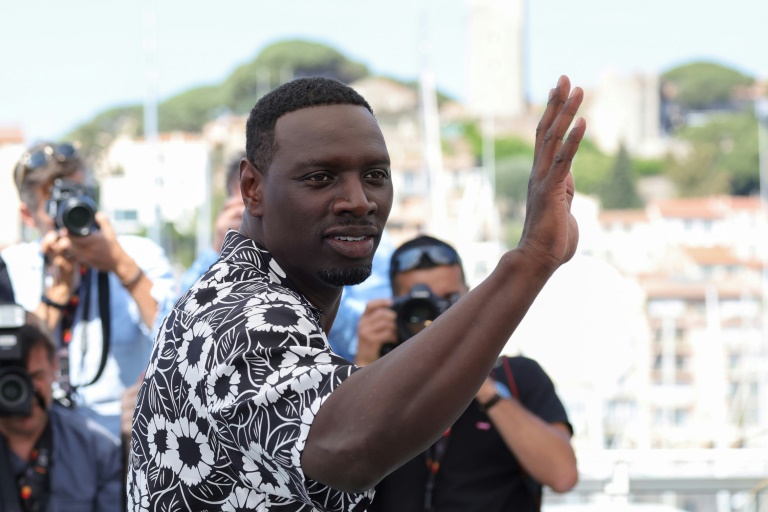
French superstar Omar Sy — who has won a huge international following with his roles in “Untouchable” and the Netflix smash hit “Lupin” — plays the lead in the story about a father and a son who are both forced into the trenches.

“My idea is to put things into question,” Vadepied told AFP. “Question France’s historical relationship with its former colonies, what do we have to say about that today, do we even know what we did?”

While rejecting any “frontally political” approach, he said that “if we deny the facts we can never move on, we need to tell these stories, everybody needs to know them.”

The idea was however “not to guilt-trip people, but to recognise the painful history and free ourselves”.

Sy, the France-born son of west African immigrants, told the audience at the film’s opening night: “We have the same story, but we don’t have the same memories.”

The second Cannes week will see the screening of “Nos Frangins” (“Our Brothers”) by French director Rachid Bouchareb who in 2006 sparked a nationwide debate with “Indigenes” (“Days of Glory”), a film about the contribution of North African soldiers to the French Free Forces during World War II.

In his latest movie, he tells the story of Malik Oussekine, a student killed in 1986 and whose name resonates deeply among French minorities.

On the night of December 6, 1986, two police officers beat to death the 22-year-old French-Algerian on the sidelines of a student protest in Paris.

He had not been involved in the demonstration, and his killing became a turning point — triggering weeks of unrest and leading to the unprecedented conviction of the officers involved.

It took 35 years for the death of Malik Oussekine to be recounted on-screen.

Close Bitnami banner
Bitnami