World

Judge blocks Biden plan to lift border expulsion policy

A health rule imposed at the start of the Covid-19 pandemic that has blocked most asylum seekers at the US border with Mexico must stay in place, a judge ruled Friday.

Title 42, the colloquial name for an order that can effectively prevent anyone without a visa from entering the United States, even to claim asylum, was due to expire on Monday.

President Joe Biden’s administration said the rule was no longer needed, more than two years after it was imposed by then-president Donald Trump.

But Republican governors of more than 20 states went to court to demand that it remain in place, arguing relaxing it would spur an influx of migrants — a hot-button political issue in the United States.

On Friday, federal judge Robert Summerhays issued an injunction to that effect.

“The Plaintiff States contend that the Termination Order will result in a surge of border crossings, and that this surge will result in an increase in illegal immigrants residing in the states,” Summerhays’ ruling says.

“They also contend that the transition back to immigration enforcement… will result in an increase in immigration ‘parolees’ in the Plaintiff States.

“The court finds that the plaintiff states have satisfied each of the requirements for a preliminary injunction.” 

The White House said it would abide by the ruling, but would appeal.

“The Administration disagrees with the court’s ruling, and the Department of Justice has announced that it will appeal this decision,” a statement said.

“The authority to set public health policy nationally should rest with the Centers for Disease Control, not with a single district court.”

– ‘Nonsensical decision’ –

For migration reform campaigners, Title 42 has been a failure: an immigration policy dressed up as a health policy — and not fit for either purpose.

The rule allows for the immediate, without-cause removal of any foreigner or non-resident trying to enter the country without a visa.

There is no legal process, nor any formal deportation to country of origin, and a border agent can apply a Title 42 expulsion without the lengthy interview process usually required.

Campaigners seized on Friday’s ruling as further proof that the immigration system in the United States is broken.

“Today’s unfortunate decision says that the government can suspend asylum with no notice at all, but can’t restore normal immigration law without going through a lengthy and complicated process,” Aaron Reichlin-Melnick, senior policy adviser for the American Council on Migration, told AFP.

“This nonsensical decision will lead to continued harm for asylum seekers and will continue to create chaos at the border.”

More than 1.8 million expulsions have been carried out under Title 42. Some are thought to be the same person expelled multiple times.

With no legal penalty for anyone expelled under the rule, many who are deported return to try again, often in ever-more dangerous circumstances.

Campaigners point to the rocketing death toll for would-be migrants — 557 people died at the border in 2021, the deadliest year since records began in 1998.

The deaths occur as a result of dehydration and starvation during desert crossings, as well as when people drown in rivers and fall while climbing the border wall.

“Seeking asylum is a legal right, and yet this bedrock of the American legal system is quickly eroding at a time of unprecedented need,” said Krish O’Mara Vignarajah, President and CEO of Lutheran Immigration and Refugee Service.

“The (court’s) decision undermines the Biden administration’s efforts to implement what the vast majority of Americans support – a fair, humane, and orderly immigration system. 

“Instead, it maintains a status quo that has been wholly ineffective in establishing a secure border. Only the coyotes profiteering off of people seeking protection have reason to celebrate this ill-reasoned ruling.”

Dogged determination: migrant and pup cross eight countries en route to US

With his fluffy black dog in tow, Gilberto Rodriguez left Venezuela two months ago on a perilous eight-country journey, mostly on foot, with dreams of a better life in the United States.

Leaving behind his wife and two children, aged six and eight, Rodriguez has slept rough, gone hungry, witnessed violence and paid bribes to police.

But he smiles from ear-to-ear as he caresses his loyal canine companion of two years, whose name “Negro” means “Black” in Spanish.

“He has also crossed everything just like us, he eats the same we eat, he’s also a migrant,” he told AFP in the town of Tecun Uman in eastern Guatemala, the sixth country stop on his north-bound route.

Their journey so far has taken Rodriguez and Negro from Caracas to Colombia and through the perilous Darien jungle to Panama.

There, they came across some of the criminal gangs that prey on migrants fleeing poverty and political upheaval in their home countries.

“We were with some women and they raped them,” Rodriguez recalled. “As for us, they stole our phones.”

The pair then made their way through Costa Rica, Nicaragua and Honduras to Guatemala, where they joined hundreds of other undocumented migrants eyeing the Suchiate River that separates them from Mexico.

– Evading detection –

Unlike a few months ago, there are no crowds on the Guatemalan side of the river.

Police stop and board buses to verify the identity documents of travellers in an operation seeking to prevent the formation of migrant caravans.

Since January this year, Guatemala has expelled more than 500 migrants from Honduras, El Salvador, Nicaragua, Venezuela and Cuba.

To evade detection, migrants have taken to moving in small groups instead, with plans to meet up again once in Mexico.

There awaits the final hurdle: the Rio Grande, which separates Mexico from the United States.

US President Joe Biden’s administration has been seeking to end the implementation of Title 42, a public health order that has allowed for the expulsion of migrants during the Covid-19 crisis.

The move to lift the order sparked uproar at home for fear it would boost undocumented migrant arrivals even with numbers five times higher on average than in the years before the coronavirus outbreak.

But Rodriguez and most of the other migrants making their way north say they have never even heard of Title 42.

– Cops ‘take our money’ –

A more pressing concern is evading the police in Guatemala — and not only to avoid arrest.

“The issue is with those cops who take our money,” Rodriguez said.

On their long trip, the man and his best friend have often had to rely on charity, sometimes sharing their food.

When shelters did not allow animals, they slept on the street.

Why put himself through this? “We had to flee,” Rodriguez said of his life in Venezuela.

“The salary is not enough, you buy everything in dollars and what they pay you in bolivars is nothing.”

On the penultimate stretch of his journey, Rodriguez clambers onto a boat made of old tires and planks, a trip for which he paid just over $1.

He clutches Negro in his arms as a man pushes a long oar along the river floor, and ten minutes later, they are across.

The dog, seated quietly between his master’s legs during the crossing, quickly jumps off and onto dry land, now in Mexico.

“We have crossed mountains, rivers, streams… we are no longer afraid of anything,” said Moises Ayerdi, a 25-year-old Nicaraguan migrant who made the same trip.

He said he had left his home, wife and three-year-old daughter because he was the target of political persecution by President Daniel Ortega’s government.

“Our feet hurt, we arrived here sick… We are used to it. We will continue. Just like we crossed Honduras, Guatemala, we will cross Mexico,” he vowed.

Rio's urban gardens produce healthy food for the poor

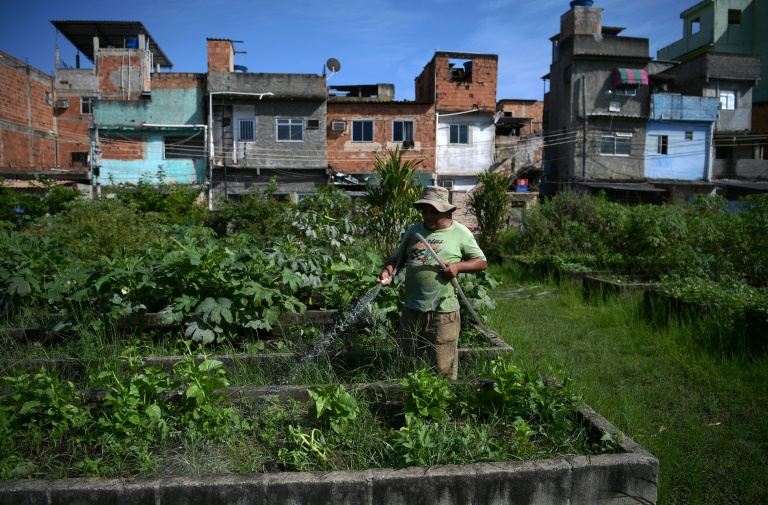
Gun-toting youths watch over a street in a Rio de Janeiro slum hit hard by drug trafficking, but walk a bit further and this rough area also boasts the largest urban vegetable garden in Latin America.

This success story is unfolding in a favela called Manguinhos in the north of Rio, and thrives as the rest of the country frets over rampant inflation and worries over Russian fertilizer, a major concern for Brazil’s powerful agriculture sector.

The first seed was planted in late 2013 on a parcel of land known then as “crackolandia” because it was home to so many drug addicts.

And little by little it has established itself and come to be respected in a neighborhood where drug traffickers are in charge.

These days the garden feeds some 800 families a month with produce that is pesticide free and affordable, two features that do not always go hand in hand.

“Why do poor people have to be doomed to eating poisoned food? My goal is to stop organic food from just being for the elite,” Julio Cesar Barros, one of the managers of the garden, told AFP, alluding to high priced fruit and vegetables sold in wealthy neighborhoods like Copacabana and Ipanema.

The Manguinhos garden is one of 56 in Rio that Barros launched with city authorities in 2006. And it has been praised by an international agreement called the Milan Urban Food Policy Pact as one of the best such systems in the world.

This particular garden is the size of four football fields and every month it produces 2.5 tons of yuca, carrots, onions, cabbage and other vegetables.

Half is sold to families for an average of two reales (40 US cents) per kilo and the rest is donated to orphanages and shelters.

– A way out of drugs and crime –

Wearing a cap to ward off the hot sun, Dione Enedina Da Silva, 73, crouches down and rips up weeds growing among the rows of vegetable plants.

“The garden changed everything for me: the way I lived, the way I ate,” this woman with 10 grandchildren and many great grandchildren said. “Before I barely had money to buy carrots and onions.”

Da Silva is one of 25 employees of the garden, who are paid with revenue from sales. She used to work cleaning hospitals, but other workers at the garden were involved in drugs and crime in the slum and had a grim future, said Barros.

That is the case of a 40 year old employee who prefers not to give his name or details of his past.

“Working here is therapy. I come every day, rain or shine. I am not leaving,” he said.

He is now proud of what he does and says his work means his 11 year old daughter eats good, healthy food.

– Obesity vs. education –

“Food education here is awful,” said Barros. Indeed, the rate of obesity among people over age 20 rose from 12.2 percent to 26.8 percent from 2002 to 2019, according to government statistics.

“What happens if a child arrives home with a vegetable they planted at school? Education changes and the child begins to influence the parents to eat better,” said Barros, whose projects also features gardens at schools.

“Eating healthy is important but food is not always affordable,” said Alesandra Almeira, 39, a slum resident who shops at the Manguinhos garden every week.

Barros said the quality of the produce from these gardens is drawing the attention of health-oriented restaurants in Rio, who have started buying at community projects.

“I have a problem: is the food no longer going to be for those who need it and go back to the rich? We have to figure out a way to resolve this.”

In the meantime, Barros’s project is going full steam ahead.

The Rio city government has announced plans to expand a garden in the Parque de Madureira area of the city to make it almost four times the size of Manguinhos. Officials said that would make it the world’s largest urban garden.

Canada celebrates political icon 'Hurricane Hazel', aged 101

Hazel McCallion, 101, was recently reappointed to the board of Canada’s largest airport as she forges ahead with a career that has included being a city mayor for 36 years and playing professional hockey.

Her tenacity earned her the nickname “Hurricane Hazel.”

“I don’t know how it came about (that) they call me ‘Hurricane Hazel,'” she said in an interview with AFP at a Mississauga, Ontario exhibit celebrating her life, adding with a boisterous laugh: “I know I move quickly.”

And nothing seems to stop her. Throughout her long life, she says she followed the mantra: work hard and be prepared.

“Hard work never killed anybody, my mother told me that,” she said. “If you want to go anywhere you have to work hard.”

Born in 1921, in Port Daniel, Quebec, Hazel is the youngest of five children. Her father worked in the fishing industry while her mother was a nurse.

She left the family farm at age 16 to continue her education, before taking up secretarial work during the Second World War at a Montreal engineering firm.

She also played on a professional women’s hockey team for two seasons, losing two teeth while earning Can$5 (US$4) per match, which she described as “a princely sum in those days.”

In 1951, she married Sam McCallion with whom she had three children.

“She wasn’t always there, but she was there when she needed to be,” recalled her son Peter McCallion, describing her as a “wonderful” grandmother to her only granddaughter.

– ‘Feel that you’re contributing’ –

Inspired by former Ottawa mayor Charlotte Whitton — the first female mayor of a major Canadian city — and Margaret Thatcher, she entered politics in the 1960s.

In 1978, she won the mayoralty of Mississauga on the shores of Lake Ontario, neighbouring Toronto — helped at the polls by her refusal to be baited by her opponent’s sexist remarks during the campaign.

Today, she spurns questions on gender and politics. “It has not been difficult at all. I have been supported by men both in business and in politics,” she said, adding that she’s been “fortunate.”

McCallion has left an indelible mark on Mississauga, which has dramatically changed over the past decades as it grew to become Canada’s seventh largest city.

She had been in office only a few months when a train carrying toxic chemicals derailed in a populated area of the city, and erupted in flames.

McCallion gained a national profile for managing the mass evacuation of 220,000 residents, in which nobody died or was seriously injured.

“To live a happy life you have to be very positive and you have to feel that you’re contributing. You can’t think of ‘me’ all the time,” she says, explaining her commitment to public service.

She would be re-elected 11 more times to lead the city of Mississauga, making her one of Canada’s longest serving mayors.

According to Tom Urbaniak, author of a book on Mississauga under her watch, her longevity in politics is due to her strong personality and accessibility, but also “her down-to-Earth populism” and outspokenness.

“Hazel McCallion leans towards conservatism but she is extremely pragmatic,” said the Cape Breton University professor, who noted her support for political parties of all stripes.

The self-described “builder” was voted most popular mayor, before retiring three years later at age 93.

A stamp collector, McCallion says she enjoys gardening and making videos for charitable causes, and keeps up with the news, wearing a yellow and blue ribbon on her lapel to show support for Ukraine at war.

“I’ve lived one hundred years and I’ve never felt so negative about what is happening in the world today,” she laments. “It’s very disturbing.”

Boeing's Starliner spaceship docks with ISS in high-stakes test mission

Boeing’s Starliner capsule docked with the International Space Station Friday, a major milestone in a high-stakes uncrewed test flight as the US aerospace giant seeks to restore its reputation following past failures.

The spaceship made contact at 8:28 pm Eastern time (0028 GMT Saturday), a little over 24 hours after it blasted off from the Kennedy Space Center in Florida on a mission to prove itself capable of providing safe rides for NASA astronauts.

“Starliner spacecraft completes its historic first docking to the International Space Station, opening a new avenue of access for crews to the orbiting laboratory,” said an announcer.

But the vessel missed the scheduled rendezvous time by more than an hour due to technical issues — including a problem that required ground control to retract its docking system then re-deploy it.

Starliner also encountered some propulsion problems early on in its journey, with two thrusters responsible for placing it in a stable orbit failing, though officials insisted these were non-critical systems.

One of 12 orbital maneuvering and attitude control (OMAC) thrusters located on Starliner’s aft side shut off after one second, at which point a second thruster kicked in and took over, but also cut out after 25 seconds. 

The ship’s software then engaged a third thruster that completed the necessary burn. 

“That system operated normally during all of the propulsion system demonstrations, and with redundancies in place, does not pose a risk to the rest of the flight test,” a NASA blog post about the issue said.

Starliner’s success is key to re-establishing Boeing’s credibility after its first launch, back in 2019, failed to dock with the ISS due to software bugs — one that led to it burning too much fuel to reach its destination, and another that could have destroyed the vehicle during re-entry. 

A second try was scheduled in August 2021, but the capsule was rolled back from the launchpad to address sticky valves that weren’t opening as they should and the vessel was eventually sent back to the factory for fixes.

NASA is looking to certify Starliner as a second “taxi” service for its astronauts to the space station — a role that Elon Musk’s SpaceX has provided since succeeding in a test mission for its Dragon capsule in 2020.

– Seeking redemption –

Both companies were awarded fixed-price contracts — $4.2 billion to Boeing and $2.6 billion to SpaceX — in 2014, shortly after the end of the Space Shuttle program, during a time when the United States was left reliant on Russian Soyuz rockets for rides to the orbital outpost. 

Boeing, with its hundred-year history, was considered by many as the sure shot, while then-upstart SpaceX was less proven. 

In reality, it was SpaceX that rocketed ahead and recently sent its fourth routine crew to the research platform, while Boeing’s development delays have cost the company hundreds of millions of dollars.

Starliner is delivering more than 800 pounds of cargo to the ISS as part of this mission.

Its sole passenger is a mannequin named Rosie the Rocketeer — a play on the World War II campaign icon Rosie the Riveter — whose job is to collect flight data with her sensors to learn what human astronauts would experience.

“We are a little jealous of Rosie,” NASA astronaut Mike Fincke, who is expected to be among the first crew selected for a manned demonstration mission later this year should OFT-2 succeed, said at a press conference this week.

The gumdrop-shaped capsule will spend about five days in space, then undock and return to Earth on May 25, using giant parachutes to land in the desert of the western United States. 

NASA sees a second provider to low Earth orbit as a vital backup, should SpaceX encounter problems. 

Boeing's Starliner spaceship docks with ISS in high-stakes test mission

Boeing’s Starliner capsule docked with the International Space Station Friday, a major milestone in a high-stakes uncrewed test flight as the US aerospace giant seeks to restore its reputation following past failures.

The spaceship made contact at 8:28 pm Eastern time (0028 GMT Saturday), a little over 24 hours after it blasted off from the Kennedy Space Center in Florida on a mission to prove itself capable of providing safe rides for NASA astronauts.

“Starliner spacecraft completes its historic first docking to the International Space Station, opening a new avenue of access for crews to the orbiting laboratory,” said an announcer.

But the vessel missed the scheduled rendezvous time by more than an hour due to technical issues — including a problem that required ground control to retract its docking system then re-deploy it.

Starliner also encountered some propulsion problems early on in its journey, with two thrusters responsible for placing it in a stable orbit failing, though officials insisted these were non-critical systems.

One of 12 orbital maneuvering and attitude control (OMAC) thrusters located on Starliner’s aft side shut off after one second, at which point a second thruster kicked in and took over, but also cut out after 25 seconds. 

The ship’s software then engaged a third thruster that completed the necessary burn. 

“That system operated normally during all of the propulsion system demonstrations, and with redundancies in place, does not pose a risk to the rest of the flight test,” a NASA blog post about the issue said.

Starliner’s success is key to re-establishing Boeing’s credibility after its first launch, back in 2019, failed to dock with the ISS due to software bugs — one that led to it burning too much fuel to reach its destination, and another that could have destroyed the vehicle during re-entry. 

A second try was scheduled in August 2021, but the capsule was rolled back from the launchpad to address sticky valves that weren’t opening as they should and the vessel was eventually sent back to the factory for fixes.

NASA is looking to certify Starliner as a second “taxi” service for its astronauts to the space station — a role that Elon Musk’s SpaceX has provided since succeeding in a test mission for its Dragon capsule in 2020.

– Seeking redemption –

Both companies were awarded fixed-price contracts — $4.2 billion to Boeing and $2.6 billion to SpaceX — in 2014, shortly after the end of the Space Shuttle program, during a time when the United States was left reliant on Russian Soyuz rockets for rides to the orbital outpost. 

Boeing, with its hundred-year history, was considered by many as the sure shot, while then-upstart SpaceX was less proven. 

In reality, it was SpaceX that rocketed ahead and recently sent its fourth routine crew to the research platform, while Boeing’s development delays have cost the company hundreds of millions of dollars.

Starliner is delivering more than 800 pounds of cargo to the ISS as part of this mission.

Its sole passenger is a mannequin named Rosie the Rocketeer — a play on the World War II campaign icon Rosie the Riveter — whose job is to collect flight data with her sensors to learn what human astronauts would experience.

“We are a little jealous of Rosie,” NASA astronaut Mike Fincke, who is expected to be among the first crew selected for a manned demonstration mission later this year should OFT-2 succeed, said at a press conference this week.

The gumdrop-shaped capsule will spend about five days in space, then undock and return to Earth on May 25, using giant parachutes to land in the desert of the western United States. 

NASA sees a second provider to low Earth orbit as a vital backup, should SpaceX encounter problems. 

Boeing's Starliner spaceship docks with ISS in high-stakes test mission

Boeing’s Starliner capsule docked with the International Space Station Friday, a major milestone in a high-stakes uncrewed test flight as the US aerospace giant seeks to restore its reputation following past failures.

The spaceship made contact at 8:28 pm Eastern time (0028 GMT Saturday), a little over 24 hours after it blasted off from the Kennedy Space Center in Florida on a mission to prove itself capable of providing safe rides for NASA astronauts.

“Starliner spacecraft completes its historic first docking to the International Space Station, opening a new avenue of access for crews to the orbiting laboratory,” said an announcer.

But the vessel missed the scheduled rendezvous time by more than an hour due to technical issues — including a problem that required ground control to retract its docking system then re-deploy it.

Starliner also encountered some propulsion problems early on in its journey, with two thrusters responsible for placing it in a stable orbit failing, though officials insisted these were non-critical systems.

One of 12 orbital maneuvering and attitude control (OMAC) thrusters located on Starliner’s aft side shut off after one second, at which point a second thruster kicked in and took over, but also cut out after 25 seconds. 

The ship’s software then engaged a third thruster that completed the necessary burn. 

“That system operated normally during all of the propulsion system demonstrations, and with redundancies in place, does not pose a risk to the rest of the flight test,” a NASA blog post about the issue said.

Starliner’s success is key to re-establishing Boeing’s credibility after its first launch, back in 2019, failed to dock with the ISS due to software bugs — one that led to it burning too much fuel to reach its destination, and another that could have destroyed the vehicle during re-entry. 

A second try was scheduled in August 2021, but the capsule was rolled back from the launchpad to address sticky valves that weren’t opening as they should and the vessel was eventually sent back to the factory for fixes.

NASA is looking to certify Starliner as a second “taxi” service for its astronauts to the space station — a role that Elon Musk’s SpaceX has provided since succeeding in a test mission for its Dragon capsule in 2020.

– Seeking redemption –

Both companies were awarded fixed-price contracts — $4.2 billion to Boeing and $2.6 billion to SpaceX — in 2014, shortly after the end of the Space Shuttle program, during a time when the United States was left reliant on Russian Soyuz rockets for rides to the orbital outpost. 

Boeing, with its hundred-year history, was considered by many as the sure shot, while then-upstart SpaceX was less proven. 

In reality, it was SpaceX that rocketed ahead and recently sent its fourth routine crew to the research platform, while Boeing’s development delays have cost the company hundreds of millions of dollars.

Starliner is delivering more than 800 pounds of cargo to the ISS as part of this mission.

Its sole passenger is a mannequin named Rosie the Rocketeer — a play on the World War II campaign icon Rosie the Riveter — whose job is to collect flight data with her sensors to learn what human astronauts would experience.

“We are a little jealous of Rosie,” NASA astronaut Mike Fincke, who is expected to be among the first crew selected for a manned demonstration mission later this year should OFT-2 succeed, said at a press conference this week.

The gumdrop-shaped capsule will spend about five days in space, then undock and return to Earth on May 25, using giant parachutes to land in the desert of the western United States. 

NASA sees a second provider to low Earth orbit as a vital backup, should SpaceX encounter problems. 

US jails sons of Panama ex-president for three years

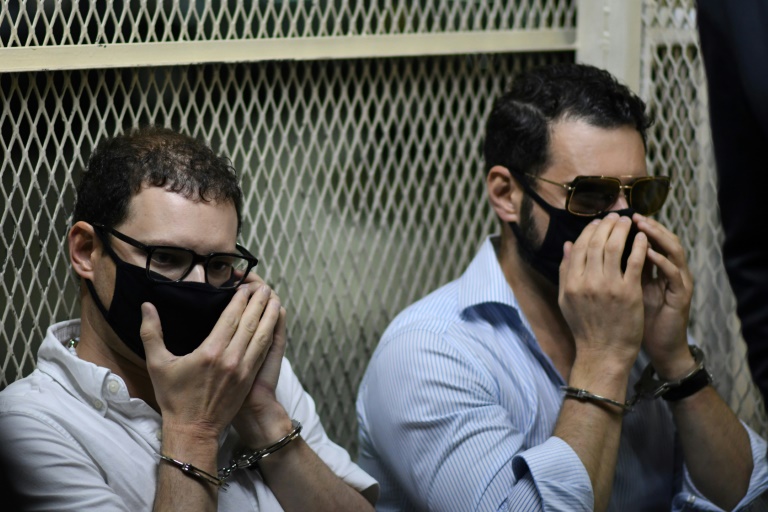
A New York court on Friday sentenced two sons of former Panamanian president Ricardo Martinelli to three years in prison on charges of corruption linked to the Brazilian construction giant Odebrecht. 

The sentence against Luis Enrique and Ricardo Martinelli, which also includes a fine of $250,000, is well below the nine to 11 years prosecutors had asked for.

They were accused of having received $28 million in bribes from the disgraced construction group, of which $19 million had passed through US accounts. 

The brothers pleaded guilty last December after being extradited from Guatemala to the United States. 

Washington had demanded their extradition over accusations of involvement in operations by Odebrecht, which allegedly paid more than $700 million in bribes to Panamanian government officials to win contracts. 

Panama is also demanding that the Martinelli brothers face charges there in another corruption scandal. 

Their father, who served as president from 2009 to 2014, is himself accused in the Odebrecht case, but has announced his intention to run for president in 2024. 

The Odebrecht scandal has hit a slew of leaders across Latin America, and former bosses of the Brazilian company have admitted in court to illegally distributing millions of dollars in bribes in exchange for public contracts.

Hyundai to build $5.5 bn electric vehicle plant in US

South Korean automaker Hyundai will build a $5.5 billion electric vehicle and battery plant in the southern US state of Georgia, its governor announced Friday, as President Joe Biden pursued his trip to Seoul.

Brian Kemp made the announcement alongside Hyundai Motor Company president Jay Chang at the future factory site near Savannah, hailing the more than 8,000 jobs the venture is expected to create.

“We are proud to welcome Hyundai Motor Group to Georgia as we forge an innovative future together,” Kemp said, according to a statement released by his office.

He called the plant “the largest economic development project in our state’s history.”

Hyundai suppliers are expected to invest an additional $1 billion in the factory, which will have an annual capacity of 300,000 units, according to the statement.

The automaker said it plans to begin construction in January 2023 and to complete the plant in the first half of 2025. It did not yet give any details on which of its electric models will be produced at the Georgia location.

“This new EV plant is the future of our business, and it will help us meet the growing demands of our US customers,” Chang said in the statement.

Hyundai has projected that 27 percent of its global fleet will be electric within seven years.

By building battery production into the new factory, Hyundai “aims to establish a stable supply chain for EV battery and other EV components in the US market,” the statement said.

Biden arrived on Friday in South Korea, on a trip aimed at cementing economic ties with Seoul. He is due to meet with Chang on Sunday, according to the White House.

The Hyundai plant will be the second electric vehicle factory in Georgia: electric truck maker Rivian announced in December that it will invest $5 billion to build its second US assembly plant there.

Hyundai aims to be the third-largest provider of electric vehicles in the United States by 2026, but it faces stiff competition.

The sector is currently dominated by Tesla, but traditional automakers General Motors and Ford plan to invest tens of billions of dollars to increase their electric offerings in the coming years, and many start-ups are also trying to break into the industry.

China rate cut boosts Asian, European stocks

Asian and European stocks rebounded Friday on China’s interest rate cut, but US equities gyrated amid fears that sky-high inflation will spark a recession.

“Markets have been looking for an excuse to bounce, and a China rate cut provided the reason,” IG analyst Chris Beauchamp told AFP.

The People’s Bank of China announced it would lower its five-year loan prime rate — a key interest rate governing how lenders base their mortgage rates — to 4.45 percent from 4.6 percent.

The move is in contrast to other major central banks — like the US Federal Reserve and the Bank of England — that are raising borrowing costs to combat rocketing consumer prices.

The Chinese move sparked optimism among traders that it could boost the world’s second-largest economy from its Covid-induced stupor.

“The rate cut announced by the PBOC is obviously good news and is clearly targeted at revitalising the ailing property market which continues to suffer due to the crackdown last year and Covid lockdowns this year,” said Craig Erlam, senior market analyst at OANDA.

“This could help to revive a hugely important part of the economy,” he added, but “whether it’s enough to help China hit its 5.5 percent growth target this year is another thing.” 

Asian stocks closed with gains, as did Europe’s main markets although those faded as the day wore on. 

Wall Street also opened higher but later tumbled, with the S&P 500 temporarily sinking into a “bear market,” a drop of more than 20 percent from a recent peak.

The broad-based S&P 500 finished at 3,901.36, basically unchanged for the day, but down three percent for the week and off 19 percent from its January high point.

“Stocks remain on a shaky footing,” said market analyst Fawad Razaqzada at City Index and FOREX.com.

He said investors are worried about inflation, interest rate hikes, low economic growth, stagflation, and recession.

“Perhaps most importantly for stocks, the Fed is not there to provide cushion, like before,” he added, as the US central bank is raising interest rates to combat inflation.

Downcast earning reports from retailers have heightened market uncertainty at a time of rising interest rates, surging energy prices, China’s Covid lockdowns and Russia’s ongoing war on Ukraine.

Major stock indices have lost huge portions of their value in recent months.

In Europe, Paris and Frankfurt stocks are down between 14 and 15 percent, while London’s main index has shed a modest 3.9 percent.

– Key figures at around 2040 GMT –

New York – Dow: FLAT at 31,261.90 (close)

New York – S&P 500: FLAT at 3,901.36 (close)

New York – Nasdaq: DOWN 0.3 percent at 11,354.62 (close)

London – FTSE 100: UP 1.2 percent at 7,389.98 (close)

Frankfurt – DAX: UP 0.7 percent at 13,981.91 (close)

Paris – CAC 40: UP 0.2 percent at 6,285.24 (close)

EURO STOXX 50: UP 0.5 percent at 3,657.03 (close)

Hong Kong – Hang Seng Index: UP 3.0 percent at 20,717.24 (close)

Shanghai – Composite: UP 1.6 percent at 3,146.57 (close)

Tokyo – Nikkei 225: UP 1.3 percent at 26,739.03 (close)

Brent North Sea crude: UP 0.4 percent at $112.55 per barrel

West Texas Intermediate: UP 2.7 percent at $113.23 per barrel

Euro/dollar: DOWN at $1.0564 from $1.0588

Pound/dollar: UP at $1.2497 from $1.2467

Euro/pound: DOWN at 84.50 pence from 84.93 pence

Dollar/yen: UP at 127.86 yen from 127.79

burs-jmb/hs

Close Bitnami banner
Bitnami