World

Wall Street stocks tumble following weak results from retailers

Wall Street stocks suffered one of their worst batterings since 2020 on Wednesday, as downcast earnings reports from retailers exacerbated worries about consumer resilience and corporate profitability.

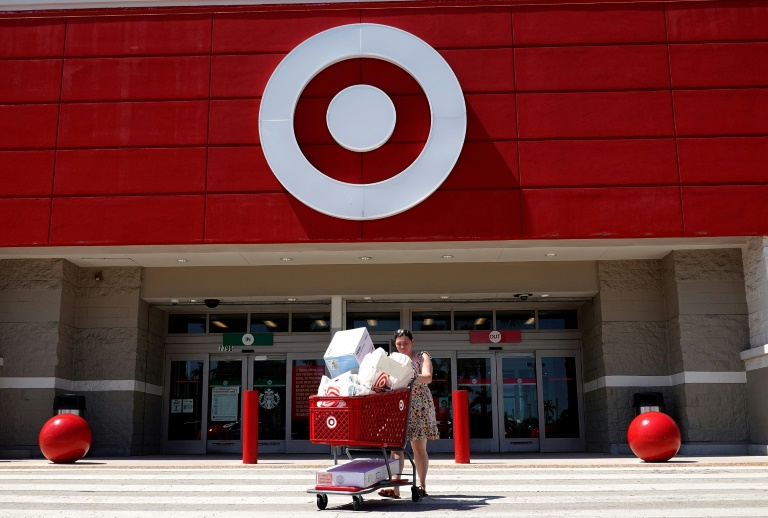
With European markets also in retreat, major US indices took cues from Target, the North American-focused big-box retailer, which plunged around 25 percent after earnings missed expectations despite higher sales.

The company pointed to the hit from higher operating costs in results that echoed those of bigger rival Walmart, which had an ugly day Tuesday. The retailers said profits were under pressure and some consumers were avoiding discretionary purchases as prices for food, gasoline and other household staples rise.

All three major US indices dove, with the Dow sinking more than 1,150 points or 3.6 percent, and the Nasdaq plunging 4.7 percent.

“The big falls in shares of these retails… highlights the damage inflation is inflicting on the sector’s profit margins,” said Fawad Razaqzada at City Index.

“What’s more, consumers are getting squeezed as well and if they now start to cut back on spending then retailers could suffer even further,” he added.

Consumer-oriented names were among the most punished on Wednesday, with Procter & Gamble losing 6.2 percent, Coca-Cola 7.0 percent and Walgreens Boots Alliance 8.4 percent.

The weak results come in a market already buffeted by recession fears as the Federal Reserve raises interest rates to counter inflation

Earlier, European markets also were under pressure. 

News that UK inflation spiked to a 40-year peak of nine percent in April helped push London stocks down 1.1 percent.

The figure also sent the pound sliding on worries that the cost-of-living crisis will spark a recession in Britain, in line with the Bank of England’s recent forecast.

In the eurozone, Frankfurt fell 1.3 percent and Paris shed 1.2 percent in value.

Worries about weakening growth put downward pressure on oil prices, which dropped 2.5 percent, while the dollar strengthened against other major currencies.

“A recession is looking increasingly inevitable in the UK and other countries… if the inflation data does not improve,” OANDA analyst Craig Erlam told AFP.

“That does not bode well for equity markets.

– Key figures at around 2110 GMT –

New York – Dow: DOWN 3.6 percent at 31,490.07 (close)

New York – S&P 500: DOWN 4.0 percent at 3,923.68 (close)

New York – Nasdaq: DOWN 4.7 percent at 11,418.15 (close)

London – FTSE 100: DOWN 1.1 percent at 7,438.09 (close)

Frankfurt – DAX: DOWN 1.3 percent at 14,007.76 (close)

Paris – CAC 40: DOWN 1.2 percent at 6,352.94 (close)

EURO STOXX 50: DOWN 1.4 percent at 3,690.74 (close)

Hong Kong – Hang Seng Index: UP 0.2 percent at 20,644.28 (close)

Shanghai – Composite: DOWN 0.3 percent at 3,085.98 (close)

Tokyo – Nikkei 225: UP 0.9 percent at 26,911.20 (close)

Brent North Sea crude: DOWN 2.5 percent at $109.11 per barrel

West Texas Intermediate: DOWN 2.5 percent at $109.59 per barrel

Euro/dollar: DOWN at $1.0462 from $1.0550 at 2100 GMT Tuesday

Pound/dollar: DOWN at $1.2344 from $1.2493

Euro/pound: UP at 84.76 pence from 84.45 pence

Dollar/yen: DOWN at 128.20 yen from 129.38 yen

burs-jmb/to
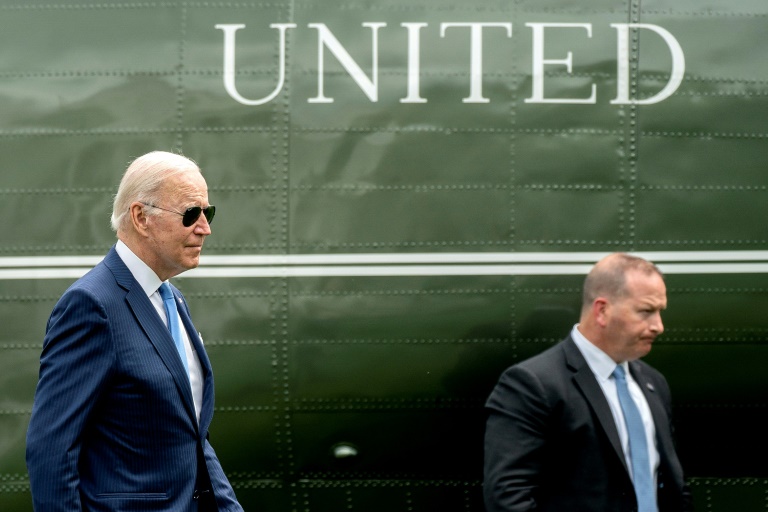
Biden sells renewed US leadership in first Asia trip, but N.Korea looms

Joe Biden leaves Thursday for his first trip as president to Asia convinced that the confrontation with Russia has reinvigorated US leadership, while wary that a rogue North Korean nuclear test could tear up the optimistic script.

The Democrat is going to South Korea, then Japan on Sunday to hold summits with the leaders of both countries, as well as joining a regional summit of the Quad group — Australia, India, Japan, and the United States — while in Tokyo.

During the first leg, he will visit US and South Korean troops, but will not make the traditional presidential trek to the fortified frontier known as the DMZ between South Korea and the unpredictable, isolated dictatorship of North Korea, the White House said.

The trip is being touted as proof that the United States is further building on recent moves to cement its years-long pivot to Asia, where rising Chinese commercial and military power is increasingly pushing back against decades of US leadership.

National Security Advisor Jake Sullivan rejected the idea that the war in Ukraine is distracting Biden from that mission.

Underlining the competing demands from two sides of the world, Biden will be meeting Thursday morning at the White House with the leaders of Finland and Sweden to celebrate their applications for joining NATO right before he boards Air Force One for Seoul.

But Sullivan said there was no “tension” in the twin focus. “We regard this as mutually reinforcing,” Sullivan told reporters.

“There’s something quite evocative about going from meeting with the president of Finland and the prime minister of Sweden to reinforce the momentum behind the NATO alliance and the free world’s response to Ukraine, then getting on a plane and flying out to the Indo-Pacific.”

– North Korean wild card –

Briefing reporters on the aims of the trip, Sullivan said Biden is headed to Asia with “the wind at our back” after successful US leadership in creating the tough Western response to President Vladimir Putin’s now almost three-month long invasion of neighboring Ukraine.

The high military, diplomatic and economic cost facing Russia is seen in Washington as a cautionary tale for China to digest as it eyes ambitions to gain control over democratic-ruled Taiwan, even if that means going to war.

But for all the White House’s evident self-confidence, officials admit that North Korea’s nuclear weapons program is a wild card on the trip.

Sullivan said it was possible that North Korea, which has defied UN sanctions in conducting an array of nuclear-capable missile tests this year, could use Biden’s visit to stage “provocations.”

This could mean “further missile tests, long range missile tests or a nuclear test, or frankly both, in the days leading into, on or after the president’s trip to the region,” he said.

The Biden administration is prepared to “make both short and longer term adjustments to our military posture as necessary to ensure that we are providing both defensive deterrence to our allies in the region and that we’re responding.”

Sullivan said a potential response was being “closely” coordinated with South Korea and Japan and that he had also spoken about the issue with his Chinese counterpart earlier Wednesday.

– West meets East –

Sullivan said the administration wants not so much to confront China on the trip as to use Biden’s diplomacy to show that the West and its Asian partners will not be divided and weakened.

He pointed to cooperation from South Korea and Japan, among others, in the sanctions regime against Russia led by European powers and the United States. He also referred to Britain’s role in the recently created security partnership AUKUS.

“European countries are increasingly invested in the Indo-Pacific,” he said.

“So for us, there is a certain level of integration and symbiosis in the strategy we are pursuing in Europe and the strategy we’re pursuing in the Indo-Pacific. And President Biden’s unique capacity to actually stitch those two together, I think, is going to be a hallmark of his foreign policy,” Sullivan said.

This “powerful message” will be “heard in Beijing,” Sullivan said, “but it’s not a negative message and it’s not targeted at any one country.”

'Pharma Bro' Shkreli released to halfway house in US

So-called “Pharma bro” Martin Shkreli has been released from a Pennsylvania prison to a halfway house in New York state, the US Bureau of Prisons said Wednesday.

Shkreli, who became a poster child for predatory pharmaceutical pricing before being convicted of securities fraud in 2017, was transferred Wednesday from a low-security prison in Allenwood, Pennsylvania to undisclosed “community confinement” in New York state, said a BOP spokesperson in an email.

He is scheduled to be released from BOP’s custody on September 14, the spokesperson said.

Shkreli’s attorney, Benjamin Brafman, confirmed the release, saying he was “pleased” to report that his client was let out early “after completing all programs that allowed for his prison sentence to be shortened,” according to a statement.

“While in the halfway house I have encouraged Mr. Shkreli to make no further statement, nor will he or I have any additional comments at this time.”

Once dubbed “the most hated man in America,” Shkreli, 39, became infamous for suddenly raising the price of the HIV drug Daraprim in 2015 by 5,000 percent — from $13.50 a pill to $750.

Shkreli was originally sentenced in 2018 to seven years in prison in a fraud case not directly related to the Daraprim matter. He has been in custody since September 2017.

New York agency accuses Amazon of workforce discrimination

New York state accused Amazon Wednesday of discriminating against pregnant workers and staff with disabilities by refusing to make reasonable accommodations.

The state’s Division of Human Rights faulted Amazon for allowing worksite managers to override accommodations consultants when they urged flexibility for workers protected under law. 

“My administration will hold any employer accountable, regardless of how big or small, if they do not treat their workers with the dignity and respect they deserve,” said New York Governor Kathy Hochul in a statement that described Amazon as having 23 worksites in New York with more than 39,000 workers.

In one case, a pregnant worker asked not to be required to lift packages over 25 pounds. The worksite manager refused to make the accommodation, resulting in an injury that forced the employee into “indefinite unpaid leave,” the agency said.

In another case, a worksite manager denied a request from a worker with a documented disability who presented medical documentation justifying the need for a specific sleep schedule. 

After initially recommending the accommodation, the consultant reversed position after the site manager refused to grant the change, the agency said.

“Since the 1970s — years before the (federal) Americans with Disabilities Act — New York State has prohibited discrimination against pregnant employees in the workplace,” said Melissa Franco, deputy commissioner for enforcement at the agency. 

“The division will work to ensure that everyone in our state is fully afforded the rights and dignities that the law requires.”

The agency is seeking an administrative order requiring Amazon to cease the current conduct, train managers on how to handle requests for reasonable accommodation and pay civil fines.

Amazon told AFP in a statement that it was “surprised” by Hochul’s announcement, saying it had been cooperating with the investigation and “had no indication a complaint was coming.”

The e-commerce giant said it had “numerous programs” in place to make sure that all its employees felt supported.

“While we don’t always get it right with a workforce of over 1.6 million people, we work diligently to offer the best available options to accommodate individual situations,” Amazon said in the statement.

UN chief warns of famine, urges Russia to free Ukrainian grain

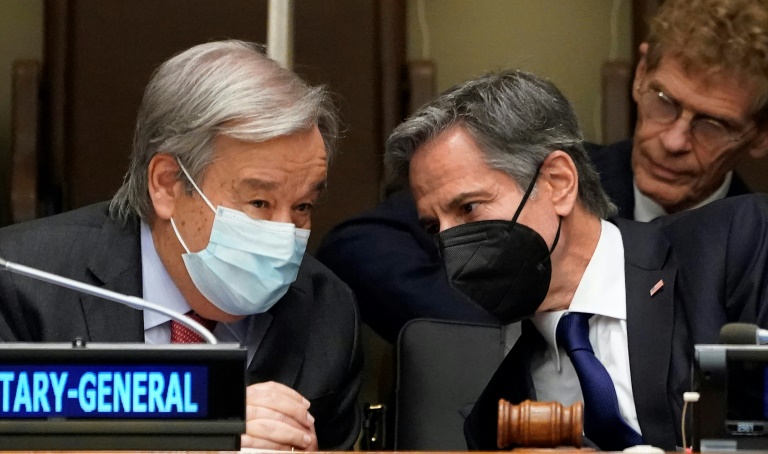
UN chief Antonio Guterres warned Wednesday of years of mass hunger and famine if a growing global food crisis goes unchecked as he urged Russia to release Ukrainian grain.

Speaking at a major United Nations summit in New York, Guterres said the war in Ukraine was compounding global food insecurity already worsened by warming temperatures and the coronavirus pandemic.

Guterres said that in just two years, the number of severely food insecure people has doubled — from 135 million pre-pandemic to 276 million today.

He added that more than half a million people are living in famine conditions, an increase of more than 500 percent since 2016.

“Now the war in Ukraine is amplifying and accelerating all these factors: climate change, Covid-19 and inequality,” he told the meeting on the growing food crisis chaired by US Secretary of State Antony Blinken.

“It threatens to tip tens of millions of people over the edge into food insecurity, followed by malnutrition, mass hunger and famine, in a crisis that could last for years,” Guterres added.

Before Russia’s invasion of its neighbor in February, Ukraine was seen as the world’s bread basket, exporting 4.5 million tonnes of agricultural produce per month through its ports -– 12 percent of the planet’s wheat, 15 percent of its corn and half of its sunflower oil.

But with the ports of Odessa, Chornomorsk and others cut off from the world by Russian warships, the supply can only travel on congested land routes that are far less efficient.

Guterres called on Russia to free up Ukrainian exports of grain.

“Let’s be clear: there is no effective solution to the food crisis without reintegrating Ukraine’s food production,” he said.

“Russia must permit the safe and secure export of grain stored in Ukrainian ports.

“Alternative transportation routes can be explored — even if we know that by itself, this will not be enough to solve the problem,” Guterres added.

The UN chief also said that Russian food and fertilizers “must have full and unrestricted access to world markets.”

Russia is the world’s top supplier of key fertilizers and gas.

The war and international economic sanctions on Moscow have disrupted supplies of fertilizer, wheat and other commodities from both countries, pushing up prices for food and fuel, especially in developing nations.

The fertilizers are not subject to the Western sanctions but sales have been disrupted by measures taken against the Russian financial system, diplomats say.

Colombia beefs up security for right-wing presidential candidate

The Colombian government has stepped up security for right-wing presidential candidate Federico Gutierrez following threats from paramilitary and drug trafficking groups ahead of elections later this month.

Gutierrez, who is trailing leftist candidate Gustavo Petro in opinion polls ahead of the May 29 vote, received a threatening note from a paramilitary organization calling itself the Black Eagles, according to his campaign team. 

Interior Minister Daniel Palacios said instructions were given to boost Gutierrez’s security in response to the threat, which had raised “concern both inside the campaign and in the intelligence agencies.” 

The note designated those who frequent Gutierrez’s party headquarters as “military targets” and threatened that the heads of Gutierrez and his entourage would “roll.” 

Palacios said there had also been threats from the Gulf Clan, the largest drug trafficking group in Colombia, the world’s biggest cocaine producer. 

The authorities had already stepped up security for Petro, a former guerrilla who had to call off a public appearance this month after his team received “first-hand information” about an assassination plot by paramilitaries.

In the 20th century, five presidential candidates were assassinated by opponents, drug traffickers or paramilitary groups in Colombia.

The country was gripped by more than five decades of conflict between the state and the Revolutionary Armed Forces of Colombia (FARC), which ended with a 2016 peace deal.

While the level of violence has dropped since then, Colombia remains wracked by a multifaceted conflict involving drug traffickers and a multitude of armed groups on the left and right of the political spectrum.

On the campaign trail, Gutierrez has vowed a frontal assault by a “strong state” against criminal groups.

“We are swimming in drugs: 245,000 hectares of illicit crops,” the 47-year-old told AFP.

Gutierrez also said the financial strengthening of illegal groups such as the ELN guerrillas, FARC dissidents, the Gulf Clan and paramilitary groups only serves to “threaten the population.”

He added the government’s fight would be “against criminal structures,” with a focus on the “interdiction on drug production routes and laboratories.”

Gutierrez has also accused Petro of spying on his campaign after claiming to have found a microphone at its offices in Medellin.

Petro mocked the claims on Twitter, but a police investigation has been opened.

A second, run-off election round will take place on June 19 if no single candidate out of seven in the running receives a majority of votes in the first round — an outcome polls suggest is unlikely.

Pee pals: Dolphins use taste of urine to recognize friends

Think about people you know, and how you could tell they were around even if you couldn’t see them: their voice, perhaps, or even a favored deodorant.

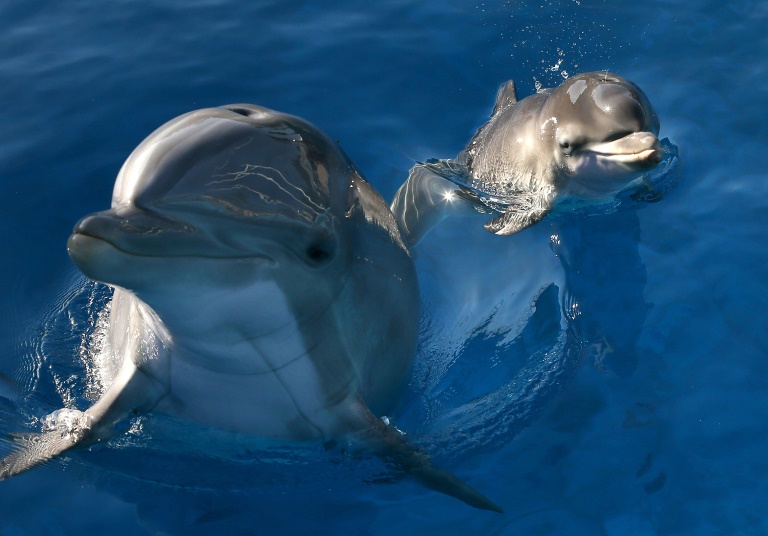
For bottlenose dolphins, it’s the taste of urine and signature whistles that allow them to recognize their friends at a distance, according to a study published Wednesday in Science Advances. 

“The use of taste is highly beneficial in the open ocean because urine plumes will persist for a while after an animal has left,” wrote the team, led by Jason Bruck at the University of St Andrews.

“By recognizing who caused a plume, dolphins would be alerted to the recent presence of that individual even if it had not signaled its presence vocally.”

The question of whether animals can attach “labels” to their friends in their minds has been difficult to answer. Prior research has focused on lab-based experiments, leaving it unclear whether animals use labeling when communicating naturally.

Bottlenose dolphins, which use “signature whistles” to selectively address specific individuals, and can remember these for over 20 years, were thus an interesting test case to study.

To investigate, the team presented eight dolphins with urine samples from familiar and unfamiliar individuals, finding they spent around three times as long sampling urine from those they knew.

Genital inspection, in which a dolphin uses its jaw to touch the genitals of another individual, is common in their social interactions, providing a good opportunity to learn the taste of others’ urine. 

For the purposes of this study, the dolphins were trained to provide urine samples on demand in exchange for food.

Dolphins do not have olfactory bulbs, and the corresponding nerve is underdeveloped, leaving the team certain it was taste and not smell at play.

Next, the team paired urine samples with recordings of signature whistles played via underwater speakers, corresponding to either the same dolphin that provided the urine sample, or a mismatched sample.

Dolphins remained close to the speaker longer when the vocalizations matched the urine samples — indicating that the two lines of evidence together evoked more interest.

The team suggested that major urinary proteins, as well as lipids, were likely responsible for individual chemical signatures.

“Given the recognition skills revealed in our study, we think that it is likely that dolphins can also extract other information from urine, such as reproductive state, or use pheromones to influence each other’s behavior,” they said.

War in Ukraine: Latest developments

Here are the latest developments in the war in Ukraine:

– More than 1,000 Mariupol fighters remain: separatist –

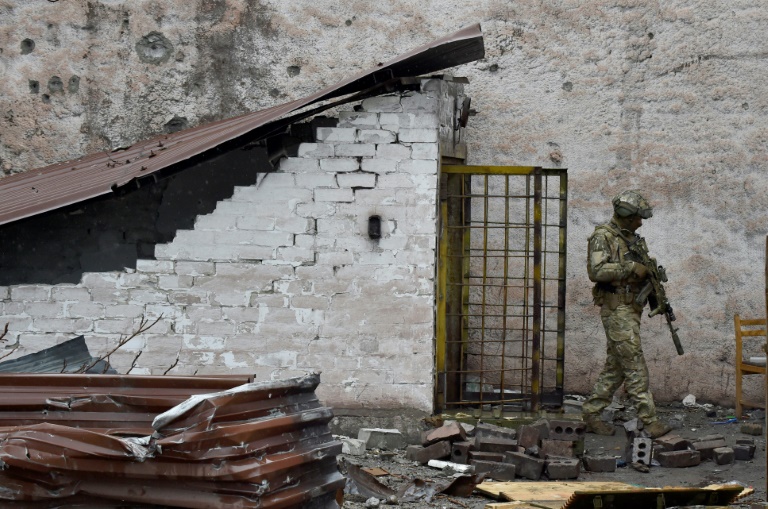
More than 1,000 Ukrainian soldiers including senior commanders, remain inside the besieged Azovstal steel plant in Ukraine’s port city of Mariupol, a pro-Russian separatist leader, Denis Pushilin, says.

Russia says that a total of 959 Ukrainian soldiers have surrendered at the plant, including 80 wounded, since Monday.

It said that the injured are being treated in a hospital in a part of the eastern Donetsk region controlled by pro-Russian rebels.

Kyiv’s defence ministry says it will do “everything necessary” to rescue the personnel still in the plant’s tunnels.

Ukraine says it hopes to exchange Azovstal fighters for Russian soldiers it is holding.

– Russian soldier pleads guilty to war crimes – 

A 21-year-old Russian soldier pleads guilty to killing an unarmed Ukrainian civilian at a war crimes trial in Kyiv, in the first such case to go to court since the start of the offensive.

Vadim Shishimarin from Irkutsk in Siberia admitted gunning down the 62-year-old man near the central village of Chupakhivka to prevent him reporting a carjacking by fleeing Russian troops.

He faces possible life imprisonment for war crimes and premeditated murder after the case heard by a district court in Kyiv.

“By this first trial, we are sending a clear signal that every perpetrator, every person who ordered or assisted in the commission of crimes in Ukraine shall not avoid responsibility,” Ukraine’s chief prosecutor Iryna Venediktova tweeted.

– Finland, Sweden submit NATO bids –

Finland and Sweden submit their bids to join NATO, sealing their decision to jettison decades of military non-alignment, despite threats of reprisals from Moscow.

NATO chief Jens Stoltenberg calls it a “historic step”. He has promised to welcome them “with open arms” while an advisor to US President Joe Biden says Washington is “confident” Turkey will overcome concerns on the membership bids.

Biden offers US support to Finland and Sweden in the event of “aggression” during the application process.

Several other NATO allies, most notably Britain, have offered security assurances and German has offered joint exercises.

NATO ambassadors meeting in Brussels fail to reach consensus on starting formal membership negotiations.

Finland, which shares a 1,300-kilometre (800-mile) border with Russia, and Sweden fear they could be future targets of Russian aggression following Moscow’s invasion of Ukraine. Public support in the two countries for NATO membership skyrocketed after the war began.

– Moscow expels dozens of diplomats –

Russia expels dozens of French, Italian and Spanish diplomats in tit-for-tat responses to the expulsion of Russian diplomats over the Ukraine conflict.

The foreign ministry says 27 Spanish, 24 Italian and 34 French diplomats have been declared “persona non grata”.

All three countries condemn the move, with Italian Prime Minister Mario Draghi calling it a “hostile act” which will make resolving the war through peaceful means more difficult.

– US reopens Kyiv embassy –

The United States reopens its embassy in Kyiv after closing it for three months due to the Russian invasion of Ukraine, the State Department says.

“The Ukrainian people, with our security assistance, have defended their homeland in the face of Russia’s unconscionable invasion, and, as a result, the Stars and Stripes are flying over the embassy once again,” Secretary of State Antony Blinken says in a statement.

– Russian fire intensifies in north –

Russian forces have intensified artillery fire on Ukrainian border settlements around the city of Sumy to the north and close to the Russian border and Chernihiv to the east of the capital over the past few weeks, the Ukrainian army is reported as saying by the Institute for the Study of War.

The shelling comes despite the Russian military having scaled back its offensive in the north to focus on the eastern Donbas region.

burs-cb-jmy/pvh

Russian pleads guilty as Ukraine holds first war crimes trial

A 21-year-old Russian soldier on Wednesday pleaded guilty to the cold-blooded murder of a Ukrainian civilian, as Kyiv began a judicial reckoning for alleged atrocities after nearly three months of war.

Ukraine’s first trial for war crimes since Russia invaded on February 24 came as President Vladimir Putin was forced to also reckon with the prospect of NATO vastly expanding its reach on his borders.

Abandoning decades of non-alignment, Finland and Sweden formally submitted a joint application to join the military alliance at its headquarters in Brussels.

US President Joe Biden expressed strong backing for the two NATO applications and offered US support in the event of “aggression” during the application process.

British Prime Minister Boris Johnson said the applications would not have been expected a short time ago, “but Putin’s appalling ambitions have transformed the geopolitical contours of our continent”.

The applications face resistance from NATO member Turkey, which accuses the Nordic neighbours of harbouring anti-Turkish extremists. 

President Recep Tayyip Erdogan demanded “respect” from NATO over his government’s concerns.

But Western allies remain optimistic they can overcome Turkey’s objections. For now, several including Britain have offered security guarantees to Finland and Sweden to guard against any Russian aggression.

On the ground, in Ukraine’s ruined port city of Mariupol, more than 1,000 Ukrainian soldiers including senior commanders remained inside the besieged Azovstal steel plant, a pro-Russian separatist leader said.

Moscow said that 959 of the troops had surrendered this week.

– ‘Beyond normal’ –

Kyiv’s defence ministry said it would do “everything necessary” to rescue the personnel still in the sprawling plant’s tunnels but admitted there was no military option available.

Those who have left Azovstal were taken into Russian captivity, including 80 who were heavily wounded, the Russian defence ministry said.

The ministry, which published images showing soldiers on stretchers, said the injured were transported to a hospital in the eastern Donetsk region controlled by pro-Kremlin rebels.

The defence ministry in Kyiv said it was hoping for an “exchange procedure… to repatriate these Ukrainian heroes as quickly as possible”.

But their fate was unclear, with Kremlin spokesman Dmitry Peskov refusing to say whether they would be treated as criminals or prisoners of war.

Putin had “guaranteed that they would be treated according to the relevant international laws”, Peskov said.

Russia’s alleged disregard for international law has played out in Ukraine with accusations — including mass rape and massacres — that are under investigation also by international bodies.

Peskov accused Kyiv of a “complete lack of will” towards peace talks, after Ukrainian negotiator Mykhaylo Podolyak said stop-start dialogue was “on hold”, having failed to yield any breakthroughs.

– ‘Clear signal’ –

Vadim Shishimarin, a shaven-headed sergeant from Irkutsk in Siberia, is expected to be the first of many prosecuted by Ukraine itself. He faces a life sentence after his guilty plea in a cramped Kyiv courtroom.

“By this first trial, we are sending a clear signal that every perpetrator, every person who ordered or assisted in the commission of crimes in Ukraine shall not avoid responsibility,” prosecutor general Iryna Venediktova said.

Russia’s government has no information on the soldier, Peskov said, adding that many such cases reported by Ukraine are “simply fake or staged”.

Shishimarin admitted to a war crime in shooting dead an unarmed 62-year-old man in Ukraine’s Sumy region four days into the invasion, as the man rode a bicycle.

The International Criminal Court is deploying its largest-ever field team to Ukraine, with 42 investigators, forensic experts and support staff being sent into the field to gather evidence of alleged war crimes.

The US State Department also announced it was creating a special unit to research, document and publicise Russian war crimes.

The United States on Wednesday also reopened its embassy in Kyiv, after closing it for three months due to the Russian invasion.

“The Ukrainian people, with our security assistance, have defended their homeland in the face of Russia’s unconscionable invasion, and, as a result, the Stars and Stripes are flying over the embassy once again,” Secretary of State Antony Blinken said in a statement.

– ‘My war is not over’ –

The Kremlin intensified a tit-for-tat round of diplomatic expulsions against European countries, ordering out dozens of personnel from France, Italy and Spain.

Despite their last-ditch resistance in places such as Mariupol, and their successful defence of Kyiv, Ukrainian forces are retreating across swathes of the eastern front.

White smoke from burning fields marks the pace of Russia’s advance around the village of Sydorove, on the approaches to the militarily important city of Slovyansk and Ukraine’s eastern administrative centre in Kramatorsk.

Meanwhile top EU officials urged member states to be ambitious in helping Ukraine rebuild after the war, including through possible joint borrowing to cover the massive costs.

“There is a time, sooner or later, when we will have to look at funding on a European scale as we did for Covid,” said Commission Vice President Frans Timmermans, at a news conference in Brussels.

Most automakers fall short on climate goals: report

Only two of the world’s 12 top automakers plan to make enough electric vehicles by 2030 to stay in step with Paris Agreement climate goals, experts said Wednesday.

Globally, more than half of all new vehicles coming off of production lines in 2029 would need to be electric for the sector to be compliant with the goal of capping global warming at 1.5 degrees Celsius above preindustrial levels, according to Influence Map, a research NGO that evaluates corporate climate goals and policies.

At the same time, 11 of the 12 carmakers — while publicly supporting the Paris Agreement — have actively opposed government policies to accelerate the shift to electric vehicles, especially the phase-out internal combustion engines, Influence Map said.

Japanese auto giants Toyota, Honda and Nissan are especially far off the mark, with non-polluting cars accounting for only 14, 18 and 22 percent, respectively, of their planned production in 2029, the report said. 

South Korea’s Hyundai, US manufacturer Ford and France’s Renault — with 27, 28 and 31 percent of their global fleets projected to be electric in seven years — were only marginally more on track.

The standout exception is US-based Tesla, a “pure player” manufacturer that has only ever made electric cars and trucks.

– Lagging behind –

“Almost all automakers are failing to keep pace with the transition to zero emissions,” said Influence Map program Manager Ben Youriev.

“Those lagging the furthest behind are also the most negative when it comes to climate policy advocacy.”

Ford, Stellantis, Volkswagen and BMW come closer to the 52 percent threshold for compatibility with Paris temperature target, with 36 to 46 percent of their fleets planned to be electric in 2029.

Besides Tesla, only Mercedes-Benz — at 56 percent — is projecting a transition in keeping with that target.

To evaluate automaker trajectories, Influence Map cross-references different datasets.

Researchers used the International Energy Agency’s (IEA) scenario for decarbonising the transport sector rapidly enough to not jeopardise the 1.5C goal, which would need 57.5 percent of all cars produced in 2030 to be electric.

The IEA’s Net Zero by 2050 report also assumes the share of renewables in global electricity generation would be about 60 percent in 2030.

The Influence Map report then compared this goal with IHS Markit production forecasts to 2029, corresponding to a 52 percent share of electric vehicles in the IEA schema. 

Collectively, the combined global production of battery electric vehicles by all automakers is forecast to only reach 32 percent by 2029.

That means the auto industry would need to boost production of zero-emission cars by 80 percent in order to hit the IEA 2030 production target.

– Impact of government policy –

The report findings reveal the critical impact of government policy on the pace of the transition away from internal combustion engines, which account for around 16 percent of global energy-related CO2 emissions, according to the UN’s Intergovernmental Panel on Climate Change (IPCC).

In the European Union, which aims to cut greenhouse gas emissions to 55 percent below 1990 levels by 2030, Toyota’s produced fleet is projected to be 50 percent electric by 2029. 

But in the United States, where fuel emissions standards are less stringent, that figure is only four percent.

Similarly, Ford’s EU-based production is forecast to be 65 percent electric by 2029 — nearly double it’s global average.

One pension fund with shares in Toyota and Volkswagen expressed concern about the Influence of the Map findings.

“As investors, we are concerned with the picture painted which confirms that some companies in the auto industry are placing themselves on the wrong side of history when actively opposing much needed climate change-related rules and regulations,” Anders Schelde, CIO of Denmark’s AkademikerPension, with $20 billion of assets under management, told AFP.

“We are also worried about Toyota scoring worst among peers on climate lobbying as the company is jeopardizing its valuable brand.”

Close Bitnami banner
Bitnami