World

Sri Lanka's embattled president escapes censure motion

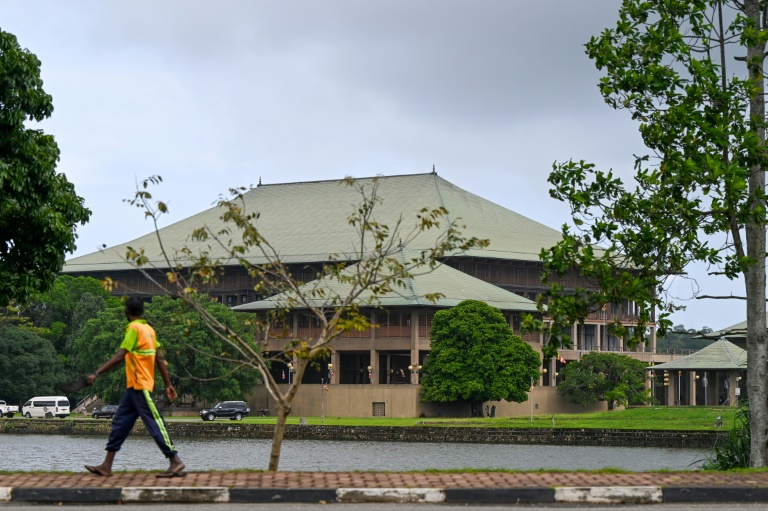
Sri Lanka’s beleaguered president side-stepped a censure motion on Tuesday after his fractured coalition rallied to delay a resolution blaming him for the country’s worst economic crisis.

Gotabaya Rajapaksa’s shaky coalition voted against taking up the unprecedented “displeasure of parliament” motion.

The non-binding motion was proposed by the main opposition Tamil party, the Tamil National Alliance, saying it echoed the demands of thousands of anti-government demonstrators who have for weeks been seeking Rajapaksa’s resignation.

Shortages of food, fuel and medicines, along with record inflation and lengthy blackouts, have brought severe hardships to Sri Lankans, in the worst financial crisis since independence from Britain in 1948.

The president’s elder brother Mahinda stepped down as prime minister last week and in a bid to defuse mounting public anger, Gotabaya appointed opposition politician Ranil Wickremesinghe to replace him.

Wickremesinghe has won crucial support from the two main opposition parties to form a “unity government” to pull the country out of the dire economic crisis, but had yet to form a full cabinet on Monday afternoon.

He was expected to name a new cabinet later, but political sources said negotiations were still underway on sharing portfolios.   

In an address to the nation Monday, Wickremesinghe said the country had run out of petrol and that the “next couple of months will be the most difficult ones of our lives”.

Most petrol stations in the capital were closed on Tuesday with long queues outside the few that were still open.

Sri Lanka had run out of dollars to finance essential imports, Wickremesinghe said, and three oil tankers were waiting off Colombo to be paid before they would unload.

The country was also out of 14 essential drugs including anti-rabies vaccines, the premier said, adding suppliers of medicines had not been paid for about four months.

Over 100,000 people missing in Mexico: data

The number of people reported missing in violence-wracked Mexico has exceeded 100,000, according to official data, with rights groups calling for “immediate” action from the government to locate the disappeared.

The country’s National Registry of Missing Persons — which has been tracking disappearances since 1964 — said that as of Monday, the whereabouts of 100,012 people are unknown. About 75 percent are men. 

Disappearances have skyrocketed in the wake of mounting drug violence that has rocked the country for 16 years.

The Movement for Our Disappeared warned Monday that the figure was “certainly well below the number” of cases that are reported daily, calling for the government to “deal with this crisis in a comprehensive and immediate manner.” 

Last April, the UN Committee against Enforced Disappearances warned that Mexico was facing an “alarming upward trend” in missing people cases.

Organized crime groups were mainly responsible for these disappearances, the UN body said, with “varying degrees of acquiescence or omission” on the part of public officials.

The lack of official help in investigating the cases has led families of the disappeared, especially mothers, to form groups that search for clandestine graves in the hope of finding their relatives.

The Mexican government has reported that around 37,000 unidentified bodies are being held in forensic services, though civil organizations warn the number could be much higher.

Authorities are working to consolidate a database of the disappeared with genetic samples, though many corpses have been buried without being identified due to the country’s overflowing morgues.

The UN’s top human rights body said the disappearances represented a “human tragedy of enormous proportions.”

“No effort should be spared to put an end to these human rights violations and abuses of extraordinary breadth, and to vindicate victims’ rights to truth, justice, reparation and guarantees of non-repetition,” said UN High Commissioner for Human Rights Michelle Bachelet.

The first reported disappearances in Mexico date back to the authorities’ so-called “dirty war” against leftist movements from the 1960s-1980s.

Mexico has also registered over 340,000 deaths — mostly attributed to organized crime groups — since 2006, when a major anti-drug military offensive was launched.

Indian insurance giant slumps after country's biggest-ever IPO

Indian state-owned insurance giant LIC slumped on its market debut Tuesday following the country’s biggest-ever initial public offering, closing nearly eight percent below the IPO price.

Prime Minister Narendra Modi’s government raised $2.7 billion by selling 3.5 percent of Life Insurance Corporation of India as his administration seeks to sell off state assets to bolster tattered public finances.

But it was forced to cut back the offer from a planned five percent after markets turned volatile following Russia’s invasion of Ukraine and China’s Covid lockdowns.

The offer price of 949 rupees ($12.22) had valued LIC at $77 billion, but the stock traded under pressure all day, closing 7.75 percent lower at 875.45 rupees a share.

The muted debut could test market appetite as Modi seeks to privatise more shares in nationalised companies to plug an estimated 16.6 trillion rupee ($214 billion) fiscal deficit.

Market analyst Arun Kejriwal said the slump on LIC’s first day of trading was a “learning” experience, adding that the government will have to do more to convince investors if it wants to sell more of its stake.

But the IPO saw enthusiastic participation from small investors — including many first-timers — and was oversubscribed nearly three times.

“I knew it won’t be a great listing but it doesn’t matter to me,” said 30-year-old Ayush, a recent market entrant, who was unbowed by the decrease in share price.  

“I bought the shares for the long-term.”

Global equities have been tumultuous for most of 2022. Foreign investors have withdrawn a net 1.71 trillion rupees ($22 billion) from Indian markets so far this year, stock exchange data showed, as US monetary policy tightening further roiled sentiment.

– Synonymous with life insurance –

India was heavily regulated for decades after independence, and the state still retains an outsize role in the economy.

Hundreds of companies are owned by national or lower-level governments, operating in fields ranging from mining and resources to electricity and construction.

Modi has pledged to “monetise and modernise” the sometimes moribund sector, and the insurance giant’s IPO followed a years-long effort by bankers and bureaucrats to appraise the mammoth firm and prepare it for listing.

Founded in 1956 by nationalising and combining more than 240 firms, LIC was a monopoly until private companies were allowed to enter the market in 2000.

It continues to lead the pack with a 61 percent market share and an army of 1.3 million “LIC agents” giving it huge reach, particularly in remote rural areas.

But its dominance has declined steadily in the face of competition from net-savvy private insurers offering specialised products.

The firm warned in its regulatory filing that “there can be no assurance that our corporation will not lose further market share” to private companies.

– ‘Enormous’ potential –

In a country where only three percent of the 1.4 billion population has life insurance, analyst Kejriwal said LIC’s potential remains “enormous”. 

“It has actually bounced back in the last two-three years. And Covid has seen a turnaround in the fortunes of LIC,” he told AFP, pointing to its digitisation efforts.

Going public will also force more transparency on the insurance behemoth.

“The IPO is going to galvanise LIC into being much more effective than it was,” Kejriwal added.

LIC is also India’s largest asset manager, with 39.55 trillion rupees under management as of September 30, including significant stakes in Indian blue chips such as Reliance and Infosys.

LIC’s real estate assets include vast offices at prime urban Indian locations, including a 15-storey office in Chennai that was once the country’s tallest building.

The firm is also believed to own a large collection of rare and valuable artwork that includes paintings by MF Husain — known as the Pablo Picasso of India — although the value of these holdings has not been made public.

Kyiv seeks Azovstal rescue after hundreds of fighters 'surrender'

Ukrainian authorities were seeking to extract the last defenders of the Azovstal steelworks in Mariupol on Tuesday, as Russia said hundreds of soldiers who left in an earlier operation had surrendered.

Moscow claimed control of the strategic port city of Mariupol last month after a weeks-long siege, but hundreds of Ukrainian soldiers remained holed up in underground tunnels beneath the huge Azovstal industrial zone, blocked by Russian troops.

Russia’s defence ministry said 265 Ukrainian soldiers had surrendered at the site, including 51 wounded who were taken to a hospital in a part of the eastern Donetsk region controlled by pro-Kremlin rebels.

Ukraine’s defence ministry previously said 264 Ukrainian fighters were evacuated to Russia-controlled territory, including 53 who were “heavily wounded”.

In an update on Tuesday morning, it said an “exchange procedure will be carried out to repatriate these Ukrainian heroes as quickly as possible”.

It added that for those still holed up in Azovstal, Kyiv was doing “everything necessary for their rescue” but said that “unfortunately, Ukraine today cannot unblock Azovstal by military means”.

The ministry hailed their contribution to the wider fight following Russia’s invasion of Ukraine on February 24, which has left thousands dead and sent millions fleeing.

“Thanks to the defenders of Mariupol, Ukraine received vital time to accumulate reserves, regroup and mobilise forces and receive assistance from allies,” it said.

Holding the steelworks had delayed the transfer of 20,000 Russian troops to other parts of Ukraine and stopped Moscow from quickly capturing the southern city of Zaporizhzhia, the Ukrainian army said.

– Trying to stay alive –

Despite the resources of its giant neighbour, Ukraine has managed to repel the Russian army for longer than many expected, fortified by weapons and cash from Western allies.

After circling the capital Kyiv in the early weeks of the war, Moscow has focused increasingly on the eastern region of Donbas, bordering Russia.

Ukrainian officials say Russian troops are withdrawing from around Kharkiv, the country’s second-largest city, to be redeployed to Donbas, and Kyiv on Monday claimed control of territory on the border.

The area around Kharkiv has been under constant attack and Kyiv’s gains have come at a high cost, with villages gutted and destroyed by bombs.

In Ruska Lozova, just north of Kharkiv, Rostislav Stepanenko recounted to AFP how he survived shelling in his village, caught in the firing line between Russian and Ukrainian forces.

He had gone back to collect some belongings but returned empty-handed and stunned by the incessant artillery fire.

Asked what he did for a living, he joked that he was “trying to stay alive”.

And his age? “Hopefully, I will be 54, but today I wouldn’t expect that,” he said with a nervous smile.

– ‘Shelling without stopping’ –

“The armed forces of Ukraine are repelling constant attacks in those areas where Russia is still trying to advance,” President Volodymyr Zelensky said in his nightly address on Monday.

“Severodonetsk and other cities in Donbas remain the main targets for the occupiers.”

Taking Severodonetsk, the easternmost city held by Ukrainian forces, would grant the Kremlin de facto control of Lugansk, one of two regions — along with Donetsk — that comprise Donbas.

Lugansk regional governor Sergiy Gaiday has said Russian troops were “shelling Severodonetsk without stopping” and early on Tuesday he said two buildings at the city’s general hospital had been hit overnight.

“We have 10 dead and three wounded in the region,” he wrote on Telegram. 

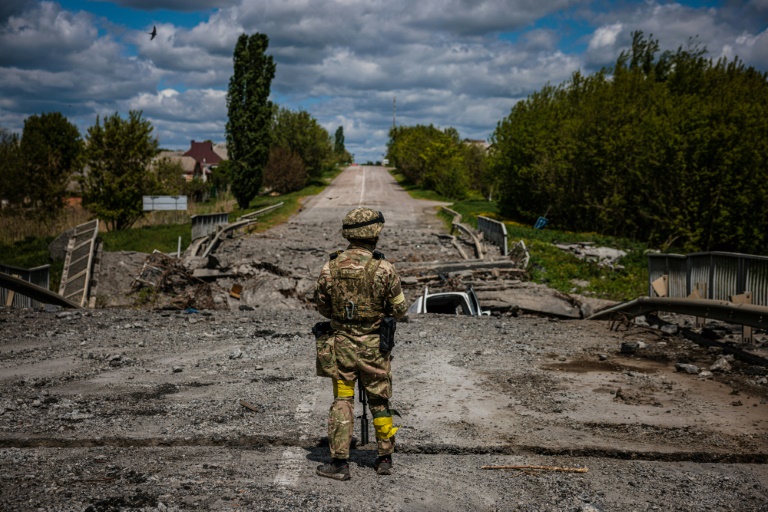
However, Russia’s attempt to completely encircle Severodonetsk has been repelled, with Ukrainian forces blowing up railway bridges to slow their advance.

Gaiday said on Tuesday that the Russians had been forced to withdraw from assaults on Girske and Sirotyne, near Severodonetsk.

Russian shelling continued across the whole country overnight, with air sirens heard throughout Ukraine in the early hours of Tuesday.

“Today is a bad morning in Chernigiv region,” an official from the northern area’s Regional Military Administration wrote on Telegram on Tuesday. 

“Early in the morning, the enemy fired missiles at the village of Desna… We have dead and many wounded.” 

To the west, an official from Lviv’s Regional Military Administration said a military infrastructure facility “almost on the border with Poland” had been hit.

The army’s southern operational command said Odessa and Mykolaiv had also been struck and that there had been victims in both cities. 

– NATO bids ‘no direct threat’ –

Fearful of Russian aggression, European Union nations Sweden and Finland — which shares a long border with Russia — are poised to give up decades of military non-alignment and join the NATO alliance. 

Russian President Vladimir Putin said on Monday the move posed “no direct threat for us … but the expansion of military infrastructure to these territories will certainly provoke our response”. 

Putin’s reaction was more moderate than comments made earlier on Monday by deputy foreign minister Sergei Ryabkov, who had called the expansion a “grave mistake with far-reaching consequences”. 

The move is not a done deal. Turkish President Recep Tayyip Erdogan on Monday confirmed his country’s intention to block the applications, accusing Finland and Sweden of harbouring terror groups, including outlawed Kurdish militants.

Any membership bid must be unanimously approved by NATO’s 30 nations.

But US Secretary of State Antony Blinken voiced confidence on Sunday that Sweden and Finland would join NATO and is due to meet Turkish Foreign Minister Mevlut Cavusoglu in Washington on Wednesday.

– ‘Time is running out’ –

EU foreign ministers met on Monday to discuss their own attempt to up the pressure on Russia by adding a ban on Russian oil to already unprecedented economic sanctions.

The oil proposal has so far been blocked by Hungary over the cost.

“We are unhappy with the fact that the oil embargo is not there,” Ukraine’s top diplomat Dmytro Kuleba said afterwards.

“It’s clear who’s holding up the issue. But time is running out because every day Russia keeps making money and investing this money into the war.”

Togo reopens its borders after two years

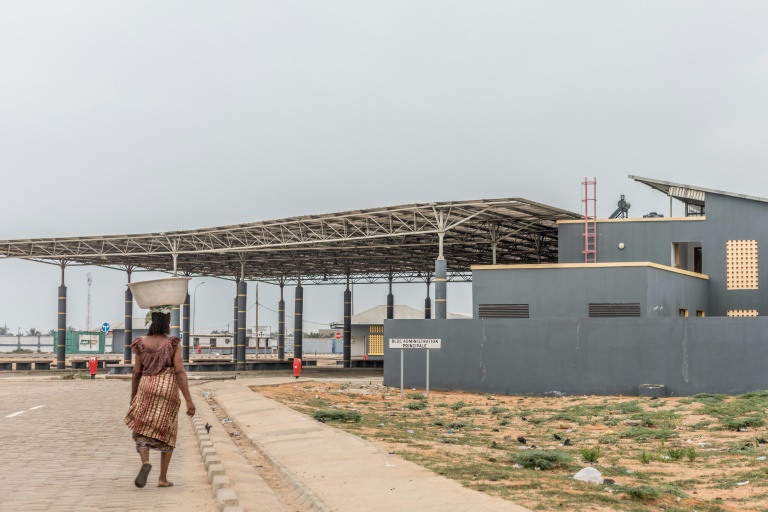
The West African state of Togo said it would reopen its land borders on Tuesday after closing them more than two years ago to help prevent the spread of coronavirus. 

The country recorded only 32 cases so far this month, with zero deaths. 

“Considering the slowdown in cases of Covid-19, all of our land borders will reopen starting on Tuesday 17 May at 00:00 GMT,” the government said in a statement late on Monday.

“Free movement can resume as long as travellers present a proof of vaccination,” it added. 

Togo’s neighbours are Burkina Faso to the north, Ghana to the west and Benin to the east.

The authorities called however for “vigilance” and “continued adherence to preventive measures.”

The government also said the vaccination campaign, which started in March last year, should continue.

At the end of April, 32 percent of the country’s adult population was fully vaccinated according to official data.

Civil society groups and opposition parties had been calling for a relaxation of measures in recent months, as the number of Covid-19 cases plummeted. 

Togo’s land and air borders were closed in March 2020, although the air borders reopened in August that year. The sea borders were never closed.

Last August, some youths protested at the border with Ghana, asking for borders to reopen and trade to resume. 

Since the start of the pandemic, Togo has recorded 37,023 cases of which 273 were fatal. 

Asian stocks rally on hopes of Shanghai gradually reopening

Hong Kong led a rally across Asian markets Tuesday on hopes that China’s economic engine Shanghai will ease its weeks-long lockdown and gradually reopen businesses, though analysts cautioned there may be little long-term relief. 

Much of the city of 25 million has been under stay-at-home orders since April as Beijing attempts to stamp out an Omicron-fuelled virus surge under its strict zero-Covid policy.

Shanghai Vice Mayor Chen Tong said Sunday that the city would gradually reopen businesses starting this week. 

Though no details were given and residents were still in their homes on Tuesday, Asian markets cheered the announcement.

“Hopes that the Shanghai lockdowns will ease, along with the ensuing supply chain disruptions, have been enough to lift Asian equities as well, which are staging a modest bounce,” said Jeffrey Halley of OANDA.

Tuesday’s rally coincided with the third day in a row that Shanghai recorded no Covid-19 cases outside of its quarantine facilities, he said. 

“We should continue watching the headline ticker for daily Omicron cases. Most especially, in Shanghai, where if literally one case appears again, any relief rally in Chinese markets could disappear in a puff of smoke.”

The impact of Beijing’s zero-Covid strategy on the world’s second-largest economy was revealed Monday when official data showed retail sales and industrial production in April on-year had slumped to their lowest levels in more than two years.

World markets have also been roiled by surging inflation and Russia’s war in Ukraine — leaving investors jittery.

“Markets remain in fight or flight mode while rolling the dice on recession odds,” Stephen Innes of SPI Asset Management said.

“Investors’ hopes remain elevated that yesterday’s worse than expected Chinese outruns could prove to be a ‘whatever it takes’ moment, and local policymakers will step hard on the stimulus pedal.”

China has announced measures to help young people find jobs, with the urban unemployment rate at its highest in over two years, and officials have lowered the mortgage rate for first-time homebuyers.

On Tuesday Hong Kong closed higher by more than three percent, while mainland China’s two indices — the Shanghai Composite Index and Shenzhen Composite Index — also saw a bounce.

Manila, Singapore, Seoul, and Sydney were also in positive territory all day.

European markets followed the lead, with Frankfurt, Paris and London all trading up at opening. 

– Commodities concerns –

In commodities trade, wheat prices soared to a record after major producer India banned exports because of a heatwave hitting production.

New Delhi said the move was needed to protect the food security of its 1.4 billion people in the face of lower production and steep global prices.

Worldwide wheat prices had already surged on supply concerns after Russia’s February invasion of agricultural powerhouse Ukraine, which previously accounted for 12 percent of global exports.

By Monday’s close of the Euronext market, the price of wheat had jumped to 438.25 euros ($456.68) per tonne, breaking the previous closing record of 422.40 struck on March 7, according to trader Damien Vercambre at grains brokerage Inter-Courtage.

Oil also jumped overnight, and by Tuesday US crude benchmark WTI hovered around $114 a barrel. 

“The EU’s rising tensions with Russia and the resulting uncertainties over the bloc’s oil and gas supply remain front and centre,” Vandana Hari, founder of Vanda Insights in Singapore, told Bloomberg.

“Having said that, with a $10 jump since last Tuesday, it’s hard to see much more upside in crude unless events take a sudden turn for the worse.”

– Key figures at around 0900 GMT –

Hong Kong – Hang Seng Index: UP 3.3 percent at 20,602.52 (close) 

Shanghai – Composite: UP 0.7 percent at 3,093.70 (close)

London – FTSE 100: UP 0.6 percent at 7,509.81

Tokyo – Nikkei 225: UP 0.4 percent at 26,659.75 (close)

West Texas Intermediate: UP 0.2 percent at $114.44 per barrel

Brent North Sea crude: UP 0.3 percent at $114.60 per barrel

Euro/dollar: UP at $1.0479 from $1.0436 at 2030 GMT Monday

Pound/dollar: UP at $1.2481 from $1.2323

Euro/pound: DOWN at 83.97 pence from 84.67 pence

Dollar/yen: UP at 129.26 yen from 129.08 yen

New York – Dow: UP 0.1 percent at 32,223.42 (close)

— Bloomberg News contributed to this story —

Shanghai says 'zero-Covid' achieved but millions still in lockdown

Shanghai on Tuesday declared it had achieved “zero-Covid” across all its districts, sparking derision on social media as millions in China’s biggest city remained under lockdown.

Confronted with its worst outbreak since the beginning of the pandemic, China — the last major economy still closed off to the world — put the city of 25 million under heavy restrictions in early April.

The government’s insistence on squashing the Omicron-variant-driven outbreak prompted rare protests and angry scuffles with authorities as Shanghai residents reject the prolonged confinement and food shortages.

“All 16 districts of Shanghai have already achieved zero-Covid at the community level,” Shanghai health commission official Zhao Dandan told reporters on Tuesday.

That means none of the over 1,000 new infections recorded on Tuesday was detected outside of quarantined areas, city authorities said.

China’s strategy to achieve zero Covid cases includes strict border closures, lengthy quarantines, mass testing and rapid, targeted lockdowns.

Vice mayor Chen Tong said on Sunday that the city would gradually reopen businesses starting this week, without giving specifics.

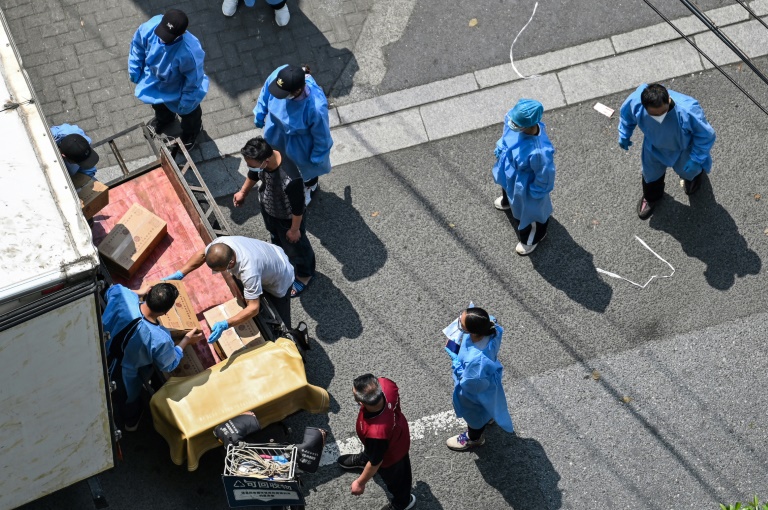
But millions in Shanghai were still unable to leave their residential compounds on Tuesday.

More than 3.8 million people were officially still under the strictest forms of lockdown in the city, according to official figures.

Social media erupted in disbelief at the gap between official statements and the reality of life under an enduring lockdown.

“Since society has reached Covid-zero, why are people in Songjiang district still only allowed to go out once every two days?” a blogger on the Twitter-like Weibo asked.

“Is this a parallel universe Shanghai?” asked another.

In some areas of the city, restrictions have even been quietly tightened in recent days. 

Live video broadcast Tuesday by Chinese media showed crowds gathering at Shanghai’s Hongqiao Railway Station as train services leaving the city resumed.

Meanwhile, multiple airlines resumed domestic flights out of Shanghai this week after nearly all routes out of the city were suspended during the outbreak.

People are only allowed to leave Shanghai after receiving permission and taking multiple Covid tests.

– Economic slowdown –

China has shown no sign of giving up its protracted struggle to maintain zero Covid cases, despite the mounting economic costs of miserable retail, house and car sales and climbing unemployment.

The country kept cases low for much of the pandemic through its strict strategy, but the surge in Omicron cases in recent months has raised questions about zero-Covid’s sustainability.

Chinese health officials on Monday said they had detected the country’s first case of the highly transmissible Omicron subvariant BA.2.12.1 — already widespread in countries including the US — in a traveller arriving from Kenya.

Beijing is mass testing residents almost every day after a surge in cases — counted in the dozens each day but still enough to prompt tight restrictions on movement and association.

Millions of people in the capital have been ordered to work from home and transport services have been suspended with people fearing a repeat of Shanghai’s lockdown chaos.

Tightened Covid rules on Beijing’s university campuses also provoked a rare show of defiance from angry students over the weekend, with hundreds gathering outside one Peking University dormitory to protest new movement restrictions. 

The recent lockdowns dragged retail sales and factory output in the country down in April to their lowest level since March 2020, with analysts warning that disruptions could extend into the summer.

Sandstorm blankets Saudi capital in grey haze

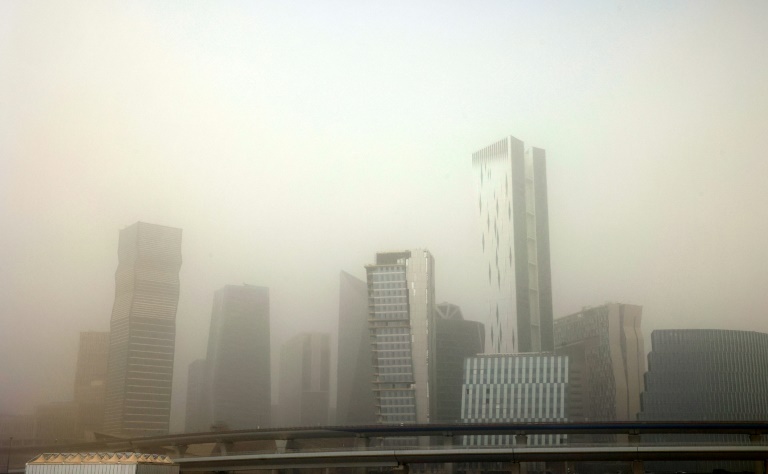
A sandstorm engulfed Saudi Arabia’s capital and other regions of the desert kingdom Tuesday, hampering visibility and slowing road traffic.

A thick grey haze made iconic Riyadh buildings such as Kingdom Centre nearly impossible to see from more than a few hundred metres (yards) away, though there were no announced flight delays or cancellations. 

The kingdom’s meteorology centre forecast “surface dusty winds” in the country’s east and in Riyadh, “reducing horizontal sight”, according to the official Saudi Press Agency.

Dusty conditions were also expected farther west in the holy cities of Mecca and Medina, according to the forecast.

Electronic signs along Riyadh’s highways warned drivers to reduce their speed because of the lower visibility. 

In central Riyadh, sand layered cars and buildings, and residents struggled to keep it out of their homes.

“Working outside is very difficult because of the dirt,” a Pakistani construction worker who gave his name as Kalimullah told AFP as he installed tiles.

“I try to wash my face from time to time,” the 30-year-old added, wrapping a piece of cloth around his face to block the sand. 

Saudi office worker Abdullah Al-Otaibi said he was grateful he works indoors. 

“Dust storms are part of our culture and we are used to it, but some of them are severe,” said Al-Otaibi, 39, rubbing his eyes as he hurried into his office building. 

Parts of Saudi Arabia typically see sandstorms between March and May, with varying intensity. The frequency of the storms has increased in recent months in the region. 

Neighbouring Iraq has experienced eight sandstorms since mid-April, a phenomenon fuelled by soil degradation, intense droughts and low rainfall linked to climate change.

In Iran on Tuesday, government offices and schools and universities were closed in many provinces due to “unhealthy weather” and sandstorms, state media reported.

ht-rcb/th/fz

Hezbollah lose ground, reformists surge in Lebanon polls

Shiite group Hezbollah and its allies lost their majority in Lebanon’s parliament, official results showed Tuesday, while independents achieved a surprise breakthrough.

Full results announced by the interior ministry two days after the election revealed that no bloc will control the 128-seat assembly, a deadlock observers fear could usher in a tense period of political jostling.

The polls, the first since Lebanon was ravaged by its worst ever economic crisis and a cataclysmic explosion at Beirut port in 2020, were seen as a prerequisite for a crucial IMF bailout.

The Iranian-backed Hezbollah and its main allies had the support of around 70 lawmakers in the outgoing parliament but will now fall just short of the 65 seats needed to retain a majority.

Their strongest opponents in parliament will be led by the Christian Lebanese Forces party of former warlord Samir Geagea, that raked in several new seats on the back of a virulent anti-Hezbollah campaign.

New reformist faces who entered the legislative race on the values of a 2019 anti-establishment uprising made a stronger showing that many had predicted.

At least 13 independents who backed the 2019 protest movement won seats. Twelve of them will sit in parliament for the first time.

Together with independents and other non-aligned MPs who have sometimes supported the now-defunct protest movement’s demands, they could find themselves in a kingmaking position.

– Breakthrough –

Analyst Ziad Majed said that the economic context could play in favour of reformists who will for the first time be pushing from within parliament, not just as outsiders.

“This will create political and popular pressure for reformists and forces of change to cooperate,” he said.

One of the most notable victories notched up by independents was the election in southern Lebanon of Elias Jradeh and Firas Hamdan for seats that Hezbollah and its allies had not lost in three decades.

Another major satisfaction for those described in Lebanon as the “thawra” (revolution, in Arabic) candidates, was the defeat of several reviled MPs loyal to the Syrian government of Bashar al-Assad.

In what was interpreted by independents as a gesture of spite by Hezbollah, a group of youths on scooters descended on Martyrs Square overnight and burned down the “revolution fist”.

The temporary monument had become a visual symbol of the secular protests that swept Lebanon in October 2019 and had raised hopes of democratic change.

The movement lost momentum as Lebanon’s ruling cartel of sectarian political barons bided their time and one of the sharpest economic downturns of our time muffled popular discontent.

The parliamentary elections were a first major test for those in the protest camp who chose to enter the political fray.

Hezbollah and its ally Amal retained all 27 parliament seats reserved for Shiite lawmakers but other allies lost ground.

The Free Patriotic Movement of Lebanese President Michel Aoun, which has had an alliance with the Shiite bloc since 2006, lost a few seats.

– Crisis ahead? –

The main issue that polarises parliament is Hezbollah’s right to keep an arsenal that is often described as equivalent to or better than the state’s.

Some see it as a historical right and the best defence for the small Mediterranean country while others consider Hezbollah’s weapons to be the root of all of Lebanon’s ills.

Sami Nader, an analyst with the Levant Institute for Strategic Affairs, said that Hezbollah had suffered symbolic losses but was sceptical the polls could yield radical changes.

“Hezbollah and the Iranian axis took a blow but will this pave way for change in Lebanon? I have doubts,” he told AFP.

The formation of a government, the election of parliament’s speaker and the presidential election could all be very contentious and lead to protracted political crises.

Speaker Nabih Berri has held his job since 1992.

President Michel Aoun, the world’s third oldest head of state, had long planned for his son-in-law Gebran Bassil to take over but the Lebanese Forces’ surge in the polls could disrupt that scenario.

Lebanon shares power among its religious communities, and politics is often treated as a family business. By convention, the president is a Maronite Christian, the premier a Sunni Muslim, and the parliamentary speaker a Shiite.

Ukrainian town of New York comes under Russian assault

The four-year-old recognised the low whistle of the Russian artillery shell hurtling toward the Ukrainian town of New York long before his mother had a chance to grab his hand.

“Here comes one,” the boy said matter-of-factly a few long moments before the blast of an exploding building echoed across the small town with the big American name.

His exhausted 28-year-old mother did not even bother to duck.

Valeria Kolakevych has heard so many shells whizz overhead in the third month of Russia’s offensive that she knows instinctively how close each will land while it is still in the air.

“It was terrible,” Kolakevych said, without skipping a beat in her story about a round of fire that had badly damaged four neighbouring houses the previous night.

“And the most terrible thing is that there was nothing there — just civilians,” she said as another artillery shell blew something up near the upper end of the hilly street.

The second impact forced her 11-year-old daughter to utter a soft yelp and cover her ears. The little boy followed his sister’s lead and hunched closer to the ground.

Kolakevych took her children’s hands and walked off as more blasts rang out from fields that once made up the de facto border between government territory and lands overseen by Moscow-backed insurgents in Ukraine’s industrial east.

– Shooting from three sides –

Russia’s February 24 invasion has reignited fighting along fronts that froze over once Ukraine’s eight-year separatist conflict in the east settled into a dreary stalemate after claiming 14,000 lives.

Russia initially prioritised seizing Kyiv and Ukraine’s second city of Kharkiv in the north.

Setbacks in both have put the onus on Russian and pro-Kremlin separatist forces to break through from a southern flank that stretches from Crimea to the destroyed city of Mariupol further east.

This has spelled trouble for New York — a town of 10,000 mostly Russian speakers that attempted a fresh start last year by dropping its Soviet name Novgorodske and adopting one first chosen by its German settlers in the 1800s.

Locals say there’s no record of how the town first got its name. It was changed under the Soviet Union in 1951 and back again last year after an activist campaign.

Residents say artillery fire began pelting New York a month ago and has grown heavier by the day.

“It is getting really bad. There was a bit of shooting here and there before but it did not really bother us,” seamstress Valentyna Kanebalotskaya said while moving her belongings to her daughter’s house in a slightly safer part of town.

“But now they are shooting at us from the west, east and south,” the 71-year-old said.

– Abandoned military base –

Ukraine’s stretched forces are sending in their biggest guns and toughest units to hold off a Russian advance on two important cities in the northeastern corner of the front.

But the Ukrainian military presence verges on non-existent within the confines of New York itself.

A naked mannequin inexplicably stands next to the open door of an abandoned military base filled with sandbags on one of the town’s main roads.

A few forlorn soldiers appear to represent the main defence of a central square that has been bombed repeatedly in the past week.

“You see that crater — a Russian jet did that,” a soldier who agreed to be identified as Oleksandr said, showing off a yawning hole in the dirt road.

Behind it stood the broken frame of a large factory and a chain of other ruined buildings comprising the town’s industrial district.

– Chemical danger –

Oleksandr’s main worry is that the Russians might accidentally hit a neighbourhood plant that manufactures a raw material for paints and plastics called phenol.

“That is a very frightening thing. Just one direct hit and it would react like a chemical weapon,” the 36-year-old soldier said.

“It rolls along the ground and its consequences are very tragic.”

Both sides have accused the other of planning chemical attacks — a charge that appears at least partially aimed at deflecting blame in case someone accidentally hits a hazardous site with stray fire.

Yet residents appear more worried about more immediate problems, such as a lack of running water and gas. Some of the Russian speakers even blame the artillery attacks on Ukraine.

“The Ukrainians come in to fire from the hills here and then leave. And then all of us get shelled,” said pensioner Yelena Valeryanova.

She and many other Russian speakers use patronymics instead of last names when talking to reporters out of fear of retribution from local Ukrainian officials.

“The Donetsk (separatists) treat us better,” she said.

Close Bitnami banner
Bitnami