World

UAE's ailing President Sheikh Khalifa dies aged 73

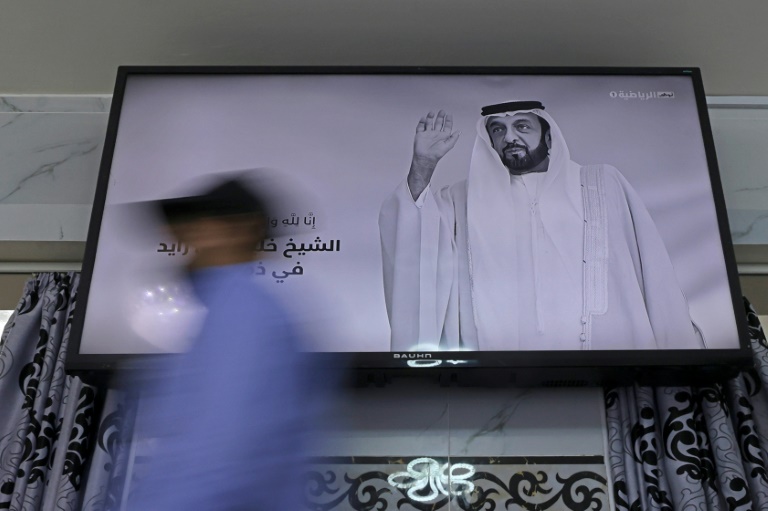
UAE President Sheikh Khalifa bin Zayed Al-Nahyan died Friday aged 73 after a years-long battle with illness, triggering a period of mourning and a handover of power in the oil-rich Gulf state.

Sheikh Khalifa, who was in office during a time of rocketing fortunes for the United Arab Emirates but was rarely seen in public, was laid to rest in Abu Dhabi’s Al Bateen Cemetery just hours after his death was announced, in accordance with Muslim tradition.

Sheikh Khalifa’s funeral prayers were conducted by his expected successor and half-brother Mohamed bin Zayed, who has long been viewed as the country’s de facto ruler.

“The people of the Emirates are united in grief as we mourn the loss of our leader and President, Khalifa bin Zayed,” tweeted Mohamed bin Zayed, often known as “MBZ”.

The most visible testament to Sheikh Khalifa is the world’s tallest building, Dubai’s Burj Khalifa, which was renamed after he bailed out the debt-hit emirate when the global financial crisis struck in 2009.

Flags flew at half-mast above the interior ministry in Abu Dhabi and other landmarks at the start of 40 days of official mourning, with work suspended in the public and private sectors until Tuesday.

Emirati men in traditional dress attended sombre funeral prayers at Abu Dhabi’s enormous, white-marble Sheikh Zayed Grand Mosque, where the imam’s voice brimmed with emotion over the loudspeaker.

As tributes poured in from abroad, US President Joe Biden called Sheikh Khalifa “a true partner and friend of the United States”. Neighbouring Saudi Arabia suspended sports and entertainment events and Oman, Lebanon and Kuwait also ordered three days of mourning.

In a demonstration of the UAE’s diverse allegiances, Russian President Vladimir Putin also paid tribute, as did Iran’s foreign minister and Israeli Prime Minister Naftali Bennett.

Sheikh Khalifa took over as the UAE’s second president in November 2004, succeeding his father as the 16th ruler of Abu Dhabi, the richest of the federation’s seven emirates.

He has made few public appearances since 2014, when he had surgery following a stroke, although he has continued to issue rulings. 

The cause of death was not immediately released.

– Frail figure –

The UAE, a former British protectorate that was founded in 1971, has gone from desert outpost to booming state in its short history, fuelled by its oil wealth and Dubai’s rise as a trading and financial centre.

The Arab world’s second-biggest economy behind Saudi Arabia is now wielding growing political influence, filling a space ceded by traditional powers such as Egypt, Iraq and Syria.

The country of about 10 million also joined military campaigns in Libya and Yemen and broke ranks with much of the Arab world to establish ties with Israel in 2020.

As the changes unfolded, the bearded Sheikh Khalifa had cut a frail figure on his occasional public appearances, while his half-brother hosted world leaders and led diplomatic forays abroad.

Sheikh Khalifa, who had no formal higher education, came to the rescue of Dubai when it was hit by the global financial crisis, extending a multi-billion-dollar lifeline to the emirate.

Dubai’s ruler, UAE Vice President Sheikh Mohammed bin Rashid Al-Maktoum, said the country mourned “with hearts filled with sadness”.

The emir of Qatar — which was blockaded by the UAE, Saudi Arabia and other states in a three-and-a-half-year crisis until January 2021 — offered his condolences, as did British Prime Minister Boris Johnson and French President Emmanuel Macron.

In Saudi Arabia, the UAE’s powerful neighbour and closest ally, King Salman ordered funeral prayers at Mecca’s Great Mosque and the Prophet’s Mosque in Medina.

Saudi’s de facto ruler Crown Prince Mohammed bin Salman, who was regarded as a protege of Mohamed bin Zayed, phoned him with his condolences.   

The official WAM news agency named Mohamed bin Zayed as the new ruler of Abu Dhabi, and said the leaders of the other emirates would meet him at the capital’s Al Mushrif Palace on Saturday.

The leaders of the seven emirates elect the UAE’s president for five-year, renewable terms, according to the country’s constitution.
Georgia's breakaway region to hold referendum on joining Russia in July: leader

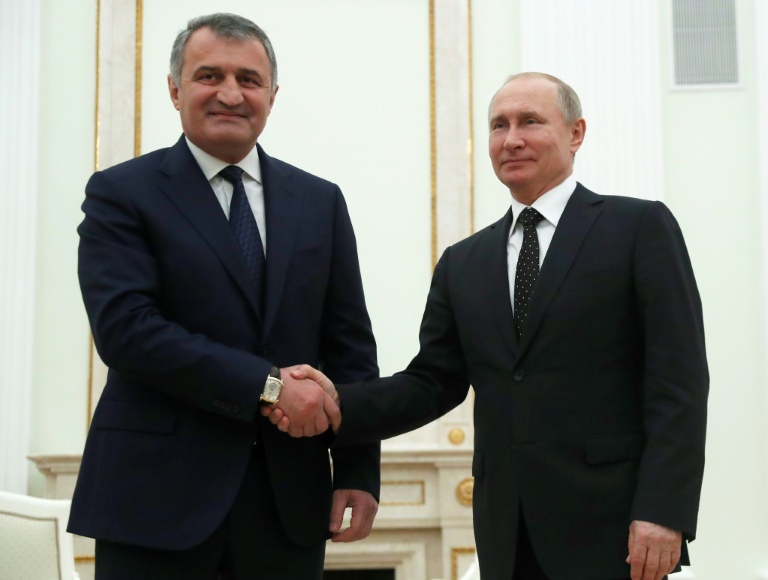
The leader of Georgia’s breakaway region of South Ossetia on Friday set July 17 as a date for a referendum on joining Russia.

“Anatoly Bibilov signed a decree on holding a referendum in the Republic of South Ossetia,” his office said in a statement, citing his people’s “historic aspiration” to join Russia.

South Ossetia was in the centre of the Russian-Georgian war in 2008 after which the Kremlin recognised the territory — along with another separatist region, Abkhazia — as an independent state and stationed military bases there.

The announcement came on the 79th day of Russia’s military campaign in Ukraine, with thousands killed and more than six million people fleeing the pro-Western country.

Ukraine’s separatist regions of Donetsk and Lugansk have also expressed interest in joining Russia.

The full-scale offensive on Ukraine has sparked an outpouring of solidarity in Georgia.

Georgia has previously denounced as “unacceptable” plans by South Ossetia to hold a referendum on joining Russia.

In August 2008, Russia launched an assault against Georgia which was battling pro-Russian militia in South Ossetia, after they shelled Georgian villages.

The fighting ended five days later with a European Union-mediated ceasefire but claimed more than 700 lives and displaced tens of thousands of ethnic Georgians.

Pentagon chief urges 'immediate' Ukraine ceasefire in call with Russian counterpart

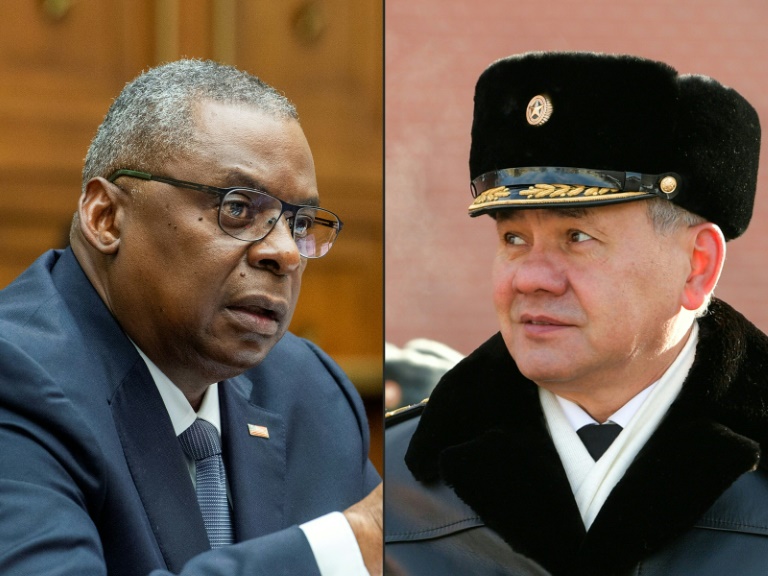
US Defense Secretary Lloyd Austin urged an immediate ceasefire in Ukraine Friday in talks with Russian Defense Minister Sergei Shoigu, but their first call since the war began resolved no immediate issues, the Pentagon said.

Shoigu spoke with Austin at the Pentagon chief’s request for about an hour, their first direct discussion since February 18, six days before Russia invaded Ukraine.

“Secretary Austin urged an immediate ceasefire in Ukraine and emphasized the importance of maintaining lines of communication,” the Pentagon said in a statement.

The Russian Defense Ministry confirmed the call, saying the two sides discussed current international security issues, “including the situation in Ukraine.”

No other details were offered officially by either side, but a senior US defense official dampened expectations that any progress was made on the war situation beyond the reopening of a crucial line of communication between Moscow and Washington.

“The call itself didn’t specifically solve any acute issues or lead to a direct change in what the Russians are doing or what they are saying,” the official said.

The official added that the US call for a ceasefire was not a change in US policy toward the war, even as Washington has said it wants to support Ukraine with arms and funding in a longer effort to weaken the Russian military.

“Our call for a ceasefire is very much in line with what other allies and partners want to see happen,” the official said.

French President Emmanuel Macron recently urged the two sides to negotiate a settlement.

On Friday German Chancellor Olaf Scholz asked Russian President Vladimir Putin in a call to agree to a ceasefire and negotiations, according to his office.

Scholz called for a ceasefire “as soon as possible to improve the humanitarian situation and make progress in the search for a diplomatic solution to the conflict,” his office said.

The call also came as Finland and Sweden have expressed the desire to join the NATO defense alliance, a direct consequence of Russia’s attack on Ukraine, which is not part of NATO.

Neither side would say whether NATO’s expansion, which Russia has opposed, was discussed in the defense chiefs’ call.

At the UN Security Council Friday, the United States branded as “ludicrous” Russian allegations that the US government had run a secret biological and chemical weapons program in Ukraine.

The allegations “are categorically false and ludicrous,” said US Deputy Ambassador to the UN Richard Mills.

The defense chiefs’ conversation came as Russian and Ukrainian forces battle along a long front line in eastern and southern Ukraine, with the Pentagon maintaining that Russia is weeks behind goals set in its war plan.

The Pentagon official said the Russians are “not making any major gains in the Donbas” region where the fighting is heaviest. 

“Ukrainian artillery is frustrating Russian efforts to  make much ground,” the official said.

But Moscow has shown no indication of pulling back and is believed by Western intelligence to want to take control of a wide swath of southern Ukraine stretching along the Black Sea to Moldova.

Puerto Rico boat wreck victims mostly Haitian

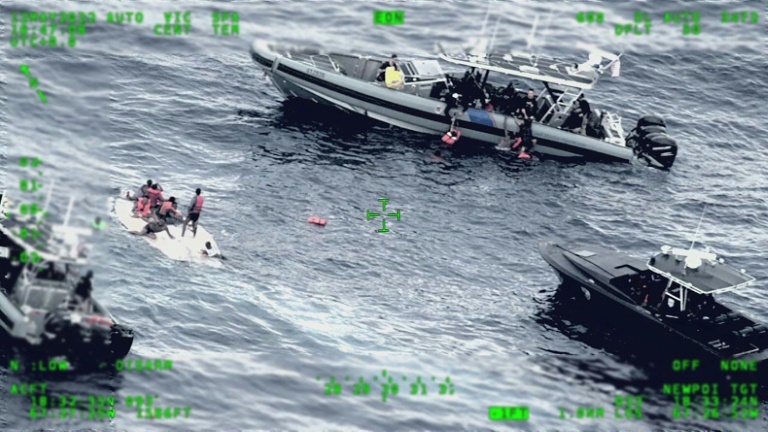
The majority of migrants traveling in a boat that capsized off the coast of Puerto Rico were Haitians, authorities said Friday, adding that of the 11 dead, all were women.

A total of 38 survivors have been found and rescuers continue to search where the accident occurred, about 10 nautical miles (19 kilometers) north of Desecheo Island, an uninhabited US territory between Puerto Rico and the Dominican Republic.

The survivors were “36 Haitian and 2 Dominican Republic nationals, of which eight remain hospitalized,” the US Coast Guard said on Twitter Friday.

Haitian Prime Minister Ariel Henry tweeted his condolences to the families of the dead, who he said were Haitians.

“The news of the sinking of a boat off the coast of Puerto Rico which caused the death of 11 of our compatriots deeply upsets me,” he said.

Of the dead were all were women, and autopsies will be performed on them, according to the Puerto Rico Forensic Science Institute.

A Customs and Border Patrol helicopter first spotted the boat and  people in the water who appeared not to be wearing life jackets around midday on Thursday.

Several days prior, a Haitian woman died in the area after her boat carrying 69 migrants capsized. The other passengers were rescued by the US Coast Guard and the Dominican Navy.

In March, hundreds of Haitian arrived by boat in Florida. And more than 100 were intercepted by the coast guard near the Bahamas.

Haiti, the poorest country in the Americas, is facing an acute political, economic and security crisis.

Russian military woes continue in Ukraine's east: experts

When Russia shifted its focus to the Donbas in eastern Ukraine after failing to seize Kyiv, Western powers feared an onslaught that would see Ukrainian forces crumble within days.

But poor planning, high casualties and low morale have once again dashed Russian hopes for a quick win, experts say.

Ukraine has even managed to push Moscow’s troops out of the northern city of Kharkiv, and on the main eastern front Russian and Ukrainian forces appear to be settling into a stalemate.

“The expectation was that when they came back from Kyiv, they would launch all at once one of the Soviet-style offensives,” said Mark Cancian of the Washington-based Center for Strategic and International Studies (CSIS) think-tank. “That didn’t happen.”

Western sources say up to 12,000 Russian soldiers have been killed in recent weeks, while Kyiv puts the number at 25,000. 

Such huge losses have harmed Moscow’s ability to score a decisive win, despite the scaled-back operations. 

“This is not the Red Army of World War II that marched to victory over the bodies of its dead,” said Cancian.

Instead Russia has “a much smaller army that has to be very careful about its casualties”, Cancian said, adding that Moscow had lost a lot of skilled personnel.

And the loss of troops inevitably drains morale that observers deemed low from the very beginning.  

The Russian army undertook major military reform after it was seen as falling short in the 2008 war in Georgia.

The 2014 annexation of the Ukrainian Black Sea peninsula of Crimea angered the West but displayed a military that was far more agile and able to carry out a lightening operation.

Russia’s intervention in Syria — from 2015 — also tipped the balance in Syria’s civil war and helped keep president Bashar al-Assad in power.

But none of the recent military operations prepared Russia for the level of resistance they encountered, and which intelligence services completely failed to foresee.

“This isn’t a war between David and Goliath,” said a French high-ranking military official who asked not to be named. 

-‘Recipe for disaster’-

Like its Soviet predecessor, the Russian army’s strategy is based on mathematical calculations that leave little room for initiative and having to deal with unexpected situations, the source said. 

On February 24, Russia launched its offensive on three fronts simultaneously: in the north towards Kyiv, in the east and in the south.

Since the end of March, Russia has concentrated 80 percent of its available troops in the east, compared to 20 percent previously. 

And Moscow has managed to reposition a great number of tanks and adapt to some of its pro-Western neighbour’s tactics. 

Yet, many of the Russian army’s problems of the kind seen in the first month of the war in northern Ukraine and around Kyiv remain unsolved.

“Each unit is waging its own war both tactically and strategically” instead of coordinating, said Alexander Grinberg, from the Jerusalem Institute for Security and Strategy (JISS) think-tank. 

“Even if Putin declares a general call-up — theoretically they can recruit more people –, it is hard to figure out how they will overcome the most basic organisational problems,” said Grinberg. 

The Chief of General Staff himself, Valery Gerasimov, has been on the frontline — a sign of his difficulty to delegate power. 

“The system is so centralised that Putin himself almost takes manual control of things that should be carried out by the military professionals,” Ivan Klyszcz, a researcher from the University of Tartu in Estonia, told AFP. 

“This is a recipe for disaster.”

The stalemate on the eastern front means a sudden Russian victory now seems permanently off the cards, according to experts. 

For Putin, any kind of result will therefore be some kind of defeat, Klyszcz said. 

“Russia has taken on a challenge that it dramatically underestimated. It launched a war it could not win,” he said. 

Musk sends mixed messages on Twitter deal, pressuring shares

Elon Musk sent mixed messages Friday about his proposed Twitter acquisition, sending shares of the microblogging platform lower amid skepticism over whether the deal will close.

In an early morning tweet, Musk said the $44 billion takeover was “temporarily on hold,” pending questions over the social media company’s estimates of the number of fake accounts or “bots.”

That sent Twitter’s stock plunging 25 percent.

Two hours later, the unpredictable Tesla chief executive added a tweet, saying “Still committed to acquisition.”

Shares recovered but around midday were still off 8.2 percent at $41.38.

While the reliability of user figures is an important benchmark for assessing revenues of Twitter and other social media companies, analysts generally interpreted Musk’s messages as an attempt to pull out of the deal or to try to force a lower price.

“Although we never questioned Musk’s ability to complete such a transaction from a financial perspective, we thought the biggest risk was Elon himself having a change of heart,” CFRA Research’s Angelino Zino said an analyst’s note.

He said the move gives Musk “leverage” and increases the chance “that he either adjusts his offer price downward or just completely walks away.”

The chief of SpaceX as well as Tesla, Musk is currently listed by Forbes as the world’s wealthiest person, with a fortune of some $232 billion, much of it in Tesla stock.

Seen by his champions as an iconoclastic genius and by his critics as an erratic megalomaniac, he surprised many investors with his pursuit of Twitter.

Musk has described his motivation as stemming from a desire to ensure freedom of speech on the platform and to boost monetization of an Internet site that is influential in media and political circles but has struggled to attain profitable growth.

On Tuesday, Musk said he favored lifting the ban on Donald Trump, who was kicked off the platform in January 2021 shortly after the former US president’s efforts to overturn his election defeat led to the January 6 assault on the US Capitol.

Analysts also have said the site can boost Musk’s other ventures, including Tesla, which so far has grown without following the auto-industry custom of spending heavily on marketing.

But markets have shown skepticism since the April 28 announcement that the Twitter board agreed to sell at $54.20 a share.

The share price has lagged that level, suggesting investors viewed deal closure as not assured, and  has fallen further as the broader tech market retreated this week.

– ‘Horror show’ –

In his first tweet about the deal Friday, Musk linked to an article from May 2 referencing Twitter’s latest filing to US regulators.

The document said an internal review showed Twitter had 229 million “monetizable daily active users” in the first quarter of this year, and just five percent were regarded as false or spam accounts. 

Analyst Dan Ives from Wedbush said the “circus show” was likely to translate into a “Friday 13th horror show.”

“The nature of Musk creating so much uncertainty in a tweet (and not a filing) is very troubling,” he said.

Musk has gotten into hot water with regulators over his tweets in the past, but the Twitter purchase agreement includes a clause specifying that he is free to tweet about the deal provided his posts “do not disparage the company or any of its representatives.”

Market analyst Susannah Streeter of Hargreaves Landsdown said the takeover bid “risks hitting the skids.”

There will be questions “over whether fake accounts are the real reason behind this delaying tactic,” Streeter said, adding that “it may be a strategy to row back on the amount he is prepared to pay to acquire the platform.”

Musk’s potential stewardship of the social media site has hit several bumps since the takeover attempt was made public, and sparked worry from activists, over lifting of the Trump ban as well as the possibility the new owner would open the gates to abusive and misinformative posts.

US media have reported that the transaction is being investigated by regulators, including the Securities and Exchange Commission with which Musk has frequently clashed.

The SEC is probing Musk’s tardy disclosure of his stake in Twitter, according to the Wall Street Journal.

EU hikes military aid for Ukraine as Sweden edges to NATO membership

Europe pledged another half billion dollars in military support for Kyiv on Friday as Sweden followed Finland further down a path toward NATO membership, a goal Russia describes as a threat.

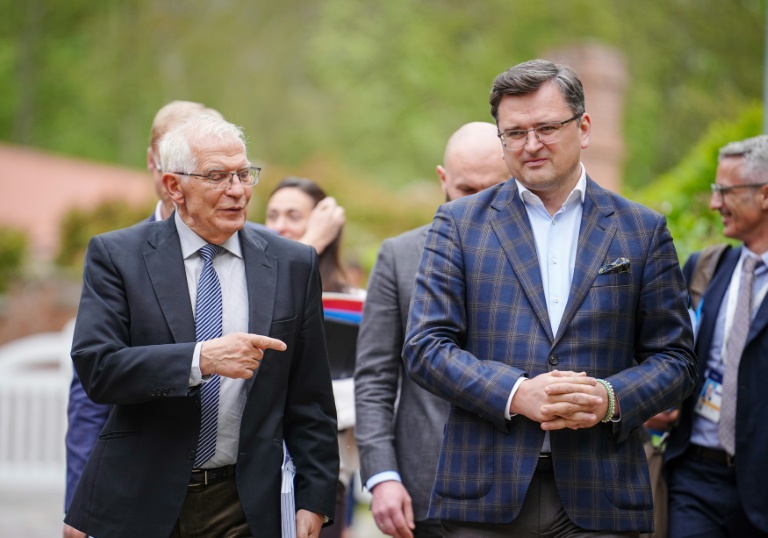
European Union foreign policy chief Josep Borrell promised Ukraine an extra 500 million euros ($520 million), bringing the bloc’s total military aid to two billion euros.

“The recipe is clear –- more of the same,” Borrell said at a gathering of leading democracies as the war entered its 12th week.

Borrell joined Group of Seven foreign ministers in the German sea resort of Wangels, where they conferred with counterparts from Ukraine and Moldova.

“It is very important at this time that we keep up the pressure on Vladimir Putin by supplying more weapons to Ukraine, by increasing the sanctions,” British Foreign Secretary Liz Truss said.

President Putin invaded Russia’s neighbour on February 24, unleashing a worldwide shock that has resounded especially in Sweden and Finland.

Traditionally neutral, the two Nordic countries are taking steps towards fast-track membership of NATO.

The Kremlin has warned Russia would deem further eastward expansion of the alliance a potential threat to its security.

A day after Finnish leaders recommended joining NATO “without delay,” a subsidiary of Russian state energy firm Inter RAO said Russia would cut off electricity supplies to Finland from Saturday.

“This situation is exceptional and happened for the first time in over 20 years of our trading history,” RAO Nordic said.

Finland’s electricity operator said it could cope by importing power from Sweden and Norway.

In Stockholm, a review by parliamentary parties said Swedish NATO membership would have “a deterrent effect” on war in northern Europe.

In addition, “within the framework of current cooperation, there is no guarantee that Sweden would be helped if it were the target of a serious threat or attack,” it said.

The report stopped short of offering a concrete recommendation, although expectations are high Sweden will emulate Finland when the government announces its decision in the coming days.

NATO says it would welcome both countries — wealthy, established democracies with advanced militaries — with open arms.

But a potential hurdle was thrown up by Turkey, a NATO member.

President Recep Tayyip Erdogan, whose country is part of NATO, said he did not have a “positive opinion” on their  membership.

“Scandinavian countries are like a guesthouse for terror organisations,” he said after Friday prayers in Istanbul.

Turkey has long accused Nordic countries, especially Sweden, of harbouring extremist Kurdish groups and supporters of Fethullah Gulen, a US-based preacher wanted over a failed coup in 2016.

The two countries said they would discuss the issue with Turkey on Saturday at NATO foreign ministers’ meeting in Berlin.

– Russian failures – 

Expectations of a lightning victory by Russia have sputtered out, raising speculation that the conflict could be protracted.

Russia abandoned early attempts to seize the capital Kyiv in the face of fierce defence by the Ukrainian army, supported by an influx of Western weaponry that has now reached billions of dollars.

Since then, Russia has focused its offensive in the eastern region of Donbas, where it has been supporting ethnic Russian-separatists.

Yet this too seems to be hampered by poor planning, high casualties and low morale, say experts.

“The expectation was that when they came back from Kyiv, they would launch all at once one of the Soviet-style offensives,” said Mark Cancian of the Washington-based Center for Strategic and International Studies (CSIS) think-tank. 

“That didn’t happen,” he observed.

Western sources say up to 12,000 Russian soldiers have been killed in recent weeks, while Kyiv puts the number at 25,000. 

Ukrainian armed forces chief Valery Zaluzhny said Russia had resorted to “massive use” of anti-ship cruise missiles against civilian infrastructure.

“One of the reasons for the enemy’s transition to this tactic is the refusal to use aviation, which suffers vast losses,” he said on Facebook.

In Washington, the Pentagon said the US and Russian defence chiefs had held their first conversation since February 18, although no “acute issues” were resolved in the call.

– War crimes –

A Russian soldier accused of killing a civilian appeared in a court in Kyiv on Friday ahead of the first war crimes trial since the start of the offensive.

Vadim Shishimarin, 21, allegedly gunned down an unarmed 62-year-old civilian who had witnessed a carjacking by fleeing Russian troops.

He faces possible life imprisonment on charges of war crimes and premeditated murder.

The trial marks a significant moment in Ukraine, where accounts of murder, torture and rape by Russian forces are multiplying.

In eastern Ukraine, witnesses who spoke to AFP in the village of Stepanki, near the regional capital of Kharkiv, accused the Russians of shelling a home, killing several people.

They said six people who lived in the house were drinking tea in the courtyard when a tank approached.

“They started going into the house to hide,” said Olga Karpenko, 52. The tank took aim and fired at them as they entered the house.

“Four people died, two were injured. My daughter died from a shrapnel wound in the back of her head,” Karpenko said.

The UN Human Rights Council and International Criminal Court (ICC) have decided to launch their own probes into alleged atrocities.

More than six million people have fled Ukraine, more than half of them going to neighbouring Poland, the UN refugee agency says.

– Gas supplies –

Economists meanwhile pored over the impact of a downturn in Russian gas supplies for Europe, where several countries, including economic giant Germany, are heavily dependent on Russian energy.

Russian energy giant Gazprom announced Thursday it would stop supplying gas via the Polish part of the Yamal-Europe pipeline following retaliatory sanctions that Moscow imposed on Western companies.

Gazprom also said gas transiting to Europe via a site in Ukraine had dropped by a third.

Last year, Russian imports accounted for nearly 40 percent of EU gas consumption.

Ole Hvalbye, a specialist with the Scandinavian bank SEB, said the loss through Ukraine amounted to around two percent of European gas consumption, while the Polish pipeline had carried little gas for several months.

The fall “does not scream crisis, but it is a wake-up call for what is to come,” he said.

Finnish electricity network operator said would be able to make do without Russian electricity.

burs/ri/har

Stocks bounce after Fed boss calms nerves over rates

Global stock markets rebounded Friday as fears eased about the pace of interest rate rises in the United States that are aimed at bringing down the country’s highest inflation in decades.

Wall Street pushed strongly higher with the Dow climbing 1.6 percent in late morning trading. The tech-heavy Nasdaq jumped 3.6 percent and the S&P rose 2.3 percent.

European equities all closed more than two percent higher following solid gains in Asia. 

“It is largely a sentiment-driven trade wrapped up in the notion that stocks are deeply oversold and due for a bounce,” analysts at Briefing.com said.

Stocks have tumbled for much of this week on fears the Federal Reserve was planning to lift US interest rates by 75 basis points at a single meeting.

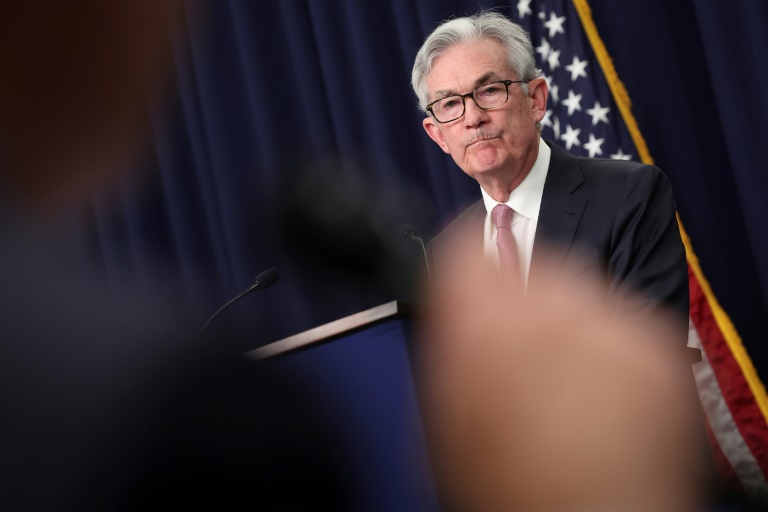
However, equities on Friday staged “a relief rally” after Fed boss Jerome Powell calmed nerves over the potential hefty increase, said Jeffrey Halley, analyst at OANDA trading group. 

“The rally today looks more like a technical rebound after a torrid week than a structural turn in sentiment,” he added.

Investors also sold off stocks as they sought to reduce risk amid the Ukraine war and worried about the economic impact of China’s Covid lockdowns.

Those China worries also eased on Friday.

“Global sentiment seems to be getting some relief as China officials suggested that Covid-related lockdowns — which have been another source of uneasiness — may be set to ease,” analysts at Charles Schwab investment bank said.

Oil prices pushed higher Friday after much volatility, reaching around $110 per barrel yet again,

“Prices appear to be caught in a pincer of concern about slowing demand due to the impact of higher prices, as well as China’s Covid lockdowns and worries about Russian supply and the loss of that due to sanctions,” said analyst Michael Hewson at CMC Markets. 

Meanwhile, the euro struck a new five-year low against the dollar.

Bitcoin held above $30,000, a day after the cryptocurrency slumped under $27,000, its lowest level since late 2020.

Its crash this week was fuelled by the collapse of two so-called “stablecoin” cryptocurrencies — TerraUSD and Tether — which proved to be anything but stable, leaving investors panicked. 

On the corporate front, Twitter’s share price plunged after Elon Musk said he was putting a temporary halt on his much-anticipated $44-billion deal to buy the social media giant.

Its shares slumped more than seven percent and are trading below what Musk has promised to pay for the company’s shares.

Hewson said the announcement fuelled “concerns that Musk may be preparing the ground for backing out of the deal, although he will take a $1bn hit were he to do so.”

– Key figures at around 1530 GMT –

New York – Dow: UP 1.6 percent at 32,230.15 points

EURO STOXX 50: UP 2.5 percent at 3,668.92

London – FTSE 100: UP 2.6 percent at 7,418.15 (close)

Frankfurt – DAX: UP 2.1 percent at 14,027.93 (close)

Paris – CAC 40: UP 2.5 percent at 6,362.68 (close)

Hong Kong – Hang Seng Index: UP 2.7 percent at 19,898.77 (close)

Shanghai – Composite: UP 0.9 percent at 3,084.28 (close)  

Tokyo – Nikkei 225: UP 2.6 percent at 26,427.65 (close)

Brent North Sea crude: UP 3.1 percent at $110.80 per barrel

West Texas Intermediate: UP 3.5 percent at $109.80 per barrel

Euro/dollar: UP at $1.0413 from $1.0382 at 2100 GMT Thursday

Pound/dollar: UP at $1.2238 from $1.2199

Euro/pound: UP at 85.10 pence from 85.08 pence

Dollar/yen: DOWN at 129.20 yen from 129.97 yen

Ukraine's key IT sector booming despite Russian invasion

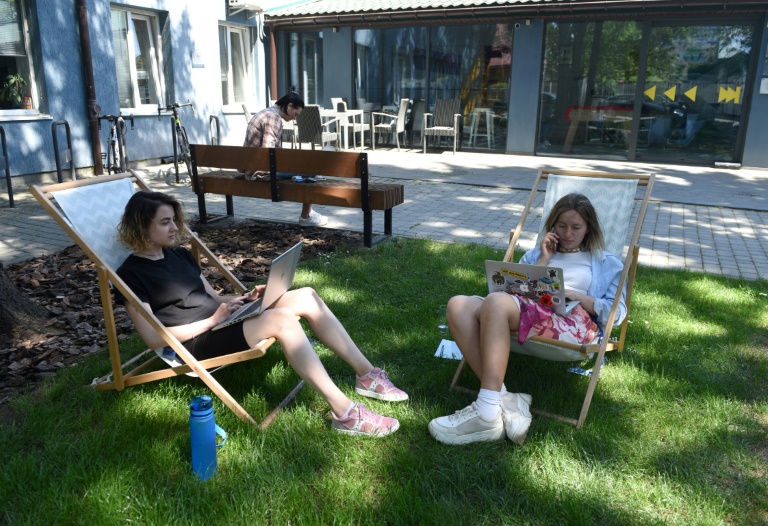
Ukraine’s IT sector is booming despite the Russian invasion. Workers with stickers on their laptops recline on beach chairs outside a warehouse for start-ups in the east Ukraine city of Lviv giving off major Silicon Valley vibes.

But the atmosphere inside is different.

Through the glass doors of the complex, young Ukrainians zig-zag between stacks of bulletproof vests and cardboard boxes filled with helmets ready for the front.

They are part of Ukraine’s burgeoning tech sector which was forced to adapt after Russia’s invasion and has become key to supporting the war effort.

“Most tech companies had developed contingency plans” in case of war said Stepan Veselovskiy, the head of the “IT Cluster Lviv” community.

He told AFP that companies transferred servers to secure locations and established back-up systems outside the country before Russia invaded on February 24.

When Russian bombing started, IT companies shut offices in the capital Kyiv and eastern city of Kharkiv and engineers found refuge in western Ukraine or Poland next door.

Veselovskiy said there were already around 500 tech companies in Lviv before the war but now estimates that 80 percent of the sector is in the western city. 

One is Infopulse, which provides various digital services to mainly European customers.

It brought 300 of its 2,300 employees to Lviv, where it has offices in one of the city’s few buildings equipped with a bunker.

There are bunk beds and stable internet underground so employees to continue working in the event of an air raid.

There are also generators in case Russian forces target power stations and terminals for Elon Musk’s Starlink internet service.

“Even in the most drastic conditions, business can continue,” regional manager Ivan Korzhov said. 

They can even thrive. 

– Tech army –

Since the start of the war, Infopulse has gained four new customers and in April — the second month of the Russian invasion — it created 25 new jobs in Ukraine.

It is not the only tech company in Ukraine to do so. 

Veselovskiy says February — when Russia attacked — was a historically good month for Ukraine’s tech sector and its estimated 200,000 employees. 

“It slowed down a bit in March, but we are very optimistic for the future because the war doesn’t stop us from growing,” he said.

This is a stark contrast to other industries, battered by the invasion. Exports for traditional sectors such as steel and agriculture have collapsed.

But the tech sector, naturally, has not been affected by the destruction of bridges, roads or the blocking of ports. 

It has, according to Veselovsky, made more than $2 billion since the start of the war and has become the country’s leading exporter. 

“It’s a good thing for Ukraine because we generate income in dollars every month when the country really needs it,” Korzhov said.

“We pay our taxes and give a lof of money” to the government. 

The IT Cluster Kyiv has already allocated $2 million, mainly to buy equipment for Ukrainian soldiers.

That’s how its offices ended up looking like an army depot.

The sector has also offered its brightest to help the military.

Softserve — one of Ukraine’s biggest tech companies — has worked on the military’s websites for free and IT Cluster Kyiv modernised one of the military’s command centres.

Infopulse also participates in a joint project by the Ukrainian army and the ministry of digital transformation.

“Specialists in tech and cybersecurity work with the government on the information front,” its regional manager Korzhov said. 

He then repeated a popular slogan in Ukraine: “We are not waiting for peace, but for victory.”

EU sees reopening of Iran nuclear talks but US cautious

The European Union said Friday it had unblocked stalled talks with Iran after a mission to Tehran but the United States raised doubts on whether it was enough to revive a nuclear deal.

EU envoy Enrique Mora visited Tehran this week in a bid to help restart the 2015 nuclear deal, two months after slow-moving negotiations in Vienna to bring Iran and the United States back into compliance broke off.

EU foreign policy chief Josep Borrell said that the trip had gone “better than expected”.

“The negotiations had stalled and now they have been reopened,” Borrell told reporters on the sidelines of a G7 meeting in Germany. 

“There is a perspective of reaching a final agreement.”

President Joe Biden has backed a return to the deal trashed by his predecessor Donald Trump but has been frustrated by Iran’s demands.

The United States voiced appreciation to Mora and said it  would speak to him in depth.

“All of that said, at this point,” State Department spokesman Ned Price said, “the deal remains far from uncertain.”

“It is up to Iran to decide whether it wants to conclude a deal quickly,” he told reporters.

“We and our partners are ready — we have been for some time — but now it’s really up to Iran.”

He warned that the United States was preparing for all scenarios including a failure to return to the deal.

The latest diplomacy comes against the backdrop of protests in Iran after President Ebrahim Raisi, a hardline cleric, imposed austerity measures to cope with an economy battered by soaring inflation and US-led sanctions.

Demonstrators in the southern city of Izeh attacked shops and tried to set fire to a mosque, state news agency IRNA reported.

Mora has also pressed the clerical state to release an Iranian-Swedish academic, Ahmedreza Djalali, who faces execution for allegedly passing along information on Iranian nuclear scientists to Israel’s Mossad spy agency, leading to their assassinations.

– ‘Positive enough’ signals –

The 2015 deal gave Iran sanctions relief in exchange for curbs on its nuclear programme to guarantee that it could not develop a nuclear weapon, something Tehran has always denied wanting to do.

Formally known as the Joint Comprehensive Plan of Action, the agreement was left on life support by Trump’s withdrawal and unilateral imposition of sanctions, including pressing other nations not to buy Iranian oil.

Iran responded by reversing its own compliance with the accord, leading to threats from its arch-rival Israel that it could take military action if its nuclear work advances too significantly.

An Iranian return to compliance would see the easing of some of the most biting US sanctions.

But a key sticking point is Iran’s demand that the United States reverse Trump’s designation of the elite Islamic Revolutionary Guard Corps from a terrorism blacklist.

Borrell said “these disagreements on what to do about the Revolutionary Guards” had hampered progress in the talks for two months.

He said Mora had taken the EU’s message to Tehran “that we couldn’t continue like this”.

“The answer has been positive enough,” Borrell said.

“These kind of things cannot be solved overnight. Let’s say things were blocked and they have been deblocked.”

Iran’s Foreign Minister Hossein Amir-Abdollahian said Mora’s two days of talks “were another opportunity to focus on initiatives to resolve the remaining issues.”

“A good and credible agreement is available if the United States makes a political decision and adheres to its commitments,” Amir-Abdollahian wrote on Twitter.

The emir of Qatar, Sheikh Tamim bin Hamad Al-Thani, also met Supreme Leader Ayatollah Ali Khamenei and Raisi on Thursday to push for progress.

Close Bitnami banner
Bitnami