World

North Korea confirms first Covid-19 death in 'explosive' outbreak

North Korea confirmed its first ever Covid-19 death on Friday, saying fever was spreading “explosively” nationwide and tens of thousands of people were being isolated and treated after falling sick.

The nuclear-armed country only reported its first Covid cases Thursday, saying it was moving into “maximum emergency epidemic prevention system” after sick patients in the capital Pyongyang tested positive for Omicron.

North Korea has been under a rigid coronavirus blockade since the start of the pandemic in 2020, but with massive Omicron outbreaks in all neighbouring countries, experts said it was only a matter of time before Covid snuck in.

“A fever whose cause couldn’t be identified explosively spread nationwide from late April,” the official Korean Central News Agency said.

“Six persons died (one of them tested positive for the BA.2 sub-variant of Omicron,)” it added.

With its 25 million people not vaccinated against Covid, North Korea’s crumbling health infrastructure would struggle to deal with a major outbreak, experts say.

“On May 12 alone, some 18,000 persons with fever occurred nationwide and as of now up to 187,800 people are being isolated and treated,” KCNA said.

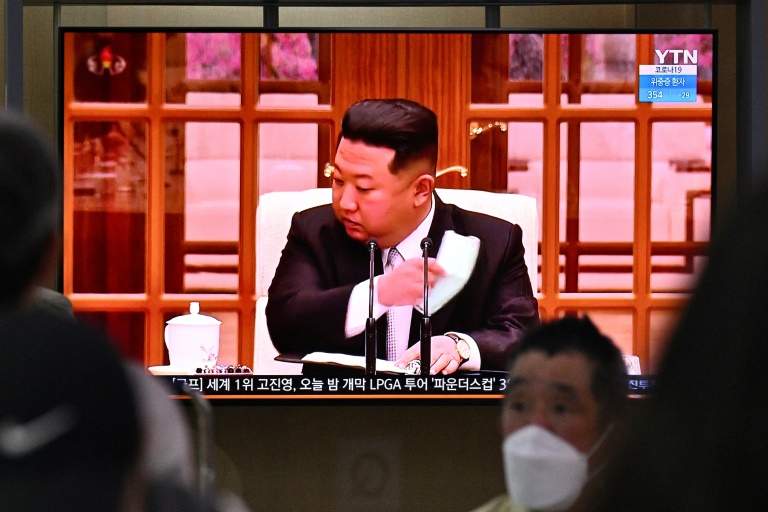
Leader Kim Jong Un — seen wearing a mask on state TV for the first time — oversaw an emergency meeting of the Politburo on Thursday and ordered nationwide lockdowns in a bid to halt the spread of the virus.

On Friday, KCNA said Kim visited the state emergency epidemic prevention headquarters and “learned about the nationwide spread of Covid-19”.

“It is the most important challenge and supreme tasks facing our Party to reverse the immediate public health crisis situation at an early date,” KCNA added.

– Military parade –

It is likely that the massive nationwide outbreak is linked to a huge military parade held in Pyongyang on April 25, said Cheong Seong-chang of the Sejong Institute.

“Holding a military parade attended by a large crowd, when Omicron was raging in neighboring China, shows Pyongyang was overconfident in their capabilities to fight and prevent the virus,” he told AFP.

North Korea was likely to see “major chaos” due to the rapid spread of Omicron, he said, given that the country is currently reporting nearly 20,000 cases in a single day.

“If the death toll from Omicron spikes, Pyongyang may have to ask for China’s support,” he added.

Beijing, Pyongyang’s sole major ally and benefactor, said Thursday that it was ready to assist North Korea with its Covid-19 outbreak. 

But China, the world’s only major economy to still maintain a zero-Covid policy, is itself battling multiple Omicron outbreaks — with some major cities, including financial hub Shanghai, under strict stay-at-home orders.

North Korea has previously turned down offers of Covid vaccines from China, as well as from the World Health Organization’s Covax scheme.

Kim said Friday that the outbreak of fever “shows that there is a vulnerable point in the epidemic prevention system” and called for more lockdowns.

Kim “said that it is the top priority to block the virus spread by actively locking down areas and isolating and treating persons with fever in a responsible manner,” KCNA reported.

Analysts said that China’s experience with Omicron indicated lockdowns might not be successful, but with no antiviral treatment or vaccines, North Korea has few other options.

– Nuclear distraction –

North Korea test-fired three short range ballistic missiles, Seoul said Thursday — shortly after confirming their first cases of Covid.

New South Korean President Yoon Suk-yeol’s administration slammed the North’s “continuing provocations with a ballistic missile launch despite the outbreak of coronavirus,” his security office said after a meeting.

After high-profile talks collapsed in 2019, North Korea has doubled down on weapons testing, conducting a blitz of launches so far this year, including intercontinental ballistic missiles.

Satellite imagery indicates North Korea is preparing to conduct a nuclear test, and the United States has warned this could come as soon as this month.

If Pyongyang needs aid — vaccines and medicine — they might need to delay the test, some analysts said, but others warned the Covid-19 outbreak could hasten things along.

“A nuclear test would be a good way to distract the public from the pandemic,” Yang Moo-jin, a professor at the University of North Korean Studies, told AFP.
Finland poised for NATO membership as Ukraine war crimps Russian gas

Finland took a step Thursday towards fast-track NATO membership, triggering a blunt warning from the Kremlin, as the war in Ukraine throttled supplies of Russian gas to Europe and the number of people who fled the country passed six million.

In Geneva, the UN Human Rights Council decided to probe alleged Russian atrocities in Ukraine, in a vote overwhelmingly approved by its members but snubbed by Russia.

And in graphic new evidence of potential war crimes by Moscow’s forces, CNN aired footage it said showed Russian troops shooting two unarmed civilians in the back. AFP has not independently verified the footage.

Finland’s leaders declared their nation must apply to join NATO “without delay” — a seismic change in policy since Russia invaded its neighbour in February. 

“As a member of NATO, Finland would strengthen the entire defence alliance,” President Sauli Niinisto and Prime Minister Sanna Marin said in a joint statement.

Kremlin spokesman Dmitry Peskov warned Russia would “definitely” see Finnish membership as a threat.

The Russian foreign ministry said Moscow would be “forced to take reciprocal steps, military-technical and other, to address the resulting threats”.

In launching the invasion of Ukraine, President Vladimir Putin cited in part what he called the threat from NATO, which expanded eastwards after the Cold War.

Finland has been a declared neutral in East-West crises for decades, and as recently as January its leaders ruled out NATO membership.

But the February 24 invasion shocked the Nordic nation.

It shares a 1,300-kilometre (800-mile) border with Russia and its past is studded with conflict with its giant neighbour.

NATO has already declared it will warmly embrace Finland and Sweden, two countries with deep pockets and well-equipped armies. 

Finland’s entry will be “smooth and swift”, NATO chief Jens Stoltenberg promised on Thursday.

Germany, France and the powerful US Senate Foreign Relations Committee also strongly voiced their support, and Britain has already pledged its assistance.

A special committee will announce Finland’s formal decision on a membership bid on Sunday. Sweden, another neutral state, is widely expected to follow. 

– Russian gas –

Russia’s flow of gas to Europe meanwhile fell, spurring fears for Germany and other heavily dependent economies.

Russian energy giant Gazprom announced it would stop supplying gas via the Polish part of the Yamal-Europe pipeline following retaliatory sanctions that Moscow imposed Wednesday on Western companies.

Gazprom also said gas transiting to Europe via Ukraine had dropped by a third — a fall it blamed on Ukraine’s pipeline operator, which the company denies, pointing the finger at Russia.

Ukraine and Poland are major supply routes for Russian gas to Europe and the two sides have kept flows going despite the conflict.

The European Union’s heavy reliance on Russian energy has made it reluctant to add oil and gas imports to sanctions targeting Russia’s economy.

Mykhaylo Podolyak, a senior aide to Ukrainian President Volodymyr Zelensky, urged the bloc to impose an immediate embargo.

“If the leaders had acted decisively in 1938, Europe could have avoided WWII,” he wrote on Twitter. “History won’t forgive us if we make the same mistake again.”

With a global food crisis feared as Ukrainian exports tumble, host Germany said the G7 club of industrialised nations will tackle the issue for the world’s poorest nations at talks beginning Thursday.

– Shelling –

Fighting in Ukraine has been concentrated in the south and east since Russia abandoned attempts to seize Kyiv.

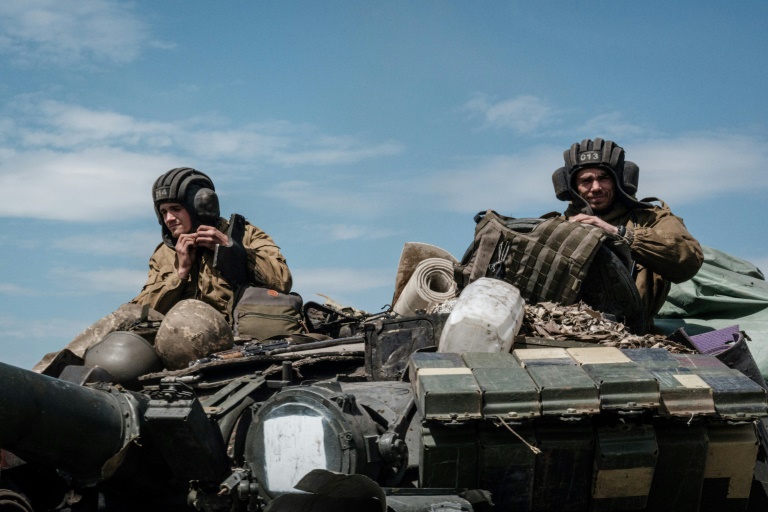
Ukraine’s presidency said shelling continued throughout Lugansk — part of the Donbas region where Ukrainian forces are fiercely opposing Russian armour and Kremlin-backed separatists.

Russian troops are trying to take complete control of Rubizhne, block a key highway between Lysychansk and Bakhmut and seize Severodonetsk, the office said.

Zelensky said Thursday in his daily address to the nation that Russian forces have destroyed 570 health care facilities in the country, including 101 hospitals. “What for? It’s nonsense. It’s barbarity,” he said.

In the northeastern region of Chernigiv three people were killed and 12 others wounded early Thursday in a strike on a school in Novgorod-Siversky, the emergency services said. 

In the southern port city of Mariupol, besieged troops in the vast Azovstal steelworks have been holding out against weeks-long bombardment, refusing demands to surrender.

Ukrainian Deputy Prime Minister Iryna Vereshchuk said “difficult talks” were underway over the evacuation of 38 seriously wounded troops.

Russia’s army said it struck Donetsk and Kharkiv on Thursday, killing more than 170 people and destroying Ukrainian drones and rockets.

– War crimes probe –

In Geneva, the UN Human Rights Council voted 33-2 to investigate alleged atrocities by Russian troops.

The resolution, brought by Ukraine, will focus on alleged crimes in the Kyiv, Chernigiv, Kharkiv and Sumy regions in late February and March.

“These have been 10 weeks of sheer horror to the people of my country,” Deputy Foreign Minister Emine Dzhaparova told the UN meeting from Kyiv, accusing Putin’s forces of “pure evil”.

The International Criminal Court in The Hague has already begun its own inquiry, sending investigators to the Kyiv suburb of Bucha.

The invasion has sparked an exodus of civilians, many of whom describe torture, sexual violence and indiscriminate destruction.

The UN refugee agency said on Thursday the number of those who have fled Ukraine had passed six million, more than half of them going to neighbouring Poland.

Ukrainian prosecutors say they have received reports of more than 10,000 alleged crimes, with 622 suspects identified.

On Wednesday, the office said it would launch the first trial for war crimes.

CNN and the BBC on Thursday released what they said was security camera footage showing two Ukrainian civilians being shot in the back by Russian soldiers near a car dealership outside of Kyiv on March 16.

One man died on the spot, the other shortly thereafter.

Ukrainian authorities and witnesses interviewed by AFP also accused Russian forces of killing several civilians in March after shelling a residential home in the east Ukrainian village of Stepanki from a tank.

“They started going into the house to hide,” said Olga Karpenko, 52, whose daughter was among those killed. The tank took aim and fired as they entered the house.

“Four people died, two were injured. My daughter died from a shrapnel wound in the back of her head,” Karpenko said.

Canada gymnasts break silence on abuses and sport's 'toxic culture'

They excelled in the athletic spotlight, but their feats on the beam and bars masked a darker reality: Canadian gymnasts are taking legal action to denounce a “toxic” culture of physical, sexual and psychological abuse by the sport’s top brass.

Having tolerated the harm for decades, victims around the world have come forward in the wake of a US gymnastics scandal that broke in 2015 before spreading abroad, including to Britain where athletes launched a similar legal action last year.

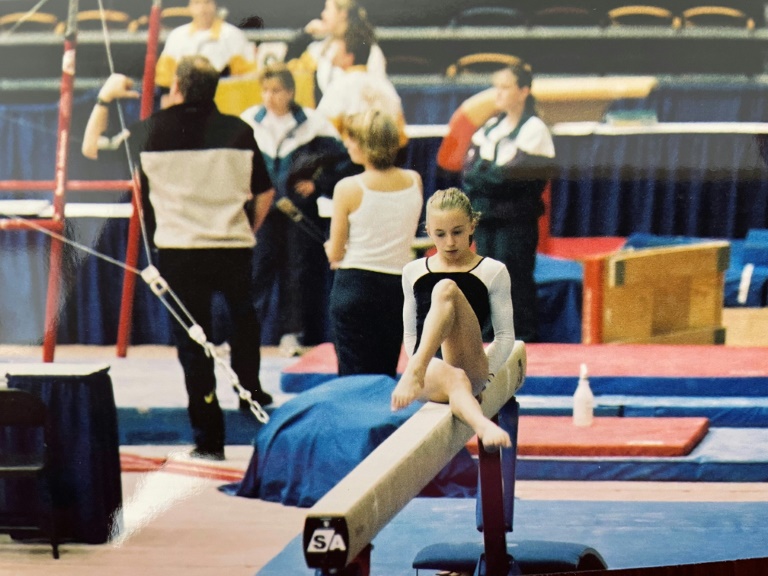
As a child gymnast in Vancouver, Amelia Cline dreamed of Olympic glory. In her teens, the elite athlete devoted thirty hours a week to training.

“Unfortunately the early years of my gymnastics days, as positive as they were, they’ve been somewhat wiped out by those last three years that were so brutal,” the former gymnast, now 32, told AFP.

She and other athletes on Wednesday filed a lawsuit against Gymnastics Canada and several provincial federations for tolerating a climate of abuse and mistreatment for decades.

“The lawsuit is essentially designed to hopefully hold these institutions accountable for systemic psychological, emotional, physical and sexual violence,” she said.

At the end of March, a group of more than 70 present and former gymnasts published an open letter to Sports Canada denouncing a “toxic culture and abusive practices that persist within Canadian gymnastics.”

The number of signatories has since grown to more than 400, with the group calling for an independent investigation to shed light on the sport’s problems.

The “general public really doesn’t understand the magnitude of the abuses that are occurring at the gyms,” said Kim Shore, a former gymnast and spokeswoman for Gymnast For Change Canada, who says her daughter has also suffered mistreatment in the sport.

Micheline Calmy-Rey, president of the Gymnastics Ethics Foundation created in 2019 in response to the scandal said “it seems logical to us that an independent investigation be conducted.”

Gymnastics Canada on Thursday said the allegations in the lawsuit “describe behaviour that is unacceptable in any sport environment, and we take them very seriously.”

– ‘Grilled about my weight’ –

In a blog post, Cline says that at 14, she weighed 85 pounds (38.5 kg) and was “grilled about my weight on a weekly basis.”

Some 20 years after giving up gymnastics, she says she still suffers from the “long-term effects” of mistreatment that left her with chronic pain and made it hard for her to maintain healthy eating habits.

Like many of her peers, she laments a “culture of fear and silence” in gymnastics clubs across the country. “You don’t question what (the coaches) are doing. They’re the experts, and they’re the ones who are going to take you to the Olympics,” she explained.

“I was always afraid of my coaches,” another gymnast told AFP on condition of anonymity. “I loved gymnastics. I loved travelling. I loved being with the other girls, but I was so afraid of them.”

She described a powerful loneliness felt by child gymnasts, whose parents were often banned from practices. Very young athletes were even told never to speak about their training.

“Many times the kids are told what happens in the gym stays in the gym,” recalled Shore.

She says gymnastics has been corrupted by a “culture of control and dominance” over athletes.

“The provincial bodies are made up of individuals who are conflicted,” she said, explaining that “in some provinces, the chair of the board is also the head coach of a gymnastics club.”

Now that a claim has been filed and the problems have been exposed, Cline and her lawyers believe that the number of plaintiffs will increase “significantly.”

Cline just wishes her nightmare will never be experienced by other young gymnasts. 

“There’s really no other mechanism within Canada to actually hold institutions like this accountable except through the legal system,” she said.

One killed, 12 injured in Karachi bombing: police

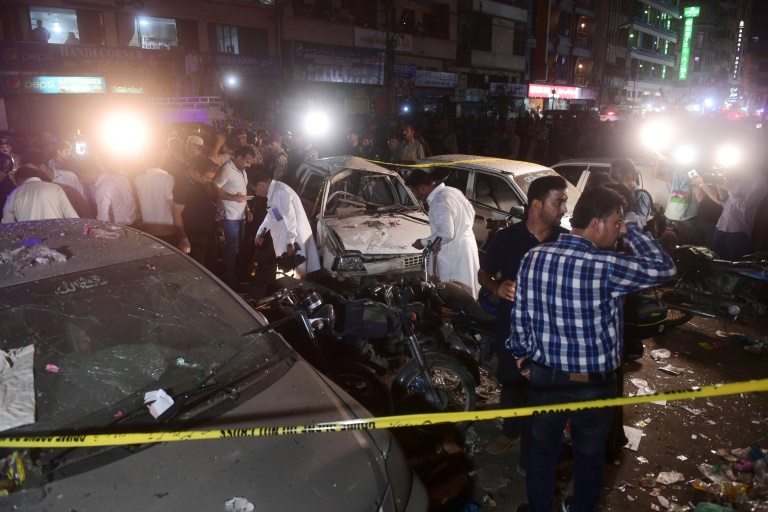
One person was killed and 12 injured in a bomb blast late Thursday in Karachi, police said, just two weeks after a suicide attack by a Pakistan separatist group killed four in the same city.

The explosion tore through the Saddar neighbourhood of Pakistan’s most populous city at around 11:00 pm (1800 GMT).

“Initial investigation suggested that the explosive material was planted in a motorcycle that was parked near a trash bin,” said local police station house officer Sajjad Khan.

The target of the attack was not immediately announced.

However Khan said a coast guard vehicle was among “several” damaged in the blast while the one person slain was a “passerby”.

Last month a female suicide bomber killed four people, including three Chinese nationals, in an attack on a minibus carrying staff from a Beijing cultural programme at Karachi University.

The Baloch Liberation Army (BLA) — a group fighting for independence in Pakistan’s largest and most impoverished province — claimed responsibility for the April 26 strike.

China has made massive energy and infrastructure investments in Balochistan under a $54 billion scheme known as the China-Pakistan Economic Corridor.

However the programme has put Chinese citizens in the crosshairs of Baloch separatists, who say local residents do not see their fair share of riches from natural resources in the region.

In April 2021 a suicide bomb attack at a luxury hotel hosting the Chinese ambassador in Quetta, the provincial capital of Balochistan, killed four and wounded dozens. 

The ambassador was unhurt.

And this January Baloch separatists killed three and wounded 22 in a bombing on the eastern megacity of Lahore.

More widely, Pakistan has been witnessing an uptick in militant attacks.

The Pakistan Institute for Conflict and Security Studies said assaults rose by 24 percent between March and April.

First image of black hole at Milky Way's centre revealed

An international team of astronomers on Thursday unveiled the first image of a supermassive black hole at the centre of our own Milky Way galaxy — a cosmic body known as Sagittarius A*.

The image — produced by a global team of scientists known as the Event Horizon Telescope (EHT) Collaboration — is the first, direct visual confirmation of the presence of this invisible object, and comes three years after the very first image of a black hole from a distant galaxy.

“For decades, we have known about a compact object that is at the heart of our galaxy that is four million times more massive than our Sun,” Harvard University astronomer Sara Issaoun told a press conference in Garching, Germany, held simultaneously with other media events around the world.

“Today, right this moment, we have direct evidence that this object is a black hole.”

Black holes are regions of space where the pull of gravity is so intense that nothing can escape, including light.

The image thus depicts not the black hole itself, because it is completely dark, but the glowing gas that encircles the phenomenon in a bright ring of bending light.

As seen from Earth, it appears the same size as a donut on the surface of the Moon, Issaoun explained.

“These unprecedented observations have greatly improved our understanding of what happens at the very centre of our galaxy,” EHT project scientist Geoffrey Bower, of Taiwan’s Academia Sinica, said in a statement.

The research results are published in The Astrophysical Journal Letters.

– Virtual telescope –

Sagittarius A* — abbreviated to Sgr A*, and pronounced “sadge-ay-star” — owes its name to its detection in the direction of the constellation Sagittarius. 

Located 27,000 light years from Earth, its existence has been assumed since 1974, with the detection of an unusual radio source at the centre of the galaxy.

In the 1990s, astronomers mapped the orbits of the brightest stars near the centre of the Milky Way, confirming the presence of a supermassive compact object there — work that led to the 2020 Nobel Prize in Physics.

Though the presence of a black hole was thought to be the only plausible explanation, the new image provides the first direct visual proof.

Capturing images of such a faraway object required linking eight giant radio observatories across the planet to form a single “Earth-sized” virtual telescope called the EHT.

“The EHT can see three million times sharper than the human eye,” German scientist Thomas Krichbaum of the Max Planck Institute for Radio Astronomy told reporters.

“So, when you are sitting in a Munich beer garden, for example, one could see the bubbles in a glass of beer in New York.”

The EHT gazed at Sgr A* across multiple nights for many hours in a row — a similar idea to long-exposure photography and the same process used to produce the first image of a black hole, released in 2019. 

That black hole is called M87* because it is in the Messier 87 galaxy.

– Einstein would be ‘ecstatic’ –

The two black holes bear striking similarities, despite the fact that Sgr A* is 2,000 times smaller than M87*.

“Close to the edge of these black holes, they look amazingly similar,” said Sera Markoff, co-chair of the EHT Science Council, and a professor at the University of Amsterdam.

Both behaved as predicted by Einstein’s 1915 theory of General Relativity, which holds that the force of gravity results from the curvature of space and time, and cosmic objects change this geometry.

Despite the fact Sgr A* is much closer to us, imaging it presented unique challenges.

Gas in the vicinity of both black holes moves at the same speed, close to the speed of light. But while it took days and weeks to orbit the larger M87*, it completed rounds of Sgr A* in just minutes.

The brightness and pattern of the gas around Sgr A* changed rapidly as the team observed it, “a bit like trying to take a clear picture of a puppy quickly chasing its tail,” said EHT scientist Chi-kwan Chan of the University of Arizona.

The researchers had to develop complex new tools to account for the moving targets.

The resulting image — the work of more than 300 researchers across 80 countries over a period of five years — is an average of multiple images that revealed the invisible monster lurking at the centre of the galaxy.

“The fact that we’re able to make an image of one, something that should be unseeable… I think that that’s just really exciting,” Katie Bouman, a Caltech professor who played a key role in creating the image, told AFP.

Scientists are now eager to compare the two black holes to test theories about how gasses behave around them — a poorly understood phenomenon thought to play a role in the formation of new stars and galaxies.

Probing black holes — in particular their infinitely small and dense centers known as singularities, where Einstein’s equations break down — could help physicists deepen their understanding of gravity and develop a more advanced theory.

“What about Einstein? Would he smile seeing all these hundreds of scientists still not having proven him wrong?” said Anton Zensus of the Max Planck Institute.

“I rather think that he would be ecstatic seeing all the experimental possibilities we have in this field today.”

US Senate confirms Powell for second term as central bank chief

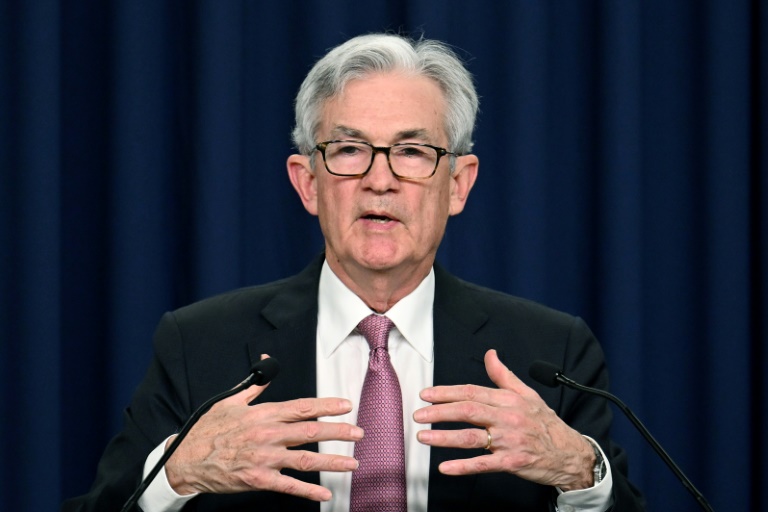
The US Senate on Thursday confirmed Jerome Powell to a second term as head of the Federal Reserve, as the central bank fights to crush soaring inflation.

The 80-19 vote came amid inflation that has hit a 40-year high, fueled by the conflict in Ukraine and ensuing sanctions imposed on Russia, as well as Covid-19 restrictions in China that have raised concerns the global supply snarls may worsen.

Powell, a Republican who enjoyed broad bipartisan support, had continued at the helm of the central bank although his first four-year term officially expired February 4.

His confirmation was delayed by a drawn-out process to approve Lisa Cook to join the Fed board — the first Black woman to serve in the post — who was finally confirmed on Tuesday with only Democratic votes.

The vote on Powell came the day after the upper house of Congress approved the nomination of Philip Jefferson of Davidson College, marking the first time the Fed board has had more than one Black governor.

US President Joe Biden, whose popularity has taken a hit from the soaring inflation and record gasoline prices, has repeatedly said that tackling the issue is primarily a job for the Fed.

“I am pleased to see the Senate take a step forward on my agenda to get inflation under control by confirming my nominees to the Fed,” he said in a statement after the vote.

– Bringing down inflation –

Powell, who first joined the Fed board in 2012, led the central bank as it slashed the benchmark interest rate to zero at the start of the pandemic in March 2020 and pumped money into the financial system to prevent a severe downturn in the world’s largest economy.

Now he is overseeing efforts to cool price pressures impacting American families.

The Fed last week announced its largest rate hike since 2000 and signaled similar increases were likely in the coming months.

The challenge for Powell and the Fed is to turn down the heat on inflation without tipping the United States into recession, but he has expressed confidence that the economy is strong enough to withstand the tighter monetary policy.

With the latest additions, the Fed board will be just one short of its full complement of seven governors. 

The Senate last month confirmed longtime Fed governor Lael Brainard as vice chair of the board.

In his statement, Biden urged the Senate to confirm his final nominee, Michael Barr, as vice chair for supervision.

The US president’s initial nominee for the role of top Fed banking cop, Sarah Bloom Raskin, withdrew her name from consideration in March when it became clear she would not have sufficient support.

She had previously won bipartisan approval for senior roles at the Fed and Treasury, but faced opposition from Republicans and from a key Democratic lawmaker over her stance on climate change issues in banking supervision.

The Republican opposition in the Senate boycotted a committee vote on her nomination and the four other top Fed positions, which she cited as the main factor in her decision to drop out.

Cook and Jefferson each have researched inequality in the labor market. 

Powell has repeatedly stressed the importance of ensuring economic opportunities extend to disadvantaged groups — a notable change of focus in an economy where Black workers face far higher unemployment rates than other racial groups.

Cook, a professor of economics and international relations at Michigan State University, has focused her research on how discrimination has harmed the American economy and the damage downturns do to the poor.

Jefferson, also an economics professor, is only the fourth Black man to serve as a Fed governor.

Palestinians honour slain journalist, reject joint probe

Thousands of Palestinians on Thursday honoured Al Jazeera journalist Shireen Abu Akleh across the occupied West Bank and annexed east Jerusalem, a day after she was shot dead during an Israeli army raid.

Israel and the Palestinians have traded blame over the killing of Palestinian-American Abu Akleh, 51, a veteran of the Qatar-based network’s Arabic service, during clashes in the Jenin refugee camp.

The United States, European Union and United Nations have backed calls for a full investigation into what Al Jazeera labelled a deliberate killing “in cold blood”, but the Palestinian Authority (PA) has rejected holding a joint probe with Israel.

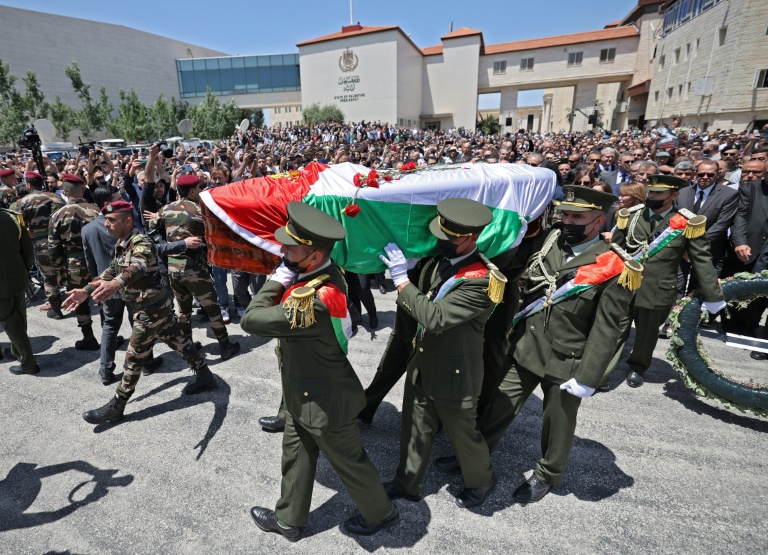
In a sign of Abu Akleh’s stature among Palestinians, she received what was described as a full state memorial at the Ramallah compound of president Mahmud Abbas.

Thousands lined the route as her coffin, draped in the Palestinian flag, was driven through the West Bank city, where a street is to be renamed in her honour.

Many held flowers, wreaths and pictures of the slain journalist, who has been widely hailed for her bravery and professionalism through her coverage of the conflict.

– ‘Wound in our hearts’ –

“This crime should not go unpunished,” said Abbas, adding that the PA held Israel “completely responsible” for her death, and had “rejected” an Israeli proposal for a joint investigation.

Israeli Prime Minister Naftali Bennett had said Wednesday it was “likely” Abu Akleh was killed by stray Palestinian gunfire — but Defence Minister Benny Gantz later conceded that it could have been “the Palestinians who shot her” or fire from “our side”.

On a visit to Tehran, Qatar’s Emir Sheikh Tamim bin Hamad Al-Thani blamed “Israeli occupation forces” for the “heinous crime”. 

Bennett on Thursday accused the PA of blocking Israel from accessing “the basic findings that would be necessary in order to reach the truth,” and warned them not to “taint the investigative process.”

Draped in a Palestinian scarf, mourner Tariq Ahmed, 45, described the death as a “tragedy for all the nation”, comparing his grief to that he felt at the funeral of Palestinian leader Yasser Arafat.

“I have not felt this pain since Arafat died,” Ahmed said.

Another mourner, 45-year-old Hadil Hamdan, said that “Shireen was part of our lives”, adding that “her voice entered every home, and her loss is a wound in our hearts”.

Ibrahim Abu Allan, 52, attended the memorial in his wheelchair, having travelled from the southern  West Bank. “The road was difficult, but Shireen deserves a farewell,” he said.

– No joint probe –

Abu Akleh, a Palestinian Christian born in Israeli-annexed east Jerusalem, is scheduled to be buried alongside her parents in a cemetary near Jerusalem’s Old City on Friday.

As her coffin began its journey to Jerusalem to the drumbeat of a marching band, crowds chanted slogans demanding an end to Palestinian security cooperation with Israel.

Israel had publicly called for a joint probe and stressed the need for Palestinian authorities to hand over the fatal bullet for forensic examination.

The European Union has urged an “independent” probe while the United States demanded the killing be “transparently investigated”, calls echoed by UN human rights chief Michelle Bachelet.

PA official Hussein Al-Sheikh, a close Abbas confidant, said the Palestinian “investigation would be completed independently”.

An initial autopsy and forensic examination were conducted in Nablus in the Israel-occupied West Bank hours after her death.

– New Jewish settlements –

In a move likely to further inflame West Bank tensions, Israel on Thursday advanced plans for 4,427 Jewish settler homes. 

About 475,000 settlers already live in the West Bank, alongside some 2.7 million Palestinians, in communities widely regarded as illegal under international law.

Settlement monitor Peace Now warned the announcement “deepens the occupation,” while right-wing Interior Minister Ayelet Shaked, a member of Bennett’s religious nationalist Yamina party, hailed a “day of celebration for the settler movement.”

Tensions had already risen with a wave of attacks that have killed at least 18 people in Israel since March 22, including an Arab-Israeli police officer and two Ukrainians.

A total of 31 Palestinians and three Israeli Arabs have died during the same period, according to an AFP tally, among them perpetrators of attacks and those killed by Israeli security forces in West Bank operations.

Seeing Milky Way's new black hole is 'only the beginning': US researcher

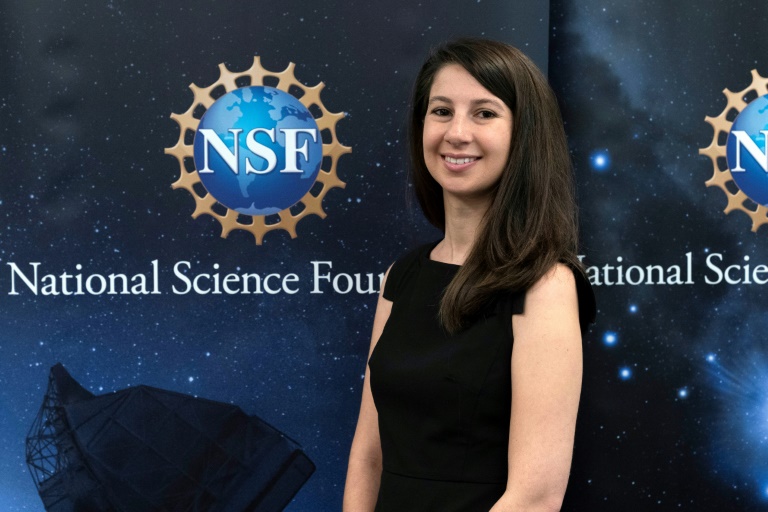
At just 33 years old, Caltech assistant professor Katie Bouman is already a veteran of two major scientific discoveries.

The expert in computational imaging — developing algorithms to observe distant phenomena — helped create the program that led to the release of the first image of a black hole in a distant galaxy in 2019.

She quickly became something of a global science superstar, and was invited to testify before Congress about her work.

Now, she has again played a key role in the creation of a groundbreaking image of the supermassive black hole at the heart of our own Milky Way galaxy — a cosmic body known as Sagittarius A*.

Her working group within the Event Horizon Telescope Collaboration, which revealed the stunning image Thursday, was tasked with piecing it together from the mass of data garnered by telescopes around the world.

Bouman spoke with AFP shortly after the breakthrough announcement.

– How does this discovery compare to 2019? –

“The first one was just so exciting because it was the first one, and just being able to see a black hole for the first time was spectacular. But I think the holy grail of the Event Horizon Telescope has always been to image Sagittarius A*. 

“The reason why is because we have a lot more information from other observations on what we expected Sgr A* to look like. And so being able to see an image of that, it’s much easier for us to see how it matches with what we expected from prior observations and theory. 

“So I think that even though it is the second image that we’re showing, it’s actually a lot more exciting for that reason that we can actually use this to do more tests on our understanding of gravity.”

– Why was it harder to see Sagittarius A*? –

“We collected the data for both M87* and Sgr A* in the same week in 2017, but it took us so much longer to make a picture of Sgr A* than M87*. 

“Sgr A* has a lot of other things that are going on that make it a lot more challenging for us to make an image. We’re actually observing the black hole through the plane of the galaxy. And that means that the gas in the galaxy actually scatters the image. It makes it look like we’re looking at the black hole through, like, a frosted window, like in a shower. That’s one challenge. 

“But I would say the biggest challenge that we face is the fact that the black hole is evolving really quickly. The gas in M87* and Sgr A* is moving at roughly the same speed. But whereas it takes days to weeks to make a full orbit around M87*, for Sgr A*, it’s evolving from minute to minute.”

– Why are black holes so fascinating? – 

“It just breaks with what we’re used to here on Earth, right? Light can’t even escape from it, and it’s bending, it’s warping space-time around it. It’s just this mysterious thing and I think it just captures the imagination.

“What’s cooler than working on black holes — they’re so mysterious, right? And the fact that we’re able to make an image of one, something that should be unseeable… I think that that’s just really exciting.”

– What do you foresee in the future? A film? – 

“I think this is really only the beginning. And now that we know that we have these extreme laboratories of gravity, we can go back and we can improve our instruments and improve our algorithms in order to see more and to extract more science.

“We made our first attempts at making a movie and we made a lot of progress, but we’re not there yet — where we feel we’re confident enough that we feel, this is what Sgr A* looks like from minute to minute. 

“So now we’re going to go back, try to add more telescopes around the world, try to collect more data, so that we can actually show something that we feel really sure about.”

Finland poised for NATO membership as Ukraine war crimps Russian gas

Finland on Thursday took a step towards fast-track membership of NATO, triggering a blunt warning from the Kremlin, as the war in Ukraine throttled supplies of Russian gas to Europe and the number fleeing the country passed six million.

In Geneva, the UN Human Rights Council decided to probe alleged Russian atrocities in Ukraine, in a vote overwhelmingly approved by its members but snubbed by Russia.

Announcing a seismic change in policy since Russia invaded its neighbour in February, Finland’s leaders declared their nation must apply to join NATO “without delay”.

“NATO membership would strengthen Finland’s security,” President Sauli Niinisto and Prime Minister Sanna Marin said in a joint statement in Helsinki. 

“As a member of NATO, Finland would strengthen the entire defence alliance.”

But Kremlin spokesman Dmitry Peskov warned Russia would “definitely” see Finnish membership as a threat.

The Russian foreign ministry said Moscow would be “forced to take reciprocal steps, military-technical and other, to address the resulting threats to its national security”.

In launching the invasion of Ukraine, President Vladimir Putin cited in part what he called the threat from NATO, which expanded eastwards after the Cold War.

The foreign ministry accused NATO of seeking to create “another flank for the military threat to our country”.

Finland has been a declared neutral in East-West crises for decades, and as recently as January its leaders ruled out NATO membership.

But the February 24 invasion shocked the Nordic nation.

It shares a 1,300-kilometre (800-mile) border with Russia and its past is studded with conflict with its giant neighbour.

NATO has already declared it will warmly embrace Finland and Sweden, two countries with deep pockets and well-equipped armies. 

Finland’s entry will be “smooth and swift”, NATO chief Jens Stoltenberg promised on Thursday.

Germany, France and the powerful US Senate Foreign Relations Committee also strongly voiced their support, and Britain has already pledged its assistance.

A special committee will announce Finland’s formal decision on a membership bid on Sunday. Sweden, another neutral state, is widely expected to follow its neighbour. 

– Russian gas –

Russia’s flow of gas to Europe fell meanwhile, spurring fears for Germany and other heavily dependent economies.

Russian energy giant Gazprom announced it would stop supplying gas via the Polish part of the Yamal-Europe pipeline following retaliatory sanctions that Russia slapped on Western companies on Wednesday.

Gazprom also said gas transiting to Europe via Ukraine had dropped by a third — a fall it blamed on Ukraine’s pipeline operator, which the company denies, pointing the finger at Russia.

Ukraine and Poland are major supply routes for Russian gas to Europe and the two sides have kept flows going despite the conflict.

The European Union’s heavy reliance on Russian energy has made it reluctant to add oil and gas imports to sanctions that are inflicting a toll on Russia’s economy.

The EU is struggling to overcome Hungarian resistance for plans to ban Russian oil.

Mykhaylo Podolyak, a senior aide to Ukrainian President Volodymyr Zelensky, drew a parallel with the 1930s as he urged the bloc to impose an immediate embargo.

“If the leaders had acted decisively in 1938, Europe could have avoided WWII,” he wrote on Twitter. “History won’t forgive us if we make the same mistake again.”

With a global food crisis feared as Ukrainian exports tumble, host Germany said the G7 club of industrialised nations will tackle the issue for the world’s poorest nations at talks beginning on Thursday.

– Shelling –

Fighting in Ukraine has been concentrated in the south and east since Russia abandoned attempts to seize Kyiv.

Ukraine’s presidency said shelling continued throughout Lugansk — part of the Donbas region where Ukrainian forces are fiercely opposing Russian armour and Kremlin-backed separatists.

Russian troops are trying to take complete control of Rubizhne, block a key highway between Lysychansk and Bakhmut and seize Severodonetsk, the office said.

In the northeastern region of Chernigiv three people were killed and 12 others wounded early Thursday in a strike on a school in Novgorod-Siversky, the emergency services said. 

In the southern port city of Mariupol, besieged troops in the vast Azovstal steelworks have been holding out against weeks-long bombardment, refusing demands to surrender.

Ukrainian Deputy Prime Minister Iryna Vereshchuk said “difficult talks” were underway over the evacuation of 38 seriously wounded troops.

Russia’s army said it struck Donetsk and Kharkiv on Thursday, killing more than 170 people and destroying Ukrainian drones and rockets.

– War crimes probe –

In Geneva, the UN Human Rights Council voted 33-2, with 12 abstentions, to investigate alleged atrocities by Russian troops.

The resolution, brought by Ukraine, will focus on alleged crimes in the Kyiv, Chernigiv, Kharkiv and Sumy regions in late February and March, “with a view to holding those responsible to account”.

“These have been 10 weeks of sheer horror to the people of my country,” Deputy Foreign Minister Emine Dzhaparova told the UN meeting from Kyiv, accusing Putin’s forces of “pure evil”.

The International Criminal Court in The Hague has already begun its own inquiry, sending investigators to the Kyiv suburb of Bucha.

The invasion has sparked an exodus of civilians, many of whom describe torture, sexual violence and indiscriminate destruction.

The UN refugee agency said on Thursday the number of those fleeing had passed six million, more than half of them going to neighbouring Poland.

Ukrainian prosecutors say they have received reports of more than 10,000 alleged crimes, with 622 suspects identified.

On Wednesday, the office said it would launch the first trial for war crimes.

Ukrainian authorities and witnesses interviewed by AFP on Thursday accused Russian forces of killing several civilians in March after shelling a residential home in the east Ukrainian village of Stepanki from a tank.

– Dilemmas –

Across Ukraine, lives have been turned upside down, forcing millions to make anguished choices of how to respond.

Zhanna Protsenko, a social worker in the frontline town of Orikhiv, spoke to AFP as she prepared to visit people who refused or were unable to evacuate.

“How can I leave them here?” the 56-year-old asked, standing near a hospital hit by a strike in the past week. 

“We work. We have no time to hide,” she said as contractors repaired rows of blown-out windows and an oil drum-sized hole in the facade.

But some Ukrainian refugees have also been returning to their country and been joyfully reunited with loved ones.

“Time has passed, we have accepted this terrible reality, we can coexist with it,” said Olena Shalimova, who had fled Kyiv after an explosion close to her home.

bur/ri/imm/har

Qatar, EU say pushing stalled Iran nuclear talks

Qatar’s emir and the European Union on Thursday said they are working to push forward stalled negotiations aimed at reviving a 2015 nuclear deal between Iran and major world powers.

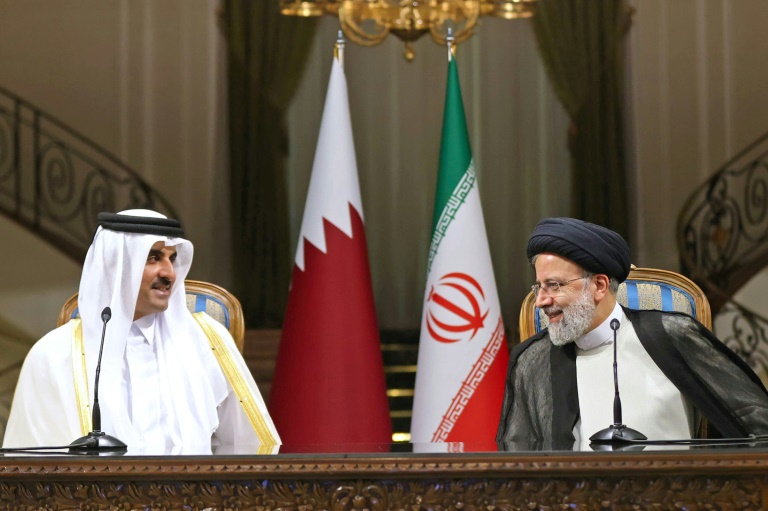
Sheikh Tamim bin Hamad Al-Thani met Iran’s Supreme Leader Ayatollah Ali Khamenei and President Ebrahim Raisi in Tehran as an EU envoy held a second day of meetings with Iran’s chief negotiator Ali Bagheri in the Iranian capital.

The meetings came as a French diplomatic source expressed pessimism over prospects for the talks that have been paused since March between world powers and Iran on restoring the landmark deal.

The 2015 deal gave Iran sanctions relief in exchange for curbs on its nuclear programme to guarantee that it could not develop a nuclear weapon, something Tehran has always denied wanting to do.

Formally known as the Joint Comprehensive Plan of Action, the agreement was left on life support in 2018 by then-US president Donald Trump’s unilateral decision to withdraw and impose punishing sanctions. This prompted Iran to begin rolling back its own commitments.

Qatar, a close US ally, has added the Iran nuclear dispute to its list of diplomatic hotspots where it has taken a behind-the-scenes mediation role.

“Regarding the negotiations taking place in Vienna, Qatar always looks at them positively,” Sheikh Tamim said during a news conference with Raisi, adding that “the only solution to any disagreement is by peaceful means and dialogue.”

“We are, God willing, pushing all the parties towards” reaching an agreement that is “fair” for everyone, said the Qatari emir.

Raisi did not raise the nuclear issue during the news conference, but he cautioned against foreign meddling.

“Any interference of Western and foreign countries in the region not only can’t ensure security but will also be harmful to regional security,” he said.

Khamenei also told Sheikh Tamim that issues in the region, such as conflicts in Syria and Yemen, can be resolved through regional dialogue without “foreign intervention”, the Iran leader’s office said in a statement.

“Negotiations should not be from a position of weakness, while the other side, mainly the United States and others, rely on military and financial power”, he added.

– Sticking points –

The emir’s one-day visit came as the European Union’s nuclear talks coordinator, Enrique Mora, continued discussions with Bagheri in Tehran, state news agency IRNA reported.

An EU spokesman said Mora was seeking to rescue the nuclear deal.

“It’s in the interest and it’s the role of the coordinator actually to do everything he can in order to save this agreement,” said Peter Stano.

Mora “is in Tehran exactly to move these talks forward, to be able to go back to Vienna and to conclude them in a positive way,” he added.

His visit coincided with a pessimistic assessment by a French diplomatic source who said negotiations “are at a point of deadlock”.

Among the main sticking points in the negotiations is Tehran’s demand for the United States to remove Iran’s Islamic Revolutionary Guard Corps from a designated list of terrorist groups.

A deal had been ready in March but “slipped away” because of this dispute, the French source said.

IRNA said “unfreezing Iran’s assets, cooperation in holding the 2022 World Cup, pursuing prisoner exchanges and cooperation in the field of energy” were also on the agenda of the emir’s visit.

Unlike some of its Gulf Arab neighbours, Qatar has maintained close relations with Iran and the two countries share the world’s largest natural gas field.

Tehran has expressed interest in hosting spectators for football’s World Cup finals in Qatar in November on its nearby resort island of Kish.

It is waiving visa fees for visitors in the hope of attracting fans to the island.

Sheikh Tamim thanked Iran for its “cooperation and support for the success of this competition”.

Khamenei described the level of economic relations between the two countries as “very low” and said it “should be multiplied.”

Close Bitnami banner
Bitnami