World

Activists condemn Iran 'hostage taking' of foreigners

Iran is engaged in a brazen policy of hostage taking of foreigners to extract concessions from the West, activists say, with further Western nationals arrested and others even facing execution.

Campaigners accuse Iran of a systematic policy of hostage taking over four decades from the earliest period of the Islamic republic after the ousting of the shah, starting with the 1979-1981 siege at the US embassy in Tehran.

France said Thursday that two of its citizens had been detained in Iran, with sources identifying them as a French teachers’ union official and the unionist’s spouse, and the foreign ministry denouncing a “baseless arrest”.

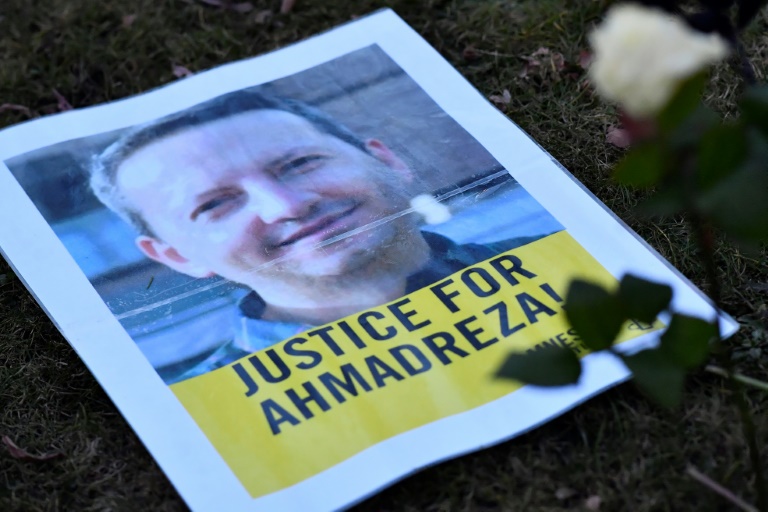
Meanwhile, Swedish-Iranian academic Ahmadreza Djalali is at risk of an execution that media reports say is due to be carried out by May 21, over his 2017 conviction on spying charges that are vehemently denied by his family.

Iran denies any such policy of hostage taking and insists all foreigners are tried according to due legal process. However it has repeatedly shown a willingness for prisoner exchanges and taken part in swaps in the past.

“It is diplomacy by coercion: not settling international disputes simply by classic negotiation between states,” said a Western specialist on the issue, asking not to be named due to the sensitivity.

– ‘Call it hostage taking’ –

Even after the recent high-profile release by Tehran of British detainees Nazanin Zaghari-Ratcliffe and Anoosheh Ashoori, activists say at least a dozen Westerners including Americans, British and Germans citizens remain held in Iran.

German citizen Jamshid Sharmahd is on trial in Tehran on charges that could see him hanged, as is Swedish national Habib Chaab. Supporters say both men were abducted in third countries before being brought to Iran.

These tensions are also growing at a hugely sensitive moment in the talks to revive the 2015 deal on curbing Iran’s nuclear programme, with Europe warning that Tehran has a last chance to strike a deal.

Mahmood Amiry-Moghaddam, founder of the Iran Human Rights NGO, said there was “no doubt” the Westerners were being held as hostages, saying Europe needed to take a firmer line and condemn Iran’s actions as hostage taking.

“Iran has carried out hostage taking for a long time, for the last 40 years. It has been successful as a policy, as Western countries have always responded. So Iran continued,” he told AFP.

“It is a big problem for Europe that they are not calling the hostage taking for what it is. It is a huge mistake that puts human lives in danger,” he said.

Wary of adding further complications into the already prickly nuclear talks, major European powers have generally steered clear of public accusations that Iran is carrying out hostage taking.

In a rare moment of candour, French Foreign Minister Jean-Yves Le Drian said in an interview in January that France was pressuring Iran “to ensure that these hostages –- and we have to call it this –- who are held in Iran are freed”.

But contacts continue between Europe and Iran, with the EU’s foreign policy number two Enrique Mora in Tehran this week for talks on salvaging the nuclear deal.

– ‘Blatant extortion’ –

Amiry-Moghaddam described the fate of Djalali as a “very important test” for Europe, saying “whether they can save him will be decisive.”

Warnings by Iranian media and officials that he faces execution have coincided with the conclusion of an unprecedented trial in the Swedish capital Stockholm of former Iranian official Hamid Noury, who was arrested in 2019 over the 1988 massacres of thousands of opposition prisoners.

The trial, taking place under the principle of universal jurisdiction, has infuriated Tehran, which this month summoned the Swedish ambassador. Meanwhile, another Swedish man was arrested in Iran this month.

“The Iranian government is engaging in blatant extortion,” said Hadi Ghaemi, executive director of the US-based Center for Human Rights in Iran (CHRI).

He accused Iran of “collecting dual nationals to use in its arsenal of human bargaining chips”.

Raphael Chenuil Hazan, director of the France-based NGO Together Against the Death Penalty (ECPM), said Europe “cannot remain silent” in the face of the risk of executions of dual nationals. 

“The death penalty should not be used as a political bargaining tool. Iran must understand that this execution would inevitably have a strong political cost,” he said.
US Senate set to confirm Powell for second term as central bank chief

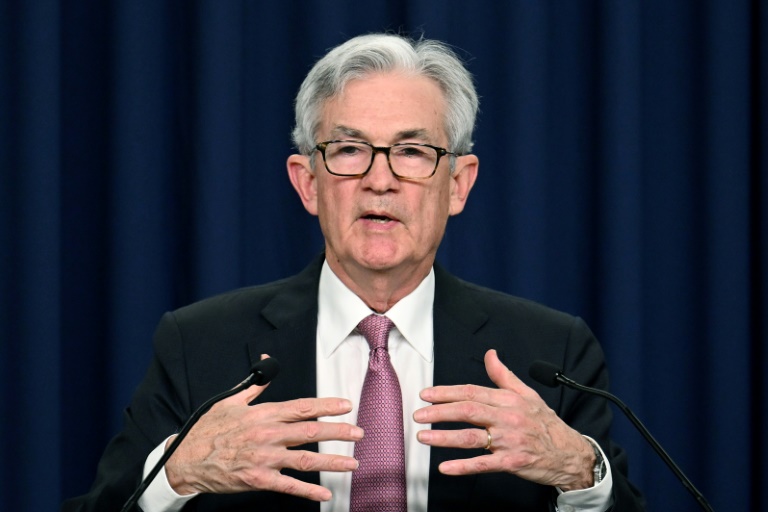
The US Senate was poised Thursday to confirm Jerome Powell to a second term as head of the Federal Reserve, as the central bank works to crush soaring inflation.

The vote will come as inflation has hit a 40-year high, fueled by the conflict in Ukraine and ensuing sanctions imposed on Russia, as well as Covid-19 restrictions in China that have raised concerns the global supply snarls may worsen.

Powell, a Republican who enjoys broad bipartisan support, has continued at the helm of the central bank although his first term officially expired February 4.

His confirmation was delayed by a drawn-out process to approve Lisa Cook to join the Fed board — the first Black woman to serve in the post — who was finally confirmed on Tuesday with only Democratic votes.

The vote on Powell comes the day after the upper house of Congress approved the nomination of Philip Jefferson of Davidson College, marking the first time the Fed board has had more than one Black governor.

US President Joe Biden, whose popularity has taken a hit from the soaring inflation and record gasoline prices, has said repeatedly that tackling the issue is primarily a job for the Fed.

“I put forward highly qualified nominees to lead that institution, and I strongly urge the Senate to confirm them without delay,” he said Tuesday.

Powell led the central bank as is slashed the benchmark interest rate to zero at the start of the pandemic in March 2020 and pumped money into the financial system to prevent a severe downturn in the world’s largest economy, and is now overseeing efforts to cool price pressures impacting American families.

The Fed last week announced its largest rate hike since 2000 and signaled similar increases were likely in the coming months.

The challenge for Powell and the Fed is to turn down the heat on inflation without tipping the United States into recession, but he has expressed confidence that the economy is strong enough to withstand the tighter monetary policy.

With the latest additions, the Fed board will be just one short of its full complement of seven governors.

Cook and Jefferson each have researched inequality in the labor market. 

Powell has repeatedly stressed the importance of ensuring economic opportunities extend to disadvantaged groups — a notable change of focus in an economy where Black workers face far higher unemployment rates than other racial groups.

Cook, a professor of economics and international relations at Michigan State University, has focused her research on how discrimination has harmed the American economy and the damage downturns do to the poor.

Jefferson, also an economics professor, is only the fourth Black man to serve as a Fed governor.

Crisis-hit Sri Lanka appoints new PM to replace president's brother

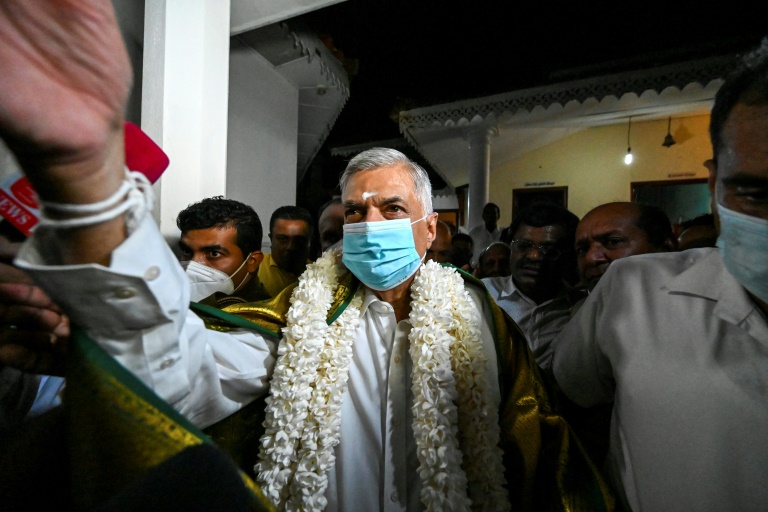
Sri Lanka’s embattled president swore in a new prime minister Thursday to replace his brother, who was banned from leaving the country after his supporters launched violent attacks on a protest against the nation’s economic crisis. 

The new premier, Ranil Wickremesinghe, has already served in the office five times — but it remains to be seen whether he will be able to get any legislation through parliament.

The 73-year-old will be tasked with navigating Sri Lanka through the worst downturn in its history as an independent nation, with months of shortages and blackouts inflaming public anger.

“We want to return the nation to a position where our people will once again have three meals a day,” Wickremesinghe said after his appointment.

“Our youth must have a future.”

In a bid to win over opposition lawmakers demanding he quit, President Gotabaya Rajapaksa, 72, had pledged to give up most of his executive powers and pave the way for a new cabinet.

Mahinda Rajapaksa, the president’s brother, resigned as prime minister on Monday after his supporters attacked anti-government demonstrators who had been protesting peacefully for weeks.

This marked a turning point and unleashed several days of chaos and violence in which at least nine people were killed and over 200 injured, with dozens of Rajapaksa loyalist homes set on fire.

On Thursday, a court banned Mahinda, his politician son Namal, and more than a dozen allies from leaving the country after ordering an investigation into the violence.

“Congratulations to the newly appointed Prime Minister,” Mahinda tweeted from the Trincomalee naval base on the country’s east coast, where he took refuge after fleeing the capital Colombo. 

“I wish you all the best as you navigate these troubled times.”

Security forces patrolling in armoured personnel carriers with orders to shoot looters on sight have largely restored order.

A curfew was lifted Thursday morning — only to be reimposed after a six-hour break allowing Sri Lanka’s 22 million people to stock up on essentials.

– ‘Collapse beyond redemption’ –

Sri Lankans have suffered months of severe shortages of food, fuel and medicine — as well as long power cuts — after the country burnt through foreign currency reserves needed to pay for vital imports.

The central bank chief warned Wednesday that the economy would “collapse beyond redemption” unless a new government was urgently appointed.

Wickremesinghe is seen as a pro-West free-market reformist, potentially making bailout negotiations with the International Monetary Fund and others smoother.

With many from Rajapaksa’s party having defected in recent months, no group in the 225-member assembly has an absolute majority, making parliamentary approval of the unity government’s legislation potentially tricky.

Wickremesinghe insisted he had enough support to govern when speaking to reporters after his appointment. 

But it remains to be seen whether a new cabinet will be enough to calm public anger if Rajapaksa continues to resist calls for his resignation.

“What he has done is despicable, he has brought all of us to this state of hunger and poverty,” Abu Nawaz, a small business owner in Colombo, told AFP.

“What is the point of keeping him as the president?” he added. “Will this end our miseries?”

– ‘We can’t wait any longer’ – 

Wickremesinghe had already been working closely with Rajapaksa before his appointment to push through sweeping policy changes, an official close to their discussions told AFP. 

The central bank almost doubled key interest rates and announced a default on Sri Lanka’s $51-billion external debt as part of the policy shift, officials said. 

“His appointment as PM, and the quick formation of an inclusive government, are first steps to addressing the crisis,” US ambassador to Sri Lanka Julie Chung tweeted.

The main opposition SJB party was initially invited to lead a new government, but its leader Sajith Premadasa insisted the president first step down.

In recent days the party has split, with a dozen SJB lawmakers pledging support to Wickremesinghe.

“We must address the economic crisis,” said the party’s Harin Fernando. “We can’t wait any longer.”

Wickremesinghe was greeted by a small group of supporters as he arrived to pray at a Buddhist temple in Colombo after he was sworn in.

But members of Sri Lanka’s influential Buddhist clergy have already signalled their dissatisfaction with the appointment of the veteran politician, who served as premier as recently as 2019.

“What we asked for is a new government that will include fresh blood, not those whose who have already been rejected by the people,” said leading monk Omale Sobitha.

Crisis-hit Sri Lanka appoints new PM to replace president's brother

Sri Lanka’s embattled president swore in a new prime minister Thursday to replace his brother, who was banned from leaving the country after his supporters launched violent attacks on a protest against the nation’s economic crisis. 

The new premier, Ranil Wickremesinghe, has already served in the office five times — but it remains to be seen whether he will be able to get any legislation through parliament.

The 73-year-old will be tasked with navigating Sri Lanka through the worst downturn in its history as an independent nation, with months of shortages and blackouts inflaming public anger.

“We want to return the nation to a position where our people will once again have three meals a day,” Wickremesinghe said after his appointment.

“Our youth must have a future.”

In a bid to win over opposition lawmakers demanding he quit, President Gotabaya Rajapaksa, 72, had pledged to give up most of his executive powers and pave the way for a new cabinet.

Mahinda Rajapaksa, the president’s brother, resigned as prime minister on Monday after his supporters attacked anti-government demonstrators who had been protesting peacefully for weeks.

This marked a turning point and unleashed several days of chaos and violence in which at least nine people were killed and over 200 injured, with dozens of Rajapaksa loyalist homes set on fire.

On Thursday, a court banned Mahinda, his politician son Namal, and more than a dozen allies from leaving the country after ordering an investigation into the violence.

“Congratulations to the newly appointed Prime Minister,” Mahinda tweeted from the Trincomalee naval base on the country’s east coast, where he took refuge after fleeing the capital Colombo. 

“I wish you all the best as you navigate these troubled times.”

Security forces patrolling in armoured personnel carriers with orders to shoot looters on sight have largely restored order.

A curfew was lifted Thursday morning — only to be reimposed after a six-hour break allowing Sri Lanka’s 22 million people to stock up on essentials.

– ‘Collapse beyond redemption’ –

Sri Lankans have suffered months of severe shortages of food, fuel and medicine — as well as long power cuts — after the country burnt through foreign currency reserves needed to pay for vital imports.

The central bank chief warned Wednesday that the economy would “collapse beyond redemption” unless a new government was urgently appointed.

Wickremesinghe is seen as a pro-West free-market reformist, potentially making bailout negotiations with the International Monetary Fund and others smoother.

With many from Rajapaksa’s party having defected in recent months, no group in the 225-member assembly has an absolute majority, making parliamentary approval of the unity government’s legislation potentially tricky.

Wickremesinghe insisted he had enough support to govern when speaking to reporters after his appointment. 

But it remains to be seen whether a new cabinet will be enough to calm public anger if Rajapaksa continues to resist calls for his resignation.

“What he has done is despicable, he has brought all of us to this state of hunger and poverty,” Abu Nawaz, a small business owner in Colombo, told AFP.

“What is the point of keeping him as the president?” he added. “Will this end our miseries?”

– ‘We can’t wait any longer’ – 

Wickremesinghe had already been working closely with Rajapaksa before his appointment to push through sweeping policy changes, an official close to their discussions told AFP. 

The central bank almost doubled key interest rates and announced a default on Sri Lanka’s $51-billion external debt as part of the policy shift, officials said. 

“His appointment as PM, and the quick formation of an inclusive government, are first steps to addressing the crisis,” US ambassador to Sri Lanka Julie Chung tweeted.

The main opposition SJB party was initially invited to lead a new government, but its leader Sajith Premadasa insisted the president first step down.

In recent days the party has split, with a dozen SJB lawmakers pledging support to Wickremesinghe.

“We must address the economic crisis,” said the party’s Harin Fernando. “We can’t wait any longer.”

Wickremesinghe was greeted by a small group of supporters as he arrived to pray at a Buddhist temple in Colombo after he was sworn in.

But members of Sri Lanka’s influential Buddhist clergy have already signalled their dissatisfaction with the appointment of the veteran politician, who served as premier as recently as 2019.

“What we asked for is a new government that will include fresh blood, not those whose who have already been rejected by the people,” said leading monk Omale Sobitha.

Qatar emir blames Israel for Al Jazeera journalist death

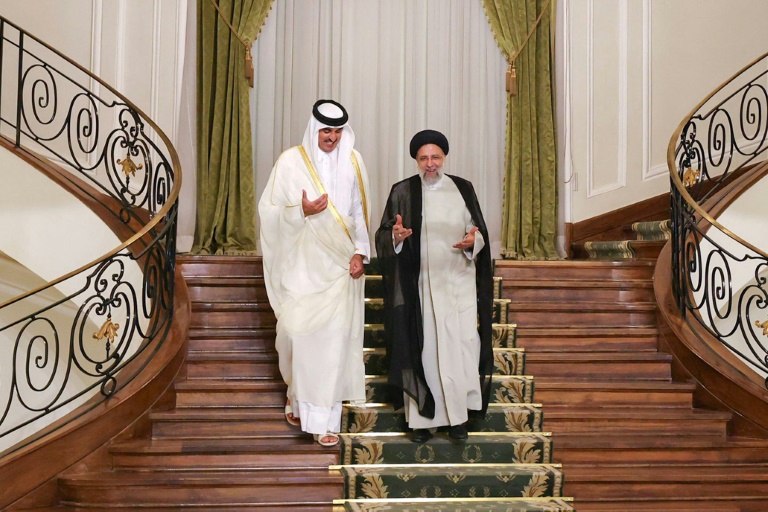
The emir of Qatar on Thursday accused Israel over the death of Al Jazeera journalist Shireen Abu Akleh during an Israeli army raid in the occupied West Bank.

Abu Akleh was “killed by the Israeli occupation forces”, Sheikh Tamim bin Hamad Al-Thani said at a joint news conference in Tehran with Iran’s President Ebrahim Raisi.

“We must hold the perpetrators of this heinous crime accountable,” the Qatari leader added.

Abu Akleh, a 51-year-old Palestinian-American, was shot dead on Wednesday as she covered the Israeli military operation in the Jenin refugee camp.

The Qatar-based pan-Arab television channel charged that the Israeli forces had killed her deliberately “in cold blood”.

Israeli Prime Minister Naftali Bennett had said Wednesday it was “likely” Abu Akleh was killed by stray Palestinian gunfire, but Defence Minister Benny Gantz later conceded it could have been “the Palestinians who shot her” or fire from “our side”.

Calls have mounted around the world for an independent investigation into the shooting.

But the Palestinians have turned down an Israeli offer to carry out a joint probe, saying they would investigate alone and share their findings.

The Iranian president also implicated Israel, the sworn enemy of the Islamic republic.

“We are certain that these crimes cannot bring security to the Zionist regime. To the contrary, they will only increase popular anger” towards Israel, Raisi said.

Palestinians honour slain journalist, reject joint probe

Thousands of Palestinians on Thursday honoured Al Jazeera journalist Shireen Abu Akleh across the occupied West Bank and annexed east Jerusalem, a day after she was shot dead during an Israeli army raid.

Israel and the Palestinians have traded blame over the killing of Palestinian-American Abu Akleh, 51, a veteran of the Qatar-based network’s Arabic service, during clashes in the Jenin refugee camp.

The United States, European Union and United Nations have backed calls for a full investigation into what Al Jazeera labelled a deliberate killing “in cold blood”, but the Palestinian Authority (PA) has rejected holding a joint probe with Israel.

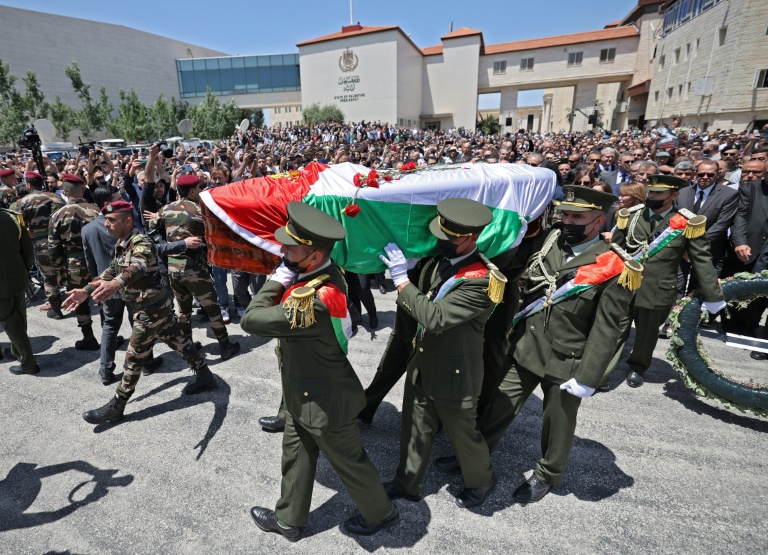
In a sign of Abu Akleh’s stature among Palestinians, she received what was described as a full state memorial at the Ramallah compound of president Mahmud Abbas.

Thousands lined the streets as her coffin, draped in the Palestinian flag, was driven through the West Bank city.

Many held flowers, wreaths and pictures of Abu Akleh, who has been widely hailed for her bravery and professionalism through her coverage of the conflict.

– ‘Wound in our hearts’ –

“This crime should not go unpunished,” said Abbas, adding that the PA held Israel “completely responsible” for her death, and had “refused and rejected” an Israeli proposal for a joint investigation.

Israeli Prime Minister Naftali Bennett had said Wednesday it was “likely” Abu Akleh was killed by stray Palestinian gunfire — but Defence Minister Benny Gantz later conceded that it could have been “the Palestinians who shot her” or fire from “our side”.

Bennett on Thursday accused the PA of blocking Israel from accessing “the basic findings that would be necessary in order to reach the truth,” and warned them not to “taint the investigative process.”

Draped in a Palestinian scarf, Tariq Ahmed, 45, described the death as a “tragedy for all the nation”, comparing his grief to that he felt at the funeral of iconic Palestinian leader Yasser Arafat.

“I have not felt this pain since Arafat died,” Ahmed said.

Another mourner, 45-year-old Hadil Hamdan, said that “Shireen was part of our lives”, adding that “her voice entered every home, and her loss is a wound in our hearts”.

– No joint probe –

Abu Akleh, a Christian born in Israeli-annexed east Jerusalem, is scheduled to be buried in the city on Friday.

As her coffin began its journey to Jerusalem to the drumbeat of a marching band, crowds chanted slogans demanding an end to Palestinian security cooperation with Israel.

Israel had publicly called for a joint probe and stressed the need for Palestinian authorities to hand over the fatal bullet for forensic examination.

The European Union has urged an “independent” probe while the United States demanded the killing be “transparently investigated”, calls echoed by UN human rights chief Michelle Bachelet.

But senior PA official Hussein Al-Sheikh, a close Abbas confidant, said the Palestinian “investigation would be completed independently”.

He added that Abu Akleh’s family, the United States, Qatar and “all official authorities” would be informed of the results.

An initial autopsy and forensic examination were conducted in Nablus in the Israel-occupied West Bank hours after her death, but no final conclusions have been disclosed.

A source in the Palestinian attorney general’s office said the results of a preliminary report on the bullet were expected as early as Thursday evening.

– New Jewish settlements –

In a move likely to further inflame West Bank tensions, Israel on Thursday advanced plans for 4,427 Jewish settler homes. 

Some 475,000 settlers live in the West Bank, alongside some 2.7 million Palestinians, in communities widely regarded as illegal under international law.

Settlement monitor Peace Now warned the announcement “deepens the occupation,” while right-wing Interior Minister Ayelet Shaked, a member of Bennett’s religious nationalist Yamina party, hailed “day of celebration for the settler movement.”

The Civil Administration’s high planning committee gave final approval to 2,791 units and initial endorsement for another 1,636 units, Peace Now said.

Tensions have again risen with a wave of attacks that have killed at least 18 people in Israel since March 22, including an Arab-Israeli police officer and two Ukrainians.

A total of 31 Palestinians and three Israeli Arabs have died during the same period, according to an AFP tally, among them perpetrators of attacks and those killed by Israeli security forces in West Bank operations.

Astronomers reveal first image of black hole at Milky Way's centre

An international team of astronomers on Thursday unveiled the first image of a supermassive black hole at the centre of our own Milky Way galaxy — a cosmic body known as Sagittarius A*.

The image — produced by a global team of scientists known as the Event Horizon Telescope (EHT) Collaboration — is the first, direct visual confirmation of the presence of this invisible object, and comes three years after the very first image of a black hole from a distant galaxy.

“For decades, we have known about a compact object that is at the heart of our galaxy that is four million times more massive than our Sun,” Harvard University astronomer Sara Issaoun told a press conference in Garching, Germany, held simultaneously with other media events around the world.

“Today, right this moment, we have direct evidence that this object is a black hole.”

Black holes are regions of space where the pull of gravity is so intense that nothing can escape, including light.

The image thus depicts not the black hole itself, because it is completely dark, but the glowing gas that encircles the phenomenon in a bright ring of bending light.

As seen from Earth, it appears the same size as a donut on the surface of the Moon, Issaoun explained.

“These unprecedented observations have greatly improved our understanding of what happens at the very centre of our galaxy,” EHT project scientist Geoffrey Bower, of Taiwan’s Academia Sinica, said in a statement.

The research results are published in The Astrophysical Journal Letters.

– Virtual telescope –

Sagittarius A* — abbreviated to Sgr A*, and pronounced “sadge-ay-star” — owes its name to its detection in the direction of the constellation Sagittarius. 

Located 27,000 light years from Earth, its existence has been assumed since 1974, with the detection of an unusual radio source at the centre of the galaxy.

In the 1990s, astronomers mapped the orbits of the brightest stars near the centre of the Milky Way, confirming the presence of a supermassive compact object there — work that led to the 2020 Nobel Prize in Physics.

Though the presence of a black hole was thought to be the only plausible explanation, the new image provides the first direct visual proof.

Capturing images of such a faraway object required linking eight giant radio observatories across the planet to form a single “Earth-sized” virtual telescope called the EHT.

“The EHT can see three million times sharper than the human eye,” German scientist Thomas Krichbaum of the Max Planck Institute for Radio Astronomy told reporters.

“So, when you are sitting in a Munich beer garden, for example, one could see the bubbles in a glass of beer in New York.”

The EHT gazed at Sgr A* across multiple nights for many hours in a row — a similar idea to long-exposure photography and the same process used to produce the first image of a black hole, released in 2019. 

That black hole is called M87* because it is in the Messier 87 galaxy.

– Einstein would be ‘ecstatic’ –

The two black holes bear striking similarities, despite the fact that Sgr A* is 2,000 times smaller than M87*.

“Close to the edge of these black holes, they look amazingly similar,” said Sera Markoff, co-chair of the EHT Science Council, and a professor at the University of Amsterdam.

Both behaved as predicted by Einstein’s 1915 theory of General Relativity, which holds that the force of gravity results from the curvature of space and time, and cosmic objects change this geometry.

Despite the fact Sgr A* is much closer to us, imaging it presented unique challenges.

Gas in the vicinity of both black holes moves at the same speed, close to the speed of light. But while it took days and weeks to orbit the larger M87*, it completed rounds of Sgr A* in just minutes.

The brightness and pattern of the gas around Sgr A* changed rapidly as the team observed it, “a bit like trying to take a clear picture of a puppy quickly chasing its tail,” said EHT scientist Chi-kwan Chan of the University of Arizona.

The researchers had to develop complex new tools to account for the moving targets.

The resulting image — the work of more than 300 researchers across 80 countries over a period of five years — is an average of multiple images that revealed the invisible monster lurking at the centre of the galaxy.

Scientists are now eager to compare the two black holes to test theories about how gasses behave around them — a poorly understood phenomenon thought to play a role in the formation of new stars and galaxies.

Probing black holes — in particular their infinitely small and dense centers known as singularities, where Einstein’s equations break down — could help physicists deepen their understanding of gravity and develop a more advanced theory.

“What about Einstein? Would he smile seeing all these hundreds of scientists still not having proven him wrong?” said Anton Zensus of the Max Planck Institute.

“I rather think that he would be ecstatic seeing all the experimental possibilities we have in this field today.”

Russia using energy 'as weapon', says Berlin

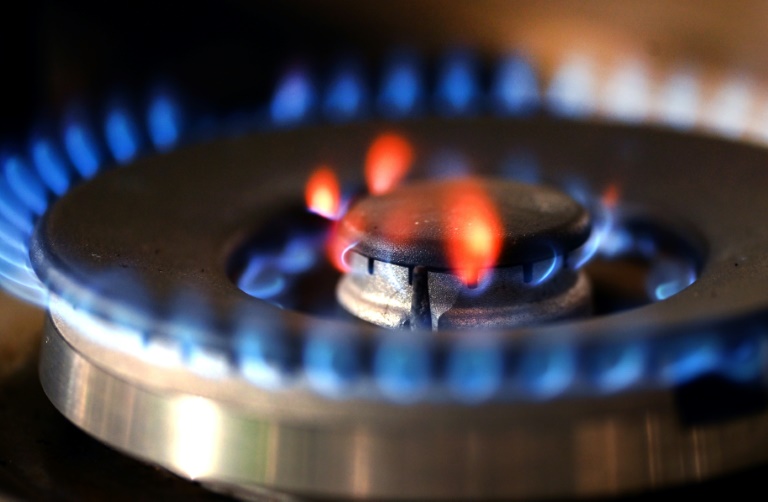
German Economy Minister Robert Habeck accused Russia on Thursday of using energy as “a weapon”, after Moscow slapped sanctions on Western energy firms and slowed gas flows to Europe.

“It has to be said that the situation is coming to a head, in such a way that the use of energy as a weapon is now being realised in several areas,” Habeck told reporters in Berlin.

Ukrainian Foreign Minister Dmytro Kuleba, on a visit to the German capital, said Moscow had shown itself to be an unreliable supplier. 

Kuleba urged Europe to end its heavy dependence on Russian gas that was helping to finance Moscow’s war machine.

“This energy oxygen for Russia must be turned off and that is especially important for Europe,” Kuleba said at a joint press conference with Habeck.

“Europe must get rid of this complete dependence on Russian gas, since Russia has shown… that it is not a reliable partner and Europe cannot afford that.”

Russia on Thursday said it would stop sending natural gas via the Polish section of the Yamal-Europe pipeline as part of retaliation for Western sanctions over its invasion of Ukraine.

The move comes a day after Russia issued a government decree imposing sanctions on 31 EU, US and Singaporean energy firms.

Most of the companies belong to the Gazprom Germania group of subsidiaries of Russian energy giant Gazprom. 

The sanctions include a ban on transactions and the entry into Russian ports of vessels linked to the affected companies.

Meanwhile, operators on Thursday reported a drop in gas supplies from Russia via Ukraine for a second day, after Kyiv said it would suspend flows through a key eastern transit pipeline called Sokhranivka because the area was no longer under Ukrainian control.

But Gazprom has denied there was a case for the Ukrainian side to declare “force majeure” and said it was impossible to reroute all the supplies through another Ukrainian pipeline.

– ‘Blackmail’ fears –

Gazprom told the Interfax news agency that supplies transiting Ukraine on Thursday were at 50.6 million cubic metres in total, compared to 72 million cubic metres the day before.

Germany, which is hugely reliant on Russian energy, said it had been able to make up the shortfall through gas imports from Norway and the Netherlands.

The head of Germany’s Federal Network Agency, Klaus Mueller, also noted that Russia had been very “surgical” about its pick on which companies to sanction, selecting only storage and trading companies, and “not the operators”.

This “very well-planned, precise decree allows it to keep doing business with Germany, but not on old contract conditions”, rather under new conditions that other gas dealers would then have to conclude with Russia, said Mueller.

Europe’s biggest economy is racing to wean itself off Russian energy and has already almost completely phased out Russian coal. 

But ditching Russian oil and gas will be more difficult.

With fears growing that Russia could abruptly turn off the energy taps, Habeck said Germany was focusing on building up gas reserves to prepare for winter.

“The gas storage facilities must be full by winter or else we will be in a situation where we can easily be blackmailed,” he warned.

US mourns one million dead from Covid-19

The United States has crossed the threshold of one million deaths from Covid-19, the White House said on Thursday, as the nation seeks to turn the page on the pandemic despite threats of another surge.

“Today, we mark a tragic milestone,” President Joe Biden said in a statement that acknowledged the “unrelenting” pain of bereaved families, and urged Americans to remain vigilant as cases tick back up.

“One million empty chairs around the dinner table,” Biden said. “Each an irreplaceable loss. Each leaving behind a family, a community, and a nation forever changed.”

Biden’s announcement came as he chaired a global virtual Covid summit, taking place as Europe also passed two million Covid deaths, focused on efforts to bring the pandemic under control worldwide and prepare for future health emergencies.

The US leader came to the summit hobbled by Congress’ failure to approve $22.5 billion in continued emergency Covid funding, including for the international supply of vaccines, and he warned it was “critical” for lawmakers to keep financing testing, vaccines and treatments. 

America recorded its first Covid-19 death, on the West Coast, in early February 2020. By the next month, the virus was ravaging New York and the White House was predicting up to 240,000 deaths nationwide.

But those projections were way off.

Even in New York — the hard-hit early epicenter of America’s Covid crisis — the million death milestone was difficult to comprehend. 

“It’s unfathomable,” Diana Berrent, one of the first people in New York state to catch Covid-19, said of the toll that far exceeds epidemiologists’ worst predictions.

Back in spring 2020, New York City hospitals and morgues overflowed, and the sound of ambulance sirens rang down empty streets as then-president Donald Trump responded chaotically in Washington.

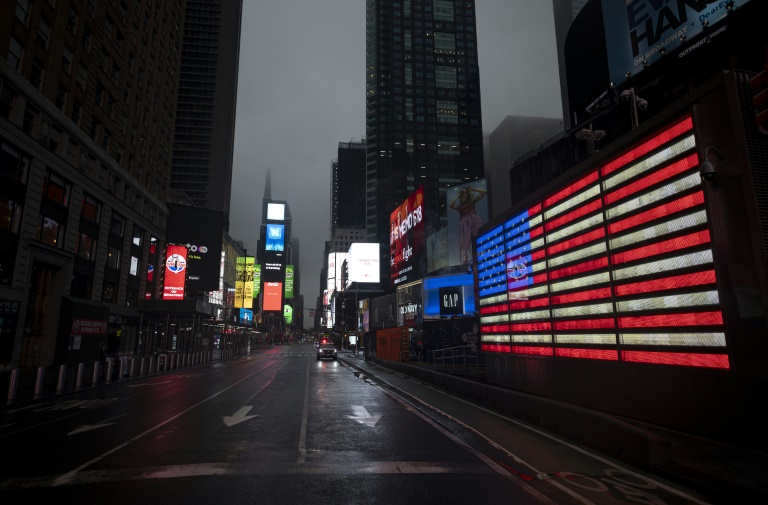
Two years on, and life in the Big Apple is largely back to normal as residents attempt to put the collective trauma of the virus that has killed 40,000 New Yorkers behind them.

Broadway stage lights are once again illuminated, yellow taxis clog main avenues and bars in business districts hum with post-work chatter. 

“Without a doubt you feel the energy of the people that are on the streets. It’s been a long time coming,” Alfred Cerullo, president of a business improvement group in Midtown Manhattan, told AFP.

New York’s rebound has been aided by its high inoculation numbers — about 88 percent of adults are fully vaccinated, a rate that was boosted by mandates, including for indoor activities like dining.

Jeffrey Bank, owner of Carmine’s restaurant near Times Square, says sales at the Italian eatery are better than they were in 2019, as residents and tourists make up for lost time.

“People have been sitting at home for two years. They want to celebrate and they’re entitled to,” he told AFP.

– ‘Disconnect’ –

But the city has a long way to go. Many stores remain empty and only 38 percent of Manhattan workers are in the office on an average weekday, according to Kastle Systems, a security firm that tracks building occupancy.

The Big Apple’s tourism board also doesn’t expect visitor numbers to get back to the 67 million of 2019 people for a few years, and business owners fear another wave of infections.

In recent weeks, the United States has seen an uptick in the number of daily virus cases, largely due to the new Omicron subvariant.

The rise has coincided with the lifting of mask mandates.

“I think we are in a place where psychologically and socially and economically, people are largely done with the pandemic,” said Celine Gounder, an infectious disease expert at New York University.

“(But) the pandemic is not over. So you have a disconnect between what is happening epidemiologically and what’s happening in terms of how people are responding,” she told AFP.

Among the most at-risk are the unvaccinated, lower-income populations, uninsured people and communities of color, she says. 

– Mandates –

Ideological clashes over curfews and mask and vaccine mandates characterized America’s early pandemic response, as it racked up the world’s highest death toll, with hospitals overwhelmed and morgues failing to keep up with the dead.

Trump was late to back social distancing, repeatedly undermined top scientist Anthony Fauci, peddled unproven medical treatments, and politicized mask-wearing — before eventually being hospitalized with the virus himself. 

Trump did pump billions of dollars into vaccine research and by mid-December 2020, the first vaccines were available for health care workers.

But deaths kept soaring amid a slow take-up of shots in conservative areas of the country.

New president Biden and many Democratic governors enforced mandates but Republican-led states like Florida and Texas outright banned them, highlighting America’s patchwork of rules that made forming a unified response to the pandemic difficult.

pdh-ia-nr-bfm/ec

Finnish president, PM in favour of joining NATO 'without delay'

Finland’s president and prime minister said on Thursday they were in favour of joining NATO and a formal decision would be taken this weekend, after Russia’s war in Ukraine sparked a swift U-turn in opinion.

The Kremlin immediately responded to the announcement, saying it would have to take “military-technical” steps if Finland joined the Western military alliance, which would “definitely” pose a threat to Russia.

“The expansion of NATO and the approach of the alliance to our borders does not make the world and our continent more stable and secure,” Kremlin spokesman Dmitry Peskov told reporters.

Several NATO members, including the US, Germany, Norway, Denmark and Poland, welcomed Finland’s move. 

Neighbouring Sweden, which like Finland has been militarily non-aligned for decades, is also expected to announce its decision on NATO membership in the coming days.

That decision will very likely come at a meeting on Sunday of Prime Minister Magdalena Andersson’s Social Democratic Party.

The two countries are widely expected to submit their membership bids in unison. 

“Finland must apply for NATO membership without delay,” President Sauli Niinisto and Prime Minister Sanna Marin said in a joint statement.

“NATO membership would strengthen Finland’s security. As a member of NATO, Finland would strengthen the entire defence alliance,” the statement said.

A special committee will announce Helsinki’s formal decision on a membership bid on Sunday, it added.

In Washington, Pentagon spokesman John Kirby said Vladimir Putin “didn’t want a strong NATO on his western flank. He’s getting that”, adding that the Swedish and Finnish militaries “may be small, but they are powerful”. 

Moscow has repeatedly warned Stockholm and Helsinki of consequences if they were to join the alliance.

“Joining NATO would not be against anyone,” Niinisto, who has often served as a mediator between Russia and the West, told reporters on Wednesday.

To Russia, he would say: “You caused this. Look in the mirror,” he said. 

In a blog post later Thursday, Niinisto struck a conciliatory note, writing: “Russia is and will remain Finland’s border neighbour. It must continue to be able to handle practical matters with it.”

As recently as January, amid tensions between the West and Russia, Marin said a NATO bid would be “very unlikely” during her current mandate, which ends in April 2023.

– Rattled by war –

But after its powerful eastern neighbour invaded Ukraine on February 24, Finland’s political and public opinion swung dramatically in favour of membership as a deterrent against Russian aggression.

A poll published on Monday by public broadcaster Yle showed that a record 76 percent of Finns now support joining the alliance, up from the steady 20-30 percent registered in recent years.

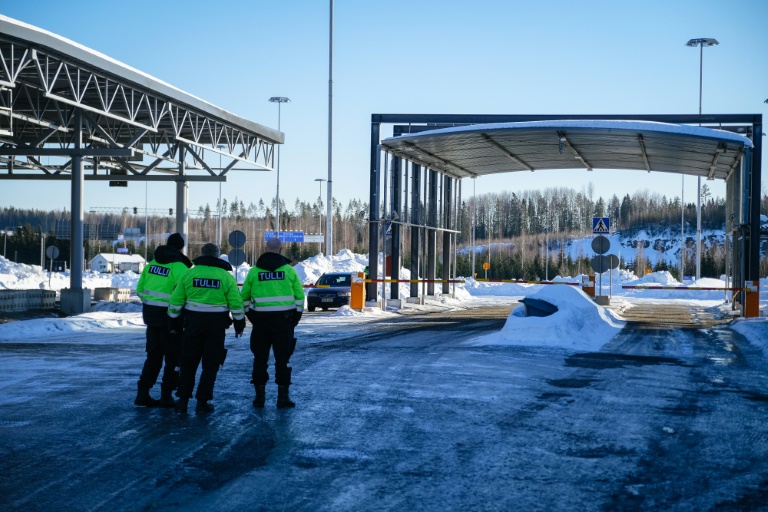
A country of 5.5 million people, Finland shares a 1,300-kilometre (800-mile) border with Russia.

In 1939, it was invaded by the Soviet Union.

Finns put up a fierce fight during the Winter War but were ultimately forced to cede a huge stretch of its eastern Karelia province in a peace treaty with Moscow.

Defence Minister Antti Kaikkonen said Thursday on his blog he hoped Sweden would come to the same conclusion and “we could apply for membership together.”

Swedish Foreign Minister Ann Linde said “Finland’s decision is naturally of great importance to Sweden” and said her government would announce its decision “soon”. 

– ‘Swift’ process to join –

There has been broad political support for NATO membership in Finland, amid a general view that Russia’s invasion has eroded the security situation in Europe.

Finns questioned by AFP after Thursday’s announcement were also unanimous in their support.

“We stood alone in 1939, we don’t want to stand alone again,” said Nick Paterson, a 56-year-old entrepreneur.

“It’s very important that the leaders of our country are on the same page and I think it was a good decision,” said Ville Laakso, a 31-year-old lawyer. 

Finland and Sweden have long cooperated with NATO, and are expected to be able to join the alliance quickly. 

NATO Secretary General Jens Stoltenberg said Thursday Finland’s entry would be “smooth and swift”. 

Finland’s next step is a meeting on Sunday of a special committee made up of the president, prime minister and up to six other cabinet ministers. It will make the formal decision whether to submit a Finnish application.

The proposal will then be presented to parliament for a debate on Monday. 

After an official bid is submitted to the alliance, negotiations get underway. Lawmakers in all 30 NATO member states then need to ratify Finland’s application, a process that can take up to a year.

Foreign Minister Pekka Haavisto said on Tuesday he believed Finland could be a full NATO member “at the earliest” on October 1.

Close Bitnami banner
Bitnami