World

Crisis-hit Sri Lanka appoints new PM to replace president's brother

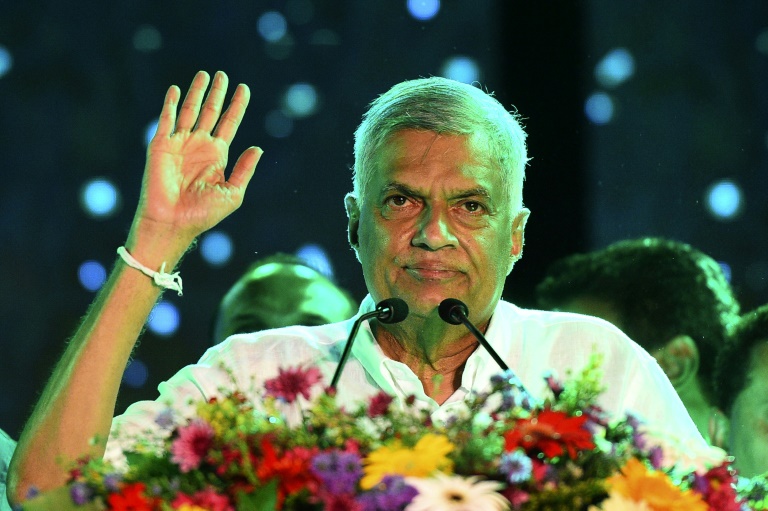
Sri Lanka’s president swore in a new prime minister Thursday to replace his brother, who was banned from leaving the country after his supporters launched violent attacks on a protest against the nation’s dire economic crisis. 

The new premier, Ranil Wickremesinghe, has already served in the office five times — but it remains unclear if he will be able to get any legislation through parliament.

The 73-year-old will be tasked with navigating Sri Lanka through its worst downturn in its history as an independent nation, with months of shortages and blackouts inflaming public anger.

“A cabinet is likely to be appointed tomorrow,” Sudewa Hettiarachchi, a spokesman for President Gotabaya Rajapaksa, told AFP.

In a televised address to the nation on Wednesday night, Rajapaksa stopped short of yielding to weeks of countrywide protests calling for him to resign.

But in a bid to win over opposition lawmakers demanding he quit, Rajapaksa, 72, pledged to give up most of his executive powers and set up a new cabinet this week.

“I will name a prime minister who will command a majority in parliament and the confidence of the people,” he said.

Mahinda Rajapaksa, the president’s brother, resigned as prime minister on Monday after his supporters attacked anti-government demonstrators who had been protesting peacefully for weeks.

This marked a turning point and unleashed several days of chaos and violence in which at least nine people were killed and over 200 injured, with dozens of Rajapaksa loyalist homes set on fire.

Mahinda has since fled the capital Colombo and taken refuge at the Trincomalee naval base on the country’s east coast.

On Thursday, a court banned him, his politician son Namal, and more than a dozen allies from leaving the country after ordering an investigation into the violence.

Security forces patrolling in armoured personnel carriers with orders to shoot looters on sight have largely restored order.

A curfew was lifted Thursday morning — only to be reimposed after a six-hour break allowing Sri Lanka’s 22 million people to stock up on essentials.

– ‘Collapse beyond redemption’ –

Sri Lankans have suffered months of severe shortages of food, fuel and medicines — as well as long power cuts — after the country burnt through foreign currency reserves needed to pay for vital imports.

The central bank chief warned Wednesday that the economy would “collapse beyond redemption” unless a new government was urgently appointed.

Wickremesinghe, 73, is seen as a pro-West free-market reformist, potentially making bailout negotiations with the International Monetary Fund and others smoother.

With many from Rajapaksa’s party having defected in recent months, no group in the 225-member assembly has an absolute majority, making parliamentary approval of the unity government’s legislation potentially tricky.

It also remains to be seen whether a new cabinet will be enough to calm public anger if Rajapaksa continues to resist calls for his resignation.

“What he has done is despicable, he has brought all of us to this state of hunger and poverty,” Abu Nawaz, a small business owner in Colombo, told AFP.

“What is the point of keeping him as the president?” he added. “Will this end our miseries?”

Wickremesinghe had already been working closely with Rajapaksa before his appointment, to shake up the finance ministry and the central bank with sweeping policy changes, an official close to their discussions told AFP. 

– ‘We can’t wait any longer’ –

The central bank almost doubled key interest rates and announced a default on Sri Lanka’s $51-billion external debt as part of the policy shift, officials said. 

The main opposition SJB party was initially invited to lead a new government, but its leader Sajith Premadasa insisted the president first step down.

In recent days the party has split, with a dozen SJB lawmakers pledging support to Wickremesinghe.

“We can’t be imposing conditions that cannot be fully met. First, we must address the economic crisis,” said the party’s Harin Fernando.

“We need at least $85 million a week to finance essential imports. We must collectively find a way to raise this money urgently,” he added.

Fernando said he expected a new ministry to be formed by Friday. “We can’t wait any longer,” he added.

Crisis-hit Sri Lanka appoints new PM to replace president's brother

Sri Lanka’s president swore in a new prime minister Thursday to replace his brother, who was banned from leaving the country after his supporters launched violent attacks on a protest against the nation’s dire economic crisis. 

The new premier, Ranil Wickremesinghe, has already served in the office five times — but it remains unclear if he will be able to get any legislation through parliament.

The 73-year-old will be tasked with navigating Sri Lanka through its worst downturn in its history as an independent nation, with months of shortages and blackouts inflaming public anger.

“A cabinet is likely to be appointed tomorrow,” Sudewa Hettiarachchi, a spokesman for President Gotabaya Rajapaksa, told AFP.

In a televised address to the nation on Wednesday night, Rajapaksa stopped short of yielding to weeks of countrywide protests calling for him to resign.

But in a bid to win over opposition lawmakers demanding he quit, Rajapaksa, 72, pledged to give up most of his executive powers and set up a new cabinet this week.

“I will name a prime minister who will command a majority in parliament and the confidence of the people,” he said.

Mahinda Rajapaksa, the president’s brother, resigned as prime minister on Monday after his supporters attacked anti-government demonstrators who had been protesting peacefully for weeks.

This marked a turning point and unleashed several days of chaos and violence in which at least nine people were killed and over 200 injured, with dozens of Rajapaksa loyalist homes set on fire.

Mahinda has since fled the capital Colombo and taken refuge at the Trincomalee naval base on the country’s east coast.

On Thursday, a court banned him, his politician son Namal, and more than a dozen allies from leaving the country after ordering an investigation into the violence.

Security forces patrolling in armoured personnel carriers with orders to shoot looters on sight have largely restored order.

A curfew was lifted Thursday morning — only to be reimposed after a six-hour break allowing Sri Lanka’s 22 million people to stock up on essentials.

– ‘Collapse beyond redemption’ –

Sri Lankans have suffered months of severe shortages of food, fuel and medicines — as well as long power cuts — after the country burnt through foreign currency reserves needed to pay for vital imports.

The central bank chief warned Wednesday that the economy would “collapse beyond redemption” unless a new government was urgently appointed.

Wickremesinghe, 73, is seen as a pro-West free-market reformist, potentially making bailout negotiations with the International Monetary Fund and others smoother.

With many from Rajapaksa’s party having defected in recent months, no group in the 225-member assembly has an absolute majority, making parliamentary approval of the unity government’s legislation potentially tricky.

It also remains to be seen whether a new cabinet will be enough to calm public anger if Rajapaksa continues to resist calls for his resignation.

“What he has done is despicable, he has brought all of us to this state of hunger and poverty,” Abu Nawaz, a small business owner in Colombo, told AFP.

“What is the point of keeping him as the president?” he added. “Will this end our miseries?”

Wickremesinghe had already been working closely with Rajapaksa before his appointment, to shake up the finance ministry and the central bank with sweeping policy changes, an official close to their discussions told AFP. 

– ‘We can’t wait any longer’ –

The central bank almost doubled key interest rates and announced a default on Sri Lanka’s $51-billion external debt as part of the policy shift, officials said. 

The main opposition SJB party was initially invited to lead a new government, but its leader Sajith Premadasa insisted the president first step down.

In recent days the party has split, with a dozen SJB lawmakers pledging support to Wickremesinghe.

“We can’t be imposing conditions that cannot be fully met. First, we must address the economic crisis,” said the party’s Harin Fernando.

“We need at least $85 million a week to finance essential imports. We must collectively find a way to raise this money urgently,” he added.

Fernando said he expected a new ministry to be formed by Friday. “We can’t wait any longer,” he added.
Astronomers reveal first image of black hole at Milky Way's centre

An international team of astronomers on Thursday unveiled the first image of a supermassive black hole at the centre of our own Milky Way galaxy — a cosmic body known as Sagittarius A*.

The image — produced by a global team of scientists known as the Event Horizon Telescope (EHT) Collaboration — is the first, direct visual confirmation of the presence of this invisible object, and comes three years after the very first image of a black hole from a distant galaxy.

“It’s very exciting to show you today this best-ever image” of Sagittarius A*, EHT project director Huib van Langevelde told a press conference in Garching, Germany.

Black holes are regions of space where the pull of gravity is so intense that nothing can escape, including light. 

The image thus depicts not the black hole itself, because it is completely dark, but the glowing gas that encircles the phenomenon — which is four million times more massive than our Sun — in a bright ring of bending light.

“These unprecedented observations have greatly improved our understanding of what happens at the very centre of our galaxy,” said EHT project scientist Geoffrey Bower, of Taiwan’s Academia Sinica.

Bower also said in a statement provided by the French National Centre for Scientific Research (CNRS) that the observations had offered “new insights on how these giant black holes interact with their surroundings”.

The results are published in The Astrophysical Journal Letters.

– Virtual telescope –

Sagittarius A* — abbreviated to Sgr A*, which is pronounced “sadge-ay-star” — owes its name to its detection in the direction of the constellation Sagittarius. 

Its existence has been assumed since 1974, with the detection of an unusual radio source at the centre of the galaxy.

In the 1990s, astronomers mapped the orbits of the brightest stars near the centre of the Milky Way, confirming the presence of a supermassive compact object there — work that led to the 2020 Nobel Prize in Physics.

Though the presence of a black hole was thought to be the only plausible explanation, the new image provides the first direct visual proof.

Because it is 27,000 light years from Earth, it appears the same size in the sky as a donut on the Moon.

Capturing images of such a faraway object required linking eight giant radio observatories across the planet to form a single “Earth-sized” virtual telescope called the EHT.

These included the Institute for Millimeter Radio Astronomy (IRAM) 30-meter telescope in Spain, the most sensitive single antenna in the EHT network.

The EHT gazed at Sgr A* across multiple nights for many hours in a row — a similar idea to long-exposure photography and the same process used to produce the first image of a black hole, released in 2019. 

That black hole is called M87* because it is in the Messier 87 galaxy.

– Moving target –

The two black holes bear striking similarities, despite the fact that Sgr A* is 2,000 times smaller than M87*.

“Close to the edge of these black holes, they look amazingly similar,” said Sera Markoff, co-chair of the EHT Science Council, and a professor at the University of Amsterdam.

Both behaved as predicted by Einstein’s 1915 theory of General Relativity, which holds that the force of gravity results from the curvature of space and time, and cosmic objects change this geometry.

Despite the fact Sgr A* is much closer to us, imaging it presented unique challenges.

Gas in the vicinity of both black holes moves at the same speed, close to the speed of light. But while it took days and weeks to orbit the larger M87*, it completed rounds of Sgr A* in just minutes.

The brightness and pattern of the gas around Sgr A* changed rapidly as the team observed it, “a bit like trying to take a clear picture of a puppy quickly chasing its tail,” said EHT scientist Chi-kwan Chan of the University of Arizona.

The researchers had to develop complex new tools to account for the moving targets.

The resulting image — the work of more than 300 researchers across 80 countries over a period of five years — is an average of multiple images that revealed the invisible monster lurking at the centre of the galaxy.

Scientists are now eager to compare the two black holes to test theories about how gasses behave around them — a poorly understood phenomenon thought to play a role in the formation of new stars and galaxies.

Probing black holes — in particular their infinitely small and dense centers known as singularities, where Einstein’s equations break down — could help physicists deepen their understanding of gravity and develop a more advanced theory.

Finnish president, PM in favour of joining NATO 'without delay'

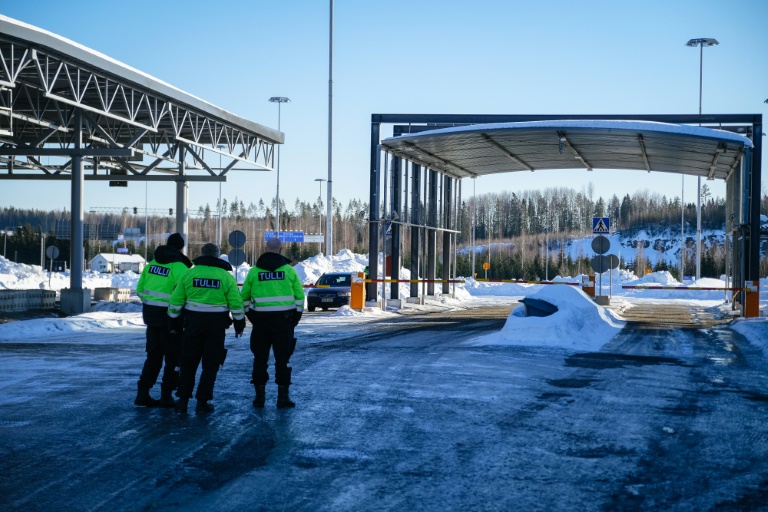
Finland’s president and prime minister said on Thursday they were in favour of joining NATO and a formal decision would be taken this weekend, after Russia’s war in Ukraine sparked a swift U-turn in opinion.

The Kremlin immediately responded to the announcement, saying it would have to take “military-technical” steps if Finland joined the Western military alliance, which would “definitely” pose a threat to Russia.

“The expansion of NATO and the approach of the alliance to our borders does not make the world and our continent more stable and secure,” Kremlin spokesman Dmitry Peskov told reporters.

Several NATO members, including Norway, Denmark and Poland, meanwhile welcomed Finland’s move. 

Neighbouring Sweden, which like Finland has been militarily non-aligned for decades, is also expected to announce its decision on NATO membership in the coming days.

That decision will very likely come at a meeting on Sunday of Prime Minister Magdalena Andersson’s Social Democratic Party.

The two countries are widely expected to submit their membership bids in unison. 

“Finland must apply for NATO membership without delay,” President Sauli Niinisto and Prime Minister Sanna Marin said in a joint statement.

“NATO membership would strengthen Finland’s security. As a member of NATO, Finland would strengthen the entire defence alliance,” the statement said.

A special committee will announce Helsinki’s formal decision on a membership bid on Sunday, it added.

Moscow has repeatedly warned Stockholm and Helsinki of consequences if they were to join the alliance.

“Joining NATO would not be against anyone,” Niinisto, who has often served as a mediator between Russia and the West, told reporters on Wednesday.

His response to Russia would be: “You caused this. Look in the mirror,” he said. 

In a blog post later Thursday, Niinisto struck a conciliatory note, writing: “Russia is and will remain Finland’s border neighbour. It must continue to be able to handle practical matters with it.”

As recently as January, amid tensions between the West and Russia, Marin said a NATO bid would be “very unlikely” during her current mandate, which ends in April 2023.

– Rattled by war –

But after its powerful eastern neighbour invaded Ukraine on February 24, Finland’s political and public opinion swung dramatically in favour of membership as a deterrent against Russian aggression.

A poll published on Monday by public broadcaster Yle showed that a record 76 percent of Finns now support joining the alliance, up from the steady 20-30 percent registered in recent years.

A country of 5.5 million people, Finland shares a 1,300-kilometre (800-mile) border with Russia.

In 1939, it was invaded by the Soviet Union.

Finns put up a fierce fight during the Winter War but were ultimately forced to cede a huge stretch of its eastern Karelia province in a peace treaty with Moscow.

Defence Minister Antti Kaikkonen said Thursday on his blog he hoped Sweden would come to the same conclusion and “we could apply for membership together.”

Swedish Foreign Minister Ann Linde said “Finland’s decision is naturally of great importance to Sweden” and said her government would announce its decision “soon”. 

– ‘Swift’ process to join –

There has been broad political support for NATO membership in Finland, amid a general view that Russia’s invasion has eroded the security situation in Europe.

Finns questioned by AFP after Thursday’s announcement were also unanimous in their support.

“We stood alone in 1939, we don’t want to stand alone again,” said Nick Paterson, a 56-year-old entrepreneur.

“It’s very important that the leaders of our country are on the same page and I think it was a good decision,” said Ville Laakso, a 31-year-old lawyer. 

Finland and Sweden have long cooperated with NATO, and are expected to be able to join the alliance quickly. 

NATO Secretary General Jens Stoltenberg said Thursday Finland’s entry would be “smooth and swift”. 

The next step is for Finland’s President and Ministerial Committee on Foreign and Security Policy — a body made up of the president, prime minister and up to six other cabinet ministers — to meet on Sunday.

The committee will make the formal decision whether to submit a Finnish application.

The proposal will then be presented to parliament for a debate on Monday. 

After an official bid is submitted to the alliance, negotiations get underway. Lawmakers in all 30 NATO member states then need to ratify Finland’s application, a process that can take up to a year.

Foreign Minister Pekka Haavisto said on Tuesday he believed Finland could be a full NATO member “at the earliest” on October 1.

Finland poised for NATO membership as Ukraine war crimps Russian gas

Finland on Thursday took a step towards fast-track membership of NATO, triggering a blunt warning from the Kremlin, as the war in Ukraine throttled supplies of Russian gas to Europe.

“Finland must apply for NATO membership without delay,” President Sauli Niinisto and Prime Minister Sanna Marin announced in a statement in Helsinki.

“NATO membership would strengthen Finland’s security,” they said. “As a member of NATO, Finland would strengthen the entire defence alliance.”

But Kremlin spokesman Dmitry Peskov warned Russia would “definitely” see Finnish membership as a threat.

The Russian foreign ministry said Moscow would be “forced to take reciprocal steps, military-technical and other, to address the resulting threats to its national security.”

In launching the invasion of Ukraine, President Vladimir Putin cited in part what he called the threat from NATO, which expanded eastwards after the Cold War.

The foreign ministry accused NATO of seeking to create “another flank for the military threat to our country”.

“Helsinki should be aware of its responsibility and the consequences of such a move,” it said. 

Finland has been a declared neutral in East-West crises for decades, and as recently as January its leaders ruled out NATO membership of the alliance.

But the February 24 invasion shocked the Nordic nation.

It shares a 1,300-kilometre (800-mile) border with Russia and its past is studded with conflict with its giant neighbour.

NATO has already declared it will warmly embrace two countries with rich pockets and advanced militaries. 

Finland’s entry will be “smooth and swift,” NATO chief Jens Stoltenberg promised on Thursday.

A special committee will announce Finland’s formal decision on a membership bid on Sunday. 

Sweden, another neutral state, is widely expected to follow its neighbour. 

– Russian gas –

Russia’s flow of gas to Europe gas fell meanwhile, spurring fears for Germany and other heavily-dependent economies.

Russian energy giant Gazprom announced it would stop supplying gas via the Polish part of the Yamal-Europe pipeline following retaliatory sanctions that Russia announced against Western companies on Wednesday.

Gazprom also said Thursday gas transiting to Europe via Ukraine had dropped by a third — a fall it blamed on Ukraine’s pipeline operator, which the company denies and lays on Russia.

Ukraine and Poland are major supply routes for Russian gas to Europe and the two sides have kept flows going despite the conflict.

The European Union’s heavy reliance on Russian energy has made it reluctant to add oil and gas imports to sanctions that are inflicting a toll on Russia’s economy.

Germany accused Russia of using “energy as a weapon”.

“The situation is coming to a head,” Economy Minister Robert Habeck said.

The EU is struggling to overcome Hungarian resistance for plans to ban Russian oil.

Mykhailo Podolyak, a senior aide to Ukrainian President Volodymyr Zelensky, drew a parallel with the 1930s as he urged the bloc to impose an immediate embargo.

“If the leaders had acted decisively in 1938, Europe could have avoided WWII,” he wrote on Twitter. 

“But politicians acted cowardly and flirted with the aggressor. The result is million tragedies. History won’t forgive us if we make the same mistake again.”

– Shelling –

Fighting in Ukraine has been concentrated on the south and east since Russia abandoned attempts to seize the capital Kyiv in the opening weeks of the war.

Ukraine’s presidency said shelling continued throughout Lugansk — part of the Donbas region where Ukrainian forces are fiercely opposing Russian armour and Kremlin-backed separatists.

Russian troops are trying to take complete control of Rubizhne, block a key highway between Lysychansk and Bakhmut highway and seize Severodonetsk, the office said.

In the northeastern region of Chernigiv three people were killed and 12 others wounded early Thursday in a strike on a school in Novgorod-Siversky, the emergency services said. 

Across Ukraine, lives have been turned upside down, forcing millions to make anguished choices of how to respond.

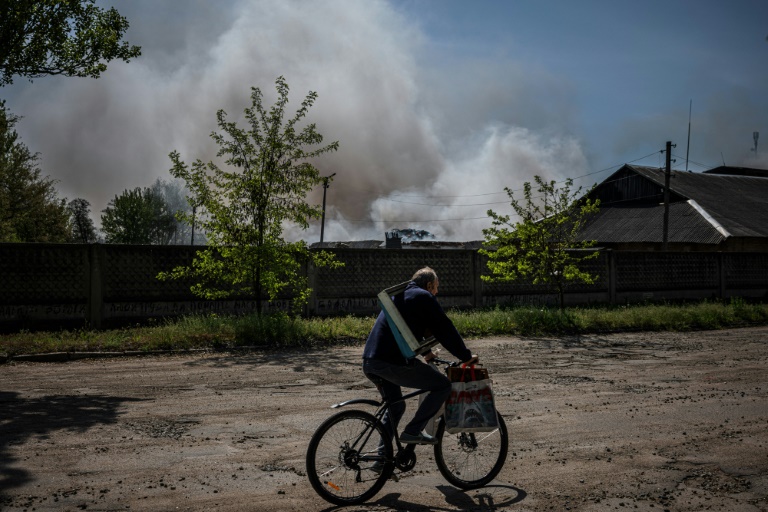
Zhanna Protsenko, a social worker in the frontline town of Orikhiv, spoke to AFP as she was about to head off on her bicycle to visit people who refused or were unable to evacuate.

“How can I leave them here?” the 56-year-old asked, standing near a hospital that was hit by a strike in the past week. 

“We work. We have no time to hide,” she said as contractors repaired rows of the hospital’s blown-out windows and an oil drum-sized hole blasted in its brick facade. 

– War crimes –

The UN Human Rights Council, in a session snubbed by Russia, was due to vote Thursday on a draft resolution calling for an investigation into war crimes.

“These have been 10 weeks of sheer horror to the people of my country,” Deputy Foreign Minister Emine Dzhaparova told the meeting from Kyiv.

“Only the world standing strong in solidarity with the Ukrainian people can defeat this pure evil.”

The invasion has sparked an exodus of nearly six million civilians, many of whom bear accounts of torture, sexual violence and indiscriminate destruction.

The Ukrainian prosecutor’s office said it has received reports of more than 10,000 alleged crimes, with 622 suspects identified.

On Wednesday, the office said it would launch the first trial for war crimes.

Vadim Shishimarin, a 21-year-old Russian soldier, is accused of killing an unarmed 62-year-old civilian as he fled with four other soldiers in a stolen car.

– Mariupol holdouts – 

In the southern port city of Mariupol, besieged troops in the vast Azovstal steelworks have been holding out against weeks-long bombardment, refusing demands to surrender.

Ukrainian Deputy Prime Minister Iryna Vereshchuk said “negotiations are under way” about the situation there, focusing on a step-by-step operation beginning with the evacuation of the seriously wounded.

“There are hundreds of soldiers and officers of the armed forces, the national guard, the national police, security service, the border service and the defence forces,” she said.

“The guys need to be rescued. Everyone needs rescue.”

Palestinians honour slain journalist, reject joint probe

Thousands of Palestinians on Thursday honoured Al Jazeera journalist Shireen Abu Akleh at a memorial service in the occupied West Bank, a day after she was shot dead during an Israeli army raid.

Israel and the Palestinians have traded blame over the killing of Palestinian-American Abu Akleh, 51, a veteran of the Qatar-based network’s Arabic service, during clashes in the Jenin refugee camp.

The United States, European Union and United Nations have backed calls for a full investigation into what Al Jazeera labelled a deliberate killing “in cold blood”, but the Palestinian Authority (PA) has rejected holding a joint probe with Israel.

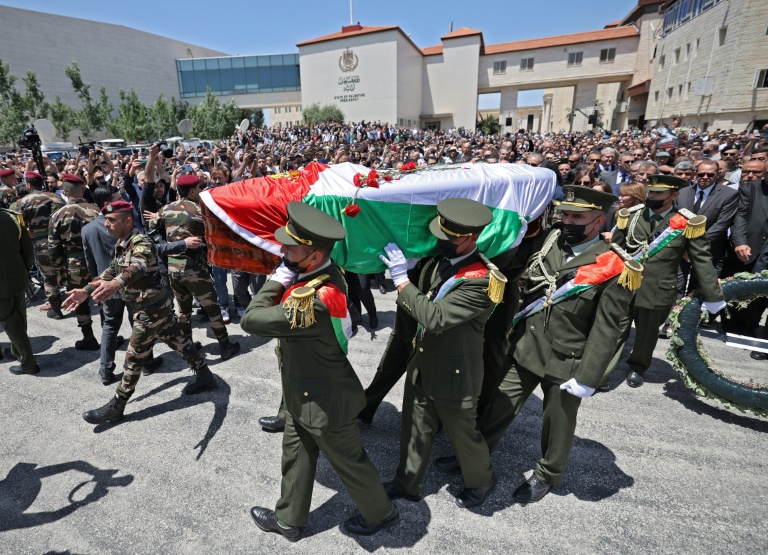
In a sign of Abu Akleh’s stature among Palestinians, she received what was described as a full state memorial at the Ramallah compound of president Mahmud Abbas, attended by foreign diplomats, prominent Arab Israeli politicians, and senior Palestinian leaders.

Thousands lined the streets as her coffin, draped in the Palestinian flag, was driven through the West Bank city.

– ‘Crime’ –

Many held flowers, wreaths and pictures of Abu Akleh, who has been widely hailed for her bravery and professionalism and was well known to Arabic audiences since she covered the second Palestinian Intifada, or uprising, from 2000 to 2005.

“This crime should not go unpunished,” said Abbas.

He stressed that the PA held Israel “completely responsible” for her death, and had “refused and rejected” an Israeli proposal for a joint investigation.

Israeli Prime Minister Naftali Bennett had said Wednesday it was “likely” Abu Akleh was killed by stray Palestinian gunfire — but Defence Minister Benny Gantz later conceded that it could have been “the Palestinians who shot her” or fire from “our side”.

“We are not certain how she was killed,” Gantz told reporters. “We are investigating.”

Draped in a Palestinian scarf under the late morning sun, Tariq Ahmed, 45, described the death as a “tragedy for all the nation”, comparing his grief to that he felt at the funeral of iconic Palestinian leader Yasser Arafat.

“I have not felt this pain since Arafat died,” Ahmed said.

– No joint probe –

As Abu Akleh’s coffin was taken out of the presidential compound to the drumbeat of a marching band, crowds chanted slogans demanding and end to Palestinian security cooperation with Israel.

Men ran alongside the ambulance as it drove to the checkpoint barrier between Ramallah and Jerusalem.

Israel had publicly called for a joint probe and stressed the need for Palestinian authorities to hand over the bullet that killed Abu Akleh for forensic examination.

The European Union has urged an “independent” probe while the United States demanded the killing be “transparently investigated”, calls echoed by UN human rights chief Michelle Bachelet.

But senior PA official Hussein Al-Sheikh, a close Abbas confidant, said the Palestinians would investigate alone and share their findings.  

“We affirmed that our investigation would be completed independently,” Sheikh said.

He added that Abu Akleh’s family, the United States, Qatar and “all official authorities” would be informed of the results.

An initial autopsy and forensic examination were conducted in Nablus in the Israel-occupied West Bank hours after her death, but no final conclusions have been disclosed.

A source in the Palestinian attorney general’s office said the results of a preliminary report on the bullet were expected later Thursday.

– ‘Sister of all Palestinians’ –

Abu Akleh, a Christian born in Israeli-annexed east Jerusalem, is scheduled to be buried in the city on Friday.

At the family’s Jerusalem home late Wednesday, her brother Antoun said she was “the sister of all Palestinians”, adding that “what happened cannot be silenced.”

Her death came nearly a year after an Israeli air strike destroyed a Gaza building that housed the offices of Al Jazeera and news agency AP.

Tensions have again risen with a wave of attacks that have killed at least 18 people in Israel since March 22, including an Arab-Israeli police officer and two Ukrainians.

A total of 31 Palestinians and three Israeli Arabs have died during the same period, according to an AFP tally, among them perpetrators of attacks and those killed by Israeli security forces in West Bank operations.

North Korea fires missiles after Covid cases prompt Kim to order lockdown

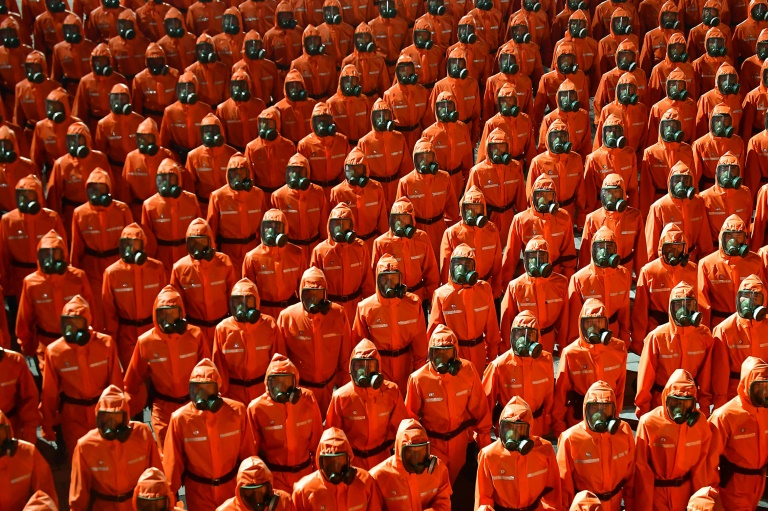
North Korea confirmed its first-ever Covid-19 cases Thursday and declared a “serious emergency”, with leader Kim Jong Un appearing in a mask on television for the first time to order nationwide lockdowns.

Hours after the shock announcement — the first time the nuclear-armed country has admitted to having Covid cases — Seoul’s military said it had detected three short-range ballistic missiles fired from near Pyongyang.

The launch, one of more than a dozen sanctions-busting weapons tests so far this year, comes shortly after Washington warned that Kim’s regime could test a nuke any day, with satellite images indicating fresh activity at nuclear sites.

Earlier Thursday, North Korea said it had moved into a “maximum emergency epidemic prevention system” after patients with fevers in Pyongyang tested positive for the “Omicron BA.2 variant” of Covid.

Kim, wearing a mask on state television for the first time, oversaw an emergency politburo meeting to discuss the outbreak and “called on all the cities and counties of the whole country to thoroughly lock down their areas”.

Kim told the meeting that the goal was to “quickly cure the infections in order to eradicate the source of the virus spread,” official news agency KCNA said, without specifying how many cases had been detected.

With its 25 million people not vaccinated against Covid, North Korea’s crumbling health infrastructure would struggle to deal with a major outbreak, experts say.

– ‘Continuing provocations’ –

South Korea’s military said the short-range ballistic missiles Pyongyang tested Thursday flew 360 km (220 miles) at an altitude of 90 km.

New President Yoon Suk-yeol’s administration slammed North Korea’s “continuing provocations with a ballistic missile launch despite the outbreak of coronavirus,” his security office said after a meeting.

By following its reporting of Covid cases with a missile test, North Korea is signalling that “coronavirus control and its pursuit of national defence are two separate things,” Yang Moo-jin, a professor at the University of North Korean Studies said.

“It is now reasonable to assume it could also conduct a nuclear test with Kim Jong Un’s greenlight at any moment,” he added.

– No vaccines –

“For Pyongyang to publicly admit Omicron cases, the public health situation must be serious,” Leif-Eric Easley, a professor at Ewha University in Seoul said.

“Pyongyang will likely double down on lockdowns, even though the failure of China’s zero-Covid strategy suggests that approach won’t work against the Omicron variant.”

North Korea has turned down offers of Covid vaccines from the World Health Organization, China and Russia.

Accepting vaccines through the WHO’s Covax scheme “requires transparency over how vaccines are distributed,” Go Myong-hyun, a researcher at the Asan Institute for Policy Studies, told AFP.

“That’s why North Korea rejected it,” Go said.

North Korea is surrounded by countries that have battled — or are still fighting to control — significant Omicron-fuelled outbreaks.

South Korea, which has high rates of vaccination, has recently eased almost all Covid restrictions, with cases sharply down after a spike in March.

China, the world’s only major economy to still maintain a zero-Covid policy, is battling multiple Omicron outbreaks — with some major cities, including financial hub Shanghai, under strict stay-at-home orders.

It appears North Korea will try to avoid China’s strict measures, which have seen millions of people locked into their apartments for several weeks, including in Beijing, said Cheong Seong-chang of the Sejong Institute.

But even less harsh measures would create a “severe food shortage and the same chaos China is now facing,” he said.

Seoul-based specialist site NK News reported that areas of Pyongyang had already been locked down for two days, with reports of panic buying.

– Nuke test? –

South Korea’s president, who was sworn in Tuesday, has vowed to get tough with Pyongyang after five years of failed diplomacy.

After high-profile talks collapsed in 2019, North Korea has doubled down on weapons testing, conducting a blitz of launches so far this year, including intercontinental ballistic missiles.

Satellite imagery indicates North Korea is preparing to conduct a nuclear test, and the United States has warned this could come as soon as this month.

The Covid outbreak could potentially disrupt their military programme, analysts said — or accelerate it.

“There is a possibility of delaying the nuclear test in order to focus on overcoming the coronavirus,” Yang Moo-jin, a professor at the University of North Korean Studies, told AFP. 

But he said if public fears over an outbreak were to spread, Kim might go ahead with a test “to divert this fear to another place”.

The Sejong Institute’s Cheong agreed that more weapons tests were likely for the regime to “boost the morale of North Korean citizens” in light of the Covid situation.

Beijing residents swamp supermarkets after lockdown rumours

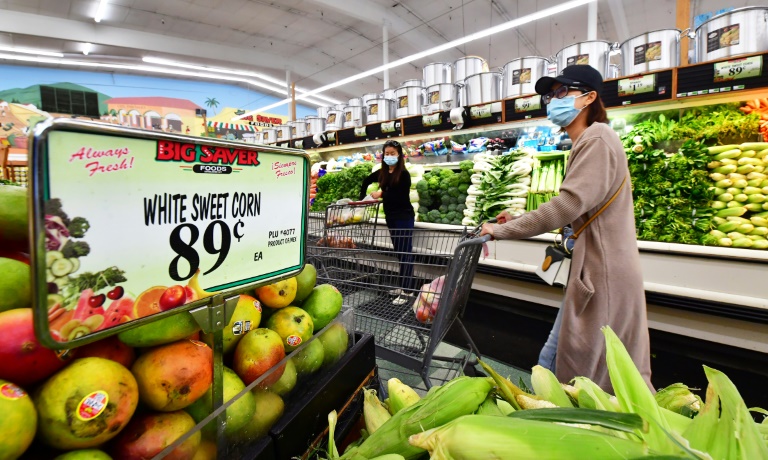
Beijing residents rushed to supermarkets on Thursday as Chinese officials tried to curb mounting panic over a rumour the capital would be placed under stay-at-home orders.

The city has been trying to stamp out a wave of cases in recent weeks, closing subway stations and telling many residents to work from home, with hundreds of communities sealed off to contain cases.

On Thursday there were rumours online that authorities were about to impose a strict lockdown, prompting many to rush to food stores and stock up.

Beijing residents fear they may face draconian measures similar to those that have trapped most of Shanghai’s 25 million people at home for weeks — after what was initially described as a days-long shutdown.

No lockdown was announced Thursday, but officials confirmed they will start three more rounds of mass testing for residents in 12 of the city’s main districts and “recommended” that people stay home and “reduce movement” during that time.

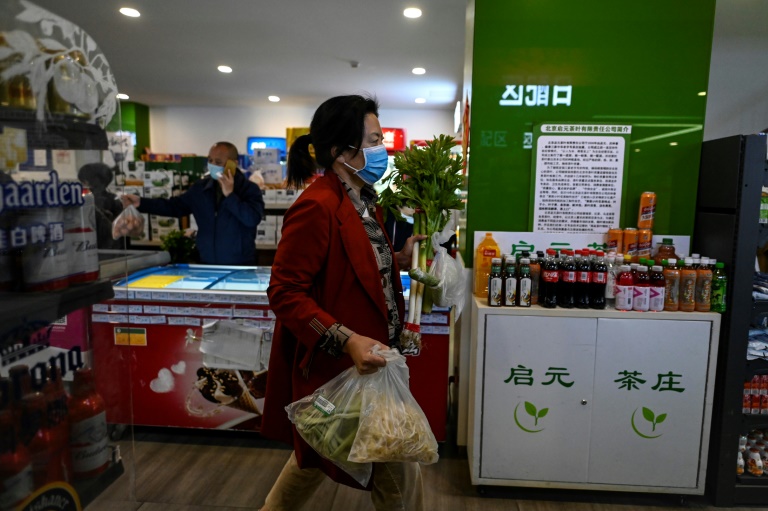
AFP saw staff at one local supermarket in central Beijing rushing to restock as shelves of vegetables were emptied out.

Sui Xin, 41, told AFP that he had gone to the store after he read on social media that the capital’s officials might keep residents at home.

“Everyone is stocking up,” he said, buying eggs and instant noodles. “I’ll be fine whether I’m required to stay home for three days or seven.”

“I’m just buying some chicken wings and instant noodles, there’s nothing left,” a shopper surnamed Huang said, queueing at another packed supermarket.

Long lines of shoppers in masks filled supermarket aisles in the city, many with baskets stocked with fresh vegetables and others carrying sacks of rice.

“I’m not stockpiling, I only came here to buy some veg to cook tonight,” one bemused shopper surnamed Jing told AFP. “I was stunned by this scene — everyone crowding around and snatching groceries.”

Officials tried to calm residents at a daily press conference Thursday, saying that there was no need to panic buy food, and urging people to stay calm.

“The so-called lockdown and ‘silent period’ are all rumours,” said Beijing official Xu Hejian.

There’s no need to grab groceries or stock up. City residents, please don’t worry.”

But many were still nervous.

“I can’t say for sure whether there will be a lockdown, but I’m definitely scared about it,” a shopper surnamed Wang told AFP.

The National Health Commission reported 47 Covid-19 cases in Beijing on Thursday, including 11 who had no symptoms.

According to one online tracker by Tencent, Beijing has more than 650 areas that are under Covid-19 restrictions, including those with stay-at-home orders. 

UK will act unless N.Ireland Brexit deal is changed: FM Truss

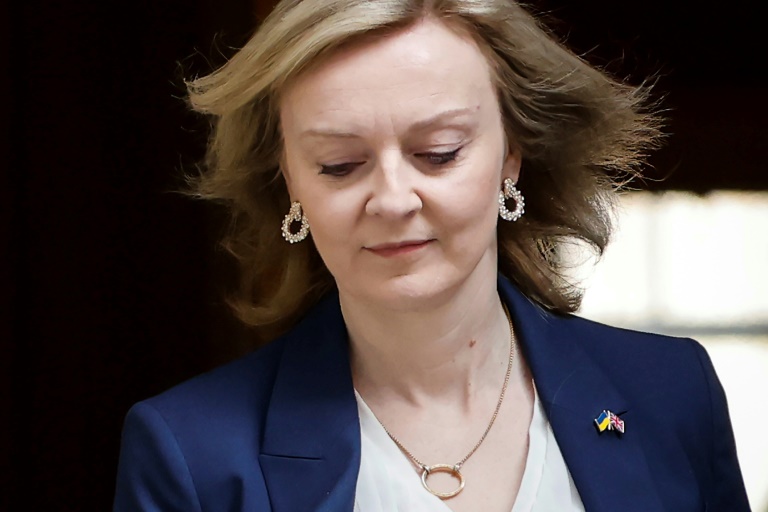
The UK will have “no choice but to act” unless the European Union agrees to change post-Brexit trading arrangements in Northern Ireland, Foreign Secretary Liz Truss said on Thursday. 

Political tensions have risen in the UK province after elections last week saw pro-Irish nationalists Sinn Fein become the biggest party for the first time and now bid to lead a power-sharing executive.

But pro-UK unionists, who believe the Brexit deal’s Northern Ireland Protocol is driving a wedge between the province and mainland Great Britain, are refusing to join the executive in Belfast until it is changed.

Truss spoke to European Commission vice president Maros Sefcovic on Thursday, telling him that the situation was “a matter of internal peace and security for the United Kingdom.

If the EU does not “show the requisite flexibility to help solve those issues, then as a responsible government we would have no choice but to act,” she said. 

London has repeatedly said it is prepared to trigger the protocol’s Article 16 suspension clause unless the deal it signed up to is changed — a move the EU has warned could lead to a wider trade war.

Sefcovic responded by warning that any move by the UK ignore post-Brexit trade rules in Northern Ireland would be unacceptable and threaten the 1998 peace deal that ended decades of violence over British rule in the province.

“Unilateral action… is simply not acceptable,” Sefcovic said in a statement.

“This would undermine trust between the EU and UK as well as compromise our ultimate objective – to protect the Good Friday (Belfast) Agreement. 

“Upholding the rule of law and living up to international obligations is a necessity,” he added.

– ‘Two-tier system’ –

Either party can invoke Article 16 if it believes the protocol is leading to “serious economic, societal or environmental difficulties that are liable to persist”.

The UK government says that checks on goods heading from to Northern Ireland from England, Scotland and Wales are undermining peace in the province, with unionists protests already turning violent.

Separate trading arrangements for Northern Ireland, which bind the province bound to many European rules, were agreed because the province has the UK’s only land border with the EU. 

Keeping the border open with neighbouring Ireland, an EU member, was mandated in the Good Friday Agreement, given the frontier was a frequent flashpoint for violence.

But it means checks have to be done elsewhere, to prevent goods getting into the EU single market and customs union by the back door via Northern Ireland.

Unionists believe it has created a border in the Irish Sea which threatens Northern Ireland’s place as part of the wider UK, and makes a united Ireland more likely.  

Truss told Sefcovic that the UK’s priority was “to protect peace and stability in Northern Ireland”. 

“She also noted that the current situation was causing unacceptable disruption to trade and had created a two-tier system where people in Northern Ireland weren’t being treated the same as everyone else in the UK,” according to a read out of the phone call released by her office.

Truss added that the EU “bore a responsibility to show more pragmatism and ensure the Protocol delivered on its original objectives,” claiming that the government had proposed measures to remove trade barriers within the UK while protecting the EU single market.

Sefcovic said that the EU had already proposed “wide-ranging and impactful solutions” that would “substantially improve the way the protocol is implemented,” but that London had rejected them.

Global stocks slump on alarm over US inflation

World equities tanked Thursday as slowing US inflation failed to dent fears of rising global interest rates and sent oil prices diving on demand concerns.

The European single currency sank to a January 2017 low at $1.0422 as the greenback was lifted by its haven status.

Frankfurt, London and Paris stock markets each sank more than two percent in midday deals after heavy falls in Asia and on Wednesday in the United States.

Panic-stricken investors also sent virtual unit bitcoin tumbling to the lowest level since late 2020 after a dramatic collapse in some stablecoin cryptocurrencies.

US inflation slowed to 8.3 percent in April after a four-decade peak of 8.5 percent in March, data showed overnight.

– ‘Another cruel blow’ –

“While it will come as a relief that (US) inflation has finally peaked and the deceleration has started, the fact that it didn’t do so nearly as much as expected is just another cruel blow to households and the economy,” Oanda analyst Craig Erlam told AFP.

“Central banks are going to have to do more if (inflation) data does not drastically improve in the next few months.”

Investors had hoped the US consumer price data would lower pressure on the Federal Reserve to hike borrowing costs.

However April’s reading eclipsed market expectations of 8.1-percent inflation.

Interest rates are being hiked worldwide to tackle decades-high inflation, which is fuelled mostly by rocketing energy costs.

London’s stock market was slammed Thursday also by news that the UK economy shrank in March on fallout from soaring inflation, increasing the prospect of a recession — or two quarters of contraction in a row.

The data sent the pound sliding to a May 2020 low at $1.2166.

World markets have been volatile for much of 2022 owing to China’s Covid-19 lockdowns, Russia’s invasion of Ukraine, and as surging inflation weighed on consumer sentiment. 

US President Joe Biden called April’s overall slowdown “heartening” — but acknowledged inflation was still a major challenge.

“Bringing it down is my top economic priority,” he said.

– Key figures at around 1115 GMT –

London – FTSE 100: DOWN 2.1 percent at 7,195.76 points

Frankfurt – DAX: DOWN 2.0 percent at 13,550.53

Paris – CAC 40: DOWN 2.3 percent at 6,125.54

EURO STOXX 50: DOWN 2.2 percent at 3,567.30

Hong Kong – Hang Seng Index: DOWN 2.2 percent at 19,380.34 (close)  

Shanghai – Composite: DOWN 0.1 percent at 3,054.99 (close) 

Tokyo – Nikkei 225: DOWN 1.8 percent at 25,748.72 (close)

New York – Dow: DOWN 1.0 percent at 31,834.11 (close)

Brent North Sea crude: DOWN 1.3 percent at $106.15 per barrel

West Texas Intermediate: DOWN 1.3 percent at $104.34 per barrel

Euro/dollar: DOWN at $1.0442 from $1.0513 at 2100 GMT Wednesday

Pound/dollar: DOWN at $1.2211 from $1.2251

Euro/pound: DOWN at 85.53 pence from 85.81 pence

Dollar/yen: DOWN at 128.58 yen from 129.97 yen

burs-rfj/bcp/rl

Close Bitnami banner
Bitnami