World

California ban on selling semi-automatic guns to young adults overturned

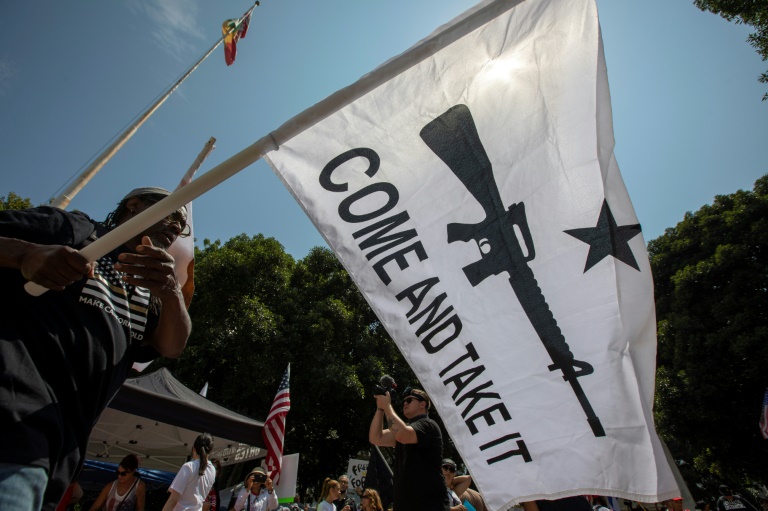
California’s ban on the sale of semi-automatic weapons to adults under the age of 21 violates the country’s constitution, a US federal appeals court ruled Wednesday.

California has in recent years passed several laws tightening the regulation of firearms, which, according to recently released federal data, were linked to more than 45,000 deaths nationwide in 2020.

Buyers under 21 years old are already prohibited from purchasing handguns in California, but a new law that went into effect on July 1, 2021 added a prohibition on the sale of semi-automatic weapons.

That new law was challenged by several individuals and groups lobbying for gun ownership rights, and the case has been working its way through the courts.

By a two-to-one vote, judges on the Ninth Circuit Court of Appeals found that the law violated the Second Amendment to the US Constitution, which says that Americans have a right to “keep and bear arms.”

“America would not exist without the heroism of the young adults who fought and died in our revolutionary army,” wrote Judge Ryan Nelson, referring to America’s war for independence almost 250 years ago.

“Today, we reaffirm that our Constitution still protects the right that enabled their sacrifice: the right of young adults to keep and bear arms,” added Nelson, who was nominated to the court by former president Donald Trump.

The appellate court’s decision does not impact California’s ban on the sale of handguns to those under 21, which is also the legal age at which individuals are allowed to purchase alcohol throughout the United States.

According to Small Arms Survey, there were approximately 393 million firearms in civilian possession in the United States as of 2017, or more than one per person.

Despite recurring mass-casualty shootings and a nationwide wave of gun violence, several initiatives to reform gun regulations have failed in the US Congress, leaving states and local councils to enact their own restrictions.

Azerbaijan refugees vow 'Great Return' to Karabakh

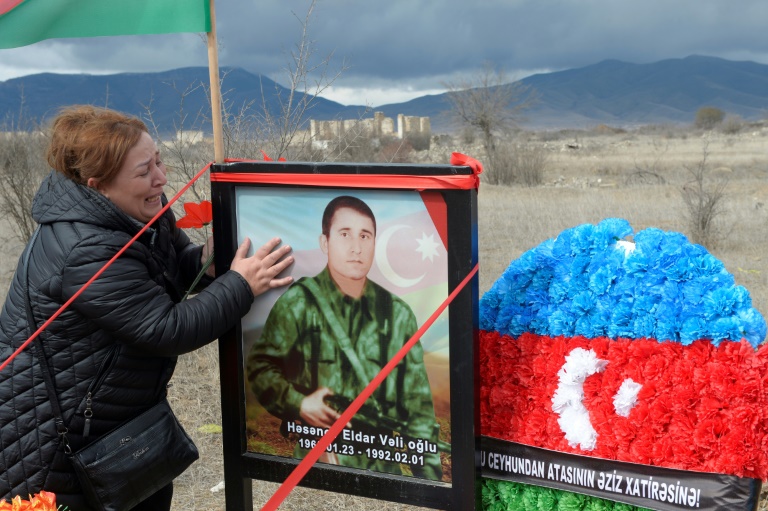
Ali Hasanov looked over the overgrown ruins of his hometown in Nagorno-Karabakh and vowed to return and rebuild it.

“Whatever time it might take, we will return to Aghdam,” said Hasanov. “We want to live here… we belong here.”

Aghdam has been a ghost town since June 1993 when Armenian separatist forces took it from Azerbaijan, sending its entire population of 28,000 people fleeing for their lives. 

The 65-year-old metalworker returned to the disputed region for the first time since on a Azerbaijan government bus tour of “liberated lands” its army retook from Armenia after six weeks of fighting in 2020.

The latest war — in which more than 6,500 people were killed — saw energy-rich Baku take back much of the territory it lost in the conflict in the early 1990s with its old Soviet neighbour in the aftermath of the collapse of the Communism.

Some 30,000 died in that bitter war and hundreds of thousands were forced from their homes.

Hasanov said he “couldn’t sleep a wink” the night before he travelled to Aghdam, which was Karabakh’s biggest town before it was razed by the Armenians.

He said his “soul was itching to get to Aghdam” ever since he and his family fled the city after it was shelled.

“To me, it was the most beautiful city in the world,” he said, standing in the middle of a wasteland that stretched out to the faraway bluish mountains.

The Azerbaijan government began the regular bus trips to the “liberated lands” in January, the first time its former inhabitants have been able to set foot in the mountainous enclave in three decades.

– Dream come true –

It is the first step in what Baku calls the “Great Return”, an ambitious government plan to repopulate remote Karabakh with its former Azerbaijani population.

Escorted by police armed with automatic rifles, buses to Aghdam and Karabakh’s recaptured cultural capital, Shusha, depart Baku twice a week for day-long trips that only give visitors two and a half hours to see their former homes.

Hasanov said the visit was a dream come true.

“Our house stood behind that fence,” he said as tears welled up in his eyes.

“There was an alley of huge plane trees over there, under which we’d play backgammon or dominoes, and over there — a football stadium, the favourite place for our neighbourhood’s lads.”

Such was the destruction, that another refugee from Aghdam, Gulbeniz Jafarova, couldn’t even find the ruins of her house.

“But (the) native spirit is hovering here. It feels like I spent 30 years in a prison cell and was just freed,” the 55-year-old dressmaker added.

At Aghdam’s cemetery she visited the grave of her brother who was killed aged 27, defending the town from Armenian separatist forces who controlled the region until the latest war.

“My mother’s last words before she died were, ‘My son.’ I promised her that I would visit his grave.”

– ‘We belong here’ –

Azerbaijan’s government has vowed to spend billions of petrodollars on the region’s reconstruction, with $1.3 billion allocated in last year’s budget for infrastructure projects such as new roads, bridges and airports.

Baku has pledged to transform Aghdam into one of the country’s biggest cities and plans to set up an industrial park.

Foreign Minister Jeyhun Bayramov said in January that “very shortly we will witness the first families returning to their homes” in Karabakh.

But the “Great Return” of refugees remains a distant prospect, given the scale of devastation of towns like Aghdam and the dangers from landmines, which were used extensively in the conflict, which regularly flared up over the decades.

“Whatever time it might take, we will return to Aghdam,” Hasanov insisted. “We want to live here. My sons say we belong here.”

Cannes marks its 75th year in nostalgic form

From Maverick to Bowie to Elvis, the Cannes Film Festival launches its 75th-anniversary edition on Tuesday with a roster full of icons from the last century.

The world’s foremost film festival always tries to strike a balance between serious arthouse fare and popcorn-guzzling entertainment. 

It has scored some big crowd-pleasers for its diamond jubilee, with Tom Cruise coming to the French Riviera for the European launch of “Top Gun: Maverick”, the sequel to his era-defining mega-hit from 1986. 

Music legends will feature prominently, with flamboyant Australian director Baz Luhrmann screening his biopic “Elvis” along with new documentaries about David Bowie (“Moonage Daydream”) and rock’n’roller Jerry Lee Lewis (“Trouble in Mind” by one-half of the Coen brothers, Ethan Coen). 

While those are all playing outside the main competition, there are also iconic names in the race for the top prize Palme d’Or, not least Canadian horror maestro David Cronenberg. 

The 79-year-old returns to his body-horror (dis)comfort zone with “Crimes of the Future”, in which Kristen Stewart, Lea Seydoux and Viggo Mortensen turn gruesome surgical alterations into a sexualised performance art.

– Five films from women –

Meanwhile, US filmmaker James Gray gets nostalgic for his New York adolescence in “Armageddon Time”, starring Anne Hathaway and Anthony Hopkins. 

And one of France’s most feted directors, Claire Denis, is back with “The Stars at Noon”, a thriller set in Central America featuring Robert Pattinson. 

Following some last-minute additions, a total of 21 films are competing for the Palme d’Or, including several from previous winners: the Dardenne brothers from Belgium, Sweden’s Ruben Ostlund, Japan’s Hirokazu Kore-eda and Romania’s Cristian Mungiu.

Only five are directed by women — though that still makes it a record year for female representation at Cannes — among them US indie darling Kelly Reichardt who is presenting “Showing Up” with Michelle Williams.

Julia Ducournau became only the second woman to win the Palme last year for her wild and gory “Titane”.

One of its stars, French actor Vincent Lindon, heads the jury this year with a team that includes Iran’s two-time Oscar-winning director Asghar Farhadi, Indian actress Deepika Padukone and British actress-director Rebecca Hall. 

– ‘Sadness, shame, pain’ –

The war in Ukraine will be an inevitable talking point. 

Its beleaguered filmmakers will get a special day at the industry marketplace that runs alongside the festival and Ukrainian director Sergei Loznitsa will present a timely film out of competition, “The Natural History of Destruction”, about the bombing of German cities in World War II.

The main competition also includes Russia’s Kirill Serebrennikov, who was unable to attend for his two previous nominations due to a politically-charged conviction for embezzlement back home.

Now in exile, the director recently told AFP of the “horror, sadness, shame, pain” he felt about the invasion of Ukraine, which he said was an act of “self-killing” by the Russian government.

Elsewhere, the festival will celebrate the return of “Mad Max” creator George Miller, who returns with “Three Thousand Years of Longing”, a different beast for the Australian director, featuring Idris Elba as a djinn. 

And actor-director Ethan Hawke will add to the nostalgic feel of the fortnight with his new series, “The Last Movie Stars”, about 1960s Hollywood golden couple Paul Newman and Joanne Woodward.

This year’s honorary Palme d’Or will be presented to US actor Forest Whitaker, best known for his Oscar-winning turn in “The Last King of Scotland”. 

Ukraine to hold first war crimes trial as Moscow says Kyiv shelled Russian city

Ukraine announced it will hold its first war crimes trial over the Russian invasion, as Moscow accused Kyiv of shelling a Russian city in the war’s latest flashpoint.

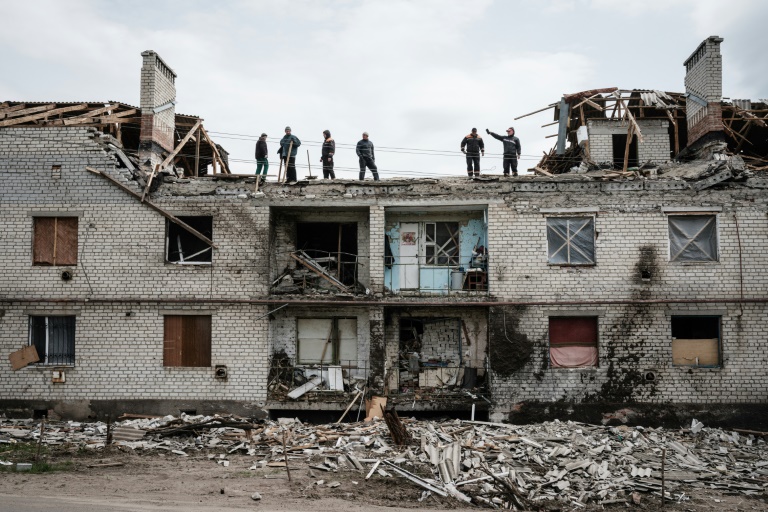
The conflict has devastated cities and displaced millions, with fears also growing of its broader international impact as gas supplies to Europe were disrupted by a halt in Russian flows through Ukraine.

Kyiv has repeatedly accused Russian troops of committing atrocities since the invasion began on February 24, and Ukrainian authorities said Wednesday they would launch the first war crimes trial of the conflict.

The prosecutor general’s office said Vadim Shishimarin, a 21-year-old Russian service member, is accused of killing an unarmed 62-year-old civilian as he fled with four other soldiers in a stolen car.

“The man died on the spot just a few dozen metres from his home,” said a statement from prosecutor Iryna Venediktova’s office.

Shishimarin faces possible life imprisonment if found guilty.

Venediktova’s office has said it has received reports of more than 10,000 alleged war crimes, with 622 suspects identified.

The Russian invasion has sparked an exodus of nearly six million civilians, many of whom bear accounts of torture, sexual violence and indiscriminate destruction.

The UN Human Rights Council is due to hold a special session on Ukraine on Thursday.

Moscow has focused on eastern and southern Ukraine since it failed to take Kyiv in the first weeks of its campaign.

Ukraine’s forces were boosted by what Kyiv described as the recapture of four villages around the northeastern city of Kharkiv, close to the border with Russia.

In the Russian city of Belgorod, around 70 kilometres (43 miles) from Kharkiv, authorities said one person was killed and six injured by Ukrainian shelling.

Belgorod governor Vyacheslav Gladkov said it was “the most difficult situation” facing the border region since Russia sent its troops into Ukraine 11 weeks ago.

Authorities in Russian regions bordering Ukraine have repeatedly accused Ukrainian forces of launching attacks.

In April, Gladkov said Ukrainian helicopters carried out a strike on a fuel storage facility in Belgorod.

– ‘They come in waves’ –

In southern Ukraine, the pro-Kremlin authorities in the city of Kherson urged Putin to annex the region.

Kherson was the first major Ukrainian city to fall in the current conflict. It lies north of Crimea, which was annexed by Russia in 2014.

Kirill Stremousov, deputy head of Kherson’s Moscow-installed administration, said there would be a “request to make Kherson region a full subject of the Russian Federation”.

The Kremlin replied it was up to the residents of Kherson to “determine their own fate”.

Ukrainian presidential aide Mykhaylo Podolyak said Kherson would be liberated and “the invaders may ask to join even Mars or Jupiter”.

Ukrainian President Volodymyr Zelensky has framed his nation’s resistance to the Russian invasion as a “war against tyranny”, but the fierce fightback has carried a heavy cost.

In a rare release of battle casualty figures, Ukraine’s National Guard said Wednesday that 561 of its members have been killed and nearly 1,700 wounded since the invasion began.

Neither the defence ministry in Kyiv nor its counterpart in Moscow has provided official death counts, but in mid-April, Zelensky said between 2,500 and 3,000 Ukrainian soldiers had been killed.

Ukraine’s effort to hold the Russian-speaking Donbas region in the east has also become increasingly desperate.

“They come in waves,” volunteer fighter Mykola said of the repeated Russian attempts to push past a strategic river near a rural settlement called Bilogorivka.

– NATO decision by Finland, Sweden –

Much of the world has moved to isolate Putin as punishment for the invasion.

Russia “is today the most direct threat to the world order with the barbaric war against Ukraine,” European Commission President Ursula von der Leyen said in Tokyo Thursday after meeting Japanese Prime Minister Fumio Kishida.

Kishida, whose government joined the tough measures against Moscow, added: “Russia’s invasion of Ukraine is not just a matter for Europe, but it shakes the core of the international order including Asia. This must not be tolerated.”

Russia has been hit with a wave of punishing economic sanctions that have started to take a toll on its foreign exchange reserves.

Zelensky said Wednesday that he had spoken with German Chancellor Olaf Scholz about boosting penalties on Moscow.

“Step by step we are doing everything to make the aggressor feel the biggest pain from the aggression,” the Ukrainian leader said.

But ramping up the embargoes has not been straightforward, with concern among some nations in Europe that rely on Russian gas.

Kyiv said Wednesday that Russia had halted gas supplies through a key transit hub in the east. 

The stoppage caused supplies to plunge by 25 percent in Germany, which is dependent on Russia for its energy and has rejected an immediate full embargo on Russian gas.

The invasion of Ukraine has also prompted Sweden and Finland to consider NATO membership.

Finland was due to reveal its position on joining the bloc on Thursday.

– A mother mourns –

A Ukrainian commander in Mariupol appealed directly to Elon Musk on Wednesday, asking the world’s richest man to intervene on behalf of those trapped by Russian forces in the southern port city.

The war has devastated Mariupol, where Ukrainians have sustained a pocket of resistance at a steel factory.

Iryna Yegorchenko, 43, learned Wednesday that her soldier son Artem had died protecting the Azovstal plant.

“I suddenly felt relieved,” she told AFP.

The 22-year-old was crushed during the collapse of a structure and “quickly went to God”, said Yegorchenko, who lives in Kyiv.

“He decided to defend his homeland, his people… I have nothing to be ashamed of as a mother.”

burs-qan/lb/ser

Sri Lanka president set to name new PM

Beleaguered President Gotabaya Rajapaksa was set to name a new prime minister Thursday to try to steer Sri Lanka out of its dire economic crisis after days of violence, officials said.

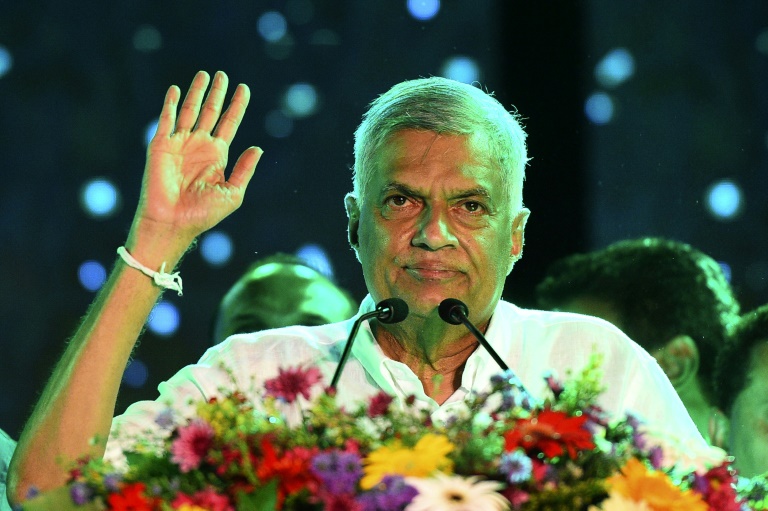
Respected five-time former premier Ranil Wickremesinghe was the frontrunner to head a “unity government” with cross-party support in the 225-member parliament and replace Rajapaksa’s elder brother Mahinda who stepped down on Monday.

“A swearing-in is likely today unless there is a last-minute hiccup,” a senior official close to the president told AFP.

In a televised address to the nation on Wednesday night, Rajapaksa stopped short of yielding to weeks of nationwide protests calling for him to resign.

The country of 22 million people is in its worst economic crisis since independence with severe shortages of food, fuel and medicines and long power cuts.

But in a bid to win over the opposition who wanted Rajapaksa to quit, the 72-year-old pledged to give up most of his executive powers and set up a new cabinet this week.

“I will name a prime minister who will command a majority in parliament and the confidence of the people,” Rajapaksa said in the televised speech.

Mahinda Rajapaksa resigned as prime minister on Monday after his supporters attacked anti-government supporters and ran riot in Colombo.

This unleashed several days of violence that killed at least nine people and injured more than 200, with dozens of Rajapaksa loyalist homes set on fire.

Security forces patrolling in armoured personnel carriers with orders to shoot on sight anyone engaged in looting or violence have since cracked down on public disorder.  

A curfew was lifted Thursday morning only to be reimposed after a six-hour break allowing people to stock up on essentials.

The main opposition SJB party was initially invited to lead a new government, but its leader Sajith Premadasa insisted that the president first step down.

However, about a dozen MPs from the SJB pledged support to Wickremesinghe, 73, who has been prime minister five times since 1993 and is seen as a pro-West free-market reformist.

Wickremesinghe is the only legislator from his United National Party (UNP) which was routed at the August 2020 election that gave Rajapaksa a two-thirds majority.

With the economic crisis, the Rajapaksa government began to unravel with mass defections to the opposition, but since April no group in the 225-member assembly enjoys an absolute majority.

Sri Lanka is in talks with the International Monetary Fund and others about a bailout package after a shortage of foreign currency forced it to default on its foreign debts last month.

The island nation’s central bank chief warned Wednesday that the economy will “collapse” unless a new government was urgently appointed.

How will Lebanon vote impact the crisis-hit economy?

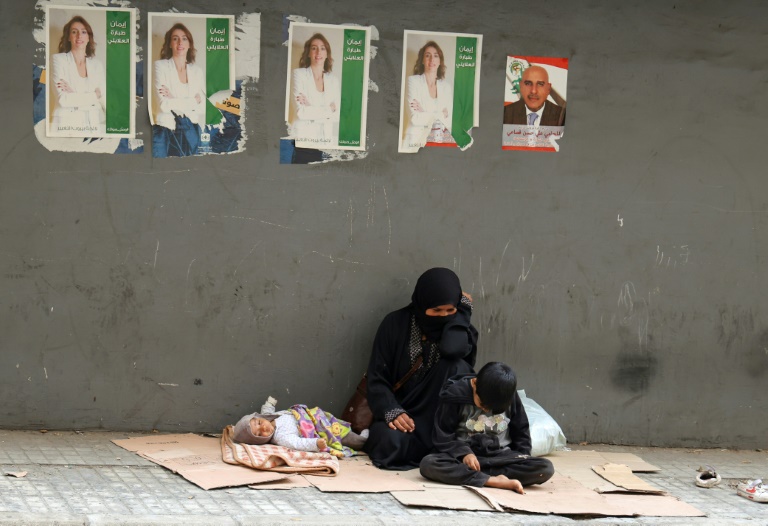
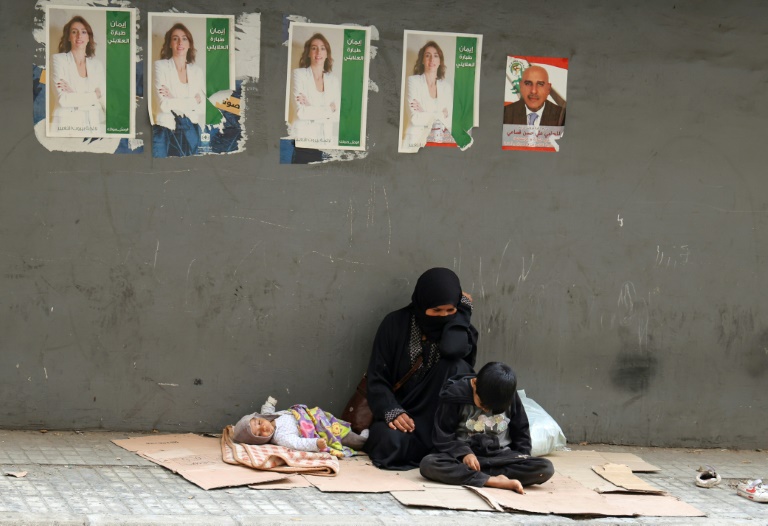
The Lebanese parliament voted in on Sunday will have to tackle overdue reforms required for international assistance the cash-strapped country desperately needs. 

After Lebanon struck a conditional deal with the International Monetary Fund for a $3 billion aid package, AFP looks at the challenges that await incoming lawmakers in a country where there is little consensus on a roadmap for financial recovery.

– How bad is the crisis? –

Since 2019, Lebanon has suffered an unprecedented economic decline caused by decades of mismanagement and corruption. 

The World Bank last year said Lebanon was likely to rank among the world’s worst financial crises since the mid-19th century.

The state’s bankrupcy has hampered imports of basic items including food, medicine and fuel.

Starved of hydrocarbons, the country’s power stations have scaled down their operations to a near minimum. Power cuts can last up to 23 hours a day, forcing residents to rely on expensive private generators to keep the lights on. 

The Lebanese pound, pegged at 1,507 to the dollar since 1997, has lost more than 90 percent of its value on the black market. 

More than 80 percent of people have fallen into poverty, according to the United Nations.

The monthly minimum wage, once worth $450, is now roughly equal to $25, and inflation has reached triple digits.

The situation is made worse by informal banking controls that have gradually tightened since they were first put in place in 2019. 

Depositors are denied access to foreign currency savings and forced to withdraw their money in Lebanese pounds at an exchange rate set by the central bank that is far below the market price. 

– Why is the IMF deal crucial? –

The IMF last month announced the conditional agreement for aid to help Lebanon emerge from financial ruin.

However, final IMF approval for the 46-month financing programme is contingent on timely implementation of critical reforms long demanded by Lebanon’s international donors, the global lender said.

The overdue reforms have been stymied by political divisions leading to deadlock in both parliament and government while the country sinks deeper into poverty.

“Lebanon has to show commitment and establish credibility in regards to reforms before the international community can commit to any financial support,” Deputy Prime Minister Saade Chami told AFP.

“The ball is in our court.”

Billionaire Prime Minister Najib Mikati has said there is “no choice” for Lebanon other than an IMF deal.

“Carrying out the required actions will bring solutions faster” for Lebanon, Mikati said, relaying a message from IMF representatives.  

– What must happen next? –

Chami, who heads Lebanon’s delegation in IMF talks, said that the new parliament will have to tackle four urgent tasks.

It will have to set a draft 2022 annual budget, which is already overdue, and pass a capital control law that formalises restrictions imposed by banks on deposits, Chami said.

The legislature will also have to approve two amendments to meet IMF demands, he said. 

One would affect banking secrecy laws that have hampered attempts to conduct financial audits of the central bank and other institutions.

Parliament will also have to amend its bank restructuring law, according to Chami, to reorganise a bloated financial sector that has lost the confidence of depositors and investors. 

“Failure to do that will have negative implications on the IMF deal and the economic situation,” Chami said. 

Lebanon, which defaulted on its debt in March 2020, estimates the total financial losses for the state, central bank and commercial banks at $69 billion. This number was the basis for the IMF negotiations.

Setting up a legal framework to reform and restructure the banking sector will be among the new parliament’s major tests, given the shared interests between Lebanon’s political and financial elite, said Sami Nader, director of the Levant Institute for Strategic Affairs.

How will Lebanon vote impact the crisis-hit economy?

The Lebanese parliament voted in on Sunday will have to tackle overdue reforms required for international assistance the cash-strapped country desperately needs. 

After Lebanon struck a conditional deal with the International Monetary Fund for a $3 billion aid package, AFP looks at the challenges that await incoming lawmakers in a country where there is little consensus on a roadmap for financial recovery.

– How bad is the crisis? –

Since 2019, Lebanon has suffered an unprecedented economic decline caused by decades of mismanagement and corruption. 

The World Bank last year said Lebanon was likely to rank among the world’s worst financial crises since the mid-19th century.

The state’s bankrupcy has hampered imports of basic items including food, medicine and fuel.

Starved of hydrocarbons, the country’s power stations have scaled down their operations to a near minimum. Power cuts can last up to 23 hours a day, forcing residents to rely on expensive private generators to keep the lights on. 

The Lebanese pound, pegged at 1,507 to the dollar since 1997, has lost more than 90 percent of its value on the black market. 

More than 80 percent of people have fallen into poverty, according to the United Nations.

The monthly minimum wage, once worth $450, is now roughly equal to $25, and inflation has reached triple digits.

The situation is made worse by informal banking controls that have gradually tightened since they were first put in place in 2019. 

Depositors are denied access to foreign currency savings and forced to withdraw their money in Lebanese pounds at an exchange rate set by the central bank that is far below the market price. 

– Why is the IMF deal crucial? –

The IMF last month announced the conditional agreement for aid to help Lebanon emerge from financial ruin.

However, final IMF approval for the 46-month financing programme is contingent on timely implementation of critical reforms long demanded by Lebanon’s international donors, the global lender said.

The overdue reforms have been stymied by political divisions leading to deadlock in both parliament and government while the country sinks deeper into poverty.

“Lebanon has to show commitment and establish credibility in regards to reforms before the international community can commit to any financial support,” Deputy Prime Minister Saade Chami told AFP.

“The ball is in our court.”

Billionaire Prime Minister Najib Mikati has said there is “no choice” for Lebanon other than an IMF deal.

“Carrying out the required actions will bring solutions faster” for Lebanon, Mikati said, relaying a message from IMF representatives.  

– What must happen next? –

Chami, who heads Lebanon’s delegation in IMF talks, said that the new parliament will have to tackle four urgent tasks.

It will have to set a draft 2022 annual budget, which is already overdue, and pass a capital control law that formalises restrictions imposed by banks on deposits, Chami said.

The legislature will also have to approve two amendments to meet IMF demands, he said. 

One would affect banking secrecy laws that have hampered attempts to conduct financial audits of the central bank and other institutions.

Parliament will also have to amend its bank restructuring law, according to Chami, to reorganise a bloated financial sector that has lost the confidence of depositors and investors. 

“Failure to do that will have negative implications on the IMF deal and the economic situation,” Chami said. 

Lebanon, which defaulted on its debt in March 2020, estimates the total financial losses for the state, central bank and commercial banks at $69 billion. This number was the basis for the IMF negotiations.

Setting up a legal framework to reform and restructure the banking sector will be among the new parliament’s major tests, given the shared interests between Lebanon’s political and financial elite, said Sami Nader, director of the Levant Institute for Strategic Affairs.

Cardinal's arrest deepens alarm over Hong Kong crackdown

The arrest of a 90-year-old Catholic cardinal under Hong Kong’s national security law has triggered international outrage and deepened concerns over China’s crackdown on freedoms in the financial hub.

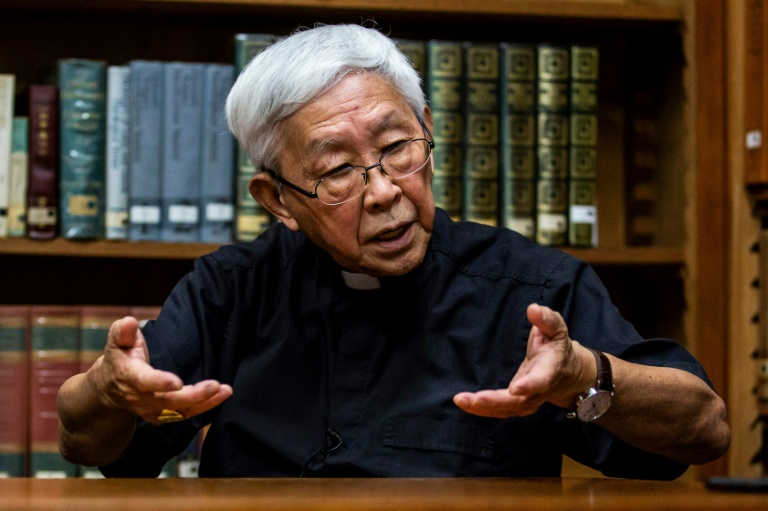
Retired cardinal Joseph Zen, one of the most senior Catholic clerics in Asia, was among a group of veteran democracy advocates arrested Wednesday on a charge of “colluding with foreign forces”. 

Cantonese pop singer Denise Ho, veteran barrister Margaret Ng and prominent cultural studies scholar Hui Po-keung were also arrested, the latter at the airport as he attempted to travel to Europe to take up an academic post.

The four were detained for their involvement in a now-disbanded defence fund that helped pay legal and medical costs for those arrested in the huge and sometimes violent democracy protests that convulsed Hong Kong three years ago.

China responded to the protests with a broad campaign to crush the democracy movement and transform the once outspoken city into something more closely resembling the authoritarian mainland.

Zen and his colleagues, who were released on bail late Wednesday, join more than 180 Hong Kongers arrested under the national security law to date. 

Those charged are typically denied bail and can face up to life in prison if convicted. 

– ‘Deeply troubling’ –

Criticism came from Western nations who have accused China of eviscerating freedoms it once promised Hong Kong could maintain. 

The United States, which has previously sanctioned key Chinese officials over the ongoing crackdown, called on Beijing to “cease targeting Hong Kong’s advocates”.

“Freedom of expression (is) critical to prosperous and secure societies,” White House spokesperson Karine Jean-Pierre told reporters.

The Vatican said it was concerned by Zen’s arrest and “following the development of the situation very closely”.

Canada, meanwhile, said consular officials were trying to access Ho, a popular singer and LGTBQ campaigner who is a dual Hong Kong-Canadian national. 

Canadian foreign minister Melanie Joly called the arrests “deeply troubling”. 

“The ongoing targeting of civil society groups erodes the rights and freedoms of Hong Kong residents guaranteed under Hong Kong’s Basic Law,” she wrote on Twitter. 

EU foreign policy chief Josep Borrell said he was following the arrests with “great concern”. 

Human Rights Watch called it a “shocking new low for Hong Kong”.

“Even by Hong Kong’s recent standards of worsening repression, these arrests represent a shocking escalation,” added Amnesty International.

– ‘Six crimes’ –

Cardinal Zen fled Shanghai for Hong Kong after the communists took power in China in 1949 and rose to become bishop of Hong Kong.

He has been critical of the Vatican’s decision to reach a compromise with China over the appointment of bishops on the mainland and a long-term advocate of Hong Kong’s democracy movement.

Those arrested Wednesday were suspected of endangering national security because they allegedly asked foreign nations or overseas organisations to impose sanctions on Hong Kong, police said.

Ta Kung Pao, a nationalist newspaper that answers to Beijing’s Liaison Office in Hong Kong, published an article Thursday detailing “six crimes” allegedly committed by the group and their defence fund.

The alleged crimes included funding lobbying trips and activist meetings with British lawmakers, providing financial aid to Hong Kong “rioters” who had fled to Canada and Taiwan, and accepting donations from overseas.

It also listed a HK$1.3 million ($165,000) donation from Apple Daily, a popular pro-democracy tabloid that collapsed last year after its assets were frozen by the security law. 

But most of the alleged actions cited by Ta Kung Pao took place before the enactment of the national security law, which is not supposed to be retroactive.

Reporting in the paper and its sister publication Wen Wei Po often heralds action by Hong Kong’s national security police, and the defence fund has previously been a target of coverage. 

The fund disbanded last year after national security police demanded it hand over operational details including information about its donors and beneficiaries.

Ukraine to hold first war crimes trial as Moscow says Kyiv shelled Russian city

Ukraine announced it will hold its first war crimes trial over the Russian invasion, as Moscow accused Kyiv of shelling a Russian city in the war’s latest flashpoint.

The conflict has devastated cities and displaced millions, with fears also growing of its broader international impact as gas supplies to Europe were disrupted by a halt in Russian flows through Ukraine.

Kyiv has repeatedly accused Russian troops of committing atrocities since the invasion began on February 24, and Ukrainian authorities said Wednesday they would launch the first war crimes trial of the conflict.

The prosecutor general’s office said Vadim Shishimarin, a 21-year-old Russian service member, is accused of killing an unarmed 62-year-old civilian as he fled with four other soldiers in a stolen car.

“The man died on the spot just a few dozen metres from his home,” said a statement from prosecutor Iryna Venediktova’s office.

Shishimarin faces possible life imprisonment if found guilty.

Venediktova’s office has said it has received reports of more than 10,000 alleged war crimes, with 622 suspects identified.

The Russian invasion has sparked an exodus of nearly six million civilians, many of whom bear accounts of torture, sexual violence and indiscriminate destruction.

The UN Human Rights Council is due to hold a special session on Ukraine on Thursday.

Moscow has focused on eastern and southern Ukraine since it failed to take Kyiv in the first weeks of its campaign.

Ukraine’s forces were boosted by what Kyiv described as the recapture of four villages around the northeastern city of Kharkiv, close to the border with Russia.

In the Russian city of Belgorod, around 70 kilometres (43 miles) from Kharkiv, authorities said one person was killed and six injured by Ukrainian shelling.

Belogorod governor Vyacheslav Gladkov said it was “the most difficult situation” facing the border region since Russia sent its troops into Ukraine 11 weeks ago.

Authorities in Russian regions bordering Ukraine have repeatedly accused Ukrainian forces of launching attacks.

In April, Gladkov said Ukrainian helicopters carried out a strike on a fuel storage facility in Belgorod.

– ‘They come in waves’ –

In southern Ukraine, the pro-Kremlin authorities in the city of Kherson urged Putin to annex the region.

Kherson was the first major Ukrainian city to fall in the current conflict. It lies north of Crimea, which was annexed by Russia in 2014.

Kirill Stremousov, deputy head of Kherson’s Moscow-installed administration, said there would be a “request to make Kherson region a full subject of the Russian Federation”.

The Kremlin replied it was up to the residents of Kherson to “determine their own fate”.

Ukrainian presidential aide Mykhaylo Podolyak said Kherson would be liberated and “the invaders may ask to join even Mars or Jupiter”.

Ukrainian President Volodymyr Zelensky has framed his nation’s resistance to the Russian invasion as a “war against tyranny”, but the fierce fightback has carried a heavy cost.

In a rare release of battle casualty figures, Ukraine’s National Guard said Wednesday that 561 of its members have been killed and nearly 1,700 wounded since the invasion began.

Neither the defence ministry in Kyiv nor its counterpart in Moscow has provided official death counts, but in mid-April, Zelensky said between 2,500 and 3,000 Ukrainian soldiers had been killed.

Ukraine’s effort to hold the Russian-speaking Donbas region in the east has also become increasingly desperate.

“They come in waves,” volunteer fighter Mykola said of the repeated Russian attempts to push past a strategic river near a rural settlement called Bilogorivka.

– NATO decision by Finland, Sweden –

Much of the world has moved to isolate Putin as punishment for the invasion.

Russia “is today the most direct threat to the world order with the barbaric war against Ukraine,” European Commission President Ursula von der Leyen said in Tokyo Thursday after meeting Japanese Prime Minister Fumio Kishida.

Kishida, whose government joined the tough measures against Moscow, added: “Russia’s invasion of Ukraine is not just a matter for Europe, but it shakes the core of the international order including Asia. This must not be tolerated.”

Russia has been hit with a wave of punishing economic sanctions that have started to take a toll on its foreign exchange reserves.

Zelensky said Wednesday that he had spoken with German Chancellor Olaf Scholz about boosting penalties on Moscow.

“Step by step we are doing everything to make the aggressor feel the biggest pain from the aggression,” the Ukrainian leader said.

But ramping up the embargoes has not been straightforward, with concern among some nations in Europe that rely on Russian gas.

Kyiv said Wednesday that Russia had halted gas supplies through a key transit hub in the east. 

The stoppage caused supplies to plunge by 25 percent in Germany, which is dependent on Russia for its energy and has rejected an immediate full embargo on Russian gas.

The invasion of Ukraine has also prompted Sweden and Finland to consider NATO membership.

Finnish was due to reveal its position on joining the bloc on Thursday.

– A mother mourns –

A Ukrainian commander in Mariupol appealed directly to Elon Musk on Wednesday, asking the world’s richest man to intervene on behalf of those trapped by Russian forces in the southern port city.

The war has devastated Mariupol, where Ukrainians have sustained a pocket of resistance at a steel factory.

Iryna Yegorchenko, 43, learned Wednesday that her soldier son Artem had died protecting the Azovstal plant.

“I suddenly felt relieved,” she told AFP.

The 22-year-old was crushed during the collapse of a structure and “quickly went to God”, said Yegorchenko, who lives in Kyiv.

“He decided to defend his homeland, his people… I have nothing to be ashamed of as a mother.”

burs-qan/lb

Russia 'most direct threat to world order': EU's von der Leyen

Top European officials warned Thursday that Russia poses the “most direct threat” to world order and urged China to play a more constructive role on the international stage as they held talks in Tokyo.

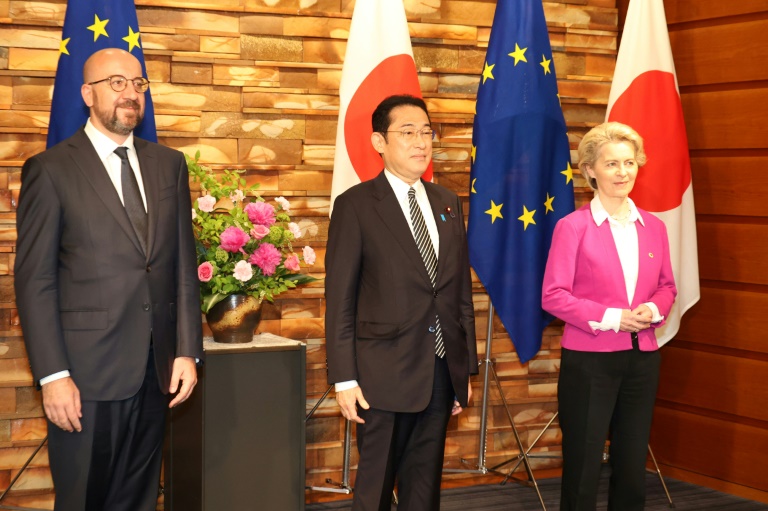
European Commission President Ursula von der Leyen and European Council President Charles Michel are in Japan for talks that have touched on Russia’s invasion of Ukraine but also growing concerns about China’s role in Asia and beyond.

Russia “is today the most direct threat to the world order with the barbaric war against Ukraine, and its worrying pact with China,” von der Leyen said after talks with Japanese Prime Minister Fumio Kishida.

The annual summit comes with much of the international community rallying to pressure Moscow over Ukraine.

“Russia’s invasion of Ukraine is not just a matter for Europe, but it shakes the core of the international order including Asia. This must not be tolerated,” said Kishida, whose government has joined tough sanctions on Moscow, including on energy.

Beijing’s increasingly muscular stance in Asia was also on the agenda, with the EU looking to take a more high-profile role in confronting China.

“Our cooperation in Ukraine is critical in Europe, but it’s also important in the Indo-Pacific and we also want to deepen our consultation on a more assertive China,” said Michel.

“China must stand up to defend the multilateral system that it has benefitted from in developing its country.”

Von der Leyen said the EU and Japan were stepping up cooperation including launching a digital partnership that will focus on competitiveness and security.

She said the two sides would also work on supply chains, which have been disrupted by the pandemic and the war in Ukraine, but are also the subject of worry about China’s role in chip production.

“There are materials and technologies that have become essential to our economy and everyday lives, like semiconductors for example. We must be able to count on trustworthy supply chains,” she said.

– Infrastructure investment –

Japan and the EU have been working to strengthen ties, including with a landmark 2019 trade deal, and Tokyo has broken with past diplomatic postures to take a strong stand on Ukraine.

It has sanctioned Russian businesses and officials, sent humanitarian and financial aid to Ukraine and joined a G7 pledge to phase out or ban Russian oil.

Japan has, however, stopped short of measures on gas because of its reliance on energy imports.

Von der Leyen and Michel are due to hold a working lunch with Kishida later Thursday, with Michel visiting Hiroshima on Friday.

Kishida said their discussions would include talks on tensions in the South and East China Seas, where Tokyo fears Beijing is increasingly attempting to stake a claim to disputed territory.

There are also longstanding fears about whether Beijing could move to take control of Taiwan, which China claims and has vowed to eventually seize.

Michel said the two sides discussed “ways to boost our cooperation in security and defence”, noting Japan is the only Asian country specifically mentioned in the EU’s 2030 security and defence plan.

Von der Leyen also urged cooperation on infrastructure in the region, in a veiled reference to Beijing, which has sought to cement alliances in the region and beyond with projects sometimes criticised as debt traps.

“The needs for investment are huge, and the options are limited. They very often come at a price that no country should have to pay, like encroachments on their sovereignty,” she said.

Close Bitnami banner
Bitnami