World

Sri Lanka's economy on brink of collapse as troops quell unrest

Sri Lanka’s economy will “collapse” unless a new government is urgently appointed, the central bank chief warned Wednesday, as security forces fanned out on the streets to restore order after spasms of mob violence.

Police say nine people have died since Monday, when frustration at a dire economic crisis erupted into clashes between backers and opponents of President Gotabaya Rajapaksa, injuring more than 200.

Armoured personnel carriers have carried troops into the capital Colombo and a heavy security presence commanded to shoot looters on sight has largely restored order without sparking further violence.

But Central Bank Governor Nandalal Weerasinghe said it was critical that a new administration take charge by Friday or the country would suffer a catastrophe.

“The economy will completely collapse and no one will be able to save it,” he told reporters.

“The country was fast going down a slope when I took over just over a month ago. I thought we were able to apply the brakes, but with events of Monday the brakes no longer work.”

Shortly after taking over as the bank’s chief in April, Weerasinghe announced a default on Sri Lanka’s $51 billion external debt, saying the country had no money to pay its creditors.

He said political stability was vital to implement the reforms needed to address Sri Lanka’s snowballing debt crisis and the acute shortage of foreign exchange to import essentials.

A nationwide curfew is still in effect and the streets of the capital Colombo were almost deserted on Wednesday aside from soldiers manning checkpoints.

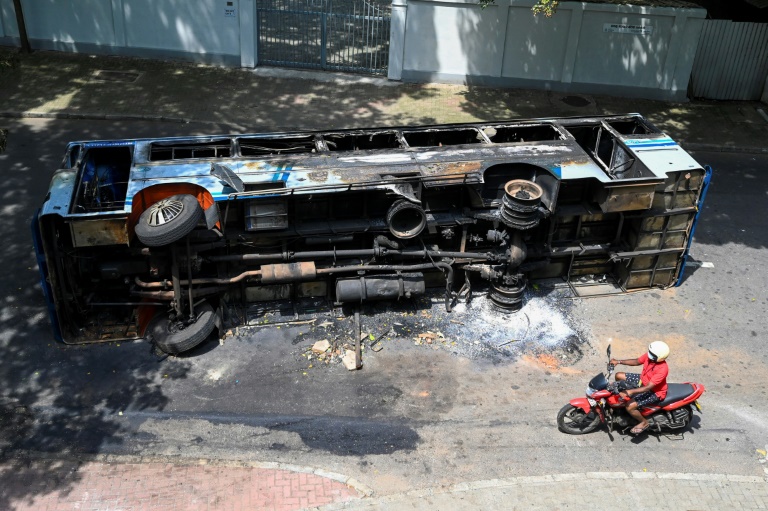
Several roads were still partially blocked by the charred remains of buses that had been set alight by anti-government crowds.

– Public unease –

The heavy security presence has brought widespread public unease, prompting Sri Lanka’s top military official to publicly deny speculation of a looming coup.

“Don’t ever think that we are trying to capture power,” said Kamal Gunaratne, the secretary of the defence ministry.

“The military has no such intentions.”

A small crowd continued to defy the curfew near President Rajapaksa’s seafront office, where a protest camp has for the past month maintained a vigil calling on him to step down.

“We want the whole Rajapaksa clan out because they are so, so corrupt. They have been eating into Sri Lanka like a caterpillar eating into some fruit,” activist Kaushalya Fernando told AFP.

In a televised address to the nation, Rajapaksa said he was willing to curtail his own powers in the interests of forming a unity government to navigate Sri Lanka out of the crisis.

“I appeal to all to support me to ensure that the country does not collapse and we are able to prove the essentials to all,” he said.

But the main opposition SJB party reiterated it will not be a part of any government with Rajapaksa still president, even after his brother Mahinda’s resignation as prime minister on Monday.

– Turning point –

Sri Lankans have been suffering shortages of essential goods, fuel and medicines for months in the island’s worst economic downturn since independence in 1948.

The crisis moved into a darker phase on Monday when government supporters with sticks and clubs attacked demonstrators who had been protesting peacefully for weeks demanding the president’s resignation.

Mobs then retaliated across the country, torching dozens of homes of ruling-party politicians. 

Mahinda Rajapaksa had to be rescued in a pre-dawn military operation on Tuesday and taken to a naval dockyard for safety after protesters tried to storm his official residence.

Echoing the UN rights chief and the European Union, the United States on Tuesday said it was concerned both with the violence and the deployment of the military.

“We stress that peaceful protesters should never be subjected to violence or intimidation,” State Department spokesman Ned Price told reporters.

India meanwhile was forced to deny social media rumours — some using old images of Mahinda boarding a helicopter — that it was helping Rajapaksa family members to flee.

The Indian “High Commission would like to categorically deny speculative reports in sections of media and social media about India sending her troops to Sri Lanka,” it said a statement.

With vital tourism revenues torpedoed by the pandemic, Sri Lanka last month defaulted on its foreign debt, some of it stemming from Rajapaksa vanity projects built with Chinese loans.

The International Monetary Fund this week began a “virtual mission” of staff-level talks on a possible bailout.

IMF mission chief Masahiro Nozaki said the lender aimed to be “fully prepared for policy discussions once a new government has been formed”.

Disney profit slips but streaming TV subscribers jump

Disney on Wednesday said its profit slipped in the recently ended quarter but its television streaming service and parks were booming.

The entertainment giant reported net income of $470 million, just over half of the $912 million profit it made in the same period a year earlier.

Park attendance that had fallen due to the pandemic, however, rebounded and the Disney+ television streaming service gained 7.9 million subscribers to top 205 million total, the company said.

“Our strong results in the second quarter, including fantastic performance at our domestic parks and continued growth of our streaming services once again proved that we are in a league of our own,” said Walt Disney Company chief executive Bob Chapek.

Disney+ gained more subscribers than analysts had expected, in stark contrast to a dive in subscriber numbers reported by rival Netflix in the first quarter of this year.

A drop of just 200,000 users — less than 0.1 percent of the total Netflix customer base — caused shares in the Silicon Valley firm to plunge and prompted a shareholder to file a lawsuit accusing the streaming television titan of not making it clear that subscriber numbers were in peril.

Competition in the streaming television market has intensified, particularly from Disney+, with the cost of producing coveted original shows climbing as well. 

Disney said that as its streaming television service continues to grow strongly, its resorts and parks are generally operating without any of the significant Covid-19 related restrictions on capacity that were in place last year.

The pandemic does continue to vex film and television show production, Disney said, but it has been able to release films in theaters so far this year.

“Our slate for the remainder of this year is incredibly strong,” Chapek told analysts while discussing the company’s line-up of shows for streaming and theaters.

Disney shares were up more than three percent in after-market trade that followed release of the earnings figures.

Paris plans green makeover of Champs-Elysees for Olympics

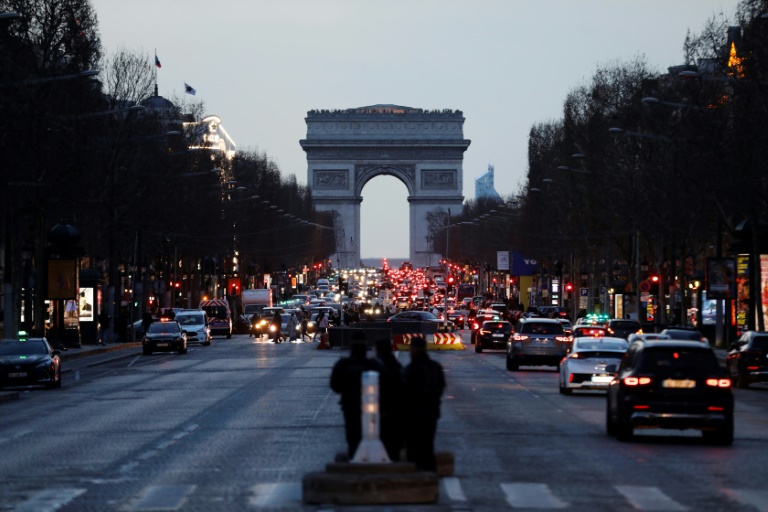
Paris will give the famed Champs-Elysees a makeover ahead of the 2024 Olympic Games by planting trees and increasing pedestrian areas, the French capital’s officials said on Wednesday.  

The French often call it “the most beautiful avenue in the world” but activists complain that traffic and luxury retail have turned it into a noisy and elitist area shunned by ordinary Parisians.

“We need to re-enchant the capital’s most famous avenue, which has lost a lot of its splendour in the past 30 years,” the mayor of the capital’s 8th district Jeanne d’Hauteserre told reporters. 

“It’s a reduction of the space for cars, to be clear, because that’s how we need to envision the city of the future,” socialist Paris mayor Anne Hidalgo said. 

The plan is in keeping with other efforts by the city leader to squeeze cars out of Paris and make the city more green, a push that has divided residents with critics saying her policies go too far too fast.  

Later Wednesday, the Paris police gave a less than enthusiastic response to Hidalgo’s plans, stressing that the Champs-Elysees is a transport route, which falls under the purview of the French state.

In a tweet, the prefect of police said he would “carefully examine” the proposals from the mayor’s office.

His team pointed out that their boss had not received the proposals, adding that he “must be involved in the project”.

But supporters have lauded the former presidential candidate Hidalgo’s efforts to reduce pollution and increase green areas in the densely populated city that can become unbearable when increasingly frequent summer heatwaves hit.

Around the Arc de Triomphe, which perches atop the Champs-Elysees, the plan is to widen the pedestrian ring surrounding the monument. 

And at the bottom of the two kilometre-(1.2 mile) long avenue next to the Place de la Concorde, the “Re-enchant the Champs-Elysees” plan will revamp the gardens.

“We will create a hectare and a half of green spaces and plant over a hundred trees,” deputy mayor Emmanuel Gregoire said. 

Paris will spend 26 million euros ($27.5 million) in the lead up to the Olympics on the works set to begin within weeks. 

The terraces near the top of the avenue favoured by tourists will also be reworked by Belgian designer Ramy Fischler, who will strive to “preserve the identity and personality” of the area, he said.

The Champs-Elysees was first laid out in 1670 but was given a revamp by Baron Haussmann, the architect behind the transformation of Paris under Napoleon III in the mid-19th century.

Over the centuries, the avenue has been the stage for the high and low moments in French history, hosting celebrations and commemorations as well as protests, notably the violent Yellow Vest movement.

It is also used as the route for the Bastille Day military parade, which celebrates the French republic and its armed forces on July 14, as well as the finishing point for the annual Tour de France cycle race. 

Google making smartwatch in 'ambient' computing push

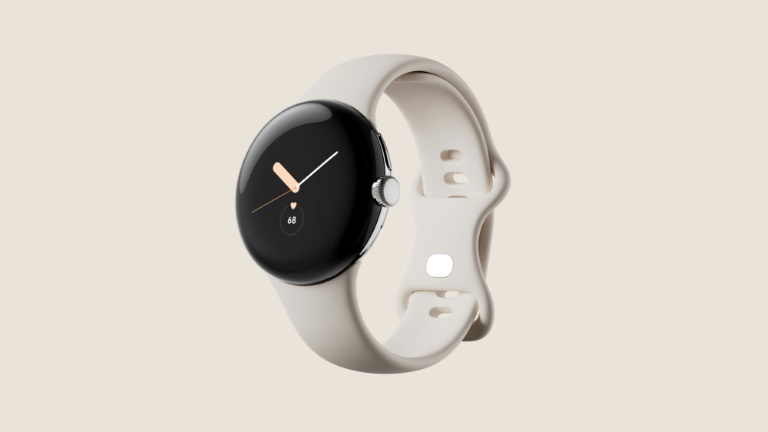
Google on Wednesday said it is strapping a smartwatch onto its Pixel hardware line as part of an “ambient computing” vision to make its services available anywhere at any time.

The Alphabet-owned internet titan used its annual developers conference to showcase a Pixel line expanding to include a smartwatch and tablet as well as upgraded earbuds and a more affordable version of its flagship smartphone.

Backed up by artificial intelligence, cloud computing and sophisticated custom mobile chips, the family of gadgets is intended to work seamlessly together, Google senior vice president of hardware and services Rick Osterloh said during a briefing.

“All these things work in concert on our vision of ambient computing,” Osterloh said. “Providing the help people need, whenever they need it.”

The Pixel Watch will be released late this year, along with a new premium Pixel 7 smartphone, with pricing and other details to be disclosed closer to launch, Google said. 

The first Pixel smartwatch designed and built by Google will integrate health features from Fitbit, which Alphabet bought in a $2.1 billion deal that closed last year, and take on market leading Apple Watch.

“It just takes time to integrate a company with all the technology and people that Fitbit has,” Osterloh said of the Pixel smartwatch timing.

There will be a version of the Pixel Watch that synchs to Android-powered smartphones and one that has its own wireless internet connectivity, the internet giant said.

Google is also working on a Pixel tablet computer expected to be released next year, figuring there is an interest in large screen mobile devices even if that overall market has been lackluster.

“We’ve got a lot going on in the Pixel pipeline and it represents investments across all different kinds of technologies,” Osterloh said.

A smaller version of the Pixel 6 smartphone released by Google late last year will hit shelves on July 28 at a price of $449, along with new Pixel Buds Pro ear pieces priced at $199.

While smartphones powered by Google’s free Android operating software dominate the global market, the Silicon Valley company’s Pixel models have amassed scant share.

“We’re really investing a lot and expanding the mobile part of our vision,” Osterloh said.

“It’s like an iceberg and that you didn’t see a lot of what was happening underneath but now you can really see all these things coming to the surface.”

– Software smarts –

Alphabet chief Sundar Pichai provided a peek of augmented reality glasses that Google is working on, providing few details but demonstrating how they could translate conversations in real time, showing wearers transcriptions.

“All of this work is in service of a timeless mission to organize the world’s information and make it universally accessible and useful,” Pichai said of what Google shared during a 2-hour presentation before a live audience in a concert venue near the company’s Silicon Valley headquarters.

Google’s hardware announcements were backed by a slew of enhancements to software powering its core search service, artificial intelligence capabilities, and Android mobile devices.

Improvements included enabling artificial intelligence to converse with people more naturally, and to “read” through pages of documents or messages and provide people with insightful, terse summaries of their contents.

An enhancement to search lets images captured by smartphone cameras and queries uttered by users be combined to allow, for example, someone to ask Google to scan a market shelf to find a top-rated brand of nutless chocolate, demonstrations showed.

And a new Google Wallet being rolled out in the weeks ahead is being designed to one day replace real-world billfolds, right down to holding digital versions of driver licenses.

France opens torture case against Interpol's UAE president

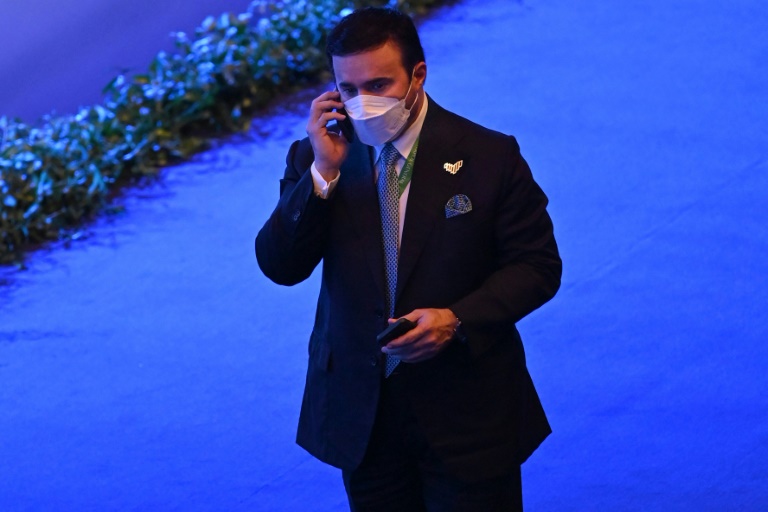
French authorities have opened a case against Interpol’s Emirati president over accusations of torture and arbitrary detention by two Britons who were detained in the UAE, a source close to the inquiry told AFP on Wednesday.

The case into suspected complicity in torture by Ahmed Nasser al-Raisi was confirmed by France’s anti-terror prosecutors office (PNAT), which has handed it to an investigating magistrate who will now decide whether to press charges.

The two Britons, Matthew Hedges and Ali Issa Ahmad, accuse Raisi of having ultimate responsibility — as a senior interior ministry security official — for the torture and arbitrary detention they say they suffered in the United Arab Emirates.

The source said the investigating magistrate must also decide if Raisi, who was elected Interpol president in November, enjoys diplomatic immunity from prosecution in France.

The Britons filed the complaint under France’s principle of universal jurisdiction, which allows it to prosecute serious crimes even if they are committed on foreign soil.

This means Raisi could be detained for questioning if he visits the country. Interpol’s headquarters are in the southeastern French city of Lyon which he is believed to have visited several times this year.

The case against Raisi, opened in late March, goes a step further than the torture inquiry launched against him by French prosecutors in November over the detention of UAE dissident Ahmed Mansoor.

At the time, the UAE’s foreign ministry rejected the complaints over Mansoor’s detention conditions as “without foundation”. 

“Any legal complaint that may be filed with allegations against al-Raisi is without merit and will be rejected,” the UAE foreign ministry added.

In the latest case, the inquiry is in the hands of an investigating magistrate, a step that precedes the pressing of any charges.

Contacted by AFP, the UAE embassy in Paris declined to comment.

Interpol’s general secretariat said it was “premature” to comment as it was an ongoing matter between the parties involved.

– ‘Psychological torture’ –

Both plaintiffs were in Paris on Wednesday to testify before the investigating magistrate.

Hedges, an academic specialising in the UAE, says he was detained and tortured in the country from May to November 2018 after being arrested on charges of espionage during a study trip.

He was forced to make false confessions that led to a sentence of life imprisonment before his release under international pressure led by the UK.

He told AFP on Wednesday that he spent seven months in solitary confinement, and forced to take medication. This, he said, was part of “a very specific strategy to inflict psychological torture”.

Interrogations lasted for up to 15 hours at a time, and there were threats of violence against him and his family, Hedges said, calling his ordeal “terrifying”.

He began to self-harm and tried to take his own life, “all a result of the medication”.

Hedges said that Raisi “had to have known” about his treatment.

Ahmad, meanwhile, said he was repeatedly beaten and even stabbed during a month in detention in January 2019, allegedly for enthusiastically supporting the UAE’s Gulf rival Qatar in a football clash against Iraq during that year’s AFC Asian Cup.

During his arrest, a policeman cut the Qatari flag out of his T-shirt with a pocketknife, injuring Ahmad in the process, he told AFP.

He was “interrogated day and night” during the detention. “It’s a very hard time I have been through, it’s horrendous,” he said.

Both men have also initiated legal action against Raisi in Norway, Sweden and Turkey.

Raisi’s four-year term at Interpol is largely ceremonial, with Secretary General Juergen Stock handling day-to-day management of the organisation.

His candidacy for the Interpol job prompted an outcry from activists, who pointed to the generous funding Interpol receives from the United Arab Emirates.

gd-sjw-js-jh/imm/har

US inflation slowed in April but prices for many goods rising

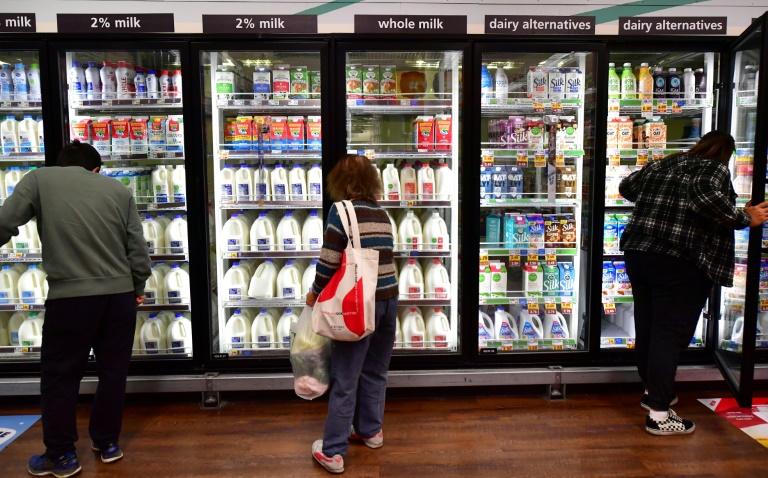
US inflation slowed in April, according to new data released Wednesday, but Americans are still seeing their wallets empty faster than before when they buy groceries and pay rent.

President Joe Biden has gone on the offensive, blaming the price spike on Russian leader Vladimir Putin’s invasion of Ukraine, and announcing a series of steps he hopes will ease the pain.

The conflict and the sanctions imposed on Russia have driven up prices around the world for fuel, grain and fertilizer, raising costs for farmers who in turn are forced to raise prices.

Biden, whose popularity has taken a hit from the highest inflation in four decades, has labeled the recent surge “Putin’s price hike.”

While visiting a farm in Illinois on Wednesday, he laid out the White House strategy to help food producers, including boosting domestic fertilizer production to combat a nationwide shortage.

“My administration has been working to drive down the cost of farmers… and prices to consumers,” he told reporters.

That includes a $500 million federal investment in fertilizer production and working with the G7 to increase global fertilizer supplies, as well as to “prevent export restrictions on food and agricultural inputs, and bring more global production to market, which will stabilize prices.”

The latest inflation data offered some good news, as the consumer price index (CPI) slowed slightly last month, jumping 8.3 percent compared to April 2021, after peaking in March at 8.5 percent, according to a Labor Department report.

Biden called the slow-down “heartening” in a statement earlier Wednesday, but acknowledged inflation is still a major challenge, and said “bringing it down is my top economic priority.”

The dip was helped by easing energy costs, as gasoline fell 6.1 percent in April compared to March after an 18.3 percent surge in the previous month.

But gasoline prices at the pump hit a new record on Tuesday, so the news from April may be of little comfort to drivers.

Biden noted during his speech that to offset this, he had signed an emergency waiver last month to allow the nationwide sale of e-15 gasoline — a blend of ethanol and gasoline — during the summer, when fuel sales tend to go up as more Americans travel for vacation.

Prices continued to rise last month for a range of goods, including housing, groceries, airline fares and new vehicles, and annual inflation remains at its highest rate since early 1982.

– Groceries more expensive –

CPI rose just 0.3 percent compared to March, after the 1.2 percent surge in the prior month, but excluding volatile food and energy goods, the “core” index last month increased at double the March rate, the Labor Department report said.

A large driver was food at home, which jumped 10.8 percent over the last 12 months — the largest annual increase since November 1980, it said.

The index for meat, poultry, fish and eggs surged 14.3 percent in the biggest gain since May 1979.

Americans saw big increases in the month for dairy and cereal products, even as fruit and vegetable costs fell last month.

Even with the decline in gasoline, energy costs have surged 30.3 percent over the past 12 months, with gasoline up 43.6 percent compared to a year ago.

Economists expect inflation to continue to slow gradually, but see no sign the Federal Reserve will ease up on what it said will be rapid interest rate increases to try to tamp down the price pressures and cool demand.

The Fed last week announced its largest rate hike since 2000, and signaled similar increases were likely in the coming months.

Despite the “modest reprieve” in the data suggesting inflation peaked in March, “the renewed rise in gasoline prices towards a record $4.50 nationally and increase in diesel prices signals that there is still upward risk to the inflation outlook,” Kathy Bostjancic of Oxford Economics said in an analysis.

“Further, the Covid-related China lockdowns and the continued Russia-Ukraine war places further stress on already strained supply chains.”

Calls mount for probe into reporter's killing during Israeli raid

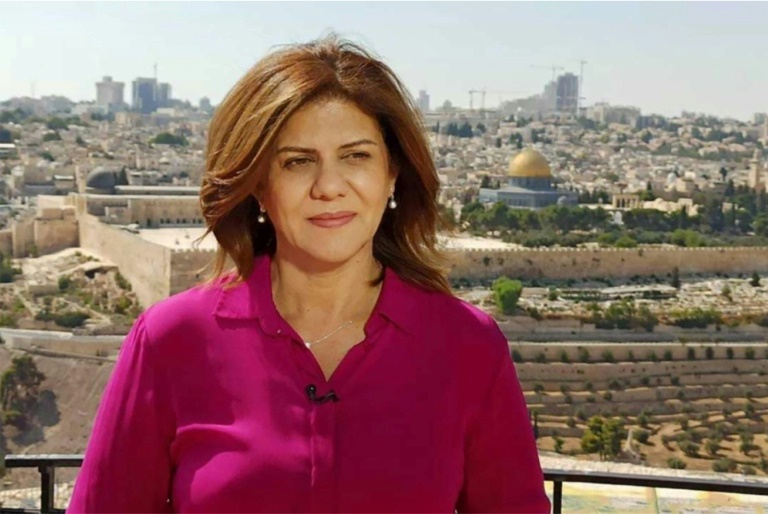
Calls mounted Wednesday for an independent investigation into the killing of veteran Al Jazeera journalist Shireen Abu Akleh, who was shot dead as she covered an Israeli army raid in the occupied West Bank.

The Qatar-based TV channel charged that Israeli forces deliberately and “in cold blood” shot Abu Akleh, 51, a Palestinian-American and a Christian, in the head during the unrest in the Jenin refugee camp.

Israel’s Defence Minister Benny Gantz, who briefed reporters late Wednesday, appeared to distance himself from earlier remarks by Prime Minister Naftali Bennett, who had said it was “likely” that Abu Akleh was killed by stray Palestinian gunfire.

“Our initial findings from the investigation cannot indicate what gunfire was directed at Shireen and cannot exclude any option under this operational chaos”, Gantz said. He said Palestinian gunmen in Jenin were firing from “multiple directions.”

“We are not certain how she was killed,” added Gantz, who called Abu Akleh’s death “a serious loss.”

Another Al Jazeera journalist, producer Ali al-Samudi, was wounded in the incident in which both wore helmets and vests marked “Press”.

Samudi said no Palestinian fighters were nearby, stressing that otherwise “we would not have gone into the area”.

– ‘Turned in panic’ –

The European Union urged an “independent” investigation while the United States’ envoy to the UN, Linda Thomas-Greenfield, demanded the killing be “transparently investigated”, calls also made by UN human rights chief Michelle Bachelet.

Israel has offered to participate in a joint investigation with the Palestinian Authority, and Gantz urged the PA to provide the army with the bullet that killed Abu Akleh.

Gantz told reporters that Israel was seeking the findings of the Palestinian autopsy, conducted in Nablus earlier Wednesday.  

There was no indication on whether Palestinian officials were prepared to cooperate with Israel in an investigation.

Rayyan Ali, a forensic pathologist at Al Najah University in Nablus where the autopsy was conducted, told reporters “it is not possible to make any statement about who bears responsibility,” because details of the weapon and ammunition used had not been fully examined by experts.

Abu Akleh, who joined Al Jazeera in 1997 and whose coverage of the conflict was revered across Palestinian society, will receive a full state memorial at the Palestinian presidential compound in Ramallah on Thursday.

Her was body carried through the city on Wednesday evening, with thousands chanting “thank you, dear Shireen.”

The Israeli army has stepped up operations in Jenin, a historic flashpoint in the Israeli-Palestinian conflict, in recent weeks. 

Several of the suspects blamed for deadly attacks on Israelis were from the area.

Witnesses in Jenin said that the Israeli army had been targeting the home of an Islamist operative, with an apartment’s heavy metal door blown off its hinges.

Majid Awais, a witness, told AFP that Abu Akleh “turned in panic” when she saw her colleague Samudi was shot, and that she was struck by the fatal bullet moments later.

An AFP photographer reported that Israeli forces were firing in the area, and that he then saw Abu Akleh’s body lying on the ground, with no Palestinian gunmen visible at the time.

– ‘Assassinated’ –

Al Jazeera said in a statement that “the Israeli occupation forces assassinated in cold blood Al Jazeera’s correspondent in Palestine”.

Her death came nearly a year after an Israeli air strike destroyed a Gaza building that housed the offices of Al Jazeera and news agency AP.

Tensions have risen in recent months as Israel has grappled with a wave of attacks which has killed at least 18 people since March 22, including an Arab-Israeli police officer and two Ukrainians.

A total of 31 Palestinians and three Israeli Arabs have died during the same period, according to an AFP tally, among them perpetrators of attacks and those killed by Israeli security forces in West Bank operations.

In the latest unrest targeting Israeli forces, a West Bank Palestinian attempted to stab a police officer in Jerusalem’s Old City late Wednesday.

Officers opened fire, leaving the attacker with serious injuries, police said. 

The latest Palestinian death was an 18-year-old killed by Israeli troops during clashes near Ramallah on Wednesday. The army said its forces had used rubber bullets to suppress unrest.

Biggest white diamond ever auctioned fetches $21.9 million

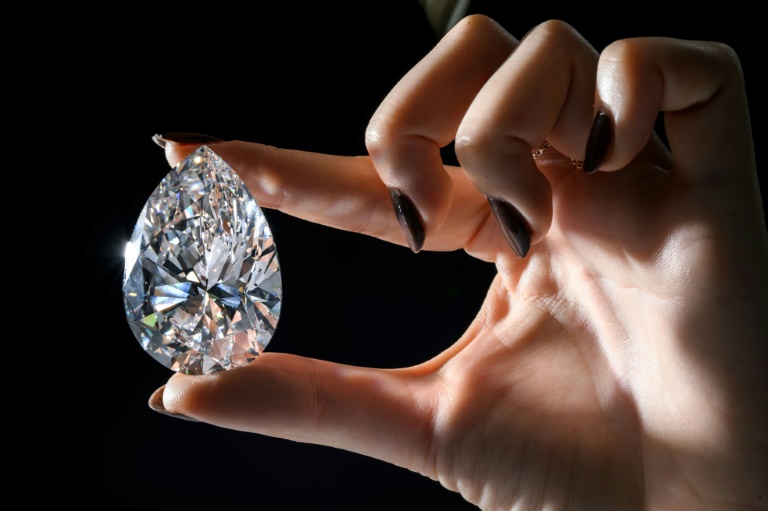
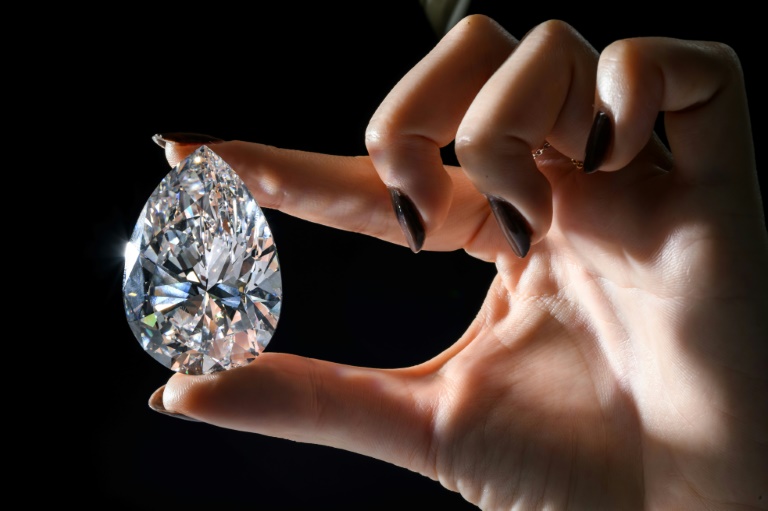
The Rock, the biggest white diamond ever auctioned, sold for 21.7 million Swiss francs ($21.9 million) on Wednesday, far short of the record for such a jewel.

The 228.31-carat stone, larger than a golf ball, was sold in Geneva by Christie’s auction house.

There had been high hopes that The Rock would smash the world record for a white diamond, which stands at $33.7 million, a sum fetched in Geneva in 2017 for a 163.41-carat gem.

But the bidding, which started at 14 million Swiss francs, ground to a halt after two minutes at 18.6 million, with the price rising to 21.7 million once the buyer’s premium was added on.

The pre-sale estimate had been 19-30 million Swiss francs.

The Rock, a perfectly symmetrical pear-shaped diamond, was sold by an unnamed owner from North America. It was bought by a private collector bidding by telephone.

Rahul Kadakia, Christie’s international head of jewellery, brought down the hammer to applause in the sale room in the plush Hotel des Bergues.

Diamonds are graded in colour from D to Z and Kadakia told AFP that despite falling short of the overall record, The Rock had set a new world record price per carat for a G-colour diamond.

“When you look at the price per carat — 100,000 per carat — this is the level of a D colour diamond, and we achieved that for a G colour diamond. So in fact, we’re very pleased as are the sellers, as is the buyer.”

Max Fawcett, head of the jewels department at Christie’s auction house in Geneva, said there were only a handful of diamonds of similar size and quality to The Rock.

The large diamond was extracted from a mine in South Africa in the early 2000s and has been shown in Dubai, Taipei and New York ahead of the sale in Geneva.

– Red Cross gem –

The Rock was up for grabs alongside a historic intense yellow diamond associated for more than a century with the Red Cross.

A seven-figure chunk of the proceeds will be donated to the International Committee of the Red Cross, headquartered in Geneva, at a time when war is once again stalking the European continent.

The Red Cross Diamond, a cushion-shaped, 205.07-carat canary yellow jewel, sold for 14.2 million Swiss francs including the buyer’s premium — well above its price estimate of seven to 10 million francs.

Multiple bidders fought fiercely over the gem for 10 minutes, ending in a duel in increments of 50,000 francs before one private collector won through.

The original rough stone was found in 1901 in a De Beers company mine in South Africa and is said to have weighed around 375 carats.

As well as ranking among the largest diamonds in the world, a striking feature is its pavilion, which naturally bears the shape of a Maltese cross.

The stone was first put up for sale on April 10, 1918 at Christie’s in London. It was offered by the Diamond Syndicate in aid of the British Red Cross Society and the Order of St John.

The Red Cross Diamond fetched £10,000 — approximately £600,000 ($740,000) in today’s money. It was bought by the London jewellers S.J. Phillips.

It was sold again by Christie’s in Geneva in 1973, fetching 1.8 million Swiss francs, before being offered by the auction house for a third time.

“A 104-year history of the diamond with Christie’s; we’re very pleased that we were able to locate it, and we’re very pleased that we were able to secure it in another private collection,” said Kadakia.

Also sold was a tiara that belonged to Princess Irma of Fuerstenberg (1867-1948), a member of one of the most pre-eminent aristocratic families in the Habsburg Empire.

It was estimated at 400,000 to 600,000 Swiss francs. However, it sold for way more: 2.4 million francs, having caught the eye in a prominent spot at the pre-sale exhibition.

Biggest white diamond ever auctioned fetches $21.9 million

The Rock, the biggest white diamond ever auctioned, sold for 21.7 million Swiss francs ($21.9 million) on Wednesday, far short of the record for such a jewel.

The 228.31-carat stone, larger than a golf ball, was sold in Geneva by Christie’s auction house.

There had been high hopes that The Rock would smash the world record for a white diamond, which stands at $33.7 million, a sum fetched in Geneva in 2017 for a 163.41-carat gem.

But the bidding, which started at 14 million Swiss francs, ground to a halt after two minutes at 18.6 million, with the price rising to 21.7 million once the buyer’s premium was added on.

The pre-sale estimate had been 19-30 million Swiss francs.

The Rock, a perfectly symmetrical pear-shaped diamond, was sold by an unnamed owner from North America. It was bought by a private collector bidding by telephone.

Rahul Kadakia, Christie’s international head of jewellery, brought down the hammer to applause in the sale room in the plush Hotel des Bergues.

Diamonds are graded in colour from D to Z and Kadakia told AFP that despite falling short of the overall record, The Rock had set a new world record price per carat for a G-colour diamond.

“When you look at the price per carat — 100,000 per carat — this is the level of a D colour diamond, and we achieved that for a G colour diamond. So in fact, we’re very pleased as are the sellers, as is the buyer.”

Max Fawcett, head of the jewels department at Christie’s auction house in Geneva, said there were only a handful of diamonds of similar size and quality to The Rock.

The large diamond was extracted from a mine in South Africa in the early 2000s and has been shown in Dubai, Taipei and New York ahead of the sale in Geneva.

– Red Cross gem –

The Rock was up for grabs alongside a historic intense yellow diamond associated for more than a century with the Red Cross.

A seven-figure chunk of the proceeds will be donated to the International Committee of the Red Cross, headquartered in Geneva, at a time when war is once again stalking the European continent.

The Red Cross Diamond, a cushion-shaped, 205.07-carat canary yellow jewel, sold for 14.2 million Swiss francs including the buyer’s premium — well above its price estimate of seven to 10 million francs.

Multiple bidders fought fiercely over the gem for 10 minutes, ending in a duel in increments of 50,000 francs before one private collector won through.

The original rough stone was found in 1901 in a De Beers company mine in South Africa and is said to have weighed around 375 carats.

As well as ranking among the largest diamonds in the world, a striking feature is its pavilion, which naturally bears the shape of a Maltese cross.

The stone was first put up for sale on April 10, 1918 at Christie’s in London. It was offered by the Diamond Syndicate in aid of the British Red Cross Society and the Order of St John.

The Red Cross Diamond fetched £10,000 — approximately £600,000 ($740,000) in today’s money. It was bought by the London jewellers S.J. Phillips.

It was sold again by Christie’s in Geneva in 1973, fetching 1.8 million Swiss francs, before being offered by the auction house for a third time.

“A 104-year history of the diamond with Christie’s; we’re very pleased that we were able to locate it, and we’re very pleased that we were able to secure it in another private collection,” said Kadakia.

Also sold was a tiara that belonged to Princess Irma of Fuerstenberg (1867-1948), a member of one of the most pre-eminent aristocratic families in the Habsburg Empire.

It was estimated at 400,000 to 600,000 Swiss francs. However, it sold for way more: 2.4 million francs, having caught the eye in a prominent spot at the pre-sale exhibition.

Google making smartwatch in 'ambient' computing push

Google on Wednesday said it is strapping a smartwatch onto its Pixel hardware line as part of an “ambient computing” vision to make its services available anywhere at any time.

The Alphabet-owned internet titan used its annual developers conference to showcase a Pixel line expanding to include a smartwatch and tablet as well as upgraded earbuds and a more affordable version of its flagship smartphone.

Backed up by artificial intelligence, cloud computing, and sophisticated custom mobile chips, the family of gadgets is intended to work seamlessly together to be conveniently available when desired, Google senior vice president of hardware and services Rick Osterloh said during a briefing.

“All these things work in concert on our vision of ambient computing,” Osterloh said.

“Providing the help people need, whenever they need it.”

The Pixel Watch will be released late this year, along with a new premium Pixel 7 smartphone, with pricing and other details to be disclosed closer to launch, Google said. 

The first Pixel smartwatch designed and built by Google will integrate health features from Fitbit, which Alphabet bought in a $2.1 billion deal that closed last year, and take on market leading Apple Watch.

“It just takes time to integrate a company with all the technology and people that Fitbit has,” Osterloh said of the Pixel smartwatch timing.

There will be a version of the Pixel Watch that synchs to Android-powered and one that has its own wireless internet connectivity, the internet giant said.

Google is also working on a Pixel tablet computer expected to be released next year, figuring their is an interest in large screen mobile devices even if that overall market has been lackluster.

“We’ve got a lot going on in the Pixel pipeline and it represents investments across all different kinds of technologies,” Osterloh said.

A smaller version of the Pixel 6 smartphone released by Google late last year will hit shelves on July 28 at a price of $449, along with new Pixel Buds Pro ear pieces priced at $199.

While smartphones powered by Google’s free Android operating software dominate the global market, the Silicon Valley company’s Pixel models have amassed scant share.

“We’re really investing a lot and expanding the mobile part of our vision,” Osterloh said.

“It’s like an iceberg and that you didn’t see a lot of what was happening underneath but now you can really see all these things coming to the surface.”

Close Bitnami banner
Bitnami