World

Australia's election battle gets personal

Australian Prime Minister Scott Morrison derided his Labor Party opponent Wednesday as an unreliable “loose unit” on the economy as he fought to catch up in the opinion polls 10 days from the federal election on May 21.

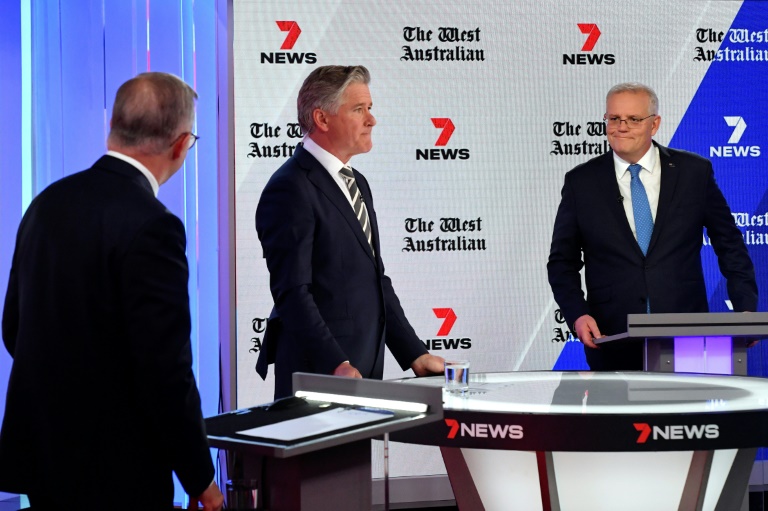
In their third televised election debate, characterised as the “final showdown” before 17 million Australians cast their compulsory votes, Morrison and Labor’s Anthony Albanese got personal.

At the outset of the campaign last month, Albanese forgot both the unemployment rate and the main lending rate. More recently, he apparently had difficulty explaining his party’s disability policy.

“He’s a loose unit when it comes to the economy. He makes things up as he goes along,” said Morrison using a slang term for someone who is unreliable.

Albanese hit back, accusing Morrison of shirking responsibility for the slow rollout of vaccines and rapid antigen tests in the Covid-19 pandemic, for his management of the 2019-2020 “Black Summer” bushfires, and this year’s deadly east coast floods.

“Whenever this prime minister is confronted with any challenges, he blames the states, blames someone else consistently,” he said.

Albanese accused Morrison’s conservative Liberal-National Party coalition of allowing climate change policy to drift.

The prime minister has vowed to mine and export coal for as long as there are buyers, touted a “gas-fired recovery” from the pandemic, and resisted global calls to cut carbon emissions faster by 2030.

“Climate change is real and it is here now. We see it with the bushfires and floods,” Albanese told the Channel Seven-hosted debate.

“Australia can be a renewable energy superpower for the world if we seize this opportunity.”

– ‘In the mood to change’ –

The pair also sparred on a string of other policy disagreements: Morrison’s failure to fulfil a three-year-old campaign promise to create a federal anti-corruption commission; Albanese’s support for minimum wages to match inflation; and Labor’s support for more funding for childcare.

Despite the public wrangles, including in two previous election debates, the opinion polls have not budged much since Morrison called the election a month ago.

A weekend Newspoll gave Labor a 54-46 percent lead over Morrison’s ruling coalition on a two-party basis.

But few pundits are counting Morrison out.

Three years ago, he defied a string of negative opinion polls to win what he termed a “miracle” election.

Opinion polls in any case are a snapshot, not a prediction, cautioned Mark Kenny, professor at the Australian National University in Canberra.

But “if I put my money on it, I think I’ll probably go with what passes for empirical data that we do have at the moment, which suggests that Australians are in the mood to change the government: they’ve had enough of Morrison”, he told AFP.

On the campaign stump, Morrison freely concedes: “You may not like me.” He has pointed, however, to Australia’s post-pandemic economic resurgence and low unemployment rate.

Even on the economy, however, he has difficulties.

Inflation is running hot at a 20-year high as prices soar at gas stations, in shops, and for housing.


New Airbnb feature aims to 'redistribute' tourists from oversold venues

Seeking to address “over-tourism” at popular destinations, Airbnb unveiled Wednesday a new feature that encourages users to search by trip category, not only destination.

The goal is to “redistribute” users away from traveler-jammed venues, such as Venice, Paris or the biggest US cities, Airbnb executives said.

Under the new Airbnb program, consumers can pick from up to 56 categories such as “beach,” “countryside,” “iconic cities” or “design” the latter showcasing homes featured in architectural magazines. Some four million properties are tagged, with more categories to be added over time. 

The revamp is an alternative from the search box long used by Airbnb and other online travel sites where users enter in a destination and travel dates.

Airbnb users will still be able to search the conventional way, but the category option provides an alternative to steer demand away from oversold locales, said Chief Executive Brian Chesky.

“We felt everyone was just going to the same places. They’re just typing in Los Vegas and Orlando and Miami and Rome and Los Angeles and New York,” Chesky said at a briefing unveiling the changes.

“We’re trying to spread everyone out over as many places and as many dates as possible,” said Chesky, who described the plan as “good for Airbnb” but added that it would also “alleviate some of the issue of over-tourism.”

Users can go to the categories tab at the top of their screen, pick dates and then scan through pages of options at different price points in different cities or countries. 

In developing the new feature, Airbnb urged some owners to upgrade their photos so that the property’s profile page for “amazing pools” had a pool and that “skiing” properties were shown with snow, Chesky said

“Over-tourism isn’t too many people in the world traveling… it’s too many people going to the same places at the same time,” said Chesky, who also pointed to Airbnb features for those with flexible time frames away from the most in-demand times.

Responding to a trend of longer stays, Airbnb is tweaking the system to perform “split stays” where users can book two successive trips at once. 

Another change is to allow users three days to rebook or get a refund if a property falls short of what was promised; under the current system, users have just 24 hours to complain.

New Airbnb feature aims to 'redistribute' tourists from oversold venues

Seeking to address “over-tourism” at popular destinations, Airbnb unveiled Wednesday a new feature that encourages users to search by trip category, not only destination.

The goal is to “redistribute” users away from traveler-jammed venues, such as Venice, Paris or the biggest US cities, Airbnb executives said.

Under the new Airbnb program, consumers can pick from up to 56 categories such as “beach,” “countryside,” “iconic cities” or “design” the latter showcasing homes featured in architectural magazines. Some four million properties are tagged, with more categories to be added over time. 

The revamp is an alternative from the search box long used by Airbnb and other online travel sites where users enter in a destination and travel dates.

Airbnb users will still be able to search the conventional way, but the category option provides an alternative to steer demand away from oversold locales, said Chief Executive Brian Chesky.

“We felt everyone was just going to the same places. They’re just typing in Los Vegas and Orlando and Miami and Rome and Los Angeles and New York,” Chesky said at a briefing unveiling the changes.

“We’re trying to spread everyone out over as many places and as many dates as possible,” said Chesky, who described the plan as “good for Airbnb” but added that it would also “alleviate some of the issue of over-tourism.”

Users can go to the categories tab at the top of their screen, pick dates and then scan through pages of options at different price points in different cities or countries. 

In developing the new feature, Airbnb urged some owners to upgrade their photos so that the property’s profile page for “amazing pools” had a pool and that “skiing” properties were shown with snow, Chesky said

“Over-tourism isn’t too many people in the world traveling… it’s too many people going to the same places at the same time,” said Chesky, who also pointed to Airbnb features for those with flexible time frames away from the most in-demand times.

Responding to a trend of longer stays, Airbnb is tweaking the system to perform “split stays” where users can book two successive trips at once. 

Another change is to allow users three days to rebook or get a refund if a property falls short of what was promised; under the current system, users have just 24 hours to complain.

Cardinal, pop star among latest Hong Kong security arrests: sources

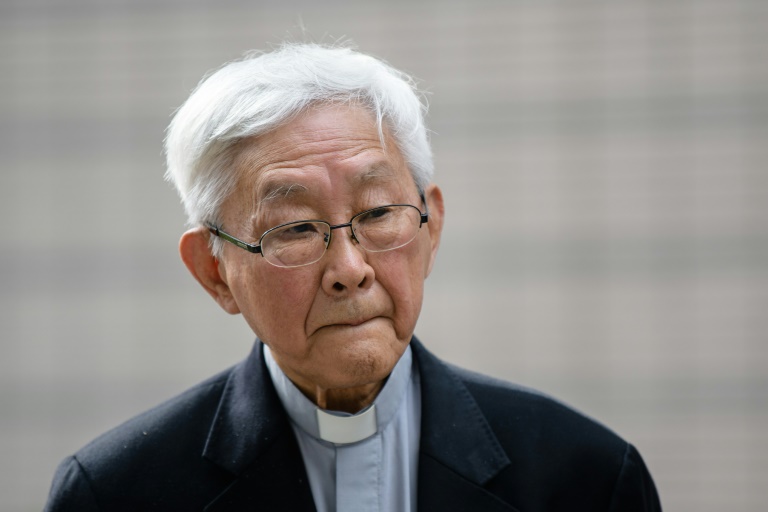
An elderly Catholic cardinal critical of Beijing and a Cantonese pop star are among a group of veteran democracy advocates who have been arrested under Hong Kong’s national security law, legal and police sources said Wednesday.

Those arrested were all trustees of a now-disbanded fund that helped finance demonstrators detained during massive democracy protests that swept Hong Kong three years ago.

Retired cleric Cardinal Joseph Zen and singer Denise Ho were among those detained, a police source and a legal source confirmed to AFP.

Zen, who recently turned 90, is a former bishop of Hong Kong and one of the most senior Catholic clerics in the Chinese business hub. 

He has been critical of the Vatican’s decision to reach a compromise with China over the appointment of bishops on the mainland and an advocate of Hong Kong’s democracy movement.

Ho is a popular local vocalist and an outspoken advocate for LGBTQ rights. 

Prominent cultural studies scholar Hui Po-keung was arrested at Hong Kong’s airport on his way to take up an academic post in Europe on Tuesday, two legal sources previously confirmed to AFP.

Hui was arrested for “collusion with foreign forces”, one source said, an offence under a security law that Beijing imposed on Hong Kong in response to the democracy protests.

Three legal sources said veteran barrister Margaret Ng was also arrested.

Police have yet to issue a statement on the arrests.

The security law has crushed dissent in the once outspoken business hub and can carry up to life in jail.

Those arrested were among five trustees of the “612 Humanitarian Relief Fund”, which helped arrested protesters pay their legal and medical bills.

Another trustee, democracy activist Cyd Ho, has already been jailed for unauthorised assembly in a separate case.

The fund disbanded last year after the city’s national security police demanded it hand over operational details including information about its donors and beneficiaries.

Shortly before the fund closed in October, Hong Kong’s Lingnan University said its contract with Hui had ended but declined to state a reason on privacy grounds.

Academics who played prominent roles in Hong Kong’s now decimated democracy movement have often found themselves dropped by universities and are struggling to find work.

A social commentator and prolific author, Hui taught for more than two decades at Lingnan University and was credited by former student leader Nathan Law with inspiring his political career.

Troops move to quell unrest after deadly Sri Lanka clashes

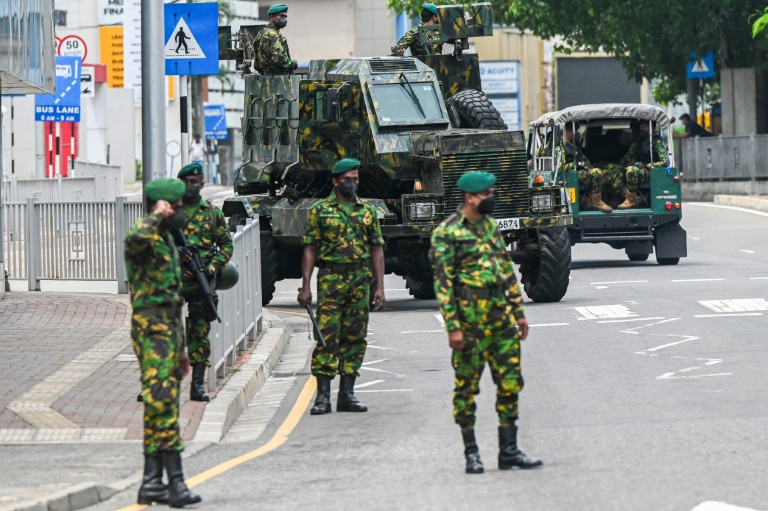
Soldiers stood behind wrought-iron barricades and next to burnt-out buses in the heart of Sri Lanka’s capital Colombo Wednesday, guarding almost deserted streets after a convulsion of deadly clashes.

The occasional car ambled past long rows of shuttered shops before being halted by troops, who cast wary eyes over its occupants as they enforce a nationwide curfew imposed to stop mob violence.

Weeks of overwhelmingly peaceful demonstrations against Sri Lanka’s crippling economic crisis boiled over on Monday, with at least nine people killed and furious mobs torching the homes of government lawmakers.

Security forces have been instructed to shoot on sight anyone engaged in arson or committing further violence after struggling to curb unrest over the past two days. 

“The situation is getting better and we are hopeful of lifting the curfew by tomorrow morning,” Kamal Gunaratne, the country’s defence chief, told reporters on Wednesday.

Small groups of young men were still seen roaming Colombo’s streets late on Tuesday after the defence ministry announcement, defying the stay-home order that had already been in effect for 24 hours.

Further north, a crowd had formed an unofficial checkpoint on the highway leading to Sri Lanka’s main airport, stopping cars to check for government figures after rumours they would try to flee the country.

The blockade had been dispersed by morning while armoured personnel carriers had brought thousands of troops into the capital, to the consternation of many of its residents. 

“This regime… has a problematic history with using a military presence to silence the people,” Amalini, who has participated in anti-government protests and declined to give her surname, told AFP.

“I don’t think this is the way to calm people.”

– Charred remains –

Despite the relative quiet, the streets were still littered with reminders of Monday’s spasm of disorder.

Around the city centre were the charred remains of at least a dozen buses set alight by enraged crowds, some overturned and others pushed into a lake.

The vehicles had brought in mobs of government loyalists from the countryside who set upon demonstrators with sticks and clubs.

Hours later, the incident prompted the resignation of Prime Minister Mahinda Rajapaksa, who protesters blamed for instigating the attacks.

Rajapaksa, head of a family that has dominated Sri Lanka’s politics for much of the past two decades, later had to be rescued from his Colombo residence by soldiers after it was besieged by an angry crowd.

The former leader is now being guarded at a naval base on the other side of the country after rumours he was preparing to flee Sri Lanka were denied by his son.

Reprisals carried on elsewhere late into the night and through the next day, with mobs setting alight dozens of homes belonging to ruling-party politicians around the country. 

– ‘They wanted to create problems’ –

Nearly all of Colombo’s residents had kept to their homes on Wednesday as the government stepped up efforts to restore order.

But troops have so far not enforced the curfew at a protest camp by the capital’s seafront, where a crowd has been gathered for the past month to demand the government quit over its mismanagement of the economic crisis. 

The site faces the office of President Gotabaya Rajapaksa — Mahinda’s younger brother — and it was there that the club-wielding pro-government mobs sparked the unrest that soon engulfed the island nation. 

“They wanted to create problems for a peaceful protest, that’s why they came and hit everyone,” Mohandas Aravindh, a participant in the protest camp, told AFP.

Aravindh said that people still supported the camp’s efforts to compel the government’s resignation and the curfew had not deterred its inhabitants. 

“We don’t want a single person from the Rajapaksa family to be in Sri Lanka,” he said.

In Kyiv, boxing gyms offer chance to ease war stress

The sound of hip hop mixes with the dull thud of fists walloping heavy bags as a group of Ukrainian boxers unleash combinations, burning off weeks of pent up stress.

“With the curfew in the city and restrictions on movement, we needed some place to blow off steam and discharge emotional tension,” said Oleksandr, a 38-year-old employee of the International Red Cross in the Ukrainian capital Kyiv who did not give his family name.

“Naturally, this helps a lot,” he added after wrapping up a workout involving pad work, running and several rounds hammering away at a punching bag. 

Weeks after Russian forces retreated from Kyiv’s suburbs, the city is slowly returning to life, where nearly two-thirds of the capital’s residents have returned following the outbreak of the war.  

Restaurants are reopening and pavement cafes are once again attracting customers with the arrival of a late spring, where many appear to be ignoring the occasional air raid sirens echoing through the city. 

Gyms have also begun to reopen, among them the All Stars Boxing Club in downtown Kyiv.

At All Stars, trainers put boxing enthusiasts, fitness fanatics, and newcomers through their paces — jumping rope, doing crunches and sparring. 

For the past two decades, Ukraine has maintained a dominant presence in the boxing world, with their fighters gaining a reputation for speed, movement, and fighting IQ — skills that also appear to have been adopted on the battlefield. 

Kyiv’s Mayor Vitali Klitschko along with his brother Wladimir held a range of heavyweight titles for years, turning the pair into superstars in Ukraine and beyond. That fame also helped drive forward Vitali’s successful political career.

Oleksandr Usyk — the world’s unified heavyweight champion — briefly hung up his gloves in February to join the territorial defence forces before returning to train for a highly-anticipated rematch against Britain’s star boxer Anthony Joshua this summer. 

– Stress buster –

“Certainly these boxers motivate me, but I am not training to become a professional, but rather to stay fit,” said Vladyslav, a 35-year-old real estate investor. 

“Sports helps me to stay fit, both mentally and physically, and helps overcome stress,” he told AFP. 

And it is the same for many others at All Stars, where boxing offers a way to stay in shape while also helping manage the heavy bouts of anxiety and stress that come with life during wartime. 

“Under these circumstances, sports is the only activity where one can really engage and make good use of himself,” said Igor, a 35-year-old civil servant. 

He comes from Donetsk in the eastern Donbas region which lived through the outbreak of a Moscow-backed insurgency in 2014 that served as a years-long prelude to Russia’s full-scale invasion of Ukraine that began in February. 

“It’s deja vu, kind of. Sports helps,” Igor told AFP when asked how he was holding up. 

“One of the advantages of boxing is that it keeps your mind clear,” added Oleksandr.  

“All thoughts go away, it helps to reboot.”

Sri Lanka's economy on brink of collapse as troops quell unrest

Sri Lanka’s economy will “collapse” unless a new government is urgently appointed, the central bank chief warned Wednesday, as security forces fanned out on the streets to restore order after spasms of mob violence.

Police say nine people have died since Monday, when frustration at a dire economic crisis erupted into clashes between backers and opponents of President Gotabaya Rajapaksa, injuring more than 200.

Opposition parties have refused Rajapaksa’s overtures for a unity government to resolve a political deadlock and instead demanded his resignation.

Central Bank Governor Nandalal Weerasinghe said it was critical that a new administration take charge by Friday or the country would suffer a catastrophe.

“The economy will completely collapse and no one will be able to save it,” he told reporters.

“The country was fast going down a slope when I took over just over a month ago. I thought we were able to apply the brakes, but with events of Monday the brakes no longer work.”

Shortly after taking over as the bank’s chief in April, Weerasinghe announced a default on Sri Lanka’s $51 billion external debt, saying the country had no money to pay its creditors.

He said political stability was vital to implement the reforms needed to address Sri Lanka’s snowballing debt crisis and the acute shortage of foreign exchange to import essentials.

Security forces have largely curbed public disorder after they were deployed to enforce a nationwide curfew with orders to “shoot on sight” anyone engaged in looting or violence.

“If the situation is not brought under control, there could be total anarchy,” a senior security official told AFP on condition of anonymity.

– Deserted streets –

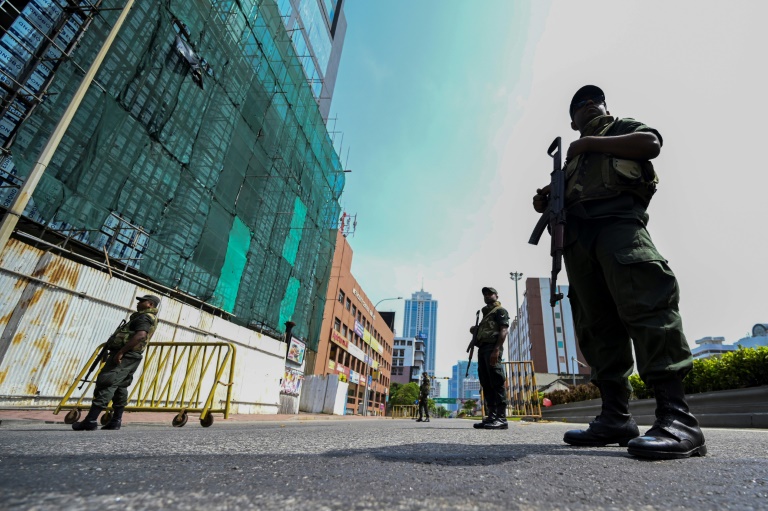
The capital Colombo was almost deserted on Wednesday aside from soldiers manning checkpoints, near the charred remains of buses that had been set alight by anti-government crowds.

With armoured personnel carriers and a heavy security presence, Sri Lanka’s military chief addressed a press conference to deny speculation of a looming coup.

“Don’t ever think that we are trying to capture power,” said Kamal Gunaratne, the secretary of Sri Lanka’s defence ministry.

“The military has no such intentions.”

A small crowd continued to defy the curfew near the president’s seafront office, where a protest camp has for the past month maintained a vigil calling on him to step down.

“We want the whole Rajapaksa clan out because they are so, so corrupt. They have been eating into Sri Lanka like a caterpillar eating into some fruit,” activist Kaushalya Fernando told AFP.

In a tweet, Rajapaksa on Wednesday called for “all Sri Lankans to join hands as one, to overcome the economic, social & political challenges”.

But the main opposition SJB party reiterated it will not be a part of any government with Rajapaksa still president, even after his brother Mahinda’s resignation as prime minister on Monday.

– Turning point –

Sri Lankans have been suffering shortages of essential goods, fuel and medicines for months in the island’s worst economic downturn since independence in 1948.

The crisis moved into a darker phase on Monday when government supporters with sticks and clubs attacked demonstrators who had been protesting peacefully for weeks demanding the president’s resignation.

Mobs then retaliated across the country, torching dozens of homes of ruling-party politicians. 

Mahinda Rajapaksa had to be rescued in a pre-dawn military operation on Tuesday and taken to a naval dockyard for safety after protesters tried to storm his official residence.

Echoing the UN rights chief and the European Union, the United States on Tuesday said it was concerned both with the violence and the deployment of the military.

“We stress that peaceful protesters should never be subjected to violence or intimidation, whether that’s on the part of the military force or civilian units,” State Department spokesman Ned Price told reporters.

India meanwhile was forced to deny social media rumours — some using old images of Mahinda boarding a helicopter — that it was helping Rajapaksa family members to flee.

The Indian “High Commission would like to categorically deny speculative reports in sections of media and social media about India sending her troops to Sri Lanka,” said a statement.

With vital tourism revenues torpedoed by the pandemic, Sri Lanka last month defaulted on its foreign debt, some of it stemming from Rajapaksa vanity projects built with Chinese loans.

The International Monetary Fund this week began a “virtual mission” of staff-level talks on a possible bailout.

IMF mission chief Masahiro Nozaki said the lender aimed to be “fully prepared for policy discussions once a new government has been formed”.

Al Jazeera's Shireen Abu Akleh: pioneering Palestinian reporter

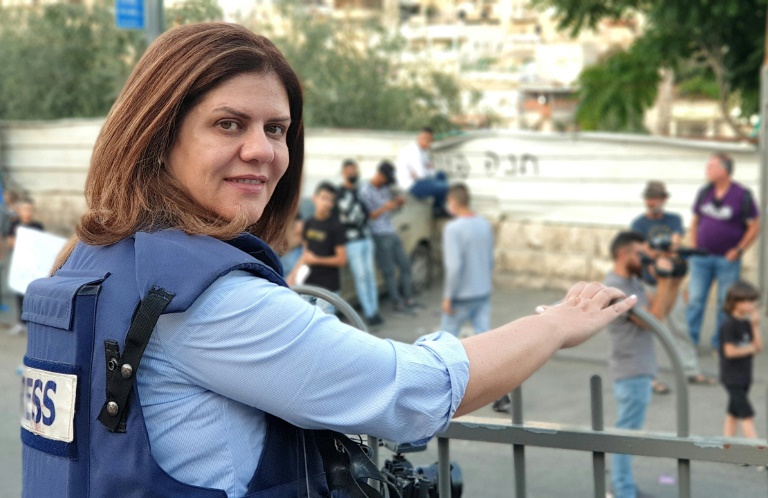
Shireen Abu Akleh, who was killed Wednesday while covering clashes in the Israeli-occupied West Bank, was among Arab media’s most prominent figures and widely hailed for her bravery and professionalism.

In the hours after her death, young Palestinians described Abu Akleh, 51, as an inspiration, especially to women, many of whom were motivated to pursue journalism because of her.

“She never tired,” Al Jazeera senior international correspondent Hoda Abdel-Hamid told AFP by phone from Ukraine. “She was always there whenever anything happened… She wanted to be there, to tell the story, constantly,” she added.

In an interview shortly before her death, Abu Akleh, who was also a US citizen, described herself as a “product of Jerusalem,” with the Israeli-Palestinian conflict shaping much of her life.

She was born in Israeli-annexed east Jerusalem to a Palestinian Christian family. Her mother was born in west Jerusalem, before the creation of Israel in 1948, and her father was from Bethlehem, in the occupied West Bank.

She graduated from university the year the Oslo peace accords were signed and then joined the nascent Voice of Palestine radio, before switching to Al Jazeera in 1997, where she went on to become an iconic personality in Arab media.

In a sign of her importance to Palestinian audiences, flowers were placed on the side of the road by West Bank residents as the vehicle carrying her body moved towards Nablus, where an autopsy was scheduled before her burial in Jerusalem.

– Breaking gender roles –

Journalist Muhammad Daraghmeh, a close friend who teaches at Birzeit University in the West Bank, said Abu Akleh was “one of the strongest journalists in the Arab world”.

Her prominence grew through her coverage of the second Palestinian intifada, or uprising, from 2000 to 2005.

Senior Al Jazeera journalist Dima Khatib tweeted that Abu Akleh was “one of the first Arab women war correspondents in the late 1990s when the traditional role of women was to present from the television studio”.

“Shireen was a pioneer in a generation that broke stereotypical gender roles in TV journalism.”

Al Jazeera, the Palestinian Authority and witnesses said she was shot by Israeli forces while covering an Israeli army raid in Jenin.

Israel’s Prime Minister Naftali Bennett said it was “likely” that she was killed by indiscriminate gunfire from Palestinian militants.

Abdel-Hamid said: “We need investigation and accountability, not just investigations that lead nowhere.”

In a recent interview, Abu Akleh said she was often afraid while reporting but made sure to avoid unnecessary risk.

“I don’t throw myself at death,” she told an outlet in the West Bank city of Nablus. “I search for a safe place to stand and how to protect my crew before worrying about the footage.”

Last year, Abu Akleh wrote in the publication This Week in Palestine that Jenin, the place where she died, was not just “one ephemeral story in my career or even in my personal life”.

“It is the city that can raise my morale and help me fly. It embodies the Palestinian spirit that sometimes trembles and falls but, beyond all expectations, rises to pursue its flights and dreams.”

bur-yz/bs/fz/dv

Companies lawyer up to navigate Russia sanctions

The deployment of unprecedented sanctions against Russia over the Ukraine war has left companies with a complex legal minefield to navigate, prompting them to hire more lawyers to avoid costly missteps.

The European Union alone is inching towards its sixth sanctions package, while the United States, Britain, Japan and even traditionally neutral Switzerland have imposed restrictions on trade with Russia.

Unprecedented in their scale and speed, Western measures against Moscow have ranged from freezing assets to export bans on strategic products like semiconductors and financial sanctions.

Alex Zuck, managing director for product strategy at Moody’s Analytics, said the company in recent weeks had spoken to “hundreds” of compliance executives “struggling with and thinking about the sanctions exposure”.

Some companies have to expand their legal teams in response to the ever-shifting landscape, said a source in the European banking industry.

“There is a layer of complexity exacerbated by the fact that we get new sets of sanctions almost every week,” the source said.

Conforming to the sanctions is even tougher because Russia had been closely integrated into the world economy and was seen as a promising market by many Western businesses.

Those firms are now on a legal “war footing”, said Elodie Valette, a lawyer at Bryan Cave Leighton Paisner, which aids companies in the car manufacturing and energy industries, among others.

“They set up teams which sometimes manage almost only that because, for some, their daily activity was put in a difficult position,” she told AFP.

Suddenly inundated with work, lawyers scrambled to examine the sanctions, categorise them by activity and invite clients to make audits as they found themselves “a little lost” at the start, she added.

“Now the companies are starting to see how they can strengthen their programme for the future,” said Zuck.

“I don’t believe many people think there will be an abrupt end to the sanctions — they are going to last, probably increase.” 

– Tricky task –

The call to economic arms began with the outbreak of war in late February, with the first measures obliging companies to compile an inventory of their Russian partners.

Business relations have to be scrutinised individually and painstakingly, including a review of clients, providers and partners, to see who really lies behind Russian structures.

“You need to go to the IT systems and conduct investigations. Having a name is just the tip of the iceberg, you need to find all the connections and the links,” the banking source said.

Zuck said the task is tricky as the United States and the European Union, for example, have different definitions of the level of control a Russian entity needs to have to trigger sanctions.

The manual approach of asking counterparties to disclose beneficial owners is sometimes “very difficult” due to the opacity of many Russian structures, he added.

“I dont believe many people think there will be an abrupt end to the sanctions. They are going to last, probably increase,” Zuck said.

Banks, especially those with close financial relations with Russia and countries on friendly terms with the Kremlin, are on the frontline of the economic war.

Despite some divergences between US, EU and UK sanctions regimes, the political objectives are the same and banks with the biggest exposure to Russia must reinforce their compliance teams, said the European banking industry source.

Violating sanctions can cost companies dearly. In 2014, the United States ordered French bank BNP Paribas to pay almost $9 billion for violating US embargoes against Iran, Cuba and Sudan.

“Today, everyone wants to apply the sanctions strictly,” said Valette.

Ferdinand Marcos Jr claims victory in Philippines election

The son of the late Philippines dictator Ferdinand Marcos on Wednesday claimed victory in the presidential election, vowing to be a leader “for all Filipinos”, his spokesman said.

With an initial count almost complete, Ferdinand Marcos Jr, popularly known as “Bongbong”, has secured over 56 percent of the vote and more than double the tally of his nearest rival, liberal Leni Robredo.

In his first press conference, Marcos said that 31 million Filipinos had “voted for unity” — but he stopped short of declaring victory as he waits for the vote counting to finish.

His win is an astonishing reversal in the fortunes of the Marcos family, who have gone from the presidential palace to pariahs and back again in the space of a few decades.

“To the world, he says: Judge me not by my ancestors, but by my actions,” spokesman Vic Rodriguez said in a statement.

Voters had been predicted to back Marcos by a landslide in Monday’s election, after relentless online whitewashing of the family’s past, the backing of powerful political dynasties and public disenchantment with post-dictatorship governments. 

For years, pro-Marcos accounts have flooded social media, leaving many young Filipinos believing his father’s rule was a golden period of peace and prosperity.

In reality, Marcos senior left the Philippines bankrupt and impoverished, and killed, tortured and jailed tens of thousands of opponents during his corrupt dictatorship.

Hours after his thumping victory, Marcos Jr visited his father’s grave at the national heroes’ cemetery in Manila.

Photos posted on official Marcos social media accounts on Wednesday showed him standing before the oversized tomb with his head slightly bowed and covering his eyes with his right hand, as if crying.

Marcos vowed to “hit the ground running” when he takes office on June 30, with the economy, prices, jobs and education to be his government’s priorities.

“I know that the counting is not over, it is not yet official, but I’m always guided and always look to the fact that 31 million of our countrymen voted for unity,” Marcos told reporters at his campaign headquarters in Manila.

Marcos refused to take questions at the end of the press conference, which lasted less than five minutes.

He is waiting for all the votes to be counted before he declares victory, Rodriguez told reporters earlier.

The president-elect was greeted by a crush of supporters as he arrived at the headquarters before fronting the media. 

The crowd erupted in cheers when Marcos grabbed a cardboard sign from a fan that read “Thank you 31 million”.

“I am so happy, so overwhelmed,” said Joseph Bugayong, a 30-year-old gardener standing outside the building.

“I saw him in person and even shook his hand. My wait was worth it.”

– Questions over leadership style –

The Marcos family’s astounding journey from ignominy back to political favour has overshadowed questions about what Marcos Jr’s administration would do.

There were few hints on the campaign trail after Marcos snubbed televised debates and largely avoided media interviews as he sought to avoid own goals.

Rights groups, Catholic church leaders and political analysts fear the huge win could embolden Marcos to rule with a heavy fist and push through constitutional changes that could entrench his rule.

His running mate Sara Duterte, the daughter of the outgoing president, also won the vice presidency, which is elected separately, in a landslide. 

Their success at the ballot box means the two offspring of authoritarian leaders will hold the highest elected positions for the next six years. 

In his first cabinet appointment, Marcos said Duterte would serve as education secretary.

The overwhelming win has devastated Robredo’s supporters, who saw the election as a make-or-break moment for the country’s fragile democracy.

Many of them went door to door across the vast archipelago in a months-long effort to convince voters to support the liberal candidate for the top job.

Robredo, a 57-year-old lawyer and the current vice president, has admitted “clear disappointment” about the result but vowed to continue the fight against poor governance.

Marcos will have to contend with this opposition that could congeal into a potent pro-democracy movement.

“I think they could still be in a position to check the worst instincts of the incoming Marcos and Duterte administration,” said political analyst Richard Heydarian.

Close Bitnami banner
Bitnami