World

South Korea's Yoon calls on North to trade nukes for aid

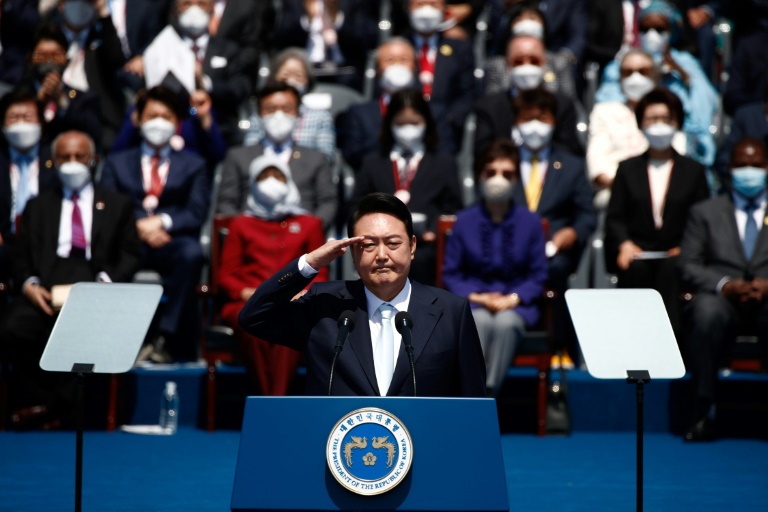
South Korea’s President Yoon Suk-yeol called on the North to give up its nuclear weapons in exchange for massive economic aid at his swearing-in Tuesday, describing Pyongyang’s missiles as a threat to regional and global security.

Yoon, 61, who started work in an underground bunker with a security briefing on North Korea, took office at a time of high tensions on the peninsula, with Pyongyang conducting a record 15 weapons tests since January, including two launches last week.

The former prosecutor, who won a close election by a razor-thin margin in March, said in his inaugural speech that he would consider sending transformative levels of economic aid to the North — but only if Pyongyang first gives up its nuclear weapons.

“If North Korea genuinely embarks on a process to complete denuclearisation, we are prepared to work with the international community to present an audacious plan that will vastly strengthen North Korea’s economy and improve the quality of life for its people,” he said.

Yoon’s predecessor Moon Jae-in pursued a policy of engagement with Pyongyang, brokering summits between Kim and then-US president Donald Trump. But talks collapsed in 2019 and diplomacy has stalled since.

“While North Korea’s nuclear weapon programs are a threat not only to our security and that of Northeast Asia, the door to dialogue will remain open so that we can peacefully resolve this threat,” Yoon added.

But the offer of “audacious” aid is a dud, analysts say: North Korea, which invests a vast chunk of its GDP into its UN-sanctioned weapons programs, has long made it clear it will not trade nukes for aid.

“Since 2009, North Korea has stated it will not give up its nukes for economic incentives,” Park Won-gon, a professor at Ewha University told AFP.

“Yoon’s comment will only trigger Pyongyang, who will see it as an attack,” Park added.

Kim does not want massive economic growth because achieving this would require opening up North Korea’s information ecosystem, said Chad O’Carroll of Seoul-based specialist site NK News. 

“Ideological pollution would rapidly steep in, a key risk for Pyongyang’s ruler… Yoon’s denuclearisation plans won’t go anywhere… because the ‘carrot’ is actually poisonous,” he wrote on Twitter.

– Unpopular move –

During his inauguration speech, Yoon said that South Korea was facing “multiple crises,” citing the pandemic, global supply chain issues and economic woes, and new armed conflicts and wars.

“Such complex, multi-faceted crises are casting a long and dark shadow over us,” he said, adding that he was confident the country would emerge from its current difficulties.

“Koreans never succumbed; we became stronger and wiser,” he said.

But Yoon is not likely to have an easy ride, taking office with some of the lowest approval ratings of any democratically elected South Korean president.

His approval hovers at around 41 percent, according to a recent Gallup poll, with outgoing President Moon, in contrast, at 44 percent.

The biggest reason for Yoon’s unpopularity, the survey found, was his decision to move the presidential office from the decades-old Blue House to the former defence ministry in downtown Seoul.

The hasty, expensive move soured public sentiment, with critics claiming it was unnecessary and put the country’s security at risk during a time of heightened tensions with the North.

Yoon said the Blue House, located at a site used by the Japanese colonial administration from 1910 to 1945, was a “symbol of imperial power”, claiming the relocation would ensure a more democratic presidency.

The Blue House grounds will be opened to the public as a park, and during the inauguration ceremony, footage of people walking up to the once-fortified compound was broadcast live.

The formal inauguration ceremony was staged outside Seoul’s National Assembly, featuring marching army bands, soldiers in ceremonial dress, and a 21-gun salute.

Around 40,000 people attended the massive inauguration ceremony, which local reports said was the country’s most expensive such event by far, at 3.3 billion won ($2.6 million).

US President Joe Biden — who is set to visit Seoul later this month — sent a high-profile delegation, headed by Douglas Emhoff, husband of US Vice President Kamala Harris.

Japan and China also sent high-level representatives, with Yoon saying he wants to mend sometimes fractious relations with regional powers.


US extradition dropped after Megaupload co-defendants strike deal

Two former colleagues of tech entrepreneur Kim Dotcom have agreed to face online piracy charges in a New Zealand court in exchange for US extradition proceedings being dropped, authorities and the defendants said on Tuesday.

Dotcom, founder of the Megaupload file-sharing system, is still being pursued by the United States on fraud, money laundering and racketeering charges punishable with up to 20 years in jail.

The website — an early prototype of cloud storage — was shut down when New Zealand police raided Dotcom’s Auckland mansion in January 2012 at the behest of the FBI, triggering numerous court hearings and appeals.

Former coders Mathias Ortmann and Bram van der Kolk said in a statement issued by their lawyer that they have agreed to face equivalent charges in New Zealand.

“We have reached an agreement with the New Zealand Government and the United States of America under which we have agreed to be charged in New Zealand for offences similar to those we face in the United States,” the two men said.

They emphasised that the case has taken a “heavy toll on our lives” and that neither wants to leave New Zealand, where they have residency.

New Zealand’s Crown Law Office confirmed the deal in a statement, saying the charges filed in Auckland District Court on Tuesday morning were the equivalent of what the pair would have faced in the United States.

US prosecutors allege the Megaupload service facilitated widespread piracy of films and publications, costing rights holders more than US$500 million. 

Dotcom is now the last remaining person charged in the case to still be facing extradition.

A fourth defendant, former Megaupload marketing manager Finn Batato, had extradition charges dropped last year after developing a life-threatening medical condition.

All four men have maintained their innocence, questioning why Megaupload was targeted.

Dotcom responded on social media on Tuesday, posting a defiant photograph accompanied by a message: “Keep fighting!”.

He denies any wrongdoing and is living in Queenstown, New Zealand while on bail as he fights extradition proceedings.

US extradition dropped after Megaupload co-defendants strike deal

Two former colleagues of tech entrepreneur Kim Dotcom have agreed to face online piracy charges in a New Zealand court in exchange for US extradition proceedings being dropped, authorities and the defendants said on Tuesday.

Dotcom, founder of the Megaupload file-sharing system, is still being pursued by the United States on fraud, money laundering and racketeering charges punishable with up to 20 years in jail.

The website — an early prototype of cloud storage — was shut down when New Zealand police raided Dotcom’s Auckland mansion in January 2012 at the behest of the FBI, triggering numerous court hearings and appeals.

Former coders Mathias Ortmann and Bram van der Kolk said in a statement issued by their lawyer that they have agreed to face equivalent charges in New Zealand.

“We have reached an agreement with the New Zealand Government and the United States of America under which we have agreed to be charged in New Zealand for offences similar to those we face in the United States,” the two men said.

They emphasised that the case has taken a “heavy toll on our lives” and that neither wants to leave New Zealand, where they have residency.

New Zealand’s Crown Law Office confirmed the deal in a statement, saying the charges filed in Auckland District Court on Tuesday morning were the equivalent of what the pair would have faced in the United States.

US prosecutors allege the Megaupload service facilitated widespread piracy of films and publications, costing rights holders more than US$500 million. 

Dotcom is now the last remaining person charged in the case to still be facing extradition.

A fourth defendant, former Megaupload marketing manager Finn Batato, had extradition charges dropped last year after developing a life-threatening medical condition.

All four men have maintained their innocence, questioning why Megaupload was targeted.

Dotcom responded on social media on Tuesday, posting a defiant photograph accompanied by a message: “Keep fighting!”.

He denies any wrongdoing and is living in Queenstown, New Zealand while on bail as he fights extradition proceedings.

Egypt's ancient 'zar' ritual puts exorcism on stage

A stage, lights, a mesmerised audience: it looks like an Egyptian folkloric concert but Umm Sameh is singing to heal the sick by driving out the demons that possess them.

The music and dance ritual known as “zar”, with centuries-old roots in Ethiopia and Sudan, is traditionally performed to ward off or exorcise jinn or evil spirits.

“We’re not quacks or witches,” said Umm Sameh, aged in her 70s, with kohl-lined eyes, large hoops swaying in her ears and gold bracelets tinkling on her arms.

“The singing is spiritual and brings out negative energies,” said the lead singer of the Mazaher ensemble, adding that they also perform prayers from Islam’s mystic Sufi practices.

Traditionally, the zar ritual would last several days and include animal sacrifices. But no blood is spilled at Cairo’s Makan Cultural Centre, where the group performs to the delight of foreign and local guests.

The audience is bewitched by Umm Sameh’s voice and nod their heads to the drumbeat. 

In a patriarchal society where women face frequent discrimination, zar ceremonies are among the few cultural practices in which they take centre stage.

Umm Sameh said she learned the ritual from age 11 from her mother and grandmother. 

Six decades later, she recites the same lyrics to the same tunes — all from memory, she adds proudly, because she has “inherited them and grown up with them”.

– ‘Old healing ritual’ –

“Zar is a very old healing ritual, a bit like medical treatment,” said Ahmed al-Maghraby, founder of Mazaher, which he says is Egypt’s last group to perform zar in public.

He set up the Makan performance space 22 years ago “to preserve this cultural heritage and archive local music from all over Egypt”.

It was a tough feat, he said, because zar has historically been derided by devout Muslims as a pagan practice, and rejected by modernising state authorities as a backward rural tradition.

“Middle Eastern and Egyptian society regards everything local with disgust,” lamented Maghraby. 

He said it was foreign tourists who first brought Egyptians to the shows, who he remembered used to say “No! There’s jinn and blood!'”

“For them, the zar was always something sinful.”

Ensemble member Abou Samra said “people have a very negative idea of zar because of the movies,” in Egypt, long regarded as the Hollywood of the Arab world.

In one of them, 1987 horror movie “Al Taweeza” (The Curse), superstars Youssra and Tahia Carioca contorted themselves, drenched in fake blood, and emitting shrill cries.

But zar is “an art like all other arts,” said Abou Samra, who plays the tanboura, a six-string lyre. “We have to let go of these stereotypes.”

– New generation –

Times are indeed changing. The ensemble, whose musicians and dancers were all over 60, have brought in a new member.

Azza Mazaher, who grew up watching her mother Umm Hassan do percussion, now also drums and energises the show as she dances across the stage.

Azza said the group now performs in both the old and new ways.

“If someone feels sick and the doctors can’t find a treatment, we can hold a ceremony,” she told AFP.

“But here, we’re performing a light piece of folklore, so people can discover it, understand it and enjoy it.”

Mazaher has taken part in several European festivals, and more Egyptians are flocking to their Cairo performances, appreciative of the home-grown artform.

Mariam Essawi, an audience member in her 20s, said: “They look like us, they represent us. Zar is part of our history and our cultural heritage. It’s very strange that we don’t know it.”

Duterte popularity sweeps daughter to Philippines election win

Outgoing Philippine President Rodrigo Duterte could face international charges over his deadly drug war, but his daughter’s thumping victory in the vice presidential race shows his popularity remains sky-high.

Sara Duterte secured more than half the votes in Monday’s election, a ringing endorsement for the family name that has become a byword for brutality and impunity in the poverty-plagued country.

More than 6,200 people have officially died in Duterte’s anti-narcotics campaign since he came to power in 2016, but rights groups estimate the true figure is in the tens of thousands.

While the deaths have been widely condemned and triggered an International Criminal Court probe, Duterte’s swift brand of justice struck a chord with many Filipinos fed up with the bureaucracy, corruption and dysfunction that affects their daily lives.

That popularity has rubbed off on his daughter, who supporters see as a safe pair of hands to continue his legacy — and protect him from potential criminal charges in the Philippines or abroad when he leaves office.

Sara Duterte’s success in the election on Monday cements the family’s place at the centre of politics for another six years and ensures the Duterte name stays on the list of powerful political dynasties.

With her running mate Ferdinand Marcos Junior capturing the presidency, the two offspring of authoritarian leaders have been elevated to the nation’s highest elected positions.

On the campaign trail, they embraced many of the elder Duterte’s policies, alarming human rights activists, journalists and religious leaders. 

Duterte, 43, had once been tipped to try to succeed her father in the presidential palace as voter surveys last year put her well in front of other possible contenders, including Marcos Jr.

But she stunned political observers — and apparently her dad — by striking a deal with the son of the country’s former dictator and instead running for the deputy’s job.

When Duterte walked arm-in-arm with Marcos Jr at a society wedding near Manila last November, Filipinos knew a political marriage had also been sealed.

The arrangement also brought together several powerful families that control swathes of the Philippines and have the means to direct voters to support their chosen candidate.

“I think we would have had an entirely different race had Sara Duterte decided to run for the presidency — probably Marcos would not have run at all,” said political analyst Richard Heydarian, after a recent pre-election survey showed Marcos Jr on track to win big.

While her role as vice president will be largely ceremonial, it puts her within a heartbeat of the highest office and in pole position to run for president in six years’ time.

She could also wield significant influence in the next administration.

The elder Duterte will be hoping so as he prepares to step down on June 30, making him fair game for prosecution.

– Quick temper – 

Until now, Duterte’s career has been in lockstep with her father, following him into law and then succeeding him as mayor of Davao City on the southern island of Mindanao. 

Known for her quick temper — she once repeatedly punched a court sheriff in front of TV cameras — she also has a fondness for big motorbikes and tattoos.

She is married and has three children nicknamed Sharkie, Stingray and Stonefish. 

Duterte entered politics in 2007, serving three years as vice mayor while her father was mayor of Davao — the family stronghold.

They swapped positions for the next three years and she again succeeded him as mayor in 2016 when he won the presidency.

Analysts say Duterte is not a carbon copy of her father, describing her as a more moderate version of a man known for his foul-mouthed tirades.

Yet some had questioned her broad appeal to voters, saying she lacked the charisma and humour of her father — key traits in a country where personality trumps policy.

Duterte has a fractious relationship with her dad, but has acted as first lady on some of his official trips overseas.

She defended him on the 2016 campaign trail after he sparked international outcry by joking about an Australian missionary who was raped and killed.

The younger Duterte disclosed in a since-deleted Instagram post: “Not a joke. I am a rape victim. But I will still vote for President Rodrigo Duterte.”

Sony logs record full-year sales but net profit dips

Sony on Tuesday reported its best-ever sales in the financial year to March thanks to strong results in movies, electronics and music, while net profit dipped 14 percent from the previous year’s record high.

A lockdown-fuelled gaming boom has slowed, but the Japanese giant has seen success in other entertainment sectors, with “Spider-Man: No Way Home” overtaking “Avatar” as North America’s third-highest-grossing film.

Demand for sensors used in smartphone cameras has continued to soar, and Sony Music also scored a winner with Adele’s latest album “30” and strong licence revenue in its popular anime business.

The conglomerate reported full-year sales for 2021-22 of 9.9 trillion yen ($76 billion) and net profit of 882 billion yen.

In 2020-21, Sony logged a record net profit of more than a trillion yen, partly thanks to tax gains and the explosion in popularity of video games during Covid-19 lockdowns.

The 10 percent increase in sales from 8.99 trillion yen in 2020-21 “was mainly due to significant increases in sales in the pictures, electronics products and solutions and music segments”, Sony said.

Hideki Yasuda, senior analyst at Toyo Securities, said Sony would likely benefit from the fall of the yen, which has hit 20-year lows against the dollar this year.

He said the conglomerate is now succeeding in a broader range of sectors with favourable business environments, such as music and movies.

“Sony is really turning into a content company now, from its previous status as an electronics manufacturer.”

– PlayStation 5 supply woes –

For the current financial year to March 2023, Sony predicts sales will rise 15 percent to 11.4 trillion yen, while net profit is projected to slip six percent to 830 billion yen.

Sony has faced challenges rolling out its PlayStation 5 console, which remains difficult to get hold of 18 months after its November 2021 launch — in part due to supply chain disruption including the global chip shortage.

The company “could have sold so many more PS5s if they were able to produce more”, according to Serkan Toto, an analyst at Kantan Games in Tokyo.

“I don’t see any kind of problem for Sony in the gaming world or in the gaming market, except for the supply chain issues: it’s impossible to get a PlayStation 5. It’s ridiculous,” he told AFP.

Even then, Sony has released a stream of popular games from “Ratchet and Clank” to “Gran Turismo 7”, Toto said.

Philippine dictator's son wins landslide presidential victory

The son of late Philippine dictator Ferdinand Marcos cemented a landslide presidential election victory Tuesday, after Filipinos bet a familiar but tainted dynasty could ease rampant poverty — while dismissing warnings the clan’s return would deepen corruption and weaken democracy.

With an initial count almost complete, Ferdinand “Bongbong” Marcos Junior had secured over 56 percent of the vote and more than double the tally of his nearest rival, liberal Leni Robredo.

His now unassailable lead of 16 million-plus votes spells another astonishing reversal in the fortunes of the Marcos family, who have gone from the presidential palace to pariahs and back again in the space of a few decades.

The Marcos victory is a hammer blow to millions of Filipinos who hoped to reverse course after six bloody years of increasingly authoritarian rule by outgoing President Rodrigo Duterte. 

Far from repudiating Duterte’s excesses, Filipino voters elected his daughter Sara as vice president by a landslide in a parallel vote.

In 1986, Marcos senior and kleptocratic first lady Imelda Marcos were chased into exile by the “People Power” revolution.  

Marcos junior steadfastly refused to denounce his family’s brutal and corrupt excesses in a campaign marked by a relentless online whitewashing of history.

With memories of the regime fading with time and muddied by countless misleading Facebook posts, Filipino voters turned to Marcos to rekindle past glories that were mostly imagined. 

“He will lift our country from the poverty we’re experiencing now,” said supporter and retired police officer Anthony Sola, who described himself as elated.

The 50-year-old dismissed allegations that the Marcoses stole as much as $10 billion during their last period in power: “I don’t believe they stole money, because if they did, they should have been imprisoned already.”

Some 43 percent of Filipinos consider themselves poor, and 39 percent more feel they are on the borderline, according to a March poll by the Social Weather Survey.

Delivering a late-night address from his campaign headquarters in Manila on Monday, a tired but beaming Marcos thanked volunteers for months of “sacrifices and work”.

But he stopped short of claiming victory, warning that “the count is not yet done”. A fully certified tally is not expected before May 28.

On the streets, hundreds of ecstatic supporters set off fireworks late into the night, waved the national flag and clambered onto parked cars to chant in victory.

– ‘More death, more hunger’ –

Rights activists, Catholic leaders and political commentators all had warned about returning the Marcos clan to power.

“This election could have been our biggest chance for radical change,” said Mae Paner, a 58-year-old political satirist who was part of the People Power Revolution.

“There will be more death, there will be more debt, there will be more hunger. The Marcoses will steal,” she said. 

Bonifacio Ilagan, who endured two years of imprisonment and torture under Marcos senior’s imposition of martial law, said the election exposed a deep malaise in Philippine society.

It had, he said, laid bare, “how deeply the trickery of historical fraudsters has seeped into the consciousness of Filipinos.”

Failed presidential hopeful Leni Robredo, a lawyer and the current vice president, admitted “clear disappointment” about the result but vowed to continue the fight against poor governance.

The 57-year-old had promised to clean up the dirty style of politics that has long plagued the feudal and corrupt democracy, where a handful of surnames hold sway.

In the final weeks before the election, her campaign morphed into a catchall pro-democracy movement that drew almost one million people to a single protest in Manila.

Fearing a backlash from 15 million disgruntled voters — with many alleging voting irregularities in Monday’s poll — police urged restraint. 

“I am appealing to you to remain calm. Let us respect the result of the vote,” said acting Philippine police chief Lieutenant-General Vicente Danao.

The country’s Commission on Elections indicated that despite long queues and problems with some voting machines, the initial tabulation of votes had gone well. 

– Failure to connect –

For the liberal opposition, analyst Mark Thompson said there should be a period of soul searching and a broadening of its message beyond “good governance”.

“They need to make clear that they’re going to improve the lives of the average Filipino,” said Thompson, who is director of the Southeast Asia Research Centre at the City University of Hong Kong.

For Marcos, the coming weeks and months will bring high expectations from poor supporters already angry at a string of post-dictatorship governments, which many believe had failed to materially improve their lives.

“He is yet to set out a coherent, detailed, plan for getting the Philippines’ economy back on track after the devastation of the pandemic,” said Eurasia Group analyst Peter Mumford.

Marcos will have to try to meet those expectations while keeping the support of several of the country’s powerful political dynasties, who will expect patronage in return for delivering blocs of votes. 

“One of the key watchpoints under his administration will be whether corruption and cronyism — already notable risks in the Philippines — worsen,” said Mumford.

Philippine dictator's son wins landslide presidential victory

The son of late Philippine dictator Ferdinand Marcos cemented a landslide presidential election victory Tuesday, as Filipinos bet on a familiar dynasty to ease rampant poverty — dismissing warnings the tarnished clan will deepen corruption and weaken democracy.

With an initial count almost complete, Ferdinand “Bongbong” Marcos Junior had secured over 50 percent of the vote and more than double the tally of his nearest rival, liberal Leni Robredo.

His now unassailable lead of 16 million votes spells another astonishing reversal in the fortunes of the Marcos family, who have gone from the presidential palace to pariahs and back again in half a century.

The Marcos victory is a hammer blow to millions of liberal Filipinos who hoped to reverse course after six bloody years of increasingly authoritarian rule by outgoing President Rodrigo Duterte. His daughter Sara won the vice presidency, which is elected separately, in a landslide. 

In 1986, Marcos senior and kleptocratic first lady Imelda Marcos were chased into exile by the “People Power” revolution.  

Marcos junior steadfastly refused to denounce his family’s brutal and corrupt excesses in a campaign marked by a relentless online whitewashing of history.

With memories of the regime fading with time and muddied by countless misleading Facebook posts, Filipino voters turned to Marcos to rekindle past glories that were mostly imagined. 

“He will lift our country from the poverty we’re experiencing now,” said supporter and retired policeman Anthony Sola, who described himself as elated.

The 50-year-old dismissed allegations that the Marcoses stole as much as $10 billion during their last period in power: “I don’t believe they stole money, because if they did, they should have been imprisoned already.”

Delivering a late-night address from his campaign headquarters in Manila on Monday, a tired but beaming Marcos thanked volunteers for months of “sacrifices and work”.

But he stopped short of claiming victory, warning that “the count is not yet done”. 

A fully certified tally is not expected before May 28.

On the streets, hundreds of ecstatic supporters set off fireworks late into the night, waved the national flag and clambered onto parked cars to chant in victory.

– ‘More death, more hunger’ –

Rights activists, Catholic leaders and political commentators had all warned about returning the Marcos clan to power.

“This election could have been our biggest chance for radical change,” said Mae Paner, a 58-year-old political satirist who was part of the People Power Revolution.

“There will be more death, there will be more debt, there will be more hunger. The Marcoses will steal,” she said. 

Bonifacio Ilagan, who endured two years of imprisonment and torture under Marcos senior’s imposition of martial law, said the election exposed a deep malaise in Philippines society.

It had, he said, laid bare, “how deeply the trickery of historical fraudsters has seeped into the consciousness of Filipinos.”

Failed presidential hopeful Leni Robredo, a lawyer and the current vice president, admitted “clear disappointment” about the result but vowed to continue the fight against poor governance.

The 57-year-old had promised to clean up the dirty style of politics that has long plagued the feudal and corrupt democracy, where a handful of surnames hold sway.

In the final weeks before the election, her campaign morphed into a catchall pro-democracy movement that drew almost one million people to a single protest in Manila.

Fearing a backlash from 15 million disgruntled voters — with many alleging voting irregularities in Monday’s poll — police urged restraint. 

“I am appealing to you to remain calm. Let us respect the result of the vote,” said acting Philippine police chief Lieutenant-General Vicente Danao.

The country’s Commission on Elections indicated that despite long queues and problems with some voting machines, the initial tabulation of votes had gone well. 

– Failure to connect –

For the liberal opposition, analyst Mark Thompson said there should be a period of soul searching and a broadening of its message beyond “good governance”.

“They need to make clear that they’re going to improve the lives of the average Filipino,” said Thompson, who is director of the Southeast Asia Research Centre at the City University of Hong Kong.

For Marcos, the coming weeks and months will bring high expectations from poor supporters already angry at a string of post-dictatorship governments, which many believe had failed to materially improve their lives.

“He is yet to set out a coherent, detailed, plan for getting the Philippines’ economy back on track after the devastation of the pandemic,” said Eurasia Group analyst Peter Mumford.

Marcos will have to try to meet those expectations while keeping the support of several of the country’s powerful political dynasties, who will expect patronage in return for delivering blocs of votes. 

“One of the key watchpoints under his administration will be whether corruption and cronyism — already notable risks in the Philippines — worsen,” said Mumford.

Three decades after Pablo Escobar's death, drugs ravage Medellin

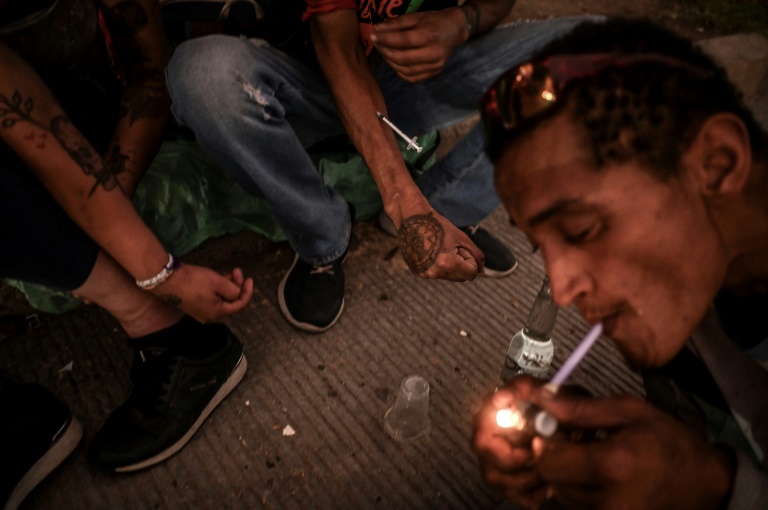
Three decades after cartel boss Pablo Escobar was shot dead by police on a rooftop in Medellin, the very city he had sought to uplift with drug money is being ravaged by it.

Junkies frequent hundreds of sales points dotted around Colombia’s second city, which has become the epicenter of the domestic drug trade.

“Easy access? Yes, absolutely. In Medellin you can find it anywhere. Even on the floor you find drugs,” Manue Morales, an out-of-work engineer and chronic user of “basuco” — the cheapest drug on the market — told AFP.

Basuco is derived from the coca leaf also used to make cocaine, and mixed with other low-grade substances.

His hands shaking, 32-year-old Morales inhaled a dose in a public park, using a pipe fashioned from a PVC tube, even as pedestrians and police milled around.

“I am a bit nervous,” he confessed.

“The truth is that one is less cautious and it (the basuco) can cause you to do stupid things,” said Morales, who lost his job due to drug use.

Four brief months later, all his worldly belongings fit into a worn briefcase, and he often sleeps rough. 

Morales’s downfall, he said, started at a so-called “vice plaza” — drug vending points that numbered about 160 in Medellin ten years ago, according to police.

Researchers estimate the figure is now closer to 800.

– ‘Billion-dollar industry’ –

In 2013, some 3.5 percent of Colombians said they had ever taken an illegal substance, according to the state statistics agency.

By 2019, the number had almost tripled to 9.7 percent.

With aid from the United States, leader in the global “war on drugs”, a Colombian crackdown since the early 2000s has forced traffickers to look homeward.

“A concentration of product was generated… that could not be exported due to this strong anti-drug policy,” said toxicologist Juan Carlos Sanchez.

Domestic clients, however, are not getting the best of what the world’s largest cocaine exporter has to offer.

Instead, they are getting hooked on cheaper, low-quality and often dangerous drugs.

With 2.2 million inhabitants, Medellin is today the city with the highest drug consumption — 15.5 percent — in Colombia.

The Medellin city council estimates that each drug “plaza” can make up to $75,000 a month — the equivalent of some 300 minimum salary earners.

But authorities say the increase in domestic drug use has gone hand-in-hand with rising insecurity.

Since 2018, more than 2,500 people have been killed in gang wars nationally, police general Herman Bustamante told AFP.

Official data does not distinguish between gangster and civilian deaths.

– ‘Mafia peace’ –

In Medellin, the numbers reveal a paradox.

In 1992, at the height of the search for Escobar, the city’s homicide rate was 350 per 100,000. Last year it was down to 15.5, even as drug use has surged.

According to Luis Fernando Quijano of social development NGO Corpades, this was more telling of a “mafia peace” than of any real progress.

There were “pacts,” he said, between narco gangs and some local authorities to allow drug trade in exchange for relative security in their areas.

“When seizures are made… it is often not the product of (police) intelligence,” Quijano added. “They are delivered (by the narcos) to create the image that… the security strategy is working.”

Bustamante conceded that some police have been arrested for colluding with traffickers, without giving numbers.

“As long as there are consumers… criminals will see a business opportunity,” he said.

– ‘The Bronx’ –

In 2018, then Medellin mayor Federico Gutierrez accompanied nearly 1,000 police who bulldozed the city’s main drug market, known as “The Bronx.”

Gutierrez, the right-wing candidate in presidential elections later this month, has vowed a harsher police clampdown on domestic drug trafficking.

His leftist rival Gustavo Petro wants to address drug use as a public health problem.

Since 2021, the government has demolished at least 129 vending spots countrywide.

But many quickly return, including The Bronx.

Twenty-four hours a day, vendors call out the names of their wares: “blones” (marijuana joints), “rocks” (cocaine), ecstasy or “wheels” as they call Clonazepam pills, a psychiatric medicine with sedative effects.

Others offer “tusibi” — calling it “tusi” for short or sometimes “pink cocaine” — the latest party drug based on Ketamine mixed with substances such as ecstasy and mescaline, a psychedelic derived from a cactus.

Though “banned” from street sale — considered too harmful even by the gangs — those who want it can also find heroin, at about $2.5 per gram. 

Addict Julian, his discolored skin stretching over the pronounced cheekbones of his emaciated face, told AFP he needed to inject himself four times a day.

As night fell, Julian — who did not want to give his full name — met his supplier in a park thronging with people.

The transaction takes mere seconds. 

“Before, you did not see people injecting themselves in the street, discarding syringes,” said Julian. “We were few.”

But no longer.

Russia shells Ukraine's Odessa as US pledges fresh arms for Kyiv

Russian forces intensified their fight in Ukraine’s east and fired missiles over the port city of Odessa, as President Joe Biden signed a law speeding up arms deliveries to Kyiv.

The southern city was hit by a series of missiles Monday, destroying buildings, setting ablaze a shopping centre and killing one person, its city council said, just hours after a visit by European Council President Charles Michel.

As Russia stepped up its fight to seize Ukraine’s east, US President Joe Biden resurrected a World War II measure to aid Kyiv, opening the spigots on artillery, anti-aircraft missiles, anti-tank weapons and other powerful Western materiel.

The United States has sent some $4 billion in military aid to Ukraine already but “caving to aggression is even more costly,” Biden said as he signed the act, passed with unusual bipartisan support.

Missiles earlier rumbled through Moscow’s Red Square as Russia’s President Vladimir Putin sought to channel national pride on the anniversary of the defeat of Nazi Germany into support for a war that has killed thousands and sent millions into exile.

On the ground in Ukraine, the governor of Lugansk reported “very serious battles” in the frontline areas of Bilogorivka and Rubizhne.

An AFP team reported seeing columns of trucks filled with soldiers and heavy equipment move down the main road leading away from the city of Severodonetsk — one of its last eastern strongholds against Russia — suggesting Ukraine was pulling back from some parts of the front.

In the devastated southern port of Mariupol, pro-Russian separatists feted Victory Day, with leader Denis Pushilin and residents carried a giant black and orange ribbon of Saint George — a symbol of WWII celebrations in Russia — through a city that has seen some of the heaviest fighting since the invasion on February 24.

Full control of Mariupol would allow Moscow to create a land bridge between the Crimean peninsula, which it annexed in 2014, and eastern regions run by pro-Russian separatists.

Some have speculated that Putin was seeking to achieve that goal in time for Victory Day, but a small contingent of depleted Ukrainian forces continued their defence of a final bastion at the Azovstal steelworks.

– ‘I bow to Putin’ –

In his speech in Moscow, the Russian leader blamed the West and Ukraine for the two-and-a-half-month conflict, telling the parade that his country faced an “absolutely unacceptable threat” and warning against the “horror of a global war”.

“You are fighting for the Motherland, for its future, so that no one forgets the lessons of the Second World War,” he said.

The celebration in Red Square also featured some 11,000 troops and more than 130 military vehicles, although a planned military flypast was cancelled.

“Putin conducts politics so well, well done to him. He makes sure that our boys don’t die, that there is as little blood as possible. I bow down to him,” added Taisiya Chepurina, 81, whose husband fought in the Battle of Stalingrad in 1943.

But Ukrainians and Western powers accused Putin of exploiting the anniversary, with protesters in Warsaw tossing blood-red paint on the Russian ambassador, chanting “fascists!” and hoisting a Ukrainian flag, as he visited a cemetery.

Ukrainian leader Volodymyr Zelensky also invoked the ghosts of World War II, chiding Russia for claiming sole credit for winning.

“We will not allow anyone to annex this victory. We will not allow it to be appropriated,” he said in a video speech shortly before Putin spoke.

In Kyiv the commemoration day was largely shunned as life slowly returned to normal, weeks after fierce fighting raged in its suburbs.

– Camps in the east? –

Still facing the brunt of the fighting are Ukraine’s civilians, with the country reeling from a Russian attack on a school over the weekend that killed 60 people.

And the Pentagon said Monday it has seen indications that those caught up in Russia’s invasion are being forcibly removed from their homeland.

“I can’t speak to how many camps or what they look like,” Pentagon spokesman John Kirby told reporters when asked about statements from Kyiv that some 1.2 million Ukrainians were being sent across the border and placed in camps.

“But we do have indications that Ukrainians are being taken against their will into Russia,” Kirby said. He called these actions “unconscionable” and “not the behaviour of a responsible power.”

The deportation of Ukrainians from their own nation — often to isolated or economically depressed regions of Russia, according to Kyiv — is another indication that Putin “simply won’t accept and respect Ukrainian sovereignty,” he added.

– Progress towards embargo –

In another step forward in building pressure on Russia, EU chief Ursula von der Leyen said she made “progress” on a proposed Russian oil embargo during talks with Hungarian Prime Minister Viktor Orban.

The populist Orban is one of Putin’s closest friends in Europe and had held up the bloc’s attempt to phase out Russian oil — one of the most painful measures yet taken by the West — as he pointed to economic consequences in landlocked Hungary.

But France’s President Emmanuel Macron poured cold water on Ukraine’s oft-repeated desire for fast-track European Union membership, saying it would take “decades”. 

Macron, however, suggested building a broader political bloc that could also include Britain.

One ray of hope has come from prisoner swaps.

Ukrainian soldier Glib Stryzhko, 25, was gravely wounded and captured in Mariupol in April but finally released after a secret phone call to his mother.

“After we were loaded onto the bus waiting for us, the driver said: ‘Guys, you can breathe. You are home now,'” Stryzhko told AFP from his hospital bed in Zaporizhzhia.

burs-oho/mtp

Close Bitnami banner
Bitnami