World

Social network Grindr going public at $2.1 bn value

Social network Grindr on Monday said it has hooked up with a special purpose acquisition company to become a publicly traded company valued, out of the gate, at $2.1 billion.

Los Angeles-based Grindr expected to raise $384 million when it combines with Tiga Acquisition Corp and becomes Grindr Inc.

“Grindr is the leading platform focused on the LGBTQ+ community for digital connection and engagement,” said chief executive Jeff Bonforte.

“Grindr is well positioned to be a public company and will continue to expand the ways it serves the LGBTQ+ community.”

Grindr had an average of 10.8 million users monthly last year, most of whom are age 35 or younger, the company said in a release.

The startup founded in 2009 said it is profitable.

Grindr’s union with the SPAC pends regulatory approval and is expected to be consummated in the second half of this year, the company said.

“This transaction is a milestone event,” said Grindr board chair James Lu.

The Grindr app early this year disappeared from multiple app stores in China as authorities tightened control of the country’s already heavily policed internet and purged online behavior the ruling Communist Party disapproves of.

The country’s cyber authority conducted a campaign to root out illegal and sensitive content during the Lunar New Year holiday and February’s Winter Olympics.

Although the world’s most populous nation decriminalized homosexuality in 1997, same-sex marriage is illegal and LGBTQ issues remain taboo.

The Chinese former owner of Grindr, Beijing Kunlun Tech, sold the app to investors in 2020 under pressure from US authorities concerned that the potential misuse of its data could present national security risks.

Norwegian authorities in December said that they were fining Grindr more than six million euros for illegally sharing users’ personal data with third parties.

“Our conclusion is that Grindr has disclosed user data to third parties for behavioral advertisement without a legal basis,” said Tobias Judin, head of the Norwegian Data Protection Authority’s (DPA) international department.

Grindr, which bills itself as “the world’s largest social networking app for gay, bi, trans, and queer people,” is accused of sharing GPS coordinates, elements of its users’ profiles such as age or sex and the very fact that they use the app, thus giving indications of their sexual orientation.

The lack of clear information about this practice given to users and lack of explicit approval on this point from them violates the General Data Protection Regulation (GDPR) adopted by the European Union in 2018, according to the Norwegian DPA.

Grindr has appealed the fine, the Norwegian regulatory authority said in an online post in February.

Death toll rises to 40 in Havana hotel blast

The death toll from an explosion at a luxury hotel in the old quarter of Havana has risen to 40, the health ministry said Monday.

It said 54 people were injured in the blast last week, including six that are still in critical condition. The death toll Monday morning had been 35.

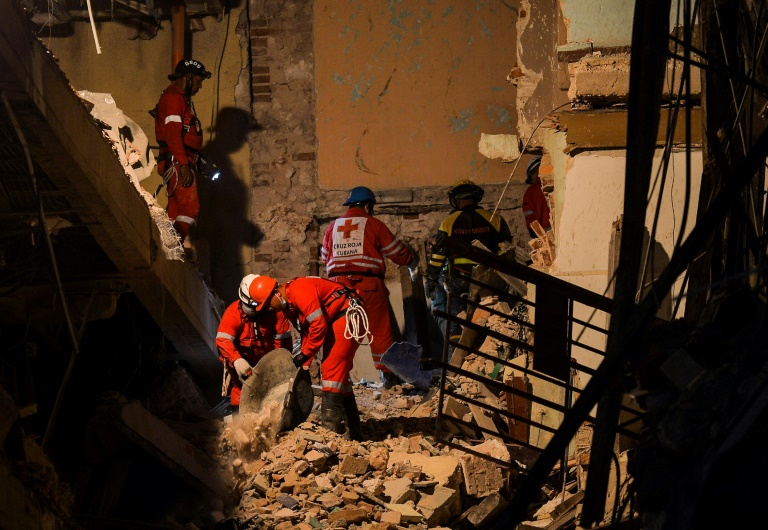
Crews continued to comb through the rubble of the Saratoga five-star hotel, which was being renovated and had no guests at the time of the blast, seemingly caused by a gas leak.

The search is now focused on the basement and sub-basement of the building.

“It is at a very dangerous stage because of the concentration of the rubble and the danger of collapse,” fire department head Luis Carlos Guzman told state television Monday, updating the confirmed death toll.

The tourism ministry said that at the time of the blast there were 51 workers inside the hotel, which was readying for its post-refurbishment reopening this week.

The ACN state news agency said four bodies found overnight were those of hotel workers.

“According to family members, it is estimated that there are about 12 or 13 people still trapped,” the news agency added.

The first four floors of the hotel were gutted in the late-morning blast that sent smoke billowing into the air and rubble tumbling to the ground.

The explosion, which an official said happened while a gas tank was being refilled by a tanker truck, tore off large parts of the facade, blew out windows and destroyed cars parked outside the hotel.

The luxury property is known for having hosted celebrities such as Madonna, Beyonce, Mick Jagger and Rihanna.

Settlement curbs firm's facial recognition database in US

Startup Clearview AI has agreed to limit access to its controversial facial recognition database in the United States, settling a lawsuit filed by privacy advocates, a court filing showed Monday.

The deal, which needs approval by the court to become final, would resolve litigation filed two years ago by the American Civil Liberties Union (ACLU) and rights groups accusing Clearview of violating a strict biometric privacy law in the state of Illinois.

A main provision of the settlement permanently bans Clearview from making its “faceprint” database available to most businesses or other private entities in the country, according the ACLU.

“Clearview can no longer treat people’s unique biometric identifiers as an unrestricted source of profit,” said ACLU speech, privacy and technology director Nathan Freed Wessler.

“Before this agreement, Clearview ignored the fact that biometric information can be misused to create dangerous situations and threats” to lives, said Linda Xochitl Tortolero, chief executive of Chicago-based nonprofit Mujeres Latinas en Accion.

“Today that’s no longer the case.”

Clearview will also stop its practice of offering free trial accounts to police officers without the knowledge or approval of their employers, the ACLU said.

The ban does not limit Clearview from working with federal or state agencies other than those in Illinois, the lawsuit said.

Clearview admits no wrongdoing in the settlement.

Clearview AI says it has built up a database of more than 10 billion facial images taken from public websites, ranging from social media to news portals, which it touts as a tool for law enforcement.

– Still checking faces –

Clearview chief executive Hoan Ton-That said the company has told the court that it intends to make its facial recognition software available to commercial customers, without the database of images.

“Clearview AI’s posture regarding sales to private entities remains unchanged,” the chief executive said in response to an AFP inquiry.

Facial recognition is used to unlock smartphones, verify identities, board aircraft and more, he noted.

The settlement does not require any “material change” in the Clearview business model,” said Cahill Gordon, an attorney representing the company.

Campaigners have condemned Clearview’s use of images for being open to abuse, and a number of groups including Privacy International last year filed complaints with data regulators in France, Austria, Italy, Greece and Britain.

Italy’s data privacy watchdog in March fined Clearview 20 million euros (almost $22 million) over its facial recognition software.

The watchdog ordered the company to delete data relating to people in Italy and banned it from further collection and processing of information there.

France’s privacy watchdog as well in December ordered Clearview to delete data on its citizens and cease further collection.

Meanwhile in June last year, Canada’s independent parliamentary watchdog ruled that both Clearview’s database and the use of it by federal police were illegal.

Even chance world will breach 1.5C warming within 5 years: UN

There is an even chance that global temperatures will temporarily breach the benchmark of 1.5 degrees Celsius above pre-industrial levels in one of the next five years, the United Nations warned Tuesday.

The 2015 Paris Agreement on climate change saw countries agree to cap global warming at “well below” 2C above levels measured between 1850 and 1900 — and 1.5C if possible.

“The chance of global near-surface temperature exceeding 1.5C above pre-industrial levels at least one year between 2022 and 2026 is about as likely as not,” the UN’s World Meteorological Organization said in an annual climate update.

The WMO put the likelihood at 48 percent, and said it was increasing with time.

An average temperature of 1.5 C above the pre-industrial level across a multi-year period would breach the Paris aspirational target.

There is a 93 percent chance of at least one year between 2022-2026 becoming the warmest on record and dislodging 2016 from the top ranking, said the WMO.

The chance of the five-year temperature average for 2022-2026 being higher than the last five years (2017-2021) was also put at 93 percent.

“This study shows — with a high level of scientific skill — that we are getting measurably closer to temporarily reaching the lower target of the Paris Agreement,” said WMO chief Petteri Taalas.

“The 1.5C figure is not some random statistic. It is rather an indicator of the point at which climate impacts will become increasingly harmful for people and indeed the entire planet.”

– ‘Edging ever closer’ –

The Paris Agreement level of 1.5C refers to long-term warming, but temporary exceedances are expected to occur with increasing frequency as global temperatures rise.

“A single year of exceedance above 1.5C does not mean we have breached the iconic threshold of the Paris Agreement, but it does reveal that we are edging ever closer to a situation where 1.5C could be exceeded for an extended period,” said Leon Hermanson, of Britain’s Met Office national weather service, who led the report.

The average global temperature in 2021 was around 1.11C above pre-industrial levels, according to provisional WMO figures.

The report said that back-to-back La Nina events at the start and end of 2021 had a cooling effect on global temperatures.

However, this was only temporary and did not reverse the long-term global warming trend.

La Nina refers to the large-scale cooling of surface temperatures in the central and eastern equatorial Pacific Ocean, typically occurring every two to seven years. 

The effect has widespread impacts on weather around the world — typically the opposite impacts to the El Nino warming phase in the Southern Oscillation cycle.

Any development of an El Nino event would immediately fuel temperatures, as it did in 2016, said the WMO.

– Greenhouse gas link –

The annual mean global near-surface temperature for each year between 2022 and 2026 is predicted to be between 1.1C and 1.7C higher than pre-industrial levels.

There is only a 10 percent chance of the five-year mean exceeding the 1.5C threshold.

“For as long as we continue to emit greenhouse gases, temperatures will continue to rise,” said Taalas.

“And alongside that, our oceans will continue to become warmer and more acidic, sea ice and glaciers will continue to melt, sea level will continue to rise and our weather will become more extreme.

“Arctic warming is disproportionately high and what happens in the Arctic affects all of us.”

Meanwhile, predicted precipitation patterns for 2022, compared to the 1991-2020 average, suggest an increased chance of drier conditions over southwestern Europe and southwestern North America, and wetter conditions in northern Europe, the Sahel, northeastern Brazil, and Australia.

Global stocks and oil slump on China lockdowns, interest rates

World stock markets mostly sank Monday and oil prices slumped as China’s Covid lockdowns added to stubborn fears over the impact of rising US interest rates and surging inflation.

Wall Street suffered another rout, with the tech-rich Nasdaq slumping more than four percent and the S&P 500 ending below 4,000 points for the first time since March 2021.

Frankfurt, London and Paris all fell more than two percent, as did Tokyo.

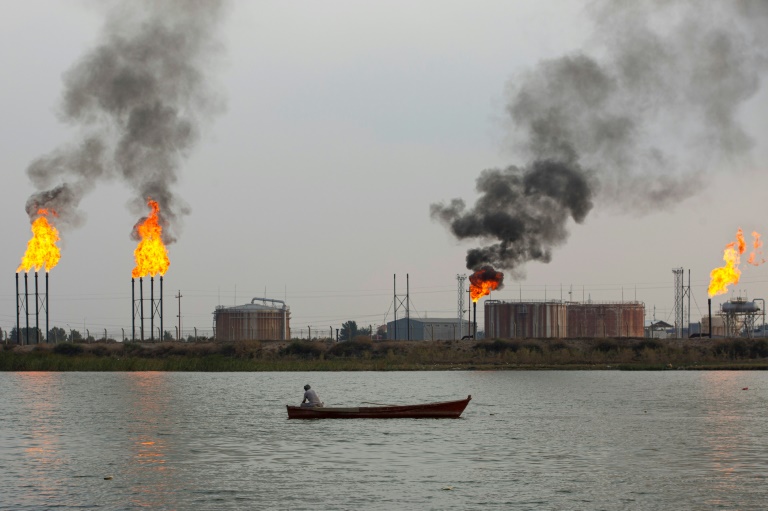
Meanwhile, oil prices slid more than five percent, while bitcoin plunged below $31,000 hitting its lowest level since late 2020, as investors shunned the volatile cryptocurrency.

“The bloodletting on stock markets has continued today as we start a new week … with the biggest declines being seen in basic resources after the latest China trade data,” said market analyst Michael Hewson at CMC Markets UK.

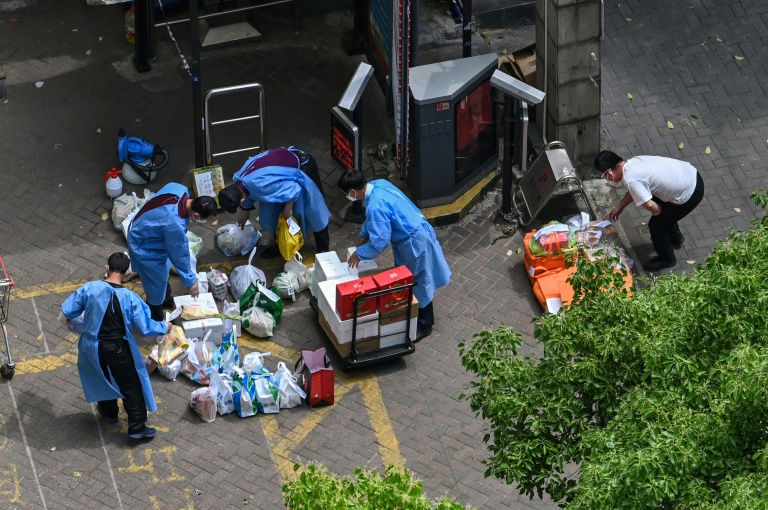
Millions of people in Beijing stayed home on Monday as China tries to fend off a Covid-19 outbreak with creeping restrictions on movement.

Residents of the capital fear they may soon find themselves in the grip of the same draconian measures that have trapped most of Shanghai’s 25 million people at home for weeks.

Lockdowns across dozens of Chinese cities — from the manufacturing hubs of Shenzhen and Shanghai to the breadbasket of Jilin — have wreaked havoc on supply chains over recent months and further stoked global inflationary pressures.

Investors were given more bad news after China reported that exports in April slumped to their lowest level in almost two years, due to the nation’s strict zero-Covid policy.

– Anxiety spreads –

US stock markets dived late last week after the Federal Reserve raised up interest rates by a half-percentage point and flagged more aggressive hikes ahead to tackle decades-high inflation, and continued sinking on Monday.

“Anxiety is stemming from the Fed’s next moves, with uncertainty creeping in about the scale and speed of interest rate hikes,” said Hargreaves Lansdown analyst Sophie Lund-Yates.

Global markets also have taken a beating this year following Russia’s invasion of Ukraine.

President Vladimir Putin on Monday defended the offensive in Ukraine and blamed Kyiv and the West, as he looked to use the grand Victory Day celebrations to mobilize patriotic support for the campaign.

However, investors were relieved that Putin made no major announcements, despite reports he could use the anniversary to announce an escalation of the conflict.

“Putin has not declared a war on Ukraine to enable full mobilisation which is obviously a relief,” noted Markets.com analyst Neil Wilson.

– Key figures at around 2050 GMT –

New York – Dow: DOWN 2.0 percent at 32,245.70 (close)

New York – S&P 500: DOWN 3.2 percent at 3,991.24 (close)

New York – Nasdaq: DOWN 4.3 percent at 11,623.25 (close)

London – FTSE 100: DOWN 2.3 percent at 7,216.58 (close)

Frankfurt – DAX: DOWN 2.2 percent at 13,380.67 (close)

Paris – CAC 40: DOWN 2.8 percent at 6,086.02 (close)

EURO STOXX 50: DOWN 2.8 percent at 3,526.86 (close)

Shanghai – Composite: UP 0.1 percent at 3,004.14 (close)

Tokyo – Nikkei 225: DOWN 2.5 percent at 26,319.34 (close)

Hong Kong – Hang Seng Index: Closed for a holiday  

Brent North Sea crude: DOWN 5.7 percent at $105.94 per barrel

West Texas Intermediate: DOWN 6.1 percent at $103.09 per barrel

Euro/dollar: UP at $1.0563 from $1.0551 on Friday

Pound/dollar: DOWN at $1.2331 from $1.2348

Euro/pound: UP at 85.64 pence from 85.52 pence

Dollar/yen: DOWN at 130.26 yen from 130.56 yen

burs-jmb

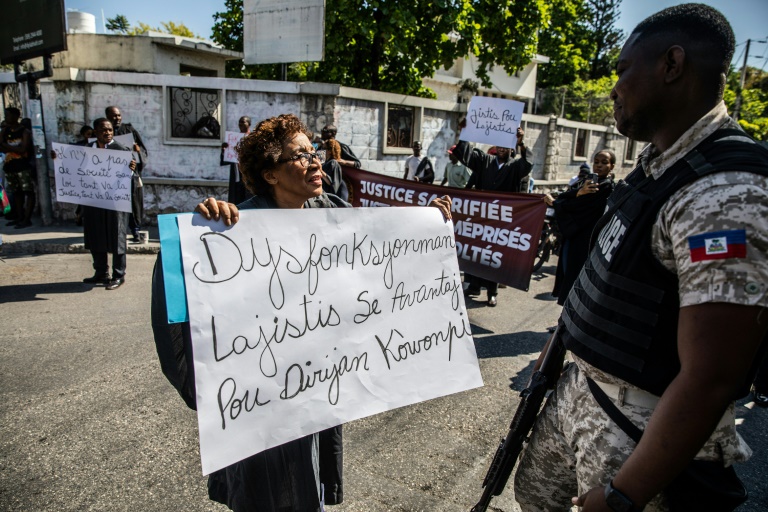
Eight Turks among 12 kidnapped by gang on bus in Haiti

Twelve people, eight of them Turkish citizens, were kidnapped while travelling by bus in Haiti, officials said Monday, as the Caribbean country struggles with a surge of attacks by increasingly powerful gangs.

The group were taken hostage Sunday as they drove to the capital Port-au-Prince from the neighboring Dominican Republic, Turkish consul Hugues Josue told AFP.

He said they were members of Muslim association Ashape, which has since 2019 provided language courses and religious education, according to its website.

“During their abduction, they got off the bus and had time to contact their organization,” he said. Haitian police confirmed the kidnapping.

They were abducted east of Port-au-Prince, between the communes of Croix des Bouquets and Ganthier, Josue added, saying the five men and three women are aged between 20 and 26.

They were on a bus that left Santo Domingo, the Dominican capital, at 9.00 am carrying “a Dominican driver, a Haitian hostess and 10 passengers,” said Michaelle Durandis, a representative of the Metro bus company.

“Among the 10 passengers, there were eight Turks and two Haitians,” she told Haitian radio Vision 2000, adding that she had had no contact after the vehicle crossed the border in the middle of afternoon.

The United Nations said last week that clashes between rival gangs in northern Port-au-Prince have claimed the lives of at least 75 people since fresh violence erupted on April 24.

The world body said it was “deeply concerned by the rapid deterioration of the security situation” in the city.

– Hospitals closing –

For decades, armed gangs have run amok in the poorest neighborhoods of Port-au-Prince, but they have increased their hold across the Haitian capital and the country at-large in recent years, sending murders and kidnappings skyrocketing.

On Monday, two charity hospitals in the capital said they were closing “until further notice” following the kidnapping of one of their pediatricians last week.

“Without the presence of health personnel, who have been targeted on many occasions and are unable to reach health facilities safely, health care cannot be delivered”, said Richard Frechette, president of the foundation “Our little brothers and sisters,” which has operated in Haiti for more than 30 years.

The UN has denounced the “extreme violence” of the gangs, saying local sources recorded “acts of sexual violence, including the gang rape of children as young as 10 years, and the terrorization and intimidation of the local populations living in areas controlled by rival gangs.” 

It estimates that as many as half a million Haitian children have lost access to education because of gang violence.

Last October, the “400 Mawozo” — one of the most powerful and feared of the gangs — abducted a group of 17 North American missionaries and their relatives, including five children.

After five of the group were released, the rest escaped to safety in December.

The district where the violence has been centered contains the only road access to the country’s north as well as between Haiti’s capital and the Dominican Republic.

Since June, authorities have also lost control of the only road connecting Port-au-Prince to the south. 

Red Cross chief on Iran visit talks Afghans' plight

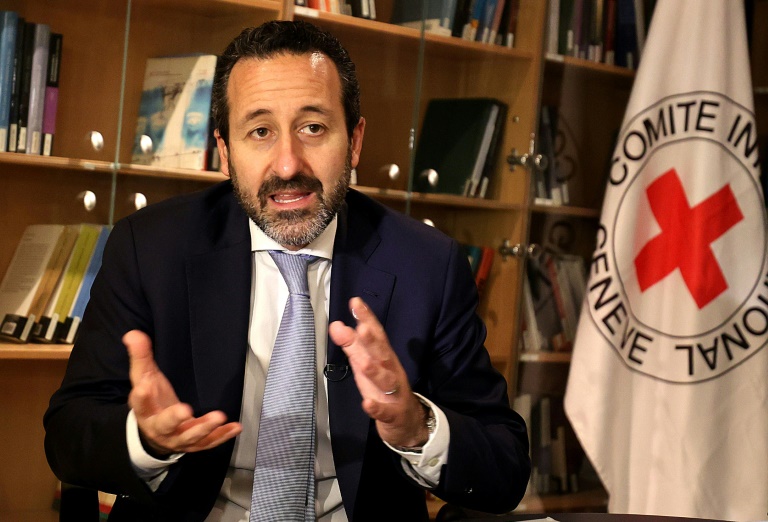
The head of the Red Cross on Monday said he discussed in Iran the plight of Afghan migrants who fled their country after the Taliban took power last year.

“Afghanistan was very much present in the conversation, especially in the wake of the recent developments that we witnessed in August with the change in the government,” Robert Mardini told AFP after two days of talks in Tehran with Iranian authorities.

“The discussions were positive. We see eye to eye,” said Mardini, director general of the International Committee of the Red Cross (ICRC).

More than one million Afghans have sought refuge in Iran since the Taliban returned to power in August, according to Iran’s state news agency IRNA.

Thousands of Afghans daily try to cross into neighbouring Iran in search of work, or in a bid to reach Europe in the hope of asylum.

The Islamic republic now hosts a total of five million Afghans, according to Iran’s foreign ministry.

Mardini said the ICRC discussed with Iran’s Red Crescent ways of “providing critical health services to Afghan migrants and refugees”.

“We did that during the Covid pandemic where the Iranian Red Crescent, with our support, was able to provide vaccination services to Afghan migrants,” he said.

Mardini said he also discussed in Iran the situations in Yemen and Syria and the effects of the armed conflicts, as well as climate change, in those countries.

Talks with Iranian officials at the foreign and interior ministries also focused on the fate of missing persons from the Iran-Iraq war in the 1980s, he said.

According to him “around 40,000” people are still considered missing from that eight-year war which ended in 1988.

“We support the two governments in clarifying the fate of the missing persons… Every year, on average, there are between 600 and 800 human remains that are being repatriated to their families,” Mardini told AFP.

In Mexico, some spend Mother's Day looking for missing children

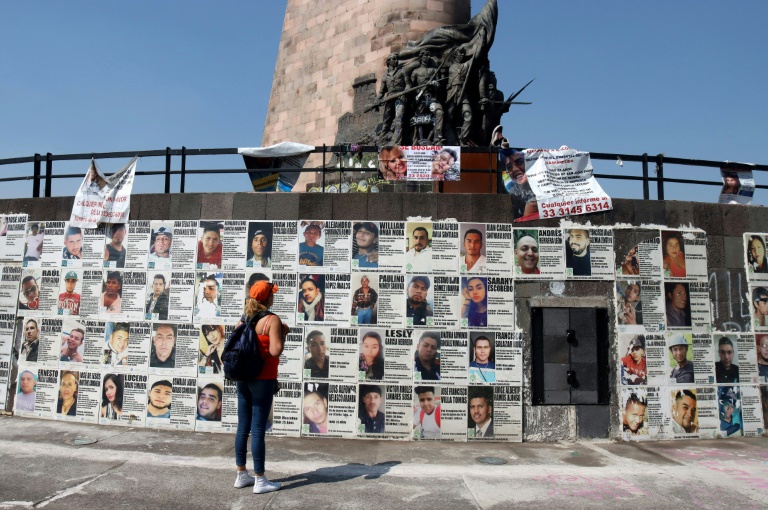
While most Mexicans celebrate Mother’s Day on Tuesday, thousands of women will mark the occasion by continuing their desperate mission to find out what happened to their missing children.

Five of Maria Guadalupe Camarena’s nine children are among the more than 95,000 people who have disappeared in the violence-plagued Latin American country.

“There are five empty chairs. There’s nothing to celebrate here,” said the 61-year-old domestic worker from the western state of Jalisco.

Asked about her plans for Mother’s Day, she answered without hesitation: “Look for my children.”

Jalisco is the Mexican state with the most missing people — nearly 15,000.

Camarena’s daughter Lucero vanished in 2016 after going to a job interview.

Four of her sons disappeared in 2019 when they were traveling by road to visit a relative and were detained by police.

Although two officers were accused of forced disappearance, they have not been tried and there has been no official search operation.

The United Nations Committee on Enforced Disappearances in April urged Mexico to tackle an “alarming trend” of rising enforced disappearances, facilitated by “almost absolute impunity.”

– A mother’s mission –

Araceli Hernandez, 50, has photos of her daughter Vanessa and son Manuel, in their 20s, on an altar in her home.

She has not heard from them since 2017 when first Vanessa disappeared and then her brother while he was looking for her.

“They had been missing for about four months when I grabbed a backpack, some bottles of water, a wooden stick and started walking in the hills,” Hernandez said.

She joined the growing number of mothers who have formed associations that comb the countryside for clandestine graves that might hold their children’s remains.

She also walks the streets of the city of Guadalajara putting up missing person posters, tearfully kissing the images of her son and daughter.

“It’s my mission as a mother,” she said.

‘My life project’

When she wakes up each morning, Rosaura Magana, 61, lights a candle and prays next to a photo of her son Carlos Eduardo.

He disappeared five years ago when armed men who said they were from the prosecutor’s office arrived at his workplace and took him away with three others, two of whom were released.

“I never thought this would be my life project,” she said of the days she now spends looking for her son instead of enjoying her retirement.

She criticized the authorities for the lack of progress in the case.

The two people who were freed refused to say what happened and the case has gone through six prosecutors and eight investigative police officers, Magana said.

– ‘We found nothing’ –

Azulema Estrada, 49, has learned on her own about the laws and excavation techniques needed to look for Ivan Alfredo, who disappeared in 2020 aged 30.

Her son was taken by gunmen from his home in the northern state of Sonora along with his partner.

A search of a hillside where their remains are suspected to be buried was unable to cover all the ground, and when lookouts working for drug cartels spotted them it became too difficult to return.

“Unfortunately we found nothing,” she said.

In Mexico, even searching for the missing can carry significant risks.

Disappearances began during the Mexican authorities’ so-called dirty war against the revolutionary movements of the 1960s-1980s.

They soared after the government launched a military offensive against drug cartels in 2006, since when more than 340,000 people have been murdered in a spiral of violence.

According to the government, there are around 37,000 unidentified corpses lying unclaimed in forensic services, though activists believe the number is more than 50,000.

The authorities aim to use genetic testing to reunite more parents with their children’s remains.

But in the meantime, with morgues overflowing, some corpses are buried before they can be identified.

NY Times Wordle solution 'fetus' causes kerfuffle

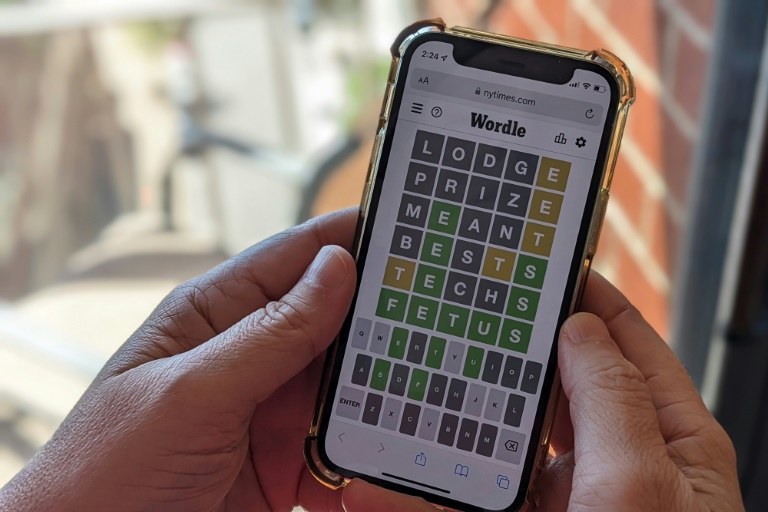
The New York Times, owner of the hit game Wordle, hastily changed the solution Monday from “fetus,” a term recently catapulted into the news as US abortion rights face possible restrictions by the Supreme Court.

Some of the game’s millions of players “may see an outdated answer that seems closely connected to a major recent news event,” the editorial director of the paper’s game section, Everdeen Mason, said in a statement.

Without mentioning the actual word, she said the choice was “entirely unintentional and a coincidence — today’s original answer was loaded into Wordle last year.”

That, of course, was long before a leaked Supreme Court draft decision last week revealed that if adopted, the majority of justices would overturn Roe v. Wade, the landmark 1973 decision which enshrined a woman’s right to an abortion nationwide.

Wordle, a daily game which consists of guessing one five-letter word in just six tries, was bought by the Times in January after it skyrocketed in worldwide popularity.

“We take our role seriously as a place to entertain and escape, and we want Wordle to remain distinct from the news,” Mason said.

“When we discovered last week that this particular word would be featured today, we switched it for as many solvers as possible,” although it was too late to change it for all.

Already in February, the paper announced that it had scrubbed Wordle of many obscure as well as “insensitive or offensive words.”

On social media, some users shared the day’s two solutions, mocking the center-left paper for being overly delicate.

The NYT editorial board last week took a formal stand in favor of the right to abortion, with an op-ed titled “America Is Not Ready for the End of Roe v. Wade.”

Sri Lanka PM quits as violence kills 5, injures 180

Violence raged across Sri Lanka late into the night on Monday, with five people dead and some 180 injured as prime minister Mahinda Rajapaksa quit after weeks of protests.

Those killed in the worst unrest since the crisis began included a lawmaker from the ruling party who shot two people. Another ruling party politician gunned down two others.

Earlier in the day, government supporters in the capital Colombo attacked with sticks and clubs opponents angry over Sri Lanka’s worst economic crisis since the island nation’s 1948 independence.

“We were hit, the media were hit, women and children were hit,” one witness said, asking not to be named, as dozens of people were admitted to hospital.

US Ambassador Julie Chung tweeted that Washington condemned “the violence against peaceful protestors” and called for the Sri Lankan government “to conduct a full investigation, including the arrest & prosecution of anyone who incited violence”.

The clashes precipitated the resignation of prime minister Rajapaksa, the elder brother to President Gotabaya Rajapaksa. In stepping down, the premier said he was paving the way for a unity government.

But it was unclear if the opposition would join any administration with Gotabaya Rajapaksa as president, and the resignation failed to assuage public anger.

Retaliatory attacks by government opponents were reported across the island of 22 million people even after police declared an indefinite curfew.

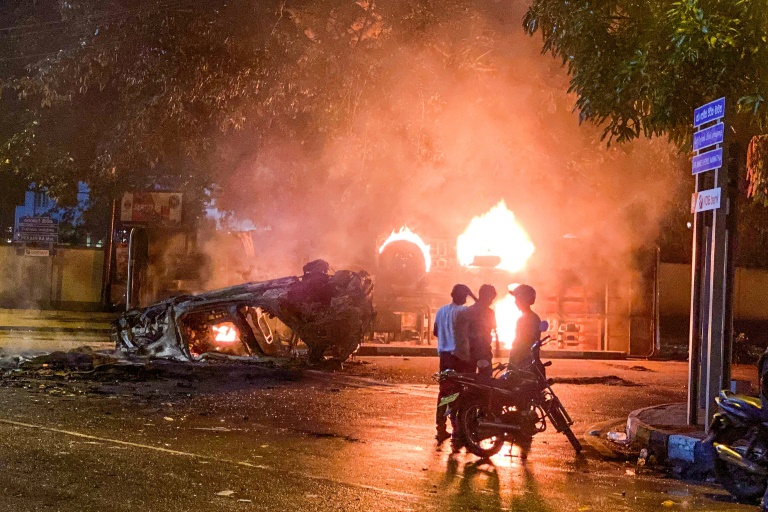
Thousands of protestors tried to storm the official residence of the prime minister in the capital, setting fire to a truck at the entrance as they breached the main gate.

Police responded by firing tear gas and gunshots into the air from the residence where Mahinda Rajapaksa remained holed up.

Witnesses saw several tear gas cannisters hit the US embassy compound across from the Temple Trees residence, a key symbol of state power in the South Asian island.

Officials said the military deployed hundreds of troops to guard the outgoing premier and his aides at the building.

– Surrounded –

Elsewhere, ruling-party lawmaker Amarakeerthi Athukorala shot two people and then took his own life after a mob of anti-government protesters surrounded him outside Colombo, police said.

Athukorala’s bodyguard was also found dead at the scene, police said.

Another ruling party politician who was not named opened fire on protesters in the southern town of Weeraketiya, killing two and wounding five, authorities said.

Police reported that dozens of homes of ruling party politicians were attacked by angry mobs across the island, setting fire to houses and vehicles. 

Buses and trucks used by government loyalists to bring people to the capital earlier in the day were also targeted.

Doctors at Colombo National Hospital, where more than 180 people were treated for injuries, intervened to rescue wounded government supporters, with soldiers breaking open locked gates.

“They may be murderers, but for us they are patients who must be treated first,” a doctor shouted at a mob blocking the entrance to the emergency unit.

Crowds also attacked a museum devoted to the Rajapaksas in the family’s ancestral village in the deep south of the island, razing it to the ground, police said.

Several Rajapaksa homes were also torched in different parts of the country.

A hotel in Negombo owned by a close associate of Mahinda Rajapaksa’s children was set ablaze, along with a Lamborghini car parked inside. There were no casualties among foreign guests, police said.

– State of emergency –

On Friday, the government imposed a state of emergency granting the military sweeping powers to arrest and detain people, after trade unions brought the country to a virtual standstill.

The defence ministry said anti-government demonstrators were behaving in a “provocative and threatening manner” and disrupting essential services, in a statement on Sunday.

Sri Lanka’s crisis was sparked after the coronavirus pandemic hammered vital income from tourism and remittances, starving the country of foreign currency needed to pay off its debt and forcing the government to ban many imports.

This led to severe shortages, runaway inflation and lengthy power blackouts.

In April, the country announced it was defaulting on its $51 billion foreign debt.

“Mahinda Rajapaksa likely read the writing on the wall and realised it was time to go,” expert Michael Kugelman from the Wilson Center told AFP.

“But until and unless President Rajapaksa steps down, no one — whether the masses in the streets or key political stakeholders — will be appeased.”

Close Bitnami banner
Bitnami