World

'We are not Nazis': Kyiv quietly marks Victory Day

As Lera Nelyub walked alongside her grandfather Nikolai, she admitted it was difficult to find a way to talk about the ongoing Russian invasion with the 97-year-old World War II veteran. 

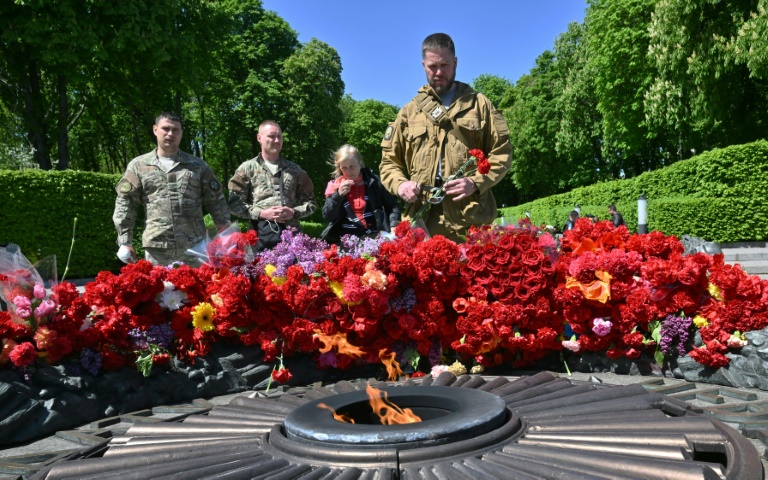
At Kyiv’s Tomb of the Unknown Soldier on Monday, she held on to him as he bent to lay a bouquet of flowers to honour the memory of his friends and comrades from the Soviet Army who died fighting the Nazis in World War II. 

“It is difficult for him to talk about it. At first when he was watching the news, he couldn’t believe what was happening,” said Nelyub when asked how her grandfather felt about Russian President Vladimir’s Putin’s ongoing war to “de-Nazify” Ukraine.

“It is completely idiotic what’s happening… Putin has an alternative history,” she said.

As Ukrainians flocked to the city’s World War II monument, Putin was in Moscow’s Red Square giving a speech for Russia’s Victory Day celebrations, where he derided Ukraine and sought to justify his invasion as an extension of Moscow’s war against the Nazis in the 1940s. 

But the argument held little water in Kyiv, where a steady stream of relatives of those who fought and died fighting the Nazi invasion paid their respects to the fallen. 

Tetyana Levchenko, 65, bristled at Putin’s diatribes as she laid her own flowers at the monument.  

“This is a holiday for me — a big, bright holiday. It’s the day of victory over fascist Germany,” said Levchenko. 

“This concerns me personally and my family… We are not Nazis,” she insisted. 

Between eight and 10 million Ukrainians are believed to have died in the brutal fighting of World War II that saw the Soviet Union repel the Nazi invasion of its territory that helped defeat Hitler’s Third Reich. 

– Honouring the recent dead –

Earlier in the day, President Volodymyr Zelensky invoked the ghosts of the war to lambast Russia, saying Ukraine was “proud” of its role in defeating the Nazi forces.

“We will not allow anyone to annex this victory. We will not allow it to be appropriated,” he said in a video address.

For months, Putin has sought to link Russia’s ongoing invasion of Ukraine to the events of World War II, describing the authorities in Kyiv as neo-Nazis.

But Sergiy Marmuzin, a 46-year-old labourer, shrugged off the ongoing political wrangling over the conflict, saying it would not stop him from commemorating what he considers a sacred day. 

“Sure, this holiday is used in political games of some sort, but it remains a holiday to me,” Marmuzin told AFP, saying his great-grandfather died in the war.

Others were visiting Kyiv’s World War II monument to honour Ukraine’s latest martyrs — those killed in the ongoing fight against the Russian invaders. 

“I wanted to commemorate our warriors, warriors who defend us,” said retired teacher Nina Mironova, 72.  

“I want this war to end so much, because it has brought us so much grief.”
Saudi fights to lead 'saturated' MidEast aviation market

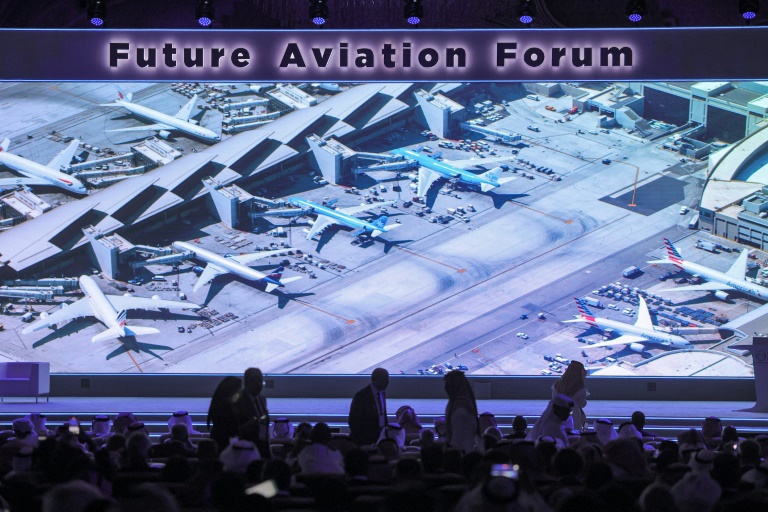
Saudi Arabia on Monday pitched aviation industry leaders on its plans to become a global travel hub, drawing scepticism from analysts who questioned how it could compete against regional heavyweights. 

The conservative kingdom’s aviation goals, part of Crown Prince Mohammed bin Salman’s wide-ranging “Vision 2030” reforms, include more than tripling annual traffic to 330 million passengers by the end of the decade. 

It also wants to draw $100 billion in investments to the sector by 2030, establish a new national flag carrier, construct a new “mega airport” in Riyadh and move up to five million tonnes of cargo each year. 

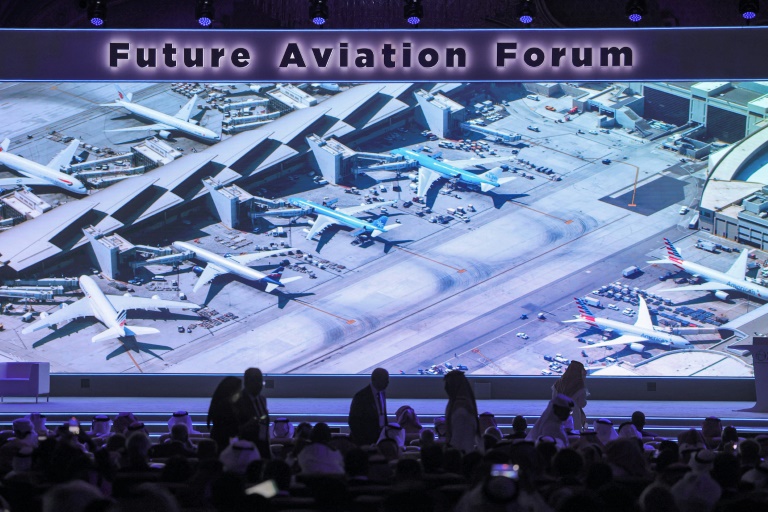
Officials outlined how they intend to hit those targets during a global aviation forum that began Monday in Riyadh. Organisers said 2,000 delegates are trying to chart the airline industry’s post-pandemic recovery. 

“Over the next 10 years the kingdom will emerge as the Middle East’s leading aviation hub,” Transport Minister Saleh Al-Jasser told the forum’s opening session. 

The strategy hinges on tapping the large domestic market of Saudi Arabia, whose population is around 35 million, he told AFP in an interview, citing what analysts described as a major advantage for Saudi carriers over regional rivals Emirates and Qatar Airways. 

“We are very focused on building connectivity to Saudi Arabia, in helping the tourism industry to grow in Saudi Arabia and helping the Saudi people connect to the world… That’s what we are focused on,” he said. 

But steep competition raises questions about how feasible the Saudi plans are. 

“They’re fighting multiple headwinds on the aviation front,” said Robert Mogielnicki with the Arab Gulf States Institute in Washington. 

“You have established regional players that have great brand recognition and are already important parts of the economies of Qatar and Dubai.” 

In Saudi Arabia, by contrast, “the air transport sector is not as central to the economy so that urgency is not there, though the Saudis do have big ambitions for the sector. It’s a new entity, so they’re going to have to play catch-up.” 

– ‘Not going to be easy’ –

The kingdom is currently served by flag carrier Saudia and its budget subsidiary flyadeal, both based in the coastal city of Jeddah, as well as other budget carriers including the Riyadh-based flynas. 

Even without the kingdom’s planned new airline, Saudi carriers are fighting for space not just with Emirates and Qatar Airways but also regional budget airlines like flydubai and Air Arabia.

“It is a rather saturated market,” Henrik Hololei, the European Commission’s Director-General for Mobility and Transport, told AFP. 

“It’s clear that it’s not going to be easy for any airline that wants to have a global reach to enter that market.” 

Multiple analysts highlighted the need for Saudi Arabia to improve its airports.

Last weekend the head of the company that operates the airport in Jeddah, gateway to the holy sites in Mecca and Medina, was fired after what state media described as “a crisis of overcrowding and flight delays”. 

Hololei said “the vision and very ambitious announcements” need to be complemented by details. 

“How they are going to play the cards, this remains to be seen.”

Saudi fights to lead 'saturated' MidEast aviation market

Saudi Arabia on Monday pitched aviation industry leaders on its plans to become a global travel hub, drawing scepticism from analysts who questioned how it could compete against regional heavyweights. 

The conservative kingdom’s aviation goals, part of Crown Prince Mohammed bin Salman’s wide-ranging “Vision 2030” reforms, include more than tripling annual traffic to 330 million passengers by the end of the decade. 

It also wants to draw $100 billion in investments to the sector by 2030, establish a new national flag carrier, construct a new “mega airport” in Riyadh and move up to five million tonnes of cargo each year. 

Officials outlined how they intend to hit those targets during a global aviation forum that began Monday in Riyadh. Organisers said 2,000 delegates are trying to chart the airline industry’s post-pandemic recovery. 

“Over the next 10 years the kingdom will emerge as the Middle East’s leading aviation hub,” Transport Minister Saleh Al-Jasser told the forum’s opening session. 

The strategy hinges on tapping the large domestic market of Saudi Arabia, whose population is around 35 million, he told AFP in an interview, citing what analysts described as a major advantage for Saudi carriers over regional rivals Emirates and Qatar Airways. 

“We are very focused on building connectivity to Saudi Arabia, in helping the tourism industry to grow in Saudi Arabia and helping the Saudi people connect to the world… That’s what we are focused on,” he said. 

But steep competition raises questions about how feasible the Saudi plans are. 

“They’re fighting multiple headwinds on the aviation front,” said Robert Mogielnicki with the Arab Gulf States Institute in Washington. 

“You have established regional players that have great brand recognition and are already important parts of the economies of Qatar and Dubai.” 

In Saudi Arabia, by contrast, “the air transport sector is not as central to the economy so that urgency is not there, though the Saudis do have big ambitions for the sector. It’s a new entity, so they’re going to have to play catch-up.” 

– ‘Not going to be easy’ –

The kingdom is currently served by flag carrier Saudia and its budget subsidiary flyadeal, both based in the coastal city of Jeddah, as well as other budget carriers including the Riyadh-based flynas. 

Even without the kingdom’s planned new airline, Saudi carriers are fighting for space not just with Emirates and Qatar Airways but also regional budget airlines like flydubai and Air Arabia.

“It is a rather saturated market,” Henrik Hololei, the European Commission’s Director-General for Mobility and Transport, told AFP. 

“It’s clear that it’s not going to be easy for any airline that wants to have a global reach to enter that market.” 

Multiple analysts highlighted the need for Saudi Arabia to improve its airports.

Last weekend the head of the company that operates the airport in Jeddah, gateway to the holy sites in Mecca and Medina, was fired after what state media described as “a crisis of overcrowding and flight delays”. 

Hololei said “the vision and very ambitious announcements” need to be complemented by details. 

“How they are going to play the cards, this remains to be seen.”

Sri Lanka PM quits as violence kills 5, injures 180

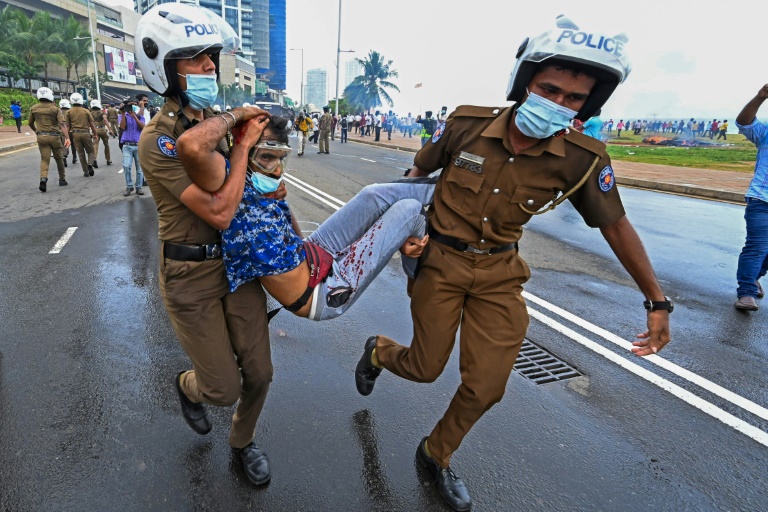
Sri Lankan Prime Minister Mahinda Rajapaksa quit on Monday, as an outbreak of political violence killed five people including an MP and wounded almost 200.

Lawmaker Amarakeerthi Athukorala from the ruling party shot two people — killing a 27-year-old man — and then took his own life after being surrounded by a mob of anti-government protesters outside Colombo, police said.

And another ruling-party politician who was not named opened fire on anti-government protesters in the southern town of Weeraketiya, killing two and wounding five, according to police.

Sri Lanka has suffered months of blackouts and dire shortages of food, fuel and medicines in its worst economic crisis since independence.

This sparked weeks of overwhelmingly peaceful demonstrations against President Gotabaya Rajapaksa, as well as his brother the prime minister.

On Monday scores of Rajapaksa loyalists attacked unarmed protesters camping outside the president’s office on a seafront promenade in downtown Colombo, AFP reporters said.

“We were hit, the media were hit, women and children were hit,” one witness said, asking not to be named.

Police fired tear gas and water cannon and declared an immediate curfew in Colombo, which was later widened to include the entire South Asian island nation of 22 million people.

A total of 181 people were hospitalised, a Colombo National Hospital spokesman told AFP. Eight were injured elsewhere.

The army riot squad was called in to reinforce police. Soldiers had mostly been deployed throughout the crisis to protect deliveries of fuel and other essentials, but not to prevent clashes before.

“Strongly condemn the violent acts taking place by those inciting & participating, irrespective of political allegiances,” President Rajapaksa tweeted. “Violence won’t solve the current problems.”

Mahinda Rajapaksa tendered his resignation as prime minister, saying it was to pave the way for a unity government — but it was unclear if the opposition would cooperate.

– US condemnation –

The US ambassador Julie Chung tweeted that Washington condemned “the violence against peaceful protestors today, and call(s) on the government to conduct a full investigation, including the arrest & prosecution of anyone who incited violence”.

Mary Lawlor, UN special rapporteur, said she had heard “disturbing reports… of repression & disproportionate use of force against peaceful demonstrators who are protesting against allegations of corruption & widespread impunity in Government”.

After the Colombo violence, anti-government protesters who had been demonstrating peacefully since April 9 began retaliating across the island, despite the curfew.

MP Athukorala’s car was surrounded by thousands of people in the town of Nittambuwa as he returned home from the capital after the clashes.

He shot two people before fleeing to a nearby building and then “took his own life with his revolver”, a police official told AFP by telephone.

Athukorala’s bodyguard was also found dead at the scene, police said.

Angry mobs set alight the homes of at least three pro-Rajapaksa politicians, along with some nearby vehicles, while buses and trucks used by the government loyalists in and around Colombo were targeted for destruction.

Doctors at Colombo National Hospital intervened to rescue wounded government supporters, with soldiers breaking open locks to open the gates.

“They may be murderers, but for us they are patients who must be treated first,” a doctor shouted at a mob blocking the entrance to the emergency unit.

Mobs attacked the controversial Rajapaksa museum in the family’s ancestral village in the deep south of the island and razed it to the ground, police said. Two wax statues of the Rajapaksa parents were flattened.

– State of emergency –

On Friday, the government imposed a state of emergency granting the military sweeping powers to arrest and detain people, after trade unions brought the country to a virtual standstill.

The defence ministry said in a statement on Sunday that anti-government demonstrators were behaving in a “provocative and threatening manner” and disrupting essential services.

Sri Lanka’s crisis began after the coronavirus pandemic hammered vital income from tourism and remittances, starving it of foreign currency needed to pay off its debt and forcing the government to ban many imports.

This in turn has led to severe shortages, runaway inflation and lengthy power blackouts.

In April, the country announced it was defaulting on its $51 billion foreign debt.

Global stocks and oil slump on China lockdowns, interest rates

World stock markets mostly sank Monday and oil prices slumped as China’s Covid lockdowns added to stubborn fears over the impact of rising US interest rates and surging inflation.

Frankfurt, London and Paris all fell more than two percent, as did Tokyo.

On Wall Street, the Dow was down nearly two percent in late morning trading, with the tech-heavy Nasdaq continuing a steep decline with a 3.7 percent drop.

Meanwhile, bitcoin plunged to a 2022 low below $33,000 as investors shunned the volatile cryptocurrency.

“The bloodletting on stock markets has continued today as we start a new week … with the biggest declines being seen in basic resources after the latest China trade data showed that imports ground to a halt in April,” said market analyst Michael Hewson at CMC Markets UK.

Millions of people in Beijing stayed home on Monday as China’s capital tries to fend off a Covid-19 outbreak with creeping restrictions on movement.

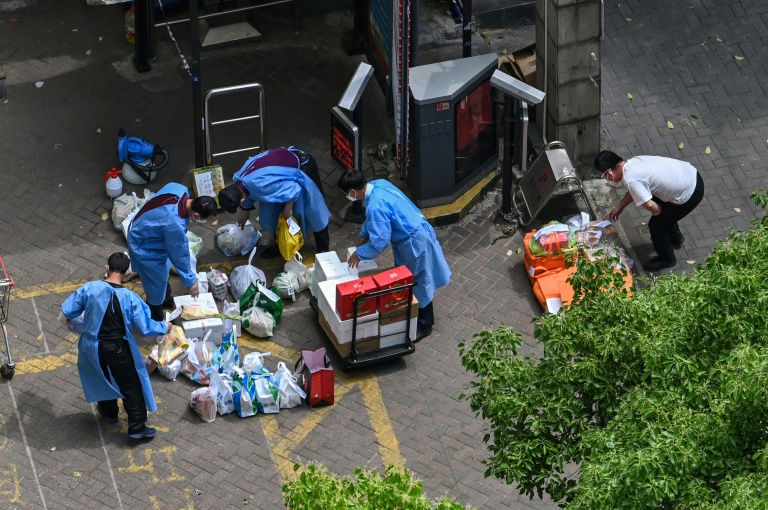
Beijing residents fear they may soon find themselves in the grip of the same draconian measures that have trapped most of Shanghai’s 25 million people at home for weeks.

Lockdowns across dozens of Chinese cities — from the manufacturing hubs of Shenzhen and Shanghai to the breadbasket of Jilin — have wreaked havoc on supply chains over recent months and further stoked global inflationary pressures.

Investors were given more bad news on Monday as China’s April exports slumped to their lowest level in almost two years, due to the nation’s strict zero-Covid policy.

Exports plunged to 3.9 percent on-year, while imports were stagnant for April.

Data also showed the lockdowns have already hit oil demand in China, prompting a five percent drop in oil prices. 

“Oil is offside too as China confirmed its oil imports in the first four months of the year fell by 4.8 percent,” said David Madden at Equiti Capital.

– Anxiety spreads –

Stock markets had dived last week after the Federal Reserve ramped up interest rates by a half-percentage point and flagged more hikes to tackle decades-high inflation.

“Anxiety is stemming from the Fed’s next moves, with uncertainty creeping in about the scale and speed of interest rate hikes,” said Hargreaves Lansdown analyst Sophie Lund-Yates.

Analysts at Charles Schwab brokerage said that “elevated inflation pressures continue to cloud conviction, with the Fed and other central banks beginning to tighten monetary policy. 

“Meanwhile, inflation concerns continue to be exacerbated by the war in Ukraine and ongoing supply chain challenges,” they added.

Global markets have also taken a beating this year from Russia’s invasion of Ukraine.

President Vladimir Putin on Monday defended Russia’s offensive in Ukraine and blamed Kyiv and the West, as he looked to use grand Victory Day celebrations to mobilise patriotic support for the campaign.

However, investors were relieved that Putin made no major announcements, despite reports he could use the anniversary to announce an escalation of the conflict or a general mobilisation.

“Putin has not declared a war on Ukraine to enable full mobilisation which is obviously a relief,” noted Markets.com analyst Neil Wilson.

– Key figures at around 1530 GMT –

New York – Dow: DOWN 1.9 percent at 32,266.84 points

EURO STOXX 50: DOWN 2.5 percent at 3,486.21

London – FTSE 100: DOWN 2.3 percent at 7,216.58 

Frankfurt – DAX: DOWN 2.2 percent at 13,380.67

Paris – CAC 40: DOWN 2.8 percent at 6,086.02

Shanghai – Composite: UP 0.09 percent at 3,004.14 (close)

Tokyo – Nikkei 225: DOWN 2.5 percent at 26,319.34 (close)

Hong Kong – Hang Seng Index: Closed for a holiday  

Brent North Sea crude: DOWN 5.0 percent at $106.77 per barrel

West Texas Intermediate: DOWN 5.4 percent at $103.87 per barrel

Euro/dollar: DOWN at $1.0536 from $1.0551 on Friday

Pound/dollar: DOWN at $1.2311 from $1.2348

Euro/pound: UP at 85.55 pence from 85.45 pence

Dollar/yen: DOWN at 130.23 yen from 130.56 yen

burs-rl/lcm

French court upholds fake-job verdict against former PM Fillon

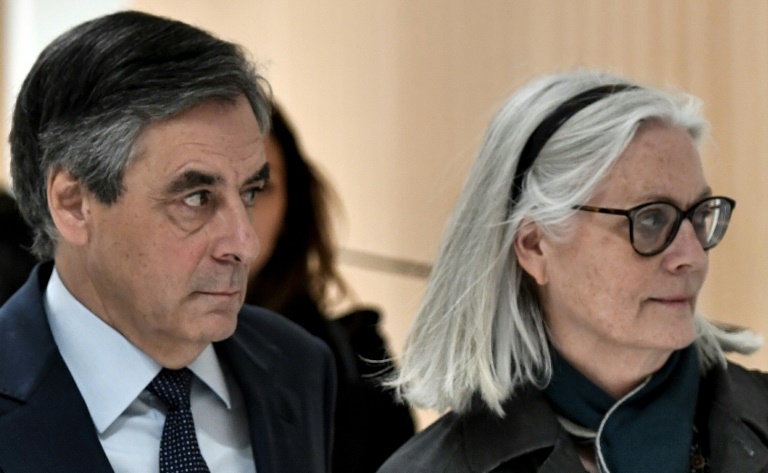
A French appeals court on Monday upheld a conviction against former right-wing prime minister Francois Fillon for providing a fake parliamentary assistant job to his wife that saw her paid hundreds of thousands of euros in public funds.

The “Penelopegate” scandal, revealed in a media report while he was the front-runner in the 2017 presidential race, torpedoed his political career and cleared a path for then-relatively unknown Emmanuel Macron to win the race.

Fillon, a hard-nosed fiscal conservative, angrily denied the claim and insisted that his wife Penelope Fillon had done genuine constituency work while he was an MP for the western Sarthe department.

But prosecutors insisted there was scant record of any actual work and noted she had rarely joined her husband at the lower-house National Assembly, which was a civil plaintiff in the case.

The court trimmed Fillon’s sentence to four years in prison with three suspended — down from five years with three suspended when he was first found guilty in 2020.

Penelope Fillon was given a suspended two-year prison sentence for the embezzlement and complicity in misuse of public funds charges, down from three years suspended, but the court maintained fines of 375,000 euros for each of them.

They were also ordered to repay 800,000 euros ($845,000) to the National Assembly, which reimbursed Penelope for the job as Fillon’s assistant.

Under French sentencing guidelines, it is unlikely that Fillon will spend any time behind bars, and can be ordered instead to wear an ankle-bracelet.

The couple was not in court for the verdict, and their defence team said they would lodge a further appeal with France’s supreme court.

“The court did not draw the conclusions of its own findings with regards to the evidence demonstrating the reality of Mrs Fillon’s work,” the lawyers said in a statement.

– ‘Never got involved’ –

At the November appeals hearings, prosecutors said there was clear evidence that Fillon and his stand-in as MP for the Sarthe department, Marc Joulaud, employed Fillon’s wife Penelope in an “intangible” or “tenuous” role as a parliamentary assistant between 1998 and 2013.

The court also upheld Monday the original three-year suspended sentence for Joulaud.

Fillon, now 68, was widely tipped to win the 2017 presidency race when the Canard Enchaine newspaper reported that Penelope had been his parliamentary assistant for 15 years, earning some one million euros over the period.

It later emerged that Fillon also used public money to pay two of his children a combined 117,000 euros for allegedly sham work while he was a senator, before he became premier in the government of president Nicolas Sarkozy from 2007 to 2012.

On Monday, the court overturned that conviction, however.

But he was again convicted, in a third fraud case, of getting the millionaire owner of a literary magazine to pay his wife 135,000 euros for “consulting work” that was largely fake.

The magazine’s owner, Marc Ladreit de Lacharriere, pleaded guilty to the charges in December 2018, and was given a suspended eight-month prison sentence and a 375,000 euro fine.

Lastly, he was again found not-guilty of failing to declare an interest-free loan of 50,000 euros from Ladreit de Lacharriere in 2013.

Fillon insisted he was the target of a “political assassination” and before the appeals court he insisted that Penelope’s “on-the-ground” work in Sarthe was “immaterial” but very “real.”

“I was not a fake deputy only concerned about money,” he said.

But investigators seized on a 2016 newspaper interview in which Penelope said: “Until now, I have never got involved in my husband’s political life.”

Since withdrawing from politics, Fillon had held jobs on the boards of Russian petrochemicals giant Sibur and hydrocarbons firm Zarubezhneft.

He has quit both posts since Russia’s invasion of Ukraine.

Moscow marks Victory Day in shadow of Ukraine conflict

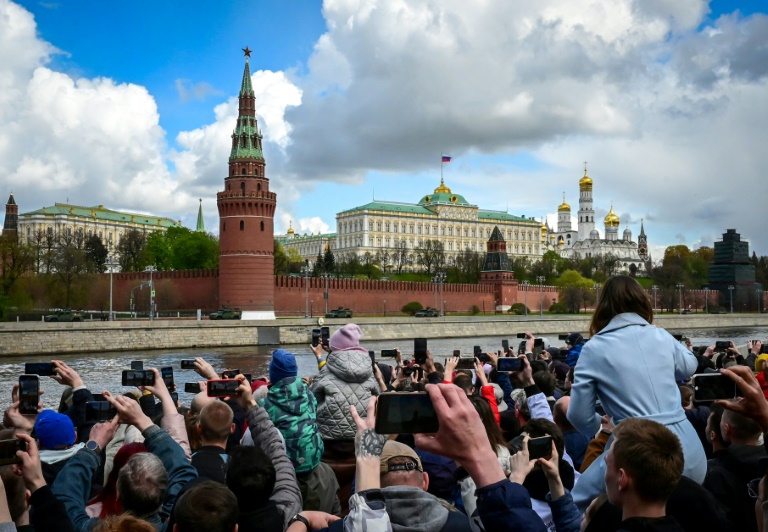
Tanks rolled through the streets of Moscow on Monday just like every May 9, but this year’s Victory Day was being marked with Russia’s military action in Ukraine on everyone’s minds.

The annual celebration, which sees military vehicles parade through Red Square and central city streets, is one of Russia’s most important holidays, celebrating the anniversary of the Soviet victory over Nazi Germany in 1945.

In most years the focus is squarely on the past, on the heroic victories and sacrifices of what Russians call the Great Patriotic War.

But with troops now deployed in Ukraine for what President Vladimir Putin calls a campaign to “de-Nazify” Russia’s pro-Western neighbour, this year the present was never far away.

Joining the crowds in central Moscow, Anya said she was from the Ukrainian city of Mariupol — which has seen some of the heaviest fighting since Moscow sent troops to Ukraine on February 24 — and that she supported Russia’s military action.

“I am very grateful to Putin for what he is doing…. We must defeat Nazism like our grandparents,” said Anya, wearing a military-style cap and a black-and-orange ribbon, a symbol of World War II victory celebrations in Russia.

Like others who spoke to AFP on Monday, Anya refused to give her last name.

– Memory ‘stolen and destroyed’ – 

Other participants questioned whether it was appropriate to link the sacred memories of World War II with the current conflict.

“You shouldn’t draw parallels, these are completely different times,” said 40-year-old Irina, who came out to pay tribute to her two grandfathers who fought against Nazi Germany. 

She said she hoped “all this will end quickly”.

Some simply chose to ignore the celebrations, like 35-year-old blogger Anna, who said she would spend the morning in bed with noise-cancelling headphones. 

“I can’t bear anything connected to the military anymore, because it used to be associated with peace and defending the Motherland. Now it’s not,” she said.

“It feels like the whole memory of Victory Day has been stolen and destroyed,” she said.

For many, the day was a simply a chance to enjoy some time off and the spectacle of the parade.

Waving Soviet and Russian flags, they watched as tanks, intercontinental ballistic missile launchers and armoured vehicles made their way to Red Square.

“Look, those are S-300s and S-400s, they’re using them in Ukraine right now,” said one man to his girlfriend in the crowd.

“These are the most powerful weapons we have,” said a father to his little boy perched on his shoulders as surface-to-air missile systems went by.

The city was festooned with Soviet-era symbols ahead of the celebration, including a 10-metre-high replica of a medal from 1945 reading “USSR – Victory” and displayed outside the Bolshoi Theatre, a short walk from the Kremlin.

– ‘Z’ the new symbol –

But a new military symbol was also on display this year, drawn on car windows and on people’s clothes — the letter “Z” that is being used to show support for Russia’s campaign in Ukraine.

During rehearsals for the parade, Russian fighter jets even practised flying across Moscow in the shape of a “Z”, although the flypast was cancelled on the day due to bad weather. 

Below Moscow’s busy roads, Viktoria, the owner of a small cafe in an underground passage, said she felt “it’s a little strange” to celebrate Victory Day this year.

“I avoid reading the news but what I do follow are the soldiers who died in Ukraine, who are buried in Russian regions,” said the 30-year-old from Kalmykia, a region in southwestern Russia. 

She said she fears the economic consequences of the unprecedented sanctions imposed on Russia over the conflict.

“We are all afraid of the future. There have been deaths from Covid, will there be deaths from starvation?”

War in Ukraine: Latest developments

Here are the latest developments in the war in Ukraine:

– War defends ‘Russian Motherland’: Putin –

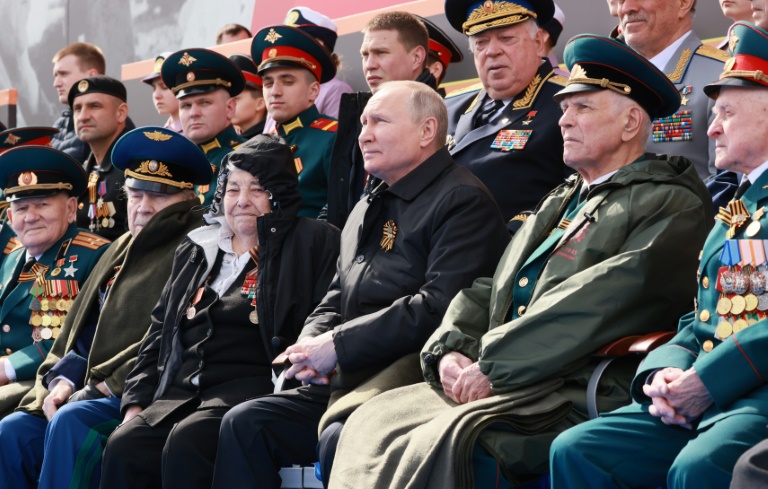
Russian President Vladimir Putin delivers his highly anticipated Victory Day speech at a giant military parade in Moscow. He says he had no choice but to send troops into Ukraine to defend the Russian “Motherland” from an “absolutely unacceptable threat”.

Speculation that he could use the 77th anniversary of the Soviet victory over Nazi Germany in World War II to expand the conflict comes to naught.

The Russian leader insists instead on the need to avoid “the horror of a global war”.

– ‘We will win,’ says Zelensky –

Ukraine’s President Volodymyr Zelensky says he will not allow the Soviet Union’s victory over the Nazis to be “appropriated” by Putin.

“We are proud of our ancestors who together with other nations in the anti-Hitler coalition defeated Nazism. And we will not allow anyone to annex this victory. We will not allow it to be appropriated,” he says.

He compares the Russian invasion to the Nazi occupation of parts of present-day Ukraine, vowing, “We won then. We will win now.”

– Russian generals ‘should be court martialled’ –

Britain’s Defence Secretary Ben Wallace slams what he calls the “absurdity” of Russian generals as they flank Putin at the Victory Day parade “resplendent in their manicured parade uniforms and weighed down by their many medals”.

He says “all professional soldiers should be appalled at the behaviour of the Russian Army”.

“Not only are they engaged in an illegal invasion and war crimes but their top brass have failed their own rank and file to the extent they should be court martialled.”

– Ukraine ‘decades’ away from EU membership: Macron –

EU chief Ursula von der Leyen says the bloc will give its opinion on Ukraine’s membership bid next month but French President Emmanuel Macron appears to rule out the prospect of the country joining the club in the near future.

Macron, whose country currently holds the rotating EU presidency, says joining the bloc would take “decades” and suggests instead that Ukraine and other EU hopefuls like Moldova and Georgia be integrated into a new, yet-to-be-created “European political community”.

– Russia using ‘ageing’ munitions –

As the conflict in Ukraine drags on, Russia’s stockpiles of precision-guided munitions are likely being depleted, leaving it reliant on “ageing” munitions that are less accurate, Britain’s military intelligence says.

“Russia’s invasion of Ukraine has revealed shortcomings in its ability to conduct precision strikes at scale,” the defence ministry says in a note.

– EU leader ducks for cover –

European Council President Charles Michel is forced to break off a meeting and take cover from missile fire during a surprise visit to the southern Ukrainian city of Odessa to mark Victory Day.

The strike took place as he held talks with Ukrainian Prime Minister Denys Shmygal, an EU official said.

– Don’t humiliate Russia, Macron warns –

Macron says peace efforts will not be served by Russia’s “humiliation”.

“Tomorrow we’ll have a peace to build, let’s never forget that,” he tells reporters in Strasbourg. 

“The terms of the discussion and negotiation will be set by Ukraine and Russia, but that will not be done through… the exclusion of one another, nor even in their humiliation.”

burs-cb/jmy/raz

Havana hotel blast toll rises to 35

Rescue workers have pulled another four bodies from the ruins of a Havana luxury hotel wrecked in an explosion last week, raising the death toll to 35, an official said.

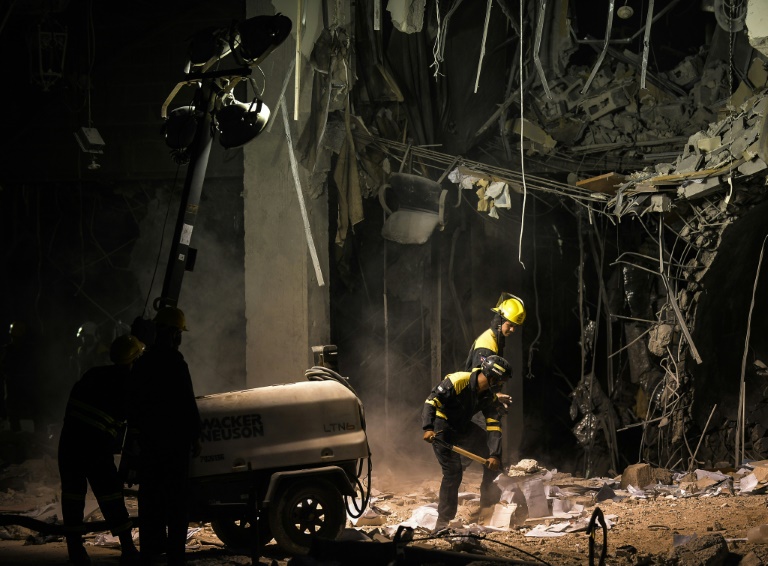
Crews continued to comb through the rubble of the Saratoga five-star hotel, which was being renovated and had no guests at the time of the late-morning blast last Friday that was seemingly caused by a gas leak.

The search is now focused on the basement and sub-basement of the building.

“It is at a very dangerous stage because of the concentration of rubble and the danger of collapse,” fire department head Luis Carlos Guzman told state television Monday, updating the death toll.

At the time of the blast, said the tourism ministry, there were 51 workers inside the hotel, which was readying for its post-refurbishment reopening this week.

The ACN state news agency said the four bodies found overnight were those of hotel workers.

“According to family members, it is estimated that there are about 12 or 13 people still trapped,” the news agency added.

On Sunday, officials said 24 people were receiving treatment in hospital.

The first four floors of the hotel were gutted in the blast that sent debris flying, smoke billowing into the air and rubble tumbling to the ground.

The explosion tore off large parts of the facade, blew out windows and destroyed cars parked outside the hotel, known for having hosted celebrities such as Madonna, Beyonce, Mick Jagger and Rihanna.

The dome of a nearby Baptist church also collapsed.

A 29-year-old Spanish tourist, who had been walking nearby, was among the fatalities, who also included four children and a pregnant woman.

The tourist’s husband was injured in the blast that an official said happened while a gas tank was being refilled by a tanker truck.

EasyJet tackles Covid staff shortage by removing seats

EasyJet plans to remove seats from Airbus aircraft this summer, allowing the British airline to fly with fewer cabin crew as it struggles with Covid absences and staff recruitment.

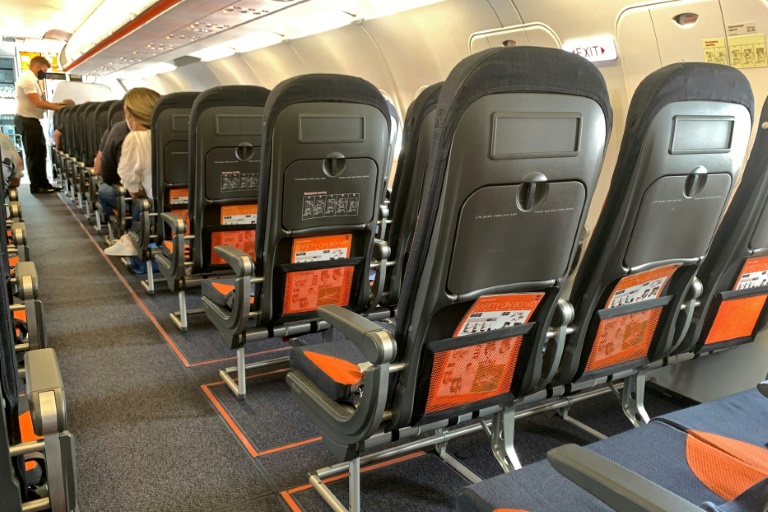
The carrier over the weekend revealed that during the upcoming peak flying season, it will cut the number of passenger seats on its A319 jets to 150 from 156.

This will allow it to fly with three cabin crew instead of four, under regulations imposed by the Civil Aviation Authority watchdog in Britain.

EasyJet said in a statement that its seat reduction “is an effective way of… building additional resilience and flexibility into our operation this summer”.

While the global aviation sector was ravaged by the coronavirus outbreak that grounded planes and slashed thousands of jobs, demand is recovering strongly after travel curbs were lifted.

This is turn has caused a rush for new staff.

EasyJet said only its UK fleet of A319 planes would be affected by the removal of seats.  

This numbers 60 jets, or slightly half of its A319 fleet.

The announcement comes after EasyJet cancelled a large number of flights over Easter as the sector faced a high level of absences owing to Covid.

Also last month, the no-frills carrier forecast its flight bookings to return to pre-Covid levels this summer, guiding it towards a lower-than-expected loss.

Close Bitnami banner
Bitnami