World

France puts ex-top Rwanda official on trial for genocide

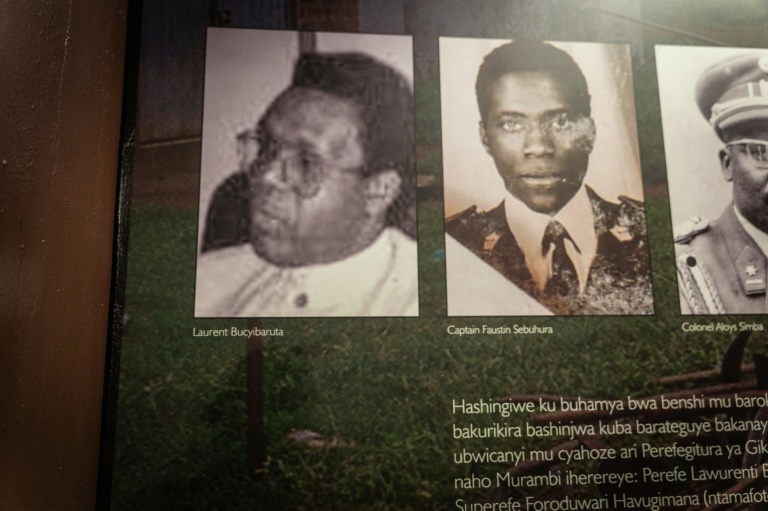
A former senior Rwandan official went on trial in Paris on Monday accused of complicity in the African nation’s genocide, the most high-ranking figure yet to face justice in France over the 1994 massacres.

The case of Laurent Bucyibaruta is the fourth from the Rwandan genocide to come to court in France, which had long been under pressure from activists to act against suspected perpetrators who had taken refuge on French soil. 

An estimated 800,000 Tutsis and moderate Hutus perished in 100 days of slaughter in 1994 in which Hutu militiamen massacred Tutsis taking cover in churches and schools.

Standing trial on charges of genocide, complicity in genocide and complicity in crimes against humanity, Bucyibaruta faces a life sentence if convicted. 

The 78-year-old, who suffers from health problems, entered the courtroom in a wheelchair, a walking stick in his hand. 

Bucyibaruta, in a hoarse voice, asked if he could remain seated, as offered by the court’s president. 

At the heart of the case are several “security” meetings, either ordered by Bucyibaruta or in which he participated. The accusation says they were slaughter-planning sessions.

– Tens of thousands killed –

In particular the former prefect of the southern province of Gikongoro is accused of persuading thousands of people to take refuge in the Murambi Technical School, by promising them food, water and protection. 

But days later, in the early hours of April 21, tens of thousands of Tutsis were executed in one of the genocide’s grimmest episodes.

The court will also discuss Bucyibaruta’s responsibility in the massacre of around 90 Tutsi pupils at the Marie Merci school in Kibeho on May 7 and in the execution of Tutsi prisoners — including three priests — in Gikongoro prison.

Bucyibaruta denies the charges and refutes any involvement in the killings. 

His lawyers will first call for the case to be thrown out for unreasonable delays, as the proceedings began 22 years ago. 

But if that fails, Bucyibaruta’s defence told AFP they would call for his acquittal.

The trial is expected to last two months and feature over 100 witnesses including survivors from Rwanda, who have flown over or will appear via videoconference. 

Bucyibaruta, who has been in France since 1997 and is under judicial supervision, has myriad health problems which should limit the hearings to seven hours a day. 

Four people in three cases have already been convicted in French courts over the genocide: a former hotel driver handed a 14-year sentence, an army officer jailed for 25 years and two mayors given life sentences.

Dozens march in Belgrade to mark 1945 Soviet victory

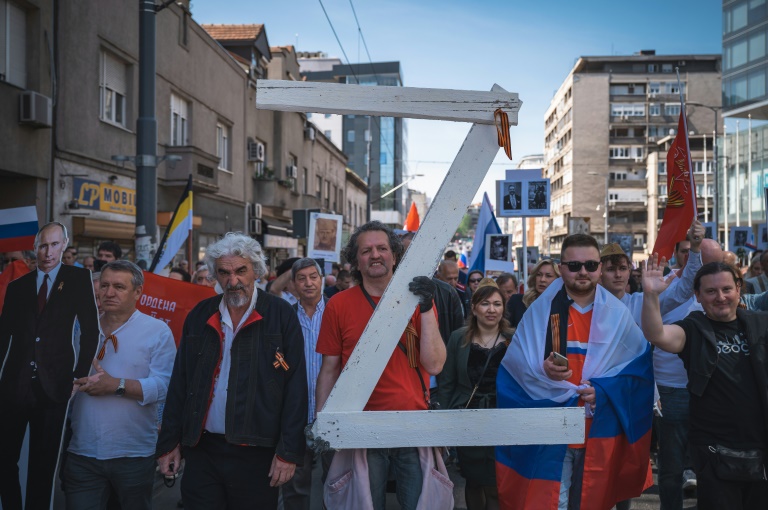
Some two hundred people marched Monday in the Serbian capital in an event organised by the Russian embassy in Belgrade to mark the Soviet defeat of Nazi Germany in World War II.

Serbia, which aspires to join the European Union, is a traditional ally of Russia and refuses to impose sanctions on Moscow over the invasion of Ukraine.

People taking part in the so-called “Immortal Regiment” march walked in silence through downtown Belgrade, cheering from time to time, and carried pictures of their loved ones killed during the war.

A man who walked at the head of the column carried a large letter “Z”, the mark of Russia’s invasion.

Another one carried a life-size cardboard cutout of Russian President Vladimir Putin, while some waved Russian and Soviet Union flags.

Many Serbs hold a favourable view of the Kremlin while Putin sees Serbia as a foothold in Europe. There have previously been pro-Russia rallies in Serbia after Moscow’s forces entered Ukraine in February.

Monday’s march ended at the liberators’ cemetery where representatives of Russia, Belarus, Kazakhstan, Azerbaijan and Serbia laid wreaths.

Their Ukrainian peers did the same Sunday.

“People have to remember, it’s easy to forget what was going on (in World War II)… and that’s why we have such a situation” in Ukraine, Marija Devric, 31, told AFP.

The finance expert took part in the march to honour her great-grandfather who “went from Moscow to Berlin” during the war.

Global stocks deepen losses on rising rates, China lockdowns

World stock markets mostly sank Monday on stubborn fears over the impact of rising US interest rates, surging inflation and China’s Covid lockdowns.

Frankfurt, London and Paris each shed more than one percent nearing the half-way stage after Tokyo closed down 2.5 percent.

On Wall Street, all three major indices fell by more than one percent at the start of trading. 

Shanghai edged higher and Hong Kong was shut for a holiday.

Oil prices lost two percent on demand worries and the haven dollar rose, while bitcoin plunged to a 2022 low below $33,000 as investors shunned the volatile cryptocurrency.

Stock markets had dived last week after the Federal Reserve ramped up interest rates by a half-percentage point and flagged more hikes to tackle decades-high inflation.

“Elevated inflation pressures continue to cloud conviction, with the Fed and other central banks beginning to tighten monetary policy,” said analysts at Charles Schwab brokerage. 

“Meanwhile, inflation concerns continue to be exacerbated by the war in Ukraine and ongoing supply chain challenges,” they added.

– Anxiety spreads –

“Anxiety is stemming from the Fed’s next moves, with uncertainty creeping in about the scale and speed of interest rate hikes,” said Hargreaves Lansdown analyst Sophie Lund-Yates.

“All this comes at the same time as China grapples with ongoing lockdowns and the prevailing economic storm these entail.”

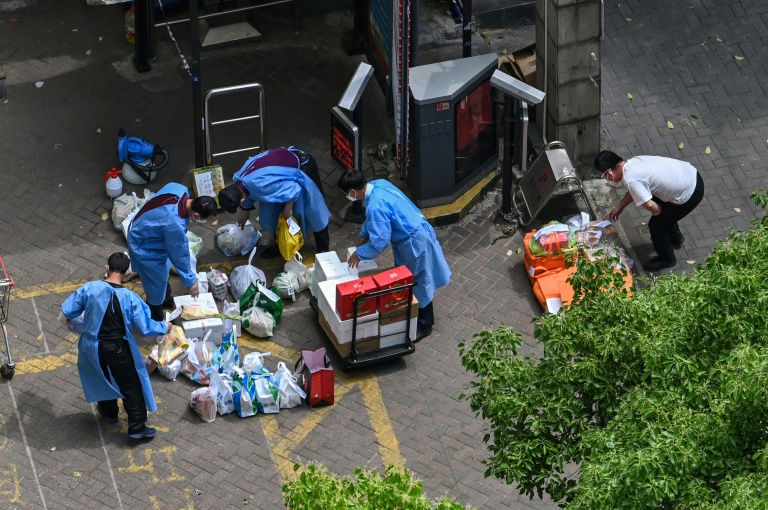
Millions of people in Beijing stayed home on Monday as China’s capital tries to fend off a Covid-19 outbreak with creeping restrictions on movement.

Beijing residents fear they may soon find themselves in the grip of the same draconian measures that have trapped most of Shanghai’s 25 million people at home for weeks.

Lockdowns across dozens of Chinese cities — from the manufacturing hubs of Shenzhen and Shanghai to the breadbasket of Jilin — have wreaked havoc on supply chains over recent months and further stoked global inflationary pressures.

Investors were given more bad news on Monday as China’s April exports slumped to their lowest level in almost two years, due to the nation’s strict zero-Covid policy.

Exports plunged to 3.9 percent on-year, while imports were stagnant for April.

Global markets have also taken a beating this year from Russia’s invasion of Ukraine.

President Vladimir Putin on Monday defended Russia’s offensive in Ukraine and blamed Kyiv and the West, as he looked to use grand Victory Day celebrations to mobilise patriotic support for the campaign.

However, investors were relieved that Putin made no major announcements, despite reports he could use the anniversary to announce an escalation of the conflict or a general mobilisation.

“Putin has not declared a war on Ukraine to enable full mobilisation which is obviously a relief,” noted Markets.com analyst Neil Wilson.

– Key figures at around 1330 GMT –

London – FTSE 100: DOWN 1.5 percent at 7,272.51 points

Frankfurt – DAX: DOWN 1.3 percent at 13,499.06

Paris – CAC 40: DOWN 1.7 percent at 6,151.30

EURO STOXX 50: DOWN 1.5 percent at 3,520.86

New York – Dow: DOWN 1.3 percent at 32,460.23

Shanghai – Composite: UP 0.09 percent at 3,004.14 (close)

Tokyo – Nikkei 225: DOWN 2.5 percent at 26,319.34 (close)

Hong Kong – Hang Seng Index: Closed for a holiday  

Brent North Sea crude: DOWN 2.2 percent at $110.18 per barrel

West Texas Intermediate: DOWN 2.4 percent at $107.42 per barrel

Euro/dollar: DOWN at $1.0543 from $1.0551 on Friday

Pound/dollar: UP at $1.2350 from $1.2348

Euro/pound: DOWN at 85.38 pence from 85.45 pence

Dollar/yen: UP at 130.73 yen from 130.56 yen

burs-rl/lcm

Dictator's son Marcos holds commanding lead in Philippine presidential poll

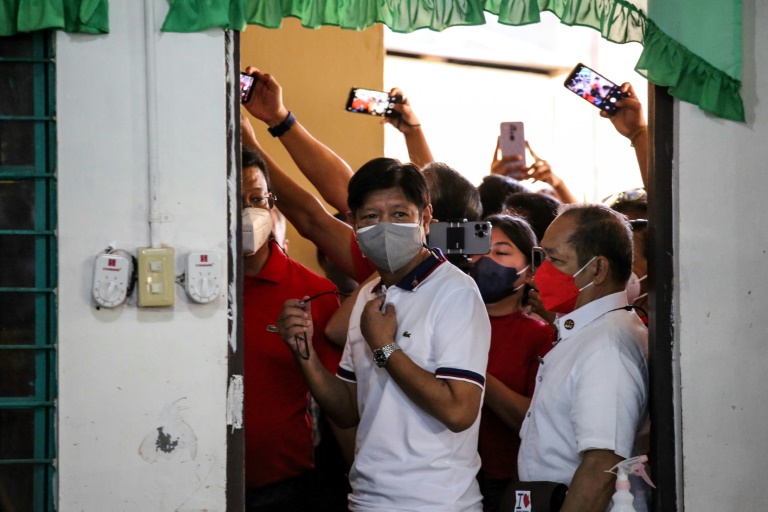
The son of late Philippines dictator Ferdinand Marcos commanded a massive early lead in the presidential election Monday, according to an unofficial tally of results that pointed to a historic landslide victory.

Nearly 40 years after his namesake father was deposed by a popular revolt and his family chased into exile, Ferdinand Marcos Jr was seen doubling the tally of his nearest rival.

With more than 60 percent of the country’s precincts reporting, Marcos had garnered more than 20 million votes, to liberal candidate Leni Robredo’s 9.4 million.

In the Philippines, the winner only has to get more votes than anyone else.

But if sustained, the tally — published by local media from Commission on Elections figures — would make Marcos the first Philippine president since his father’s ouster to be elected with an absolute majority.

It would also signal an astonishing turnaround for the fortunes of the Marcos clan, who have come from pariahs to the presidential palace in a generation.

“This will be a historic election,” said Cleve Arguelles, an assistant lecturer in political science at De La Salle University in Manila.

Commission on Elections chief George Garcia told AFP: “Until the last vote is counted, it’s not yet the end of everything.”

But the writing appeared to be on the wall for Marcos’s nine rivals, vying to succeed President Rodrigo Duterte in elections seen by many as a make-or-break moment for the Philippines’ fragile democracy.

The results would be a crushing blow for supporters of Robredo, the incumbent vice president who turned her campaign into a movement to defend democracy and brought almost a million people onto the streets in one recent rally.

From before dawn, mask-clad voters formed long queues to cast their ballots in 70,000 polling stations across the archipelago.

Polls officially closed at 7:00 pm (1100 GMT).

At Mariano Marcos Memorial Elementary School in the northern city of Batac, the ancestral home of the Marcoses, voters waved hand fans to cool their faces in the tropical heat.

Bomb sniffer dogs swept the polling station before Marcos Jr, 64, arrived with his younger sister Irene and eldest son Sandro.

They were followed by the family’s flamboyant 92-year-old matriarch Imelda, who was lowered from a white van while wearing a long, red top with matching trousers and slip-on flats.

Sandro, 28, who is running for elected office for the first time in a congressional district in Ilocos Norte province, admitted the family’s history was “a burden”.

But he added: “It’s one that we also try to sustain and protect and better as we serve.”

Casting her ballot for Robredo at a school in the central province of Camarines Sur, Corazon Bagay said the former congresswoman deserved to win.

“She has no whiff of corruption allegations,” said the 52-year-old homemaker.

“She’s not a thief. Leni is honest.”

Since Robredo announced her bid for the top job in October, volunteer groups have mushroomed across the country seeking to convince voters to back her in what they see as a battle for the country’s soul.

But relentless whitewashing of the elder Marcos’s brutal and corrupt regime, support of rival elite families and public disenchantment with post-Marcos governments have fuelled the scion’s popularity.

After six years of Duterte’s authoritarian rule, rights activists, Catholic leaders and political analysts fear Marcos Jr will be emboldened to rule with an even heavier fist if he wins by a large margin.

– Authoritarian rule – 

Robredo, a 57-year-old lawyer and economist, had promised to clean up the dirty style of politics that has long plagued the feudal and corrupt democracy, where a handful of surnames hold sway.

Marcos Jr and running mate Sara Duterte — both offspring of authoritarian leaders — have insisted they are best qualified to “unify” the country.

Hundreds of thousands of red-clad supporters turned out at Marcos Jr and Duterte’s raucous rally in Manila on Saturday, as they made a last push for votes.

Josephine Llorca said successive governments since the 1986 revolution that ousted the family had failed to improve the lives of the poor.

“We tried it and they were even worse than the Marcoses’ time,” she said.

– ‘Another crossroads’ – 

Other candidates seeking the presidency included boxing legend Manny Pacquiao and former street scavenger turned actor Francisco Domagoso.

Personality rather than policy typically influences many people’s choice of candidate, though vote-buying and intimidation are also perennial problems.

More than 60,000 security personnel have been deployed to protect polling stations and election workers. 

Police reported at least two deadly shootings at polling stations on the restive southern island of Mindanao that had left four people dead and three wounded.

That followed a grenade attack on Sunday that injured nine people. 

Misinformation on social media, meanwhile, sought to confuse voters.

The Commission on Elections branded as “fake and spurious” documents circulating online showing it had disqualified a senatorial hopeful and five political parties.

Whatever the result, Marcos Jr opponents have already vowed to pursue efforts to have him disqualified over a previous tax conviction and to extract billions of dollars in estate taxes from his family.

“It’s another crossroads for us,” said Judy Taguiwalo, 72, an anti-Marcos activist who was arrested twice and tortured during the elder Marcos’s regime.

“We need to continue to stand up and struggle.”

French court opens hearing into deadly Yemenia Airways crash

A French court opened hearings Monday in the case of the 2009 crash of a Yemenia Airways flight that killed 152 people but miraculously left a 12-year-old girl alive.

The Yemeni national airline, whose representatives will not be in the dock due to the country’s still-raging civil war, faces a maximum fine of 225,000 euros ($240,000) for involuntary homicide and injuries in a trial expected to last four weeks.

On June 29, 2009, flight Yemenia 626 was on approach to Moroni, the capital of the Comoros islands which lie between Mozambique and Madagascar, after departing from the airport in the Yemeni capital Sanaa.

France’s overseas territory of Mayotte is also part of the Comoros archipelago. Among the 142 passengers and 11 crew were 66 French citizens.

Rather than landing safely, just before 11:00 pm the Airbus A310 plunged into the Indian Ocean with its engines running at full throttle, killing everyone on board except Bahia Bakari, then just 12 years old.

In interviews and a book of her own, Bakari remembered “turbulence” during the approach, before feeling what seemed to be an electric shock and then blacking out — only to find herself in the sea.

She survived by clinging to debris for 11 hours until she was found by a fishing boat the following day.

Bakari was present as proceedings opened Monday, as were around 100 family members or friends of the crash victims. She is expected to testify on May 23.

– ‘Bitter taste’ –

Although the black boxes were found weeks after the crash, France accused the Comoros government of dragging its feet in the investigation, while victims’ families accused Yemen of lobbying to hinder a trial of the national carrier.

“Thirteen years is a very long time, it’s psychologically and morally exhausting, even physically,” said Said Assoumani, president of a victims’ association.

“But after 13 years of waiting and impatience, the criminal trial has finally come.”

Investigators and experts found there was nothing wrong with the aircraft, blaming instead “inappropriate actions by the crew during the approach to Moroni airport, leading to them losing control”.

But Yemenia Airways has been attacked by prosecutors for pilot training “riddled with gaps” and continuing to fly to Moroni at night despite its non-functioning landing lights.

“Yemenia remains deeply marked by this catastrophe… nevertheless it maintains its innocence,” the company’s lawyer Leon-Lef Forster said.

Meanwhile, the absence of any company representatives at the trial “leaves the families and the survivor with a bitter taste”, said Sebastien Busy, a lawyer for another victims’ association.

Around 560 people have joined the suit as plaintiffs, many of them from the region around Marseille in southern France, home to many of the victims.

A video feed to the southern port city has been set up for their benefit, allowing them to follow part of the proceedings.

Sri Lanka PM quits as violence kills 3, injures 150

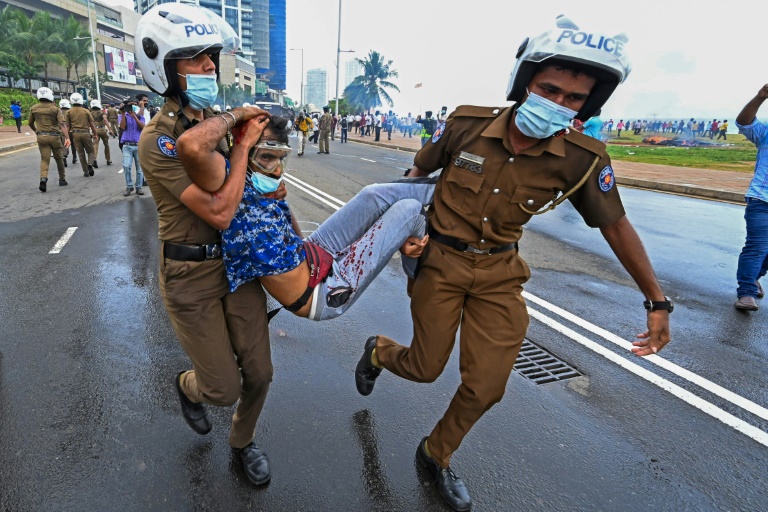
Sri Lankan Prime Minister Mahinda Rajapaksa quit on Monday after a day of violence saw three people including an MP killed and over 150 wounded as government supporters armed with sticks and clubs attacked protestors.

Lawmaker Amarakeerthi Athukorala from the ruling party shot two people — killing a 27-year-old man — and then himself after being surrounded by a mob of anti-government protestors outside the city, police said.

Sri Lanka has suffered months of blackouts and dire shortages of food, fuel and medicines in its worst economic crisis since independence, sparking weeks of overwhelmingly peaceful anti-government demonstrations.

On Monday scores of Rajapaksa loyalists attacked unarmed protesters camping outside the president’s office at the sea-front Galle Face promenade in downtown Colombo since April 9, AFP reporters said.

The violence began after several thousand supporters of the prime minister, brought in buses from rural areas, poured out of his nearby official residence.

Rajapaksa had addressed some 3,000 supporters at his house and pledged he would “protect the interests of the nation.”

The supporters then initially pulled down tents of protesters in front of the prime minister’s Temple Trees residence and torched anti-government banners and placards.

They then marched to the nearby promenade and began destroying other tents set up by the “Gota go home” campaign that demands the president step down.

“We were hit, the media were hit, women and children were hit,” one witness told AFP, asking not to be named.

Police fired tear gas and water cannon and declared an immediate curfew in Colombo which was later widened to include the entire South Asian island nation of 22 million people.

Over 150 injured people were hospitalised, Colombo National Hospital spokesman Pushpa Soysa told AFP. 

Officials said the army riot squad was called in to reinforce police. Soldiers have been deployed throughout the crisis to protect deliveries of fuel and other essentials but until now not to prevent clashes.

“Strongly condemn the violent acts taking place by those inciting & participating, irrespective of political allegiances. Violence won’t solve the current problems,” President Rajapaksa tweeted.

– US condemnation –

The US ambassador to Sri Lanka said Washington condemned “the violence against peaceful protestors today, and call(s) on the government to conduct a full investigation, including the arrest & prosecution of anyone who incited violence”.

“Our sympathies are with those injured today and we urge calm and restraint across the island,” Julie Chung tweeted.

MP Athukorala’s car was surrounded in the town of Nittambuwa outside Colombo as he returned home from the capital after the clashes.

“The MP fled the scene and took refuge at a nearby building,” a police official told AFP by telephone. “Thousands surrounded the building and he then took his own life with his revolver.” 

Athukorala’s bodyguard was also found dead at the scene, police said. 

Opposition MP Sajith Premadasa tried to move into the area after the Colombo clashes, but he came under attack from a mob and his security staff bundled him into a car and drove off. 

– ‘Unity government’ –

Mahinda Rajapaksa meanwhile tendered his resignation as prime minister to the president, his brother Gotabaya.

“I am resigning with immediate effect so that you will be able to appoint an all-party government to guide the country out of the current economic crisis,” the prime minister said in the letter, seen by AFP.

The country’s largest opposition party had said before the clashes that it would not join any government helmed by a member of the Rajapaksa clan.

The resignation of the prime minister automatically means the cabinet stands dissolved.

– ‘Restraint’ –

The violence was the worst since police shot dead one protestor and wounded 24 others blockading a railway line and a highway between Colombo and the central city of Kandy on April 19.

On Friday, the government imposed a state of emergency granting the military sweeping powers to arrest and detain people after trade unions brought the country to a virtual standstill.

The defence ministry said in a statement on Sunday that anti-government demonstrators were behaving in a “provocative and threatening manner” and disrupting essential services.

President Rajapaksa has not been seen in public since tens of thousands attempted to storm his private residence in Colombo on March 31.

Sri Lanka’s crisis began after the coronavirus pandemic hammered vital income from tourism and remittances, starving the country of foreign currency needed to pay off its debt and forcing the government to ban the imports of many goods. 

This in turn has led to severe shortages, runaway inflation and lengthy power blackouts.

In April, the country announced it was defaulting on its $51 billion foreign debt.

Russian envoy to Poland splattered with liquid on Victory Day

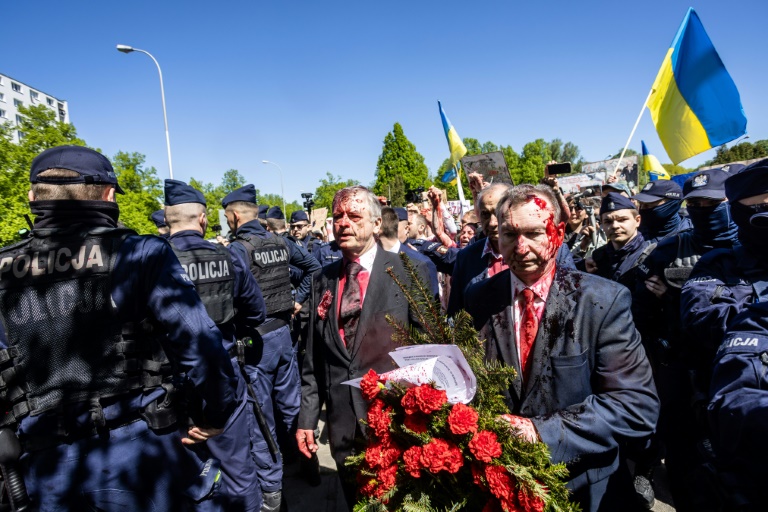
The Russian ambassador to Poland was splattered with a red substance by pro-Ukraine activists in Warsaw on Monday when he tried to lay a wreath to mark Victory Day.

Victory Day is celebrated annually on May 9 to commemorate the Soviet defeat of Nazi Germany in World War II. This year’s events are taking place as Moscow’s military campaign in Ukraine enters its third month.

“In Warsaw, during the laying of a wreath at the cemetery of Soviet soldiers, an attack was carried out on the Russian ambassador to Poland, Sergei Andreev, and the Russian diplomats accompanying him,” Russian foreign ministry spokeswoman Maria Zakharova said on Telegram.

“The admirers of neo-Nazism have again shown their faces,” she said, repeating Russia’s assertion that it is fighting neo-Nazis in Ukraine.

Chanting “fascists” and brandishing the national flag, pro-Ukraine activists blocked the ambassador’s way as he walked toward the mausoleum, preventing him from laying his wreath, according to an AFP photographer at the scene.

Several individuals then threw a red substance on his face and clothes, and also splattered some of the men in his entourage. 

After wiping his face with his hand, Andreev said “I am proud of my country and my president”. 

Andreev told Russian news agency RIA Novosti that he was not seriously harmed in the attack, adding that the red substance was some sort of syrup.

The Russian embassy had planned to hold an official ceremony at the site but cancelled after a negative response from Warsaw’s mayor and the foreign ministry.

– ‘Young neo-Nazis’ –

But Andreev still showed up with his wreath, as did individual Russians throughout the morning, while pro-Ukrainian protesters held up a big sign that said “criminals” and displayed photos of the war-torn country. 

Polish Interior Minister Mariusz Kaminski said after the incident that “Polish authorities did not recommend that the Russian ambassador lay flowers on May 9 in Warsaw”.

“The police made it possible for the ambassador to drive away safely,” he added.

Kaminski also tweeted that the activists had gathered there legally to protest “Russian aggression in Ukraine, where every day the crime of genocide takes place.”

“The emotions of the Ukrainian women — who took part in the demonstration and whose husbands are courageously fighting to defend their homeland — are understandable,” he added. 

Russia’s foreign ministry said it had protested to Polish officials “their indulgence of young neo-Nazis”.

“Russia has demanded that Poland organise without delay the wreath-laying ceremony while providing complete security in the face of all sorts of provocations,” it said in a statement. 

Poland has accepted hundreds of thousands of refugees from neighbouring Ukraine since Moscow sent troops into the country on February 24.

burs-amj/gw

Western multinationals congratulate Hong Kong's new leader

Western multinationals and local tycoons published newspaper adverts congratulating John Lee on becoming Hong Kong’s next leader, following a rubber-stamp selection process decried as anti-democratic by many major economies Monday.

Lee, 64, a former security chief who oversaw the crackdown on Hong Kong’s democracy movement, was anointed the business hub’s new leader on Sunday in a near-unanimous vote by a small committee of Beijing loyalists.

He was the sole candidate in the race to succeed outgoing leader Carrie Lam at a time when Hong Kong is being remoulded in China’s authoritarian image.

Canada, France, Germany, Italy, Japan, the UK and the United States on Monday joined the European Union in voicing alarm.

“We… underscore our grave concern over the selection process for the Chief Executive in Hong Kong as part of a continued assault on political pluralism and fundamental freedoms,” the G7 group said in a joint statement with the EU.

Beijing hailed the process as “a real demonstration of democratic spirit” and said it was the culmination of a strategy to ensure only “patriots” run Hong Kong.

– Corporate congratulations –

Ta Kung Pao and Wen Wei Po, two newspapers that answer to the office which sets Beijing’s Hong Kong policy, were filled with adverts on Monday from leading companies and business figures praising Lee’s selection.

Most were from Chinese and Hong Kong businesses as well as community organisations. 

The “Big Four” accountancy firms — KPMG, Deloitte, EY and PwC — were among Western multinationals placing adverts, as were city airline Cathay Pacific and conglomerates Swire and Jardine Matheson.

Messages were also carried by Hong Kong’s family tycoon-dominated property giants, including Sun Hung Kai and Henderson Land Development.

Western businesses have found themselves in an increasingly precarious position in Hong Kong, especially as tensions have risen with China.

Many have embraced progressive political causes in Western markets, such as the anti-racism Black Lives Matter movement, same-sex equality and ridding supply chains of labour abuses.

But they usually steer clear of any criticism of China’s policies towards hotspots such as Hong Kong, Xinjiang, Tibet and Taiwan.

Some companies such as HSBC, Standard Chartered, Swire and Jardine Matheson publicly backed Beijing’s national security law, which was imposed on Hong Kong after 2019’s democracy protests to curb dissent.

– Can Hong Kong reopen? –

The elevation of Lee, who is under US sanctions, places a security official in Hong Kong’s top job for the first time after a tumultuous few years for a city battered by political unrest and economically debilitating pandemic controls.

Despite the city’s mini-constitution promising universal suffrage, Hong Kong has never been a democracy, the source of years of protests since the 1997 handover from Britain to China.

Lee won 99 percent of the votes cast by the 1,461-strong committee that picks the city’s leader.

The former police officer has vowed to strengthen Hong Kong’s national security and integrate the city further with the mainland.

He wants to reboot the city’s economy and slowly reopen its pandemic-sealed borders at a time when its rivals have moved to living with the coronavirus.

But it is unclear how he can do that given China has doubled down on its strict zero-Covid strategy.

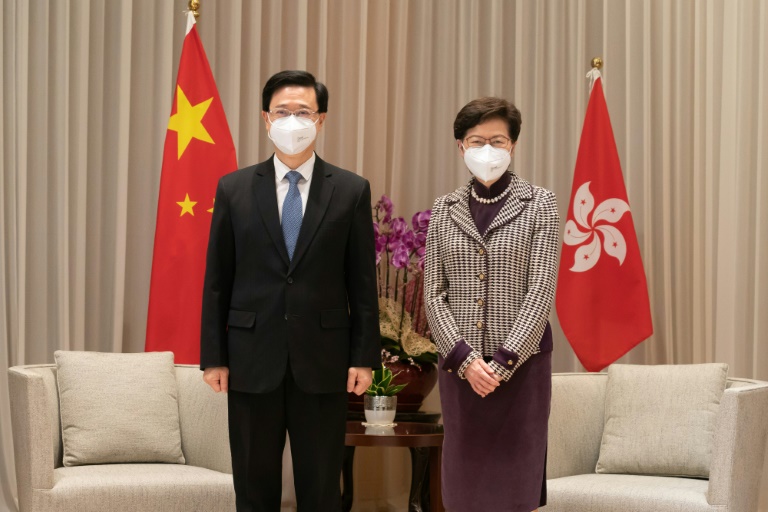
On Monday morning, Lam met her successor and both gave short speeches stressing that they would prepare for an orderly transition.

Lee, who takes over on July 1, was Lam’s security chief and then her deputy.

He was asked by reporters whether Hong Kongers could criticise his administration or risk being arrested for “speech crimes” like dozens of democracy activists in recent years. 

Lee took umbrage at that description.

“I think you are very wrong to describe that people are now charged simply because of their expressed opinions,” he said.

“People are brought to court because of the suspicion against them and their actions contravening the law,” he added. “It is their action.”

Lee said his first port of call would be China’s top agencies in Hong Kong — the Liaison Office, the national security committee, the foreign ministry’s office and the People’s Liberation Army garrison.

Western multinationals congratulate Hong Kong's new leader

Western multinationals and local tycoons published newspaper adverts congratulating John Lee on becoming Hong Kong’s next leader, following a rubber-stamp selection process decried as anti-democratic by many major economies Monday.

Lee, 64, a former security chief who oversaw the crackdown on Hong Kong’s democracy movement, was anointed the business hub’s new leader on Sunday in a near-unanimous vote by a small committee of Beijing loyalists.

He was the sole candidate in the race to succeed outgoing leader Carrie Lam at a time when Hong Kong is being remoulded in China’s authoritarian image.

Canada, France, Germany, Italy, Japan, the UK and the United States on Monday joined the European Union in voicing alarm.

“We… underscore our grave concern over the selection process for the Chief Executive in Hong Kong as part of a continued assault on political pluralism and fundamental freedoms,” the G7 group said in a joint statement with the EU.

Beijing hailed the process as “a real demonstration of democratic spirit” and said it was the culmination of a strategy to ensure only “patriots” run Hong Kong.

– Corporate congratulations –

Ta Kung Pao and Wen Wei Po, two newspapers that answer to the office which sets Beijing’s Hong Kong policy, were filled with adverts on Monday from leading companies and business figures praising Lee’s selection.

Most were from Chinese and Hong Kong businesses as well as community organisations. 

The “Big Four” accountancy firms — KPMG, Deloitte, EY and PwC — were among Western multinationals placing adverts, as were city airline Cathay Pacific and conglomerates Swire and Jardine Matheson.

Messages were also carried by Hong Kong’s family tycoon-dominated property giants, including Sun Hung Kai and Henderson Land Development.

Western businesses have found themselves in an increasingly precarious position in Hong Kong, especially as tensions have risen with China.

Many have embraced progressive political causes in Western markets, such as the anti-racism Black Lives Matter movement, same-sex equality and ridding supply chains of labour abuses.

But they usually steer clear of any criticism of China’s policies towards hotspots such as Hong Kong, Xinjiang, Tibet and Taiwan.

Some companies such as HSBC, Standard Chartered, Swire and Jardine Matheson publicly backed Beijing’s national security law, which was imposed on Hong Kong after 2019’s democracy protests to curb dissent.

– Can Hong Kong reopen? –

The elevation of Lee, who is under US sanctions, places a security official in Hong Kong’s top job for the first time after a tumultuous few years for a city battered by political unrest and economically debilitating pandemic controls.

Despite the city’s mini-constitution promising universal suffrage, Hong Kong has never been a democracy, the source of years of protests since the 1997 handover from Britain to China.

Lee won 99 percent of the votes cast by the 1,461-strong committee that picks the city’s leader.

The former police officer has vowed to strengthen Hong Kong’s national security and integrate the city further with the mainland.

He wants to reboot the city’s economy and slowly reopen its pandemic-sealed borders at a time when its rivals have moved to living with the coronavirus.

But it is unclear how he can do that given China has doubled down on its strict zero-Covid strategy.

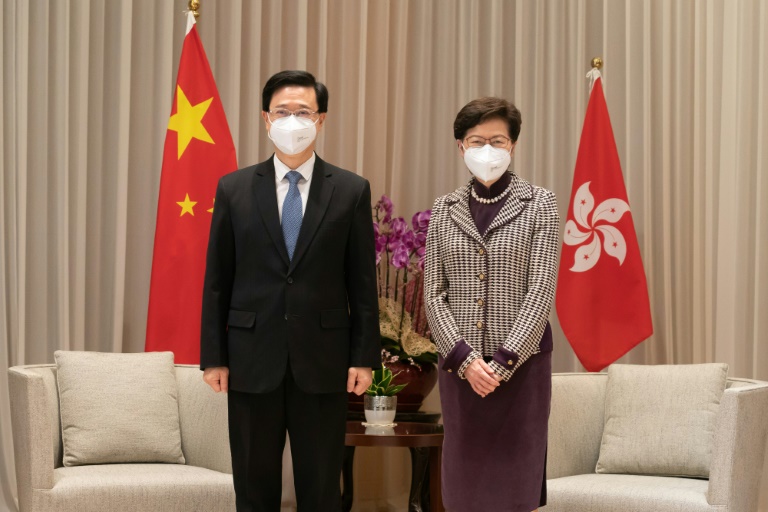
On Monday morning, Lam met her successor and both gave short speeches stressing that they would prepare for an orderly transition.

Lee, who takes over on July 1, was Lam’s security chief and then her deputy.

He was asked by reporters whether Hong Kongers could criticise his administration or risk being arrested for “speech crimes” like dozens of democracy activists in recent years. 

Lee took umbrage at that description.

“I think you are very wrong to describe that people are now charged simply because of their expressed opinions,” he said.

“People are brought to court because of the suspicion against them and their actions contravening the law,” he added. “It is their action.”

Lee said his first port of call would be China’s top agencies in Hong Kong — the Liaison Office, the national security committee, the foreign ministry’s office and the People’s Liberation Army garrison.

War in Ukraine: Latest developments

Here are the latest developments in the war in Ukraine:

– Putin says war is to ‘defend Russian Motherland’ –

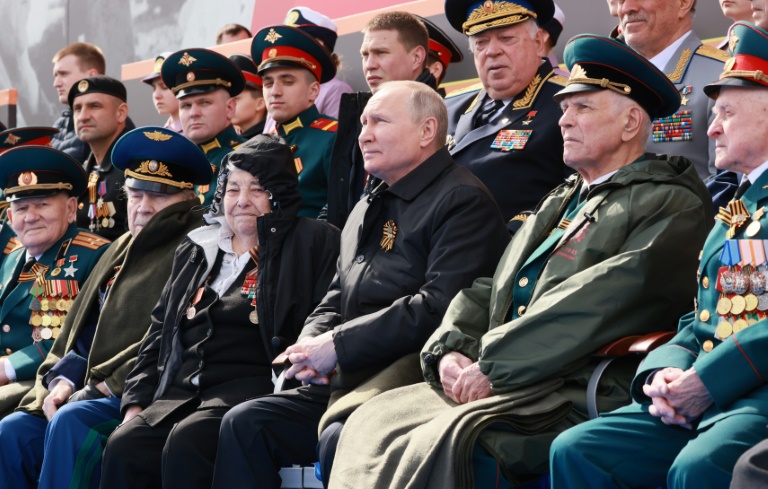
Russian President Vladimir Putin delivers his highly anticipated Victory Day speech at a giant military parade in Moscow. He says he had no choice but to send troops into Ukraine to defend the Russian “Motherland” from an “absolutely unacceptable threat”.

Speculation that he could use the 77th anniversary of the Soviet victory over Nazi Germany in World War II to expand the conflict come to naught.

The Russian leader insists instead on the need to avoid “the horror of a global war.”

– From Vladivostok to Aleppo – 

Victory Day celebrations are held across Russia, kicking off in the Far Eastern city of Vladivostok, where thousands took part in the local “Immortal Regiment” march.

The marches, which have become increasingly popular in recent years, feature people carrying photos of veterans or family members who died World War II. Russian communities abroad also organize marches, including in the northern Syrian city of Aleppo, where Russia intervened in 2015 to crush opposition to President Bashar al-Assad.

This year, participants are also encouraged to bring photos of those who died fighting in Ukraine.

The march in Moscow aims to draw one million people.

– ‘We will win’, says Zelensky –

Ukraine’s President Volodymyr Zelensky says he will not allow the Soviet Union’s victory over the Nazis to be “appropriated” by Putin.

“We are proud of our ancestors who together with other nations in the anti-Hitler coalition defeated Nazism. And we will not allow anyone to annex this victory. We will not allow it to be appropriated,” he says.

He compares the Russian invasion to the Nazi occupation of parts of present-day Ukraine.

“We won then. We will win now,” he says.

– Russian generals ‘should be court martialled’ –

Britain’s defence minister Ben Wallace, himself a former soldier, says Russia’s military top brass “should be court martialled.”

Wallace calls out the generals’ “absurdity” as they flank Putin at the Victory Day parade “resplendent in their manicured parade uniforms and weighed down by their many medals”.

In a speech he will give later Monday he says “all professional soldiers should be appalled at the behaviour of the Russian Army.”

“Not only are they engaged in an illegal invasion and war crimes but their top brass have failed their own rank and file to the extent they should be court martialled.”

– ’60 killed’ in school bombing –

Zelensky says that that some 60 people sheltering in a school in the eastern village of Bilogorivka were killed in a Russian air strike, in one of the deadliest attacks since Russia invaded on February 24.

Lugansk region governor Sergiy Gaiday said rescuers are searching the rubble for survivors but that the prospects were bleak because the building was “completely destroyed”.

Russia has stated that “liberating” the eastern Donbas region, which comprises the Luhansk and Donetsk administrative regions, is its primary objective.

– Mariupol steelworks soldiers vow no surrender –

Ukrainian forces in the sprawling Azovstal steelworks in the Russian-controlled city of Mariupol — the last pocket of Ukrainian resistance in the devastated port city — vow to fight on.

Ukraine has said all women, children and elderly civilians have been evacuated from Azovstal as part of a UN and Red Cross humanitarian mission.

– Kyiv protests German police confiscating Ukraine flag –

Kyiv condemns Berlin’s “mistake” after German police confiscate a giant Ukrainian flag displayed by demonstrators at the Soviet War Memorial in the German capital.

Police say it was to ensure that a World War II commemoration ceremony stayed peaceful after a ban on displays of flags or military symbols at 15 memorial sites across Berlin.

burs-cb/lc

Close Bitnami banner
Bitnami