World

Western multinationals congratulate Hong Kong's new leader

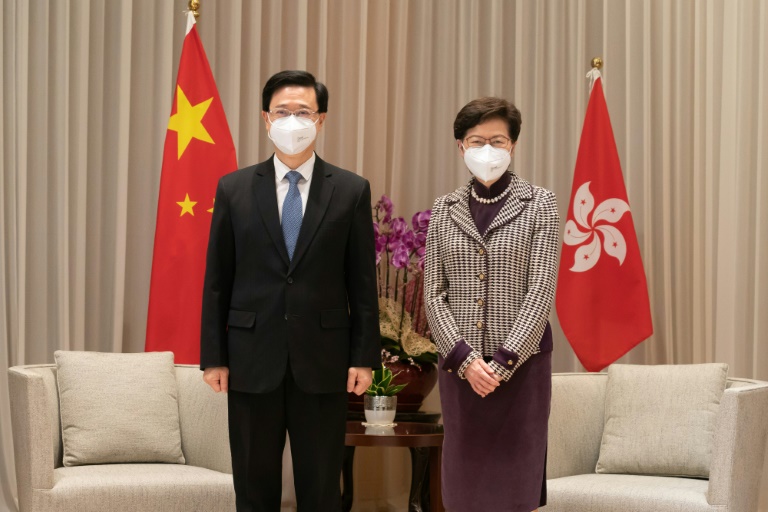
Western multinationals and local tycoons published newspaper adverts on Monday congratulating John Lee on becoming Hong Kong’s next leader, following a rubber-stamp selection process condemned by critics as anti-democratic.

Lee, 64, a former security chief who oversaw the crackdown on Hong Kong’s democracy movement, was anointed the business hub’s new leader on Sunday in a near-unanimous vote by a small committee of Beijing loyalists.

He was the sole candidate in the race to succeed outgoing leader Carrie Lam at a time when Hong Kong is being remoulded in China’s authoritarian image. 

Ta Kung Pao and Wen Wei Po, two newspapers that answer to the office which sets Beijing’s Hong Kong policy, were filled with adverts on Monday from leading companies and business figures praising Lee’s selection.

The majority were from Chinese and Hong Kong businesses as well as community organisations. 

The “Big Four” accountancy firms — KPMG, Deloitte, EY and PwC — were among western multinationals placing adverts, as were city carrier Cathay Pacific and conglomerates Swire and Jardine Matheson.

Messages were also carried by Hong Kong’s family tycoon-dominated property giants, including Sun Hung Kai and Henderson Land Development. 

Western businesses have found themselves in an increasingly precarious position in Hong Kong, especially as geopolitical tensions have risen with China.

Many have embraced progressive political causes in western markets, such as the anti-racism Black Lives Matter movement, same-sex equality and ridding supply chains of labour abuses. 

But they usually steer clear of any criticism of China’s policies towards hotspots like Hong Kong, Xinjiang, Tibet and Taiwan.

Some companies such as HSBC, Standard Chartered, Swire and Jardine Matheson publicly backed Beijing’s national security law, which was imposed on Hong Kong after 2019’s democracy protests to curb dissent.

– Can Hong Kong reopen? –

The elevation of Lee, who is under US sanctions, places a security official in Hong Kong’s top job for the first time after a tumultuous few years for a city battered by political unrest and economically debilitating pandemic controls.

Despite the city’s mini-constitution promising universal suffrage, Hong Kong has never been a democracy, the source of years of protests since the 1997 handover to China.

After the 2019 rallies, Beijing responded with a crackdown and a new “patriots only” political vetting system that eradicated the city’s once outspoken political opposition.

Lee faced no rivals and won 99 percent of the votes cast by the 1,461-strong committee that picks the city’s leader — roughly 0.02 percent of the city’s population. 

Beijing hailed the process as “a real demonstration of democratic spirit”.

European Union foreign policy chief Josep Borrell countered that the selection process was a “violation of democratic principles and political pluralism”. 

Lee, a former police officer, has vowed to strengthen Hong Kong’s national security and integrate the city further with the mainland. 

He wants to reboot the city’s economy and slowly reopen its pandemic sealed borders at a time when rivals have moved to living with the coronavirus. 

But it is unclear how he can do that given China has doubled down on its strict zero-Covid strategy.

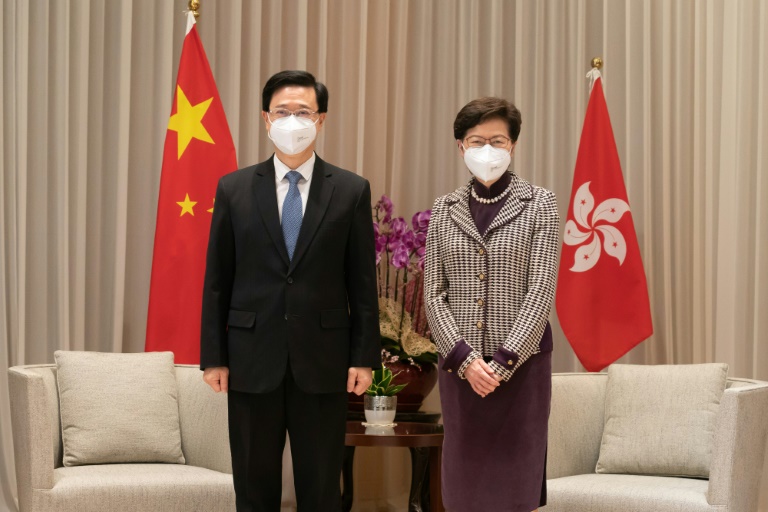
On Monday morning, Lam met her successor Lee and both gave short speeches stressing that they would prepare for an orderly transition between their administrations. 

Lee, who takes over on July 1, was Lam’s security chief and then her deputy.

He was asked by reporters whether Hong Kongers could criticise his administration or risk being arrested for “speech crimes” like dozens of democracy activists in recent years. 

Lee took umbrage to that description. 

“I think you are very wrong to describe that people are now charged simply because of their expressed opinions,” he said. 

“People are brought to court because of the suspicion against them and their actions contravening the law,” he added. “It is their action.”

Lee said his first port of call would be China’s top agencies in Hong Kong — the Liaison Office, the national security committee, the foreign ministry’s office and the People’s Liberation Army garrison.
Marcos Jr eyes victory as Philippines votes for new president

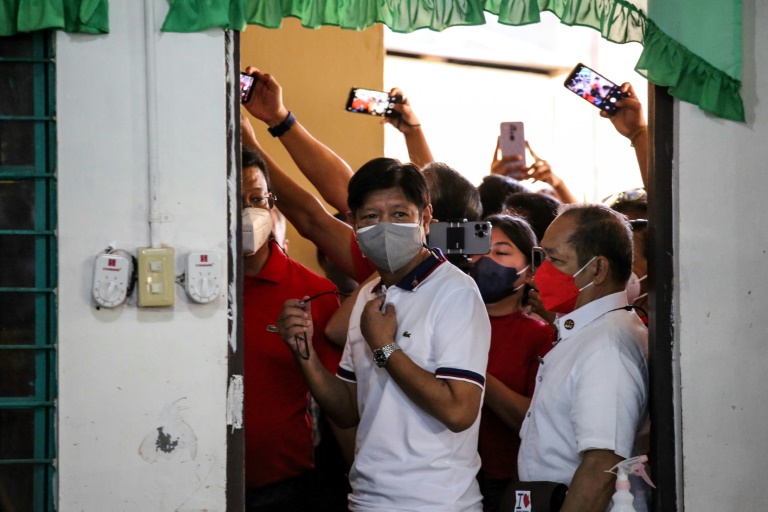
Millions of Filipinos thronged polling stations Monday to elect a new president, with the son of former dictator Ferdinand Marcos the favourite to win the high-stakes vote.

Nearly 40 years after the patriarch was deposed by a popular revolt and the family chased into exile, Ferdinand Marcos Jr looks set to complete their remarkable comeback from pariahs to the peak of political power.

Ten candidates are vying to succeed President Rodrigo Duterte in elections seen by many as a make-or-break moment for the Philippines’ fragile democracy.

But only Marcos Jr and his rival Leni Robredo, the incumbent vice president, have a credible chance of winning. 

From before dawn, mask-clad voters formed long queues to cast their ballots in 70,000 polling stations across the archipelago.

At Mariano Marcos Memorial Elementary School in the northern city of Batac, the ancestral home of the Marcoses, voters waved hand fans to cool their faces in the tropical heat.

Bomb sniffer dogs swept the polling station before Marcos Jr arrived with his younger sister Irene and eldest son Sandro. 

They were followed by the family’s flamboyant 92-year-old matriarch Imelda, who was lowered from a white van while wearing a long red top with matching trousers and slip-on flats. 

Sandro, 28, who is running for elected office for the first time in a congressional district in Ilocos Norte province, admitted the family’s history was “a burden”.

But he added: “It’s one that we also try to sustain and protect and better as we serve.”

Casting her ballot for Robredo at a school in the central province of Camarines Sur, Corazon Bagay said the former congresswoman “deserves” to win.

“She has no whiff of corruption allegations,” said the 52-year-old homemaker.

“She’s not a thief. Leni is honest.”

Supporters chanting “Leni, Leni” greeted Robredo as she arrived at the same school to vote. 

Turnout is expected to be high among the more than 65 million Filipinos eligible to vote.

“We can say that our elections are a success with so many people lining up to vote,” said George Garcia of the Commission on Elections.

At the end of a bitter campaign, polls showed Marcos Jr heading towards a landslide victory.

In the Philippines, the winner only has to get more votes than anyone else.

Since Robredo announced her bid for the top job in October, volunteer groups have mushroomed across the country seeking to convince voters to back her in what they see as a battle for the country’s soul.

But relentless whitewashing of the elder Marcos’s brutal and corrupt regime, support of rival elite families and public disenchantment with post-Marcos governments have fuelled the scion’s popularity.

After six years of Duterte’s authoritarian rule, rights activists, Catholic leaders and political analysts fear Marcos Jr will be emboldened to rule with an even heavier fist if he wins by a large margin.

“We think it will worsen the human rights crisis in the country,” said Cristina Palabay, secretary-general of human rights alliance Karapatan. 

While Marcos Jr had a 75 percent chance of winning, the outcome was not guaranteed, according to Eurasia Group analyst Peter Mumford, who said potential complacency among his supporters could work in Robredo’s favour.

– Authoritarian rule – 

Robredo, a 57-year-old lawyer and economist, has promised to clean up the dirty style of politics that has long plagued the feudal and corrupt democracy, where a handful of surnames hold sway.

Marcos Jr and running mate Sara Duterte — both offspring of authoritarian leaders — have insisted they are best qualified to “unify” the country, though what that means is unclear. 

Hundreds of thousands of red-clad supporters turned out at Marcos Jr and Duterte’s raucous rally in Manila on Saturday, as they made a last push for votes.

Josephine Llorca said successive governments since the 1986 revolution that ousted the family had failed to improve the lives of the poor.

“We tried it and they were even worse than the Marcoses’ time,” she said.

Surveys indicate Marcos Jr, 64, will win more than half the votes, which would make him the first presidential candidate to secure an absolute majority since his father was overthrown.

Political analyst Richard Heydarian warned such a big win could enable Marcos Jr to make constitutional changes to entrench his power and weaken democratic checks and balances.

“(Rodrigo) Duterte never had the discipline and wherewithal to push his authoritarian agenda to its logical extreme,” Heydarian said.

– ‘Another crossroads’ – 

Other candidates seeking the presidency include boxing legend Manny Pacquiao and former street scavenger turned actor Francisco Domagoso.

Personality rather than policy typically influences many people’s choice of candidate, though vote-buying and intimidation are also perennial problems in Philippine elections.

More than 60,000 security personnel have been deployed to protect polling stations and election workers. 

Police reported at least two deadly shootings at polling stations on the restive southern island of Mindanao that had left four people dead and three wounded. 

That followed a grenade attack on Sunday that injured nine people. 

In a rousing speech Saturday, Robredo declared: “Victory awaits us.”

Whatever the result, though, Marcos Jr opponents have already vowed to pursue efforts to have him disqualified over a previous tax conviction and to extract billions of dollars in estate taxes from his family.

“It’s another crossroads for us,” said Judy Taguiwalo, 72, an anti-Marcos activist who was arrested twice and tortured during the elder Marcos’s regime.

“We need to continue to stand up and struggle.”

'Our real Victory Day': Ukrainians shun Soviet WWII anniversary

The solemn rhetoric and formal gatherings in Ukraine marking the Soviet Union’s victory over Nazi Germany on May 9 every year always had deep personal resonance for 62-year-old Volodymyr Kostiuk.

His father was a soldier in the Moscow’s Red Army, fought in Europe during World War II and was held captive in a Nazi prisoner of war camp.

But this year, his pride has turned to indignation and anger, with the anniversary blackened by Russia’s full-scale invasion of his country.

“We were fighting together against the Nazis. It was our joint victory. Today the Russians are killing and torturing us. This shared history no longer means anything,” Kostiuk told AFP, after fleeing from his home as Russian troops poured into Ukraine.

“Did we win then for them to annihilate us now?”

The Soviet Union’s victory over Nazi Germany has traditionally been a holiday of national pride in the countries of the former Soviet Union, which with up to 27 million people killed, suffered the highest toll of any nation in World War II.

Since Russian President Vladimir Putin came to power, the holiday has taken on increasingly militaristic overtones, with a bombastic military parade through Moscow’s Red Square in showing off its latest military hardware.

But this year, to shore up Western support and distance the country from Soviet-era rituals, Ukraine is drawing parallels between the horrors brought on Europe by the Nazis and Russia’s invasion.

– ‘Evil has returned’ –

“Decades after World War II, darkness has returned to Ukraine. Evil has returned — in a different uniform, under different slogans, but for the same purpose,” Ukraine President Volodymyr Zelensky said in an address on May 8.

He compared bombings of European cities in World War II to Russian shelling on Ukraine this year and said Russia, like Nazi Germany, was attempting to “give this evil a sacred purpose.”

The Ukrainian Institute of National Memory summarised the trend in blunter terms, proposing a new slogan for remembrance day.

“We defeated the Nazis — we will defeat the russhisty,” it put forward, using a play on words in Ukrainian that combines the words Russian and fascist.

Ukraine was among the ex-Soviet nations most devastated by World War II.

Its cities were attacked in the first hours of the Nazi invasion; it spent several years under occupation; was the scene of such atrocities as the Babyn Yar massacre of Jews outside Kyiv; saw more than two million of its citizens sent as slave labour to Germany; and is believed to have lost eight million civilians and soldiers in all.

But this year commemorative events marking victory of the Nazis have been cancelled with barrages of Russian fire rocking frontline towns.

Even before Russia invaded Ukraine on February 24, the country was cooling to the Kremlin’s approach to commemoration.

Ukraine began distancing itself from Victory Day’s Soviet traditions more than a decade ago, first by dropping Moscow’s preferred title of “The Great Patriotic War” opting instead for World War II in official discourse and history books.

The ousting of a Kremlin-friendly president and Russia’s annexation of the Crimean peninsula from Ukraine in 2014 saw the gap widen.

As well as Moscow’s support for pro-Russian separatists, these historic moments saw Kyiv embark on its ongoing project of “de-Sovietisation,” tearing down monuments and symbols from its Soviet past.

After the separatist conflict broke out in the east, Ukraine adopted the poppy used by some Western countries as its symbol of remembrance.

It also banned displays of the black-and-orange Saint George ribbon, which has been omnipresent at Victory Day celebrations in Russia as a symbol of Moscow’s military prowess since its annexation of Crimea in 2014.

– ‘No one will be celebrating –

And since 2015, remembrance events are held not only on May 9 as in Soviet times, but also on May 8 dubbed “Day of Memory and Reconciliation,” mirroring European traditions. 

Russia’s invasion has only quickened this trend. Recent polls show just over 30 percent of Ukrainians see Victory Day as important, down from 80 percent in previous years.

The pollster, Rating, described the shift as a “key change in historical memory,” within society, noting that one in four respondents said the event was a “relic of the past”.

Some Ukrainian politicians are calling for May 9 events to be scrapped entirely.

Meanwhile on the streets of Kyiv, Ukrainians had a different win on their minds.

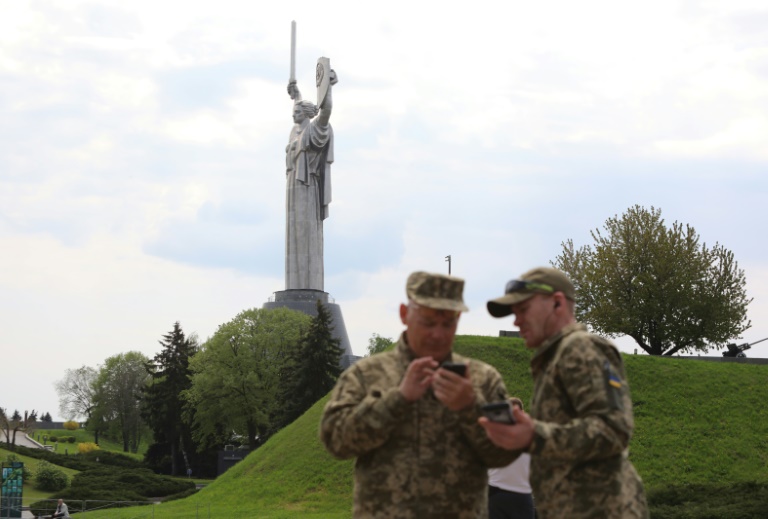
Leonid Kotlarevsky, a soldier told AFP near a huge World War II monument in Kyiv that May 9 was a celebration “for our grandfathers who fought against fascism.”

“But these Russian are fascists too, and we should destroy them,” he said.

Rodion, a 51-year-old pensioner nearby said “no one will be celebrating May 9 now,” after Russia’s invasion.

“We will have our own Victory Day, when Ukraine and the whole global community will win against Russia. And that’s going to be our real Victory Day.”

Downtown Beijing goes quiet as zero-Covid policy smothers capital

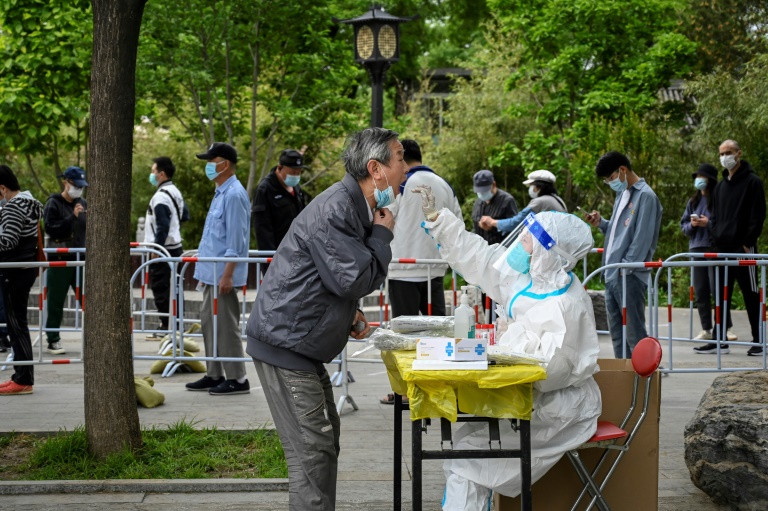
Millions of people in Beijing stayed home on Monday as China’s capital tries to fend off a Covid-19 outbreak with creeping restrictions on movement.

Beijing residents fear they may soon find themselves in the grip of the same draconian measures that have trapped most of Shanghai’s 25 million people at home for several weeks.

Officials there have said the eastern powerhouse is winning its battle against the country’s worst outbreak since the pandemic began.

Yet the Shanghai lockdown has intensified, causing outrage and rare protest in the last major economy still glued to a zero-Covid policy.

That policy has winded an economy which just months ago had shown China was bouncing back fast from the pandemic.

Customs data released Monday said exports in April slumped to their lowest monthly rate since June 2020, as key supply chains from Shanghai to Shenzhen became knotted by restrictions.

There is also a pressing political dynamic to China’s virus response, with President Xi Jinping pegging the legitimacy of his leadership to protecting Chinese lives from Covid.

Xi, who is expected to secure another five-year term as president later this year, has doubled down on the zero-Covid approach, despite mounting frustrations among the public.

In Beijing, subway stations and offices were empty during rush hour Monday morning across Chaoyang — the city’s most populous district — after officials stepped up a work-from-home order on Sunday over rising Covid cases.

Non-essential businesses in the district, home to 3.5 million people, were shuttered, with even the Apple store in the popular Sanlitun shopping area ordered to close after opening briefly in the morning.

“I feel very uncomfortable seeing so few people around,” Wang, a middle-aged cleaner waiting outside a restaurant for her shift to start, told AFP.

Beijing has reported hundreds of infections in recent weeks, with 49 new Covid-19 infections confirmed on Monday, a relatively tiny number by international comparisons but enough to stir restrictions in the political heart of the country.

Some finance workers were moving into hotels near their offices, as restrictions start to shape daily life in the city of 21 million. 

“Our company said we should try not to go home as they feel that there may be risks in commuting,” a Beijing-based investment manager who has moved into a hotel near his workplace.

“Some of my friends have been advised not to take public transport to work, and to drive or take a bicycle, so as not to be affected by the spread.”

– Shanghaied –

Shanghai has borne the brunt of the country’s Omicron surge, with more than 500 deaths, according to official numbers.

The financial hub has ordered multi-day curfews for residents of multiple neighbourhoods, according to notices seen by AFP, even as daily case numbers have dwindled into the low thousands.

Anger has seethed online at the perceived bungling of virus controls, mixed messaging and heavy-handedness of Shanghai officials, including sweeping people with negative Covid tests into state quarantine and leaving entire neighbourhoods short of food.

The frustration has also hit the streets — in a country where protest is rare and swiftly snuffed out by authorities.

Authorities have verified a video that ripped across social media over the weekend showing residents in Zhuanqiao Town neighbourhood clashing with hazmat-suited health authorities over food shortages.

“Police took action as soon as possible to persuade onlookers to disperse and calm the situation down,” a statement by the Zhuanqiao Town Covid response team said Sunday. 

“According to an on-site investigation, the troublemakers had sufficient supplies at home.”

Residents of the neighbourhoods hit by new curfews — including some areas previously declared lower-risk — have been ordered not to step out of their apartments except for PCR tests for as long as a week and forbidden from ordering “non-essential” deliveries, according to the notices.

Western multinationals congratulate Hong Kong's new leader

Western multinationals and local tycoons published newspaper adverts on Monday congratulating John Lee on becoming Hong Kong’s next leader, following a rubber-stamp selection process condemned by critics as anti-democratic.

Lee, 64, a former security chief who oversaw the crackdown on Hong Kong’s democracy movement, was anointed the business hub’s new leader on Sunday in a near unanimous vote by a small committee of Beijing loyalists.

He was the sole candidate in the race to succeed outgoing leader Carrie Lam at a time when Hong Kong is being remoulded in China’s authoritarian image. 

Ta Kung Pao and Wen Wei Po, two newspapers that answer to the office which sets Beijing’s Hong Kong policy, were filled with adverts on Monday from leading companies and business figures praising Lee’s selection.

The majority were from Chinese and Hong Kong businesses as well as community organisations. 

The “Big Four” accountancy firms — KPMG, Deloitte, EY and PwC — were among western multinationals placing adverts, as were city carrier Cathay Pacific and conglomerates Swire and Jardine Matheson.

Messages were also carried by Hong Kong’s family tycoon-dominated property giants, including Sun Hung Kai and Henderson Land Development. 

Western businesses have found themselves in an increasingly precarious position in Hong Kong, especially as geopolitical tensions have risen with China.

Many have embraced progressive political causes in western markets, such as the anti-racism Black Lives Matter movement, same sex equality and ridding supply chains of labour abuses. 

But they usually steer clear of any criticism of China’s policies towards hotspots like Hong Kong, Xinjiang, Tibet and Taiwan.

Some companies such as HSBC, Standard Chartered, Swire and Jardine Matheson publicly backed Beijing’s national security law, which was imposed on Hong Kong after 2019’s democracy protests to curb dissent.

– Can Hong Kong reopen? –

The elevation of Lee, who is under US sanctions, places a security official in Hong Kong’s top job for the first time after a tumultuous few years for a city battered by political unrest and economically debilitating pandemic controls.

Despite the city’s mini-constitution promising universal suffrage, Hong Kong has never been a democracy, the source of years of protests since the 1997 handover to China.

After the 2019 rallies, Beijing responded with a crackdown and a new “patriots only” political vetting system that eradicated the city’s once outspoken political opposition.

Lee faced no rivals and won 99 percent of the votes cast by the 1,461-strong committee that picks the city’s leader — roughly 0.02 percent of the city’s population. 

Beijing hailed the process as “a real demonstration of democratic spirit”.

European Union’s foreign policy chief Josep Borrell countered that the selection process was a “violation of democratic principles and political pluralism”. 

Lee, a former police officer, has vowed strengthen Hong Kong’s national security and integrate the city further with the mainland. 

He wants to reboot the city’s economy and slowly reopen its pandemic sealed borders at a time when rivals have moved to living with the coronavirus. 

But it is unclear how he can do that given China has doubled down on its strict zero-Covid strategy.

On Monday morning, Lam met her successor Lee and both gave short speeches stressing that they would prepare for an orderly transition between their administrations. 

Lee, who takes over on July 1, was Lam’s security chief and then her deputy.

Lee said his first port of call would China’s top agencies in Hong Kong — the Liaison Office, the national security committee, the foreign ministry’s office and the People’s Liberation Army garrison.
Marcos Jr eyes landslide as Philippines votes for new president

Millions of Filipinos thronged polling stations Monday to elect a new president, with the son of former dictator Ferdinand Marcos the favourite to win the high-stakes election.

Nearly 40 years after the patriarch was deposed by a popular revolt and the family chased into exile, Ferdinand Marcos Junior looks set to complete their remarkable comeback from pariahs to the peak of political power.

Ten candidates are vying to succeed President Rodrigo Duterte in elections seen by many as a make-or-break moment for the Philippines’ fragile democracy.

But only Marcos Jr and his rival Leni Robredo, the incumbent vice president, have a credible chance of winning. 

People wearing masks began forming long queues before dawn to cast their votes when polling stations opened across the archipelago.

At Mariano Marcos Memorial Elementary School in the northern city of Batac, the ancestral home of the Marcoses, voters waved hand fans to cool their faces in the tropical heat.  

Bomb sniffer dogs swept the polling station before Marcos Jr arrived with his younger sister Irene and eldest son Sandro. 

They were followed by the family’s flamboyant 92-year-old matriarch Imelda, who was lowered from a white van while wearing a long red top with matching trousers and slip-on flats. 

Sandro, 28, who is running for elected office for the first time in a congressional district in Ilocos Norte province, admitted the family’s history was “a burden”. 

But he added: “It’s one that we also try to sustain and protect and better as we serve.”

Casting her ballot for Robredo at a school in Magarao municipality, in the central province of Camarines Sur, Corazon Bagay said the former congresswoman “deserves” to win.

“She has no whiff of corruption allegations,” said the 52-year-old homemaker. 

“She’s not a thief. Leni is honest.”

Supporters chanting “Leni, Leni” greeted Robredo as she arrived at the same school to vote. 

Turnout is expected to be high among the over 65 million Filipinos eligible to vote.

“The long lines are magnificent. Filipinos wanted to be heard and heard loudly,” said George Garcia of the Commission on Elections.

Nearly 2,000 vote counting machines had malfunctioned across the country, he said. There are more than 70,000 polling stations.

At the end of a bitter campaign, polls showed Marcos Jr heading towards a landslide. He had a double-digit lead over Robredo in the latest surveys and she will need a low turnout of Marcos Jr voters or a late surge of support to score an upset.

In the Philippines, the winner only has to get more votes than anyone else.

Since Robredo announced her bid for the top job in October, volunteer groups have mushroomed across the country seeking to convince voters to back what they see as a battle for the country’s soul. 

But relentless whitewashing of the elder Marcos’s brutal and corrupt regime, support of rival elite families and public disenchantment with post-Marcos governments have fuelled the scion’s popularity.

After six years of Duterte’s authoritarian rule, rights activists, Catholic church leaders and political analysts fear Marcos Jr will be emboldened to rule with an even heavier fist if he wins by a large margin.

“We think it will worsen the human rights crisis in the country,” said Cristina Palabay, secretary-general of human rights alliance Karapatan. 

While Marcos Jr had a 75 percent chance of winning, the outcome was not guaranteed, according to Eurasia Group analyst Peter Mumford, who said potential complacency among his supporters could work in Robredo’s favour.

– Authoritarian rule – 

Robredo, a 57-year-old lawyer and economist, has promised to clean up the dirty style of politics that has long plagued the feudal and corrupt democracy, where a handful of surnames hold sway.

Marcos Jr and running mate Sara Duterte — both offspring of authoritarian leaders — have insisted they are best qualified to “unify” the country, though what that means is unclear. 

Hundreds of thousands of red-clad supporters turned out at Marcos Jr and Duterte’s raucous rally in Manila on Saturday, as they made a last push for votes.

Josephine Llorca said it was worth betting on another Marcos because successive governments since the 1986 revolution that ousted the family had failed to improve the lives of the poor.

“We tried it and they were even worse than the Marcoses’ time,” she said.

Surveys indicate Marcos Jr, 64, will win more than half the votes, which would make him the first presidential candidate to secure an absolute majority since his father was overthrown.

Political analyst Richard Heydarian warned such a big win could enable Marcos Jr to make constitutional changes to entrench his power and weaken democratic checks and balances.

“(Rodrigo) Duterte never had the discipline and wherewithal to push his authoritarian agenda to its logical extreme,” Heydarian said.

“That historic opportunity could fall on the lap of the Marcoses.”

– ‘Another crossroads’ – 

Other candidates seeking the presidency include boxing legend Manny Pacquiao and former street scavenger turned actor Francisco Domagoso.

Personality rather than policy typically influences many people’s choice of candidate, though vote-buying and intimidation are also perennial problems in Philippine elections. 

More than 60,000 security personnel have been deployed to protect polling stations and election workers. 

Shortly after voting got under way, three security guards were killed when gunmen opened fire at a polling station in a restive region of the southern island of Mindanao, police said. 

That followed a grenade attack on Sunday in the same province that left nine people wounded. 

Allegations of dirty tactics marred the final week of the campaign, as Marcos Jr warned of electoral fraud while Robredo accused him of being a “liar”. 

In a rousing speech to hundreds of thousands of supporters on Saturday, Robredo declared: “Victory awaits us.”

Whatever the result, though, Marcos Jr opponents have already vowed to pursue efforts to have him disqualified over a previous tax conviction and extract billions of dollars in estate taxes from his family.

“It’s another crossroads for us,” said Judy Taguiwalo, 72, an anti-Marcos activist who was arrested twice and tortured during the elder Marcos’s regime.

“We need to continue to stand up and struggle.”

China's April exports slump to lowest in two years as virus bites

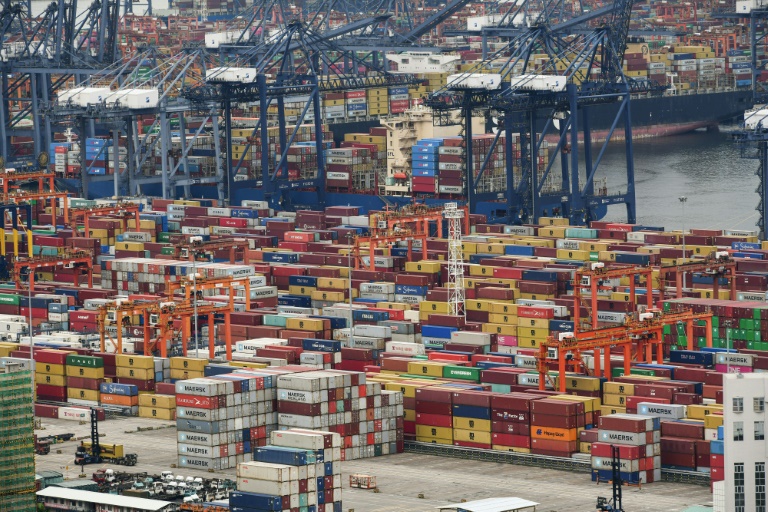
China’s export growth slumped in April to its lowest level in almost two years, customs data showed Monday, as a Covid resurgence shuttered factories, sparked transport curbs and caused congestion at key ports.

The data shows the extent of growing damage to the world’s second largest economy as millions are confined to their homes — particularly in key business hub Shanghai — to stamp out its worst Covid resurgence since the early days of the pandemic.

Beijing has persisted with a strict zero-Covid policy involving lockdowns and mass testing, but the economic costs are mounting as manufacturing hubs and supply chains atrophy under gruelling restrictions.

Export growth plunged to 3.9 percent on-year last month, the Customs Administration said Monday.

While this was above analysts’ expectations of 2.7 percent growth according to a Bloomberg poll, it marked the lowest rate since June 2020.

Import growth was flat in April, an improvement from a 0.1 percent contraction in March, as Chinese consumers remain hesitant under a welter of restrictions across the country.

Customs spokesman Li Kuiwen tried to strike an upbeat note on  Monday saying the economy still has room to make a turnaround and that its “positive fundamentals” remain unchanged.

But analysts are less optimistic.

“Export growth could get worse in the next couple of months due to the pandemic and China’s stringent Covid containment measures, falling external demand, and loss of orders to other regions,” Nomura chief China economist Ting Lu told AFP.

Export growth was among the key economic drivers of the last several quarters but could turn into a “drag” on the economy, he warned

Last month, China’s trade surplus came in at $51.1 billion, according to official data.

– ‘A dilemma’ –

In April, China’s biggest city Shanghai was almost entirely sealed off as it became the epicentre of the country’s worst coronavirus surge, with many factories halting production and trucker shortage causing goods to pile up at its port.

Restrictions also appear to be looming in other cities, including the capital Beijing.

“Lockdowns in large cities like Shanghai and rising input costs are major reasons” behind the underwhelming trade figures, analyst Zhaopeng Xing of ANZ Research said.

While top leaders have offered words of reassurance for tech, infrastructure and jobs, experts warn that Beijing’s unswerving adherence to its zero-Covid strategy will continue to hack into growth.

“China faces a dilemma: how to contain Omicron outbreaks without causing too much damage to the economic activities,” said Zhiwei Zhang, chief economist at Pinpoint Asset Management.

China's April exports slump to lowest in two years as virus bites

China’s export growth slumped in April to its lowest level in almost two years, customs data showed Monday, as a Covid resurgence shuttered factories, sparked transport curbs and caused congestion at key ports.

The data shows the extent of growing damage to the world’s second largest economy as millions are confined to their homes — particularly in key business hub Shanghai — to stamp out its worst Covid resurgence since the early days of the pandemic.

Beijing has persisted with a strict zero-Covid policy involving lockdowns and mass testing, but the economic costs are mounting as manufacturing hubs and supply chains atrophy under gruelling restrictions.

Export growth plunged to 3.9 percent on-year last month, the Customs Administration said Monday.

While this was above analysts’ expectations of 2.7 percent growth according to a Bloomberg poll, it marked the lowest rate since June 2020.

Import growth was flat in April, an improvement from a 0.1 percent contraction in March, as Chinese consumers remain hesitant under a welter of restrictions across the country.

Customs spokesman Li Kuiwen tried to strike an upbeat note on  Monday saying the economy still has room to make a turnaround and that its “positive fundamentals” remain unchanged.

But analysts are less optimistic.

“Export growth could get worse in the next couple of months due to the pandemic and China’s stringent Covid containment measures, falling external demand, and loss of orders to other regions,” Nomura chief China economist Ting Lu told AFP.

Export growth was among the key economic drivers of the last several quarters but could turn into a “drag” on the economy, he warned

Last month, China’s trade surplus came in at $51.1 billion, according to official data.

– ‘A dilemma’ –

In April, China’s biggest city Shanghai was almost entirely sealed off as it became the epicentre of the country’s worst coronavirus surge, with many factories halting production and trucker shortage causing goods to pile up at its port.

Restrictions also appear to be looming in other cities, including the capital Beijing.

“Lockdowns in large cities like Shanghai and rising input costs are major reasons” behind the underwhelming trade figures, analyst Zhaopeng Xing of ANZ Research said.

While top leaders have offered words of reassurance for tech, infrastructure and jobs, experts warn that Beijing’s unswerving adherence to its zero-Covid strategy will continue to hack into growth.

“China faces a dilemma: how to contain Omicron outbreaks without causing too much damage to the economic activities,” said Zhiwei Zhang, chief economist at Pinpoint Asset Management.

More violence after Israel arrests Palestinian suspected axe murderers

Two Palestinians were shot dead and another was wounded in separate incidents in the Israeli-occupied West Bank and annexed east Jerusalem on Sunday, officials said, the latest in a spate of violence.

The unrest came hours after the arrest of two Palestinians suspected of axing three Israelis to death, and as a series of anti-Israeli attacks and bloody violence has left dozens dead since late March, among them Palestinian and Arab-Israeli perpetrators.

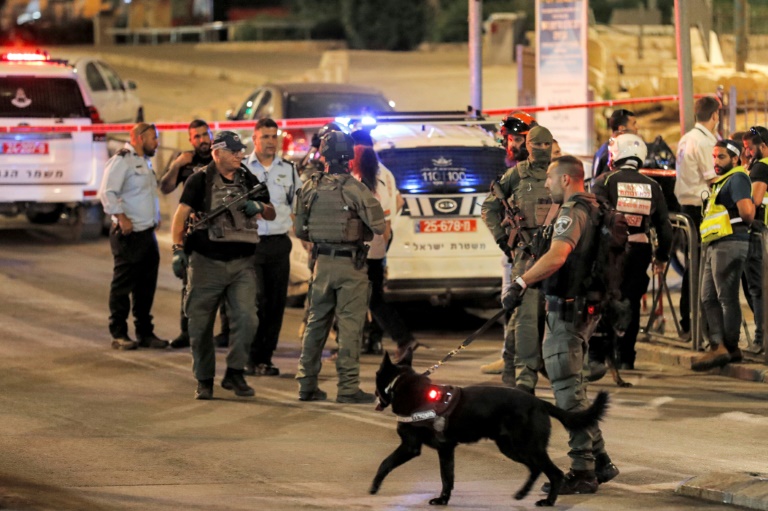
In the southern West Bank, a Palestinian armed with a knife infiltrated the Tekoa settlement before being shot by a resident, the army said.

“Soldiers were dispatched to the scene and are searching the area for additional suspects,” a statement from the military said.

The Palestinian health ministry said Motasem Attalah, 17, was killed.

A short time earlier, a 19-year-old Palestinian without an entry permit for Israel stabbed a police officer outside the Old City in east Jerusalem before being shot and “neutralised” by forces at the scene, a police statement said.

The officer was taken to hospital in moderate condition, police said, with medics saying the stabber was not dead.

Earlier Sunday, Israeli soldiers shot dead a Palestinian who tried to enter Israel through the Jewish state’s barrier in the north of the occupied West Bank. 

Soldiers “identified a (person) trying to cross the security barrier” near Tulkarem, an army statement said. “The force shot at him in accordance with procedures. The suspect was taken for medical care.”

A spokesman for the Sheba hospital in central Israel told AFP the Palestinian had died of his wounds, with the Palestinian health ministry identifying the deceased as Mahmud Eram.

Security forces had earlier arrested two Palestinians suspected of carrying out an axe attack in central Israel on Thursday that left three dead.

The security services — who previously identified the suspects as Assad Yussef al-Rifai, 19, and Subhi Imad Abu Shukair, 20 — said the pair were spotted hiding in a bush near a quarry, just outside the central town of Elad, where the attack took place.

The perpetrators had entered Israel through the porous barrier with the West Bank, an Israeli military official said earlier, calling their infiltration a “failure” of the army.

– Bloody cash –

Thursday’s attack in Elad, populated by mainly ultra-Orthodox Jews, was the sixth deadly incident targeting Israelis since March 22.

Witnesses said two assailants leapt from a car swinging axes at passers-by, leaving three dead and four wounded, before fleeing in the same vehicle.

The manhunt included the police, domestic security agency and the army, along with helicopters and drones, the security forces said. 

The Israeli military official said bloody banknotes, presumably dropped by the suspects in flight, helped lead the forces to where the pair were hiding. 

Forces scanning the area noticed a bush “that looked a bit different”, said the official, who spoke to reporters on condition of anonymity.

Israel has identified the three killed Thursday as Yonatan Habakuk, 44, and Boaz Gol, 49, both from Elad, as well as Oren Ben Yiftach, 35.

The bloodshed unfolded as Israel marked the 74th anniversary of its founding, which has previously been a tense day in the Israeli-Palestinian conflict.

– Hamas threats –

The Elad killings followed a tense period in which the Muslim fasting month of Ramadan, the Jewish festival of Passover and the Christian holiday of Easter overlapped.

Tensions have boiled over into violent clashes between Israelis and Palestinians at the Al-Aqsa mosque compound, a highly contested site in Jerusalem’s Israeli-annexed Old City.

Palestinian president Mahmud Abbas had condemned the Elad attacks, warning that the murder of Israeli civilians risked fuelling a broader cycle of violence.

But the Gaza Strip’s Islamist rulers Hamas praised the attack — as did the Gaza-based Islamic jihad armed group — calling it a consequence of unrest at Al-Aqsa. 

The Islamic Jihad called the attackers “heroes” and said their arrest would not “discourage” people from continuing their violent resistance.

Hamas said the attack “demonstrates our people’s anger at the occupation’s attacks on holy sites”.

Last week Hamas threatened Israel with rockets, knives and axes if its security forces carry out further raids on the Al-Aqsa mosque compound.

A string of anti-Israeli attacks since March 22 have killed 18 people, including an Arab-Israeli police officer and two Ukrainians.

Two of the deadly attacks were carried out in the Tel Aviv area by Palestinians.

A total of 29 Palestinians and three Israeli Arabs have died during the same period, among them perpetrators of attacks and those killed by Israeli security forces in West Bank operations.

Downtown Beijing goes quiet as zero-Covid policy smothers capital

Millions of people in Beijing stayed home on Monday as China’s capital tries to fend off a Covid-19 outbreak with creeping restrictions on movement.

Beijing residents fear they may soon find themselves in the grip of the same draconian measures that have trapped most of Shanghai’s 25 million people at home for several weeks.

Officials there have said the eastern powerhouse city is winning its battle against China’s worst outbreak since the pandemic began.

Yet the Shanghai lockdown has intensified, causing outrage and rare protest in the last major economy still glued to a zero-Covid policy.

In Beijing, subway stations and offices were empty during rush hour Monday morning across Chaoyang — the city’s most populous district — after officials stepped up a work-from-home order on Sunday over rising Covid cases.

Non-essential businesses in the district, home to 3.5 million people, were shuttered, with even the Apple store in the popular Sanlitun shopping area ordered to close after opening briefly in the morning.

“I feel very uncomfortable seeing so few people around,” Wang, a middle-aged cleaner waiting outside a restaurant for her shift to start, told AFP.

Beijing has reported hundreds of infections in recent weeks, with 49 new Covid-19 infections confirmed on Monday, a relatively tiny number but enough to stir restrictions in the political heart of the country.

Shanghai has borne the brunt of the country’s Omicron surge, with more than 500 deaths, according to official numbers.

The financial hub has ordered multi-day curfews for residents of multiple neighbourhoods, according to notices seen by AFP, even as daily case numbers have dwindled into the low thousands.

Anger has seethed online at the perceived bungling of virus controls, mixed messaging and heavy-handedness of Shanghai officials, including sweeping people with negative Covid tests into state quarantine and leaving entire neighbourhoods short of food.

The frustration has also hit the streets – in a country where protest is rare and swiftly snuffed out by authorities.

Authorities have confirmed the veracity of a video that ripped across social media over the weekend showing residents in Zhuanqiao Town clashing with hazmat-suited health authorities over food shortages.

“Police took action as soon as possible to persuade onlookers to disperse and calm the situation down,” a statement by the Zhuanqiao Town Covid response team said Sunday. 

“According to an on-site investigation, the troublemakers had sufficient supplies at home.”

Residents of the neighbourhoods hit by new curfews — including some areas previously declared lower-risk — have been ordered not to step out of their apartments except for PCR tests for as long as a week and forbidden from ordering “non-essential” deliveries, according to the notices.

Close Bitnami banner
Bitnami