World

US First Lady Biden makes unannounced visit to Ukraine

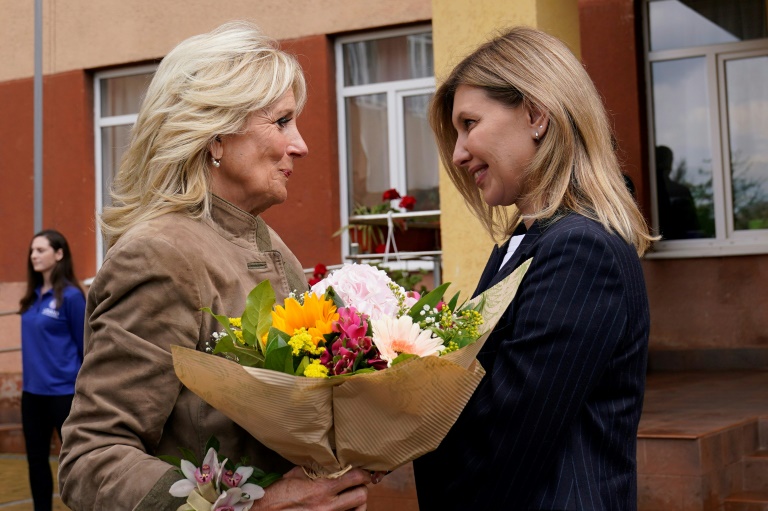
US First Lady Jill Biden made an unannounced visit to Ukraine on Sunday, meeting her Ukrainian counterpart Olena Zelenska at a school sheltering civilians displaced by the war.

“I wanted to come on Mother’s Day. I thought it was important to show the Ukrainian people that this war has to stop and this war has been brutal and that the people of the United States stand with the people of Ukraine,” Biden told reporters.

The 70-year-old wore a large pin in the form of the blue and yellow Ukrainian flag.

She traveled to Ukraine from Slovakia as part of a regional tour that included Romania and was meant to be yet another display of American support for Ukraine and the countries assisting it in the wake of the Russian invasion.

A US official traveling with President Joe Biden’s wife also said it was Zelenska’s first public appearance since Russia invaded Ukraine on February 24.

Zelenska thanked Biden “for this very courageous act”.

“Because we understand what it takes for the US first lady to come here during a war when the military actions are taking place every day, where the air sirens are happening every day, even today,” she told Biden.

Zelenska stressed the symbolism of Biden’s Mothering Sunday visit. 

– ‘Feel your love’ –

“We also feel your love and support during such an important day,” the Ukrainian said.

Following a closed-door meeting, the first ladies joined local children in a classroom crafting cardboard and tissue paper bears as presents for their mothers.

Biden and Zelenska both crafted their own bear, using white and yellow tissue paper.

During their face-to-face talks, Biden asked Zelenska how she was holding up as a mother during war time. She and President Volodymyr Zelensky have a 17-year-old daughter and a nine-year-old son.

Zelenska said she was grateful that she “is able to hold her children’s hands every night even though she can’t be with her husband,” said Michael LaRosa, a spokesman for Biden.

Zelenska also said her biggest concern right now is the mental health of children, soldiers and other people in Ukraine, he said. 

Biden first expressed an interest in March in visiting Ukraine but the opportunity did not arise until later, LaRosa said.  

After the unannounced trip to Ukraine, Biden returned to Slovakia.

There she had met earlier with refugees, aid workers and residents in the city of Kosice and the village of Vysne Nemecke. In Bratislava she met with US embassy staff and government officials.

Nearly 5.5 million refugees have fled Ukraine since Russian President Vladimir Putin launched his invasion, according to the United Nations. More than 360,000 of them have crossed into Slovakia, according to UN figures.

In Romania, too, Biden met with Ukrainian refugees on Saturday and praised them as “amazingly strong.”

“We stand with you, I hope you know that,” she said at a school in Bucharest, accompanied by her Romanian counterpart Carmen Iohannis, according to images transmitted by TVR public television.

More than 810,000 Ukrainians have entered Romania since the start of the war, according to UN figures released April 29.
War in Ukraine: Latest developments

Here are the latest developments in the war in Ukraine:

– Ukraine says 60 dead in school bombing –

Some 60 people sheltering in a village school in east Ukraine died after a Russian air strike, says Ukrainian President Volodymyr Zelensky during an address to the G7 summit by video conference.

UN chief Antonio Guterres is “appalled” by the bombing, his spokesman says, reiterating that “civilians and civilian infrastructure must always be spared in times of war”.

– G7 meets on Ukraine –

As President Volodymyr Zelensky talks with G7 leaders via video conference, the White House saying the club of rich nations is “committed to phasing out or banning the import of Russian oil”. 

Washington also announces new sanctions on three major Russian television stations and says it will deny Russian companies and wealthy individuals access to US accounting and consulting services.

– US First Lady Biden, Canada’s Trudeau visit Ukraine –

US First Lady Jill Biden makes an unannounced visit to Ukraine, meeting with her Ukrainian counterpart Olena Zelenska at a school.

Canadian Prime Minister Justin Trudeau pays a separate visit to Irpin outside Kyiv, a city badly damaged by Moscow’s forces early in the war, saying Russian leader Vladimir Putin is “responsible for heinous war crimes”.

– Mariupol steelworks soldiers vow no surrender –

Ukrainian forces in the sprawling Azovstal steelworks in the Russian-controlled city of Mariupol — the last pocket of Ukrainian resistance in the devastated port city — vow to fight on.

Ukraine has said all women, children and elderly civilians have been evacuated from Azovstal as part of a UN and Red Cross humanitarian mission.

– Kyiv protests German police confiscating Ukraine flag –

Kyiv condemns Berlin’s “mistake” after German police confiscate a giant Ukrainian flag displayed by demonstrators at the Soviet War Memorial in the German capital.

Police say it was to ensure that a World War II commemoration ceremony stayed peaceful after a ban on displays of flags or military symbols at 15 memorial sites across Berlin.

But Ukrainian Foreign Minister Dmytro Kuleba tweets. “It’s deeply false to treat them equally with Russian symbols.”

– Battle for eastern city –  

Ukrainian forces are struggling to hold on to the nearly surrounded city of Severodonetsk, the easternmost city still held by Kyiv which, if captured, would give Russia de facto control of Lugansk — the smaller of the two republics comprising the eastern war zone.

A local official says about 15,000 civilians remain in the city.

– Azovstal evacuees reach safety –

Eight buses carrying 174 Mariupol civilians, including 40 evacuated from the Black Sea port’s besieged Azovstal steelworks, arrive in Ukrainian-controlled Zaporizhzhia.

Evacuees, some with young children, leave white buses that had transported them to a shopping centre car park. Humanitarian workers escort elderly people, including a woman in a wheelchair.

– Victory Day parade –

Russia is poised to hold its annual parade Monday marking the Soviet victory in World War II, where its military might will be showcased amid Moscow’s ongoing campaign in Ukraine.

burs-ams/imm/jj

Dozens feared dead in school bombing as G7 rallies behind Ukraine

Rescuers on Sunday scrambled to find dozens of civilians feared dead in a strike on a Ukrainian school as the G7 reaffirmed their unity with Kyiv on the eve of Russia’s World War II victory celebrations.

US First Lady Jill Biden and Canadian Prime Minister Justin Trudeau made unannounced visits to Ukraine and G7 leaders joined President Volodymyr Zelensky on a video call as Kyiv’s allies rallied with further pledges of support.

But shelling and missile strikes have intensified on the ground and depleted Ukrainian forces are bracing to defend their final bastion in the devastated port city of Mariupol.

Ukraine is desperate to deny Moscow a symbolic win before Russian President Vladimir Putin leads commemorations of the Soviet Union’s defeat of Nazi Germany on Monday.

Putin is expected to flaunt his military might during the large, symbolically important event and justify the invasion by comparing it with the previous struggle against Nazism and the national pride it brought.

“Today, our soldiers, as their ancestors, are fighting side by side to liberate their native land from the Nazi filth with the confidence that, as in 1945, victory will be ours,” Putin said.

Zelensky also marked a day commemorating the end of the 1939-1945 war by comparing Ukraine’s battle for national survival to the region’s war of resistance against its former Nazi occupiers.

“Decades after World War II, darkness has returned to Ukraine, and it has become black and white again,” Zelensky said, in a monochrome social media video shot against the backdrop of a bombed-out apartment block.

“Evil has returned, in a different uniform, under different slogans, but for the same purpose,” he warned, trying to turn Putin’s “anti-Nazi” rhetoric back on itself.

– Fresh sanctions –

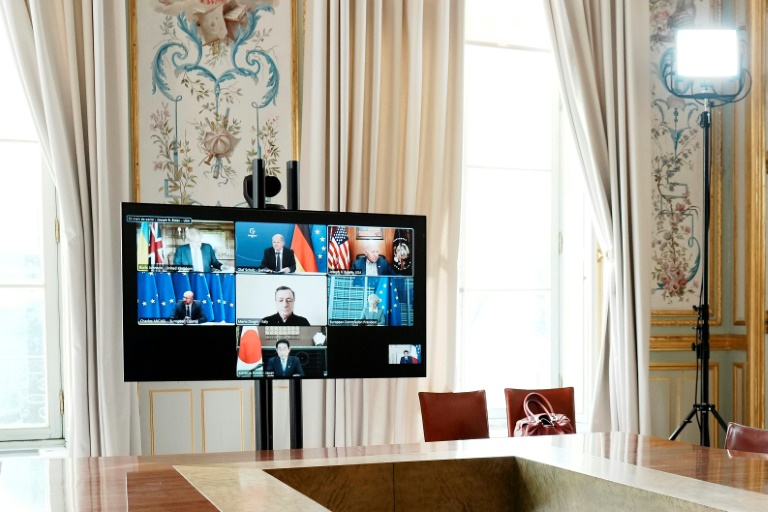
Zelensky met G7 leaders via video conference to discuss the crisis.

The group — which includes France, Germany, Canada, Italy, Japan, Britain and the United States — in a statement on Sunday said Putin’s “unprovoked war of aggression” had brought “shame on Russia and the historic sacrifices of its people”.

The White House said the G7 was “committed to phasing out or banning the import of Russian oil”.

But EU diplomats will meet again next week to hammer out the details of their latest sanctions package against Moscow, after a proposed embargo on Russian oil exposed rifts in the bloc.

In a separate statement, the White House said the United States would sanction three major Russian television stations and deny all Russian companies access to US firms’ consulting and accounting services.

Canadian leader Trudeau said Putin was responsible for “heinous war crimes” as he visited Irpin, a suburb on the northwest edge of Kyiv that was the scene of heavy fighting in the early weeks of the conflict.

Local mayor Oleksandr Markushyn posted pictures on social media and said Trudeau “came to Irpin to see with his own eyes all the horror that the Russian occupiers had done to our city”.

Separately, the US first lady met her Ukrainian counterpart Olena Zelenska at a school sheltering civilians, including children displaced by the conflict, near Ukraine’s border with Slovakia.

“I wanted to come on Mother’s Day,” Jill Biden told reporters, saying she wanted to show that the United States stands with Ukraine.

On the ground, the key battles were being fought in Ukraine’s east.

– Tunnel network –

Civilians have now been evacuated from Mariupol’s Azovstal steelworks, leaving a small force of defenders holed up in its sprawling network of underground tunnels and bunkers.

The complex — the final pocket of Ukrainian resistance in the Black Sea port city — has taken on a symbolic value.

“We, all of the military personnel in the garrison of Mariupol, we have witnessed the war crimes performed by Russia, by the Russian army. We are witnesses,” said Ilya Samoilenko, an intelligence officer with the far-right Azov regiment defending the site.

“Surrender is not an option because Russia is not interested in our lives,” he said.

Taking full control of Mariupol would also allow Moscow to create a land bridge between the Crimean peninsula, which it annexed in 2014, and regions run by pro-Russian separatists in the east.

In one of those regions, Lugansk, Ukrainian forces are now mounting a last-ditch defence of the city of Severodonetsk, formerly an industrial city of 100,000 people, now Russia’s next target.

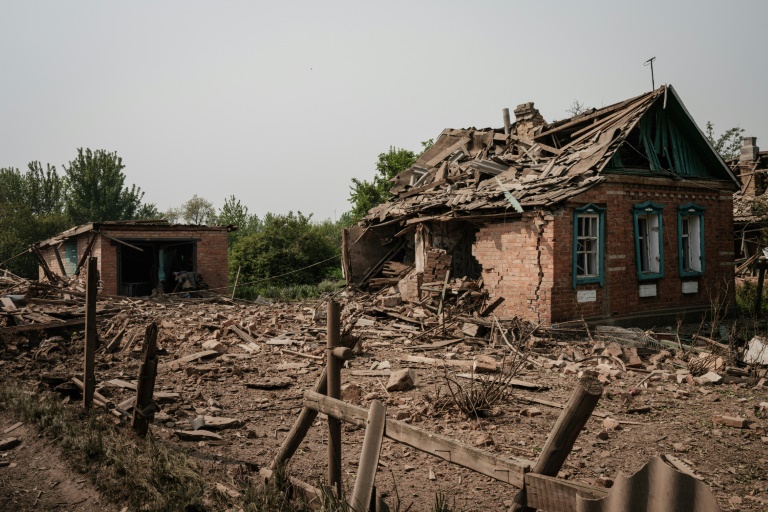
In the same region, governor Sergiy Gaiday said 60 civilians were feared dead after a school in the village of Bilogorivka was hit in an air strike.

“The bombs fell on the school and unfortunately it was completely destroyed. There was a total of 90 people, 27 were saved,” he said on Telegram. 

“Sixty people who were in the school are very probably dead.”

Rescuers could not work overnight because of a threat of new strikes but resumed their work on Sunday.

– ‘Filtration camps’ –

Rescuers were also looking for survivors in the neighbouring village of Shepilivka after a strike hit a house where 11 people were sheltering in the basement, Gaiday said.

Civilians who escape Mariupol describe passing through Russian “filtration” sites where several evacuees told AFP they were questioned, strip-searched, fingerprinted, and had their phones and documents checked.

“They asked us if we wanted to go to Russia… or stay and rebuild the city of Mariupol,” said Azovstal evacuee Natalia, who spoke on condition that her full name not be published.

“But how can I rebuild it? How can I return there if the city of Mariupol doesn’t exist anymore?”

burs-dc/imm/raz

G7 countries pledge to stop Russia oil imports

The G7 club of wealthy nations committed Sunday to phasing out its dependency on Russian oil and issued a scathing statement accusing President Vladimir Putin of bringing “shame” on Russia with his invasion of Ukraine.

The statement from the Group of Seven — France, Canada, Germany, Italy, Japan, Britain and the United States — did not specify exactly what commitments each country will make to move away from Russian energy.

But it was an important development in the ongoing campaign to pressure Putin by crippling Russia’s economy, and underscores the unity of the international community against Moscow’s actions.

“We commit to phase out our dependency on Russian energy, including by phasing out or banning the import of Russian oil. We will ensure that we do so in a timely and orderly fashion, and in ways that provide time for the world to secure alternative supplies,” the joint statement said.

“This will hit hard at the main artery of Putin’s economy and deny him the revenue he needs to fund his war,” the White House said. 

The announcement came as the G7 held its third meeting of the year on Sunday via video conference, with Ukrainian President Volodymyr Zelensky participating. 

The West has so far displayed close coordination in its announcements of sanctions against Russia, but has not moved at the same pace when it comes to Russian oil and gas.

The United States, which was not a major consumer of Russian hydrocarbons, has already banned their import.

But Europe is far more reliant on Russian oil. The European Union has already said it is aiming to cut its reliance on Russian gas by two-thirds this year, though Germany has opposed calls for a full boycott, with member states continuing intense negotiations Sunday. 

The G7 also slammed Putin personally for his actions in Ukraine.

The Russian president’s “unprovoked war of aggression” against its Eastern European neighbor has brought “shame on Russia and the historic sacrifices of its people,” the group said in its statement.

“Russia has violated the international rules-based order, particularly the UN Charter, conceived after the Second World War to spare successive generations from the scourge of war,” the statement continued.

– Fresh US sanctions –

The date of Sunday’s G7 meeting is highly symbolic: Europeans commemorate the end of World War II in Europe on May 8. 

Sunday’s meeting also comes on the eve of the May 9 military parade in Russia, which marks the Soviet Union’s victory over Nazi Germany. 

Washington also announced a new round of sanctions against Russia in a White House statement on Sunday, focusing on two major areas: the media, and access by Russian companies and wealthy individuals to world-leading US accounting and consulting services.

The US will sanction Joint Stock Company Channel One Russia, Television Station Russia-1, and Joint Stock Company NTV Broadcasting Company. Any US company will be prohibited from financing them through advertising or selling them equipment.

“US companies should not be in the business of funding Russian propaganda,” said a senior White House official who requested anonymity, stressing that these media were directly or indirectly controlled by the Kremlin.

Another line of attack by Washington: banning the provision of “accounting, trust and corporate formation, and management consulting services to any person in the Russian Federation,” according to the White House.

Those services are used to run multinational companies, but also potentially to circumvent sanctions or hide ill-gotten wealth, the White House official said. 

The official stressed that while the Europeans had the closest industrial links with Russia, the United States and the United Kingdom dominated the world of accounting and consulting, notably through the “Big Four” — the four global audit and consulting giants Deloitte, EY, KPMG and PwC.

Washington has also announced new bans on the export of American products to Russia, covering a range of capital goods from bulldozers to ventilation systems and boilers. 

The United States announced on Sunday that it would impose visa restrictions on 2,600 Russian and Belarusian officials, as well as sanctions against officials of Sberbank and Gazprombank.

Economist sworn in as Costa Rica president

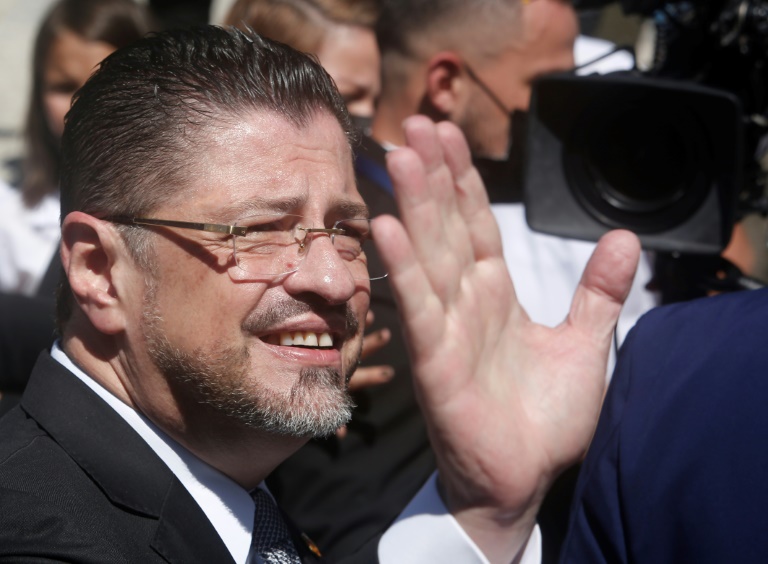
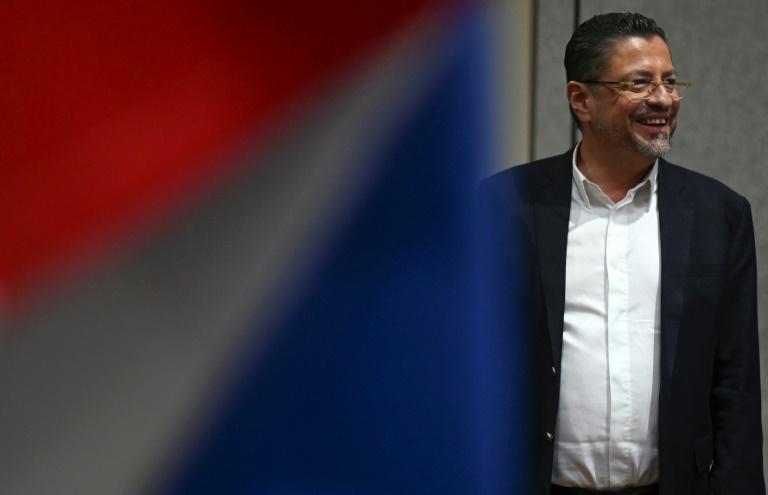
Economist and former finance minister Rodrigo Chaves was sworn in Sunday as Costa Rica’s president for a four-year mandate focused on reinvigorating one of Latin America’s most stable economies.

The former World Bank executive, who resigned from the global lender amid a sexual harassment scandal, has made it his mission to tackle Costa Rica’s economic recline.

The country is faced with rising foreign debt — about 70 percent of GDP — a poverty rate of 23 percent, unemployment of 14 percent, and public sector corruption.

Tourism, one of the country’s main economic drivers, was hard hit by the coronavirus pandemic, and the country of 5.2 million people experienced an increase in unemployment equaled in the region only by Peru. 

“It is fundamental for the country that Chaves improves the economy,” Adrian Aguiluz, a 35-year-old resident of the capital, said ahead of the inauguration.

“This new government has an opportunity to do something different.”

Chaves, who served six months as finance minister in the outgoing government, won a runoff election over former president Jose Maria Figueres — himself tainted by a corruption scandal.

The 60-year-old Chaves had been a surprise qualifier for the April 3 final race, having polled fourth ahead of February’s first round.

While he was a senior official at the World Bank, where he worked for 30 years, he was investigated over sexual harassment complaints brought by multiple women.

He was demoted, and later resigned to take on the role of finance minister in President Carlos Alvarado’s government.

Last month, Chaves offered “sincere apologies” to two accusers, young subordinates, having previously said the alleged harassment amounted to mere “jokes” that were “misinterpreted due to cultural differences.”

This week, Chaves said his government would not ratify the Escazu Agreement that establishes protection for environmentalists, arguing it was unnecessary and would harm the economy. Costa Rica, a regional leader in environmental protection, had hosted the signing of the agreement in 2018.

The new president has also vowed to improve Costa Rica’s deal with the IMF for a loan of more than $1.7 billion.

Spanish King Felipe VI attended the ceremony at Congress in San Jose, along with heads of state and delegations from nearly 100 countries.

War in Ukraine: Latest developments

Here are the latest developments in the war in Ukraine:

– Mariupol steelworks soldiers vow no surrender –

Ukrainian forces in the sprawling Azovstal steelworks in the Russian-controlled city of Mariupol — the last pocket of Ukrainian resistance in the devastated port city — say they will not surrender, vowing to fight on.

“Surrender is not an option,” said Ilya Samoilenko, an Azov regiment intelligence officer, during a press conference.

“All our supplies are limited. We still have water. We still have munitions. We will have our personal weapons. We will fight until the best resolution of the situation.”

Ukraine has said all women, children and elderly civilians have been evacuated from Azovstal as part of a UN and Red Cross humanitarian mission.

– G7 meets on Ukraine –

President Volodymyr Zelensky talks with G7 leaders via video conference to discuss the situation in his country, with the White House saying the club of rich nations is “committed to phasing out or banning the import of Russian oil”. 

Washington also announces new sanctions on three major Russian television stations and says it will deny Russian companies and wealthy individuals access to US accounting and consulting services.

Meanwhile, diplomats are locked in difficult negotiations on the terms of the European Union’s sixth round of sanctions against Russia, with several members seeking guarantees for their oil supplies.

– School in east Ukraine bombed, dozens feared dead –

Some 60 people sheltering in a village school in east Ukraine are feared dead after an air strike, says the governor of the Lugansk region, Sergii Gaidai.

Ninety people were in the village school of Bilogorivka when the air strike hit Saturday, said Gaidai on Telegram.

“The bombs fell on the school and unfortunately it was completely destroyed,” he said, saying that 27 people had been saved. “Sixty people who were in the school are very probably dead.

– US First Lady Biden, Canada’s Trudeau separately visit Ukraine –

US First Lady Jill Biden makes an unannounced visit to Ukraine, meeting with her Ukrainian counterpart Olena Zelenska at a school.

The trip comes even as Canadian Prime Minister Justin Trudeau pays a visit to Irpin outside Kyiv, a city badly damaged by Russian forces early in the war. 

– Battle for eastern city –  

Ukrainian forces are struggling to hold on to the nearly surrounded city of Severodonetsk, the easternmost city still held by Kyiv. 

Were the city to fall, it would mean Russia has gained de facto control of Lugansk — the smaller of the two republics comprising the eastern war zone — in time for Russia’s annual Victory Day celebrations Monday.

“I would rather not guess how long we can hold on,” the Ukrainian unit commander tells AFP, describing the situation as “critically stable”. 

A local official says about 15,000 civilians remain in the city.

– Victory Day parade –

Russia is poised to hold its annual parade Monday marking the Soviet victory in World War II, where its military might will be showcased amid Moscow’s ongoing campaign in Ukraine.

President Vladimir Putin is expected to deliver a speech during the parade, which some Western officials believe could be a declaration of all-out war on Ukraine, speculation the Kremlin has dismissed as “nonsense”. 

– ‘Staggering’ Russian violations –

The Council of Europe’s human rights commissioner, Dunja Mijatovic, calls Russian violations of human rights in Ukraine “staggering” after a four-day visit to the country. 

The visit to areas outside Kyiv illustrated “mounting evidence of widespread arbitrary killings, torture, and enforced disappearances”, the council says in a statement.

burs-ams/imm

Ukraine battles to hold eastern bastions as US First Lady visits

Ukrainian forces braced Sunday to defend their final bastion in the devastated port city of Mariupol, desperate to deny Russia a symbolic win on the eve of Moscow’s Victory Day celebrations.

Kyiv’s allies lent their support, with US First Lady Jill Biden and Canadian Prime Minister Justin Trudeau making unannounced visits to Ukraine, and G7 leaders due to join President Volodymyr Zelensky on a video call.

But fierce fighting continued on the ground. Shelling and missile strikes have intensified in the build up to the World War II anniversary, and rescuers are searching for 60 Ukrainian civilians feared killed in the bombing of a village school.

Zelensky marked a day commemorating the end of the 1939-1945 war by comparing Ukraine’s battle for national survival to the region’s war of resistance against its former Nazi occupiers.

“Decades after World War II, darkness has returned to Ukraine, and it has become black and white again,” Zelensky said, in a monochrome social media video shot against the backdrop of a bombed out apartment block.

“Evil has returned, in a different uniform, under different slogans, but for the same purpose,” he warned, trying to turn Russia leader President Vladimir Putin’s “anti-Nazi” rhetoric back on itself.

Russia, meanwhile, was gearing up for a Victory Day parade designed to associate the invasion of its neighbour with the national pride felt over the Soviet Union’s defeat of Germany. 

“Today, our soldiers, as their ancestors, are fighting side by side to liberate their native land from the Nazi filth with the confidence that, as in 1945, victory will be ours,” Putin said.

Zelensky was also to meet G7 leaders via video conference to discuss the crisis, and European diplomats will meet again next week to hammer out the details of their latest sanctions package against Moscow.

The US first lady met her Ukrainian counterpart Olena Zelenska at a school sheltering civilians, including children displaced by the conflict, near Ukraine’s border with Slovakia.

“I wanted to come on Mother’s Day,” Biden told reporters. 

“I thought it was important to show the Ukrainian people that this war has to stop and this war has been brutal and that the people of the United States stand with the people of Ukraine.”

Separately, Canadian leader Trudeau visited Irpin, a suburb on the northwest edge of Kyiv that was the scene of heavy fighting in the early weeks of the conflict.

Local mayor Oleksandr Markushyn, posted pictures on social media and said Trudeau “came to Irpin to see with his own eyes all the horror that the Russian occupiers had done to our city.”

On the ground, the key battles were being fought in Ukraine’s east.

– Tunnel network –

Civilians have now been evacuated from Mariupol’s Azovstal steelworks, leaving a small force of defenders holed up in its sprawling network of underground tunnels and bunkers.

The complex — the final pocket of Ukrainian resistance in the port city — has taken on a symbolic value.

“We, all of the military personnel in the garrison of Mariupol, we have witnessed the war crimes performed by Russia, by the Russian army. We are witnesses,” said Ilya Samoilenko, an intelligence officer with the far-right Azov regiment, which is defending the steelworks.

“Surrender is not an option because Russia is not interested in our lives,” he said.

Taking full control of Mariupol would also allow Moscow to create a land bridge between the Crimean peninsula, which it annexed in 2014, and regions run by pro-Russian separatists in the east.

In one of those regions, Lugansk, Ukrainian forces are now mounting a last ditch defence of the city of Severodonetsk, formerly an industrial city of 100,000 people, now Russia’s next target.

In the same region, governor Sergiy Gaiday said 60 civilians were feared dead after a school in the village of Bilogorivka was hit in an air strike.

“The bombs fell on the school and unfortunately it was completely destroyed. There were a total of 90 people, 27 were saved,” he said on Telegram. 

“Sixty people who were in the school are very probably dead.”

Rescuers could not work overnight because of a threat of new strikes, but resumed their work on Sunday.

– ‘Filtration camps’ –

Rescuers were also looking for survivors in the neighbouring village of Shepilivka after a strike hit a house where 11 people were sheltering in the basement, Gaiday said.

Civilians who escape Mariupol describe passing through Russian “filtration” sites where several evacuees told AFP they were questioned, strip-searched, fingerprinted, and had their phones and documents checked.

“They asked us if we wanted to go to Russia… or stay and rebuild the city of Mariupol,” said Azovstal evacuee Natalia, who spoke on condition that her full name not be published.

“But how can I rebuild it? How can I return there if the city of Mariupol doesn’t exist anymore?”

Russia’s campaign has run into tough resistance — and galvanised Kyiv’s Western allies to impose potentially crippling sanctions on the Russian economy and Putin’s inner circle.

burs-dc/gw

Northern Ireland in limbo after Sinn Fein triumphs

Northern Ireland’s feuding leaders came under international pressure Sunday to unite in a new government, after the Irish nationalist party Sinn Fein secured an unprecedented election win.

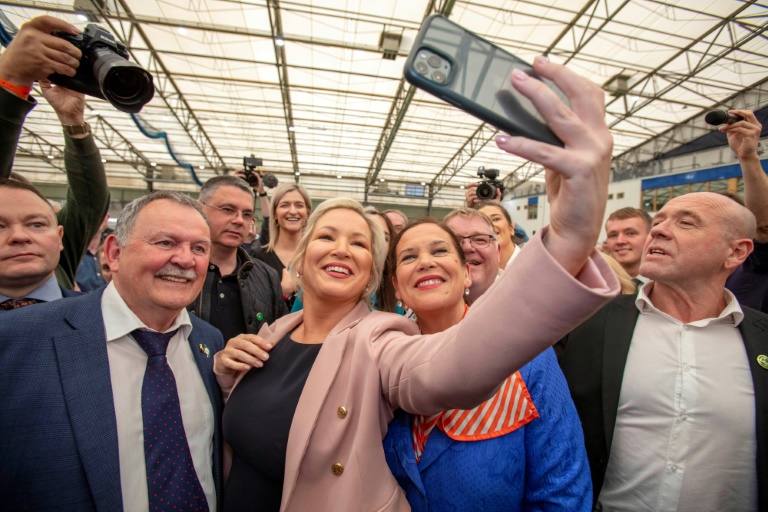
Once the political wing of the paramilitary IRA, Sinn Fein won enough seats in the devolved legislature to nominate its Northern Ireland leader Michelle O’Neill as first minister.

The result from Thursday’s election for the Stormont assembly marked a potentially seismic shift, a century after Northern Ireland was carved out as a Protestant fiefdom under British rule.

With all 90 seats filled from Thursday’s proportional voting, Sinn Fein won 27 seats, ahead of the Democratic Unionist Party (DUP) on 25 and the cross-community Alliance party on 17.

At the imposing Stormont legislative building, formerly a bastion of unionist monopoly power, disaffected DUP voter Jordan Black said: “I feel like a lot of them are stuck in the past really. 

“Change might be for the better,” the 26-year-old mechanic told AFP. 

“If they (Sinn Fein) start doing stuff that helps people and helps everybody, then more power to them, 100 percent,” he said.

– ‘New era’ –

O’Neill said the result “ushers in a new era” for the divided territory, and Sinn Fein said it wanted a referendum on reuniting Ireland within five years.

But only the UK government can grant a referendum, and Northern Ireland Secretary Brandon Lewis noted that a majority of voters overall still backed the constitutional status quo. 

Ahead of convening party leaders for talks in Belfast on Monday, Lewis recognised nevertheless that Sinn Fein’s triumph was a “significant moment for Northern Ireland”. 

“I think it is an important moment to show that everybody can work together, regardless of who is first and deputy first minister,” he told BBC television.

Lewis urged the leaders to “work with each other to find a way to come back into Stormont (and) form the executive”.

The Irish and US governments also urged Northern Ireland’s leaders to form a new power-sharing executive, under the terms of a 1998 peace deal that ended three decades of bloodshed.

But DUP leader Jeffrey Donaldson demanded Prime Minister Boris Johnson first “deliver on his word” and scrap post-Brexit trading rules with the EU.

Unionists fear the so-called Northern Ireland Protocol is casting them adrift from the UK, by imposing a de-facto trading border in the Irish Sea.

– ‘Naughty boys’ –

Lewis said the government still preferred to negotiate a solution with Brussels on the protocol — but reserved the right to act unilaterally to protect intra-UK trade and Northern Ireland’s constitutional status.

“It’s very disappointing that what we’re hearing is the EU is already saying it won’t show any flexibility,” the minister said.

While Sinn Fein will get to nominate a first minister, Northern Ireland’s government can only form under the 1998 deal if the DUP agrees to take part and serve in the role of deputy first minister.

Lorraine Kane, a 58-year-old civil servant, said “the DUP shot themselves in the foot, pretty much”. 

“They talked a lot about the Northern Ireland Protocol and the Irish Sea border, and that’s not what people wanted out of this election. 

“People were more concerned about the cost of living. I think that’s where Sinn Fein hit it right on the nail,” she said. 

“It’ll be interesting to see now if the DUP will actually go into the power-sharing agreement with them, or whether they’ll simply be like naughty boys and throw their toys out of the pram and decide that they don’t want to play anymore.”

The parties have 24 weeks to resolve their differences or face a new election. Ministers from the outgoing executive can continue in caretaker roles, overseen by London.

Katy Hayward, professor of political sociology at Queen’s University Belfast, said the parties were likely to take the full 24 weeks for interminable horse-trading.

She noted the DUP wants the protocol removed, Sinn Fein has longstanding demands to protect the Irish language and the Alliance wants an overhaul at Stormont to recognise the rise of the middle ground — none of which can be easily achieved.

“But given the urgency of crises in the cost of living and healthcare, we do need an executive formed and then can think of bigger adjustments to the (1998) Good Friday Agreement when we’re in a better place,” Hayward told AFP.

Economist to be sworn in as Costa Rica president

Economist and former finance minister Rodrigo Chaves is to be sworn in Sunday as Costa Rica’s president for a four-year mandate focused on reinvigorating one of Latin America’s most stable economies.

The former World Bank executive, who resigned from the global lender amid a sexual harassment scandal, has vowed to tackle Costa Rica’s severe economic problems: rising foreign debt — about 70 percent of GDP — a poverty rate of 23 percent, unemployment of 14 percent and public sector corruption.

Tourism, one of the country’s main economic drivers, was hard hit by the coronavirus pandemic, and the country of 5.2 million people experienced an increase in unemployment equaled in the region only by Peru. 

“It is fundamental for the country that Chaves improves the economy,” Adrian Aguiluz, a 35-year-old resident of the capital, said ahead of the inauguration.

“This new government has an opportunity to do something different.”

Chaves, who served six months as finance minister in the outgoing government, won a runoff election over former president Jose Maria Figueres — himself tainted by a corruption scandal.

The 60-year-old Chaves had been a surprise qualifier for the April 3 runoff, having polled fourth ahead of February’s first round.

While he was a senior official at the World Bank, where he worked for 30 years, he was investigated over sexual harassment complaints brought by multiple women.

He was demoted, and later resigned to take on the role of finance minister in President Carlos Alvarado’s government.

Last month, Chaves offered “sincere apologies” to two accusers, young subordinates, having previously said the alleged harassment amounted to mere “jokes” that were “misinterpreted due to cultural differences.”

This week, Chaves said his government would not ratify the Escazu Agreement that establishes protection for environmentalists, arguing it was unnecessary and would harm the economy. Costa Rica, a regional leader in environmental protection,had  hosted the signing of the agreement in 2018.

The new president has also vowed to improve Costa Rica’s deal with the IMF for a loan of more than $1.7 billion.

Spanish King Felipe VI is set to attend the ceremony in San Jose, along with delegations from nearly 100 countries.

Australia PM says will 'ensure' no China base on Solomon Islands

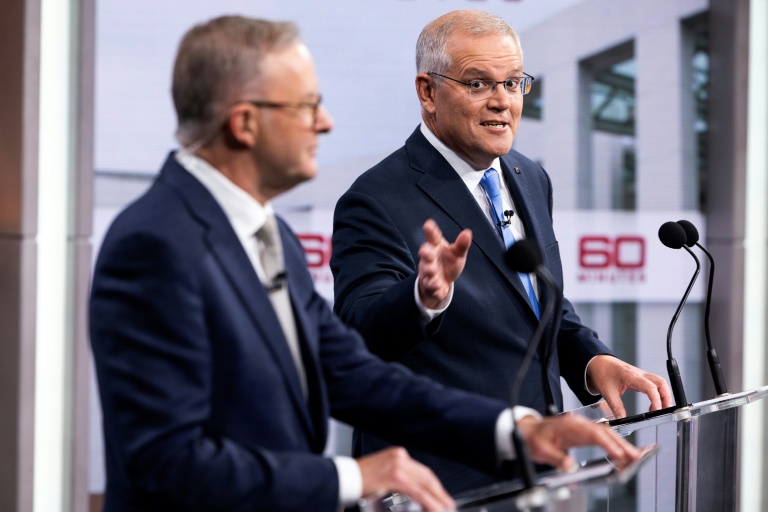
Australia would work with its allies to prevent China setting up a military base in the Solomon Islands, Prime Minister Scott Morrison vowed Sunday during a heated debate before May 21 elections.

China’s growing clout in the Pacific has become a hot political issue in Australia ahead of the polls, following Beijing’s announcement last month that it had signed a security pact with the Solomons.

The China-Solomons deal has not been publicly released but a leaked draft alarmed countries in the region, particularly sections that would allow Chinese naval deployments to the Solomons — less than 2,000 kilometres (1,200 miles) from Australia.

The deal sparked fears China may set up a military base in the Pacific state, though the Solomon Islands government has insisted this is not on the cards.

Morrison, whose conservative government is trailing the opposition in latest opinion polls, has been criticised for failing to prevent China from signing the deal in a region where Australia has traditionally had great influence.

Opposition Labor Party leader Anthony Albanese described it in the televised debate as a “massive foreign policy failure”.

The prime minister has warned that establishing a Chinese military base in the Solomons would be crossing a “red line”.

Pressed during the debate on what that red line means, Morrison said: “Australia would work with partners to ensure that that type of an outcome would be prevented.”

Morrison added, however, that it would be “unwise” to speculate about specific measures that Australia might take to prevent a military base being established on the Solomons.

“The Solomon Islands government themselves have made it very clear to us that that is not an outcome that they are seeking or supporting either. I believe it is not in their national interest to have such a presence,” he said.

– ‘Lack of transparency’ –

During Sunday’s testy debate, the Australian prime minister and opposition leader also sparred over the rising cost of living, how best to tackle global warming and anti-corruption measures.

But China’s political and military sway in the Pacific region have emerged as a major foreign policy concern.

Australia’s foreign minister Marise Payne held talks with her Solomons counterpart in Brisbane on Friday night during which she repeated Australia’s “deep concern” over the China security agreement and the “lack of transparency” over its content.

But she said the Solomons’ foreign minister, Jeremiah Manele, reassured her that Australia remained the Pacific state’s “partner of choice”.

The Solomons’ prime minister, Manasseh Sogavare, has reacted angrily to criticism of the China deal, saying his country was being treated like “kindergarten students walking around with Colt 45s in our hands”.

The Solomon Islands government severed ties with Taiwan in September 2019 in favour of diplomatic relations with China, a switch that unlocked investment but stoked inter-island rivalries.

Last November, protests against Sogavare’s rule flared into riots in the capital Honiara, during which much of the city’s Chinatown was torched. Australia led an international peacekeeping mission to help restore calm.

Close Bitnami banner
Bitnami