World

Between searing drought and Ukraine war, Iraq watchful over wheat

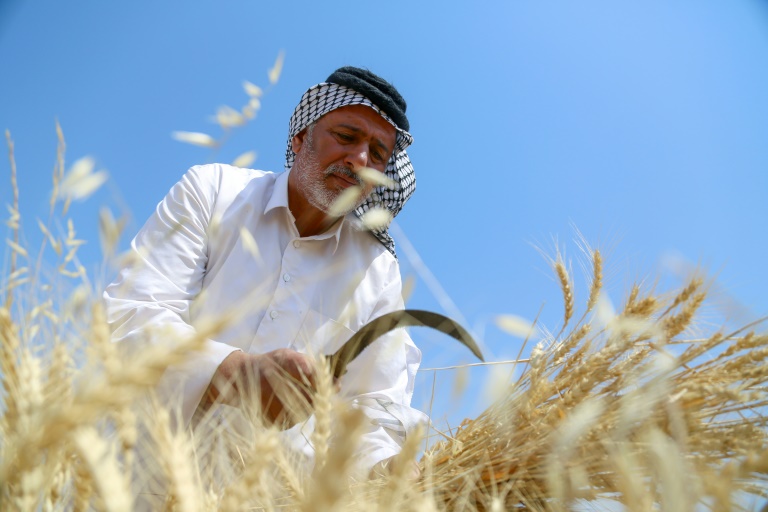
Iraqi farmer Kamel Hamed looks at the golden ears of wheat waving in the wind, unable to hide his anguish over the baking heat that is decimating his harvest.

“The drought is unbelievable,” said the 53-year-old in a white dishdasha robe and keffiyeh head covering at his farm in Jaliha village of central Diwaniya province.

“Even the well water can’t be used, it’s salt water.”

Searing heat and a lack of rain were already threatening his harvest. Then came Russia’s invasion of Ukraine in February, driving up the cost of fuel, seeds and fertiliser.

Like all farmers in Iraq, Hamed must follow the instructions of the state authorities who are the main grain buyers.

They determine the areas to be planted and the level of irrigation, depending on rain and water reserves. This year, due to water shortages, Iraq has reduced the area under cultivation by half.

As a result, Hamed has planted just one quarter of his 100 donums (10 hectares), where the combine harvester was now throwing grain into a truck bed.

“This year we didn’t even get 500 kilograms (1,100 pounds) of wheat from one donum” — less than half the usual harvest — he said.

The war in Ukraine has “pushed up the price of motor oil and of high-yield seeds”, he added — yet “another financial burden for farmers”.

“I don’t know how to support my family. No salary, no job, where can I go?”

– ‘Abandon the land’ – 

After decades of war and insurgency, Iraq faces another huge challenge: severe water scarcity driven by climate change.

It is highly sensitive issue for Iraq and its 41 million people, who feel the impacts on a daily basis, from depleted rivers to rapid desertification and more intense sandstorms.

Iraq’s big rivers, the Tigris and Euphrates, and their tributaries originate in Turkey and Syria as well as Iran, which dam them upstream, reducing the flow as they enter Iraq.

Irrigated by the Euphrates, Diwaniya province, where Jaliha is located, normally receives 180 cubic metres of water per second.

This year the volume has been at least halved to “80 to 90 cubic metres”, said Hani Shaer, who heads a farmers’ collective responsible for distributing the water.

The result can be seen in the stagnant water in the main irrigation canal, which serves the 200,000 donums of surrounding land, with some gullies now completely dry.

Shaer denounced a lack of support from authorities, charging that the agriculture ministry provided just five kilos of fertiliser this season, down from 40 kilos in previous years.

“The farmer will leave, abandon the land and head to the city to look for any kind of work,” he said.

– Collapsed harvest –

Agriculture ministry spokesman Hamid al-Nayef said the state was helping by raising the purchase price in order to pay producers around $500 per tonne of wheat.

In 2019 and 2020, wheat harvests had reached five million tonnes, enough to guarantee “self-sufficiency” for Iraq, he told AFP.

This season, Iraq may only grow 2.5-3 million tonnes of wheat, “not enough for a whole year for the Iraqis,” Nayef acknowledged.

“We will have to import,” he said.

Iraq will be confronted with the vagaries of the world market and prices driven up by the conflict in Ukraine, even though Baghdad imports its cereals mainly from Canada, Australia and the United States.

“With the interplay of supply and demand, prices are rising even in the United States and other countries,” Nayef said.

Back in Jaliha, another farmer, Ahmed al-Jelhawi, was questioning his life choices. He said he used to harvest 500 tonnes of wheat, but this year expects just 50-75 tonnes.

“I gave up my studies to devote myself to agriculture,” he lamented. “But this year, agriculture is zero.”

“Between the low production and the rising prices, we probably won’t be able to plant next year.”
Between searing drought and Ukraine war, Iraq watchful over wheat

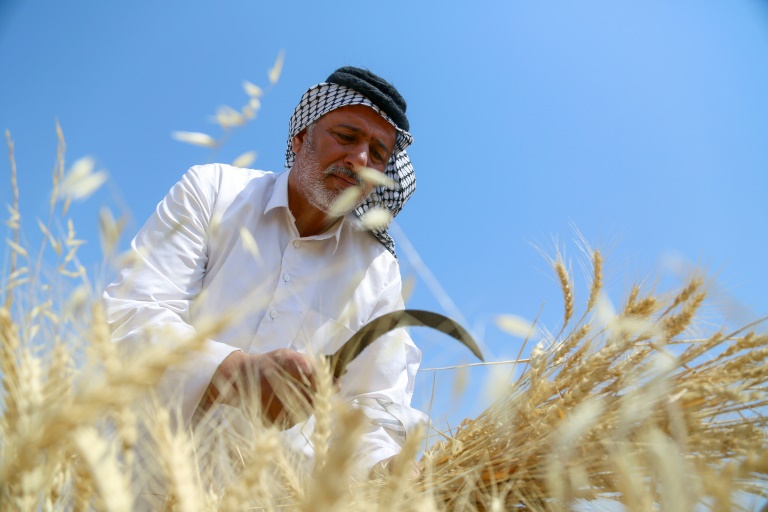
Iraqi farmer Kamel Hamed looks at the golden ears of wheat waving in the wind, unable to hide his anguish over the baking heat that is decimating his harvest.

“The drought is unbelievable,” said the 53-year-old in a white dishdasha robe and keffiyeh head covering at his farm in Jaliha village of central Diwaniya province.

“Even the well water can’t be used, it’s salt water.”

Searing heat and a lack of rain were already threatening his harvest. Then came Russia’s invasion of Ukraine in February, driving up the cost of fuel, seeds and fertiliser.

Like all farmers in Iraq, Hamed must follow the instructions of the state authorities who are the main grain buyers.

They determine the areas to be planted and the level of irrigation, depending on rain and water reserves. This year, due to water shortages, Iraq has reduced the area under cultivation by half.

As a result, Hamed has planted just one quarter of his 100 donums (10 hectares), where the combine harvester was now throwing grain into a truck bed.

“This year we didn’t even get 500 kilograms (1,100 pounds) of wheat from one donum” — less than half the usual harvest — he said.

The war in Ukraine has “pushed up the price of motor oil and of high-yield seeds”, he added — yet “another financial burden for farmers”.

“I don’t know how to support my family. No salary, no job, where can I go?”

– ‘Abandon the land’ – 

After decades of war and insurgency, Iraq faces another huge challenge: severe water scarcity driven by climate change.

It is highly sensitive issue for Iraq and its 41 million people, who feel the impacts on a daily basis, from depleted rivers to rapid desertification and more intense sandstorms.

Iraq’s big rivers, the Tigris and Euphrates, and their tributaries originate in Turkey and Syria as well as Iran, which dam them upstream, reducing the flow as they enter Iraq.

Irrigated by the Euphrates, Diwaniya province, where Jaliha is located, normally receives 180 cubic metres of water per second.

This year the volume has been at least halved to “80 to 90 cubic metres”, said Hani Shaer, who heads a farmers’ collective responsible for distributing the water.

The result can be seen in the stagnant water in the main irrigation canal, which serves the 200,000 donums of surrounding land, with some gullies now completely dry.

Shaer denounced a lack of support from authorities, charging that the agriculture ministry provided just five kilos of fertiliser this season, down from 40 kilos in previous years.

“The farmer will leave, abandon the land and head to the city to look for any kind of work,” he said.

– Collapsed harvest –

Agriculture ministry spokesman Hamid al-Nayef said the state was helping by raising the purchase price in order to pay producers around $500 per tonne of wheat.

In 2019 and 2020, wheat harvests had reached five million tonnes, enough to guarantee “self-sufficiency” for Iraq, he told AFP.

This season, Iraq may only grow 2.5-3 million tonnes of wheat, “not enough for a whole year for the Iraqis,” Nayef acknowledged.

“We will have to import,” he said.

Iraq will be confronted with the vagaries of the world market and prices driven up by the conflict in Ukraine, even though Baghdad imports its cereals mainly from Canada, Australia and the United States.

“With the interplay of supply and demand, prices are rising even in the United States and other countries,” Nayef said.

Back in Jaliha, another farmer, Ahmed al-Jelhawi, was questioning his life choices. He said he used to harvest 500 tonnes of wheat, but this year expects just 50-75 tonnes.

“I gave up my studies to devote myself to agriculture,” he lamented. “But this year, agriculture is zero.”

“Between the low production and the rising prices, we probably won’t be able to plant next year.”
The siege of Mariupol

Key developments in the siege of the strategic Ukrainian port of Mariupol where Russia has been seeking to conquer the last pocket of resistance holed up in a sprawling steelworks, after a rush to evacuate civilians trapped inside.

Located on the Sea of Azov, the city has been a key prize for Russia in its bid to join up the annexed Crimea peninsula to the west with territory held by pro-Russian rebels in the east.

A timeline:

– Pounded, encircled –

On March 2, a week after the Russian invasion of Ukraine, Moscow’s artillery begins pounding Mariupol, a predominantly Russian-speaking city of 441,000 inhabitants some 55 kilometres (35 miles) from the Russian border and 85 kilometres from the pro-Russian separatist stronghold of Donetsk.

The mayor accuses Russian forces and pro-Russian fighters of seeking to “impose a blockade” by cutting off food supplies and vital infrastructure, including water, electricity and heating.

– Maternity ward bombed –

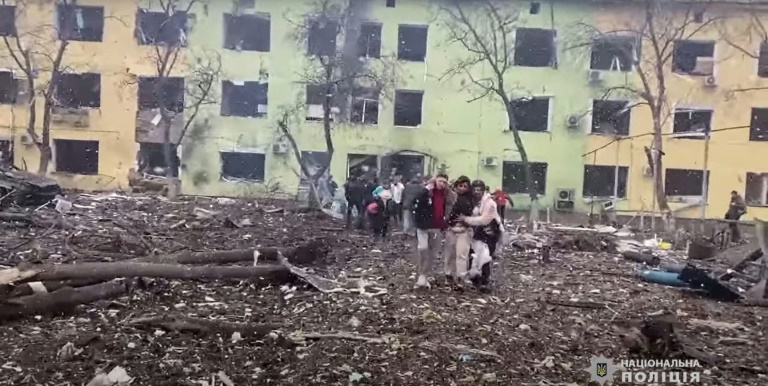
On March 9, Russia targets a building housing a maternity ward and paediatric hospital in Mariupol, killing three, including a young girl.

Ukraine and the European Union condemn a “war crime”. Russia claims the building is sheltering Ukrainian nationalists.

– First evacuations –

Mid-March sees the start of the evacuation of thousands of civilians from the city through a humanitarian corridor.

Earlier evacuation attempts had collapsed with both sides accusing the other of failing to halt fire.

– Theatre destroyed –

On March 16, Russian air strikes raze a theatre sheltering hundreds of people, mostly women and children. It takes days to reach survivors trapped in an underground shelter.

Ukrainian authorities estimate some 300 people were killed.

Moscow denies the attack, blaming Ukraine’s far-right Azov battalion, which is based in the city.

– ‘Freezing hellscape’ –

On March 21, Kyiv rejects a first Russian ultimatum to Ukrainian forces in the city to surrender. 

Civilians who manage to escape in their own vehicles describe a “freezing hellscape riddled with dead bodies and destroyed buildings”, Human Rights Watch says.

– Ceasefire, more evacuations –

On March 30, Moscow announces a ceasefire to allow the evacuation of civilians from Mariupol to the Ukrainian-controlled city of Zaporizhzhia. 

On April 4, Mariupol mayor Vadym Boychenko says the city has been “90 percent” destroyed.

On April 7, the new “mayor” of Mariupol, Konstantin Ivashchenko, installed by pro-Russian forces, says that around 5,000 civilians have died.

– ‘Last battle’ –

On April 11, marines in Mariupol say they are preparing for a “last battle”, with fighting concentrated at the Azovstal steelworks after separatists say they seized the port.

– Thousands dead –

The next day, the regional authorities say at least 20,000 people have been killed.

The United States says it has “credible information” that Russia may use “chemical agents” in its offensive.

Over the following week, Russia issues a string of ultimatums to troops holed up at the steelworks to give themselves up but they refuse.

– Civilians trapped – 

On April 20, Ukraine proposes special negotiations on the fate of Mariupol, where hundreds of civilians are also sheltering alongside troops in the steelworks.

– Mariupol ‘liberated’ –

On April 21, Russian President Vladimir Putin declares the “liberation” of Mariupol to be a “success.” He orders the Russian military to refrain from storming the Azovstal plant, telling them to besiege it instead, “so that not even a fly can escape.”

On May 2, an initial group of around 100 civilians is evacuated from the plant, arriving in Zaporizhzhia.

– Women, children rescued –

On May 3, Russian forces launch a “powerful assault” on the plant using artillery and planes, according to Ukraine.

The next day, Russia announces its forces will cease fire at Azovstal and open a humanitarian corridor for civilian evacuations for three days. Ukrainian fighters say the assault continues.

On May 6, the Ukrainian presidency says almost 500 civilians have been evacuated in total, but the UN-led rescue operation is ongoing.

A day later, Kyiv says “all women, children and the elderly” have been extracted from the plant to safety.

It urges Doctors Without Borders (MSF) to evacuate its soldiers from the steel plant, adding those wounded are “dying because of gangrene and sepsis” without medicine.

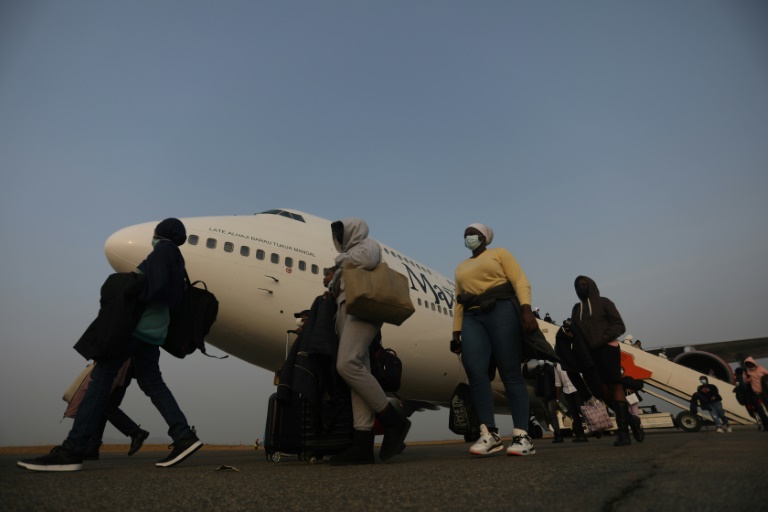
Nigerian airlines suspend flights over soaring fuel prices

Nigerian airlines are to suspend all flights from Monday over rising jet fuel prices, an umbrella organisation of operators said on Saturday.

The cost of fuel has soared worldwide since Russia invaded its neighbour Ukraine in February and the West responded by slapping sanctions on Moscow.

The Airline Operators of Nigeria said the price of jet fuel had jumped from 190 to 700 Nigerian naira per litre (from $0.45 to almost $1.70).

“No airline in the world can absorb this kind of sudden shock from such an astronomical rise over a short period,” the AON said.

The group said it would now cost a customer 120,000 naira ($289) for a one-hour flight, a sum unaffordable for Nigerians “already experiencing a lot of difficulties”.

The AON therefore wished “to regrettably inform the general public that member airlines will discontinue operations nationwide with effect from Monday May 9, 2022 until further notice,” it said.

The aviation ministry responded by urging airlines to “consider the multiplier effect of shutting down operations, on Nigerians and global travellers”.

The Nigerian consumer protection agency also implored “domestic airlines to consider the effect of the proposed shutdown on passengers and the magnitude of difficulties and hardship associated with such an action”.

It added it was “concerned with rising consumer feedback that airlines have continued to sell tickets beyond the date announced for the proposed service shutdown.”

Social media users made fun of the airlines suggesting customers find alternative means of travel.

“Airlines in Nigeria will shut down their services to passengers from Monday,” one tweeted to more than 110,000 followers.

“I hope you can trek from Lagos to Abuja?” they wrote, of the journey of more than 700 kilometres (more than 400 miles) by road between the country’s largest city and its capital — one that normally takes just over an hour on an airplane.

“If you use the roads, I hope you have your ransom money?” they added, making light of abductions in other parts of the oil-rich country.

Nigeria produces 1.4 million barrels of crude a day, but it refines little. It relies almost completely on fuel imports, making the local market vulnerable to disruptions.

The rising price of fuel has caused prolonged power blackouts in recent weeks.

Sinn Fein hails 'new era' for N.Ireland after historic poll win

Sinn Fein leader Michelle O’Neill on Saturday acclaimed a “new era” for Northern Ireland as her Irish nationalist party handed a historic election defeat to pro-UK unionists who had monopolised power for decades.

Once the political wing of the paramilitary IRA, Sinn Fein won enough seats in the devolved legislature to nominate O’Neill as first minister — a century after Northern Ireland was carved out as a Protestant fiefdom under British rule.

O’Neill appealed for a “healthy debate” about reunifying Ireland, but the Democratic Unionist Party (DUP) stood by its refusal to form a new power-sharing government, opening up the prospect of months-long political limbo.

“Today ushers in a new era,” said O’Neill, who at 45 came of political age after the 1998 Good Friday Agreement ended three decades of bloodshed in Northern Ireland.

“It’s a defining moment for our politics and our people,” she added.

“I will provide leadership which is inclusive, which celebrates diversity, which guarantees rights and equality for those who have been excluded, discriminated against or ignored in the past.” 

With 88 of 90 seats filled from Thursday’s proportional voting, Sinn Fein was assured of 27 seats in the Stormont assembly, ahead of the DUP on a maximum of 25, and the cross-community Alliance party on 17.

“The people have spoken, and our job is now to turn up. I expect others to turn up also,” O’Neill told reporters, stressing the new government must tackle foremost a cost-of-living crisis in the UK, ahead of the debate about Irish unity.

The DUP occupied the role of first minister in the outgoing assembly, before it collapsed the executive in protest at post-Brexit trading rules between the UK and EU.

– ‘Long shadow’ –

DUP leader Jeffrey Donaldson demanded that UK Prime Minister Boris Johnson “deliver on his word to honour the commitments he has given and to take the action that is necessary” on the Northern Ireland Protocol.

He urged “decisive action by the government to remove the Irish Sea border, because we don’t believe it is acceptable or necessary to have checks on goods moving within the United Kingdom”.

While Sinn Fein will get to nominate a first minister, Northern Ireland’s government can only form under the 1998 deal if the DUP agrees to take part and serve in the role of deputy first minister.

“I want a government in Northern Ireland, but it has to be one based on stable foundations,” Donaldson said.

“And the long shadow of the Northern Ireland Protocol is harming our economy, it’s harming political stability.”

Johnson’s Northern Ireland Secretary Brandon Lewis was expected to meet the party leaders in Belfast on Monday. The parties will have 24 weeks to resolve their differences or face a new election.

In a statement, Lewis urged all the parties to form a new executive “as soon as possible”. 

The voters had a number of messages, he said. “They were clear that they want a fully functioning devolved government in Northern Ireland, they want the issues around the protocol addressed, and that they want politics to work better.”

Irish premier Micheal Martin said it was “now incumbent on all political parties and elected representatives to deliver on their mandate” to form an administration and “serve the interests of all of the people of Northern Ireland”.

England, Wales and Scotland also voted in local and regional elections on Thursday, punishing embattled Johnson’s scandal-mired Conservatives but without a landslide for the main opposition Labour party.

The Scottish National Party strengthened its hold, and the result in Northern Ireland played into its own argument for separation from the UK. 

SNP leader Nicola Sturgeon congratulated Sinn Fein’s leadership “on a truly historic result”.

Johnson is expected to lay out his post-election plans in the Queen’s Speech in parliament on Tuesday, which will have to take into account the forming a government in Northern Ireland, long riven by sectarian unrest.

The other big winner in Northern Ireland was Alliance, which said its strong showing in third place underlined the need for Northern Ireland to move past old divisions.

“I think given all the challenges that we face, if we squander this opportunity people will not forgive us, so we need to get in there,” Alliance leader Naomi Long said.

Civilians leave steelworks as Ukraine braces for renewed offensive

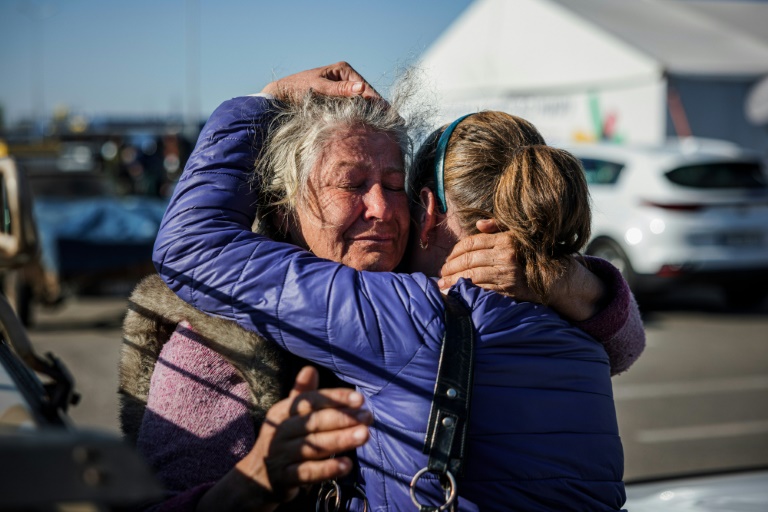
All vulnerable civilians have been evacuated from Mariupol, Ukraine said Saturday, presaging a showdown between Kyiv’s last remaining soldiers there and the besieging Russian forces ahead of celebrations marking the Soviet World War II victory.

The Azovstal steelworks, the final Ukrainian holdout in the devastated port city, has taken on a symbolic value in the war. Kyiv fears a renewed intensity to Moscow’s offensive.

“All women, children and the elderly have been evacuated from Azovstal,” Deputy Prime Minister Iryna Vereshchuk said.

Fighting continues on many fronts, and Ukraine’s defence ministry said it had destroyed another Russian vessel — a Serna-class landing craft — in the Black Sea.

“The traditional parade of the Russian Black Sea fleet on May 9 this year will be held near Snake Island — at the bottom of the sea,” the ministry added. Russia did not immediately confirm the incident.

Earlier, Ukraine’s defence ministry said Russian forces had resumed their assault on the Azovstal site, despite talk of a truce to allow trapped civilians to flee.

– Putin may ‘double down’ –

On Monday, President Vladimir Putin will celebrate the World War II Soviet victory over Nazi Germany with a traditional Victory Day parade.

According to Russia’s defence ministry, 77 aircraft will conduct a fly-past, including the rarely seen Il-80 Doomsday plane that can withstand a nuclear attack.

Despite apocalyptic nuclear threats carried by Russian state media, the CIA said Saturday it saw no indication Moscow was preparing to use tactical atomic weapons in the Ukraine conflict.

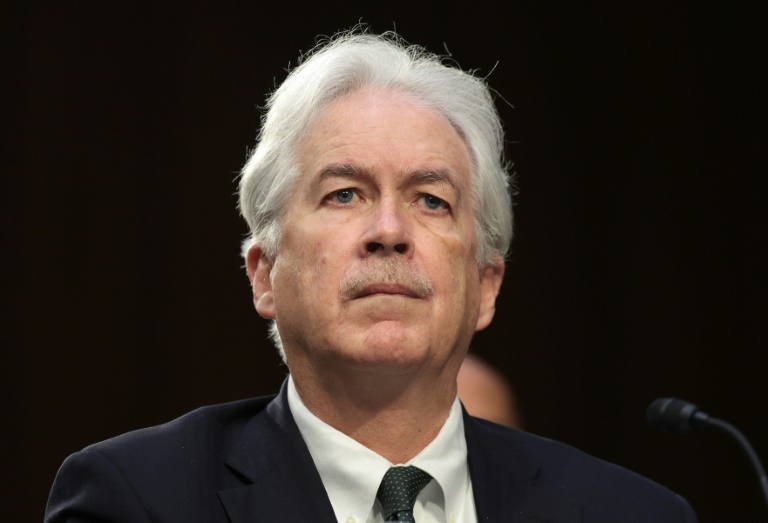
“We don’t see, as an intelligence community, practical evidence at this point of Russian planning for the deployment or even potential use of tactical nuclear weapons,” CIA director Bill Burns said at a conference.

Burns also warned that Putin believed he could not afford defeat in Ukraine and that he might be “doubling down” on the offensive.

Eight Mig-29 fighter jets will fly over Moscow’s Red Square during Monday’s festivities, forming the letter “Z” — the mark of Russia’s military assault in Ukraine. 

The Russian campaign has run into tough resistance — and galvanised Kyiv’s western allies to comprehensively sanction the Russian economy and Putin’s inner circle.

But with Victory Day approaching, Ukrainian officials fear more intense missile and artillery bombardments and renewed assaults, as Moscow scrambles for symbolic wins.

– ‘Massive bombardments’ –

The Ukrainian rescue service said a missile had hit a technical college in Kostiantynivka, in the eastern region of Donetsk, killing at least two people. 

Donetsk regional governor Pavlo Kyrylenko reported “massive bombardments” along the frontline.

Four civilians had been killed in Donetsk, two in Bakhmut and two in Kostiantynivka, with another nine people wounded, he added.

Ukrainian forces meanwhile have launched a counter-offensive.

According to the defence ministry, Russian troops were forced to demolish three road bridges near Tsyrkuny and Ruski Tyshky outside Kharkiv, to slow the Ukrainian advance.

And British intelligence said Ukrainian forces equipped with high-end weaponry by the western allies, have been able to destroy at least one of Russia’s most advanced tanks, the T-90M.

“The conflict in Ukraine is taking a heavy toll on some of Russia’s most capable units and most advanced capabilities,” UK Defence Intelligence said.

“It will take considerable time and expense for Russia to reconstitute its armed forces following this conflict,” it said, adding that sanctions on advanced components would make it harder for Russia to re-arm.

– Western aid –

The West is stepping up arms deliveries to Ukraine’s forces, US President Joe Biden announcing a $150-million package of military aid.

That brings the total value of US weaponry sent to Ukraine since the Russian invasion began to $3.8 billion.

Biden has urged Congress to approve a further $33 billion package, including $20 billion in military aid, “to strengthen Ukraine on the battlefield and at the negotiating table”.

G7 leaders, including Biden, and Ukraine’s President Volodymyr Zelensky, will on Sunday discuss Western support for Kyiv in videoconference.

Biden’s wife, US First lady Jill Biden, was in Romania Saturday meeting Ukrainian refugees. 

After listening to mothers and children recount how they fled Russia’s invasion of their country, she told them: “We stand with you, I hope you know that.”

Ambassadors from EU member states meet in Brussels Sunday to discuss their sixth round of economic sanctions against Moscow, which this time should include a phased ban on imports of Russian oil.

– Russia to remain ‘forever’ –

The last Ukrainian soldiers in the devastated Black Sea port of Mariupol are believed to be holed up in the tunnels and bunkers beneath Azovstal.

Ukraine’s Azov battalion, leading the defence at Azovstal, said one Ukrainian fighter had been killed and six wounded when Russian forces opened fire during an earlier attempt to evacuate people by car.

Taking full control of Mariupol would allow Moscow to create a land bridge between the Crimea peninsula, which it annexed in 2014, and separatist regions run by Russian puppets in the east.

In those regions of the Donbas, separatists said they had removed Ukrainian and English language traffic signs for Mariupol and replaced them with Russian ones.

In neighbouring Lugansk, Ukrainian officials said on Friday that Russian forces had almost encircled Severodonetsk — the easternmost city still held by Kyiv — and were trying to storm it.

Kherson in the south remains the only significant city Russia has managed to capture since the war began.

A senior official from the Russian parliament, Andrey Turchak, said during a visit to the city on Friday that Russia would remain in southern Ukraine “forever”.

burs-gw/jj

Taliban order Afghan women to cover faces in public

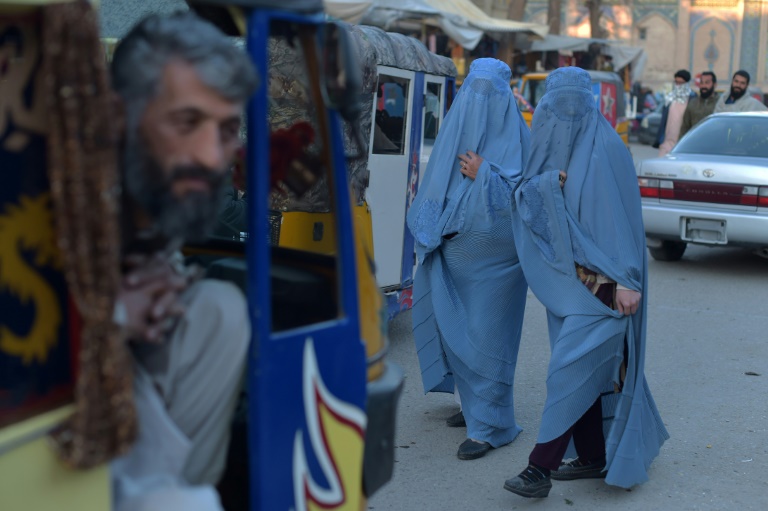
The Taliban on Saturday imposed some of the harshest restrictions on Afghanistan’s women since seizing power, ordering them to cover fully — including their faces — in public, ideally with the traditional burqa.

The decree from Taliban leader Hibatullah Akhundzada also said that if women had no important work outside then it was “better they stay at home”, and outlined punishments for their male guardians if they did not comply with the new dress code.

It was the latest in a slew of Taliban restrictions on women, including banning them from any government jobs, secondary education and travelling alone outside their cities, and prompted widespread international condemnation.

“So much pain & grief for women of my country, my heart is exploding. So much hatred & anger against Taliban, enemies of women, enforcers of gender apartheid, enemies of Afghanistan & humanity. The world is a bystander to our pain, to an apartheid, to complete tyranny,” tweeted Shaharzad Akbar, the former chairperson of Afghanistan’s Human Rights Commission. 

“Those women who are not too old or young must cover their face, except the eyes, as per sharia directives, in order to avoid provocation when meeting men who are not mahram (adult close male relatives),” said the decree approved by Akhundzada and released by Taliban authorities at a ceremony in Kabul.

It said the best way for a woman to cover her face and body was to wear the chadari, a traditional, blue, all-covering Afghan burqa that includes a screen over the face.

“They should wear a chadari as it is traditional and respectful,” it said.

The Ministry for Promotion of Virtue and Prevention of Vice, which released the new order, announced a slew of punishments if the dress code is not followed.

It said a woman’s father or male guardian would be summoned and could even be imprisoned if the offence was committed repeatedly.

Women working in government institutions who did not follow the order “should be fired”, the ministry added.

Government employees whose wives and daughters do not comply will also be suspended from their jobs, the decree said.

– ‘Regressive’ –

The militants took back control of the country in August last year, promising a softer rule than their previous stint in power between 1996 and 2001, which was marked by human rights abuses.

The international community has long tied the resumption of aid to Afghanistan’s economy, shattered by more than four decades of fighting, and the recognition of the Taliban government to the Islamists’ ability to keep their promises.

But the new controls on women have realised the worst fears of human rights activists and sparked a flurry of condemnation abroad. 

“We are extremely concerned that the rights and progress Afghan women and girls have achieved and enjoyed over the last 20 years are being eroded,” a US State Department spokesman told AFP. 

The official added: “We and many of our partners in the international community remain deeply troubled by recent steps the Taliban have taken directed at women and girls, including restrictions on education and travel.”

The United Nations mission in Afghanistan similarly condemned the Taliban’s move, saying it might “further strain engagement with the international community.”

“If they want international acceptance, they must live up to their obligations and commitments, particularly on the rights of women and girls,” the British Foreign Office said in a statement. 

“Such steps will only intensify opposition to them,” said Imtiaz Gul, head of the Islamabad-based Centre for Research and Security Studies.

During their first regime, the Taliban made the burqa compulsory for women.

Since their return to power, the much-feared vice ministry has issued several “guidelines” on dress but Saturday’s edict is one of the harshest restrictions on women.

“Islam never recommended chadari,” said a women’s rights activist who asked not to be named.

“I believe the Taliban are becoming regressive instead of being progressive. They are going back to the way they were in their previous regime.”

Another women’s rights activist, Muska Dastageer, said Taliban rule had triggered “too much rage and disbelief”.

“We are a broken nation forced to endure assaults we cannot fathom. As a people we are being crushed,” she said on Twitter.

The hardline Islamists triggered international outrage in March when they ordered secondary schools for girls to shut, just hours after they reopened for the first time since their seizure of power.

Officials have never justified the ban, apart from saying girls’ education must be according to “Islamic principles”.

That ban was also issued by Akhundzada, according to several Taliban officials.

Women have also been ordered to visit parks in the capital on separate days from men.

Some Afghan women initially pushed back strongly against the restrictions, holding small demonstrations — but the Taliban cracked down on these unsanctioned rallies and rounded up several of the ringleaders, holding them incommunicado while denying they had been detained. 

In the 20 years between the Taliban’s two stints in power, girls were allowed to go to school and women were able to seek employment in all sectors, though the country remained socially conservative. 

Many women already wear the burqa in rural areas.

Rare May fires break out in Siberia, kill at least 10

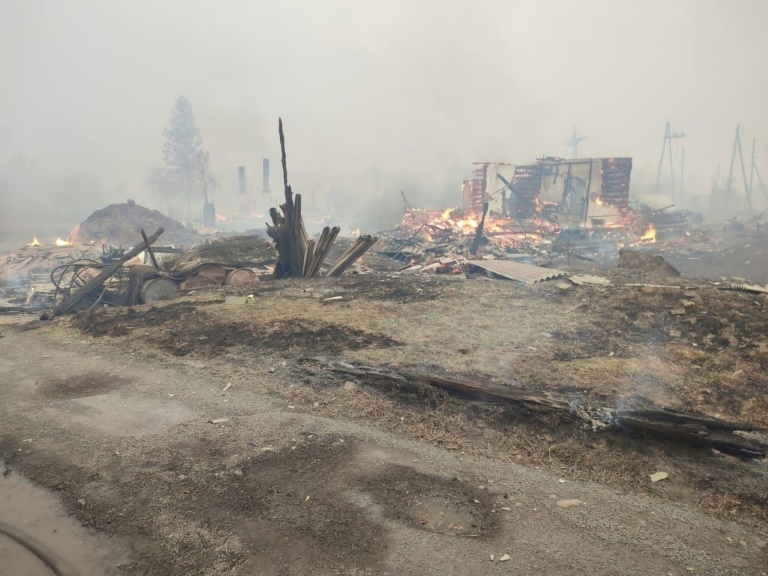
Fires that have broken out across southwestern Siberia have killed at least 10 people and damaged hundreds of buildings, local authorities said on Saturday.

Hundreds of firefighters are trying to contain the blazes, which are a rare occurrence in the region during May and have been fuelled by lack of rain and fierce winds, they said.

In the Krasnoyarsk region, at least five people lost their lives in the fires, which damaged around 450 homes, the local authorities said, declaring a state of emergency.

In the Kemerovo region, three people were found dead in a burnt home. 

In the Omsk region, two people died.

“Extinguishing (the fires) is being complicated by meteorological conditions — violent winds are fanning the flames and preventing them from being put out,” the regional ministry for emergencies in Krasnoyarsk said on Telegram.

Regional governor Alexander Uss said gales of up to 40 metres per second had brought down trees and power lines across large swathes of the Krasnoyarsk region, sparking the fires which authorities said 300 firemen backed by 90 vehicles were fighting.

“We have called for help from neighbouring territories but are aware that will in the best case not arrive for some hours,” said Uss, adding temporary shelters were being opened for people in the worst-hit areas. 

“I have given the order to cut off electricity in part of the region — save for survival facilities, service stations and water supply systems,” he said.

Roman Vilfand, of Russia’s Hydrometeorological Research Centre, told the TASS news agency that such fires were rare in the month of May.

“But there hasn’t been rain for a long time, there were fires, and then strong wind,” he said.

Forest-rich Siberia has suffered from unprecedented fires for several years. 

Last year, they belched 16 million tonnes of carbon into the atmosphere, according to an annual European climate report.

Rare May fires break out in Siberia, kill at least 10

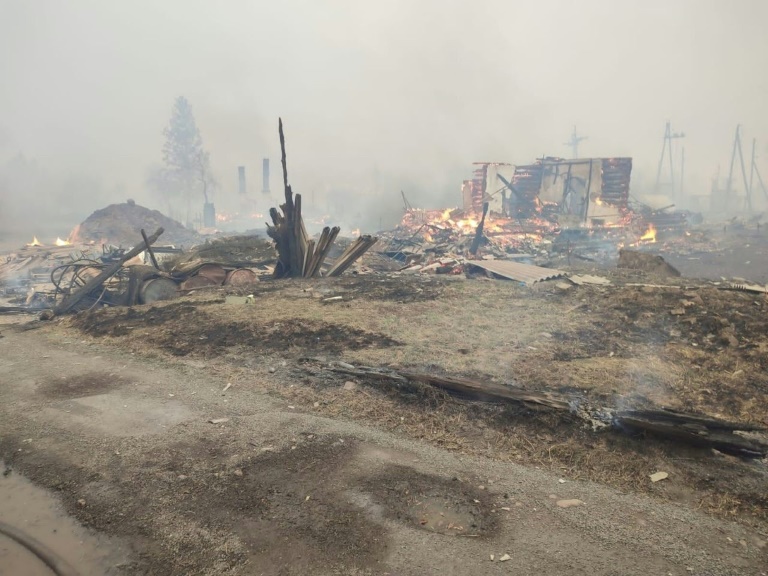
Fires that have broken out across southwestern Siberia have killed at least 10 people and damaged hundreds of buildings, local authorities said on Saturday.

Hundreds of firefighters are trying to contain the blazes, which are a rare occurrence in the region during May and have been fuelled by lack of rain and fierce winds, they said.

In the Krasnoyarsk region, at least five people lost their lives in the fires, which damaged around 450 homes, the local authorities said, declaring a state of emergency.

In the Kemerovo region, three people were found dead in a burnt home. 

In the Omsk region, two people died.

“Extinguishing (the fires) is being complicated by meteorological conditions — violent winds are fanning the flames and preventing them from being put out,” the regional ministry for emergencies in Krasnoyarsk said on Telegram.

Regional governor Alexander Uss said gales of up to 40 metres per second had brought down trees and power lines across large swathes of the Krasnoyarsk region, sparking the fires which authorities said 300 firemen backed by 90 vehicles were fighting.

“We have called for help from neighbouring territories but are aware that will in the best case not arrive for some hours,” said Uss, adding temporary shelters were being opened for people in the worst-hit areas. 

“I have given the order to cut off electricity in part of the region — save for survival facilities, service stations and water supply systems,” he said.

Roman Vilfand, of Russia’s Hydrometeorological Research Centre, told the TASS news agency that such fires were rare in the month of May.

“But there hasn’t been rain for a long time, there were fires, and then strong wind,” he said.

Forest-rich Siberia has suffered from unprecedented fires for several years. 

Last year, they belched 16 million tonnes of carbon into the atmosphere, according to an annual European climate report.

Putin 'doesn't believe he can afford to lose' in Ukraine: CIA chief

Russian President Vladimir Putin believes that he cannot afford to lose in Ukraine and is “doubling down” on the war, but shows no signs of planning to use tactical nuclear weapons, CIA director Bill Burns said Saturday.

Despite the failure of Russian forces to capture Kyiv and their struggle to advance along the war’s main frontlines in the southeastern Donbas region, the Russian leader has not changed his view that his troops can defeat Ukraine’s, Burns said.

Putin’s belief in the Russian military’s ability to wear down Ukrainian resistance probably has not been shaken despite key battlefield defeats, the US spy chief told a Financial Times conference.

“I think he’s in a frame of mind in which he doesn’t believe he can afford to lose,” Burns said.

He said Putin has been “stewing” for years over Ukraine — once part of the Soviet Union — in a “very combustible combination of grievance and ambition and insecurity.”

Putin has not been deterred by the resistance in the war “because he staked so much on the choices that he made to launch this invasion,” Burns said.

“I think he’s convinced right now that doubling down still will enable him to make progress,” Burns said.

– Tactical nuclear weapons –

Burns, a former US ambassador to Russia who has spent much time studying the Russian leader, said his and other Western intelligence agencies see no sign that Moscow is prepared to deploy tactical nuclear weapons in order to gain a victory in Ukraine or to target Kyiv’s supporters.

Russia placed its nuclear forces on high alert shortly after launching the invasion on February 24. 

Since then Putin has made thinly veiled threats hinting at willingness to deploy Russia’s tactical nuclear weapons if the West directly intervenes in the Ukraine conflict.

“We don’t see, as an intelligence community, practical evidence at this point of Russian planning for the deployment or even potential use of tactical nuclear weapons,” Burns said.

“Given the kind of saber-rattling that … we’ve heard from the Russian leadership, we can’t take lightly those possibilities,” he said.

“So we stay very sharply focused as an intelligence service … on those possibilities at a moment when the stakes are very high for Russia,” he said.

Burns did not offer any assessment of the current battlefield situation or predict how the war would end.

– China ‘unsettled’ –

But he said that China, which Washington now sees as its primary adversary, is studying closely the lessons of the war and what they mean for Beijing’s desire to take control of Taiwan.

Burns said he does not believe that Chinese President Xi Jinping has altered his goal of eventually uniting Taiwan with China, by force if necessary.

But he said he thinks Beijing has been “surprised” by the poor performance of Russian military forces as well as the tough resistance coming from the entire Ukrainian society, as well as the strong defense support the West has provided Kyiv.

Russia’s experience in Ukraine is probably affecting Beijing’s calculation “about how and when” they try to gain control of Taiwan, which China views as a renegade province. 

“I think they’ve been struck by the way in which particularly the transatlantic alliance has come together to impose economic costs on Russia as a result of that aggression,” he continued.

Beijing has been “unsettled by the fact that what Putin has done is to drive Europeans and Americans closer together,” Burns said.

“What conclusions get drawn from all that remains a question mark,” he said.

“I think the Chinese leadership is looking very carefully at all this, at the costs and consequences of any effort to use force to gain control over Taiwan.”

Close Bitnami banner
Bitnami