World

Tarnished icon Lula seeking a comeback in Brazil

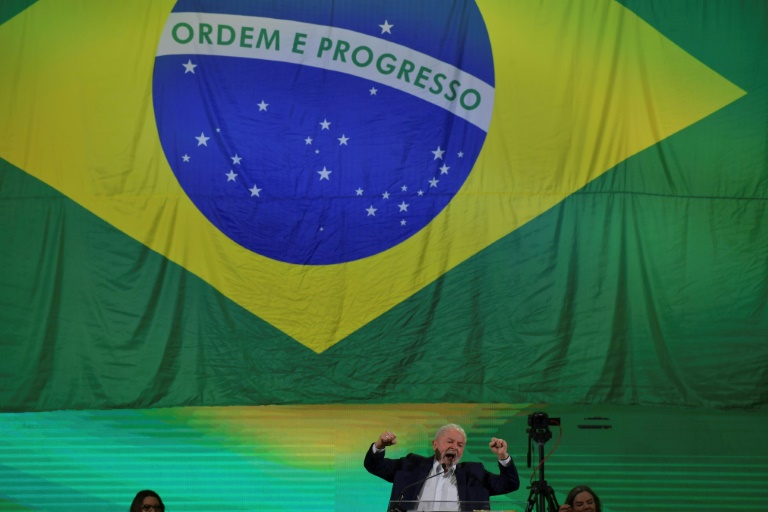
Charismatic ex-steelworker Luiz Inacio Lula da Silva rose from poverty to become the most popular president in Brazilian history, only to fall spectacularly from grace when he was jailed for corruption.

Now, capping a lifetime of dramatic twists of fate, the 76-year-old leftist icon is seeking his unlikeliest turnaround yet: a presidential comeback.

Lula, who launched his campaign Saturday, will seek to stop his nemesis, far-right President Jair Bolsonaro, from winning a new term in Brazil’s October elections.

“I’m jumping back into the fight,” Lula told a cheering crowd in Sao Paulo, joking in his trademark gravelly voice that he was “a young man of 76.”

Known for his political skill and common Ttouch, Lula left office on January 1, 2011 as a blue-collar hero who presided over a watershed boom and helped lift tens of millions of people from poverty.

But he then became embroiled in a massive corruption scandal that engulfed some of Brazil’s most influential politicians and business executives.

Lula was jailed in 2018, removing him as the favorite in that year’s presidential race — which Bolsonaro won.

He spent more than 18 months in prison before being freed pending appeal.

Then, in March last year, Brazil’s Supreme Court annulled his convictions, ruling there was bias on the part of the lead judge in the case, Sergio Moro, who had gone on to become Bolsonaro’s justice minister.

The ruling landed like a bomb just as Brazil geared up for this year’s elections.

Loved and hated with roughly equal passion in Brazil, Lula has been the front-runner ever since.

– Fallen giant –

Brazil’s first working-class head of state, Lula enjoyed widespread popularity as president, when a commodity-fueled economic boom helped him ride out numerous corruption scandals.

Under his administration, which mixed trailblazing social programs with market-friendly economic policy, some 30 million people rose from poverty in Brazil, where inequality is among the world’s worst.

Lula also turned Brazil into a key player on the international stage, helping bring it the world’s two biggest sporting events, the World Cup in 2014 and the 2016 Olympics in Rio de Janeiro.

Called “the most popular politician on Earth” by no less than Barack Obama, he stepped down after two terms, basking in 87 percent popularity ratings.

But just as he settled into the role of elder statesman, he was clobbered by “Operation Car Wash,” the sweeping investigation that uncovered a massive web of corruption centered on state-run oil company Petrobras.

Lula was sentenced to a total of 26 years on charges of accepting a triplex beach apartment and renovations at a ranch property as bribes for greasing companies’ access to juicy Petrobras contracts.

He has always denied the accusations against him, alleging a plot to sideline him and his Workers’ Party (PT).

– From poverty to power –

Lula grew up in deep poverty, the seventh of eight children born to a family of illiterate farmers in the arid northeastern state of Pernambuco.

When he was seven, his family joined a wave of migration to the industrial heartland of Sao Paulo state. Lula worked as a shoeshine boy and peanut vendor on the street, before becoming a steelworker at age 14.

In the 1960s, he lost the little finger of his left hand in a workplace accident.

He rose quickly to become president of his trade union, and was the force behind major strikes in the 1970s that challenged the military dictatorship then in power.

In 1980, he co-founded the Workers’ Party, standing as its candidate for president nine years later.

Lula made three unsuccessful bids for the presidency, from 1989 to 1998, each time chipping away at the establishment notion that a poor, uneducated laborer could never lead Brazil.

The fourth time, in 2002, he succeeded, taking office on January 1, 2003, and winning re-election in 2006.

He is hoping to repeat that success this year, his sixth presidential campaign.

His wife of four decades, Marisa Leticia Rocco, died of a stroke in 2017.

Lula says he is now “in love as if I were 20 years old” with Rosangela “Janja” da Silva, a sociologist and Workers’ Party activist, whom he plans to marry later this month.
France's Macron vows new start at second term inauguration

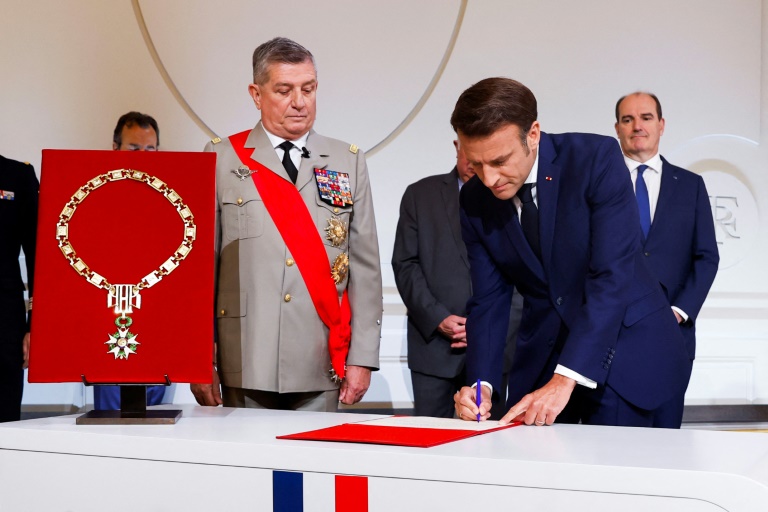
French President Emmanuel Macron on Saturday vowed a new start to face immense challenges in foreign and domestic policy, as he was inaugurated for a second term after his election victory over the far right.

In a ceremony at the Elysee Palace, Macron was confirmed by Constitutional Council chief Laurent Fabius as the winner of April election and then signed the formal re-investiture document.

Attended by 450 people, including his wife Brigitte and his only surviving predecessors Francois Hollande and Nicolas Sarkozy, the ceremony was relatively modest but marked the first time a French leader is serving a second term in 20 years.

Macron faces a daunting agenda of implementing the reforms he vowed when he came to power as France’s youngest-ever president in 2017, as well as dealing with the Russian assault against Ukraine.

“Rarely has our world and our country been confronted with such a combination of challenges,” he said, referring to the Russian invasion, the pandemic and the ecological emergency.

He vowed to be a “new president” for a “new mandate” and create a “stronger France”.

“Every day of the mandate that lies ahead I will have just one compass point. And that is to serve.”

– ‘Worn-out rites’ –

He also suggested a more inclusive and understanding style of ruling after his first term saw critics complain the former investment banker had abrasive and arrogant methods.

He vowed a “new method” to govern, far from the “worn-out rites and choreography” of the past.

In a tradition dating back to the Middle Ages, 21 cannon shots were fired from the Invalides military memorial complex to celebrate the inauguration.

With no drive down the Avenue des Champs-Elysees or long red carpet, the ceremony resembled the re-inaugurations of Francois Mitterrand in 1988 and Jacques Chirac in 2002, the last French president to win a second term.

Macron’s second term will only start officially when the first one expires at midnight on May 13.

He is set to keep playing a leading role in efforts to stop Russia’s war against Ukraine, while he carries an immense burden of expectation as a leader on the European stage with Germany still finding its footing in the post-Angela Merkel era.

Macron vowed to “act to avoid any escalation following the Russian aggression in Ukraine, to help democracy and courage to prevail, to build a new European peace and a new autonomy on our continent.”

On the domestic front, Macron must deal with the crisis over the rising cost of living and also brace for possible protests when he finally tackles his cherished pension reform, raising France’s retirement age.

He reaffirmed a vow for full employment in France and vowed to fight against inequality by reforming the health and school systems as well as against “daily insecurities and terrorism that is still there”.

Attending the ceremony were the parents of teacher Samuel Paty who was beheaded by an Islamist extremist in 2020. His mother was moved to tears when the president embraced them.

– ‘Having difficulty’ –

Macron won the second round of presidential polls on April 24 with a score of 58.55 percent against far-right rival Marine Le Pen.

The ceremony comes at a time of political flux in the wake of Macron’s election victory, as France gears up for legislative polls that swiftly follow in June.

Macron is expected to name a new premier in place of incumbent Jean Castex to lead a revamped government into the elections, but not until his second term officially kicks off.

He has mooted naming a female politician with a focus on social responsibility — although reports have indicated that overtures to leftist figures, such as former official Veronique Bedague and Socialist parliamentary group chief Valerie Rabault, have been rebuffed.

“Here they are obviously having difficulty finding the right person,” French political historian Jean Garrigues told AFP.

Meanwhile, the Socialist Party along with the Greens and Communists, is forming an unprecedented alliance for the parliamentary elections with the hard left France Unbowed (LFI) party of Jean-Luc Melenchon.

He was by far the best performing left-wing candidate in the first round of presidential elections and is spearheading efforts to mount a convincing challenge to Macron.

Pro-Macron factions have regrouped under the banner of Ensemble (Together) while his own Republic on the Move party, which has struggled to create a grass-roots base, is renaming itself Renaissance.

Garrigues said the problems of the ruling party were “linked by nature to his (Macron’s) political positioning which is both on the right and the left”. 

vl-leb-jri-sjw/bp

Russia steps up Ukraine assaults ahead of Victory Day parades

Ukraine said  civilians had been evacuated from a besieged Mariupol steel plant on Saturday as Russian forces unleashed new bombardments across the country ahead of Victory Day festivities in Moscow.

The Azovstal steel mill is the last pocket of Ukrainian resistance in the devastated port city and its fate has taken on a symbolic value in the broader battle since Russia’s invasion.

“All women, children and the elderly have been evacuated from Azovstal,” Deputy Prime Minister Iryna Vereshchuk said.

Fighting continues on many fronts, and Ukraine’s defence ministry said it had destroyed another Russian vessel — a Serna-class landing craft — in the Black Sea.

“The traditional parade of the Russian Black Sea fleet on May 9 this year will be held near Snake Island — at the bottom of the sea,” the ministry added. Russia did not immediately confirm the incident.

Ukraine’s defence ministry had earlier said Russian forces had resumed their assault on the Azovstal site, despite talk of a truce to allow trapped civilians to flee.

On Monday, President Vladimir Putin will celebrate the World War II Soviet victory over Nazi Germany with a traditional Victory Day parade.

According to Russia’s defence ministry, 77 aircraft will conduct a flypast, including the rarely-seen Il-80 Doomsday plane that can withstand a nuclear attack. 

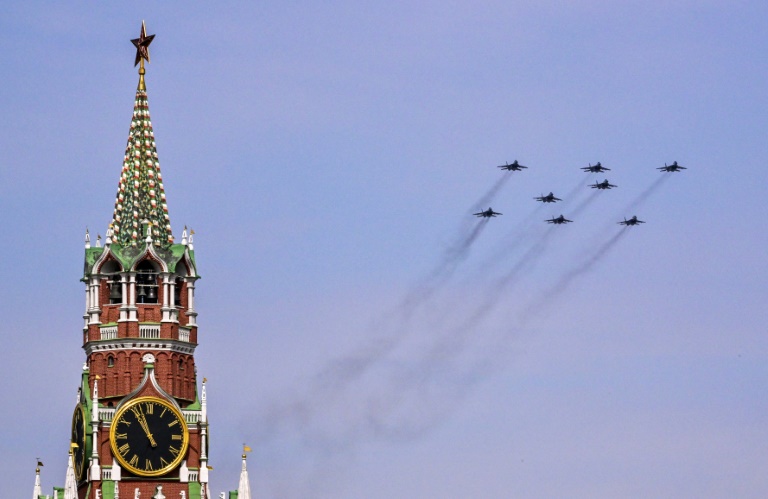
Eight Mig-29 fighter jets will fly over Moscow’s Red Square forming the letter “Z” — the mark of Russia’s military assault in Ukraine. 

The Russian campaign has run into tough resistance — and provoked Kyiv’s western allies into slapping sanctions on the Russian economy and Putin’s inner circle.

But with Victory Day approaching, Ukrainian officials fear more intense missile and artillery bombardments and renewed assaults as Moscow scrambles for symbolic wins.

The Ukrainian rescue service said a missile hit a technical college in Kostiantynivka, in the eastern region of Donetsk, causing a fire and at least two deaths. 

Donetsk regional governor Pavlo Kyrylenko said there had been “massive bombardments” along the frontline. 

Strikes were also reported in the north of Ukraine near the city of Kharkiv and in the southern city of Mikolaiv, a key Russian target.

Ukrainian forces have launched a counter-offensive of their own.

– Bridges down –

According to the defence ministry, Russian troops were forced to demolish three road bridges near Tsyrkuny and Ruski Tyshky outside Kharkiv, to slow the Ukrainian advance.

According to British intelligence, Ukrainian forces equipped with high-end weaponry by the western allies, have been able to destroy at least one of Russia’s most advanced tanks, the T-90M.

“The conflict in Ukraine is taking a heavy toll on some of Russia’s most capable units and most advanced capabilities,” UK Defence Intelligence said.

“It will take considerable time and expense for Russia to reconstitute its armed forces following this conflict,” it said, warning sanctions on advanced components would make it harder for Russia to re-arm.

The West, meanwhile, is stepping up arms deliveries to Ukraine’s defenders.

On Friday, US President Joe Biden announced another package of military assistance worth $150 million, including radars for detecting the source of enemy artillery fire.

This brings the total value of US weaponry sent to Ukraine since the Russian invasion began to $3.8 billion.

Biden had urged Congress to approve a further $33 billion package, including $20 billion in military aid, “to strengthen Ukraine on the battlefield and at the negotiating table.”

The G7 leaders, including Biden, and Ukraine’s President Volodymyr Zelensky are to meet in videoconference on Sunday to discuss Western support for Kyiv.

And Biden’s wife, US First lady Jill Biden, was in Romania meeting Ukrainian refugees. 

“You are amazingly strong,” Biden said in Bucharest after listening to mothers and children recount how they fled Russia’s invasion of their country.

“We stand with you, I hope you know that.”

Ambassadors from EU member states were to meet in Brussels on Sunday to discuss their sixth round of economic sanctions against Moscow, which this time should include a phased ban on imports of Russian oil.

– Azovstal evacuation –

On Friday, Zelensky said “diplomatic options” were also under way to rescue Ukrainian soldiers from the Mariupol steelworks, as civilian evacuations continued. 

About 200 civilians, including children, had been thought to be trapped in the tunnels and bunkers beneath Azovstal, along with Ukrainian soldiers making their last stand.

Russia announced a day-time ceasefire at the plant for three days starting Thursday but the Ukrainian army said Russian “assault operations” had continued.

Ukraine’s Azov battalion, leading the defence at Azovstal, said one Ukrainian fighter had been killed and six wounded when Russian forces opened fire during an attempt to evacuate people by car.

– Russia to remain ‘forever’ –

Taking full control of Mariupol would allow Moscow to create a land bridge between the Crimean peninsula, which it annexed in 2014, and separatist regions run by Russian puppets in the east.

In those regions of the Donbas, separatists said they had removed Ukrainian and English language traffic signs for Mariupol and replaced them with Russian ones.

“Russia has come back here forever,” said Denis Pushilin, head of a pro-Russian breakaway region in Donetsk.

In neighbouring Lugansk, Ukrainian officials said on Friday that Russian forces had almost encircled Severodonetsk — the easternmost city still held by Kyiv — and are trying to storm it.

Kherson in the south remains the only significant city Russia has managed to capture since the war began.

A senior official from the Russian parliament visiting the city on Friday also emphasised that Russia would remain in southern Ukraine “forever”.

“There should be no doubt about this. There will be no return to the past,” Andrey Turchak said.

burs-ah/yad

Taliban order Afghan women to cover fully in public

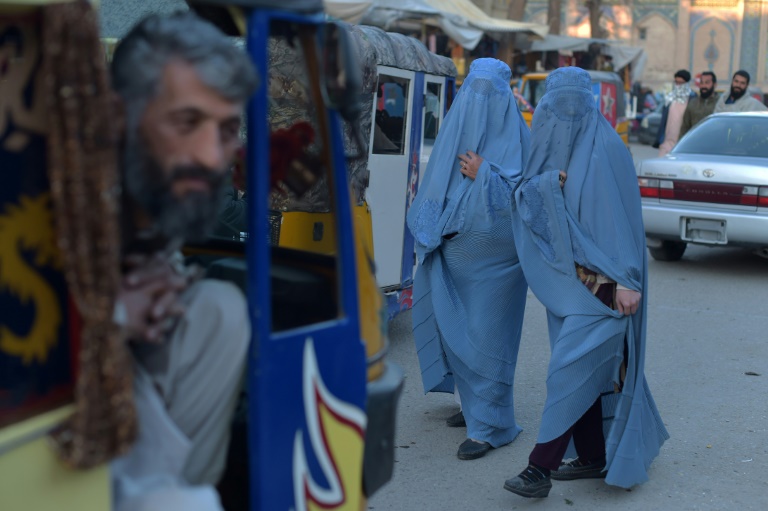
The Taliban on Saturday imposed some of the harshest restrictions on Afghanistan’s women since they seized power, ordering them to cover fully in public, ideally with the traditional burqa.

The militants took back control of the country in August last year, promising a softer rule than their previous stint in power between 1996 and 2001, which was marked by human rights abuses.

But they have already imposed a slew of restrictions on women — banning them from many government jobs, secondary education, and from travelling alone outside their cities.

On Saturday, Afghanistan’s supreme leader and Taliban chief Hibatullah Akhundzada approved a strict dress code for women in public.

“Those women who are not too old or young must cover their face, except the eyes, as per sharia directives, in order to avoid provocation when meeting men who are not mahram (adult close male relatives),” said a decree approved by Akhundzada and released by Taliban authorities at a ceremony in Kabul.

It said the best way for a woman to cover her face and body was to wear the chadari, a traditional, blue, all-covering Afghan burqa.

“They should wear a chadari as it is traditional and respectful,” it said.

Akhundzada’s decree also said that if women had no important work outside then it was “better they stay at home”.

The Ministry for Promotion of Virtue and Prevention of Vice, which released the new order, announced a slew of punishments if the dress code is not followed.

It said a woman’s father or male guardian would be summoned and could even be imprisoned if the offence was committed repeatedly.

Women working in government institutions who did not follow the order “should be fired”, the ministry added.

Government employees whose wives and daughters do not comply will also be suspended from their jobs, the decree said.

The new restrictions were expected to spark a flurry of condemnation abroad.

– ‘Regressive’ –

Many in the international community want humanitarian aid for Afghanistan and recognition of the Taliban government to be linked to the restoration of women’s rights.

“It is an unexpected regressive step and will not help Taliban in winning international recognition,” said Imtiaz Gul, head of the Islamabad-based Centre for Research and Security Studies.

“Such steps will only intensify opposition to them.”

During their first regime, the Taliban made the burqa compulsory for women.

Since their return to power, the much-feared vice ministry has issued several “guidelines” on dress but Saturday’s edict is one of the harshest restrictions on women.

“Islam never recommended chadari,” said a women’s rights activist who asked not to be named.

“I believe the Taliban are becoming regressive instead of being progressive. They are going back to the way they were in their previous regime.”

Another women’s rights activist, Muska Dastageer, said Taliban rule had triggered “too much rage and disbelief”.

“We are a broken nation forced to endure assaults we cannot fathom. As a people we are being crushed,” she said on Twitter.

The hardline Islamists triggered international outrage in March when they ordered secondary schools for girls to shut, just hours after they reopened for the first time since their seizure of power.

Officials have never justified the ban, apart from saying girls’ education must be according to “Islamic principles”.

That ban was also issued by Akhundzada, according to several Taliban officials.

Women have also been ordered to visit parks in the capital on separate days from men.

Some Afghan women initially pushed back strongly against the restrictions, holding small demonstrations where they demanded the right to education and work. 

But the Taliban cracked down on these unsanctioned rallies and rounded up several of the ringleaders, holding them incommunicado while denying they had been detained. 

In the 20 years between the Taliban’s two stints in power, girls were allowed to go to school and women were able to seek employment in all sectors, though the country remained socially conservative. 

Many women already wear the burqa in rural areas.

Jill Biden hails 'amazingly strong' Ukraine refugees in Romania

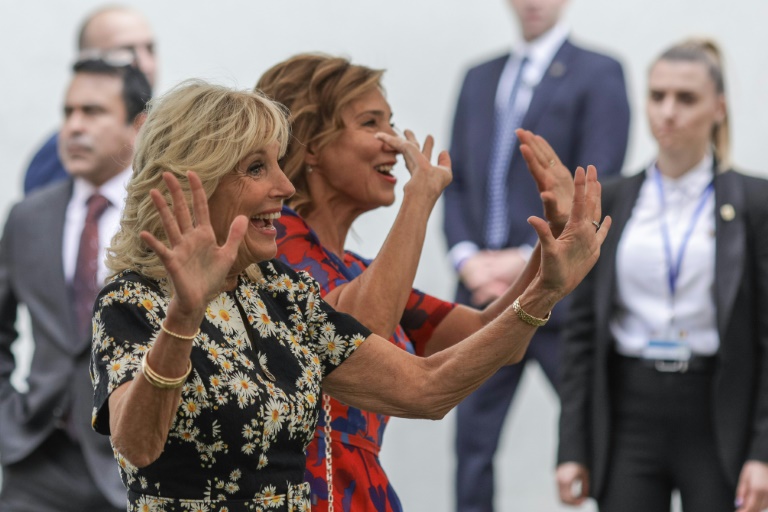
US First Lady Jill Biden hailed the “amazingly strong” refugees from war-torn Ukraine as she visited neighbouring Romania on Saturday.

“You are amazingly strong,” Biden said after listening to mothers and children recount how they fled Russia’s invasion of their country.

“We stand with you, I hope you know that,” she said in a visit to a school in Bucharest, accompanied by her Romanian counterpart Carmen Iohannis, according to images transmitted by TVR public television.

More than 810,000 Ukrainians have entered Romania since the start of the war, according to UN figures released on April 29.

Most have moved on to other countries, with an estimated 80,000 staying, half of them children, according to the World Vision foundation.

Biden’s visit to the region is the latest show of US support for Ukraine and the countries assisting it, and follows a trip to Kyiv by US House Speaker Nancy Pelosi, who met with President Volodymyr Zelensky a week ago.

On Friday Biden met with US service members in Romania and on Sunday, she is set to travel to Slovakia, where she will meet with refugees, aid workers and local residents in the city of Kosice and the village of Vysne Nemecke.

She will also travel to the Slovak capital Bratislava to meet with US embassy staff and government officials.

Nearly 5.5 million refugees have fled Ukraine since Russian President Vladimir Putin launched his invasion on February 24, according to the UN.

More than 360,000 of them have crossed the border into Slovakia, according to UN figures.

US President Joe Biden has proposed a huge $33 billion package for arming and supporting Ukraine.

Jill Biden hails 'amazingly strong' Ukraine refugees in Romania

US First Lady Jill Biden hailed the “amazingly strong” refugees from war-torn Ukraine as she visited neighbouring Romania on Saturday.

“You are amazingly strong,” Biden said after listening to mothers and children recount how they fled Russia’s invasion of their country.

“We stand with you, I hope you know that,” she said in a visit to a school in Bucharest, accompanied by her Romanian counterpart Carmen Iohannis, according to images transmitted by TVR public television.

More than 810,000 Ukrainians have entered Romania since the start of the war, according to UN figures released on April 29.

Most have moved on to other countries, with an estimated 80,000 staying, half of them children, according to the World Vision foundation.

Biden is on a three-day visit to the region, in the latest show of US support for Ukraine and the countries assisting it.

On Friday she met with US service members in Romania and on Sunday, she is set to travel to Slovakia, where she will meet with refugees, aid workers and local residents in the city of Kosice and the village of Vysne Nemecke.

The first lady’s visit is Her trip follows a trip to Kyiv by US House Speaker Nancy Pelosi, who met with President Volodymyr Zelensky a week ago.

Nearly 5.5 million refugees have fled Ukraine since Russian President Vladimir Putin launched his invasion on February 24, according to the UN.

Russia steps up Ukraine assaults ahead of Victory Day parades

Ukraine tried to evacuate more civilians from a besieged Mariupol steel plant on Saturday as Russian forces unleashed new bombardments across the country ahead of Victory Day festivities in Moscow.

The Azovstal steel mill is the last pocket of Ukrainian resistance in the devastated port city and its fate has taken on a symbolic value in the broader battle since Russia’s invasion.

Fighting continues on many fronts, and Ukraine’s defence ministry said it had destroyed another Russian warship — a Serna-class landing craft — in the Black Sea.

“The traditional parade of the Russian Black Sea fleet on May 9 this year will be held near Snake Island — at the bottom of the sea,” the ministry added. Russia did not immediately confirm the incident.

Ukraine’s defence ministry had earlier said Russian forces had resumed their assault on the Azovstal site, despite talk of a truce to allow trapped civilians to flee the complex.

Vice Prime Minister Iryna Vereshchuk said rescuers would try to evacuate more civilians on Saturday. 

On Monday, President Vladimir Putin will celebrate the World War II Soviet victory over Nazi Germany with a traditional Victory Day parade.

According to Russia’s defence ministry, 77 aircraft will conduct a flypast, including the rarely-seen Il-80 Doomsday plane that can withstand a nuclear attack. 

Eight Mig-29 fighter jets will fly over Moscow’s Red Square forming the letter “Z” — the mark of Russia’s military assault in Ukraine. 

The campaign has run into tough resistance — and provoked Kyiv’s western allies into slapping massive economic sanctions on the Russian economy and Putin’s inner circle.

But with Victory Day fast approaching, Ukrainian officials fear more intense missile and artillery bombardments and renewed assaults as Moscow scrambles for symbolic wins.

The Ukrainian rescue service said a missile hit a technical college in Kostiantynivka, in the eastern region of Donetsk, causing a fire and at least two deaths. 

Donetsk regional governor Pavlo Kyrylenko said there had been “massive bombardments” along the frontline. 

Strikes were also reported in the north of Ukraine near the city of Kharkiv and in the southern city of Mikoleyev, a key Russian target.

Ukrainian forces have launched a counter-offensive of their own.

– Bridges down –

According to the defence ministry, Russian troops were forced to demolish three road bridges near Tsyrkuny and Ruski Tyshky outside Kharkiv, to slow the Ukrainian advance.

According to British intelligence, Ukrainian forces equipped with high-end weaponry by the western allies, have been able to destroy at least one of Russia’s most advanced tanks, the T-90M.

“The conflict in Ukraine is taking a heavy toll on some of Russia’s most capable units and most advanced capabilities,” UK Defence Intelligence said.

“It will take considerable time and expense for Russia to reconstitute its armed forces following this conflict,” it said, warning sanctions on advanced components would make it harder for Russia to re-arm.

The west, meanwhile, is stepping up arms deliveries to Ukraine’s defenders.

US President Joe Biden on Friday announced another package of military assistance worth $150 million, including counter-artillery radars used for detecting the source of enemy fire.

This brings the total value of US weaponry sent to Ukraine since the Russian invasion began to $3.8 billion.

Biden had urged Congress to approve a further $33 billion package, including $20 billion in military aid, “to strengthen Ukraine on the battlefield and at the negotiating table.”

The G7 leaders, including Biden, and Ukraine’s President Volodymyr Zelensky are to meet in videoconference on Sunday to discuss Western support for Kyiv.

And Biden’s wife, US First lady Jill Biden, is in Romania meeting US troops and Ukrainian refugees. 

The Council of Europe’s human rights commissioner, Dunja Mijatovic, who has finished a four-day visit to Ukraine, including to areas just outside Kyiv, condemned “staggering” human rights violations by Russian forces. 

Her visit showed “the extent of such egregious human rights and humanitarian law violations, with mounting evidence of widespread arbitrary killings, torture, and enforced disappearances.”

The organisation, which protects human rights, democracy and the rule of law in Europe, expelled Russia as a member in March. 

– Azovstal evacuation –

On Friday, Zelensky said “diplomatic options” were also under way to rescue Ukrainian soldiers from the Mariupol steelworks, as civilian evacuations continued. 

The Russian defence ministry said 50 people were evacuated from the site, including 11 children.

It added they were handed over to the UN and Red Cross, which are assisting in the operation, and that the “humanitarian operation” would continue on Saturday. 

About 200 civilians, including children, are thought to be trapped in the tunnels and bunkers beneath Azovstal, along with Ukrainian soldiers making their last stand.

Russia announced a day-time ceasefire at the plant for three days starting Thursday but the Ukrainian army said Russian “assault operations” had continued by ground and air.

Ukraine’s Azov battalion, leading the defence at Azovstal, said one Ukrainian fighter had been killed and six wounded when Russian forces opened fire during an attempt to evacuate people by car.

– Russia to remain ‘forever’ –

Since failing to take Kyiv early on in the war, Russia has refocused on the south and east of Ukraine.

Taking full control of Mariupol would allow Moscow to create a land bridge between the Crimean peninsula, which it annexed in 2014, and separatist, pro-Russian regions in the east.

In those regions, separatists said they had removed Ukrainian and English language traffic signs for Mariupol and replaced them with Russian ones.

Locals want to see proof that “Russia has come back here forever,” said Denis Pushilin, head of a pro-Russian breakaway region in Donetsk.

In neighbouring Lugansk, Ukrainian officials said on Friday that Russian forces had almost encircled Severodonetsk — the easternmost city still held by Kyiv — and are trying to storm it.

Kherson in the south remains the only significant city Russia has managed to capture since the war began.

A senior official from the Russian parliament visiting the city on Friday also emphasised that Russia would remain in southern Ukraine “forever”.

“There should be no doubt about this. There will be no return to the past,” Andrey Turchak said.

burs-dc/bp

Taliban order Afghan women to cover fully in public

The Taliban on Saturday imposed some of the harshest restrictions on Afghanistan’s women since they seized power, ordering them to cover fully in public, ideally with the traditional burqa. 

The militants took back control of the country in August last year, promising a softer rule than their previous stint in power between 1996 and 2001, which was marked by human rights abuses.

But they have already imposed a slew of restrictions on women — banning them from many government jobs, secondary education, and from travelling alone outside their cities.

On Saturday, Afghanistan’s supreme leader and Taliban chief Hibatullah Akhundzada approved a strict dress code for women when they are in public.

A decree said the best way for a woman to cover her face and body was to wear the chadari, a traditional, blue, all-covering Afghan burqa.

“They should wear a chadari as it is traditional and respectful,” said the decree approved by Akhundzada and released by Taliban authorities at a ceremony in Kabul.

“Those women who are not too old or young must cover their face, except the eyes, as per sharia directives, in order to avoid provocation when meeting men who are not mahram (adult close male relatives),” it said.

Akhundzada’s decree also said that if women had no important work outside then it was “better they stay at home”.

The Ministry for Promotion of Virtue and Prevention of Vice, which released the new order, announced a slew of punishments if the dress code is not followed.

It said a woman’s father or male guardian would be summoned and could even be imprisoned if the offence was committed repeatedly.

Women working in government institutions who did not follow the order “should be fired”, the ministry added.

Government employees whose wives and daughters do not comply will also be suspended from their jobs, the decree said.

The new restrictions were expected to spark a flurry of condemnation abroad. 

Many in the international community want humanitarian aid for Afghanistan and recognition of the Taliban government to be linked to the restoration of women’s rights.

– ‘Regressive’ –

During their first regime, the Taliban made the burqa compulsory for women.

Since their return to power, the much-feared vice ministry has issued several “guidelines” on dress but Saturday’s edict is one of the harshest restrictions on women.

“Islam never recommended chadari,” said a women’s rights activist who asked not to be named.

“I believe the Taliban are becoming regressive instead of being progressive. They are going back to the way they were in their previous regime.”

Another women’s rights activist, Muska Dastageer, said Taliban rule had triggered “too much rage and disbelief”.

“We are a broken nation forced to endure assaults we cannot fathom. As a people we are being crushed,” she said on Twitter.

The hardline Islamists triggered international outrage in March when they ordered secondary schools for girls to shut, just hours after they reopened for the first time since their seizure of power.

Officials have never justified the ban, apart from saying girls’ education must be according to “Islamic principles”.

That ban was also issued by Akhundzada, according to several Taliban officials.

Women have also been ordered to visit parks in the capital on separate days from men.

Some Afghan women initially pushed back strongly against the restrictions, holding small demonstrations where they demanded the right to education and work. 

But the Taliban cracked down on these unsanctioned rallies and rounded up several of the ringleaders, holding them incommunicado while denying they had been detained. 

In the 20 years between the Taliban’s two stints in power, girls were allowed to go to school and women were able to seek employment in all sectors, though the country remained socially conservative. 

Many women already wear the burqa in rural areas.

War in Ukraine: Latest developments

Here are the latest developments in the war in Ukraine:

– US announces new weapons package  –

US President Joe Biden announces a new $150 million weapons package to Ukraine, including artillery munitions and radar, while urging Congress to pass a $33 billion aid package including $20 billion in military aid.

The new batch brings the total value of US weaponry sent by the Biden administration to Ukraine — including heavy artillery, shoulder-held Stinger anti-aircraft missiles and drones — to $3.8 billion since Russia invaded on February 24, says Secretary of State Antony Blinken.

– Dozens of civilians evacuated from Azovstal plant –

Fifty more civilians have been evacuated from the besieged Azovstal steel plant in the destroyed city of Mariupol, says Ukrainian Deputy Prime Minister Iryna Vereshchuk, even as the factory continues to be hit by ground and air attacks.

The operation, which Vereshchuk says will continue Saturday, was to coincide with a daytime ceasefire announced by Russia starting Thursday, but Ukraine’s army accused Moscow of continuing its assault on the plant.

Before the UN-led evacuation, about 200 civilians, including children, were estimated to still be trapped in the Soviet-era tunnels and bunkers beneath the factory, along with a group of Ukrainian soldiers making a last stand.

– Troops, tanks in Red Square rehearsal for Victory Day parade –

Russia holds its final rehearsal for an annual parade marking the Soviet victory in World War II, where its military might will be showcased amid Moscow’s ongoing campaign in Ukraine.

Rehearsal for the May 9 event saw jet fighters flying over Moscow’s Red Square forming the symbol “Z” in support of Russia’s military action in Ukraine, while tanks and troops took part in the parade. 

Russian President Vladimir Putin is expected to deliver a speech during the parade, which some Western officials believe could be a declaration of all-out war on Ukraine, speculation that the Kremlin has dismissed as “nonsense.” 

– Human rights commissioner calls Russian violations ‘staggering’ –

The Council of Europe’s human rights commissioner, Dunja Mijatovic, calls Russian violations of human rights in Ukraine “staggering” after a four-day visit to the country. 

The visit to areas outside Kyiv illustrated “the extent of such egregious human rights and humanitarian law violations, with mounting evidence of widespread arbitrary killings, torture, and enforced disappearances,” the council says in a statement.

The organisation, which protects human rights, democracy and the rule of law in Europe, expelled Russia as a member in March. 

– UN Security Council adopts first declaration on war – 

The UN Security Council makes its first declaration on Ukraine since Russia’s February 24 invasion of its neighbour, but stops short of supporting a mediation effort by Secretary-General Antonio Guterres.

“The Security Council expresses deep concern regarding the maintenance of peace and security of Ukraine,” the text adopted Friday said.

The 15-member council includes Russia, which in February vetoed a resolution condemning the invasion and asking Moscow to pull out its forces. 

– Italy impounds yacht tied to Putin –

Italian authorities impound a $700 million, 140-metre mega yacht as speculation swirls it could belong to Russian President Vladimir Putin.

“Scheherazade”, which has been berthed for several months at a shipyard on Italy’s western coast, has been the subject of an ownership probe  by the financial police.

Italy’s investigation has helped establish “significant economic and business links” between the official owner and “eminent people in the Russian government”, as well as Russians on the West’s sanctions list, the economy ministry says.

– Eastern city surrounded –  

Russian forces have almost encircled Severodonetsk, the easternmost city still held by Ukraine where about 15,000 people remain, a local official says.

Oleksandr Striuk, the head of the Severodonetsk military administration, says on Ukrainian television that Kyiv’s army is so far “repelling these attacks” but the Russians were pressing on.

burs-ams/yad

Russia fine tunes Victory Day parade amid Ukraine campaign

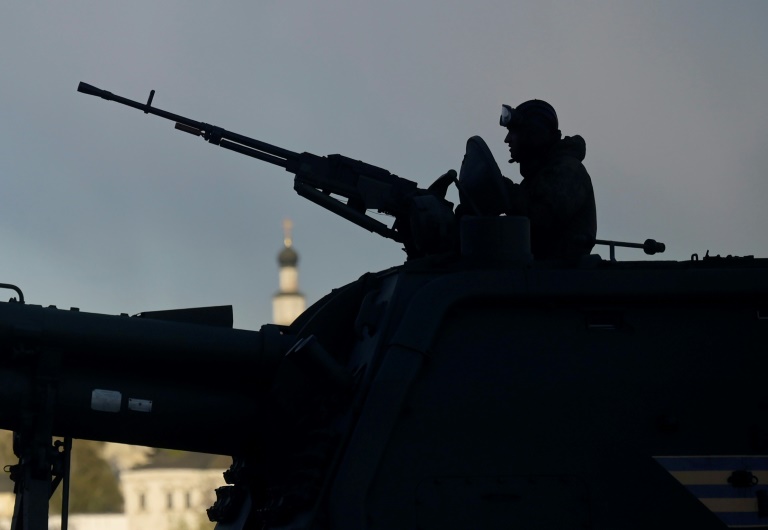
Russia on Saturday held its final rehearsal for an annual parade marking the Soviet victory in World War II, where its military might will be showcased amid Moscow’s campaign in Ukraine.

To mark the 77th anniversary since victory in what Russia calls the Great Patriotic War, thousands of soldiers will march across the Red Square in Moscow followed by tanks, armoured vehicles and missile launchers.

Monday’s Victory Day parade comes on the third month of Russia’s “military operation” in Ukraine despite predictions of a swift victory.

Troops who participated in the operation took part in Saturday’s practice, indicating that they’ll participate in Monday’s parade, the state TASS agency reported.

The parade became an annual event after the collapse of the Soviet Union in 1991 and has gained prominence during President Vladimir Putin’s two decades in power as a display of military muscle. 

Like every year, Putin is expected to deliver a speech at the parade. Some Western officials say he may declare all-out war on Ukraine or announce mobilisation across the country. 

The Kremlin has dismissed this as “nonsense”. 

Since sending troops into Ukraine on February 24, Russia has said it is carrying out a “special military operation” to “de-Nazify” the country.

The term is loaded in Russia, the successor of the Soviet Union, which lost 20 million people in the war against Nazi Germany.

According to Russia’s defence ministry, 77 aircraft will participate in the flypast, including the rarely-seen Il-80 Doomsday plane that is capable of withstanding a nuclear attack. 

Eight Mig-29 fighter jets will fly over Red Square forming the letter Z — a symbol of Russia’s military campaign in Ukraine. 

On the ground, Russia will be displaying its nuclear-capable hardware, including the Yars intercontinental nuclear missiles and Iskander short-range ballistic missile systems.

The Kremlin said no foreign leaders were invited to attend the parade as it was “not a jubilee year”. 

Also on May 9, parades take place on a smaller scale in dozens of cities across the nation as well as the so-called “Immortal Regiment” march, which involves people carrying photos of veterans or family members who died in the war.

This year, participants of the processions are also encouraged to bring photos of those who died fighting in Ukraine.

Close Bitnami banner
Bitnami