World

Rights groups say Iran will seek to manipulate UN visit

Human rights groups on Friday warned Tehran will try to use an upcoming visit to Iran by a UN expert in order to avoid accountability.

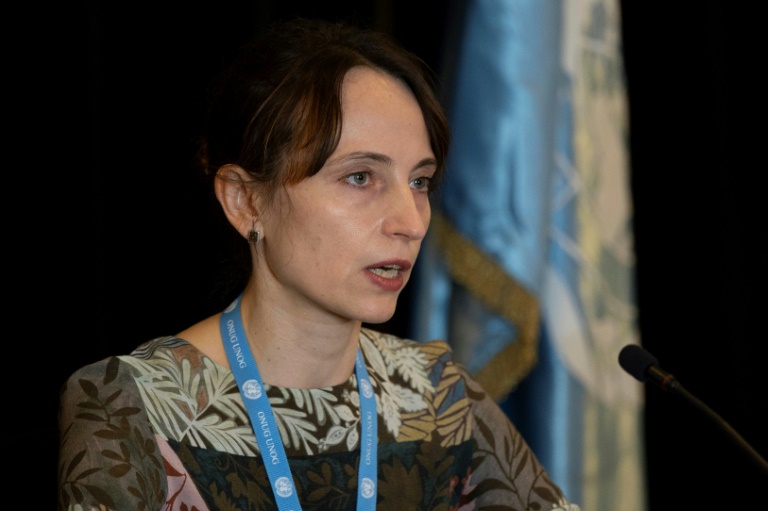
Alena Douhan, the special rapporteur focused on the impact of unilateral sanctions, is due to begin a visit to Iran from Saturday, the United Nations has said.

The mission from May 7 to 18 will be the first to the Islamic republic by a special rapporteur since 2005.

In a statement Thursday, Douhan said she hoped to “gather first-hand information on the impact of unilateral coercive measures on the full realisation of all human rights” in Iran.

“My visit will aim at covering all walks of life and sectors affected by such measures,” said Douhan, whose official title is “special rapporteur on the negative impact of the unilateral coercive measures on the enjoyment of human rights.”

Her mission comes during a stalemate in talks between Iran and world powers to revive a 2015 agreement which gave Iran sanctions relief in return for curbs on its nuclear programme. In 2018 then-US president Donald Trump withdrew from the deal and imposed crippling sanctions on Iran, which then began rolling back its own commitments.

Douhan works under a mandate from the United Nations Human Rights Council.

But a group of 11 human rights groups warned in a statement Friday that Iran’s government will try to “instrumentalise” the visit “in a cynical attempt to deflect attention from its well-documented record of human rights violations”.

The visit “comes after 17 years of denial of access to any of the 14 UN human rights monitors that have requested to visit the country,” said the statement.

“By inviting the only expert whose mandate is to look at external actors’ liability for rights violations in the country, Iranian authorities exploit this visit in an inconspicuous attempt to blunt scrutiny of its record of non-cooperation with the UN human rights system,” said the statement signed by groups including United for Iran, Article 19 and Iran Human Rights Documentation Centre.

Douhan said she will “pay particular attention to the adverse effects on the most vulnerable segments of society, including in the current context of the Covid-19 pandemic”.

The rights groups say Iran has a history of blatant rights violations, and “legitimate concern over the impact of sanctions cannot and must not overshadow the Iranian authorities’ responsibility for failing to ensure — and sometimes actively restricting — access to health, work, education, internet and adequate living standards for all in Iran.”

They added: “The international community must not be fooled, and Iran should not be rewarded for its attempt to avoid accountability.” 
Biden heads to Ohio to tout industrial renewal plan

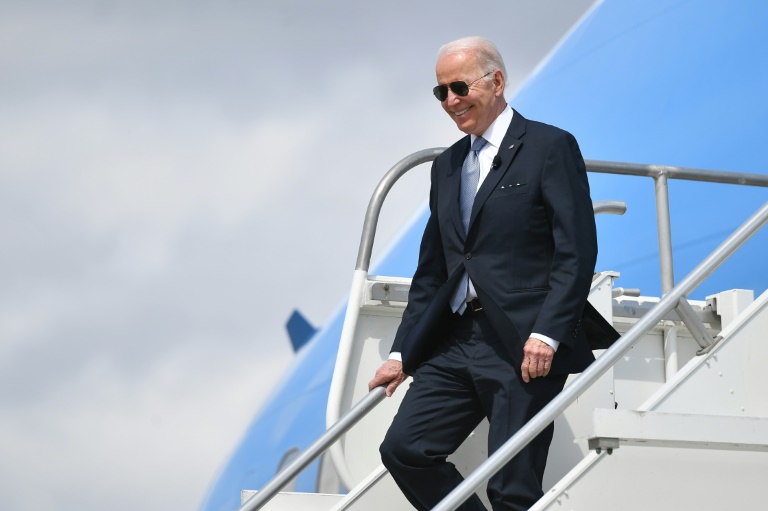
US President Joe Biden will travel to political battleground state Ohio on Friday to announce the launch of a new industrial renewal plan that his administration hopes will revive the country’s manufacturing sector.

The initiative, dubbed “AM Forward” (Additive Manufacturing Forward), is aimed at increasing the use of 3D printing and other next-generation production technologies among US companies, a White House statement said.

Several top US firms, including GE Aviation, Honeywell, Lockheed Martin, Raytheon and Siemens Energy, have committed to a voluntary pact to support US-based suppliers in adopting new parts manufacturing technologies, the statement said.

Small and medium enterprises that choose to take up the initiative will be able to avail the support of federal programs to boost their competitiveness in the sector, the administration promised.

Biden will announce the plan in the US midwestern state of Ohio — a political battleground that has often been a bellwether in US presidential polls — ahead of a general election in November. 

The president’s Democratic Party will be seeking to build on its slim majority in the US Congress at the polls.

The election for Ohio’s next senator, a position previously held by a Republican considered moderate, is one that will be closely watched. 

It will pit Democrat Tim Ryan against newcomer J.D. Vance, a 37-year-old former marine and author known for his bestselling memoir “Hillbilly Elegy.”

Vance won the race for the Republican nomination this week after being endorsed by former US president Donald Trump.

He graduated from the Ivy League Yale Law School and was previously opposed to Trump — famously dubbing him “America’s Hitler” — but later became an ardent supporter.

Vance’s victory in the hotly contested Ohio Republican primary has been seen as an indication of the sway that Trump still holds over Republican party voters. 

Conservatives lose key councils in UK vote, historic N.Ireland result predicted

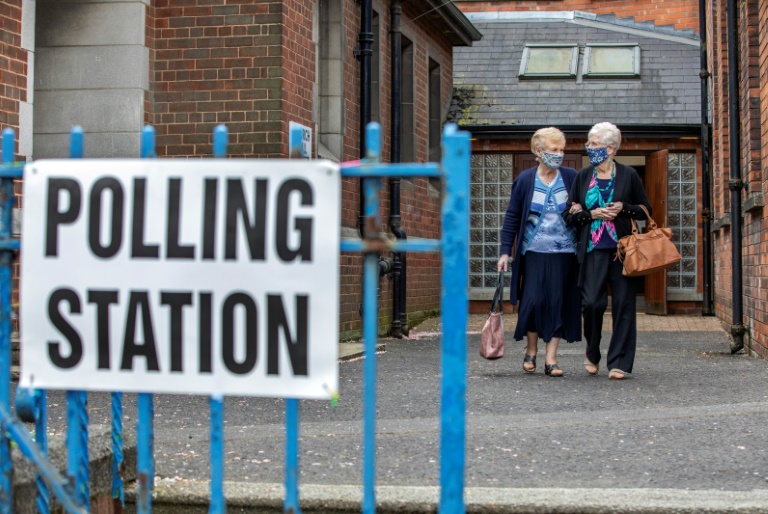
Prime Minister Boris Johnson’s Conservative party lost control of key councils in London, according to partial results from local and regional UK elections on Friday, with a potentially historic change looming in Northern Ireland.

The main UK opposition Labour party of Keir Starmer won control of long-term Conservative strongholds in the capital, including Margaret Thatcher’s “favourite” council Wandsworth, and Westminster for the first time since it was created in 1964.

Only about a third of English votes have been counted. Results from the remainder, as well as Scotland, Wales and Northern Ireland are expected throughout the day.

The contest for the devolved assembly in Belfast could see a pro-Irish nationalist party win for the first time, with huge constitutional implications for the four-nation UK.

Predicted victors Sinn Fein — the former political wing of paramilitary group the IRA — are committed to a vote on reunification with the Irish republic to the south, a century after the island was partitioned.

The English results so far are not a landslide for Labour, which is seeking to capitalise on a cost of living crisis and Johnson’s own performance, including his unprecedented police fine for attending a lockdown-breaking party at Downing Street.

But Starmer, visiting Barnet, in northwest London, where Labour seized control of the council from the Tories, hailed what he called “a big turning point”.

“When it comes to London, you can hardly believe those names come off our lips. Wandsworth! They’ve been saying for years ‘You’ll never take Wandsworth from us.’ We’ve just done it! Westminster! It’s an astonishing result,” he told supporters.

– ‘Catastrophic’ –

The former chief of staff of Conservative ex-premier Theresa May said the results in London were “catastrophic”.

“Wandsworth and Westminster were flagship councils,” Gavin Barwell tweeted. “Losing them should be a wake up call for the Conservative Party.”

Party chairman Oliver Dowden, though, sought to play down Conservative losses, saying they were consistent with mid-term expectations, and insisted Johnson was not under threat.

The Barnet Labour group leader said the result was a reflection of disillusionment with the Tories, who are hoping to extend their 12 years in power for another term at the next general election, which is due by 2024.

“I think a lot of Conservatives haven’t voted this time, I think they feel alienated from No 10 and that they are, I don’t know, they’ve been disappointed with Boris Johnson and so not voting and I think that’s made a difference as well,” Barry Rawlings told the BBC.

Johnson, 57, won a landslide 2019 general election victory by vowing to take the UK out of the European Union, and reverse rampant regional inequality.

Despite making good on his Brexit pledge, the coronavirus pandemic largely stalled his domestic plans. 

But his position has been put in jeopardy because of anger at lockdown-breaking parties at his Downing Street office and the steeply rising cost of living.

Poor results could reignite questions about his leadership, putting his position in jeopardy.

Labour is bidding to leapfrog the Conservatives into second place in Scotland, behind the pro-independence Scottish National Party (SNP), and remain the largest party in Wales, where 16 and 17-year-olds are eligible to vote for the first time. 

– Sinn Fein rise –

The contest for the 90 seats in Northern Ireland’s power-sharing assembly is set to capture attention, after numerous polls put Sinn Fein ahead. 

The pro-UK Democratic Unionist Party (DUP) and cross-community Alliance Party were tied for second.

First results are expected on Friday but counting is set to continue into Saturday. Early indications were that turnout was about 54 percent — down from nearly 65 percent in 2017.

Sinn Fein has dialled down its calls for Irish unity during campaigning, saying it is “not fixated” on a date for a sovereignty poll, instead focusing on the rising cost of living and other local issues.

Party vice president Michelle O’Neill has insisted voters are “looking towards the future” with pragmatism rather than the dogmatism that has long been the hallmark of Northern Irish politics.

O’Neill’s DUP rivals have sought to keep the spotlight on possible Irish reunification in the hope of bolstering their flagging fortunes.

In February, its first minister withdrew from the power-sharing government in protest at post-Brexit trade arrangements, prompting its collapse. 

DUP leader Jeffrey Donaldson has said that his party would not form a new executive unless London rips up the trading terms, known as the Northern Ireland Protocol.

Asian, European markets track Wall St rout as pound falls further

Asian and European equities tumbled Friday following a rout on Wall Street fuelled by worries over rising interest rates and surging inflation, while the pound extended losses the day after taking a beating on fears of a UK recession. 

Global markets have been battered this year by a series of crises including surging inflation, rising interest rates, China’s economic slowdown and the war in Ukraine.

There was some relief after the Federal Reserve on Wednesday lifted borrowing costs 50 basis points — the most since 2000 — but suggested a feared 75-point lift was not on the agenda for now.

However, US traders ran for the hills Thursday as they contemplated a period of fierce monetary tightening by the US central bank as it struggles to contain inflation running at a more than 40-year high.

The Nasdaq — dominated by tech firms particularly sensitive to higher rates — lost five percent, while the Dow and S&P 500 fell more than three percent. 

“Valuations become even more sensitive, very sensitive, when rates are going up and that is what we are experiencing,” Kristina Hooper, at Invesco, told Bloomberg Television. 

“It’s just getting exacerbated as we get into the thick of monetary-policy tightening in the US.”

That sell-off filtered through to Asia, where Hong Kong tanked 3.8 percent as tech firms took a hit. Meanwhile, the European Chamber of Commerce in the city called the finance hub’s stringent pandemic travel restrictions and frequent flight bans a “nightmare” for businesses. 

The remarks come a week after the Australian Chamber of Commerce recommended that Hong Kong follow the lead of Singapore or Japan by lowering quarantine requirements for business travellers.

Shanghai, Sydney, Seoul, Mumbai, Bangkok, Singapore, Wellington, Taipei and Manila also tanked, while London, Paris and Frankfurt were in the red in early trade.

However, Tokyo closed higher Friday on bargain-hunting, though gains were limited as investors remained cautious ahead of the release of US jobs data later in the day.

Adding to the angst was ongoing weakness in China’s economy caused by strict lockdowns and other containment measures as officials struggle to bring a virus flare-up under control by sticking to a zero-Covid policy.

Various districts in Beijing told residents on Thursday to work from home, while Shanghai, the biggest city in the country, remains essentially shut down.

– China’s policy ‘a drag’ –

Analysts at Nomura on Friday predicted that mass testing mandates alone could cost up to 2.3 percent of annual gross domestic product, while Fitch Ratings cut its forecast for China’s full-year economic growth to 4.3 percent from 4.8 percent.

Despite the predicted bloodletting, China’s top brass have continued to pledge to “unwaveringly adhere” to zero-Covid and “fight against” criticism of the policy. 

“The zero-Covid policy is likely to remain a drag on domestic demand for the foreseeable future,” said senior economist Silvia Dall’Angelo of Federated Hermes Limited. 

“China also faces headwinds coming from high commodity prices, the war in Ukraine and the potential for secondary sanctions, and a possible sharp slowdown in Europe.”

On currency markets the pound continued to struggle a day after plunging more than two percent in reaction to the Bank of England’s updated forecast that warned annual inflation would top 10 percent and the economy would contract later this year.

Crude rose after key oil producers led by Saudi Arabia and Russia refused to lift output more than their planned marginal increase as they weighed tight supply concerns caused by the Ukraine war. 

“The prospect of EU sanctions on Russian oil threatens to make an already-tight situation worse,” Howie Lee, at Oversea-Chinese Banking Corp, said.

“With OPEC+ not hitting their monthly quotas as well, the supply shortage issue appears to overshadow the demand loss from China.”

– Key figures at around 0810 GMT –

Hong Kong – Hang Seng Index: DOWN 3.8 percent at 20,001.96 (close)

Shanghai – Composite: DOWN 2.2 percent at 3,001.56 (close)

London – FTSE 100: DOWN 0.5 percent at 7,461.80

Tokyo – Nikkei 225: UP 0.7 percent at 27,003.56 (close)

West Texas Intermediate: UP 0.4 percent at $108.70 per barrel

Brent North Sea crude: UP 0.4 percent at $111.39 per barrel

Euro/dollar: DOWN at $1.0535 from $1.0540 on Thursday

Pound/dollar: DOWN at $1.2318 from $1.2353

Euro/pound: UP at 85.53 pence from 84.13 pence

Dollar/yen: UP at 130.55 yen from 129.23 yen

New York – Dow: DOWN 3.1 percent at 32,997.97 (close)

Israel launches manhunt after three killed in ultra-Orthdox city

Israeli security forces launched a manhunt Friday for two Palestinians suspected of killing three Israelis in an attack that came as the Jewish state marked its founding.

The attack on Thursday night in Elad, a central city mainly populated by ultra-Orthodox Jews, was the sixth in which Israelis have been targeted since March 22.

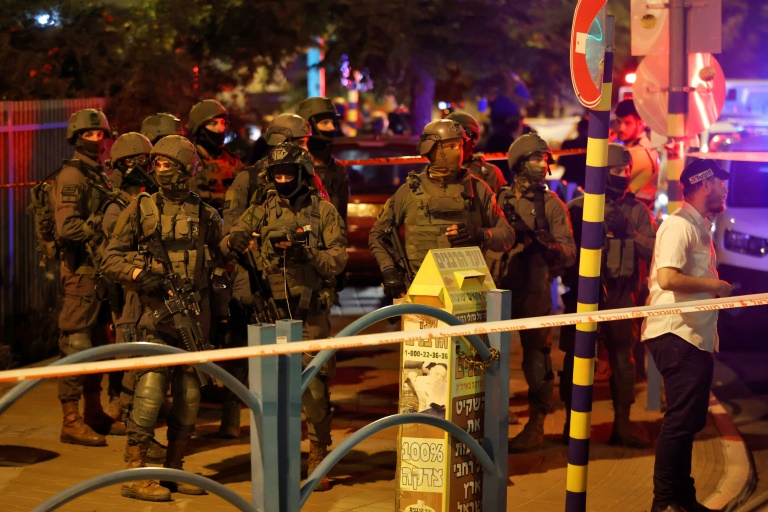
Witnesses told AFP that two assailants leapt from a car swinging axes at passers-by, leaving three of them dead and four wounded, before fleeing in the same vehicle.

The attack came hours after clashes between Israelis and Palestinians at the Al-Aqsa mosque compound, a highly contested site in Jerusalem’s Israeli-annexed Old City that has been the focal point during weeks of violence.

It followed a tense period in which the Muslim fasting month of Ramadan, the Jewish festival of Passover and the Christian holiday of Easter overlapped.

Palestinians have been angered by an uptick in Jewish visits to the Al-Aqsa compound, where by long-standing convention Jews may visit but are not allowed to pray.

Israel has said the status quo would remain unchanged at the site known to Jews as the Temple Mount.

The Elad attack was condemned by the United States and Palestinian president Mahmud Abbas, who warned it could lead to spiralling violence.

But Hamas and Islamic Jihad, another Palestinian armed group, praised the attack, calling it a consequence of unrest at Al-Aqsa. Neither group claimed responsibility.

“This operation demonstrates our people’s anger at the occupation’s attacks on holy sites,” Hamas spokesman Hazem Qassem said of the attack in Elad.

“The storming of the Al-Aqsa mosque cannot go unpunished.”

– ‘Pay the price’ –

Israeli security forces have mounted a massive search operation for the attackers, identified by the police as Assad Yussef al-Rifai, 19, and Subhi Imad Abu Shukair, 20.

As helicopters and drones roared overhead in search of the perpetrators, young ultra-Orthodox Jewish men in crisp white shirts were seen linking arms and chanting near the scene of the attack.

Women gathered on balconies overlooking the site, as masked forensic officers packed the bodies of the dead into bags and police stopped and searched cars.

Police asked the public to provide information on the suspects after publishing their pictures and names. They were described as residents of the village of Rummanah near Jenin in the occupied West Bank.

Israel’s Defence Minister Benny Gantz announced measures to stop them escaping.

Alon Rizkan of the Magen David Adom emergency response service said the “scene of the attack was complex”, adding he had seen a 40-year-old man lying dead near a roundabout, another man unconscious at an adjoining park and a wounded man next to him. Both later died of their injuries.

The dead were identified by Israeli media as Yonatan Habakuk, 44, and Boaz Gol, 49, both from Elad, and Oren Ben Yiftah, a 35-year-old from the central city of Lod.

“We will get our hands on the terrorists… and ensure they pay the price,” Israeli Prime Minister Naftali Bennett said.

The majority of Elad’s 50,000 residents are members of Israel’s ultra-Orthodox Jewish community, known as haredim.

Gantz announced a closure of the West Bank — in place for the anniversary — would remain in force through Sunday.

– Spate of attacks –

Prior to Thursday’s incident, a string of attacks since March 22 had killed 15 people, including an Arab-Israeli police officer and two Ukrainians, in separate attacks inside Israel.

Two of the deadly attacks were carried out in the Tel Aviv area by Palestinians.

A total of 27 Palestinians and three Israeli Arabs have died during the same period, among them perpetrators of attacks and those killed by Israeli security forces in West Bank operations.

Israeli Foreign Minister Yair Lapid said “the joy of independence day had been interrupted in an instant”.

For Palestinians, the anniversary of Israel’s 1948 declaration of independence marks the Nakba, or “catastrophe”, when more than 700,000 fled or were expelled during the war surrounding Israel’s creation.

Last week, the Gaza Strip’s Islamist rulers Hamas threatened Israel with rockets and attacks on synagogues if its security forces carried out further raids on the Al-Aqsa mosque compound.

“Whoever has a rifle must have it ready, and whoever does not have a rifle must prepare their knife or their axe,” said Yahya Sinwar, Hamas chief in the Israeli-blockaded Palestinian enclave.

The latest violence on Thursday at Al-Aqsa came following a tense April, in which nearly 300 people were injured in clashes between police and Palestinians at the site.

gl-ag/ach/dv

Indian climber dies on Himalayan peak

An Indian climber has died in Nepal near the summit of the world’s third-highest peak, expedition organisers said Friday, the third fatality of this year’s busy Himalayan spring climbing season. 

Narayanan Iyer, 52, died Thursday at an altitude of 8,200 metres (26,900 feet), near the top of Mount Kanchenjunga.

“He was slower than others and we had two guides assist him. He was very exhausted, couldn’t continue and collapsed,” Nivesh Karki of expedition company Pioneer Adventure told AFP. 

Karki said that Iyer’s family had been informed and the company is working out details for the recovery of his body.

Nepal has issued 68 permits to foreign climbers for the 8,586-metre (28,169-foot) Kanchenjunga this season and several made it to the summit on Thursday. 

Iyer is the third climber to die in Nepal this year.

Last month, a Greek climber died on the 8,167-metre (26,795-foot) Dhaulagiri after he fell ill while descending.

Days later, a Nepali climber who was carrying equipment uphill was found dead on Mount Everest. 

Nepal, home to eight of the world’s highest peaks, usually attracts hundreds of adventurers during the spring climbing season, when temperatures are warm and winds are typically calm.

The country only reopened its peaks to mountaineers last year after the pandemic shut down the industry in 2020. 

But with coronavirus cases receding, expedition operators in Nepal are hopeful of a busier climbing season this year.

Nepal’s government has already issued permits to 918 mountaineers for the season, including 316 for Mount Everest.

War in Ukraine: Latest developments

Here are the latest developments in the war in Ukraine:

– Hundreds evacuated from Mariupol –

Hundreds of civilians have been evacuated from the devastated city of Mariupol and its besieged Azovstal steel plant in a UN-led rescue operation, the Ukrainian president’s office says.

“We have managed to evacuate almost 500 civilians,” Andriy Yermak, who heads Volodymyr Zelensky’s office, said on Telegram.

He said Kyiv will “do everything to save all its civilians and military” stuck in the southern port city, adding that the operation was ongoing.

– Mariupol factory ceasefire in doubt –

The Russian military had announced a three-day ceasefire starting Thursday at Azovstal, where Ukrainian forces are making a last stand.

But a commander of the Azov regiment that is defending it says in a video on Telegram that “heavy bloody fighting continues”, accusing Russia of violating its promise of a ceasefire.

President Vladimir Putin says the Russian army is “still ready” to give safe passage to civilians trapped at Azovstal.

“As for the militants remaining at Azovstal, the Kyiv authorities must give them an order to lay down their arms,” the Kremlin quotes Putin as saying.

– Pentagon denies helping target Russian generals –

The US Defense Department denies providing intelligence on the locations of Russian generals on the battlefield so that Ukrainian forces could kill them.

“We do not provide intelligence on the location of senior military leaders on the battlefield or participate in the targeting decisions of the Ukrainian military,” Pentagon spokesman John Kirby says, responding to an explosive New York Times report on US support for Ukraine’s military.

Separately, US media reports Washington had shared intelligence that helped Ukraine sink the Russian warship Moskva last month.

But a US official, speaking on condition of anonymity, tells AFP that the United States does not “provide specific targeting information on ships”.

– West slowing, not hindering operation: Kremlin –

The Kremlin accuses the West of preventing a quick end to Russia’s military campaign.

“The United States, Britain, NATO as a whole hand over intelligence… to Ukraine’s armed forces on a permanent basis,” spokesman Dmitry Peskov tells reporters. 

“Coupled with the flow of weapons that these countries are sending to Ukraine, these are all actions that do not contribute to the quick completion of the operation.”

But Peskov says the West is “incapable of hindering the achievement” of the Russian operation’s goals.

– Donor conference, crowdfunding –

More than six billion euros ($6.3 billion) were collected at a Ukraine donors’ conference in Warsaw, Polish Prime Minister Mateusz Morawiecki says.

Separately, Ukrainian President Volodymyr Zelensky launches a global crowdfunding platform — United24 — to help Kyiv win the war with Russia and rebuild the country’s infrastructure.

Ukraine’s government in April estimated the cost of rebuilding after the war to be at least $600 billion (570 billion euros).

– Fiji seizes oligarch’s yacht –

Fiji authorities seize Russian oligarch Suleiman Kerimov’s $300 million yacht after a US request to hold the vessel for violating sanctions and for alleged ties to corruption, the US Justice Department says.

The 348-foot (106-metre) “Amadea” was berthed in Lautoka, Fiji in the South Pacific when local authorities took control of it.

– Sell seized assets: EU chief –

The European Union should confiscate and sell Russian assets it has seized and use the proceeds to rebuild Ukraine, EU chief Charles Michel says, echoing an idea already floated in the United States. 

The EU said early last month it had frozen 30 billion euros ($31.5 billion) in assets linked to blacklisted Russian and Belarusian individuals.

– Eastern assault continues –

The governor of Ukraine’s eastern Donbas region Pavlo Kyrylenko says at least 25 civilians were wounded in an overnight Russian strike on the city of Kramatorsk.

Moscow seeks to establish “full control” of the regions of Lugansk and Donetsk, and to maintain a land corridor to occupied Crimea.

The Ukrainian army meanwhile says it has retaken control of “several settlements on the border of Mykolaiv and Kherson regions”. 

– Russia, Israel and the Holocaust –

Israeli Prime Minister Naftali Bennett says Putin has apologised for remarks made by Russian Foreign Minister Sergei Lavrov, who claimed Adolf Hitler may have had “Jewish blood”. 

The comments had sparked outrage in Israel.

A Kremlin summary of the Bennett-Putin call, which came as Israel marked 74 years since the creation of the Jewish state, made no mention of a Putin apology.

It did, however, note that the leaders discussed the “historic memory” of the Holocaust.

– Zelensky invites German leaders –

German Chancellor Olaf Scholz is yet to commit to visiting Kyiv, even after Ukraine’s leader invited him and President Frank-Walter Steinmeier — three weeks after the German president was snubbed by Kyiv.

– NATO, Sweden and the Baltic Sea –

NATO Secretary General Jens Stoltenberg says the alliance could heighten its presence around Sweden and the Baltic Sea to protect the country from Russian interference during a potential membership application.

burs-qan/dva

Asian, European markets track Wall St rout as pound falls further

Asian and European equities tumbled Friday following a rout on Wall Street fuelled by worries over rising interest rates and surging inflation, while the pound extended losses the day after taking a beating on fears of a UK recession. 

Global markets have been battered this year by a series of crises including surging inflation, rising interest rates, China’s economic slowdown and the war in Ukraine.

There was some relief after the Federal Reserve on Wednesday lifted borrowing costs 50 basis points — the most since 2000 — but suggested a feared 75-point lift was not on the agenda for now.

However, US traders ran for the hills Thursday as they contemplated a period of fierce monetary tightening by the US central bank as it struggles to contain inflation running at a more than 40-year high.

The Nasdaq — dominated by tech firms particularly sensitive to higher rates — lost five percent, while the Dow and S&P 500 fell more than three percent. 

“Valuations become even more sensitive, very sensitive, when rates are going up and that is what we are experiencing,” Kristina Hooper, at Invesco, told Bloomberg Television. 

“It’s just getting exacerbated as we get into the thick of monetary-policy tightening in the US.”

That sell-off filtered through to Asia, where Hong Kong tanked more than three percent as tech firms took a hit. Meanwhile, the European Chamber of Commerce in the city called the finance hub’s stringent pandemic travel restrictions and frequent flight bans a “nightmare” for businesses. 

The remarks come a week after the Australian Chamber of Commerce recommended that Hong Kong follow the lead of Singapore or Japan by lowering quarantine requirements for business travellers.

Shanghai, Sydney, Seoul, Mumbai, Bangkok, Singapore, Wellington, Taipei and Manila also tanked. London, Paris and Frankfurt fell at the open.

However, Tokyo closed higher Friday on bargain-hunting, though gains were limited as investors remained cautious ahead of the release of US jobs data later in the day.

Adding to the angst was ongoing weakness in China’s economy caused by strict lockdowns and other containment measures as officials struggle to bring a virus flare-up under control by sticking to a zero-Covid policy.

Various districts in Beijing told residents on Thursday to work from home, while Shanghai, the biggest city in the country, remains essentially shut down.

– China’s policy ‘a drag’ –

Analysts at Nomura on Friday predicted that mass testing mandates alone could cost up to 2.3 percent of annual gross domestic product, while Fitch Ratings cut its forecast for China’s full-year economic growth to 4.3 percent from 4.8 percent.

Despite the predicted bloodletting, China’s top brass have continued to pledge to “unwaveringly adhere” to zero-Covid and “fight against” criticism of the policy. 

“The zero-Covid policy is likely to remain a drag on domestic demand for the foreseeable future,” said senior economist Silvia Dall’Angelo of Federated Hermes Limited. 

“China also faces headwinds coming from high commodity prices, the war in Ukraine and the potential for secondary sanctions, and a possible sharp slowdown in Europe.”

On currency markets the pound continued to struggle a day after plunging more than two percent in reaction to the Bank of England’s updated forecast that warned annual inflation would top 10 percent and the economy would contract later this year.

Crude rose after key oil producers led by Saudi Arabia and Russia refused to lift output more than their planned marginal increase as they weighed tight supply concerns caused by the Ukraine war. 

“The prospect of EU sanctions on Russian oil threatens to make an already-tight situation worse,” Howie Lee, at Oversea-Chinese Banking Corp, said.

“With OPEC+ not hitting their monthly quotas as well, the supply shortage issue appears to overshadow the demand loss from China.”

– Key figures at around 0720 GMT –

Hong Kong – Hang Seng Index: DOWN 3.6 percent at 20,037.72 

Shanghai – Composite: DOWN 2.2 percent at 3,001.56 (close)

London – FTSE 100: DOWN 0.2 percent at 7,489.97 

Tokyo – Nikkei 225: UP 0.7 percent at 27,003.56 (close)

West Texas Intermediate: UP 0.7 percent at $109.01 per barrel

Brent North Sea crude: UP 0.7 percent at $111.66 per barrel

Euro/dollar: DOWN at $1.0495 from $1.0540 on Thursday

Pound/dollar: DOWN at $1.2300 from $1.2353

Euro/pound: UP at 85.33 pence from 84.13 pence

Dollar/yen: UP at 130.43 yen from 129.23 yen

New York – Dow: DOWN 3.1 percent at 32,997.97 (close)

Battered war trophies incite raw emotions in Ukraine's capital

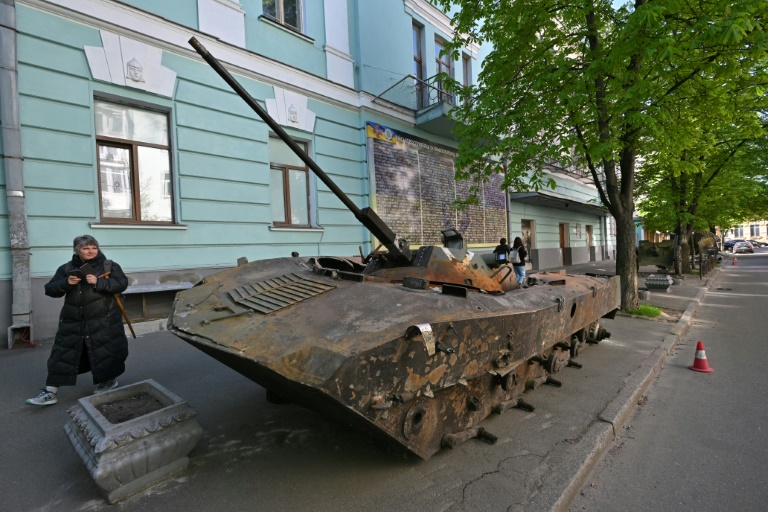
For Valeriy Stavichenko, the sight of mangled Russian war equipment perched along the pavement in downtown Kyiv triggers feelings of bliss in the heart of the 71-year-old Soviet Army veteran. 

“I’m happy,” he said with a grin after inspecting the pockmarked tail of a downed Russian fighter jet. 

“The more destroyed enemy vehicles we have, the closer victory is,” said Stavichenko, who stumbled on the bits and pieces of the Russian war machine on a recent walk in the Ukrainian capital.

The battered war trophies stood in stark contrast to the birdsong and blooming chestnut trees lining the quiet avenue in the capital’s government quarter. 

The display outside the National Museum of Military History — featuring the fighter jet’s tail and a smashed infantry fighting vehicle — was unveiled last week as part of a project dreamed up by another Ukrainian veteran. 

The exhibit’s curator Pavlo Netesov hopes the freshly destroyed equipment will serve as a visible reminder of the war’s toll to residents in downtown Kyiv — who have been largely spared from the harsh ground fighting that has erupted elsewhere in the country. 

“I want people through those things to understand this war as I see it, as it’s going on,” Netesov told AFP.

For weeks, Netesov witnessed the brutal toll of the war first-hand as a volunteer member of the Ukrainian military deployed in Kyiv’s suburbs, where he helped beat back Russian forces while also collecting equipment, weapons, and keepsakes from the battlefield. 

Along with the trophies on display in Kyiv, Netesov has decorated his personal office with an array of war memorabilia amassed in Ukraine over the years, with lamps fashioned from mortar shells and shoulder-fired rockets adorning the walls. 

– ‘We have to win’ –

In the future, Netesov hopes to line the entire avenue outside the military history museum with various war remnants, insisting that preserving the memories of the conflict’s brutal costs will be vital for Ukraine as the nation moves forward. 

“It’s a normal practice to exhibit war trophies, but it’s not about swagger,” said Netesov. “It’s important for me to preserve those artefacts to show that it really happened.”

The sight of the conflict’s detritus just blocks from President Volodymyr Zelensky’s war-time headquarters triggered a range of reactions from passersby — blank stares, selfies and brief chuckles.

But not all were pleased with the presence of the battered war trash. 

Twenty-eight-year-old attorney Inna Hopaitsa said the remnants unearthed memories of the first dark days of the Russian invasion and the overwhelming fear that waylaid people across Ukraine. 

“It’s really painful and hard,” said Hopaitsa, her voice cracking.

But she admitted that preserving the “heroic deeds” of the Ukrainian military was a necessary endeavour. 

Since Ukrainian fighters scored a stunning defeat against Russian forces on the outskirts of Kyiv in late March, much of the destroyed equipment and armour from the fighting has been towed away and cleared from the roads leading to the capital. 

The ruined tanks, artillery pieces, and armoured fighting vehicles will likely end up in scrap yards or  museums. 

While looking over the shattered infantry vehicle, Inna’s husband Valeriy Hopaitsa said he was more ambivalent about the future of the war’s remnants, insisting there were more pressing matters at hand. 

“First, we have to win,” said the 26-year-old. “Only then can we decide what to do with these vehicles and remains.”

Closing the 'escape valve': Venezuela pursues de-dollarization

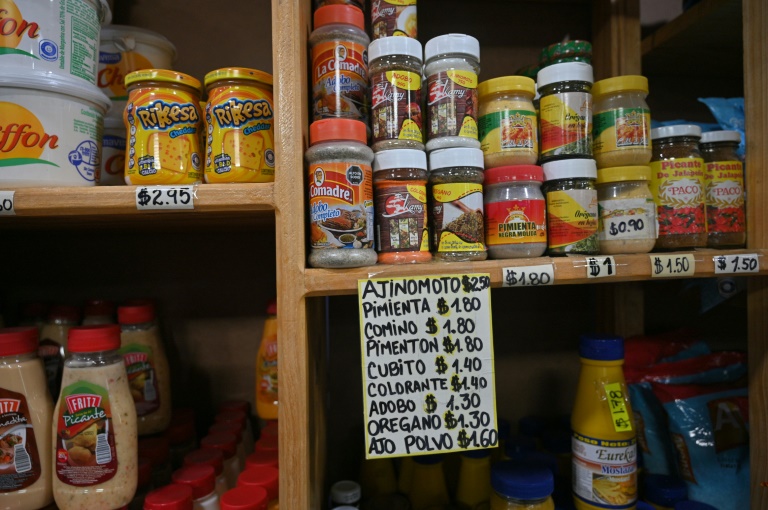
Having opened its arms to the US dollar as an “escape valve” Venezuela is now trying to re-energize its own currency, which has been crippled by devaluation in recent years.

The aim is to incorporate $3 billion circulating on the streets of the South American country into its financial system, but experts warn it is a risky gamble.

Distrust in the bolivar due to severe devaluations, demonetization and four years of hyperinflation persists, despite a slow down in price rises and economic recovery following seven years of recession in which GDP fell by 80 percent.

The dollarization, described by President Nicolas Maduro as an “escape valve”, alongside an easing of price controls brought an end to the scarcity of bare essentials and the interminable queues for what little was available, such as a bag of rice.

“It’s a risky bet with bad timing because the recovery is very weak and the economy is still suffering from chronic inflation. Not hyperinflation but still chronic inflation,” Asdrubal Oliveros, director of consultancy Ecoanalitica, told AFP.

“(Inflation is) very high for you … (to be able) to re-establish confidence in the currency from one day to the next.”

The latest move, applied at the end of March, was to impose a tax ranging from three to 20 percent on transactions using foreign currencies.

The government hopes to encourage use of the bolivar, which was also boosted by a massive injection of foreign currency into the market to stabilize the exchange rate.

The official exchange rate has only fallen from 4.18 bolivars to the dollar in October to 4.43, a depreciation of 6.7 percent, compared 76 percent last year and more than 95 percent in each of the three previous years.

Inflation ended 2021 at 686 percent, according to the Central Bank — the highest in the world but an enormous improvement on the preceding three years: 130,000 percent in 2018, 9,500 percent in 2019 and just under 3,000 percent in 2020.

– ‘Different dynamic’ –

The government has recorded some successes in its policy to boost use of the bolivar.

The Superintendency of Banks said that since the imposition of the new foreign currency tax, online bolivar payments were up 21 percent and debit card payments increased 22 percent.

“We’re entering a different dynamic,” Henkel Garcia, director at consultants Econometrica, told AFP.

“Venezuela is currently a demonetized country. They are trying to remonetize it and to do so with bolivars …. Having your own currency gives you a scope to maneuver.”

Outlawed for 15 years by state currency controls, the dollar became a refuge for Venezuelans during the economic crisis in 2019.

The dollar started being widely used when frequent nationwide power cuts made card payments and bank transfers impossible, as the bolivar’s depreciation left the local currency in scarce supply.

Now, Ecoanalitica says almost 45 percent of urban commerce is done in dollars and 8.5 percent in Colombian pesos, a popular currency in border areas.

In 2021, foreign currencies made up 70 percent of the market.

“Four in every five (dollars) are outside the banks, the people have them in their hands, in businesses, in their homes. We’re talking about around $3 billion in circulation,” said Oliveros.

If that money was put into banks it could boost depressed credit.

There are risks, however, not least the possibility of “slowing the advance of economic activity” given that dollarization gave “certainty” to the private sector, said Oliveros.

– ‘Tax? Bye-bye’ –

“They charged me the three percent in two places. I paid in dollars and they charged me the taxes in bolivars,” said Maria Isabel Marcano, 48, after a shopping run.

Although the tax was implemented a little over a month ago, many Caracas businesses are still not applying it to foreign currency transactions, insisting they are still updating their systems. As an incentive, the government has offered loans to buy tax machines. 

Not everyone is convinced, however.

“There are people who come and say to you: are you going to charge me the tax? If you charge me, bye-bye,” said one merchant.

But others, like the popular Arturo’s chain of fried chicken restaurants, say the new system is up and running.

The company has around 70 restaurants in the country, and says it only had to suspend trading for a few hours at the end of March.

“Now, everything is working normally,” Laura Decena, the company’s marketing director, told AFP.

Close Bitnami banner
Bitnami