World

Pound slumps, Wall Street tumbles

The pound slumped Thursday after the Bank of England flagged a possible recession and double-digit inflation, while Wall Street tumbled after having jumped the previous day on the Federal Reserve holding back on aggressively raising rates.

Meanwhile oil prices rose after OPEC+ only modestly hiked production targets.

The BoE’s quarter-point hike was widely expected by the market, but the central’s banks updated forecast for annual inflation to rise above 10 percent this year and the economy to contract later this year spooked investors.

The British pound plunged more than two percent after the BoE decision.

The drop in the pound was sparked by “the changes in the economic forecasts, which pointed to a potential recession by year end, and the warnings that rates may not rise as high as markets had been expecting in the months ahead,” said market analyst Michael Hewson at CMC Markets UK.

The BoE said UK output was expected to contract in the final quarter of the year when inflation is set to enter double digits as household energy prices rise sharply, although the central bank doesn’t forecast a full-blown recession for the moment.

“Uncertainty over inflation and growth puts rate setters in a tricky dilemma,” said City Index analyst Fawad Razaqzada as it makes striking the right policy balance very difficult.

“So, the key risk facing the UK is not necessarily tighter policy, but uncertainty over monetary policy and, more to the point, stagflation,” he added.

Central banks worldwide are raising interest rates, with inflation sitting at the highest levels in decades.

Prices are surging as economies reopen from pandemic lockdowns, and in the wake of the Ukraine war that is aggravating already high energy costs.

News that Turkish inflation soared to 70 percent in April highlighted the battle central bankers face in controlling prices.

The BoE’s latest move follows a half percentage point hike Wednesday by the US Fed as inflation soars also in the world’s biggest economy.

Wall Street’s main indices had surged around three percent in response, relieved that the central bank wasn’t moving more aggressively in steps that could cause the economy to slow.

But those gains were reversed on Thursday, with the tech-heavy Nasdaq Composite falling 4.6 percent in late morning trading.

In Europe, London managed to hold onto a marginal gain but both Frankfurt and Paris fell.

– OPEC+ decision –

Inflation has been dragged higher globally in large part owing to surging energy prices.

As expected, Saudi Arabia, Russia and other key oil producers in the OPEC+ group agreed to another marginal increase in output as they weighed tight supply concerns due to the Ukraine war against risks to demand amid coronavirus restrictions in China. 

That sent oil prices jumping by more than three percent to firmly above $110 per barrel, but they later gave up most of their gains.

Traders on Thursday digested also earnings updates from some of the world’s biggest companies.

Shares in Airbus soared around percent in Paris after the European aircraft maker said late Wednesday that its net profit more than tripled in the first quarter to 1.2 billion euros ($1.3 billion), despite the impact of sanctions against Russia.

The results confirm the company’s recovery after the Covid-19 pandemic slammed the air travel industry in 2020.

– Key figures at around 1530 GMT –

New York – Dow: DOWN 2.9 percent at 33,073.60 points

EURO STOXX 50: DOWN 0.8 percent at 3,696.63

London – FTSE 100: UP 0.1 percent at 7,503.27 (close)

Frankfurt – DAX: DOWN 0.5 percent at 13,902.52 (close)

Paris – CAC 40: DOWN 0.4 percent at 6,368.40 (close)

Hong Kong – Hang Seng Index: DOWN 0.4 percent at 20,793.40 (close)

Shanghai – Composite: UP 0.7 percent at 3,067.76 (close)

Tokyo – Nikkei 225: Closed for a holiday

Brent North Sea crude: UP 0.7 percent at $110.87 per barrel

West Texas Intermediate: UP 0.3 percent at $108.12 per barrel

Euro/dollar: DOWN at $1.0506 from $1.0625 on Wednesday

Pound/dollar: DOWN at $1.2337 from $1.2632

Euro/pound: UP at 85.12 pence from 84.06 pence

Dollar/yen: UP at 130.39 yen from 129.05 yen

burs-rl/lc
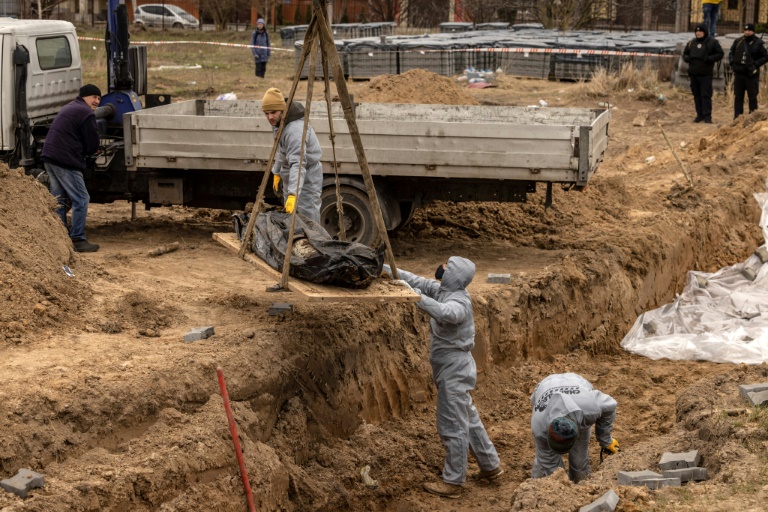
Ukraine, 'Five Eyes' justice officials discuss war crimes

Top justice officials from the five English-speaking members of the “Five Eyes” intelligence alliance held talks with Ukraine’s prosecutor general on investigating war crimes, the US Justice Department said Thursday.

The attorneys general of the United States, Britain, New Zealand, Australia, and Canada met virtually Wednesday with Iryna Venediktova, their Ukrainian counterpart, on Wednesday as Kyiv seeks action on thousands of suspected war crimes resulting from Russia’s invasion.

The six “discussed their coordinated efforts to hold accountable individuals whose criminal actions are enabling war crimes in Ukraine,” the US Justice Department said in a statement.

“Our commitment to working with our international partners, including Ukraine’s prosecutor general, to investigate and prosecute those responsible for atrocities in Ukraine remains steadfast,” said US Attorney General Merrick Garland in the statement.

“We will be relentless in our efforts to bring to justice those who facilitate the death and destruction we are witnessing in Ukraine.”

Last week Venediktova told Deutsche Welle, the German broadcaster, that Ukraine investigators had identified 8,600 suspected war crimes cases, and another 4,000 connected to war crimes, linked to the war which began on February 24.

The alleged crimes documented include “killing civilians, bombing of civilian infrastructure, torture” and “sexual crimes” that are being reported in the “occupied territory of Ukraine”, Venediktova said.

The Justice Department said Garland also updated his counterparts on US efforts to penalize billionaire oligarchs who support Russian President Vladimir Putin, and on the $33 billion in new aid for Ukraine that the White House has requested from Congress. 

Also on the call were British Attorney General Suella Braverman, Australia’s Attorney General Michaelia Cash, Canadian Minister of Justice David Lametti, and New Zealand’s Attorney General, David Parker.

New clashes at Jerusalem's Al-Aqsa mosque compound

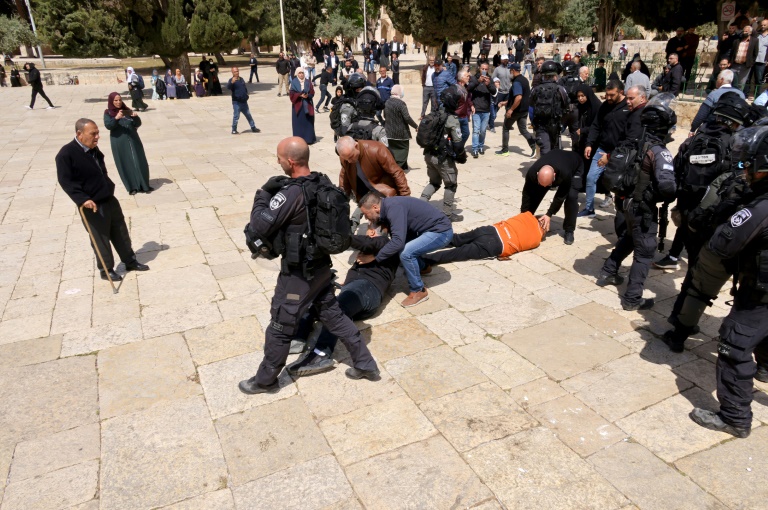
Calm returned to Jerusalem’s Al-Aqsa mosque compound on Thursday afternoon following early-morning clashes between Israelis and Palestinians that shattered a pause over the Muslim Eid al-Fitr holiday.

Israeli police said they had repelled “dozens of rioters” who had been “throwing stones and other objects” at the security forces. Yet, by afternoon prayers, Palestinian mingled in the mosque’s courtyard under the mid-day sun, while large numbers of police stood by.

An AFP correspondent said there was a heavy police presence in front of the mosque as groups of Jewish faithful returned to the site for the first time this month.

The clashes came on the anniversary of Israel’s 1948 independence and followed a tense period in which the Muslim fasting month of Ramadan, the Jewish festival of Passover and the Christian holiday of Easter overlapped.

Ramadan ended Sunday and was followed by the Eid al-Fitr holiday.

The Palestinian Red Crescent said two people had been injured in Thursday’s clashes, which came on the eve of Nakba day on which Palestinians mark the “catastrophe” when more than 700,000 fled or were expelled during the war surrounding Israel’s creation. 

About 600 Jewish “extremists” converged on the Al-Aqsa compound, the sheikh of Al-Aqsa mosque, Omar al-Kiswani, told AFP.

The Palestinian Foreign Ministry labelled the Israeli actions a “declaration of religious war” while Jordan condemned Israel for allowing Jewish “extremists” to “break into” the compound.

The site is Islam’s third-holiest. It is also Judaism’s holiest place, known to Jews as the Temple Mount.

Palestinians have been angered by an uptick in Jewish visits to the compound, where by longstanding convention Jews may visit but are not allowed to pray.

Israeli Foreign Minister Yair Lapid has said the Jewish state “will not change” this status quo.

The latest morning violence came following a tense April, in which nearly 300 people were injured in clashes between police and Palestinians at Al-Aqsa. Violence also flared in the occupied West Bank, following attacks in Israel and raids by the Israeli military.

Last week, the Gaza Strip’s Islamist rulers Hamas threatened Israel with rockets and synagogue attacks if Israeli forces carried out further raids at Al-Aqsa.

Far-right opposition lawmaker Itamar Ben Gvir, a leading figure behind Jewish efforts to march on the compound, said that the Jewish visits on Thursday proved that “Hamas is a weak organisation that can be easily subdued”.

A raid by Israeli police into the compound last month sparked widespread condemnation from regional leaders.

Jordan, which manages Jerusalem’s holy sites, accused Israel of upsetting the long-standing status quo which allows all faiths to worship at their sacred sites in the city.

The mounting violence since March 22 has killed 15 people, including an Arab-Israeli police officer and two Ukrainians, in separate attacks inside Israel. Two of the deadly attacks were carried out in the Tel Aviv area by Palestinians.

A total of 27 Palestinians and three Israeli Arabs have died during the same period, among them perpetrators of attacks and those killed by Israeli security forces in West Bank operations.

UK voters head to polls with historic N.Ireland result predicted

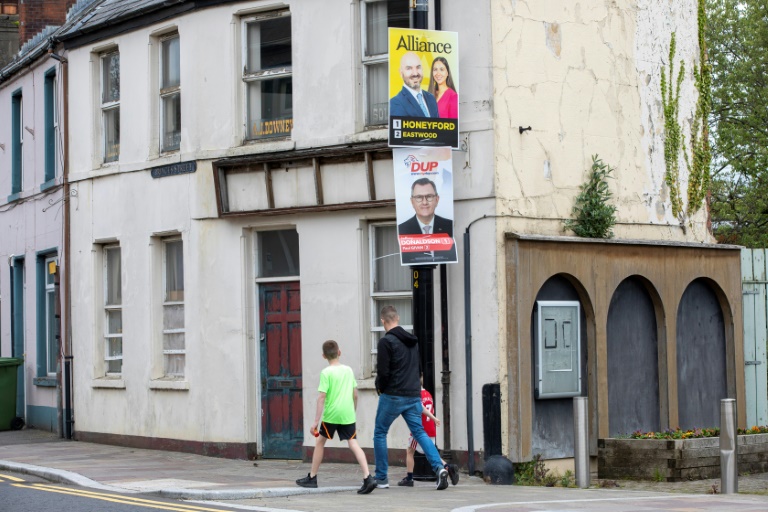
Local and regional elections were being held across the UK on Thursday that could prove historic in Northern Ireland and heap further pressure on embattled Prime Minister Boris Johnson.

The contest for the devolved assembly in Belfast could see a pro-Irish nationalist party win for the first time in the troubled history of the British province.

The results, expected from Friday, could have huge constitutional implications for the four-nation UK’s future, with predicted victors Sinn Fein committed to a vote on reunification with Ireland.

Voters are electing councils in Scotland, Wales and much of England, with Johnson facing a potentially pivotal mid-term popularity test.

Poor results could reignite simmering discontent within his ruling Conservatives about his leadership, after a string of recent scandals.

– Jeopardy –

The prime minister voted in central London with his dog Dilyn, while the main UK opposition Labour leader Keir Starmer cast his ballot in the north of the capital with his wife, Victoria.

Johnson, 57, won a landslide 2019 general election victory by vowing to take the UK out of the European Union, and reverse rampant regional inequality.

Despite making good on his Brexit pledge, the pandemic largely stalled his domestic plans. 

But his position has been put in jeopardy because of anger at lockdown-breaking parties at his Downing Street office and the steeply rising cost of living.

The polls, which close at 2100 GMT, should also point to whether Labour poses a serious threat, as it tries to make inroads across England despite defending the many gains it made at the last local elections in 2018.

Labour is bidding to leapfrog the Conservatives into second place in Scotland, behind the pro-independence Scottish National Party (SNP), and remain the largest party in Wales, where 16 and 17-year-olds are eligible to vote for the first time. 

– ‘Sea change’ –

The contest for Northern Ireland’s power-sharing assembly is set to capture attention, after numerous polls put Sinn Fein ahead.

A University of Liverpool poll reported Tuesday it remained on target to win comfortably with over a quarter of the vote. 

The pro-UK Democratic Unionist Party (DUP) and cross-community Alliance Party were tied for second.

Deirdre Heenan, professor of social policy at Ulster University, said there was a feeling the election “really is momentous”. 

“It will be a sea change if a nationalist becomes first minister,” she told AFP.

Sinn Fein — the IRA’s former political wing — has dialled down its calls for Irish unity during campaigning, saying it is “not fixated” on a date for a sovereignty poll, instead focusing on the rising cost of living and other local issues.

Party vice president Michelle O’Neill, who voted in County Tyrone, west of Belfast, has insisted voters are “looking towards the future” with pragmatism rather than the dogmatism that has long been the hallmark of Northern Irish politics.

– Power-sharing? –

In Belfast, municipal worker John Potts, 56, said a border poll was low down people’s priorities.

“Let’s get Stormont (the Northern Ireland Assembly) up and running, let’s sort out pay and health and education and the pandemic, and then we can have a wee chat about the constitution,” he told AFP.

O’Neill’s DUP rivals have sought to keep the spotlight on possible Irish reunification in the hope of bolstering their flagging fortunes.

In February, its first minister withdrew from the power-sharing government in protest at post-Brexit trade arrangements, prompting its collapse. 

DUP leader Jeffrey Donaldson said after casting his vote that his party would not form a new executive unless London rips up the trading terms, known as the Northern Ireland Protocol.

“Words alone will not be sufficient,” he told reporters. “I will not enter an executive until that action is taken.”

– Deliver –

In England, the Conservatives are predicted to lose hundreds of councillors and even control of long-time strongholds in London to Labour.

Johnson has tried to sideline the so-called “partygate” scandal that last month saw him become the first British prime minister to be fined for breaking the law while in office.

In Askrigg, in finance minister Rishi Sunak’s consitutency in northern England, HR manager Gemma said rising prices were “definitely” a more urgent issue.

“I think cost of living is a big one that people are going to be thinking about as they’re voting today, in terms of housing, transport, local issues,” she told AFP.

In Scotland, SNP leader Nicola Sturgeon is hoping that a strong performance in contests for all 32 local authorities can lay the groundwork for another independence referendum.

Disgraced surgeon defends windpipe transplants at Swedish trial

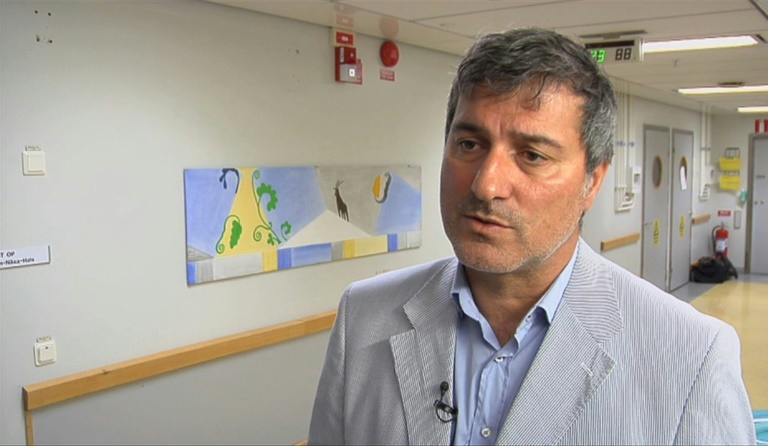
An Italian surgeon once hailed for pioneering windpipe surgery but now charged with assault told a Swedish court Thursday the experimental procedures were the result of “teamwork” and that he just wanted to save lives.

Paolo Macchiarini won praise in 2011 after claiming to have performed the world’s first synthetic trachea transplants using stem cells, while he was a surgeon at Stockholm’s Karolinska University Hospital.

The experimental procedure was hailed as a breakthrough in regenerative medicine.

But allegations soon emerged that the procedure had been carried out on at least one person who had not been critically ill at the time of the surgery.

Together with his colleagues, Macchiarini, 63, performed a total of eight such transplants between 2011 and 2014 — three in Sweden in 2011 and 2012, and five in Russia.

The three patients in Sweden died, though the deaths have not been directly linked to the surgeries.

Last week, prosecutors spent three days arguing that the surgeries in Sweden constituted assault, or alternatively bodily harm due to negligence, as Macchiarini disregarded “science and proven experience.”

The surgeon addressed the court for the first time on Thursday.

“I have been silent all these years, and it’s because my lawyers said to do so. Because we believe that the only judgement that is right should come from a legal court,” Macchiarini said in an opening statement.

– ‘Not alone’ –

Macchiarini insisted several times that the transplants were an alternative decided upon after all other options had been excluded — what he referred to as a “Plan B”.

Macchiarini’s lawyer, Bjorn Hurtig, meanwhile insisted that the surgeries were the result of “teamwork” and had been discussed with other senior colleagues.

“Paolo Macchiarini was not alone in planning and making decisions,” Hurtig told the court, presenting medical notes and references to conferences where the transplants were discussed.

Chief prosecutor Jim Westerberg told AFP on Wednesday he believed that Macchiarini had acted with “reckless intent”, arguing that he had continued performing the surgeries even though complications arose with earlier ones.

Defence lawyer Hurtig pointed however to emails from Macchiarini to colleagues, where he stressed the serious nature of his patients’ conditions and his desire to try and save their lives.

In one case, of a 37-year-old man from Eritrea studying in Iceland, other doctors had suggested treatments such as palliative care.

Hurtig presented an email where Macchiarini argued that “we should at least try to save the life of this student”.

Hurtig also presented emails that appeared to show one patient’s symptoms improving following the surgery.

Paolo Macchiarini “had but one intent, and that was to do good,” the lawyer said.

In 2013, the Karolinska Hospital suspended all trachea transplants and refused to extend Macchiarini’s contract as a surgeon.

A year later, several surgeons at the hospital filed a complaint alleging that Macchiarini had downplayed the risks of the procedure.

– Reopened investigation –

Macchiarini was also employed by the Karolinska Institute research facility, which awards the Nobel Medicine Prize. An external review in 2015 found Macchiarini guilty of research misconduct. 

Even though the Institute sacked him in 2016, it repeatedly defended him until 2018, when its own review found him and several other researchers guilty of scientific misconduct.

The university’s principal and several others stepped down over the scandal.

Medical journal The Lancet in 2018 retracted two papers authored by Macchiarini.

A criminal investigation was closed in 2017, only to be reopened in December of 2018 and charges were finally filed in September of 2020.

The trial, held in the Solna district court near the Karolinska Institute, is scheduled to conclude on May 23.

Zelensky invites Germany's Scholz and Steinmeier to Kyiv

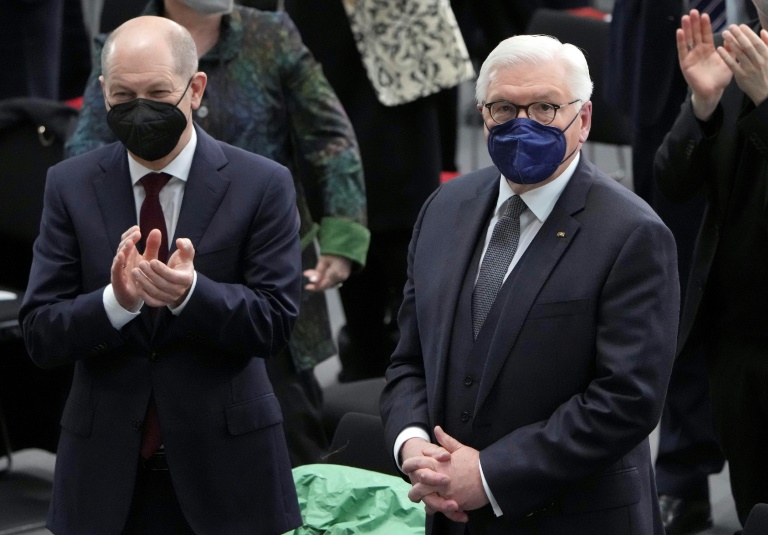
Ukraine’s President Volodymyr Zelensky has invited Germany’s Chancellor Olaf Scholz and President Frank-Walter Steinmeier to visit, the German president’s office said on Thursday, three weeks after Steinmeier was snubbed by Kyiv.

Zelensky made the invitation during a telephone call with Steinmeier on Thursday, a source from the president’s office told AFP, during which “past irritations were cleared up” and Steinmeier expressed his “solidarity, respect and support” for Ukraine.

A diplomatic spat had been rumbling between the two countries since Steinmeier admitted last month he had offered to visit but was “not wanted in Kyiv”.

The German president, also a former foreign minister, has come under heavy criticism since Russia’s invasion of Ukraine in February for his years-long detente policy towards Moscow.

Ukraine’s ambassador to Germany in March boycotted a solidarity concert hosted by Steinmeier, protesting that the soloists featured on the programme were all Russians.

“In the middle of a war against civilians! An affront. Sorry I’m staying away,” Andrij Melnyk wrote on Twitter.

Steinmeier and Scholz are both Social Democrats (SPD), who have over the years pushed for closer ties with Russia — including energy ties that have left Germany heavily dependent on Russian gas.

Steinmeier admitted in April that he had made a “mistake” in pushing for Nord Stream 2, the controversial pipeline built to double Russian gas imports to Germany.

– ‘Distorted and slanderous’ –

Criticism has also mounted against former chancellor and fellow SPD member Gerhard Schroeder, who is a lobbyist for Russian gas and has close ties to Russian President Vladimir Putin.

Scholz, meanwhile, has been criticised for his own failure to visit Kyiv, as well as his hesitancy over providing heavy weapons to help Ukraine resist Russia’s invasion.

Even as German opposition leader Friedrich Merz visited Ukraine this week, Scholz said he did not want to visit himself until Kyiv’s differences with Steinmeier had been ironed out.

However, Germany did say last week it would send anti-aircraft tanks to Ukraine, in a clear switch in Berlin’s cautious policy on military backing for Kyiv.

Scholz also expressed backing for a motion passed by the German parliament calling for the acceleration of the delivery of heavy weapons to Ukraine.

The chancellor has also hit back at criticism of the SPD, accusing his opponents of a “distorted and slanderous depiction” of its Russia policy.

In the telephone call on Thursday, Steinmeier said Germany “stands with united forces in solidarity at Ukraine’s side”, the source from the president’s office said.

Both presidents described the talks as “very important and very good”, the source said.

Astronaut crew returning to Earth after six months on ISS

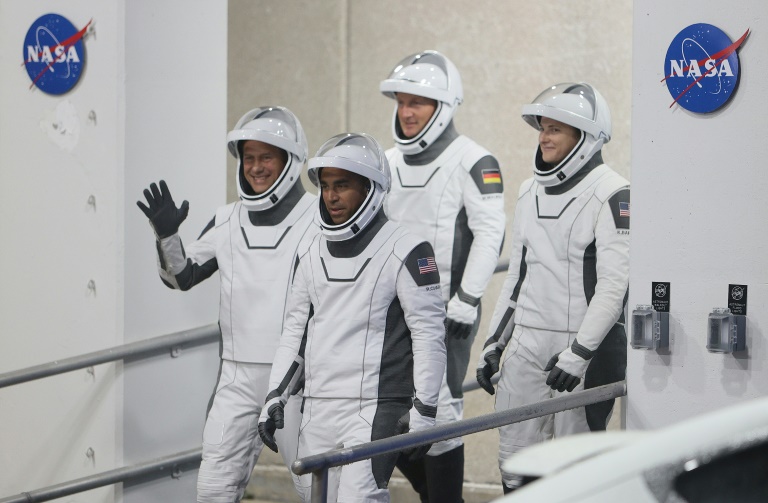
NASA’s Crew-3 mission was returning home to Earth on Thursday after six months aboard the International Space Station.

The SpaceX Dragon Endurance spacecraft with NASA astronauts Kayla Barron, Raja Chari, and Tom Marshburn, as well as European Space Agency astronaut Matthias Maurer undocked from the orbital laboratory overnight.

Their 23.5 hour journey back should see them splash down off the coast of Florida at 12:43 am on Friday (0443 GMT).

They leave behind the one Italian and three American astronauts of Crew-4, and three Russian cosmonauts. Ahead of departure, Marshburn handed command of the station over to Russian Oleg Artemyev.

During their mission, Crew-3 carried out hundreds of scientific experiments, including growing chiles in space to add to knowledge of cultivating crops on long term missions, exploring how concrete hardens in space, and Earth monitoring.

“Every day on @Space_Station is #EarthDay for @NASA_Astronauts since we see how thin the precious layer is that protects everything we know & love as a human race,” Crew-3 commander Chari wrote in a tweet.

“Hopefully, @NASA research will help w/ H20 purification & carbon dioxide reductions but the rest is up to us.”

Chancellor Olaf Scholz wished Maurer, the 12th German in space, “a good and safe journey back with a soft landing,” thanking him on Twitter for “all the new discoveries in space that are so important for us here on Earth.”

Crew-3’s expedition came at an increasingly busy time for commercial space. 

They welcomed aboard a private crew that included three wealthy businessmen that came and went on another SpaceX Crew Dragon, as well as a Japanese mission that flew on a Soyuz aircraft to the Russian segment.

The ISS now awaits docking with an uncrewed Boeing Starliner capsule, which is set to launch from Florida on May 19. 

NASA is looking to certify a second company to ferry astronauts to the region of space called Low Earth Orbit, leaving it to develop its super heavy space launch system (SLS) rocket for missions to the Moon, and eventually Mars.

Top oil producers agree modest supply boost amid demand concerns

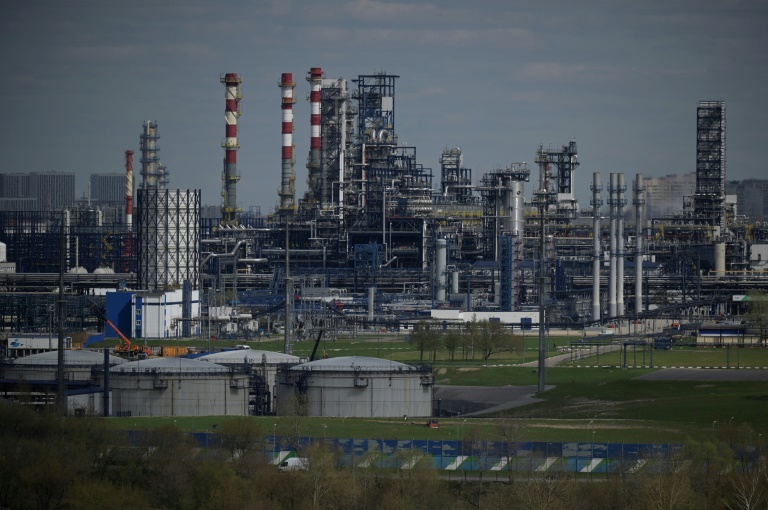
Saudi Arabia, Russia and other key oil producers agreed Thursday on another marginal increase in output, bolstered by risks to demand amid coronavirus restrictions in China. 

Russia’s invasion of Ukraine has added to supply concerns, which have increased with Europe’s announced moves on a potential Russian oil embargo.

OPEC+ members confirmed they’ll stick to their strategy of modestly boosting output, adding another 432,000 barrels per day for June.

In short back-to-back meetings via video conference, the group “noted the continuing effects of geopolitical factors and issues related to the ongoing pandemic”, it said in a press release.

Prices had soared on Wednesday, with the Brent North Sea contract closing above $110 a barrel, its highest level in two-and-a-half weeks. 

At around 1400 GMT on Thursday, Brent stood at $113.25 a barrel and American WTI at $110.64 a barrel.

– Inability to meet quotas –

Analysts had widely expected the Organization of Petroleum Exporting Countries (OPEC), led by Riyadh, and their 10 partners led by Moscow to stay the course. 

“In any case, the decision by OPEC+ to raise its output quota in June is only as relevant as its ability to meet that quota. In recent months, it has failed to do so,” Edward Gardner, a commodities economist for Capital Economics, said.

Between a lack of investment in oil infrastructure in some member countries and operational problems, the cartel regularly fails to meet its production quotas.

The cartel’s strategy dates back to the spring of 2021 when the economy began recovering and oil market stabilised after the drastic cuts imposed amid the shock of the pandemic. 

Largely spared for two years, China in recent weeks has been battling its worst coronavirus outbreak since the spring of 2020 which has strained its zero-Covid strategy. 

Beijing on Wednesday closed dozens of metro stations and residents fear their city will be locked down, as is already the case in Shanghai, the country’s largest city with 25 million people. 

“The slowing activity in China is certainly a factor that will justify their decision to stay put, faced with the mounting international pressure to increase production to address the worsening global energy crisis,” Ipek Ozkardeskaya, an analyst at Swissquote bank, told AFP ahead of the meeting.

As for the new economic sanctions planned against Russia, they were also not expected to move the needle for the moment. 

In its sixth package of sanctions, the European Commission is seeking a ban on all Russian crude oil and refined products transported by sea and pipeline by the end of 2022, European Commission President Ursula von der Leyen told the European Parliament.

– ‘Huge impact’ –

That prospect threatens supply in an already tense European market.

While unanimity among the 27 EU member states is required for the sanctions to go forward, Hungary, which is highly dependent on Russian deliveries, rejected the project in its current form.

“If it (the EU) manages to convince its members to ratify the plan… then this will have a huge impact on Russian oil exports,” Fawad Razaqzada, analyst at City Index and Forex.com, said ahead of the meeting.

Stephen Innes, an analyst at SPI Asset Management, said OPEC+’s wait-and-see approach was “increasingly untenable” and “contrary to its mission statement”.

“(It’s) why they have fallen under constant criticism for being slow and technically unprepared to react to recent developments in global markets,” he said.

Sri Lanka police tear gas student protesters outside parliament

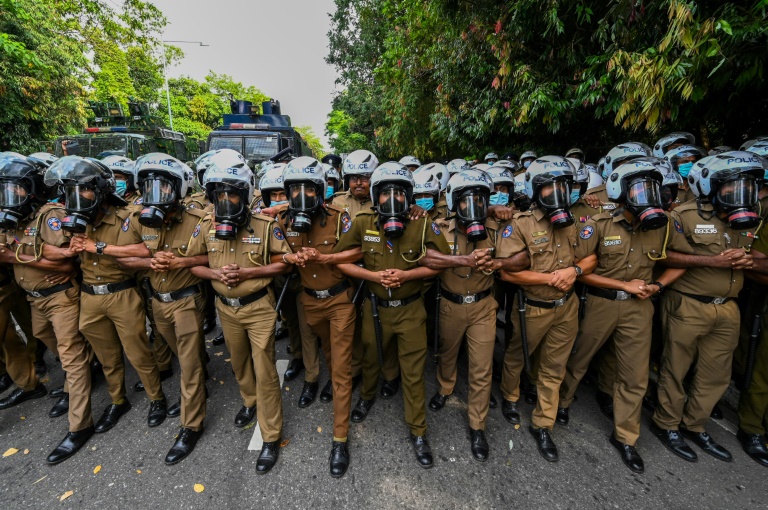
Police fired tear gas on students attempting to storm Sri Lanka’s parliament Thursday as the protesters demanded the resignation of President Gotabaya Rajapaksa over the country’s worst-ever economic crisis.

Protesters led by the Inter University Students’ Federation were about to pull down the yellow-painted iron barricades on the main drive leading to the legislature when riot police unleashed a barrage of tear gas.

The students had marched from a nearby university and closed in on the parliament building located on a man-made lake island when police moved in.

Even as the crowds dispersed, police kept firing tear gas canisters that hit shops in the nearby Diyatha Uyana park, witnesses said.

Police had earlier set up barricades around the sprawling parliament complex where a vacancy for the deputy speaker was being filled unopposed. 

Sri Lanka’s 22-million population has been facing acute shortages of food, fuel and medicines for months, bringing tens of thousands onto the streets to demand the resignation of Rajapaksa and other members of his powerful ruling family. 

The president and his family have made it clear that they will not step down despite escalating demonstrations across the island.

– Trade unions –

Sri Lanka’s trade unions have announced a one-day work stoppage on Friday.

The organisers of the strike have asked temples and churches to ring their bells for an hour on Friday morning in a show of solidarity.

Finance minister Ali Sabry warned on Wednesday that the country will have to endure its unprecedented economic hardships for at least two more years.

Sabry said the country now has less than $50 million in usable foreign exchange reserves, needed to finance essential goods to keep Sri Lanka’s import-dependent economy ticking over.

Official data shows reserves at $1.7 billion, but most of that figure includes a Chinese currency swap which cannot be used to pay for imports from other countries.

Sabry said the government faltered by delaying an approach to the International Monetary Fund for a bailout.

Sri Lanka’s economic crisis took hold after the coronavirus pandemic hammered income from tourism and remittances.

Last month, Colombo announced it was defaulting on its $51 billion foreign debt.

Sri Lanka police tear gas student protesters outside parliament

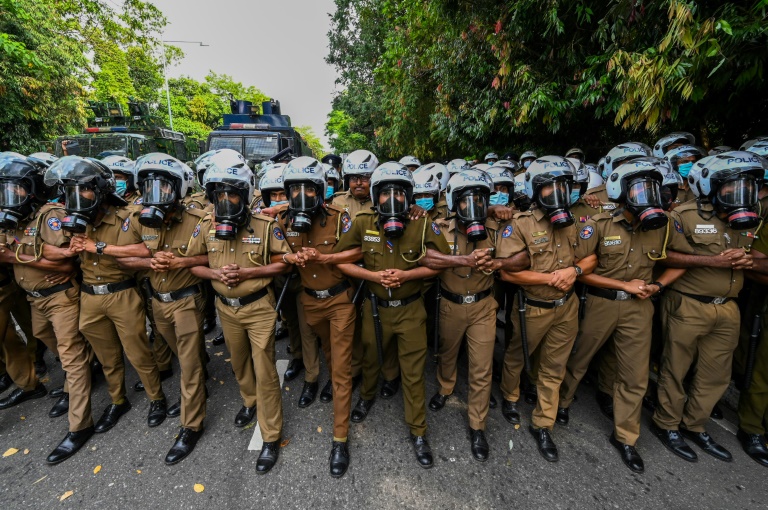
Police fired tear gas on students attempting to storm Sri Lanka’s parliament Thursday as the protesters demanded the resignation of President Gotabaya Rajapaksa over the country’s worst-ever economic crisis.

Protesters led by the Inter University Students’ Federation were about to pull down the yellow-painted iron barricades on the main drive leading to the legislature when riot police unleashed a barrage of tear gas.

The students had marched from a nearby university and closed in on the parliament building located on a man-made lake island when police moved in.

Even as the crowds dispersed, police kept firing tear gas canisters that hit shops in the nearby Diyatha Uyana park, witnesses said.

Police had earlier set up barricades around the sprawling parliament complex where a vacancy for the deputy speaker was being filled unopposed. 

Sri Lanka’s 22-million population has been facing acute shortages of food, fuel and medicines for months, bringing tens of thousands onto the streets to demand the resignation of Rajapaksa and other members of his powerful ruling family. 

The president and his family have made it clear that they will not step down despite escalating demonstrations across the island.

– Trade unions –

Sri Lanka’s trade unions have announced a one-day work stoppage on Friday.

The organisers of the strike have asked temples and churches to ring their bells for an hour on Friday morning in a show of solidarity.

Finance minister Ali Sabry warned on Wednesday that the country will have to endure its unprecedented economic hardships for at least two more years.

Sabry said the country now has less than $50 million in usable foreign exchange reserves, needed to finance essential goods to keep Sri Lanka’s import-dependent economy ticking over.

Official data shows reserves at $1.7 billion, but most of that figure includes a Chinese currency swap which cannot be used to pay for imports from other countries.

Sabry said the government faltered by delaying an approach to the International Monetary Fund for a bailout.

Sri Lanka’s economic crisis took hold after the coronavirus pandemic hammered income from tourism and remittances.

Last month, Colombo announced it was defaulting on its $51 billion foreign debt.

Close Bitnami banner
Bitnami