World

China’s Covid rules batter business confidence: EU Chamber

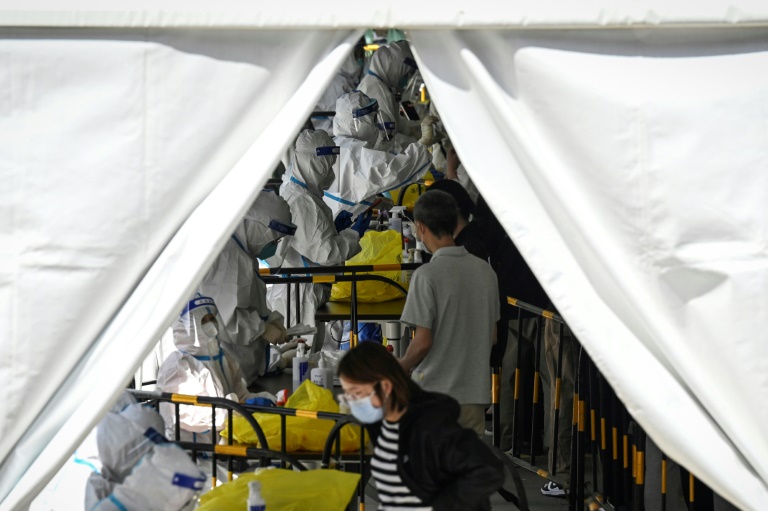
China’s strict zero-Covid policy has led to a plunge in confidence among European companies operating in the country as supply chains are tangled, revenue projections fall and staff leave, according to a business group survey released Thursday.

Beijing remains wedded to its strategy of stamping out coronavirus clusters with targeted lockdowns and mass testing, even as the fast-spreading Omicron variant makes this increasingly difficult.

But the European Chamber of Commerce said in a report that the strict containment measures in dozens of Chinese cities, including the biggest Shanghai, had caused “disruption on an epic scale”.

“While the war (in Ukraine) has had an impact on European businesses operating in China, Covid-19 presents a far more immediate challenge and has caused a considerable drop in business confidence,” the Chamber added.

Its survey of more than 370 members was conducted in late April.

Nearly a quarter of respondents are now considering moving current or planned investments in China to other markets — more than doubling from two months ago.

Almost 60 percent of respondents decreased their revenue projections for this year, while around a third saw a drop in staffing, results showed.

Most companies also reported a negative hit on supply chains, with struggles accessing raw materials and components, or to deliver finished products.

“The Chinese market has lost a considerable amount of allure for many respondents,” the report said, adding that Covid measures have made it less attractive for investment.

The Chamber said a vast majority of firms surveyed agreed with proposals to focus more on vaccinating China’s entire population, allowing positive cases with no or mild symptoms to quarantine at home, and allowing mRNA vaccines to be used.

Businesses are also being bogged down by the war in Ukraine, according to the survey, with the disruption of logistics to and from Europe.

Rail freight is no longer an option and aircraft need to circumvent Russian and Ukrainian airspace — increasing distance and costs.

And “the susceptibility of operations to future shocks must be weighed, in particular the prospect of a deterioration in EU-China relations”, said the report.
China’s Covid rules batter business confidence: EU Chamber

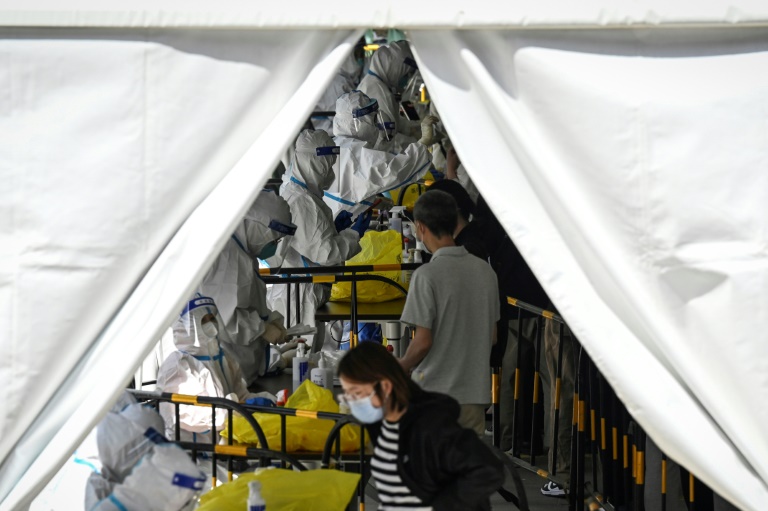
China’s strict zero-Covid policy has led to a plunge in confidence among European companies operating in the country as supply chains are tangled, revenue projections fall and staff leave, according to a business group survey released Thursday.

Beijing remains wedded to its strategy of stamping out coronavirus clusters with targeted lockdowns and mass testing, even as the fast-spreading Omicron variant makes this increasingly difficult.

But the European Chamber of Commerce said in a report that the strict containment measures in dozens of Chinese cities, including the biggest Shanghai, had caused “disruption on an epic scale”.

“While the war (in Ukraine) has had an impact on European businesses operating in China, Covid-19 presents a far more immediate challenge and has caused a considerable drop in business confidence,” the Chamber added.

Its survey of more than 370 members was conducted in late April.

Nearly a quarter of respondents are now considering moving current or planned investments in China to other markets — more than doubling from two months ago.

Almost 60 percent of respondents decreased their revenue projections for this year, while around a third saw a drop in staffing, results showed.

Most companies also reported a negative hit on supply chains, with struggles accessing raw materials and components, or to deliver finished products.

“The Chinese market has lost a considerable amount of allure for many respondents,” the report said, adding that Covid measures have made it less attractive for investment.

The Chamber said a vast majority of firms surveyed agreed with proposals to focus more on vaccinating China’s entire population, allowing positive cases with no or mild symptoms to quarantine at home, and allowing mRNA vaccines to be used.

Businesses are also being bogged down by the war in Ukraine, according to the survey, with the disruption of logistics to and from Europe.

Rail freight is no longer an option and aircraft need to circumvent Russian and Ukrainian airspace — increasing distance and costs.

And “the susceptibility of operations to future shocks must be weighed, in particular the prospect of a deterioration in EU-China relations”, said the report.
UK voters head to polls with historic N.Ireland result predicted

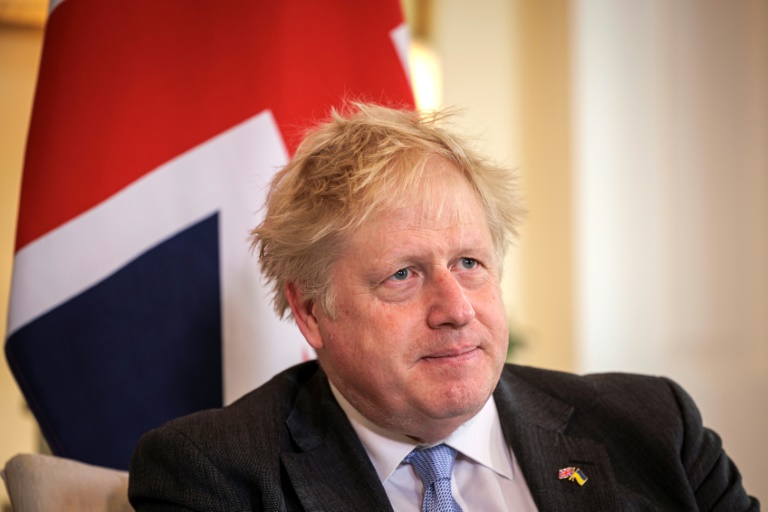
Polls opened across the UK on Thursday in local and regional elections that could prove historic in Northern Ireland and heap further pressure on embattled Prime Minister Boris Johnson.

The contest for the devolved assembly in Belfast could see a pro-Irish nationalist party win for the first time in the troubled history of the British province.

The results, which are expected from Friday, could have huge constitutional implications for the four-nation UK’s future, with predicted victors Sinn Fein committed to a vote in the province on reunification with Ireland.

Polls opened at 0600 GMT for councils in Scotland, Wales and much of England, with Johnson facing a potentially pivotal mid-term popularity test.

Poor results could reignite simmering discontent within his ruling Conservatives about his leadership, after a string of recent scandals.

– Jeopardy –

Johnson, 57, won a landslide 2019 general election victory by vowing to take Britain out of the European Union, and reverse rampant regional inequality.

Despite making good on his Brexit pledge, the pandemic largely stalled his domestic plans. 

But his position has been put in jeopardy because of anger at revelations of lockdown-breaking parties at his Downing Street office and a cost-of-living crisis.

Heavy losses could revive calls among Tory MPs to trigger an internal contest to oust Johnson as party leader and from power.

The polls should also point to whether the main opposition Labour party poses a serious threat, as it tries to make inroads across England despite defending the many gains it made at the last local elections in 2018.

Labour is bidding to leapfrog the Conservatives into second place in Scotland, behind the pro-independence Scottish National Party (SNP), and remain the largest party in Wales, where 16 and 17-year-olds are eligible to vote for the first time. 

– ‘Sea change’ –

The contest for Northern Ireland’s power-sharing assembly is set to capture attention, after numerous polls put Sinn Fein ahead.

A University of Liverpool poll reported Tuesday it remained on target to win comfortably with over a quarter of the vote. 

The pro-UK Democratic Unionist Party (DUP) and cross-community Alliance Party were tied for second.

Deirdre Heenan, professor of social policy at Ulster University, said there was a feeling the election “really is momentous”. 

“It will be a sea change if a nationalist becomes first minister,” she told AFP.

Sinn Fein — the IRA’s former political wing — has dialled down its calls for Irish unity during campaigning, saying it is “not fixated” on a date for a sovereignty poll, instead focusing on the rising cost of living and other local issues.

Party vice president Michelle O’Neill has insisted voters are “looking towards the future” with pragmatism rather than the dogmatism that has long been the hallmark of Northern Irish politics.

“They’re very much looking towards those of us that can work together versus those that don’t want to work together,” she said.

– Power-sharing? –

But her DUP rivals have sought to keep the spotlight on possible Irish reunification in the hope of bolstering their flagging fortunes.

In February, its first minister withdrew from the power-sharing government in protest at post-Brexit trade arrangements, prompting its collapse. 

At a final election debate between the five biggest parties, DUP leader Jeffrey Donaldson reiterated the party would not form a new executive unless London rips up the trading terms, known as the Northern Ireland Protocol.

Although many unionist voters share DUP dislike for it, the party is also getting blamed.

On Belfast’s staunchly unionist Shankill Road, gift shop owner Alaine Allen paused from selling merchandise marking Queen Elizabeth II’s Platinum Jubilee to complain the Protocol is “killing small businesses”.

“Hopefully they’ll get in again, but no one’s actually working for the people,” the 58-year-old said.

– Deliver –

In England, the Conservatives are predicted to lose hundreds of councillors and even control of long-time strongholds in London to the main UK opposition Labour party.

“People across the country are going to focus on which government, which party, is going to deliver for them,” Johnson said this week.

He has tried to sideline the so-called “partygate” scandal that last month saw him become the first British prime minister to be fined for breaking the law while in office.

In Scotland, SNP leader Nicola Sturgeon is hoping a strong performance in contests for all 32 local authorities can lay the groundwork for another independence referendum.

Johnson has repeatedly rejected the push for a second poll, after Scots in 2014 voted by 55 percent to 45 percent not to break away.

Hoppy and glorious: brewery bets on queen's jubilee beer rush

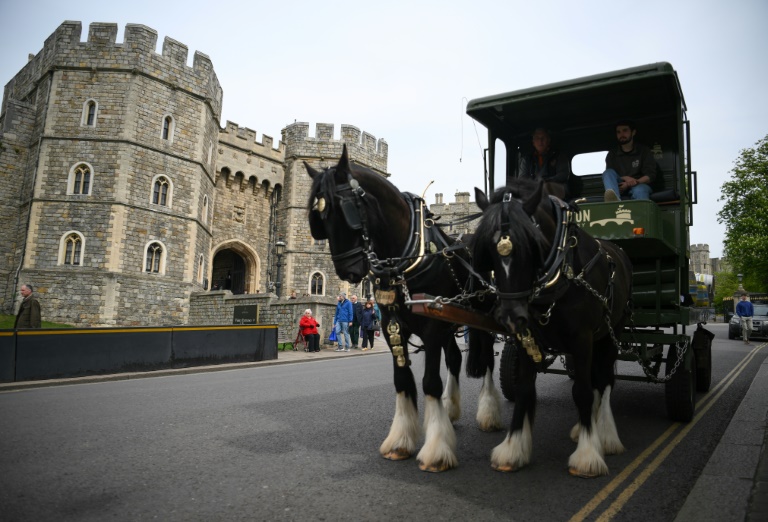
Draught horses Albert and Ivan trot down the streets of Windsor, hauling a barrel-laden cart as pubs stock up on beer ahead of Queen Elizabeth II’s Platinum Jubilee and a hoped-for influx of visitors.

The two Shire breeds with black coats and feathered hooves stop to unload their cart, which later this month is set to carry Castle Hill, a beer created specially to mark the queen’s 70 years on the throne.

“We call it Castle Hill because when the queen first came to the throne, the ascension was announced on the Castle Hill at Windsor,” explains Will Calvert, director of the Windsor & Eton brewery, which is bathed in the sweet smell of malt and hot water.

Brewed with barley from the royal farm and hops from England and New Zealand — the two extremes of the Commonwealth which the queen heads — Castle Hill is “a very nice refreshing beer for drinking outdoors in the summer for the Jubilee” he says.

Calvert’s brewery has been honoured with the “royal warrant”, meaning they supply the royal household, and will start distributing their one-off Jubilee brew closer to the festivities.

The United Kingdom will mark the reign of its longest-serving monarch from June 2-5, with street parties, concerts and parades.

Britons will get two days off work and pubs will be allowed to stay open longer.

In Windsor, just west of London, a parade, fireworks and a giant picnic within the famed castle’s park are planned. The town centre is bedecked with British Union flags and banners announcing the festivities.

“I think we’re going to be very busy especially if the sun is shining,” said Denisa Hucinova, 35, who manages The Boatman pub on the banks of the River Thames, just below the castle.

“We expect to have lots and lots of tourists and every local person will come here.”

“We’re looking forward to that. This is a great celebration. 70 years — it’s amazing, isn’t it? I’m glad that this day comes and that we can all witness it,” she said, after putting the barrels away and patting the horses.

For the town’s shops and pubs, the four days of festivities should provide plenty of business after the lean years of the pandemic.

“The years of Covid were difficult for our business as they were for anybody in hospitality in the UK and around the world,” said Calvert.

“Occasions like this are good for us, because they give us a chance to trade and showcase our beers and get out to the world.”

– ‘More customers’ –

Tourists have returned to Windsor, but with less money, laments Muthucumara Samy Kesavan, manager of the House of Gifts souvenir shop, perfectly positioned just metres (yards) from the castle.

“Business after the pandemic is slightly picking up, it is not normal yet. It is still very quiet,” he said, hoping the jubilee will bring in a wave of customers. 

“The spending is not normal yet but we hope it will improve. Especially in a month or so.”

Inside his shop, the queen’s face is printed on tea towels, cloth bags, T-shirts and tea cups. 

Mugs honouring the queen’s grandson Harry, who married Meghan Markle at Windsor in 2018, are on sale at a reduced price, unwanted by customers since he left royal life and moved to the United State.

The queen remains by far the most popular royal, according to opinion polls and souvenir shop sales.

“I like her very much. I love her,” said Kesavan. 

“And I saw her a few times, once in Windsor and a couple of times in London”.

The British public still adores the queen, in the twilight of her reign, despite scandals that have engulfed her family, including her son Andrew’s association with deceased paedophile Jeffrey Epstein.

“She’s marvellous, she’s built a whole life for the country and the people of the country,” said Sandra Pinder, 61. “She worked so hard, there is nobody like her.”

“All the tours she’s done to promote the country and she does bring a lot for tourism,” said Pinder, accompanying her granddaughter to see the Changing of the Guard at Windsor.

“We love the queen. We all love the queen in the family… She’s 96 years old now. The proof is in the pudding, as we say in England.”

Australian PM urges calm after Solomons leader cites 'invasion' threat

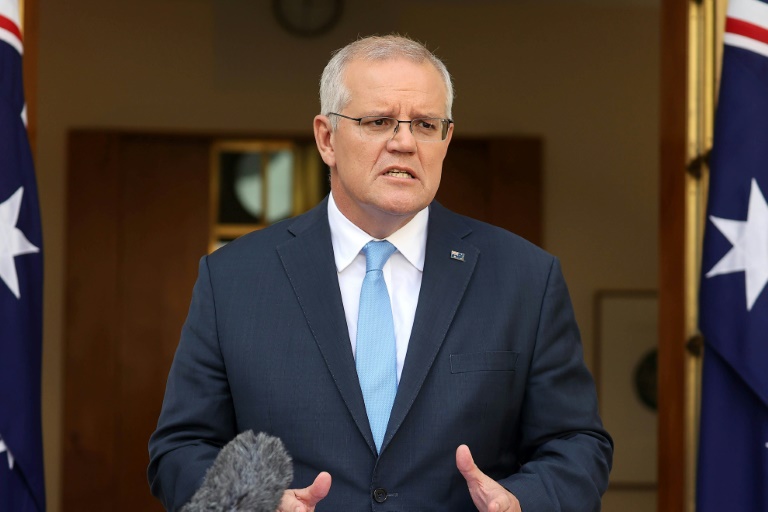
Australian Prime Minister Scott Morrison urged a calm response Thursday after the Solomon Islands’ leader cited an “invasion” threat and said his nation was being treated like an infant wielding a handgun. 

Morrison, who faces federal elections May 21, has been battling criticism of his government’s foreign policy after the Pacific island nation signed a security pact with China last month.

The China deal raised alarm in Australia and the United States, which fear it may give Beijing a military foothold in the South Pacific less than 2,000 kilometres (1,200 miles) from Australia’s coast.

“We need to be calm and composed when we deal with these issues,” Morrison told journalists Thursday.

The Australian leader said he was concerned for the security of the Solomons and the Pacific after Prime Minister Manasseh Sogavare signed the “secret arrangement” with Beijing.

Morrison insisted his government treated the Pacific “family” as an equal.

But Sogavare was irritated by US and Australian criticism of the deal.

“We deplore the continued demonstration of lack of trust by the concerned parties,” Sogavare told parliament Tuesday, adding there was “nothing to be concerned about” with the pact.

– ‘We are insulted’ –

Without naming countries, Sogavare said there had been a “warning of military intervention” if other countries’ interests were undermined in the Solomons.

“In other words, Mr Speaker, we are threatened with invasion. And that is serious,” the prime minister said.

“We are being treated as kindergarten students walking around with Colt 45s in our hands, and therefore we need to be supervised,” he added.

“We are insulted.”

Sogavare’s government severed ties with Taiwan in September 2019 in favour of diplomatic relations with China, a switch that unlocked investment but stoked inter-island rivalries.

Last November, protests against Sogavare’s rule flared into riots in the capital Honiara, during which much of the city’s Chinatown was torched.

Australia deployed about 100 police and military peacekeepers in response to a request by the Solomon Islands. They were joined by forces from New Zealand, Fiji and Papua New Guinea.

But Sogavare said a “personal envoy” of Morrison had briefed him at the time that the peacekeepers would not protect Chinese businesses or China’s embassy.

Chinatown could not be saved “because our police were overwhelmed”, Sogavare said, adding the “rules of engagement” precluded peacekeeper involvement.

The prime minister said Solomon Islands police were unable to assure the Chinese embassy’s protection during the Honiara riots.

China’s ambassador had asked the Solomons government to allow it to bring in 10 “special police protection personnel”, he said, to help secure the embassy.

“Under the UN conventions, we are fully obliged to grant that request,” Sogavare said.

War in Ukraine: Latest developments

Here are the latest developments in the war in Ukraine:

– ‘Heavy fighting’ at Azovstal –

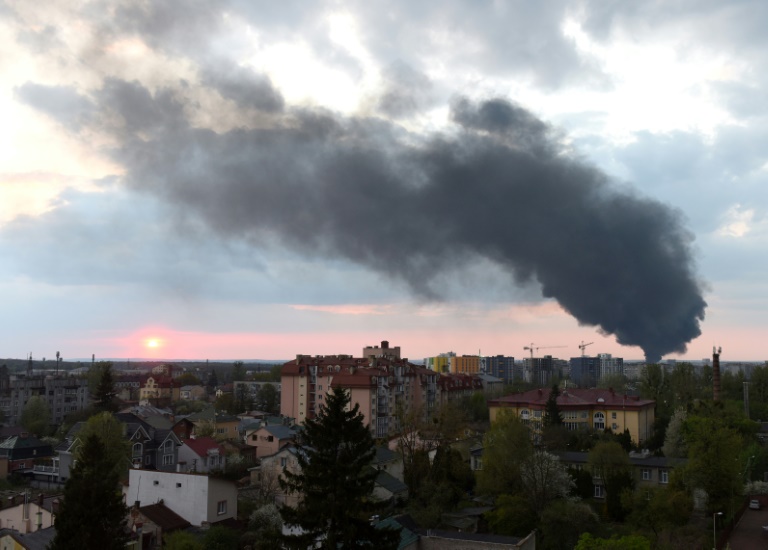
The mayor of the destroyed city of Mariupol says contact has been lost with Ukrainian forces holed up in the Azovstal steel plant amid “heavy fighting” with Russian troops.

City officials have no way of knowing “what’s going on, whether they are safe or not”, Vadym Boichenko tells Ukrainian television.

The Kremlin denies Russia is storming the plant after Ukraine accuses Moscow of launching a “powerful” assault on the industrial zone.

Later Russia announces its forces will cease fire at Azovstal and open a humanitarian corridor for civilians for three days. 

– Zelensky appeal –

As evacuations from Mariupol continue, Ukrainian President Volodymyr Zelensky asks United Nations Secretary General Antonio Guterres to help save the lives of the remaining wounded Ukrainians trapped in Azovstal, and calls on the UN to “assist in the removal of all the wounded”.

“The lives of the people who remain there are in danger. Everyone is important to us,” he says. 

– Nuclear-capable missile practice –

Russia says its forces have practised simulated nuclear-capable missile strikes during war games in Kaliningrad, an enclave on the Baltic Sea located between EU members Poland and Lithuania. 

Moscow practised simulated “electronic launches” of nuclear-capable Iskander mobile ballistic missile systems, the defence ministry says in a statement.

– 20 bodies found in Kyiv region –

The bodies of another 20 civilians are found in the Kyiv region, police say, raising the total number found there so far to 1,235. 

Kyiv regional police chief Andriy Nebytov says the latest discoveries were found in Borodianka and the surrounding villages, some 25 kilometres (15 miles) from Bucha, the town near Kyiv now synonymous with allegations of Russian war crimes.

– Biden ‘open’ to more sanctions –

US President Joe Biden says he is “open” to imposing more sanctions on Russia and will discuss measures with allies from the G7 in the next few days.

“We’re always open to additional sanctions,” Biden says shortly after the European Union announced plans for banning Russian oil imports and other new measures. 

– New EU sanctions, oil ban take shape –

EU chief Ursula von der Leyen says the bloc will impose a gradual Russian oil ban. 

“We will phase out Russian supply of crude oil within six months and refined products by the end of the year,” she tells the European Parliament.

– EU states opposing embargo ‘complicit’: Kyiv –

Ukraine says EU countries blocking an embargo on imports of Russian oil would be complicit in crimes committed by Russian troops on Ukrainian territory by funding Moscow’s military.

“If there is any country in Europe who will continue to oppose the embargo on Russian oil, there will be good reason to say, this country is complicit in the crimes committed by Russia in the territory of Ukraine,” Ukraine Foreign Minister Dmytro Kuleba says in a briefing on social media.

– Mariupol military parade planned: Kyiv –

Ukraine accuses Russia of planning to hold a military parade in the destroyed city of Mariupol on May 9 to celebrate victory over the Nazis in World War II.

Kyiv says an official from Russia’s presidential administration has arrived in the strategic southern port city, to oversee plans for the Victory Day parade.

– Eastern assault continues –

Russian forces continue to pound sites to the east of the country, Ukraine’s general staff says, as Moscow seeks to establish “full control” of the regions of Lugansk and Donetsk, and to maintain a land corridor to occupied Crimea.

In Lugansk, governor Sergiy Gaiday says two people have died in the last 24 hours, and “the whole region is under fire completely, there is no safe place”.

– Belarus launches manoeuvres –

Belarus, a Moscow ally that shares a border with Ukraine, launches “surprise” military manoeuvres, to test the reactive capacity of its army, its defence ministry says. 

Belarus military units were testing their capacity to “go on the alert, move to predetermined zones and undertake combat training,” it says. 

– EU to support Moldova –

European Council President Charles Michel pledges to increase EU military aid to Moldova, Ukraine’s neighbour that has seen a series of attacks in a pro-Moscow separatist region.

burs/cdw/raz/reb

Australian PM urges calm after Solomons leader cites 'invasion' threat

Australian Prime Minister Scott Morrison urged a calm response Thursday after the Solomon Islands’ leader cited an “invasion” threat and said his nation was being treated like an infant wielding a handgun. 

Morrison, who faces federal elections May 21, has been battling criticism of his government’s foreign policy after the Pacific island nation signed a security pact with China last month.

The China deal raised alarm in Australia and the United States, which fear it may give Beijing a military foothold in the South Pacific less than 2,000 kilometres (1,200 miles) from Australia’s coast.

“We need to be calm and composed when we deal with these issues,” Morrison told journalists Thursday.

The Australian leader said he was concerned for the security of the Solomons and the Pacific after Prime Minister Manasseh Sogavare signed the “secret arrangement” with Beijing.

Morrison insisted his government treated the Pacific “family” as an equal.

But Sogavare was irritated by US and Australian criticism of the deal.

“We deplore the continued demonstration of lack of trust by the concerned parties,” Sogavare told parliament Tuesday, adding there was “nothing to be concerned about” with the pact.

– ‘We are insulted’ –

Without naming countries, Sogavare said there had been a “warning of military intervention” if other countries’ interests were undermined in the Solomons.

“In other words, Mr Speaker, we are threatened with invasion. And that is serious,” the prime minister said.

“We are being treated as kindergarten students walking around with Colt 45s in our hands, and therefore we need to be supervised,” he added.

“We are insulted.”

Sogavare’s government severed ties with Taiwan in September 2019 in favour of diplomatic relations with China, a switch that unlocked investment but stoked inter-island rivalries.

Last November, protests against Sogavare’s rule flared into riots in the capital Honiara, during which much of the city’s Chinatown was torched.

Australia deployed about 100 police and military peacekeepers in response to a request by the Solomon Islands. They were joined by forces from New Zealand, Fiji and Papua New Guinea.

But Sogavare said a “personal envoy” of Morrison had briefed him at the time that the peacekeepers would not protect Chinese businesses or China’s embassy.

Chinatown could not be saved “because our police were overwhelmed”, Sogavare said, adding the “rules of engagement” precluded peacekeeper involvement.

The prime minister said Solomon Islands police were unable to assure the Chinese embassy’s protection during the Honiara riots.

China’s ambassador had asked the Solomons government to allow it to bring in 10 “special police protection personnel”, he said, to help secure the embassy.

“Under the UN conventions, we are fully obliged to grant that request,” Sogavare said.

Millions in Beijing urged to work from home to fight Covid outbreak

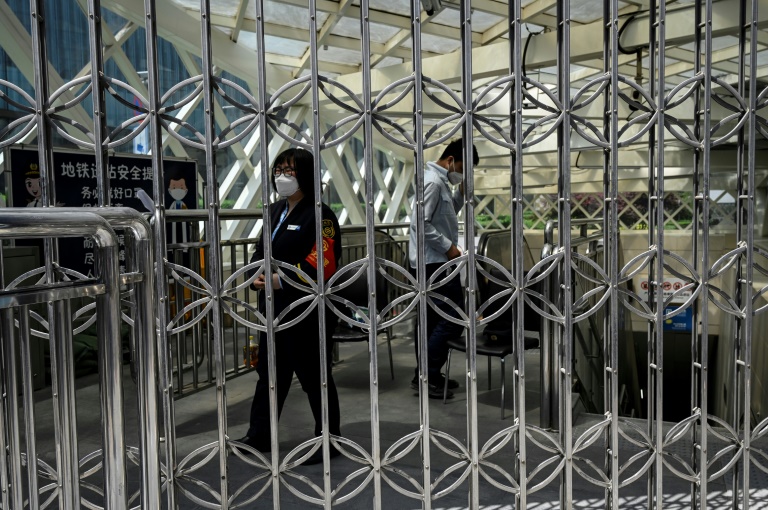
Millions of people in Beijing returned to work Thursday, many remotely, with scores of subway stations shut after a national holiday muted by the coronavirus curbs.

Chinese authorities have pressed on with their zero-Covid policy involving lockdowns and mass testing as they battle the biggest outbreak since the early days of the pandemic, with entire neighbourhoods in the capital sealed over handfuls of infections.

Beijing reported 50 local virus cases on Thursday, a day after it said people in its most populous district Chaoyang should work from home.

Those in the area, home to around 3.5 million, who need to visit their offices were encouraged to drive themselves and avoid gatherings.

Another Beijing district Tongzhou has also encouraged residents to work at home, while dozens of subway stations across the city remained closed.

Some employees were seen returning to their buildings on Thursday in Chaoyang, scanning their health codes that permit entry to venues.

Beijing is treading cautiously after an extended lockdown in Shanghai, China’s largest city, led to food shortages and public anger.

Shanghai — the epicentre of the latest outbreak — reported more than 4,600 mostly asymptomatic infections on Thursday.

The moves followed an unusually quiet Labour Day holiday, with the capital banning dining at restaurants and shutting down gyms.

Domestic tourism revenues over the five-day break were down by more than 40 percent from a year ago, according to official data.

More than 40 cities in China were implementing full or partial lockdowns, or measures restricting mobility as of May 3, according to Nomura estimates.

Key cities such as Hangzhou and Beijing have also ordered more regular Covid testing.

Some curbs were being loosened, however, with Beijing announcing Wednesday that international travellers can be released from quarantine after 10 days in a centralised facility and a week of home isolation, down from a total of 21 days.

This was based on the characteristics of the Omicron virus variant, government spokesman Xu Hejian told reporters, pointing to a shorter incubation period and usually milder symptoms.

Close contacts of confirmed cases will also have a shorter centralised quarantine, officials said.

UK voters head to polls with historic N.Ireland result predicted

Polls open across the UK on Thursday in local and regional elections that could prove historic in Northern Ireland and heap further pressure on embattled Prime Minister Boris Johnson.

The contest for the devolved assembly in Belfast could see a pro-Irish nationalist party win for the first time in the troubled history of the British province.

The results, which are expected from Friday, could have huge constitutional implications for the four-nation UK’s future, with predicted victors Sinn Fein committed to a vote in the province on reunification with Ireland.

Polls open at 0600 GMT for councils in Scotland, Wales and much of England, with Johnson facing a potentially pivotal mid-term popularity test.

Poor results could reignite simmering discontent within his ruling Conservatives about his leadership, after a string of recent scandals.

– Jeopardy –

Johnson, 57, won a landslide 2019 general election victory by vowing to take Britain out of the European Union, and reverse rampant regional inequality.

Despite making good on his Brexit pledge, the pandemic largely stalled his domestic plans. 

But his position has been put in jeopardy because of anger at revelations of lockdown-breaking parties at his Downing Street office and a cost-of-living crisis.

Heavy losses could revive calls among Tory MPs to trigger an internal contest to oust Johnson as party leader and from power.

The polls should also point to whether the main opposition Labour party poses a serious threat, as it tries to make inroads across England despite defending the many gains it made at the last local elections in 2018.

Labour is bidding to leapfrog the Conservatives into second place in Scotland, behind the pro-independence Scottish National Party (SNP), and remain the largest party in Wales, where 16 and 17-year-olds are eligible to vote for the first time. 

– ‘Sea change’ –

The contest for Northern Ireland’s power-sharing assembly is set to capture attention, after numerous polls put Sinn Fein ahead.

A University of Liverpool poll reported Tuesday it remained on target to win comfortably with over a quarter of the vote. 

The pro-UK Democratic Unionist Party (DUP) and cross-community Alliance Party were tied for second.

Deirdre Heenan, professor of social policy at Ulster University, said there was a feeling the election “really is momentous”. 

“It will be a sea change if a nationalist becomes first minister,” she told AFP.

Sinn Fein — the IRA’s former political wing — has dialled down its calls for Irish unity during campaigning, saying it is “not fixated” on a date for a sovereignty poll, instead focusing on the rising cost of living and other local issues.

Party vice president Michelle O’Neill has insisted voters are “looking towards the future” with pragmatism rather than the dogmatism that has long been the hallmark of Northern Irish politics.

“They’re very much looking towards those of us that can work together versus those that don’t want to work together,” she said.

– Power-sharing? –

But her DUP rivals have sought to keep the spotlight on possible Irish reunification in the hope of bolstering their flagging fortunes.

In February, its first minister withdrew from the power-sharing government in protest at post-Brexit trade arrangements, prompting its collapse. 

At a final election debate between the five biggest parties, DUP leader Jeffrey Donaldson reiterated the party would not form a new executive unless London rips up the trading terms, known as the Northern Ireland Protocol.

Although many unionist voters share DUP dislike for it, the party is also getting blamed.

On Belfast’s staunchly unionist Shankill Road, gift shop owner Alaine Allen paused from selling merchandise marking Queen Elizabeth II’s Platinum Jubilee to complain the Protocol is “killing small businesses”.

“Hopefully they’ll get in again, but no one’s actually working for the people,” the 58-year-old said.

– Deliver –

In England, the Conservatives are predicted to lose hundreds of councillors and even control of long-time strongholds in London to the main UK opposition Labour party.

“People across the country are going to focus on which government, which party, is going to deliver for them,” Johnson said this week.

He has tried to sideline the so-called “partygate” scandal that last month saw him become the first British prime minister to be fined for breaking the law while in office.

In Scotland, SNP leader Nicola Sturgeon will be hoping a strong performance in contests for all 32 local authorities can lay the groundwork for another independence referendum.

Johnson has repeatedly rejected the push for a second poll, after Scots in 2014 voted by 55 percent to 45 percent not to break away.

Hong Kong more unequal, less free as Carrie Lam leaves office

Hong Kong has emerged a more unequal city, its freedoms curtailed and international shine dulled after five years with Carrie Lam at the helm, analysts say, as her turbulent leadership draws to an end.

Lam, Hong Kong’s first woman leader, took office promising to heal divisions and tackle livelihood issues, especially a housing crisis.

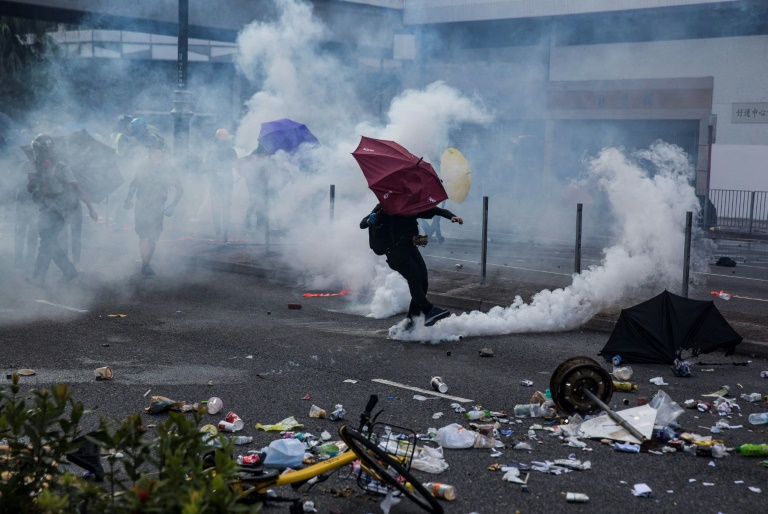
Her term was instead dominated by massive democracy protests and Beijing’s subsequent crackdown, as well as a zero-Covid pandemic strategy that kept the city isolated while rivals reopened.

She is on track to depart at the end of June with the lowest approval ratings of any leader since the handover from Britain.

In her final policy address last October, Lam described Hong Kong as “much stronger than ever” after China intervened to ensure stability.

Her government survived the mass protest movement, but many say she failed to deliver on life improvement pledges — which even China’s leadership says are at the heart of the city’s “deep-rooted social conflicts”.

Last year, 1.65 million Hong Kongers — nearly one in four — were living below the government’s official poverty line, which for a one-person household means HK$4,400 ($560) a month.

This was the highest level since records began 12 years ago.

“The grassroots have been very neglected,” said Sze Lai-shan, deputy director of the Society for Community Organization.

“Sometimes it feels like (the government) is living on a different planet.”

Even pro-establishment figures have been unimpressed. 

“You may say (Lam) has been working very hard, but little has been achieved in solving the deteriorating livelihood issues and Hong Kong’s deep-rooted conflicts,” senior Beijing advisor Lau Siu-kai told AFP.

–  World’s most expensive property –

Last July, China’s top official on Hong Kong affairs Xia Baolong gave a speech widely seen as a reflection of Beijing’s growing impatience with the housing crisis, something every leader since the 1997 handover has failed to solve.

The city, Xia said, must “say goodbye” to cage homes and the tiny shared apartment rooms where some 220,000 Hong Kongers still dwell.

Hong Kong has long held the title of the world’s most unaffordable housing market, where a study this year showed the median property price is 23 times the median household income. 

Lam increased public housing supply, more than her predecessors, but demand still outstripped supply with the wait time increasing to six years.

Chan Kim-ching, a land-use researcher at the Liber Research Community, said Lam overly prioritised building flats to buy.

“By putting home ownership as the goal, it exacerbated the wealth inequality in society,” Chan told AFP.

“(Lam’s) policies do not target those in the greatest need. There is a mismatch.”

– Exodus –

The last two years of Lam’s term also witnessed a historic outflow of people — fleeing either the political crackdown or some of the world’s strictest pandemic controls.

The departures surged further this year when Hong Kong’s zero-Covid policy collapsed as the more transmissible Omicron variant broke through, killing more than 9,000 people, mostly under-vaccinated elderly.

A net 160,000 people departed Hong Kong in the first three months of the year. 

Lam recently acknowledged that the curbs had caused a brain drain among foreign businesses, saying it was an “undeniable fact”.

Meanwhile, Beijing’s ongoing efforts to reshape Hong Kong’s political landscape sparked another emigration wave among locals.

After the 2019 protests were crushed, China imposed a sweeping national security law that criminalised dissent and transformed the once outspoken city.

Police arrested 182 people under the security law. Most of the city’s prominent democracy activists are either in jail or have fled overseas.

In the annual international press freedom chart released this week by Reporters Without Borders, Hong Kong plummeted from 80th to 148th place.  

Frances Hui, an activist granted asylum in the United States, described Lam as an “obedient enforcer” of Chinese leader Xi Jinping’s agenda. 

“She accelerated the suppression of freedoms,” Hui told AFP.

The Hong Kong diaspora is steadily growing in places like Britain, Canada and the United States.

“I didn’t expect that taking part in activism will lead to me having to seek asylum,” Hui said.

“That’s a reflection of how far Hong Kong has fallen.”

Close Bitnami banner
Bitnami