World

US stocks rally, dollar retreats as Fed lifts interest rates

Wall Street stocks rallied and the dollar retreated Wednesday after the Federal Reserve announced a large 50 basis points interest rate increase but ruled out an even bigger hike for the foreseeable future.

The decision — which follows weeks of anticipation and speculation as Fed officials have vowed a tough response to inflation — came as European officials proposed a gradual ban on Russian crude, lifting oil prices.

With inflation at the highest rate in four decades, Federal Reserve Chair Jerome Powell sent a message directly to the American people, expressing concern for the pain caused by rising prices, and pledging to use all available tools to bring them down.

Wednesday’s interest rate hike, the biggest since 2000, was coupled with a move to begin reducing the central bank’s bond holdings from June 1, marking the Fed’s most aggressive steps so far to counter inflation.

Powell said half-percentage point increases “should be on the table at the next couple of meetings,” but added that a three-quarter point increase “is not something the committee is actively considering.”

Stocks rallied off the remarks as Powell also expressed confidence the US central bank could engineer a “soft landing” that tames inflation without sending the economy into a recession.

Major US indices powered about three percent higher, while the dollar retreated against the euro and other currencies.

Art Hogan, strategist at National Securities, said the Fed’s decision met expectations but contained “no hawkish surprise,” adding that stocks could push higher in the coming sessions.

Some analysts have viewed the stock market as positioned for a potential rally after suffering deep losses in April amid worries over the Fed.

The central bank’s announcement followed data showing slowing growth in the US services sector and lackluster private-sector hiring that reflected limited labor capacity. The report comes ahead of Friday’s closely-watched government jobs data.

In earlier trading, European stocks closed down, after a broadly downbeat session in Asia, although key bourses including Shanghai and Tokyo remained shut.

Oil prices rebounded sharply after the European Commission proposed a gradual ban on Russian crude over Moscow’s invasion of Ukraine.

The Fed announcement is due one day before the Bank of England is also predicted to deliver a hike.

India’s central bank unexpectedly ramped up its key rate by 40 basis points to 4.4 percent on Wednesday.

Policymakers are seeking to tackle runaway prices but risk damaging global economic recovery from the pandemic.

Investor sentiment also remains dogged by the fallout from Russia’s ongoing Ukraine invasion, which has fueled bumper gains for many raw materials including crude.

– Key figures at around 2100 GMT –

New York – Dow: UP 2.8 percent at 34,061.06 (close)

New York – S&P 500: UP 3.0 percent at 4,300.17 (close)

New York – Nasdaq: UP 3.2 percent at 12,964.86 (close)

London – FTSE 100: DOWN 0.9 percent at 7,493.45 (close)

Frankfurt – DAX: DOWN 0.5 percent at 13,970.82 (close) 

Paris – CAC 40: DOWN 1.2 percent at 6,395.68 (close)  

EURO STOXX 50: DOWN 1.0 percent at 3,724.99 (close) 

Hong Kong – Hang Seng Index: DOWN 1.1 percent at 20,869.52 (close)

Tokyo – Nikkei 225: Closed for a holiday

Shanghai – Composite: Closed for a holiday

Brent North Sea crude: UP 4.9 percent at $110.14 per barrel

West Texas Intermediate: UP 5.3 percent at $107.81 per barrel

Euro/dollar: UP at $1.0625 from $1.0521 on Tuesday

Pound/dollar: UP at $1.2632 from $1.2499

Euro/pound: DOWN  at 84.06 pence from 84.18 pence

Dollar/yen: DOWN at 129.05 yen from 130.14 yen

US Fed makes biggest rate increase since 2000 to fight inflation

The Federal Reserve on Wednesday announced its biggest rate hike since 2000, with a half percentage point increase as it works to crush soaring US inflation.

With inflation at the highest rate in four decades, Federal Reserve Chair Jerome Powell sent a message directly to the American people, expressing concern for the pain caused by rising prices, and pledging to use all available tools to bring them down.

But he told reporters he remains confident the economy is strong enough to withstand rate increases without tipping into a recession.

After a quarter-point hike in March, the US central bank’s policy-setting Federal Open Market Committee (FOMC) pushed the benchmark interest rate above 0.75 percent as it works to cool the economy, and confirmed more increases “will be appropriate.”

The hike will raise the costs of all types of borrowing, from mortgages to credit cards to car loans, cooling demand and business activity.

Inflation has become an overriding concern after the world’s largest economy saw annual consumer prices surge 8.5 percent over the 12 months to March — the biggest jump since December 1981.

Policymakers continue to believe inflation will gradually return to the Fed’s two-percent target as it raises borrowing costs, but in a statement following the conclusion of its two-day meeting, the FOMC said it will be “highly attentive to inflation risks.”

In an unusual move, Powell opened his news conference speaking to the American people.

“Inflation is much too high. And we understand the hardship that is causing,” he said, promising to use all tools available to bring it down “expeditiously.”

He acknowledged that higher interest rates also bring their share of pain, but “everyone would be better off if we can get this job done. The sooner, the better.”

To achieve that aim, he said “additional 50-basis point increases should be on the table at the next couple of meetings,” however, a more aggressive three-quarter point hike is not under consideration.

The Fed’s goal is to engineer a “soft landing,” reining in inflation while avoiding a contraction in economic activity, and Powell said that outcome is likely.

“It’s a strong economy, and nothing about it suggested… that it’s close to or vulnerable to a recession,” he said.

– Ukraine war impact –

But with China’s pandemic lockdowns worsening global supply snarls and the war in Ukraine pushing commodity prices higher, analysts fear factors beyond the central bank’s control could undermine that goal, and perhaps plunge the US economy into a recession.

The FOMC acknowledged the “highly uncertain” impact of Russia’s invasion of Ukraine and Western sanctions on Moscow, which are “creating additional upward pressure on inflation and are likely to weigh on economic activity.” 

In addition, Covid lockdowns in China “are likely to exacerbate supply chain disruptions,” the statement said. 

– Offloading bonds –

Though it contracted in the first quarter, Powell said the economy was healthy enough to withstand higher rates, and pointed to robust job gains and strong household and business spending.

However, central bankers cannot engineer a solution for the worker shortages that have challenged businesses and raised fears of a wage-price spiral, when employees demand higher salaries and fuel price increases. 

Powell downplayed those concerns, saying some of the inflation is due to price shocks, while Fed policy can help address the “imbalance” in the labor market.

On Wednesday, payroll services firm ADP reported private employers added a weaker-than-expected 247,000 workers in April, a sign that companies are struggling to find available labor, while government data released Tuesday showed there are nearly two openings for every job seeker.

The FOMC also said it would begin reducing its massive bond holdings starting June 1, beginning at the pace of $47.5 billion a month, and then doubling after three months, also aimed at removing stimulus from the economy.

The decision was widely expected, and many economists believe the FOMC will again hike rates by a half-point in June, though Ian Shepherdson of Pantheon Economics said, “After that we think all bets are off, given the likelihood of a steep, sustained drop in inflation, a clear softening in manufacturing, and a meltdown in housing market activity.”

Stock markets cheered the Fed move, closing sharply higher, with big gains in interest-sensitive tech shares.

Shareholder sues Netflix over subscriber slip

A Netflix shareholder is seeking class action status for a lawsuit accusing the streaming television titan of not making it clear that subscriber numbers were in peril.

A disclosed drop of just 200,000 users — less than 0.1 percent of its total customer base — was enough to send shares plunging after Netflix announced quarterly earnings in April.

The company anticipates a much larger drop in the current quarter — of around two million net subscribers.

The suit filed Tuesday in federal court in San Francisco accuses top executives at Netflix of not telling investors that subscriber growth was slowing due to people sharing accounts and competition ramping up in the market.

“Defendants’ positive statements about the company’s business, operations, and prospects were materially false and/or misleading and/or lacked a reasonable basis,” read the suit filed by lawyers at Glancy Prongay & Murray on behalf of a shareholder.

Netflix did not immediately reply to a request for comment.

Executives at the company said on an earnings call that they are focused on combating the 100 million households who watch Netflix for free thanks to shared passwords.

“When we were growing fast, it wasn’t the high priority to work on,” co-founder Reed Hastings admitted. “And now we’re working super hard on it.”

Chief operating officer Gregory Peters said Netflix wasn’t trying to shut down sharing, “but we’re going to ask you to pay a bit more to be able to share.”

In March, Netflix put out word that it is testing charging a fee to subscribers who share their accounts with people who don’t live in the same home.

Competition in the streaming television market meanwhile has intensified, particularly from Disney+, with the cost of producing coveted original shows climbing as well.

To attract viewers, Netflix is preparing cheaper subscriptions that include advertisements — which it expects to roll out in the next couple years.

The Los Gatos, California-based company has long defended its no-ads model, which set it apart from competitors such as Disney+, HBO Max and Apple.

For Pivotal analyst Jeff Wlodarczak, streaming “appears nearly fully penetrated globally post-Covid,” and the companies now must set their sights on converting pirates into subscribers, gaining greater market share from each other and driving up prices.”

The suit filed Tuesday is seeking to represent everyone who owned Netflix shares in the six months ending April 19, 2022, and is asking for unspecified cash damages as well as compensation for financial losses.

Trading strikes as tension builds in Ukraine no-man's land

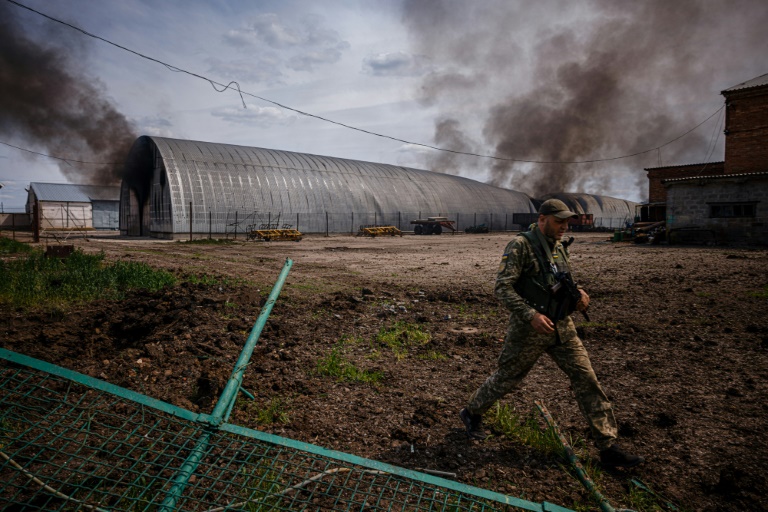
The blaze in a football field-length storage building had been burning at least a day — but there are no firefighters in Temyrivka because everyone has evacuated, leaving the black smoke to rise unhindered.

This one of a string of southeastern Ukrainian villages in no-man’s land near the town of Pokrovska, where the two sides are just a few kilometres apart — so close that Ukrainian troops with binoculars can see the Russians digging at their positions.

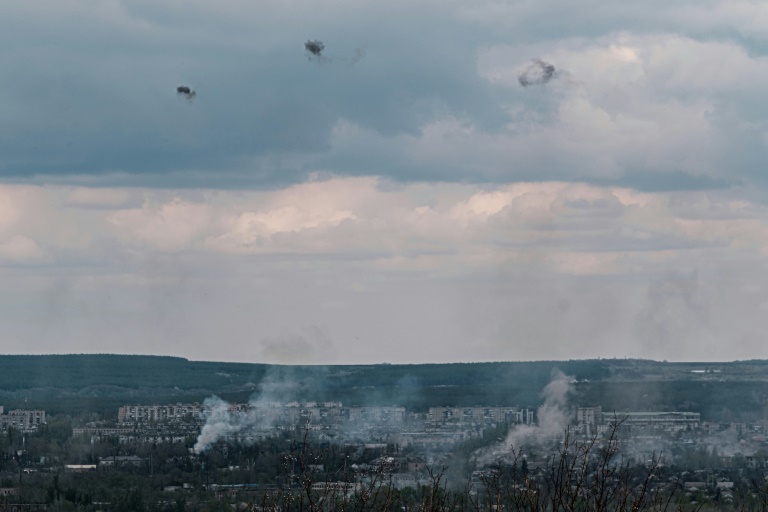
The deep thump of artillery exchanges comes on top of the odd rocket salvo, yet Ukrainian soldiers told AFP during a visit Wednesday that there was almost no face-to-face fighting.

As the focus of Russia’s invasion has moved to Ukraine’s east, there is a steady build-up of tension, with lower-intensity but explosive strikes in some areas while fighting increases in others.

“As for now, they never come on foot, only artillery,” said soldier Dmytro Sirenko, 40, as he peered in the Russians’ direction across a broad, green expanse of farms, fields and the occasional house.

“We have time to entrench ourselves, hide and wait for the possible advance of the enemy,” he said, a rifle in one hand as he stood in a recently dug foxhole.

Because of the threat of a Russian armoured vehicle assault, anti-tank rockets are positioned in many foxholes and bunkers at one Ukrainian outpost flanked by fields of bright yellow flowers used in the nation’s vegetable oil industry.

Near the front lines, more than an hour’s drive east of the government-held city of Zaporizhzhia, the civilian population drops to almost nothing the closer you get to the shelling.

In Temyrivka, AFP met only two civilians. They said they had already left the area but had come back to collect some things from their home.

Then they quickly drove away from the splintered roofs and steadily burning storage building.

– Calm before the storm? –

Russia’s campaign to take Ukraine by force, despite unprecedented international sanctions, has dropped into a lower gear and become an effort to chip away steadily at the embattled nation’s defences in the east.

“The Russians can’t be everywhere at the same time. They try to grab small pieces (of the front) — one here, one there,” explained Sirenko. 

“If nobody’s in the way, then they advance.”

In southern Ukraine, Russian forces have taken over a strip of territory stretching from the besieged port city of Mariupol to Kherson, the region just north of Crimea. 

The frontline area visited by AFP includes large expanses of farmland with tractors in the fields working in places further from the shelling, while some stretches of land closer to the fighting were untilled.

In March, Ukraine officials warned the invasion could be disastrous for the nation’s harvest, which is crucial to global food supplies.

Several regions, especially the fertile lands around Kherson, Zaporizhzhia and Odessa in the south, are at risk because of the violence.

Yet for the troops spending hours watching across the fields for an attack, there are risks even more urgent than Ukraine’s farm production.

With Russia days away from its May 9 commemoration of victory over the Nazis in 1945, experts have predicted President Vladimir Putin may try to declare a win in Ukraine, and troops told AFP they were watching for an offensive.

“Now it’s too calm,” said a soldier called Eugene, who did not give his surname. 

“There had been a lot of ruckus around here. And now it’s calm… like before the storm, as they say,” he added.

Mexico enlists private sector to help tame inflation

Mexico announced Wednesday an agreement with members of the private sector aimed at maintaining prices of staple foods in the face of the highest inflation in two decades.

“This is not about price controls. It’s an agreement, an alliance to guarantee that the basic food basket is priced fairly,” President Andres Manuel Lopez Obrador told reporters.

The non-binding pact is designed to keep prices of basic foods stable for at least six months, Finance Minister Rogelio Ramirez de la O said.

Mexico’s influential Business Coordinating Council said it was ready to help maintain the prices of 24 staple foods. 

Baked goods giant Bimbo pledged to maintain the price of white bread.

Telmex, the communications giant owned by tycoon Carlos Slim, also threw its weight behind the plan, promising not to raise telephone and internet prices this year.

But not all Mexicans were convinced.

“I don’t think it’s going to work,” said Javier Ramirez, a 40-year-old programmer waiting to buy groceries at a market in the capital.

“Everything’s more expensive and salaries aren’t rising at the same rate as inflation,” added Ramirez, who said he had cut back on avocado and fish due to the high prices.

Javier Espinosa, a 53-year-old shopkeeper, called the plan a “joke” because the prices of many other goods not covered by the agreement are likely to keep rising.

“The truth is I don’t feel like it helps at all,” he said.

“What you have to do is invest — in the countryside, in tourism, everywhere” to generate more incomes and jobs, Espinosa added.

Like many countries, Mexico is facing a sharp rise in consumer prices that is pushing up the cost of living.

Mexican inflation hit 7.45 percent in March, well above the central bank’s target of around 3.0 percent.

Mexico already subsidizes fuel, using money generated by its oil and gas industry, without which inflation would be around 10 percent, Ramirez de la O said.

The measures presented by the government also aim to boost production of corn, rice and beans to prevent shortages.

Two million more tons of fertilizer — a product facing a supply squeeze because of the war in major producer Ukraine — will be distributed to the agricultural sector.

The government said it would boost road security to prevent food theft and pledged not to increase tolls and rail transport fees.

The Mexican central bank has raised its benchmark interest rate at seven consecutive meetings, to 6.5 percent, in an attempt to rein in soaring consumer prices.

With concerns mounting about inflation and weaker US growth, the Bank of Mexico downgraded its economic outlook in March, forecasting growth of 2.4 percent this year.

Mexico enlists private sector to help tame inflation

Mexico announced Wednesday an agreement with members of the private sector aimed at maintaining prices of staple foods in the face of the highest inflation in two decades.

“This is not about price controls. It’s an agreement, an alliance to guarantee that the basic food basket is priced fairly,” President Andres Manuel Lopez Obrador told reporters.

The non-binding pact is designed to keep prices of basic foods stable for at least six months, Finance Minister Rogelio Ramirez de la O said.

Mexico’s influential Business Coordinating Council said it was ready to help maintain the prices of 24 staple foods. 

Baked goods giant Bimbo pledged to maintain the price of white bread.

Telmex, the communications giant owned by tycoon Carlos Slim, also threw its weight behind the plan, promising not to raise telephone and internet prices this year.

But not all Mexicans were convinced.

“I don’t think it’s going to work,” said Javier Ramirez, a 40-year-old programmer waiting to buy groceries at a market in the capital.

“Everything’s more expensive and salaries aren’t rising at the same rate as inflation,” added Ramirez, who said he had cut back on avocado and fish due to the high prices.

Javier Espinosa, a 53-year-old shopkeeper, called the plan a “joke” because the prices of many other goods not covered by the agreement are likely to keep rising.

“The truth is I don’t feel like it helps at all,” he said.

“What you have to do is invest — in the countryside, in tourism, everywhere” to generate more incomes and jobs, Espinosa added.

Like many countries, Mexico is facing a sharp rise in consumer prices that is pushing up the cost of living.

Mexican inflation hit 7.45 percent in March, well above the central bank’s target of around 3.0 percent.

Mexico already subsidizes fuel, using money generated by its oil and gas industry, without which inflation would be around 10 percent, Ramirez de la O said.

The measures presented by the government also aim to boost production of corn, rice and beans to prevent shortages.

Two million more tons of fertilizer — a product facing a supply squeeze because of the war in major producer Ukraine — will be distributed to the agricultural sector.

The government said it would boost road security to prevent food theft and pledged not to increase tolls and rail transport fees.

The Mexican central bank has raised its benchmark interest rate at seven consecutive meetings, to 6.5 percent, in an attempt to rein in soaring consumer prices.

With concerns mounting about inflation and weaker US growth, the Bank of Mexico downgraded its economic outlook in March, forecasting growth of 2.4 percent this year.

Drone swarms can now fly autonomously through thick forest

A swarm of 10 bright blue drones lifts off in a bamboo forest in China, then swerves its way between cluttered branches, bushes and over uneven ground as it autonomously navigates the best flight path through the woods.

The experiment, led by scientists at Zhejiang University, evokes scenes from science fiction — and the authors in fact cite films such as “Star Wars,” “Prometheus” and “Blade Runner 2049” in the opening of their paper published Wednesday in the journal Science Robotics.

“Here, we take a step forward (to) such a future,” wrote the team, led by Xin Zhou.

In theory, there are myriad real world applications, including aerial mapping for conservation and disaster relief work. But the technology has needed to mature so that flying robots can adapt to new environments without crashing into one another or objects, thus endangering public safety.

Drone swarms have been tested in the past, but either in open environments without obstacles, or with the location of those obstacles programmed in, Enrica Soria, a roboticist at the Swiss Federal Institute of Technology Lausanne, who was not involved in the research, told AFP.

“This is the first time there’s a swarm of drones successfully flying outside in an unstructured environment, in the wild,” she said, adding the experiment was “impressive.”

The palm-sized robots were purpose-built, with depth cameras, altitude sensors and an on-board computer. The biggest advance was a clever algorithm that incorporates collision avoidance, flight efficiency and coordination within the swarm.

Since these drones do not rely on any outside infrastructure, such as GPS, swarms could be used during natural disasters. 

For example, they could be sent into earthquake-hit areas to survey damage and identify where to send help, or into buildings where it’s unsafe to send people.

It’s certainly possible to use single drones in such scenarios, but a swarm approach would be far more efficient, especially given limited flight times. 

Another possible use is having the swarm collectively lift and deliver heavy objects.

There’s also a darker side: swarms could be weaponized by militaries, just as remote-piloted single drones are today. The Pentagon has repeatedly expressed interest and is carrying out its own tests.

“Military research is not shared with the rest of the world just openly, and so it’s difficult to imagine at what stage they are with their development,” said Soria.

But advances shared in scientific journals could certainly be put to military use.

– Coming soon? –

The Chinese team tested their drones in different scenarios — swarming through the bamboo forest, avoiding other drones in a high-traffic experiment, and having the robots follow a person’s lead.

“Our work was inspired by birds that fly smoothly in a free swarm through even very dense woods,” wrote Zhou in a blog post.

The challenge, he said, was balancing competing demands: the need for small, lightweight machines, but with high-computational power, and plotting safe trajectories without greatly prolonging flight time.

For Soria, it’s only a matter of a few years before we see such drones deployed in real-life work. First, though, they will need to be tested in ultra-dynamic environments like cities, where they’ll constantly come up against people and vehicles. 

Regulations will also need to catch up, which takes additional time.

Drone swarms can now fly autonomously through thick forest

A swarm of 10 bright blue drones lifts off in a bamboo forest in China, then swerves its way between cluttered branches, bushes and over uneven ground as it autonomously navigates the best flight path through the woods.

The experiment, led by scientists at Zhejiang University, evokes scenes from science fiction — and the authors in fact cite films such as “Star Wars,” “Prometheus” and “Blade Runner 2049” in the opening of their paper published Wednesday in the journal Science Robotics.

“Here, we take a step forward (to) such a future,” wrote the team, led by Xin Zhou.

In theory, there are myriad real world applications, including aerial mapping for conservation and disaster relief work. But the technology has needed to mature so that flying robots can adapt to new environments without crashing into one another or objects, thus endangering public safety.

Drone swarms have been tested in the past, but either in open environments without obstacles, or with the location of those obstacles programmed in, Enrica Soria, a roboticist at the Swiss Federal Institute of Technology Lausanne, who was not involved in the research, told AFP.

“This is the first time there’s a swarm of drones successfully flying outside in an unstructured environment, in the wild,” she said, adding the experiment was “impressive.”

The palm-sized robots were purpose-built, with depth cameras, altitude sensors and an on-board computer. The biggest advance was a clever algorithm that incorporates collision avoidance, flight efficiency and coordination within the swarm.

Since these drones do not rely on any outside infrastructure, such as GPS, swarms could be used during natural disasters. 

For example, they could be sent into earthquake-hit areas to survey damage and identify where to send help, or into buildings where it’s unsafe to send people.

It’s certainly possible to use single drones in such scenarios, but a swarm approach would be far more efficient, especially given limited flight times. 

Another possible use is having the swarm collectively lift and deliver heavy objects.

There’s also a darker side: swarms could be weaponized by militaries, just as remote-piloted single drones are today. The Pentagon has repeatedly expressed interest and is carrying out its own tests.

“Military research is not shared with the rest of the world just openly, and so it’s difficult to imagine at what stage they are with their development,” said Soria.

But advances shared in scientific journals could certainly be put to military use.

– Coming soon? –

The Chinese team tested their drones in different scenarios — swarming through the bamboo forest, avoiding other drones in a high-traffic experiment, and having the robots follow a person’s lead.

“Our work was inspired by birds that fly smoothly in a free swarm through even very dense woods,” wrote Zhou in a blog post.

The challenge, he said, was balancing competing demands: the need for small, lightweight machines, but with high-computational power, and plotting safe trajectories without greatly prolonging flight time.

For Soria, it’s only a matter of a few years before we see such drones deployed in real-life work. First, though, they will need to be tested in ultra-dynamic environments like cities, where they’ll constantly come up against people and vehicles. 

Regulations will also need to catch up, which takes additional time.

In east Ukraine, the war-weary listen out to stay alive

After hearing the shells raining down around her for weeks, 58-year-old Ludymyla is still learning to differentiate between the sounds of the explosions ripping apart towns in war-scarred Donbas.

“It starts with a whistle and then everything shakes. It’s a hail of bombs,” the care worker who declined to give her last name tells AFP during a run for groceries in Lyman, a village in the crossfire.

“Do you hear it, too? We’ve been hearing this sound for an eternity,” she says.

For residents of Donbas who, like Ludymyla, have dismissed official calls to flee, and Ukrainian soldiers holding the line, interpreting the omnipresent sounds of war has become key to staying alive.

They are learning to game-out loud duels between Russian and Ukrainian artillery, the buzzing of drones overhead, and slow wailing of sirens to gauge threat levels.

Ludymyla says she hasn’t learned to tell yet whether the shelling she hears is “plus” or “minus” — war jargon in Donbas for outgoing shelling by Ukraine’s army, or incoming bombardments from Russian forces and their proxies.

“I’m not an expert. I leave that to the guys,” she says, referring to Ukrainian soldiers, before taking off on her bike.

Plus or minus? Since 2014, when fighting erupted between Ukrainian forces and Kremlin-backed separatists, that is the first question asked when shooting starts. 

Twenty-two-year-old Ukrainian solider, Denis, has been holed up in a trench in Barvinkove on the eastern frontline long enough to know exactly which is which.

– ‘First a whistle, then explosions’ –

“You know when it’s plus because it’s louder the closer it is. First it’s a whistle and then explosions. It’s one per shot and you can count them,” he told AFP.

“When it’s minus — on us — there’s a high-pitched sound, loud and clear. It just goes ‘boom'”.

The war in Donbas is primarily a duel between Russian and Ukrainian artillery tens of kilometres apart.

This tit-for-tat starts with a muffled detonation that sends a vibration through the body, then there is a hissing noise from the sky, and finally the explosion as shells land.

They are Grad rockets that are launched by the dozen and shroud Ukrainian military positions and villages in a terrifying and deadly shroud of explosions.

“The Grad goes ‘vziou, vziou, vziou,'” says Denis. “Rockets in general — it’s a very high-pitched noise”.

And these are sounds that can echo and reverberate dozens of kilometres across grassy plains in eastern Ukraine, particularly when these heavy weapons fire off barrages.

Ukrainian soldiers on the frontline said listening out for those barrages — and knowing and when they are close — is especially important at night, when soldiers on lookout are mostly listening out.

“It takes a long time to get good at figuring out the threat level. You have to listen constantly,” says a Ukraine sergeant who goes by the name of Viking.

– War ’embedded in our bodies’ –

“Like, with bombers, you have to know how to identify them while they’re still at a distance, before they strike. It’s an apprenticeship in itself,” he says in a trench on the outskirts of Lyman.

And while Russian or Ukrainian Sukhoi fighter jets do not regularly fly over Donbas, the buzz of drones is a more frequent feature on the frontline — one that sends troops immediately taking cover.

The rat-a-tat-tat of small arms that so dominated fighting between separatists and the Ukrainian army after 2014 is almost non-existent now, replaced with bigger guns for bigger goals.

Throughout Ukraine — not only in the eastern frontline regions — the slow wail of air-raid sirens warning of imminent strikes is another sound the country is adjusting to day and night.

Since the first week of the war, that piercing shrill has been accompanied by the pings of push notifications issuing the same warning on phones.

But in east Ukraine, where authorities for weeks have been urging residents to flee, the few who remain hardly heed the warning wail.

Some town and cities have even lowered the volume of the sirens to spare local the ear-splitting shrill.

That is not the case in Sloviansk, an urban hub in east Ukraine and key prize for invading Russian troops, where sirens emit a high-pitched scream more likely to push out residents than the attack it is warning against.

Outside Lyman, which is expected to fall imminently to Russian troops, 59-year-old farmer Anna Sysouyouk tells AFP that these sounds of war have been “embedded in our bodies since 2014.”

“Our grandchildren are born into them. But you never get used to these sounds and you shouldn’t get used to them,” she said.

Death toll climbs to five in central China building collapse

Authorities have raised the death toll to five in a building collapse in central China that has left dozens missing, state media reported early Thursday. 

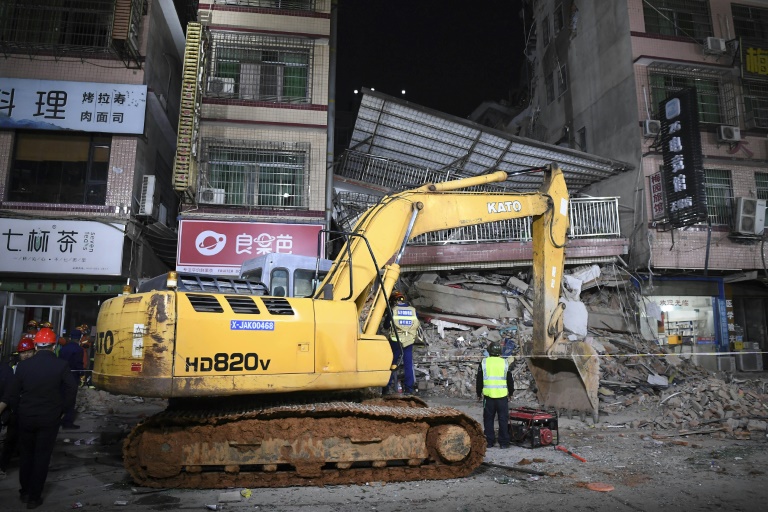
The commercial building in Changsha city, Hunan province — which housed apartments, a hotel and a cinema — caved in on Friday, sparking a massive response with hundreds of emergency workers.

The flattened structure, which has left a gaping hole in a dense Changsha streetscape, created a mess of debris and crumbled concrete beams.

The official Xinhua news agency reported Thursday that the death toll now stands at five, up from two previously. In addition, 10 people have been pulled from the rubble alive. 

The tenth survivor was found conscious at approximately 12:00 am, Xinhua said.

There are 23 people believed to be trapped in the building, and no contact has been established with an additional 39 other missing individuals, according to state media.

Rescuers have been able to find live victims with the help of sniffer dogs, life detectors and drones, as well as thanks to shouting and knocking, the outlet said.

Authorities have alleged that surveyors falsified a safety audit of the building, which Xinhua classified as “a self-built” structure.

President Xi Jinping earlier called for a search “at all cost” and ordered a thorough investigation into the cause of the collapse, state media reported.

Building collapses are not uncommon in China due to weak safety and construction standards, as well as corruption among officials tasked with enforcement.

Close Bitnami banner
Bitnami