World

Stocks drop before expected Fed hike; oil soars on EU embargo

Global stock markets slid Wednesday in cautious deals before an expected half-point interest rate hike from the inflation-fighting US Federal Reserve.

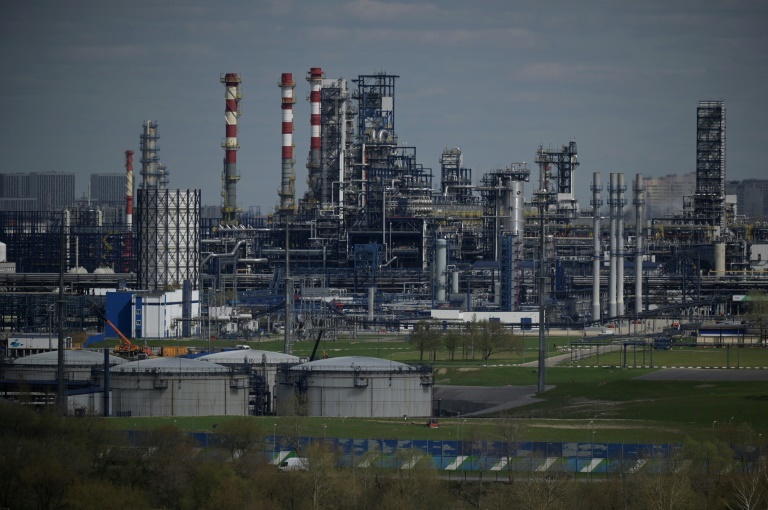
Oil prices meanwhile rebounded sharply after EU chief Ursula von der Leyen said the bloc would impose a gradual ban on Russian crude over Moscow’s invasion of Ukraine.

European stocks fell after a broadly downbeat session in Asia, although key bourses including Shanghai and Tokyo remained shut.

The dollar drifted lower versus the euro and yen.

– Trading cautiously –

“Stocks across Europe are trading cautiously ahead of today’s Fed announcement,” City Index analyst Fiona Cincotta told AFP.

“Stock markets often fall in reaction to rising interest rates because the cost of borrowing becomes more expensive and earnings and growth slows.”

The Fed is Wednesday forecast to unveil a half-percentage-point interest rate hike — its biggest increase since 2000 — as global central banks race to tame galloping inflation in the wake of the Ukraine war.

The announcement is due one day before the Bank of England is also predicted to deliver a hike.

India’s central bank unexpectedly ramped up its key rate by 40 basis points to 4.4 percent on Wednesday.

Policymakers are seeking to tackle runaway prices — but risk damaging global economic recovery from the pandemic.

Investor sentiment also remains dogged by fallout from Russia’s ongoing Ukraine invasion, which has fuelled bumper gains for many raw materials including crude.

That has in turn sent inflation accelerating to multi-decade highs in nations including Britain and the United States.

Oil jumped almost four percent Wednesday after the latest EU crackdown on Russia, which is a major producer of crude.

“We now propose a ban on Russian oil. This will be a complete import ban on all Russian oil, seaborne and pipeline, crude and refined,” von der Leyen told the European Parliament.

But, she added, “we will make sure that we phase out Russian oil in an orderly fashion”, with crude banned gradually over the next six months and refined fuels by the end of the year.

The EU executive also proposed sanctioning the head of the Russian Orthodox Church, Patriarch Kirill, and excluding Russian bank Sberbank from the SWIFT network.

– ‘EU tightens screw’ –

“As the EU tightens the sanctions screw on Russia by bringing in a phased ban on its crude oil, worries about global supply have reared up again,” said Susannah Streeter, senior analyst at Hargreaves Lansdown.

“The price of the benchmark Brent scurried up … to above $108 a barrel after the toughened up stance emerged.”

Oil traders were already on tenterhooks before Thursday’s gathering of OPEC and other key producers including Russia, who will discuss whether or not to lift output more than expected.

The alliance known as OPEC+ had slashed output in 2020 when oil prices crashed due to the pandemic.

When demand picked up again last year as countries emerged from lockdowns, the coalition began to modestly increase production.

– Key figures at around 1030 GMT –

London – FTSE 100: DOWN 0.6 percent at 7,518.79 points

Frankfurt – DAX: DOWN 0.2 percent at 14,015.37

Paris – CAC 40: DOWN 0.5 percent at 6,442.56

EURO STOXX 50: DOWN 0.5 percent at 3,744.34

Brent North Sea crude: UP 3.7 percent at $108.87 per barrel

West Texas Intermediate: UP 3.7 percent at $106.26 per barrel

Hong Kong – Hang Seng Index: DOWN 1.1 percent at 20,869.52 (close)

Tokyo – Nikkei 225: Closed for a holiday

Shanghai – Composite: Closed for a holiday

New York – Dow: UP 0.2 percent at 33,128.79 (close)

Euro/dollar: UP at $1.0528 from $1.0521 on Tuesday

Pound/dollar: UP at $1.2514 from $1.2499

Euro/pound: DOWN at 84.12 pence from 84.18 pence

Dollar/yen: DOWN at 129.96 yen from 130.14 yen
EU eyes Russian oil import ban as Moscow strikes western Ukraine

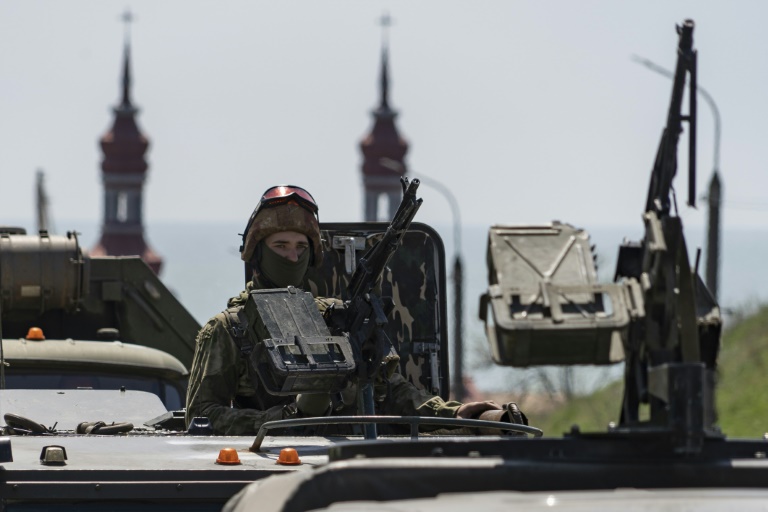
The European Commission proposed a gradual ban on Russian oil imports Wednesday to punish Moscow for its invasion of Ukraine, as Russian forces pounded sites to the east of the country and hit targets in the far west near the EU border.

The EU also pledged to “significantly increase” its support for Moldova, Ukraine’s neighbour that has seen a series of attacks in a Moscow-backed separatist region, sparking fears it could be drawn into the conflict.

European Commission chief Ursula von der Leyen announced the bloc would “phase out Russian supply of crude oil within six months, and refined products by the end of the year”.

If approved, the oil ban would be the EU’s toughest move yet against Russia’s strategic energy sector that helps the Kremlin finance its war, but will still not touch its huge gas exports.

Hungary and Slovakia, both hugely dependent on Russian oil, would be given more time to meet the ban under the proposed plan, which will need unanimous approval before going into effect.

The proposed new sanctions also include moves against Russia’s biggest bank, Sberbank, and the targeting of Patriarch Kirill, the head of the Russian Orthodox Church.

– Solidarity for Moldova –

Western allies continue to provide Kyiv with cash and weapons in a bid to force Russian President Vladimir Putin to pull back, alongside unprecedented sanctions.

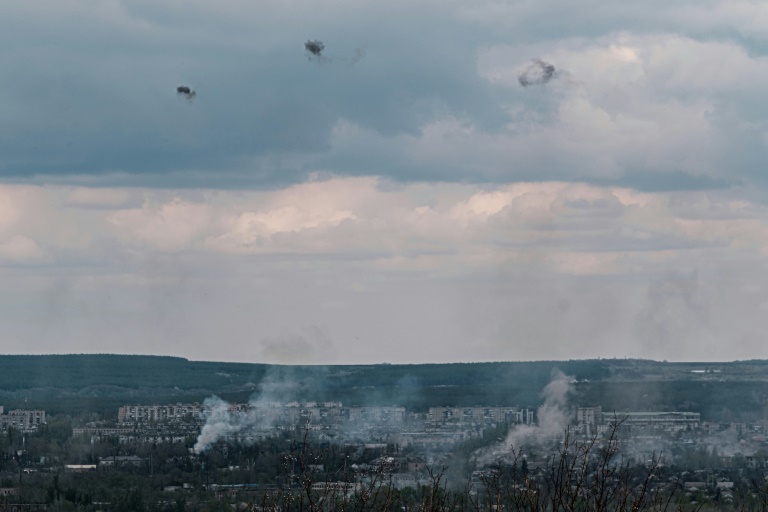
But more than two months after the February 24 invasion, Russian forces continue to batter the south and east, where 21 civilians were killed and 28 wounded in a series of assaults in Donetsk on Tuesday.

Both sides on Wednesday also reported Russian strikes on key transport infrastructure around the western city of Lviv, near Poland, and Transcarpathia, a region bordering Hungary.

In neighbouring Moldova, there are fears the conflict will spill over the border.

Visiting the tiny ex-Soviet republic Wednesday, European Council President Charles Michel offered the EU’s “full solidarity” and support including in the areas of logistics and cyber defence.

“This year we plan to significantly increase our support to Moldova by providing its armed forces with additional military equipment,” he told a press conference with President Maia Sandu.

Ukraine has accused Russia of wanting to destabilise Moldova’s separatist region of Transnistria to create a pretext for a military intervention.

– ‘No storming’ of Azovstal –

The war in Ukraine has killed thousands of people and displaced more than 13 million, creating the worst refugee crisis in Europe since World War II.

There was some rare good news on Tuesday with the arrival in the Ukrainian-held city of Zaporizhzhia of more than 150 civilians evacuated from the devastated southern port city of Mariupol.

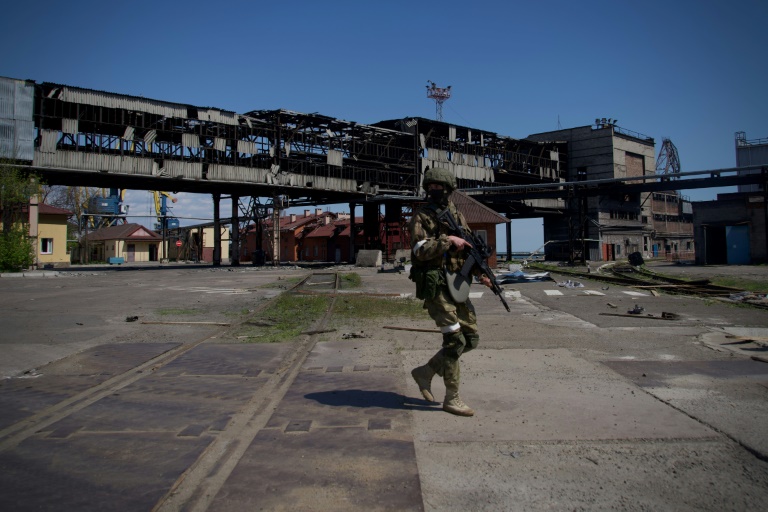
Further evacuations from the city, now almost entirely under Russian control after two months of siege, were to take place Wednesday with the help of the United Nations and the Red Cross, a Mariupol mayoral adviser said.

Osnat Lubrani, UN humanitarian coordinator for Ukraine, had earlier said that 101 of the civilians had been evacuated from the immense underground galleries of the Azovstal steelworks, but more could be trapped.

The Russian army said Tuesday that its forces and pro-Moscow separatists were attacking “firing positions” in Azovstal where Ukrainian fighters are making their last stand.

But Kremlin spokesman Dmitry Peskov on Wednesday denied Ukrainian claims that it had launched a “powerful assault”, telling reporters: “There is no storming.”

“The order was publicly given by the supreme commander-in-chief to cancel the assault,” he said, referring to an order given by Putin last month not to pursue an attack on the area.

– Bombing every second –

Azovstal evacuees who emerged from a caravan of white buses in Zaporizhzhia were met at a makeshift reception centre by crying loved ones and dozens of journalists.

“We are so thankful for everyone who helped us. There was a moment we lost hope, we thought everyone forgot about us,” evacuee Anna Zaitseva said, holding her six-month-old baby in her arms.

Elyna Tsybulchenko, 54, who worked at the site doing quality control before the war trapped her there, described days and nights of endless barrages.

“They bombed like every second… everything was shaking. Dogs barked and children screamed,” she told AFP. “But the hardest moment was when we were told our bunker would not survive a direct hit.”

– ‘No safe place’ –

Since abandoning early attempts to capture Ukraine’s capital Kyiv, Russian forces have shifted to the east, including largely Russian-speaking areas, and the south.

Ukraine’s general staff said Wednesday the Russian assault continued with the aim of establishing “full control” of the regions of Lugansk and Donetsk, and to maintain a land corridor to occupied Crimea.

Russia’s defence ministry said Wednesday that its air- and sea-based weapons had destroyed six electrical substations near railways including around Lviv, near Odessa to the south, and near Dnipropetrovsk to the south-east.

It said Ukrainian troops in the eastern Donbas region had used the railway stations to transport weapons and ammunition from the EU and United States.

Meanwhile in the eastern Lugansk region, governor Sergiy Gaiday said two people had died in the last 24 hours, and “the whole region is under fire completely, there is no safe place”.

– Battle for democracy –

US President Joe Biden on Tuesday framed the war as a historic battle for democracy in a speech to workers at a factory producing Javelin missiles, which have wreaked havoc on Russian tanks.

Reprising one of his presidency’s core themes, Biden said the fight by democratic Ukraine against Putin’s Russia was a front in a wider contest between democracies and autocracies worldwide, including China.

Chinese leader Xi Jinping had told him that democracies can no longer “keep up,” Biden said.

Ukraine is the “first” battle “to determine whether that’s going to happen,” he said.

Elsewhere, diplomats said Russia will boycott a UN Security Council meeting Wednesday with the EU’s Political and Security Committee (PSC), a further sign of deteriorating relations between Moscow and its United Nations partners.

burs-ar/spm

Inflation prompts surprise India interest rate hike

India’s central bank announced a surprise interest rate hike on Wednesday, as Asia’s third-biggest economy reels from galloping inflation in the wake of the Ukraine war.

The announcement came hours before the US Federal Reserve was expected to undertake its largest rate hike in two decades in response to accelerating inflation in the world’s biggest economy.

This could spark capital outflows from emerging markets such as India.

In its first increase in borrowing costs since August 2018, the Reserve Bank of India increased the policy repo rate by 40 basis points to 4.40 per cent with immediate effect.

“As several storms hit together, our actions today are important steps to steady the ship,” RBI governor Shaktikanta Das said in a televised address.

“Most alarmingly, persistent and spreading inflationary pressures are becoming more acute with every passing day.”

Das added that shortages of edible oils due to the conflict in Europe and export bans by key producers — Indonesia imposed a complete ban on palm oil exports last week — were causing food prices in India to shoot up.

The Indian economy bounced back strongly from the coronavirus pandemic with one of the world’s fastest growth rates, but in common with other developing economies is now grappling with rising costs as global commodity prices skyrocket.

India is the world’s largest importer of edible oils including palm oil and soya oil, which are trading at record highs.

The country of 1.4 billion people also imports more than 80 percent of its crude oil needs, with its dependence growing as domestic production falls.

Consumer inflation has consistently overshot the RBI’s two-to-six percent target range in the first three months of the year, hitting a 17-month high of 6.95 percent in March.

Economists expect inflation crossed seven percent in April.

The rate hike is “very well timed, as our own CPI inflation projection for April 2022 is an eye-watering 7.4 percent,” ICRA chief economist Aditi Nayar said.

“By advancing the rate decision by approximately one month, the MPC has focused on preventing inflationary expectations from unanchoring in an increasingly uncertain environment.”

The central bank’s next scheduled meeting to set interest rates wasn’t until June 8.

Last month, all six members of the RBI’s monetary policy committee voted to hold the key rate unchanged at a historic low of four percent for the 11th straight meeting.

But in its first clear signal of a future rate hike, Das had said the bank was “focusing on withdrawal of accommodation to ensure that inflation remains within the target going forward, while supporting growth”.

It had also lowered its growth forecast to 7.2 percent for the 2022-23 financial year, from 7.8 percent projected earlier.

It had raised its inflation forecast to 5.7 percent for the fiscal year that started April 1, up from 4.5 percent estimated in February.

Indian stocks fell to a two-month low after the announcement, with the benchmark Sensex closing 2.29 percent lower. Bond yields rose sharply.

EU targets Russian oil, Patriarch in new sanctions

The European Union’s executive unveiled Wednesday plans for a gradual ban on Russian oil imports as part of a raft of new sanctions to punish Moscow for invading Ukraine.

The proposed measures include moves against Russia’s biggest bank and the targeting of Patriarch Kirill, the head of the Russian Orthodox Church.

If approved, the oil ban would be the EU’s toughest move yet against Russia’s strategic energy sector that helps the Kremlin finance its war, but will still not touch its huge gas exports.

The embargo is part of the bloc’s sixth sanction package, and would be phased-in over the rest of the year to help countries adapt.

The EU is the biggest consumer of Russia’s crude oil. Last year Russia supplied the bloc’s 27 members with 30 percent of their crude and 15 percent of their petroleum products.

“We now propose a ban on Russian oil. This will be a complete import ban on all Russian oil, seaborne and pipeline, crude and refined,” European Commission chief Ursula von der Leyen told a session of the European Parliament in Strasbourg.

But, she added, “we will make sure that we phase out Russian oil in an orderly fashion”, with crude banned gradually over the next six months and refined fuels by the end of the year. 

Ambassadors from the 27 European Union countries met on Wednesday to assess her plan, and it will need unanimous approval before going into effect.

The proposal also asked that Hungary and Slovakia, both hugely dependent on Russian oil, be given an extra year to meet the ban, a document seen by AFP showed. 

In a statement sent to AFP, Hungary said it saw no guarantee for its energy security in the proposed ban.

Asked if this meant Hungary outrightly rejected the EU’s proposal, the government press office did not immediately answer.

– ‘War supporter’ –

Von der Leyen also said her proposal would deny Sberbank, Russia’s biggest bank, access to SWIFT, the global banking communications system.

By hitting Sberbank and two other banks, “we hit banks that are systemically critical to the Russian financial system and Putin’s ability to wage destruction,” she said.

Her proposal also singled out Patriarch Kirill, calling him “a long-time ally of President Vladimir Putin who has become one of the most prominent supporters” of the war.

The new list mainly includes Russian military personnel, but also the wife, daughter and son of Kremlin spokesman Dmitry Peskov.

Von der Leyen said the high-ranking military officers included those “who committed war crimes in Bucha and who are responsible for the inhuman siege of the city of Mariupol”.

“This sends another important signal to all perpetrators of the Kremlin’s war: We know who you are, and you will be held accountable,” von der Leyen said.

The EU also proposed banning more Russian broadcasters from the airwaves in Europe. 

The bloc already banned media outlets RT and Sputnik in March and pressured tech giants to remove them from their platforms.

In east Ukraine, the war-weary listen out to stay alive

After hearing the shells raining down around her for weeks, 58-year-old Ludymyla is still learning to differentiate between the sounds of the explosions ripping apart towns in war-scarred Donbas.

“It starts with a whistle and then everything shakes. It’s a hail of bombs,” the care worker who declined to give her last name tells AFP during a run for groceries in Lyman, a village in the crossfire.

“Do you hear it, too? We’ve been hearing this sound for an eternity,” she says.

For residents of Donbas who, like Ludymyla, have dismissed official calls to flee, and Ukrainian soldiers holding the line, interpreting the omnipresent sounds of war has become key to staying alive.

They are learning to game-out loud duels between Russian and Ukrainian artillery, the buzzing of drones overhead, and slow wailing of sirens to gauge threat levels.

Ludymyla says she hasn’t learned to tell yet whether the shelling she hears is “plus” or “minus” — war jargon in Donbas for outgoing shelling by Ukraine’s army, or incoming bombardments from Russian forces and their proxies.

“I’m not an expert. I leave that to the guys,” she says, referring to Ukrainian soldiers, before taking off on her bike.

Plus or minus? Since 2014, when fighting erupted between Ukrainian forces and Kremlin-backed separatists, that is the first question asked when shooting starts. 

Twenty-two-year-old Ukrainian solider, Denis, has been holed up in a trench in Barvinkove on the eastern frontline long enough to know exactly which is which.

– ‘First a whistle, then explosions’ –

“You know when it’s plus because it’s louder the closer it is. First it’s a whistle and then explosions. It’s one per shot and you can count them,” he told AFP.

“When it’s minus — on us — there’s a high-pitched sound, loud and clear. It just goes ‘boom'”.

The war in Donbas is primarily a duel between Russian and Ukrainian artillery tens of kilometres apart.

This tit-for-tat starts with a muffled detonation that sends a vibration through the body, then there is a hissing noise from the sky, and finally the explosion as shells land.

They are Grad rockets that are launched by the dozen and shroud Ukrainian military positions and villages in a terrifying and deadly shroud of explosions.

“The Grad goes ‘vziou, vziou, vziou,'” says Denis. “Rockets in general — it’s a very high-pitched noise”.

And these are sounds that can echo and reverberate dozens of kilometres across grassy plains in eastern Ukraine, particularly when these heavy weapons fire off barrages.

Ukrainian soldiers on the frontline said listening out for those barrages — and knowing and when they are close — is especially important at night, when soldiers on lookout are mostly listening out.

“It takes a long time to get good at figuring out the threat level. You have to listen constantly,” says a Ukraine sergeant who goes by the name of Viking.

– War ’embedded in our bodies’ –

“Like, with bombers, you have to know how to identify them while they’re still at a distance, before they strike. It’s an apprenticeship in itself,” he says in a trench on the outskirts of Lyman.

And while Russian or Ukrainian Sukhoi fighter jets do not regularly fly over Donbas, the buzz of drones is a more frequent feature on the frontline — one that sends troops immediately taking cover.

The rat-a-tat-tat of small arms that so dominated fighting between separatists and the Ukrainian army after 2014 is almost non-existent now, replaced with bigger guns for bigger goals.

Throughout Ukraine — not only in the eastern frontline regions — the slow wail of air-raid sirens warning of imminent strikes is another sound the country is adjusting to day and night.

Since the first week of the war, that piercing shrill has been accompanied by the pings of push notifications issuing the same warning on phones.

But in east Ukraine, where authorities for weeks have been urging residents to flee, the few who remain hardly heed the warning wail.

Some town and cities have even lowered the volume of the sirens to spare local the ear-splitting shrill.

That is not the case in Sloviansk, an urban hub in east Ukraine and key prize for invading Russian troops, where sirens emit a high-pitched scream more likely to push out residents than the attack it is warning against.

Outside Lyman, which is expected to fall imminently to Russian troops, 59-year-old farmer Anna Sysouyouk tells AFP that these sounds of war have been “embedded in our bodies since 2014.”

“Our grandchildren are born into them. But you never get used to these sounds and you shouldn’t get used to them,” she said.

War in Ukraine: Latest developments

Here are the latest developments in the war in Ukraine:

– New EU sanctions, oil ban take shape –

EU chief Ursula von der Leyen says the bloc will impose a gradual Russian oil ban, as part of new sanctions to punish Russia for invading Ukraine.

“We will phase out Russian supply of crude oil within six months and refined products by the end of the year,” she tells the European Parliament.

In a document seen by AFP, von der Leyen’s proposal asks that Hungary and Slovakia, both hugely dependent on Russian oil, be given more time to meet the ban. 

The EU executive also proposes sanctioning the head of the Russian Orthodox Church, Patriarch Kirill, and excluding Russian bank Sberbank from the SWIFT network.

– Attack on Azovstal –

Russian forces launch a “powerful assault” on the Azovstal plant in Mariupol, Ukraine’s army says. The Kremlin says its forces, along with pro-Moscow Ukrainian separatists, are using artillery and planes to target the site.

– A deadly day – 

In one of a series of assaults in Ukraine’s east, 21 civilians are killed and another 28 wounded in the Donetsk region Tuesday, local authorities say.

Ten of the 21 dead are killed in the shelling of the Avdiivka coke plant, according to regional governor Pavlo Kyrylenko, who says the daily death toll is the highest since a Russian strike on a train station in Kramatorsk about a month ago.

– Evacuees reach Zaporizhzhia – 

Further evacuations from the  long-besieged port city of Mariupol are expected Wednesday, a day after 156 people arrived in (the Ukrainian-held city of) Zaporizhzhia.

– Strikes in west –

A rocket strike knocks out power in part of Lviv, the western city near Poland that has turned into a haven for the displaced due to its comparative calm, mayor Andriy Sadovy says on Twitter. 

Missiles also strike far to the country’s west in Transcarpathia, a region bordering Hungary that has largely been spared to date, says Victor Mykyta, head of the local military administration. 

– Belarus launches surprise manoeuvres –

Belarus, a Moscow ally that shares a border with Ukraine, launches “surprise” military manoeuvres, to test the reactive capacity of its army, its defence ministry says. 

Belarus military units were testing their capacity to “go on the alert, move to predetermined zones and undertake combat training,” it says. 

– Russia accuses Israeli ‘mercenaries’ –

A spokeswoman for Russia’s foreign ministry claims Israeli mercenaries are fighting “shoulder to shoulder” with the far-right Azov Regiment in Ukraine.

Azov rose to prominence in 2014, when its far-right activists took up arms to fight pro-Russian separatists in Ukraine’s eastern Donbas region, but have since fallen under the command of Ukraine’s military.

The comments by Maria Zakharova further fuel tensions with Israel after Russia suggested Adolf Hitler had “Jewish blood”.

– EU to support Moldova –

European Council President Charles Michel pledges to increase EU military aid to Moldova, Ukraine’s neighbour that has seen a series of attacks in a pro-Moscow separatist region.

“This year we plan to significantly increase our support to Moldova by providing its armed forces with additional military equipment,” Michel tells a press conference with Moldova’s President Maia Sandu during a visit to the country.

– Russia to boycott UN meet –

In a rare move, Russia will boycott a UN Security Council meeting Wednesday with the EU’s Political and Security Committee (PSC), diplomats say, a further sign of deteriorating relations between Moscow and its United Nations partners.

burs/jmy/spm

Ukrainian supporters rally behind embattled Azov regiment

Valentyna Ocheretna has waited in vain for weeks for a call from her son Sasha. In March, he was wounded in battle against Russian troops in the strategic city of Mariupol. Since then, there’s been silence.

For eight years, Sasha has fought with Ukraine’s Azov regiment — a far-right volunteer battalion turned Ukrainian national guard unit renowned for the mettle of its fighters and links to extremists.

“He chose to defend his country. And no one can fault him for doing so,” Ocheretna told AFP in the Ukrainian capital.

The regiment has long been fodder for Russian President Vladimir Putin during his lengthy rants against Kyiv and repeated vows to rid Ukraine of Nazis.

But in Ukraine, the Azov regiment has largely enjoyed a solid reputation and been showered with praise for its years-long commitment to fight Russian incursions into the country.

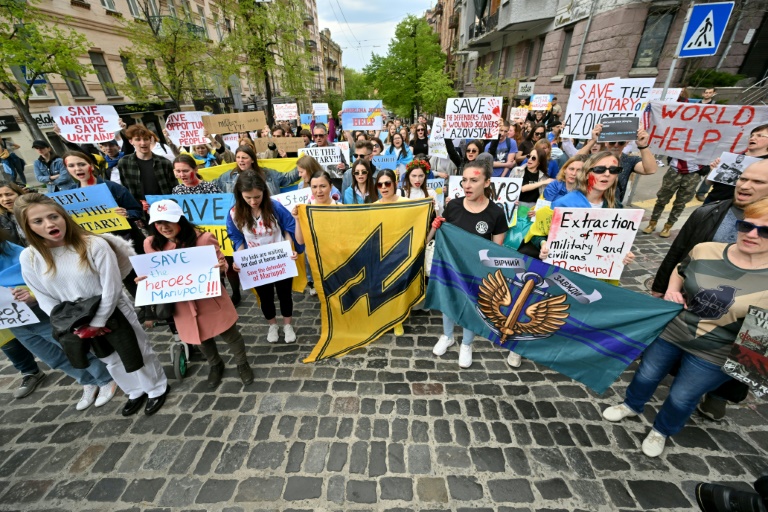
This week, demonstrators gathered in Kyiv to rally public support for Azov and their fellow defenders of Mariupol, as the Russians launched another withering assault on a sprawling steel plant where Ukrainian forces in the southern city are taking a final stand.

Many of the participants had family and friends in the Azov Regiment, with some brandishing its yellow and blue flag featuring the infamous “Wolfsangel” logo that draws a striking similarity to insignia used by German Nazi SS units in World War II.

But despite criticism mostly from abroad of the regiment, Azov’s backers in Ukraine insist that their forces are fighting fascists, not supporting them.

“If they had radical beliefs, they would have been pushed out of the army. I don’t see any far-right radicalism or extremism in them,” said Taras Tokovyi, a 32-year-old entrepreneur in Kyiv.

“They are simply Ukrainian heroes,” he added. 

Mariupol resident Svitlana Mitroshchenko agreed, citing the vital support — including food and supplies — Azov fighters provided to civilians in the war-torn port city following the Russian invasion.

– ‘Get out alive’ –

“If not for these Azov guys, this would probably have been another Bucha,” said Mitroshchenko, 47, fighting back tears as she referred to the Kyiv suburb where Ukraine and the West have accused Moscow’s forces of killing civilians.

“It’s the Russians who should really be called Nazis,” she added.

Azov rose to prominence when it took up arms to beat back pro-Russian separatists in the Donbas in 2014, when Ukraine was in disarray following Moscow’s lightning capture and later annexation of the Crimean peninsula.

Its founding members embraced a host of neo-Nazi symbols while maintaining links to a network of far-right movements before watering down its hard-line ideology and falling under the command of the Ukrainian military.

“The Azov Regiment is part of the national guard of Ukraine, it is not an independent paramilitary unit anymore. The connection with right-wing, radical politicians remains in history,” said Volodymyr Fesenko, a Kyiv-based political analyst.

Since Russia invaded Ukraine in February, Azov’s defence of Mariupol — where their fighters and Ukrainian military units remain outgunned and outnumbered by Russian forces — has only crystalised their popularity, giving them a status reserved for the bravest of the brave.

“They have big hearts for standing up in such a difficult situation,” said Khrystyna Shemchuk, 21.

“Only a person with a big heart can stay there and fight in such conditions — probably staying there to die.”

But for 51-year-old Svitlana Prypyshna whose son is an Azov soldier based in Mariupol, the survival of the regiment’s remaining forces is what matters most.

“My heart is breaking apart. My soul is crying out. But I cannot do anything about it,” said Prypyshna.

“Of course, I feel proud, but I hope they get out alive.”

North Korea fires ballistic missile in latest show of force

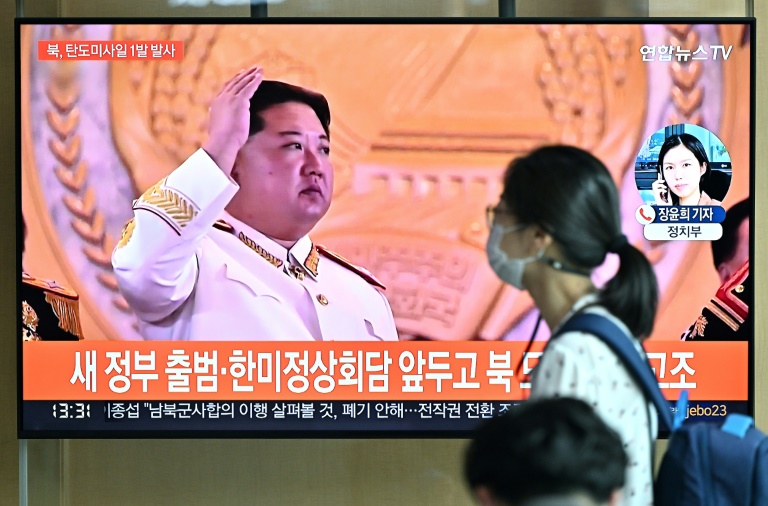
North Korea fired a ballistic missile Wednesday, Seoul said, a week after Kim Jong Un vowed to boost Pyongyang’s nuclear arsenal and just days before the South inaugurates a new, hawkish president.

Pyongyang has conducted 14 weapons tests since January, including firing an intercontinental ballistic missile at full-range for the first time since 2017.

Last week Kim oversaw a huge military parade, vowed to rapidly expand and improve his nuclear arsenal, and warned of possible “pre-emptive” strikes — as satellite imagery indicates he may soon resume nuclear testing.

The Wednesday test comes days before the May 10 inauguration of South Korea’s President-elect Yoon Suk-yeol, who has vowed to take a hard line with North Korea and ramp-up security cooperation with the US after years of failed diplomacy.

North Korea fired the ballistic missile at 12:03 pm (0303 GMT), Seoul’s Joint Chiefs of Staff said, likely from the Sunan Airfield near Pyongyang, the site of previous recent ICBM tests.

The missile flew 470 km (300 miles) and reached an altitude of 780 km, the JCS said, adding it was a “blatant violation of UN Security Council resolutions.”

Japan’s state minister of defence Makoto Oniki confirmed the launch and the missile’s trajectory, saying it had landed “outside of Japan’s exclusive economic zone.”

North Korea’s “repeated launches of ballistic missiles threaten peace and safety of our nation, the region, and the international community,” he added.

Seoul’s national security council said it “strongly” condemned the launch, urging the North to “cease actions that pose a serious threat to the Korean Peninsula” and to return to dialogue. 

Since high-level diplomacy with then-US president Donald Trump collapsed, North Korea has doubled-down on Kim’s plans for military modernisation, seemingly impervious to threats of more sanctions as it ignores the United States’ offers of talks.

– More nukes? –

Kim Jong Un said at last week’s military parade that he would take measures to develop “the nuclear forces of our state at the fastest possible speed”, according to footage of his speech broadcast on state media.

Repeated negotiations aimed at convincing Kim to give up his nuclear weapons have come to nothing.

“There is a good chance that they test-fired a missile that can be equipped with a nuclear warhead,” Ahn Chan-il, a North Korean studies scholar, told AFP Wednesday.

Kim also warned that he could “pre-emptively” use his nuclear force to counter so-called hostile forces at a meeting with top military brass last week.

Analysts said Kim’s messaging on his nuclear weapons, plus the recent test, could be seen as a signal to President-elect Yoon, who has threatened a pre-emptive strike on Pyongyang.

“It could be a warning message to… Yoon,” said Hong Min of the Korea Institute for National Unification.

Yoon has suggested he is only willing to talk about peace if North Korea confirms it is willing to denuclearise — something Pyongyang will never accept, Hong said.

“It could also signal Pyongyang’s stance that it has no choice but to further enhance its arsenal if Seoul and Washington decided to deploy strategic military assets to the South,” he added.

– Seoul’s hard line –

For five years under President Moon Jae-in, Seoul has pursued a policy of engagement with Pyongyang, brokering high-level summits between Kim and Trump while reducing joint US military drills the North sees as provocative.

But for President-elect Yoon this “subservient” approach has been a manifest failure. 

He said on the campaign trail he would like more US missile defences — and even tactical nuclear weapons — deployed in South Korea, and has vowed to ramp up joint military exercises, which infuriate Pyongyang. 

US President Joe Biden is due to visit South Korea later this month to meet with Yoon.

Other analysts said that North Korea’s testing blitz could be aimed at taking advantage of gridlock at the United Nations following Russia’s invasion of Ukraine.

It is “virtually impossible” for the Security Council to sanction North Korea — which has supported Russia’s attack on Ukraine — due to Moscow’s veto power, said Cheong Seong-chang of the Center for North Korea Studies at the Sejong Institute.

“The North therefore will try to test as many missiles as possible that it has not been able to do so far, enabling it to enhance capabilities of its arsenal at a fast pace.”

Social media threatening press freedom: Nobel laureate

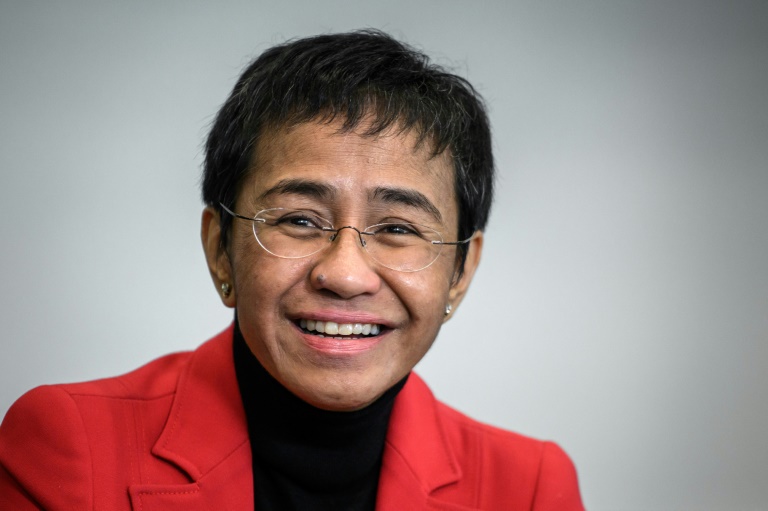
The rise of social media has allowed dangerous propaganda to flourish and left professional journalists facing constant threat of attack, according to Philippine journalist and Nobel Peace Prize laureate, Maria Ressa.

The situation for media workers around the world at the moment is “bleak”, Ressa told AFP in an interview, saying much of the blame lies with the dramatic shift in the way information is distributed.

Speaking on the sidelines of an event in Geneva on Tuesday to mark World Press Freedom Day, the 58-year-old co-founder of the news website Rappler highlighted how social media had made it far easier to spread propaganda, reject facts and change historical realities.

She pointed to the Philippines, which appears set next week to hand the presidency to Ferdinand Marcos Jr, whose dictator father and namesake presided over massive plunder and human rights abuses in the country.

“He looks set to win, and the only way that is possible is because history shifted in front of our eyes,” Ressa said.

Marcos Jr’s links to his father have made him one of the nation’s most polarising politicians.

But he has benefitted from a deluge of fake and misleading posts on social media platforms targeting a largely young electorate with no memory of the corruption, killings and other abuses committed during the elder Marcos’s 20-year rule. 

– Separate realities –

Ressa pointed at how Marcos Jr has refused to participate in debates and to answer questions from traditional journalists, seeming to follow the playbook of populist politicians like Brazilian President Jair Bolsonaro.

“This is the problem with social media: It has allowed propaganda to flourish and literally has allowed public figures like Marcos, like Bolsonaro to ignore (media) checks and balances… and to create their own realities,” Ressa said.

“That’s not a good thing.”

In the face of such challenges, “the mission of journalism is more important today than ever,” Ressa said.

She says social media first enabled split global narratives around Russia’s annexation of Crimea back in 2014.

That dangerous fragmenting of media narratives has obviously worsened dramatically since Russia’s invasion of Ukraine in February, bringing with it fears of looming nuclear attacks and World War III.

In such an environment, access to reliable facts is vital, Ressa said.

“I think this is one of those moments where everything that (journalists) do will matter, because that’s… how close we are to the edge.” 

– ‘No guardrails’ –

The dramatic technological shift in the industry has meanwhile left journalists far more vulnerable to attacks and threats.

“There are no guardrails,” Ressa said, pointing to the largely lawless world of social media, often based on algorithms that promote the outrage and hateful debate that drive traffic, and where “troll armies” can easily be unleashed on critics.

“Every time you do a difficult story to try to hold power to account, you have to be ready to get personally attacked.” 

Ressa, who shared the 2021 Nobel Peace Prize with Russian journalist Dmitri Muratov, has seen her share of threats, attacks and intimidation.

The vocal critic of Philippines President Rodrigo Duterte and his deadly drug wars faces multiple criminal lawsuits, which she says could see her sent to prison for 100 years.

Ressa sees the Nobel win as “vindication”, voicing “relief” that the Nobel Committee had recognised how difficult journalists’ jobs have become and that “risks have increased.”

The win did not, however, lessen her legal woes, she said, adding that the legal complaints against her and Rappler had in fact “accelerated”.

Ressa said it was unfair that the journalists were being “asked to sacrifice so much”, urging governments and the global community to step up and regulate the technologies that have transformed our information society.

“Guardrails have to be put in place so we can do our jobs.”

Until then, journalists “have no choice” but to continue holding the line as best they can in defence of democracy, Ressa said.

“We’re just putting our finger in the dam and hoping that the rest of society kicks in.”

Asian markets drop ahead of key Fed rate decision

Equities fell in Asian trade Wednesday as traders nervously awaited what is expected to be the biggest Federal Reserve interest rate hike in more than two decades.

With inflation showing little sign of easing from its 40-year highs, the US central bank has set itself on a hawkish course of tightening this year, sending shivers through world markets.

The prospect of higher borrowing costs has been compounded by a range of crises including the war in Ukraine, elevated oil prices and China’s Covid lockdowns that have strangled crucial global supply chains.

The Fed now has to walk a fine line between getting control of surging prices and making sure it does not knock the recovery in the world’s top economy off course.

“The Fed remains very focused on bringing inflation down, however, any further hawkish pivots will likely be tempered to some extent by the desire to achieve a soft landing,” said Blerina Uruci at T. Rowe Price.

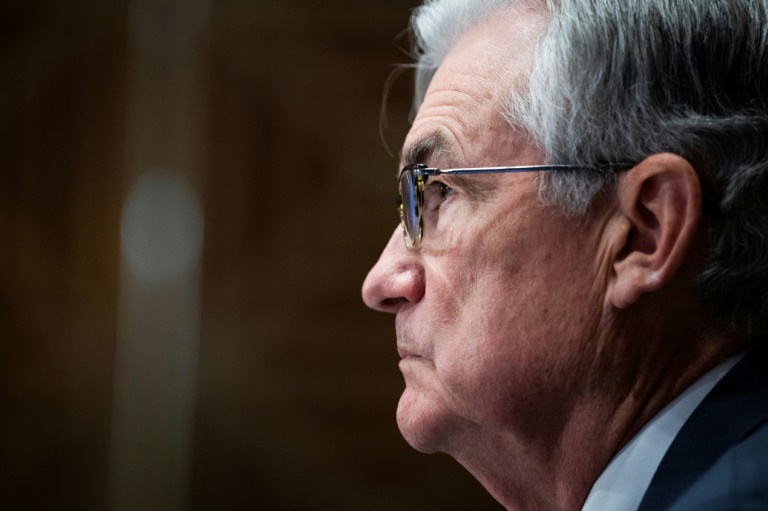
The Fed is expected to announce a half-percentage point lift Wednesday — its biggest since 2000 — but boss Jerome Powell’s post-meeting news conference will be closely watched for an idea about future hikes.

Speculation was swirling that 75 basis points could be on the table at some point this year.

“Powell will fall back to ‘we are not on pre-set rate hikes’ or something along those lines — ‘we go in with an open mind each meeting and will talk it over and we’ll see where we go from there’,” said Tony Farren, managing director at Mischler Financial Group.

“The market would take that as hawkish. For his comments to seem dovish, he’d have to shut down the talk of 75 basis points. And while I don’t think he’ll endorse it, I don’t think he’ll shut it down.”

– Russian oil ban –

After a broadly positive lead from Wall Street, Asian markets struggled in holiday-thinned trade.

Hong Kong, Sydney, Seoul, Mumbai and Singapore slipped, but Taipei and Manila rose while Wellington was flat.

Tokyo, Shanghai, Jakarta, Kuala Lumpur and Bangkok were closed.

London, Paris and Frankfurt fell in early exchanges.

Oil prices rose after European Commission president Ursula von der Leyen on Wednesday said the European Union would impose a gradual Russian oil ban in retaliation for the war in Ukraine.

The news offset the expected hit to demand from China’s coronavirus lockdowns, including in the country’s biggest city, Shanghai.

A huge release of crude from reserves by dozens of countries including the United States has also helped keep prices tempered.

Investors are waiting for a meeting Thursday of OPEC and other major producers including Russia, where they will discuss whether or not to lift output more than expected.

– Key figures at around 0810 GMT –

Hong Kong – Hang Seng Index: DOWN 1.1 percent at 20,869.52 (close)

London – FTSE 100: DOWN 0.3 percent at 7,541.82

Tokyo – Nikkei 225: Closed for a holiday

Shanghai – Composite: Closed for a holiday

Euro/dollar: UP at $1.0524 from $1.0519 on Tuesday

Pound/dollar: UP at $1.2510 from $1.2491

Euro/pound: DOWN at 84.13 pence from 84.17 pence

Dollar/yen: DOWN at 130.09 yen from 130.14 yen

West Texas Intermediate: UP 2.9 percent at $105.37 per barrel

Brent North Sea crude: UP 2.8 percent at $107.89 per barrel

New York – Dow: UP 0.2 percent at 33,128.79 (close)

Close Bitnami banner
Bitnami