World

Delhi driver grows garden on autorickshaw roof to beat the heat

Yellow and green autorickshaws are ubiquitous on New Delhi’s roads but Mahendra Kumar’s vehicle stands out — it has a garden on its roof aimed at keeping passengers cool during the searing summer season.

Kumar says the thick patch of green keeps the vehicle cool even when temperatures are touching 45 degrees Celsius (113 Fahrenheit) in the Indian capital, enough to melt the tar on roads.

Kumar, 48, has grown over 20 varieties of shrubs, crops and flowers, attracting commuters and passers-by who stop to click selfies and photos of the unique “moving garden”.

“Around two years ago I had this idea during the peak of the summer season. I thought if I can grow some plants on the roof, it will keep my auto cool and give relief from the heat to my passengers,” Kumar told AFP.

Kumar also installed two mini coolers and fans inside.

“It is now like a natural AC (air conditioner). My passengers are so happy after the ride that they don’t mind paying me an extra 10-20 bucks ($0.13-.26),” said the father of three.

Delhi’s 20 million residents have been sweltering in an early summer heatwave that has hit India, from Himachal Pradesh in the north to Odisha in the east.

Temperatures last week crossed 45 degrees Celsius in parts of the Delhi region — several degrees higher than normal.

Forecasters say the heatwave conditions would abate in the next three or four days but warned it would rise again thereafter.

Heatwaves have killed over 6,500 people in India since 2010, and scientists say climate change is making them harsher and more frequent across South Asia.

Kumar said he was doing his “own small bit” for the environment by planting lettuce, tomatoes and millets on his autorickshaw.

Preparing the roof for sowing was simple: Kumar first put a mat followed by a thick sack on which he sprinkled some soil.

He got grass from the roadside and seeds from friends and acquaintances and within days, the seeds sprouted into green shoots.

“It does not require much effort at all. I just water the plants using a bottle twice a day,” he said.

Kumar’s initiative is an inspiration for his fellow drivers who have been asking him for tricks and tips.

Passer-by Naima Jamal was also mighty impressed with Kumar’s clean and green auto that runs on compressed natural gas, which is less polluting than petrol or diesel.

“It’s a great idea,” Jamal, a housewife, told AFP. “Delhi has become a concrete jungle, there is hardly any greenery.

“We need more such autorickshaws on the roads — they are pleasing to the eyes and the soul.”

Russia struggles to turn Black Sea rule into amphibious attack

Russia may rule the Black Sea but any amphibious assault on the Ukrainian coast seems risky while Kyiv’s missiles threaten to destroy Russian ships if they get too close, experts say.

According to British intelligence sources, Russia operates around 20 warships in the Black Sea, where the balance of power is now static since Turkey blocks any access by vessels belonging to a warring party.

“It’s their ‘Mare Nostrum’,” said Captain Eric Lavault, a spokesman for the French navy, a reference to the Latin term meaning “Our Sea” used in ancient Rome to describe the Mediterranean.

The fact that all the other Black Sea countries either already belong to NATO or hope to join the Western alliance has not cowed Russia’s claim to supremacy.

On paper, the recent capture of the coastal Ukrainian city of Mariupol and Russian control of the entire Sea of Azov coastline should underline Russian dominance and allow Moscow’s troops to establish a direct logistics link between its fighters in the Donbas region and the eastern port of Novorossiysk, Lavault said.

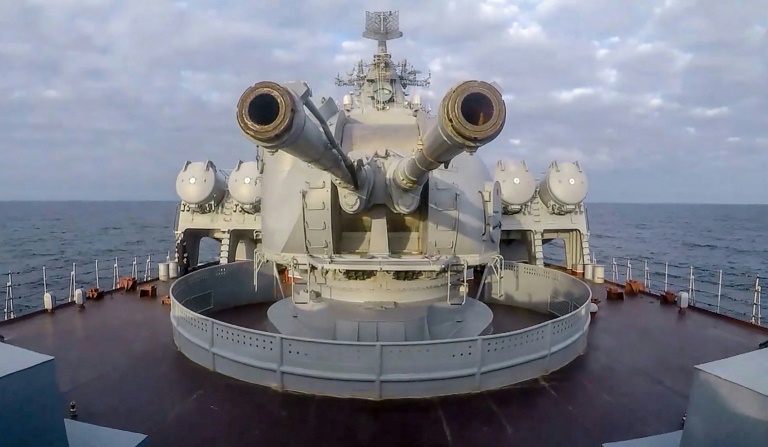
But since the surprise sinking last month of the Russian warship Moskva all bets are off.

The disappearance of the Russian flagship has created great uncertainty for the attackers along what is still a Ukrainian-controlled coastline between Odessa and Romania.

This is not thanks to Kyiv’s navy, which has been destroyed, but to land-based missiles like the Neptune — believed to have delivered the fatal blow to the Moskva — and, soon, the Harpoon that Britain is to deliver to Ukraine.

The impact of the Moskva’s sinking on Russian planning may well prevent any attempt by the Russian navy to land near Odessa with the aim of surrounding the Ukrainian heartland and linking up Russian forces with separatists in the Moldavian Transnistria region.

“That zone presents a threat that the Russians must take into account,” said defence expert Igor Delanoe at the French-Russian Monitor, a political analysis body based in Moscow.

Any such landing is currently “out of reach” for the Russians, said Delanoe.

Russian progress in the Donbas region could open up new options, he said, “but they will have to neutralise the coastal defences,” he cautioned.

– ‘Not Russia’s any more’ –

Russian forces have had great trouble locating and destroying Ukrainian surface-to-air missiles because of their mobility, said Michael Petersen, director of the Russia Maritime Studies Institute and an associate professor at the US Naval War College.

“I suspect that would also be the case for any mobile coastal defense cruise missile system that Ukraine may have,” he said, adding that the exact number of Neptune missiles — which have a range of some 300 kilometres (200 miles) — available to Ukrainian forces was unknown.

Russia’s failure to establish air superiority, and its apparent inability to precision-target missiles, are not helping its efforts to knock out Ukraine’s coastal defences, added French navy spokesman Lavault.

He said this had allowed the defenders to create “a maritime cordon sanitaire” and threaten Russian southern supply lines between Kherson and Nikolayev.

In addition, Ukraine has deployed mines, and is expected to take delivery of naval surface drones promised by the US, although it is not certain that they will be armed.

“More likely, if Ukraine is provided with unmanned systems, they would be used to provide surveillance and reconnaissance for weapon systems,” Petersen said.

British Defence Secretary Ben Wallace meanwhile went as far as contesting Russia’s centuries-old supremacy in the Black Sea altogether.

“The Russians can’t control the Black Sea,” he told Sky News. “It’s not theirs anymore.”

Whatever the outcome of the Ukraine war, Russia will not give up its Black Sea role quietly, experts agreed.

But as other Black Sea countries, notably Romania and Turkey, deploy their own coastal missile systems based on Ukraine’s example, Moscow’s role will become harder to maintain.

“Certainly Russia will be less secure in the Black Sea than they were before the war,” said Petersen.

Markets, oil fall on weak Chinese data

Stock markets and oil prices fell in holiday-thinned trade Monday as traders digested weak Chinese economic data and a looming US interest rate hike.

Equities kicked off the month of May on the wrong foot after Wall Street finished a tough April by closing sharply down on Friday following disappointing results from tech giant Amazon.

Paris and Frankfurt were down in midday trading while London was closed for a bank holiday.

Tokyo, Seoul, Mumbai, Manila and Wellington all fell. Hong Kong and mainland Chinese markets were closed along with several other Asian markets.

Sydney also retreated, though Qantas shares rose after the airline said it would launch the world’s longest non-stop commercial flight between Sydney and London by the end of 2025.

Data at the weekend showed Chinese manufacturing activity shrank last month at its fastest pace since the start of the pandemic as the government applies Covid-19 lockdowns in the country’s biggest cities.

The government’s refusal to shift from its zero-Covid policy and strict containment measures is fanning fears about the world’s number two economy and key driver of global growth.

“There is a bit of mixed sentiment among traders today,” Naeem Aslam, analyst at AvaTrade, told AFP.

“On one hand you have bargain hunters coming to market but then on the other hand traders are concerned about the weakness on the Chinese economic data,” he said.

– Rate hike looms large –

Investors are also looking ahead at the US Federal Reserve’s two-day policy meeting, which starts Tuesday and is expected to see the central bank hike borrowing costs by half a point — the most since 2000.

Some analysts are predicting the Fed could even announce a three-quarter-point increase at some point as it battles more than 40-year-high inflation.

With some commentators warning rates could go as high as three percent, there are also worries the Fed could be too heavy handed and tip the US economy into recession.

Fed boss Jerome Powell “could cement the view that 50 (basis points) is the new 25, but more worrying for stock pickers, there are lots of QE to unwind”, said SPI Asset Management’s Stephen Innes, referring to the quantitative easing bond-buying programme used by the Fed to keep rates low.

“So, the question is, how much of the impact of the balance sheet runoff” has been priced in.

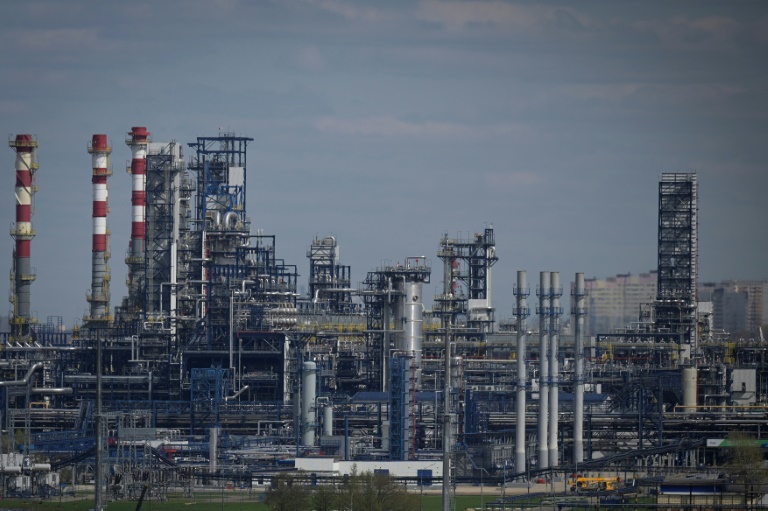
The struggles in China, the world’s biggest crude importer, led to a drop in prices of the commodity on demand concerns, offsetting worries about tighter supply as the EU eyes a ban on Russian oil over its invasion of Ukraine.

Brent North Sea crude, the international benchmark, was down 2.7 percent at $104.30 per barrel.

The European Commission is currently preparing a sanctions text that could be put to the 27 member states as early as Wednesday, sources said, adding that the ban would be introduced over six to eight months to give countries time to diversify their supply.

– Key figures at around 1040 GMT –

Frankfurt – DAX: DOWN 0.6 percent at 14.014.37 points

Paris – CAC 40: DOWN 1.3 percent at 6.448,41 

EURO STOXX 50: DOWN 1.5 percent at 3.746,88

London – FTSE 100: Closed for a holiday

Tokyo – Nikkei 225: DOWN 0.1 percent at 26,818.53 (close)

Hong Kong – Hang Seng Index: Closed for a holiday

Shanghai – Composite: Closed for a holiday

New York – Dow: DOWN 2.8 percent at 32,977.21 (close)

Euro/dollar: DOWN at $1.0528 from $1.0550 on Friday

Pound/dollar: DOWN at $1.2570 from $1.2578

Euro/pound: DOWN at 83.77 pence from 83.86 pence

Dollar/yen: UNCHANGED at 129.89 yen

West Texas Intermediate: DOWN 3.2 percent at $101.39 per barrel

Brent North Sea crude: DOWN 2.7 percent at $104.30 per barrel

Tanker strike worsens fuel woes in crisis-hit Sri Lanka

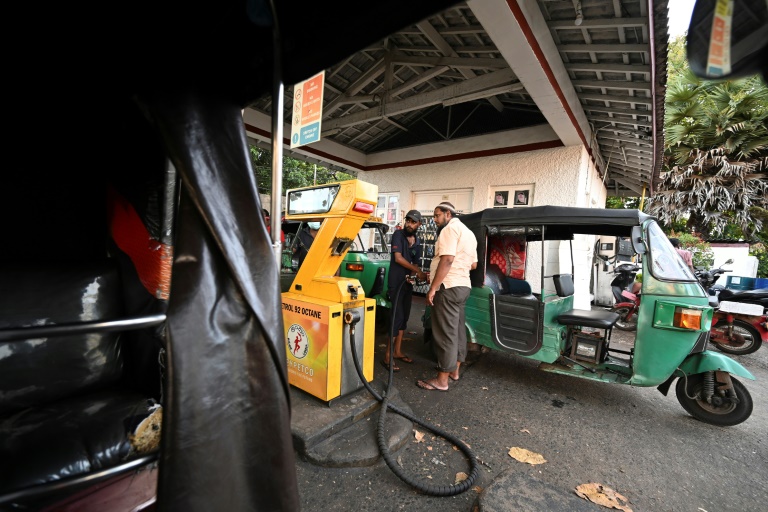
A strike by owners of fuel tankers over the weekend renewed Sri Lanka’s long queues for diesel and petrol on Monday as pumps ran dry, compounding the island nation’s economic and energy crisis.

Sri Lanka is in the grip of a pandemic-spurred economic freefall, the worst since independence from Britain in 1948, which has led to shortages of food and other essentials. 

The lack of fuel has been an especially large sticking point for the government, as petrol prices have increased by 90 percent while diesel — commonly used for public transport — has gone up by 138 percent.

Fuel woes eased slightly last week as supplies arrived under a $500 million credit line from India.

But the salve proved temporary as fuel tanker operators have been on strike since late Saturday, demanding an increase to their prices to ferry the petrol across the country.

Energy minister Kanchana Wijesekera said Monday he needed at least three more days to restore the supplies of petrol and diesel. 

“I appeal to the motorists to bear with us for three more days,” he told reporters in Colombo, adding that the government was trying to hire other mobile container owners not affiliated with the protest.

According to Wijesekera, the union representing tanker operators was demanding a 115 percent increase in fees, outstripping an offer of 95 percent more from state-owned Ceylon Petroleum Corp (CPC).

“We are willing to increase, but not by as much as the tanker operators are demanding,” he said.

“If we give in, the CPC will go bankrupt.”

But the operators say running costs are up due to diesel prices being raised 138 percent, while insurance, spare parts and wages have spiked due to the sharp depreciation of Sri Lanka’s currency.

The rupee has dropped by more than 40 percent against the dollar since March.

Tens of thousands have protested for weeks across the country, with demonstrators also camped daily outside the residence of President Gotabaya Rajapaksa calling for his resignation over alleged corruption and mismanagement of the economy.

Sri Lanka has sought about $3 billion from the International Monetary Fund to overcome the balance-of-payments crisis and boost depleted reserves.

The government has also announced a sovereign default on its huge foreign debt.

Tanker strike worsens fuel woes in crisis-hit Sri Lanka

A strike by owners of fuel tankers over the weekend renewed Sri Lanka’s long queues for diesel and petrol on Monday as pumps ran dry, compounding the island nation’s economic and energy crisis.

Sri Lanka is in the grip of a pandemic-spurred economic freefall, the worst since independence from Britain in 1948, which has led to shortages of food and other essentials. 

The lack of fuel has been an especially large sticking point for the government, as petrol prices have increased by 90 percent while diesel — commonly used for public transport — has gone up by 138 percent.

Fuel woes eased slightly last week as supplies arrived under a $500 million credit line from India.

But the salve proved temporary as fuel tanker operators have been on strike since late Saturday, demanding an increase to their prices to ferry the petrol across the country.

Energy minister Kanchana Wijesekera said Monday he needed at least three more days to restore the supplies of petrol and diesel. 

“I appeal to the motorists to bear with us for three more days,” he told reporters in Colombo, adding that the government was trying to hire other mobile container owners not affiliated with the protest.

According to Wijesekera, the union representing tanker operators was demanding a 115 percent increase in fees, outstripping an offer of 95 percent more from state-owned Ceylon Petroleum Corp (CPC).

“We are willing to increase, but not by as much as the tanker operators are demanding,” he said.

“If we give in, the CPC will go bankrupt.”

But the operators say running costs are up due to diesel prices being raised 138 percent, while insurance, spare parts and wages have spiked due to the sharp depreciation of Sri Lanka’s currency.

The rupee has dropped by more than 40 percent against the dollar since March.

Tens of thousands have protested for weeks across the country, with demonstrators also camped daily outside the residence of President Gotabaya Rajapaksa calling for his resignation over alleged corruption and mismanagement of the economy.

Sri Lanka has sought about $3 billion from the International Monetary Fund to overcome the balance-of-payments crisis and boost depleted reserves.

The government has also announced a sovereign default on its huge foreign debt.

'Operating normally': Russia shows seized Ukraine nuclear plant

Nearly two months after it was seized by Russian forces, there are few signs of the fighting for the Zaporizhzhia nuclear power plant in Ukraine that sparked global fears of a potential atomic disaster.

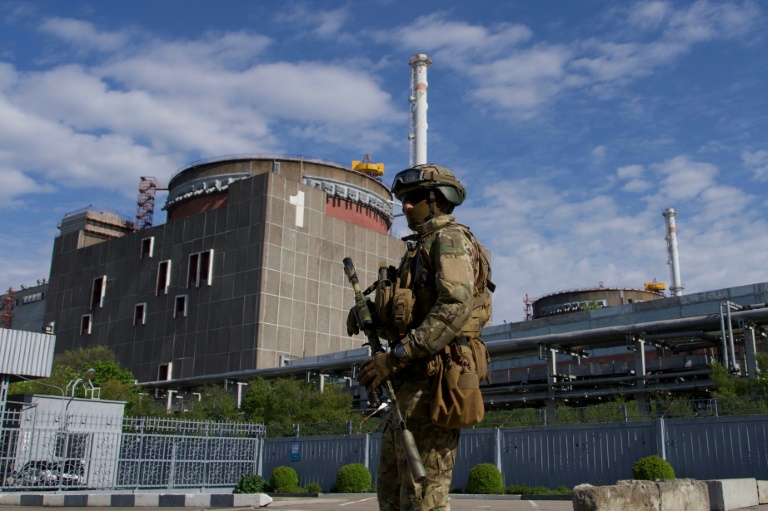
Other than a scorched administrative building, the vast complex in southern Ukraine — Europe’s largest nuclear power plant — appeared largely untouched by the clashes during a visit by AFP this weekend, part of a press tour organised by the Russian military. 

There has been deep international concern over the situation at the plant, which has six of Ukraine’s 15 reactors and can create enough energy for four million homes.

Russian forces seized the site amid fighting in early March that caused a large fire at a training facility at the plant, which sits along the Dnipro river south of the Ukrainian-held city of Zaporizhzhia. 

There was no spike in radiation, but the clashes nonetheless caused deep worries, especially in the country that was the site of the world’s worst nuclear accident at Chernobyl in 1986.

Rafael Grossi, the head of the UN’s nuclear watchdog, the International Atomic Energy Agency, said last week that it was “extremely important” for IAEA monitors to be able to access the site, which was built in the early 1980s but modernised in recent years. 

Russia insists it is taking all necessary precautions at the plant, where its troops now patrol in the shadows of its enormous and heavily reinforced red-domed reactors.

– ‘Everything is good!’ –

“The Zaporizhzhia NPP is operating normally, in compliance with all nuclear, radiation and environmental safety standards,” Valery Vasilyev, a major general with Russia’s Nuclear, Biological and Chemical Protection Troops, told journalists at the site. 

The facade of the training centre that caught fire remains blackened and its windows were blown out, but no other signs of damage at the plant were visible. 

Soldiers on patrol or positioned behind sandbags showed no sign of concern and wore no protective equipment against radiation.

“Everything here is good!” Andrey Shevchik, the new pro-Russian mayor of Energodar, the city of around 50,000 people built in the 1970s to serve local power plants, told journalists at the site.

“Residents and workers of the nuclear power plant are completely safe,” he said.

“All comfortable conditions are being created for them to work, to generate energy, and to keep the nuclear power plant safe.”

Shevchik said the plant was “ready to sell electricity to Europe”, before driving off in a gleaming SUV painted with Russian flags.

He also said residents who had fled were returning to the city, though there was no way to verify the claim.

It is unclear how exactly the plant is now operating, though Ukrainian workers continue to work on site under Russian supervision.

AFP was unable to meet any of the Ukrainian staff at the plant or to speak to residents in Energodar.

Ukraine to evacuate more civilians from besieged Mariupol

Ukrainian authorities planned to evacuate more civilians from Mariupol on Monday, after dozens were finally brought to safety following weeks trapped under heavy fire in a steel complex.

The sprawling Azovstal plant is the last holdout of Ukrainian forces in the strategic southern port city, which has been besieged by Russian forces since they invaded Ukraine on February 24.

The United Nations said Sunday that a “safe passage operation” was taking place at the Azovstal plant, which includes a maze of Soviet-era underground tunnels.

According to Kyiv, roughly 100 civilians have been evacuated from the plant, although Russia’s defence ministry gave a lower figure of 80 civilians, including women and children.

“Those who wished to leave for areas controlled by the Kyiv regime were handed over to UN and ICRC (Red Cross) representatives,” the Russian ministry said.

In a regular address to the nation, Ukrainian President Volodymyr Zelensky said those evacuated were due to arrive in Ukraine-controlled Zaporizhzhia on Monday, with further evacuations planned that day.

“For the first time, there were two days of real ceasefire on this territory. More than 100 civilians have already been evacuated — women and children first of all,” he said.

The head of the Donetsk Regional Military Administration said that Monday’s evacuation was due to begin at 7:00 am local time (0400 GMT).

– Lyman expected to fall –

One Russian news report put the number of civilians still in the plant at more than 500.

Mariupol is an important strategic hub connecting the Russian-held southern and eastern parts of Ukraine and has seen some of the worst of the fighting.

With the Russian siege leaving residents in dire conditions, with little access to food water and medicine, the city has become emblematic of a war that has uprooted more than 13 million people from their homes and killed thousands.

Russian forces continued their push into eastern Ukraine on Sunday, killing eight civilians in rocket attacks in Donetsk and Kharkiv, the regions’ governors said.

Moscow’s army has refocused on the east, notably the Donbas region, which includes Donetsk and Lugansk, after failing to take the capital Kyiv in the first few weeks of the war. 

Lyman, a former railway hub known as the “red town” for its redbrick industrial buildings, is expected to be one of the next places to fall after Ukrainian forces withdrew.

Russian forces appeared to have made notable advances around the town, advancing on their positions by several kilometres, an AFP team in the area said Sunday.

Russia has moved to solidify its grip on areas it controls and from Sunday introduced the Russian ruble in the region of Kherson — initially to be used alongside the Ukrainian hryvnia.

– ‘Relentless fear’ –

“Beginning May 1, we will move to the ruble zone,” Kirill Stremousov, a civilian and military administrator of Kherson, was cited as saying by Russia’s state news agency RIA Novosti.

He said the hryvnia could be used during a four-month period, but then “we will completely switch to settlements in rubles”.

On the frontline in the east, Russian troops — helped by massive use of artillery — have advanced slowly but steadily.

But Ukrainian forces have also recaptured some territory in recent days, including the village of Ruska Lozova, which evacuees said had been occupied for two months.

“It was two months of terrible fear. Nothing else, a terrible and relentless fear,” Natalia, a 28-year-old evacuee from Ruska Lozova, told AFP after reaching Kharkiv.

Kyiv has admitted that Russian forces have captured a string of villages in the Donbas region and has asked Western powers to deliver more heavy weapons to bolster its defences there.

“Everyone understands that we must guard the line here,” Lieutenant Yevgen Samoylov of the 81st Brigade told AFP as his unit rotated away from the front line near the town of Sviatogirsk.

“We cannot let the enemy move closer. We try to hold it with all our force.”

Kyiv said Monday that its drones had sunk two Russian patrol boats near the Black Sea’s Snake Island, which became a symbol of Ukrainian resistance after soldiers there rebuffed Russian demands to surrender.

“The Bayraktars are working,” said Valeriy Zaluzhnyi, the commander in chief of the Ukrainian Armed Forces, in a defence ministry statement, referring to Turkish-made military drones.

– Further EU sanctions –

Western powers have sought to up the pressure on Russia as its onslaught on Ukraine drags on, with sources telling AFP Sunday that the European Union will propose a phased-out ban on Russian oil imports as part of its fresh round of sanctions against Moscow.

The European Commission, which draws up sanctions for the EU’s 27 countries, is preparing the text, which could be put to the member states as early as Wednesday, diplomats said.

Several diplomats said the ban on oil was made possible after a policy U-turn by Germany, which had resisted the measure as too disruptive and potentially harmful to its economy.

On Saturday, US Speaker of the House Nancy Pelosi met President Zelensky, becoming the most senior US government official to visit since the war began.

“Do not be bullied by bullies,” she told reporters at a news conference in Rzeszow in southern Poland on Sunday after returning from Ukraine.

“If they are making threats, you cannot back down.” 

She promised to enact the $33 billion (31 billion euro) arms and support package announced by US President Joe Biden last week.

Russia has been seeking ways to push back against the growing international pressure.

The speaker of the lower house of parliament, Vyacheslav Volodin, suggested Moscow could seize Russia-based assets of countries it deems hostile. “It is fair to take reciprocal measures,” he said.

burs-ar/jm

The longest non-stop flights in the world

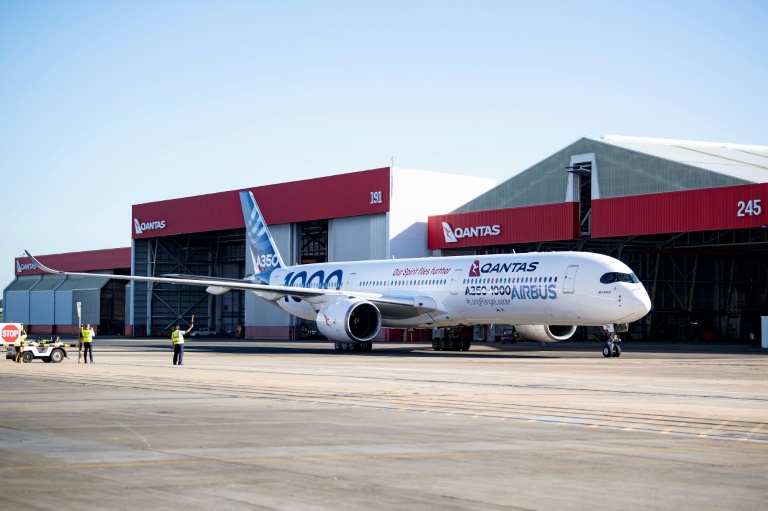
Qantas has revealed plans for the world’s longest-duration commercial flight by the end of 2025, ferrying passengers between Sydney and London on Airbus A350s in just over 19 hours.

Only a handful of airlines fly non-stop over such vast distances, which present a host of challenges including the capability of planes, commercial viability, and even the health of crew and passengers.

Here are some of the longest-duration flights in the world today:

Singapore to New York: 18 hrs 40 min

Singapore Airlines Flight SQ24 to New York’s John F. Kennedy International airport is currently the longest commercial journey in the world, taking passengers more than 15,000 kilometres (9,300 miles) from the city-state to the eastern United States on Airbus A350-900s.

It also operates the second-longest journey — Flight SQ22, also on A350-900s, to Newark in the US state of New Jersey is scheduled at 18 hours and 25 minutes.

Qantas will use the A350-1000 variant for its planned Sydney-London flights.

Darwin to London – 17 hrs 55 min

The longest current Qantas route — QF9 — connects Darwin in northern Australia with London daily, with passengers covering almost 14,000 km on Boeing 787 Dreamliners.

The flights were originally operated between London and the western city of Perth, but were moved to Darwin because of Covid-linked travel restrictions in Australia.

Qantas has said it will resume the Perth-London route this year.

Los Angeles to Singapore – More than 17 hrs

Singapore Airlines Flight SQ35 takes passengers more than 14,000 km over the Pacific Ocean from Los Angeles on the US West Coast to the Asian city-state in 17 hours and 10 minutes.

The carrier’s San Francisco-Singapore flight is scheduled at 16 hours and 40 minutes.

New York-Hong Kong in 16-17 hrs?

Cathay Pacific said in March that it was planning to alter its New York-Hong Kong route over the Atlantic instead of the Pacific Ocean, making it a longer journey than Singapore Airlines Flight SQ24 to JFK.

The flight path will cover “just under 9,000 nautical miles” (10,357 miles) — or 16,668 kilometres — in 16 to 17 hours, the airline told AFP in a statement.

It declined to be drawn why its flight path gave a wide berth to Russia’s airspace, which it has previously flown through, according to Bloomberg.

Many airlines have cancelled routes to Russian cities or are avoiding Russian airspace over Moscow’s invasion of Ukraine.

Cathay Pacific said the decision was taken because “strong seasonal tailwinds” made the new route more favourable.

The longest non-stop flights in the world

Qantas has revealed plans for the world’s longest-duration commercial flight by the end of 2025, ferrying passengers between Sydney and London on Airbus A350s in just over 19 hours.

Only a handful of airlines fly non-stop over such vast distances, which present a host of challenges including the capability of planes, commercial viability, and even the health of crew and passengers.

Here are some of the longest-duration flights in the world today:

Singapore to New York: 18 hrs 40 min

Singapore Airlines Flight SQ24 to New York’s John F. Kennedy International airport is currently the longest commercial journey in the world, taking passengers more than 15,000 kilometres (9,300 miles) from the city-state to the eastern United States on Airbus A350-900s.

It also operates the second-longest journey — Flight SQ22, also on A350-900s, to Newark in the US state of New Jersey is scheduled at 18 hours and 25 minutes.

Qantas will use the A350-1000 variant for its planned Sydney-London flights.

Darwin to London – 17 hrs 55 min

The longest current Qantas route — QF9 — connects Darwin in northern Australia with London daily, with passengers covering almost 14,000 km on Boeing 787 Dreamliners.

The flights were originally operated between London and the western city of Perth, but were moved to Darwin because of Covid-linked travel restrictions in Australia.

Qantas has said it will resume the Perth-London route this year.

Los Angeles to Singapore – More than 17 hrs

Singapore Airlines Flight SQ35 takes passengers more than 14,000 km over the Pacific Ocean from Los Angeles on the US West Coast to the Asian city-state in 17 hours and 10 minutes.

The carrier’s San Francisco-Singapore flight is scheduled at 16 hours and 40 minutes.

New York-Hong Kong in 16-17 hrs?

Cathay Pacific said in March that it was planning to alter its New York-Hong Kong route over the Atlantic instead of the Pacific Ocean, making it a longer journey than Singapore Airlines Flight SQ24 to JFK.

The flight path will cover “just under 9,000 nautical miles” (10,357 miles) — or 16,668 kilometres — in 16 to 17 hours, the airline told AFP in a statement.

It declined to be drawn why its flight path gave a wide berth to Russia’s airspace, which it has previously flown through, according to Bloomberg.

Many airlines have cancelled routes to Russian cities or are avoiding Russian airspace over Moscow’s invasion of Ukraine.

Cathay Pacific said the decision was taken because “strong seasonal tailwinds” made the new route more favourable.

Can pee help feed the world?

“Go pee on the rhubarb!” 

Engineer Fabien Esculier has never forgotten his grandmother’s unconventional approach to gardening — in fact, it has inspired his career. 

Human urine may seem like a crude way of fertilising plants in the era of industrial agriculture, but as researchers look for ways to reduce reliance on chemicals and cut environmental pollution, some are growing increasingly interested in the potential of pee.    

Plants need nutrients — nitrogen, phosphorus and potassium — and we ingest these through food, before “excreting them, mostly through urine”, said Esculier, who runs the OCAPI research programme in France looking at food systems and human waste management. 

This presents an opportunity, scientists think. 

Fertilisers using synthetic nitrogen, in use for around a century, have helped drive up yields and boost agricultural production to feed a growing human population.

But when they are used in large quantities, they make their way into river systems and other waterways, causing choking blooms of algae that can kill fish and other aquatic life. 

Meanwhile, emissions from this agricultural ammonia can combine with vehicle fumes to create dangerous air pollution, according to the United Nations. 

Chemical fertilisers also create emissions of the potent greenhouse gas nitrous oxide, contributing to climate change. 

But the pollution does not just come directly from the fields. 

“Modern-day sanitation practices represent one of the primary sources of nutrient pollution,” said Julia Cavicchi, of the United States Rich Earth Institute, adding that urine is responsible for around 80 percent of the nitrogen found in wastewater and more than half of the phosphorus.  

To replace chemical fertilisers, you would need many times the weight in treated urine, she said.

But she added: “Since the production of synthetic nitrogen is a significant source of greenhouse gases, and phosphorus is a limited and non-renewable resource, urine diverting systems offer a long-term resilient model for human waste management and agricultural production.” 

One 2020 study by UN researchers found that global wastewater has the theoretical potential to offset 13 percent of the world’s demand for nitrogen, phosphorus and potassium in agriculture.

But pee diversion is easier said than done. 

– ‘Very radical’ – 

In the past, urban excrement was transported to agricultural fields to be used as fertiliser along with animal manure, before chemical alternatives began to displace them.

But now if you want to collect urine at source, you need to rethink toilets and the sewage system itself. 

A pilot project to do just that began in Sweden in the early 1990s in a selection of eco-villages. 

Now there are projects in Switzerland, Germany, the US, South Africa, Ethiopia, India, Mexico and France. 

“It takes a long time to introduce ecological innovations and especially an innovation such as urine separation which is very radical,” said Tove Larsen, a researcher at Switzerland’s Eawag aquatic research institute. 

She said the early urine-diverting toilets were considered unsightly and impractical, or raised concerns about unpleasant odours. 

But she hopes a new model — developed by the Swiss company Laufen and Eawag — should solve these difficulties, with a design that funnels urine into a separate container. 

Once the pee is collected it needs to be processed. 

Urine is not normally a major carrier of disease, so the World Health Organization recommends leaving it for a period of time, although it is also possible to pasteurise it. 

Then there are various techniques for concentrating or even dehydrating the liquid, reducing its volume and the cost of transporting it to the fields. 

– ‘Surprise’ –

Another challenge is overcoming public squeamishness. 

“This subject touches on the intimate,” said Ghislain Mercier, of the publicly-owned planning authority Paris et Metropole Amenagement. 

It is developing an eco-district in the French capital with shops and 600 housing units, which will use urine collection to fertilise green spaces in the city. 

He sees significant potential in large buildings like offices, as well as houses not connected to mains drainage.  

Even restaurants. Also in Paris is the 211 restaurant, equipped with waterless toilets that collect urine. 

“We have had quite positive feedback,” said owner Fabien Gandossi.

“People are a little surprised, but they see little difference compared to a traditional system.”

But are people ready to go to the next level and eat urine-fertilised foods? 

One study on the subject highlighted found differences from country to country. The acceptance rate is very high in China, France and Uganda for example, but low in Portugal and Jordan. 

– Water works – 

Prices of synthetic fertilisers are currently soaring because of shortages caused by Russia’s invasion of Ukraine, which has also spurred countries to consider shoring up their food security.

That could be an opportunity help “make the subject more visible”, said Mercier. 

Marine Legrand, an anthropologist working with Esculier at the OCAPI network, said that there are still “obstacles to overcome”.

But she believes that water shortages and increased awareness of the toll of pollution will help change minds.

“We are beginning to understand how precious water is,” she told AFP.  

“So it becomes unacceptable to defecate in it.” 

Close Bitnami banner
Bitnami