World

Murals bring 'joy' to Baghdad concrete jungle

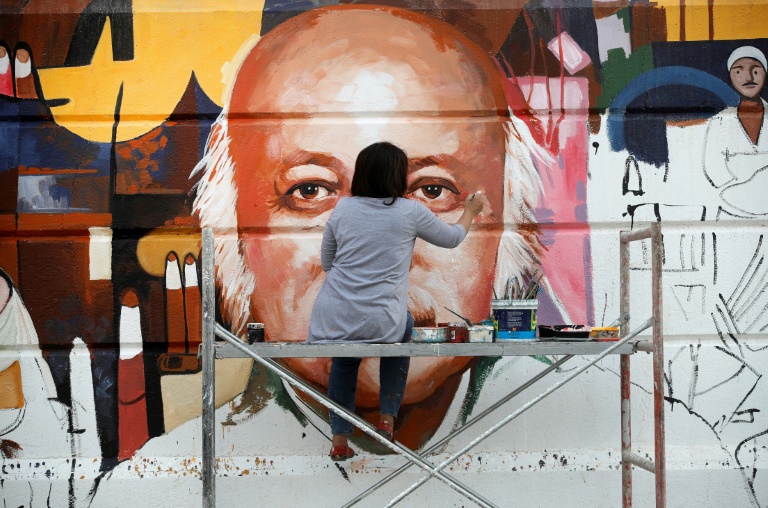
Iraqi artist Wijdan al-Majed is transforming Baghdad’s concrete jungle into a colour-filled city with murals depicting well-known figures from the war-scarred country and abroad.

Perched on a scaffold at a busy intersection, the 49-year-old artist and instructor at the Baghdad College of Fine Arts is adding final touches to a mural dedicated to celebrated Iraqi poet Muzzafar al-Nawab.

Peasant women in traditional dress adorn the background of the mural, commissioned by Baghdad mayor Alaa Maan.

He launched the initiative nine months ago in a bid to “bring beauty to the city and move art to the streets to get rid of the grey and dusty colours” that hang over Baghdad.

Majed, an artist more accustomed to exhibiting her work in the cosy and reflective settings of galleries, at first had helpers to create the street art.

But she has turned to working alone, undaunted by the “huge challenges” she faces as a woman in a largely conservative, male-dominated society.

“Sometimes I work late into the night,” said Majed, wearing jeans and shoes splattered with paint.

“The street is scary at night, and it’s not easy for a woman to be out so late,” she said.

Motorists and passers-by often slow down or stop to watch the woman on her scaffold, paintbrush in hand and hard at work.

– ‘Iraqis accepted me’ –

Disparaging comments are sometimes fired her way.

“I learn to live with it and ignore them,” she said.

“People have become used to seeing a woman paint. Iraqi society has accepted me.”

Many Iraqis are happily surprised by the transformation of their capital.

“This is the most beautiful Muzaffar,” a motorist shouted as he drove past Majed while she touched up the poet’s mural.

Nicknamed the “revolutionary poet”, Muzaffar al-Nawab, who spent years in jail for writing about successive repressive regimes in Iraq, holds a special place in the hearts of many Iraqis.

At least 16 murals have been painted across Baghdad, with one devoted to Jawad Salim, considered the father of Iraqi modern art and a celebrated sculptor, and another to the late, world-famous Iraqi-British architect Zaha Hadid.

German sociologist Max Weber and Catholic saint Mother Teresa are among the foreigners celebrated on Baghdad’s new murals.

Maan, the mayor and an architect by profession, chooses the subjects which Majed paints in vivid colours — a jarring contrast with the rest of the city.

– ‘Bringing joy’ to the city –

Baghdad’s infrastructure was laid to waste by a 13-year international embargo against the regime of late dictator Saddam Hussein, the 2003 US-led invasion that toppled him and the subsequent years of sectarian violence, culminating in the rise and fall of the Islamic State jihadist group.

Maan acknowledges that much needs to be done to rehabilitate the city, which once stood as a beacon of Arab culture but now struggles like most of Iraq with corruption and mismanagement.

“The city is the first victim: any problem elsewhere in the country is reflected here,” Maan said.

“When unemployment soars, you will see street vendors… and when the housing crisis flares, slums emerge.”

Graffiti covers many buildings and facades in Baghdad — including political messages dating back to bloody anti-government protests that rocked the country for months from late 2019.

Cables from private electricity generators — desperately needed to make up for chronic power cuts — add to the disfigurement of the capital.

For Majed, painting murals “brings joy” across the city of nine million people.

In the teeming Al-Sadriya neighbourhood, known for its popular market, a mural depicting two men selling watermelons has won hearts.

“This is a slice of Baghdad’s heritage,” said textile merchant Fadel Abu Ali, 63.

The mural is a reproduction of a work by late artist Hafidh al-Droubi, who often portrayed Baghdad daily life.
Qantas to launch longest non-stop passenger flight

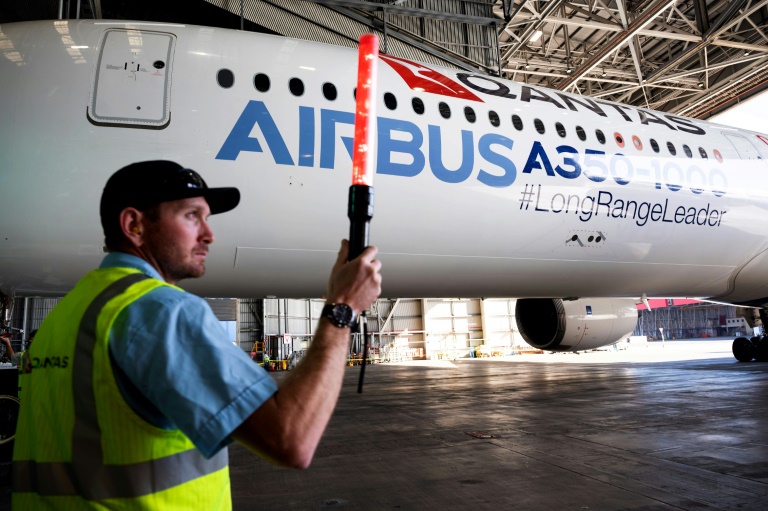
Qantas announced on Monday it will launch the world’s longest non-stop commercial flight, with passengers set to spend 19 hours in the air traveling from Sydney to London by the end of 2025.

After five years of planning, the airline said it was ordering 12 Airbus A350-1000 aircraft to operate the “Project Sunrise” flights to cities including London and New York.

Non-stop flights will start from Sydney by the end of 2025, it said, with long-haul trips later planned to include Melbourne.

“New types of aircraft make new things possible,” said Qantas chairman Alan Joyce, according to a statement.

“The A350 and Project Sunrise will make any city just one flight away from Australia,” he said.

“It’s the final frontier and the final fix for the tyranny of distance.”

Qantas operated research flights for the long-haul route in 2019, including a trial London-Sydney trek of 17,800 kilometres (11,030 miles), which took 19 hours and 19 minutes.

A trial New York-Sydney flight in the same year covered 16,200 kilometres (10,200 miles) and took a little over 19 hours.

Singapore Airlines currently operates the world’s longest non-stop commercial flight from Singapore to New York, covering 16,700 kilometres (10,400 miles) in a little under 19 hours.

Qantas already operates a 14,498-kilometre Perth-London trip that takes 17 hours.

– ‘Maximum comfort’ –

“As you’d expect, the cabin is being specially designed for maximum comfort for long-haul flying,” Joyce said.

Qantas said the new A350 aircraft would be configured for 238 passengers with first-class suites offering a separate bed, recliner chair and wardrobe.

It promised spacier economy sections and a “wellbeing zone” designed for “movement, stretching and hydration”.

At the same time, Qantas confirmed it was also ordering 40 A321 XLR and A220 aircraft from Airbus. In addition, it bought options for another 94 of these planes until the end of 2034.

“The A320s and A220s will become the backbone of our domestic fleet for the next 20 years, helping to keep this country moving,” Joyce said.

The newer aircraft would reduce emissions by at least 15 percent if running on fossil fuels, and more if using sustainable aviation fuel, he said.

“We have come through the other side of the pandemic a structurally different company,” the airline boss said.

“Our domestic market share is higher and the demand for direct international flights is even stronger than it was before Covid.”

Qantas said the total cost of the deal was a matter of commercial confidence, though it indicated it had obtained a significant discount on the standard price of the aircraft.

The A350-1000 planes will be powered by Rolls-Royce Trent XWB-97 turbofan engines, designed to be 25 percent more fuel efficient than the previous generation of aircraft, Qantas said.

UN chief urges swift return to civilian rule in Burkina Faso, Guinea, Mali

UN chief Antonio Guterres called Sunday for the military juntas in Burkina Faso, Guinea and Mali to hand power back to civilians as soon as possible and reminded the world to deliver on “climate emergency” promises.

Speaking after meeting Senegalese President Macky Sall in Dakar, he said they had agreed on the need to keep talking to the de facto authorities in all three countries so as to get a swift return to “constitutional order”.

All three countries, struggling with a jihadist insurgency in the Sahel region, have recently experienced military coups: Mali in August 2020 and May 2021; Guinea in September 2021; and Burkina Faso in January 2022.

Sall is the current chair of the West African bloc ECOWAS, which has suspended all three countries from its membership.

ECOWAS imposed heavy sanctions against Mali in January after the regime there rejected a rapid return to civilian rule.

It has threatened similar sanctions against Guinea and Burkina Faso if they fail to enable a swift transition to civilian rule within a “reasonable” timeframe.

But the military regimes in both countries rejected the timetable set out by ECOWAS.

Last Monday, Ouagadougou said they had no plans to shorten the three-year transition period they had already announced.

And on Saturday evening, Guinea’s junta leader Colonel Mamady Doumbouya said he had opted for a 39-month transition period to civilian rule.

The decision was roundly condemned Sunday by opposition leaders in Guinea, including both the party of the ousted president Alpha Conde and opposition groups that had opposed him.

The regime in Mali is also continuing to defy ECOWAS pressure.

On April 21 it announced the launch of a two-year transition “process” before elections are held.

ECOWAS had called for elections within 16 months at the most.

– Triple crisis –

Turning to the issue of global warming, Guterres said “the climate emergency… increases the security risk”.

African countries, he said, were “often the first victims” of global warming for which they are “not responsible”.

Developed countries had pledged to help the countries of the south to finance their “transition towards renewable energies and green jobs”, he noted.

“It’s time to take action. It’s time to keep the promise of 100 billion dollars a year made in Paris,” he said, referring to national pledges under the 2015 Paris Agreement aimed at capping global warming below two degrees Celsius.

In Dakar, Guterres visited the site of the future headquarters of the UN’s regional operations as well as a manufacturing unit soon to produce Covid-19 vaccines and also experimental anti-malaria and tuberculosis vaccines.

Guterres also addressed the consequences of the war in Ukraine on Africa, where he said the conflict “aggravates a triple crisis: food, energy and financial”.

To enable the countries of the continent to cope, Guterres urged once again international financial institutions to put in place “urgently… debt relief measures… so that governments can avoid default and invest in social safety nets and sustainable development for their people”.

May Day holiday marred by clashes in Turkey, France

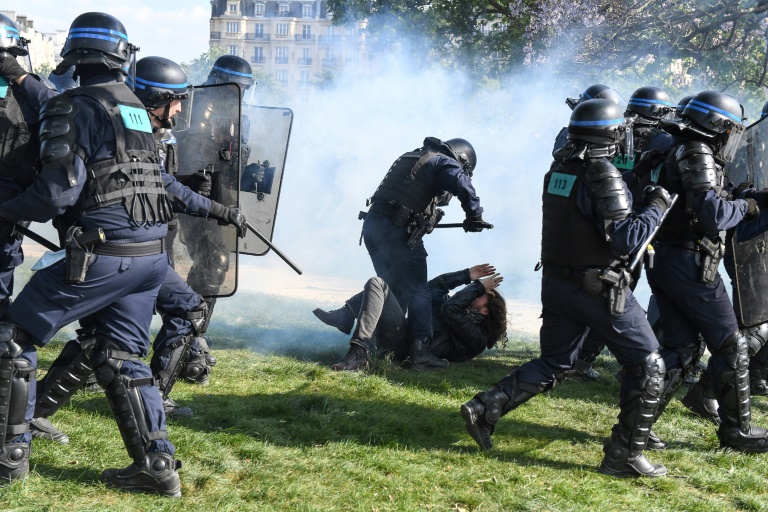
Police and protesters clashed in Turkey and France during May Day rallies on Sunday, as tens of thousands marched across the world in support of workers’ rights.

Turkish riot police detained scores of demonstrators in Istanbul, pinning some of them to the ground and dragging them away from the rally, which the governor’s office said was unauthorised.

And rallies in Paris quickly turned violent as youths clashed with police on the sidelines and buildings were vandalised, though unions said more than 200,000 people joined demonstrations across France and most were peaceful.

May 1 is a public holiday in many countries and Sunday saw events on every continent.

European rallies sparked the most controversy with Turkish protesters gathering at Istanbul’s Taksim Square, an area synonymous with anti-government protests, chanting “long live labour and freedom, long live May Day”.

City officials said the group refused to disperse and 164 were detained, with government-approved rallies elsewhere in Turkey passing off peacefully.

French ministers denounced the violence in Paris and prosecutors said 50 people had been arrested.

Martine Haccoun, a 65-year-old retired doctor, told AFP she came to protest in the southern city of Marseille to show re-elected President Emmanuel Macron “that we didn’t give him a blank cheque for five years”.

She said many voted for Macron simply to stop far-right challenger Marine Le Pen.

– ‘Not slogans’ –

While scuffles were reported in Italian cities including Turin, thousands gathered in London and cities across Germany with no sign of trouble.

In Spain, around 10,000 people joined a demonstration in Madrid and dozens of other cities also held well-attended rallies.

Labour Minister Yolanda Diaz of the communist party said she wanted to show solidarity “with the workers of Ukraine, who today aren’t able to protest”.

In the Greek capital Athens, more than 10,000 joined rallies against a background of spiralling inflation. 

Prime Minister Kyriakos Mitsotakis took to social media to promise a raise in the minimum wage by 50 euros a month.

“We honour the working people not with slogans, but with acts,” he wrote on Twitter.

Kenyan Prime Minister Uhuru Kenyatta similarly used his May Day speech to promise a 12 percent hike in the minimum wage, though activists said it was not enough to keep pace with inflation.

– ‘Pull by his ear’ –

The mood was uglier in Sri Lanka, where the opposition showed rare unity in calling for President Gotabaya Rajapaksa to resign over the country’s worst-ever economic crisis.

“It is time for us to pull him by his ear and kick him out,”  former legislator Hirunika Premachandra said at a rally in Colombo.

South African President Cyril Ramaphosa was also feeling the heat, being forced to leave an event when miners stormed the stage he was due to speak at and chanted “Cyril must go”.

However, other leaders were able to harness the energy of the crowds.

Xiomara Castro, the new president of Honduras, was greeted by thousands chanting her name, and she responded by telling them she would govern for them and put an end to a “dark era” of corruption and drug trafficking.

Elsewhere in Latin America, one leftist-organized group in Buenos Aires protested repaying International Monetary Fund loans, while another group of pro- Argentina government demonstrators praised current policy. 

There were also two separate marches in the Venezuelan capital of Caracas, with hospital workers and other basic service employees calling for a “dignified salary” at one demonstration.

“People, listen, join the fight!” they chanted. 

President Nicolas Maduro addressed the crowds at a separate pro-government march elsewhere in the city, blaming United States sanctions for his country’s “economic storm” and announcing “Venezuela is headed for prosperity”.

Thousands of May 1 demonstrators in Chile took to the streets only days after the government announced a 12.5 percent rise in the minimum wage, which is set to reach 400,000 pesos ($470) per month from August. President Gabriel Boric has said his goal is to raise it to 500,000 pesos by 2026.

May Day came too soon for many in China to enjoy what is usually one of the year’s busiest holidays.

A series of lockdowns sparked by rising Covid cases meant restaurants and tourist sites were deserted during what is usually a frenetic period.

“Obviously it’s bad in terms of our own self-interest, but it’s necessary overall for the good of the country,” said a young waiter at a deserted restaurant near the Forbidden City in Beijing.

burs-jxb/har/caw/st

War in Ukraine: Latest developments

Here are the latest developments in the war in Ukraine:

– Some 100 evacuated  from steel plant –

An initial group of around 100 civilians have been evacuated from the besieged Azovstal steel plant in the southern port city of Mariupol, Ukrainian President Volodymyr Zelensky says. 

Moscow says some civilians were handed over to the UN and the Red Cross.


– ‘Don’t be bullied’ says Pelosi –

US Speaker of the House Nancy Pelosi has urged Ukraine not to back down in the face of “bullies” like Russia following a surprise weekend visit to Kyiv.

“Do not be bullied by bullies. If they are making threats, you cannot back down. That’s my view of it,” she tells a news conference in the Polish city of Rzeszow, a day after talks in the Ukrainian capital with President Zelensky. 

“We are here for the fight and you cannot fold to a bully,” Pelosi says.


– EU wants to phase out Russian oil –

The EU will propose a phased out ban on Russian oil imports as part of its fresh round of sanctions against Russia for its invasion of Ukraine, sources say.

The European Commission, which draws up sanctions for the EU’s 27 countries, is currently preparing the text, which could be put to the member states as early as Wednesday, diplomats say.

Several diplomats say the ban on oil was made possible after a policy U-turn by Germany, which had resisted the measure, seeing it as too disruptive and potentially harmful to its economy.


– Scholz defends Ukraine policies –

German Chancellor Olaf Scholz has defended his decisions on Ukraine, rejecting criticisms that he has been acting too slowly and not doing enough on Russia’s invasion.

Scholz has come under fire over recent weeks for not taking rapid action or doing enough to provide desperately sought armaments to Ukraine.

“I make my decisions quickly and in coordination with our allies,” he tells Bild on Sunday. 

But “I am suspicious of hasty action and Germany going it alone”, the chancellor says.

– One hurt in Russian military site fire –

A fire has broken out at a Russian defence ministry site in Belgorod, close to the border with Ukraine, the region’s governor says, slightly injuring one person.

– Denmark, Sweden demand answers on airspace breaches –

Denmark and Sweden are summoning Russia’s ambassadors after a Russian spyplane violated the air space of both countries, their governments say.

Officials said the plane entered Danish airspace on Friday evening east of the Danish Baltic island of Bornholm before flying into Swedish airspace.

– Russia could seize assets –

Moscow suggests it could seize the Russia-based assets of countries it deems hostile in retaliation for a US proposal to sell off Russian oligarchs’ assets and pay the proceeds to Ukraine.

“As far as companies based in Russian territory are concerned whose owners are citizens of hostile countries and where the decision has been taken” to seize Russian assets, “it is fair to take reciprocal measures and confiscate assets,” says the speaker of Russia’s lower house of parliament, Vyacheslav Volodin.

burs-jhe/har

Dozens of civilians evacuated from Mariupol steel plant

Roughly 100 civilians have been evacuated from a besieged  steel plant in the eastern Ukrainian city of Mariupol, Ukrainian President Volodymyr Zelensky said on Sunday.

The UN said earlier that a “safe passage operation” was going on at the Azovstal plant, the last holdout in the Black Sea port city that has endured a Russian blockade for the full duration of the conflict that began on February 24.

Russia’s defence ministry gave a lower figure of 80 civilians, adding: “Those who wished to leave for areas controlled by the Kyiv regime were handed over to UN and ICRC (Red Cross) representatives.”

The UN has not said how many civilians it is transporting and it was not immediately clear why the sides had given different figures.

Thousands have been killed and millions displaced since Russia’s invasion, and stories of the harsh conditions in besieged Mariupol have horrified the world.

“Evacuation of civilians from Azovstal began,” Zelensky said on Twitter, adding that they were due to arrive in Ukraine-controlled Zaporizhzhia on Monday.

“Grateful to our team! Now they, together with UN, are working on the evacuation of other civilians from the plant.”

The Russian defence ministry earlier confirmed civilians were leaving, releasing a video that showed cars and buses travelling in the dark marked with a “Z”, the letter used by the Russian forces in the conflict.

– ‘Do not be bullied’ –

Pope Francis used his weekly prayer to renew his appeal for humanitarian corridors from the city, saying it had been “bombed and destroyed in a barbaric manner”.

Western powers have rushed to send military aid to Ukraine and imposed heavy sanctions on Russia.

“Do not be bullied by bullies,” US Speaker of the House Nancy Pelosi told reporters at a news conference in Rzeszow in southern Poland on Sunday after returning from Ukraine.

“If they are making threats, you cannot back down.”

Pelosi met Zelensky on Saturday, becoming the most senior US figure to visit since the war began.

She promised to enact the $33-billion (31-billion-euro) arms and support package announced by US President Joe Biden last week.

Western powers have also hit Russia with unprecedented sanctions and EU foreign policy chief Josep Borrell said on Sunday more measures were in the pipeline.

“We must use our economic and financial abilities to make Russia pay the price for what it is doing,” he said.

– Russian ruble introduced –

The conflict is concentrated in the east and south of Ukraine, although there have been Russian missile strikes across the country, mainly targeting infrastructure and supply lines.

Russia’s defence ministry also on Sunday said it had used high-precision Onyx missiles to strike a hangar at a military aerodrome near the Black Sea port city of Odessa housing arms from the United States and European countries and destroyed the runway.

Ukrainian authorities had reported the strike on Saturday but said only that it destroyed the runway.

Russia has moved to solidify its grip on areas it controls and from Sunday introduced the Russian ruble in the region of Kherson — initially to be used alongside the Ukrainian hryvnia.

“Beginning May 1, we will move to the ruble zone,” Kirill Stremousov, a civilian and military administrator of Kherson, was cited as saying earlier by Russia’s state news agency RIA Novosti.

He said there would be a period of four months in which the hryvnia could be used, but then “we will completely switch to settlements in rubles”.

– ‘Guard the line’ –

On the front line in the east, Russian troops have advanced slowly but steadily in some areas — helped by massive use of artillery — but Ukrainian forces have also recaptured some territory in recent days, particularly around the city of Kharkiv.

One of the areas taken back from Russian control was the village of Ruska Lozova, which evacuees said had been occupied for two months.

“It was two months of terrible fear. Nothing else, a terrible and relentless fear,” Natalia, a 28-year-old evacuee from Ruska Lozova, told AFP after reaching Kharkiv.

Kyiv has admitted that Russian forces have captured a string of villages in the Donbas region and has asked Western powers to deliver more heavy weapons to bolster its defences there.

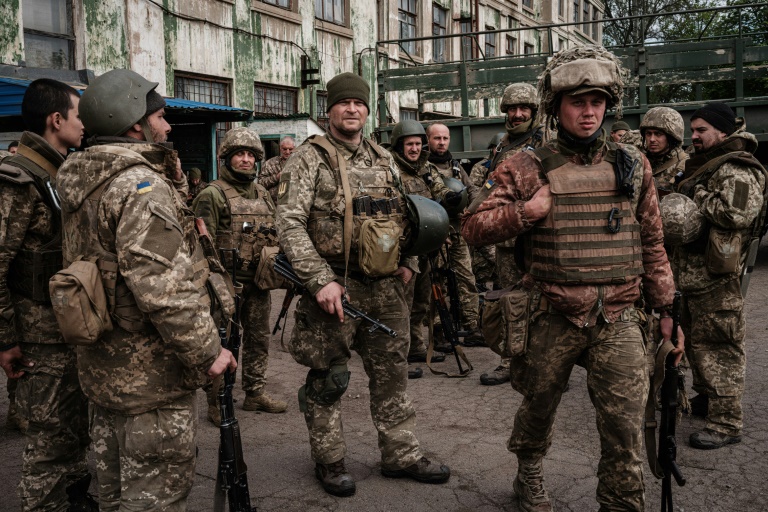
“Everyone understands that we must guard the line here,” lieutenant Yevgen Samoylov of the 81st brigade told AFP as his unit rotated away from the front line near the town of Sviatogirsk.

“We cannot let the enemy move closer, we try to hold it with all our force.” 

Thousands rally in Armenia against Karabakh concessions

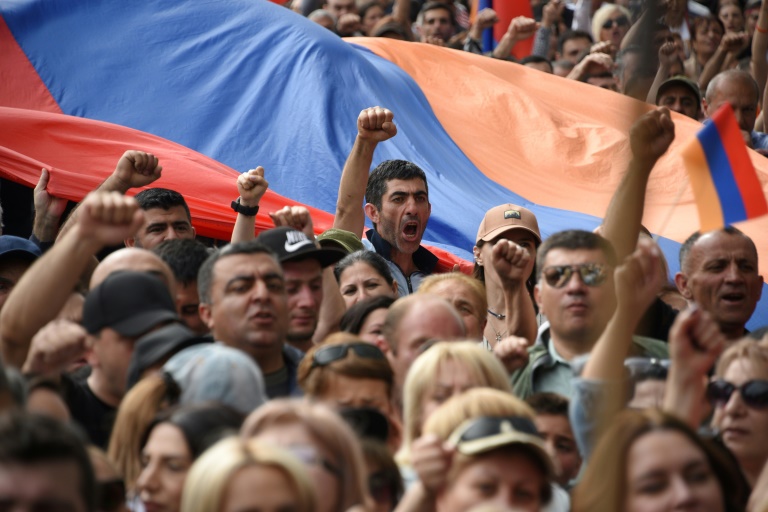
Thousands of opposition supporters rallied Sunday in the Armenian capital Yerevan to warn the government against concessions to arch-foe Azerbaijan over the long-disputed Nagorno-Karabakh region.

Opposition parties have accused Prime Minister Nikol Pashinyan of plans to give away all of Karabakh to Azerbaijan after he told lawmakers last month that the “international community calls on Armenia to scale down demands on Karabakh.”

On Sunday, several thousand opposition supporters gathered in the capital’s central Square of France, blocking traffic throughout central Yerevan.

Protesters shouted demands for Pashinyan to resign, with many holding placards that read “Karabakh”.

Parliament Vice Speaker and opposition leader Ishkhan Sagatelyan said: “Any political status of Karabakh within Azerbaijan is unacceptable to us.”

“Pashinyan had betrayed people’s trust and must go,” he told journalists at the rally, adding that the protest movement “will lead to the overthrow of the government in the nearest future”.

Addressing the crowd, he announced “a large scale campaign of civil disobedience to begin on Monday”.

“I call on everyone to begin strikes. I call on students not to attend classes. Traffic will be fully blocked in central Yerevan.”

– ‘Threat of unrest’ –

On Saturday, Armenia’s National Security Service warned of “a real threat of mass unrest in the country.”

Yerevan and Baku had been locked in a territorial dispute since the 1990s over the mountainous region of Azerbaijan predominantly populated by ethnic Armenians.

Karabakh was at the centre of a six-week war in 2020 that claimed more than 6,500 lives before it ended with a Russian-brokered ceasefire agreement.

Under the deal, Armenia ceded swathes of territories it had controlled for decades and Russia deployed some 2,000 peacekeepers to oversee the truce.

In April, Pashinyan and Azerbaijani President Ilham Aliyev met for rare EU-mediated talks in Brussels after which they tasked their foreign ministers to “begin preparatory work for peace talks.”

The meeting came after a flare-up in Karabakh on March 25 that saw Azerbaijan capture a strategic village in the area under the Russian peacekeepers’ responsibility, killing three separatist troops.

Baku tabled in mid-March its set of framework proposals for the peace agreement that includes both sides’ mutual recognition of territorial integrity, meaning Yerevan should agree on Karabakh being part of Azerbaijan.

Armenian Foreign Minister Ararat Mirzoyan sparked controversy at home when he said — commenting on the Azerbaijani proposal — that for Yerevan “the Nagorno-Karabakh conflict is not a territorial issue, but a matter of rights” of the local ethnic-Armenian population.

Ethnic Armenian separatists in Nagorno-Karabakh broke away from Azerbaijan when the Soviet Union collapsed in 1991. The ensuing conflicts claimed around 30,000 lives. 

Afghan leader hails 'security' in rare appearance to mark Eid

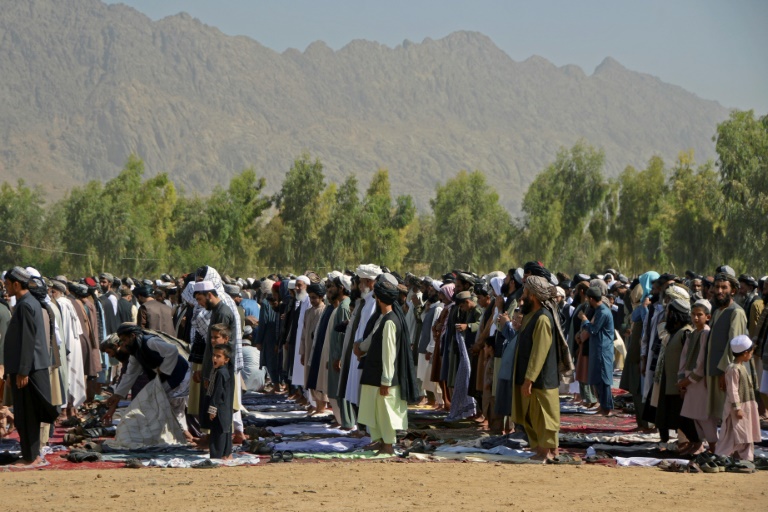
Afghanistan’s supreme leader appeared publicly for only the second time in six years on Sunday, telling worshippers celebrating Eid al-Fitr the Taliban had achieved freedom and security since seizing power last year.

Speaking just two days after a bomb ripped through a mosque in Kabul, an atmosphere of heightened security surrounded the man introduced as Hibatullah Akhundzada, the chief of the Taliban.

“Congratulations on victory, freedom and success,” he told thousands of worshippers at the Eidgah mosque in the southern city of Kandahar, the hardline Islamist group’s de facto power centre.

“Congratulations on this security and for the Islamic system.”

While the number of bombings across Afghanistan has dropped since Kabul fell to the Taliban last August, attacks soared over the final two weeks of the fasting month of Ramadan, which ended Saturday for Afghans.

Dozens of civilians have been killed in the primarily sectarian attacks — some claimed by the Islamic State group — targeting members of the Shiite and Sufi Muslim communities. 

Friday’s bombing of a Sunni mosque in the capital killed at least 10 people. 

Akhundzada delivered his brief address from one of the front rows of worshippers in Kandahar without turning to face the crowd, according to social media posts. 

Taliban officials did not allow journalists to approach him, while two helicopters hovered over the mosque for the whole of the two-hour event.

Dozens of Taliban fighters were deployed where Akhundzada and other Taliban leaders were sitting and they stopped worshippers from taking their pictures on cellphones.

An AFP correspondent who reported from the mosque confirmed that the voice said to be Akhundzada’s came from the front rows of worshippers.

– ‘Biggest dream’ –

When the man introduced as the Taliban leader began to speak, worshippers chanted “Allahu Akbar! Long live Islamic Emirate and Long Live Akhundzada!”

Worshipper Aziz Ahmad Ahmadi said he was overwhelmed.

“I cried when I heard the voice of Sheikh Saheb (Akhundzada)… to hear him is like achieving my biggest dream,” he told AFP, but added he had failed to spot the leader among the crowd.

Another Kandahar resident, Bismillah, who attended the prayers at the Eidgah mosque, said, “I’m so happy that I can’t even describe it”.

“I had a dream to pray alongside my supreme leader, to hear his voice or to see him.”

A senior Taliban government official told AFP that he saw Akhundzada delivering the address.

“I saw him from a distance as he spoke. I even met him two days ago at his office,” he said, requesting not to be named.

It was Akhundzada’s second known public appearance since taking control of the Taliban in 2016.

Akhundzada’s low profile has fed speculation about his role in the new Taliban government, formed after the group took control of Kabul on August 15 — and even rumours of his death.

His public profile has largely been limited to the release of messages during Islamic holidays from his office in Kandahar.

In October, Akhundzada visited the Darul Uloom Hakimiah mosque in the southern city, according to an audio recording circulated by Taliban social media accounts.

– ‘Sad situation’ –

On Friday, in a message released ahead of Eid al-Fitr, he made no mention of the bloodshed that had rocked Afghanistan over Ramadan, instead praising the Taliban’s building of “a strong Islamic and national army” and “strong intelligence organisation”.

Unlike Kandahar, many Afghans in Kabul preferred to stay indoors on Sunday rather than pray at mosques after the recent deadly attacks.

“The situation of our people is very sad, especially after what happened in the mosques,” Kabul resident Ahmad Shah Hashemi told AFP.

“Many young and old people have been martyred. The people of Afghanistan have nothing but sorrow.”

The deadliest attack during Ramadan was in the northern province of Kunduz, where a bomb ripped through a mosque as a group of Sufis performed rituals.

At least 36 people were killed and scores more were wounded. No group has so far claimed that attack.

Dozens of civilians evacuated from Mariupol steel plant

Roughly 100 civilians have been evacuated from the besieged Mariupol steel plant in eastern Ukraine and are heading out of Russian-controlled territory, Ukrainian President Volodymyr Zelensky said on Sunday.

The announcement came after the UN said a “safe passage operation” was ongoing at Azovstal, where Ukrainian forces say they and hundreds of civilians have been sheltering from Russian bombardment.

“Evacuation of civilians from Azovstal began,” Zelensky said on Twitter.

Zelensky said the group was expected to arrive in the city of Zaporizhzhia, which is under Ukrainian control, on Monday.

“Grateful to our team! Now they, together with UN, are working on the evacuation of other civilians from the plant,” he said.

The Russian defence ministry earlier said 46 civilians had left the plant on Saturday.

“All of the civilians were given accommodation, food and necessary medical help,” the ministry said.

A ministry video showed a convoy of cars and buses travelling in the dark, marked with a “Z”, the letter used by the Russian forces in the conflict.

– ‘Barbaric’ bombing –

The fate of Mariupol, a strategic port city linking Russian-held areas of southern and eastern Ukraine, has drawn worldwide condemnation.

Pope Francis on Sunday used his weekly Angelus prayer to renew his appeal for humanitarian corridors from the city, saying it had been “bombed and destroyed in a barbaric manner”.

Thousands have been killed and millions displaced by Russia’s invasion, which began on February 24.

Western powers have rushed to send military aid to Ukraine and imposed heavy sanctions on Russia.

“Do not be bullied by bullies,” US Speaker of the House Nancy Pelosi told reporters at a press conference in Rzeszow in southern Poland on Sunday after returning from Ukraine.

“If they are making threats, you cannot back down. That’s my view of it. We are here for the fight and you cannot fold to a bully,” she said.

Pelosi met Zelensky on Saturday, becoming the most senior US figure to visit since the war began.

“We are visiting you to say thank you for your fight for freedom… Our commitment is to be there for you until the fight is done,” she told him.

Pelosi also promised to enact the $33-billion (31-billion-euro) arms and support package announced by US President Joe Biden last week.

– Russian ruble introduced –

The conflict is concentrated in the east and south of Ukraine, although there have been Russian missile strikes across the country, mainly targeting infrastructure and supply lines.

Russia’s defence ministry also on Sunday said it had used high-precision Onyx missiles to strike a hangar at a military aerodrome housing arms from the United States and European countries and destroyed the runway.

Ukrainian authorities had reported the strike on Saturday but said only that it destroyed the runway.

Russia has moved to solidify its grip on areas it controls and from Sunday introduced the Russian ruble in the region of Kherson — initially to be used alongside the Ukrainian hryvnia.

“Beginning May 1, we will move to the ruble zone,” Kirill Stremousov, a civilian and military administrator of Kherson, was cited as saying earlier by Russia’s state news agency RIA Novosti.

He said there would be a period of four months in which the hryvnia could be used, but then “we will completely switch to settlements in rubles”.

– ‘Guard the line’ –

On the front line in the east, Russian troops have advanced slowly but steadily in some areas — helped by massive use of artillery — but Ukrainian forces have also recaptured some territory in recent days, particularly around the city of Kharkiv.

One of the areas taken back from Russian control was the village of Ruska Lozova, which evacuees said had been occupied for two months.

“It was two months of terrible fear. Nothing else, a terrible and relentless fear,” Natalia, a 28-year-old evacuee from Ruska Lozova, told AFP after reaching Kharkiv.

Kyiv has admitted that Russian forces have captured a string of villages in the Donbas region and has asked Western powers to deliver more heavy weapons to bolster its defences there.

“Everyone understands that we must guard the line here,” lieutenant Yevgen Samoylov of the 81st brigade told AFP as his unit rotated away from the front line near the town of Sviatogirsk.

“We cannot let the enemy move closer, we try to hold it with all our force.” 

War in Ukraine: Latest developments

Here are the latest developments in the war in Ukraine:

– Safe passage from steel plant starts –

An operation is under way for civilians to leave the besieged Azovstal steel plant in the Ukrainian port city of Mariupol, a UN spokesman says. 

“UN confirms that a safe passage operation is ongoing in Azovstal steel plant, in coordination with the ICRC and the parties to the conflict,” says spokesman Jens Laerke.

Russian news agencies report 40 people left the plant while the Russian defence ministry says nearly 50 civilians had left a day earlier.

– Pelosi backs Zelensky –

US Speaker of the House Nancy Pelosi voices support for Ukraine’s “fight for freedom” at a meeting with President Volodymyr Zelensky on a visit to Kyiv, US and Ukrainian officials say.

“We believe that we are visiting you to say thank you for your fight for freedom… Our commitment is to be there for you until the fight is done,” Pelosi tells Zelensky.

– Angelina Jolie visits Lviv –

Hollywood star Angelina Jolie makes a surprise appearance in the western Ukrainian city of Lviv where she meets displaced people and is spotted in a cafe.

Jolie also visited injured children at a hospital and spoke to volunteers. The actress is a UNHCR special envoy but it was not known if she was visiting the country in that capacity. 

– Turkey spokesman meets Zelensky –

Turkish presidential spokesman Ibrahim Kalin has met Zelensky in Kyiv, his office says. 

There were no immediate details about the content of Kalin’s meeting, but Ankara has been mediating between Ukraine and Russia in efforts to end the war.

– Germany slashes Russia reliance –

Germany says it has made progress in sharply reducing its reliance on Russian energy, a strategic shift Europe’s biggest economy has embarked on since Russia invaded Ukraine.

Russian supplies now make up 12 percent of Germany’s oil imports compared to 35 percent previously, the economy ministry says.

Coal from Russia has also been slashed to eight percent compared to 45 percent of Germany’s purchases previously, it added in a statement.

– Missile hits Odessa airport –

A Russian missile destroys the runway at Odessa airport in southern Ukraine but there are no victims, the regional governor Maxim Marchenko says on his Telegram account.

– Russia could seize assets –

Moscow suggests it could seize the Russia-based assets of countries it deems hostile in retaliation for a US proposal to sell off Russian oligarchs’ assets and pay the proceeds to Ukraine.

“As far as companies based in Russian territory are concerned whose owners are citizens of hostile countries and where the decision has been taken” to seize Russian assets, “it is fair to take reciprocal measures and confiscate assets,” says the speaker of Russia’s lower house of parliament, Vyacheslav Volodin.

– Russian plane enters Swedish airspace –

A Russian reconnaissance plane briefly violated Sweden’s airspace, Swedish defence officials say, as the Scandinavian country ponders a bid for NATO membership after Russia’s invasion of Ukraine.

– 13 million uprooted –

More than 5.4 million Ukrainians have fled their country since Russia invaded two months ago, with tens of thousands joining their ranks every day, the United Nations says.

Beyond the refugees, the International Organization for Migration (IOM) estimates more than 7.7 million people have been displaced within Ukraine, meaning that more than 13 million people overall have been uprooted by the conflict.

burs-jhe/raz

Close Bitnami banner
Bitnami