World

Dozens leave Mariupol plant as Pelosi backs 'fight for freedom'

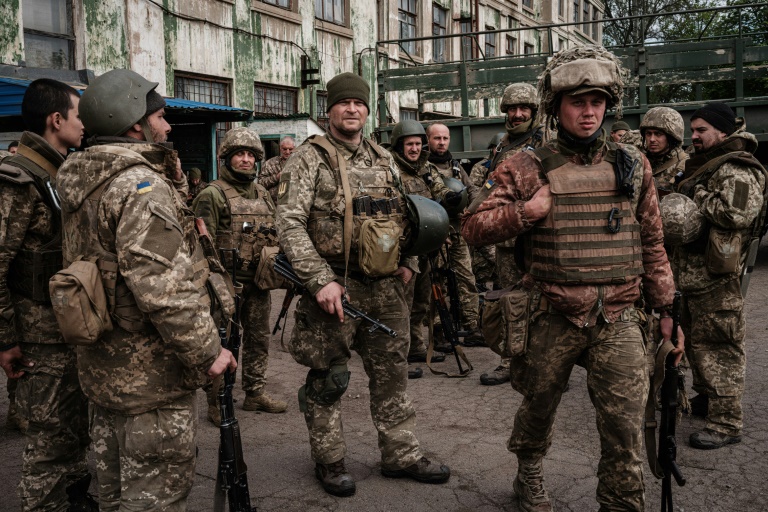
Dozens of civilians have left a besieged steel plant in the city of Mariupol, Russia said on Sunday, as US House Speaker Nancy Pelosi voiced support for Ukraine’s “fight for freedom” during a visit to Kyiv.

Russia’s defence ministry said a total of 46 civilians left in two groups on Saturday from the area around the Azovstal plant — the last holdout of Ukrainian forces in the city.

The development raised hopes of a larger, long-awaited evacuation from the battered plant, where local fighters say they and hundreds of civilians are still sheltering.

Ukrainian President Volodymyr Zelensky said in a video Saturday evening that Kyiv was “doing everything to ensure that the evacuation mission from Mariupol is carried out”.

Petro Andryushchenko, an adviser to Mariupol’s mayor, said on Telegram on Sunday that there would be “radio silence on the evacuation situation”.

Thousands have been killed and millions displaced since Russia began its invasion on February 24.

Western powers have rushed to send military aid to Ukraine and imposed heavy sanctions on Russia.

“We are visiting you to say thank you for your fight for freedom… Our commitment is to be there for you until the fight is done,” Pelosi said at a meeting with Zelensky.

Pelosi also said in a statement that “additional American support is on the way” following President Joe Biden’s announcement last week of a $33-billion (31-billion-euro) arms and support package.

– Russian ruble introduced –

The conflict is now concentrated in the east and south of Ukraine, although there have been Russian missile strikes across the country, mainly targeting infrastructure and supply lines.

On Saturday, Ukrainian authorities said a Russian missile strike had destroyed the runway of Odessa airport in the southwest of the country.

Near Bucha, the town near Kyiv that has become synonymous with allegations of Russian war crimes, police reported finding three bodies shot in the head with their hands tied.

The victims were found in a pit and had been “brutally killed” by Russian soldiers, the police said in a statement.

“The victims’ hands were tied, cloths were covering their eyes and some were gagged. There are traces of torture on the corpses,” the statement said.

Ukrainian prosecutors say they have pinpointed more than 8,000 war crimes carried out by Moscow’s troops and are investigating 10 Russian soldiers for suspected atrocities in Bucha.

Russia has denied any involvement in civilian deaths in Bucha.

Meanwhile, Russia has moved to solidify its grip on areas it controls and from Sunday introduced the Russian ruble in the region of Kherson — initially to be used alongside the Ukrainian hryvnia.

“Beginning May 1, we will move to the ruble zone,” Kirill Stremousov, a civilian and military administrator of Kherson, was cited as saying earlier by Russia’s state news agency RIA Novosti.

He said there would be a period of four months in which the hryvnia could be used, but then “we will completely switch to settlements in rubles”.

– ‘Terrible and relentless fear’ –

On the front line in the east, Russian troops have advanced slowly but steadily in some areas — helped by massive use of artillery — but Ukrainian forces have also recaptured some territory in recent days, particularly around the city of Kharkiv.

One of the areas taken back from Russian control was the village of Ruska Lozova, which evacuees said had been occupied for two months.

“It was two months of terrible fear. Nothing else, a terrible and relentless fear,” Natalia, a 28-year-old evacuee from Ruska Lozova, told AFP after reaching Kharkiv.

“We were in the basements without food for two months, we were eating what we had,” said Svyatoslav, 40, who did not want to give his full name, his eyes red with fatigue.

Kyiv has admitted that Russian forces have captured a string of villages in the Donbas region and has asked Western powers to deliver more heavy weapons to bolsters its defences there.

Zelensky said he spoke on Saturday with French President Emmanuel Macron and British Prime Minister Boris Johnson “on defence support for Ukraine and other efforts necessary to end the war”.

“I informed Boris about the current situation on the battlefield in the areas of active clashes and in detail about the situation in our east, in Mariupol, in the south of the country,” he said. 

“All the leaders of the free world know what Russia has done to Mariupol. And Russia will not go unpunished for this.”

Russia has warned Western countries against sending more military aid.

On Sunday, Russia also suggested that it could seize the Russian-based assets of countries it deems hostile in retaliation to a US proposal to sell off Russian oligarchs’ assets and pay the proceeds to Ukraine.

“As far as companies based in Russian territory are concerned whose owners are citizens of hostile countries and where the decision has been taken” to seize Russian assets, “it is fair to take reciprocal measures and confiscate assets,” said the speaker of Russia’s lower house of parliament, Vyacheslav Volodin. 

“And the proceeds from the sale of these assets will be used for our country’s development,” he said on his Telegram channel.
Sixth survivor pulled from China building collapse, dozens still missing

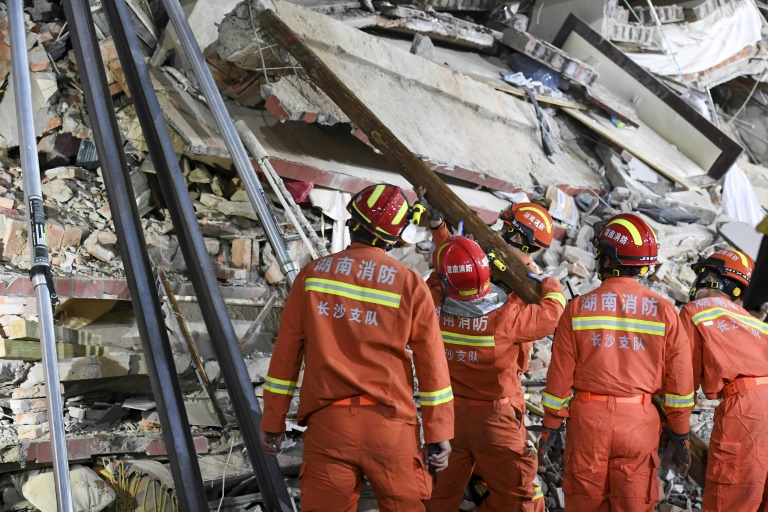
Rescuers pulled a sixth survivor from a collapsed building in central China Sunday, state media reported, two days into a search-and-rescue operation that has workers looking for dozens feared missing.

The building in Changsha city, Hunan province — which housed a hotel, apartments and a cinema — caved in Friday afternoon, leaving a gaping hole in the dense streetscape. 

City officials said Saturday five survivors had been pulled out of the structure, leaving 18 still trapped. A further 39 could not be contacted after the incident.

After 50 hours of rescue efforts, a woman — the sixth survivor — was pulled out from the rubble Sunday, state broadcaster CCTV reported, showing footage of firefighters loading a person covered in dust onto a gurney. 

Changsha police said nine people — including the building’s owner and a team of safety inspectors — were detained Sunday in connection to the accident. They alleged that surveyors had falsified a safety audit of the building. 

No cause for the disaster has yet been given by authorities.

Changsha’s mayor earlier vowed to “spare no effort” in their search for the people still trapped. 

“We will seize the golden 72 hours for rescue and try our best to search for the trapped people,” mayor Zheng Jianxin said in news briefing Saturday. 

He added that over 700 first responders had been dispatched to the scene.

State media showed firefighters — backed by a digger — cutting through a morass of metal and sheets of concrete, while rescuers shouted into the tower of debris to communicate with any survivors.

A crowd gathered as chains of rescuers removed pieces of brick by hand, allowing experts a deeper look into the wreckage. 

Some of the injured were rushed away on stretchers, while sniffer dogs combed the area for further signs of life.

President Xi Jinping on Saturday called for a search “at all cost” and ordered a thorough investigation into the cause of the collapse, state media reported.

A top Communist Party official was dispatched to the scene — an indication of the severity of the disaster.

China’s minister of emergency management Huang Ming urged officials to “thoroughly eliminate all kinds of hidden safety risks” in a Saturday meeting.

Building collapses are not uncommon in China, due to weak safety and construction standards as well as corruption among officials tasked with enforcement.

In January, an explosion triggered by a suspected gas leak brought down a building in the city of Chongqing, killing at least 16 people.

War in Ukraine: Latest developments

Here are the latest developments in the war in Ukraine:

– Pelosi backs Zelensky –

US Speaker of the House Nancy Pelosi voices support for Ukraine’s “fight for freedom” at a meeting with President Volodymyr Zelensky on a visit to Kyiv, US and Ukrainian officials say.

“We believe that we are visiting you to say thank you for your fight for freedom… Our commitment is to be there for you until the fight is done,” Pelosi tells Zelensky.

– Angelina Jolie visits Lviv –

Hollywood star Angelina Jolie makes a surprise appearance in the western Ukrainian city of Lviv where she meets displaced people and is spotted in a cafe.

Jolie also visited injured children at a hospital and spoke to volunteers. The actress is a UNHCR special envoy but it was not known if she was visiting the country in that capacity. 

– Turkey spokesman meets Zelensky –

Turkish presidential spokesman Ibrahim Kalin has met Ukrainian President Volodymyr Zelensky in Kyiv, his office says. 

There were no immediate details about the content of Kalin’s meeting, but Ankara has been mediating between Ukraine and Russia in efforts to end the war.

– Civilian group leaving Mariupol –

A group of 20 civilians are leaving the Azovstal steelworks, where the last Ukrainian troops are holed up in the Black Sea port of Mariupol, the soldiers there say.

Their departure could signal the start of a long-awaited larger evacuation of the last hold-out in the Russian-held city.

– Missile hits Odessa airport –

A Russian missile destroys the runway at Odessa airport in southern Ukraine but there are no victims, the regional governor Maxim Marchenko says on his Telegram account.

– Russian plane enters Swedish air space: Stockholm –

A Russian reconnaissance plane briefly violated Sweden’s airspace,  Swedish defence officials say, as the Scandinavian country ponders a bid for NATO membership after Russia’s invasion of Ukraine.

– Ukrainians freed in prisoner swap –

Fourteen Ukrainians including a pregnant soldier have been freed in the latest prisoner exchange with Russian forces, Ukraine says, without revealing the number of Russians returned to Moscow.

The exchange of seven military personnel and seven civilians included a soldier who is five months pregnant, Deputy Prime Minister Iryna Vereshchuk announces on Telegram.

– More bodies found near Bucha –

The bodies of three men shot in the head and with their hands tied have been found in a pit near Bucha, a town close to Kyiv, police say.

There were also traces of torture, says the statement. Bucha has become synonymous with allegations of Russian war crimes since dozens of bodies were first discovered there in early April.

– France to ‘intensify’ aid –

French President Emmanuel Macron says France will “intensify” its supply of military and humanitarian support following a conversation with his Ukrainian counterpart Volodymyr Zelensky.

– Kharkiv shelled again –

Ukraine’s second city Kharkiv is hit by multiple Russian shellings, though President Zelensky says Ukrainian forces are making “tactical successes” in the region.

One person was killed and five injured, Kharkiv’s regional military administration says on Telegram.

– 13 million uprooted –

More than 5.4 million Ukrainians have fled their country since Russia invaded two months ago, with tens of thousands joining their ranks every day, the United Nations says.

Beyond the refugees, the International Organization for Migration (IOM) estimates more than 7.7 million people have been displaced within Ukraine, meaning that more than 13 million people overall have been uprooted by the conflict.

burs-jhe/kjm

Rare birth of Asiatic cheetah cubs in Iran

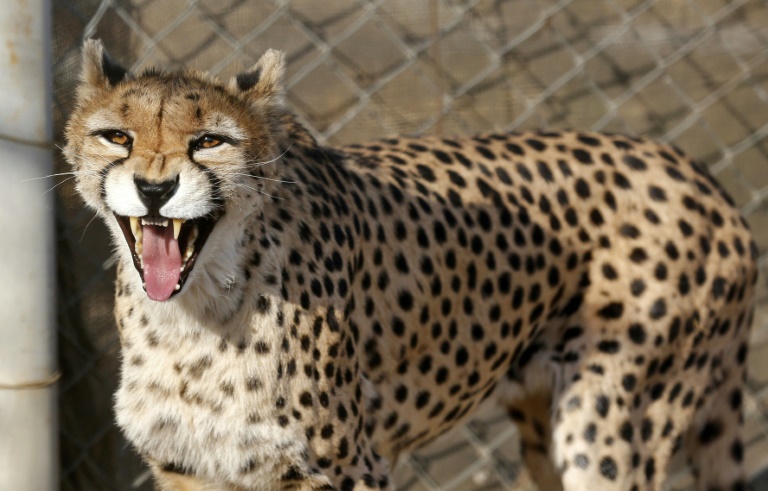
An Asiatic cheetah gave birth to three “healthy” cubs in Iran, the head of the environment department said Sunday, calling it a first in captivity for the endangered species.

“Iran”, one of only a dozen cheetahs found in the Islamic republic, delivered three “healthy” cubs by C-section, Ali Salajegheh told IRNA news agency.

“This is the first birth of an Asiatic cheetah in captivity,” he said.

“By preserving these cubs, we can increase the cheetah population in captivity and then in semi-captivity,” Salajegheh added.

The cubs were born in the Touran Wildlife Refuge in the Semnan province east of Tehran, where the mother and her babies are being monitored in intensive care.

The world’s fastest land animal, capable of reaching speeds of 120 kilometres (74 miles) per hour, cheetahs once stalked habitats from the eastern reaches of India to the Atlantic coast of Senegal and beyond

They are still found in parts of southern Africa, but have practically disappeared from North Africa and Asia.

Iran is one of the last countries in the world where the Asiatic cheetahs live in the wild and began a United Nations-supported protection programme in 2001.

The subspecies “Acinonyx jubatus venaticus”, commonly known as the Asiatic cheetah, is critically endangered, according to the International Union for Conservation of Nature.

In January deputy environment minister Hassan Akbari said Iran is home to only a dozen Asiatic cheetahs — down from an estimated 100 in 2010.

Their situation “is extremely critical”, Akbari said at the time, adding that the animals have been victims of drought, hunters and car accidents.

Afghan leader hails 'security' in rare appearance to mark Eid

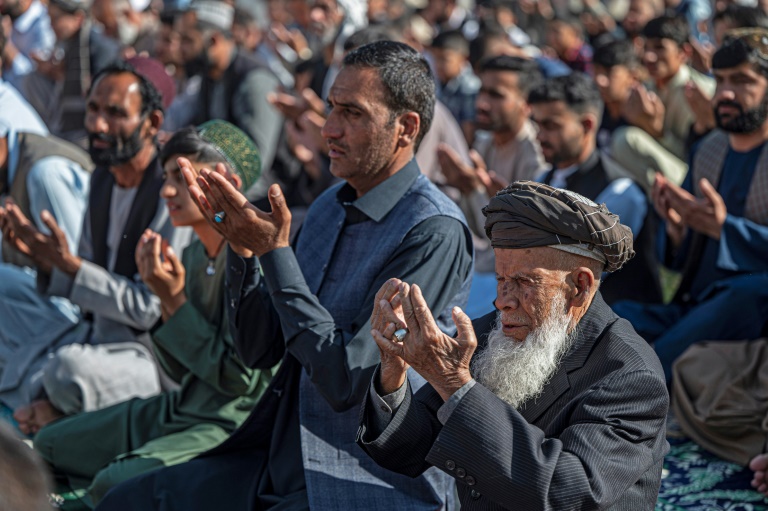
Afghanistan’s supreme leader appeared publicly for only the second time in six years on Sunday, telling worshippers celebrating Eid al-Fitr the Taliban had achieved freedom and security since seizing power last year.

Speaking just days after a bomb ripped through a mosque in Kabul, an atmosphere of heightened security surrounded the man introduced as Hibatullah Akhundzada.

“Congratulations on victory, freedom and success,” he told thousands of worshippers at the Eidgah mosque in the southern city of Kandahar, the hardline Islamist group’s de facto power centre.

“Congratulations on this security and for the Islamic system.”

While the number of bombings across the country has dropped since Kabul fell to the Taliban last August, attacks soared over the final two weeks of the fasting month of Ramadan, which ended Saturday for Afghans.

Dozens of civilians have been killed in the primarily sectarian attacks — some claimed by the Islamic State group — targeting members of the Shiite and Sufi Muslim communities. Friday’s bombing in the capital killed at least 10. 

Akhundzada delivered his brief address from one of the front rows of worshippers in Kandahar without turning to face the crowd, according to social media posts. Taliban officials did not allow journalists to approach him, an AFP correspondent reported.

Two helicopters hovered over the mosque for the whole of the two-hour event.

It was Akhundzada’s second known public appearance since taking control of the Taliban in 2016.

In October, he had visited the Darul Uloom Hakimiah mosque in Kandahar, according to an audio recording circulated by Taliban social media accounts.

– A reclusive figure –

Akhundzada’s low profile has fed speculation about his role in the new Taliban government, formed after the group took control of Kabul on August 15 — and even rumours of his death.

His public profile has largely been limited to the release of messages during Islamic holidays, and Akhundzada is believed to spend most of his time in Kandahar.

On Friday, in a message released ahead of Eid al-Fitr, he made no mention of the bloodshed that had rocked Afghanistan over Ramadan, instead praising the Taliban’s building of “a strong Islamic and national army” and “strong intelligence organisation”.

On Sunday, many Afghans preferred to stay indoors after the recent deadly attacks.

“The situation of our people is very sad, especially after what happened in the mosques,” Kabul resident Ahmad Shah Hashemi told AFP.

“Many young and old people have been martyred. The people of Afghanistan have nothing but sorrow.”

The deadliest attack during Ramadan was in the northern province of Kunduz, where a bomb ripped through a mosque as a group of Sufis performed rituals.

At least 36 people were killed and scores more were wounded. No group has so far claimed that attack.

Nine detained in connection with China building collapse

Police in central China announced the detention of nine people on Sunday over a collapsed building, as increasingly desperate rescuers comb the debris for any survivors. 

The building, in Changsha city, housed a hotel, apartments and a cinema. It caved in Friday afternoon, leaving a gaping hole in the dense streetscape. 

At least 18 people were trapped and another 39 were incommunicado, according to city mayor Zheng Jianxin.

Five people were rescued from the pancaked structure overnight Friday.

Changsha police said on social media that the building’s owner and three others responsible for its design and construction were detained Sunday on suspicion of “major responsibility for an accident”.

Another five people, all members of a private building inspection firm, “provided a false safety report after conducting a building safety audit of the hotel”, the statement on Twitter-like Weibo said. 

No cause for the disaster has yet been given by authorities.

Changsha’s mayor vowed to “seize the golden 72 hours for rescue and try our best to search for the trapped people” in a news briefing Saturday, adding that over 700 first responders had been dispatched to the scene.

State media showed firefighters — backed by a digger — cutting through a morass of metal and sheets of concrete, while rescuers shouted into the tower of debris to communicate with any survivors.

A crowd gathered as chains of rescuers removed pieces of brick by hand, allowing experts a deeper look into the wreckage. 

Some of the injured were rushed away on gurneys, while sniffer dogs combed the area for further signs of life.

President Xi Jinping on Saturday called for a search “at all cost” and ordered a thorough investigation into the cause of the collapse, state media reported.

A top Communist Party official was dispatched to the scene — an indication of the severity of the disaster.

China’s minister of emergency management Huang Ming urged officials to “thoroughly eliminate all kinds of hidden safety risks” in a Saturday meeting.

Building collapses are not uncommon in China, due to weak safety and construction standards as well as corruption among officials tasked with enforcement.

In January, an explosion triggered by a suspected gas leak brought down a building in the city of Chongqing, killing at least 16 people.

From recession to inflation, how the US Fed has dealt with crises

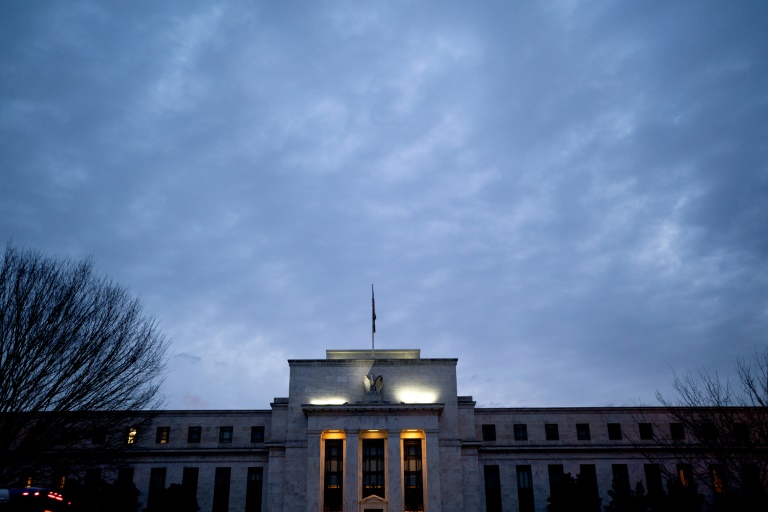
The US Federal Reserve has strongly signaled it will raise interest rates by half a percentage point this week to rein in soaring inflation, and likely continue hiking throughout this year.

The Fed has long played a decisive role when the world’s largest economy faces tough times. Here are some of its major actions since the 2008 global financial crisis:

– The financial crisis and recovery –

November 2008: The Fed began injecting liquidity into financial markets following the collapse of Lehman Brothers investment bank. The central bank launched three such programs before ending asset purchases in June 2014.

December 2008: The central bank cut its lending rate to zero amid the crisis, where it remained until December 2015.

October 2017: The Fed began reducing the holdings on its balance sheet, which had ballooned from less than $900 billion before the crisis to $4.5 trillion.

– Trade war slows growth –

December 2018 to August 2019: Interest rates peaked in the range of 2.25 percent to 2.5 percent.

Fall 2019: The Fed cut rates several times to the 1.5-1.75 percent range as the trade war launched by then-president Donald Trump slowed growth. The Republican leader had criticized the bank for its high rates.

– Support during the pandemic –

March 3, 2020: The Fed cut its lending rate by 50 basis points to between one and 1.25 percent.

March 16, 2020: As Covid-19 spread across the country and the economy shut down, the Fed slashed its lending rate by 100 basis points to zero and resumed its asset purchase policy, which eventually reached $120 billion per month in Treasury bonds and mortgage-backed securities.

– Economy recovers, inflation arrives –

November 3, 2021: The Fed announced it will begin slowing the pace of its asset purchases, with a view towards ending them entirely by the following June, which would set the stage for rate hikes to fight inflation.

December 15, 2021: Recognizing that inflation will not be “transitory,” as top officials had believed, the central bank accelerated the end of its asset purchases to March.

March 16, 2022: The central bank raised interest rates for the first time since 2018 to the 0.25-0.50 percent range.

April 6, 2022: The minutes from the Fed’s March policy meeting are released, showing that many participants see one or more 50-basis point rate hikes as necessary if inflation pressure continues.

April 29, 2022: The Fed’s preferred inflation gauge, the personal consumption expenditures price index, rises 6.6 percent year-on-year and 0.9 percent month-on-month in March, both faster paces than the month prior.

Fed gears up to attack inflation as US recession fears grow

The Federal Reserve this week is set to redouble its assault against record US inflation while facing an array of shocks both internal and external that analysts fear may one day put the world’s largest economy into a recession.

The policy setting Federal Open Market Committee (FOMC) will convene its two-day meeting on Tuesday, and top officials have strongly signaled they will hike interest rates by half a percentage point and announce plans to reduce their massive holdings of debt.

Both moves would further tighten lending conditions in the world’s largest economy and potentially take the steam out of consumer prices that are rising at rates not seen since the 1980s — driven, in part by the Fed’s own policies.

The rate hike is expected to be one of several the Fed makes this year, but with the economy also facing shocks from Russia’s invasion of Ukraine and Covid lockdowns in China, analysts warn the central bank must strike a delicate balance to stop a downturn.

“They’re going to have to be very, very nimble to keep the economy from going into a ditch,” Jay Bryson, managing director and chief economist at Wells Fargo’s Corporate and Investment Bank, said in an interview. 

– No more easy money –

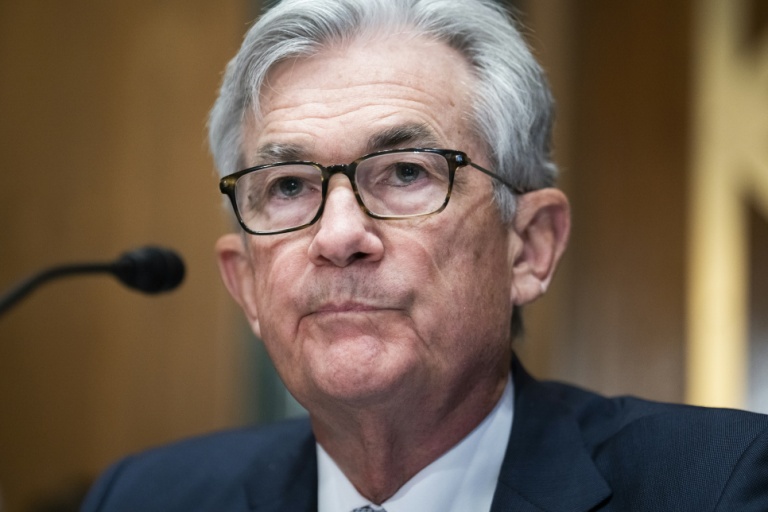
Top Fed officials including Chair Jerome Powell have hinted strongly that a half-percentage point hike will be agreed to at the May 3-4 meeting, twice the amount of the quarter-point hike the FOMC implemented in March.

The central bank is also expected to announce plans to begin offloading the trillions of dollars in Treasury bonds and mortgage-backed securities it bought during the pandemic to support the economy, which would raise borrowing costs.

“They told us everything in advance,” said Roberto Perli, head of global policy at Piper Sandler. “I’d be shocked if they do anything different at this point.”

With consumer prices 8.5 percent higher in March compared to the same month in 2021, raising rates has become an imperative for the Fed, which cut rates to zero as the pandemic began but attracted criticism for keeping them there throughout last year, even as inflation rose.

“Inflation is still very high by all means, so full speed ahead for now with the hawkish rhetoric,” Perli said.

– Beyond their control –

The Fed’s tools are sharpest at pressuring demand, but the US economy is also being battered by shocks emanating from beyond its borders and therefore the central bank’s control, creating fears the Fed will raise rates, inflation will stay high and a downturn will follow.

The war in Ukraine has prompted a global spike in prices for oil as well as other commodities, while the pandemic lockdowns in China could worsen global supply snarls that have bedeviled the US economy in its recovery.

“They’re not very well equipped to deal with these shocks,” Perli said.

A recession is not viewed as imminent, despite last week’s release of government data showing GDP shrank in the first quarter of this year, which economists see as a consequence of trade issues that swamped otherwise healthy consumer and business spending.

The grim scenario could instead arrive next year, and Bryson said a harbinger would be if prices remain elevated even as the Fed tightens its lending rate.

“The probability of a recession is not insignificant at this point,” he said.

“If the inflation numbers continue to come in hot, then I’d say the probability of recession continues to go up.”

Perli sees signs that Powell himself worries about the Fed’s ability to pull off a “soft landing,” as the technique of quelling inflation without causing a recession is known.

In March, the Fed chair told a conference, “My colleagues and I will do our very best to succeed in this challenging task” — words Perli said he found troubling.

“It’s not a way of putting things that denotes a lot of confidence,” he said.

Risking jail and Church ire, Russian priests condemn Ukraine conflict

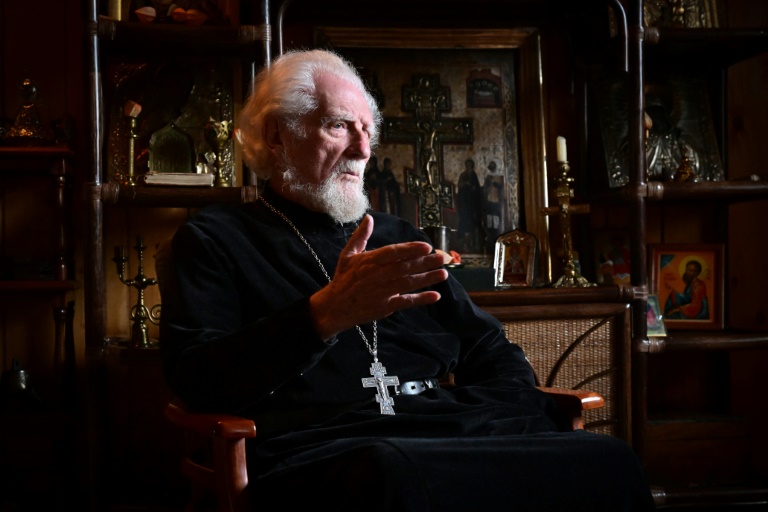
Father Georgy Edelshtein is keen to debate those who disagree with his opposition to Russia’s military campaign in Ukraine. 

“I’d like to see one or two of my opponents sitting right here,” the 89-year-old says, pointing to an empty armchair in his living room full of gilded icons.

The white-bearded priest in a black cassock is one of the few Russian Orthodox priests to have spoken out against Moscow’s military operation in Ukraine.

In a quavering voice, but without hesitation, he explains: “I’m afraid I am a bad priest. I’ve never been against all wars but I’ve always been against any land-grabbing, aggressive war.”

Ukraine “is an independent state and let them build their state as they see necessary,” he tells AFP in his house in the hamlet of Novo-Bely Kamen on the banks of the River Volga in the Kostroma region, a six-hour drive from Moscow.

Since Russia launched its military action on February 24, only a handful of priests from the Russian Orthodox Church led by Moscow Patriarch Kirill — which counts some 150 million believers across the world — have spoken out openly against the Kremlin’s military campaign.

Kirill has given a series of increasingly bellicose sermons, calling for Russians to “rally around” the authorities to help conquer “enemies” he accuses of trying to destroy historic unity between Russia and Ukraine.

Since he started heading the Church in 2009, Kirill has sought closer ties with President Vladimir Putin’s government, backing conservative values over Western liberalism.

The Russian Orthodox Church was severely restricted and under KGB control in the USSR.

Even after the 1991 collapse of the Soviet Union it has never encouraged criticism of the authorities, but some priests are nevertheless speaking out. 

– ‘Blood on hands’ –

On February 25, a day after the military operation began, Edelshtein signed a letter written by a priest friend, Father Ioann Burdin, that was posted on the website of Burdin’s parish church in the village of Karabanovo in the Kostroma region.

“The blood of Ukrainian residents will remain on the hands not only of the rulers of Russia and soldiers carrying out this order. Their blood is on the hands of each of us who approve this war or simply remain silent,” said the post, which was later deleted.

Metropolitan Ferapont of Kostroma, a highly placed monk, condemned the letter, saying that only two priests out of 160 in the region opposed the operation.

But their protests did not stop there.

On March 6, Burdin preached about the human cost of the ongoing fighting.

The very same day he was summoned for questioning by investigators.

On March 10, he was ordered to pay a fine of 35,000 rubles ($489/450 euros) for “discrediting” the armed forces, punishable by up to three years in prison for a repeat offence.

Four people testified against him in court.

“During the sermon, Father Burdin… told us that he was going to pray for Ukraine,” a female parishioner said according to court documents seen by AFP.

– ‘Satanist’ –

Burdin, 50, continues to condemn the military action.

“For me, the commandment ‘Thou shalt not kill’ is unconditional,” he told AFP at his house close to Kostroma.

He says few priests oppose the conflict because many are susceptible to “propaganda”, combined with the fear of sanctions and prosecution.

Burdin, who teams his black cassock with a baseball cap and has a Telegram channel, says police have photographed his house and car.

Edelshtein says that Burdin is “braver than me, I am retired.” 

He did not face any state sanction for signing Burdin’s letter and had already largely retired from the Church, while still allowed to hold services.

Edelshtein had a Jewish father while his mother was a Polish Catholic. He converted to Orthodoxy in 1955, hoping to escape the Soviet system.

Yet Church leaders were “lackeys of the Communist regime,” he says, and “Satanist” Joseph Stalin revived the current Moscow Patriarchy.

The two priests do not present themselves as dissidents, however, and in the name of Church unity say they are not calling for believers to disobey the Patriarch.

“If a person commits a personal sin, he himself rebels (against God), not the whole Church with him,” Burdin says.

His recent setbacks have hit him hard, nonetheless. In early April he withdrew from active service and is thinking about whether to stay in the Church.

The son of a priest, he was ordained in 2015 after a career in journalism. 

“If I’m within the Church but censoring myself as I speak, if I’m silent about a sin being a sin, and about bloodshed being unacceptable, then I will just gradually, without noticing, stop being a pastor,” he says.

Lebanese students in limbo after fleeing Ukraine war

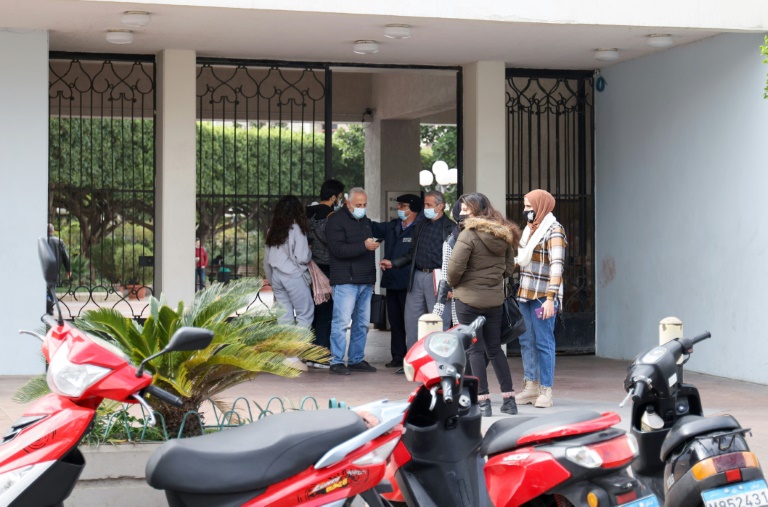
Lebanese university students who fled Ukraine are now struggling to complete their education back home, facing a precarious future as an unprecedented economic crisis crushes their country and their career prospects.

“Even war is better than being here,” said 25-year-old Yasser Harb, who left Kyiv just two days before Russia invaded Ukraine on February 24.

The final-year medical student is now back in a country where electricity is scarce, public services are dysfunctional at best, the local currency has collapsed and living costs have skyrocketed.

He and fellow students are now battling to continue their studies remotely, while others face interruptions amid obstacles to transferring their enrolment.

Beirut said in late March that around 1,000 students had managed to leave Ukraine, long a destination for Lebanese seeking more affordable universities.

At least 340 of them have registered with Lebanon’s education ministry to continue their studies.

But Education Minister Abbas Halabi said none of those registered had joined a private university in Lebanon, noting that most had arrived mid-semester.

He acknowledged that students “whose universities in Ukraine were bombed could not even recover their transcripts” to proceed with re-enrolment back home.  

Bassam Badran, president of the country’s only public university, the Lebanese University, said returning students would have to wait until the next academic year to enrol. 

“They will have to pass the entrance examination at the start of the next school year,” he said.

– ‘No sense’ – 


Since returning, Harb has been struggling to complete his degree online from his family home in south Lebanon, as power cuts of up to 23 hours a day wreak havoc with his internet connection and his studies.

Even electricity from expensive private generators can be unstable and rarely covers the gaps.

“Slow internet makes it hard to understand what our teachers are saying and affects our grades,” he told AFP, adding that he was thinking of returning to Ukraine once flights resume.

The capital Kyiv has managed to maintain electricity supply despite the ongoing conflict, and public transport has remained functional, with life steadily resuming a semblance of normalcy. 

“In Kyiv, at least I had all the basic services,” Harb said.

Samer Dakdouk, a fifth-year medical student at university in Kharkiv, is also struggling to adjust to studying from remote in Lebanon.  

“Nothing is easy for us here,” said the 23-year-old, who occasionally interns at a hospital in Beirut.

“Hospital positions are rare in Lebanon but practice is crucial,” he said.

“Having an online medical degree makes no sense.” 

– ‘Burden’ – 

Lebanon’s economic crisis has spurred an exodus, with many of the country’s educated youth, as well as medical professionals, among those flooding out.

Its higher education system, once a source of national pride, has also taken a battering. 

According to the Arab Barometer survey published in April, nearly half of Lebanon’s population is looking to leave. 

Nathalie Deeb, 24, managed to flee Ukraine for Germany and continue her medical studies remotely from there. 

“I didn’t go back to Lebanon because Germany offers more opportunities and I don’t want to burden my parents,” she said. 

Since 2019, the Lebanese pound has lost more than 90 percent of its value, and the monthly minimum wage — once equivalent to $450 — is now worth about $25. 

Deeb said annual tuition fees at her university in Kyiv were around $4,400 per year — five times less than re-enrolling at the average private Lebanese university.

The faculty of medicine at the public Lebanese University is saturated with applicants and only accepts a select few. 

Deeb’s father already had to sell their family home in Beirut and move back to his native village in south Lebanon so he could afford to pay for her studies in Ukraine.

She said she was “lucky” to have been able to stay in Europe instead of returning to Lebanon.

“Those who went back regret it,” she said.

Close Bitnami banner
Bitnami