World

Gabon counts on visitors to help preserve great apes

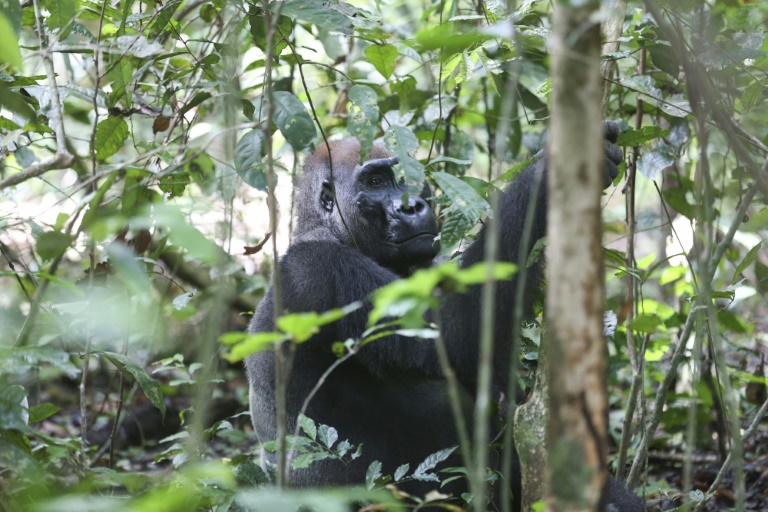
Around a bend on a narrow trail that runs deep into the forest of Gabon’s Loango national park, Kamaya comes into view. The huge silverback gorilla coolly watches visitors arrive, then goes back to his meal.

Perched on a strong branch, the 150-kilo (330-pound) beast greedily pulls more leaves from the tree to his mouth with a slow but powerful movement before lumbering down the trunk. Soon he dozes off calmly.

After two years of a total shutdown due to the Covid-19 pandemic, the executive secretary of the National Parks Agency (ANPN) has decided to resume public observations of Gabon’s gorillas, hoping the iconic species will serve as a “loss leader” to boost niche tourism.

That Kamaya and his family of about 10 individuals are so used to humans is the outcome of long labours by a team of trackers and scientists who also collect data.

They work to win funds to protect a species threatened with extinction and to attract foreign visitors.

Spending one hour with Kamaya and his group costs 300,000 CFA francs, (450 euros, almost 500 dollars), on top of charges for access to the site and accommodation.

Loango Park, which covers more than 155,000 hectares (380,000 acres) of the densely forested country, offers ample reward for a 4-5 hour road journey from Port-Gentil, the second city, followed by the track and a final stage by boat.

Though steep, the price is much lower than that paid to see the mountain gorillas in Uganda or Rwanda. It also generates income to manage protected areas that provide a safe place for the animals.

— ‘Illegal activities’ —

“Tourism is a beneficial conservation strategy for gorillas,” says Koro Vogt, manager of the Gorilla Loango project. The mountain gorillas of Rwanda and Uganda were almost extinct before funds from tourism helped to double their numbers in three decades, attaining a population of about 1,000 individuals today.

The western gorillas are far more numerous. Their total population is estimated at 360,000 individuals across six central African countries, about a quarter of them in Gabon. The Loango park is home to nearly 1,500 gorillas, some 280 kilometres (175 miles) south of the capital Libreville.

However, scientific studies by the Max Planck Institute for Evolutionary Anthropology, which specialises in great apes, indicate that the number of western gorillas is falling by three percent each year due to the destruction of  habitat, poaching and disease.

These threats are heightened by increased access to remote areas occupied by gorillas, the bush meat trade, corruption and lack of law enforcement.

Protected areas such as Loango, which are theoretically perfectly safe for animals, are home to only about 20 percent of the great apes in Gabon.

“To safeguard the gorillas, our guards patrol the national parks to reduce illegal activities and catch poachers,” says Christian Tchemambela, executive secretary of the ANPN.

“This species emblematic of Gabon is also a strong draw for foreign visitors. The development of ecotourism is at the heart of our strategy,” he adds. From June 2016 until the beginning of 2020, 845 tourists were able to observe the gorillas on site.

— ‘Gain their trust’ —

A ray of sunlight pierces the treetops and shines on Mokebo, a 15-year-old female, and the little one she is carrying on her back. Not yet a year old, Etchutchuku stirs, glances at the few people watching him, and hides shyly behind his mother.

Close by, a nearly adult male, Waka, approaches the observers out of curiosity. He is unafraid, shows no signs of aggression and settles peacefully a few metres (feet) away.

“This process is very long, it takes years to gain their trust and we are not sure of succeeding,” says eco-guide Hermann Landry.

“You have to follow them every day, all year round, relentlessly. Sometimes you lose track of them for several days and that’s serious, because they can regain their natural fear of humans,” adds Landry, a former poacher who declares that he “fell in love” with gorillas and conservation work.

During an initial habituation phase, gorillas are afraid of humans and run away when approached. In the next phase, they stop fleeing but may react with aggressive charges.

In the final phase, they react calmly and continue their activities without concern about the human presence.

Today, Gabon is counting on the gorillas to attract new visitors.

There are two family groups in the country accustomed to humans, one in Loango, the other in the Moukalaba Doudou National Park 600 kilometres (370 miles) south of Libreville. However, tourist infrastructure is still almost non-existent.

Will Twitter's 'poison pill' be too tough for Elon Musk to swallow?

The so-called “poison pill” Twitter has proposed to use against Elon Musk’s potential hostile takeover is a mechanism with a proven track record that could force the outspoken entrepreneur into negotiations.

To halt a takeover, the board plans to activate the pill if the Tesla CEO comes to own more than 15 percent of Twitter. 

He already holds 9.2 percent of the company, and said Thursday he has ready the $46.5 billion necessary to make an offer for the rest.  

Such a “pill” would allow other Twitter shareholders to purchase shares at half price, increasing the amount of shares in circulation and weakening Musk’s influence. 

It would then be nearly impossible for him to take total control of the company without having to spend significantly more than he had originally planned. 

“The dilution created by this defense has generally served its intended deterrence effect,” explained Eric Wehrly, associate professor of finance at Western Washington University. 

The “poison pill” was invented 40 years ago by business lawyer Martin Lipton to counteract a wave of hostile takeovers on Wall Street. 

“It was the age of the corporate raiders,” Lipton explained to the media site The Deal in 2011, from investors such as Carl Icahn to Kirk Kerkorian.  

Quickly contested in court, the practice was declared legal for the first time in 1985 by the Delaware Supreme Court — a tax friendly state where Twitter, although officially based in Californian, is incorporated.

“Delaware is the home to roughly half of publicly traded companies in the US and has fairly well established law regarding the implementation of poison pills,” said Jon Karpoff, a finance professor at the University of Washington. 

“Unless there’s something unusual about Twitter’s pill, which I would highly doubt… Musk would be unlikely to have a successful legal challenge,” he said.

Boston College associate law professor Brian Quinn doesn’t think the issue will even end up in court. 

“Elon Musk has no case,” he said. 

– Negotiate and rally –

An alternative to acquiring the majority of the company would be for Musk to change the makeup of the board, according to Quinn, installing new members more in line with his vision for Twitter. 

But the agenda for Twitter’s next general meeting, on May 25, is already set, meaning Musk would have to wait until the next general meeting in 2023 to even bring it up. 

And the board of directors can only be removed in batches, anyways.

Some members’ terms are up this year, while others will remain in their position until 2023, 2024 or 2025.

Musk wouldn’t be able to win over a majority of the board until at least 2024.

According to Quinn, “there’s no record of an acquirer overcoming the pill by replacing the board through two successive elections.”

“The only option for an acquirer is to negotiate with the board of directors,” Quinn said, presumably by proposing an even higher offer, but without any guarantee of success.

And in the event of a negotiation, Musk wouldn’t be able to count on the support of former Twitter head and co-founder Jack Dorsey, unless there is a quick resolution.

Dorsey, who has previously expressed affinity for the billionaire, announced after his resignation in November that he would not run for another term as director and would step down after this year’s meeting. 

In tandem with the official negotiations, Musk would have to start making his case to shareholders, according to Karpoff, a task which has already begun — mainly by tweeting. 

“And I think his personal popularity among a lot of people will help them in that,” Karpoff said. 

“I wouldn’t be surprised if we even got a bunch of retail investors involved in struggling to acquire Twitter shares, and joining the attempt to pressure board members to strike a deal with Musk.”

China axes 15 coal plants abroad after Xi pledge, but loopholes remain: study

More than a dozen Chinese coal power projects overseas were cancelled after a ban last year on funding such plants, but loopholes could allow 18 others to still go ahead, according to a study published Friday.

China is the world’s biggest emitter of the greenhouse gases driving global warming. It has vowed to peak carbon emissions by 2030 and become carbon-neutral by 2060, but these do not include its fossil-fuel investments abroad.

It is also the largest public funder of overseas coal plants, and was planning to build 67 in more than a dozen countries when President Xi Jinping announced a ban on financing “new projects” in September.

Since then, Chinese developers have cancelled 15 overseas coal projects as funding dried up and host countries demanded greener alternatives, a study by the Helsinki-based Centre for Research on Energy and Clean Air (CREA) said.

The cancelled projects would have generated 12.8 gigawatts of electricity — or the total power generation capacity in Singapore, the think tank added.

But a lack of clear rules has allowed Chinese developers to continue to build new coal power projects, it warned.

“The key concern is that China will continue to fund or build new coal projects to power industrial parks under the Belt and Road Initiative,” said Isabella Suarez, a researcher at CREA, referring to Xi’s $1 trillion global infrastructure push.

“The loophole is that because the industrial parks have been years in the making, additional coal on these projects would not be considered new, even if… tenders are happening after the pledge to ban coal funding.”

– Deadly impact –

China’s top economic planner issued vague guidelines in March, telling developers to “proceed cautiously” on coal plants that were in the final stages of planning.

These could potentially stop Chinese funding for 32 planned coal plants and prompt the “reexamination” of 36 others that are under way, according to the CREA report.

However, “about 18 coal projects (in the pipeline) that can generate 19.2 Gigawatts of power have already secured financing and permits… and could still go ahead,” Suarez said.

AFP has sought comment on the report from the National Development and Reform Commission, China’s economic planner.

Most of these projects are in Indonesia, where China is investing billions to mine nickel and other minerals needed to build electric vehicles, according to data from the Global Energy Monitor.

Vietnam and Bangladesh have in recent months requested China to build gas projects instead of the agreed coal projects, according to government notices.

The deadly impact of climate change — from extreme heatwaves to more intense superstorms — is already being felt across the world.

Experts say emissions must be halved within a decade to limit global warming to well below 2 degrees Celsius (36 degrees Fahrenheit) or ideally to 1.5C as stated in the Paris climate accord.

China axes 15 coal plants abroad after Xi pledge, but loopholes remain: study

More than a dozen Chinese coal power projects overseas were cancelled after a ban last year on funding such plants, but loopholes could allow 18 others to still go ahead, according to a study published Friday.

China is the world’s biggest emitter of the greenhouse gases driving global warming. It has vowed to peak carbon emissions by 2030 and become carbon-neutral by 2060, but these do not include its fossil-fuel investments abroad.

It is also the largest public funder of overseas coal plants, and was planning to build 67 in more than a dozen countries when President Xi Jinping announced a ban on financing “new projects” in September.

Since then, Chinese developers have cancelled 15 overseas coal projects as funding dried up and host countries demanded greener alternatives, a study by the Helsinki-based Centre for Research on Energy and Clean Air (CREA) said.

The cancelled projects would have generated 12.8 gigawatts of electricity — or the total power generation capacity in Singapore, the think tank added.

But a lack of clear rules has allowed Chinese developers to continue to build new coal power projects, it warned.

“The key concern is that China will continue to fund or build new coal projects to power industrial parks under the Belt and Road Initiative,” said Isabella Suarez, a researcher at CREA, referring to Xi’s $1 trillion global infrastructure push.

“The loophole is that because the industrial parks have been years in the making, additional coal on these projects would not be considered new, even if… tenders are happening after the pledge to ban coal funding.”

– Deadly impact –

China’s top economic planner issued vague guidelines in March, telling developers to “proceed cautiously” on coal plants that were in the final stages of planning.

These could potentially stop Chinese funding for 32 planned coal plants and prompt the “reexamination” of 36 others that are under way, according to the CREA report.

However, “about 18 coal projects (in the pipeline) that can generate 19.2 Gigawatts of power have already secured financing and permits… and could still go ahead,” Suarez said.

AFP has sought comment on the report from the National Development and Reform Commission, China’s economic planner.

Most of these projects are in Indonesia, where China is investing billions to mine nickel and other minerals needed to build electric vehicles, according to data from the Global Energy Monitor.

Vietnam and Bangladesh have in recent months requested China to build gas projects instead of the agreed coal projects, according to government notices.

The deadly impact of climate change — from extreme heatwaves to more intense superstorms — is already being felt across the world.

Experts say emissions must be halved within a decade to limit global warming to well below 2 degrees Celsius (36 degrees Fahrenheit) or ideally to 1.5C as stated in the Paris climate accord.

Cash-strapped Sri Lanka hit by record inflation

Crisis-hit Sri Lanka’s inflation hit a record high for the sixth consecutive month, official data showed on Friday as the government asked the IMF for an urgent bailout.

The broad-based National Consumer Price Index (NCPI) rose 21.5 percent year-on-year in March, more than four times the 5.1 percent inflation of a year earlier.

Food inflation in March stood at 29.5 percent, according to the latest data from the Department of Census and Statistics.

The figures are likely to rise further: the state-run oil company has subsequently raised the price of diesel, commonly used in public transport, by 64.2 percent.

The worsening economic crisis has led to clashes at nationwide demonstrations calling on President Gotabaya Rajapaksa to step down over mismanagement and corruption.

Sri Lanka asked the International Monetary Fund this week for emergency assistance, but was told that the South Asian nation’s $51 billion external debt was “unsustainable” and must be “restructured” before any help.

“When the IMF determines that a country’s debt is not sustainable, the country needs to take steps to restore debt sustainability prior to IMF lending,” the Fund’s country director Masahiro Nozaki said in a statement on Wednesday.

“Approval of an IMF-supported program for Sri Lanka would require adequate assurances that debt sustainability will be restored.”

The government has announced a default on its foreign debt and said precious foreign exchange will be reserved to finance essential food and medicines.

Police clashed with protesters in central Sri Lanka on Tuesday, killing one of them and wounding nearly 30.

At least eight people have also died waiting in long lines for fuel in the past six weeks.

The country’s foreign exchange shortage has led to a slowing down of imports, including essentials. 

Shops have rationed the quantity of rice, milk powder, sugar, lentils and tinned fish sold to consumers.

Sri Lanka’s economy has collapsed since the onset of the pandemic, with a nosedive in tourism revenue as well as foreign worker remittances.

Musk says he has financing to take Twitter buyout bid to investors

Elon Musk has lined up $46.5 billion in financing for a possible hostile takeover of Twitter and is “exploring” a direct tender offer to shareholders, according to a securities filing released Thursday.

Musk’s filing pointed to a $13 billion debt facility from a financing consortium led by Morgan Stanley, a separate $12.5 billion margin loan from the same bank, as well as $21 billion from Musk’s personal fortune.

The Tesla chief, who has been rebuffed by the Twitter board, is “exploring whether to commence a tender offer… but has not determined whether to do so at this time,” the filing said.

Still, shares of Twitter did not rise significantly, suggesting skepticism that a deal will happen.

The world’s richest man on April 14 launched an unsolicited bid to buy Twitter for $54.20 a share, saying the influential microblogging platform had fallen short of free-speech imperatives.

The following day, Twitter moved to defend itself against the $43 billion takeover effort, announcing a “poison pill” plan that would make it harder for the billionaire to get a controlling stake in the social media company.

Despite Musk’s great wealth, the question of financing had been seen as a potential stumbling block because much of Musk’s holdings are in Tesla shares rather than cash.

Shares of Twitter fluctuated Thursday, finishing at $47.08, up 0.8 percent but far below the $54.20 price in Musk’s offer. That suggests investors remain skeptical a deal will happen, said Eric Talley, a professor a Columbia Law School specializing in corporate law and mergers.

“I think a lot of people feel like either the board isn’t going to start talking to Elon Musk, or that Elon Musk might just decide to chase a different rainbow the day after tomorrow, and this will all have been a big fever dream,” Talley told AFP.

– Closer to deal? –

Analysts noted that Twitter’s poison pill poses a big challenge to any effort not backed by the board.

The defense established by Twitter kicks in if an investor buys more than 15 percent in shares without the directors’ agreement. Musk holds nine percent.

The manuever makes it harder for a buyer to build too big of a stake without board approval, by triggering an option that allows other investors to buy more of a company’s shares at a discount.

CFRA Research Angelo Zino said Musk’s effort still faces significant hurdles in light of the Twitter board’s opposition to his proposal and the poison pill mechanism.

“Despite the filing, we don’t believe it puts Musk any closer towards reaching a deal,” Zino said. 

“We think Musk could look to increase his stake closer to 15 percent to put additional pressure on Twitter, but we think he will ultimately need to have constructive conversations with the board to be successful.”

Musk’s efforts have raised hopes about the commercial potential of Twitter, which has struggled to achieve profitable growth despite its influential spot in culture and politics. 

But the polarizing Tesla CEO’s campaign also has sparked concern among technology and free-speech experts who point to Musk’s unpredictable statements and history of bullying critics, which contradict his stated aims.

Under Parag Agrawal, who took over as Twitter CEO late last year, the company has made progress on new monetization features, such as subscription products, said a note from Truist Securities, adding that “short-term, Musk’s involvement at this stage runs the risk of disrupting those efforts.”

Talley noted that Musk thus far has not released a “creative revenue generation plan,” adding that Musk may have such a document, “but he certainly hasn’t unveiled it.”

CNN to close streaming service after one month

CNN will shut down its new streaming service next week, just one month after launching it with much fanfare, the US network announced Thursday.

CNN+ was billed as one of the most significant developments in the television channel’s history but will close on April 30.

The decision was made by new management after CNN’s former parent company, WarnerMedia, merged with Discovery to form Warner Bros. Discovery earlier this month, CNN Business said.

“While today’s decision is incredibly difficult, it is the right one for the long-term success of CNN,” Chris Licht, the incoming president of CNN, wrote in a memo to staff, according to the New York Times.

“It allows us to refocus resources on the core products that drive our singular focus: further enhancing CNN’s journalism and its reputation as a global news leader.”

CNN+ was launched on March 29, with the network investing tens of millions of dollars in the venture and running an aggressive marketing campaign as it tried to break into America’s competitive streaming marketplace.

It had also lured talent from other networks including former Fox News anchor Chris Wallace.

Hundreds of CNN+ staff, many of whom had only just been hired, were told of the decision to close on Thursday.

WHO 'strongly recommends' Pfizer's Covid pill

The World Health Organization said Friday it “strongly recommended” Pfizer’s Covid-19 antiviral pill Paxlovid for patients with milder forms of the disease who were still at a high risk of hospitalisation.

However the UN agency warned it was “extremely concerned” that the inequality in access seen with Covid vaccines would again leave low- and middle-income countries “pushed to the end of the queue”.

US pharma giant Pfizer’s combination of nirmatrelvir and ritonavir was the “superior choice” of treatment for unvaccinated, elderly or immunocompromised people with Covid, the WHO’s experts said in the BMJ medical journal.

For the same patients, the WHO also made a “conditional (weak) recommendation” of the antiviral drug remdesivir made by US biotech firm Gilead — which it had previously recommended against.

The WHO recommended Paxlovid over remdesivir, as well as over Merck’s molnupiravir pill and monoclonal antibodies.

Pfizer’s oral treatment prevents hospitalisation more than the “available alternatives, has fewer concerns with respects to harms than molnupiravir, and is easier to administer than intravenous remdesivir and antibodies,” the WHO’s experts said.

The new recommendation was based on the findings of two trials involving almost 3,100 patients which showed that Paxlovid reduced the risk of hospital admission by 85 percent.

The trials also “suggested no important difference in mortality” and “little or no risk of adverse effects leading to drug discontinuation”. 

The recommendation applies to people over the age of 18, but not to pregnant or breastfeeding women.

It also does not apply to patients with a low risk of complications from the disease, because the benefit would be minimal.

The WHO’s experts also declined to give an opinion for patients with severe forms of the disease, due to a lack of data.

– Limitations and inequities –

The WHO stressed the limitations of such antiviral treatments. 

“The medicine can only be administered while the disease is at its early stages,” they said.

This means the patients must quickly test positive and be prescribed the pill by a doctor — all of which can pose obstacles for low- and middle-income countries, the WHO said.

Yet Covid pills have been seen as a potentially huge step in ending the pandemic as they can be taken at home, rather than in hospital.

Patients must start taking their Paxlovid pills within five days of the onset of symptoms — the course then lasts five days.

Remdesivir can be taken within seven days of symptoms setting in, but it is administered intravenously over three days.

– Questions about cost –

The WHO called on Pfizer to “make its pricing and deals more transparent” for Paxlovid.

Lisa Hedman, the WHO’s senior advisor on access to medicines, said that radio station NPR reported a full course of Paxlovid costs $530 in the United States. Another source unconfirmed by WHO gave the price of $250 in an upper-middle income country.

Remdesivir meanwhile costs $520, Hedman said, but generic versions made by companies in India sell for $53-$64. 

There is also a question mark over whether the virus could build resistance to these treatments.

But earlier this month Pfizer CEO Albert Bourla predicted a bright future for treatments like Paxlovid as people grow tired of getting further booster vaccinations.

Coming under fire for prioritising wealthy countries with its vaccine, Pfizer has agreed to allow some generic drugmakers around the world to make cheaper versions of Paxlovid under a UN-backed scheme. 

But on Friday the WHO “strongly recommended” that Pfizer let more generic manufacturers produce the drug and “make it available faster at affordable prices”.

Ecotourism giving rare iguanas a sweet tooth

Ecotourists feeding grapes to rock iguanas on remote islands in the Bahamas have given them a sweet tooth and high blood sugar, researchers said Thursday, warning of unknown effects on the health of the vulnerable reptiles.

Northern Bahamian rock iguanas living on the Exuma Islands are so hooked on the tasty tourist treats that they rush to the beaches when they hear boats approaching. 

“For a tour operator it was a wonderful way to ensure that you would be able to see these animals and people would have these close and personal interactions,” said Charles Knapp, of the John G Shedd Aquarium in the United States.

Conservationists had already started to become concerned that the non-native fruit, delivered to the iguanas on the end of skewers, was making the large lizards less wary of humans and potentially vulnerable to smugglers for the pet trade. 

But those closely involved with the creatures began to suspect the diets were causing even more of an upset. The clue was in their poo. 

A Northern Bahamian rock iguana which consumes the leaves and fruiting plants that nature intended has faeces that scientist Susannah French, of Utah State University, likens to a “Cuban cigar — a bunch of rolled up leaves”.

The excretions of those that had developed a taste for the tourists’ grapes are a watery mess.   

That prompted researchers to look into the impacts of these sugar-packed diets on the iguanas’ bodies. 

Their study, published in the Journal of Experimental Biology, first looked in the lab at the effects of a high glucose diet on common green iguanas. 

“We were able to then basically deliver glucose over time to mimic the sort of intake these iguanas in the field were getting,” French told AFP. They found that these animals struggled to regulate their blood glucose levels.  

– Harmful habit? –

Next researchers travelled to the Bahamas and captured a total of 48 iguanas on four islands, half from populations frequented by tourists and the other half from more sheltered and remote outcrops.     

Each iguana was fed a glucose drink and researchers then monitored their blood sugar for almost a day. 

They found that those on the islands visited by tourists had the highest glucose peaks, with some remaining high for hours, while those iguanas that never saw humans saw levels rise at a slower rate and return to normal more quickly.

While the researchers concluded that the sugary feeding regime affects iguanas physically, they do not yet know how it might impact their health. 

“In other species, this would be a pathology. We would say yes this is diabetes if it was mice or humans,” said French, who said that further research would investigate a range of potential health effects, from impacts on immunity to reproduction. 

Researchers are also looking at how losing their appetite for their normal grazing of local plants might affect the wider environment on the islands. 

The iguanas are by no means the only species affected by well-meaning tourists packing inappropriate snacks. 

In 2018 researchers found green turtles fed by tourists in the Canary Islands had markers in the blood linked to high consumption of proteins and fat.

Knapp said conservationists acknowledge the importance of tourism for the Bahamas and said tour operators had shown willingness to evolve their tactics — switching from bread to grapes — to avoid harming the iguanas. 

But there has been a recent proliferation of smaller boat operations, he said, making it harder to make sure people were acting ethically. 

“We do not want to try to mandate a complete stoppage, we’re just trying to provide the information that they can then use to help develop a plan that perhaps is more sustainable,” he added. 

In war-torn Ukraine, dimmed hopes for escargot exports

Ivan Yuskevych used to export truckloads of edible snails from his Ukrainian farm to western Europe, but first coronavirus and now war have dashed production and emptied his restaurant.

As thousands of snails mated in a dark and humid room nearby, the former engineer recounted how he started the business with his wife in 2016 after tasting his first escargots on holiday in Greece.

“Before Covid, our farm produced 36 tonnes each season,” he said in a village outside the western city of Lviv, a rooster crowing in the background.

“We focused mainly on exports” to Italy, but also France and Spain, he said.

But with the coronavirus, “demand fell and so did prices, reducing our plan for Europe to zero”.

Yuskevych said they were just gearing up for a better season this year when Russia invaded in late February, sending the country’s economy into a tailspin.

Ukraine’s output is expected to shrink by 45 percent this year, the World Bank says.

The war has killed thousands of people, but also ravaged infrastructure, displaced millions from their homes, and drawn many men away from their jobs to the front.

– Snail caviar –

Agricultural exports decreased four-fold in March compared to February, the economy ministry has said, in a country famed for its wheat and sunflower oil.

In the relatively sheltered west of the country, authorities have called on businesses to reopen and make money to support the war effort.

But in the agrotourism section of his farm, Yuskevych said he was only planning to produce half the snails he had hoped for this year, and far less than in its heyday.

After his wife and son escaped abroad, he thought about halting production altogether.

Then he saw that staff from a sister farm in eastern Ukraine had fled their homes and wanted to work, and so he invited them to join him.

In the steamy room where his snails lay their spawn, it is now Iryna Yablinska’s job to delicately extract some of the white eggs from coconut peat, salt them, and turn them into caviar.

The rest will be relocated into polystyrene boxes to become larvae, and then into the garden to grow into fully-fledged adults.

Yablinska, her husband and two children — aged six and two — used to live in Kramatorsk close to the eastern front line, but fled on February 24 when they heard the first rockets.

– Chickens and war planes –

Today the farm may be empty of tourists, but at least the west of the country is more stable and her six-year-old is able to attend school online.

“We feel safe here,” she said.

In the garden, Yuskevych showed off a brood of black Silkie chickens, once a key attraction for visiting children. 

Like past diners in the restaurant, they too sometimes eat escargots, he said.

When he and his wife returned from Greece all those years ago, they discovered that people were foraging for snails in Ukraine, and sending them to Lithuania to be processed then sold in western Europe as a Lithuanian product, he said.

They thought they could cut out the middleman.

But it turned out the local variety was not really suitable for fine cuisine, so today their gastropods hail from North Africa.

As Yuskevych stood between his snail nursery and the chicken coops, a war plane flew low across the wintry April skyline.

He said planes and helicopters often dashed over the quiet village these days.

“Thank God they’re all Ukrainian,” he said.

Close Bitnami banner
Bitnami