World

End of an era as Netflix faces stagnation challenges

Having lost subscribers for the first time in more than a decade, Netflix faces the new challenge of stagnation from a position of strength.

A drop of just 200,000 users — less than 0.1 percent of its total customer base — was enough to send Wall Street panicking, with shares plunging more than 30 percent on Wednesday.

The loss of subscribers and the company’s various plans to revive business “change the historically simple story” of Netflix’s solid success, said Wells Fargo analysts, who cut its price target in half.

“The new outlook is clear as mud,” they said.

If the Q1 loss of subscribers might seem a blip at first blush, Netflix is signaling otherwise: The company anticipates a much larger drop in its second quarter — of around two million net subscribers.

“I’m not sure that’s a turning point” for Netflix, said Scott Zari of S&P Global Ratings.

“But I think it is indicative of maybe a new phase of slower growth,” he said.

Bank of America analysts said in a note that Netflix “made it clear that we can expect very low subscriber growth in ’22 and ’23 with no margin expansion.”

The shift was felt even in the tone of the company’s results presentation on Tuesday evening.

The affair focused less on the streamer’s mega hits such as “Bridgerton” and “Ozark” and more on combating the 100 million households who watch Netflix for free thanks to shared passwords.

“When we were growing fast, it wasn’t the high priority to work on,” co-founder Reed Hastings admitted. “And now we’re working super hard on it.”

Chief operating officer Gregory Peters said Netflix wasn’t trying to shut down sharing, “but we’re going to ask you to pay a bit more to be able to share.”

According to Zari, “future growth will be dependent on how can they monetize those households.”

– Advertising is coming –

To attract viewers, Netflix is preparing cheaper subscriptions with advertising — which it expects to roll out in the next couple years.

The Los Gatos, California-based company has long defended its no-ads model, which set it apart from competitors such as Disney+, HBO Max and Apple.

For Pivotal analyst Jeff Wlodarczak, streaming “appears nearly fully penetrated globally post-Covid,” and the companies now must set their sights on converting pirates into subscribers, gaining greater market share from each other and driving up prices.”

Increasing prices won’t help Netflix in the short term, though it raised its fees in January to the extent that it is now the most expensive among the major streamers.

“I think they’ll have to adjust their business,” said Paul Hardart, a professor at New York University, including “on the cost side, investing in content.”

For University of Richmond professor Joel Mier, Netflix’s price increases and axing of password sharing are “peripheral but meaningful” short-term solutions, while its long-term strategy remains “investing in local-content creation and establishing its gaming presence.”

With 221 million subscribers, “Netflix is by far the market leader in the streaming space,” Zari said.

“They’re very far ahead, particularly in the global marketplace,” said Hardart. “I think it will give them a lot of advantages.”

The problems Netflix faces are “not good news” for the company, he emphasized.

But as the global leader, whatever Netflix goes through, the other streamers are also likely to face eventually.

It’s “probably worse news for the other services that are starting to try to build themselves,” he said.

Red Cross denies Kyiv's accusation of working 'in concert' with Moscow

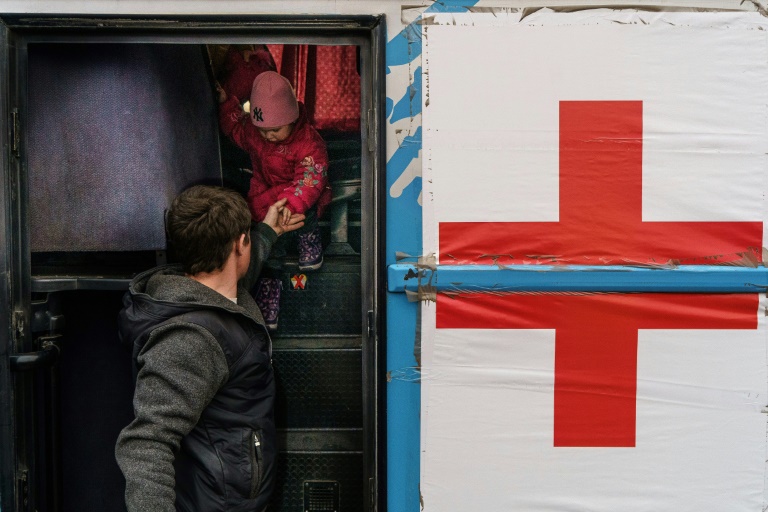
A senior Kyiv official on Wednesday accused the International Committee of the Red Cross of working “in concert” with Russia in Ukraine, a charge the organisation denied.

Ombudswoman Lyudmyla Denisova decried ICRC’s announcement last month that it was planning to open a branch in Russia’s southern Rostov region to help Ukrainian refugees, who, Kyiv says, have been forcibly deported to Russia.

“The International Red Cross is not fulfilling its mandate, I am certain of that,” Denisova said on Ukrainian television Wednesday after meeting with the head of the ICRC’s Ukrainian branch.

Citing data from the United Nations, Denisova said that some 550,000 Ukrainians, including 121,000 children, have been taken to Russia during the course of the war, but Kyiv has no information on who these people are and where they are being kept.

“Where are they? In filtration camps? In temporary facilities?” Denisova asked.

The official said she had asked both her Russian counterpart Tatyana Moskalkova and the ICRC for help in getting information on these refugees so that Ukraine could facilitate their return home, but had received “zero answer from her or from the Red Cross”.

Asked by the TV anchor whether Denisova suspected that the Red Cross was working “in concert” with Russia, Denisova replied: “Yes, I suspect they are.”

The ICRC strongly rejected Kyiv’s accusations.

“The ICRC does not ever help organize or carry out forced evacuations. We would not support any operation that would go against people’s will and international law,” the organisation said in a statement to AFP.

It added: “Building and maintaining a dialogue with parties to a conflict is essential to get access to all people affected and obtain necessary security guarantees for our teams to deliver life-saving aid.”

The Red Cross said it has been exploring the possibility to open an office in southern Russia.

“Our sole objective is to alleviate the suffering of the people affected by the armed conflict. And the suffering right now is simply immense.”

Gaza militants, Israel in biggest exchange of fire since last war

Palestinian militants fired volleys of rockets from Gaza into Israel, which responded with air strikes in the early hours of Thursday in the biggest escalation since an 11-day war last year.

A rocket from Gaza on Wednesday evening fell harmlessly in a garden in the southern Israeli city of Sderot, police said.

Israel struck back in central Gaza after midnight, witnesses and security sources said, prompting further launches of at least four rockets by militants in the besieged territory.

Israel’s army said its jets had targeted a military post and a tunnel complex “containing raw chemicals used for the manufacturing of rocket engines”. 

Hamas, the Islamist movement which rules Gaza, said it had fired surface-to-air rockets at Israeli planes.

The exchanges come after nearly a month of deadly violence in Israel and the Palestinian Territories, focused on Jerusalem’s flashpoint Al-Aqsa Mosque compound, known to Jews as the Temple Mount.

Hours earlier, Israeli police had blocked crowds of Jewish ultra-nationalist protesters from approaching the Muslim quarter of the Old City in east Jerusalem, aiming to head off an escalation after four weeks of violence that have left at least 36 people dead.

Last year, a similar ultra-nationalist march had been scheduled in the Old City when Hamas launched a barrage of rockets towards Israel, sparking the 11-day war.

Early Wednesday evening, more than a thousand ultra-nationalist demonstrators waving Israeli flags had gathered, some shouting “death to the Arabs”, but the police blocked them from reaching Damascus Gate and the Old City’s Muslim quarter.

Far-right lawmaker Itamar Ben Gvir, a controversial opposition politician, led the protest after being barred from the Damascus Gate area earlier in the day by Prime Minister Naftali Bennett. 

“I’ll say it clearly, I’m not going to blink, not going to fold,” Ben Gvir told AFP, as his fans chanted “Bennett go home!”

“I’m not allowed to enter Damascus gate,” the former lawyer said. “Based on what law?”

Bennett had said earlier in a statement he had blocked the rally for security reasons.

“I have no intention of allowing petty politics to endanger human lives,” he said.

“I will not allow a political provocation by Ben Gvir to endanger IDF (Israeli army) soldiers and Israeli police officers, and render their already heavy task even heavier.” 

Ben Gvir retorted Thursday that “some Jews don’t surrender to Hamas”.

– ‘Provocation’ –

Tensions are high as the Jewish Passover festival coincides with the Muslim holy month of Ramadan.

Palestinians and Israeli Arabs carried out four deadly attacks in Israel in late March and early April that claimed 14 lives, mostly civilians.

A total of 23 Palestinians have meanwhile been killed since March 22, including assailants who targeted Israelis, according to an AFP tally.

On Tuesday, Israel carried out its first air strike on the Gaza Strip in months, in response to the first rocket since January from the Palestinian enclave.

UN Secretary-General Antonio Guterres said he was “deeply concerned by the deteriorating situation in Jerusalem”.

He added that he was in contact with the parties to press them “to do all they can to lower tensions, avoid inflammatory actions and rhetoric”, according to a statement by his spokesperson in New York.

Bennett, himself a right-winger and a key figure in Israel’s settlement movement, leads an ideologically divided coalition government.

Earlier this month, his coalition lost its one-seat majority in the 120-seat Knesset, Israel’s parliament, after a member left in a dispute over the use of leavened bread products in hospitals during Passover.

Then on Sunday, the Raam party, drawn from the country’s Arab-Israeli minority, suspended its support for the coalition over the Al-Aqsa violence.

Right-wing lawmakers are under pressure to quit Israel’s government, which is seen by some on the right as being too favourable to Palestinians and Israel’s Arab minority.

Pnina, a 62-year-old civil servant demonstrating in Jerusalem on Wednesday, told AFP that “we want to go to all of Jerusalem, and our government is not letting us”.

gl-yz-az-par/reb

Le Pen, Macron in bitter clash ahead of tight French election

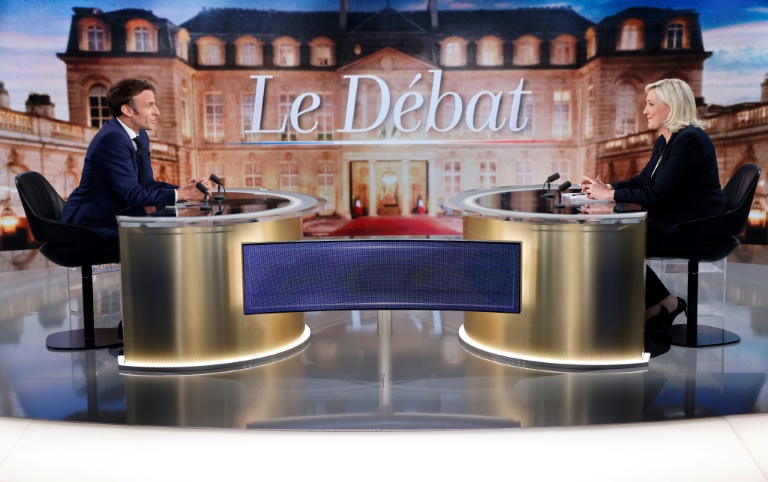
French President Emmanuel Macron and far-right rival Marine Le Pen on Wednesday clashed bitterly over relations with Russia and the Islamic headscarf as they sought to sway undecided voters in an acrimonious debate four days ahead of presidential elections.

France faces a stark choice in Sunday’s second-round run-off between the centrist Macron and the anti-immigration Le Pen, who will seek to become the country’s first far-right head of state in an outcome that would send shockwaves around Europe.

There was little cordiality in the bruising three-hour live televised debate, with Macron repeatedly seeking to land punches on Le Pen over her record, while she sought to keep the focus on the government’s performance. 

With Russia’s invasion of Ukraine overshadowing the campaign, Macron angrily zeroed in on a loan Le Pen’s party had taken from a Czech-Russian bank ahead of her 2017 election campaign.

“You are dependent on the Russian government and you are dependent on Mr (Russian President Vladimir) Putin,” Macron said. “When you speak to Russia you are speaking to your banker.”

Macron also referred to Le Pen’s past recognition of Russia’s 2014 annexation of the Ukrainian peninsula of Crimea. “Why did you do this?” he asked.

Le Pen replied that she was “an absolutely and totally free woman”, arguing that her party had only taken that loan as it could not find financing in France where banks refused to lend to her.

Macron adopted a variety of poses to express scepticism at her arguments, raising his eyebrows, leaning his chin on his fists and lamenting in apparent bewilderment “Madame Le Pen… Madame Le Pen!” 

– ‘Civil war’ –

The most explosive clash came when Le Pen confirmed she was sticking to her controversial policy of banning the wearing of the Islamic headscarf by women in public, describing it as a “uniform imposed by Islamists”.

Macron responded: “You are going to cause a civil war if you do that. I say this sincerely.” 

She also vowed to put an end to “anarchic and massive” immigration into France, claiming it was worsening crime which she said was becoming “unbearable” for people all over the country.

The priority for Le Pen was to avoid a repeat of the 2017 run-off debate where Macron managed to make her look flustered and sometimes not on top of her brief.

“It’s not Gerard Majax (on TV) this evening,” retorted Macron, referring to a well-known French television conjurer. “You never explain how you will finance your projects and you are not honest with people.”

She sought to put heat on the president, mocking how the “Mozart of finance” had left a “bad” economic legacy that included an extra 600 billion euros ($650 billion) in national debt.

On the environment, Le Pen hit back at Macron’s accusation that she was “climate-sceptic” by calling him a “climate-hypocrite”. 

Turning to Europe, Le Pen insisted she wanted to stay in the European Union but reform the bloc into an “alliance of nations”.

“Europe is not all or nothing,” she said, as Macron retorted that she appeared to be proposing something other than EU membership.

“Your policy is to leave Europe,” he said, describing the election as a “referendum for or against the EU”. 

There were also intense exchanges on daily concerns such as the rising cost of living, which Le Pen has made a major feature of her campaign.

Both candidates have their eyes on voters who backed third-placed hard-left candidate Jean-Luc Melenchon in the first round. He has refused to urge his supporters to vote for Macron in order to keep Le Pen out of the Elysee Palace.

Le Pen said she had seen people “suffering” over the first five years of Macron’s rule and that “another choice is possible”.

Macron replied that “we must and should improve people’s daily lives through major projects for the school and health systems”.

– Tighter race –

Macron is favourite to win the run-off, with most polls showing an advantage of over 10 percent, which would make him the first French president to win a second term since Jacques Chirac in 2002.

But analysts and allies of the president have warned the result is far from a foregone conclusion, with polls indicating over 10 percent of French who intend to cast their ballots have yet to decide who to vote for.

Supporters of both camps celebrated the performances of their candidates, with Macron brandishing his trademark self-confidence and Le Pen avoiding the pitfalls of 2017.

But the challenger did not at any moment cause Macron discomfort, while the president adopted a much more aggressive approach.

“Macron on the attack, Le Pen on the defensive,” headlined the Le Parisien daily in its Thursday edition. The left-leading Liberation said Le Pen was “vague on numerous subjects” and Macron “arrogant”.

A snap opinion poll by Elabe for BFM TV said 59 percent of viewers found Macron the most convincing and that 39 percent plumped for Le Pen.

“Such a waste,” tweeted Melenchon. “The country deserved better”.

False alarm sees US Capitol evacuated

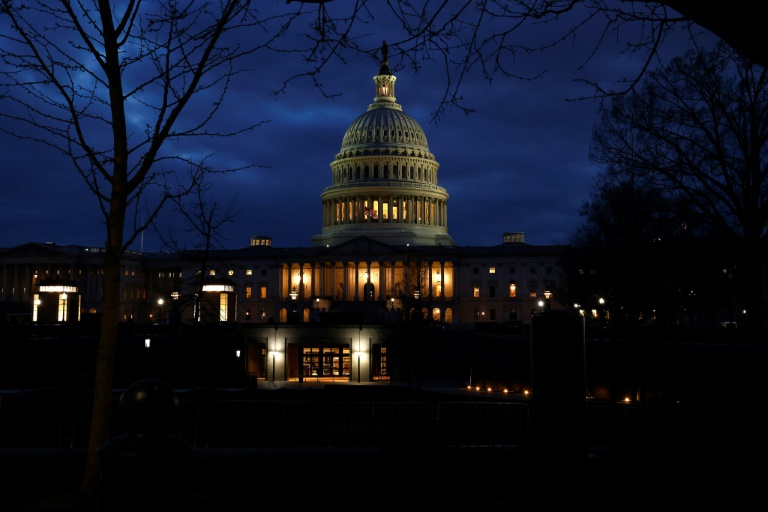
The US Capitol was briefly evacuated Wednesday after a false alarm saw police tracking an aircraft they said was a “probable threat” — but reportedly turned out to be carrying parachutists as part of a baseball pregame show.

Police tasked with protecting the complex at the heart of US government in Washington issued an initial statement shortly after 6:30 pm (2230 GMT) saying they had ordered an evacuation as they were “tracking an aircraft that poses a probable threat.”

They did not give further details.

The news became a top headline within minutes in the United States, where the memories of September 11, 2001 attacks — which saw Al-Qaeda fly passenger jets into the World Trade Center in New York and the Pentagon in Washington — are still poignant.

But police swiftly issued a second statement to say the order had been given “out of an abundance of caution” and that there was “no threat” to the complex.

“The aircraft no longer poses a threat to the Capitol Complex and the USCP is now preparing buildings for reentry,” said the update from the US Capitol Police.

Neither the House of Representatives nor the Senate, the chambers of Congress that are located in the Capitol, were in session at the time of the scare.

There was no immediate explanation for the order, but unverified reports suggested it came after a parachute display at the nearby Washington Nationals Park, a baseball stadium, part of a pregame show for “Military Appreciation Night.”

NBC’s Capitol Hill correspondent Garrett Haake tweeted that he had “Just watched some people parachute down over/near the US Capitol amid an evacuation order.”

NBC, citing police, said they were part of a demonstration by the Golden Knights at the stadium. The Golden Knights are the US Army’s official aerial parachute demonstration team. 

“Seems they might not have told Capitol Police they’d be in the airspace. One officer here told me she saw the small plane appearing to circle before the parachuters jumped,” Haake tweeted.

The stadium is roughly 1.5 miles (2.5 kilometers) from the Capitol. The Nationals were playing the Arizona Diamondbacks there Wednesday.

The US Capitol was the focal point of an actual violent attack just 15 months ago, on January 6 2021, when supporters of then-president Donald Trump stormed the building in an effort to stop certification of Joe Biden’s presidential election victory.

Despite Wednesday’s scare being a false alarm, lawmakers and visitors were shaken by the warning.

“We just went through a very stressful 15 minutes, but we are thankful that everyone is safe,” congresswoman Teresa Leger Fernández said on Twitter.

Two young Swiss tourists visiting Washington said they were walking towards the historic white domed Capitol to take a tour when police waved them away from the structure.

“They shut the security barriers behind us. They didn’t tell us why and I thought it was better not to ask,” said one of the tourists, who asked not to be named.

Tesla reports record profits, bullish on 2022 output

Tesla reported another banner quarter of profit growth Wednesday on pricier vehicles and said its 2022 output plan was on track despite ongoing supply chain problems and a hit from recent Covid-19 lockdown measures in China.

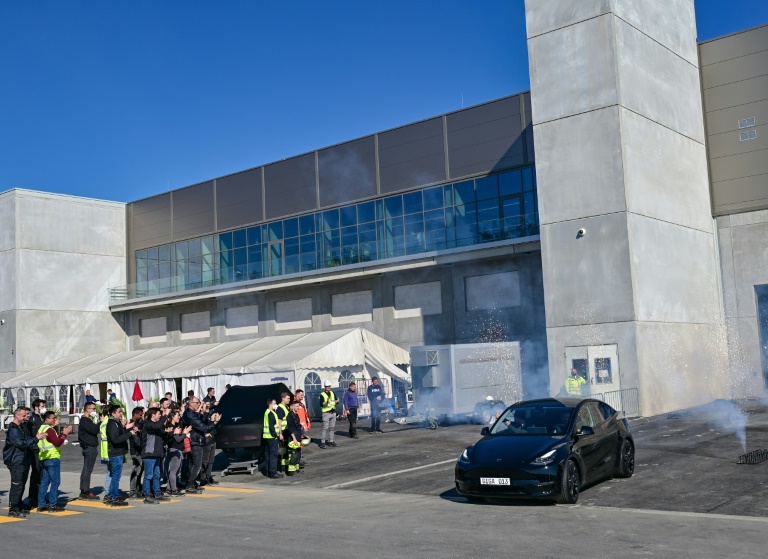
Elon Musk’s high-flying electric vehicle company notched a new record in quarterly profits of $3.3 billion following the unveiling of new factories in Germany and the US state of Texas that have begun commercial deliveries.

Headwinds facing the company include increasing raw material costs, as well as a weeks-long outage at the Shanghai plant following the Chinese government’s latest Covid-19 restrictions.

“Our own factories have been running below capacity for several quarters as supply chain became the main limiting factor, which is likely to continue through the rest of 2022,” Tesla said in its earnings press release.

Still Musk said it “seems likely” the company will produce more than one and a half million vehicles in 2022, which would be above the company’s long-term target of at least 50 percent output growth.

“We are growing very rapidly year over year and remain confident of exceeding 50 percent growth fore forseeable future,” Musk said on a conference call with investors and analysts. “The future is very exciting.”

But the Model 3 Tesla currently lists for a starting price of $42,690, putting it beyond reach for many households.

Musk, who has long spoken of the need to make electric vehicles affordable for the masses to combat climate change, insisted “we absolutely want to make EVs as affordable as possible.”

“It’s been very difficult when inflation is at a 40-or 50-year high” said Musk, who noted how suppliers have sought 20 to 30 percent price increases for parts.

– Struggle for affordability –

For the latest quarter, Tesla reported profits of $3.3 billion, up 658 percent from the year-ago period on an 81 percent jump in revenues to $18.8 billion.

The company produced 305,407 autos in the period, slightly below the level in the prior quarter, but enough to push output above one million over the last 12 months.

Chief Financial Officer Zach Kirkhorn said Tesla’s Shanghai plant “lost about a month of built volume” due to the lockdown, but that manufacturing “is resuming at limited levels working to get back to full production as quickly as possible.”

Kirkhorn said cost inflation on raw materials had accelerated during the first quarter, and second-quarter costs are trending “slightly higher” than that.

As supply chain problems have persisted, auto analysts have cautioned that the EV build-out could be constrained by limited raw materials.

ISeeCars analyst Karl Brauer cited rising costs for lithium, palladium and nickel as a challenge for Tesla and the auto industry more generally.

“Cost and supply concerns around various battery components isn’t going away, and will likely grow as global EV production and demand grows,” Brauer said.

“Electric vehicles have always struggled to be as cost effective as internal combustion cars. And there’s every indication that struggle will continue.”

Musk acknowledged some of these challenges for EVs, calling for entrepreneurs to focus on building lithium supply.

“Can more people please get into the lithium business?” Musk quipped. “Do you like minting money? The lithium business is for you!”

The results are the latest in a series of strong earnings that has brought glory to Musk, who has most recently launched an unsolicited bid to acquire Twitter.

The social media platform is fighting the effort, unveiling a “poison pill” plan that would make it harder for the billionaire to get a controlling stake. The matter did not come up during the Tesla conference call.

Tesla shares rose 5.0 percent to $1,026.99 in after-hours trading.

US leads G20 boycott of Russian finance officials

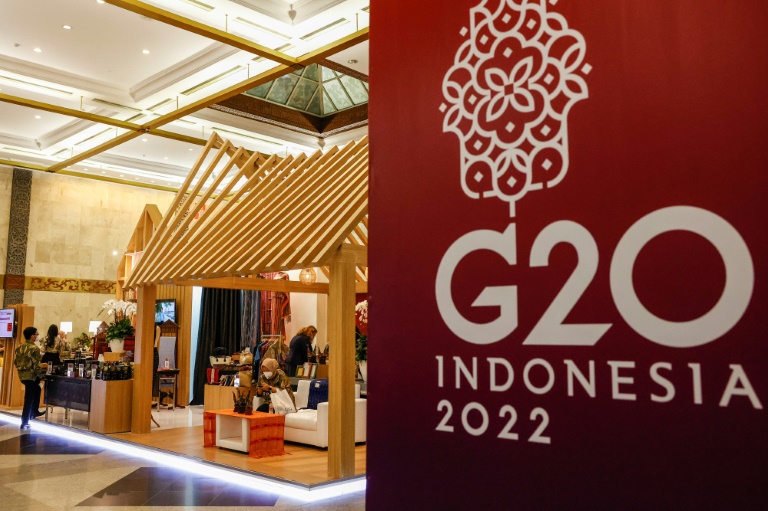
US Treasury Secretary Janet Yellen led a multinational group of finance chiefs on a walkout Wednesday as Russian officials spoke during a meeting of the G20, in the latest protest by Western nations over Moscow’s invasion of Ukraine.

Russia’s attack on its neighbor loomed over the meeting of finance ministers and central bank governors from the world’s most developed countries, the first since President Vladimir Putin ordered the invasion in late February.

British and Canadian officials also took part in the boycott, officials confirmed, underscoring the boiling tensions at the gathering convened to address global challenges like rising debt and a possible food crisis.

“Multiple finance ministers and central bank governors including Ukraine Finance Minister (Sergiy Marchenko) and Secretary Yellen walked out when Russia started talking at the G20 meeting,” a source familiar with the event told AFP. 

“Some finance ministers and central bank governors who were virtual turned their cameras off when Russia spoke.”

Canadian Deputy Prime Minister Chrystia Freeland tweeted a photograph of the officials who left the meeting, saying, “The world’s democracies will not stand idly by in the face of continued Russian aggression and war crimes.”

During the gathering, French Finance Minister Bruno Le Maire called on Russian delegates to refrain from attending the sessions, saying “war is not compatible with international cooperation.”

The Group of 20, chaired by Indonesia this year, includes major economies like the United States, China, India, Brazil, Japan and several countries in Europe, including Russia. 

– ‘Very important forum’ –

Indonesian Finance Minister Sri Mulyani Indrawati, who led the meeting said, the walkout was done “without disrupting… our discussion” on the substance of the agenda.

“All members see the G20 as a very important forum,” she told reporters. “So I’m confident that this will not erode the cooperation as well as the role of the G20.”

Prior to the meeting, German Finance Minister Christian Lindner said the country, which chairs the G7 group of liberal democracies, would try to find common ground, but ruled out providing “a stage for Russia to spread propaganda and lies.” He did not join the walkout.

Russian Finance Minister Anton Siluanov attended the meeting virtually, and “called on the partners to avoid politicizing the dialogue and stressed that the G20 has always been and remains primarily an economic format,” his ministry said in a statement.

The finance officials are gathering on the sidelines of the World Bank and IMF’s spring meetings in Washington. 

Despite the friction, IMF Managing Director Kristalina Georgieva said global cooperation “must and will continue,” pointing to multiple issues that “no country can solve on its own.”

Georgieva, who heads an institution with 189 members, told reporters, “I can vouch for the fact that it is more difficult when there are tensions, but it is not impossible.”

– Debt woes –

The meetings in Washington are focused on how to help the global economy recover from the new shock caused by Russia’s invasion, which has driven prices for food and fuel higher and caused the IMF to lower its global growth outlook to 3.6 percent for this year.

Western nations have retaliated for the bloody incursion with sanctions meant to harm Russia’s economy and turn it into a pariah state.

US President Joe Biden has proposed ejecting Russia from the G20.

But Mark Sobel, a former Treasury official who is now US chairman of the Official Monetary and Financial Institutions Forum, told AFP there was no obvious mechanism for booting Moscow, which is to varying degrees supported by China and India.

“I think that it really does raise a fundamental question about how are you going to manage global governance,” he said of the tensions.

The divide also bodes ill for the G20 Common Framework created during the pandemic to help heavily indebted countries find a path to restructure their obligations, which Sobel said is “flailing” as China and private-sector creditors drag their feet on participating.

Ukraine calls for talks in teetering Mariupol as Moscow holds ICBM test

Ukraine called Wednesday for urgent negotiations with Russia in Mariupol, which appeared close to falling after weeks of siege, as Vladimir Putin flexed his military muscle with the test launch of a new, nuclear capable ICBM.

Washington downplayed the test of the intercontinental ballistic missile and said it had been notified in advance, but Putin said it would make the Kremlin’s enemies “think twice”, raising tensions nearly two months after he invaded Ukraine and ignited a global crisis.

Mariupol, a strategic port city on the Sea of Azov, has been under a horrific siege almost since the invasion began. On Wednesday, Moscow issued another call for the devastated city’s defenders to surrender.

But Kyiv proposed a “special round” of talks with Moscow, without any conditions, in Mariupol itself. 

“One on one. Two on two. To save our guys, Azov, military, civilians, children, the living & the wounded. Everyone. Because they are ours,” wrote top Ukraine negotiator and presidential aide Mykhailo Podolyak on Twitter.

He tweeted after a Ukrainian commander in the besieged Azovstal steel plant in Mariupol issued a desperate plea for help, saying his marines were “maybe facing our last days, if not hours”.

“The enemy is outnumbering us 10 to one,” said Serhiy Volyna from the 36th Separate Marine Brigade.

“We appeal and plead to all world leaders to help us. We ask them to use the procedure of extraction and take us to the territory of a third-party state.”

An adviser to the city’s mayor described a “horrible situation” in the encircled steel plant and reported that up to 2,000 people — mostly women and children — are without supplies of drinking water, food and fresh air.

“Powerful bombs have been dropped several times on Azovstal, we have been bombed from boats… we are under siege. The front is 360 degrees,” said Svyatoslav Palamar, a commander in the nationalist Azov battalion defending the city, in a post on Telegram. 

“The situation is critical, we call on international leaders to help the children,” he added.

Mariupol has become a symbol of Ukraine’s unexpectedly fierce resistance since Russian troops invaded the former Soviet state on February 24.

Capturing it would allow Russia to have a land bridge between the Crimea peninsula, which it annexed in 2014, and the two Moscow-backed separatist statelets in Ukraine’s east. 

The offer of talks came after Kyiv said it had agreed with Russian forces to open a safe route for civilians to flee the devastated city — but that the had attempt failed.

– Biden ‘amazed’ by resistance –

As fighting raged in Ukraine’s east and south, European Council leader Charles Michel visited Kyiv and vowed the EU would do “everything possible” to help Ukraine win the war.

“You are not alone. We are with you,” Michel said during a press conference alongside Ukraine’s President Volodymyr Zelensky.

Zelensky said his country still did not have enough weapons to resist the invasion, despite billions in military aid from Western allies — though, in a video message he added his partners “understand our needs better.”

Ahead of Michel’s arrival, the Pentagon said Ukraine had received fighter planes to bolster its air force — but later it corrected that statement, saying only aircraft parts had been delivered.

Washington has repeatedly vowed to do everything it can to help Kyiv, without igniting a direct conflict with nuclear-armed Russia.

On Wednesday US President Joe Biden said he has been “amazed” by Ukrainian resistance. 

“They’re tougher and more proud than I thought,” he said, adding that Western “weapons and ammunition are flowing in daily.”

He said NATO remains “united, focused and energized,” adding: “I don’t think Putin counted on it.”

– ‘Nothing good’ –

Russia said Wednesday its forces had launched 73 air strikes across Ukraine, hitting dozens of locations where Ukrainian troops were concentrated.

In eastern Ukraine’s Kramatorsk, a large city in the Donetsk region, residents were bracing for the worst.

“It’s going to be a mess,” said Alexander, 53. “There’s nothing good to expect.”

Further from the frontlines, residents were still reeling weeks after Russian forces withdrew from the area near Kyiv. 

At a morgue in Bucha, families carefully searched body bags and examined cadavers looking for missing loved ones.

In the car park body bags arrived in carts or were piled up in trailers, vans and non-refrigerated trucks.

Four hundred bodies have been discovered there since the Russians withdrew on March 31, local police chief Vitaly Lobas told AFP. Around a quarter of them are still unidentified.

“The majority died violent deaths,” Lobas said.

Ukrainian authorities have said that over 1,200 bodies have been found in the Kyiv region so far.

Putin has said he launched the so-called military operation in Ukraine to save Russian speakers there from a “genocide” carried out by a “neo-Nazi” regime.

But his forces have faced allegations of war crimes — most recently from the EU’s Michel, who toured the devastated town of Borodianka Wednesday. 

“History will not forget the war crimes that have been committed here,” Michel wrote on Twitter. 

burs-st/bgs

United Airlines bullish on Q2 as it reports another loss

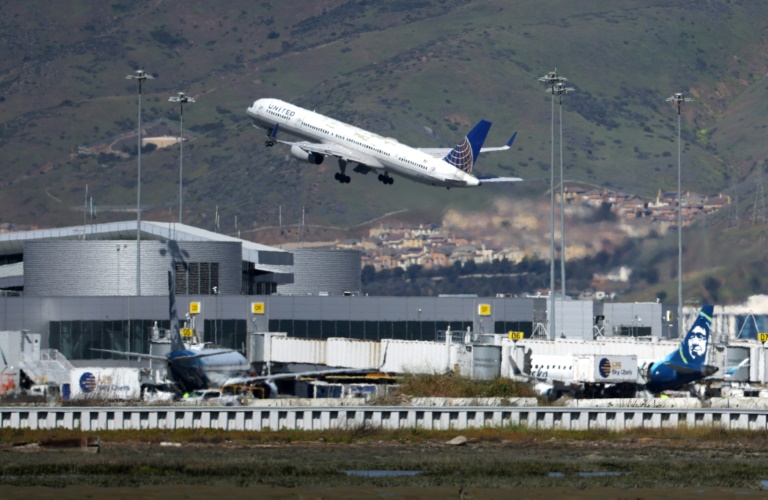
United Airlines reported another quarterly loss Wednesday on the lingering drag from Covid-19 but offered a bullish outlook based on surging travel demand.

Chief Executive Scott Kirby described the current demand environment as “the strongest it’s been in my 30 years in the industry,” echoing commentary from other airline CEOs eager for the pandemic to finally recede.

Shares soared in after-hours trading.

Airlines have struggled for more than two years, downsizing staff and surviving a cash-burning period with help from US government support programs and the private debt market.

In the most recent quarter, United reported a $1.4 billion loss, roughly the same shortfall as in the year-ago period. Revenues more than doubled to $7.6 billion.

But Kirby and other airline executives have vowed a robust post-pandemic turnaround — with the second quarter of 2022 potentially the start of a much better period.

For the second quarter, United is projecting a 17 percent jump from the 2019 period in the closely watched benchmark of revenue per available seat mile, constituting what United called “the strongest second quarter revenue guidance in company history.”

But one concern facing the industry is the drag from higher jet fuel prices. United projected costs of $3.43 per gallon in the second quarter, which would be more than 74 percent above the 2021 level.

Shares of United jumped 8.1 percent to $50.27 in after-hours trading.

Italy signs gas deal with Angola seeking to end dependence on Russia

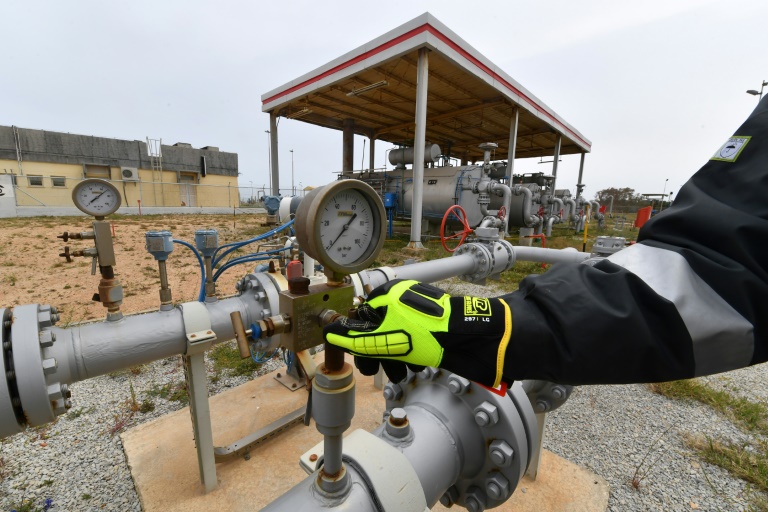
Italy on Wednesday penned a deal with Angola to ramp up gas supplies from the southern African country as it urgently scrambles to break away from Russian gas over the Ukraine war.

A declaration of intent was signed to develop “new” natural gas ventures and to increase exports to Italy, a statement from the Italian foreign minister announced.

“Today we have reached another important agreement with Angola to increase gas supplies,” Foreign Minister Luigi Di Maio said in the statement.

“Italy’s commitment to differentiate energy supply sources is confirmed,” said Di Maio at the end of a two-and-half-hour long visit to Luanda. 

Prime Minister Mario Draghi wants to add Angola and Congo-Brazzaville to a portfolio of suppliers to substitute Russia, which provides about 45 percent of Italian gas.

“We do not want to depend on Russian gas any longer, because economic dependence must not become political subjection,” he said in an interview with the Corriere della Sera daily published on Sunday.

“Diversification is possible and can be implemented in a relatively short amount of time — quicker than we imagined just a month ago,” he said.

Draghi was due to go himself but after testing positive for Covid-19 sent Di Maio and Ecological Transition Minister Roberto Cingolani in his place.

Cingolani described the deal as “an important agreement that gives impetus to the partnership between Italy and Angola in the fields of renewables, biofuels, LNG (liquefied natural gas) and training in technology and environment”.

The two ministers, accompanied by Claudio Descalzi, chief executive of Italian energy giant ENI, also met President Joao Lourenco. They were later headed to neighbouring Congo-Brazzaville where they are expected to meet President Denis Sassou Nguesso on Thursday.

“This is a race against time to make sure we stock gas and oil for the next winter season,” said Francesco Galietti, head of Rome-based consultancy Policy Sonar.

Angola’s Foreign minister Tete Antonio described the signature as “very important”.

A similar declaration will be signed in the Republic of Congo.

The foray follows the clinching of agreements with Algeria and Egypt in recent weeks.

Algeria is currently Italy’s second-largest supplier, providing around 30 percent of its consumption.

ENI said the deal with Algeria’s Sonatrach would boost deliveries of gas through the Transmed undersea pipeline by “up to nine billion cubic metres per year” by 2023-24.

Transmed only had spare pipeline capacity of 7.8 billion cubic metres per year in 2021 — though it has said it is ready to expand.

Italy has also been in talks with Azerbaijan over the expansion of the Trans-Adriatic Pipeline (TAP).

– ‘Fanciful’ –

The Egypt accord could result in up to three billion cubic metres of liquefied natural gas (LNG) being bound for Europe and Italy in particular this year, ENI said.

Italy is looking into buying or renting two floating storage and regasification units (FSRU) to allow it to import more LNG.

Diversification will not be cheap, warn experts, who foresee extra taxes passed on to businesses and families.

Davide Tabarelli, head of energy think tank Nomisma Energia, said Rome was rightly exploiting the “excellent relationships” that ENI has built up over 69 years in Africa, where it is the sector leader in terms of production and reserves.

But the idea of replacing Russian gas “in the short term” was “fanciful”, he told AFP. “It will take at least two or three years.”

The government said it expects to get the floating regasification units into place within 18 months.

It has also talked of kick-starting stalled projects for two onshore regasification plants, which would take some four years to build.

– ‘Operation thermostat’ –

Italy is one of Europe’s biggest guzzlers of gas, which currently represents 42 percent of its energy consumption, and it imports 95 percent of the gas it uses.

The government hopes to reduce that by accelerating the investment in renewables and has vowed to cut red tape on wind and solar farms.

Draghi has called for a collective sacrifice, asking Italians this month: “Do we want to have peace or do we want to have the air conditioning on?”

His rallying cry was met with some grumbling in a country feeling the effects of global heating, which science shows is driven by humans burning fossil fuels.

Undeterred, the government is readying so-called “operation thermostat”, which could see the public sector turn down heating in schools and offices by one degree, and the equivalent for air conditioning in the summer.

The rule would apply to private households and companies too, though it would be difficult to police.

It could save some four billion cubic metres of natural gas a year — or around 14 percent of the total gas imported from Russia, according to La Stampa newspaper.

Close Bitnami banner
Bitnami