World

Europe stocks shine but US mixed as Netflix plunges

European stocks rose Wednesday as investors tracked corporate earnings and developments in the Ukraine conflict, while US stocks ended mixed and Netflix shares tumbled after the streaming giant reported a drop in subscribers.

Oil prices slid further after having slumped the previous day on demand concerns.

“The upbeat market mood, which helped Wall Street close firmly higher yesterday, has followed through into Europe,” City Index senior market analyst Fiona Cincotta told AFP.

Frankfurt won 1.5 percent and Paris rose 1.4 percent, aided by news of a return to growth in eurozone industrial output in February.

London added 0.4 percent, held back by mining shares that were penalized following disappointing performance by Rio Tinto due to the pandemic and production issues.

Europe equities and oil had dropped Tuesday as Moscow launched its eastern offensive in Ukraine and after the IMF slashed its 2022 global economic growth forecasts by 0.8 percentage points, largely over inflationary concerns linked to the war and the pandemic.

“Whilst the Russian war remains a key driver in the markets, the bad news has been priced in for now,” Cincotta said.

“Instead, some areas of optimism are arising with banks outperforming after the ECB (European Central Bank) soothed nerves with news that all big banks in the eurozone can withstand Russian write-offs,” she added.

– Netflix ‘shocker’ –

Across the Atlantic, Wall Street had a mixed session, with the Dow seeing a decent gain but the Nasdaq dropping more than a point thanks to Netflix, which had released disappointing earnings following the close Tuesday.

The streaming giant plunged just over 35 percent after it announced its first drop in quarterly subscriptions in a decade, blaming the erosion to the suspension of its service in Russia due to Moscow’s invasion of Ukraine.

“There (are) no two ways to look at it, Netflix was a shocker and is likely to take the wind out of the Nasdaq’s recent rally, or at least put it on pause,” Cincotta said.

The tech-rich index closed 1.2 percent lower.

“That said, broadly speaking earnings season has been reasonably solid so far, economic data hasn’t revealed any major cracks either, which is helping to keep risk sentiment buoyant,” she added.

Michael Hewson at CMC Markets said that the slump in Netflix shares “appears to be prompting a significant de-risking in the more highly valued areas of the US market.”

In Asia trading, concerns about China’s economy hit trading in Shanghai and Hong Kong.

Shanghai’s main stock index was Asia’s biggest faller, losing 1.4 percent as the People’s Bank of China (PBoC) kept key lending rates unchanged amid uncertainty over the impact of ongoing Chinese Covid restrictions.

Hong Kong — which plummeted on Tuesday over concerns about Beijing’s ongoing tech-sector crackdown — also ended down.

“PBoC policymakers realize the futility of cutting rates during a lockdown as policies incentivizing lending will have a minimal short-term positive impact on activity so long as mobility restrictions remain in place,” noted independent analyst Stephen Innes.

– Key figures around 2055 GMT –

New York – Dow: UP 0.7 percent at 35,160.79 (close)

New York – S&P 500: DOWN 0.1 percent at 4,459.45 (close)

New York – Nasdaq: DOWN 1.2 percent at 13,453.07 (close)

EURO STOXX 50: UP 1.7 percent at 3,896.81 (close)

London – FTSE 100: UP 0.4 percent at 7,629.22 (close) 

Frankfurt – DAX: UP 1.5 percent at 14,362.03 (close)

Paris – CAC 40: UP 1.4 percent at 6,624.91 (close)

Tokyo – Nikkei 225: UP 0.86 percent at 27,217.85 (close)

Shanghai – Composite: DOWN 1.4 percent at 3,151.05 (close) 

Hong Kong – Hang Seng Index: DOWN 0.4 percent at 20,944.67 (close)

Euro/dollar: UP at $1.0850 from $1.0788 late on Tuesday

Dollar/yen: DOWN at 127.84 yen from 128.91 yen

Pound/dollar: UP at $1.3065 from $1.2998

Euro/pound: UP at 83.03 pence from 82.99 pence

Brent North Sea crude: UP 0.1 percent at $107.32 per barrel

West Texas Intermediate: FLAT at $102.56 per barrel

burs-rl/rlp/cs/caw
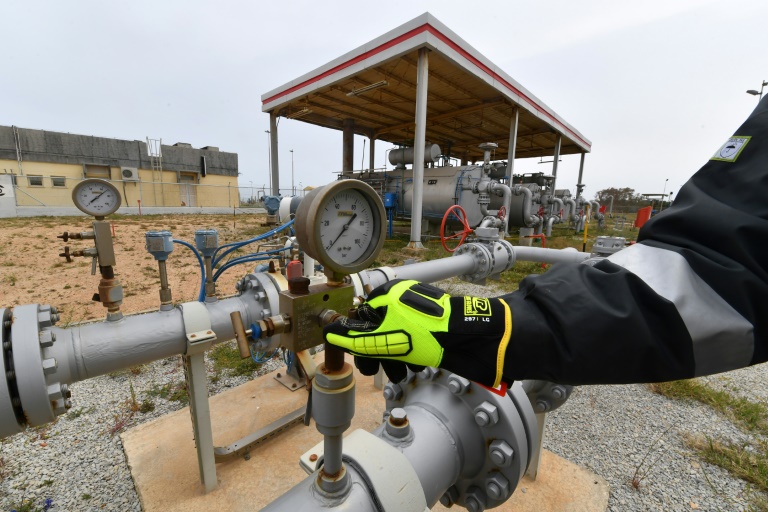
Italy signs gas deal with Angola seeking to end dependence on Russia

Italian ministers on Wednesday signed a deal with Angola to ramp up gas supplies from the southern African country as Italy urgently scrambles to break away from Russian gas over the Ukraine war.

A declaration of intent was signed to develop “new” natural gas ventures and to increase exports to Italy, a statement from the Italian foreign minister announced.

“Today we have reached another important agreement with Angola to increase gas supplies,” Foreign Minister Luigi Di Maio said in the statement.

“Italy’s commitment to differentiate energy supply sources is confirmed,” said Di Maio at the end of a two-and-half-hour long visit to Luanda. 

Prime Minister Mario Draghi wants to add Angola and the Congo Republic to a portfolio of suppliers to substitute Russia, which provides about 45 percent of Italian gas.

“We do not want to depend on Russian gas any longer, because economic dependence must not become political subjection,” he said in an interview with the Corriere della Sera daily published on Sunday.

“Diversification is possible and can be implemented in a relatively short amount of time — quicker than we imagined just a month ago,” he said.

Draghi was due to go himself but after testing positive for Covid-19, sent Di Maio and Ecological Transition Minister Roberto Cingolani in his place.

Cingolani described the deal as “an important agreement that gives impetus to the partnership between Italy and Angola in the fields of renewables, biofuels, LNG and training in technology and environment”.

The two ministers, accompanied by Claudio Descalzi, chief executive of Italian energy giant ENI, also met President Joao Lourenco. They were headed to neighbouring Brazzaville where they are expected to meet President Denis Sassou Nguesso on Thursday.

“This is a race against time to make sure we stock gas and oil for the next winter season,” said Francesco Galietti, head of Rome-based consultancy Policy Sonar.

A similar declaration will be signed in the Republic of Congo.

The foray follows the signing of agreements with Algeria and Egypt in recent weeks.

Algeria is currently Italy’s second-largest supplier, providing around 30 percent of its consumption.

ENI said the deal with Algeria’s Sonatrach would boost deliveries of gas through the Transmed undersea pipeline by “up to nine billion cubic metres per year” by 2023-24.

Transmed only had spare pipeline capacity of 7.8 billion cubic metres per year in 2021 — though it has said it is ready to expand.

Italy has also been in talks with Azerbaijan over the expansion of the Trans-Adriatic Pipeline (TAP).

– ‘Fanciful’ –

The Egypt accord could result in up to three billion cubic meters of liquefied natural gas (LNG) bound to Europe and Italy in particular this year, ENI said.

Italy is looking into buying or renting two floating storage and regasification units (FSRU) to allow it to import more LNG.

Diversification will not be cheap, warn experts, who foresee extra taxes passed on to businesses and families.

Davide Tabarelli, head of energy think tank Nomisma Energia, said Rome was rightly exploiting the “excellent relationships” that ENI has built up over 69 years in Africa, where it is the sector leader in terms of production and reserves.

But the idea of replacing Russian gas “in the short term” was “fanciful”, he told AFP. “It will take at least two or three years.”

The government said it expects to get the floating regasification units into place within 18 months.

It has also talked of kick-starting stalled projects for two onshore regasification plants, which would take some four years to build.

– ‘Operation thermostat’ –

Italy is one of Europe’s biggest guzzlers of gas, which currently represents 42 percent of its energy consumption, and it imports 95 percent of the gas it uses.

The government hopes to reduce that by accelerating the investment in renewables and has vowed to cut red tape on wind and solar farms.

Draghi has called for a collective sacrifice, asking Italians this month: “Do we want to have peace or do we want to have the air conditioning on?”

His rallying cry was met with some grumbling in a country feeling the effects of global heating, which science shows is driven by human burning of fossil fuels.

Undeterred, the government is readying so-called “operation thermostat”, which could see the public sector turn down heating in schools and offices by one degree, and the equivalent for air conditioning in the summer.

The rule would apply to private households and companies too, though it would be difficult to police.

It could save some four billion metric cubes of natural gas a year — or around 14 percent of the total gas imported from Russia, according to La Stampa newspaper.

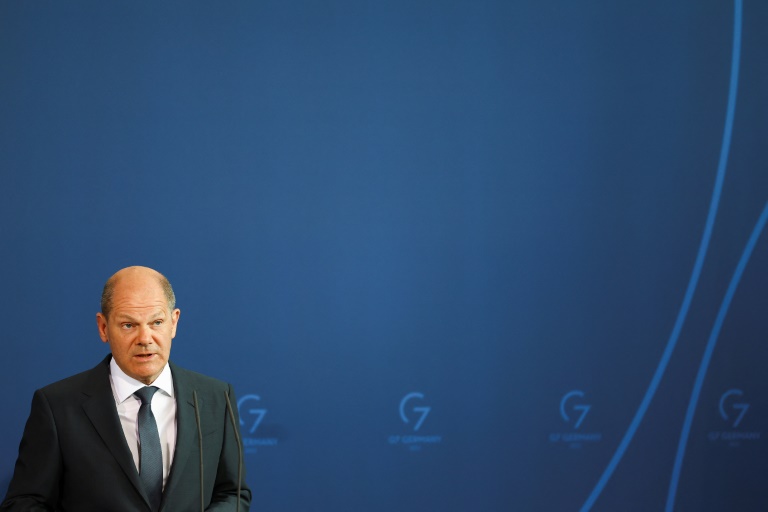
Taciturn Scholz under fire for hesitant Ukraine stance

German Chancellor Olaf Scholz was under growing pressure on Wednesday over his perceived lack of leadership over the war in Ukraine and his dogged refusal to send heavy weapons to the country.

Almost two months after he responded to Russia’s invasion of Ukraine by promising a “turning point” in German defence policy, critics say the chancellor has failed to take enough concrete action.

Scholz has sent defensive weapons to Ukraine and announced extra military aid in recent weeks but has so far not agreed to directly send heavy weapons — leaving Germany increasingly out of step with European and NATO allies.

“We believe that the Bundeswehr (German army) would be capable of supplying us with the weapons we need right now,” Ukraine’s ambassador to Germany, Andriy Melnyk, told the ZDF broadcaster on Wednesday. “We do not know why this is not happening.”

Army general Markus Laubenthal said the Bundeswehr was simply not in a position to send the weapons Ukraine wants, as this would “considerably weaken (Germany’s own) defence capability”.

The chancellor also said in a speech on Tuesday evening that Germany does not want to “go it alone” and send heavy weapons without the backing of its allies.

But with the United States, Canada, Britain, the Netherlands and others all stepping up their deliveries in recent days, Die Welt newspaper said “the German government’s position is increasingly a case of going it alone” in the other direction.

And the Bild daily reported on Wednesday that the government had deliberately withdrawn armoured vehicles and tanks from a list of equipment German arms manufacturers were offering to make available to Ukraine at the end of March — slashing the inventory from 48 to 24 pages.

– ‘What is Germany doing?’ –

“Germany’s reputation is being damaged” and “valuable time is being lost”, opposition leader Friedrich Merz told the WDR broadcaster.

“There are NATO partners who are well ahead of Germany” and “already delivering heavy weapons to Ukraine”, Merz said, leaving people at home and abroad asking: “What is Germany doing?”

Scholz has also faced criticism from within his own coalition government, a partnership between his Social Democrats (SPD), the Green party and the liberal FDP.

Anton Hofreiter from the Greens accused him of failing “to show enough leadership”, while Marie-Agnes Strack-Zimmermann of the FDP called on him to finally “take the baton in his hand and set the rhythm”.

Since Russia’s invasion of Ukraine, several members of Scholz’s SPD have come under fire over the party’s close historic ties with Moscow, including President Frank-Walter Steinmeier and former chancellor Gerhard Schroeder.

The Handelsblatt daily said the SPD was under “increasing pressure” over the war and in danger of creating the impression it “has not broken with its Russia policy of past years”.

– ‘Destructive for Europe’ –

Famous for his calm stoicism and taciturn demeanour, Scholz won last September’s election in Germany with a campaign that played on his reputation as a safe pair of hands.

But his strategy of being “calmness personified” may finally have reached its limits, the Sueddeutsche Zeitung suggested on Tuesday. 

“Either Scholz will deliver an answer to Germany’s ‘turning point’ and Russia’s crimes in Ukraine with his trademark stoicism, or his stoic calmness will see him fail horribly,” it said.

Many Germans agree, according to a recent survey for Der Spiegel magazine. Asked whether they saw Scholz as a strong leader, 65 percent of respondents replied with either “not especially” or “not at all”.

“The German chancellor is never the first and often even the last when it comes to responding in this war,” Der Spiegel said, pointing to Scholz’s hesitancy on cutting Russia off from the SWIFT banking payments system as well as his reluctance to ban Russian gas.

“If the course of the past few months has shown one thing, it’s that Scholz doesn’t make decisions until he has no other choice,” it said.

Catherine de Vries, a Dutch professor of political science at Bocconi University, said Scholz was continuing the legacy of former chancellor Angela Merkel by offering the “smallest possible concessions at the last possible moment”. 

This approach was perhaps understandable from a domestic point of view, she wrote on Twitter, but “destructive for Europe”.

US leads G20 boycott of Russian finance officials

US Treasury Secretary Janet Yellen led a multi-nation walkout of a meeting Wednesday of finance officials from the world’s richest countries when Russian officials spoke, in protest against Moscow’s invasion of Ukraine.

Russia’s attack on its neighbor loomed over the meeting of G20 finance ministers and central bank governors, the first since President Vladimir Putin ordered the invasion in late February.

British, French and Canadian officials joined the boycott, officials confirmed, underscoring the boiling tensions at the gathering of the Group of 20 which convened to address global challenges like rising debt and a possible food crisis.

“Multiple finance ministers and central bank governors including Ukraine Finance Minister (Sergiy Marchenko) and Secretary Yellen walked out when Russia started talking at the G20 meeting,” a source familiar with the event told AFP. 

“Some finance ministers and central bank governors who were virtual turned their cameras off when Russia spoke.”

Canadian Deputy Prime Minister Chrystia Freeland tweeted a photograph of the officials who left the meeting, saying, “The world’s democracies will not stand idly by in the face of continued Russian aggression and war crimes.”

And during the gathering French Finance Minister Bruno Le Maire called on Russian delegates to refrain from attending the sessions, saying “war is not compatible with international cooperation.”

Experts see little chance at this meeting for the bloc to find consensus on global challenges such as climate change and debt relief for poor nations.

“I think expectations should be extremely low,” said Matthew Goodman, senior vice president for economics at the Washington-based Center for Strategic and International Studies (CSIS). 

“It’s hard to see how the G20 is going to pull together in the face of… the Ukraine crisis,” he said in an interview.

The G20, chaired by Indonesia this year, includes major economies like the United States, China, India, Brazil, Japan and several countries in Europe, including Russia. 

The finance officials are gathering virtually on the sidelines of the World Bank and International Monetary Fund’s spring meetings in Washington. 

Despite the friction, IMF Managing Director Kristalina Georgieva said global cooperation “must and will continue,” pointing to multiple issues that “no country can solve on its own.”

Georgieva, who heads an institution with 189 members, told reporters, “I can vouch for the fact that it is more difficult when there are tensions, but it is not impossible.”

– Expected gridlock –

The meetings in Washington are focused on how to help the global economy recover from the new shock caused by Russia’s invasion, which has driven prices for food and fuel higher and caused the IMF to lower its global growth outlook to 3.6 percent for this year.

Western nations have retaliated for the bloody incursion with sanctions meant to harm Russia’s economy and turn it into a pariah state.

Speaking to reporters prior to the meeting, German Finance Minister Christian Lindner said the country, which chairs the G7 group of liberal democracies, would try to find common ground, but added: “We will not provide a stage for Russia to spread propaganda and lies.”

Russian Finance Minister Anton Siluanov attended the meeting virtually, and “called on the partners to avoid politicizing the dialogue and stressed that the G20 has always been and remains primarily an economic format,” the ministry said in a statement.

US President Joe Biden has proposed ejecting Russia from the G20.

But Mark Sobel, a former Treasury official who is now US chairman of the Official Monetary and Financial Institutions Forum, told AFP there was no obvious mechanism for booting Moscow, which is to varying degrees supported by China and India.

“I think that it really does raise a fundamental question about how are you going to manage global governance,” he said of the tensions.

The divide also bodes ill for the G20 Common Framework, created during the pandemic to help heavily indebted countries find a path to restructure their debt, but which Sobel said is “flailing” as China and private-sector creditors drag their feet on participating.

US leads G20 boycott of Russian finance officials

US Treasury Secretary Janet Yellen led a multi-nation walkout of a meeting Wednesday of finance officials from the world’s richest countries when Russian officials spoke, in protest against Moscow’s invasion of Ukraine.

Russia’s attack on its neighbor loomed over the meeting of G20 finance ministers and central bank governors, the first since President Vladimir Putin ordered the invasion in late February.

British, French and Canadian officials joined the boycott, officials confirmed, underscoring the boiling tensions at the gathering of the Group of 20 which convened to address global challenges like rising debt and a possible food crisis.

“Multiple finance ministers and central bank governors including Ukraine Finance Minister (Sergiy Marchenko) and Secretary Yellen walked out when Russia started talking at the G20 meeting,” a source familiar with the event told AFP. 

“Some finance ministers and central bank governors who were virtual turned their cameras off when Russia spoke.”

Canadian Deputy Prime Minister Chrystia Freeland tweeted a photograph of the officials who left the meeting, saying, “The world’s democracies will not stand idly by in the face of continued Russian aggression and war crimes.”

And during the gathering French Finance Minister Bruno Le Maire called on Russian delegates to refrain from attending the sessions, saying “war is not compatible with international cooperation.”

Experts see little chance at this meeting for the bloc to find consensus on global challenges such as climate change and debt relief for poor nations.

“I think expectations should be extremely low,” said Matthew Goodman, senior vice president for economics at the Washington-based Center for Strategic and International Studies (CSIS). 

“It’s hard to see how the G20 is going to pull together in the face of… the Ukraine crisis,” he said in an interview.

The G20, chaired by Indonesia this year, includes major economies like the United States, China, India, Brazil, Japan and several countries in Europe, including Russia. 

The finance officials are gathering virtually on the sidelines of the World Bank and International Monetary Fund’s spring meetings in Washington. 

Despite the friction, IMF Managing Director Kristalina Georgieva said global cooperation “must and will continue,” pointing to multiple issues that “no country can solve on its own.”

Georgieva, who heads an institution with 189 members, told reporters, “I can vouch for the fact that it is more difficult when there are tensions, but it is not impossible.”

– Expected gridlock –

The meetings in Washington are focused on how to help the global economy recover from the new shock caused by Russia’s invasion, which has driven prices for food and fuel higher and caused the IMF to lower its global growth outlook to 3.6 percent for this year.

Western nations have retaliated for the bloody incursion with sanctions meant to harm Russia’s economy and turn it into a pariah state.

Speaking to reporters prior to the meeting, German Finance Minister Christian Lindner said the country, which chairs the G7 group of liberal democracies, would try to find common ground, but added: “We will not provide a stage for Russia to spread propaganda and lies.”

Russian Finance Minister Anton Siluanov attended the meeting virtually, and “called on the partners to avoid politicizing the dialogue and stressed that the G20 has always been and remains primarily an economic format,” the ministry said in a statement.

US President Joe Biden has proposed ejecting Russia from the G20.

But Mark Sobel, a former Treasury official who is now US chairman of the Official Monetary and Financial Institutions Forum, told AFP there was no obvious mechanism for booting Moscow, which is to varying degrees supported by China and India.

“I think that it really does raise a fundamental question about how are you going to manage global governance,” he said of the tensions.

The divide also bodes ill for the G20 Common Framework, created during the pandemic to help heavily indebted countries find a path to restructure their debt, but which Sobel said is “flailing” as China and private-sector creditors drag their feet on participating.

Troops defending battered Mariupol plead for outside help

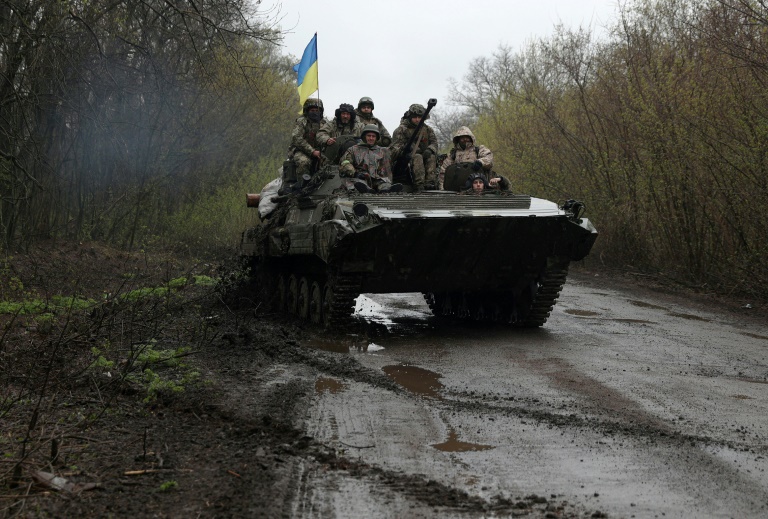
Besieged Ukrainian troops defending Mariupol called desperately for outside help Wednesday, warning the strategic port could fall within hours as Russia demanded they surrender and the latest civilian evacuation bid failed.

Raising tensions, Russia meanwhile said it had tested a new nuclear-capable intercontinental ballistic missile. The United States said it had been notified and the test was not deemed a threat.

In the latest ultimatum issued in its battle to capture Mariupol after a two-month siege, Moscow made another call for the city’s defenders to surrender by 1100 GMT.

It announced the opening of a humanitarian corridor for any Ukrainian troops who agreed to lay down their arms.

Kyiv said early Wednesday it had agreed with Russian forces to open a safe route for civilians to flee the devastated city. But Deputy Prime Minister Iryna Vereshchuk said later the bid “did not work” and efforts would resume Thursday.

A commander in the besieged Azovstal steel plant issued a desperate plea for help, saying his marines were “maybe facing our last days, if not hours”.

“The enemy is outnumbering us 10 to one,” said Serhiy Volyna from the 36th Separate Marine Brigade early Wednesday.

“We appeal and plead to all world leaders to help us. We ask them to use the procedure of extraction and take us to the territory of a third-party state.”

– EU vows to help Ukraine win –

As fighting raged in Ukraine’s east and south, European Council leader Charles Michel visited Kyiv and vowed the EU would do “everything possible” to help Ukraine win the war.

“You are not alone. We are with you,” Michel said during a press conference alongside Ukrainian President Volodymyr Zelensky.

But Zelensky said Ukraine still did not have enough weapons to resist the invasion, despite military aid from Western allies.

“The situation in Mariupol is deteriorating” with thousands of troops and civilians stuck in the city, Zelensky said.

“There are two ways to unblock Mariupol. The first one is serious armed assistance. So far, we do not have enough such hardware. The second one is diplomatic, but so far Russia does not agree.”

Hours ahead of Michel’s arrival, the Pentagon said Ukraine had received fighter planes to bolster its air force — but later corrected that statement, saying only aircraft parts had been delivered.

– Eastern offensive –

Control of Mariupol and the separatist-controlled eastern Donbas region would allow Moscow to create a southern corridor to the Crimean Peninsula that it annexed in 2014, depriving Ukraine of much of its coastline.

Fighting flared back up this week after Russia launched a major offensive into Donbas.

The battle for Mariupol appeared to be nearing a tipping point, after nearly two months of devastating fighting that has seen untold numbers of civilians trapped and killed.

An adviser to the mayor of Mariupol described a “horrible situation” in the encircled steel plant and reported that up to 2,000 people — mostly women and children — are without “normal” supplies of drinking water, food and fresh air.

Svyatoslav Palamar, a commander in the nationalist Azov battalion defending Mariupol, said the Russian attack on the sprawling complex was relentless. 

“Powerful bombs have been dropped several times on Azovstal, we have been bombed from boats… we are under siege. The front is 360 degrees,” said Palamar in a post on Telegram. 

“The situation is critical, we call on international leaders to help the children,” he added.

– ‘Violent deaths’ –

Elsewhere on the frontlines, Ukraine’s defence ministry reported its troops had beaten back a Russian attack in the city of Izium, south of the partly blockaded second city of Kharkiv in the east.

Kyiv also claimed enemy losses in a Ukrainian counter-attack near the town of Marinka in Donetsk.

Separately, Russia said Wednesday its forces had launched 73 air strikes across Ukraine, hitting dozens of locations where troops were concentrated.

In eastern Ukraine’s Kramatorsk, a large city in the Donetsk region, residents were already bracing for the worst. 

“It’s going to be a mess,” said Alexander, 53. “There’s nothing good to expect.”

Further from the frontlines, residents were still reeling weeks after Russian forces withdrew from the area near the capital Kyiv. 

At a morgue in Bucha, families carefully searched body bags and examined cadavers looking for missing loved ones.  

In the car park of the small communal morgue, the body bags arrived in carts or were piled up in trailers, vans and non-refrigerated trucks.

Four hundred bodies have been discovered there since the Russians withdrew on March 31, local police chief Vitaly Lobas told AFP. Around a quarter of them are still unidentified.

“The majority died violent deaths” and were shot, Lobas said.

Ukrainian authorities have said that over 1,200 bodies have been found in the Kyiv region so far.

– ‘War crimes’ – 

President Vladimir Putin has said he launched the so-called military operation in Ukraine in February to save Russian speakers in the country from a “genocide” carried out by a “neo-Nazi” regime.

Russian Foreign Minister Sergei Lavrov accused “nationalist” Ukrainian forces of using civilians as human shields and of refusing to evacuate via humanitarian corridors.

But his forces have faced allegations of war crimes — most recently from the EU’s Michel, who toured the devastated nearby town of Borodianka Wednesday. 

“History will not forget the war crimes that have been committed here,” Michel wrote on Twitter. 

Putin said the test of the Sarmat intercontinental ballistic missile Wednesday would make the Kremlin’s enemies “think twice”.

US Department of Defense Spokesman John Kirby said Moscow “properly notified” Washington of the test under an arms treaty.

“Testing is routine, and it was not a surprise,” Kirby told reporters. The Pentagon “has not deemed the test to be a threat to the United States or its allies”.

burs-ds/rlp/raz

Maradona shirt auction opens with bid of $5 million

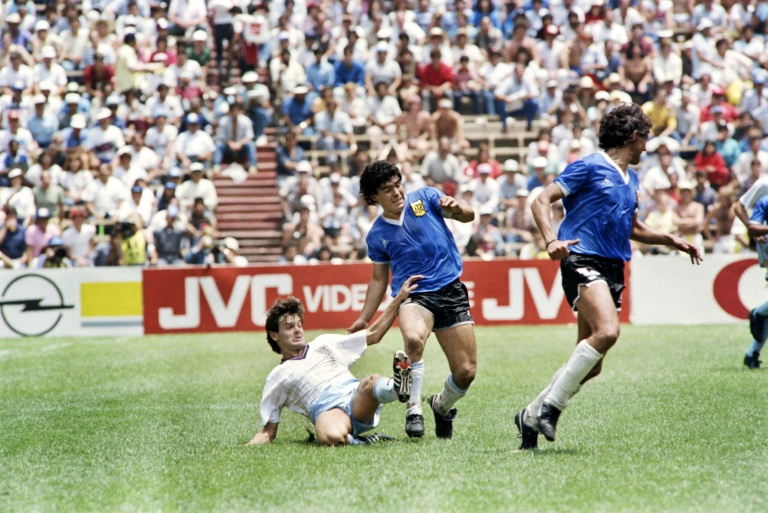
An auction of the jersey worn by Diego Maradona when he scored twice against England in the 1986 World Cup, including the infamous “hand of God” goal, kicked off Wednesday with a bid of over $5 million.

Sotheby’s is selling the blue number 10 Argentina shirt in an online sale that runs until May 4.

A few hours after bidding opened, the site showed that a first offer of £4 million ($5.2 million) — matching the low end of the auction house’s pre-sale estimate — had been registered.

That would set a new record price for a football jersey at auction.

The record for a game-worn shirt from any sport is $5.6 million, set in 2019 for a jersey Babe Ruth wore while on the New York Yankees.

Maradona’s daughter cast doubt on the sale earlier this month when she claimed that the shirt put up for auction had been the one her father wore in the goalless first half, not the second when he scored his two goals. 

Sotheby’s insists they have the right shirt, though.

It had been owned since the end of the controversial encounter by opposing midfielder Steve Hodge, who swapped his jersey with Maradona after England lost 2-1.

Hodge, whose autobiography is titled “The man with Maradona’s shirt,” has for the past 20 years loaned the jersey to be on public display at the National Football Museum in Manchester.

The quarter-final showdown became etched in football folklore for Maradona’s two goals — one notorious and one sublime — in Mexico City’s seething Aztec Stadium.

The first came shortly after half-time when Hodge, on the edge of the England penalty area, intercepted a pass and flicked the ball back towards goal.

Maradona, running into the box, rose with England’s goalkeeper Peter Shilton and punched the ball into the net. He later said the goal had been scored “a little with the head of Maradona, a little with the hand of God.”

Soon after, Maradona left five English defenders in his wake before gliding past Shilton and slotting home for a strike that was voted “Goal of the Century” in a 2002 FIFA poll.

Argentina went on to win the final and Maradona, who died from a heart attack in 2020, became worshipped in his home country.

Europe stocks shine but US mixed as Netflix plunges

European stocks rose Wednesday as investors tracked corporate earnings and developments in the Ukraine conflict, while US stocks were mixed as Netflix shares tumbled after the streaming giant reported a drop in subscribers.

Oil prices slid further after having slumped the previous day on demand concerns.

“The upbeat market mood which helped Wall Street close firmly higher yesterday has followed through into Europe,” City Index senior market analyst Fiona Cincotta told AFP.

Frankfurt won 1.5 percent and Paris rose 1.4 percent, aided by news of a return to growth in eurozone industrial output in February.

London added 0.4 percent, held back by mining shares that were penalised following disappointing performance by Rio Tinto due to the pandemic and production issues.

Europe equities and oil had dropped Tuesday as Moscow launched its eastern offensive in Ukraine and after the International Monetary Fund slashed its global 2022 economic growth forecasts by 0.8 percentage points, largely over inflationary crises linked to the war and the coronavirus pandemic.

“Whilst the Russian war remains a key driver in the markets, the bad news has been priced in for now,” Cincotta said.

“Instead, some areas of optimism are arising with banks outperforming after the ECB (European Central Bank) soothed nerves with news that all big banks in the eurozone can withstand Russian write-offs,” she added.

– Netflix ‘shocker’ –

Wall Street was mixed in late morning trading, with the Dow adding 0.7 percent.

But Netflix shares plunged 36 percent after the streaming giant reported its first drop in quarterly subscriptions in a decade, blaming the quarter-over-quarter erosion to suspension of its service in Russia due to Moscow’s invasion of Ukraine.

“There is no two ways to look at it, Netflix was a shocker and is likely to take the wind out of the Nasdaq’s recent rally, or at least put it on pause,” Cincotta said.

The Nasdaq Composite was down 0.9 percent.

“That said, broadly speaking earnings season has been reasonably solid so far, economic data hasn’t revealed any major cracks either, which is helping to keep risk sentiment buoyant,” she added.

Michael Hewson at CMC Markets said that the slump in Netflix shares “appears to be prompting a significant de-risking in the more highly valued areas of the US market”.

In Asia trading, concerns about China’s economy hit trading in Shanghai and Hong Kong.

Shanghai’s main stocks index was Asia’s biggest faller, losing 1.4 percent as the People’s Bank of China (PBoC) kept key lending rates unchanged amid uncertainty over the impact of ongoing Chinese Covid restrictions.

Hong Kong — which plummeted on Tuesday over concerns about Beijing’s ongoing tech-sector crackdown — also ended down.

“PBoC policymakers realise the futility of cutting rates during a lockdown as policies incentivising lending will have a minimal short-term positive impact on activity so long as mobility restrictions remain in place,” noted independent analyst Stephen Innes.

– Key figures around 1530 GMT –

New York – Dow: UP 0.7 percent at 35,170.23 points

EURO STOXX 50: UP 0.7 percent at 3,770.86

London – FTSE 100: UP 0.4 percent at 7,629.22 (close) 

Frankfurt – DAX: UP 1.5 percent at 14,362.03 (close)

Paris – CAC 40: UP 1.4 percent at 6,624.91

Tokyo – Nikkei 225: UP 0.86 percent at 27,217.85 (close)

Shanghai – Composite: DOWN 1.4 percent at 3,151.05 (close) 

Hong Kong – Hang Seng Index: DOWN 0.4 percent at 20,944.67 (close)

Euro/dollar: UP at $1.0855 from $1.0788 late on Tuesday

Dollar/yen: DOWN at 127.77 yen from 128.91 yen

Pound/dollar: UP at $1.3048 from $1.2998

Euro/pound: UP at 83.21 pence from 82.99 pence

Brent North Sea crude: DOWN 0.5 percent at $106.71 per barrel

West Texas Intermediate: DOWN less than 0.1 percent at $102.48 per barrel

burs-rl/rlp

Climate, big agriculture slashing insect populations 'by half'

A warming world and intensive agriculture are causing insect populations to plummet by nearly half compared to areas less affected by temperature rises and industrial farming, researchers said Wednesday.

The researchers measured both insect abundance and number of species in areas across the world and compared that to insects in more pristine habitats. 

The study published in Nature found that the double whammy of global warming and shrinking habitats has not just hit population numbers, but also provoked a 27 percent drop in the diversity of species.

“The reductions are greatest in the tropics,” lead author Charlie Outhwaite, a macroecologist at University College London’s Centre for Biodiversity and Environmental Research, told AFP.

But less data from tropical regions, which are richest in biodiversity, means the global decline in insects is likely worse than the study’s headline figures suggest, she said.

The calculations may also be too conservative because areas used to benchmark change — while the most pristine on the planet — have already been degraded to some extent by human activity.     

While in line with earlier estimates of insect decline, the new findings are based on different methodologies.

Covering 18,000 species from beetles to butterflies to bees, the study drew from 750,000 data points collected from 1992 to 2012 at 6,000 locations.

“Previous studies have been carried out at the small scale on a limited number of species or species groups,” Outhwaite said. 

The consequences of insect decline are significant. 

Some three-quarters of 115 top global food crops depend on animal pollination, including cocoa, coffee, almonds and cherries.

Some insects are also crucial for pest control — especially of other bugs.

Ladybugs, praying mantis, ground beetles, wasps and spiders all play crucial roles in keeping pest insects in check, from aphids and fleas to cutworms and caterpillars. 

Insects are also crucial for decomposing waste and nutrient cycling. 

– ‘A catastrophic outcome’ –

The study is the first to look at the combined impact of rising temperatures and industrial agriculture, including the widespread use of insecticides.

“We often only consider one driver of change, such as land use, whereas in reality a lot of drivers will be impacting the same space,” Outhwaite said.

The interaction between these drivers, the study shows, is worse than if they had acted independently.

Even without climate change, converting a tropical forest into agricultural land leads to drier hotter areas due to the removal of vegetation that provides shade and retains moisture in the air and soil. 

Add a degree or two of warming, and these regions become even hotter and drier, pushing certain species of insects up to or beyond their limits.

In some regions, insects are now experiencing extended periods in which temperatures exceed the highest extremes of less than a century before.

Up to now, intensive agriculture and habitat loss have been the major driver of insect decline. 

Earlier research, for example, estimates the number of flying insects across Europe has dropped 80 percent on average, causing bird populations to shrink by more than 400 million in three decades.  

“We know that you can’t just keep losing species without, ultimately, causing a catastrophic outcome,” said Tom Oliver, a professor of applied ecology at the University of Reading. 

“You cannot keep removing rivets from an aeroplane without it eventually falling out of the sky.”

– Farming hope –

The new study points to a strategy that could extend a lifeline to threatened insects.

Areas practising low-intensity agriculture — fewer chemicals, less monoculture — that were surrounded by at least 75 percent natural habitat saw only a seven percent decline in insect abundance. 

But if the density of surrounding natural habitat dropped below 25 percent, insect population declined by nearly two-thirds.

“I think this finding gives us hope that we can successfully design landscapes to produce food where biodiversity can thrive,” Jane Hill, a professor of Ecology at the University of York, told the Science Media Centre.

Insects comprise about two-thirds of all terrestrial species, and have been the foundation of key ecosystems since emerging almost 400 million years ago.

Moles, hedgehogs, anteaters, lizards, amphibians, most bats, many birds and fish all feed on insects.

Small bees better at coping with warming, bumblebees struggle: study

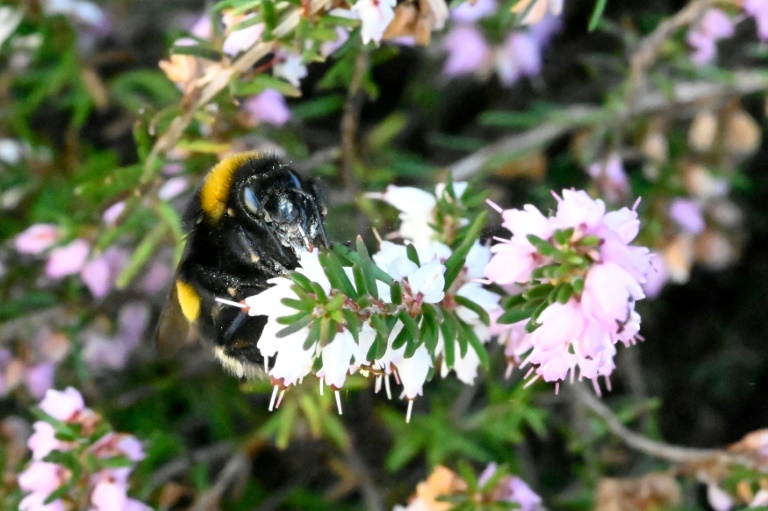
Climate change could lead to more small-bodied bees but fewer bumblebees, according to research published Wednesday, warning of potential “cascading” effects on plant pollination and across whole ecosystems.

Scientists in the United States trapped and studied more than 20,000 bees over eight years in an area of the Rocky Mountains to find out how different types of bees reacted to changing climatic conditions.

The authors said that while environmental conditions varied from year to year, the sub-alpine region from which they took samples is “particularly vulnerable to climate change”, with generally warming spring temperatures and earlier snow melt.

They found that comb-building cavity nesters and larger bodied bees declined in abundance as temperatures increased, while smaller, soil-nesting bees increased. 

“Our research suggests that climate-induced changes in temperature, snowpack and summer precipitation may drastically reshape bee communities,” the authors said.

– Bumblebees ‘more threatened’ –

Researchers said the findings suggest a reduction of bigger bees, including in the families of bumblebee, leafcutters and mason bees, with higher temperatures.

Declines were particularly marked for bumblebees, which the researchers said suggests “this group is more threatened under climate warming than other bees in our system”. 

That tallies with other studies showing that bumblebees, the dominant pollinators in many ecosystems, have a lower heat tolerance than other bees and move to cooler regions at higher altitudes as temperatures warm.

Researchers said their findings suggest both bumblebees’ body size and nest behaviour could also make them more vulnerable in a warming world.

In general, the authors said climate-driven changes to pollinator communities “could have cascading effects on pollination and ecosystem functioning”.

For example, they said losing bigger bees, which tend to fly further for food, may mean a reduction in longer-distance pollination.

The study, published in the journal Proceedings of the Royal Society B, was specifically focused on mountainous areas, but the researchers said other research across the US showed declines in larger bees in response to environmental changes. 

They did however say their findings that drier conditions favoured bees with specialist diets may not be applicable to other ecosystems, where climate change is expected to bring more rainfall.

Insects are the world’s top pollinators — 75 percent of 115 top global food crops depend on animal pollination, including cocoa, coffee, almonds and cherries, according to the UN.

In a landmark 2019 report, scientists concluded that nearly half of all insect species worldwide are in decline and a third could disappear altogether by century’s end.

One in six species of bees have gone regionally extinct somewhere in the world.

The main drivers of extinction are thought to be habitat loss and pesticide use.

Close Bitnami banner
Bitnami