World

Sri Lanka town under curfew, foreign concern over killing

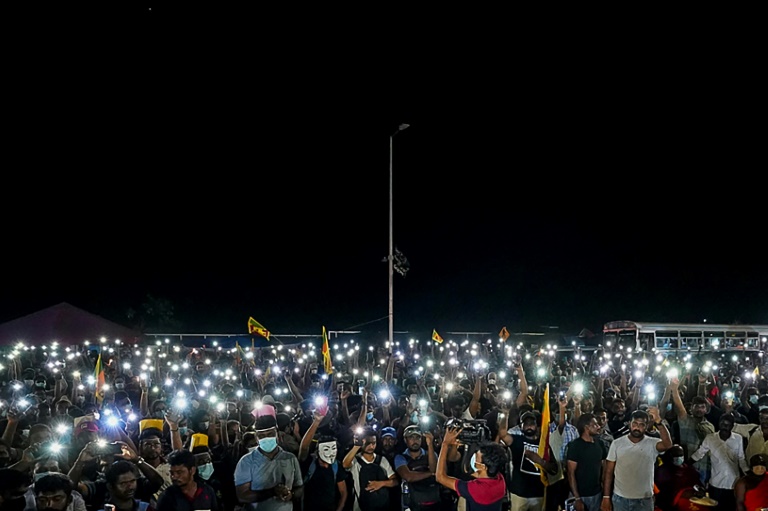
Police kept up a curfew in central Sri Lanka on Wednesday, a day after the killing of an anti-government demonstrator in escalating protests across the island triggered international condemnation.

The government promised investigations into allegations that police used excessive force to disperse people protesting high fuel prices and demanding President Gotabaya Rajapaksa’s resignation over the worsening economic crisis.

Sri Lanka is in the grip of its worst economic downturn since independence in 1948, with regular blackouts, severe shortages of fuel and other goods and record inflation causing widespread misery. 

“I have already initiated an inquiry into the conduct of officers at Rambukkana,” police chief Chandana Wickramaratne said in a statement as he ordered an indefinite curfew in the area.

The crowd was about to set alight a diesel tanker when officers opened fire to disperse in Rambukkana, 95 kilometres (60 miles) east of the capital, police said in an earlier statement.

In the first fatal clash since anti-government protests broke out this month, at least 29 people including 11 policemen were wounded, officials said.

Top Colombo-based envoys, including those from the US, Britain and Canada, expressed concern over the police shooting and called for restraint from all sides as Sri Lanka opens bailout talks with the International Monetary Fund in Washington.

“A full, transparent investigation is essential and the people’s right to peaceful protest must be upheld,” US ambassador Julie Chung said.

The British High Commissioner Sarah Hulton added: “I condemn violence in all forms and call for restraint.”

And her Canadian counterpart David McKinnon said that “those instigating violence must be accountable”.

Within hours, police fired tear gas to break up another protest in the south of the island, but there were no immediate reports of casualties, officials and residents said.

Police moved to disperse people occupying a main road and holding up traffic in Matara, 160 kilometres (100 miles) south of Colombo, residents said.

Across the country, there were protests against Tuesday’s sharp increase in fuel prices and the shortage of diesel and petrol as the government seeks three to four billion dollars from the IMF to overcome its balance-of-payments crisis and boost depleted reserves.

Trade unions have called a general strike on Wednesday to protest rising living costs.

Public transport fares are set to rise by 35 percent on Wednesday after diesel was raised by nearly 65 percent the day before. Bread has gone up nearly 30 percent. 

In the capital Colombo, a large crowd has been camped outside the President’s seafront office since April 9, demanding the leader step down. 

Rajapaksa acknowledged public anger over the ruling family’s mismanagement on Monday, after appointing a new cabinet to try to assuage fury over the crisis.

Sri Lanka’s economic meltdown came after the coronavirus pandemic torpedoed vital revenue from tourism and remittances and the government last week announced a default on huge foreign debt.
Sri Lanka town under curfew, foreign concern over killing

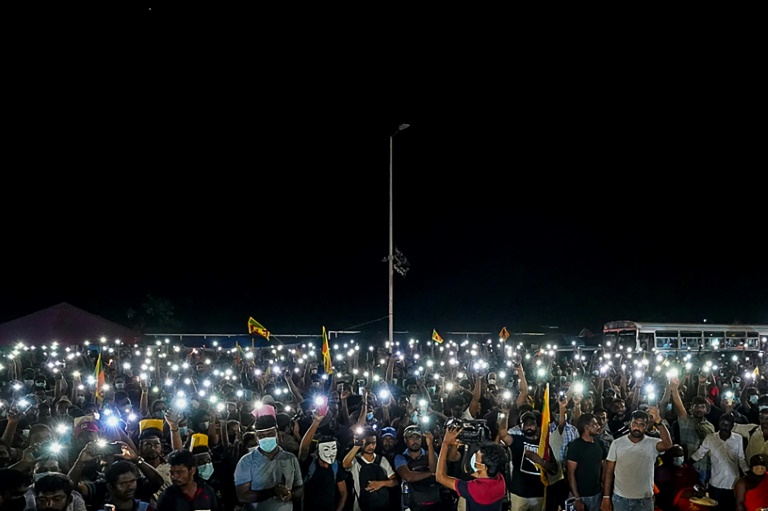
Police kept up a curfew in central Sri Lanka on Wednesday, a day after the killing of an anti-government demonstrator in escalating protests across the island triggered international condemnation.

The government promised investigations into allegations that police used excessive force to disperse people protesting high fuel prices and demanding President Gotabaya Rajapaksa’s resignation over the worsening economic crisis.

Sri Lanka is in the grip of its worst economic downturn since independence in 1948, with regular blackouts, severe shortages of fuel and other goods and record inflation causing widespread misery. 

“I have already initiated an inquiry into the conduct of officers at Rambukkana,” police chief Chandana Wickramaratne said in a statement as he ordered an indefinite curfew in the area.

The crowd was about to set alight a diesel tanker when officers opened fire to disperse in Rambukkana, 95 kilometres (60 miles) east of the capital, police said in an earlier statement.

In the first fatal clash since anti-government protests broke out this month, at least 29 people including 11 policemen were wounded, officials said.

Top Colombo-based envoys, including those from the US, Britain and Canada, expressed concern over the police shooting and called for restraint from all sides as Sri Lanka opens bailout talks with the International Monetary Fund in Washington.

“A full, transparent investigation is essential and the people’s right to peaceful protest must be upheld,” US ambassador Julie Chung said.

The British High Commissioner Sarah Hulton added: “I condemn violence in all forms and call for restraint.”

And her Canadian counterpart David McKinnon said that “those instigating violence must be accountable”.

Within hours, police fired tear gas to break up another protest in the south of the island, but there were no immediate reports of casualties, officials and residents said.

Police moved to disperse people occupying a main road and holding up traffic in Matara, 160 kilometres (100 miles) south of Colombo, residents said.

Across the country, there were protests against Tuesday’s sharp increase in fuel prices and the shortage of diesel and petrol as the government seeks three to four billion dollars from the IMF to overcome its balance-of-payments crisis and boost depleted reserves.

Trade unions have called a general strike on Wednesday to protest rising living costs.

Public transport fares are set to rise by 35 percent on Wednesday after diesel was raised by nearly 65 percent the day before. Bread has gone up nearly 30 percent. 

In the capital Colombo, a large crowd has been camped outside the President’s seafront office since April 9, demanding the leader step down. 

Rajapaksa acknowledged public anger over the ruling family’s mismanagement on Monday, after appointing a new cabinet to try to assuage fury over the crisis.

Sri Lanka’s economic meltdown came after the coronavirus pandemic torpedoed vital revenue from tourism and remittances and the government last week announced a default on huge foreign debt.
New Indian 'sex start-ups' challenge old taboos

The couple behind a new start-up using adult toys and cheeky adverts to challenge long-held taboos say they want to take the “shame, guilt and fear” out of sex in India.

Despite its heritage as the land of the Kama Sutra, open discussions around sexuality and intimacy are often regarded as obscene in the largely conservative country.

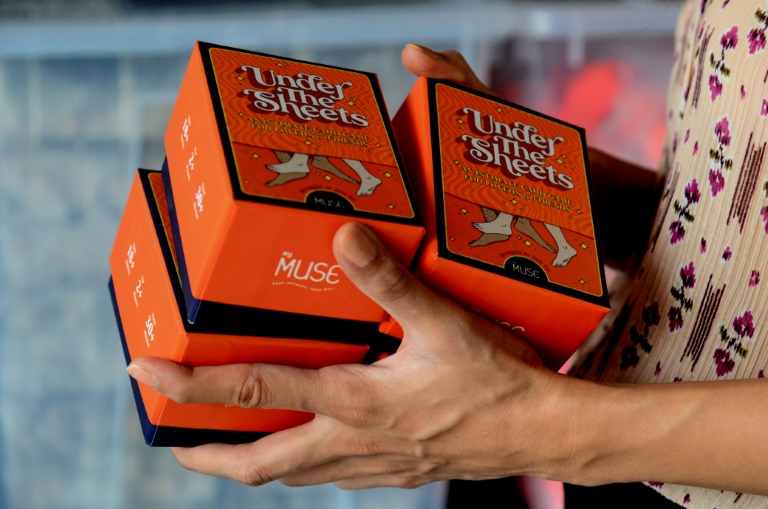
MyMuse, founded by Anushka and Sahil Gupta, are tackling this with tongue-in-cheek marketing and creative euphemisms, which they say make the products seem less intimidating and encourage first-time buyers.

“Diwali is coming and so should you! And as always, we’re urging you to save the fireworks for the bedroom,” exclaimed one such advertisement on Facebook before one of India’s biggest religious holidays, and its customary pyrotechnics, last year.

“There’s this shame, guilt and fear associated with buying something that should be used in your intimate areas, and that’s the first thing we wanted to turn around,” Anushka says.

MyMuse is one of a growing number of businesses riding a wave of sexual liberation amongst urban young professionals, already navigating global trends on Instagram and comfortable with dating apps such as Tinder, Bumble and Hinge.

Investors too are betting on this untapped market in the vast country of 1.4 billion: India’s nascent sex toys sector was valued at $91 million by TechSci Research in 2020, and predicted to grow 16 percent annually.

– No sleaze, no misogyny –

The Guptas began shipping out discreetly packaged vibrators — “massagers” in MyMuse’s genteel parlance -– candles, and lubricants from a spare bedroom in their home during last year’s Covid-19 lockdowns.

Benefitting from capital pouring into Indian tech start-ups during the pandemic, the firm received seed funding from venture capitalist firms. They have made more than a dozen hires and now ship to nearly 200 cities nationwide.

Using a targeted social media campaign, they say they are trying to reframe the conversation around sex away from often “sleazy” portrayals in Bollywood movies.

“(We want to) just remove all of that misogyny, sexism from this idea and just make it something that’s beautiful, that’s natural, universal,” Anushka, who left her job at WeWork to become an entrepreneur, explains.

There are a growing number of services for India’s sexually curious: fellow start-up Gizmoswala offers same-day delivery on bondage kits for Mumbai residents, while LoveTreats exhorts online shoppers to discover their “naughty side” with lingerie sets and remote-controlled vibrators. 

But they still need to contend with wider society — particularly older, more conservative generations that idolise female virtue and honour, and a culture where arranged marriages are still the norm.

“There are many Indias when it comes to sexual awareness. While one India has accepted and changed, another is changing slowly and another is still 10 or 20 years behind,” sex education specialist Jaya Aiyappa says.

Vigilante groups have attacked couples they believe are not behaving in line with “Indian values”.

Politicians and the police have also been accused of raiding hotels, nightclubs and attacking young people for public displays of affection, drinking or wearing immodest clothing.

A haul of vibrators and dildos was seized by customs last year -– the result of a boom in online orders during pandemic lockdowns — because Indian law still bans the import of “toys that resemble human body parts”.

– Change the conversation –

The lack of dialogue around sex can lead to misinformation and abuse, Aiyappa warns, adding that even efforts to introduce a broader sex education curriculum in schools have faced a backlash.

Anushka Gupta says she realised things needed to change when she returned from working abroad and struggled to find even basic sexual health products such as contraceptives and lubricants.

“This is a situation that’s fundamentally broken,” she said, adding that Indian women often face a culture of enforced silence around sex.

“It’s the most typically Indian conundrum where they will not talk to a woman about sex at all until she’s married, and the moment she’s married they’ll be like, ‘So when’s the baby coming?'”

But beyond challenging social norms, this new wave of start-ups see an opportunity for a “sexual wellness” industry in India. 

Sahil, who has an MBA from Harvard Business School and previously worked in private equity, says that most young married couples still live with their families –- the bedroom is their only place of real privacy.

“The bedroom in India for a lot of people is one of the few safe spaces that is untouched,” he explains, describing it as a couple’s “oasis”. 

MyMuse already sells bespoke candles and plans to expand into clothing and offer sex counselling services, while Gizmoswala is set to manufacture and export its own-brand toys to other South Asian nations.

Smartphone proliferation and easy access to modern Indian dramas such as Netflix hit Lust Stories are also tackling taboo subjects like same-sex relationships and casual dating, helping to normalise conversations about intimacy. 

Requesting anonymity, one 32-year-old professional, says of the shift in attitudes: “It’s exciting that this is finally happening in India. The conversation around sex is really changing.”

Ukraine gets warplanes as Mariupol officer warns facing 'last days'

Ukraine received fighter jets to help resist the Russian invasion, as Moscow intensified its offensive in the east where a besieged officer in Mariupol warned Wednesday his forces were facing their “last days, if not hours”.

The West has responded to a renewed Russian push into the Donbas region with fresh weapons for Kyiv and a push to increase “Moscow’s international isolation”.

The Pentagon said that Ukraine had recently received fighter planes and parts to bolster its air force, declining to specify the number of aircraft and their origin.

Kyiv has asked its Western partners to provide MiG-29s, which its pilots already know how to fly and a handful of Eastern European countries have.

Control of Donbas and the besieged southern port of Mariupol would allow Moscow to create a southern corridor to the Crimean peninsula that it annexed in 2014, depriving Ukraine of much of its coastline.

In the latest ultimatum issued in its battle to capture Mariupol, Moscow issued another call for the city’s defenders to surrender on Wednesday by 2 pm Moscow time (1100 GMT) and announced the opening of a humanitarian corridor for any Ukrainian troops who agreed to lay down their arms.

As the deadline approached, a commander in the besieged Azovstal power plant issued a desperate plea for help, saying his marines were “maybe facing our last days, if not hours”.

“The enemy is outnumbering us 10 to one,” Serhiy Volyna from the 36th Separate Marine Brigade said.

“We appeal and plead to all world leaders to help us. We ask them to use the procedure of extraction and take us to the territory of a third-party state.”

Thousands of troops and civilians remain holed up in the plant.

An advisor to the mayor of Mariupol described a “horrible situation” in the encircled complex and reported that up to 2,000 people — mostly women and children — are without “normal” supplies of drinking water, food, and fresh air.

But during an interview broadcast on CNN Tuesday, Pavlo Kyrylenko — who oversees the Donetsk region’s military administration — insisted Mariupol remained contested.

“The Ukrainian flag is flying over the city,” he said. “There are certain districts where street fighting is continuing. I can’t say the Russians are controlling them.”

– ‘We are bombed everywhere’ –

Elsewhere on the front lines, Ukraine’s defence ministry reported its troops had beaten back a Russian attack in the city of Izium, south of the partly blockaded second city of Kharkiv.

In the town of Novodruzhesk, 65-year-old resident Nadya said “We are bombed everywhere.”

“It’s a miracle that we’re still alive,” she said, her voice trembling. 

“We were lying on the ground and waiting. Since February 24, we’ve been sleeping in the cellar.”

Kyiv also claimed enemy losses in a Ukrainian counter-attack near the town of Marinka in Donetsk.

The governor of the eastern Lugansk region Sergiy Gaiday said Ukrainian forces were holding their ground in the face of heavy fighting.

“We have positional battles in the cities of Rubizhne and Popasna. The enemy cannot do anything though. They are losing people and equipment there,” Gaiday said.

“Our guys are shooting down drones there. Shooting down planes on the border of the Lugansk and Kharkiv regions, so they are holding on.”

Russian forces, meanwhile, said “high-precision air-based missiles” hit 13 Ukrainian positions in parts of Donbas while other air strikes “hit 60 military assets”, including in towns close to the eastern front line.

– ‘War crime’ – 

President Vladimir Putin has said he launched the so-called military operation in Ukraine in February to save Russian speakers in the country from a “genocide” carried out by a “neo-Nazi” regime.

But his forces have faced allegations of war crimes — most recently from German Chancellor Olaf Scholz, who said Tuesday that Putin was responsible for atrocities in Ukraine.

“The killing of thousands of civilians as we have seen is a war crime for which the Russian president bears responsibility,” Scholtz said.

UN Secretary-General Antonio Guterres also denounced Russia’s ongoing offensive, and issued calls for a four-day truce to mark the Orthodox Holy Week.

“Instead of a celebration of new life, this Easter coincides with a Russian offensive in eastern Ukraine,” Guterres told reporters.

“The intense concentration of forces and firepower makes this battle inevitably more violent, bloody and destructive.”

Guterres for a “humanitarian pause” from Holy Thursday until Easter Sunday on April 24.

“Hundreds of thousands of lives hang in the balance.”

burs-oho/qan

Shanghai Covid death toll rises to 17

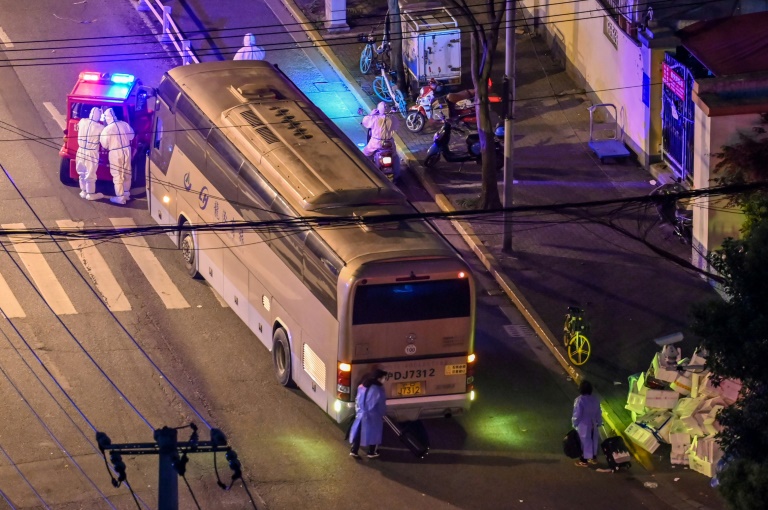
China reported seven Covid-19 deaths in Shanghai on Wednesday, raising the toll in the city to 17 fatalities as authorities struggled to rein in infections despite a gruelling, weeks-long lockdown.

The fast-spreading Omicron coronavirus variant has driven a huge spike in cases in the metropolis of 25 million people, and the government has imposed tight movement restrictions and multiple rounds of mass testing to combat the outbreak.

The lockdown has taken a heavy social and economic toll, with residents voicing their fury on social media over food shortages and lack of access to non-Covid medical care.

The seven newly reported deaths were cases with underlying conditions such as lung cancer and diabetes, city authorities said. Five of the patients were people over the age of 70.

The patients “became severely ill after admission to hospital, and died after ineffective rescue efforts, with the direct cause of death being underlying disease,” the Shanghai government said in a statement.

The city reported more than 18,000 new and mostly asymptomatic coronavirus cases on Wednesday.

More than 400,000 infections have been reported in Shanghai since March, and the city reported its first Covid deaths on Monday.

The official death toll remains low compared with the reported cases, but some have cast doubt on these figures, pointing to the low vaccination rate in China’s vast elderly population.

By comparison, Hong Kong — which also has a high number of unvaccinated elderly — has recorded nearly 9,000 deaths out of 1.18 million known cases since Omicron surged there in January.

Beijing insists its zero-Covid policy of hard lockdowns, mass testing and lengthy quarantines has averted fatalities and the public health crises seen in many other parts of the world.

But the latest lockdowns have clogged supply chains, forcing businesses to halt production.

Authorities have called for a “white list” of key industries and companies to be drawn up so production can continue, with more than 600 firms identified for early work resumption in Shanghai.

US electric car giant Tesla “officially resumed production” on Tuesday, state media reported, after suspending work at its “gigafactory” in the city for more than 20 days.

The resumption will happen in a “closed-loop system”, however, with staff sleeping on site and being tested for Covid, Bloomberg News reported.

Le Pen, Macron to face off in crunch TV election duel

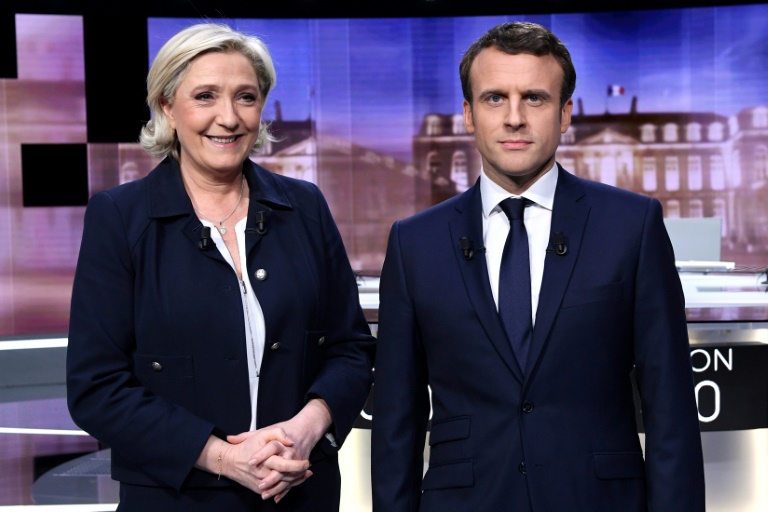
French leader Emmanuel Macron and the far-right’s Marine Le Pen go head-to-head in a crunch TV debate on Wednesday, seeking to sway undecided voters with four days left until the presidential election’s decisive second round.

Macron holds a solid poll lead, but his political allies have warned against any complacency in the prime-time duel — their only direct clash — which will be watched by millions.

Some polls are predicting a lead of around 10 points for Macron over Le Pen in the run-off, a repeat of the 2017 election. But undecided voters and abstentions could yet swing the figures.

Le Pen has cleared her diary to concentrate on preparing for the debate, hoping to avoid any repeat of the fiasco five years ago, when her ill-prepared performance contributed to her defeat at the hands of the centrist Macron.

This year’s vote will mark the closest the far right has come to taking the Elysee presidential palace. Marine Le Pen’s father Jean-Marie was crushed by Jacques Chirac in the 2002 run-off election, and she was easily defeated by Macron in 2017.

The live televised debate — scheduled from 1900 GMT — has been a political tradition in France since 1974, when Socialist Francois Mitterrand took on centrist Valery Giscard d’Estaing.  

But it did not take place in 2002, when Chirac said debate was impossible with “intolerance and hatred” after Jean-Marie Le Pen stunned France by making the run-off.

– ‘Kick in the backside’ –

The stakes are high in this election, and Europe is watching.

Macron is expected to continue to champion the EU if he wins another five years in office. Le Pen has vowed to reform it under a far-right presidency.

Opinion polls currently put Macron at 53 to 56 percent in the run-off against 44 to 47 percent for Le Pen — a much tighter finish than five years ago, when Macron carried the vote with 66 percent.

For Le Pen, the debate represents a final chance to win back ground in the polls and convince France she has moderated her anti-immigration party into a mainstream force.

Macron will likely seek to portray her as a dangerous extremist who cannot be trusted on foreign policy — especially after Russia’s invasion of Ukraine, given her past comments in support of President Vladimir Putin.

Both candidates are particularly keen to woo the electorate of hard-left candidate Jean-Luc Melenchon, who finished a strong third in the first round.

Le Pen was reportedly spending Tuesday with her closest aides to rehearse the debate, having admitted previously that her performance against Macron in 2017 was not up to scratch. 

“For me, failure is sometimes a kick in the backside,” she told TF1 television.

Le Monde newspaper said Le Pen would seek to present herself as a credible French leader and portray the election as an anti-Macron “referendum”.

She has “spent five years trying to bury that disastrous (2017) televised duel, by sprucing up her image, party and ideological tenets,” the paper said.

– ‘Either could win’ –

Macron has insisted the election is not yet in the bag, reminding voters of the political upsets of 2016 when Britons voted to leave the EU and Americans put Donald Trump in the White House.

Key allies have made clear nothing should be taken for granted, telling voters tempted to stay at home that they must cast their ballots. 

“The game isn’t over yet and we certainly can’t draw conclusions… that this election, this match, is already decided,” Prime Minister Jean Castex told France Inter radio. 

“We have to convince the French that Emmanuel Macron’s programmes are the best for France and for them,” he said. He added that if Macron won, his government would resign to give the ruling party new impetus ahead of legislative elections in June.

Castex’s predecessor as prime minister, Edouard Philippe, mayor of the northern city of Le Havre and a heavyweight centre-right backer of Macron, said nothing could be taken for granted due to the numerous “unknowns” hanging over the election — abstentions above all.

He told Le Figaro newspaper on Monday that the so-called Republican front — which in past elections had seen French voters of all political stripes line up against the far right — “was no longer a natural reflex”.

“Right now, either candidate could win,” added another ally, Francois Bayrou, the leader of the pro-Macron Modem party.

Oil stabilises after big drop on IMF growth cut

Asian markets were flat on Wednesday as oil began clawing its way back up from a big drop after the International Monetary Fund downgraded its global growth forecast for 2022. 

The IMF lowered its outlook to 3.6 percent — a .08 percent slash from its previous estimate released in January — prompting a five-percent dive in oil prices on Tuesday. 

The fund pointed to surging energy prices, rising debt, supply-chain woes, and a series of inflationary crises linked to the war in Ukraine and the coronavirus pandemic.

“The economic effects of the war are spreading far and wide — like seismic waves that emanate from the epicenter of an earthquake,” IMF chief economist Pierre-Olivier Gourinchas said in the report.

While oil prices showed their first sign of susceptibility to global economic trends after the announcement, US stocks rallied on the back of promising housing-starts data and solid corporate earnings.

“In the absence of inventory buffers, there are only two things that can send oil lower, recession and or demand destruction. More folks were more willing to check one or both of those boxes overnight on the back of the IMF economic warning shot and China’s protracted lockdown,” said Stephen Innes at SPI Asset Management.

Tens of millions are still barred from leaving home in China’s economic centre Shanghai and tech hub Shenzhen, where a Covid-19 outbreak has broken down supply lines and shuttered businesses.

Alongside the positive corporate earnings and housing data, much of Wall Street’s strength also stemmed from the positioning of the market.

“It’s a nice reflex rally from an oversold position,” said Art Hogan, strategist at National Securities, who said the dynamics reflected a “pretty oversold market”.

In Tokyo, the Nikkei 225 opened slightly higher, buoyed by a cheaper yen, but the Hang Seng Index in Hong Kong was marginally lower after being battered by China growth concerns and Beijing’s crackdown on the tech sector on Tuesday.

Shanghai and Seoul were also down while Sydney, Jakarta, and Taipei were inching upward.

– Key figures around 0230 GMT –

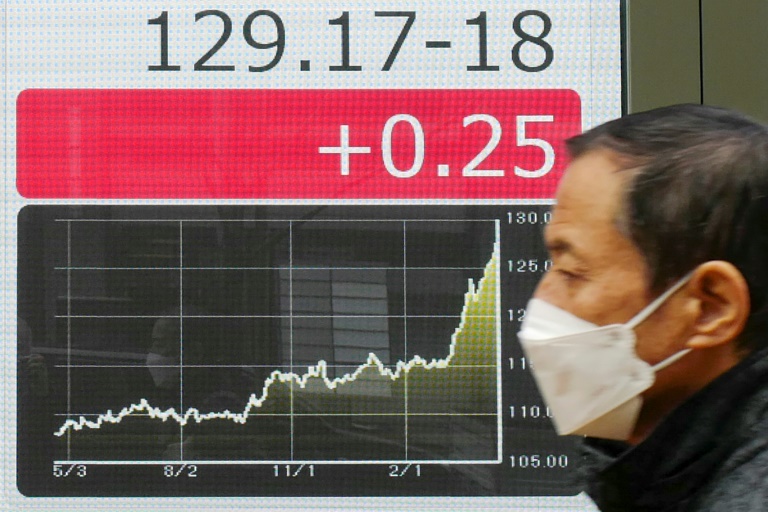
Tokyo – Nikkei 225: UP 0.56 percent at 27,135.27

Shanghai – Composite: DOWN 0.64 percent at 3,173.65 

Hong Kong – Hang Seng Index: DOWN 0.40 percent at 20,943.35 

Dollar/yen: DOWN at 128.65 yen from 128.89 yen

Euro/dollar: UP at $1.0806 from $1.0796

Pound/dollar: UP at $1.3032 from $1.2998

Euro/pound: DOWN at 82.92 pence from 82.98 pence

Brent North Sea crude: UP 0.50 percent at $107.79 per barrel

West Texas Intermediate: UP 0.67 percent at $103.25 per barrel

New York – Dow: UP 1.5 percent at 34,911.20 (close)

London – FTSE 100: DOWN 0.2 percent at 7,601.28 points (close)

burs-ssy/leg

Ukraine set to dominate G20 finance chiefs summit

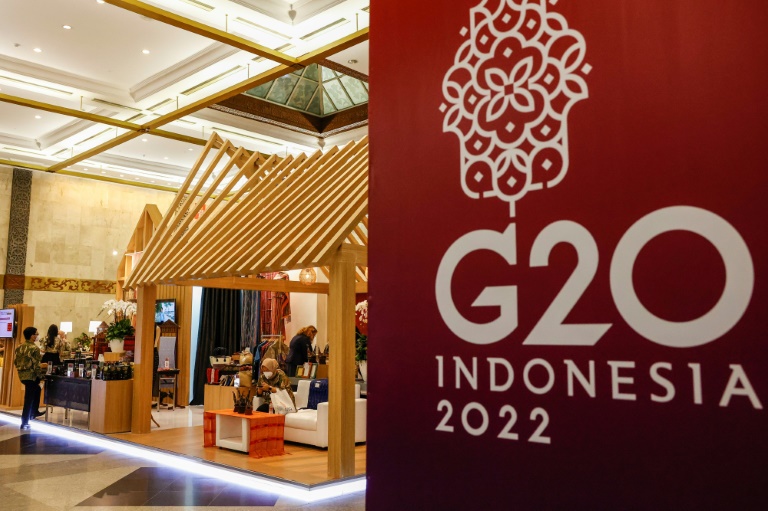
Finance officials from the world’s richest countries will meet on Wednesday to address global challenges like rising debt and a possible food crisis — if they can overcome boiling tensions over Russia’s invasion of Ukraine.

Moscow’s attack on its neighbor is set to dominate the meeting of G20 finance ministers and central bank governors, the first since Russian President Vladimir Putin ordered the invasion in February.

Western nations have retaliated for the bloody incursion with sanctions meant to harm Russia’s economy and turn it into a pariah state.

And US Treasury Secretary Janet Yellen will boycott some sessions if Russian officials are present, according to a senior US official, a stance other countries have said they will follow.

The boycott threat underscores the tumult facing the Group of 20, and experts see little chance at this meeting for the bloc to find consensus on global challenges such as climate change and debt relief for poor nations.

“I think expectations should be extremely low,” said Matthew Goodman, senior vice president for economics at the Washington-based Center for Strategic and International Studies (CSIS). 

“It’s hard to see how the G20 is going to pull together in the face of… the Ukraine crisis,” he said in an interview.

The G20, chaired by Indonesia this year, includes major economies like the United States, China, India, Brazil, Japan and several countries in Europe.

The officials will gather virtually on the sidelines of the World Bank and IMF’s spring meetings in Washington.

– Expected gridlock –

After the economic downturn caused by Covid-19, the global economy is facing a new shock caused by Russia’s invasion of its neighbor, which has driven prices for food and fuel higher and caused the IMF to lower the global growth outlook to 3.6 percent for this year.

Russian finance ministry officials are expected to participate in the event remotely, but a US Treasury official said Yellen will make it clear that “the benefits and privileges of the leading economic institutions of the world… are reserved for countries that demonstrate respect for the core principles that underpin peace and security across the world.”

But the official said the group cannot let Russia stop the important work of the G20.

France has signaled it would participate in the boycott.

A German government source said Berlin did not intend to follow suit, but “During and after the meetings … will certainly send strong messages, and will not do so alone.”

US President Joe Biden has proposed ejecting Russia from the G20 but Mark Sobel, a former Treasury official who is now US chairman of the Official Monetary and Financial Institutions Forum, told AFP there was no obvious mechanism for booting Moscow, which is to varying degrees supported by China and India.

“I think that it really does raise a fundamental question about how are you going to manage global governance,” he said of the tensions.

The divide also bodes ill for the G20 Common Framework, created during the pandemic to help heavily indebted countries find a path to restructure their debt, but which Sobel said is “flailing” as China and private sector creditors drag their feet on participating.

Washington and Beijing are increasingly at loggerheads over a host of issues unrelated to Ukraine, and Sobel said there is unlikely to be much progress over that initiative, either.

“Given the state of US-China tensions, I don’t think the US can speak really well to the China debt issues,” he said.

'Worse to be gay than corrupt' in Venezuela's military

Jose, an army captain, deserted after years of pressure. Rafael, a lieutenant, was prosecuted and expelled.

Both had clean records with Venezuela’s armed forces, but being gay brought them persecution, discrimination and humiliation before they left.

Venezuela’s military justice code states that “unnatural acts” can be punished by three years in prison and a dishonorable discharge, which makes it impossible to serve in the military and be openly gay.

Even despite recent reforms and parliamentary petitions by activists, the controversial clause remains.

“It is worse to be gay than corrupt,” said Jose, 36, a former National Guard captain who did not want his real name used.

“There are members of the military that are corrupt, thieves, drug traffickers, under investigation who are punished and then carry on working as if nothing happened,” said Jose.

He says he was under so much pressure that “my hair fell out.”

Venezuela’s armed forces have been accused many times in recent years of violating human rights when repressing anti-government protests, which the high command denies.

The “first question they ask you in the entry interview is: what is your sexual orientation, homosexual, bisexual or heterosexual? If you don’t reply that you are heterosexual, you’re discarded. That’s the first filter,” said Rafael, the former army lieutenant.

– ‘Disgusted by poofs’ –

Jose’s nightmare began in 2017 when the military decided to investigate “a large group” to determine who was gay.

Jose was unmarried and without children, two conditions needed for promotion.

Many gay members of the military get married to save their careers, but Jose refused and maintained a secret relationship with a man.

He spent “the worst four days of my life” in detention, he said through tears.

“Do you have a girlfriend?” he was aggressively asked over and again.

“The last day of the investigation, they made me take a polygraph test. They locked me in a room, connected me to machines, practically naked… and they asked me the most intimate questions.”

“How are we going to keep a poof here,” they kept telling him, using a derogatory term for a gay man, while trying to force him to sign a confession that he was gay.

“As they didn’t have any firm evidence… they dedicated themselves to humiliating me.”

He was never again allowed to command troops.

Instead, Jose was kept in a hangar, where he was only allowed to work a few hours a day.

“The commander of this unit told me he was disgusted by poofs, that he didn’t want me anywhere near him.”

In the end, he was put in charge of the unit’s Twitter account.

“I was so disappointed that I decided to leave,” said Jose, who now lives in exile in Spain.

– Body cavity search –

For Rafael, 37, it was a casual encounter that cost him his career.

A fellow member of the military had tried to kill him following an intimate encounter after a night of heavy drinking.

He was told to resign to avoid “humiliation.”

“You are being investigated for being gay. There cannot be any homosexuals in the armed forces,” Rafael was told.

“It is up to you whether it is done the easy way or the hard way,” he was warned.

The hard way included a body cavity search without his consent.

He was given two choices by the military prosecutor: resign or “we will have to continue the case and you will be jailed for two to three years.”

Defiant, Rafael chose to go to trial.

However, he was sacked over a disciplinary issue, and the trial was never held since he was no longer a member of the armed forces.

A former military official told AFP that administrative sackings were a common tactic to avoid a trial.

“They try to cover up the investigations so they don’t have to say they were kicked out for being homosexuals,” said the former official on condition of anonymity.

Rafael was so devastated that he contemplated suicide but now hopes to take his case to the Supreme Court, although he is under no illusions that he might win.

Kelvi Zambrano, a lawyer from the Coalition for Human Rights and Democracy NGO, says that change will only come if the “unnatural acts” article in the military code is declared unconstitutional.

That would take legal reform or a Supreme Court decision, as happened in Colombia and Peru.

However, even in Latin American countries where it is not illegal to be gay in the armed forces, homosexuality is rarely tolerated.

For Rafael, though, it was not just the military refusing to accept him for who he is.

“My mother doesn’t accept me, she will die without accepting that I’m gay,” he said.

“She’s one of those people that says, ‘I would prefer a criminal son than a poof.'”

Under shadow of drought, Santiago ditches exotic plants

With drought casting a constant shadow over Santiago’s 7.1 million residents, there has been a recent rush to replace thirsty, exotic plants with hardier, native ones in the hopes of staving off water rationing.

One of Latin America’s most urbanized cities has experienced more than a decade of drought, and managing water access for its fast-growing population is becoming increasingly difficult.

Last year saw the driest winter — the rainy season in Chile — this century, with 71 percent lower rainfall for Santiago than usual, according to the national meteorological office.

Predictions are equally dire for the southern-hemisphere winter about to start with the Mapocho River at 57 percent of capacity, the Maipo River at 61 percent and the El Yeso reservoir at just over two-thirds full.

City authorities are bracing for tough times ahead.

“We can’t make it rain. That is out of our hands, but we can prepare for… an extreme situation,” said Claudio Orrego, governor of Santiago.

Last week, the municipal government announced a four-step crisis plan that starts with encouraging voluntary water conservation but could end in a “Red Alert” phase of rationing.

If the water runs out, cuts will be rolled out to one sector of the city at a time, for a maximum of 24 hours each, under the plan.

It could affect some 142,000 households supplied by the Mapocho River, which bypasses Santiago from east to west, and another 1.5 million that rely on the Maipo River to the south.

– 100,000 trees –

Every day, agricultural engineer Pablo Lacalle — head of water resources at the Santiago Metropolitan Park (Parquemet) — guages the level of the Mapocho River.

Last year, the water level fell by more than half, according to official data.

“We have to plan… to know how much irrigation capacity we will have,” Lacalle told AFP with a concerned look.

“We have a deficit of about 87 percent of water in the park compared to previous years… Fifteen years ago the park had enough water to irrigate everything.”

Faced with the new reality, the park is rolling out a drought-busting re-planting plan.

“We have replaced exotic forest with native forest,” with 100,000 trees replanted in three years on the park’s northern slope, Parquemet director Eduardo Villalobos said.

Last year, pasture in the park was reduced by 50,000 square meters and replaced with endemic plants.

– Every drop ‘precious’ –

In the city itself, some are starting to take aim at green grass.

Urban architect Joaquin Cerda in 2021 launched a movement against “European-style” grass-lined sidewalks.

His project, “Vereda Nativa” (Native Sidewalk), has so far replaced some 150 square meters (1,600 square feet) of grass in the neighborhood of Pedro de Valdivia Norte with 25 native plant species. 

These were more adept, he said, to the climate of Santiago, “to prolonged drought and to live a long time without water,” he told AFP.

Now, “we water here once a week for half-an-hour using drip irrigation,” said Cerda, reducing water consumption to less than a tenth of what it was before.

“Every drop of water is very precious.”

According to the World Bank, annual precipitation in Chile’s coastal regions has decreased by 15 to 30 percent in the last century, leading to multiple periods of severe drought.

Climate change would likely change the frequency and magnitude of hazards such as wildfires and droughts, with risks for economic growth and public health, it says.

Access to water has become an increasingly contentious point in Chile.

Legally, water is a resource for public use, but the government has granted almost all exploitation rights to the private sector.

Industry accounts for about 20 percent of consumption and agriculture another 70 percent, with avocado — a major Chilean export — a particularly thirsty crop.

This all posed little problem in times of abundance, but drought brought a furious reaction in 2020 when some communities started running out of water.

Protesters occupied a well managed by a copper mining company, demanding it be used to provide water to communities instead.

The Constitutional Convention drafting a proposed new founding law for Chile on Monday approved an article stating that water is an “inalienable public good.”

Close Bitnami banner
Bitnami