World

European stocks slide on return from Easter break

European stock markets slid Tuesday, catching up with losses in Asia and on Wall Street caused by slow growth concerns in China and rising US interest rates. 

Trading for the first time since Thursday, London’s benchmark FTSE 100 index was down 0.4 percent nearing the half-way stage.

Losses were steeper in the eurozone, with Frankfurt’s DAX index and the Paris CAC 40 shedding around one percent, also after an extended weekend.

“Despite the public holiday in most of Europe yesterday, this is shaping up to be another volatile and eventful week for global markets,” noted Lukman Otunuga, senior research analyst at FXTM.

“Later today, the International Monetary Fund will release its updated global economic outlook with markets expecting a downgrade for growth this year.”

Otunuga said “such a development may hit investor confidence, sweetening appetite for safe-haven assets”.

One traditional haven, the yen, struck a fresh 20-year low Tuesday at 128 to the dollar, with the Japanese currency heavily weighed down by diverging monetary policy in Japan and the United States.

High oil prices in Japan — a major importer of crude — have also pushed the currency lower, according to analysts.

Japan’s Nikkei 225 rebounded from losses Monday — and led other major Asian stock markets higher.

But Hong Kong plummeted by its largest margin in three weeks — knocked by concerns around Beijing’s tough tech-sector regulations and economic growth concerns in China.

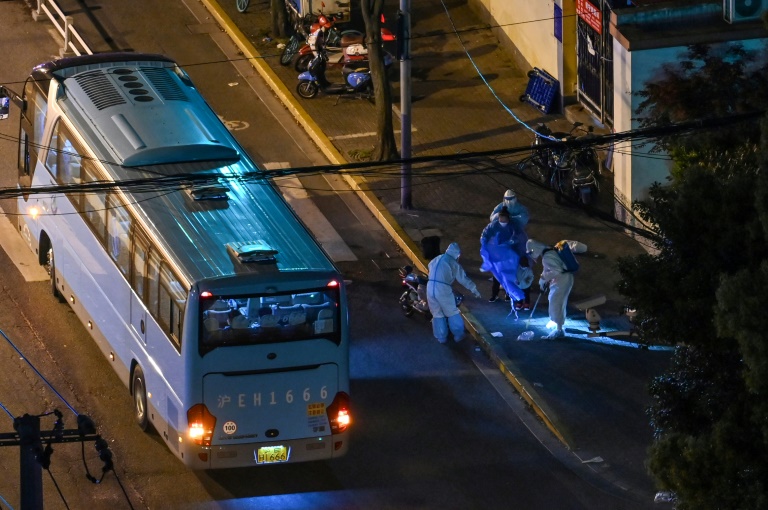
Millions of residents are still cloistered in their homes in China’s financial capital Shanghai.

Investors were left weighing whether attempts to lift the economy by Chinese policymakers — who have held off cutting interest rates — would offset Beijing’s zero-Covid policies.

“The focus in Asia is on mainland policy easing to cushion the impact of lockdowns,” said Stephen Innes at SPI Asset Management.

China’s economic growth accelerated in the first quarter of the year to 4.8 percent, official data showed Monday, but the government warned of “significant challenges” ahead.

– Key figures around 1030 GMT –

London – FTSE 100: DOWN 0.4 percent at 7,586.79 points

Frankfurt – DAX: DOWN 0.9 percent at 14,036.68

Paris – CAC 40: DOWN 1.0 percent at 6,523.90

EURO STOXX 50: DOWN 1.1 percent at 3,807.47

Tokyo – Nikkei 225: UP 0.69 percent at 26,985.09 (close)

Shanghai – Composite: DOWN 0.05 percent at 3,194.03 (close)

Hong Kong – Hang Seng Index: DOWN 2.28 percent at 21,027.76 (close)

New York – Dow: DOWN 0.1 percent at 34,411.69 (close)

Dollar/yen: UP at 128.21 yen from 126.54 yen

Euro/dollar: DOWN at $1.0793 from $1.0802

Pound/dollar: FLAT at $1.3023

Euro/pound: FLAT at 82.87 pence

Brent North Sea crude: DOWN 1.3 percent at $111.68 per barrel

West Texas Intermediate: DOWN 1.6 percent at $106.49 per barrel
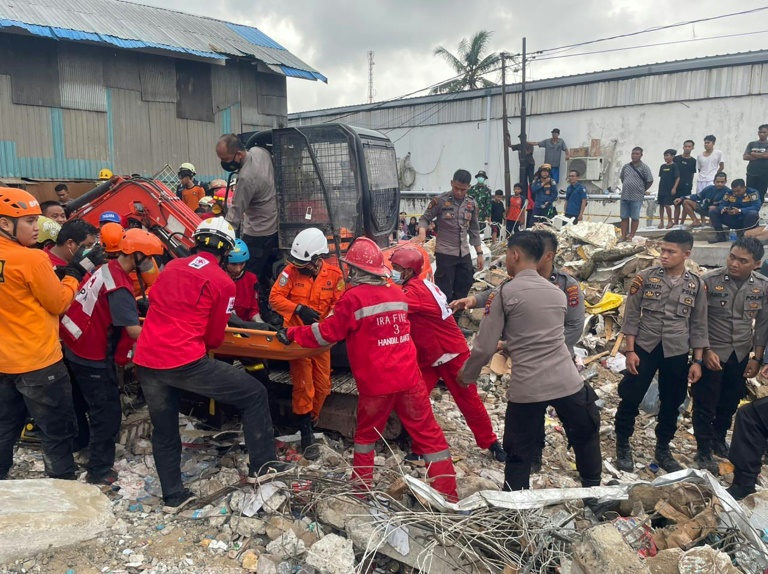
Indonesia rescuers search rubble after mini-market collapse kills 5

Rescue workers in Indonesia were searching for survivors Tuesday after a mini-market collapse killed five people and injured nine, in a country where lax construction standards have raised concerns about building safety.

The three-floor building in Borneo island’s Banjar district suddenly crumpled on Monday afternoon while it was filled with customers and employees before Muslims broke their daily fast for the Islamic holy month of Ramadan.

Emergency services were dispatched to the scene to dig overnight, pulling five bodies from the rubble and freeing nine people, South Kalimantan Police spokesman Mochammad Rifai told AFP.

“We had a report that there were in total 14 people, all of them had been found,” he said Tuesday by phone.

“However, we have not closed the search and rescue operation yet in case there are any more victims.”

Footage from the Search and Rescue Agency showed rescuers extracting two men alive from the debris, before one of them raised his hands to the workers and knelt for a brief prayer.

Rifai said police were sent to the scene to investigate the cause of the collapse, which has not been given.

“The mini-market building, as well as a lot of buildings in Banjar, stand on peatland so flooding is usual. But we cannot conclude that is the cause of the accident,” he said.

In 2020, at least two people were injured as a five-storey building in Jakarta partly collapsed. 

Previously, in 2018, a group of teenagers practising for a dance and music show were among seven killed when the building they were in collapsed in Cirebon, east of Jakarta. 

The same year, at least 75 people were injured when a mezzanine floor at Indonesia’s stock exchange building in Jakarta collapsed into the lobby.

Macron warned against complacency ahead of Le Pen duel

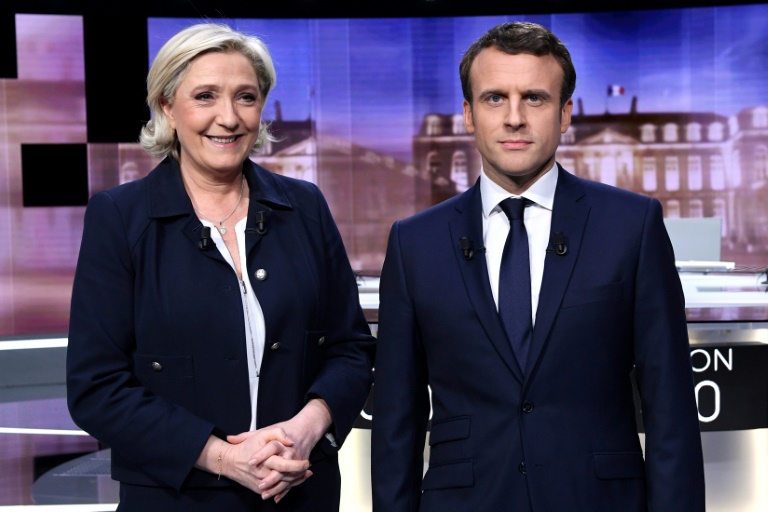
French leader Emmanuel Macron faced warnings against complacency on Tuesday despite polls showing a solid lead over far-right leader Marine Le Pen, one day ahead of a debate crucial to the outcome of the presidential election.

Macron will go head-to-head with Le Pen late on Wednesday in their only direct clash ahead of Sunday’s second-round vote, an encounter set to be watched by millions of French. 

Some polls are predicting a lead of around 10 points for Macron over Le Pen in the run-off but undecided voters and abstentions could yet swing the figures.

Both candidates are particularly keen to woo the electorate of hard-left candidate Jean-Luc Melenchon, who finished a strong third in the first round.

The vote will mark the closest the far right has been to seizing the Elysee presidential palace. Marine Le Pen’s father Jean-Marie was crushed by Jacques Chirac in the 2002 run-off election and she was easily beaten by Macron in 2017.

Opinion polls currently put the centrist Macron at 53 to 56 percent in the run-off against 44 to 47 percent for Le Pen — a much tighter finish than five years ago, when Macron carried the vote with 66 percent.

“The game isn’t over yet and we certainly can’t draw conclusions … that this election, this match, is already decided,” Prime Minister Jean Castex told France Inter radio. 

“We have to convince the French that Emmanuel Macron’s programmes are the best for France and for them,” he said. He added that if Macron won, his government would resign to give the ruling party new impetus ahead of legislative elections in June.

– ‘Either could win’ –

Castex’s predecessor as prime minister, Edouard Philippe, mayor of the northern city of Le Havre and a heavyweight centre-right backer of Macron, said nothing could be taken for granted due to the numerous “unknowns” hanging over the election and, above all, abstentions.

He told Le Figaro newspaper on Monday that the so-called Republican front — which in past elections had seen French of all political stripes line up against the far right — “was no longer a natural reflex”.

“Right now, either candidate could win,” added another ally, Francois Bayrou, the leader of the pro-Macron Modem party.

Macron had himself made clear he does not see the election as being in the bag, reminding voters of the political earthquakes of 2016 when Britons voted to leave the EU and Americans put Donald Trump in the White House.

“Think back to what British citizens were saying hours before the Brexit (referendum) or in the US before the Trump vote came: ‘I’m not going (to vote). What’s the point?’ I can tell you that the next day they regretted it,” Macron told France 5 television.

“So if you want to avoid the unthinkable or something that revolts you, choose for yourself,” he said.

– ‘Kick in the backside’ –

The run-off debate is traditionally a pivotal moment in French presidential elections and will be broadcast live on national television from 1900 GMT on Wednesday.

For Le Pen, it represents a final chance to haul back ground in the polls and convince France she has moderated her anti-immigration party into a mainstream force.

Macron is likely to seek to portray her as a dangerous extremist who cannot be trusted on foreign policy — especially after Russia’s invasion of Ukraine, due to her past close ties with President Vladimir Putin.

Le Pen was reportedly spending all Tuesday with her closest aides to rehearse the debate, with no trips on the agenda, to avoid the fumbling and missteps that marked her performance in 2017.

“For me, failure is sometimes a kick in the backside,” she told TF1 TV, again acknowledging that she had not been up to scratch in 2017.

She has vowed to ban the wearing of the Islamic headscarf in public but close lieutenants have rowed back on this somewhat, with her spokesman Sebastien Chenu admitting on BFM television that it was a “complex problem”.

China says it has signed security pact with Solomon Islands

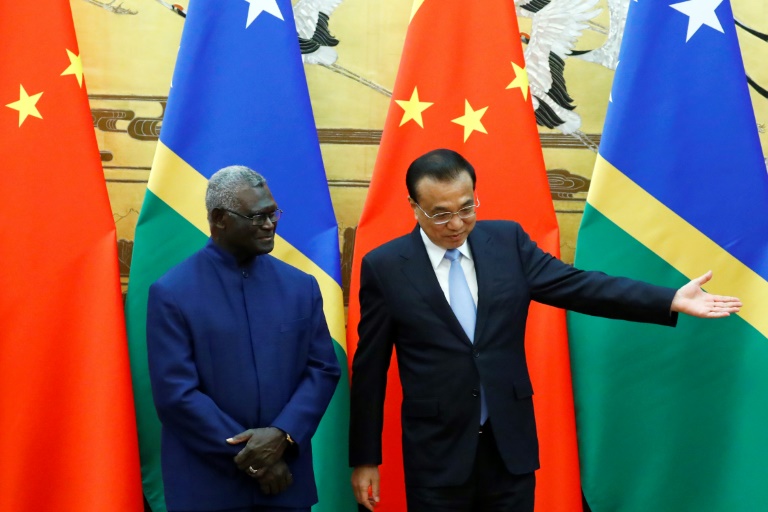
China said Tuesday it has sealed a wide-ranging security pact with the Solomon Islands, an agreement the United States and its regional allies fear could give Beijing a military foothold in the South Pacific.

The confirmation came a day after Washington discouraged a security agreement between the countries, with top US diplomats headed to the South Pacific this week to curb Beijing’s inroads.

But Chinese foreign ministry spokesman Wang Wenbin told reporters on Tuesday: “The foreign ministers of China and the Solomon Islands officially signed the framework agreement on security cooperation recently.”

He did not say when or where the signing took place.

A draft version of the agreement, leaked last month, rattled Western governments with provisions allowing for Chinese security and naval deployments to the crisis-hit Pacific island nation.

According to the draft, armed Chinese police could be deployed at the Solomon Islands’ request to maintain “social order”.

Australia is concerned the agreement could see Beijing establish a military presence less than 2,000 kilometres (1,200 miles) away.

Wang on Tuesday accused Western powers of “deliberately exaggerating tensions” over the pact, and questioned the motives behind US officials’ upcoming visit.

The security deal represents a “normal exchange and cooperation between two sovereign and independent countries,” Wang said.

“Attempts to interfere and obstruct the cooperation of island countries with China are… doomed to fail,” he added at a regular press briefing.

-‘Broad nature’-

Solomons Prime Minister Manasseh Sogavare’s assurances that he does not intend to allow China to build a military base there has done little to alleviate Western concerns.

“The broad nature of the security agreement leaves open the door for the deployment of PRC military forces to the Solomon Islands,” US State Department spokesman Ned Price said Monday.

The signing of the pact “could increase destabilisation within the Solomon Islands and will set a concerning precedent for the wider Pacific Island region,” he added.

The White House’s high-level delegation to the Solomons is expected to discuss its concerns, as well as the reopening of the US embassy in the former British protectorate’s capital, Honiara.

Earlier this month, Australian Minister for International Development and the Pacific Zed Seselja travelled to Honiara to ask the prime minister in person not to ink the deal.

The United States and its Asian allies have voiced growing concern about China’s assertiveness in the Pacific, where it is locked in several territorial disputes with neighbouring countries.

The Solomon Islands’ switch of diplomatic recognition from self-ruled Taiwan to Beijing in 2019 unlocked huge amounts of Chinese investment, but the issue has been fraught with tensions.

The island nation of 800,000 has been wracked by political and social unrest, and many of its people live in poverty.

In November, protesters tried to storm the parliament and went on a deadly three-day rampage, torching much of Honiara’s Chinatown.

The unrest was sparked by a range of tensions, including opposition to Sogavare’s rule, inter-island rivalries and high unemployment, while anti-China sentiment also played a role.

War in Ukraine: From invasion to battle for Donbas

Russia invaded Ukraine in the early hours of February 24, setting off the worst conflict in Europe in decades.

As the second phase of Russia’s offensive gets underway in the east, we look back on nearly two months of fighting that has killed thousands of civilians, sparked accusations of Russian war crimes and even genocide, and led more than 4.9 million Ukrainians to flee their country.

– February 24: Russia invades – 

Russian President Vladimir Putin announces a “special military operation” to “demilitarise” and “de-Nazify” the former Soviet state and protect Russian speakers there.

A full-scale invasion starts with air and missile strikes on several cities. Ukrainian President Volodymyr Zelensky pledges to stay in Kyiv to lead the resistance.

– February 26: Massive sanctions –

The West adopts unprecedented sanctions against Russia and military aid for Ukraine. 

A number of Russian banks are banished from the SWIFT interbank system.

Air spaces are closed to Russian aircraft and Russia is kicked out of sporting and cultural events.

– February 27: Nuclear threat –

With his troops quickly getting bogged down, Putin puts Russia’s nuclear forces on high alert, citing “aggressive” statements by NATO members and the financial sanctions.

– February 28: First talks – 

During the first peace talks between Kyiv and Moscow, Russia demands the recognition of its sovereignty over Crimea, the “demilitarisation” and “de-Nazification” of Ukraine and the guarantee of its neutrality.

Zelensky appeals for “immediate” EU membership, eliciting a cool response from Brussels.

– March 3: Kherson falls –

Russian troops gain ground in the south, where they besiege the strategic port of Mariupol, seeking to link up territory held by pro-Russian rebels with the Russian-annexed Crimea.

On March 3, the southern city of Kherson becomes the first to fall.

– March 4: Media crackdown –

Russia enacts a new law severely punishing “fake news” about its “special military operation” in Ukraine.

NATO rejects Kyiv’s pleas for a no-fly zone over Ukraine.

– March 8: First evacuations –

On March 8, the first humanitarian corridors are set up, allowing thousands of civilians to escape the northeastern city of Sumy and Kyiv suburbs.

– March 8: Oil embargo –

In a bid to starve Moscow’s war chest, the US announces a ban on imports of Russian oil and gas. EU members take a more gradual approach, vowing to dramatically reduce their dependency on Russian gas but not turn off the tap altogether.

– March 16: Zelensky lobbies Congress – 

Zelensky tells the US Congress to “remember Pearl Harbor” as he lobbies one Western parliament after another for more help to fight off Russian forces. 

– March 17: ‘War criminal’ Putin –

Biden brands Putin a “war criminal” following the bombing of a theatre in Mariupol where families were sheltering.

– March 18: Hypersonic weapons –

Russia says it has used hypersonic missiles for the first time in Ukraine to destroy a weapons storage site.

– March 25: Russia reviews goals –

As the offensive in northern Ukraine get bogged down the Russian army announces it will focus on the “liberation” of the breakaway Donbas region in the east.

– March 26: Putin must go, says Biden –

During a visit to Warsaw, Biden says Putin is a “butcher” who “cannot remain in power” but later stresses he is not seeking regime change.

– March 29: Progress at talks –

Russia says it will “radically” reduce its military activity around Kyiv and the northern city of Chernigiv after both sides hail progress in peace talks held in Istanbul. Russian forces begin redeploying.

– April 2-3: Horror in Bucha –

After the Russian withdrawal, dozens of bodies in civilian clothes are found scattered on the street or buried in shallow graves in the Kyiv suburb of Bucha. Some of the dead have their hands tied behind their backs and some bear signs of torture.

Accusations of Russian war crimes mount but Moscow claims the images are fakes.

– April 8: Train station carnage –

At least 57 people are killed in a rocket attack on a train station in the eastern city of Kramatorsk that is being used for civilian evacuations.

– April 12: Biden speaks of ‘genocide’ –

Biden accuses Russia of “genocide” in Ukraine, saying Putin appears intent on “trying to wipe out the idea of even being able to be a Ukrainian”. Canadian Prime Minister Justin Trudeau echoes the claim.

– April 13: Last stand in Mariupol –

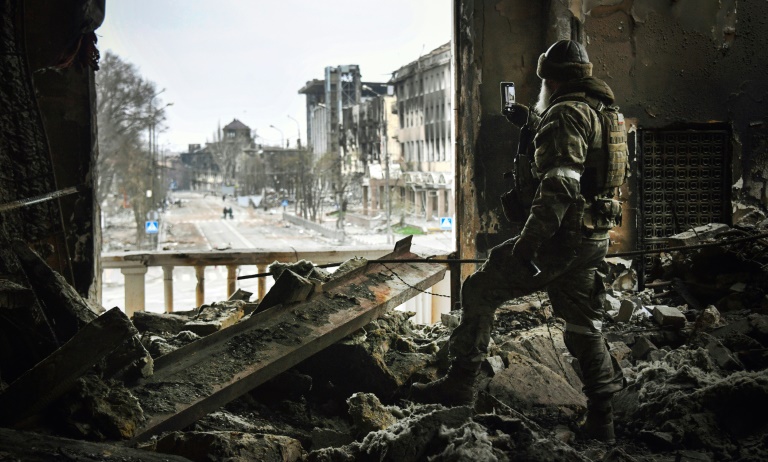
As Russia closes in on Mariupol, it says more than a thousand Ukrainian troops in the city have surrendered. Ukraine vows to fight “to the end” for control of the city, which has become a symbol of Ukrainian resistance.

– April 14: Flagship sinks –

Russia’s guided missile cruiser Moskva, a linchpin of its offensive in southern and central Ukraine, sinks in the Black Sea after being damaged by a fire. Ukraine claims its missiles took out the vessel.

– April 18: Battle for Donbas –

Russia carries out dozens of air strikes across eastern Ukraine in what Zelensky presents as the start of the “battle for the Donbas”.

Russia launches major 'offensive' in eastern Ukraine

Moscow launched dozens of air strikes across eastern Ukraine overnight, its defence ministry said Tuesday, after Kyiv accused Russian forces of unleashing a major new offensive in the Donbas region.

Russia’s defence ministry said that “high-precision air-based missiles” had hit 13 Ukrainian positions in parts of the Donbas while other air strikes “hit 60 military assets”, including in towns close to the eastern frontline. 

Ukraine’s armed forces also confirmed that fighting had increased throughout the east just hours after President Volodymyr Zelensky said Russia had kicked off the widely anticipated offensive in the Donbas region on Monday.  

“The Russian occupiers intensified offensive operations along the entire line of contact,” the general staff of Ukraine’s armed forces said in a report published early Tuesday. 

Ahead of the advance, Ukrainian authorities had urged people in Donbas to flee west to escape, even as officials called off evacuations for a third straight day from frontline cities due to ongoing fighting. 

“No matter how many Russian soldiers are brought here, we will fight. We will defend ourselves,” Zelensky said on Telegram late Monday.

Control of Donbas would allow Moscow to create a southern corridor to the occupied Crimean peninsula.

However, Zelensky’s advisor Oleksiy Arestovich offered a slightly different take during an interview on Ukrainian TV Tuesday, saying the offensive in the Donbas had been ongoing for nearly two weeks. 

“The offensive has been going on for 12 days in the Donbas,” said Arestovich. 

“They advance by looking for weak points in our defence. As soon as they find them, they infiltrate them,” he added. 

In the south, Russia continued its push to capture the besieged port city of Mariupol, as Moscow issued a fresh call for the city’s defenders to surrender.

But despite the desperate situation in the city, a senior US Defence Department official on Monday said Mariupol “is still contested”.

Monday also saw the first shipments of a new $800-million US military aid package arrive at Ukraine’s borders to be handed over in its fight against the Russian invasion.

– ‘It’s hell’ –

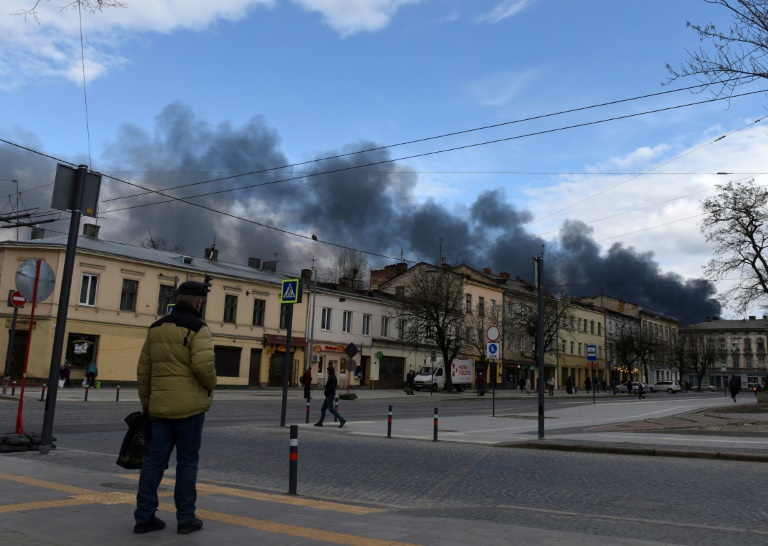
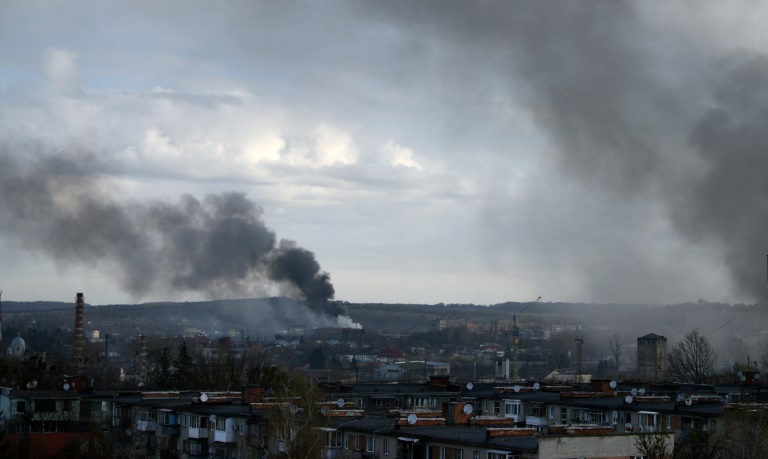
And while much of the focus has remained in Ukraine’s east, Moscow has also targeted the country’s west with air strikes, killing at least seven people in the city of Lviv near the Polish border on Monday.

Lviv has largely been spared bombardment since Russia invaded on February 24, and the city and its surroundings had become a haven for those seeking safety from the war zone.

But “today we understood clearly that we don’t have any safe places in Ukraine. It’s very dangerous,” a bank employee who gave her name as Natalia told AFP after the strikes.

Among the sites struck was a depot near Lviv that Moscow said held weapons recently delivered to Ukraine from the United States and Europe.

Shortly before Zelensky’s address late Monday, the regional governor of the Lugansk region Sergiy Gaiday also announced the beginning of Russia’s much-anticipated attack.

“It’s hell. The offensive has begun, the one we’ve been talking about for weeks. There’s constant fighting in Rubizhne and Popasna, fighting in other peaceful cities,” he said on Facebook.

Russian shelling killed at least eight civilians in eastern Ukraine, according to local authorities.

Gaiday said four people died as they tried to flee the city of Kreminna in Lugansk as Russian troops moved in.

“The Russian army has already entered there, with a huge amount of military hardware… Our defenders have retreated to new positions,” Gaiday said in a statement on social media.

Nearby, in the village of Novodruzhesk, weary locals have borne the brunt of the fighting.

“We are bombed everywhere. It’s a miracle that we’re still alive,” said Nadya, 65, her voice trembling.

“We were lying on the ground and waiting. Since February 24 we’ve been sleeping in the cellar.

“There’s no more water, electricity, nothing. We’ve got no more money, no more petrol — we can’t leave.”

– ‘Heavy attacks’ –

Russian President Vladimir Putin has said he launched the so-called military operation on February 24 to save Russian speakers in Ukraine from a “genocide” carried out by a “neo-Nazi” regime.

Putin also recognised the independence of two self-proclaimed separatist republics in Donetsk and Lugansk shortly before the invasion began.

On Monday, Putin lauded the 64th Motor Rifle Brigade — which is accused of committing atrocities near Kyiv — bestowing battle honours on them for “heroism and valour, tenacity and courage”.

Ukraine has alleged the brigade is guilty of war crimes while occupying the suburb of Bucha on the outskirts of Kyiv, where residents were shot dead, some with their hands bound.

The European Union condemned Russia’s “indiscriminate” bombing of Ukrainian civilians.

Its foreign policy chief Josep Borrell pointed to “particularly heavy attacks” in eastern and southern Ukraine and an offensive against second city Kharkiv, where officials said Russian shelling killed three people.

Seeking to strengthen ties and accelerate admission to the 27-nation bloc, Zelensky said that Ukraine hoped to receive EU candidate country status within weeks.

On Monday, he handed the EU’s envoy to Kyiv a two-volume response to a membership questionnaire brought by European Commission chief Ursula von der Leyen in March.

burs-ds/jv

War in Ukraine: Latest developments

Here are the latest developments in the war in Ukraine:

– Eastern offensive begins –

Russia says its forces have carried out dozens of air strikes in eastern Ukraine as part of a major offensive in the Donbas region that had been expected for days.

The Russian defence ministry confirms strikes on Ukrainian positions in the key town of Slovyansk and on towns close to the frontline.

“We can now confirm that Russian troops have begun the battle for the Donbas, which they have been preparing for a long time,” Ukrainian President Volodymyr Zelensky says.

– New Mariupol ultimatum –

Russia calls on Ukrainian forces to “immediately lay down arms” and issues a new ultimatum for the defenders of the besieged port city of Mariupol to end their resistance.

The Russian defence ministry says that defenders of Mariupol will be “guaranteed survival” if they lay down their arms starting at noon (0900 GMT).

Ukrainian forces in Mariupol ignored a previous such ultimatum on Sunday.

– Deaths in Lviv –

Five “powerful” Russian missiles hit the western city of Lviv, which had been mostly spared by the fighting, killing at least seven people and wounding eight, local officials say.

Russia says it has also destroyed an arms depot near Lviv containing weapons recently delivered to Ukraine.

– New US arms shipments arrive –

The first shipments of a new US military aid package have arrived at Ukraine’s borders to be handed over, a senior Pentagon official says.

The package includes 18 155mm howitzers for the first time, as well as 40,000 artillery rounds, 200 M113 armoured personnel carriers, 11 Mi-17 helicopters and 100 armoured multi-purpose vehicles.

– Biden to hold meeting of allies –

US President Joe Biden will convene a meeting of allies on Tuesday to discuss the Ukraine conflict, the White House says.

The video call will also cover “efforts to hold Russia accountable”, it says.

– Putin honours Bucha-linked brigade –

Russian President Vladimir Putin bestows an honorary title on a brigade accused by Ukraine of “war crimes” and mass killings in the town of Bucha.

A decree signed by Putin gives the 64th Motor Rifle Brigade the title of “Guards” for defending the “Motherland and state interests” and praises the “mass heroism and valour, tenacity and courage” of its members.

– Tycoon seeks prisoner exchange –

Russian state television broadcasts a video of two men it says are captured Britons asking to be exchanged for Viktor Medvedchuk, a recently captured Ukrainian tycoon close to Russian President Vladimir Putin.

Ukraine’s security services then puts out a video of Medvedchuk asking to be exchanged for Ukrainian civilians and soldiers trapped in the strategic besieged port of Mariupol.

– Nearly 5 mn have fled Ukraine: UN –

More than 4.9 million Ukrainians have fled their country following the Russian invasion, says the UN’s refugee agency.

The UNHCR says 4,934,415 Ukrainians have now left the country, up more than 65,000 on the previous day.

burs-cdw/cb/gil

Japan fast-food chain fires official over sexist comments

One of Japan’s most popular fast-food firms said on Tuesday that it had fired a top executive who reportedly suggested a marketing strategy of getting “virgins addicted” to the company’s products.

Yoshinoya, which operates a chain of restaurants serving cheap beef bowls in Japan and abroad, did not immediately confirm the exact comments made by Masaaki Ito, who was a managing director.

In a statement, the company said he had been fired for “extremely unacceptable words and deeds”.

Ito reportedly said the firm should try to “get virgins addicted” to Yoshinoya’s food because “once men treat them to expensive meals they won’t eat beef bowls any more”.

His comments were posted on social media by a person who said they had attended a university lecture where Ito spoke.

The firing came after outrage against the comments on social media sites. 

On Twitter, former Japanese Communist Party lawmaker Saori Ikeuchi called the remark “blatantly sexist” and “disgusting”.

Other users pointed out that Ito appeared to be disparaging Yoshinoya’s food.

“What’s equally incredible is how little pride and love he has for his company’s own products,” one Twitter user wrote.

Japan often appears towards the bottom of international gender equality rankings. In 2021, the World Economic Forum placed it 120 out of 156 countries on its Global Gender Gap Index rankings.

There is little female representation in the higher levels of business and politics despite women in the country being highly educated and present in the workforce.

Sexist gaffes by high-ranking officials and politicians have made waves before, including the resignation of Tokyo Olympics chief Yoshiro Mori before the Games after he suggested women speak too much in meetings.

Six killed in blasts at Shiite school in Afghan capital

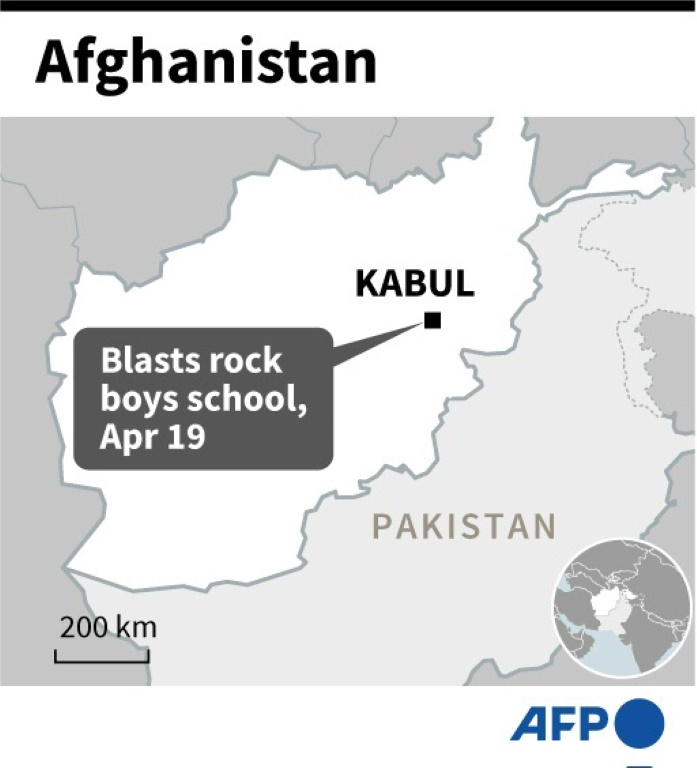
At least six people were killed and 11 wounded Tuesday by two bomb blasts at a boys’ school in the Afghan capital, with social media showing grisly images from the Hazara Shiite neighbourhood.

The number of bomb blasts in the country has significantly declined since the Taliban ousted the US-backed Afghan government in August, but the jihadist Islamic State group has claimed several attacks since then.

Kabul police spokesman Khalid Zadran told AFP that Tuesday’s blasts at the Abdul Rahim Shahid school were caused by improvised explosive devices and left at least six people killed and 11 wounded.

“These are preliminary figures. We are at the site and waiting for more details,” he said.

Zadran said a third blast had occurred at an English language centre in the same area, but did not specify whether it was caused by an explosive.

Zadran earlier tweeted that three blasts had rocked the school, which is in an area mainly inhabited by the Hazara community and has been previously targeted by the jihadist Islamic State group.

Tuesday’s blasts occurred as students were coming out of their morning classes at the school, a witness told AFP.

Grisly images posted on social media networks showed several bodies lying at the gate and compound of the school.

Images showed patches of blood, burnt books and school bags scattered at the premises. Taliban fighters were seen cordoning off the area.

Victims were taken to hospital, but Taliban fighters kept journalists from the premises.

Attacks on public targets have largely diminished since the Taliban seized power in August last year, but IS continues to operate across the country.

The Taliban have also been blamed previously for attacks targeting the Hazara community, who make up between 10 to 20 percent of the country’s 38 million population.

Taliban officials insist their forces have defeated IS, but analysts say the jihadist group is a key security challenge to the hardline Islamists who now rule Afghanistan.

Since seizing power the Taliban have regularly carried out raids on suspected IS hideouts, mainly in the eastern Nangarhar province.

IS has claimed some of the deadliest attacks in Afghanistan in recent years.

In May last year at least 85 people — mainly girl students — were killed and about 300 were wounded when three bombs exploded near their school in Dasht-e-Barchi.

No group claimed responsibility, but in October 2020 IS claimed a suicide attack on an educational centre in the same area that killed 24, including students.

In May 2020, the group was blamed for a bloody attack on a maternity ward of a hospital in the neighbourhood that killed 25 people, as well as new mothers.

UK's Johnson to face MPs' fury over 'Partygate'

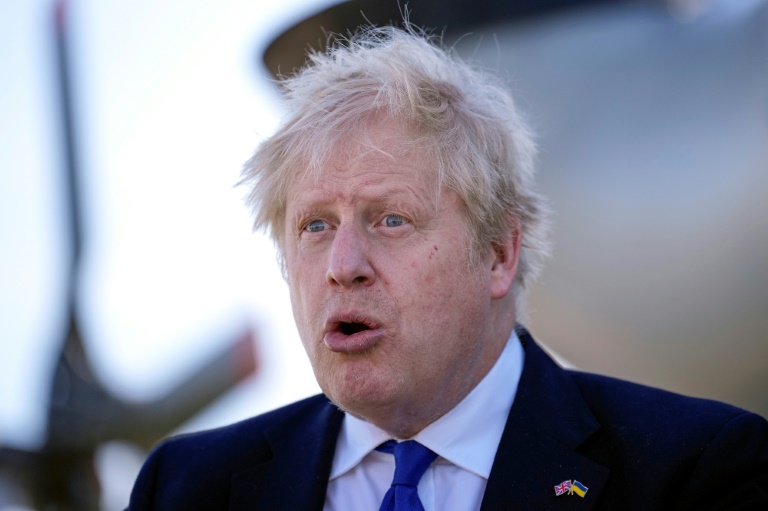
British Prime Minister Boris Johnson will face angry lawmakers on Tuesday for the first time since being fined for breaking his own coronavirus laws by attending a party at his Downing Street office.

The embattled Johnson last week became the first modern British leader to be fined for breaking the law, after police ruled he had breached lockdown curbs in 2020.

But he has weathered the initial storm and has doggedly defied calls to resign.

He can nonetheless expect a bruising few days now the House of Commons is returning from its Easter break, with MPs demanding to know why he repeatedly insisted to them that no rules had been broken.

Knowingly misleading parliament is a breach of government ministers’ code of conduct, which states they should resign as a result — and opposition lawmakers are adamant he should go.

However, Johnson, 57, is digging in, despite the possibility that he could face further penalties as police continue to investigate numerous rule-breaching events.

He will reportedly try to sideline the controversy with a “business as usual” mantra this week, which includes a two-day visit to India starting on Thursday.

“The prime minister will have his say… and will outline his version of events and face questions from MPs,” government minister Greg Hands told Sky News on Monday.

“(He) is getting on with the job, he’s delivered, and the government has delivered in anything from the vaccination programme through (to) the strong support for Ukraine.”

– Attention diverted –

London’s Metropolitan Police is investigating dozens of alleged lockdown breaches by Johnson and his staff in the Downing Street complex where he lives and works.

It said last week officers had so far issued more than 50 fines.

The scandal, the latest in a stream of controversies to hit Johnson since last year, left his position hanging by a thread and MPs from his Conservative Party in a dangerously rebellious mood.

But he boosted his survival chances with what is seen as a firm response to the war in Ukraine, which diverted attention away from the furore when he was most vulnerable.

Several Conservative lawmakers who had publicly withdrawn their support for his leadership have reversed course and argued now is not the time for a change of Tory leader.

A growing cost-of-living crisis is also credited with distracting people from the scandal, while Johnson has made several big policy announcements aimed at his pro-Brexit political base.

They include controversial plans to send migrants and asylum seekers who cross the Channel thousands of miles away to Rwanda.

However, commentators doubt he can maintain his party’s support if he is repeatedly fined, his Tories fare poorly in local elections next month and further lurid details of parties emerge.

In an ominous sign last Wednesday, Simon Wolfson, a justice minister, resigned from the government, citing “the scale, context and nature” of the rule breaches.

– ‘Liar’ –

Several Tories have also renewed calls for him to step down.

Johnson will bid to shore up his standing with them when he addresses a meeting of the Conservative parliamentary party on Tuesday evening, according to reports.

However, he could face the further embarrassment of lawmakers voting to refer him to a rarely convened parliament committee which would decide whether he had misled them over “partygate”.

Commons Speaker Lindsay Hoyle is said to be considering whether to allow such a vote, amid pressure from opposition parties.

“Boris Johnson defied his own law and then lied and lied and lied,” Angela Rayner, Labour’s deputy leader, tweeted last Tuesday.

“While the British public were making huge sacrifices, he was rule-breaking.”

Minister Brandon Lewis defended Johnson, telling Sky News on Tuesday that “at every point he has been clear with what he believes to be the truth”.

“What he also accepts is that the police have looked into this particular issue and taken a view that a fine should be issued. He accepts that, he has paid that fine, he has apologised for that.”

Johnson is undoubtedly hoping voters’ anger over “Partygate” has dissipated, but recent polling indicated widespread anger.

One national survey showed around two-thirds of people spoke negatively about him, compared to just 16 percent positively, with the word “liar” the most commonly shared response.

“Overall, ‘Partygate’ dominates views of Boris (Johnson) over Ukraine,” said James Johnson, a Conservative pollster who conducted the sample. 

“Fury has not receded. Many negative comments are by people who liked him previously but have now changed their minds.”

Close Bitnami banner
Bitnami