World

Workers at New York Apple store launch union campaign

Workers at Apple’s Grand Central Station store announced Monday they are organizing to establish a union, in what would be a first at one of the tech giant’s retail locations in the United States.

The effort, calling itself “Fruit Stand Workers United,” aims to garner signatures from at least 30 percent of the New York store, the minimum needed to qualify for a unionization election.

The campaign is connected to Workers United, an affiliate of the national Service Employees International Union, which was established in 2009 from several earlier unions. 

Workers United confirmed its involvement.

“Like so many recent campaigns, this has been worker-driven, and worker led,” Workers United said in an email. “We recognize the tremendous bravery and courage these workers have taken to stand up for their rights, and we will support them every step of the way.”

Organizers of the Grand Central campaign described themselves as working in “extraordinary times with the ongoing Covid-19 pandemic and once-in-a-generation consumer price inflation,” though their website did not disclose the name of staff members leading the effort.

“Grand Central is an extraordinary store with unique working conditions that make a union necessary to ensure our team has the best possible standards of living,” the workers said on the campaign website for the prospective union.

The Apple effort comes as a Starbucks unionization drive backed by Workers United has spread nationally after election victories last year in New York. 

Amazon is also facing a growing challenge from unions after an upstart campaign won an election at a warehouse in nearby Staten Island earlier this month. A vote at a second Staten Island Amazon site is scheduled for later in April.

On Monday, the National Labor Relations Board, which oversees union elections, indicated it received enough signatures from another Amazon warehouse to hold a vote in Bayonne, New Jersey at a site with about 200 workers.

Employees working in at least three other Apple stores are also attempting to organize, according to The Washington Post.

Apple did not immediately respond to a request for comment from AFP.

Asian markets slide on growth fears, US stocks end volatile day lower

Asian stocks closed lower on Monday as Chinese officials offered a cautious outlook despite better-than-expected growth data, while US stocks edged lower amid worries over higher interest rates.

On a day when bourses in Europe and some Asian cities were closed for holiday, Tokyo’s benchmark Nikkei 225 ended down more than one percent and Shanghai posted small losses.

China’s economic growth accelerated in the first quarter of the year to 4.8 percent, official data showed, but the government warned of “significant challenges” ahead while massive Covid-19 lockdowns started to bite.

Virus restrictions in March have already gouged at retail sales, as consumers shied away from shopping, and drove up unemployment.

“With the domestic and international environment becoming increasingly complicated and uncertain, economic development is facing significant difficulties and challenges,” NBS spokesman Fu Linghui said on Monday.

Jeffrey Halley, senior market analyst with OANDA, said the data “suggest that China started the year well, but as the quarter has moved on, the headwinds have gotten stronger.”

Shanghai reported its first Covid-19 deaths since the start of its weeks-long lockdown.

China’s largest city and economic powerhouse has stewed under a patchwork of restrictions this year amid the country’s worst Covid-19 outbreak since the start of the pandemic.

Back in the United States, Wall Street stocks gyrated in a roller-coaster session, with the S&P 500 finishing down less than 0.1 percent.

The yield on the 10-year US Treasury note rose further above 2.8 percent, its latest jump in the upward march seen over the last month as the Federal Reserve has coalesced around an aggressive plan to counter  inflation.

Meanwhile, survey data pointed to a decline in US homebuilding sentiment, reflecting the drag from higher mortgage rates, according to the National Association of Home Builders.

Oil prices pushed higher as Libya’s National Oil Corporation announced the closure of operations in major sites after staff in the key export terminal of Zueitina and the Al-Sharara oil field were blocked from working.

The Japanese yen, meanwhile, skidded to a fresh 20-year low against the dollar reflecting the continued accommodation of Japanese monetary policy, while US policy makers move to hike interest rates.

– Key figures around 2030 GMT –

New York – Dow: DOWN 0.1 percent at 34,411.69 (close)

New York – S&P 500: DOWN less than 0.1 percent at 4,391.69 (close)

New York – Nasdaq: DOWN 0.1 percent at 13,332.36 (close)

Frankfurt – DAX: Closed for a holiday

Paris – CAC 40: Closed for a holiday

London – FTSE 100: Closed for a holiday

Tokyo – Nikkei 225: DOWN 1.1 percent at 26,799.71 (close)

Shanghai – Composite: DOWN 0.5 percent at 3,195.52 (close)

Hong Kong – Hang Seng Index: Closed for a holiday

Euro/dollar: DOWN at $1.0785 from $1.0810

Pound/dollar: DOWN at $1.3012 from $1.3060

Euro/pound: UP at 82.87 pence from 82.78 pence

Dollar/yen: UP at 126.96 yen from 126.46 yen

Brent North Sea crude: UP 1.3 percent at $113.16 per barrel

West Texas Intermediate: UP 1.2 percent at $108.21 per barrel

US firm on nuclear accord as Iran casts blame

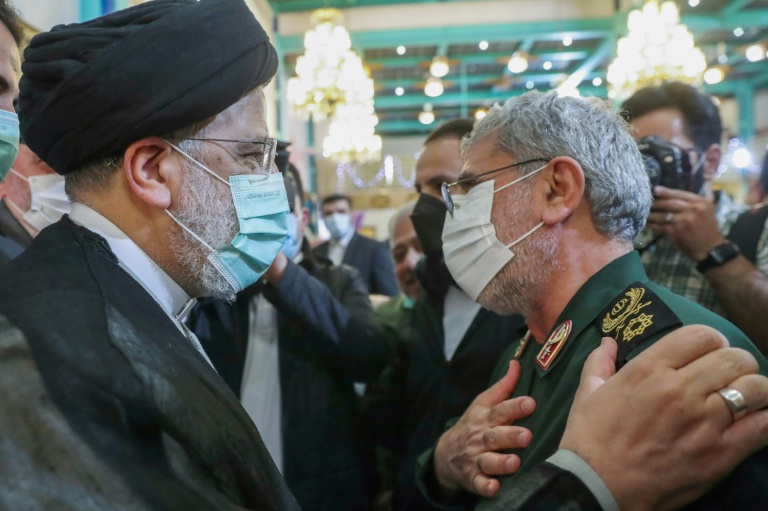
The United States on Monday appeared to dismiss a key Iranian demand to salvage a nuclear accord as Tehran blamed Washington for the prolonged impasse.

Iran and the United States have been negotiating indirectly in Vienna for a year to restore the 2015 agreement, known formally as the Joint Comprehensive Plan of Action, from which former US president Donald Trump withdrew.

One key sticking point is Iran’s insistence on removing the US designation made by Trump that the Revolutionary Guards, the clerical regime’s elite military unit with broad reach in the economy, is a terrorist organization.

“If Iran wants sanctions lifting that goes beyond the JCPOA, they’ll need to address concerns of ours that go beyond the JCPOA,” State Department spokesman Ned Price said when asked about the Revolutionary Guards’ blacklisting.

“If they do not want to use these talks to resolve other bilateral issues, then we are confident we can very quickly reach an understanding on the JCPOA and begin to reimplement the deal itself,” Price told reporters.

President Joe Biden’s administration has offered to return to the agreement, under which Iran was promised sanctions relief for curbing its nuclear program, but has voiced frustration at the slow pace of negotiations.

In Tehran, Iranian foreign ministry spokesman Saeed Khatibzadeh said that more than one issue was pending between Iran and the United States.

“Messages (from Washington) sent through (European Union coordinator Enrique) Mora these past weeks… are far from providing solutions that could lead to an accord,” he told reporters.

“The United States are responsible for these delays, because they are taking their time to give replies” that would be suitable for Iran, he said.

Mora, who coordinates the indirect US-Iran talks, visited Tehran last month for talks with Iranian officials and later went to Washington, saying he hoped to close the gaps in negotiations.

Trump reimposed sweeping sanctions, including demanding other nations not buy Iran’s oil, as he withdrew from the agreement negotiated by his predecessor Barack Obama.

Iran, in response, began rolling back on most of its commitments under the accord.

US officials have warned that Iran’s advances could eventually make a return to the JCPOA pointless, with Tehran’s regional adversary Israel repeatedly warning of military action if the clerical state is seen as close to a bomb.

Britain, China, France, Germany and Russia remain in the JCPOA.

Gaza-Israel rocket fire intercepted as Jerusalem tensions spike

Gaza militants fired a rocket into Israel Monday, the Israeli army said, the first such incident in months and a sign that a wave of violence around a Jerusalem holy site could escalate further.

“Sirens sounded in the area surrounding the Gaza Strip,” the Israeli army said, referring to a Palestinian enclave controlled by the Islamist group Hamas. 

“One rocket was fired from the Gaza Strip into Israeli territory. The rocket was intercepted by the Iron Dome Air Defense System,” the military added in a statement.

There were no immediate reports of casualties and no faction in the crowded enclave of 2.3 million inhabitants immediately claimed responsibility.

Israel holds Hamas responsible for all rocket fire from Israel, and usually carries out air strikes in response to such fire.

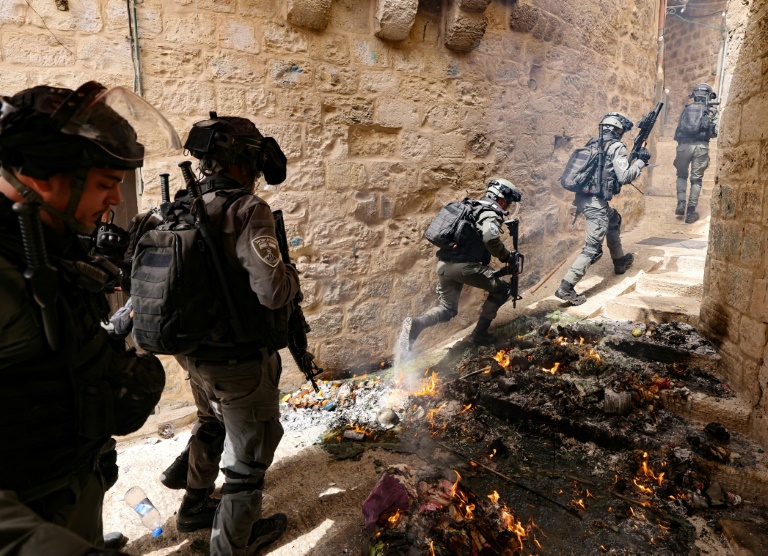
The incident, the first of its kind since January, comes after a weekend of Israeli-Palestinian violence in and around Jerusalem’s flashpoint Al-Aqsa Mosque compound that wounded more than 170 people, mostly Palestinian demonstrators.

Similar violence in Jerusalem around the same time last year triggered repeated Hamas rocket fire into Israel which escalated into an 11-day war.

– ‘Illegitimate and provocative’ –

The spike in tensions coincides with both the Muslim holy month of Ramadan and the Jewish festival of Passover.

The Al-Aqsa Mosque compound is known to Jews as Temple Mount — the holiest site in Judaism and the third-holiest in Islam.

Palestinians have been angered by repeated visits to the site by Jewish worshippers, who are permitted to enter but may not pray there.

The government of Naftali Bennett has repeatedly declared that Israeli security forces have a “free hand” to deal with demonstrators.

Hamas had warned on Sunday that “Al-Aqsa is ours and ours alone” and swore to defend Palestinians’ right to pray there.

The rocket fire and Al-Aqsa clashes came after a spike in violence including four deadly attacks since late March in the Jewish state by Palestinians and Israeli Arabs that claimed 14 lives, mostly civilians.

A total of 22 Palestinians have meanwhile been killed in the violence since March 22, including assailants who targeted Israelis, according to an AFP tally.

Israel has poured additional forces into the occupied West Bank and has been reinforcing its barrier in the territory.

State Department spokesman Ned Price said Monday that the United States was “deeply concerned” about the tensions and that senior US officials had been in touch by telephone with their counterparts from Israel, the Palestinian Authority and Arab nations. 

“We have urged all sides to preserve the historic status quo” at the Al-Aqsa compound and avoid “provocative” steps, he said.

Jordan on Monday summoned the Israeli charge d’affaires “to deliver a message of protest over illegitimate and provocative Israeli violations at the blessed Al-Aqsa Mosque”, its foreign ministry said in a statement.

Jordan serves as custodian of holy places in east Jerusalem, including the Old City, which Israel occupied in 1967 and later annexed in a move not recognised by most of the international community.

Bennett on Monday denounced what he called a “Hamas-led incitement campaign” and said Israel was doing “everything” to ensure people of all faiths could safely worship in Jerusalem.

“We expect everyone not to join the lies and certainly not to encourage violence against Jews,” he said, in an apparent reference to Jordan.

Bennett is also facing a political crisis at home after his ideologically disparate coalition lost its one-seat majority in the 120-seat Knesset, Israel’s parliament, just short of a year since he painstakingly cobbled a government together.

On Sunday, Raam, the first Arab-Israeli party ever to be part of an Israeli government, said it was “suspending” its membership over the violence in Jerusalem.

As major economies meet, US looks to increase pressure on Russia

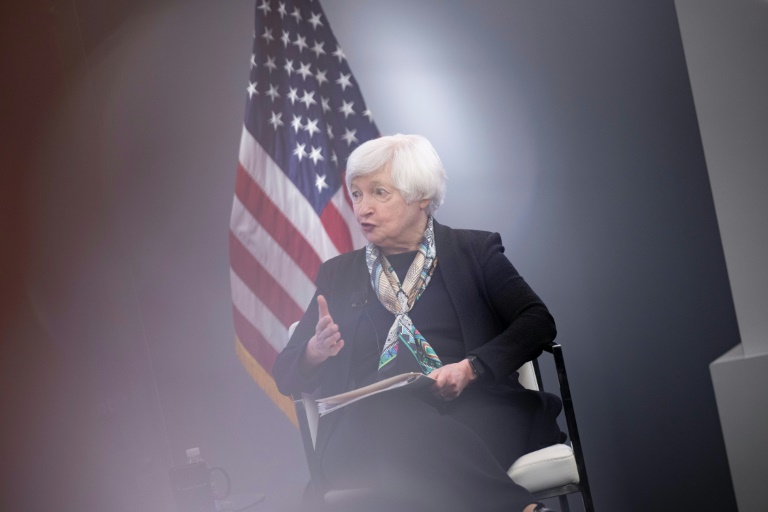
US Treasury Secretary Janet Yellen this week will call on her counterparts in major economies to ramp up the economic pain on Moscow over its invasion of Ukraine, a senior official said Monday.

The fallout from the war and the impact on the global economy will be key topics of discussion during the spring meetings of the IMF and World Bank, which began Monday.

Finance officials from the G7 and G20 nations also will meet this week.

“The secretary believes the Russian invasion of Ukraine has demonstrated the need for the world’s largest economies to stand together to defend international order and protect peace and prosperity,” the Treasury official told reporters.

“She will use this week’s meetings to work with allies to continue our united efforts to increase economic pressure on Russia while mitigating spillover effects.”

The IMF and World Bank have warned of the devastating costs the war is imposing on the global economy, especially through rising prices for energy and food at a time of high inflation.

Western sanctions on Moscow have contributed to the price pressures, which are hitting the poorest countries the hardest.

While Yellen is “deeply concerned” about the impacts, “We are firm in our resolve to hold Russia and its leadership accountable, and have imposed crippling sanctions,” the official said.

In a speech at the Peterson Institute for International Economics, Deputy Treasury Secretary Wally Adeyemo vowed to “take apart Russia’s war machine, piece by piece, by disrupting their military industrial complex and its supply chains.”

“We are continuing our efforts to use sanctions and export controls to deny Russia the critical inputs it needs, targeting key sectors like aerospace, electronics and others related to the defense sector,” he said, noting their invasion has taken longer than Moscow expected.

The Treasury official noted Washington also will continue to work to penalize countries that try to evade the sanctions and restrict Russian leader Vladimir Putin’s ability to project power, though they did not provide any specifics on the type of sanctions or the targets being considered.

– Boycotting Russia –

While Yellen will participate in key meetings this week, especially the opening session of the G20 focused on the fallout from the Russian invasion, she will not attend other sessions if officials from Moscow are included, the Treasury official said.

She will make it clear that “the benefits and privileges of the leading economic institutions of the world — which we helped create after (World War II) — are reserved for countries that demonstrate respect for the core principles that underpin peace and security across the world,” the Treasury official said. 

Russian finance officials are expected to participate remotely in the G20 meeting on Wednesday, which is led by Indonesia this year.

Other officials from the world’s leading economies may boycott the sessions as well, a French source told AFP last week.

US President Joe Biden has proposed ejecting Russia from the G20.

Yellen will meet with Ukraine’s Prime Minister Denys Shmyhal and “will reiterate the Biden administration’s firm support for the people of Ukraine as they defend their lives and their country,” according to Treasury.

Adeyemo will meet with Ukrainian Finance Minister Sergii Marchenko on Thursday.

Yellen also will call for a coordinated multilateral effort to support Ukraine’s short-term funding needs for humanitarian relief and rebuilding.

Putin honours brigade accused of atrocities as strikes hit western Ukraine

Russian President Vladimir Putin on Monday lauded a brigade accused by Ukraine of committing atrocities near the capital Kyiv as his forces pounded targets across the country, killing at least seven people in the western city of Lviv.

The air strikes in Lviv came just hours after Ukrainian President Volodymyr Zelensky accused Moscow of wanting to “destroy” the entire eastern region of Donbas where Russian forces were massing for an expected all-out assault.

Despite widespread condemnation of Russia’s invasion of Ukraine, Putin appeared to double down on Monday.  

He signed an official decree bestowing the 64th Motor Rifle Brigade the title of “Guards” for defending the “Motherland and state interests” and praised the “mass heroism and valour, tenacity and courage” of its members.

The Ukrainian defence ministry has accused the same outfit of committing war crimes while occupying the suburb of Bucha on the outskirts of Kyiv, where residents were shot dead, some with their hands bound.

The European Union condemned Russia’s “indiscriminate” bombing of Ukrainian civilians following the strikes on Lviv.

Its foreign policy chief Josep Borrell pointed to “particularly heavy attacks” in eastern and southern Ukraine and an offensive against second city Kharkiv, where officials said Russian shelling killed three people.

“Attacks on Lviv and other cities in western Ukraine show that no part of the country is spared from the Kremlin’s senseless onslaught,” Borrell added.

Seeking to strengthen ties and accelerate admission to the 27-nation bloc, President Zelensky said Ukraine hoped to receive EU candidate country status within weeks.

On Monday, he handed the EU’s envoy to Kyiv, Matti Maasikas, a two-volume response to a membership questionnaire brought by European Commission chief Ursula von der Leyen in March.

“We will receive support for this work, become a candidate for admission, and then the next final stage will begin,” Zelensky told Maasikas, in a video of the meeting on social media.

“Our people… mentally have been in Europe for a long time,” he added.

– No safe places –

Russia’s defence ministry on Monday said it had hit 16 military targets at various locations across Ukraine.

Among the targets was a depot near Lviv that Moscow said held weapons recently delivered to Ukraine from the United States and European countries.

Following the attack on Lviv, black smoke billowed from the gutted roof of a car repair shop in the northwest of the city as air raid sirens wailed.

“Fires were set off as a result of the strikes. They are still being put out. The facilities were severely damaged,” Lviv regional governor Maksym Kozytsky said on social media. 

Lviv has largely been spared the Russian bombardment that has rained down on other parts of the country since Russia invaded on February 24.

The city and its surroundings have instead become a relatively safe haven for those seeking to escape the fighting further east.

“Today we understood clearly that we don’t have any safe places in Ukraine. It’s very dangerous,” a bank employee who gave her name as Natalia told AFP after the strikes.

– Prisoner swap –

In the south, Russia continued its push to capture the besieged port city of Mariupol where the last remaining Ukrainian forces prepared for a final stand.

Ukraine has pledged to fight on and defend the strategic city, defying a Russian ultimatum for remaining fighters inside the encircled Azovstal steel plant to lay down their arms and surrender.

Russian state TV on Monday broadcast a video of what it described as “Britons” captured fighting for Ukraine and demanding that Prime Minister Boris Johnson negotiate their release.

The two haggard-looking men asked to be exchanged for Viktor Medvedchuk, a Ukrainian tycoon close to President Vladimir Putin, who was recently arrested in the pro-Western country.

Ukraine then aired its own video featuring Medvedchuk calling for his exchange in return for an evacuation of civilians and troops from Mariupol.

Mariupol has become a symbol of Ukraine’s unexpectedly fierce resistance since Russian troops invaded the former Soviet state on February 24.

Capturing Mariupol would allow Russia to have a land bridge between the Crimea peninsula, which it annexed in 2014, and the two Moscow-backed separatist statelets in Ukraine’s east. 

– ‘They have to be pushed back’ –

In the east, Ukrainian authorities urged people in Donbas to move west to escape a large-scale Russian offensive to capture its composite regions of Donetsk and Lugansk.

“Russian troops are preparing for an offensive operation in the east of our country in the near future. They want to literally finish off and destroy Donbas,” Zelensky said.

Lugansk governor Sergiy Gaiday said Monday that Russian troops had captured the nearby town of Kreminna in a “major attack” overnight.  

“The Russian army has already entered there, with a huge amount of military hardware… Our defenders have retreated to new positions,” Gaiday said in a statement on social media.

Four civilians had died as they tried to flee Kreminna, he added.

Ukraine’s security and defence council secretary Oleksiy Danilov said the attack had been part of a general Russian push against Ukraine’s defences.

“Fortunately, our military is holding on,” he added.

Four other civilians died in Russian bombing in Donetsk, said regional governor Pavlo Kyrylenko.

Heavy bouts of shelling resumed in the country’s second city of Kharkiv Monday morning, according to an AFP reporter on the ground, killing at least three people.

It came a day after another five were killed and 20 wounded during a string of strikes in the city just 21 kilometres (13 miles) from the Russian border.

On the edge of Kharkiv over the weekend, Ukrainian forces huddled in fortified positions surrounded by earth blemished with craters where they stared down the Russian lines. 

“The longer they stay in one place, the more they entrench, and the harder it will be to knock them out,” a sergeant using the call sign Oreshek told AFP. 

“They have to be pushed back.”

Ukraine officials also said on Monday they were halting the evacuation of civilians from frontline towns and cities in the east for a second day, accusing Russian forces of having blocked and shelled escape routes.

burs-ds/imm/jj

Three hurt in brazen Brazil robbery attempt

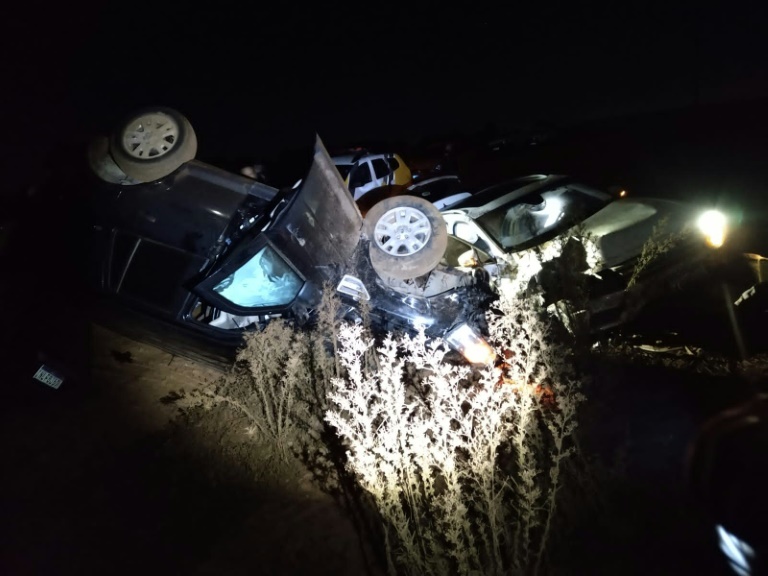
About 30 would-be robbers armed with machine guns terrorized a small Brazilian city overnight Sunday to Monday, injuring two police officers and a bystander in a brazen but ultimately failed assault on an armored cash van, authorities said.

The attackers fled empty-handed after an intense exchange of gunfire with police in the southern town of Guarapuava, and a manhunt complete with tracking dogs and helicopters was underway Monday.

Video of the assault posted on social media showed residents of Guarapuava cowering amid a deafening hail of gunfire, while other recordings appeared to show the attackers using hostages as human shields in their getaway attempt.

Two police officers were wounded: one shot in the face and the other in a leg, officials said. Neither was critical.

A resident of the town was also hurt, but no details were provided.

Police said the would-be robbers set vehicles on fire at several strategic points around the city of 183,000 people, including at the police station, in a bid to slow the security response to their attack.

But in the end, “they failed to access the safes (in the cash van) to steal the money,” said Romulo Soares, the security secretary for Parana state.

Nathan Santos, 16, said he was exiting a shopping center when the shooting started.

“A lady let us hide in her home. We heard a lot of gunfire, people shouting in the streets,” he told a Brazilian news site.

“They were shooting at the street lights so that the streets would be dark.”

Officials said the attackers, most of them armed with machine guns, used about eight or ten vehicles, some armored.

Police found explosives and bulletproof vests in cars abandoned by the would-be robbers.

Brazil has seen a number of similar robberies in recent years by heavily armed gangs targeting smaller communities in carefully planned operations.

In December 2020, gunmen burst into a bank in Criciuma, detonated explosives to blast open its safe and then threw bills in the air before fleeing.

Bystanders who raced to collect the money got in the way of pursuing police.

In October, 25 alleged members of a gang of Brazilian bank robbers were killed in a vast police operation in Minas Gerais state by police who uncovered a trove of weapons and stolen vehicles.

And last August, a gang spread terror in the city of Aracatuba, in Sao Paulo state, strapping hostages to their getaway cars as human shields in a bank robbery involving drones and explosives. 

Two civilians and one bank robber died in that assault, which also left several people injured.

Ukraine stares down Russia at Kharkiv's 'point zero'

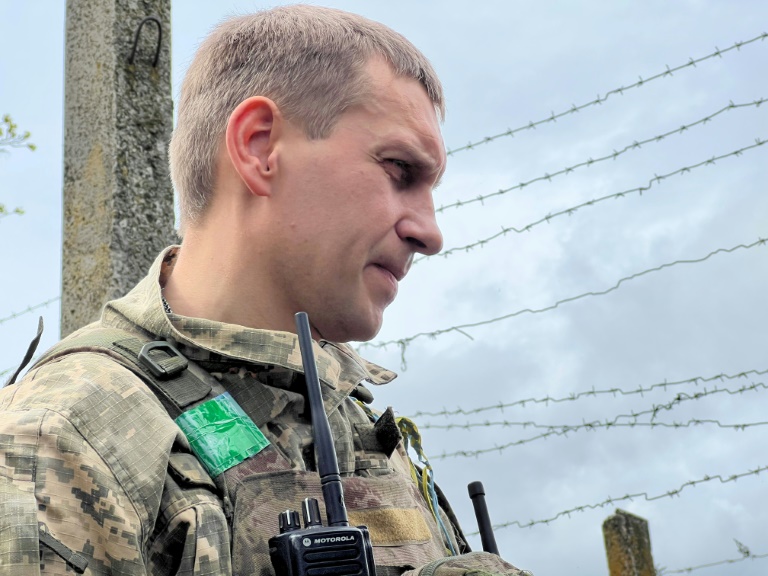
From a muddied hideout on the edge of Kharkiv a Ukrainian officer peers at the horizon, tracing the Russian lines with his outstretched finger.

On the left, the land is in Ukrainian hands, he says. To the right, the Russians are dug in, hammering Ukraine’s second city with constant bombardment.

He stands at “point zero”: the spot where the two sides meet in combat.

“How long it will last I cannot say,” said Petro, a 42-year-old army captain. 

“The enemy is entrenching, making a frontline, trying to gain a foothold.”

AFP was asked not to reveal the exact location or details of Ukrainian positions on a visit to the frontline outside Kharkiv on Sunday.

A group of soldiers live here, huddled in fortified positions surrounded by earth blemished by craters, under a silvery sky pregnant with rain.

They venture out only in small groups to dodge attention from Russian lookouts capable of calling in the strikes which thunder constantly in all directions.

Before the war Petro was a cabinet maker working in the neutral nation of Switzerland, and elsewhere in Europe.

Now the sandy-haired captain carries a hulking rifle with four magazines of ammunition strapped to his chest.

“We want, and we do, everything to destroy the enemy as soon as possible,” he said — surveying the scene where the fate of the Russian invasion is being decided.

– Deadly game of chess – 

Russia ended its northern offensive at the end of last month, cancelling the push to take Kyiv and refocussing the campaign on Ukraine’s eastern flank.

Kharkiv — just 21 kilometres (13 miles) southwest from the Russian border — is now one of the cities standing in the way of the Kremlin’s advance.

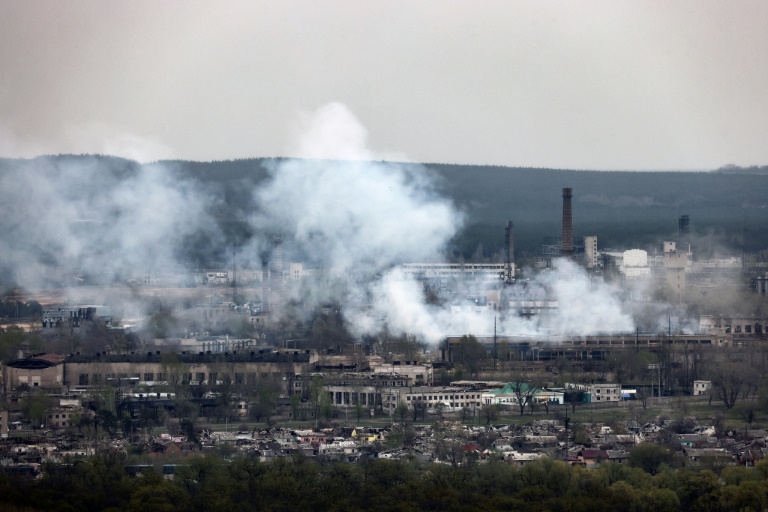
On Sunday six people were killed by shelling on the central residential district of the metropolis, home to 1.4 million before the war prompted mass evacuations.

The missiles rained down in the moments after AFP departed “point zero”, where soldiers are finely attuned to the deadly difference between incoming and outgoing fire.

There is an odd sense of domesticity about the place. One man is bundled in a sleeping bag as another casually dismantles his rifle under a desk lamp, cleaning the parts ready for action.

In a makeshift kitchen the steam from a pot on a grimy stove casts surreal mottled shadows over patriotic children’s drawings sketched in yellow and blue, delivered to the soldiers to boost morale.

At a table furnished with a bowl of shredded carrots, a tin of condensed milk and a plate of butter daggered with a kitchen knife, the men hold forth about the nature of their work.

“War is like chess – who will outplay who,” explains a 39-year-old senior lieutenant who uses the call sign “Shamil”.

“There is no apparent logic” to Russia’s tactics he says. But still he warns Ukraine’s advances of recent weeks may be a result of a bluff, a strategic withdrawal.

“We don’t feel emotions or unnecessary hopes about this — our task is to push the enemy to the borders,” he said.

At the Ukrainian lookout post a soldier eyes the enemy lines with a monocular poked through a concealed slit.

As the men prepare to leave their shelter the Russians make their latest move. An incoming salvo lands too close for comfort.

They retreat to safety for a moment then journey out once again. It’s time to prepare their riposte.

– A long war – 

As the war between Russia and Ukraine nears its third month, there is a sense that both sides are digging in for a brutal slugging match.

In fact, the conflict has been raging on a smaller scale since 2014 when President Vladimir Putin annexed the Crimean Peninsula and started backing separatists fighting in the eastern Donbas region.

Here in Kharkiv, Ukrainian forces are confident they can keep invading troops outside the city gates. 

However whole neighbourhoods of the city have already been gutted by blasts. 

Many of the remaining residents have retreated to underground metro stations to live half-lives, waiting out the war above.

A static staring contest will not relieve the city from the siege.

“The longer they stay in one place, the more they entrench, and the harder it will be to knock them out,” said a sergeant using the call sign Oreshek. “They have to be pushed back.”

“My fighting spirit is good — I am always ready to attack.”

Workers at New York Apple store launch union campaign

Workers at Apple’s Grand Central Station store announced Monday they are organizing to establish a union, in what would be a first at one of the tech giant’s retail locations in the United States.

The effort, calling itself “Fruit Stand Workers United,” aims to garner signatures from at least 30 percent of the New York store, the minimum needed to qualify for a unionization election.

The campaign is connected to Workers United, an affiliate of the national Service Employees International Union, which was established in 2009 from several earlier unions. 

“Grand Central is an extraordinary store with unique working conditions that make a union necessary to ensure our team has the best possible standards of living,” the workers said on the campaign website for the prospective union.

They described themselves as working in “extraordinary times with the ongoing Covid-19 pandemic and once-in-a-generation consumer price inflation,” though their website did not disclose the name of staff members leading the effort.

The Apple effort comes as a Starbucks unionization drive backed by Workers United has spread nationally after election victories last year in New York. 

Amazon is also facing a growing challenge from unions after an upstart campaign won an election at a warehouse in nearby Staten Island earlier this month.

Employees working in at least three other Apple stores are also attempting to organize, according to The Washington Post.

Apple did not immediately respond to a request for comment from AFP.

Putin honours brigade accused of atrocities as strikes hit western Ukraine

Russian President Vladimir Putin on Monday lauded a brigade accused by Ukraine of committing atrocities near the capital Kyiv as his forces pounded targets across the country, killing at least seven people in the western city of Lviv.

The air strikes in Lviv came just hours after Ukrainian President Volodymyr Zelensky accused Moscow of wanting to “destroy” the entire eastern region of Donbas where Russian forces were massing for an expected all-out assault.

Despite widespread condemnation of Russia’s invasion of Ukraine, Putin appeared to double down on Monday.  

The Russian president signed an official decree bestowing the 64th Motor Rifle Brigade the title of “Guards” for defending the “Motherland and state interests” and praised the “mass heroism and valour, tenacity and courage” of its members.

The Ukrainian defence ministry has accused the same outfit of carrying out “war crimes” while occupying the suburb of Bucha on the outskirts of Kyiv, where residents were shot to death with some having their hands bound.

Earlier Monday, Russia’s defence ministry said it had hit 16 military targets at various locations across Ukraine.

Following the attack on Lviv, black smoke billowed from the gutted roof of a car repair shop in the northwest of the city as air raid sirens wailed.

“Fires were set off as a result of the strikes. They are still being put out. The facilities were severely damaged,” Lviv regional governor Maksym Kozytsky said on social media. 

Lviv has largely been spared the Russian bombardment that has rained down on other parts of the country since Russia invaded on February 24.

The city and its surroundings have instead become a relatively safe haven for those seeking to escape the fighting further east.

“Today we understood clearly that we don’t have any safe places in Ukraine. It’s very dangerous,” a bank employee who gave her name as Natalia told AFP after the strikes.

– Prisoner swap –

In the south, Russia continued its push to capture the besieged port city of Mariupol where the last remaining Ukrainian forces prepared for a final stand.

Ukraine has pledged to fight on and defend the strategic city, defying a Russian ultimatum for remaining fighters inside the encircled Azovstal steel plant to lay down their arms and surrender.

Russian state TV on Monday broadcast a video of what it described as “Britons” captured fighting for Ukraine and demanding that Prime Minister Boris Johnson negotiate their release.

The two haggard-looking men asked to be exchanged for Viktor Medvedchuk, a Ukrainian tycoon close to President Vladimir Putin, who was recently arrested in the pro-Western country.

Ukraine then aired its own video featuring Medvedchuk calling for his exchange in return for an evacuation of civilians and troops from Mariupol.

“I want to ask Russian President Vladimir Putin and Ukrainian President Volodymyr Zelensky to exchange me for Ukrainian defenders and residents of Mariupol,” he said in the video published by Kyiv’s security services, wearing black clothes and looking directly into the camera.

Mariupol has become a symbol of Ukraine’s unexpectedly fierce resistance since Russian troops invaded the former Soviet state on February 24.

While several large cities were under siege, according to Prime Minister Denys Shmyhal, not one — with the exception of Kherson in the south — had fallen, and more than 900 towns and cities had been re-captured.

Capturing Mariupol would allow Russia to have a land bridge between the Crimea peninsula, which it annexed in 2014, and the two Moscow-backed separatist statelets in Ukraine’s east. 

– ‘They have to be pushed back’ –

In the east, Ukrainian authorities urged people in Donbas to move west to escape a large-scale Russian offensive to capture its composite regions of Donetsk and Lugansk.

“Russian troops are preparing for an offensive operation in the east of our country in the near future. They want to literally finish off and destroy Donbas,” Zelensky said.

Lugansk governor Sergiy Gaiday said the coming week would be “difficult” with local authorities on Monday saying Russian troops had captured the nearby town of Kreminna.  

“There was a major attack in the night” from Sunday to Monday in Kreminna, Gaiday said in a statement on social media.

“The Russian army has already entered there, with a huge amount of military hardware… Our defenders have retreated to new positions,” he added. 

Heavy bouts of shelling also resumed in the country’s second city of Kharkiv on Monday morning, according to an AFP reporter on the ground, killing at least three people.

The shelling comes a day after another five were killed and 20 wounded during a string of strikes in the city just 21 kilometres (13 miles) from the Russian border on Sunday.

On the edge of Kharkiv over the weekend, Ukrainian forces huddled in fortified positions surrounded by earth blemished with craters where they stared down the Russian lines. 

“The longer they stay in one place, the more they entrench, and the harder it will be to knock them out,” a sergeant using the call sign Oreshek told AFP. 

“They have to be pushed back.”

Ukraine officials also said on Monday they were halting the evacuation of civilians from frontline towns and cities in the east for a second day, accusing Russian forces of blocking and shelling escape routes.

burs-ds/rlp

Close Bitnami banner
Bitnami