World

Sri Lanka leader trims cabinet of relatives ahead of IMF talks

Sri Lanka’s embattled leader dropped two of his brothers and a nephew from his cabinet Monday, acknowledging public anger over the ruling family’s mismanagement of a crippling economic crisis that has prompted calls for his resignation.

President Gotabaya Rajapaksa has presided over the island nation’s most painful downturn in memory and his government is preparing for imminent bailout talks with the International Monetary Fund.

Dozens of ruling party lawmakers have turned against the administration and opposition parties have rebuffed invitations to join a unity government.

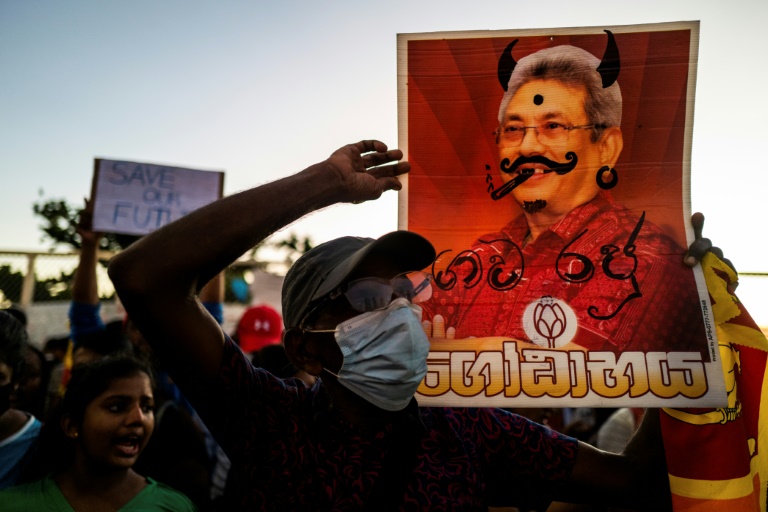
Huge protests have mobilised against Rajapaksa, including tens of thousands of people camped outside his seafront office for more than a week, though the leader has so far resisted pressure to stand down.

“People are suffering because of the economic crisis and I deeply regret it,” the president said in an address to his new cabinet, conceding that Sri Lanka should have gone to the IMF “much earlier”.

He also admitted the government had made a “mistake” in banning agrochemicals last year, a move made to conserve dwindling foreign exchange reserves that had a devastating effect on farm yields. 

The new lineup retains Prime Minister Mahinda Rajapaksa, Gotabaya’s older brother and the head of Sri Lanka’s ruling clan, while leaving out eldest sibling Chamal and younger brother Basil, the former finance minister. 

Mahinda’s eldest son Namal, who ran the sports ministry and had been touted as a future leader before the crisis, was also dropped.

– Austerity cabinet –

The 21-member cabinet is seven people fewer than its predecessor, which resigned en masse two weeks ago in response to public outrage over nepotism and corruption.

Ministers are entitled to several SUVs, a large contingent of bodyguards and unlimited fuel, as well as state housing and entertainment allowances.

Rajapaksa asked his new ministers not to avail themselves of the perks that are usually available to them and urged them to tackle corruption and waste.

New finance minister Ali Sabry led a delegation to Washington over the weekend to open talks with the International Monetary Fund from Tuesday, officials said.

Sri Lanka is seeking three to four billion dollars from the IMF to overcome its balance-of-payments crisis and boost depleted reserves.

Alongside the acute shortages, Sri Lanka is also facing record inflation and lengthy electricity blackouts, as the government has run out of foreign currency to import fuel.

Lanka IOC, a petrol retailer which accounts for a third of the local market, announced yet another steep hike in fuel costs on Monday to account for the collapse in value of the local currency. 

The cost of diesel, the fuel most commonly used for public transport, has risen by 138 percent since the start of the year while petrol prices have nearly doubled. 

The government last week announced a default on Sri Lanka’s $51 billion foreign debt and the Colombo Stock Exchange has suspended trading to prevent an anticipated market collapse.

Rajapaksa’s parliamentary majority has been thrown into question after former allies deserted the ruling coalition.

The opposition has said it will attempt to topple the government through a no-confidence vote in the coming weeks.

Monday marked the tenth straight day of protests outside Rajapaksa’s office, with demonstrators establishing a protest camp that they say will continue until the leader stands aside.

Activists shone digital projections on the office denouncing corruption and demanding the president “go home”, prompting police to hold up large screens to block the light beams. 
Sri Lanka leader trims cabinet of relatives ahead of IMF talks

Sri Lanka’s embattled leader dropped two of his brothers and a nephew from his cabinet Monday, acknowledging public anger over the ruling family’s mismanagement of a crippling economic crisis that has prompted calls for his resignation.

President Gotabaya Rajapaksa has presided over the island nation’s most painful downturn in memory and his government is preparing for imminent bailout talks with the International Monetary Fund.

Dozens of ruling party lawmakers have turned against the administration and opposition parties have rebuffed invitations to join a unity government.

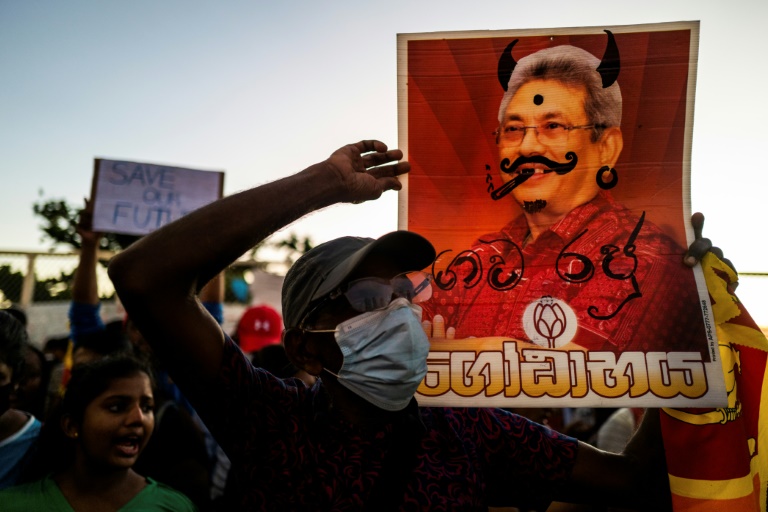
Huge protests have mobilised against Rajapaksa, including tens of thousands of people camped outside his seafront office for more than a week, though the leader has so far resisted pressure to stand down.

“People are suffering because of the economic crisis and I deeply regret it,” the president said in an address to his new cabinet, conceding that Sri Lanka should have gone to the IMF “much earlier”.

He also admitted the government had made a “mistake” in banning agrochemicals last year, a move made to conserve dwindling foreign exchange reserves that had a devastating effect on farm yields. 

The new lineup retains Prime Minister Mahinda Rajapaksa, Gotabaya’s older brother and the head of Sri Lanka’s ruling clan, while leaving out eldest sibling Chamal and younger brother Basil, the former finance minister. 

Mahinda’s eldest son Namal, who ran the sports ministry and had been touted as a future leader before the crisis, was also dropped.

– Austerity cabinet –

The 21-member cabinet is seven people fewer than its predecessor, which resigned en masse two weeks ago in response to public outrage over nepotism and corruption.

Ministers are entitled to several SUVs, a large contingent of bodyguards and unlimited fuel, as well as state housing and entertainment allowances.

Rajapaksa asked his new ministers not to avail themselves of the perks that are usually available to them and urged them to tackle corruption and waste.

New finance minister Ali Sabry led a delegation to Washington over the weekend to open talks with the International Monetary Fund from Tuesday, officials said.

Sri Lanka is seeking three to four billion dollars from the IMF to overcome its balance-of-payments crisis and boost depleted reserves.

Alongside the acute shortages, Sri Lanka is also facing record inflation and lengthy electricity blackouts, as the government has run out of foreign currency to import fuel.

Lanka IOC, a petrol retailer which accounts for a third of the local market, announced yet another steep hike in fuel costs on Monday to account for the collapse in value of the local currency. 

The cost of diesel, the fuel most commonly used for public transport, has risen by 138 percent since the start of the year while petrol prices have nearly doubled. 

The government last week announced a default on Sri Lanka’s $51 billion foreign debt and the Colombo Stock Exchange has suspended trading to prevent an anticipated market collapse.

Rajapaksa’s parliamentary majority has been thrown into question after former allies deserted the ruling coalition.

The opposition has said it will attempt to topple the government through a no-confidence vote in the coming weeks.

Monday marked the tenth straight day of protests outside Rajapaksa’s office, with demonstrators establishing a protest camp that they say will continue until the leader stands aside.

Activists shone digital projections on the office denouncing corruption and demanding the president “go home”, prompting police to hold up large screens to block the light beams. 
Ukraine stares down Russia at Kharkiv's 'point zero'

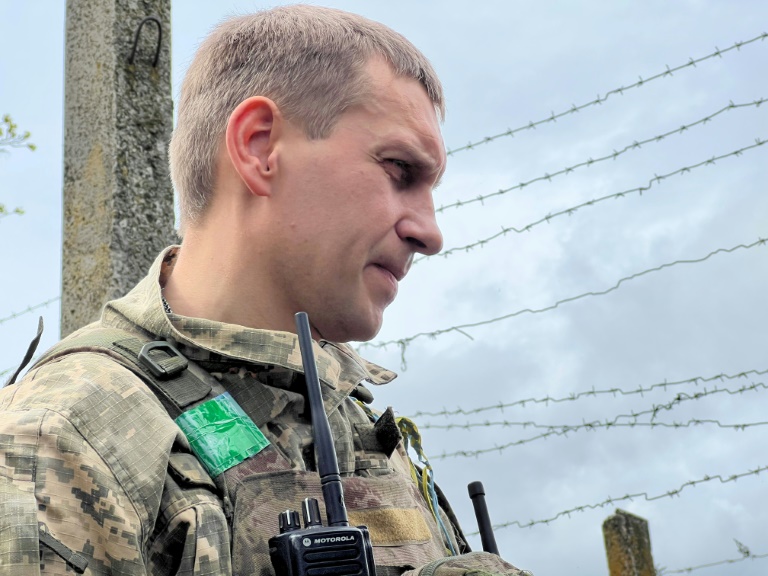
From a muddied hideout on the edge of Kharkiv a Ukrainian officer peers at the horizon, tracing the Russian lines with his outstretched finger.

On the left, the land is in Ukrainian hands, he says. To the right, the Russians are dug in, hammering Ukraine’s second city with constant bombardment.

He stands at “point zero”: the spot where the two sides meet in combat.

“How long it will last I cannot say,” said Petro, a 42-year-old army captain. 

“The enemy is entrenching, making a frontline, trying to gain a foothold.”

AFP was asked not to reveal the exact location or details of Ukrainian positions on a visit to the frontline outside Kharkiv on Sunday.

A group of soldiers live here, huddled in fortified positions surrounded by earth blemished by craters, under a silvery sky pregnant with rain.

They venture out only in small groups to dodge attention from Russian lookouts capable of calling in the strikes which thunder constantly in all directions.

Before the war Petro was a cabinet maker working in the neutral nation of Switzerland, and elsewhere in Europe.

Now the sandy-haired captain carries a hulking rifle with four magazines of ammunition strapped to his chest.

“We want, and we do, everything to destroy the enemy as soon as possible,” he said — surveying the scene where the fate of the Russian invasion is being decided.

– Deadly game of chess – 

Russia ended its northern offensive at the end of last month, cancelling the push to take Kyiv and refocussing the campaign on Ukraine’s eastern flank.

Kharkiv — just 21 kilometres (13 miles) southwest from the Russian border — is now one of the cities standing in the way of the Kremlin’s advance.

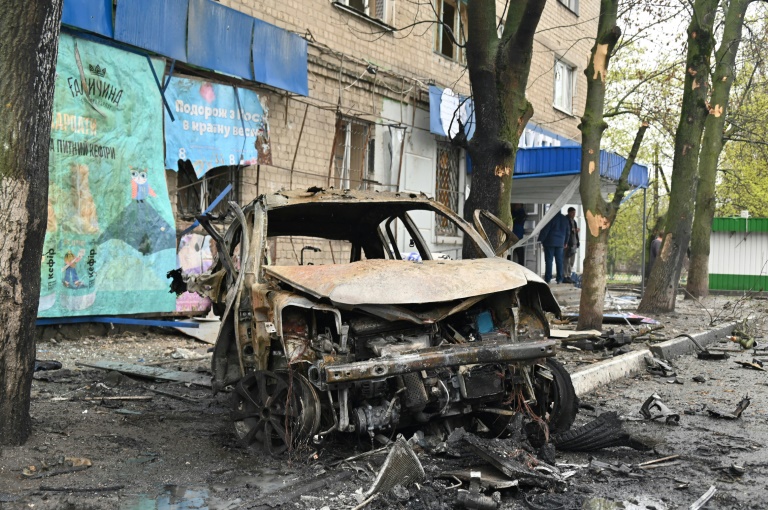
On Sunday six people were killed by shelling on the central residential district of the metropolis, home to 1.4 million before the war prompted mass evacuations.

The missiles rained down in the moments after AFP departed “point zero”, where soldiers are finely attuned to the deadly difference between incoming and outgoing fire.

There is an odd sense of domesticity about the place. One man is bundled in a sleeping bag as another casually dismantles his rifle under a desk lamp, cleaning the parts ready for action.

In a makeshift kitchen the steam from a pot on a grimy stove casts surreal mottled shadows over patriotic children’s drawings sketched in yellow and blue, delivered to the soldiers to boost morale.

At a table furnished with a bowl of shredded carrots, a tin of condensed milk and a plate of butter daggered with a kitchen knife, the men hold forth about the nature of their work.

“War is like chess – who will outplay who,” explains a 39-year-old senior lieutenant who uses the call sign “Shamil”.

“There is no apparent logic” to Russia’s tactics he says. But still he warns Ukraine’s advances of recent weeks may be a result of a bluff, a strategic withdrawal.

“We don’t feel emotions or unnecessary hopes about this — our task is to push the enemy to the borders,” he said.

At the Ukrainian lookout post a soldier eyes the enemy lines with a monocular poked through a concealed slit.

As the men prepare to leave their shelter the Russians make their latest move. An incoming salvo lands too close for comfort.

They retreat to safety for a moment then journey out once again. It’s time to prepare their riposte.

– A long war – 

As the war between Russia and Ukraine nears its third month, there is a sense that both sides are digging in for a brutal slugging match.

In fact, the conflict has been raging on a smaller scale since 2014 when President Vladimir Putin annexed the Crimean Peninsula and started backing separatists fighting in the eastern Donbas region.

Here in Kharkiv, Ukrainian forces are confident they can keep invading troops outside the city gates. 

However whole neighbourhoods of the city have already been gutted by blasts. 

Many of the remaining residents have retreated to underground metro stations to live half-lives, waiting out the war above.

A static staring contest will not relieve the city from the siege.

“The longer they stay in one place, the more they entrench, and the harder it will be to knock them out,” said a sergeant using the call sign Oreshek. “They have to be pushed back.”

“My fighting spirit is good — I am always ready to attack.”

Mexico president decries 'treason' after power reforms defeated

Mexican lawmakers rejected constitutional electricity reforms at the center of diplomatic tensions with the United States, in a blow to President Andres Manuel Lopez Obrador, who accused his opponents Monday of betraying the nation.

Lopez Obrador promoted the changes to strengthen the state-owned electricity provider and roll back the effects of liberalization under previous governments that he says benefited private companies.

But his plans alarmed the United States and Canada, prompting warnings that Mexico is in danger of violating its trade commitments by favoring state-run entities heavily dependent on fossil fuels.

After a marathon session in the lower house of Congress on Easter Sunday, the president’s Morena party failed to secure the two-thirds majority needed to amend the constitution.

An angry Lopez Obrador denounced “an act of treason against Mexico by a group of legislators who, instead of defending the interests of the people and the nation, decided to be outspoken defenders of foreign companies.”

There were 275 votes in favor and 223 against the bill, with no abstentions, the president of the lower house, Sergio Gutierrez, announced.

Gutierrez had earlier accused the opposition of wanting to remain “imperialist lackeys” at the service of foreign companies.

But Jorge Romero of the conservative National Action Party argued that the bill would put the country “back 50 years” in efforts to protect the environment.

Although Lopez Obrador remains popular, with an approval rating of nearly 60 percent, his Morena party and its allies lost its absolute majority in the lower house in legislative elections last year.

Earlier during the debate, his supporters held a rally outside the Chamber of Deputies calling for the reforms to be passed, with one carrying a sign that said “Don’t sell out the nation.” 

– ‘Big defeat’ –

The bill’s failure represents “a big defeat for Morena and Lopez Obrador because it is one of the central axes of their project to nationalize energy,” Jose Antonio Crespo, a political analyst at the Center for Research and Teaching in Economics, told AFP.

Washington had warned that Mexico’s reforms risk bringing “endless litigation” that would impede investment and undermine joint efforts to fight climate change.

“Mexico’s energy policies damage the environment, US business and investor interests in multiple sectors, and hamper joint efforts to mitigate climate change,” US Trade Representative Katherine Tai said last month according to her office.

Canada and Spain are also concerned about the consequences for their energy companies that have invested in Mexico.

The changes would have ensured that the state-owned Federal Electricity Commission (CFE) has at least 54 percent of the electricity market — a move the government says is needed to prevent soaring power prices.

The bill also envisaged a move towards a state monopoly in the mining of lithium, a vital component in electric car batteries. 

With defeat looming, Lopez Obrador submitted separate legislation Sunday to incorporate the lithium industry reforms into a mining law, which requires only a simple majority to pass since it is not a constitutional amendment.

The failure of the constitutional reform bill does not necessarily mean the end of Lopez Obrador’s electricity industry changes either.

Mexico’s Supreme Court this month endorsed a reform aimed at strengthening the CFE that was approved by Congress in 2021 but has become bogged down in legal challenges. 

Mexico president decries 'treason' after power reforms defeated

Mexican lawmakers rejected constitutional electricity reforms at the center of diplomatic tensions with the United States, in a blow to President Andres Manuel Lopez Obrador, who accused his opponents Monday of betraying the nation.

Lopez Obrador promoted the changes to strengthen the state-owned electricity provider and roll back the effects of liberalization under previous governments that he says benefited private companies.

But his plans alarmed the United States and Canada, prompting warnings that Mexico is in danger of violating its trade commitments by favoring state-run entities heavily dependent on fossil fuels.

After a marathon session in the lower house of Congress on Easter Sunday, the president’s Morena party failed to secure the two-thirds majority needed to amend the constitution.

An angry Lopez Obrador denounced “an act of treason against Mexico by a group of legislators who, instead of defending the interests of the people and the nation, decided to be outspoken defenders of foreign companies.”

There were 275 votes in favor and 223 against the bill, with no abstentions, the president of the lower house, Sergio Gutierrez, announced.

Gutierrez had earlier accused the opposition of wanting to remain “imperialist lackeys” at the service of foreign companies.

But Jorge Romero of the conservative National Action Party argued that the bill would put the country “back 50 years” in efforts to protect the environment.

Although Lopez Obrador remains popular, with an approval rating of nearly 60 percent, his Morena party and its allies lost its absolute majority in the lower house in legislative elections last year.

Earlier during the debate, his supporters held a rally outside the Chamber of Deputies calling for the reforms to be passed, with one carrying a sign that said “Don’t sell out the nation.” 

– ‘Big defeat’ –

The bill’s failure represents “a big defeat for Morena and Lopez Obrador because it is one of the central axes of their project to nationalize energy,” Jose Antonio Crespo, a political analyst at the Center for Research and Teaching in Economics, told AFP.

Washington had warned that Mexico’s reforms risk bringing “endless litigation” that would impede investment and undermine joint efforts to fight climate change.

“Mexico’s energy policies damage the environment, US business and investor interests in multiple sectors, and hamper joint efforts to mitigate climate change,” US Trade Representative Katherine Tai said last month according to her office.

Canada and Spain are also concerned about the consequences for their energy companies that have invested in Mexico.

The changes would have ensured that the state-owned Federal Electricity Commission (CFE) has at least 54 percent of the electricity market — a move the government says is needed to prevent soaring power prices.

The bill also envisaged a move towards a state monopoly in the mining of lithium, a vital component in electric car batteries. 

With defeat looming, Lopez Obrador submitted separate legislation Sunday to incorporate the lithium industry reforms into a mining law, which requires only a simple majority to pass since it is not a constitutional amendment.

The failure of the constitutional reform bill does not necessarily mean the end of Lopez Obrador’s electricity industry changes either.

Mexico’s Supreme Court this month endorsed a reform aimed at strengthening the CFE that was approved by Congress in 2021 but has become bogged down in legal challenges. 

10,000 soldiers in South Africa flood relief effort

South Africa deployed 10,000 troops on Monday to help restore power and water and search for 63 people who remain missing after deadly storms battered its east coast.

A week after unprecedented rain began to pound the city of Durban and KwaZulu-Natal (KZN) province, the death toll stood at 443, and rescue workers said hopes of finding more survivors were fading.

Clyde Naicker said his brother Ronald had been missing for a week, since he disappeared while trying to get to his job as a hospital radiographer.

“Apparently from what we heard, his vehicle got flooded and then he tried to go to safety,” Naicker said. The family has been searching every day, but police only joined their effort on Monday.

In addition to his wife, 49-year-old Ronald has two children, aged just two and three.

“The tragedy currently unfolding in our province is one of the worst natural disasters in the recorded history of our country,” KZN’s provincial government said.

Funerals were being held across the city of Durban, which bore the brunt of the storms.

But with damaged roads and waterlogged cemeteries, burials were difficult.

“There are so many deceased, and the mortuaries can’t keep up because they have been so inundated. So it is taking a little longer to get the deceased out for burial,” said Pieter van der Westhuizen, general manager for funeral services at the Avbob insurance company.

KZN Funeral Directors Association representative Nasan Chetty said the continuous rain had made it “very difficult to do burials”.

“If we dig the graves and then come back to do the burial a few hours later it is water-logged,” he told AFP. 

– Water problem –

Swathes of eThekwini, the municipality that includes Durban, remain without electricity or water, and KZN warned it could take time before services are restored.

“There are areas that have suffered extensive damage which will take longer to repair,” the province said in a statement.

But eThekwini deputy mayor Philani Mavundla said in a television interview that 80 percent of the city’s water works were down. Water tankers were being deployed across the region, but the authorities were struggling to fill them.

Some of the troops include plumbers and electricians, joining the mammoth task of trying to get life back to normal.

Many streets remain slathered with mud. In areas where repair crews have yet to reach, the homeless cleared roads to make way for water tankers to pass, an AFP correspondent observed.

Residents complained the water tankers came unannounced, with little discipline as families raced to fill receptacles.

“Well-off families come with 13 buckets and you only have two,” said Philakahle Khumalo, a 30-year-old mother of two.

“There is also a lot of pushing there. People are desperate — they don’t care about the next person.”

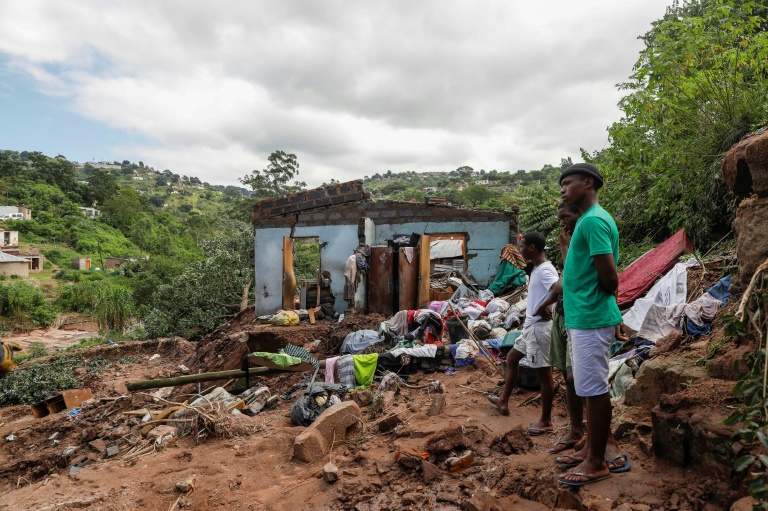
The deadliest storm on record dumped apocalyptic levels of rain on Durban and the surrounding area.

Some 40,000 people were left homeless and more than 550 schools and nearly 60 health care facilities have been damaged, according to government tallies.

Many children are due to return to class on Tuesday after the Easter break, but authorities warned that 271,000 students may not be able to attend due to damaged schools.

The government has announced an immediate one billion rand ($68 million) in emergency relief.

Nearly three dozen search teams were deployed across the region Monday, said coordinator Dave Steyn.

“The rescue operations have stopped. It’s now more of a search and recovery,” he told AFP.

– Shock –

The normally azure waters at Durban’s famed beaches have been turned a muddy brown by the mountains of earth and debris washed to the shore.

The intensity of the floods took South Africa, the most advanced African economy, by surprise.

The country is still struggling to recover from the Covid pandemic and deadly riots last year that killed more than 350 people, mostly in the now flood-struck southeastern region.

France's presidential rivals gird for high-stakes debate

Emmanuel Macron and Marine Le Pen traded barbs Monday as they returned to campaigning for the French presidency ahead of a prime-time debate that is likely to prove decisive ahead of next weekend’s second-round run-off.

The two rivals held low-key events after a brief Easter pause before Wednesday’s face-off, when the centrist Macron will defend his record over the past five years against his combative far-right rival.

It will be a rematch of their debate in 2017, when the same two finalists clashed at the same stage of the campaign. Analysts say that match was handily won by Macron, who was making his first-ever run for public office.

Le Pen, making her third attempt for the presidency, insists she is better prepared this time around.

“I’m very confident, and I think I’m going to win,” the National Rally candidate said while posing for selfies with well-wishers at the sunlit village square in Saint-Pierre-en-Auge in Normandy, western France.

“I hope this debate is carried out calmly… I hope it won’t be what I’ve been hearing for the past week, a series of insults, fake news and excesses,” she said.

“She knows her programme perfectly, and she knows very well how Macron is going to try to attack her,” Le Pen’s close ally Louis Aliot, the far-right mayor of Perpignan in southern France, told France Inter radio.

Opinion polls have suggested for weeks that Macron has the edge. On Monday, an Ipsos-Sopra Steria survey of voter intentions gave him 56 percent to Le Pen’s 44 percent.

But allowing for margins of error, Macron knows there is no room for complacency. Polls have underestimated the results of far-right candidates in the past — most notably in 2002, when Le Pen’s father Jean-Marie Le Pen reached the presidential run-off against Jacques Chirac.

– ‘Reassure everybody’ –

Macron took aim at Le Pen’s proposal to hold constitutional referendums on tougher immigration laws; on her plan for “national priority” for French citizens for jobs and welfare benefits; and her backing for citizens’ initiatives to propose and vote on legislation.

“She is implying that once elected, she believes she’s above the Constitution since she can decide not to respect it by changing the rules,” he told France Culture radio in an interview broadcast Monday.

But instead of focusing on immigration and the threat of Islamist extremism, Le Pen has insisted mainly on her plans to tackle rising prices, a key element of her strategy of presenting a more moderate face to voters.

Her team has played down in particular a proposed ban on the Islamic headscarf in public places, Le Pen acknowledging that it was a “complex problem” that would require parliamentary debate, and that “I’m not obstinate.”

Le Pen also hit back at a report that the European Union’s anti-corruption body OLAF had accused her and senior colleagues of embezzling more than 600,000 euros ($650,000) of EU funds during their time as euro-deputies.

“Low blows from the European Union, just a few days from the second round, I know all about them and I think the French aren’t stupid,” she said, adding that “I absolutely deny these allegations, which I wasn’t even aware of.”

– ‘Russian roulette’ –

Polls suggest that up to a fourth of the French electorate might not vote at all on Sunday, and much will also depend on the decisions of the millions of leftwing supporters of Jean-Luc Melenchon, who finished in a close third place in the first round on April 10.

The results of a survey Sunday carried out Melenchon’s France Unbowed party suggested that only a third of those who voted for him will back Macron to block a far-right presidency under Le Pen.

The rest preferred to return a blank or spoiled ballot, or simply to stay home on voting day next Sunday.

Melenchon, who is poised to loom large on the left ahead of parliamentary elections in June in which Macron is hoping to renew a majority if re-elected, has pointedly refused to urge voters to back Macron, saying only that “not a single vote” should go to Le Pen.

Christophe Castaner, the leader of Macron’s Republic on the Move (LREM) group in parliament, attempted to play down the significance of the survey.

But he also warned: “Not to choose, is to accept you are playing Russian roulette.”

War in Ukraine: Latest developments

Here are the latest developments in the war in Ukraine:

– Seven killed in Lviv strikes –

Five “powerful” Russian missiles hit the western city of Lviv, killing at least seven people and wounding eight, local officials say.

The attack comes as Russia hits targets across the country ahead of an expected campaign in the east.

– Three killed in Kharkiv –

Russian shelling in Kharkiv, Ukraine’s second largest city, kills at least three people.

One shell fell on a children’s playground killing a man and a woman while the other hit an aid distribution point killing one person and wounding six others, officials say.

– Russians capture eastern town –

Russian troops capture the east Ukraine town of Kreminna in a major night-time attack, say local officials.

“The Russian army has already entered there, with a huge amount of military hardware…,” Lugansk regional governor Sergiy Gaiday says on social media. “Our defenders have retreated to new positions.”

– Tycoon seeks prisoner exchange –

Russian state television broadcasts a video of two men it says are captured Britons, asking to be exchanged for Viktor Medvedchuk, a recently captured wealthy Ukrainian tycoon close to Russian President Vladimir Putin.

Ukraine’s security services then put out a video of Medvedchuk asking to be exchanged for Ukrainian civilians and soldiers trapped in the strategic besieged Ukrainian port of Mariupol.

– Civilian evacuations paused –

Ukraine says it is halting civilian evacuations from the frontline towns and cities in the east of the country for a second day.

“In violation of international humanitarian law, the Russian occupiers have not stopped blocking and shelling humanitarian routes,” Deputy Prime Minister Iryna Vereshchuk posts on social media Monday.

– Nearly 5 mn fled Ukraine: UN –

More than 4.9 million Ukrainians have fled their country following the Russian invasion, says the UN’s refugee agency, the UNHCR.

It says 4,934,415 Ukrainians have now quit the country, up more than 65,000 on the previous day.

– ‘Russia wants to destroy Donbas’ –

Ukraine’s President Volodymyr Zelensky says Russia is seeking to destroy the region of Donbas, the country’s eastern industrial heartland. 

“Russian troops are preparing for an offensive operation in the east of our country in the near future. They want to literally finish off and destroy Donbas,” Zelensky says.

– Loaned Russian paintings stuck –

Dozens of paintings by renowned Russian artists including Wassily Kandinsky are stuck in Seoul after an exhibition because of sanctions imposed on Russia over its war in Ukraine.

The exhibition at the Sejong Museum of Art wrapped up on Sunday, but the paintings are stuck in the South Korean capital as all available flight options have been shut down by the sanctions.

— Moscow job losses —

Some 200,000 employees of foreign companies in Moscow could lose their jobs due to sanctions over Russia’s military campaign in Ukraine, the city’s mayor says.

Sergei Sobyanin says authorities had last week approved a $41-million programme to support employment in the Russian capital.

World Bank planning new $170 bn crisis fund: Malpass

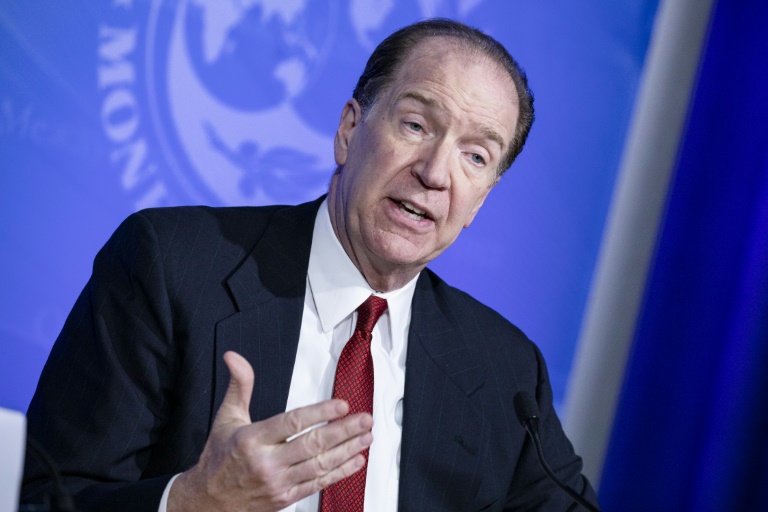
The World Bank is seeking to create a $170 billion emergency fund to help the poorest nations being buffeted by multiple crises, the bank’s President David Malpass said Monday.

The “crisis response envelope” will continue the work begun during the Covid-19 pandemic, and help countries deal with surging inflation, which was made worse by the Russian invasion of Ukraine as well as the “severe financial stress” caused by high debt levels, he said.

“This is a continued massive crisis response,” Malpass told reporters.

High debt and inflation “are two big problems facing global growth,” he said.

“I’m deeply concerned about developing countries. They’re facing sudden price increases for energy, fertilizer and food.”

The Washington-based development lender last week downgraded its forecast for global growth this year, and the IMF is expected to do the same when it releases its updated forecasts on Tuesday.

Speaking ahead of this week’s spring meetings of the IMF and World Bank, Malpass said the 15-month aid fund would run through June 2023 and build on the $157 billion Covid-response fund, which expired in June 2021.

“We expect to commit around $50 billion of this amount in the next three months,” he said, adding that he plans to discuss the fund with the bank board in coming weeks.

Malpass repeated his concern for poor countries facing high debt levels, noting that 60 percent of low-income countries already face debt distress or are at high risk.

He has recommended improvements in the G20 Common Framework adopted last year, which was meant to offer a path to restructure large debt loads, but has not yet produced results.

A key hurdle is the lack of information on the size of debt owed to China, as well as some other lenders, by private companies as well as governments.

G20 finance ministers will meet on Wednesday on the spring meetings’ sidelines.

Shabaab claims mortar attack as Somalia's new parliament meets

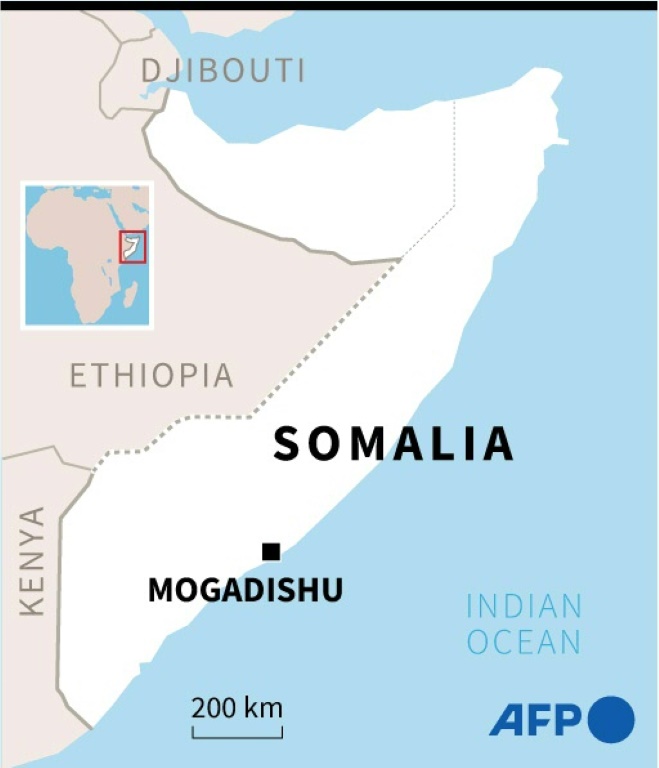
Somalia’s parliament came under mortar fire on Monday as the country’s newly elected lawmakers were meeting for only the second time since taking office, an attack claimed by the Islamist militant group Al-Shabaab.

Several people were reportedly injured but no lawmakers were harmed when several rounds of mortar shells landed near parliament in the heavily fortified compound in the capital Mogadishu, officials and a witness said.

The attack occurred as lawmakers were setting dates for parliamentary ballots to choose speakers for the lower and upper house — the next stage in a stuttering process to elect the fragile nation’s new president.

The new members of the Senate and the House of the People were sworn in on Thursday after elections held more than a year behind schedule that were marred by deadly violence and a power struggle between the current president and the prime minister.

The upper house will vote on April 26 to choose a speaker, with the lower house choosing its president the following day, officials said.

As Monday’s parliamentary session was being streamed live on television several explosions were heard and lawmakers were told to stay inside.  

“We have no details yet but these explosions were caused by mortar fire, the legislators were safe and unharmed inside the building when the incident occurred,” a security officer who asked not to be named told AFP.  

“I was in the area when the mortar shells landed outside the building where the parliamentarians were meeting, several people were wounded lightly in one of the blasts,” witness Abdukadir Ali said.

Al-Shabaab, the Al-Qaeda-linked jihadist group that has been waging an insurgency against the central government for more than a decade, claimed responsibility for the attack in a brief statement.

The UN mission in Somalia UNSOM issued a statement condemning the mortar attack.

It said it “stands firm with Somalis in their efforts to complete the electoral process and progress on national priorities.”

Some parliamentary seats remain unfilled but sufficient lawmakers have been sworn in to move the election process forward. 

So far, 297 have taken the oath of office, from a possible 329 members for both houses. 

Somalia has not held a one-person, one-vote election in 50 years.

Instead, elections follow a complex indirect model, whereby state legislatures and clan delegates pick lawmakers for the national parliament, who in turn choose the president.

Close Bitnami banner
Bitnami