World

Tunisian weavers turn rags into eco-friendly rugs

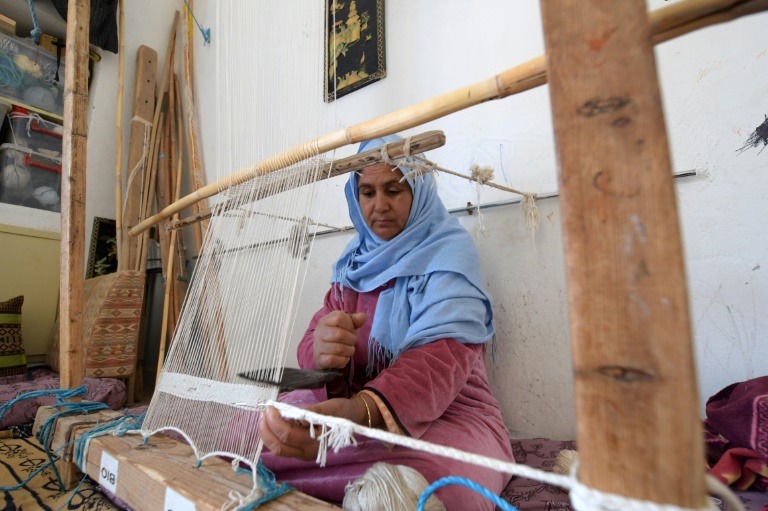
Najet unravels an old pair of jeans, raw material for a designer carpet: traditional, eco-friendly crafts are being adapted for new markets thanks to a project born in the Tunisian desert.

“I learned to weave at a young age, from my mother,” said the 52-year-old from the oasis town of Nefta, 500 kilometres (310 miles) south of Tunis.

Now, she is making a living from it.

She is selling her Turkish-style kilim rugs via Shanti, a social enterprise that helps artisans from across the North African country reach buyers and bring vital revenue into some of its most marginalised communities.

Shanti is the brainchild of Najet’s Franco-Tunisian nephew Mehdi Baccouche.

“Unstitching old jumpers, tearing up old cotton garments, making rugs out of them, it’s a folk art found in all Tunisian homes,” he told AFP.

While the skill “has been around forever”, reaching buyers is a challenge, he added. 

Back in 2014, he had asked his aunt to weave carpets for his friends, soon moving to selling them via Facebook.

Seeing the potential, two years later he created Shanti, which buys carpets and takes charge of getting them to consumers.

It also employs designers who work with artisans to improve their design skills and make their products more marketable.

“These are my creations, they come out of my imagination and Shanti approved them,” Najet said.

– ‘Recycle clothes’ –

Najet uses an eclectic array of old pullovers, socks and assorted pass-me-downs from the local flea market, giving them a new life as rugs.

She has little fear of running out of raw materials. 

Despite a lean patch, the Tunisian clothes industry still keeps 1,600 firms in business, providing 100 times that many jobs.

In Nefta, a town of some 22,000 people, Shanti has also set up a haberdashery where weavers have free access to balls of wool recycled from second-hand clothes.

The association’s local coordinator Fatima Alhamal, Najet’s daughter, says the store makes “a huge difference”.

Previously, “craftswomen had to go and find materials, which they had to pay for, then earned 12-15 euros for a kilim”.

Now Shanti pays them 40 euros ($43) apiece, up to a maximum of four a month each to avoid pressuring them into overwork.

It then sells them in Tunisia and abroad.

The association also helps the workers improve their work spaces, for example with air conditioning — a necessity in southern Tunisia’s blistering summer heat.

The work has changed the social standing of the women involved.

“People see them completely differently now,” Fatma said.

Najet says she is happy to be making a living from home.

“I don’t have to go out for anything, I can cook and eat here, I can work comfortably.”

– Eco-friendly –

Baccouche said at first people teased him for getting involved in “an old ladies’ craft”.

But the project fills a valuable niche in an area where women are disproportionately underemployed, and which has faced an ever-worsening economic crisis since before the revolt that sparked the Arab Spring uprisings of 2011.

“It was important to show that you can be an old woman who never went to school and doesn’t know how to use the internet, but you can still do something and earn a living from it,” he said.

Yet the association also tries to avoid creating conflicts within families.

It pays the women not in cash but in post office accounts where their husbands can’t see how much they are making — or use it to pay household bills.

Using its system of ordering in advance, Shanti runs a boutique in the capital Tunis.

“L’Artisanerie” also acts as a space for coordinators who train artisans from other rural areas, making bamboo furniture, poetry and embroidery.

In four years, more than 200 producers have been able to find a market for their work. Sixty work every day for L’Artisanerie.

“We’re trying to show that you can make something 100 percent Tunisian, with Tunisian materials and skills, but with a design that fits current tastes,” Baccouche said.

Some products, joint creations by artisans and Shanti designers, are sold to design-conscious Tunisians.

Others are exported or sold to bigger firms — such as Indigo, a manufacturer for Zara, or Mango, which recently bought 164 rugs made from recycled jeans.

For now, the system still relies on some support from non-profits such as Oxfam or on Danish development aid.

But Baccouche has big ambitions, with Shanti expanding into sustainable agriculture and eco-tourism.

“We’re trying to set up an entire, eco-friendly production and logistics chain,” he said.
Tunisian weavers turn rags into eco-friendly rugs

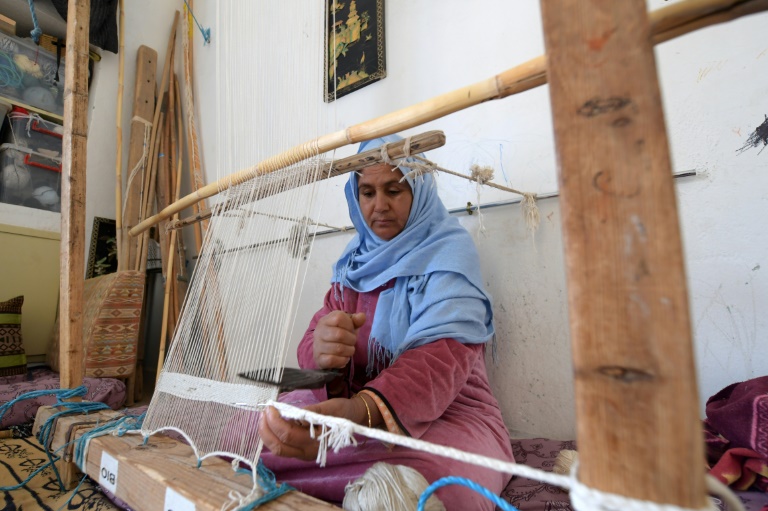
Najet unravels an old pair of jeans, raw material for a designer carpet: traditional, eco-friendly crafts are being adapted for new markets thanks to a project born in the Tunisian desert.

“I learned to weave at a young age, from my mother,” said the 52-year-old from the oasis town of Nefta, 500 kilometres (310 miles) south of Tunis.

Now, she is making a living from it.

She is selling her Turkish-style kilim rugs via Shanti, a social enterprise that helps artisans from across the North African country reach buyers and bring vital revenue into some of its most marginalised communities.

Shanti is the brainchild of Najet’s Franco-Tunisian nephew Mehdi Baccouche.

“Unstitching old jumpers, tearing up old cotton garments, making rugs out of them, it’s a folk art found in all Tunisian homes,” he told AFP.

While the skill “has been around forever”, reaching buyers is a challenge, he added. 

Back in 2014, he had asked his aunt to weave carpets for his friends, soon moving to selling them via Facebook.

Seeing the potential, two years later he created Shanti, which buys carpets and takes charge of getting them to consumers.

It also employs designers who work with artisans to improve their design skills and make their products more marketable.

“These are my creations, they come out of my imagination and Shanti approved them,” Najet said.

– ‘Recycle clothes’ –

Najet uses an eclectic array of old pullovers, socks and assorted pass-me-downs from the local flea market, giving them a new life as rugs.

She has little fear of running out of raw materials. 

Despite a lean patch, the Tunisian clothes industry still keeps 1,600 firms in business, providing 100 times that many jobs.

In Nefta, a town of some 22,000 people, Shanti has also set up a haberdashery where weavers have free access to balls of wool recycled from second-hand clothes.

The association’s local coordinator Fatima Alhamal, Najet’s daughter, says the store makes “a huge difference”.

Previously, “craftswomen had to go and find materials, which they had to pay for, then earned 12-15 euros for a kilim”.

Now Shanti pays them 40 euros ($43) apiece, up to a maximum of four a month each to avoid pressuring them into overwork.

It then sells them in Tunisia and abroad.

The association also helps the workers improve their work spaces, for example with air conditioning — a necessity in southern Tunisia’s blistering summer heat.

The work has changed the social standing of the women involved.

“People see them completely differently now,” Fatma said.

Najet says she is happy to be making a living from home.

“I don’t have to go out for anything, I can cook and eat here, I can work comfortably.”

– Eco-friendly –

Baccouche said at first people teased him for getting involved in “an old ladies’ craft”.

But the project fills a valuable niche in an area where women are disproportionately underemployed, and which has faced an ever-worsening economic crisis since before the revolt that sparked the Arab Spring uprisings of 2011.

“It was important to show that you can be an old woman who never went to school and doesn’t know how to use the internet, but you can still do something and earn a living from it,” he said.

Yet the association also tries to avoid creating conflicts within families.

It pays the women not in cash but in post office accounts where their husbands can’t see how much they are making — or use it to pay household bills.

Using its system of ordering in advance, Shanti runs a boutique in the capital Tunis.

“L’Artisanerie” also acts as a space for coordinators who train artisans from other rural areas, making bamboo furniture, poetry and embroidery.

In four years, more than 200 producers have been able to find a market for their work. Sixty work every day for L’Artisanerie.

“We’re trying to show that you can make something 100 percent Tunisian, with Tunisian materials and skills, but with a design that fits current tastes,” Baccouche said.

Some products, joint creations by artisans and Shanti designers, are sold to design-conscious Tunisians.

Others are exported or sold to bigger firms — such as Indigo, a manufacturer for Zara, or Mango, which recently bought 164 rugs made from recycled jeans.

For now, the system still relies on some support from non-profits such as Oxfam or on Danish development aid.

But Baccouche has big ambitions, with Shanti expanding into sustainable agriculture and eco-tourism.

“We’re trying to set up an entire, eco-friendly production and logistics chain,” he said.

The male model testing gender norms in a changing Saudi Arabia

With his hot pink hair extensions and leopard print pantsuit, model Ziad al-Mesfer was bound to turn heads during his recent public photo shoot in deeply conservative Saudi Arabia.

Passers-by began sneaking pictures on their mobiles merely minutes after Mesfer emerged from his white luxury car onto the cobbled sidewalks of a high-end cafe district in Riyadh, his stylist and photographer in tow.

Such appearances have helped Mesfer, 25, build a massive social media following while blazing a trail for the handful of Saudi male models brave enough to don garments widely seen as appropriate for women only –- thereby pushing the boundaries of their country’s famously rigid gender norms.

In the process he has endeared himself to expensive brands keen to profit from a spectacle that would have been unthinkable before Saudi Arabia embarked on a whirlwind series of social reforms ushered in by Crown Prince Mohammed bin Salman.

Yet Mesfer’s approach carries considerable risks.

Along with ardent fans -– mostly bubbly teenage girls who follow him on Snapchat -– the crowd gawking at the recent Riyadh shoot included one irate middle-aged man who got out of his car to denounce Mesfer as “gay”, a potential capital offence in Saudi Arabia.

The desert monarchy also traditionally forbids men who “imitate women” or wear women’s clothing, and vice versa.

Mesfer does not identify as gay –- he intends to marry a woman one day –- and explains he is simply following global brands’ embrace of androgynous fashion.

And despite occasional harassment in-person and online, he told AFP he has no plan to leave Saudi Arabia or modify his look.

“It is better for me to stay in my country and wear these clothes,” he said, “not wait for a trip abroad to go outside in a bold outfit.”

– Fashionable following –

Born into a Riyadh-based family, the eldest of six children, Mesfer started to develop his sense of style from a young age.

“I used to dress my mom, my aunts and my relatives. I used to love styling them,” he said.

“My mom used to consult me regarding these things, so I became more interested in women’s fashion.”

He only dreamed of going public with his talents after Prince Mohammed began trying to soften the kingdom’s image, including by expanding entertainment options and easing rules that required women to wear the abaya, an all-covering robe, and hijab headscarf.

Around two years ago, Mesfer started modelling outfits online using the relatively safe medium of Snapchat, which automatically deletes posts once they are viewed.

Today he boasts more than two million Snapchat followers and another 200,000 on Instagram -– the kind of clout that has captured the attention of brands including Prada and Dior.

When Gucci opened a new boutique in Riyadh last month, staff made sure to invite Mesfer to view the inventory, said senior saleswoman Loulwa Mohammed.

“It’s very important to invite him, because when we invite him and take a video or picture of him wearing any item, it sells directly,” Mohammed said. “All Saudis — old women, young girls — all of them, they are watching him.”

– ‘A kind of artist’ –

Even as other male models and would-be influencers follow his lead, Mesfer remains in a class by himself.

“He is number one,” said a sales associate at Prada who, like others interviewed for this story, declined to be named because of the topic’s sensitivity.

Yet several fashion professionals said Saudi’s limited acceptance of Mesfer should not be misconstrued as a blanket endorsement of his behaviour.

Instead they said Mesfer, who earns money partly through online ads, enjoys protection because he works with luxury brands and mingles with local celebrities who invite him to their events.

“We see him as a model, as a kind of artist, so we can’t judge him,” Gucci’s Mohammed said.

But she added: “Sometimes the reaction is negative. Saudi is a Muslim country. I wouldn’t want to see my brother doing the same thing.”

This conflicted perception of Mesfer is on vivid display in the comments on his Instagram page.

In response to a February post in which Mesfer paired a bright red coat with a skin-tight purple turtleneck, one user wrote “may God forgive us” while another wrote “I am deleting Instagram after seeing this.”

Another user, though, was encouraging: “Ziad, keep going, I love you, take care of yourself for the people who love you and do what you love, and do not care about any words.”

US judge deemed controversial Musk tweet on Tesla 'false': investors

A 2018 tweet posted by Elon Musk in which he claimed to have secured the funding to take Tesla private was deemed “false and misleading” by a judge, according to documents filed by investors suing his electric car company.

The shareholders have accused Tesla of securities fraud over their stock market losses in the wake of the August 7, 2018 tweet, which caused the share price to fluctuate wildly for several days.

In a court filing late Friday, plaintiffs asked the federal judge in charge of the case, Edward Chen, to order Musk to stop saying publicly that he “secured” funding to take Tesla private at $420 a share, as he again stated on Thursday.

In the past, the billionaire entrepreneur has said he was in talks at the time with Saudi Arabia’s sovereign wealth fund and that he was confident he would reach a deal. But no agreement was ever announced.

According to the filing, Chen recently concluded in an order not made public that Musk’s statements were “false and misleading,” and made “recklessly and with full awareness of the facts that he misrepresented in his tweets.”

Plaintiffs accused Musk of engaging in “a high-profile public campaign to present a contradictory and false narrative regarding his August 7, 2018 tweets” — which could influence eventual jurors assigned to the trial set for later this year.

The Securities and Exchange Commission, the US market regulator, also charged him with fraud in the wake of the tweets.

He eventually agreed to a deal to settle the charges, which required Tesla’s lawyers to review any social media posts with information deemed “material” to shareholders. 

He also paid a $20 million fine and stepped down as Tesla’s chairman.

Musk, who has unveiled a $43 billion hostile takeover bid for Twitter, said Thursday he felt forced into the deal with the SEC to save Tesla.

French presidential debate: pivotal campaign moment

The live televised presidential debate Wednesday between President Emmanuel Macron and his far-right challenger Marine Le Pen is set to be a crucial moment in a tight race for the Elysee.

The pair will trade blows from 1900 GMT in a clash set to be watched by millions of French nationwide ahead of the April 24 run-off election.

Unlike the United States, where Republican and Democratic candidates spar at least twice, France’s frontrunners get just one chance to take each down on live TV.

AFP takes a look at past clashes in what is now a French political tradition, many of which are etched into the memories of the French as turning points in political history.

– 1974: Hearts and minds –

Around 25 million people tuned in for France’s the first ever US-inspired televised presidential debate, pitting Socialist candidate Francois Mitterrand against centrist finance minister Valery Giscard d’Estaing. 

The two were neck-and-neck in the polls but the patrician Mitterrand’s attempts to lecture his reform-minded opponent on wealth redistribution backfired. 

“It’s a matter of heart not just intelligence,” Mitterrand argued, to which Giscard retorted: “You don’t have a monopoly on the heart, Mr. Mitterrand.”

Giscard won the election.

– 1981: ‘Man of the past’ – 

Seven years later, the two met again, with Mitterrand itching to take revenge.

This time, the incumbent was the one talking down to his opponent, calling him a “man of the past” and asking him to prove his economic credentials by quoting the franc-deutschmark exchange rate.

“I’m not your student!” Mitterrand objected.

Giscard suffered the ignominy of being the first French president voted out after a single term.

– 1988: President vs premier –

1988 produced the strange spectacle of a president taking on his own prime minister. Mitterrand and centre-right candidate Jacques Chirac were uneasy bedfellows in what the French call a “cohabitation”, where the president and government are from opposite sides of the left-right divide.

Sparks flew when Chirac insisted on calling the incumbent “Mister Mitterrand” instead of “Mister president.”

“Tonight I’m not the prime minister and you’re not the president of the republic…We’re two equal candidates,” Chirac said. 

“You’re quite right, mister prime minister,” Mitterrand snapped back. Mitterrand got re-elected.

– 1995: Return of the right –

While the first three debates got voters’ blood up, the excessively civil duel between Chirac and former Mitterrand minister Lionel Jospin in 1995 was met with howls of disappointment.

The only memorable line from their exchange was Jospin’s claim that “it’s better to have five years with Jospin (he backed the shift from a seven-year to a five-year presidential mandate) than seven years with Chirac.” 

Chirac triumphed nonetheless, winning back the presidency for the right.

– 2002: No debate with Le Pen – 

In 2002, France was in shock after far-right leader Jean-Marie Le Pen overtook Jospin in the first round of the election to tee up a spot in the run-off against the incumbent Chirac.

Chirac refused to have a debate with Le Pen saying that “faced with intolerance and hatred, no debate is possible.” Le Pen accused him of “copping out.” 

Backed by moderates from both the right and left Chirac trounced the former paratrooper.

– 2007: ‘Calm down!’ –

The first woman to make a presidential run-off, the Socialist Party’s Segolene Royal, went on the attack in 2007 against then interior minister Nicolas Sarkozy over support for the disabled.

Sarkozy, who has a reputation for irascibility, refused to take the bait. “Calm down!” he tells her. “To be a president, you have to be calm.” Royal refused to concede the point, insisting her anger is “very healthy”. Sarkozy won.

– 2012: ‘I, president’ –

Five years later, the pugnacious Sarkozy badly needed to land a knockout blow on Royal’s former partner Francois Hollande in order to hang onto the presidency. The taunts flew. Sarkozy called Hollande “a little slanderer” and accused him of lying.

But it is the Socialist Party leader, who had campaigned as a Mr Normal, who delivered the most memorable lines.

In a series of statements starting “I, as president of the republic” he set out plans to clean up the tainted political landscape bequeathed by his rival. Hollande won.

– 2017: Wipeout –

The 2017 debate, pitting nationalist Marine Le Pen — daughter of Jean-Marie who made history when he got into the run-off round in 2002 — against liberal centrist Macron is deemed the most brutal of all.

Le Pen was accused of drawing from Donald Trump’s populist playbook by mocking Macron’s relationship with his wife, Brigitte. Macron for his part accused her of “lies”. 

Le Pen got increasingly flummoxed and rummaged through her notes when Macron, a policy wonk, took her to task on her economic programme, including her plans to bring back the French franc.

Le Pen later admits that she “failed” the test. Macron won.

Human trafficking raises alarm in divided Cyprus

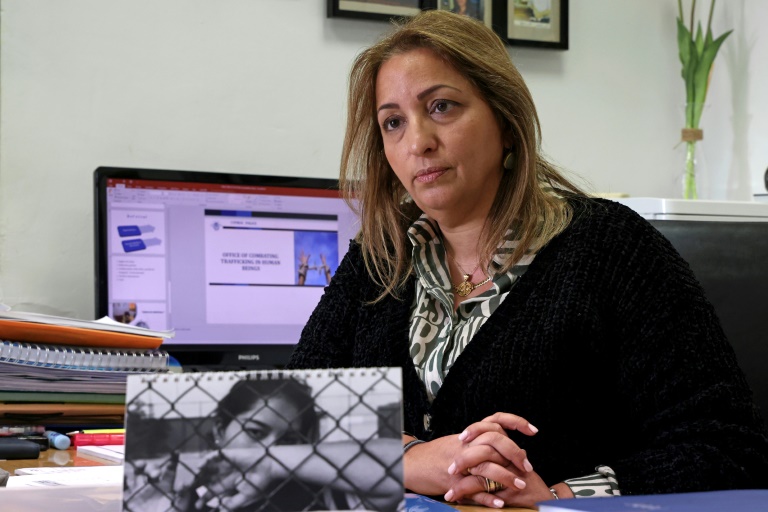
Cyprus’s frozen conflict is providing fertile ground for human traffickers with cases at “alarming” levels in the EU member state, and the breakaway north considered as bad as Afghanistan.

“I love her, but at the same time she reminds me about my past,” said one Cameroonian trafficking survivor, referring to her young daughter.

“There was so much abuse during those months,” added the woman in her 20s, who said she was rescued by a client from her ordeal.

“I didn’t die … and God saved me, so I know that He has a plan for my life,” she told an NGO working with survivors which requested anonymity to protect her identity.

Last year the US State Department downgraded Cyprus in its annual Trafficking in Persons Report from Tier 1, the highest ranking, to Tier 2, citing problems including protracted court proceedings and a lack of convictions.

While the report does not formally rank the breakaway Turkish Republic of Northern Cyprus, only recognised by Ankara, it says the territory would be in Tier 3 with the worst offenders including Afghanistan and North Korea if it did.

Cyprus has been split since 1974, after Turkey invaded in response to a Greek-sponsored coup.

And the lack of progress in resolving the conflict shifts attention and resources away from issues like human trafficking, said Nasia Hadjigeorgiou, assistant professor in transitional justice and human rights from the University of Central Lancashire Cyprus.

The stalemate also means there is no collaboration between law enforcement on the two sides, Hadjigeorgiou said.

So human trafficking across the island as a whole is “literally not being dealt with,” she said.

– ‘Red alarm’ –

In the north, traffickers are abusing student visa regulations, said Fezile Osum from the north’s Human Rights Platform, calling the situation a “red alarm”.

The organisation manages an anti-trafficking hotline that has identified 12 victims — all of sex trafficking — since late last year.

In some cases, young women from African countries are brought in as students but when they arrive “they are locked in private apartments and forced into (commercial) sex”, Osum said.

That’s on top of trafficking cases from nightclubs, where women on “barmaid” and “hostess” visas must get regular STD checks despite organised prostitution being illegal in the territory, she added.

One survivor said clubs sometimes used blackmail and drugs to control trafficked women, Osum said.

The north criminalised human trafficking for the first time in 2020, but Osum said no convictions had yet been recorded.

She knew of one victim who had reported her ordeal to police in the south, only to be told, “this happened in the north… how can we collect evidence that you were actually trafficked?”

Turkish Cypriot politician Dogus Derya said the territory’s unrecognised status meant it was unable to cooperate with international bodies to fight organised crime.

The north “can be seen as an area of ‘impunity’ for human traffickers”, she said.

– ‘No hope’ –

A 2020 European Commission report, referencing 2017-2018 data, said Cyprus eclipsed all other EU countries for the number of identified or presumed victims of human trafficking relative to its population, with 168 per million people. Britain trailed in second place with 91.

“When they come, they don’t have hope for the future,” said Paraskevi Tzeou, board member of Cyprus Stop Trafficking, referring to survivors who seek help at the organisation’s women’s shelter in the south.

They have been “from nearly everywhere” — from EU countries Romania and Bulgaria to Russia, Ukraine, Ethiopia, Nigeria, Moldova, Cameroon, India and Nepal, a worker from the shelter said, asking to remain anonymous.

The Republic of Cyprus, which controls the island’s south, adopted more comprehensive anti-trafficking legislation in 2014, bolstering it five years later.

The south officially recognised 21 victims of human trafficking last year, said Eleni Michael, head of the police anti-trafficking unit.

But 169 people were classified as “possible victims”, official figures showed.

Police work tirelessly to identify and assist genuine cases, Michael told AFP, but only verified allegations could lead to official victim status.

“If they said to us that they were exploited outside … the territory of Cyprus, it’s a little bit difficult to clarify,” she said.

Cyprus has sought to speed up glacial court proceedings, securing several recent trafficking convictions.

But a Limassol court said last month that “trafficking offences have reached alarming proportions in our country”.

Other cases have collapsed, including that of four immigration police arrested in 2018 on suspicion of assisting a trafficking network.

“The key witnesses, who were the victims of the offences… could not be traced to give evidence… despite the attempts made to locate them through EUROPOL,” the attorney general’s office told AFP.

In a faint glimmer of hope, a technical committee on criminal matters brings together representatives from both sides of the island.

But it has no statutory authority, said Greek-Cypriot co-chair Andreas Kapardis.

It “can do something (to help combat trafficking) if the political will is there”, he said.

But concern about official recognition of the north “stops some ideas in their tracks”, he added.

Libya's underground homes wait for tourism revival

Gharyan’s unique underground houses were hewn into the mountainside centuries ago, and many lie abandoned, but residents of the Libyan town are hoping tourism can help restore their heritage.

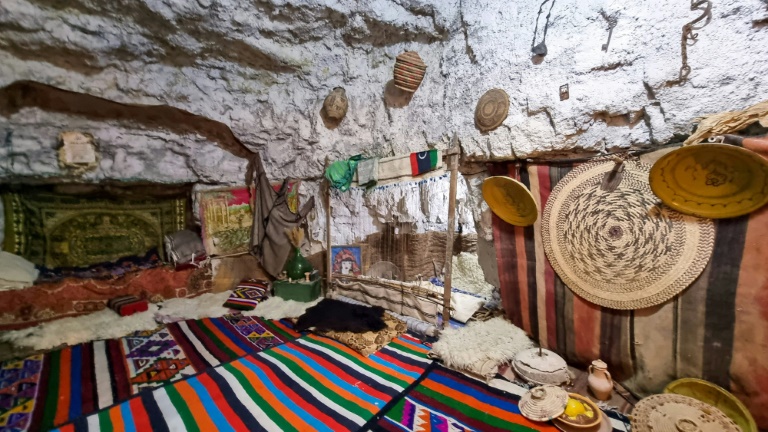
“My great-great-great-great-great-grandfather dug this yard 355 years ago,” said Al-Arbi Belhaj, who owns one of the oldest houses in the mixed Berber-Arab town south of Tripoli.

His ancestor would have used a “tajouk” pickaxe to chip away at the ground before loading the rubble into a woven date-palm “gouffa” basket to carry it away, he said.

Dug deep into the arid Nafusa mountains at around 700 metres (2,300 feet) above sea level, the home would have been protected against the scorching summers that bring temperatures up to 45 degrees Celsius (113 Fahrenheit).

It would have also stayed warm throughout the often snowy winters.

The region’s bedrock has a consistency that allowed the underground dwelling — known as a damous — to last for centuries without collapsing.

Some of the buildings are over 2,300 years old, and ancient Greek historians mentioned their existence, according to historian Youssef al-Khattali.

The area also has burial sites dating back to Phoenician times, he added.

Today, Belhaj says he is the owner of the oldest underground home in Gharyan, a town where many residents have family records and property deeds dating back centuries. 

The warren of rooms dug into the rock around the courtyard once housed as many as eight large families, he said.

He was the last person to be born there, in 1967.

In 1990, like many people seeking more comfortable dwellings with running water and electricity, the family moved out of the home, but they kept ownership of it.

Now, Belhaj has renovated it and turned it into a tourist attraction.

– ‘Designed to be versatile’ –

While late dictator Moamer Kadhafi allowed tourists to visit the country on organised trips, visitors have been thin on the ground since his fall in a 2011 revolt, which sparked a decade of chaos.

But the region’s Berber villages have continued to attract domestic tourists, and Belhaj is hoping that a return to relative stability could open the door to more visitors from Europe and elsewhere.

He charges an entry fee equivalent to a dollar for Libyans, or two for foreigners.

While some come for a cup of tea and to explore the building, others stay for lunch or spend the entire day there.

Damous structures were once common across a stretch of western Libya and eastern Tunisia — the other side of a border only drawn up in 1886.

“The same tribes extend from Nalut to Gabes,” said historian Khattali, referring to towns on the Libyan and Tunisian sides.

Their sites were carefully chosen and the buildings painstakingly excavated by hand to avoid them collapsing in the process.

In 1936, they attracted the attention of colonial power Italy, featuring in a tourist guide.

And they were not just used as homes.

“First of all, there were underground dwellings for humans and their animals, then buildings intended as places of worship,” Khattali said, referring to synagogues and churches that were mostly later converted to mosques.

Some were also used as defences, he said.

“You can still make out the traces of fortifications in certain parts of the mountain, including the remains of watchtowers.”

The buildings “were designed to be versatile, and they’ve stood the test of time,” Khattali said.

“That’s why they’re so important in the history of Libyan architecture.”

Cruise ships at center of dispute in Florida's idyllic Key West

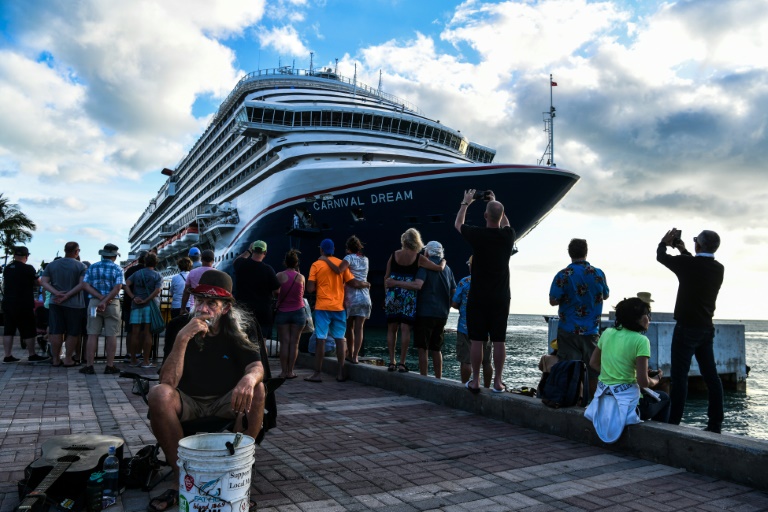
The island-city of Key West off the southern tip of Florida invites visitors to stroll slowly, enjoy turquoise waters and take in the sunset. But according to some residents, that idyllic peace is endangered — by lumbering, tourist-filled cruise ships.

The huge vessels bring thousands of visitors every day to the small city of 26,000 inhabitants, whose quaint, often pastel-colored Victorian homes line leafy, walkable streets.

Following a drawn-out local battle, the cruise tourist numbers are now down, but many residents say more still needs to be done.

While many businesses depend on the tourist throngs, residents such as Arlo Haskell find the ships to be a nuisance and believe they cause environmental harm. As a result, he founded the Safer Cleaner Ships non-profit.

“These cruise ships are an extraction industry that is profiting off of the beauty in Key West while harming that beauty and degrading the experience for everyone else,” Haskell said.

In 2020, his association put forth three local referendums: one to limit the size of cruise ships, another to allow no more than 1,500 people a day to disembark and a third to be able to prohibit boats that do the most damage to the environment.

The three proposals, each approved by between 60 to 80 percent of voters, were ratified by the city council. It was a victory for Haskell — or so he thought.

Then in June 2021, Florida Governor Ron DeSantis signed a law suspending the measures, arguing that voters could not meddle in matters of maritime trade. 

Local businesses, including ones also owned by the owner of Pier B — a huge beneficiary of the cruise ships as one of the city’s main docking locations — had donated almost $1 million to a political campaign committee supporting the governor, according to the Miami Herald.

– Public docks closed –

Relying on a bit of unexpected economic data, Safer Cleaner Ships returned to battle following DeSantis’ move. 

The info showed that cruise ship suspensions during the pandemic did not sink local finances.

To the contrary, in 2021, the city collected 25 percent more sales taxes than in 2019, before Covid.

Hotels and restaurants seem to have taken advantage of the fact that Florida promoted its open businesses in the middle of the pandemic while other states imposed rules and closings.

The city administration last month decided that since Key West cannot limit the number of cruise ships, it would close its two public docks. 

Now cruises can only park at private Pier B, which welcomes only one cruise ship per day. The era of two to three ships arriving daily is over.

The move has been a blow to some businesses. 

Although cruise tourists spend only a few hours in the city and usually eat before disembarking — generating little income for restaurants and hotels — they do buy souvenirs and snacks.

The visitors support the likes of tchotchke shops, ice cream parlors and tourist destinations, such as the Ernest Hemingway Home and Museum where the US writer lived between 1931 and 1939, according to Mayor Teri Johnston.

– Finding balance –

One morning this week, the streets of Key West were nearly deserted. Vanessa Wilder manned her downtown bike rental stand, waiting for the first passengers to disembark from a newly arrived cruise.

“The main shops and the bars down here, we thrive off of these cruise ships,” she said. 

“If we didn’t have them, a lot of businesses around here would have to shut.”

Despite his victories, Haskell maintains that things should move one step further, with cruise ships at the private dock not allowed to exceed a size specified by residents.

The boats, according to Haskell “do tremendous damage to our ecosystem” by clouding the water, which endangers the survival of corals.

But Scott Atwell, spokesman for the National Oceanic and Atmospheric Administration in Key West, said the evidence wasn’t so clear.

“We do not have specific studies on whether the cruise ship turbidity is any different than natural turbidity and whether turbidity from the ships’ channel reaches our coral reefs in a detrimental way,” he said.

In the meantime, Key West’s city council has decided to monitor water quality and also support coral restoration under an initiative that charges a fee to Pier B for disembarking passengers.

“We don’t want to get rid of the cruise ships but bring them into a moderate level so that we have good economic conditions and we also have good quality of life for our residents,” Johnston, the mayor, said.

Cruise ships at center of dispute in Florida's idyllic Key West

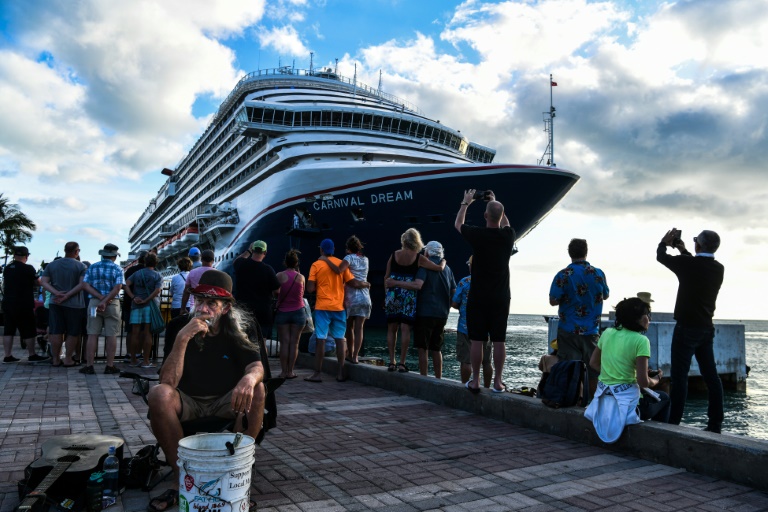
The island-city of Key West off the southern tip of Florida invites visitors to stroll slowly, enjoy turquoise waters and take in the sunset. But according to some residents, that idyllic peace is endangered — by lumbering, tourist-filled cruise ships.

The huge vessels bring thousands of visitors every day to the small city of 26,000 inhabitants, whose quaint, often pastel-colored Victorian homes line leafy, walkable streets.

Following a drawn-out local battle, the cruise tourist numbers are now down, but many residents say more still needs to be done.

While many businesses depend on the tourist throngs, residents such as Arlo Haskell find the ships to be a nuisance and believe they cause environmental harm. As a result, he founded the Safer Cleaner Ships non-profit.

“These cruise ships are an extraction industry that is profiting off of the beauty in Key West while harming that beauty and degrading the experience for everyone else,” Haskell said.

In 2020, his association put forth three local referendums: one to limit the size of cruise ships, another to allow no more than 1,500 people a day to disembark and a third to be able to prohibit boats that do the most damage to the environment.

The three proposals, each approved by between 60 to 80 percent of voters, were ratified by the city council. It was a victory for Haskell — or so he thought.

Then in June 2021, Florida Governor Ron DeSantis signed a law suspending the measures, arguing that voters could not meddle in matters of maritime trade. 

Local businesses, including ones also owned by the owner of Pier B — a huge beneficiary of the cruise ships as one of the city’s main docking locations — had donated almost $1 million to a political campaign committee supporting the governor, according to the Miami Herald.

– Public docks closed –

Relying on a bit of unexpected economic data, Safer Cleaner Ships returned to battle following DeSantis’ move. 

The info showed that cruise ship suspensions during the pandemic did not sink local finances.

To the contrary, in 2021, the city collected 25 percent more sales taxes than in 2019, before Covid.

Hotels and restaurants seem to have taken advantage of the fact that Florida promoted its open businesses in the middle of the pandemic while other states imposed rules and closings.

The city administration last month decided that since Key West cannot limit the number of cruise ships, it would close its two public docks. 

Now cruises can only park at private Pier B, which welcomes only one cruise ship per day. The era of two to three ships arriving daily is over.

The move has been a blow to some businesses. 

Although cruise tourists spend only a few hours in the city and usually eat before disembarking — generating little income for restaurants and hotels — they do buy souvenirs and snacks.

The visitors support the likes of tchotchke shops, ice cream parlors and tourist destinations, such as the Ernest Hemingway Home and Museum where the US writer lived between 1931 and 1939, according to Mayor Teri Johnston.

– Finding balance –

One morning this week, the streets of Key West were nearly deserted. Vanessa Wilder manned her downtown bike rental stand, waiting for the first passengers to disembark from a newly arrived cruise.

“The main shops and the bars down here, we thrive off of these cruise ships,” she said. 

“If we didn’t have them, a lot of businesses around here would have to shut.”

Despite his victories, Haskell maintains that things should move one step further, with cruise ships at the private dock not allowed to exceed a size specified by residents.

The boats, according to Haskell “do tremendous damage to our ecosystem” by clouding the water, which endangers the survival of corals.

But Scott Atwell, spokesman for the National Oceanic and Atmospheric Administration in Key West, said the evidence wasn’t so clear.

“We do not have specific studies on whether the cruise ship turbidity is any different than natural turbidity and whether turbidity from the ships’ channel reaches our coral reefs in a detrimental way,” he said.

In the meantime, Key West’s city council has decided to monitor water quality and also support coral restoration under an initiative that charges a fee to Pier B for disembarking passengers.

“We don’t want to get rid of the cruise ships but bring them into a moderate level so that we have good economic conditions and we also have good quality of life for our residents,” Johnston, the mayor, said.

Families demand justice four years on from Nicaragua protest repression

Alvaro Conrado’s last words were: “It hurts to breathe.”

He was 15 when he was shot in the stomach while bringing water to students protesting against the government of Nicaragua President Daniel Ortega four years ago.

He was likely shot by a sniper. His family is still waiting for justice.

“Justice and truth. That’s what we want, we want them to tell us what happened. Four years after his death no one has been arrested,” the teenager’s father, also called Alvaro Conrado, told AFP from the family home in Managua.

Protests had broken out two days before the younger Alvaro’s death, on April 18, 2018 — initially against a social security reform before exploding into a massive anti-government movement.

The country was brought to a near standstill for five months, during which the government’s response left 355 people dead and more than 100,000 exiled, according to the Inter-American Commission for Human Rights.

Nicaragua has been gripped by political crisis since.

The government declared the protests an attempted coup d’etat, and has since banned numerous opposition political parties, NGOs, independent media and even private universities.

Every level of government is in the iron grip of the ruling Sandinista National Liberation Front (FSLN) party.

Ex-guerrilla Ortega, 76, was unsurprisingly re-elected in November to his fourth consecutive mandate.

Before the vote, several potential opponents were jailed, accused of trying to overthrow the government with the help of Washington.

Several days before the anniversary of the start of the protests, Ortega’s wife and vice president, Rosario Murillo, branded the movement a “hellish malevolent evil explosion” and said it “will not be excused nor forgotten.”

The deeply religious 70-year-old said the events would be remembered as “victory over evil.”

– ‘Impossible to forget’ –

“On April 20 at midday, when I received a call saying he was hurt, I couldn’t believe it,” said Alvaro Conrado, a 53-year-old computer engineer.

“It’s impossible to forget that moment.”

He says he has since lost his job with the state, and is regularly the victim of harassment by authorities and government supporters.

His wife is afraid to come home from Spain, having left the country to denounce her son’s murder with the Mothers of April Association (AMA).

Francisca Machado, 48, from the northern town of Esteli, also lost her son Franco Valdivia, a 23-year-old law student, during the protests.

“He was the younger of my two sons… I made so many sacrifices so he could get ahead,” said Machado.

“In an instant they took his life and left me with this great void and irreparable pain.

“I feel great pain and impotence on these anniversaries. For me, there is no clean slate. I want and I demand justice, whatever it takes.”

In the south of the country on Ometepe island, farmer Justo Rodriguez was detained in 2020 for allegedly taking part in a second anniversary commemoration of the protests, which he denied.

He spent eight months in prison, where he fell ill.

Now 69, he remains bedridden and can barely speak.

“After they took me there (to prison) they brought me back in bad health,” he said.

The Nicaraguan Center for Human Rights (CENIDH), one of the few independent organizations that manages to continue operating in the country despite being banned, accuses the government of trying to impede commemorations.

According to CENIDH president Vilma Nunez, 177 opposition figures remain behind bars, including seven presidential aspirants for last November’s election who have been sentenced to up to 13 years in prison.

“Another wave of persecution has been unleashed with raids, threats and arrests,” said Nunez.

She said at least six musicians and music producers critical of the government have been arrested recently.

“Another form of repression is stripping people of their passport so that they cannot travel and if they are outside the country they cannot renew this document, which makes them illegal,” said Nunez.

Close Bitnami banner
Bitnami