World

Endangered North Atlantic right whales make a stand in Cape Cod

After many hours scouring Cape Cod Bay and a few false alarms, those aboard the Research Vessel Shearwater on a bright April day make their first sighting: three North Atlantic right whales, including a rare mother-calf pair.

The captain cuts the engines and a trio of marine biologists spring into action, rapidly snapping photos and noting markings that can be used to identify individual animals and track injuries — a vital part of conservation efforts for a species believed to have 336 members.

While the whaling that drove them to near-extinction has long been banned, unintended collisions with ships and entanglements with fishing gear are today the main threats for Eubalaena glacialis, one of the most endangered mammals in the world.

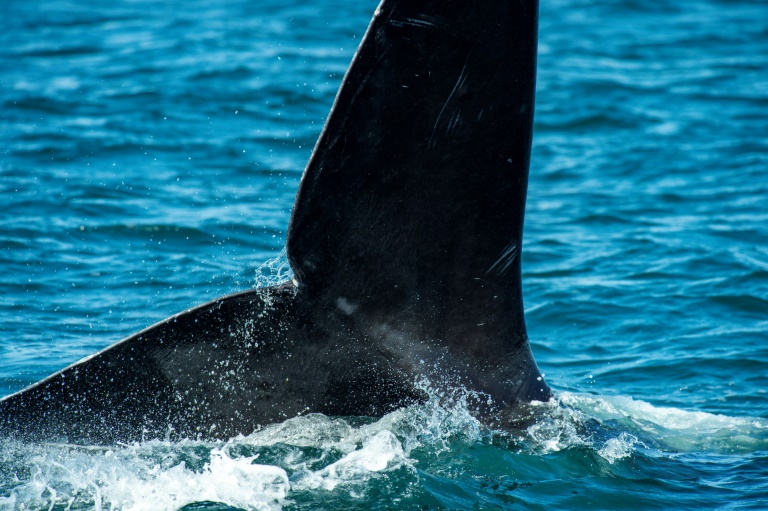
Approaching 60 feet in length and weighing over 70 tons, the North Atlantic right whale is the third largest whale in existence. Their life spans are similar to humans, with individuals living up to a century.

“Unfortunately, since 2010, their population has been decreasing,” explains Christy Hudak, the leader of the Center for Coastal Studies’ expedition that set off from Provincetown, a historic New England fishing village that is today popular for whale watching and gay tourism.

“We’re trying to spread the word regarding these amazing creatures and just how a key species they are in the circle of life.”

The CCS crew coordinates with an aerial survey plane, while a vessel from another research group flies mini-drones equipped with cameras over the whales as part of a study on the impact of rope entanglements on their growth rate.

Despite strict ship speed limits of 10 knots in some protected areas, and new rules brought in by authorities to limit the number of ropes between buoys to crab and lobster traps on the seafloor, conservationists worry it’s not enough.

The problems are compounded by climate change: as the waters of the North Atlantic warm, a tiny oil-rich crustacean called Calanus finmarchicus that is the whales’ main food resource is becoming more scarce in their habitat, which stretches from Florida to Canada.

Cape Cod Bay isn’t warming as fast as the whales’ more northern waters in the Gulf of Maine, and as a result, it is here, in their traditional feeding and nursing grounds, that the marine giants are now more commonly spotted.

Apart from photography and detailed note-taking, the crew also carry out plankton surveys: casting nets and using water pumps to take samples at various depths for lab analysis.

Knowledge of the composition and density of these zooplankton helps scientists predict peak whale arrivals and departures.

– The ‘right’ whale to hunt –

Right whales were the favored prey of commercial hunters for more than a millennium — by the Vikings, Basques, English, Dutch and finally Americans — who sought their blubber for whale oil and their baleen plates, which they use to filter their food, as a strong, flexible material used in the pre-plastic era.

According to David Laist, an author of a book on the species, their numbers prior to commercial whaling ranged up to 20,000, but by the early 20th century, the species was decimated. 

There was just one reliable sighting anywhere in the North Atlantic between the mid-1920s to 1950, Laist writes.

“The early whalers thought of them as the correct whale to catch because they were so valuable, great thick layers of blubber that produced oil that was used in lamps,” CCS founder Charles “Stormy” Mayo says, explaining the name. 

A baby boom in the 2000s led to a recent peak of more than 483 animals by 2010, but numbers are once more in decline — and in 2017, the species was rocked by a mass-die off due to a shift to new foraging grounds.

“Fourteen right whales died in a very short period, because they moved into an area in the Gulf of St. Lawrence that was not previously known and was not managed,” he said.

That move due to declining prey abundance elsewhere appears to have been caused by climate change, and left the whales highly vulnerable to the collisions and ropes that kill them.

And since the population is already so depleted, even a few deaths are enough to trigger a downward spiral, said Mayo, who was part of the first team to disentangle a whale in 1984. Mayo’s own father had hunted pilot whales, and their family has lived in the area since the 1600s.

The whales’ calving rate in its southern waters is also down.

While three years is considered a normal interval between births, the current average is three to six years, according to the National Oceanic and Atmospheric Administration.

The stressors placed on females — including non-fatal rope entanglements and ocean noise from human activities — are thought to be behind the steep decline.

– Playful calf, and a whale party – 

Right whales are distinguished by their stocky, black appearance with no dorsal fins, as well as heads adorned with knobby patches of rough skin called callosities, which are colored white from the tiny “whale lice” (cyamids) that cling to their hosts in what is thought to be a symbiotic relationship.

Following tips relayed by their colleagues in the air, the R/V Shearwater finds more right whales including a playful calf copying its mother, and a huddle that biologists call a surface active group — an opportunity to socialize.

The whales “are getting together, rolling around touching each other. The main part of it is to mate, but also just to interact with other right whales. It’s not always about sex,” Hudak says.

Back on land, Hudak says she was encouraged by what she saw over the day: a total of 10 right whales, two mother-calf pairs, and the social group, the “piece de resistance.”

The long term future of the species is far from assured, but there is hope.

Technologies are being tested to reduce entanglements — from weak rope that breaks more easily, to ropeless fishing traps that use floats triggered by remote control to ascend by themselves.

Other ideas include deploying more acoustic monitoring devices on buoys to track the whales’ movements better, and quickly respond with ship speed limits in those areas.

Also vital, said Hudak, is increasing public awareness and desire to protect the creatures.

The ship’s spotter Sarah Pokelwaldt, a recent graduate doing an internship with CCS, said she was blown away by what for her was her first encounter with calves.

“Being able to see the babies shows a lot of promise for the work that we do. It’s really fulfilling to see,” she said.

Russians flee Putin regime to join Ukraine refugees in Israel

The moment Russian tanks rolled into Ukraine, Russian filmmakers Anna Shishova-Bogolyubova and Dmitry Bogolyubov knew they had to leave Moscow.

“We were the next on the list,” the couple told AFP in their borrowed flat in Rehovot, a quiet Israeli city 20 kilometres (12 miles) south of Tel Aviv.

Once you’re on the list of alleged “foreign agents”, you face a life of “self-censorship or, sooner or later, prison”, said Bogolyubov, who directed the German-financed 2019 documentary “Town of Glory”.

The film portrays President Vladimir Putin’s use of references related to the fight against Nazi Germany to establish his authority in Russian villages.

As its international isolation has deepened, Moscow has come to view all movies made with foreign financing with suspicion, including documentaries, and the couple said theirs was no exception.

“Over the past few years, we felt threatened. In the past few months in particular, people were spying on us and taking photographs on our film sets,” Shishova-Bogolyubova said.

The couple decided to continue working in Russia but, taking advantage of their Jewish ancestry, they obtained Israeli citizenship just in case.

Israel’s Law of Return gives the right of citizenship to anyone with at least one Jewish grandparent, a criterion that tens of thousands in both Russia and Ukraine meet.

– Opposition to war –

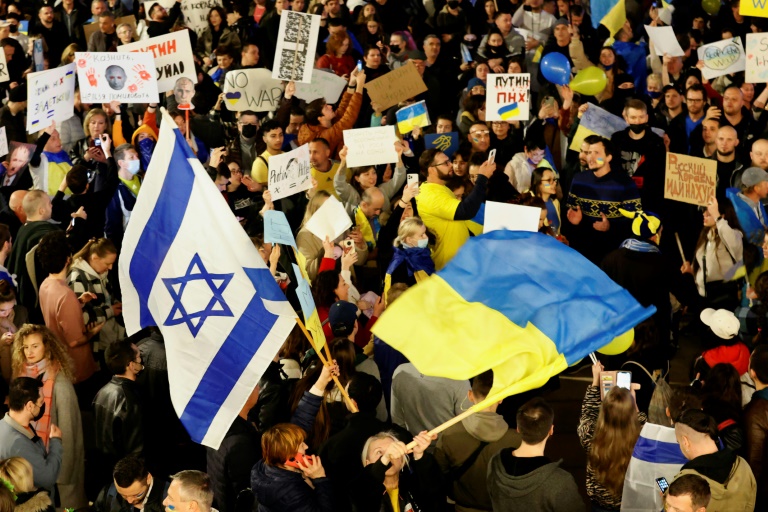
Since Russian troops invaded on February 24, nearly 24,000 Ukrainians have fled to Israel, some but not all taking advantage of the law, according to immigration ministry figures.

They have been joined by around 10,000 Russians, an Israeli immigration official told AFP.

“Most of those are young graduates, from the urban middle class,” the official said, asking not to be identified.

Like the Bogolyubovs, Moscow-born linguist Olga Romanova had prepared for the day when she no longer felt safe in Russia.

She applied for an Israeli passport after Putin’s annexation of the Crimean Peninsula in 2014.

“I always thought that one day I would join my children in Israel, but it was then that I realised that things were going wrong in Russia,” the 69-year told AFP in her son’s house outside Jerusalem surrounded by photographs of her grandchildren.

When the invasion started on the morning of February 24, “it was proof that I needed to leave as quickly as possible.

“The war in Ukraine is incompatible with my way of thinking and my moral values. It makes me sick,” she said, fighting back the tears.

– New home or stopover? –

The wave of immigration from Ukraine and Russia over the past seven weeks is the largest Israel has seen since the early 1990s when the collapse of the Soviet Union prompted hundreds of thousands to seek a new life on the shores of the Mediterranean.

“Here, we feel safe and we can sleep peacefully once more,” said Shishova-Bogolyubova.

“My four-year-old daughter, who is diabetic, is completely taken care of.

“But we don’t know if we will stay — that depends on our work. Right now, we just want to live for the moment and recover from our emotions. Afterwards, we will see.”

Sergey, a violinist who asked to be referred to by a pseudonym for fear of retribution, left Moscow for Israel with his pianist wife and three young children but expects to move on.

“I don’t know if we’ll stay here. We’ll probably go somewhere else,” he said.

Even for those who qualify for citizenship, Israel can be a terra incognita for new arrivals and nostalgia for Russia is never far below the surface.

Romanova, the linguist, found space in her 20 kilograms (44 pounds) of luggage for just two books, one an academic work, the other a novel by famed Russian novelist Mikhail Bulgakov which always accompanies her on her travels.

“I lost my country. It was stolen from me. It was taken by Putin and those KGB thugs,” she said wistfully.

Prince Harry hails Ukraine team's 'bravery' at Invictus Games opening

Britain’s Prince Harry on Saturday praised the courage of the Ukraine team at an opening ceremony for the Invictus Games in The Netherlands, where the Ukrainian competitors also received a standing ovation.

“Your bravery and choosing to come and of being here tonight cannot be overstated,” the Duke of Sussex told the audience at the ceremony in the Dutch city of The Hague.

“Glory to Ukraine,” his wife Meghan added in Ukrainian, addressing the team who had travelled to the games despite the invasion of their country ordered by Moscow on February 24.

Harry said the team had told him of their wish to attend “despite all odds… not simply to show your strength, but to tell your truth. The truth of what is happening in your country.

“You know we stand with you. The world is united with you and still you deserve more.”

The Duke and Duchess of Sussex arrived in The Netherlands on Friday, making their first joint public appearance in Europe since quitting royal life and moving to North America more than two years ago.

A day earlier they had paid a secret visit to Harry’s grandmother Queen Elizabeth II at Windsor Castle, where they also reportedly met his father Prince Charles, following tensions caused by their interview with chat show queen Oprah Winfrey in which they accused an unnamed member of the royal family of racism.

– ‘We are all behind you’ –

Dutch Prime Minister Mark Rutte told the ceremony that some members of the Ukraine team could not be at the games as they were “fighting on the frontline”.

“Of course, we are thinking of those Ukrainians in the Invictus community who have paid the ultimate price for their fighting in the war… we are all behind you,” he said.

According to the Ukraine team at least four members of the Invictus community there have died in fighing in Ukraine since 2014.

Harry, who served with the British army in Afghanistan, founded the Invictus Games for disabled military veterans.

More than 500 participants from 20 countries are taking part in the Invictus Games, which have been postponed twice because of the coronavirus pandemic.

Just before the prince’s arrival on Friday, the Ukrainian team made their own arrival to great applause.

The team of 19 people were present in the Netherlands to take part but said they regretted the absence of one participant, trapped in the besieged Ukrainian city of Mariupol.

The paramedic, Yuliia Paievska, known as Taira, is “in danger of death now”, a spokeswoman for the team told AFP.

“She is the only woman on the team and was due to compete in archery and swimming,” the team said in a statement Friday.

Macron talks up green credentials ahead of French election

President Emmanuel Macron promised to put the environment at the heart of his government if he is re-elected next weekend, in a speech in southern France on Saturday designed to appeal to young and green-minded voters. 

Macron held a major rally in the port city of Marseille while his rival, far-right leader Marine Le Pen, visited a village west of Paris.

Polls show Macron stretching his lead over Le Pen, with a fresh survey on Saturday by Ipsos Sopra/Steria suggesting that Macron would triumph with 55.5 percent versus 44.5 percent for Le Pen.  

“I hear the anxiety that exists in a lot of our young people. I see young people, adolescents, who are fearful about the future of our planet,” Macron told the rally. 

He acknowledged the “powerful message” sent in the first round of elections on April 10, when nearly eight million voters backed hard-left candidate Jean-Luc Melenchon and his ecology-heavy programme.

“It’s up to us to react and up to us to take action,” Macron said. 

As well as promising to make France “the first major nation to abandon gas, oil and coal”, Macron said he would appoint a prime minister who would be formally tasked with “ecological planning”.

He also promised new investments in renewable technologies, energy-saving residential renovations and organic food production, while pledging crackdowns on air pollution and single-use plastics.

The speech was a clear pitch to the young and left-wing voters who backed Melenchon and Greens nominee Yannick Jadot in the first round who will be crucial in the second round on April 24.

The idea of a prime minister tasked with “ecological planning” was first proposed by Melenchon.

Macron accused Le Pen of being “a climate change sceptic”, attacking her for proposing to dismantle wind turbines, which she views as costly, inefficient eyesores. 

Surveys show the environment is one of French voters’ priorities, but it has been overshadowed during the election campaign by the war in Ukraine and the spiralling cost of living.

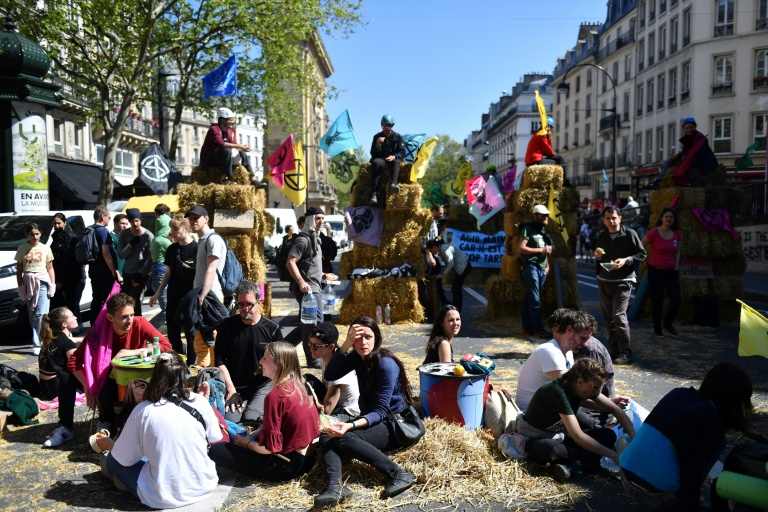
Several hundred activists from the Extinction Rebellion climate activist group blocked a main road in the centre of Paris on Saturday to denounce the “inaction” of political leaders.

“This is the only way of ensuring that everyone talks a bit about climate change,” said Antoine, a young Extinction Rebellion activist who declined to give his surname.

– Protests –

Le Pen meanwhile was touring the village of Saint Remy-sur-Avre, about an hour and half’s drive west of the capital, where she came top in last weekend’s first round.  

After hearing complaints about the loss of hospital beds and bus services locally, she promised to “govern the country like a mother, with common sense” and to defend “the most vulnerable”.

She has sought to moderate her image during campaigning this year, stressing her proposed solutions to rising living costs rather than her usual topics of immigration and Islam.

Rallies backed by trade unions against the far-right were staged in major cities on Saturday. Nearly 23,000 people turned out for the demonstrations, according to interior ministry estimates: 150,000 according to the rallies’ organisers.

Le Pen has faced repeated questions this week about her proposed ban on the Islamic headscarf in public places, which she has said will be punished with fines by the police.

The 52-year-old mother-of-three admitted on Saturday it was a “complex problem” and would be discussed by parliament if she won.

But “we need to resolve the problem of women who are obliged to wear it under pressure from Islamists”, she said. 

She has also sought to appeal to left-wing voters, who she will need in order to defeat Macron.

“We are speaking to all the French,” she told a rally in the southern city of Avignon on Thursday evening. “We hold out a firm hand but one of friendship and respect.”

Although both candidates claim to have strong environmental programmes, they have clear differences in foreign policy, attitudes to immigration, and the economy.

Eurosceptic Le Pen wants to wind back France’s commitments to the European Union and has proposed closer ties between Western military alliance NATO and Russia once the war in Ukraine is over.

Macron and Le Pen are set to meet in a crucial head-to-head debate on Wednesday evening which has proved crucial in swaying voters in the past.

Meanwhile the investigative website Mediapart reported Saturday that the EU’s anti-corruption office OLAF had delivered a report to French prosecutors last month accusing Le Pen of having fraudulently used money she received when she was a European deputy between 2004 and 2017.

burs-leb-are/jj/raz

Behind the frontlines, Ukrainians find world of ways to help

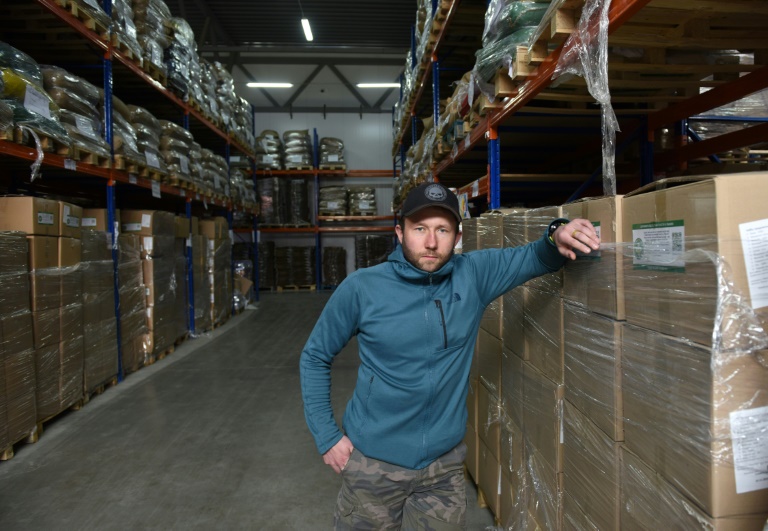
Inside a packed warehouse in war-torn Ukraine, 35-year-old volunteer Roman Kolobochok said his friend on the frontline needed a sniper scope and he was going to find him one.

His friend had messaged him a website link for the telescopic lens he needed, and he was in the middle of ordering one from the United States.

In times of war, everybody should contribute with their best skill, said the veteran scout in the western region of Lviv.

“If you’re a good hustler, you should do it,” he said.

Standing between shelves stuffed high with donations from across the world, the improvised logistician is just one of a flurry of volunteers across Ukraine applying a range of talents to help.

Before the war, Kolobochok headed the souvenir department of a restaurant chain, but also travelled to the US through his job as a medical courier for a Ukraine-based surrogacy company, he said.

After Russia invaded on February 24, he asked his bosses at the restaurant business to borrow a corner of their warehouse. 

Today, a team of fellow scouts receive requests for aid from across the country on a messaging app, then carefully match them up with available supplies on a multicoloured spread sheet.

The storehouse shelves are stacked with everything from sleeping bags and tents, to flour, coffee drinks, medical gloves and soap. In a medicine section, insulin sits in the fridge. 

– Boots and chainsaws –

In recent days, the scouts have dispatched humanitarian and medical aid to the capital Kyiv, to the eastern city of Kharkiv and Mykolaiv near the Black Sea, Kolobochok says.

But with around 50 fellow scouts now fighting the Russians, his team are also actively looking for night-vision goggles, GPS systems, and army food ration packs.

The response has been overwhelming, he says.

Strangers are making donations and the Spanish scouts have sent in truckloads of aid. One American even took time off from work in Texas to fly to Philadelphia, where he picked up 100 trauma first aid kits he had bought and then drove them to a New York airport.

In just days, they managed to raise enough funds to buy a drone.

“The world is supporting us,” Kolobochok said.

At a different storage point in the city of Lviv, fellow scout Anastasiia Sokhatska stood amid piles of home-made camouflage nets, packs of mineral water, tactical boots, flags and a couple of boxed chainsaws for combatants to build hideouts.

When the army needs something, she says, she and fellow volunteers fundraise on social media, collect the supplies, and then make sure they are delivered.

“I need to help. This is my country,” she said, as beside her two young men packed up bags.

Earlier the same day, she had learned that a close friend due to celebrate his wedding this summer had been deployed very close to the Russian frontier.

“I just don’t have the possibility to do nothing,” said the 26-year-old, who used to work in the IT sector.

Being a woman has also been an asset.

Ukrainian men of fighting age are not allowed to leave Ukraine, but women can drive back and forth across the nearby Polish border, ferrying in donated goods and equipment.

“I go there because I’m a woman, and I can just go abroad,” she said.

– Theatre turned shelter –

But it is not only scouts helping behind the frontlines.

When a huge wave of families escaping fighting arrived in Lviv at the start of the conflict, everybody pitched in however they could.

At the Les Kurbas Theatre in the city centre, actress and singer Natalia Rybka-Parkhomenko organised bedding for more than a dozen displaced people from her home city of Kharkiv to sleep on stage. 

At another make-shift shelter housing hundreds of evacuees, veterinary student Dasha Bondarenko, 19, has for weeks been helping to check in new arrivals and find them fresh clothes.

When wedding organiser and taxi business owner Pavlo Bodnar, 29, could not get into the army, he headed out to volunteer at the train station.

He obtained a rare permit to drive his car during night-time curfew, and now offers free rides to people fleeing war, or even returning from abroad, when they arrive on the platform after 10 pm.

“I organised people who have cars because I’m in the car business,” he said.

Now “I have my own fleet of people who can transport people during curfew.”

Fuel-laden ship sinks off Tunisia coast

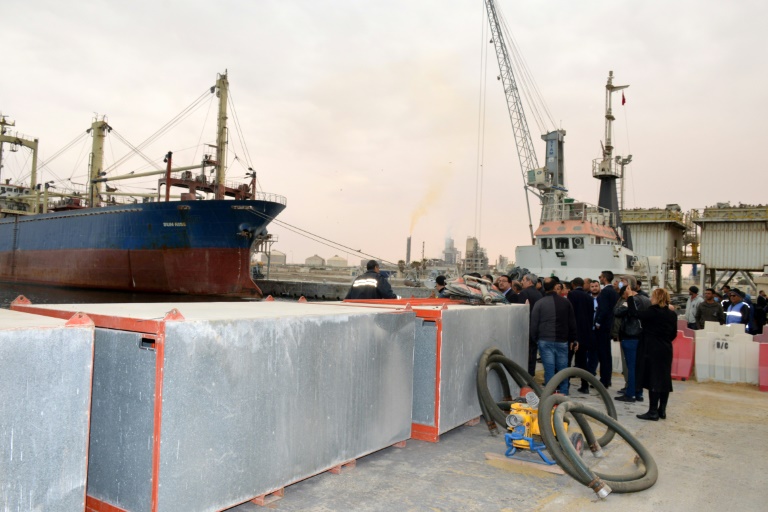
A tanker carrying 750 tonnes of diesel fuel from Egypt to Malta sank Saturday off Tunisia’s southeast coast, but officials said a large spill would likely be avoided.

The crew of the Xelo vessel had issued a distress call on Friday evening and sought shelter in Tunisian waters from bad weather before going down in the Gulf of Gabes in the morning, the authorities said.

Environment Minister Leila Chikhaoui, who travelled to the port of Gabes on Saturday to help oversee the response, said the situation was “under control”.

“We think the hull is still watertight and there is no leakage for the moment,” she told AFP.

“We think that the means we already have at our disposal will allow us to limit the accident,” she said, adding that the government would not hesitate to appeal for foreign assistance if necessary.

The district court in Gabes said it had opened an investigation into the accident.

Court spokesman Mohamed Karray said the tanker had issued a distress call before it “sunk this morning in Tunisian territorial waters”.

The Equatorial Guinea-flagged Xelo was headed from the Egyptian port of Damietta to Malta when it requested entry to Tunisian waters.

The tanker is 58 metres (63 yards) long and nine metres wide, according to ship monitoring website vesseltracker.com.

It began taking water around seven kilometres (over four miles) offshore in the Gulf of Gabes and the engine room was engulfed, according to the Tunisian environment ministry.

It said Tunisian authorities evacuated the seven-member crew.

– Polluted waters –

The environment minister said authorities were waiting for the “weather to improve in terms of both the wind and the swell before sending down divers to check with more certainty on the state of the hull”.

The weather was still too poor to start Saturday, Chikhaoui added.

As a precaution, protective booms to contain any oil slick have been placed in the water around the wreck under the supervision of the military.

Court spokesman Karray said the Georgian captain, four Turks and two Azerbaijanis were briefly hospitalised for checks and were now in a hotel.

The defence, interior, transport and customs ministries were working to avoid “a marine environmental disaster in the region and limit its impact”, the environment ministry said.

Before the ship sank, the ministry had described the situation as “alarming” but “under control”.

The Gulf of Gabes was traditionally a fishing area but activists say it has suffered from pollution caused by phosphate processing industries based nearby and the presence of a pipeline bringing oil from southern Tunisia.

In a statement Saturday, the Tunisia branch of the World Wildlife Fund said it feared a “new environmental catastrophe in the region”.

It said the area where the ship went down was a “fishing ground for 600 sailors”, adding that the wider Gulf of Gabes provided employment for around 34,000 fishermen who had already been contending with chemical pollution for decades.

The last maritime accident involving the country was in October 2018, when Tunisian freighter Ulysse slammed into the Cyprus-based Virginia anchored about 30 kilometres (20 miles) off the northern tip of the French island of Corsica, sending hundreds of tonnes of fuel spilling into the Mediterranean.

It took several days of maritime manoeuvres to disentangle the boats and pump some 520 cubic metres of propulsion fuel, which had escaped tanks.

Volunteer kitchen gutted by strike on east Ukraine city

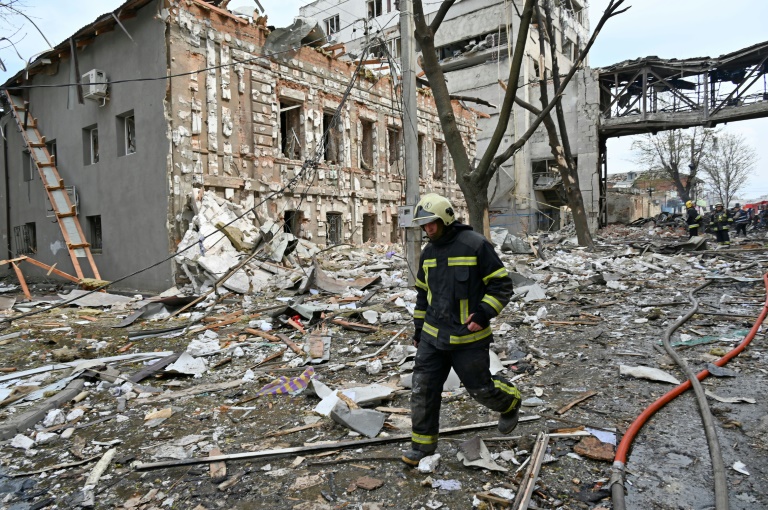
In the aftermath of Saturday’s strike on Ukraine’s second city of Kharkiv the scent of yeast hangs in the air.

Incoming fire in the city centre has turned an industrial kitchen inside out, pitching loaves of bread into the street.

Now they are sodden, from fire hoses, mingled with other absurd and macabre debris. A single misplaced shoe, scorched mannequins from a textiles outlet next door, a whole raw chicken, a Harry Potter novel.

The smell of bread blends with the acrid odour of burnt out cars. A walkway spanning the road is crumpled like an accordion. To the side, the balconies of an apartment block have been dismantled by the shockwave.

Officials said two people were killed and 18 injured here, adding yet more deaths to the toll of Russia’s military invasion of Ukraine.

Genadiy Vlasov wanders the road, shocked, aimlessly picking through fragments of plastic and metal.

Nearby his car has been totally savaged by the force of the attack.

When it came he was making bread in the kitchen, which hands out free food to residents hunkered down in the besieged city.

“The blast was so big that at first we didn’t understand what was happening,” the 52-year-old volunteer worker told AFP. “When the walls started moving we all knew we had to get out.”

– City under siege – 

Kharkiv is one of the places where President Vladimir Putin has refocussed his military campaign after calling off a push to take the capital of Kyiv at the end of March.

Just 21 kilometres (13 miles) from the border with Russia, the city has been under near constant bombardment in recent days as the Kremlin ramps up its eastern offensive.

On Friday authorities said 10 people were killed and 35 injured by Russian shelling in a residential district of Kharkiv.

One man died as he smoked at the garden window of his family home, his mother told AFP as the body was collected.

Throughout the early hours of Saturday AFP heard regular salvos of incoming and outgoing fire.

Manager Dmytro Kamykin clambers into the volunteer kitchen, demolished by fire at around 11.30 am.

The roof has been stripped off by the force of the strike. The floor is covered in fallen wall panels.

Out on the street one charred car is full of cooking implements — a frying pan, a set of knives and four pots nested inside each other.

“Three cars came with volunteers. They were severely injured and all bleeding,” said Kamykin, 56.

Three fire engines are parked up along the street. Hoses sprawl out across the ground, pumping water into smoking windows frames.

Under foot there is a river of water coursing through mounds of brickwork and warped metal.

“Near here a young man was killed,” Kamykin added with a resigned tone.

“You could see the blood on the asphalt. I ran to him but he was already dead.”

Taliban warns Pakistan after rocket attacks kill 5 Afghan children

The Taliban authorities warned Pakistan on Saturday after five children and a woman were killed in Afghanistan in alleged rocket attacks by the Pakistani military in a pre-dawn assault along the border.

Border tensions between Pakistan and Afghanistan have risen since the Taliban seized power last year, with Islamabad claiming militant groups were carrying out attacks from Afghan soil.

The Taliban deny harbouring Pakistani militants, but are also infuriated by a fence Islamabad is erecting along their 2,700-kilometre (1,600-mile) border known as the Durand line, which was drawn up in colonial times.

“Five children and a woman were killed and a man wounded in Pakistani rocket attacks in Shelton district of Kunar,” provincial director of information Najibullah Hassan Abdaal told AFP referring to the eastern province of Kunar bordering Pakistan.

Ehsanullah, a resident of Shelton district who goes by one name as many Afghans do, said the assault was carried out by Pakistani military aircraft. 

A similar pre-dawn assault was carried out in Afghanistan’s Khost province near the border, another Afghan government official said.

“Pakistani helicopters bombarded four villages near the Durand line in Khost province,” he said on condition of anonymity.

“Only civilian houses were targeted and there were casualties,” he added, but did not offer more details.

Afghanistan’s Taliban government warned Islamabad after the attacks.

“The Islamic Emirate of Afghanistan condemns in the strongest possible terms the bombardment and attack that has taken place from the Pakistan side on the soil of Afghanistan,” government spokesman Zabihullah Mujahid told reporters in an audio message.

“This is a cruelty and it is paving the way for enmity between Afghanistan and Pakistan …  We are using all options to prevent repetitions (of such attacks) and calling for our sovereignty to be respected. 

The Pakistani side should know that if a war starts it will not be in the interest of any side. It will cause instability in the region.”

– ‘Military violations’ –

Pakistani military officials were not immediately available for comment.

Afghan Foreign Minister Amir Khan Muttaqi protested to Pakistan’s ambassador in Kabul against what he said were “military violations” committed by Pakistan.

The United Nations Assistance Mission in Afghanistan (UNAMA) said it was “deeply concerned” by civilian deaths caused by air strikes, and the mission was verifying the extent of losses. 

TOLO News, Afghanistan’s leading private TV channel, showed footage of houses destroyed in the assault in Khost.

“All the targeted people were innocent civilians who had nothing to do with the Taliban or the government,” Rasool Jan, a resident of Khost, told the channel.

“We don’t know who is our enemy and why we were targeted.”

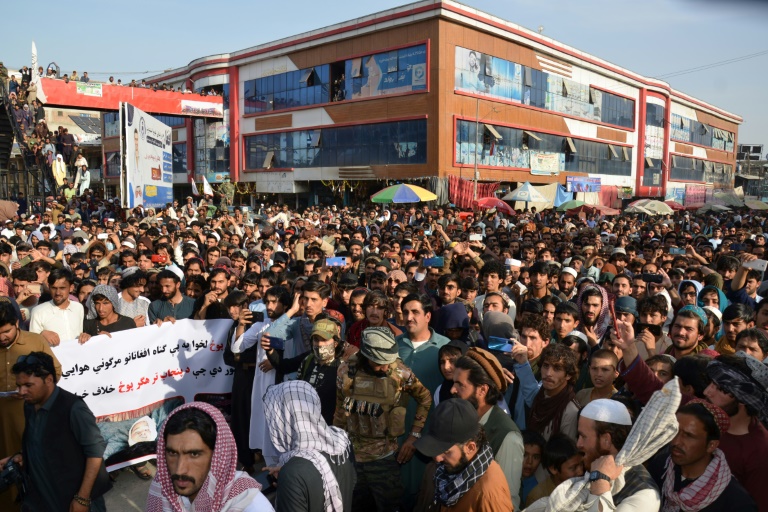
Hundreds of civilians of Khost poured into the streets chanting anti-Pakistan slogans later on Saturday, photographs obtained by AFP showed.

Border areas between the two countries have long been a stronghold for militant groups such as the Tehreek-e-Taliban Pakistan (TTP), which operates across the porous frontier with Afghanistan.

The Afghan Taliban and the TTP are separate groups in both countries, but share a common ideology and draw from people who live on either side of the border.

Thousands of people usually cross the border daily, including traders, Afghans seeking medical treatment in Pakistan, and people visiting relatives.

Since the Taliban returned to power in Afghanistan, the TTP has become emboldened and launched regular attacks against Pakistani forces.

In February, six Pakistan soldiers were killed in firing by the TTP from Afghanistan.

Last month the TTP announced it would launch an offensive against Pakistani security forces from the first day of the Muslim holy month of Ramadan.

The TTP are pressuring the Pakistani authorities to allow militants to return to their hometowns with impunity after foreign fighters were told by the Afghan Taliban to leave Afghanistan.

Climate activists disrupt traffic in London, Paris

Several hundred activists from the Extinction Rebellion activist group on Saturday blocked major roads in central Paris and London, disrupting traffic to protest “inaction” on climate change from world leaders.

Around 300 metres (980 feet) of a main thoroughfare in central Paris was taken over by activists over the Easter weekend, with some of them moving in hay bales and cement-filled containers to block traffic. 

Extinction Rebellion tweeted “thousands” of protesters were “occupying” London’s Marble Arch roundabout during a sit-in close to Hyde Park, demanding an end to the fossil fuel economy.

Demonstrators also glued themselves to a limousine in central London.

The Metropolitan Police said in a tweet that the protest caused “significant traffic disruption” and that the protesters “locked onto a stationary vehicle in the middle of the road… believed to be their own”. 

Activists from the group had glued themselves to a tanker earlier on Saturday, blocking the vehicle on a road near Hyde Park.

Three activists including 2012 Olympic canoe slalom champion Etienne Stott climbed onto the tanker belonging to British energy giant Shell, unfurling a banner saying, “End fossil filth”, Extinction Rebellion said. 

“I am aware that my actions will cause anger to many people and I am prepared to be held accountable,” Stott said. 

“But our government should also be held to account for its decisions which are destroying our planet’s ability to support human civilisation.” 

Six people were arrested, the Metropolitan Police said. 

In Paris, activists hung out a large red banner that read: “This world is dying. Let’s build the next one.” The protest is scheduled to continue until Monday. 

“Rebelling is our duty,” had been daubed in graffiti on a wall nearby. 

“This is the only way of ensuring that everyone talks a bit about climate change,” Antoine, a young activist who declined to give his surname, told AFP. 

A line of French riot police stood opposite the protesters, but officers did not intervene. 

– Anger over official policies –

Extinction Rebellion has carried out a series of protests in Britain in the past week, including shutting down four of London’s busiest bridges on Friday. 

A scientist from the group, Emma Smart, was freed on Saturday after starting a hunger strike following her arrest earlier in the week during a protest targeting the British energy ministry, Extinction Rebellion said. 

After several oil depots were targeted by the campaign group Just Stop Oil in recent days, many companies including ExxonMobil successfully took out injunctions to stop such actions, the government in London said. 

The British government last week presented a new energy security strategy after the war in Ukraine and soaring inflation, with a greater focus on nuclear power and renewable energy, but also oil from the North Sea. 

The strategy has angered many activists who believe the government is not doing enough to move away from fossil fuels. 

Many French environmentalists have been left despondent after the first round of presidential elections last weekend in which Greens candidate Yannick Jadot and hard-left ecologist Jean-Luc Melenchon were eliminated. 

A second round run-off will be held next Sunday between centrist President Emmanuel Macron and far-right leader Marine Le Pen. 

One dead after renewed Russian strikes shatter Kyiv calm

Russia stepped up air strikes on Kyiv on Saturday, killing at least one person at a tank factory a day after Moscow warned it would renew attacks following two weeks of relative calm in the Ukrainian capital.

The fresh bloodshed in Kyiv came as President Volodymyr Zelensky warned that the elimination of the last Ukrainian troops trapped in the besieged southern port of Mariupol would put an end to stalled peace talks with Moscow.

“The elimination of our troops, of our men (in Mariupol) will put an end to any negotiations” between Ukraine and Russia, Zelensky said in an interview with the Ukrainska Pravda news website. 

“That will be an impasse as we don’t negotiate neither our territories nor our people.”

Peace talks have continued since early in the fighting but offered no concrete results.

Russian officials have said they are in full control of the besieged and ruined port city of Mariupol, although Ukrainian fighters are still holed up in the city’s fortress-like steelworks.

In Kyiv, mayor Vitali Klitschko said at least one person was killed and several wounded in the latest attack.

Smoke rose from the Darnyrsky district in the southeast of the capital after what Moscow said were “high-precision long-range” strikes on the armaments plant.

“Our forces are doing everything possible to protect us, but the enemy is insidious and ruthless,” Klitschko said.

“It’s no secret that a Russian general recently said they were ready for missile attacks on the capital of Ukraine. And, as we see, they are carrying out such shelling.” 

A heavy police and military presence was deployed around the factory, the day after a similar strike on a plant that produced the Neptune missiles Kyiv and Washington say sunk Russia’s Black Sea naval flagship on Thursday.

Russia, which used sea-based long-range missiles to hit the Vizar plant on Friday, says the Moskva missile cruiser sank while being towed back to port after ammunition exploded on board.

A Russian missile strike on a residential district of Ukraine’s second-largest city Kharkiv, in the northeast of the country, killed at least two people and wounded 18 on Saturday, the public prosecutor’s office said.

Amid escalating tit-for-tat sanctions since President Vladimir Putin invaded Ukraine on February 24, Russia on Saturday said it was banning entry to British Prime Minister Boris Johnson and several other top UK officials.

“This step was taken as a response to London’s unbridled information and political campaign aimed at isolating Russia internationally, creating conditions for restricting our country and strangling the domestic economy,” the foreign ministry said in a statement.

The ministry accused London of “unprecedented hostile actions”, in particular referring to sanctions on Russia’s senior officials, and “pumping the Kyiv regime with lethal weapons”.

– Sanctions –

Britain has been part of an international effort to punish Russia with asset freezes, travel bans and economic sanctions, and Moscow’s new entry blacklist includes Deputy Prime Minister Dominic Raab, Foreign Secretary Liz Truss, and Defence Secretary Ben Wallace.

Saturday’s strike on the Ukrainian capital was among the first since invading Russian forces began withdrawing from regions around Kyiv last month, instead turning their focus on gaining control of the eastern Donbas region.

Kyiv regional governor Oleksandr Pavliuk said there were at least two other Russian strikes on the city Friday and that civilians thinking about returning should “wait for quieter times”.

Nevertheless, families and off-duty soldiers were out in the parks and on the terraces of central Kyiv on Saturday, bringing a semblance of normality to the once-bustling city.

“It’s the first time we’ve been back in the city centre. We wanted to see if public transport was working and people-watch. It’s really making me happy to see people out and about,” 43-year-old vet Nataliya Makrieva told AFP.

A Pentagon official said that the sinking of the Moskva, which had been leading Russia’s naval effort in the seven-week conflict, was a “big blow” for Moscow, while the fate of its crew of more than 500 was uncertain.

– Focus on east –

Zelensky said on Friday that between 2,500 and 3,000 Ukrainian soldiers had been killed in the conflict so far, compared to 19,000-20,000 Russian dead.

He said that around 10,000 Ukrainian soldiers had been wounded, and that it was “difficult to say how many will survive”.

Russia has so far detained around 1,000 Ukrainian civilians and captured 700 soldiers, Ukraine’s Deputy Prime Minister Iryna Vereshchuk said, while Ukraine has captured around 700 Russian soldiers.

Nine humanitarian corridors were to be opened on Saturday to allow civilians to flee the fighting, including from Mariupol, the UNIAN news agency quoted her as saying.

At least 200 children have been killed in the Russian offensive and another 360 wounded, the public prosecutor said.

In Geneva, the UN refugee agency warned that many of the nearly five million people who have fled Ukraine will not have homes to return to, as another 40,000 fled the country in 24 hours.

“People’s greatest wish is to go back home. But for so many, there is no home to return to since it’s been destroyed or damaged, or is located in an area that is not safe,” said Karolina Lindholm Billing, UNHCR’s representative in Ukraine.

Russia’s military focus now seems to be on seizing the eastern Donbas region, where Russian-backed separatists control the Donetsk and Lugansk areas.

This would allow Moscow to create a southern corridor to the occupied Crimean peninsula, and Ukrainian authorities have been urging people in the region to quickly move west in advance of a large-scale Russian offensive.

Lugansk governor Serhiy Gaidai called Saturday for civilians to leave the area while they still can.

“Evacuate, while there’s still an opportunity,” he wrote on Telegram, warning that they might be used as human shields if they remain.

Russian forces on Saturday attacked an oil refinery outside Lysychansk, a town near the front line in eastern Ukraine, sending plumes of black smoke into the sky.

burs-cjo/har

Close Bitnami banner
Bitnami