World

Lost warship dents Russian pride, navy capability

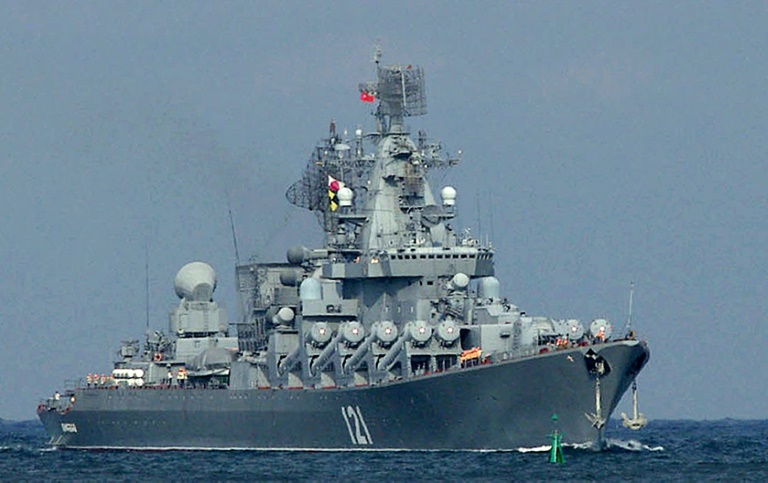
Russia’s loss of its flagship cruiser Moskva represents a dent in the operational capabilities of the Russian navy and a severe wound to Russian pride at the height of the war against Ukraine, analysts say.

The Moskva sank on Thursday after an explosion and fire that Ukraine claimed was a successful missile strike and Russia said was the result of exploding ammunition.

Until the sinking of the Moskva, nobody had good reason to doubt Russia’s supremacy in the Black Sea during the conflict with Ukraine but these calculations have now changed.

“In symbolic terms this is a great loss,” said ex-admiral Pascal Ausseur, director general of the Toulon-based Mediterranean Foundation of Strategic Studies (FMES). 

The 12,000-ton ship should have been able to withstand one missile impact or more and get a fire under control, but instead went under in just 12 hours, he told AFP.

“That was not part of the plan,” Ausseur said, adding that the Moskva probably housed the command post for the naval group which now will have to find a new home.

– ‘Same errors at sea’ –

Coming after successive setbacks for President Vladimir Putin in the 50-day-old war — including an unexpectedly weak air and land combat record — the loss of the Moskva will also have a real impact on the Russian navy’s ability to attack Ukrainian targets and keep its fellow fighters safe.

“Russia is committing the same errors at sea that they previously made on land,” said one high-ranking French officer.

The 186-metre- (610-foot-) long cruiser was equipped with 16 surface-to-surface Bazalt/Vulcan missiles used against ships as well as Fort missiles, which are navy-adapted versions of long-range S-300s, and short-range Ossa missiles.

Able to carry a crew of 680, its role was to give air cover to other ships during their operations, especially during the bombing of targets on the coast and landings, according to a Telegram post by Sergei Brachuk, a spokesman for the Odessa regional military administration.

But beyond representing a body blow to Russian military prestige, the Moskva’s loss is probably not a game changer for the Russian campaign, Western analysts said.

“The rest of the Black Sea Fleet remains a puissant force,” said Nick Brown at British intelligence analysis firm Janes.

– ‘Not de-fanged’ –

Brown cited the Admiral Grigorovich-class frigates with their much more modern air defence suite, able to launch Kalibr precision land attack missiles, as examples.

“The fleet has not been de-fanged,” he told AFP.

Institute for the Study of War (ISW) analysts said in a note that the loss of the Moskva would reduce Russia’s ability to conduct cruise missile strikes but was “unlikely to deal a decisive blow to Russian operations on the whole.” 

“The Moskva’s main role was likely conducting precision strikes with Kalibr cruise missiles on targets in Ukrainian rear areas, including logistics centres and airfields,” they said. 

The remaining force is all the more crucial for Russian capabilities as Moscow cannot dispatch a replacement for the Moskva while Turkey keeps the Bosphorus and Dardanelles straits closed to warships.

This, some analysts say, may not make a huge difference to the current phase of the war which has seen the Russian navy play a limited role.

But the ship’s loss could force Moscow to revise any plans to give the navy a bigger role in the future, said Maia Otarashvili at the Foreign Policy Research Institute.

Russian strategists have to ask the uncomfortable question whether Ukraine has more powerful defences against naval onslaught than they thought, she told AFP.

President Volodymyr Zelensky has repeatedly asked friendly Western governments to supply him with much-needed coastal defence missiles.

“What kind of recently-acquired anti-ship missiles does Ukraine have? And what damage can they do to the Russian navy?” she asked.

– ‘Real vulnerability’ –

Another consequence is that it is now far less likely that Moscow would launch any amphibious operation against a Ukrainian city such as Odessa.

“Even before this… the Russians did not have air superiority, which is a sine qua non for launching an amphibious operation,” said a senior French naval officer, who asked not to be named.

“Now they are less ready than ever to do so,” added the source.

The full story of what caused the Moskva’s demise are unlikely to be known soon, as experts will need to examine its hull which is now somewhere in the depths of the Black Sea.

But it’s already clear that the disappearance of the Moskva “reveals a real vulnerability” of the Russian navy, Ausseur said.

Whether it was a direct missile hit or an explosion caused by problems on board they “indicate possible Russian deficiencies —- either poor air defenses or incredibly lax safety procedures and damage control on the Black Sea Fleet’s flagship,” the ISW analysts said.
Mystery sarcophagus found in Notre-Dame to be opened

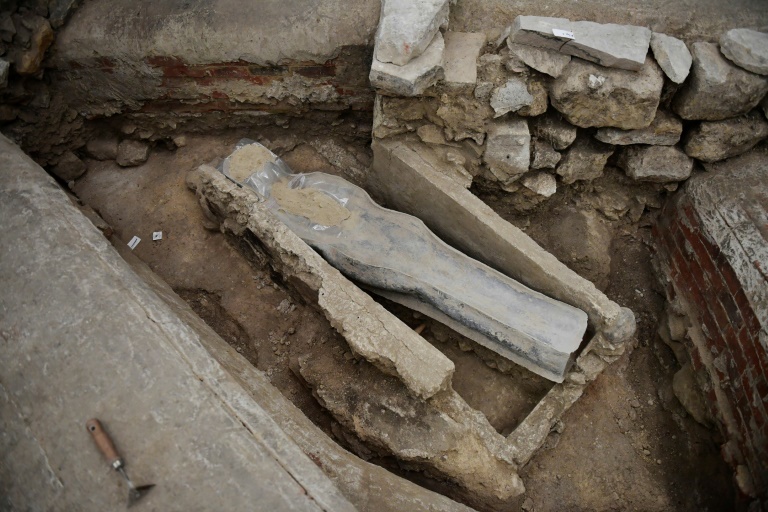
A mysterious leaden sarcophagus discovered in the bowels of Paris’ Notre-Dame cathedral after it was devastated by a fire will soon be opened and its secrets revealed, French archaeologists said Thursday.

The announcement came just a day before the third anniversary of the inferno that engulfed the 12th century Gothic landmark, which shocked the world and led to a massive reconstruction project.

During preparatory work to rebuild the church’s ancient spire last month, workers found the well-preserved sarcophagus buried more than a metre (three feet) underground, lying among the brick pipes of a 19th century heating system.

But it is believed to be much older — possibly from the 14th century.

Scientists have already peeked into the sarcophagus using an endoscopic camera, revealing the upper part of a skeleton, a pillow of leaves, fabric and as-yet unidentified objects.

The sarcophagus was extracted from the cathedral on Tuesday, France’s INRAP national archaeological research institute said during a press conference.

It is currently being held in a secure location and will be sent “very soon” to the Institute of Forensic Medicine in the southwestern city of Toulouse. 

Forensic experts and scientists will then open the sarcophagus and study its contents, to identify the skeleton’s gender and former state of health, lead archaeologist Christophe Besnier said, adding that carbon dating technology could be used.

Noting that it was found under a mound of earth that had furniture from the 14th century, Besnier said “if it turns out that it is in fact a sarcophagus from the Middle Ages, we are dealing with an extremely rare burial practice”.

They also hope to determine the social rank of the deceased. Given the place and style of burial, they were presumably among the elite of their time.

However, INRAP head Dominique Garcia emphasised that the body will be examined “in compliance” with French laws regarding human remains.

“A human body is not an archaeological object,” he said. “As human remains, the civil code applies and archaeologists will study it as such.”

Once they are done studying the sarcophagus, it will be returned “not as an archaeological object but as an anthropological asset,” Garcia added.

And could Notre-Dame, this unknown person’s home for so many centuries, serve as their final resting place?

INRAP said the possibility of “re-internment” in the cathedral was being studied. 

Five million people flee war in Ukraine

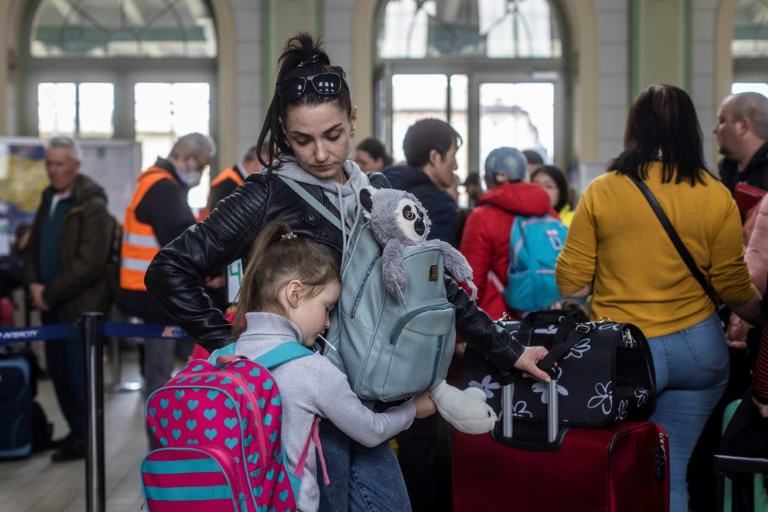
More than five million people have fled Ukraine since the Russian invasion, UN figures showed on Friday, in Europe’s fastest-growing refugee crisis since World War II.

UNHCR, the UN refugee agency, said 4,796,245 million Ukrainians had left the country since February 24.

The UN’s International Organization for Migration (IOM) says nearly 215,000 third-country nationals have also escaped to neighbouring countries.

Friday’s figures from the UNHCR were up 59,774 on those issued Thursday.

More than 2.7 million Ukrainian refugees — nearly six in 10 who have left since the war began — have fled to Poland. More than 725,000 reached Romania.

UNHCR figures show nearly 645,000 Ukrainians fled in February, with nearly 3.4 million doing so in March and more than 760,000 leaving so far this month.

Women and children account for 90 percent of those who escaped, with men aged 18 to 60 eligible for military call-up and unable to leave.

Nearly two-thirds of all Ukrainian children have been forced from their homes, including those still inside the country.

The nearly 215,000 third-country nationals who have fled — people who are citizens of neither Ukraine nor the country they entered — are largely students and migrant workers.

Beyond the refugees, the IOM estimates 7.1 million people have left their homes but are still in Ukraine.

Before the invasion, Ukraine had a population of 37 million in the regions under government control, excluding Russia-annexed Crimea and the pro-Russian separatist-controlled regions in the east.

Here is a breakdown of how many Ukrainian refugees have fled to neighbouring countries, according to UNHCR:

– Poland –

Nearly six out of 10 Ukrainian refugees — 2,720,622 so far — have crossed into Poland, according to the UN.

Many people who go to Ukraine’s immediate western neighbours travel on to other states in Europe’s Schengen open-borders zone.

The World Health Organization said Poland had made 7,000 hospital beds available for the sick and wounded from Ukraine, of which 20 percent were currently in use.

Some 652,000 people have crossed from Poland into Ukraine since the war began.

Before the crisis, Poland was already home to around 1.5 million Ukrainians, chiefly migrant workers.

– Romania –

A total of 726,857 Ukrainians entered the EU member state, including a large number who crossed over from Moldova, wedged between Romania and Ukraine. 

The vast majority are thought to have gone on to other countries. 

– Russia –

Another 484,725 refugees have sought shelter in Russia.

In addition, 105,000 people crossed into Russia from the separatist-held pro-Russian regions of Donetsk and Lugansk in eastern Ukraine between February 18 and 23.

– Hungary –

A total of 447,053 Ukrainians have entered Hungary.

– Moldova –

The Moldovan border is the closest to the major port city of Odessa. A total of 419,499 Ukrainians have crossed into the non-EU state, one of the poorest in Europe.

Most of those who have entered the former Soviet republic of 2.6 million people have moved on but an estimated 100,000 remain, including 50,000 children — of whom only 1,800 are enrolled in schools.

“Refugee children from Ukraine have fled a brutal war and have arrived dispossessed and traumatised in Moldova. They are very vulnerable and need immediate support,” said Yasmine Sherif, Director of Education Cannot Wait.

“Public schools are open to refugee children; however, the capacity is over-stretched and there is a need for urgent mental health and psycho-social services, sanitation, and teachers.”

– Slovakia –

A total of 329,597 people crossed Ukraine’s shortest border into Slovakia.

– Belarus –

Another 22,827 refugees have made it north to Russia’s close ally Belarus.

EU embargo on Russian oil, gas will take 'months'

The EU is working on broadening sanctions on Russia to include oil and gas embargoes but such measures would take “several months”,  European officials told AFP on Friday.

The bloc last week announced a ban on Russian coal in a first step against Russian energy exports — together, Moscow’s main hard currency earner. 

But the coal sanction only kicks in from mid-August, and would hit around eight billion euros ($8.7 billion) in Russia’s sales abroad, annually. 

Russian oil and gas sales to the EU account for a far higher amount of revenue: between a quarter of a billion to a billion euros per day, per different estimates.

Public and political opinion in the EU is swinging towards a total energy ban as Moscow’s war in Ukraine grinds on and yields discoveries of atrocities.

An EU official involved in discussions on cutting Russian energy imports said the European Commission is “thinking about options”. Commission chief Ursula von der Leyen has already come out publicly in favour of targeting Russian oil.

But, the official said, “adopting measures on oil means undoing existing contracts, finding alternatives and preventing circumvention”.

“That can’t be don’t overnight. It requires at least several months.”

– Outrage over war –

Building EU outrage over the war is sweeping aside hesitation by the member states reliant on Russian oil and gas, such as the bloc’s biggest economy Germany, and Italy, Greece and Austria.

Some EU countries, such as Lithuania, have already announced national bans on Russian oil and gas.

One option to quickly stall revenues going to Russia’s war could be to pay for energy imports through an escrow account, which Moscow wouldn’t be able to touch until a postwar settlement.

But there is also thinking about how Russia might retaliate, by cutting supplies to Europe, or — as President Vladimir Putin said this week — selling more to Asia.

In any case, it’s clear that European industry and consumers will have to consume less oil and gas — something economists call “demand destruction”.

“Cutting demand will have an impact with price hikes,” another EU official said, echoing comments from several ministers in the bloc.

They noted that the EU’s main ally in the sanctions, the US — which a month ago imposed its own ban on Russia’s energy imports — is leery of petrol price rises for American drivers.

“What’s more, if Russia sells oil snubbed by the Europeans to other buyers, the sanctions won’t work,” one EU official said.

The Europeans and Americans are looking to avoid the sanctions being weakened by China and India. 

Brussels is telling Beijing and New Delhi the EU would find it “difficult to accept partners who undermine the sanctions,” one EU diplomat said.

– EU unity –

At the same time, the EU is intent on preserving unity among its 27 member states as it navigates sensitive national interests on energy.

Yet determination to target Russian energy was evident at the last meeting of EU foreign ministers on Monday in Luxembourg.

“The European Union is spending hundreds of millions of euros on importing oil from Russia — that is certainly contributing to financing this war,” Irish Foreign Minister Simon Coveney said at that meeting.

“In our view, we need to cut off that financing of war, even though it creates huge challenges and problems for the EU to solve together.” 

EU foreign policy chief Josep Borrell said after the meeting that “nothing is off the table, including sanctions on oil and gas” but no decision was yet made.

Borrell said that, in 2021, the EU paid Russia $80 billion (74 billion euros) for oil and $20 billion for gas — which would work out as an average of 250 million euros per day.

Other European sources, including MEPs, have spoken of Russian fossil fuel imports to the value of up to 700 million euros per day. 

Figures vary depending on what period of time is being looked at, contract prices versus market spot prices, and currency valuations.

A spike in energy demand as Covid-19 restrictions were eased made energy prices jump even before the war in Ukraine.

The International Energy Agency said that, in 2021, the EU  imported 155 billion cubic metres of gas from Russia, representing 45 percent of its gas imports.

The World Economic Forum says the EU gets over a quarter of its imported crude from Russia, but volumes have been dropping over the past decade.

Russian regulator says French radio RFI's website blocked

Russia’s media watchdog Roskomnadzor on Friday blocked access to the website of French radio station RFI for violating a law banning the dissemination of false or extremist information.

It did not specify how the radio station had fallen foul of the law.

The RFI website appeared in Roskomnadzor’s database of blocked websites and AFP journalists in Moscow were unable to access the station’s English, French or Russian-language websites. 

Russia has accelerated efforts to silence independent media and government opponents since the start of Moscow’s military operation in Ukraine on February 24.

Russian lawmakers recently passed a law introducing up to 15 years in jail for publishing information about the military deemed false by the government.

Authorities have also restricted access to dozens of independent media outlets, also blocking access to Facebook, Twitter and Instagram.

It blocked access to the Russian-language website of the independent news outlet The Moscow Times over its coverage of Ukraine on Friday.

S.Africa flood toll nears 400 as rescuers search for missing

Police, army and volunteer rescuers on Friday widened the search for dozens still missing five days after the deadliest storm to strike South Africa’s coastal city of Durban in living memory as the death toll rose to nearly 400.

The “unprecedented” floods, which affected nearly 41,000, left a trail of destruction and at least 395 people dead.

“Sadly the number of fatalities continues to increase with the latest figure standing at 395,” regional head of the disaster managing ministry Sipho Hlomuka said in a statement.

With the government coordinating the search-and-rescue operation, the official number of people missing in KwaZulu-Natal province stood at 55.

A fleet of cars and helicopters carrying police experts set out early Friday to comb through a valley in Marianhill suburb, west of Durban, to look for 12 people reported missing in the floods, AFP correspondents said.

It is an increasingly desperate search for survivors.

Travis Trower, a director for the volunteer-run organisation Rescue South Africa, said his teams had found only corpses after following up 85 calls on Thursday.

President Cyril Ramaphosa — describing the floods as “a catastrophe of enormous proportions… not seen before in our country” — urged Good Friday prayers for  survivors.

“Let us pray for our people in KwaZulu-Natal so that they receive the healing that is required… so that they can get on with their lives,” he told El-Shaddai Tabernacle church congregants in the eastern town of Ermelo.

Thousands of survivors, left homeless after their houses were destroyed, are being housed in shelters scattered across the city, sleeping on cardboard sheets and mattresses laid on floors.

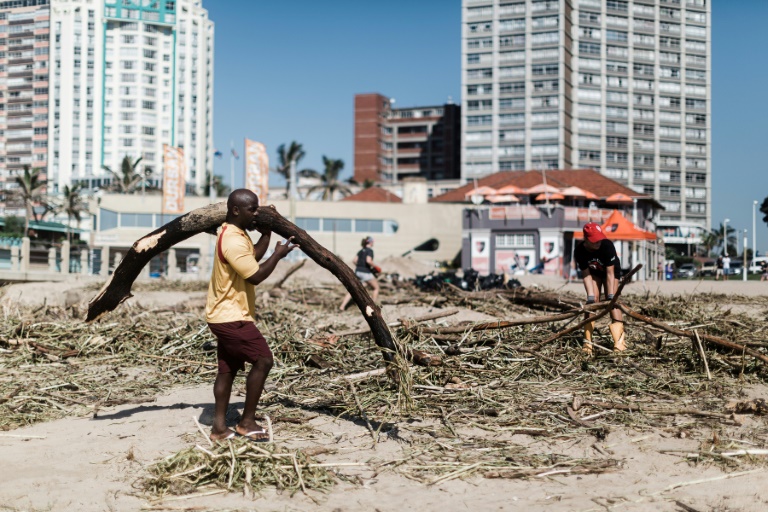
Meanwhile volunteers, with  gloves and trash bags, fanned across the city’s beaches to pick up debris left by the massive storms ahead of an expected surge of Easter weekend holidaymakers.

– ‘Absolute devastation’ –

Software manager Morne Mustard, 35, was among the scores of volunteers, who included children, picking up debris and  broken reeds from Durban’s famous Umhlanga beach.

“This is my local beach where I bring my kids, and this is where we spend our weekend, so this is for our community,”.

He roped in workmates, families and friends to help clean up as beach restaurants offered free breakfast for the volunteers.

Recalling the day the rain fell, Mustard said, “It didn’t feel real, absolute devastation, a horrendous sight, stuff spilling out on the beach must have come from someone’s house… brooms and mops, household utensils, it was such a heart sore to see.”

Some of Durban’s poorest residents have lined up to collect water from burst pipes and dug through layers of mud to retrieve their scant possessions.

Ramaphosa declared the region a state of disaster to unlock relief funds.

Weather forecasters said apocalyptic levels of rain were dumped on the region over several days.

Some areas received more than 450 millimetres (18 inches) over 48 hours, or nearly half of Durban’s annual rainfall, the national weather service said.

The South African Weather Service issued an Easter weekend warning of thunderstorms and flooding in KwaZulu-Natal.

“According to the warning that we have received, damaging winds are forecast for areas along the coast from midday (Friday) into Saturday evening,” said Hlomuka, adding disaster teams were on “high alert”.

Over 4,000 police officers have been deployed to help with relief efforts and maintain law and order amid reports of sporadic looting.

The country is still struggling to recover from the two-year-old Covid pandemic and deadly riots last year that killed more than 350 people.

North Korea celebrates founding leader's birthday

North Korea marked the birthday of its founding leader on Friday, with a rare “live” broadcast of celebrations in Pyongyang, but no sign of the military parade or weapons tests that many analysts had predicted.

Known as the Day of the Sun in the nuclear-armed North, the April 15 birthday of the late Kim Il Sung — grandfather of current leader Kim Jong Un — is one of the most important dates in Pyongyang’s political calendar.

The official KCTV broadcast showed what it said were live images of a huge number of young North Koreans performing synchronised dance moves in Pyongyang’s Kim Il Sung Square to celebrate the anniversary, with a fireworks display overhead.

Women dressed in colourful traditional attire and men in white shirts and black pants danced to Pyongyang’s propaganda music, showing a mix of traditional Korean dance moves and western waltz.

“We endlessly love the socialism that we chose,” a narrator said over the footage of the fireworks.

KCTV later showed multi-coloured fireworks near the North’s scenic Taedong River as well as the Kim Il Sung Square, and what appeared to be missile and tank-shaped light installations in the nation’s capital.

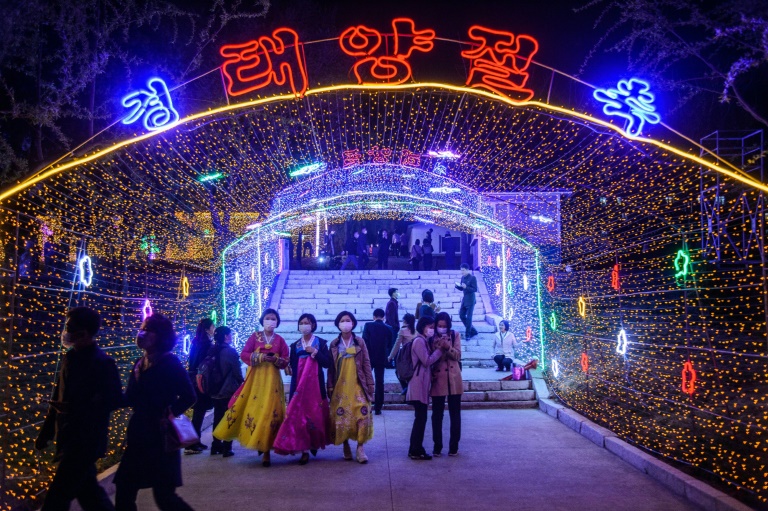
There has been a steady drumbeat of celebratory coverage in state media leading up to the day, including commemorative stamps, light festivals, dance parties and floral tributes.

“I came to see the lighting festival with my daughter. Looking at it today, it’s really cool. The most impressive thing in particular is this one that says ‘self-reliance’,” Ri Bom Chol, a 40-year-old doctor, told an AFP reporter in Pyongyang.

The anniversary celebrations come three weeks after North Korea staged its largest intercontinental ballistic missile test ever — the first time Kim’s most powerful weapons had been fired at full range since 2017.

That test was the culmination of a record-breaking blitz of sanctions-busting launches this year and signalled an end to a self-imposed moratorium on long-range and nuclear tests.

Analysts along with South Korean and US officials had widely expected Pyongyang to mark April 15 with a military parade to unveil new weaponry, or even a test of the country’s banned nuclear weapons.

But there was no mention Friday in state media of any such event.

Earlier Friday, Seoul-based specialist site NK News said its sources in the North heard helicopters and jets flying low over Pyongyang very early Friday, hinting at a military parade.

But an analysis of satellite imagery later suggested no parade had taken place, the site added.

– ‘Love is forever’ –

Another expert said it now seemed likely Pyongyang’s main military parade would be held on April 25 — the anniversary of the founding of the North Korean army.

“Since the two anniversaries are just 10 days apart, it seems a bit difficult to hold a parade on both occasions,” Yang Moo-jin, a professor at the University of North Korean Studies, told AFP.

On previous anniversaries, Pyongyang has broadcast footage of military parades on state TV many hours after the events were held, and not flagged them in advance in official newspapers.

Seoul military officials said they had no immediate information to share on a possible parade in Pyongyang, but the unification ministry said it was “closely monitoring” the situation.

Kim Il Sung died in 1994 but is the country’s “eternal president”, and his preserved body lies in state in a red-lit chamber at the Kumsusan Palace of the Sun on the outskirts of the capital.

North Koreans are taught from birth to revere Kim Il Sung and his son Kim Jong Il, and all adults wear badges depicting one or both men.

“As the days go by the yearning for the great leader is growing,” Ri Gwang Hyok, 33, told an AFP reporter in Pyongyang as they visited statues of Kim Il Sung and Kim Jong Il. 

“Love is forever,” Ri said.

Bankrupt Sri Lanka rations fuel as crisis worsens

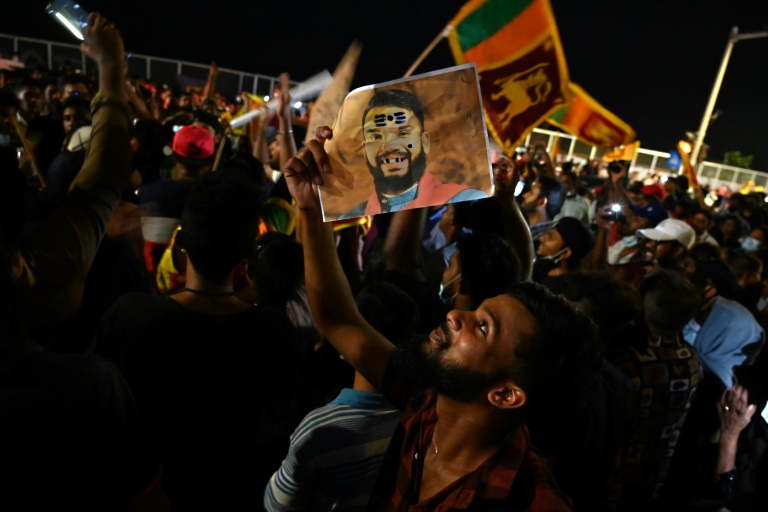
Cash-strapped Sri Lanka imposed fuel rationing on Friday in another worsening of the economic crisis that has sparked widespread demonstrations calling for President Gotabaya Rajapaksa’s resignation.

The state-run Ceylon Petroleum Corporation (CPC), which accounts for two-thirds of the retail fuel market, said it would limit the quantities drivers can buy, and banned pumping into cans altogether to prevent motorists stocking up on petrol or diesel in fear of further rationing.

The maximum for motorcycles was set at four litres of petrol, with three-wheelers allowed five litres, the CPC said. Private cars, vans and SUVs were allowed up to 19.5 litres of either petrol or diesel.

Most pumping stations were already out of petrol, while the few that remained open saw long queues. At least eight people have died while waiting in fuel lines since last month.

Energy ministry officials said they expected the country’s other fuel retailer, Lanka IOC — the local unit of Indian Oil Corporation — to follow suit. 

There was no immediate comment from the Lanka IOC, which accounts for the remaining one third of the market.

The island nation is in the grip of its worst economic crisis since independence in 1948, with severe shortages of essential goods and regular blackouts causing widespread misery.

The country’s main cooking gas retailer Litro Gas said it was completely out of stock, but hoped to get new supplies by Monday to resume distribution.

The state-owned firm said its chairman, Theshara Jayasinghe, a strong ally of Rajapaksa, had resigned on Thursday over the “prevailing situation” in the country.

Tens of thousands of people kept up a protest outside Rajapaksa’s office for a seventh straight day Friday demanding he quit over the economic hardships suffered by the country’s 22 million residents.

Sri Lanka’s economic meltdown began after the coronavirus pandemic torpedoed vital revenue from tourism and remittances. 

The government has urged citizens abroad to donate foreign exchange to help pay for desperately needed essentials after announcing a default on its entire external debt.

It has announced it will open negotiations with the International Monetary Fund to seek a bailout.

Bankrupt Sri Lanka rations fuel as crisis worsens

Cash-strapped Sri Lanka imposed fuel rationing on Friday in another worsening of the economic crisis that has sparked widespread demonstrations calling for President Gotabaya Rajapaksa’s resignation.

The state-run Ceylon Petroleum Corporation (CPC), which accounts for two-thirds of the retail fuel market, said it would limit the quantities drivers can buy, and banned pumping into cans altogether to prevent motorists stocking up on petrol or diesel in fear of further rationing.

The maximum for motorcycles was set at four litres of petrol, with three-wheelers allowed five litres, the CPC said. Private cars, vans and SUVs were allowed up to 19.5 litres of either petrol or diesel.

Most pumping stations were already out of petrol, while the few that remained open saw long queues. At least eight people have died while waiting in fuel lines since last month.

Energy ministry officials said they expected the country’s other fuel retailer, Lanka IOC — the local unit of Indian Oil Corporation — to follow suit. 

There was no immediate comment from the Lanka IOC, which accounts for the remaining one third of the market.

The island nation is in the grip of its worst economic crisis since independence in 1948, with severe shortages of essential goods and regular blackouts causing widespread misery.

The country’s main cooking gas retailer Litro Gas said it was completely out of stock, but hoped to get new supplies by Monday to resume distribution.

The state-owned firm said its chairman, Theshara Jayasinghe, a strong ally of Rajapaksa, had resigned on Thursday over the “prevailing situation” in the country.

Tens of thousands of people kept up a protest outside Rajapaksa’s office for a seventh straight day Friday demanding he quit over the economic hardships suffered by the country’s 22 million residents.

Sri Lanka’s economic meltdown began after the coronavirus pandemic torpedoed vital revenue from tourism and remittances. 

The government has urged citizens abroad to donate foreign exchange to help pay for desperately needed essentials after announcing a default on its entire external debt.

It has announced it will open negotiations with the International Monetary Fund to seek a bailout.

More than 150 hurt in Jerusalem clashes as religious festivals overlap

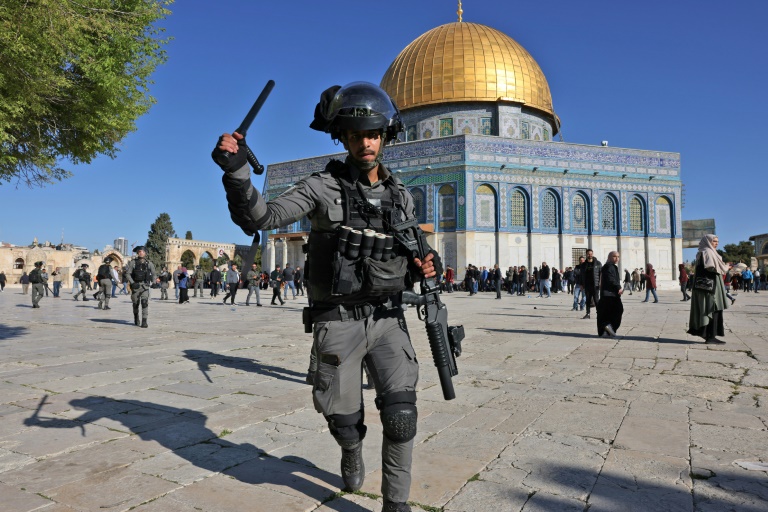
More than 150 people were wounded Friday in clashes between Palestinian demonstrators and Israeli police at Jerusalem’s Al-Aqsa mosque compound, the first face-off in the area since the start of Ramadan.

Israeli police said “dozens of masked men” marched into Al-Aqsa setting off fireworks before crowds hurled stones towards the Western Wall — considered the holiest site where Jews can pray.

Witnesses said Palestinians threw stones at Israeli forces, who fired rubber-coated bullets and sound grenades.

The Palestinian Red Crescent said 153 people were hospitalised and “dozens of other injuries” were treated at the scene. Israeli police said at least three officers were hurt.

Around 400 people were arrested, said the Palestinian Prisoner’s Club, a group which supports inmates.

The clashes come after three tense weeks of deadly violence in Israel and the occupied West Bank, and as the Jewish festival of Passover and Christian Easter overlap with the Muslim holy month of Ramadan.

Al-Aqsa is Islam’s third-holiest site. Jews refer to it as the Temple Mount, referencing two temples said to have stood there in antiquity.

Last year during Muslim fasting month, clashes that flared in Jerusalem, including between Israeli forces and Palestinians visiting Al-Aqsa, led to 11 days of devastating conflict between Israel and Gaza’s Islamist rulers Hamas.

Israeli Foreign Minister Yair Lapid said Friday’s “riots” were “unacceptable”.

“The convergence of Passover, Ramadan, and Easter is symbolic of what we have in common. We must not let anyone turn these holy days into a platform for hate, incitement, and violence,” he said.

UN Middle East peace envoy Tor Wennesland urged “the authorities on both sides to immediately de-escalate the situation and prevent any further provocations by radical actors”.

– ‘Red line’ –

Police said crowds had hurled rocks “in the direction of the Western Wall… and as the violence surged, police were forced to enter the grounds surrounding the Mosque,” adding officers “did not enter the mosque.”

But Al-Aqsa mosque director Omar al-Kiswani told AFP that an “assault was made inside the Al-Aqsa mosque”.

“More than 80 young people inside the holy mosque were displaced,” he said, adding: “Al-Aqsa mosque is a red line”.

Before Ramadan, Israel and Jordan stepped up talks in an effort to avoid a repeat of last year’s violence.

Jordan serves as custodian of the mosque compound, while Israel controls access.

Hamas leader Ismail Haniyeh said there was “no place for the invaders and occupiers in our holy Jerusalem”.

Analysts say the group wants to keep the conflict alive in the West Bank and in Jerusalem but avoid escalation in the Gaza Strip after last year’s war, and with thousands of Gazans’ Israeli work permits at risk.

“Hamas does not want a new confrontation,” said Mukhaimer Abu Saada, professor of political science at Gaza’s Al-Azhar University.

An Israeli security source said the Islamic Jihad militant group — which controls neither the West Bank nor Gaza — would be more inclined towards an escalation with Israel.

Islamic Jihad warned Friday that “the confrontation will be closer and harder” for Israeli forces if “they do not stop the aggression against our people”.

– Spiralling violence –

Israel has poured additional forces into the West Bank and is reinforcing its wall and fence barrier with the West Bank after four deadly attacks in the Jewish state that have mostly killed civilians in the past three weeks.

A total of 14 people have been killed in the attacks since March 22, including a shooting spree in Bnei Brak, an Orthodox Jewish city in greater Tel Aviv.

Twenty-two Palestinians have been killed in that time, including assailants who targeted Israelis, according to an AFP tally.

On Thursday Israel announced it would block crossings from the West Bank and Gaza into Israel from Friday afternoon through Saturday, the first two nights of the week-long Passover festival, and potentially keep the crossings closed for the rest of the holiday.

Prime Minister Naftali Bennett, who lost his parliamentary majority last week, has given Israeli forces a free hand to “defeat terror” in the West Bank, which Israel has occupied since the 1967 Six-Day War.

Some of the attacks in Israel were carried out by Arab citizens of Israel linked to or inspired by the Islamic State group, others by Palestinians, and cheered by militant groups including Hamas and Islamic Jihad.

Three Palestinians died Thursday as Israeli forces launched fresh raids into the West Bank flashpoint district of Jenin, a week after the Bnei Brak attack. A fourth died of his wounds on Friday.

gl/reb/cwl/lg/dv

Close Bitnami banner
Bitnami