World

Shanghai lockdowns could force China carmakers to stop production, XP

Chinese auto makers may have to put the brakes on production if strict Covid-19 curbs in Shanghai persist, said the founder of electric carmaker XPeng, as a prolonged lockdown of the economic hub menaces supply chains.

The lockdown has kept Shanghai’s 25 million residents mostly at home, forcing manufacturers to halt operations, and has made China’s GDP growth target of around 5.5 percent look increasingly difficult to achieve.

Covid outbreaks across the country and the associated reductions in economic activity have already hit the auto industry hard, with car sales dropping 10.5 percent in March.

“If supply chain companies in Shanghai and its surrounding areas cannot find a way to dynamically resume work and production, all original equipment manufacturers may have to stop production in May,” XPeng chief He Xiaopeng said Thursday on social media.

XPeng has been touted as a Chinese challenger to US electric car giant Tesla, and its chief said that businesses were hoping for more support from the authorities to navigate the Covid closures.

Volkswagen also said it has been “severely hit by Covid-19 outbreaks in Changchun and Shanghai”, where the German titan’s Chinese joint ventures are located.

The firm is “temporarily unable to meet high customer demand”, said Volkswagen Group China CEO Stephan Wollenstein on Thursday, adding that he hoped the production delays could be made up in the coming months.

China’s zero-Covid policy has been increasingly strained as the country battles its highest number of infections since the start of the pandemic.

Volkswagen said around 20 percent of its dealers were forced to temporarily close in March alone as a result of lockdowns.

Tesla’s multi-billion-dollar “gigafactory” in Shanghai — which the company calls its main export hub — has also been reportedly shut.

Chinese electric vehicle maker Nio said last weekend that it had suspended vehicle production, as business partners in virus-hit areas such as Jilin and Shanghai halted operations.

North Korea celebrates founding leader's birthday

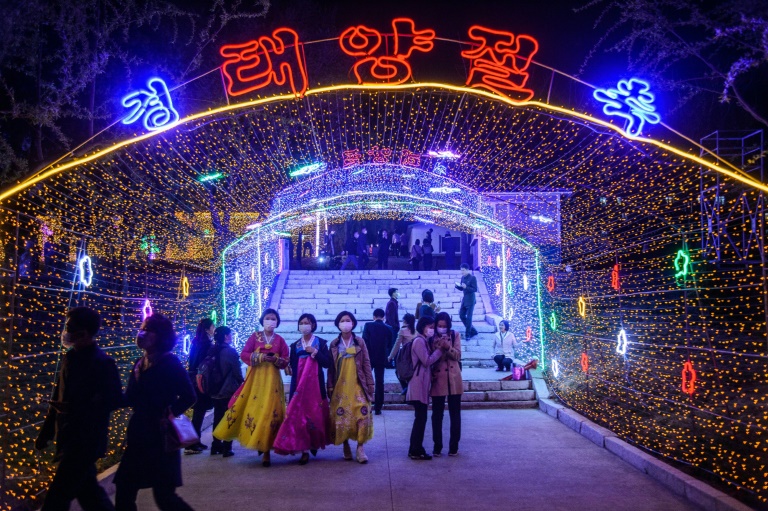
North Korea celebrated the birthday of its founding leader on Friday, state media reported, but mystery surrounded when a military parade — at which the regime may unveil new weapons — might happen.

Known as the Day of the Sun in the nuclear-armed North, the April 15 birthday of the late Kim Il Sung — grandfather of current leader Kim Jong Un — is one of the most important dates in Pyongyang’s political calendar.

There has been a steady drumbeat of celebratory coverage in state media leading up to the day itself, including commemorative stamps, light festivals, dance parties and floral tributes.

The anniversary comes three weeks after North Korea staged its largest intercontinental ballistic missile test ever — the first time Kim’s most powerful weapons had been fired at full range since 2017.

That test was the culmination of a record-breaking blitz of sanctions-busting launches so far this year and signaled an end to a self-imposed moratorium on long-range and nuclear tests.

Analysts and South Korean and US officials had widely expected Pyongyang to mark April 15 with a military parade to unveil new weaponry, or even a test of the country’s banned nuclear weapons.

But there was no mention Friday in state media of any such event.

Seoul-based specialist site NK News said its sources in the North heard helicopters and jets flying low over Pyongyang shortly after midnight Thursday — indicating a night-time military parade may have already taken place.

– ‘Love is forever’ –

But another expert said it now seemed likely Pyongyang’s main military parade could now be held on April 25 — the anniversary of the founding of the North Korean army.

“Since the two anniversaries are just 10 days apart, it seems a bit difficult to hold a parade on both occasions,” Yang Moo-jin, a professor at the University of North Korean Studies, told AFP.

On previous anniversaries, Pyongyang has broadcast footage of military parades on state TV only many hours after the events were held, and not flagged them in advance in official newspapers.

Seoul military officials said they had no immediate information to share on a possible parade in Pyongyang, but the unification ministry said it was “closely monitoring” the situation.

Kim Il Sung died in 1994 but is the country’s Eternal President, and his preserved body lies in state in a red-lit chamber at the Kumsusan Palace of the Sun on the outskirts of the capital.

North Koreans are taught from birth to revere Kim Il Sung and his son Kim Jong Il, and all adults wear badges depicting one or both men.

“As the days go by the yearning of the great leader is growing,” Ri Gwang Hyok, 33, told an AFP reporter in Pyongyang as they visited the statues of Kim Il Sung and Kim Jong Il. 

“Love is forever,” Ri added.

Asian markets drop after Wall Street retreat

Asian markets dipped Friday after a negative lead from Wall Street, with investors around the world worried about surging inflation.

Central banks in several major economies including the United States, Canada and Britain have already started raising interest rates to contain prices, but the European Central Bank on Thursday kept its stimulus plans and rates unchanged.

That sent the euro plunging to a near two-year low, but eurozone stocks were boosted while Wall Street retreated ahead of the Easter holidays.

The mood was subdued in Asia too, where only a handful of markets were open on Good Friday.

The Nikkei 225 closed 0.3 percent lower with Wall Street’s woes depressing sentiment.

Shanghai was down 0.7 percent in afternoon trade.

Russia’s invasion of Ukraine has added to the uncertainty about the global economic recovery from the Covid-19 pandemic.

This was reflected in statements from major banking executives in the United States, who described the American economy as solid but warned about the impact of the Ukraine conflict and the measures central banks such as the US Federal Reserve will take to control inflation.

“We don’t think there’s going to be a recession,” Julian Emanuel, chief equity strategist at Evercore ISI, told Bloomberg television.

“We don’t think the Fed is going to break the glass. But the problem is investors aren’t in that mindset quite yet.”

– Energy, food shocks –

Russia is a major global oil and gas supplier, and — along with Ukraine — is also a key player in the grain sector.

The conflict has shaken markets for these commodities, and the impact has been felt from the Middle East to South America.

In Yemen, there are fears of food shortages with the war-ravaged nation already on the edge of famine.

In Argentina, a strike by grain transporters has paralysed farming exports — haulers are unhappy with the rates they are paid, pointing to the spike in fuel prices because of the Ukraine crisis.

The war has sent oil prices soaring, with reports swirling about further energy sanctions on Russia.

Both main contracts have hovered above the $100 per barrel mark in recent days.

“There are no surprises here as oil continues to march higher, with global supply shortage outweighing concerns about slower demand in China,” Stephen Innes of SPI Asset Management said in a note.

– Key figures around 0700 GMT –

Tokyo – Nikkei 225: DOWN 0.3 percent at 27,093.19 (close)

Shanghai – Composite: DOWN 0.7 percent at 3,204.50

Hong Kong – Hang Seng Index: Closed for a holiday

Euro/dollar: DOWN at $1.0806 from $1.0832 at 2100 GMT Thursday

Pound/dollar: DOWN at $1.3055 from $1.3076

Euro/pound: FLAT at 82.77 pence

Dollar/yen: UP at 126.68 from 125.87

Brent North Sea crude: UP 2.7 percent at $111.70 per barrel at 2100 GMT Thursday

West Texas Intermediate: UP 2.6 percent at $106.95 per barrel at 2100 GMT Thursday

New York – Dow: DOWN 0.3 percent at 34,451.23 (close)

London – FTSE 100: UP 0.5 percent at 7,616.38 (close)

— Bloomberg News contributed to this story —

Shanghai residents scuffle with police over virus policy: video

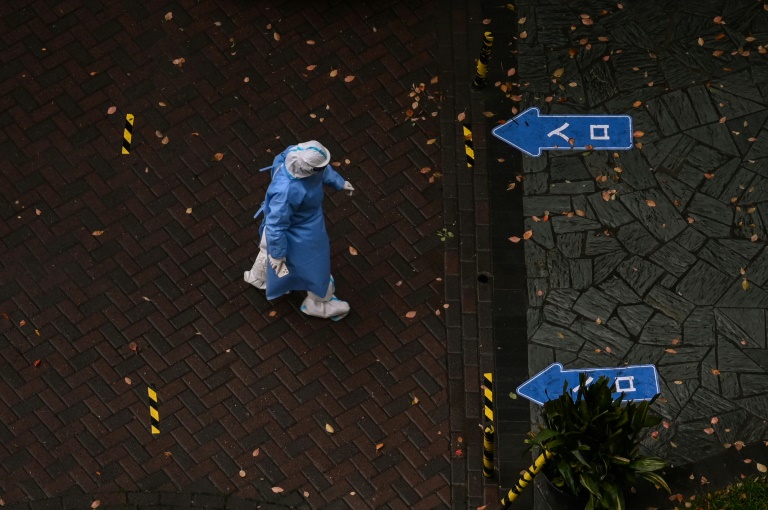
Shanghai residents scuffled with hazmat-suited police ordering them to surrender their homes to Covid-19 patients, videos on social media showed, providing a rare glimpse into rising discontent in the megacity over China’s inflexible virus response.

Shanghai, a city of 25 million and China’s economic engine room, has become the heart of the country’s biggest outbreak since the peak of the first virus wave in Wuhan over two years ago, rattling the country’s adherence to a strict zero-Covid policy.

Residents locked down since early April have complained of food shortages and over-zealous officials forcing them into state quarantine, as authorities rush to construct tens of thousands of beds to house Covid-19 patients with daily infections topping 20,000.

Late Thursday, videos circulated on social media showing residents outside a compound shouting at ranks of officials holding shields labelled “police”, as the officers tried to break through their line.

In one clip, police appear to make several arrests as the residents accuse them of “hitting people.”

The incident was triggered after authorities ordered 39 households to move from the compound “in order to meet the needs of epidemic prevention and control” and house virus patients in their apartments, according to Zhangjiang Group, the developer of the housing complex. 

It has provided a rare window into public anger in China, a country where Communist authorities brook little dissent and censors routinely wipe information relating to protests from the internet as fast as it is uploaded. 

In one live-streamed video, a woman can be heard weeping and asking “why are they taking an old person away?” as officials appeared to put someone into a car. 

Zhangjiang Group said it had compensated the tenants and moved them into other units in the same compound.

In another video, which was live-streamed, a woman is heard yelling “Zhangjiang Group is trying to turn our compound into a quarantine spot, and allow Covid-positive people to live in our compound.”

The group recognised videos of the compound that had “appeared on the internet” on Thursday and said “the situation had now settled down” after “some tenants obstructed the construction” of a quarantine fence.

China’s censors quickly stepped in to scrub evidence of the clash from Chinese social media sites — as they did with several other videos that have appeared over the last few weeks — with search results for the name of the apartment complex disappearing from the Twitter-like Weibo by Friday morning.

Shanghai residents have taken to social media to vent about food shortages and heavy-handed controls, including the killing of a pet corgi by a health worker and a now-softened policy of separating infected children from their virus-free parents.

Authorities have vowed the city “would not relax in the slightest”, preparing over a hundred new quarantine facilities to receive every person who tests positive — whether or not they show symptoms.

Clashes at Al-Aqsa mosque compound in Jerusalem: medics, witnesses

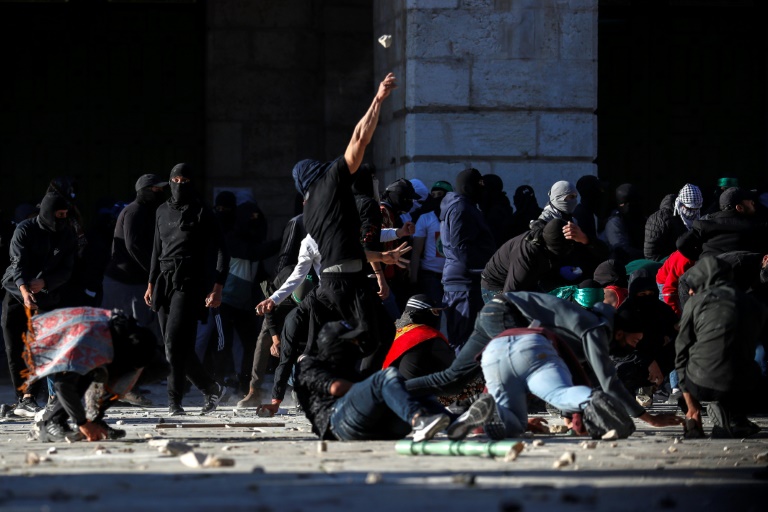
Palestinian demonstrators and Israeli police clashed at Jerusalem’s Al-Aqsa mosque compound Friday morning, medics and witnesses said. 

“Seven injured people were taken to hospital to be treated for upper body injuries,” a member of the Palestinian Red Crescent told AFP. 

Witnesses said that Palestinian protestors threw stones at Israeli security forces, who fired rubber bullets at some of the demonstrators. 

Al-Aqsa is Islam’s third holiest site. Jews refer to it as the Temple Mount, referencing two temples said to have stood there in antiquity. 

The compound is at the heart of the Israeli-Palestinian conflict, falling within Israeli-annexed east Jerusalem.

Last year during Ramadan, clashes that flared between Israeli forces and Palestinians visiting the mosque compound led to 11 days of devastating conflict between Israel and the Gaza Strip’s Islamist rulers Hamas.

Before Ramadan this year, Israel and Jordan, which serves as custodian of holy places in east Jerusalem, stepped up talks in an effort to avoid similar violence. 

Friday’s clashes come after three weeks of violence and simmering tensions in the Jewish state. 

Israel has been stunned by a string of attacks — some carried out by Arab citizens of Israel linked to or inspired by the Islamic State group, others by Palestinians, and cheered by militant groups including Hamas and Islamic Jihad.

A total of 14 people have been killed in four attacks since March 22, including a shooting spree in Bnei Brak, an Orthodox Jewish city in greater Tel Aviv, carried out by a Palestinian attacker from Jenin.

Twenty-one Palestinians have been killed in that time, including assailants who targeted Israelis, according to an AFP tally. 

Religious whipping marks Good Friday in the Philippines

Catholic zealots in the Philippines whipped their backs bloody and raw on Good Friday, as the fervently religious country marked Easter with gruesome displays of faith.

Scores of men — their faces covered — walked barefoot as they flogged themselves with bamboo whips under a blazing sun near the capital Manila, while others carried wooden crosses as they were beaten, in a ritual frowned upon by the Church.

Roy Balatbat, his skin still bearing fresh wounds from a public flailing on Thursday, walked for about a kilometre, striking himself and stopping to prostrate in prayer on the hot ground. 

“It’s punishing but if you have a wish, you will endure the pain,” Balatbat, 49, told AFP in Hagonoy municipality, Bulacan province. 

“I have been doing this for 30 years since I was a young man. My devotion is that I will only stop when I can’t do it anymore.”

While most devotees in the mainly Catholic nation spend Good Friday at church or with family, others go to these extreme lengths to atone for sins or seek divine intervention.

Before the grisly flogging begins, the men’s bare backs are deliberately punctured to make them bleed.

Veterans of the gory spectacle display scars of previous whippings, while others endure the punishing act for the first time.

“I inflict the wound to the penitents, if there’s not much blood coming out, they’ll ask for another one so their sins would be forgiven,” Reynaldo Tolentino, 51, explained. 

“They won’t feel the pain when they’re doing the penitence as long as they are sincere in doing it.”

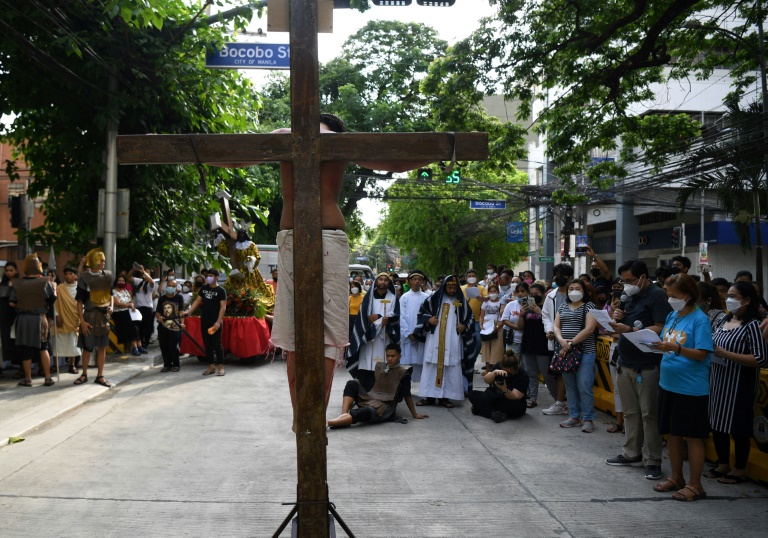
Good Friday is also usually marked by crucifixion reenactments in a city north of Manila, but the event was cancelled for the third year in a row due to Covid-19.

About a dozen Catholics regularly have themselves nailed to wooden crosses as penance for their sins. The event attracts thousands of tourists.

“We do not encourage acts of self flagellations and crucifixions,” said Father Jerome Secillano, executive secretary of the Catholic Bishops Conference of the Philippines’ public affairs committee. 

“The suffering and crucifixion of Christ is already enough to save humanity,” he told AFP, adding devotees should instead “confess their sins”.

The Philippines has lifted most Covid-19 restrictions after a sharp fall in infections and rising vaccination rates.

But the health department warned Thursday of a possible surge in cases as Filipinos dropped their guard and mingled more freely. 

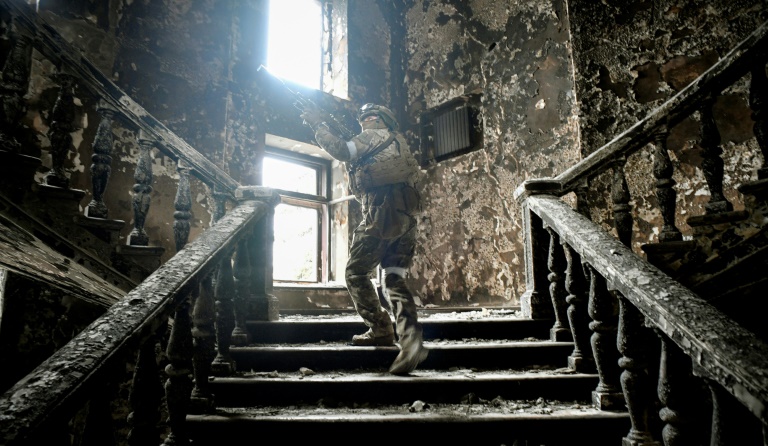
In Mariupol, destroyed buildings and fresh graves

Galina Vasilyeva looks around at the ruins of the devastated Ukrainian city of Mariupol that she once helped to build.

Pointing towards a charred nine-storey building, the retired construction worker with bright red hair says: “There are burnt corpses in there.”

“All these buildings were built by my generation. And now they have bombed everything,” says 78-year-old Vasilyeva, as she queues for humanitarian aid distributed by pro-Russia separatists.

The strategic port city was encircled by Russian troops early on in what Moscow calls its “special military operation” in Ukraine. Conquering the city would connect Russia-controlled Crimea to the territories of Moscow-backed separatists in the eastern Donbas region. 

Over a month later, Ukraine’s forces continue resisting from inside the city’s giant metallurgical and heavy machinery plants, but are struggling to hold the city with a population of around 500,000 people.

While the official death toll is unknown, thousands of civilians are believed to have died in the besieged city while others have survived with hardly any food or water and no electricity.

– Fear and horror –

“There are a lot of dead people and unfortunately, we can’t remove them all,” Yury Bukharev, a soldier in the separatist army, tells reporters taking part in a media trip organised by the Russian army, blaming ongoing fighting.

Bukharev stands inside the remains of Mariupol’s drama theatre, partially destroyed and burnt in an attack on March 16 as hundreds sheltered in its basement. 

It is not known how many people remain buried in the rubble.

“When we start removing the rubble, the number of victims will become clearer,” Bukharev says.

Authorities in Kyiv say Russia deliberately bombed the theatre, while Moscow accuses a Ukrainian nationalist battalion of blowing up the theatre themselves in order to blame it on Russia. 

They also say Ukrainian forces used high-rise apartment blocks as firing positions.

Now that the fighting has subsided, Mariupol’s residents have started coming outside in search of food, water and an escape route from the city.

“I know that we experienced horror and we don’t know what will happen next. We live like we’re on top of a volcano,” says 59-year-old Tatyana, a municipal employee, who is also waiting for humanitarian aid, carrying a broom she is using to help clear up the city. 

“There’s fear, fear! What else is there to say? A lot of people are suffering,” adds Tatyana, who didn’t give her last name. 

She says that people have died in her apartment building: “We bury them right there in the courtyards.”

AFP journalists saw numerous such hastily dug graves on a city boulevard.

— ‘Under fire’ —

With only a backpack between them, Konstantin Mavrodi and his mother Taisiya say they have left their home in the hope of finding a bus leaving for Volnovakha, a town further north under Russian control, where his grandmother lives. 

“To get here today, we had to run under fire, under bullets,” Mavrodi says.

They said they came under gunfire while walking through streets close to the Azovstal industrial zone where the Ukrainian army is still resisting, from inside tunnels dug during the Soviet era. 

The 28-year-old, who taught computer science to children, says that everyone in the city has been living without electricity or the internet since March 3, making it impossible to let family members know they are alive.

His future remains unclear, as he is neither ready to turn his back on his homeland Ukraine nor Russia, where he and his mother have relatives.

“Now we are simply people who want to live. Which country we want to live in — we will decide later,” he says. 

Back in the queue for a truck carrying humanitarian aid, Svetlana Yasakova says she does not plan to leave.

“I am homeless, my apartment is totally destroyed. I moved in three months ago, a new apartment, newly renovated,” the 43-year-old accountant in orange glasses says, smiling despite everything. 

“I live in the present moment. Today I am here, and tomorrow will be tomorrow. I love my city, even in this state. It is beautiful even like this,” Svetlana adds.

“I’m for peace, love and calm. And as they say, may God help all people and take charge of the situation.” 

Asian markets drop after Wall Street retreat

Asian markets dipped in early trade Friday after a negative lead from Wall Street, with investors around the world worried about surging inflation.

Central banks in several major economies including the United States, Canada and Britain have already started raising interest rates to contain prices, but the European Central Bank on Thursday kept its stimulus plans and rates unchanged.

That sent the euro plunging to a near two-year low, but eurozone stocks were boosted, but Wall Street retreated ahead of the Easter holidays.

The mood was subdued in Asia too, where only a handful of markets were open on Good Friday.

The Nikkei 225 slid 0.7 percent with Wall Street’s woes depressing sentiment.

The Tokyo market is likely to be “dominated by sell orders as investors are disheartened by falls in US shares,” Mizuho Securities said in a note.

Shanghai dropped 0.2 percent.

Russia’s invasion of Ukraine has added to the uncertainty about the global economic recovery from the Covid-19 pandemic.

This was reflected in statements from major banking executives in the United States, who described the American economy as solid but warned about the impact of the Ukraine conflict and the measures central banks such as the US Federal Reserve will take to control inflation.

“We don’t think there’s going to be a recession,” Julian Emanuel, chief equity strategist at Evercore ISI, told Bloomberg television.

“We don’t think the Fed is going to break the glass. But the problem is investors aren’t in that mindset quite yet.”

– Energy, food shocks –

Russia is a major global oil and gas supplier, and — along with Ukraine — is also a key player in the grain sector.

The conflict has shaken markets for these commodities, and the impact has been felt from the Middle East to South America.

In Yemen, there are fears of food shortages with the war-ravaged nation already on the edge of famine.

In Argentina, a strike by grain transporters has paralysed farming exports — haulers are unhappy with the rates they are paid, pointing to the spike in fuel prices because of the Ukraine crisis.

The war has sent oil prices soaring, with reports swirling about further energy sanctions on Russia.

Both main contracts sat above the $100 per barrel mark.

“There are no surprises here as oil continues to march higher, with global supply shortage outweighing concerns about slower demand in China,” Stephen Innes of SPI Asset Management said in a note.

– Key figures around 0320 GMT –

Tokyo – Nikkei 225: DOWN 0.7 percent at 26,995.86

Shanghai – Composite: DOWN 0.6 percent at 3,204.96

Hong Kong – Hang Seng Index: Closed for a holiday

Euro/dollar: DOWN at $1.0801 from $1.0832 at 2100 GMT

Pound/dollar: DOWN at $1.3063 from $1.3076

Euro/pound: DOWN at 82.67 from 82.77 pence

Dollar/yen: UP at 126.39 from 125.87 at 2100 GMT

Brent North Sea crude: UP 2.7 percent at $111.70 per barrel

West Texas Intermediate: UP 2.6 percent at $106.95 per barrel

New York – Dow: DOWN 0.3 percent at 34,451.23 (close)

London – FTSE 100: UP 0.5 percent at 7,616.38 (close)

— Bloomberg News contributed to this story —

Researchers decode pigs' well-being through oinks and grunts

European researchers have developed a way of decoding the feelings of pigs through their grunts, oinks and squeals in a project aimed at improving animal welfare.

Biologists studied over 7,000 recordings from 411 pigs, from the brief squeaks of satisfaction at feeding time to the desperate cries at slaughter, before classifying them into 19 different categories.

“We show that it’s possible basically to figure out the emotions of the pigs according to their vocalisations,” project leader Elodie Briefer, a lecturer at the University of Copenhagen, told AFP.

The project, split between Switzerland, Denmark, Norway, France and the Czech Republic and published in the journal Nature, offers a new way of improving animal welfare by laying the groundwork for a tool that can categorise an emotion based on the noise produced, according to the researcher.

“We also run a machine learning algorithm… which produces a spectrogram, then it is trained to recognise negative and positive contexts.”

Once developed, the new tool would allow farmers, who today can mostly only check the physical well-being of the animals, to monitor their mental health.

The researcher said if the negative squeals increase, the farmer would be alerted that something was wrong and could check.

The Scandinavian country is home to 13.2 million pigs — making it the leader in Europe with over two per capita — and for the Danish Agriculture and Food Council the implications of the study are promising.

“This concept… could potentially be a useful tool among others in the work to monitor the health and well-being of pigs,” Trine Vig, a spokeswoman for the council, said.

– ‘They’re very vocal’ – 

According to Briefer they reached “92 percent accuracy of classifying the valence… (or) whether the call is negative or positive, and 82 percent accuracy in classifying the actual context in which the sounds were produced”.

According to the findings, positive feelings are expressed in short grunts, while negative sentiments are most often expressed with longer sounds.

But why focus on the pig rather than a cow or a rabbit?

For the authors of the study, the pig, known for its wide range of squeaks and noises, was the perfect match.

“They’re very vocal, which makes them easier to study,” the researcher said.

“They produce vocalisations all the time, even in a low intensity situation, they would still vocalise.”

Researchers decode pigs' well-being through oinks and grunts

European researchers have developed a way of decoding the feelings of pigs through their grunts, oinks and squeals in a project aimed at improving animal welfare.

Biologists studied over 7,000 recordings from 411 pigs, from the brief squeaks of satisfaction at feeding time to the desperate cries at slaughter, before classifying them into 19 different categories.

“We show that it’s possible basically to figure out the emotions of the pigs according to their vocalisations,” project leader Elodie Briefer, a lecturer at the University of Copenhagen, told AFP.

The project, split between Switzerland, Denmark, Norway, France and the Czech Republic and published in the journal Nature, offers a new way of improving animal welfare by laying the groundwork for a tool that can categorise an emotion based on the noise produced, according to the researcher.

“We also run a machine learning algorithm… which produces a spectrogram, then it is trained to recognise negative and positive contexts.”

Once developed, the new tool would allow farmers, who today can mostly only check the physical well-being of the animals, to monitor their mental health.

The researcher said if the negative squeals increase, the farmer would be alerted that something was wrong and could check.

The Scandinavian country is home to 13.2 million pigs — making it the leader in Europe with over two per capita — and for the Danish Agriculture and Food Council the implications of the study are promising.

“This concept… could potentially be a useful tool among others in the work to monitor the health and well-being of pigs,” Trine Vig, a spokeswoman for the council, said.

– ‘They’re very vocal’ – 

According to Briefer they reached “92 percent accuracy of classifying the valence… (or) whether the call is negative or positive, and 82 percent accuracy in classifying the actual context in which the sounds were produced”.

According to the findings, positive feelings are expressed in short grunts, while negative sentiments are most often expressed with longer sounds.

But why focus on the pig rather than a cow or a rabbit?

For the authors of the study, the pig, known for its wide range of squeaks and noises, was the perfect match.

“They’re very vocal, which makes them easier to study,” the researcher said.

“They produce vocalisations all the time, even in a low intensity situation, they would still vocalise.”

Close Bitnami banner
Bitnami