World

The siege of Mariupol

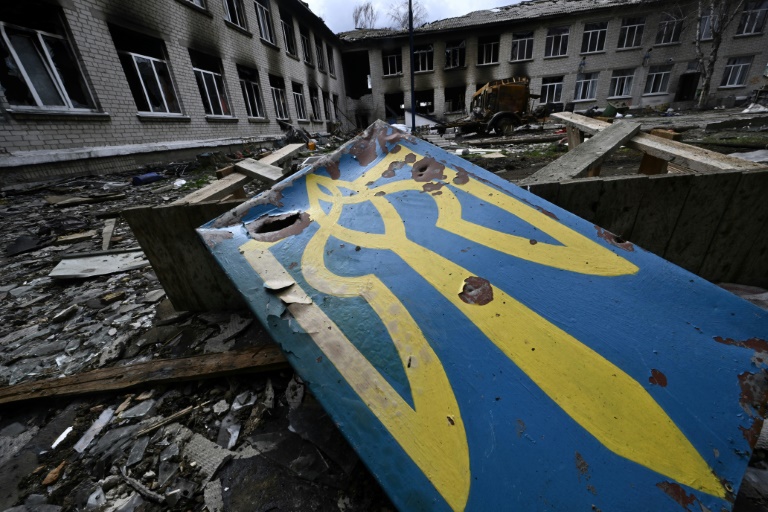
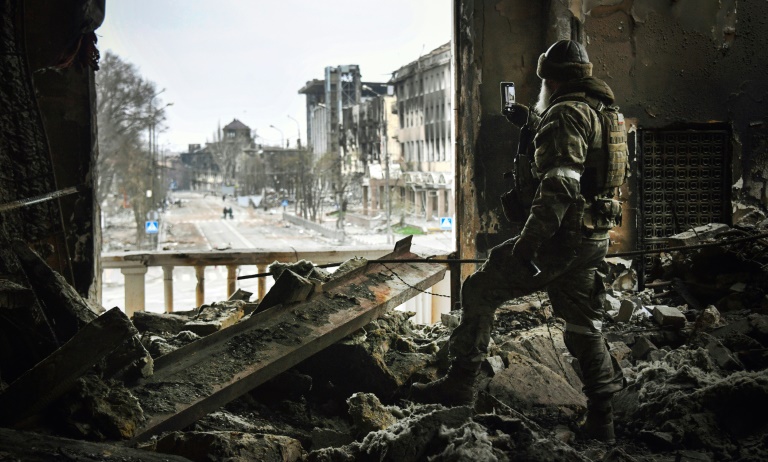
Six weeks into Russia’s bloody siege of the strategic port of Mariupol, the troops who put up a fierce fight to keep the ruined city in Ukrainian hands have begun to surrender, according to Moscow.

With Ukrainian authorities reporting tens of thousands dead there, AFP takes a look at how the siege unfolded:

– Pounded, encircled –

On March 2, a week after the Russian invasion of Ukraine, Moscow’s artillery begins pounding Mariupol, a predominantly Russian-speaking city of 441,000 inhabitants some 55 kilometres (35 miles) from the Russian border and 85 kilometres from the pro-Russia separatist stronghold of Donetsk.

The mayor accuses Russian forces and pro-Russian fighters of looking to “impose a blockade” by cutting off food supplies and vital infrastructure, including water, electricity and heating.

Taking control of the city would allow Russia to link up its forces in the Crimea peninsula, which it annexed in 2014, with the occupied ports of Berdyansk and Kherson and the separatist region of Donbas further to the north.

– Maternity ward bombed –

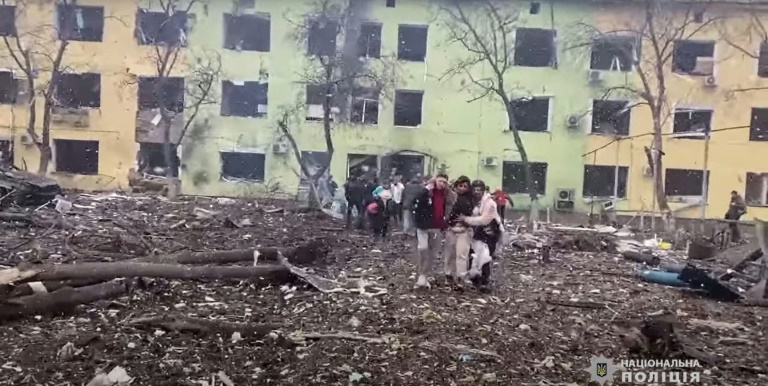
On March 9, Russia targets a building housing a maternity ward and paediatric hospital in Mariupol, killing three, including a young girl.

Ukraine and the European Union condemn a “war crime”. Russia claims the building is sheltering Ukrainian nationalists.

– First evacuations –

Mid-March sees the start of the evacuation of thousands of civilians from the city via a humanitarian corridor.

Early attempts to bring people out fail amid mutual recriminations between the warring sides.

– Theatre destroyed –

On March 16, Russian airstrikes raze a theatre providing shelter to around 1,000 people, according to Ukrainian authorities who estimate a death toll of around 300.

Moscow denies the attack, blaming Ukraine’s far-right Azov nationalist battalion.

– Refusal to surrender –

On March 21, Kyiv rejects a Russian ultimatum to Ukrainian forces to surrender Mariupol or face being court-martialled or worse.

Ukraine’s Defence Minister Oleksiy Reznikov says the city played “a huge role in destroying the enemy’s plans and enhancing our defence”. 

Civilians who manage to undertake a highly perilous escape in their own vehicles describe a “freezing hellscape riddled with dead bodies and destroyed buildings”, according to Human Rights Watch.

– Ceasefire, more evacuations –

On March 30, Moscow announces a local ceasefire to allow the establishment of a humanitarian corridor between Mariupol and the Ukrainian-controlled city of Zaporizhzhia, via the Russian-held port of Berdyansk. 

The government sends 45 buses to evacuate residents. The International Committee of the Red Cross struggles in vain to get a team to the city to help the evacuation.

On April 4, Mariupol mayor Vadym Boychenko says the city has been “90 percent” destroyed, talking the next day of “a humanitarian disaster”.

–  Claims of hiding evidence – 

On April 6, Zelensky says Russia is blocking humanitarian access to Mariupol because it wants to hide evidence of “thousands” of people killed there.

On April 7 the new “mayor” of Mariupol, Konstantin Ivashchenko, installed by pro-Russian forces, says that around 5,000 civilians have died.

– ‘Last battle’ –

On April 11, marines in the city say they are preparing for a “last battle” to control Mariupol.

Zelensky puts the toll in the “tens of thousands”.

A pro-Russia rebel leader says separatist forces in eastern Ukraine have taken control of the city’s port. 

The United States says it has “credible information” that Russia may use “chemical agents” in its offensive.

– Reports of Ukrainian surrender –

On April 13, Russia’s defence ministry says that 1,026 Ukrainian soldiers have “voluntarily laid down their arms and surrendered” near a large iron and steel factory where Ukrainian forces had been holding out.


Notre-Dame slowly reviving three years after fire

Three years after the devastating fire, Notre-Dame cathedral in Paris is mostly cleared of a thick layer of soot as an army of craftsmen race to meet a deadline to reopen in time for the 2024 Olympics.

Ahead of the anniversary of the blaze on Friday, the mammoth cleaning job of the walls, vaults and floor is almost completed, restoring the cathedral to its original whiteness. 

The inferno that engulfed the 12th century Gothic landmark on April 15, 2019 caused its central frame to collapse and ravaged the famous spire, clock and part of the vault — shocking millions around the world. 

The cathedral typically welcomed nearly 12 million visitors a year, as well as hosting 2,400 services and 150 concerts. 

As an icon of the globally beloved city, the fire triggered an outpouring of generosity with nearly 844 million euros in donations collected from 340,000 donors in 150 countries to date, according to the public body overseeing the restoration. 

The gaping hole left in the building is now filled by a forest of scaffolding. 

The first stage of the titanic project involved clearing the rubble and burnt beams, reinforcing the flying buttresses, and removing the deadly dust unleashed from  450 tonnes of lead in the structure. 

A temporary metal scaffolding had to be built for the task, which was completed last summer at a cost of 151 million euros, largely on schedule despite a three-month pause in 2020 at the start of the Covid-19 pandemic. 

– 1,000 trees –

Many of the tasks have been farmed out to specialist workshops around France. 

They include dismantling and cleaning the huge 18th century organ, the largest in France, that was spared by the fire but coated in lead dust. 

The stained glass windows, several statues and the 22 large-format paintings from the 17th and 18th centuries have also been sent for restoration. 

The next major phase is to reinstall the medieval wooden framework of the nave and choir, and the 19th century spire — which the team hopes will be completed in the first half of 2023.

A thousand trees have already been cut down in national and private forests across France in preparation. 

Meanwhile, stones are this week being extracted from quarries to start rebuilding the damaged vaults.

Tests have been carried out on two of the cathedral’s 24 chapels to practise the techniques needed to recreate their original colours. 

Work was slowed down in March by a major surprise, when a lead sarcophagus and the remains of a decorative stone dividing barrier from the 14th century were discovered in the ground.

As well as restoring the building to its former glory, the diocese has plans to add a few new touches, integrating contemporary art and old masters, along with a more modern lighting system, moveable benches and biblical phrases projected on the walls in different languages. 

A new system for visitors and worshippers will mean that when they return to the iconic cathedral in 2024, they will enter through the large central door rather than side doors.

Yen drops to 20-year low against dollar

The yen hit its lowest level against the dollar in two decades on Wednesday, extending recent falls as the gap widens between Japan’s ultra-loose monetary policy and US tightening.

Despite being traditionally considered a safe-haven currency, uncertainty fuelled by the war in Ukraine has not caused the yen to strengthen.

Instead, moves by the US Federal Reserve towards a more aggressive policy and the shock of rising oil prices in Japan — a major importer of fossil fuels — have pushed the currency lower, analysts say.

One dollar bought 126 yen on Wednesday afternoon, the lowest rate since 2002.

“The Japanese yen has been one of the weakest currencies anywhere in the world this year,” Dutch banking group ING said in a recent commentary.

“Driving the rally has been the perfect storm of a hawkish Federal Reserve, a dovish Bank of Japan (BoJ), and Japan’s negative terms of trade shock as a major fossil fuel importer.”

Government spokesman Hirokazu Matsuno said “the stability of exchange rates is important and we see rapid currency moves as undesirable”.

“We will monitor trends in the foreign currency market and the impact on the Japanese economy with a sense of urgency,” he added.

The yen had already lost 10 percent of its value against the dollar in 2021 after four years of steady strengthening.

The US central bank has embarked on an aggressive tightening path, pushing up American treasury yields which have strengthened the dollar against the yen.

But its moves stand in contrast to the Bank of Japan’s ultra-loose monetary policy, which will be maintained for now, bank governor Haruhiko Kuroda said earlier Wednesday.

“Given the economy and price situation, the Bank of Japan will seek to realise its two-percent inflation target… by resiliently continuing its current powerful monetary easing,” he said.

Swiss Bank UBS said a weaker yen would likely hit Japanese households’ purchasing power, and domestic-oriented small businesses who will face higher import costs.

“The government is offering fiscal supports and most likely will expand the supports. We think the (yen) purchase intervention is possible if the pace of depreciation is regarded as too fast,” it said in a note.

Tohru Sasaki, head of Japan Market Research at JPMorgan Chase Bank, told AFP that the Bank of Japan “has to do something to slow the pace of the yen’s depreciation”.

“The Japanese government can sell foreign reserve (USD) to intervene, but it is politically difficult,” he said, adding that it would be “strange” if the finance ministry did so while the Bank of Japan keeps its current easing policies.

Lost golden toad heralds climate's massive extinction threat

Those lucky enough to have seen them will never forget.

For just a few days every year, the elfin cloud forest of Costa Rica came alive with crowds of golden toads the length of a child’s thumb, emerging from the undergrowth to mate at rain-swelled pools.  

In this mysterious woodland the cloud drapes over mountain ridges and “the trees are dwarfed and wind-sculpted, gnarled and heavily laden with mosses,” said J Alan Pounds, an ecologist at the Monteverde Cloud Forest Preserve in Costa Rica.

“The soils are very dark and so golden toads would stand out like animal figurines. It was quite a spectacle.” 

Then in 1990, they were gone. 

The golden toad was the first species where climate change has been identified as a key driver of extinction.

Its fate could be just the beginning. 

For years, researchers have warned that the world is facing both a climate and a biodiversity crisis. Increasingly they say they are connected.

– One in 10 face extinction –

Even if warming is capped at the ambitious target of 1.5 degrees Celsius above pre-industrial levels, the UN’s Intergovernmental Panel on Climate Change says nearly one in 10 of all species face an extinction threat.

The golden toad was only found in Monteverde’s highland forest. So when trouble hit, the species was completely wiped out. 

“It was pretty clear about 99 percent of the population declined within a single year,” said Pounds, whose research into the disappearance of the golden toad was cited in the IPCC’s February report on climate impacts. 

Climate change was barely on the research radar when Pounds first arrived in Costa Rica in the early 1980s to study amphibians.

But global warming was already beginning to take its toll. 

After the disappearance of the golden toad, the Monteverde harlequin frog and others, researchers compared datasets on temperature and weather patterns with those on local species. 

They found not only the signature of the periodic El Nino weather phenomenon, but also trends linked to changes in climate.  

– Climate ‘trigger’ – 

The die-offs occurred after unusually warm and dry periods.

Pounds and his colleagues linked the declines to chytridiomycosis infection, but concluded that disease was only the “bullet — climate change was pulling the trigger.

“We hypothesised that climate change and resultant extreme events were somehow loading the dice for these kinds of outbreaks,” Pounds told AFP.

It was not an isolated incident. 

The expansion of the chytrid fungus globally, along with local climate change “is implicated in the extinction of a wide range of tropical amphibians,” according to the IPCC. 

The fingerprints of global warming have since been seen in other disappearances. 

The Bramble Cay melomys, a small rodent living on a low-lying island in the Torres Strait, was last seen in 2009.  

The only mammal endemic to the Great Barrier Reef, its populations were battered by sea-level rise, increased storm surges and tropical cyclones — all made worse by climate change.

Vegetation that provided its food plummeted from 11 plant species in 1998 to just two in 2014. It was recently declared extinct. 

Today, climate change is listed as a direct threat to 11,475 species assessed by the International Union for Conservation of Nature. Around 5,775 are at risk of extinction.

– #MeToo for species –

The main reason why climate change is increasingly cited as a threat to so many species is that its impacts are becoming more obvious, said Wendy Foden, the head of the IUCN’s climate change specialist group.

But there is also a growing understanding of the enormous variety of effects. 

Beyond extreme weather, warming can also cause species to move, change behaviour or even skew to having more male or female offspring. 

And that’s on top of other human threats like poaching, deforestation, overfishing and pollution. 

In 2019, a report by UN biodiversity report experts said one million species could disappear in the coming decades, raising fears that the world is entering a sixth era of mass extinction.

“It’s absolutely terrifying,” said Foden, adding that warnings of catastrophic biodiversity loss have often been overlooked.  

“We need a #MeToo movement for species, a whole wake up on what we are doing.” 

Almost 200 countries are currently locked in global biodiversity talks to try to safeguard nature, including a key milestone of 30 percent of Earth’s surface protected by 2030.

But Foden said the threat of climate change means that the response will have to go beyond traditional conservation. 

“That can’t happen anymore, even in the most remote wilderness, climate change will affect it,” Foden said. 

In some cases, people will need to choose which species to save. 

Take the endangered African penguin in South Africa, which Foden wrote about for the IPCC report on climate impacts. 

Forced to nest in the open after humans mined their guano nesting sites, the adults now have to swim ever further to find fish, likely because of a combination of overfishing and climate change. Meanwhile, the chicks in exposed nests can die from heat stress. 

“We are down to the last 7,000 breeding pairs. At this point, every penguin counts,” Foden said. 

– Cloudless forest –

In Monteverde, even the clouds have changed.  

While rainfall has increased somewhat over the past 50 years, Pounds said it has become much more variable.  

In the 1970,s the forest saw around 25 dry days a year on average — in the last decade it has been more like 115.  

The mist that used to keep the forest wet during the dry season has reduced by around 70 percent.

Pounds said sometimes tourists in the area stop him and ask directions to the Cloud Forest. 

“And I say: ‘You’re in it,'” he said.

“It often feels more like a dust forest than a cloud forest.”

Researchers have also seen steep declines in frogs, snakes and lizards and changes in the bird populations. Some have moved uphill to cooler areas, others have vanished from the area completely.

As for the golden toad, last year a team from the Monteverde Conservation League, supported by the conservation group Re:wild, launched an expedition to look for the golden toad in its historic habitat in the Children’s Eternal Rainforest, after tantalising rumours of sightings. 

But in vain.

Meanwhile, Pounds and his colleagues continue to keep an eye out for the golden toad during the rainy season. 

“We haven’t completely given up,” he said. 

“But with each passing year, it looks less likely that they’re going to reappear.”

Lost golden toad heralds climate's massive extinction threat

Those lucky enough to have seen them will never forget.

For just a few days every year, the elfin cloud forest of Costa Rica came alive with crowds of golden toads the length of a child’s thumb, emerging from the undergrowth to mate at rain-swelled pools.  

In this mysterious woodland the cloud drapes over mountain ridges and “the trees are dwarfed and wind-sculpted, gnarled and heavily laden with mosses,” said J Alan Pounds, an ecologist at the Monteverde Cloud Forest Preserve in Costa Rica.

“The soils are very dark and so golden toads would stand out like animal figurines. It was quite a spectacle.” 

Then in 1990, they were gone. 

The golden toad was the first species where climate change has been identified as a key driver of extinction.

Its fate could be just the beginning. 

For years, researchers have warned that the world is facing both a climate and a biodiversity crisis. Increasingly they say they are connected.

– One in 10 face extinction –

Even if warming is capped at the ambitious target of 1.5 degrees Celsius above pre-industrial levels, the UN’s Intergovernmental Panel on Climate Change says nearly one in 10 of all species face an extinction threat.

The golden toad was only found in Monteverde’s highland forest. So when trouble hit, the species was completely wiped out. 

“It was pretty clear about 99 percent of the population declined within a single year,” said Pounds, whose research into the disappearance of the golden toad was cited in the IPCC’s February report on climate impacts. 

Climate change was barely on the research radar when Pounds first arrived in Costa Rica in the early 1980s to study amphibians.

But global warming was already beginning to take its toll. 

After the disappearance of the golden toad, the Monteverde harlequin frog and others, researchers compared datasets on temperature and weather patterns with those on local species. 

They found not only the signature of the periodic El Nino weather phenomenon, but also trends linked to changes in climate.  

– Climate ‘trigger’ – 

The die-offs occurred after unusually warm and dry periods.

Pounds and his colleagues linked the declines to chytridiomycosis infection, but concluded that disease was only the “bullet — climate change was pulling the trigger.

“We hypothesised that climate change and resultant extreme events were somehow loading the dice for these kinds of outbreaks,” Pounds told AFP.

It was not an isolated incident. 

The expansion of the chytrid fungus globally, along with local climate change “is implicated in the extinction of a wide range of tropical amphibians,” according to the IPCC. 

The fingerprints of global warming have since been seen in other disappearances. 

The Bramble Cay melomys, a small rodent living on a low-lying island in the Torres Strait, was last seen in 2009.  

The only mammal endemic to the Great Barrier Reef, its populations were battered by sea-level rise, increased storm surges and tropical cyclones — all made worse by climate change.

Vegetation that provided its food plummeted from 11 plant species in 1998 to just two in 2014. It was recently declared extinct. 

Today, climate change is listed as a direct threat to 11,475 species assessed by the International Union for Conservation of Nature. Around 5,775 are at risk of extinction.

– #MeToo for species –

The main reason why climate change is increasingly cited as a threat to so many species is that its impacts are becoming more obvious, said Wendy Foden, the head of the IUCN’s climate change specialist group.

But there is also a growing understanding of the enormous variety of effects. 

Beyond extreme weather, warming can also cause species to move, change behaviour or even skew to having more male or female offspring. 

And that’s on top of other human threats like poaching, deforestation, overfishing and pollution. 

In 2019, a report by UN biodiversity report experts said one million species could disappear in the coming decades, raising fears that the world is entering a sixth era of mass extinction.

“It’s absolutely terrifying,” said Foden, adding that warnings of catastrophic biodiversity loss have often been overlooked.  

“We need a #MeToo movement for species, a whole wake up on what we are doing.” 

Almost 200 countries are currently locked in global biodiversity talks to try to safeguard nature, including a key milestone of 30 percent of Earth’s surface protected by 2030.

But Foden said the threat of climate change means that the response will have to go beyond traditional conservation. 

“That can’t happen anymore, even in the most remote wilderness, climate change will affect it,” Foden said. 

In some cases, people will need to choose which species to save. 

Take the endangered African penguin in South Africa, which Foden wrote about for the IPCC report on climate impacts. 

Forced to nest in the open after humans mined their guano nesting sites, the adults now have to swim ever further to find fish, likely because of a combination of overfishing and climate change. Meanwhile, the chicks in exposed nests can die from heat stress. 

“We are down to the last 7,000 breeding pairs. At this point, every penguin counts,” Foden said. 

– Cloudless forest –

In Monteverde, even the clouds have changed.  

While rainfall has increased somewhat over the past 50 years, Pounds said it has become much more variable.  

In the 1970,s the forest saw around 25 dry days a year on average — in the last decade it has been more like 115.  

The mist that used to keep the forest wet during the dry season has reduced by around 70 percent.

Pounds said sometimes tourists in the area stop him and ask directions to the Cloud Forest. 

“And I say: ‘You’re in it,'” he said.

“It often feels more like a dust forest than a cloud forest.”

Researchers have also seen steep declines in frogs, snakes and lizards and changes in the bird populations. Some have moved uphill to cooler areas, others have vanished from the area completely.

As for the golden toad, last year a team from the Monteverde Conservation League, supported by the conservation group Re:wild, launched an expedition to look for the golden toad in its historic habitat in the Children’s Eternal Rainforest, after tantalising rumours of sightings. 

But in vain.

Meanwhile, Pounds and his colleagues continue to keep an eye out for the golden toad during the rainy season. 

“We haven’t completely given up,” he said. 

“But with each passing year, it looks less likely that they’re going to reappear.”

Death toll from Philippines landslides, floods rises to 67

The death toll from landslides and floods in the Philippines rose to 67 on Wednesday with scores missing and feared dead, officials said, as rescuers dug up more bodies with bare hands and backhoes in crushed villages.

Most of the deaths from tropical storm Megi — the strongest to hit the archipelago this year — were in the central province of Leyte, where a series of landslides devastated communities.

Thirteen people died and around 150 were missing in the coastal village of Pilar, which is part of Abuyog municipality, after a torrent of mud and earth pushed houses into the sea and buried most of the settlement, Abuyog Mayor Lemuel Traya said.

“I have to be honest, we are no longer expecting survivors,” Traya told AFP, adding that emergency personnel were now focused on the difficult task of retrieving bodies.

About 250 people were in evacuation centres after being rescued by boat after roads were cut by landslides, he said. 

A number of villagers were also in hospital.

A rumbling sound like “a helicopter” alerted Ara Mae Canuto, 22, to the landslide hurtling towards her family’s home in Pilar. 

She said she tried to outrun it, but was swept into the water and nearly drowned. 

“I swallowed dirt, and my ears and nose are full of mud,” Canuto told AFP by telephone from her hospital bed. Her father died and her mother has not been found.

Disaster-prone Philippines is regularly ravaged by storms — including a direct hit from Super Typhoon Haiyan in 2013 — with scientists warning they are becoming more powerful as the world gets warmer because of human-driven climate change.

Baybay City is also reeling after waves of sodden soil smashed into farming settlements over the weekend, killing at least 48 people and injuring over 100, local authorities said. Twenty-seven are still missing, they added. 

Aerial photos showed a wide stretch of mud that had swept down a hill of coconut trees and engulfed Bunga village, where only a few rooftops poked through the now-transformed landscape.

“We were told to be on alert because a storm was coming, but they did not directly tell us we needed to evacuate,” said Bunga farmworker Loderica Portarcos, 47, who lost 17 relatives and a friend in the landslide.

Portarcos braved heat and humidity as she advised a backhoe operator where to dig for three bodies still embedded in the soft soil which had started to smell of rotting flesh.

“Our dead relatives are all in the morgue, but there will be no time for a wake to mourn them because the mayor told us they smell bad,” she said.

– ‘Many of us died’ – 

Three people were also killed in the central province of Negros Oriental and three on the main southern island of Mindanao, according to the national disaster agency.

The death toll from Megi is expected to rise as rescue operations switch to recovering bodies. 

Abuyog police chief Captain James Mark Ruiz said more boats were needed for victims in Pilar. But getting access to the shore was difficult.

Photos posted by the Bureau of Fire Protection on Facebook showed buildings crushed or turned over by the force of the landslide and debris in the water.

“We’re using fiber glass boats and there are steel bars exposed in the sea so it’s very difficult,” Abuyog Mayor Traya said, adding that the ground was unstable and “very risky”.

While Pilar survivor Canuto counts herself lucky to be alive, she said “many of us died and a lot are missing too”.

Whipping up seas, Megi forced dozens of ports to temporarily suspend operations, stranding thousands of people at the start of Holy Week, one of the busiest travel periods of the year in the Philippines.

It came four months after super typhoon Rai devastated swathes of the country, killing more than 400 and leaving hundreds of thousands homeless.

The Philippines — ranked among the most vulnerable nations to the impacts of climate change — is hit by an average of 20 storms every year.

Death toll from Philippines landslides, floods rises to 67

The death toll from landslides and floods in the Philippines rose to 67 on Wednesday with scores missing and feared dead, officials said, as rescuers dug up more bodies with bare hands and backhoes in crushed villages.

Most of the deaths from tropical storm Megi — the strongest to hit the archipelago this year — were in the central province of Leyte, where a series of landslides devastated communities.

Thirteen people died and around 150 were missing in the coastal village of Pilar, which is part of Abuyog municipality, after a torrent of mud and earth pushed houses into the sea and buried most of the settlement, Abuyog Mayor Lemuel Traya said.

“I have to be honest, we are no longer expecting survivors,” Traya told AFP, adding that emergency personnel were now focused on the difficult task of retrieving bodies.

About 250 people were in evacuation centres after being rescued by boat after roads were cut by landslides, he said. 

A number of villagers were also in hospital.

A rumbling sound like “a helicopter” alerted Ara Mae Canuto, 22, to the landslide hurtling towards her family’s home in Pilar. 

She said she tried to outrun it, but was swept into the water and nearly drowned. 

“I swallowed dirt, and my ears and nose are full of mud,” Canuto told AFP by telephone from her hospital bed. Her father died and her mother has not been found.

Disaster-prone Philippines is regularly ravaged by storms — including a direct hit from Super Typhoon Haiyan in 2013 — with scientists warning they are becoming more powerful as the world gets warmer because of human-driven climate change.

Baybay City is also reeling after waves of sodden soil smashed into farming settlements over the weekend, killing at least 48 people and injuring over 100, local authorities said. Twenty-seven are still missing, they added. 

Aerial photos showed a wide stretch of mud that had swept down a hill of coconut trees and engulfed Bunga village, where only a few rooftops poked through the now-transformed landscape.

“We were told to be on alert because a storm was coming, but they did not directly tell us we needed to evacuate,” said Bunga farmworker Loderica Portarcos, 47, who lost 17 relatives and a friend in the landslide.

Portarcos braved heat and humidity as she advised a backhoe operator where to dig for three bodies still embedded in the soft soil which had started to smell of rotting flesh.

“Our dead relatives are all in the morgue, but there will be no time for a wake to mourn them because the mayor told us they smell bad,” she said.

– ‘Many of us died’ – 

Three people were also killed in the central province of Negros Oriental and three on the main southern island of Mindanao, according to the national disaster agency.

The death toll from Megi is expected to rise as rescue operations switch to recovering bodies. 

Abuyog police chief Captain James Mark Ruiz said more boats were needed for victims in Pilar. But getting access to the shore was difficult.

Photos posted by the Bureau of Fire Protection on Facebook showed buildings crushed or turned over by the force of the landslide and debris in the water.

“We’re using fiber glass boats and there are steel bars exposed in the sea so it’s very difficult,” Abuyog Mayor Traya said, adding that the ground was unstable and “very risky”.

While Pilar survivor Canuto counts herself lucky to be alive, she said “many of us died and a lot are missing too”.

Whipping up seas, Megi forced dozens of ports to temporarily suspend operations, stranding thousands of people at the start of Holy Week, one of the busiest travel periods of the year in the Philippines.

It came four months after super typhoon Rai devastated swathes of the country, killing more than 400 and leaving hundreds of thousands homeless.

The Philippines — ranked among the most vulnerable nations to the impacts of climate change — is hit by an average of 20 storms every year.

Asian stocks shrug off red-hot US inflation

Many Asian markets made gains Wednesday, despite losses on Wall Street and across Europe sparked by data showing red-hot US inflation.

The US consumer price index surged 8.5 percent in March compared with a year ago, the biggest jump since December 1981. The CPI climbed 1.2 percent over February’s level.

The report was the first to fully encompass the shock caused by Russia’s invasion of Ukraine and Western sanctions against Moscow, which have caused energy and food prices to spike worldwide.

Though the US Federal Reserve was poised to raise interest rates quickly to tamp down inflation pressures, the effects will not be immediate.

Tokyo shrugged off the gloom, however, with the benchmark Nikkei 225 closing almost two percent higher.

“The Nikkei index rebounded after falling more than 600 points since the start of the week,” Okasan Online Securities said in a note. 

“Growth stocks were bought back as caution about excessive monetary tightening in the US receded.”

Hong Kong closed with small gains, while shares in Seoul, Taipei and Sydney were also up. Mumbai was down.

“Yes, US inflation was hot -– it’s hottest in 40 years. But we’re getting used to these extreme headline prints now,” said Matthew Simpson, senior market analyst at City Index.

“Besides, now high levels of inflation are no longer new news, the focus is now shifting to its trajectory and how long it may take to tail off.”

The lower-than-expected rise in core CPI “was all equity markets needed, using the singular data point to price in peak inflation” in the United States, said Jeffrey Halley, senior market analyst at OANDA.

“The perpetually bullish FOMO gnomes of the equity market, desperately searching for more drinks to keep the party alive, found it in the core inflation (month on month) data for March.”

In Shanghai, where a Covid-19 outbreak has caused mass lockdowns and snarled global trade arteries, stocks closed down by just under one percent.

That came as official data showed China’s imports shrank on-year in March for the first time in nearly two years, hit by the coronavirus and weakening consumer demand.

Imports dropped 0.1 percent, according to data from China’s Customs Administration.

At the open in Europe, shares dropped.

London slipped 0.1 percent, after official data showed UK inflation had rocketed to a 30-year high in March, while Frankfurt shed 0.6 percent and Paris lost 0.2 percent.

– Crude contracts rise –

Both major crude oil contracts were back over $100 per barrel, after Russian President Vladimir Putin vowed to continue the invasion of Ukraine and China partially eased Covid-related curbs.

“Oil seems to be the primary benefactor of (the) Ukraine vs Russia conflict dragging out longer,” noted Stephen Innes of SPI Asset Management.

In currency markets, the yen hit its lowest level against the dollar in two decades, extending recent falls as the gap widens between Japan’s ultra-loose monetary policy and Fed tightening.

Despite being traditionally considered a safe-haven currency, uncertainty fuelled by the war in Ukraine has not caused the yen to strengthen.

Instead, the Fed’s moves towards a more aggressive policy and the shock of rising oil prices in Japan — a major importer of fossil fuels — have pushed the currency lower, analysts say.

One dollar bought 126 yen at around 0630 GMT on Wednesday, the lowest rate since 2002.

– Key figures around 0810 GMT –

Tokyo – Nikkei 225: UP 1.93 percent at 26,843.49 (close)

Hong Kong – Hang Seng Index: UP 0.26 percent at 21,374.37 (close)

Shanghai – Composite: DOWN 0.82 percent at 3,186.82 (close)

London – FTSE 100: DOWN 0.1 percent to 7,568.10

Brent North Sea crude: DOWN 0.05 percent at $104.59 per barrel

West Texas Intermediate: DOWN 0.26 percent at $100.34 per barrel

Euro/dollar: UP at $1.0836 from $1.0818

Pound/dollar: UP at $1.3006 from $1.2977

Euro/pound: DOWN at 83.31 pence from 83.36 pence

Dollar/yen: DOWN at 126.07 from 126.22 yen

New York – Dow: DOWN 0.3 percent at 34,220.36 (close)

— Bloomberg News contributed to this report —

War in Ukraine: Latest developments

Here are the latest developments in the war in Ukraine:

– Mariupol troops surrender: Moscow –  

Russia says more than a thousand Ukrainian soldiers have surrendered in the besieged southeastern city of Mariupol after a ferocious six-week battle for the strategic port.

“In the city of Mariupol… 1,026 Ukrainian servicemen of the 36th Marine Brigade voluntarily laid down their arms and surrendered,” the Russian defence ministry says. Ukraine has yet to confirm the report.

– Biden accuses Russia of ‘genocide’ –

US President Joe Biden accuses Russian forces for the first time of committing genocide in Ukraine.

“Yes, I called it genocide,” he tells reporters when asked about his use of the term.

“It’s become clearer and clearer that Putin is just trying to wipe out the idea of even being able to be a Ukrainian.” 

Ukrainian President Volodymyr Zelensky, who has also accused Russia of genocide, hails Biden as a “true leader.”

– ‘Credible information’ on chemical weapons –

US Secretary of State Antony Blinken says Washington has “credible information” that Russia “may use… chemical agents” in its offensive in Mariupol.

He tells reporters he is not able to confirm reports that Moscow has already used chemical weapons there.

The world’s chemical weapons watchdog, the OPCW, says it is “concerned” over the reports.

– Polish, Baltic leaders to Kyiv –

The leaders of Poland, Estonia, Latvia and Lithuania travel to Kyiv together by train to show support for Zelensky.

German President Frank-Walter Steinmeier says he had planned to join them but was told by Kyiv he was “not wanted”. He has been criticised for his past advocacy of warmer ties with Russia.

– Residents flee east –

Residents stream out of east Ukraine’s Kramatorsk and Sloviansk as fears grow the cities will be key targets of a major new Russian offensive. 

The Pentagon says Russia is building up its forces in the eastern Donbas region, as it switches its focus to a region where pro-Russian rebels have been fighting Ukrainian forces since 2014. 

– Invasion going ‘calmly’: Putin –

Putin says Russia’s offensive is proceeding “calmly” and according to plan, with the goal of “minimising losses”.

During a televised press conference with Belarusian President Alexander Lukashenko, he dismisses reports of the discovery of hundreds of bodies of civilians in Bucha as “fake”.

– Over 400 bodies in Bucha – 

The mayor of the town of Bucha, where dozens of bodies were found after Russia’s withdrawal from northern Ukraine, says more than 400 people have been found dead so far and 25 women have reported being raped.

Zelensky says investigators have received reports of “hundreds” of rapes in areas previously occupied by Russian troops, including sexual assaults of very small children.

– Tycoon swap offer –

Zelensky offers to swap pro-Kremlin tycoon Viktor Medvedchuk, who has been close to Putin for years and who was arrested after escaping from house arrest, for Ukrainians captured by Russia.

– Over 870,000 returnees –

More than 870,000 Ukrainians who fled abroad since the start of the war have returned to the country, Ukraine’s border force says.

In total, more than 4.6 million Ukrainians have fled their country, the United Nations says.

burs-cb/yad

Asian stocks shrug off red-hot US inflation

Many Asian markets made gains Wednesday, despite losses on Wall Street and across Europe sparked by data showing red-hot US inflation.

The US consumer price index surged 8.5 percent in March compared with a year ago, the biggest jump since December 1981. CPI climbed 1.2 percent over February’s level.

The report was the first to fully encompass the shock caused by Russia’s invasion of Ukraine and Western sanctions against Moscow, which have caused energy and food prices to spike worldwide.

Though the US Federal Reserve was poised to raise interest rates quickly to tamp down inflation pressures, the effects will not be immediate.

Tokyo shrugged off the gloom, however, with the benchmark Nikkei 225 closing almost two percent higher.

“The Nikkei index rebounded after falling more than 600 points since the start of the week,” Okasan Online Securities said in a note. 

“Growth stocks were bought back as caution about excessive monetary tightening in the US receded.”

In afternoon trade, Hong Kong was eking out small gains. Shares in Seoul and Sydney were also up, while Mumbai was down.

“Yes, US inflation was hot -– it’s hottest in 40 years. But we’re getting used to these extreme headline prints now,” said Matthew Simpson, senior market analyst at City Index.

“Besides, now high levels of inflation are no longer new news, the focus is now shifting to its trajectory and how long it may take to tail off.”

The lower-than-expected rise in core CPI “was all equity markets needed, using the singular data point to price in peak inflation” in the United States, said Jeffrey Halley, senior market analyst at OANDA.

“The perpetually bullish FOMO gnomes of the equity market, desperately searching for more drinks to keep the party alive, found it in the core inflation (month on month) data for March.”

In Shanghai, where a Covid-19 outbreak has caused mass lockdowns and snarled global trade arteries, stocks were down by just under one percent.

That came as official data showed China’s imports shrank on-year in March for the first time in nearly two years, hit by the coronavirus and weakening consumer demand.

Imports dropped 0.1 percent, according to data from China’s Customs Administration.

– Crude contracts rise –

Both major crude oil contracts were back over $100 per barrel, after Russian President Vladimir Putin vowed to continue the invasion of Ukraine and China partially eased Covid-related curbs.

“Oil seems to be the primary benefactor of (the) Ukraine vs Russia conflict dragging out longer,” noted Stephen Innes of SPI Asset Management.

In currency markets, the yen hit its lowest level against the dollar in two decades, extending recent falls as the gap widens between Japan’s ultra-loose monetary policy and Fed tightening.

Despite being traditionally considered a safe-haven currency, uncertainty fuelled by the war in Ukraine has not caused the yen to strengthen.

Instead, the Fed’s moves towards a more aggressive policy and the shock of rising oil prices in Japan — a major importer of fossil fuels — has pushed the currency lower, analysts say.

One dollar bought 126 yen at around 0630 GMT on Wednesday, the lowest rate since 2002.

– Key figures around 0710 GMT –

Tokyo – Nikkei 225: UP 1.93 percent at 26,843.49 (close)

Hong Kong – Hang Seng Index: UP 0.25 percent at 21,373.20

Shanghai – Composite: DOWN 0.82 percent at 3,186.82

Brent North Sea crude: DOWN 0.18 percent at $104.45 per barrel

West Texas Intermediate: DOWN 0.30 percent at $100.30 per barrel

Euro/dollar: DOWN at $1.0818 from $1.0864

Pound/dollar: DOWN at $1.2977 from $1.3006

Euro/pound: UP at 83.36 pence from 83.28 pence

Dollar/yen: UP at 126.22 yen from 125.61 yen

New York – Dow: DOWN 0.3 percent at 34,220.36 (close)

— Bloomberg News contributed to this report —

Close Bitnami banner
Bitnami