World

Yen drops to 20-year low against dollar

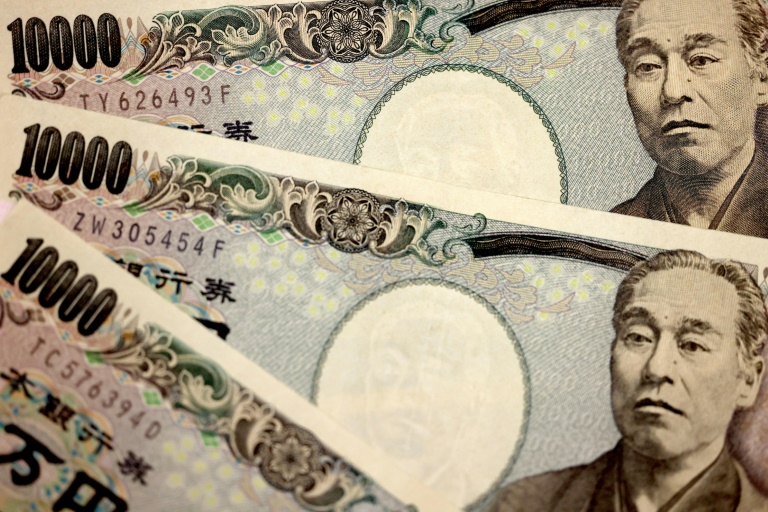
The yen hit its lowest level against the dollar in two decades on Wednesday, extending recent falls as the gap widens between Japan’s ultra-loose monetary policy and Fed tightening.

Despite being traditionally considered a safe-haven currency, uncertainty fuelled by Russia’s war in Ukraine has not caused the yen to strengthen.

Instead, moves by the US Federal Reserve towards a more aggressive policy and the shock of rising oil prices in Japan — a major importer of fossil fuels — have pushed the currency lower, analysts say.

One dollar bought 126 yen at around 0630 GMT on Wednesday, the lowest rate since 2002.

“The Japanese yen has been one of the weakest currencies anywhere in the world this year,” Dutch banking group ING said in a recent commentary.

“Driving the rally has been the perfect storm of a hawkish Federal Reserve, a dovish Bank of Japan (BoJ), and Japan’s negative terms of trade shock as a major fossil fuel importer.”

The yen had already lost 10 percent of its value against the dollar in 2021 after four years of steady strengthening.

The US central bank has taken a hawkish tone as it embarks on an aggressive tightening path, pushing up American treasury yields which have strengthened the dollar against the yen.

Earlier on Wednesday, Bank of Japan governor Haruhiko Kuroda said the bank would maintain its monetary easing policies in a bid to reach its long-held two-percent inflation target.

“Given the economy and price situation, the Bank of Japan will seek to realise its two-percent inflation target… by resiliently continuing its current powerful monetary easing,” he said.

Swiss Bank UBS said a weaker yen would likely hit Japanese households’ purchasing power and domestic-oriented small businesses who will face higher import costs.

“The government is offering fiscal supports and most likely will expand the supports. We think the JPY purchase intervention is possible if the pace of depreciation is regarded as too fast,” it said in a note.

“We cannot completely deny the possibility of the BoJ adjusting policy to cope with public criticism” on the yen’s depreciation, UBS added, noting that the bank under Kuroda “has been quite flexible and pragmatic in the past”.

Prime Minister Fumio Kishida did not comment directly on the yen’s fall when asked on Tuesday, but emphasised the importance of stability in foreign exchange rates.

“I will refrain from commenting on the level of exchange rates, but their stability is important and I think rapid fluctuations are undesirable,” he said.

War crime, crime against humanity, genocide: What's the difference?

US President Joe Biden has accused Russia’s forces of committing “genocide” in Ukraine, saying Vladimir Putin appears intent on “trying to wipe out the idea” of a distinct Ukrainian identity.

Ukrainian President Volodymyr Zelensky too has accused Russia of genocide over the discovery of hundreds of bodies of civilians in areas that were controlled by Russian forces and labelled the bloody siege of the southern port of Mariupol a “crime against humanity”.

We look at the different categories of the most serious crimes known to man, which the International Criminal Court (ICC) in The Hague was set up to prosecute. 

Neither Russia nor Ukraine are parties to the ICC but Kyiv has accepted the court’s jurisdiction for crimes committed on its territory since Russia’s invasion of Crimea in 2014. 

The court opened a probe into suspected war crimes in Ukraine on March 3 this year.

– What is a war crime? –

War crimes are serious violations of international law against civilians and combatants during  armed conflict.

The parameters of what constitutes a war crime are set out in Article 8 of the 1998 Rome Statute that established the ICC.

It defines them as “grave breaches” of the 1949 Geneva Conventions covering more than 50 scenarios, including killing, torture, rape and the taking of hostages as well as attacks on humanitarian missions.

Article 8 also covers deliberate attacks on civilians or “towns, villages, dwellings or buildings which are undefended and which are not military objectives” as well as the “deportation or transfer of all or parts of the population” of an occupied territory.

Ukraine’s authorities say they have received 5,600 complaints of alleged war crimes by Russian forces since the invasion began on February 24.

– What is a crime against humanity? –

The notion of such a crime was first laid down on August 8, 1945, and codified in article 7 of the Rome Statute. It involves “a widespread or systematic attack directed against any civilian population” including “murder” and “extermination” as well as “enslavement” and “deportation or forcible transfer”. 

Crimes against humanity can occur in peace-time and include torture, rape and discrimination, be it racial, ethnic, cultural, religious or gender-based.

– What is genocide? –

Genocide as a legal concept dating back to the Nuremburg trials of Nazi war criminals, with Polish-Jewish lawyer Raphael Lemkin coining the term to describe the Nazi extermination of six million Jews. 

The crime of genocide was formally created in the Genocide Convention of 1948 to describe “acts committed with intent to destroy, in whole or in part, a national, ethnical, racial or religious group”.

Genocide is a “very specific international crime” which is difficult to prove, says Cecily Rose, professor of international law at the University of Leiden in the Netherlands, noting that it demands proof of the “mental motivation” behind it.

– Newcomer: crime of aggression –

The ICC added a crime of aggression to its remit in 2017 to include attacks on “the sovereignty, territorial integrity or political independence” of another country.

The offence aims to ensure that political and military leaders are held accountable for invasions, but it cannot be used against the dozens of ICC members that have not recognised the court’s jurisdiction for the crime, nor against non-members.

Legal experts say bringing such a case against Russia’s president may require the establishment of a special tribunal for Ukraine.

UK inflation strikes 30-year high

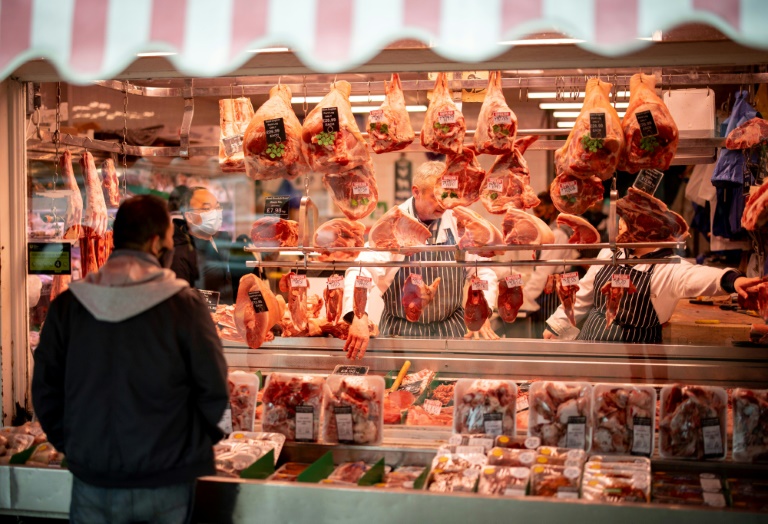
Britain’s annual inflation rate soared to the highest level in three decades last month as energy prices rocket, official data showed Wednesday, worsening a cost-of-living crisis.

Inflation surged to 7.0 percent in March from 6.2 percent in February, the Office for National Statistics said in a statement.

“Broad-based price rises saw annual inflation increase sharply again in March,” said ONS chief economist Grant Fitzner. 

“Amongst the largest increases were petrol costs.”

Prices of restaurant meals and hotel rooms also rose steeply last month after falling a year earlier during a pandemic lockdown in the UK.

Costs are surging worldwide as economies reopen from pandemic lockdowns and on fallout from the war in Ukraine.

US inflation rose by a huge 8.5 percent over the 12 months to March, the biggest jump in four decades, official data showed Tuesday.

Sharp price rises across the board are forcing central banks around the world to hike interest rates, curbing economic growth recovery.

European Central Bank governors meet Thursday to ponder record-high inflation in the eurozone and fresh economic uncertainty caused by the war in Ukraine, with policymakers signalling a willingness to take action sooner rather than later.

The US Federal Reserve and the Bank of England have already announced their first rate hikes to combat price pressures, leaving the ECB looking out of step.

– ‘Worrying time’ –

The Bank of England has predicted that UK annual inflation could reach double figures by the end of the year.

“We’re seeing rising costs caused by global pressures in our supply chains and energy markets which could be exacerbated further by Russian aggression in Ukraine,” Britain’s finance minister Rishi Sunak said Wednesday.

“I know this is a worrying time for many families,” added the embattled chancellor of the exchequer.

Sunak, along with Prime Minister Boris Johnson, confirmed Tuesday that they had been fined for breaching Covid-19 lockdown laws.

British cost-of-living is set to soar even higher owing to an April tax hike on UK workers and businesses and a fresh surge in domestic energy bills that kicked in this month.

“Soaring energy and fuel prices were the main drivers of the rise in (UK) inflation in March, but we are paying more for everything,” Myron Jobson, senior personal finance analyst at Interactive Investor, said following Wednesday’s data.

“Supply shortages and production bottlenecks owing to the pandemic have forced firms to raise their prices of late,” while Russia’s invasion of Ukraine “has made the outlook for inflation worse”, he added.

China's imports fall as Covid outbreaks, lockdowns hit demand

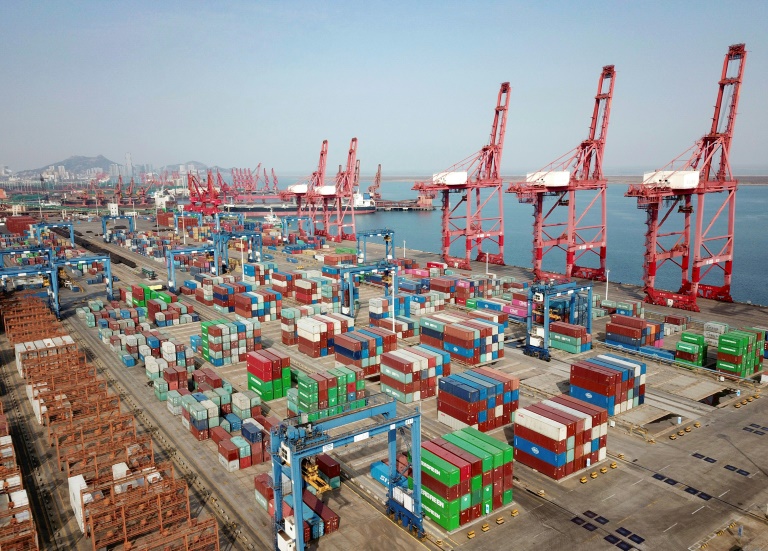
China’s imports shrank on-year in March for the first time in nearly two years, official data showed Wednesday, hit by coronavirus lockdowns and weakening consumer demand.

The world’s second-largest economy has stuck to a strict zero-Covid strategy as it tries to contain outbreaks fuelled by the Omicron variant in recent months.

The economic costs, however, have mounted — the waves of infections and resulting lockdowns have kept consumers at home, halted business operations and snarled supply chains.

Imports dropped 0.1 percent from a year ago, according to data from China’s Customs Administration — the first such decline since August 2020, in the early phase of the pandemic.

The figure was much lower than the forecast from a Bloomberg poll of economists, and a far cry from the 15.5 percent growth for the first two months this year.

“Some unexpected factors in the international and domestic environment have gone beyond our anticipation,” Customs Administration spokesman Li Kuiwen told reporters.

“Achieving the goal of stabilising foreign trade will require greater effort.”

China’s export growth slowed as well in March to 14.7 percent, down from 16.3 percent in the first two months.

While Li did not specify external factors, the drop in exports came during a period where Russia’s invasion of Ukraine and the shockwaves from it have hurt business sentiment and consumer confidence globally.

“The March trade data highlighted the impact of pandemic-related disruptions on economic activity and consumer spending,” said Rajiv Biswas, Asia-Pacific chief economist at S&P Global Market Intelligence.

He added that recent lockdowns in major cities such as Shanghai and Shenzhen “hit consumer spending hard”, while the temporary shutdown of manufacturing plants impacted demand for imported raw materials.

China’s balance of trade in March was $47.4 billion.

European demand for Chinese exports could be “a key risk”, Biswas said, given that “macroeconomic shocks from the Russia-Ukraine war, notably higher oil and gas prices and rising inflation pressures, are resulting in a downgraded EU GDP growth outlook in 2022”.

Customs spokesman Li said that in the first quarter, exports of mechanical and electronic products rose 9.8 percent from a year ago, with increases in solar cells, lithium batteries and automobiles.

“The largest declines in outbound shipments were of electronics, furniture and recreational products, pointing to an unwinding of pandemic-linked demand for these goods,” Julian Evans-Pritchard, senior China economist at Capital Economics.

Bankrupt Sri Lanka asks citizens abroad to send home cash

Sri Lanka urged its citizens overseas to send home money to help pay for desperately needed food and fuel Wednesday after announcing a default on its $51 billion foreign debt.

The island nation is in the grip of its worst economic crisis since independence in 1948, with severe shortages of essential goods and regular blackouts causing widespread hardship. 

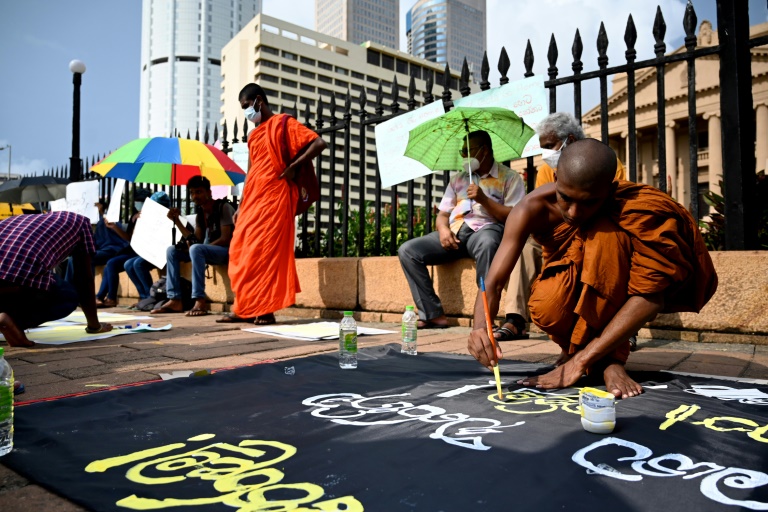
Authorities are weathering intense public anger and spirited protests demanding the government’s resignation ahead of negotiations for an International Monetary Fund bailout.

Central bank governor Nandalal Weerasinghe said he needed Sri Lankans abroad to “support the country at this crucial juncture by donating much needed foreign exchange”.

His appeal came a day after the government announced it was suspending repayments on all external debt, which will free up money to replenish scant supplies of petrol, pharmaceuticals and other necessities. 

Weerasinghe said he had set up bank accounts for donations in the United States, Britain and Germany and promised Sri Lankan expatriates the money would be spent where it was most needed. 

The bank “assures that such foreign currency transfers will be utilised only for importation of essentials, including food, fuel and medicines”, Weerasinghe said in a statement.

Tuesday’s default announcement will save Sri Lanka about $200 million in interest payments falling due on Monday, he said, adding that the money would be diverted to pay for essential imports.

Weerasinghe’s appeal has so far been greeted with scepticism from Sri Lankans abroad.

“We don’t mind helping, but we can’t trust the government with our cash,” a Sri Lankan doctor in Australia told AFP, asking for anonymity.

A Sri Lankan software engineer in Canada said he had no confidence that the money would be spent on the needy.

“This could go the same way as the tsunami funds,” he told AFP, referring to millions of dollars the island received in aid after the December 2004 disaster, which claimed at least 31,000 lives on the island.

Much of the foreign cash donations meant for survivors was rumoured to have ended up in the pockets of politicians, including current Prime Minister Mahinda Rajapaksa, who was forced to return tsunami aid funds credited to his personal account.

– Snowballing crisis –

Sri Lanka’s snowballing economic crisis began to be felt after the coronavirus pandemic torpedoed vital revenue from tourism and remittances. 

The government imposed a wide import ban to conserve dwindling foreign currency reserves and use them to service the debts it has now defaulted on.

But the resulting shortages have stoked public resentment, with day-long lines forming across the island for petrol and kerosene, the latter used for cooking stoves in poorer households. 

At least eight people have died while waiting in fuel queues since last month.

Economists say the crisis has been made worse by government mismanagement, years of accumulated borrowing and ill-advised tax cuts.

Crowds have attempted to storm the homes of government leaders, and security forces have dispersed protesters with tear gas and rubber bullets. 

Thousands of people were camped outside President Gotabaya Rajapaksa’s seafront office in the capital Colombo for a fifth straight day of protests Wednesday calling for him to step down.

Death toll from Philippines landslides, floods rises to 59

The death toll from landslides and floods in the Philippines rose to 59 on Wednesday, official figures show, as rescuers dug up more bodies with bare hands and backhoes in villages crushed by rain-induced avalanches.

Most of the deaths from tropical storm Megi — the strongest to hit the archipelago nation this year — were in the central province of Leyte, where a series of landslides devastated communities.

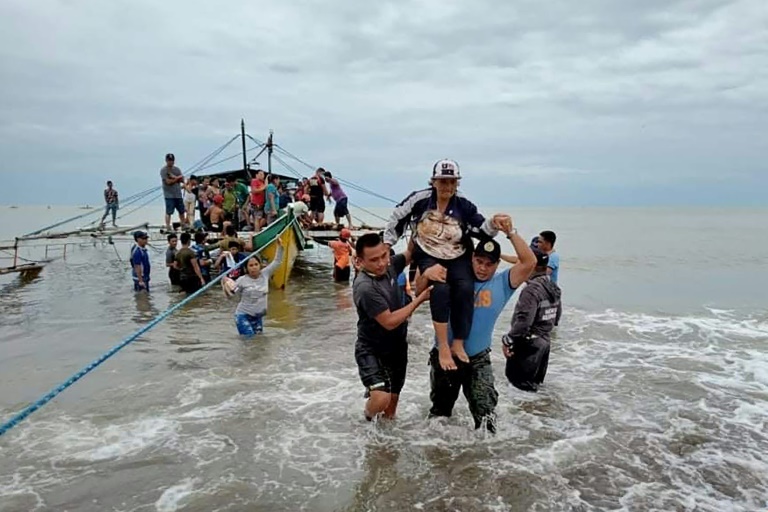
Rescuers used boats to reach survivors in Pilar, a village of about 400 people in Abuyog municipality, where a torrent of mud and earth pushed houses into the sea on Tuesday and police reported five deaths.

A rumbling sound like “a helicopter” alerted Ara Mae Canuto, 22, to the landslide hurtling towards her family’s home. She tried to outrun it, but was swept into the water and nearly drowned. 

“I swallowed dirt, and my ears and nose are full of mud,” Canuto told AFP by telephone from her hospital bed where she is being treated for cuts and bruises. Her father died and her mother has not been found.

The disaster-prone region is regularly ravaged by storms, including a direct hit from Super Typhoon Haiyan in 2013, and scientists warn they are becoming more powerful as the world gets warmer because of human-driven climate change.

Baybay City is also reeling after waves of sodden soil smashed into farming settlements over the weekend, killing at least 48 people and injuring over 100, local authorities said. Twenty-seven are still missing, they added. 

Aerial photos showed a wide stretch of mud that had swept down a hill of coconut trees and engulfed Bunga village, where only a few rooftops poked through the now-transformed landscape.

“We were told to be on alert because a storm was coming, but they did not directly tell us we needed to evacuate,” said Bunga farmworker Loderica Portarcos, 47, who lost 17 relatives and a friend in the landslide.

Portarcos braved heat and humidity as she advised a backhoe operator where to dig for three bodies still embedded in the soft soil which had started to smell of rotting flesh.

“Our dead relatives are all in the morgue, but there will be no time for a wake to mourn them because the mayor told us they smell bad,” she said.

– ‘Completely devastated’ – 

Three people were also killed in the central province of Negros Oriental and three on the main southern island of Mindanao, according to the national disaster agency.

The military has joined coast guard, police and fire protection personnel in the search and rescue efforts, which have been hampered by bad weather.

The death toll from Megi is expected to rise as the focus switches from searching for survivors to retrieving bodies. 

Abuyog police chief Captain James Mark Ruiz told AFP more boats were needed for victims in Pilar after landslides cut off road access to the community. 

“This has been the catastrophe that broke my heart,” Abuyog Mayor Lemuel Gin Traya wrote on Facebook, saying Pilar had been “completely devastated”. 

Around 50 survivors have been ferried from the community, the Bureau of Fire Protection said on Facebook on Tuesday.

Photos posted by the agency showed buildings crushed or turned over by the force of the landslide and debris in the water. 

Medical workers rushed to treat victims as they were brought to shore, applying bandages to cuts and providing emergency blankets. One woman had her right arm in a splint.

While Pilar survivor Canuto counts herself lucky to be alive, she said “many of us died and a lot are missing too”.

Whipping up seas, Megi forced dozens of ports to suspend operations and stranded thousands of people at the start of Holy Week, one of the busiest travel periods of the year in the Philippines.

It came four months after super typhoon Rai devastated swathes of the country, killing more than 400 and leaving hundreds of thousands homeless.

The Philippines — ranked among the most vulnerable nations to the impacts of climate change — is hit by an average of 20 storms every year.

Endangered pangolins get fresh chance in S.African clinic

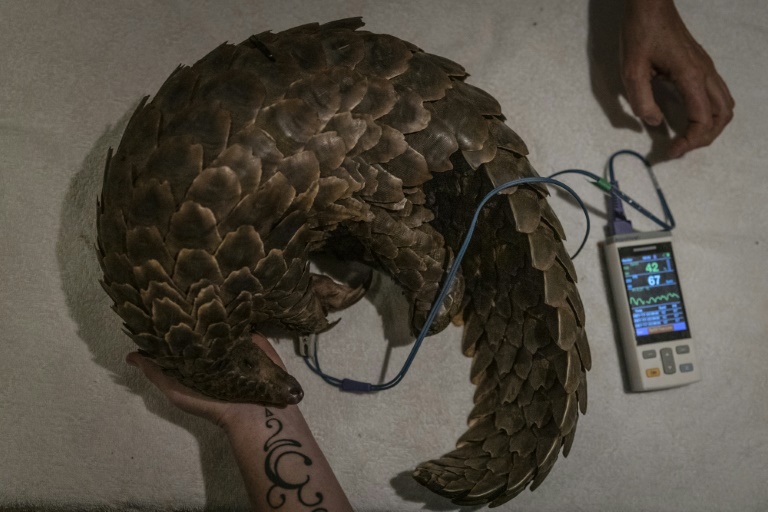
The hospital room is air-cooled to feel like a pangolin’s burrow. The patient, Lumbi, is syringe-fed with a protein-packed smoothie, given a daily dose of medicine and has his vital signs checked.

Lumbi is being treated for a blood parasite after he was rescued from traffickers during a police sting in South Africa’s northern Limpopo province late last year.

He and several other pangolins in the room are patients of Johannesburg Wildlife Veterinary Hospital, founded in 2016 to treat and rehabilitate indigenous wildlife.

They were confiscated from poachers in South Africa and neighbouring countries, including Namibia, Mozambique and Zimbabwe.

Many pangolins are in a horrendous state when they are rescued and need of medical care, after being kept in sacks and car boots for weeks with no food or water.

“It’s like an ICU (intensive care unit) for pangolins,” said Nicci Wright, the wildlife rehabilitation specialist attending to Lumbi.

The pangolins are kept at a secret site during treatment, which takes anything from weeks to months, before they can be released back into the wild.

Although pangolins have existed for around 80 million years, medically little is known about them. 

– Pangolins ‘are like people’ –

“They are so different to other animals. They really are,” said Wright, who has been working with pangolins since 2008.

Sometimes vets have to fiddle with various treatment regimes to provide the appropriate medication.

“The actual veterinary medicine and rehabilitation process hasn’t been well documented and very little is actually know about the African species,” said Wright. 

Vets administer standard treatments used on other mammals such as cats and dogs. Often they work.

“Sometimes to you just have to take a chance, and so far we have taken chances and we have been very successful and they have responded very well,” said vet Kelsey Skinner.

“It’s just a leap of faith every time you try something,” said Skinner, 30, after giving Lumbi his daily dose of meds.

Having cared for sick pangolins for several years, Skinner discovered that, like people, they have different personalities.

The scaly-skinned, insect-eating mammals are solitary, nocturnal animals.

“They are like people. They have just the most unique little personalities. 

“Some of them are shy. They don’t want to be touched. Others are very out there and play a lot in the mud. They are comedians,” she said.

“The level of personalities is like dealing with a whole lot of different people. Everyone is just so unique.”

– The most trafficked mammals –

Pangolins are believed to be the most trafficked mammals on earth. They’re prized for their scales — made of keratin, like human nails — which are used in Asia for their supposed medicinal properties.

Only found in the wild in Asia and Africa, their numbers are plummeting under pressure from poaching. Some species are listed by wildlife watchdogs as critically endangered.

It’s not known how many pangolins are left on the planet. 

The ward that now cares for Lumbi was also home, until recently, to a pangolin named Steve. Last month, Steve was released back into the wild, where he belongs, after making a full recovery.

Gareth Thomas is a volunteer pangolin walker who walked Steve weekly during the seven months of preparation for his release. 

“I’ve been with him since day one. I was there when he got pulled out of the box from the poachers,” he said during one of their final walks before the release.

After a six-hour drive, Steve was set free into the vast 23,000-hectare Manyoni Game Reserve in southern KwaZulu-Natal province.

Pangolin monitor Donald Davies from Zululand Conservation Trust offloaded a specially designed crate from the van, with Steve inside and opened it.

With two telemetry devices attached to his scales, the pangolin cautiously stepped out, sniffing around and casually walking away to find ants for an afternoon grub.

“He has all the skills he needs to survive in the wild now,” said Davies.

Freeing them into the wild is a crucial process to ensure the endangered mammals survive after the huge investment poured into their treatment and rehabilitation.

“The release process is one of the most important, because it has to be done correctly,” said Wright.  

The gentle creatures can only be released into a relatively safe area, such as a well-patrolled private game reserve, to avoid them falling into the poachers’ clutches again.

And, in addition, the habitat has to be right. “We need to be absolutely sure they are finding the right food, they are finding the burrows. Otherwise they will simply die”.

Biden accuses Putin's forces of 'genocide' in Ukraine

US President Joe Biden has for the first time accused Vladimir Putin’s forces of committing genocide in Ukraine, where Russia is intensifying its campaign to take the strategic port city of Mariupol. 

Biden’s accusation comes as Moscow — already accused by the West of widespread atrocities against civilians — is feared to be readying a massive onslaught across Ukraine’s east that Washington warned might involve chemical weapons.

“Yes, I called it genocide,” Biden told reporters on Tuesday, hours after employing the term during a speech in Iowa — its first use by a member of his administration.

“We’ll let the lawyers decide internationally whether or not it qualifies, but it sure seems that way to me,” Biden said. “It’s become clearer and clearer that Putin is just trying to wipe out the idea of even being able to be a Ukrainian.”

President Volodymyr Zelensky — who has repeatedly accused Moscow of attempted “genocide” — swiftly responded by tweeting at Biden: “True words of a true leader.”

“Calling things by their names is essential to stand up to evil,” Zelensky wrote — renewing his appeal for more heavy weapons to “prevent further Russian atrocities”.

Biden had previously described Putin as a “war criminal” as the discovery of hundreds of civilians reportedly killed in Bucha, outside Kyiv, sparked global revulsion.

But he had stopped short of using the term “genocide,” in line with longstanding US protocol, because of its strict legal definition and the heavy implication the accusation carries. 

– Tunnel warriors –

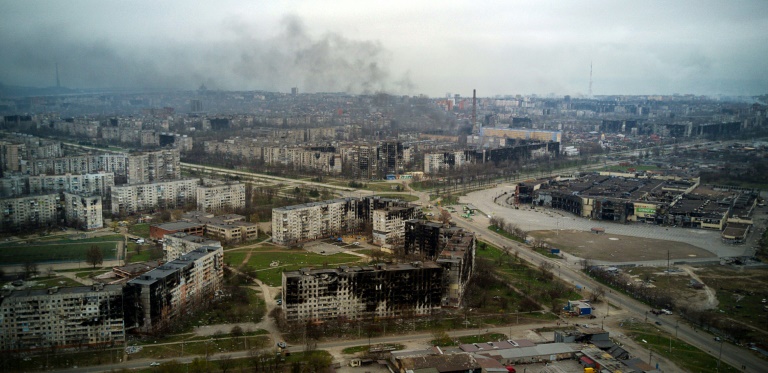
While the toll on towns occupied during the month-long offensive to take Kyiv like Bucha is still coming to light, the heaviest civilian toll is feared to be in Mariupol, where Zelensky said he believed Russia had killed “tens of thousands”.

Moscow is believed to be trying to connect occupied Crimea with Russian-backed separatist territories Donetsk and Lugansk in Donbas, and has laid siege to the strategically located city. 

Experts say its fall is inevitable, but as fighting drags toward its seventh week, the Ukrainian army is still clinging on.  

On Wednesday the Land Forces of Ukraine said on Telegram that air strikes on the city continued, particularly targeting its port and the huge Azovstal iron and steel works. 

The latter maze-like complex has been a focus of urban resistance in Mariupol, with fighters using a tunnel system below the vast industrial site to slow Russian forces down. 

“It’s a city within a city,” said Eduard Basurin, a representative for pro-Russian separatists in the eastern Donetsk region. 

“There are several underground levels that date back to Soviet times which you can’t bombard from above. You have to go underground to clean them out, and that will take time.”

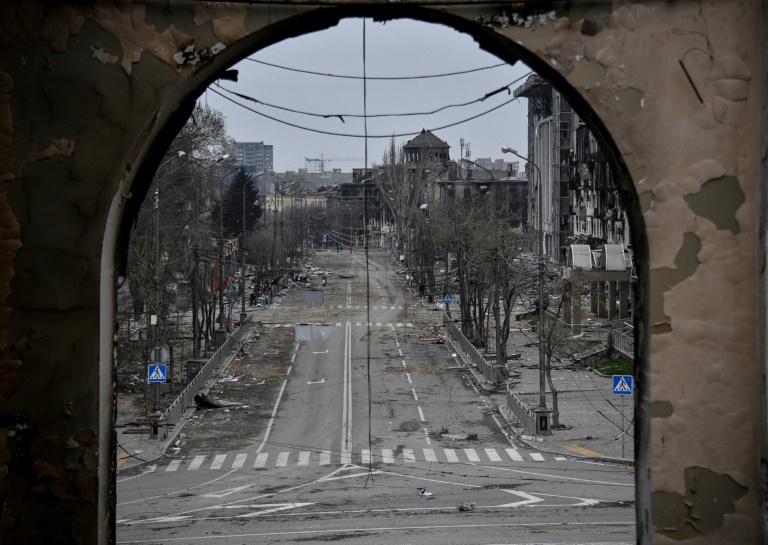
Above ground, AFP journalists in Mariupol as part of a Russian military embed saw the charred remains of the city, including the theatre where 300 people were feared killed in Russian bombardment last month.

Reports emerged on Monday from Ukraine’s Azov battalion that a Russian drone had dropped a “poisonous substance” in the area, with people experiencing respiratory failure and neurological problems.

US Secretary of State Antony Blinken said he was unable to confirm the allegations, but that Washington had “credible information” Russia might use tear gas mixed with chemical agents in the besieged port.

The world’s chemical weapons watchdog said it was “concerned” by the unconfirmed reports coming from Mariupol, and was “monitoring closely”.

Pentagon spokesman John Kirby warned the use of such weapons by Moscow would “elicit a response not just from the United States, but from the international community,” without elaborating.

– ‘Devil incarnate’ –


Heavy bombardment continued across the east as civilians were urged to flee ahead of an expected Russian troop surge around the Donbas region, notably near the town of Izyum. 

US private satellite firm Maxar Technologies published images it said showed ground forces moving towards Russia’s border with Ukraine, likely in preparation for an offensive. 

In Ukraine, Maxar said it had noted convoys of military equipment travelling in and near the Donbas region — adding they comprised of around 200 vehicles including tanks, artillery and armoured personnel carriers.  

Heeding the calls from authorities to flee, a steady stream of residents left by bus and train from the cities of Kramatorsk and neighbouring Sloviansk. 

Kramatorsk is the Ukrainian military’s main hub for its operations in the east, and so potentially a key target.

“What is happening is inhuman, (Putin) is a fascist. I don’t know what to call him — a devil incarnate,” said 82-year-old Valentina Oleynikova, who was fleeing the city with her husband.

With little hope of a quick end to fighting, Putin pledged Moscow would proceed on its own timetable, rebuffing repeated international calls for a ceasefire.

“Our task is to fulfil and achieve all the goals set, minimising losses. And we will act rhythmically, calmly, according to the plan originally proposed by the General Staff,” he told a news conference with Belarusian President Alexander Lukashenko.

– ‘They will remember’ –

Putin also dismissed as “fake” claims that hundreds of civilians were killed in Bucha under Russian occupation.

Bucha Mayor Anatoly Fedoruk said more than 400 people had been found dead after Moscow’s forces withdrew, and 25 women reported being raped, as the town prepares for the return of residents who fled the fighting.

“What people will find in their homes is shocking, and they will remember the Russian occupiers for a very long time,” he said.

In nearby Gostomel, war crimes investigators were beginning a grim probe, exhuming bodies to document the cause of death. 

One of those was that of the mayor, who the council said was “handing out bread to the hungry” when he was shot by Russian forces.

His is among the fates that are known.

“The town council has counted the number of missing at up to 400,” said regional prosecutor Andriy Tkach. “Perhaps not all the bodies are found.”

Zelensky sounded the alarm Tuesday about snowballing allegations of rape and sexual assault by Russian forces.

“Hundreds of cases of rape have been recorded, including those of young girls and very young children. Even of a baby,” the Ukrainian leader told Lithuanian lawmakers via video link.

– Tycoon swap –

In a separate development, Zelensky has offered to swap a pro-Kremlin tycoon — arrested after escaping from house arrest — for Ukrainians captured by Russia.

Zelensky posted a picture of a dishevelled-looking Viktor Medvedchuk — one of the richest people in Ukraine, who counts Putin among his personal friends — with his hands in cuffs and dressed in a Ukrainian army uniform.

“I propose to the Russian Federation to exchange this guy of yours for our boys and our girls who are now in Russian captivity,” Zelensky said in a video address on Telegram.

Medvedchuk, a hugely controversial figure in Ukraine, was under house arrest over accusations of attempting to steal natural resources from Russia-annexed Crimea and of handing Ukrainian military secrets to Moscow. 

Hong Kong leadership candidate says one-horse race 'not easy'

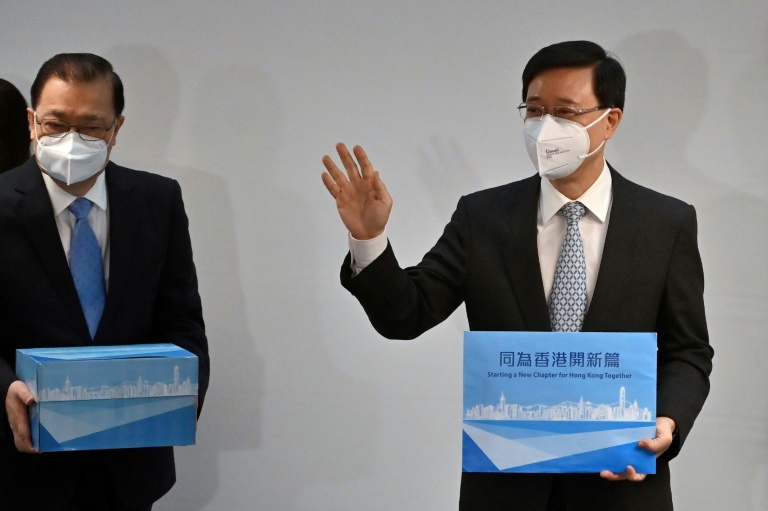
Hong Kong’s former security chief said it was “not easy” to run as the only candidate to become the city’s next leader, as he announced on Wednesday that he had secured enough nominations to enter the poll.

John Lee, 64, is expected to be anointed the business hub’s new chief executive by a committee of 1,500 Beijing loyalists next month.

Hong Kong media have widely reported that Lee will, at Beijing’s request, face no rivals in the election.

Lee officially registered his candidacy with the city’s election watchdog on Wednesday with 786 nominations from the committee.

That number surpasses the legal threshold needed for him to win the May 8 poll.

Asked by a reporter whether he faced an easier journey without rivals, Lee replied: “It is not easy because I have been working very hard to explain to various members what my election platform will be like.”

Lee has yet to publicly release a manifesto or any concrete policies, although he said one was on the way. 

“It has just been a few days since I announced to stand for the election. Writing the platform needs time,” Lee said.

The nomination period closes on Saturday.

When announcing his bid last week, Lee gave three broad priorities for his government: being “results-orientated”, enhancing Hong Kong’s competitiveness and consolidating the city’s further development.

He has since shuttled between various pro-government groups and held five online conferences with the Election Committee members to gather support.

“I think members agree with these three directions that is why they have given me the nomination but it is a hard effort,” Lee said.

Chan King-cheung, former chief editor of the Hong Kong Economic Journal, wrote in a newspaper column on Wednesday that Lee should still explain to the public what his policies are, even though ordinary residents do not get to vote. 

“To say ‘result-oriented’ without defining the result is so vague and empty that the ‘voters’ can’t tell what promises he has actually made,” Chan wrote. 

Mariupol's tunnel warriors seek to slow Russian onslaught

As Russian forces close in on the southern Ukrainian port city of Mariupol, a small number of resistance fighters hope to slow them down using a tunnel system below a vast industrial site as their base.

Experts say the fall of the city, seen as strategically vital for Russian plans to attack eastern Ukraine, is inevitable.

But holdouts in their underground bases hope to make conquering the Sea of Azov port as hard as possible for the attackers.

The urban landscape where the Ukrainian resistance plans to take on the invaders seems almost tailor-made for guerrilla warfare, with sprawling rail lines, warehouses, coal furnaces, factories, chimneys and tunnels.

The maze-like area is a metal works complex, Azovstal, owned by Metinvest, which is run by Ukraine’s richest man Rinat Akhmetov.

It has been the focus of urban fighting in Mariupol, just like the nearby Azovmash factory which makes rail components, cranes and other large metal structures.

“It’s a city within a city,” said Eduard Basurin, a representative for pro-Russian separatists in the eastern Donetsk region. 

“There are several underground levels that date back to Soviet times which you can’t bombard from above. You have to go underground to clean them out, and that will take time.”

Entering the tunnels would be all but impossible for Russian troops, according to Alexander Grinberg, analyst at the Jerusalem Institute for Strategy and Security.

– ‘They can try’ –

“They can try, but they’ll be slaughtered because the defenders of the tunnel will absolutely have the tactical upper hand,” he told AFP.

Fighters have in the past used tunnel systems to great effect in their struggle against superior forces.

The Viet Cong made the vast Cu Chi tunnel system near Saigon a base for attacks against US troops and Hamas has used tunnels in their fight against the Israeli army.

The Islamic State group’s tunnel system in Mosul, Iraq, allowed its fighters to surprise American troops with sudden appearances seemingly out of nowhere.

But the most memorable example dates back to World War II and the battle of Stalingrad with its fierce fighting in the Red October industrial complex.

“The Soviets used underground passages, sewers and tunnels to get behind German lines,” a French military source told AFP.

A sapper unit discovered a former factory used by German troops, stacked three tonnes of explosives underneath and blew up the entire complex, burying the Germans in the rubble, the source said.

The astute use of tunnels has lost none of its effectiveness in the 80 years since, rendering enemy artillery, air strikes and snipers virtually useless.

Satellite surveillance is also of limited use against combatants hiding below ground, as is technical intelligence, the spying on enemy weapons.

However, as analysts point out, the underground system only works if the network is vast and fighters have enough ammunition, food and water, which requires meticulous advance planning.

Soldiers deployed underground also need extremely good training to be operational in this unusual combat environment, said James Rands at British defence intelligence specialists Janes.

– ‘Inherent dangers’ –

“The enclosed spaces mean engagements occur at shorter ranges, limiting the effectiveness of some small arms,” he said.

Close-range use of weapons also carries “a significant risk of tunnel collapse and inherent dangers to the forces employing them”, he said.

In addition, commanding troops underground is difficult because standard communications do not work well, and tunnel networks are not usually well mapped, he said.

The evacuation of wounded soldiers is also very cumbersome, Rands added.

Despite all the advantages for the defenders, the tunnel network can possibly still be taken if, as is likely, the Ukrainians lack key equipment in sufficient quantity, such as night-vision gear, analysts said.

It may also be difficult to counter the potential use by the Russians of large quantities of water to flood the tunnels, or of gas or chemical products to force the Ukrainians to the surface.

Although Russian President Vladimir Putin said Tuesday that Russia was pursuing its Ukraine operation “calmly”, there is a chance that the tunnel wars will be anything but — and last for some time.

Close Bitnami banner
Bitnami