World

iPhone maker Pegatron halts Shanghai production over Covid

Key iPhone maker Pegatron has halted operations at two subsidiaries in the Chinese cities of Shanghai and Kunshan, as global supply chains feel the pinch of Beijing’s strict zero-Covid measures.

The business hub of Shanghai has become the heart of China’s biggest Covid-19 outbreak since the virus surfaced more than two years ago.

The city of 25 million has remained almost entirely locked down since the start of the month.

“We have temporarily suspended work,” said Pegatron in a filing to the Taiwan Stock Exchange on Tuesday.

The Taiwanese firm said it “actively cooperates with local authorities” and would try to resume operations as soon as possible.

The suspensions apply to two of its subsidiaries, in Shanghai and nearby Kunshan city.

Stay-at-home orders and stringent testing rules have strained supply chains in and around Shanghai, home to the world’s busiest container port and a critical gateway for foreign trade.

China reported nearly 28,000 local virus cases on Wednesday, the vast majority in Shanghai.

Many factories have been forced to halt operations as virus cases have surged, while some staff have been living in their workplaces as businesses struggle to operate.

Pegatron’s suspensions mark the latest blow to Apple, which has seen disruptions at other suppliers’ assembly lines in recent months as Chinese cities struggle to curb virus outbreaks.

In March, another major supplier Foxconn halted operations in the Chinese tech hub of Shenzhen.

Foxconn has “resumed fundamental operations” in Shenzhen as of late March, the company said.

Chinese authorities have struggled to maintain the flow of goods across the country as tough virus controls slow movement.

A Transport Ministry circular issued late Tuesday barred the “blocking of road transportation” vehicles and personnel, ordering more efficient Covid-19 screening along transport routes.

Anxious about the spring farming season and food supplies, officials in virus-hit areas such as the northeastern province of Jilin have also issued travel passes to let agricultural workers return to farmland on chartered buses.

“The Chinese economy has been facing a rising risk of recession since mid-March”, Nomura analysts warned this week, citing severe disruptions to the delivery of exports, with coastal areas hit hard by controls to rein in the virus.

Mayor exhumed as Ukraine confronts grim cost of war

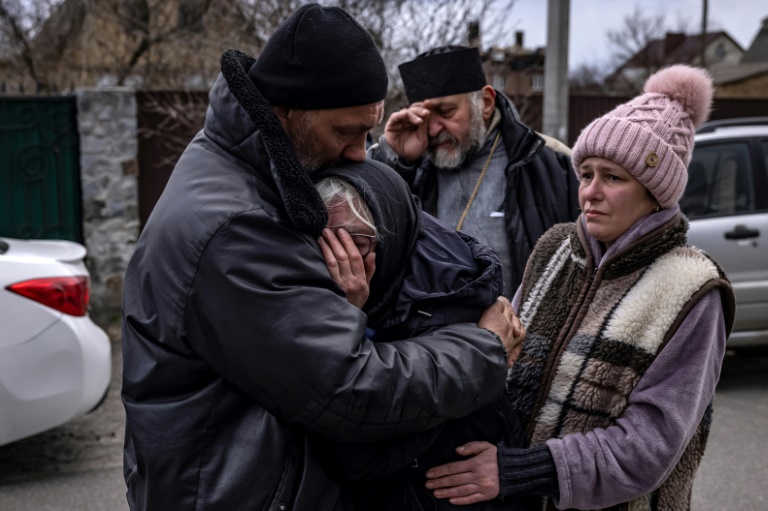
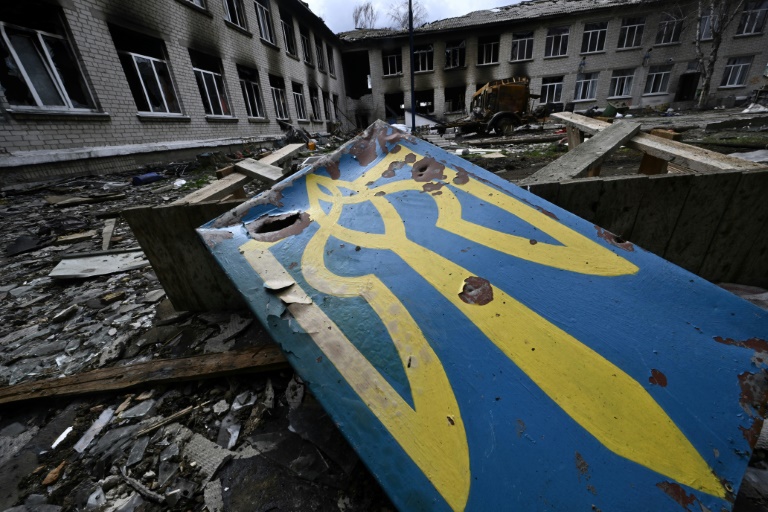
The funeral of the Gostomel mayor plays out in reverse. His body is pulled out from the ground, the crowd of mourners disperses, then a priest hugs his weeping wife and says a few kind words.

Yuriy Prylypko “was a great patriot, a great man”, says Father Petro Pavlenko. “He was loved.”

Prylypko was killed on March 7, after Russian forces rolled into the Kyiv commuter town he managed. The municipal council said he was shot dead while “handing out bread to the hungry and medicine to the sick”.

Pavlenko collected his buckled corpse in a wheelbarrow and oversaw a burial in a shallow grave between the Church of the Intercession of the Blessed Virgin and a pistachio green local government building.

On Tuesday, AFP saw the grave exhumed as Ukrainian war crime investigators opened a probe.

Workers hauled the mayor from the earth using a wide yellow cord. Police videotaped his wounds, including a bloody head injury.

His wife Valentyna wept as a group of around 30 mourners looked solemnly on. Then the body was sealed in a crumpled black body bag and placed in a van.

– ‘Shot without any reason’ –

Gostomel — a town on the cusp of Kyiv — is where Russia’s northern offensive was turned back by Ukraine.

After President Vladimir Putin ordered the invasion on February 24, troops stationed in Belarus swiftly occupied the area. However, they were hammered by air strikes and could advance no further.

Since Russia called off its assault on the capital to regroup for a push in the east, Ukrainian authorities have retaken control and started to pick through the wreckage.

The town of Bucha — one short bridge south of Gostomel — has been the focus of international attention after AFP discovered the bodies of 20 people strewn along one single street.

Ukraine says Russian forces executed civilians, while the Kremlin denounced photos of the scene as fakery.

However Gostomel, the site of a bitter battle over an airfield coveted by Russian commanders, also witnessed its own share of suffering.

“The town council has counted the number of missing at up to 400,” said regional prosecutor Andriy Tkach. 

“We are figuring out who was shot. Perhaps not all the bodies are found.”

The mayor is among those whose fate is known.

“According to the preliminary information, he was shot without any reason, together with his driver,” says Tkach, observing the exhumation wearing a vest printed with the title “war times prosecutor”.

– A second funeral – 

In Gostomel on Tuesday the final moments of other citizens were also being pieced together. 

AFP saw the body of Oleksandr Karpenko pulled from a garden grave as his mother Lyudmyla paced the path in a frenzy of grief.

Lyudmyla, her head wrapped in a black shawl, fell to the ground as it departed in a van. Father Pavlenko comforted her as it left, mumbling words of consolation.

The bodies of Gostomel are taken to a refrigerated lorry trailer in nearby Bucha where they are stored awaiting autopsy and formal funeral rites.

It is cooled to 5.7 degrees Celsius (42 degrees Fahrenheit) and marked with a stamp reading “approved for transport of perishable foodstuffs”.

There are perhaps 30 or 40 body bags inside already, and two more trailers on standby for those still to come. 

“I have never done this before, but our citizens are murdered and we must bury every person in the right way,” said Igor Karpishen after loading a batch of the bodies.

“I don’t have any words to express these feelings.”

“Welcome to peace,” the 46-year-old says with a hint of hope as he slams the lorry door shut, closing the unhappiest chapter in the history of his home.

Lost golden toad heralds climate's massive extinction threat

Those lucky enough to have seen them will never forget.

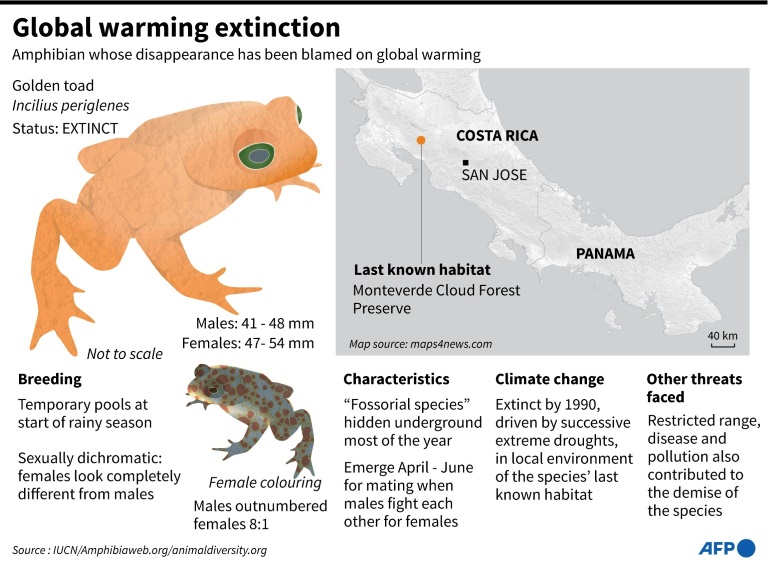
For just a few days every year, the elfin cloud forest of Costa Rica came alive with crowds of golden toads the length of a child’s thumb, emerging from the undergrowth to mate at rain-swelled pools.  

In this mysterious woodland the cloud drapes over mountain ridges and “the trees are dwarfed and wind-sculpted, gnarled and heavily laden with mosses,” said J Alan Pounds, an ecologist at the Monteverde Cloud Forest Preserve in Costa Rica.

“The soils are very dark and so golden toads would stand out like animal figurines. It was quite a spectacle.” 

Then in 1990, they were gone. 

The golden toad was the first species where climate change has been identified as a key driver of extinction.

Its fate could be just the beginning. 

For years, researchers have warned that the world is facing both a climate and a biodiversity crisis. Increasingly they say they are connected.

– One in 10 face extinction –

Even if warming is capped at the ambitious target of 1.5 degrees Celsius above pre-industrial levels, the UN’s Intergovernmental Panel on Climate Change says nearly one in 10 of all species face an extinction threat.

The golden toad was only found in Monteverde’s highland forest. So when trouble hit, the species was completely wiped out. 

“It was pretty clear about 99 percent of the population declined within a single year,” said Pounds, whose research into the disappearance of the golden toad was cited in the IPCC’s February report on climate impacts. 

Climate change was barely on the research radar when Pounds first arrived in Costa Rica in the early 1980s to study amphibians.

But global warming was already beginning to take its toll. 

After the disappearance of the golden toad, the Monteverde harlequin frog and others, researchers compared datasets on temperature and weather patterns with those on local species. 

They found not only the signature of the periodic El Nino weather phenomenon, but also trends linked to changes in climate.  

– Climate ‘trigger’ – 

The die-offs occurred after unusually warm and dry periods.

Pounds and his colleagues linked the declines to chytridiomycosis infection, but concluded that disease was only the “bullet — climate change was pulling the trigger.

“We hypothesised that climate change and resultant extreme events were somehow loading the dice for these kinds of outbreaks,” Pounds told AFP.

It was not an isolated incident. 

The expansion of the chytrid fungus globally, along with local climate change “is implicated in the extinction of a wide range of tropical amphibians,” according to the IPCC. 

The fingerprints of global warming have since been seen in other disappearances. 

The Bramble Cay melomys, a small rodent living on a low-lying island in the Torres Strait, was last seen in 2009.  

The only mammal endemic to the Great Barrier Reef, its populations were battered by sea-level rise, increased storm surges and tropical cyclones — all made worse by climate change.

Vegetation that provided its food plummeted from 11 plant species in 1998 to just two in 2014. It was recently declared extinct. 

Today, climate change is listed as a direct threat to 11,475 species assessed by the International Union for Conservation of Nature. Around 5,775 are at risk of extinction.

– #MeToo for species –

The main reason why climate change is increasingly cited as a threat to so many species is that its impacts are becoming more obvious, said Wendy Foden, the head of the IUCN’s climate change specialist group.

But there is also a growing understanding of the enormous variety of effects. 

Beyond extreme weather, warming can also cause species to move, change behaviour or even skew to having more male or female offspring. 

And that’s on top of other human threats like poaching, deforestation, overfishing and pollution. 

In 2019, a report by UN biodiversity report experts said one million species could disappear in the coming decades, raising fears that the world is entering a sixth era of mass extinction.

“It’s absolutely terrifying,” said Foden, adding that warnings of catastrophic biodiversity loss have often been overlooked.  

“We need a #MeToo movement for species, a whole wake up on what we are doing.” 

Almost 200 countries are currently locked in global biodiversity talks to try to safeguard nature, including a key milestone of 30 percent of Earth’s surface protected by 2030.

But Foden said the threat of climate change means that the response will have to go beyond traditional conservation. 

“That can’t happen anymore, even in the most remote wilderness, climate change will affect it,” Foden said. 

In some cases, people will need to choose which species to save. 

Take the endangered African penguin in South Africa, which Foden wrote about for the IPCC report on climate impacts. 

Forced to nest in the open after humans mined their guano nesting sites, the adults now have to swim ever further to find fish, likely because of a combination of overfishing and climate change. Meanwhile, the chicks in exposed nests can die from heat stress. 

“We are down to the last 7,000 breeding pairs. At this point, every penguin counts,” Foden said. 

– Cloudless forest –

In Monteverde, even the clouds have changed.  

While rainfall has increased somewhat over the past 50 years, Pounds said it has become much more variable.  

In the 1970,s the forest saw around 25 dry days a year on average — in the last decade it has been more like 115.  

The mist that used to keep the forest wet during the dry season has reduced by around 70 percent.

Pounds said sometimes tourists in the area stop him and ask directions to the Cloud Forest. 

“And I say: ‘You’re in it,'” he said.

“It often feels more like a dust forest than a cloud forest.”

Researchers have also seen steep declines in frogs, snakes and lizards and changes in the bird populations. Some have moved uphill to cooler areas, others have vanished from the area completely.

As for the golden toad, last year a team from the Monteverde Conservation League, supported by the conservation group Re:wild, launched an expedition to look for the golden toad in its historic habitat in the Children’s Eternal Rainforest, after tantalising rumours of sightings. 

But in vain.

Meanwhile, Pounds and his colleagues continue to keep an eye out for the golden toad during the rainy season. 

“We haven’t completely given up,” he said. 

“But with each passing year, it looks less likely that they’re going to reappear.”

Lost golden toad heralds climate's massive extinction threat

Those lucky enough to have seen them will never forget.

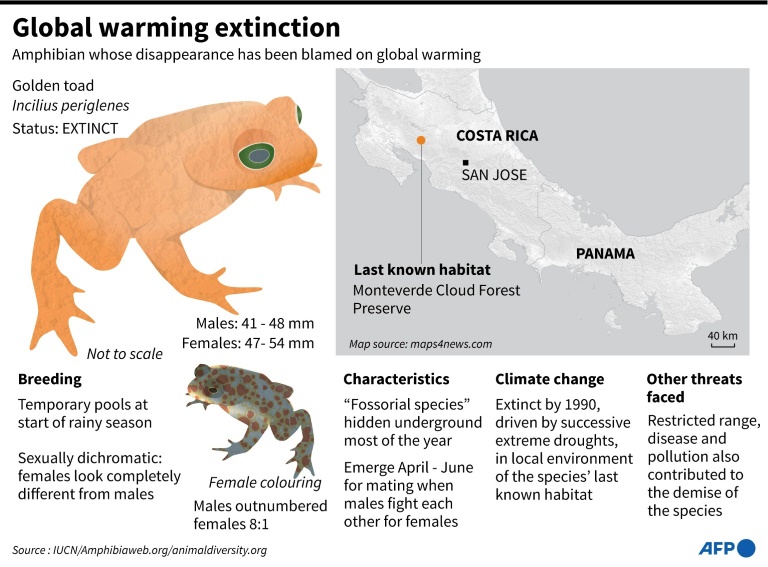
For just a few days every year, the elfin cloud forest of Costa Rica came alive with crowds of golden toads the length of a child’s thumb, emerging from the undergrowth to mate at rain-swelled pools.  

In this mysterious woodland the cloud drapes over mountain ridges and “the trees are dwarfed and wind-sculpted, gnarled and heavily laden with mosses,” said J Alan Pounds, an ecologist at the Monteverde Cloud Forest Preserve in Costa Rica.

“The soils are very dark and so golden toads would stand out like animal figurines. It was quite a spectacle.” 

Then in 1990, they were gone. 

The golden toad was the first species where climate change has been identified as a key driver of extinction.

Its fate could be just the beginning. 

For years, researchers have warned that the world is facing both a climate and a biodiversity crisis. Increasingly they say they are connected.

– One in 10 face extinction –

Even if warming is capped at the ambitious target of 1.5 degrees Celsius above pre-industrial levels, the UN’s Intergovernmental Panel on Climate Change says nearly one in 10 of all species face an extinction threat.

The golden toad was only found in Monteverde’s highland forest. So when trouble hit, the species was completely wiped out. 

“It was pretty clear about 99 percent of the population declined within a single year,” said Pounds, whose research into the disappearance of the golden toad was cited in the IPCC’s February report on climate impacts. 

Climate change was barely on the research radar when Pounds first arrived in Costa Rica in the early 1980s to study amphibians.

But global warming was already beginning to take its toll. 

After the disappearance of the golden toad, the Monteverde harlequin frog and others, researchers compared datasets on temperature and weather patterns with those on local species. 

They found not only the signature of the periodic El Nino weather phenomenon, but also trends linked to changes in climate.  

– Climate ‘trigger’ – 

The die-offs occurred after unusually warm and dry periods.

Pounds and his colleagues linked the declines to chytridiomycosis infection, but concluded that disease was only the “bullet — climate change was pulling the trigger.

“We hypothesised that climate change and resultant extreme events were somehow loading the dice for these kinds of outbreaks,” Pounds told AFP.

It was not an isolated incident. 

The expansion of the chytrid fungus globally, along with local climate change “is implicated in the extinction of a wide range of tropical amphibians,” according to the IPCC. 

The fingerprints of global warming have since been seen in other disappearances. 

The Bramble Cay melomys, a small rodent living on a low-lying island in the Torres Strait, was last seen in 2009.  

The only mammal endemic to the Great Barrier Reef, its populations were battered by sea-level rise, increased storm surges and tropical cyclones — all made worse by climate change.

Vegetation that provided its food plummeted from 11 plant species in 1998 to just two in 2014. It was recently declared extinct. 

Today, climate change is listed as a direct threat to 11,475 species assessed by the International Union for Conservation of Nature. Around 5,775 are at risk of extinction.

– #MeToo for species –

The main reason why climate change is increasingly cited as a threat to so many species is that its impacts are becoming more obvious, said Wendy Foden, the head of the IUCN’s climate change specialist group.

But there is also a growing understanding of the enormous variety of effects. 

Beyond extreme weather, warming can also cause species to move, change behaviour or even skew to having more male or female offspring. 

And that’s on top of other human threats like poaching, deforestation, overfishing and pollution. 

In 2019, a report by UN biodiversity report experts said one million species could disappear in the coming decades, raising fears that the world is entering a sixth era of mass extinction.

“It’s absolutely terrifying,” said Foden, adding that warnings of catastrophic biodiversity loss have often been overlooked.  

“We need a #MeToo movement for species, a whole wake up on what we are doing.” 

Almost 200 countries are currently locked in global biodiversity talks to try to safeguard nature, including a key milestone of 30 percent of Earth’s surface protected by 2030.

But Foden said the threat of climate change means that the response will have to go beyond traditional conservation. 

“That can’t happen anymore, even in the most remote wilderness, climate change will affect it,” Foden said. 

In some cases, people will need to choose which species to save. 

Take the endangered African penguin in South Africa, which Foden wrote about for the IPCC report on climate impacts. 

Forced to nest in the open after humans mined their guano nesting sites, the adults now have to swim ever further to find fish, likely because of a combination of overfishing and climate change. Meanwhile, the chicks in exposed nests can die from heat stress. 

“We are down to the last 7,000 breeding pairs. At this point, every penguin counts,” Foden said. 

– Cloudless forest –

In Monteverde, even the clouds have changed.  

While rainfall has increased somewhat over the past 50 years, Pounds said it has become much more variable.  

In the 1970,s the forest saw around 25 dry days a year on average — in the last decade it has been more like 115.  

The mist that used to keep the forest wet during the dry season has reduced by around 70 percent.

Pounds said sometimes tourists in the area stop him and ask directions to the Cloud Forest. 

“And I say: ‘You’re in it,'” he said.

“It often feels more like a dust forest than a cloud forest.”

Researchers have also seen steep declines in frogs, snakes and lizards and changes in the bird populations. Some have moved uphill to cooler areas, others have vanished from the area completely.

As for the golden toad, last year a team from the Monteverde Conservation League, supported by the conservation group Re:wild, launched an expedition to look for the golden toad in its historic habitat in the Children’s Eternal Rainforest, after tantalising rumours of sightings. 

But in vain.

Meanwhile, Pounds and his colleagues continue to keep an eye out for the golden toad during the rainy season. 

“We haven’t completely given up,” he said. 

“But with each passing year, it looks less likely that they’re going to reappear.”

War in Ukraine: Latest developments

Here are the latest developments in the war in Ukraine:

– Biden accuses Russians of ‘genocide’ –

US President Joe Biden accuses Russian forces of committing genocide in Ukraine, the first time his administration has used the term.

“Yes, I called it genocide,” Biden tells reporters travelling with him in Iowa when asked about his use of the term during an earlier speech. 

“It’s become clearer and clearer that Putin is just trying to wipe out the idea of even being able to be a Ukrainian.” 

Ukrainian President Volodymyr Zelensky swiftly responds: “True words of a true leader.”

– Ukrainians ‘surrounded’ in Mariupol –

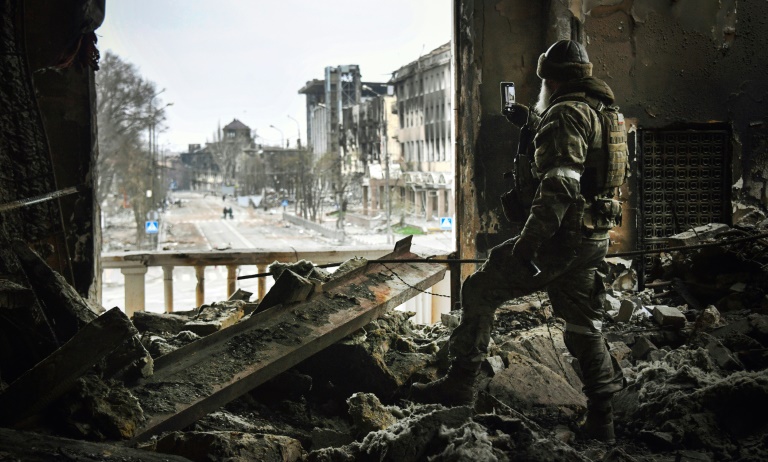
Ukrainian forces are “surrounded and blocked” in Mariupol as Russian forces push to take the southeastern port city, Mykhaylo Podolyak, an official from Zelensky’s office, tweets.

Zelensky says he believes “tens of thousands” of people in the city have been killed and makes another plea for weapons. 

– ‘Credible information’ on chemical weapons –

The United States has “credible information” that Russia “may use… chemical agents” in its offensive to take Mariupol, US Secretary of State Antony Blinken says.

He tells reporters he is not able to confirm accusations that Moscow has already used chemical weapons there.

The world’s chemical weapons watchdog, the OPCW, says it is “concerned” over reports of the use of chemical weapons in Mariupol.

– ‘All options on table’ –

Britain’s armed forces minister James Heappey tells Sky News that if evidence of chemical weapons use emerges, “all options are on the table” as a response.

“There are some things that are beyond the pale, and the use of chemical weapons will get a response,” he says.

– Over 400 bodies in Bucha – 

The mayor of the town of Bucha, where dozens of bodies were found after Russia’s withdrawal from northern Ukraine, says more than 400 people have been found dead so far and 25 women have reported being raped.

Zelensky says investigators have received reports of “hundreds of cases of rape” in areas previously occupied by Russian troops, including sexual assaults of small children.

– Burials in east –

Around 400 civilians have been buried in the town of Severodonetsk near the frontline in eastern Ukraine since the Russian invasion, the governor of the Lugansk region, Sergiy Gaiday, says.

– Rape allegations –

Zelensky says hundreds of rapes by Russian forces have been recorded, including of very young children and “even of a baby”. 

– Invasion going ‘calmly’: Putin –

Putin says Russia’s offensive is proceeding “calmly” and according to plan, with the goal of “minimising losses”.

During a televised press conference with Belarusian President Alexander Lukashenko, Putin dismisses reports of the discovery of hundreds of bodies of civilians in Bucha as fake.

– Residents flee east –

Residents stream out of east Ukraine’s Kramatorsk and Sloviansk as fears grow the cities will be key targets of a major new Russian offensive. 

The Pentagon says Russia is building up its forces in the eastern Donbas region, as it switches its focus to a region where pro-Russian rebels have been fighting Ukrainian forces since 2014. 

– Talks ‘extremely difficult’: Kyiv –

Kyiv says talks with Russia to end the war are “extremely difficult”.

“Negotiations are extremely difficult,” Ukrainian presidential adviser Podolyak says.

Putin says Ukraine’s “inconsistency on fundamental points” is creating “certain difficulties in reaching final agreements”.

– German president ‘not wanted’ in Kyiv –

German President Frank-Walter Steinmeier says he offered to visit Ukraine with other EU leaders but was told by Kyiv his trip was “not wanted”.

Steinmeier, a former foreign minister under ex-chancellor Angela Merkel, was long known for championing ties with Moscow. The snub comes as Chancellor Olaf Scholz is under increasing pressure for not having visited Ukraine.

– Tycoon swap offer –

Zelensky offers to swap pro-Kremlin tycoon Viktor Medvedchuk, who was arrested after escaping from house arrest, for Ukrainians captured by Russia.

– Over 870,000 returnees –

More than 870,000 Ukrainians who fled abroad since the start of the war have returned to the country, Ukraine’s border force says. 

Spokesman Andriy Demchenko says that 25,000 to 30,000 Ukrainians are returning each day, with growing numbers of women, children and elderly among them.

In total, more than 4.6 million Ukrainians have now fled their country, the United Nations says.

burs-reb/lb

Death toll from Philippines landslides, floods rises to 58

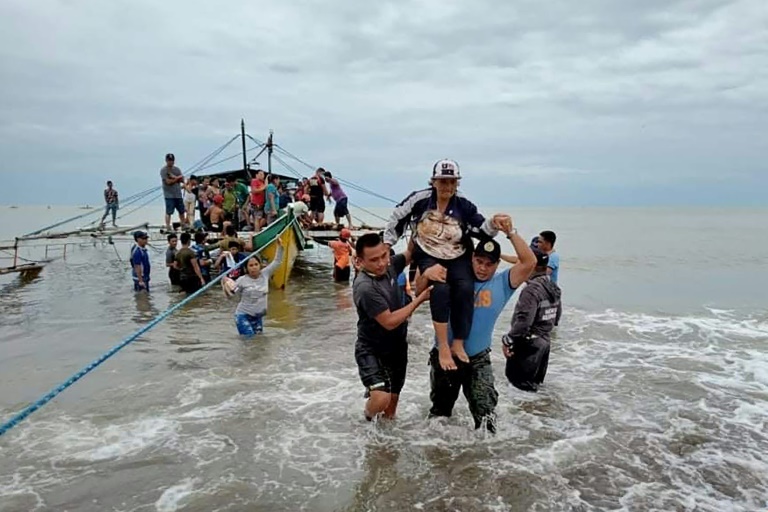
The death toll from landslides and floods in the Philippines rose to 58 on Wednesday, official tallies showed, as rescuers dug up more bodies with their bare hands in villages crushed by rain-induced avalanches.

Most of the deaths from tropical storm Megi — the strongest to hit the disaster-prone archipelago this year — were in the central province of Leyte, where a series of landslides devastated communities.

At least 47 people died and 27 were missing after waves of sodden soil smashed into farming settlements around Baybay City over the weekend, local authorities said. More than 100 people were injured, they added. 

Aerial photos showed a wide stretch of mud that had swept down a hill of coconut trees and engulfed Bunga village, where only a few rooftops poked through the now-transformed landscape.

Three people were also killed in the central province of Negros Oriental and three on the main southern island of Mindanao, according to the national disaster agency.

Search operations for survivors in Pilar village — part of Abuyog municipality in Leyte — resumed at first light on Wednesday, with boats carrying rescuers to the coastal community of around 400 people.

The operation came a day after a landslide pushed many houses in the village into the sea.

“We have five casualties, one unidentified,” Captain James Mark Ruiz of Abuyog police told AFP.

Ruiz said more boats were needed to rescue victims and retrieve bodies in the ongoing search after landslides cut off road access to the community. 

Around 50 survivors have been ferried from the village, the Bureau of Fire Protection said on Facebook on Tuesday.

Photos posted by the agency showed buildings crushed or turned over by the force of the landslide and debris in the water. 

Medical workers rushed to treat victims as they were brought to shore, applying bandages to cuts and providing emergency blankets. One woman had her right arm in a splint. 

Raymark Lasco, a radio operator at the Abuyog disaster agency, told AFP that “many people” had died and that rescue operations were ongoing.

– Port operations suspended –

Search operations also resumed around Baybay City after the rain stopped, enabling emergency personnel to access hard-hit areas, Mayor Jose Carlos Cari told CNN Philippines.

“In some barangays (villages), we’re just doing retrieval,” Cari said.

Rescuers have been using their bare hands and shovels to reach victims buried by the landslides. 

A Philippine Coast Guard video shared on Facebook on Tuesday showed rescuers carrying a mud-caked woman on a stretcher from one of the devastated villages, while other victims were piggybacked to safety.

The military has joined coast guard, police and fire protection personnel in the search and rescue efforts, which have been hampered by bad weather. 

Whipping up seas, Megi forced dozens of ports to suspend operations and stranded thousands of people at the start of Holy Week, one of the busiest travel periods of the year in the Philippines.

Megi came four months after super typhoon Rai devastated swathes of the country, killing more than 400 and leaving hundreds of thousands homeless.

Scientists have long warned that typhoons are strengthening more rapidly as the planet becomes warmer due to climate change.

The Philippines — ranked among the most vulnerable nations to its impacts — is hit by an average of 20 storms every year.

Asian stocks mostly up despite red-hot US inflation

Asian markets mostly started Wednesday with gains, despite a day of losses on Wall Street and across Europe sparked by data showing red-hot US inflation.

Hong Kong and Shanghai bucked the trend though, posting slight losses in morning trade.

The US consumer price index surged 8.5 percent in March compared with a year ago, the biggest jump since December 1981. CPI climbed 1.2 percent over February’s level.

The report was the first to fully encompass the shock caused by Russia’s invasion of Ukraine and Western sanctions against Moscow, which have caused energy and food prices to spike worldwide.

Though the Federal Reserve was poised to raise interest rates quickly to tamp down inflation pressures, the effects will not be immediate.

But Tokyo shrugged off the gloom, with the benchmark Nikkei 225 up by about 1.5 percent.

Shares in Seoul and Sydney were also up, while Mumbai was down.

“Yes, US inflation was hot -– it’s hottest in 40 years. But we’re getting used to these extreme headline prints now, to the point that markets looked past the whopping 8.5 percent y/y print in favour of core CPI only rising 0.3 percent compared to 0.5 percent expected,” said Matthew Simpson, senior market analyst at City Index.

“Besides, now high levels of inflation are no longer new news, the focus is now shifting to its trajectory and how long it may take to tail off.”

“We’re hopeful that this is where (inflation is) going to peak,” Ann Miletti, head of active equity at Allspring Global Investments, told Bloomberg Television.

But she added that markets continued to face the threat of rising rates and the impact of Covid-19 lockdowns in China, which have snarled supply chains.

Both major crude oil contracts were back over $100 per barrel, with Brent topping $105, after Russian President Vladimir Putin vowed to continue the invasion of Ukraine and China partially eased Covid-related curbs.

“Oil seems to be the primary benefactor of Ukraine vs Russia conflict dragging out longer,” noted Stephen Innes of SPI Asset Management.

– Key figures around 0230 GMT –

Tokyo – Nikkei 225: UP 1.6 percent at 26,755.05 (break)

Hong Kong – Hang Seng Index: DOWN 0.18 percent at 21,281.78

Shanghai – Composite: DOWN 0.32 percent at 3,202.98

Brent North Sea crude: UP 0.56 percent at $105.23 per barrel

West Texas Intermediate: UP 0.53 percent at $101.13 per barrel

Euro/dollar: DOWN at $1.0832 from $1.0864

Pound/dollar: UP at $1.3007 from $1.3006

Euro/pound: DOWN at 83.28 pence from 83.53 pence

Dollar/yen: UP at 125.63 yen from 125.61 yen

New York – Dow: DOWN 0.3 percent at 34,220.36 (close)

London – FTSE 100: DOWN 0.6 percent at 7,576.66 (close)

— Bloomberg News contributed to this report —

Manhunt after 10 shot in Brooklyn subway attack

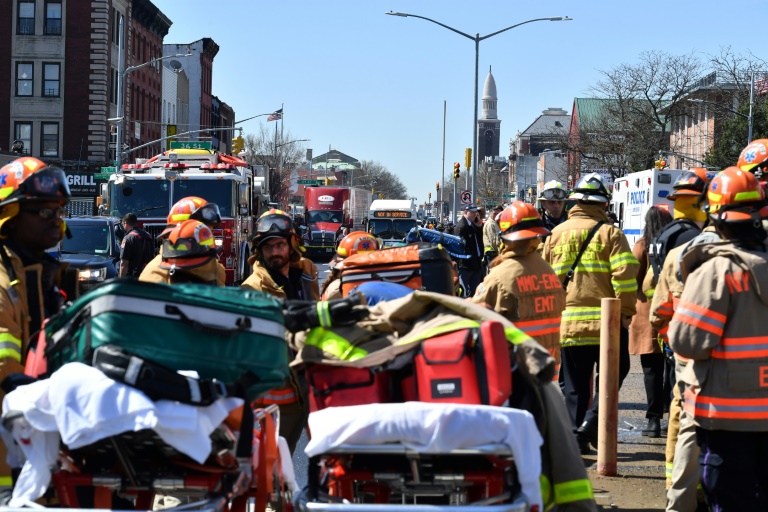
A massive manhunt was underway Tuesday in New York for a man who shot 10 people on a packed subway train, donning a gas mask before setting off two smoke bombs and opening fire on terrified commuters.

Police said the incident in Brooklyn was not being investigated as an act of terrorism, with no indication of a motive at this stage. None of the injuries were considered life-threatening.

New York Police Department commissioner Keechant Sewell told a press conference the suspected gunman put on a gas mask just as the train was arriving at the station. 

The gunman “opened two canisters that dispensed smoke throughout the subway car,” Sewell said. “He then shot multiple passengers as the train pulled into the 36th Street station.” 

In addition to the 10 gunshot victims, 13 others were injured as they tried to get out of the station or suffered smoke inhalation, according to officials.

“We are truly fortunate this was not significantly worse than it is,” Sewell said.

NYPD chief James Essig said the gunman had fired 33 shots. Police later recovered a Glock 17 nine-millimeter handgun, three additional ammunition magazines and a hatchet from the scene.

Sewell said they had identified a “person of interest” and described him as a “dark-skinned male” wearing a neon orange vest and a gray hooded sweatshirt.

They did not have anyone in custody, she said.

Both Sewell and Essig said the person of interest had posted several videos on YouTube of himself delivering long, sometimes aggressive political tirades. He also criticized New York City mayor Eric Adams.

Police were alerted to the shooting just before 8:30 am (1230 GMT).

Verified video footage posted on social media showed the train pulling into the 36th Street station, and smoke billowing out the doors as passengers rushed off, some apparently injured.

One of them, Yav Montano, recounted on CNN being inside the car when it began filling with smoke — and shots rang out.

“In the moment, I did not think that it was a shooting because it sounded like fireworks,” he said. “It just sounded like a bunch of scattered popping.”

There were 40 to 50 passengers inside at the time and they began crowding towards the front, Montano said — but the door to the next car was locked. 

“There were people in that other car that saw what was happening. And they tried to open the door, but they couldn’t,” he said. 

– ‘A lot of blood’ –

CNN aired a brief video shot by Montano inside the car showing passengers crowded together, some wearing masks and others pressing clothing against their mouths to protect against the smoke.

“There were some people whose clothes, whose pants were covered in blood,” Montano said, adding that he could not tell who was injured. “All I know is I saw, like, a lot of blood.”

Once the train finally reached the platform, the doors opened.

“People filed out, people forgot bags and shoes, and they just left everything to just get out of there as soon as possible,” Montano said.

Further footage showed passengers tending to bloodied victims lying on a smoky station platform, and subway staff shepherding panicked commuters, some still clutching their morning coffee cups.

Eyewitness Sam Carmano, speaking to local radio station 1010 WINS, was on a subway train pulling in on the opposite side of the platform when the mayhem erupted.

“My subway door opened into just like calamity and then it was people, just running to get away from whatever was happening, and then it was smoke and blood and people screaming,” he said.

– Call for witnesses –

President Joe Biden, addressing the incident during a trip to Iowa, paid tribute to the first responders and civilians who “didn’t hesitate to help their fellow passengers,” and said his team was in close contact with New York officials.

“We’re not letting up until we find the perpetrator,” Biden vowed.

The NYPD has urged witnesses to contact a tip line with any information, and New York governor Kathy Hochul promised regular updates as the investigation unfolds. 

Mass casualty shootings happen with relative frequency in the United States, where firearms are involved in approximately 40,000 deaths a year, including suicides, according to the Gun Violence Archive website.

Shootings in New York City have risen this year, and the uptick in violent gun crime has been a central focus for Adams since he took office in January. Through April 3, shooting incidents rose to 296 from 260 during the same period last year, according to police statistics.

The incident came just a day after Biden announced new gun control measures, increasing restrictions on so-called “ghost guns,” the difficult-to-trace weapons that can be assembled at home.

Lax gun laws and a constitutionally guaranteed right to bear arms have repeatedly stymied attempts to clamp down on the number of weapons in circulation, despite a majority of Americans backing greater controls.

Three-quarters of all homicides in the United States are committed with guns, and the number of pistols, revolvers and other firearms sold continues to rise.

US crypto expert jailed 63 months for helping N.Korea

A US cryptocurrency expert was sentenced Tuesday to 63 months in prison for advising North Korea on how to create cryptocurrency services and blockchain technology to circumvent US sanctions over its nuclear program, court officials in New York said.

Virgil Griffith, 39, had pleaded guilty to conspiring to violate US law, in a bid to reduce the sentence for a crime that can carry up to 20 years behind bars. 

Prosecutor Damian Williams said “there is no question North Korea poses a national security threat to our nation, and the regime has shown time and again it will stop at nothing to ignore our laws for its own benefit. 

He said that Griffith had “admitted in court he took actions to evade sanctions, which are in place to prevent (North Korea) from building a nuclear weapon.”

In April 2019 Griffith gave a presentation in Pyongyang, the North Korean capital, on cryptocurrency and blockchain technology. He was arrested at Los Angeles airport in November the same year. 

At the conference, Griffith provided information on how North Korea could use the technology to launder money and evade sanctions, including through “smart contracts,” according to the court.

The prosecution said that after the presentation, Griffith “pursued plans to facilitate the exchange of cryptocurrency between the Democratic People’s Republic of Korea and South Korea, despite knowing that assisting with such an exchange would violate sanctions against the DPRK.”

The United States prohibits the export of goods, services or technology to North Korea without special permission from the Treasury Department’s Office of Foreign Assets Control.

In addition to 63 months in jail, Griffith will spend three years on probation. 

Griffith holds a doctorate from the California Institute of Technology and has also worked on Ethereum, a Singapore-based global platform with blockchain technology for business and financial use, which has a cryptocurrency named after it.

Driverless car stopped in San Francisco puzzles cops

San Francisco police faced an unprecedented problem recently when an officer stopped a car that was driving at night with no headlights on, only to discover there was no one inside. 

The vehicle, it turned out, was a self-driving car, and the police officer’s encounter was captured on film by a passerby, who posted the footage on social media.

The clip, showing bemused officers circling the vehicle and peering through its window for several minutes, has been shared so widely that Cruise, the company that owns the vehicle, reacted on Twitter to explain what had happened.

It said the self-driving car “yielded to the police vehicle, then pulled over to the nearest safe location for the traffic stop, as intended. An officer contacted Cruise personnel and no citation was issued.”

In the footage, as the police are inspecting the parked vehicle, someone can be heard exclaiming, “There’s no one in it, it’s crazy!”

A police spokesperson said that after the police had stopped the car, a maintenance team had taken control of it.

Cruise explained that the headlights were turned off due to human error.

Founded in 2013, Cruise has developed software that allows cars to drive themselves completely autonomously. 

The US manufacturer General Motors owns the majority of shares in the company, valued at more than $30 billion thanks to investments by giants such as Microsoft, Honda and Walmart. 

Since February, Cruise has passed a key threshold in offering individuals the chance to book free trips in the streets of San Francisco in its driverless cars. 

Residents of the Californian city also regularly come across robo-taxis from Waymo, Google’s self-driving subsidiary. 

These camera-clad vehicles take passengers wherever they want, with a driver who is present but does not touch the steering wheel or the pedals.

Close Bitnami banner
Bitnami