World

For Biden's battered approval, 'nothing else matters' like inflation

Historically low joblessness is the kind of thing American leaders dream of, but President Joe Biden also has nightmarishly high inflation that supporters and opponents alike believe may cost his Democratic Party dearly.

Biden’s popularity has sunk in recent months even as the unemployment rate has ticked progressively lower amid booming job creation, which experts attribute to record-high price increases the US economy has weathered as it recovers from the pandemic. 

“Politically speaking, nothing else matters,” said Charlie Cook, a longtime political analyst and founder of the Cook Political Report.

Job growth is a traditional metric of presidential success, and the White House has attempted to focus the public’s attention on the progress made in the labor market, where new applications for jobless aid are at more than half-century lows and the unemployment rate is almost back to where it was before Covid-19 broke out.

But Cook said the spike in consumer prices to levels not seen since 1981 has undercut those arguments because while some voters may benefit from the strengthening jobs market, everyone experiences higher prices for gasoline, food and other necessities.

Biden’s approval ratings are now hovering around 42.2 percent, according to poll aggregator FiveThirtyEight, and with midterm elections in seven months, even Biden’s allies worry that his Democratic party will lose its narrow control of one, or perhaps both, houses of Congress.

“High prices are preventing Americans from feeling the Biden boom,” said Will Marshall, president of the center-left Progressive Policy Institute.

– Losing, not gaining, jobs –

Biden took office at a time when unemployment was on a downward trajectory after spiking to 14.7 percent in 2020 as businesses laid off workers en masse after the pandemic arrived on American shores.

Throughout his presidency, it has fallen steadily to hit 3.6 percent last month, a hair above its pre-pandemic level.

But consumer prices have shot up, jumping by 8.5 percent over the 12 months to March, and polls indicate Americans are pointing the finger at Biden.

Nearly two-thirds of voters disapprove of Biden’s handling of the economy, according to a poll by the Associated Press and NORC Center for Public Affairs Research released late last month, while progressive data firm Navigator Research found more Americans believe the economy is losing jobs than gaining them.

The high inflation rate is a consequence of a collision between global shortages and shipping delays, the Federal Reserve’s low interest rate policies and shocks to commodity markets caused by Russia’s invasion of Ukraine that have sent gas prices soaring.

Another factor is pandemic rescue bills Congress approved under Biden and his Republican predecessor Donald Trump that fattened Americans’ wallets and drove them to buy scarce goods.

While economists debate how much of an effect these policies have had on inflation, Marshall acknowledged missteps in Biden’s congressional priorities as prices rose last year and his administration was reeling from the chaotic withdrawal of US troops from Afghanistan.

The president won bipartisan support for a $1 trillion overhaul to the nation’s infrastructure, but delayed that bill’s passage while trying to unite Democratic lawmakers around Build Back Better, his signature proposal to overhaul the country’s social services, which ultimately failed.

“I think people mistakenly thought, well, this is a second coming of the New Deal,” Marshall told AFP, referring to a 1930s-era Democratic expansion of government in response to the Depression. “I think they overreached.”

– Can he come back? –

Douglas Holtz-Eakin, who served as an economist in Republican former president George W. Bush’s administration, said Democrats might have been worse off if they passed Build Back Better, because voters would have linked its high price tag to inflation.

“I think they benefited more from its failure than it cost them,” said Holtz-Eakin, now the president of the American Action Forum.

Biden’s Democrats control Congress, but only by the thinnest majorities — 12 seats in the House and one vote in the Senate — which he argued does not give them a mandate to enact major legislation.

“They mistakenly think they have to do something. They don’t, they should get out of the way, let the Fed take care of inflation, let the private sector take care of growth,” Holtz-Eakin said.

The Federal Reserve is in the process of raising interest rates, and many economists believe the inflation spike will flatten as the year progresses.

But whether it comes soon enough for Biden remains to be seen. 

It is common for a president’s party to lose ground in the midterm congressional elections, and his two predecessors in the White House were mauled in when their parties lost control of the House — a fate Cook warned Biden appears on course to meet.

“Are we really going to see a meaningful reduction in inflation between now and the time voting starts between late September and October?” he asked. “I don’t think it’s realistic at all.”
For Brooklyn subway riders, a morning of terror

Smoke, followed by scattered pops that some commuters mistake for fireworks but are really gunshots, then panic as a quick escape is thwarted by the subway car’s locked doors.

A passenger pounds on the door of the neighboring carriage, desperate to be let out. As the train pulls into the platform, some scream, a man grips his coffee tightly, seemingly dazed  — and others tend to the wounded who lie bleeding on the floor.

The nightmare scenes, captured by cell phone footage and described by eye-witnesses, played out on New York’s N train during morning rush hour after a gunman shot ten people and left an entire city reeling.

Police later said the suspect, a heavyset, short Black male, wore a construction vest, donned a gas-mask and pulled out a smoke canister from his bag for the attack. He was still at large Tuesday evening as a massive manhunt was underway.

“As the smoke flared up it started to engulf everything,” Yav Montano, who was in the car where the attack took place, told CNN.

“There was a lot of blood trailing on the floor… in the moment I did not think that it was a shooting because it sounded like fireworks,” he continued. “All I saw were people trampling over each other, trying to get through to the door.”

Once the train reached Brooklyn’s 36th street station, passengers made a dash for the exit — but an announcer told them to board the R train on the opposite side of the platform instead.

Sam Carmano, who was on that train, told 1010 WINS radio station: “My subway door opened into, just like calamity, and then it was people, just running to get away from whatever was happening, and then it was smoke and blood and people screaming.”

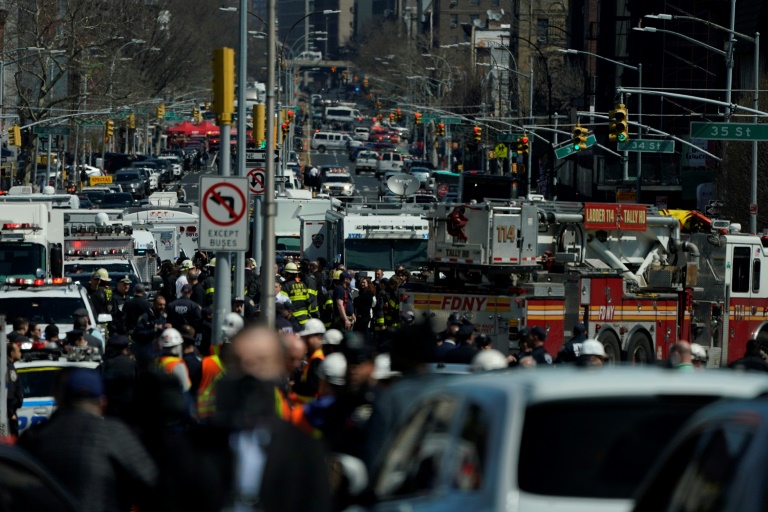
Above the ground, swarms of police, fire trucks and ambulances raced to the scene and authorities cordoned off the area, emptying out several blocks in the normally bustling commercial neighborhood.

Residents already worried about the rising tide of violent crime in America’s first city said the incident had left them shaken and even more fearful.

Brooklyn local Anna Marin told AFP she had just dropped off her son at school when she saw smoke billowing and people fleeing from the station.

She wanted to collect her child right away but had to wait several hours as the school went into a lockdown.

“I’m a little shocked. And I’m hoping that it gets better because I’m noticing it’s happening all over New York City,” she said.

burs-ia/md

Nearly 60 dead in South Africa floods

The death toll from floods and mudslides after rainstorms struck the South African port city of Durban and surrounding areas in KwaZulu-Natal province has climbed to 59, authorities said on Tuesday.

The country’s meteorologists forecasted more “disruptive” rains on the way Tuesday night but expected the “rainfall system” to weaken “considerably” on Wednesday.

“Many people lost their lives with Ethekwini (Durban metro) alone reporting 45,” while in iLembe district “more than 14 …have tragically lost their lives,” the provincial government said in a statement. 

It said the disaster “wreaked untold havoc and unleashed massive damage to lives and infrastructure” affecting all races and classes from rural areas, townships to luxury estates.

“This is a tragic toll of the force of nature and this situation calls for an effective response by government,” said President Cyril Ramaphosa who is to visit Durban on Wednesday.

African Union Commission chief Moussa Faki Mahamat expressed “sincere condolences to the families who have lost loved ones following heavy flooding” via Twitter.

Days of driving rain flooded several areas, tore houses apart and ravaged infrastructure across the southeastern city, while landslides forced train services to be suspended.

The rains have flooded city highways to such depths that only the tops of traffic lights poked out, resembling submarine periscopes.

Torrents tore several bridges apart, submerged cars and collapsed houses. A fuel tank was floating in at sea after being tossed off the road.

The rains have flooded city highways, torn apart bridges, submerged cars and collapsed houses.

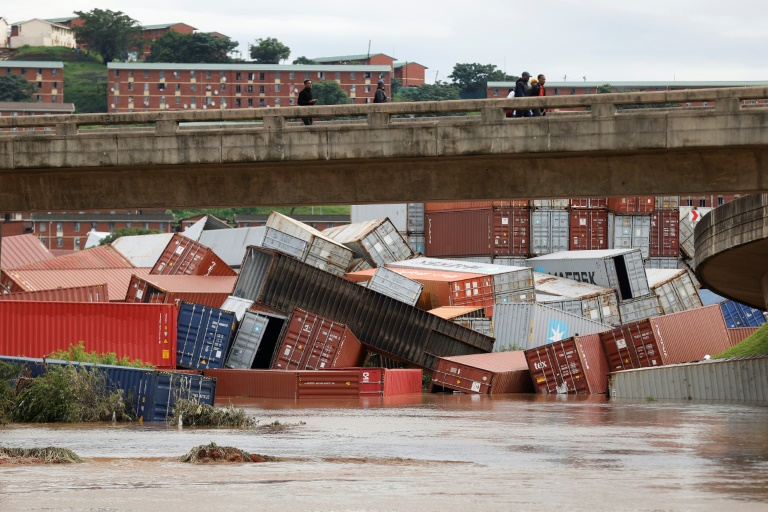
Several stacked shipping containers fell like dominoes and lay strewn on a yard, while some spilled over into a main road in the city, one of southern Africa’s largest regional gateways to the sea.

South Africa’s public logistics firm Transnet suspended shipping at Durban terminals as did global shipping firm Maersk due to the floods.

“At around 3:00 am (0100 GMT), I felt the truck shaking and I thought maybe someone bumped it and when I tried to open the curtain I saw the water level… was very high,” said truck driver Mthunzi Ngcobo.

– Looting –

The disaster management department in KwaZulu-Natal province, of which Durban is the largest city, urged people to stay at home and ordered those residing in low-lying areas to move to higher ground.

More than 2,000 houses and 4,000 “informal” homes, or shacks, were damaged, said provincial premier Sihle Zikalala.

Rescue operations, aided by the military, evacuated people trapped in affected areas.

Fifty-two secondary students and teachers who were marooned at a Durban secondary school, were successfully airlifted to safety following “a long traumatic night, trapped”, education authorities said.

More than 140 schools have been affected by the flooding.

Power stations had been flooded and water supplies disrupted — and that even graveyards had not been spared the devastation.

The city had only just recovered from deadly riots last July in which shopping malls were looted and warehouses set on fire, in South Africa’s worst unrest since the end of apartheid.

There have been reports of looting, with TV footage showing people stealing from cargo containers.

The provincial government condemned “reports of the looting of containers” during the flooding.

– ‘Climate change getting worse’ –

Southern parts of the continent’s most industrialised country are bearing the brunt of climate change — suffering recurrent and worsening torrential rains and flooding.

Floods killed around 70 people in April 2019.

“We know it’s climate change getting worse, it’s moved from 2017 with extreme storms to supposedly having record floods in 2019, and now 2022 clearly exceeding that,” University of Johannesburg development studies professor Mary Galvin said.

“Droughts and floods will become more frequent and more intense and that’s what we are seeing” she said, frustrated at government’s lack of preparedness.

“It’s absolutely devastating but equally devastating is the fact that we haven’t done anything to get ready for it,” she lamented.   

The South African Weather Service admitted that “the exceptionally heavy rainfall overnight (Monday) and (Tuesday) morning exceeded even the expectations of the southern African meteorological community at large”.

Biden accuses Putin's forces of 'genocide' in Ukraine

President Joe Biden for the first time Tuesday accused Vladimir Putin’s forces of committing genocide in Ukraine, where Russia was intensifying its campaign to subdue the devastated port city of Mariupol.

Biden’s accusation came as Moscow — already accused by the West of widespread atrocities against civilians — was feared to be readying a massive onslaught across Ukraine’s east that Washington warned might involve chemical weapons.

“Yes, I called it genocide,” Biden told reporters, hours after employing the term during a speech in Iowa — its first use by a member of his administration.

“We’ll let the lawyers decide internationally whether or not it qualifies, but it sure seems that way to me,” Biden said. “It’s become clearer and clearer that Putin is just trying to wipe out the idea of even being able to be a Ukrainian.”

Ukrainian President Volodymyr Zelensky — who has repeatedly accused Moscow of attempted “genocide” — swiftly responded by tweeting at Biden: “True words of a true leader.”

“Calling things by their names is essential to stand up to evil,” Zelensky wrote — renewing his appeal for more heavy weapons to “prevent further Russian atrocities.”

Biden had previously described Putin as a “war criminal” as the discovery of hundreds of civilians reportedly killed in Bucha, outside Kyiv, sparked global revulsion.

But he had stopped short of using the term “genocide,” in line with longstanding US protocol, because of its strict legal definition and the heavy implication the accusation carries. 

Adding to the catalogue of horrors emerging from Ukraine, Zelensky sounded the alarm Tuesday about snowballing allegations of rape and sexual assault by Russian forces.

“Hundreds of cases of rape have been recorded, including those of young girls and very young children. Even of a baby!” the Ukrainian leader told Lithuanian lawmakers via video link.

– Chemical weapon fears –

In the latest discovery fuelling allegations of Russian atrocities, Ukrainian prosecutors said six people had been found shot dead in the basement of a building outside the capital. 

While the toll on towns occupied during the month-long offensive to take Kyiv is still coming to light, the heaviest civilian toll is feared to be in Mariupol, where Zelensky said he believed Russia had killed “tens of thousands.”

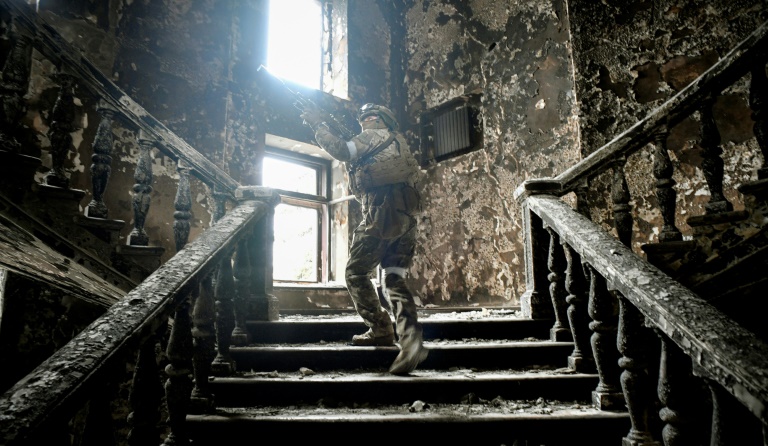
AFP journalists in Mariupol, as part of a Russian military embed, witnessed the charred remains of the city, including the theatre where 300 people were feared killed in Russian bombardment last month.

As fighting dragged toward its seventh week, the Ukrainian army was fighting desperately to defend strategically located Mariupol.

Moscow is believed to be trying to connect occupied Crimea with Russian-backed separatist territories Donetsk and Lugansk in Donbas, and has laid siege to the city, once home to more than 400,000 people.

Reports emerged on Monday from Ukraine’s Azov battalion that a Russian drone had dropped a “poisonous substance” in the area, with people experiencing respiratory failure and neurological problems.

US Secretary of State Antony Blinken said he was unable to confirm the allegations, but that Washington had “credible information” Russia might use tear gas mixed with chemical agents in the besieged port.

The world’s chemical weapons watchdog said it was “concerned” by the unconfirmed reports coming from Mariupol, and was “monitoring closely.”

Pentagon spokesman John Kirby warned the use of such weapons by Moscow would “elicit a response not just from the United States, but from the international community,” without elaborating.

– ‘They will remember’ –

With little hope of a quick end to fighting, President Vladimir Putin pledged Moscow would proceed on its own timetable, rebuffing repeated international calls for a ceasefire.

“Our task is to fulfil and achieve all the goals set, minimising losses. And we will act rhythmically, calmly, according to the plan originally proposed by the General Staff,” Putin told a news conference with Belarusian President Alexander Lukashenko.

He also dismissed as “fake” claims that hundreds of civilians were killed in Bucha under Russian occupation.

Bucha Mayor Anatoly Fedoruk said more than 400 people had been found dead after Moscow’s forces withdrew, and 25 women reported being raped, as the town prepares for the return of residents who fled the fighting.

“What people will find in their homes is shocking, and they will remember the Russian occupiers for a very long time,” he said.

– ‘Devil incarnate’ –


Heavy bombardment continued in Ukraine’s east as civilians were urged to flee ahead of an expected Russian troop surge around the Donbas region, notably near the town of Izyum — adding to the 10 million people already displaced by fighting.

A steady stream of residents fled by bus and train from Kramatorsk — the Ukrainian military’s main hub for its operations in the east — and neighbouring Sloviansk as fears grew that the cities would be key targets.

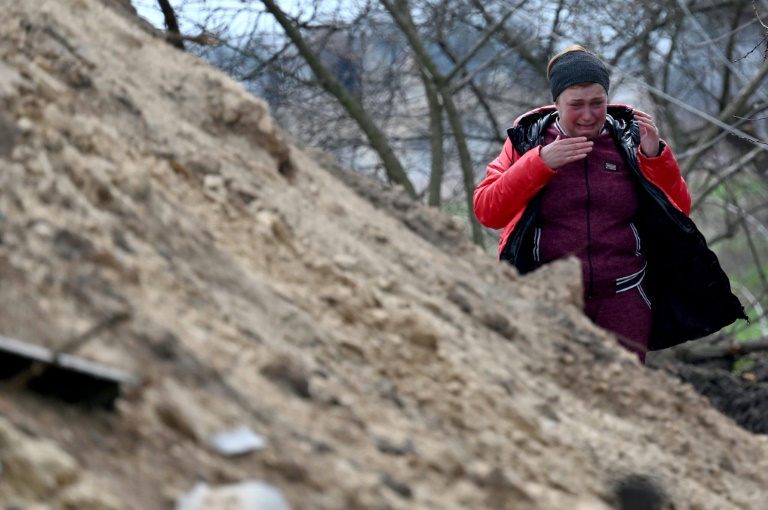
“What is happening is inhuman, (Putin) is a fascist. I don’t know what to call him — a devil incarnate,” said 82-year-old Valentina Oleynikova, who was fleeing Kramatorsk with her husband.

In the war-torn eastern town of Volnovakha, now under Moscow’s control, a school reopened with children listening to a recording of the Russian anthem, watched by armed soldiers.

After two weeks of bombardment, many houses, shops and public buildings are now semi-ruined, windowless or burnt out.

– Tycoon swap –

In a separate development, Zelensky offered to swap a pro-Kremlin tycoon — arrested after escaping from house arrest — for Ukrainians captured by Russia.

Zelensky posted a picture of a dishevelled-looking Viktor Medvedchuk — one of the richest people in Ukraine, who counts Putin among his personal friends — with his hands in cuffs and dressed in a Ukrainian army uniform.

“I propose to the Russian Federation to exchange this guy of yours for our boys and our girls who are now in Russian captivity,” Zelensky said in a video address on Telegram.

Medvedchuk, a hugely controversial figure in Ukraine, was under house arrest over accusations of attempting to steal natural resources from Russia-annexed Crimea and of handing Ukrainian military secrets to Moscow. 

US prosecutors rest case against Islamic State 'Beatle'

Prosecutors rested their case Tuesday against an alleged member of the notorious Islamic State kidnap-and-murder cell known as the “Beatles.”

El Shafee Elsheikh, 33, declined the opportunity to testify in his own defense at his trial in a federal court in Alexandria, Virginia.

Asked by Judge T.S. Ellis if he wanted to take the stand, Elsheikh said “No,” the first time his voice had been heard during the two-week trial.

Elsheikh is charged with the murders of American freelance journalists James Foley and Steven Sotloff and aid workers Kayla Mueller and Peter Kassig, and suspected of the kidnapping of nearly 20 other Westerners in Syria.

Ten European journalists, relief workers and Syrians held hostage by the “Beatles” have testified over the past few days of their brutal treatment at their captors’ hands.

Elsheikh’s lawyers declined to cross-examine any of the witnesses and presented only 20 minutes of excerpts from interviews he gave to media outlets as his defense.

The interviews were conducted after Elsheikh and another alleged “Beatle,” Alexanda Amon Kotey, were captured in January 2018 by a Kurdish militia in Syria.

Unlike now, Elsheikh acknowledged in the interviews that he had interactions with the Western hostages, who dubbed the hostage-takers the “Beatles” because of their British accents.

Elsheikh’s lawyers contend that he lied about being a “Beatle” in the interviews so he would be transferred to the United States instead of being put on trial in Iraq, where he would have faced a certain death sentence.

The final former hostage to testify was Danish photographer Daniel Rye Ottosen, who recounted how he was given 25 blows for his 25th anniversary.

He also recalled having a knife placed against his throat and a gun thrust into his mouth.

The prosecution and defense are to deliver their closing arguments on Wednesday, and the case will go to the jury.

Foley, Sotloff and Kassig were killed by their IS jailers and videos of their murders released for propaganda purposes.

According to witnesses and her family, Mueller — the other American — was turned over to IS leader Abu Bakr al-Baghdadi, who raped her repeatedly.

IS announced her death in February 2015 and said she was killed in a Jordanian airstrike, a claim that was disputed by US authorities.

Elsheikh and Kotey were turned over to US forces in Iraq following their capture.

They were flown to Virginia in 2020 to face charges of hostage-taking, conspiracy to murder US citizens and supporting a terrorist organization.

Kotey pleaded guilty in September 2021 and is facing life in prison.

The other “Beatle,” Mohamed Emwazi, the notorious executioner known as “Jihadi John,” was killed by a US drone strike in Syria in 2015.

Brazil's Lula slams Bolsonaro indigenous policies

Brazilian ex-president Luiz Inacio Lula da Silva vowed Tuesday to undo current President Jair Bolsonaro’s policies on indigenous people if elected, branding his rival a “fascist” aligned with “those who want to kill our forests.”

Speaking at a protest by thousands of indigenous people who are camping out in the capital, Brasilia, to protest Bolsonaro’s policies, Lula drew loud cheers with a promise to create a ministry of indigenous affairs if he wins Brazil’s October presidential elections.

“And one of you will have to run it, not a white person like me,” he said, wearing a beaded necklace with a colorful macaw emblem.

If elected for a new term, he said, “we’ll need to hold a ‘revocation day,’ where everything (Bolsonaro) decreed to hinder (indigenous rights) will be immediately revoked.

“We can’t allow everything you’ve fought for to be taken from you by decree and handed over to those who want to kill our forests and wildlife,” he said.

The leftist ex-steelworker, who led Brazil from 2003 to 2010, currently leads Bolsonaro in pre-election polls.

The far-right incumbent has drawn protests from indigenous groups and environmentalists for pushing legislation that would dramatically reduce the creation of new indigenous reservations and open up existing ones to mining.

A series of studies have shown protecting indigenous lands is one of the best ways to preserve forests, vital resources in the race to curb climate change.

Under Bolsonaro, who took office in 2019 with solid backing from Brazil’s powerful agribusiness sector, deforestation has surged in the crucial Amazon rainforest, home to the majority of Brazil’s 900,000 indigenous people.

There were chants of “Get out, Bolsonaro!” as Lula arrived to speak at the indigenous camp, which opened last week just up the road from the presidential palace and Congress.

Ukraine crisis pushes US inflation to new four-decade high

Americans paid more for gasoline, food and other essentials last month amid an ongoing wave of record inflation made worse by Russia’s invasion of Ukraine, according to government data released Tuesday.

The consumer price index (CPI) climbed 8.5 percent over the 12 months to March, the biggest jump since December 1981 and a sign of the pressure President Joe Biden’s administration is under even as it looks for more ways to punish Moscow for the attack on its neighbor.

The inflation surge has dragged Biden’s approval lower since it began last year, and the president sought to pin the blame on Russian President Vladimir Putin and the invasion’s disruptions to global energy markets.

“Seventy percent of the increase in prices in March came from Putin’s price hike in gasoline,” Biden argued during a speech in Iowa, though the Labor Department said it accounted for closer to half.

Prices began rising last year as the economy recovered from the Covid-19 pandemic, and while the latest report showed costs hitting new heights for many items, it also contained signs the spike may be leveling off.

Compared to February, prices rose 1.2 percent, in line with analysts’ forecasts, but “core” prices, which exclude volatile food and energy sectors, rose 0.3 percent rise, less than expected.

“The Russia-Ukraine war has added further fuel to the blazing rate of inflation via higher energy, food, and commodity prices that are turbo charged by a worsening in supply chain problems,” Kathy Bostjancic of Oxford Economics said.

The potency of the ongoing price jumps bolstered the case that the Federal Reserve will take aggressive action at its policy meeting next month, likely raising the key lending rate by half a percentage point as opposed to the quarter-point increase last month.

“With labor shortages pressuring firms to raise wages, we are in the midst of a wage-price inflation cycle that will require extreme action on the part of the Fed to rid the economy of the spreading inflation threat,” economist Joel Naroff said.

– Real pain –

A collision of factors has fueled the inflation surge, including business’ struggles to find enough workers and supplies, the Fed’s low interest rate policies, and congressionally approved stimulus measures that drove up demand among American consumers.

In response, the White House has scrambled to offer relief, including by releasing strategic oil supplies to lower prices at the pump and waiving a prohibition on selling a lower-price gasoline blend during the summer months, which Biden promoted during his visit to Iowa.

But the most potent actor in Washington against inflation is the Fed. 

Though rate hikes are expected to lower prices in the months to come, central bank Governor Lael Brainard said Tuesday that the fallout from the war in Ukraine “probably skews risks to the upside in inflation.” 

A new pandemic lockdown in China also “has the potential to lengthen out some of those constraints that we’ve seen in supply chains,” Brainard said in a discussion following the data’s release.

The Labor Department data showed Americans are facing real financial pain when they go to purchase must-have items.

Prices for shelter, the category including rents, rose 0.5 percent, while food prices rose one percent overall. 

Prices for groceries were up 1.5 percent in the month, and 10 percent over the past year — the largest such increase since March 1981, according to the data.

– Used cars reverse –

However, prices for used cars, which were one of the first items to surge last year, declined 3.8 percent last month, pushing core CPI lower. New car prices rose only 0.2 percent after seeing monthly gains of more than one percent in the latter months of 2021.

But considering how high prices have risen for other categories, Naroff said some on the Fed’s policy setting committee may advocate for an even more forceful 0.75 point rate increase next month — and that would not necessarily bring prices down quickly.

“The ability of any Fed to sharply raise rates to slow extremely high inflation, while not driving the economy into a recession, is limited, especially given factors such as war that are out of its control,” he said in a note. 

“We are talking about art here, not science, and there is little history of this Fed painting pretty pictures.”

US stocks fall on latest hot inflation report; oil prices rise

Equity markets in Europe and New York fell Tuesday following another report showing red-hot US inflation, while oil prices pushed higher.

The consumer price index surged 8.5 percent in March compared with a year ago, the biggest jump since December 1981. CPI climbed 1.2 percent over February’s level.

The report was the first to fully encompass the shock caused by Russia’s invasion of Ukraine and Western sanctions against Moscow, which have caused energy and food prices to spike worldwide.

Higher prices for food, shelter and fuel are “likely forcing some people to do without,” said economist Joel Naroff.

Though the Federal Reserve is poised to raise interest rates quickly to tamp down inflation pressures, the effects would not be immediate.

“Inflation should moderate, if only because some of the biggest increases are behind us. But there is a difference between decelerating and low,” Naroff said. 

“Since monetary (policy) works with a lag, don’t expect major progress on the inflation front even if the Fed acts aggressively.”

US equities initially climbed on the inflation data, with some analysts appearing to view the report as corroborating “peak inflation” narrative based on the idea that pricing pressures will soon ease.

But stocks lost steam later in the session, with the S&P 500 finishing 0.3 percent lower. Some analysts pointed to nervousness heading into the earnings season.

Shares of large banks fell more than one percent ahead of quarterly results, which kick off Wednesday morning with JPMorgan Chase.

Analysts expect banks to report lower earnings compared with last year, when profits from were lifted by the release of funds set aside early in the pandemic in case of bad loans.

Meanwhile, European markets fell, with London’s FTSE 100 ending the day down 0.6 percent. Frankfurt off 0.5 percent and Paris shedding 0.3 percent.

Oil prices advanced more than six percent, lifting US benchmark West Texas Intermediate back above $100 a barrel.

“The crude correction ended now that the market has mostly priced in the strategic petroleum release plan, China is beginning to lift some of their lockdowns and as negotiations between Russia and Ukraine appear to have hit a dead-end,” said Oanda’s Edward Moya. 

“The energy market expects to remain very tight from the summer and if geopolitical risks remain elevated, $100 oil should easily hold.”

– Key figures around 2040 GMT –

New York – Dow: DOWN 0.3 percent at 34,220.36 (close)

New York – S&P 500: DOWN 0.3 percent at 4,397.45 (close)

New York – Nasdaq: DOWN 0.3 percent at 13,371.57 (close)

London – FTSE 100: DOWN 0.6 percent at 7,576.66 (close)

Paris – CAC 40: DOWN 0.3 percent at 6,537.41 (close)

Frankfurt – DAX: DOWN 0.5 percent at 14,124.95 (close)

EURO STOXX 50: DOWN 0.2 percent at 3,831.47 (close)

Tokyo – Nikkei 225: DOWN 1.8 percent at 26,334.98 (close)

Hong Kong – Hang Seng Index: UP 0.5 percent at 21,319.13 (close)

Shanghai – Composite: UP 1.5 percent at 3,213.33 (close)

Brent North Sea crude: UP 6.3 percent at $104.64 per barrel

West Texas Intermediate: UP 6.7 percent at $100.60 per barrel

Euro/dollar: DOWN at $1.0832 from $1.0884 late Monday

Dollar/yen: DOWN at 125.33 yen from 125.37 yen

Pound/dollar: DOWN at $1.3002 from $1.3030

Euro/pound: DOWN at 83.28 pence from 83.53 pence

burs-jmb 

Nearly 60 dead in S.Africa floods, more rains coming

The death toll from floods and mudslides after rainstorms struck the South African port city of Durban and surrounding areas in KwaZulu-Natal province has climbed to 59, authorities said on Tuesday.

The country’s meteorologists forecasted more “extreme” rains on the way Tuesday night accompanied by “widespread flooding”. 

“Many people lost their lives with Ethekwini (Durban metro) alone reporting 45 so far,” while in iLembe district “more than 14 are reported to have tragically lost their lives,” the provincial government said in a statement. 

It said the disaster “wreaked untold havoc and unleashed massive damage to lives and infrastructure” affecting all races and social classes from rural areas, townships to luxury estates.

President Cyril Ramaphosa is due to visit the affected area on Wednesday.

“This is a tragic toll of the force of nature and this situation calls for an effective response by government,” said Ramaphosa.  

Days of driving rain flooded several areas, tore houses apart and ravaged infrastructure across the southeastern city, while landslides forced train services to be suspended.

The rains have flooded city highways to such depths that only the tops of traffic lights poked out, resembling submarine periscopes.

Torrents tore several bridges apart, submerged cars and collapsed houses. A fuel tank was floating in the sea after being tossed off the road.

The rains have flooded city highways, torn apart bridges, submerged cars and collapsed houses. A fuel tank was floating in the sea after being tossed off the road.

Several stacked shipping containers fell like dominoes and lay strewn on a yard, while some spilled over into a main road in the city, one of southern Africa’s largest regional gateways to the sea.

Global shipping firm Maersk suspended its operations in Durban on Tuesday due to the floods.

“At around 3:00 am (0100 GMT), I felt the truck shaking and I thought maybe someone bumped it and when I tried to open the curtain I saw the water level… was very high,” said truck driver Mthunzi Ngcobo.

– Looting –

The disaster management department in KwaZulu-Natal province, of which Durban is the largest city, urged people to stay at home and ordered those residing in low-lying areas to move to higher ground.

More than 2,000 houses and 4,000 “informal” homes, or shacks, have been damaged, provincial premier Sihle Zikalala, told journalists.

Rescue operations, aided by the military, are underway to evacuate people trapped in affected areas.

Fifty-two secondary students and teachers who were marooned at a Durban secondary school, were successfully airlifted to safety following “a long traumatic night, trapped”, education authorities said.

More than 140 schools have been affected by the flooding.

Durban mayor Mxolisi Kaunda earlier said that power stations had been flooded and water supplies disrupted — and that even graveyards had not been spared the devastation.

The city had only just recovered from deadly riots last July in which shopping malls were looted and warehouses set on fire, in South Africa’s worst unrest since the end of apartheid.

There have been reports of looting, with TV footage showing people stealing from a cargo containers.

The provincial government condemned “reports of the looting of containers” during the flooding, calling on police to ensure that property was protected.

– ‘Climate change getting worse’ –

Southern parts of the continent’s most industrialised country are bearing the brunt of climate change — suffering recurrent and worsening torrential rains and flooding.

Floods killed around 70 people in April 2019.

“We know it’s climate change getting worse, it’s moved from 2017 with extreme storms to supposedly having record floods in 2019, and now 2022 clearly exceeding that,” University of Johannesburg development studies professor Mary Galvin said.

“Droughts and floods will become more frequent and more intense and that’s what we are seeing” she said, frustrated at government’s lack of preparedness.

“It’s not surprising, it’s absolutely devastating but equally devastating is the fact that we haven’t done anything to get ready for it,” she lamented.   

The South African Weather Service admitted that “the exceptionally heavy rainfall overnight (Monday) and (Tuesday) morning exceeded even the expectations of the southern African meteorological community at large”.

War in Ukraine: Latest developments

Here are the latest developments in the war in Ukraine:

– Invasion going ‘calmly’: Putin –

President Vladimir Putin says Russia’s offensive is proceeding “calmly” and according to plan, with the goal of “minimising losses”.

During a televised press conference with Belarusian President Alexander Lukashenko he dismisses reports of the discovery of hundreds of bodies of civilians in the town of Bucha as fake.

– Ukrainians ‘surrounded’ in Mariupol –

Ukrainian forces are “surrounded and blocked” in Mariupol as Russian forces push to take the southeastern port city, Mykhaylo Podolyak, an official from President Volodymyr Zelensky’s office, tweets.

Zelensky says he believes “tens of thousands” of people in the city have been killed and makes another plea for weapons. 

– ‘Credible information’ on chemical weapons –

The United States has “credible information” that Russia “may use… chemical agents” in its offensive to take Mariupol, US Secretary of State Antony Blinken says.

He tells reporters he is not able to confirm accusations that Moscow has already used chemical weapons there.

The world’s chemical weapons watchdog, the OPCW, says it is “concerned” over reports of the use of chemical weapons in Mariupol.

– ‘All options on table’ –

Britain’s armed forces minister James Heappey tells Sky News that if evidence of chemical weapons use emerges, “all options are on the table” as a response.

“There are some things that are beyond the pale, and the use of chemical weapons will get a response,” he says.

– Over 400 bodies in Bucha – 

The mayor of the town of Bucha, where dozens of bodies were found after Russia’s withdrawal from northern Ukraine, says more than 400 people have been found dead so far and 25 women have reported being raped.

Zelensky says investigators have received reports of “hundreds of cases of rape” in areas previously occupied by Russian troops, including sexual assaults of small children.

– Burials in east –

Around 400 civilians have been buried in the town of Severodonetsk near the frontline in eastern Ukraine since the Russian invasion, the governor of the Lugansk region, Sergiy Gaiday, says.

– Residents flee east –

Residents stream out of east Ukraine’s Kramatorsk and Sloviansk as fears grow the cities will be key targets of a major new Russian offensive. 

The Pentagon says Russia is building up its forces in the eastern Donbas region, as it switches its focus to a region where pro-Russian rebels have been fighting Ukrainian forces since 2014. 

– Over 870,000 returnees –

More than 870,000 Ukrainians who fled abroad since the start of the war have returned to the country, Ukraine’s border force says. 

Spokesman Andriy Demchenko says that 25,000 to 30,000 Ukrainians are returning each day, with growing numbers of women, children and elderly among them.

– German president ‘not wanted’ in Kyiv –

German President Frank-Walter Steinmeier says he offered to visit Ukraine with other EU leaders but was told by Kyiv his trip was “not wanted”.

Steinmeier, a former foreign minister under ex-chancellor Angela Merkel, was long known for championing ties with Moscow. The snub comes as Chancellor Olaf Scholz is under increasing pressure for not having visited Ukraine.

– Talks ‘extremely difficult’: Kyiv –

Kyiv says talks with Russia to end the war are “extremely difficult”.

“Negotiations are extremely difficult,” Ukrainian presidential adviser Mykhaylo Podolyak says.

Putin says Ukraine’s “inconsistency on fundamental points” is creating “certain difficulties in reaching final agreements”.

– More than 4.6 million flee – 

More than 4.6 million Ukrainians have now fled their country, the United Nations says.

Close Bitnami banner
Bitnami