World

Pressure mounts on Berlin as Kyiv snubs German president

Pressure was mounting on Germany to up its game over the war in Ukraine on Tuesday as Kyiv snubbed the country’s president and Chancellor Olaf Scholz was accused of a weak response to the crisis. 

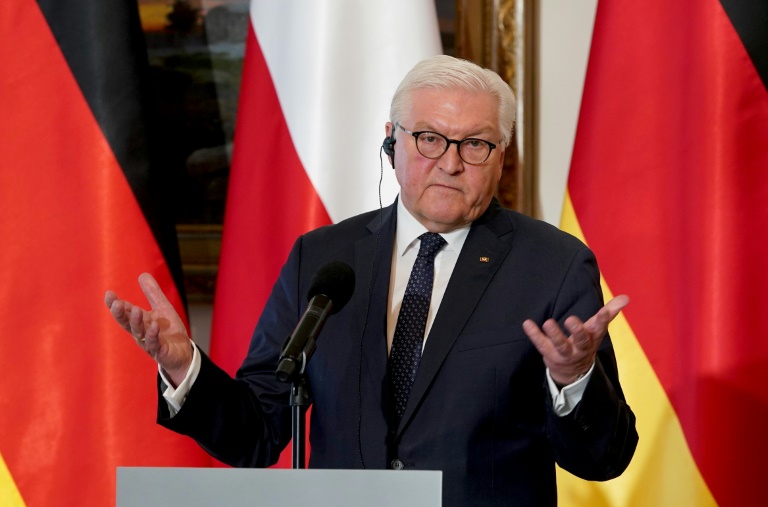
On a visit to Poland, President Frank-Walter Steinmeier admitted he had offered to visit Ukraine with other EU leaders, but Kyiv had told him he was not welcome right now.

“I was prepared to do this, but apparently, and I must take note of this, this was not wanted in Kyiv,” Steinmeier told reporters.

Steinmeier, a former foreign minister, has faced growing criticism since Russia invaded Ukraine in February for his years-long detente policy towards Moscow.

Scholz, meanwhile, was being panned for his own failure to visit Kyiv, as well as his hesitancy over providing heavy weapons to help Ukraine resist Russia’s invasion.

In the first trip by a high-level German government delegation since the start of the conflict, three top politicians were due to travel to Ukraine on Tuesday, a source told AFP.

Marie-Agnes Strack-Zimmermann of the liberal FDP, Michael Roth of Scholz’s Social Democrats and Anton Hofreiter of the Greens were meeting members of the Ukrainian parliament in the west of the country, the source said, confirming a report in Der Spiegel magazine.

But following visits by several other leaders in recent days, including British Prime Minister Boris Johnson and EU chief Ursula von der Leyen, critics have asked why Scholz himself is not making the trip.

– ‘Strong signal’ –

While Johnson was “walking side by side with Ukrainian President Volodymyr Zelensky in Kyiv” on Saturday, “Scholz was waving at an election campaign rally in Luebeck” ahead of an upcoming regional vote, the Bild daily noted.

The opposition CDU has urged Scholz to “get an idea of the situation on the ground”.

Even Strack-Zimmermann, a member of Scholz’s ruling coalition, suggested in an interview with the business daily Handelsblatt on Monday that he should “start using his powers of direction and leadership”.

The chancellor, in office since December, has also come under fire for so far refusing to send heavy weapons to Ukraine, despite his dramatic U-turn on Germany’s defence policy prompted by Russia’s invasion.

Germany had been reluctant for historical reasons to send weapons to Ukraine, but it has now sent anti-tank weapons, missile launchers and surface-to-air missiles in response to the conflict. 

However, critics want Scholz to go further.

Scholz’s own economy minister Robert Habeck has called for urgent additional weapons deliveries.

“Anything that can help the Ukrainian army now must be sent quickly,” he told German broadcasters Sat.1 and ProSieben.

Ukraine’s ambassador to Germany, Andriy Melnyk, in the same programme, said “it would be important” for Scholz to visit Kyiv and make the decision to send heavy weapons.

– ‘Insecure government’ –

Foreign Minister Annalena Baerbock, from the Green party, also voiced support for such a move on the sidelines of an EU foreign ministers’ meeting in Luxembourg on Monday.

This prompted a claim from the NTV broadcaster that Baerbock was “showing the chancellor how it’s done” and has surpassed Scholz to become “the one who sets the pace in an insecure government”.

Germany has almost exhausted its ability to supply Ukraine with weapons from its army reserves, but is working on direct deliveries from the arms industry, Defence Minister Christine Lambrecht said at the weekend.

Ukraine has received offers of tanks from Rheinmetall as well as other companies including the Krauss-Maffei Wegmann (KMW) arms group, according to media reports.

However, some of the tanks could reportedly take many months to refurbish, while critics have also pointed out that Ukrainian soldiers would have to be trained to use them.
Civilians escape east Ukraine cities as Russian assault looms

By bus and train, residents keep streaming out of east Ukraine’s Kramatorsk and Sloviansk as fears grow the cities will be key targets of a major new Russian offensive. 

On Tuesday morning, a bus in the green and yellow colours of local football team FC Kramatorsk was waiting in the rain to collect about 50 people.

Men dropped off their wives, children and elderly relatives for the journey westwards that was being funded by a church group.

Worry and sadness were etched on the faces of the loved ones as they got ready to bid each other goodbye.

The frontline is only 50 kilometres (30 miles) away to the north, east and south of Kramatorsk — the Ukrainian military’s main hub for its operations in the east.

That distance may soon be reduced soon as Russia masses its forces for an onslaught that many believe will be aimed at capturing the city, and neighbouring Sloviansk, in a pincer movement.

A family disembarked from a taxi to catch the bus, among them a little girl holding a plastic box containing a black and white cat.

Valentina Oleynikova, 82, was leaving with her husband. 

Angry that the threat of the Russian assault was forcing her to leave her home, she dismissed President Vladimir Putin’s claim that his forces were looking to liberate the largely Russian-speaking Donbas region from Ukrainian “neo-Nazis”.

“All my family is from Russia, I was born there. My father and mother too. I have relatives all over Russia,” she told AFP. 

“Here, in Donbas and Kramatorsk, people of all nationalities live. Where has he seen Nazis here?”

– ‘Devil incarnate’ –

She reserved special ire for the Russian leader as she prepared to board for her journey to stay with her sister-in-law.  

“What is happening is inhuman, he is a fascist. I don’t know what to call him — a devil incarnate,” she said.

“If only we could close the sky. Now we hear that there is a 12-kilometre convoy ready to attack the Donbas. They are inhuman,” she added, repeating a common plea on the Ukrainian side for a no-fly zone to stop Russian bombing.

Eventually the luggage was loaded and the bus was ready to pull out. 

Valentina’s grandson signalled to her through the window for her to call on her mobile.

Some of the women wiped away tears as they headed off.

The train station in Kramatorsk has been closed since a missile attack on Friday killed 57 people as crowds of residents tried to flee.

Trains evacuating people now leave from Sloviansk some 10 kilometres to the north. 

Two or three trains leave every day for the west.

On Sunday, 2,700 people were evacuated, and 1,100 on Monday, said Svetlana Biletska, the station manager. 

The first train on Tuesday left at around 11:00 am local time carrying roughly 300 passengers.

In the hubbub of the station hall, Natalia sold one-way tickets to Dnipro for 200 hryvnia (6 euros, $7) and gave out information on the schedules from the only working office.

“We have added extra cars, free of charge,” she said, declining to give her surname. 

“Some families are leaving, but many people are staying. They don’t want to leave their relatives and their homes.”

She was among those refusing to go. 

“I’m not afraid anymore,” she told AFP. 

“Something is keeping me here, I don’t know how to explain it. We work on the railway, so we are as strong as the rails.”

– ‘We have to survive’ –

A long train with 12 faded blue wagons arrived empty and immediately began turning around to take away more evacuees.

An old lady heading Vinnytsia in central Ukraine was a little bit lost. 

“You’ll have to change trains for another one going to either Kyiv or Lviv,” a railway worker in an orange waistcoat told her. 

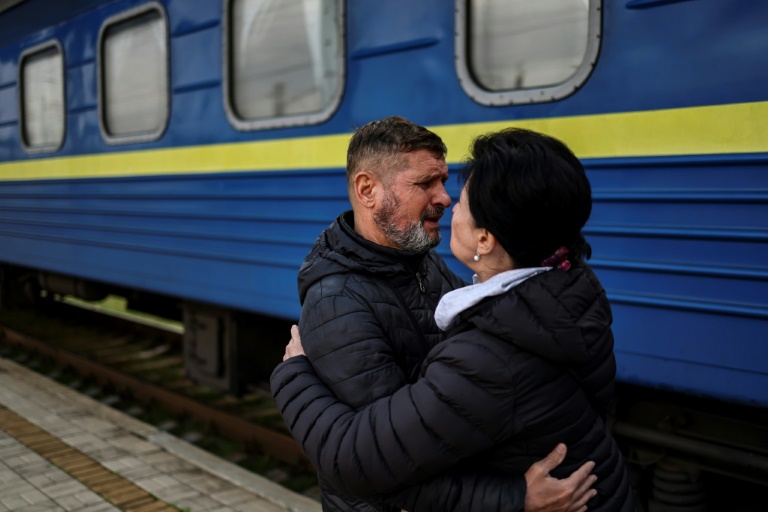
At the steps of the train, 44-year-old Nadiya Zhizhunas said a final goodbye to her husband. 

With reddened eyes, the couple held each other tight for several minutes. 

“We made the decision yesterday. I wanted to stay with my husband, but now I have to leave and he will stay here. We wanted to go through this together, it’s scary,” she told AFP. 

“It’s terribly difficult to leave. I have no idea when we will be together again. We have to survive first,” she added before turning to board.

Through the window, she made a heart with her thumbs and forefingers towards her husband. 

The train began to pull out, then stopped.

A family with children that was late ran across the tracks to get on board.

Eventually it finally left the station. Direction Kyiv, arrival expected in twelve hours. 

UK's Johnson, Sunak fined over illegal lockdown-busting parties

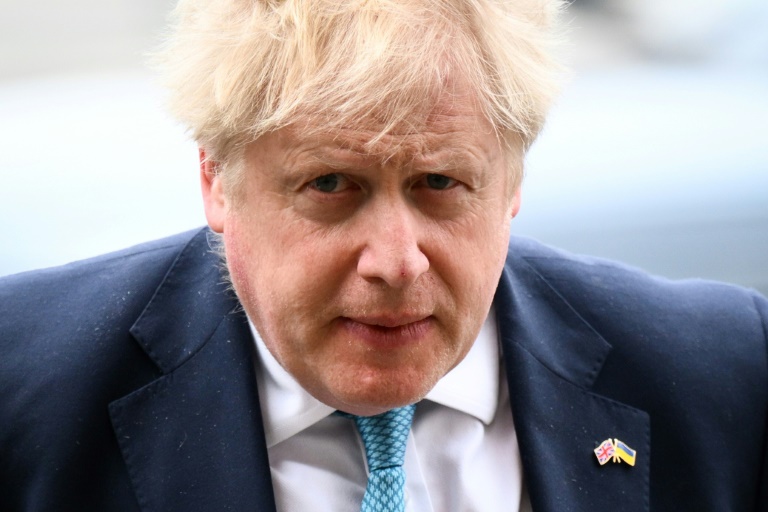
UK Prime Minister Boris Johnson offered a “full apology” on Tuesday after being fined for breaching Covid-19 lockdown laws in the so-called “Partygate” scandal, but looked set to defy calls for his resignation.

Embattled finance minister Rishi Sunak and Johnson’s wife Carrie will also be fined, as the political storm following revelations of a swathe of lockdown-busting parties in and around Downing Street threatens to engulf Johnson once more.

“Let me say immediately that I’ve paid the fine and I once again offer a full apology,” Johnson said during televised remarks.

Johnson’s office said his fine was for attending a surprise birthday gathering in his honour on the afternoon of June 19, 2020 in the Cabinet Room at Number 10.

The prime minister said the event lasted around 10 minutes, and denied that he had lied about not knowingly breaking the law, saying: “In all frankness at that time, it did not occur to me that this might have been a breach of the rules. 

“But of course the police have found otherwise and I fully respect the outcome of their investigation,” he added. 

The leader of the opposition Labour Party, Keir Starmer, swiftly called for the two most senior members of the government to resign.

“Boris Johnson and Rishi Sunak have broken the law and repeatedly lied to the British public,” Starmer tweeted. 

“They must both resign. The Conservatives are totally unfit to govern. Britain deserves better.”

However, Johnson said he now wanted “to get on and deliver the mandate that I have”, and early signs were that his MPs were currently sticking with him.

– A ‘government in crisis’ –

Johnson was left fighting for his political survival earlier this year after several lawmakers from his ruling Conservative Party withdrew their support for his leadership over the affair.

An unknown number of Conservative MPs submitted letters calling for a no-confidence vote in Johnson’s leadership.

If the Conservative Party’s 1922 Committee receives such letters from 54 of Johnson’s 360 MPs, it would spark a confidence vote.

The leader of the opposition Liberal Democrats, Ed Davey, called for parliament to be recalled from its Easter recess for a confidence vote.

“This is a government in crisis neglecting a country in crisis,” Davey tweeted.

But Russia’s invasion of Ukraine had eased the political pressure on Johnson, with MPs seemingly reluctant to trigger a leadership amid an international crisis. 

Conservative MP Roger Gale, one of those earlier calling for Johnson’s head, said on Tuesday that now was not the time to “unseat” the prime minister, as this would bolster President Vladimir Putin.

“It’s serious of course,” Gale said.

“But… I am not prepared to give Vladimir Putin the comfort of thinking that we are about to unseat the prime minister of the United Kingdom and destabilise the coalition against Putin.

“So any reaction to this is going to have to wait until we have dealt with the main crisis which is Ukraine and the Donbas,” he said, referring to the eastern Ukrainian region where Moscow is now concentrating its assault.

– Johnson ‘broke the law’ –

London’s Metropolitan Police earlier announced they had issued more than 50 fines over the parties, without disclosing the number or identities of those being fined.

Bereaved families of victims of the Covid pandemic also called on Johnson to resign.

Lobby Akinnola, spokesman for Covid-19 Bereaved Families for Justice, said Johnson and Sunak “broke the law” and “took us all for mugs.

“There is simply no way either the prime minister or chancellor can continue… Their dishonesty has caused untold hurt to the bereaved,” he said.

“They have lost all credibility with the wider public, which could cost lives if new variants mean restrictions are needed in the future.”

London police are still investigating claims that Johnson and government officials organised and attended at least a dozen boozy events in 2020 and 2021 that violated Britain’s then-strict virus curbs.

Johnson has already apologised for the parties, which included Christmas celebrations and a drink-fuelled gathering the evening before Prince Philip’s funeral.

The prime minister initially denied any rule-breaking events had occurred in the complex where he lives and works, and he consistently rejected any suggestion of personal wrongdoing.

But his opponents accused him of having misled parliament by insisting the Downing Street events were work-related and within the rules.

Clashes rock W.Bank as Palestinian attacker killed in Israel

Fresh clashes between Israeli soldiers and Palestinian militants rocked the West Bank city of Jenin on Tuesday as a Palestinian was killed after stabbing an Israeli police officer, adding to a surging death toll.

Israeli troops launched a fourth day of military operations around Jenin after an assailant from the flashpoint district last week shot and killed three people in a Tel Aviv bar in the latest of a spate of attacks that have stunned the Jewish state.

Prime Minister Naftali Bennett — who warned in response that there would “not be limits for this war” — vowed during a visit to the Tel Aviv shooting scene overnight: “We will not let our enemy stop our lives. 

“We will fight where they are located, in their bases, at their source —- and, please God, we will win.”

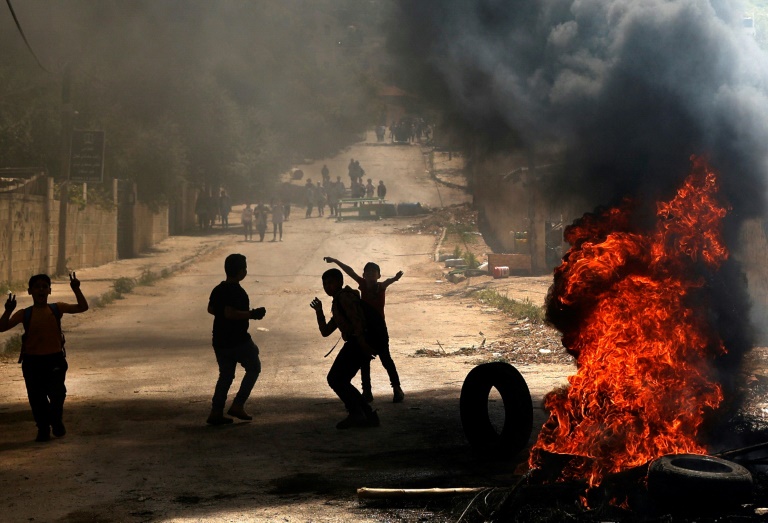
In Tuesday’s battles, which raged for a fourth day, Israeli soldiers “fired live bullets, stun grenades and tear gas,” the official Palestinian news agency Wafa said. 

The Israeli army said its soldiers fired “live ammunition toward suspects who hurled explosive devices at them as well as toward armed suspects in the area”, and arrested 20 Palestinians.

A makeshift barricade of car tyres blocked a road to the Jenin refugee camp, where a wall poster hailed the Tel Aviv shooter, Raad Hazem, 28, who was killed after a massive all-night manhunt last Friday. 

– Ramadan tensions –

“Here the (armed Palestinian) factions are united against the common enemy,” said Ismael, a young labourer from Jenin camp, labelling the Tel Aviv attack “heroic”. 

“What happened in Tel Aviv means a lot to the camp. The more operations Israeli launches here, the more resistance it will face,” he told AFP.

The latest violence to rock Israel came in the Mediterranean port city of Ashkelon, where police said an officer was checking a Palestinian man in his 40s who then “pulled out a knife and attacked the officer”.

The policeman “fired and neutralised the suspect, whose death was declared on site”, police said, adding that the officer was hospitalised with light wounds from a kitchen knife.

Police said the man was from Hebron — a powder keg where around 1,000 Jewish settlers live under heavy military protection among 200,000 Palestinians.

Palestinian youth have also clashed elsewhere with Israeli security forces, including in Ramallah, where they threw rocks and were met with tear gas.

The rise in violence comes during the Muslim fasting month of Ramadan and days before the Jewish festival of Passover and Christian Easter. 

Last year during Ramadan, tensions in Jerusalem flared into 11 days of war between Israel and the Hamas militant group ruling the Gaza Strip.

– ‘Cycle of violence’ –

Israeli troops and police have stepped up operations over the past three weeks in which four shooting, stabbing and car-ramming attacks have left 14 people dead. 

Over the same period, Israeli forces have killed 15 Palestinians, including assailants, according to an AFP tally. 

Defence Minister Benny Gantz visited an area Tuesday where a barrier that runs roughly along the West Bank border is to be extended by 40 kilometres (25 miles) in coming months under a plan approved Sunday.

Israel started building the controversial, more than 500-kilometre barrier, part wall and part fence, 20 years ago after a spate of deadly Palestinian attacks.

The army said that, following the recent attacks in Israel, it would reinforce the barrier with additional troops.

Palestinians say the barrier’s construction grabbed nearly 10 percent of the West Bank, and the International Court of Justice ruled it illegal. 

Militant group Islamic Jihad, meanwhile, hailed the Palestinian response to Israel’s military incursions in Jenin and other cities.

“We salute our people who stand like an unyielding barricade in the face of the Zionist enemy’s terrorism,” it said.

UN Secretary-General Antonio Guterres followed “with deep concern the escalating violence in the Occupied Palestinian Territory and Israel,” said his spokesman Stephane Dujarric. 

“He is appalled by the increasingly high number of casualties, including women and children,” Dujarric added.

Palestinian presidency spokesman Nabil Abu Rudeineh charged that Israel’s actions “will lead to a dangerous and uncontrollable escalation” and cause a new “cycle of violence”.

Russia closes in on Mariupol as Putin strikes defiant tone

Russian troops on Tuesday intensified their campaign to take the port city of Mariupol, part of an anticipated massive onslaught across eastern Ukraine, as President Vladimir Putin made a defiant case for the war on Russia’s neighbour.

Moscow is believed to be trying to connect occupied Crimea with Russian-backed separatist territories Donetsk and Lugansk in Donbas, and has laid siege to the strategically located city, once home to more than 400,000 people.

Civilians were struggling to flee targeted zones, with Ukrainian President Volodymyr Zelensky condemning alleged mass rapes in areas previously occupied by Russian troops, including sexual assaults of small children.

As the fighting dragged toward its seventh week, the Ukrainian army fought desperately to defend Mariupol against the Russian offensive.

“The connection with the units of the defence forces that heroically hold the city is stable and maintained,” the Land Forces of Ukraine wrote on Telegram.

However, the Russian defence ministry said its army had thwarted an attempt to break the siege with “airstrikes and artillery fire” at a factory in a northern district of the city.

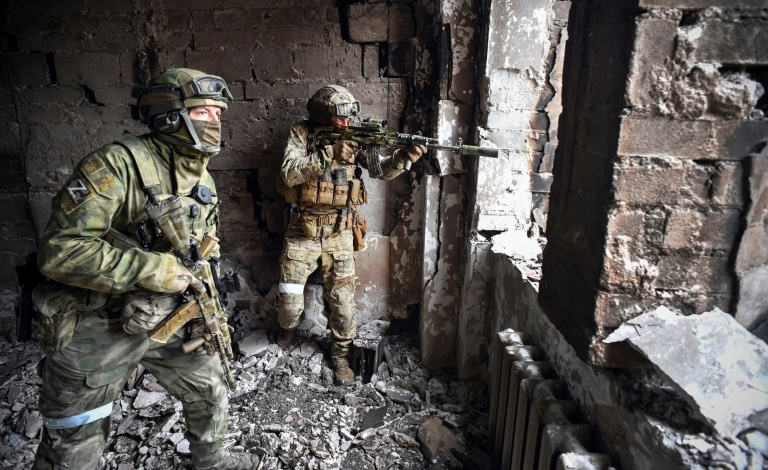
AFP journalists in Mariupol, as part of a Russian military embed, witnessed the charred remains of the city, including the theatre where 300 people were feared killed in Russian bombardment last month.

In his nightly address, Zelensky on Monday made another plea to his allies for more weapons to boost the defence of the city.

Zelensky has also said he believes Russia has killed “at least tens of thousands of people” in the city.

– ‘Shocking’ –

With little hope of a quick end to fighting, Putin pledged Moscow would proceed on its own timetable with its military operation, rebuffing repeated international calls for a ceasefire.

“Our task is to fulfil and achieve all the goals set, minimising losses. And we will act rhythmically, calmly, according to the plan originally proposed by the General Staff,” Putin said during a televised press conference with Belarusian President Alexander Lukashenko.

He also dismissed as “fake” reports of the discovery of hundreds of dead civilian bodies in the town of Bucha outside the Ukrainian capital Kyiv after the withdrawal of Moscow’s forces.

Images taken by journalists on the ground, including AFP reporters, of bodies littering the streets of Bucha sparked worldwide outrage and calls for an investigation into possible war crimes.

Bucha Mayor Anatoly Fedoruk said on Tuesday that more than 400 people had been found dead so far and 25 women reported being raped, as the town prepares for the return of residents who fled the fighting.

“What people will find in their homes is shocking, and they will remember the Russian occupiers for a very long time,” he said.

Around 400 civilians were buried in the town of Severodonetsk near the frontline in eastern Ukraine since the conflict began, the governor of the Lugansk region, Sergiy Gaiday, said on Tuesday.

– ‘Helping people’ –


However, heavy bombardment continued in the east as civilians were urged to flee ahead of an expected Russian troop surge in the region. 

Russian forces are reinforcing around the Donbas region, notably near the town of Izyum, but have not yet launched a full offensive, US Pentagon officials said Monday.

They reported a Russian convoy had been observed heading for Izyum, an hour’s drive north of Kramatorsk, saying it appeared to be a mix of personnel carriers, armoured vehicles and possible artillery.

Putin has insisted that Russia’s own security was at stake in Donbas.

“What we are doing is helping people — rescuing them on the one hand and on the other taking measures to assure Russia’s security,” he said. 

Putin accused Ukraine of “inconsistency on fundamental points” which he said was slowing down talks on ending the war.

Kyiv admitted that ongoing talks with Russia to end the war were “extremely difficult”.

“The Russian side adheres to its traditional tactics of public pressure on the negotiation process, including through certain public statements,” Ukrainian presidential adviser Mykhaylo Podolyak said in written comments to reporters.

In the war-torn eastern Ukrainian town of Volnovakha, now under Moscow’s control, a school reopened with children listening to a recording of the Russian anthem, watched by armed soldiers.

After two weeks of bombardment, many houses, shops and public buildings are now semi-ruined, windowless or burnt-out.

Meanwhile, the toll on towns previously occupied by Russian forces during their month-long offensive to take Kyiv was still coming to light.

Ukrainian prosecutors said on Tuesday six people had been found shot dead in the basement of a building outside the capital, the latest discovery fuelling allegations of Russian atrocities.

The UN Security Council — which on Monday held a session on the plight of women and children in Ukraine — will hold another meeting next week on the humanitarian situation there, in a bid to keep pressure on Russia despite its veto power over the body, diplomats said.

– ‘Rape and sexual violence’ –

Officials called for a probe into assaults against women during the conflict.

“We are increasingly hearing of rape and sexual violence,” Sima Bahous, director of the UN women’s agency, told the Security Council. “These allegations must be independently investigated to ensure justice and accountability.”

Zelensky on Tuesday voiced anger about the repeated accounts of sexual violence against Ukrainians.

“Hundreds of cases of rape have been recorded, including those of young girls and very young children. Even of a baby!” he told Lithuanian lawmakers via video link.

More than 4.6 million Ukrainian refugees have now fled their country, the UN refugee agency said — 90 percent of them women and children.

The war has displaced more than 10 million people overall. 

Ukraine’s border force said on Tuesday that more than 870,000 people who fled abroad since the start of the war had returned to the country, including a growing number of women and children. 

One of those was Tatyana Kaftan, just weeks away from giving birth to her first child, who spoke to AFP at an aid distribution point in the western city of Lviv.  

Her husband, who is waiting to be called up to the army, stood by her side.

“We left everything at home,” said the 35-year-old travel agent, who drove with her husband all the way from Mykolaiv to escape Russian shelling.  

“We have nothing.”

As the war sent energy and food prices soaring, Oxfam warned that fallout from the conflict, growing inequality and Covid could force more than a quarter of a billion people into extreme poverty this year.

Ukraine crisis pushes US inflation to new four-decade high

Americans paid more for gasoline, food and other essentials last month amid an ongoing wave of record inflation made worse by Russia’s invasion of Ukraine, according to government data released Tuesday.

The consumer price index (CPI) climbed 8.5 percent over the 12 months to March, the biggest jump since December 1981, which adds pressure to President Joe Biden’s administration even as it looks for more ways to punish Moscow for the attack on its neighbor.

Prices have surged across the world’s largest economy as it tries to recover from the Covid-19 pandemic, dragging Biden’s approval ratings lower, though the Labor Department’s March data contained signs the spike may be leveling off.

“The Russia-Ukraine war has added further fuel to the blazing rate of inflation via higher energy, food, and commodity prices that are turbo charged by a worsening in supply chain problems,” Kathy Bostjancic of Oxford Economics said.

Compared to February, prices rose 1.2 percent, in line with analysts’ forecasts, but if there were signs of deceleration to be found, they were in the lower-than-expected 0.3 percent rise in “core” prices, which exclude volatile food and energy sectors.

The potency of the ongoing price jumps bolstered the case that the Federal Reserve will take aggressive action at its policy meeting next month, likely raising the key lending rate by half a percentage point as opposed to the quarter-point increase last month.

“With labor shortages pressuring firms to raise wages, we are in the midst of a wage-price inflation cycle that will require extreme action on the part of the Fed to rid the economy of the spreading inflation threat,” economist Joel Naroff said.

– Real pain –

While the US economy has bounced back strongly from the mass layoffs that marked the early weeks of the pandemic, inflation has bedeviled the recovery since last year, as businesses struggled to find enough workers and supplies, the Fed kept interest rates low, and Congress approved stimulus measures that drove up demand among American consumers.

Biden’s public support has dropped as prices have increased, leaving the White House scrambling to offer relief, including by releasing strategic oil supplies to lower prices at the pump and waiving a prohibition on selling a lower-price gasoline blend during the summer months, a measure announced just before the data was released on Tuesday.

But the most potent actor in Washington against inflation is the Fed. 

Though rate hikes are expected to lower prices in the months to come, central bank Governor Lael Brainard said Tuesday that the fallout from the war in Ukraine “probably skews risks to the upside in inflation” 

And a new pandemic lockdown in China “has the potential to lengthen out some of those constraints that we’ve seen in supply chains,” Brainard said in a discussion after the data was released.

The Labor Department data showed Americans are facing real financial pain when they go to purchase must-have items.

Gasoline prices rose 18.3 percent last month, accounting for half the overall increase in CPI, while prices for shelter, the category including rents, rose 0.5 percent.

Food prices rose one percent overall, while prices for groceries were up 1.5 percent in the month, and 10 percent over the past year — the largest such increase since March 1981, according to the data.

– Used cars reverse –

However, prices for used cars, which were one of the first items to surge last year, declined 3.8 percent last month, pushing core CPI lower. New car prices rose only 0.2 percent after seeing monthly gains of more than one percent in the latter months of 2021.

Dan Alpert of Westwood Capital tweeted that the data showed signs of deflation “in those things that went bonkers during 2020: transportation, electronics, recreation and leisure. Supply chains are reopened for the most part and demand is becoming sated.”

But considering how high prices have risen for other categories, Naroff said some on the Fed’s policy setting committee may advocate for an even more forceful 0.75 point rate increase next month — and even that would not necessarily bring prices down quickly.

“The ability of any Fed to sharply raise rates to slow extremely high inflation, while not driving the economy into a recession, is limited, especially given factors such as war that are out of its control,” he said in a note. 

“We are talking about art here, not science, and there is little history of this Fed painting pretty pictures.”

Man in gas mask shoots 10 people on Brooklyn subway

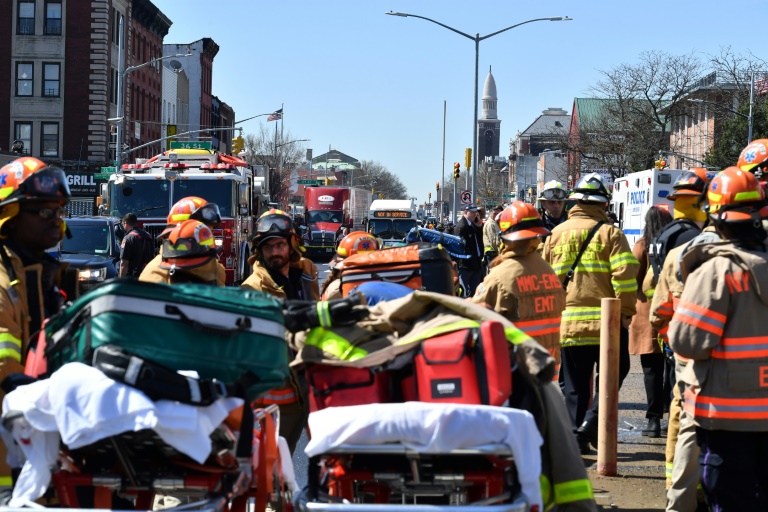
A man in a gas mask shot 10 people on a packed New York subway train during the morning rush-hour on Tuesday, setting off a smoke bomb before opening fire on terrified passengers.

Police have launched a massive manhunt for the shooter, but said the incident in Brooklyn was not being investigated as an act of terrorism and that none of the injuries were considered life-threatening. 

New York Police Department commissioner Keechant Sewell told a press conference the suspected gunman put on a gas mask just as the train was arriving at 36th Street station. 

“He then opened the canister that was in his bag and then the car filled with smoke. After that he began shooting,” Sewell said. 

The city fire department said six other people were wounded as panicked passengers fled the smoke-filled train, which pulled up to the platform moments after the shooting.

Sewell described the suspect as a lone “male, Black, approximately five feet five inches tall with a heavy build,” wearing a green construction type vest and a grey hooded sweatshirt.

Police were alerted to the shooting just before 8:30 am (1230 GMT).

Verified video footage posted on social media showed the train pulling into the 36th Street station, and smoke billowing out the doors as passengers rushed off, some apparently injured.

One of them, Yav Montano, recounted on CNN being inside the car when it began filling with smoke — and shots rang out.

“In the moment, I did not think that it was a shooting because it sounded like fireworks,” he said. “It just sounded like a bunch of scattered popping.”

There were 40 to 50 passengers inside at the time and they began crowding towards the front, Montano said — but the door to the next car was locked. 

“There were people in that other car that saw what was happening. And they tried to open the door, but they couldn’t,” he said. 

– ‘A lot of blood’ –

CNN aired a brief video shot by Montano inside the car showing passengers crowded together, some wearing masks and others pressing clothing against their mouths to protect against the smoke.

“There were some people whose clothes, whose pants were covered in blood,” Montano said, adding that he could not tell who was injured. “All I know is I saw, like, a lot of blood.”

Once the train finally reached the platform, the doors opened.

“People filed out, people forgot bags and shoes, and they just left everything to just get out of there as soon as possible,” Montano said.

Further video footage posted on Instagram appeared to show passengers tending to bloodied victims lying on a smoky station platform.

Those images showed subway staff shepherding panicked passengers, some still clutching their morning coffee cups, off the platform and into the cars of a stationary train.

– Call for witnesses –

The police department tweeted that there were “NO active explosive devices at this time,” after the fire department told AFP that “several undetonated devices” had been recovered from the scene.

The NYPD has urged people to stay clear of the area, urging witnesses to contact a tip line with any information.

The White House said President Joe Biden had been briefed on the incident and was in communication with New York officials.

New York governor Kathy Hochul promised regular updates as the investigation unfolds. 

Mass casualty shootings happen with relative frequency in the United States, where firearms are involved in approximately 40,000 deaths a year, including suicides, according to the Gun Violence Archive website.

Shootings in New York City have risen this year, and the uptick in violent gun crime has been a central focus for Mayor Eric Adams since he took office in January. Through April 3, shooting incidents rose to 296 from 260 during the same period last year, according to police statistics.

The incident came just a day after Biden announced new gun control measures, increasing restrictions on so-called “ghost guns”, the difficult-to-trace weapons that can be assembled at home.

Lax gun laws and a constitutionally guaranteed right to bear arms have repeatedly stymied attempts to clamp down on the number of weapons in circulation, despite greater controls being favored by the majority of Americans.

Three-quarters of all homicides in the United States are committed with guns, and the number of pistols, revolvers and other firearms sold continues to rise.

arb-st/ec

Boeing cuts its order book following Ukraine invasion

Boeing has removed orders for 141 jets from its backlog, mostly due to sanctions placed on Russia in the aftermath of the Ukraine invasion, officials from the plane manufacturer said Tuesday.

Most of the planes stripped from Boeing’s official tally were 737 models, with about two-thirds coming as “a result of geopolitical events,” a Boeing spokesperson said. 

The removal of the Russian jets from Boeing’s backlog comes as the company also again reported no deliveries from its 787 Dreamliner for the first quarter.

On the positive side, the company added a net of 145 new jet orders during the quarter as more people traveled and global economies recovered from the worst of the pandemic.

Boeing now holds orders for 4,231 new planes, down from 4,375, according to an update for March orders and deliveries.

The Commerce Department on April 7 announced that Russian state airline Aeroflot, Azur Air and Utair were barred from receiving American goods for the next 180 days.

The move was part of a series of steps by Washington and other Western governments in response to Moscow’s invasion of Ukraine.

In the first quarter, Boeing reported 95 commercial deliveries compared with 77 in the year-ago period. The biggest jump was for the 737, reflecting Boeing’s resumption of deliveries for the 737 MAX following a lengthy grounding.

Deliveries of the 787 have been halted since May as Boeing works to satisfy demands to address quality and manufacturing problems flagged by the Federal Aviation Administration.

At least 45 dead in South Africa floods, more rains on the way

At least 45 people have died in floods and mudslides after rainstorms struck the South African port city of Durban and surrounding KwaZulu-Natal province, the authorities said on Tuesday.

The country’s meteorologists forecasted more “extreme” rains on the way Tuesday night accompanied by “widespread flooding”. 

“The latest reports indicate that over 45 people have lost their lives as a result of the heavy rains, this number could possibly increase as more reports come in,” the province’s Department of Cooperative Governance announced in a statement.

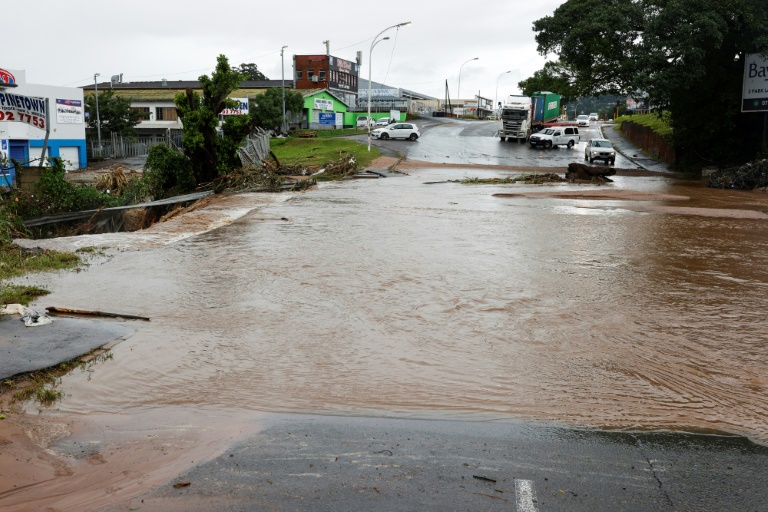
Days of pounding rain flooded several areas, tore houses apart and ravaged infrastructure across the southeastern city, while landslips caused train services across KwaZulu-Natal province to be suspended.

The rains have flooded city highways, torn apart bridges, submerged cars and collapsed houses. A fuel tank was floating in the sea after being tossed off the road.

Several shipping containers that were stacked high atop of each other, fell like dominoes and lay strewn on a yard, while some spiled over into a main road in the city, one of southern Africa’s largest regional gateways to the sea.

“At around 3am (0100 GMT), I felt the truck shaking and I thought maybe someone bumped it and when I tried to open the curtain I saw the water level… was very high,” said truck driver Mthunzi Ngcobo.

The disaster management department in KwaZulu-Natal province, of which Durban is the largest city, urged people to stay at home and ordered those residing in low-lying areas to move to higher ground.

More than 2,000 houses and 4,000 “informal” homes, or shacks, have been damaged, provincial premier Sihle Zikalala, told journalists.

Rescue operations, aided by the military, are underway to evacuate people trapped in affected areas, the provincial Department of Cooperative Governance said.

Those trapped include teachers and students at a Durban secondary school, it said.

– ‘It’s an absolute nightmare’ –

Durban mayor Mxolisi Kaunda earlier told reporters that power stations had been flooded and water supplies disrupted — and that even graveyards had not been spared the devastation.

One picture posted on Twitter by an anti-theft vehicle-tracking agency showed what looked like a human skull that had been washed to the surface of a cemetery. 

The city had only just recovered from deadly riots last July in which shopping malls were looted and warehouses set on fire, in South Africa’s worst unrest since the end of apartheid.

A local humanitarian agency, Gift of the Givers, said in a statement: “The need of the hour is huge.”

The country’s rail service PRASA said landslips and rubble on the tracks had forced it to suspend all train services in the province.

“It’s an absolute nightmare. Plenty of mudslides, people (dying),”  Garrith Jamieson, director of Durban-based ALS Paramedics Medical Services, told AFP as he predicted “more fatalities”.

Southern parts of the continent’s most industrialised country are bearing the brunt of climate change — suffering recurrent and worsening torrential rains and flooding.

Floods killed around 70 people in April 2019.

“We know it’s climate change getting worse, it’s moved from 2017 with extreme storms to supposedly having record floods in 2019, and now 2022 clearly exceeding that,” University of Johannesburg development studies professor Mary Galvin said.

“Droughts and floods will become more frequent and more intense and that’s what we are seeing” she said, frustrated at government’s lack of preparedness.

“It’s not surprising, it’s absolutely devastating but equally devastating is the fact that we haven’t done anything to get ready for it,” she lamented.   

The South African Weather Service admitted in a statement that “the exceptionally heavy rainfall overnight (Monday) and (Tuesday) morning exceeded even the expectations of the southern African meteorological community at large”.

Pressure mounts on Berlin as Kyiv snubs German president

Pressure was mounting on Germany to up its game over the war in Ukraine on Tuesday as Kyiv snubbed the country’s president and Chancellor Olaf Scholz was accused of a weak response to the crisis.

On a visit to Poland, President Frank-Walter Steinmeier admitted he had offered to visit Ukraine with other EU leaders, but Kyiv had told him he was not welcome right now.

“I was prepared to do this, but apparently, and I must take note of this, this was not wanted in Kyiv,” Steinmeier told reporters.

Steinmeier, a former foreign minister, has faced growing criticism since Russia invaded Ukraine in February for his years-long detente policy towards Moscow.

Scholz, meanwhile, was being panned for his own failure to visit Kyiv, as well as his hesitancy over providing heavy weapons to help Ukraine resist Russia’s invasion.

In the first trip by a high-level German government delegation since the start of the conflict, three top politicians were due to travel to Ukraine on Tuesday, a source told AFP.

Marie-Agnes Strack-Zimmermann of the liberal FDP, Michael Roth of Scholz’s Social Democrats and Anton Hofreiter of the Greens were meeting members of the Ukrainian parliament in the west of the country, the source said, confirming a report in Der Spiegel magazine.

But following visits by several other leaders in recent days, including British Prime Minister Boris Johnson and EU chief Ursula von der Leyen, critics have asked why Scholz himself is not making the trip.

– ‘Strong signal’ –

While Johnson was “walking side by side with Ukrainian President Volodymyr Zelensky in Kyiv” on Saturday, “Scholz was waving at an election campaign rally in Luebeck” ahead of an upcoming regional vote, the Bild daily noted.

Ukraine’s ambassador to Germany, Andriy Melnyk, has said a Scholz trip to Kyiv would send a “strong signal”, while the opposition CDU has urged him to “get an idea of the situation on the ground”.

Even Strack-Zimmermann, a member of Scholz’s ruling coalition, suggested in an interview with the business daily Handelsblatt on Monday that he should “start using his powers of direction and leadership”.

In office as chancellor since December, Scholz has often been mocked for his taciturn demeanour and was once dubbed “Scholzomat” for his boring, robotic speeches.

The chancellor has also come under fire for so far refusing to send heavy weapons to Ukraine, despite his dramatic U-turn on Germany’s defence policy prompted by Russia’s invasion.

Germany had been reluctant for historical reasons to send weapons to Ukraine, but it has now sent anti-tank weapons, missile launchers and surface-to-air missiles in response to the conflict. 

However, critics want Scholz to go further.

The three politicians visiting Ukraine on Tuesday are all in favour of delivering heavy weapons to Ukraine.

– ‘Insecure government’ –

Foreign Minister Annalena Baerbock, from the Green party, also voiced support for such a move on the sidelines of an EU foreign ministers’ meeting in Luxembourg on Monday.

This prompted a claim from the NTV broadcaster that Baerbock was “showing the chancellor how it’s done” and has surpassed Scholz to become “the one who sets the pace in an insecure government”.

Germany has almost exhausted its ability to supply Ukraine with weapons from its army reserves, but is working on direct deliveries from the arms industry, Defence Minister Christine Lambrecht said at the weekend.

Ukraine has received offers of tanks from Rheinmetall as well as other companies including the Krauss-Maffei Wegmann (KMW) arms group, according to media reports.

However, some of the tanks could reportedly take many months to refurbish, while critics have also pointed out that Ukrainian soldiers would have to be trained to use them.
“It’s not just a matter of getting in the vehicle and driving off, unless you want to expose yourself to the risk of being attacked immediately,” Strack-Zimmermann said in an interview with Der Spiegel.

Instead, Strack-Zimmermann suggested sending tanks to Ukraine from Eastern European countries that would be easier for Ukrainian soldiers to use immediately.

Close Bitnami banner
Bitnami