World

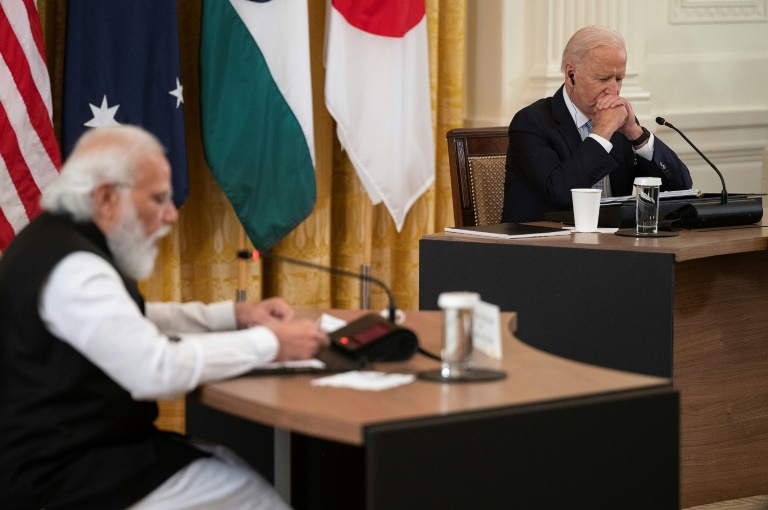
Biden, Modi to meet virtually Monday over Ukraine

US President Joe Biden and Indian Prime Minister Narendra Modi will hold a virtual summit Monday, clouded by US frustration over New Delhi’s neutral stance on Russia’s invasion of Ukraine.

The South Asian nation has tried to walk a tightrope between maintaining relations with the West and avoiding alienating Russia, and has not imposed sanctions over the conflict.

New Delhi has raised concerns in Washington in particular by continuing to buy Russian oil and gas, despite pressure from Biden for world leaders to take a hard line against Moscow.

“President Biden will continue our close consultations on the consequences of Russia’s brutal war against Ukraine and mitigating its destabilizing impact on global food supply and commodity markets,” Press Secretary Jen Psaki said in a statement on Sunday.

The call will take place at 11:00am (1500 GMT), the White House said.

The state-run Indian Oil Corp. has bought at least three million barrels of crude from Russia since the start of the invasion on February 24, in defiance of an embargo by Western nations.

Biden and Modi failed to reach a joint condemnation of the Russian invasion when they last spoke in early March at a meeting of the so-called “Quad” alliance of the United States, India, Australia and Japan.

And India abstained when the UN General Assembly voted last week to suspend Russia from its seat on the 47-member Human Rights Council over allegations that Russian soldiers in Ukraine engaged in war crimes.

– ‘Shaky’ response –

The United States has already warned that any country that actively helps Russia to circumvent international sanctions will suffer “consequences.” 

Yet this has not deterred India from working with Russia on a rupee-ruble payment mechanism to enable existing trade obligations in the wake of sanctions imposed on the Kremlin.

Biden said on March 21 that India was an exception among Washington’s allies with its “shaky” response to the Russian offensive.

In the Cold War, officially non-aligned India leaned towards the Soviet Union — in part due to US support for arch-rival Pakistan — buying its first Russian MiG-21 fighter jets in 1962.

According to experts, Russia remains India’s biggest supplier of major arms and India is also Russia’s largest customer.

Russian Foreign Minister Sergei Lavrov, who met with Modi in New Delhi in early April, lauded India for its approach to the conflict, and in particular for judging “the situation in its entirety, not just in a one-sided way.”

Biden and Modi are also expected to talk about ending the Covid-19 pandemic, countering climate change, and bolstering security and democracy in the Asia-Pacific region, where India is seen as a critical counterweight to growing Chinese power.

The last confrontation between the Chinese and Indian militaries on the Line of Control, on the border of Tibet and the Indian region of Ladakh, flared up as recently as June 2020. 

And on Thursday, India claimed to have thwarted a cyberattack launched by Chinese hackers against its power grid.

Secretary of State Antony Blinken and Defense Secretary Lloyd Austin will also hold a “U.S.-India 2+2 Ministerial” meeting Monday with Indian Minister of External Affairs Subrahmanyam Jaishankar and Minister of Defense Rajnath Singh. 
French Greens face crisis after failed presidential bid

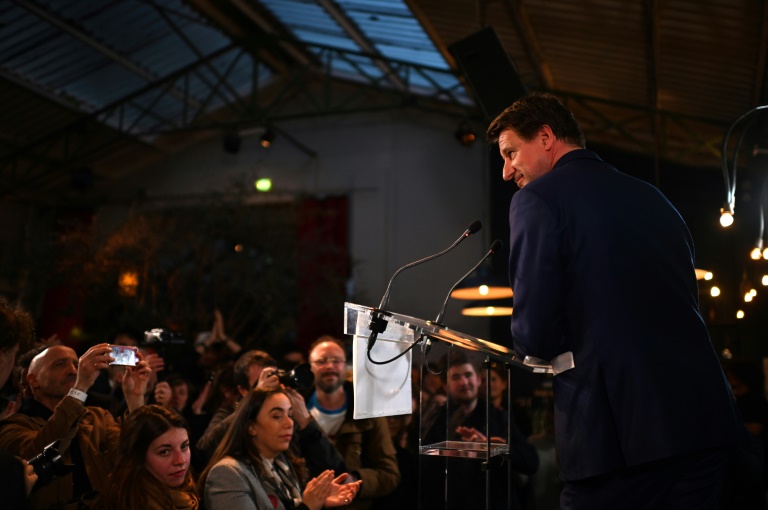
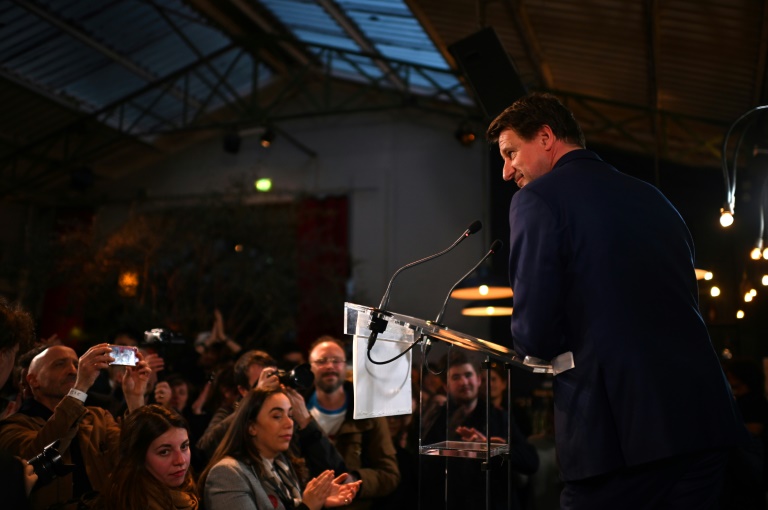
France’s Green party were facing a financial and political crisis on Monday after a deeply disappointing presidential election saw their candidate finish sixth and struggle to put climate change on the national agenda.

Yannick Jadot from the Europe Ecology-The Greens party (EELV) was eliminated in Sunday’s first round with a score of around 4.6 percent, following a campaign that never gathered momentum.

Under French campaign financing rules, only candidates who score above 5.0 percent have their expenses reimbursed by the state, leaving the Greens with a huge hole in their accounts.

“The situation is critical and the fact that we came below the bar of five percent puts us in a very, very difficult situation,” national secretary Julien Bayou told France Inter radio on Monday.

He appealed for donations from those who backed the party, as well as others “who would have liked to vote for Yannick Jadot and perhaps voted for another candidate.”

“We need this support to be able to continue to ensure the ecology movement lives on,” Bayou added.

President Emmanuel Macron finished top in Sunday’s vote on around 27.6 percent followed by far-right leader Marine Le Pen on 23.4 percent, with the pair set to contest a run-off vote scheduled for April 24.

EELV was not the only party appealing for financial help on Monday, with the once-mighty right-wing Republicans also facing a 7.0-million-euro ($7.6 million) hole in their finances after their candidate, Valerie Pecresse, scored just under 5.0 percent on Sunday.

The performance from Jadot, a former Greenpeace executive, spelled bitter disappointment for his party which was hoping to build on successes in local elections last year which saw them sweep major cities from Lyon to Bordeaux. 

Germany’s historically more powerful Green party entered government after elections last year and controls several ministries and key posts in the cabinet, including the foreign minister role. 

– ‘Enormous disappointment’ –

Jadot scored slightly better than the last ecologist candidate to stand — Eva Joly with 2.3 percent in 2012 — but less well than Noel Mamere in 2002 who secured 5.25 percent despite the stakes for the planet being much higher in 2022.

In a concession speech on Sunday night, Jadot said his programme sought to respond to the challenges posed by climate change, as well as growing economic inequalities in France.

“It’s an understatement to say that these vital challenges — vital for our country, vital for us and our children — were largely ignored in a campaign that was confiscated,” he said.

The Covid-19 pandemic overshadowed the start of campaigning before Russia’s invasion of Ukraine changed the dynamic completely, making foreign policy and the rocketing cost of living key issues for voters.

Jadot was also eclipsed by hard-left candidate Jean-Luc Melenchon, who put a big emphasis on the environment during his campaign and finished third, only narrowly missing out on a place in the run-off.

Remi Lefebvre, a French political scientist at the University of Lille in northeast France, told AFP before the vote that the Greens had been “the enormous disappointment of this campaign.”

“The problem with the greens is its social base,” he explained. “They can’t reach working-class people because the greens are not seen as reassuring.”

Low-income families often see their pitch as boiling down to “they’re going to ask us to tighten our belts even more”, Lefebvre said, while the educated, urban middle classes tended to vote for Macron.

Jadot called on his 1.5 million voters on Sunday to back Macron in the second round to bar the far-right from power, while pointing out his differences with the president.

He said the vote “is not approval for your responsibility in the fracturing of the country due to your inaction on the climate, your social failures, conformism and democratic contempt.”

French Greens face crisis after failed presidential bid

France’s Green party were facing a financial and political crisis on Monday after a deeply disappointing presidential election saw their candidate finish sixth and struggle to put climate change on the national agenda.

Yannick Jadot from the Europe Ecology-The Greens party (EELV) was eliminated in Sunday’s first round with a score of around 4.6 percent, following a campaign that never gathered momentum.

Under French campaign financing rules, only candidates who score above 5.0 percent have their expenses reimbursed by the state, leaving the Greens with a huge hole in their accounts.

“The situation is critical and the fact that we came below the bar of five percent puts us in a very, very difficult situation,” national secretary Julien Bayou told France Inter radio on Monday.

He appealed for donations from those who backed the party, as well as others “who would have liked to vote for Yannick Jadot and perhaps voted for another candidate.”

“We need this support to be able to continue to ensure the ecology movement lives on,” Bayou added.

President Emmanuel Macron finished top in Sunday’s vote on around 27.6 percent followed by far-right leader Marine Le Pen on 23.4 percent, with the pair set to contest a run-off vote scheduled for April 24.

EELV was not the only party appealing for financial help on Monday, with the once-mighty right-wing Republicans also facing a 7.0-million-euro ($7.6 million) hole in their finances after their candidate, Valerie Pecresse, scored just under 5.0 percent on Sunday.

The performance from Jadot, a former Greenpeace executive, spelled bitter disappointment for his party which was hoping to build on successes in local elections last year which saw them sweep major cities from Lyon to Bordeaux. 

Germany’s historically more powerful Green party entered government after elections last year and controls several ministries and key posts in the cabinet, including the foreign minister role. 

– ‘Enormous disappointment’ –

Jadot scored slightly better than the last ecologist candidate to stand — Eva Joly with 2.3 percent in 2012 — but less well than Noel Mamere in 2002 who secured 5.25 percent despite the stakes for the planet being much higher in 2022.

In a concession speech on Sunday night, Jadot said his programme sought to respond to the challenges posed by climate change, as well as growing economic inequalities in France.

“It’s an understatement to say that these vital challenges — vital for our country, vital for us and our children — were largely ignored in a campaign that was confiscated,” he said.

The Covid-19 pandemic overshadowed the start of campaigning before Russia’s invasion of Ukraine changed the dynamic completely, making foreign policy and the rocketing cost of living key issues for voters.

Jadot was also eclipsed by hard-left candidate Jean-Luc Melenchon, who put a big emphasis on the environment during his campaign and finished third, only narrowly missing out on a place in the run-off.

Remi Lefebvre, a French political scientist at the University of Lille in northeast France, told AFP before the vote that the Greens had been “the enormous disappointment of this campaign.”

“The problem with the greens is its social base,” he explained. “They can’t reach working-class people because the greens are not seen as reassuring.”

Low-income families often see their pitch as boiling down to “they’re going to ask us to tighten our belts even more”, Lefebvre said, while the educated, urban middle classes tended to vote for Macron.

Jadot called on his 1.5 million voters on Sunday to back Macron in the second round to bar the far-right from power, while pointing out his differences with the president.

He said the vote “is not approval for your responsibility in the fracturing of the country due to your inaction on the climate, your social failures, conformism and democratic contempt.”

Shehbaz Sharif steps out of the shadows to lead Pakistan

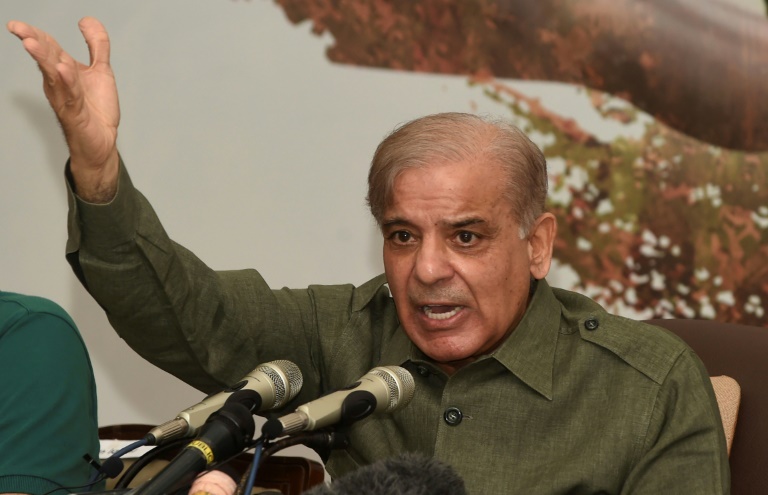
Shehbaz Sharif, who became Pakistan’s new prime minister Monday after leading the opposition alliance that ousted Imran Khan, is a tough administrator with a penchant for quoting revolutionary poetry.

Sharif is the younger brother of three-time prime minister Nawaz Sharif, who was dismissed then jailed on corruption charges in 2017 and is currently in Britain after being released from prison two years later for medical treatment.

He is a seasoned politician in his own right, however, having served for years as chief minister of Punjab province, the Sharif family’s power base, and also president of the Pakistan Muslim League-N (PML-N).

The 70-year-old jointly inherited the family’s steel business as a young man and was first elected to provincial office in 1988.

During his stints as chief minister in the years that followed, he presided over a series of big-ticket infrastructure projects, including Pakistan’s first metro bus service.

Officials were reportedly kept on their toes by workaholic Sharif’s habit of surprise visits to government offices, which he would inspect clad in a favoured safari suit and hat.

Still, critics say he did little to address the province’s core issues — including the need for civil service, health and agricultural reforms — and instead focused on vote-grabbing projects, such as distributing laptops to students or offering subsidised taxis to the jobless.

– Freed on bail –

Sharif has also been linked to graft and corruption — charges supporters say sprang from a political vendetta by Khan.

In December 2019, the National Accountability Bureau seized nearly two dozen properties belonging to Sharif and his son Hamza, accusing them of money laundering.

He was arrested and detained in September 2020, but released around six months later on bail for a trial which is still pending.

Unlike his elder brother — whose relations with the country’s powerful military and his opponents were strained — Sharif is seen as a more flexible dealmaker, capable of compromising even with his enemies.

Pakistan’s military is the country’s most powerful institution and has ruled the nation for nearly half its history — and pulls the strings even when not actually ruling.

“I have always remained a strong supporter of effective coordination between Islamabad and Rawalpindi,” Sharif said, referring to the administrative capital and the nearby military headquarters.

Sharif remains popular despite lurid tabloid headlines about multiple marriages and a property portfolio that includes luxury apartments in London and Dubai.

His current marriage, to author Tehmina Durrani, has largely ended the gossip.

Durrani, a feminist whose book “My Feudal Lord” earned her international acclaim, is also credited with improving Sharif’s respect for women. 

Tough economic and security challenges await Sharif as he inherits a stagnant economy and escalating violence from Pakistan’s Taliban and Balochistan separatists.

Tesla China exports only 60 cars in March as Covid hits auto sector

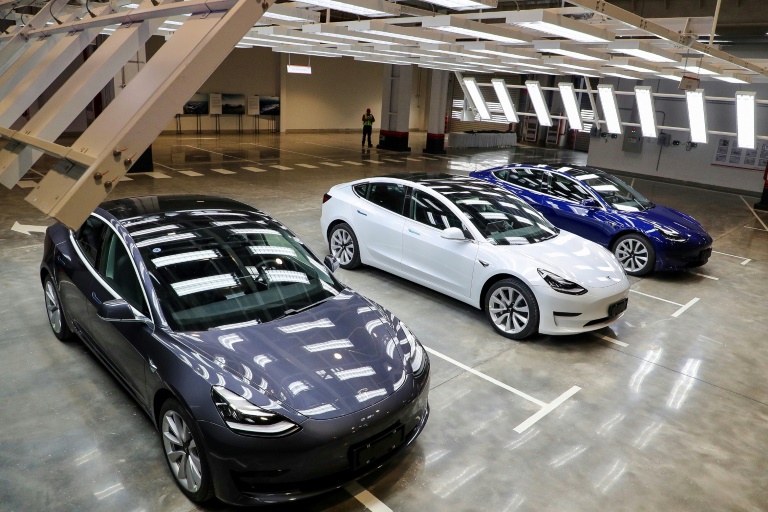
Tesla exported only 60 China-made cars in March, a trade body said Monday, with the domestic market absorbing most of its production while virus curbs in areas like Shanghai and Jilin hurt deliveries in the auto industry.

Shanghai is home to Tesla’s multibillion-dollar “giga-factory”, which the company calls its main export hub and has the capacity to produce hundreds of thousands of vehicles per year.

But the factory — like much of the country’s auto industry — has been hit by pandemic-related disruptions.

While Tesla China delivered 65,814 cars at its factory last month, only 60 were exported, the China Passenger Car Association (CPCA) said Monday, without giving further details.

In comparison, the company had exported 33,315 vehicles in February. 

Tesla’s slump is part of a wider trend across China, which saw car sales fall 10.5 percent from a year ago to 1.6 million vehicles on the back of strict measures to curb renewed virus flare-ups that have hit logistics and retail sales.

However, the new-energy sector appears to be the rare bright spot, with deliveries of the vehicles jumping 137.6 percent, compared to March 2021, and reaching 445,000 units, the CPCA said. 

Despite a chip shortage and high lithium prices, CPCA’s secretary-general Cui Dongshu said China’s share of the world’s auto market has “reached a new high of 36 percent” in the first two months of the year.

All eyes will be on Tesla’s numbers in April, given that its Shanghai factory has reportedly suspended production since March 28 amid the city’s virus lockdowns.

Beijing’s zero-Covid policy to stamp out clusters has been increasingly strained as the country battles its worst wave of infections since the start of the pandemic

Chinese electric vehicle maker Nio said Saturday it has suspended vehicle production due to hard lockdowns across the country, and warned of delays in making deliveries.

Shanghai starts easing lockdown in some neighbourhoods

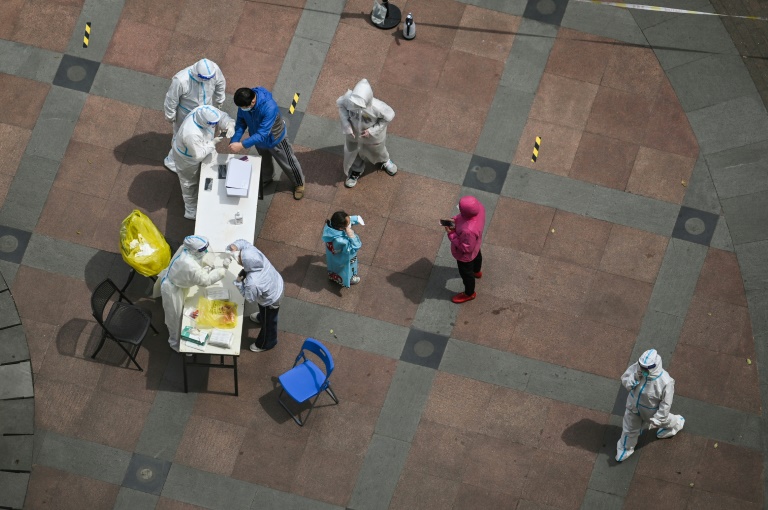
Shanghai eased restrictions on some neighbourhoods Monday after mounting outcry over inflexible Covid-19 rules that have locked down 25 million people, caused food shortages and left thousands in quarantine.

Authorities said they would gradually begin to allow those in areas with the least number of virus cases to leave their communities, although it was unclear how many people will be allowed out of their homes or when.

China has stuck to a policy of “zero Covid”, aiming to eliminate infections through rigid lockdowns, mass testing and travel restrictions.

Shanghai has been placed under some of the most severe measures since the virus emerged in Wuhan in 2019, with a strict lockdown leaving many struggling to get enough food and thousands sent to centralised quarantine centres.

Officials said they would categorise communities across the city into three levels based on the number of infections.

“Differentiated prevention and control (measures)” would refect the “actual circumstances” on the ground, Shanghai official Gu Honghui said Monday, in a move that appeared aimed at defanging rising anger over authorities’ handling of the virus.

Those in “closed control areas” or “controlled management areas” would continue to be locked down in their homes or limited to their compounds.

Residential communities which have recorded no cases in the past 14 days will allow residents to leave their homes.

But as the news filtered across Shanghai, residents scrambled to decipher the precise details from their neighbourhood committees.

One southern district which falls into the category for the lowest number of cases said it would now allow residents out once a day to buy supplies.

State news agency Xinhua said people in the least restricted areas would be “allowed in principle” to move inside their sub-districts with “strict restrictions on the scale of gathering.”

Shanghai resident Chris Miller said he had been told he was now free to leave the maternity centre where he has been staying with his wife since the birth of their son shortly before lockdown.

“I was the first of our building to go out,” he told AFP. 

“There’s basically nothing open. I went to a pharmacy and… a lot of shelves had been picked clean but there were a few things I needed that I was able to pick up.”

He said the streets were very empty but he planned to go out again.

“One of the other fathers here wants to go out for some beer,” he said.

The move appeared to divide opinions online, with some expressing concerns about spreading the virus further in the community.

But one resident posted pictures of a small queue forming at the gate to her community as residents waited to be let out.

Another unverified video showed a couple hugging in the middle of a car-less road as relieved residents started to wander around the street.

There were 27,509 new cases reported in China on Monday — the vast majority in Shanghai.

Biden cracks down on hard-to-trace 'ghost guns'

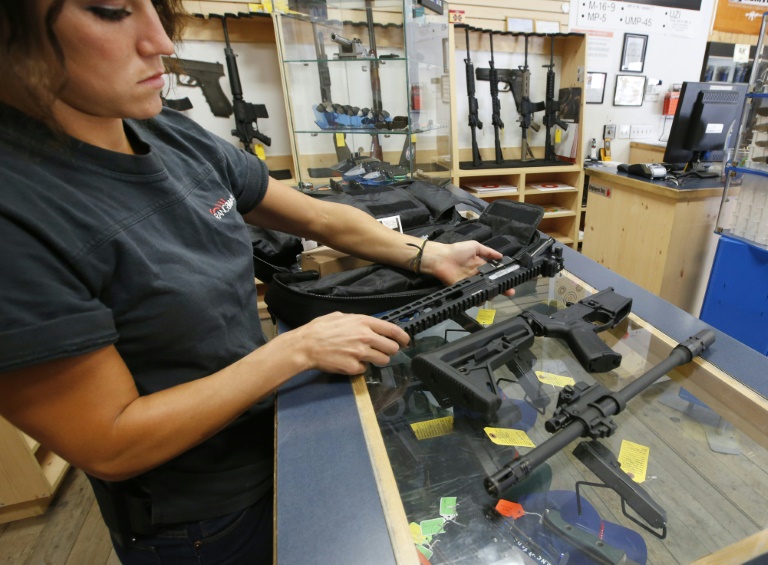
President Joe Biden will announce new measures cracking down on so-called “ghost guns” on Monday, with an executive order set to increase restrictions on the weapons that can be assembled at home in minutes and are difficult to trace as they lack serial numbers.

The new rule, a year in the making, addresses a kind of weapon that law enforcement officials say has almost doubled in its appearance in police reports between 2020 and 2021.

Such guns are “the weapon of choice for many violent criminals,” the White House said in a statement.

The new rule states that weapons part kits that can easily be assembled into a working firearm will be subject to the same requirements as commercially available fully assembled guns, administration officials said.

Dealers selling these weapons parts kits will now be required to conduct a background check on prospective buyers, according to the new regulations.

Gun kit manufacturers must also include a serial number on key weapon components, while licensed dealers who take a “ghost gun” into their inventory must add a serial number, the US Justice Department said in a statement.

Finally, in order to boost tracing efforts, the new rule states that federally licensed dealers of firearms must keep records for as long as they are in business, rather than for a 20-year period as is currently the case.

“This rule will make it harder for criminals and other prohibited persons to obtain untraceable guns, will help ensure that law enforcement officers can retrieve the information they need to solve crimes, and will help reduce the number of untraceable firearms flooding our communities,” said US Attorney General Merrick Garland.

From January 2016 to December 2021, the US Bureau of Alcohol, Tobacco and Firearms (ATF) received approximately 45,240 reports of suspected privately made firearms recovered by law enforcement, the Justice Department said. Those reports were linked to at least 692 homicide or attempted homicide investigations, it added.

The use of such weapons has been increasing, with the number of reports nearly doubling to more than 19,000 from 2020 to 2021, it said.

Over the past five-year period, the ATF could only trace 0.98 percent of suspected “ghost guns” handed in by law enforcement to an individual purchaser, the department said.

On Monday, the White House said that Biden will also nominate Steve Dettelbach, a former US attorney from Ohio, to run the ATF after the president’s first nominee, a gun control advocate, ran into opposition from Republicans and some Democrats in Congress.

Austria leader to meet Putin as Ukraine braces for eastern offensive

Austria’s chancellor on Monday will become the first European leader to visit Moscow since Russia’s invasion of Ukraine, as Kyiv steels itself for a huge Russian offensive in the country’s east. 

Karl Nehammer said he would meet with Russian President Vladimir Putin, and is expected to raise alleged war crimes in devastated areas around Kyiv that were under Russian occupation, including the town of Bucha.

Ukrainian authorities say over 1,200 bodies have been found in the area so far and that they are weighing cases against “500 suspects”, including Putin and other top Russian officials.

Russian forces are now turning their focus to the Donbas region in the east, where Ukrainian President Volodymyr Zelensky said Russian troops were preparing “even larger operations”.

Russia is believed to be seeking a link between occupied Crimea and Moscow-backed separatist territories Donetsk and Lugansk in Donbas.

“They can use even more missiles against us… But we are preparing for their actions. We will answer,” Zelensky said.

Lugansk governor Sergiy Gaiday warned that the region could suffer as badly as Mariupol, a besieged port city that even pro-Russian authorities say has been 70 percent ruined by fighting.

Marines in Mariupol warned on Monday that Ukrainian forces were preparing for a final stand to control the southern port.

“Today will probably be the last battle, as the ammunition is running out,” the 36th marine brigade of the Ukrainian armed forces said on Facebook. 

“It’s death for some of us, and captivity for the rest,” it added, saying it had been “pushed back” and “surrounded” by the Russian army.

– ‘War on civilians’ –

Over the weekend, ongoing strikes hampered evacuations in and around Kharkiv in the northeast, and 11 people were killed, including a seven-year-old child, regional governor Oleg Synegubov said.

“The Russian army continues to wage war on civilians due to a lack of victories at the front,” he said on Telegram.

In Dnipro, an industrial city of around one million inhabitants, Russian missiles rained down on the local airport, nearly destroying the facility and causing an unknown number of casualties, local authorities said.

The Russian defence ministry said it had destroyed a Ukrainian S-300 anti-aircraft system supplied by “a European country” in a hangar south of Dnipro, as well as 10 Ukrainian tanks, five self-propelled guns and five rocket launchers in the Donetsk region. 

Gaiday said a missile strike on a railway station in the city of Kramatorsk on Friday, which killed 57 people, had left many afraid to flee. Russia has denied involvement in the strike.

Gaiday again urged people to leave the region, with five humanitarian corridors agreed for Monday.

“You are alive because a Russian shell has not yet hit your house or basement — evacuate, buses are waiting, our military routes are as secure as possible,” he wrote on Telegram.

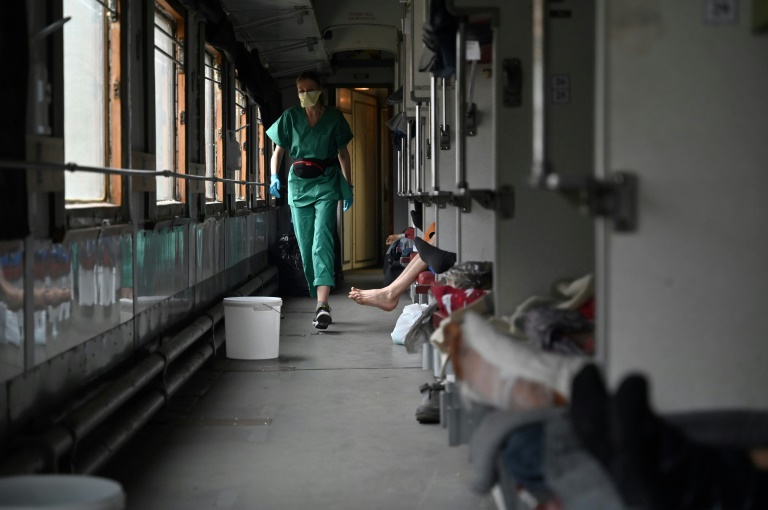
Over the weekend, nearly 50 wounded and elderly patients were transported from the east in a hospital train by medical charity Doctors Without Borders (MSF), the first such evacuation since the Kramatorsk attack.

Electrician Evhen Perepelytsia was rescued after he lost his leg in shelling in his hometown of Hirske.

“We hope that the worst is over — that after what I’ve been through, it will be better,” said the 30-year-old after arriving in the western city of Lviv.

On Monday, the Chairman of the Board of Ukrainian Railways, Alexander Kamyshin, said another railway station in the east had been attacked overnight.

“They continue to aim at the railway infrastructure,” he wrote. 

– EU talks sanctions –

On the diplomatic front, EU foreign ministers were meeting Monday to discuss a sixth round of sanctions, with concerns that divisions over a ban on Russia gas and oil imports could blunt their impact.

Austria is an EU member, but does not belong to NATO, and Nehammer’s spokesman said Brussels, Berlin and Kyiv had been informed about the Moscow visit.

The talks with Putin are expected to take place behind closed doors, without a joint media appearance. 

“We are militarily neutral, but have a clear stance on the Russian war of aggression against Ukraine,” Nehammer tweeted, calling for humanitarian corridors, a ceasefire and a full investigation of war crimes.

US President Joe Biden meanwhile will hold virtual talks on Monday with Indian Prime Minister Narendra Modi, just weeks after saying India had been “shaky” in its response to the invasion.

A US spokeswoman said the two leaders would consult on ways to offset the “destabilising impact (of the war) on global food supply and commodity markets”.

The World Bank warned Sunday that Ukraine’s economy would collapse by 45 percent this year — a much bleaker outlook than it predicted even a month ago — while Russia would see an 11 percent decline in GDP.

– ‘Atrocious cruelty’ –

Ukraine’s allies have sought to pile pressure on Moscow over allegations its troops carried out war crimes in areas around Kyiv, and there has been little sign that intermittent peace talks are progressing.

The pope has urged an Easter ceasefire, denouncing a war where “defenceless civilians” suffered “heinous massacres and atrocious cruelty.”

At least 183 children have died and 342 were injured in Ukraine in 46 days of the Russian invasion, the prosecutor general’s office said on Telegram.

Ukraine’s Foreign Minister Dmytro Kuleba on Sunday told NBC’s “Meet the Press” he was still open to negotiating with the Russians.

“If sitting down with the Russians will help me to prevent at least one massacre like in Bucha, or at least another attack like in Kramatorsk, I have to take that opportunity,” he said.

Bucha — where authorities say hundreds were killed, some with their hands bound — has become a byword for the brutality allegedly inflicted under Russian occupation. 

burs-dlc/jv

Zelensky says he believes 'tens of thousands' killed in Mariupol

Ukrainian President Volodymyr Zelensky said Monday that he believed “tens of thousands” of people in Mariupol had been killed, as he asked South Korean lawmakers to provide military assistance.

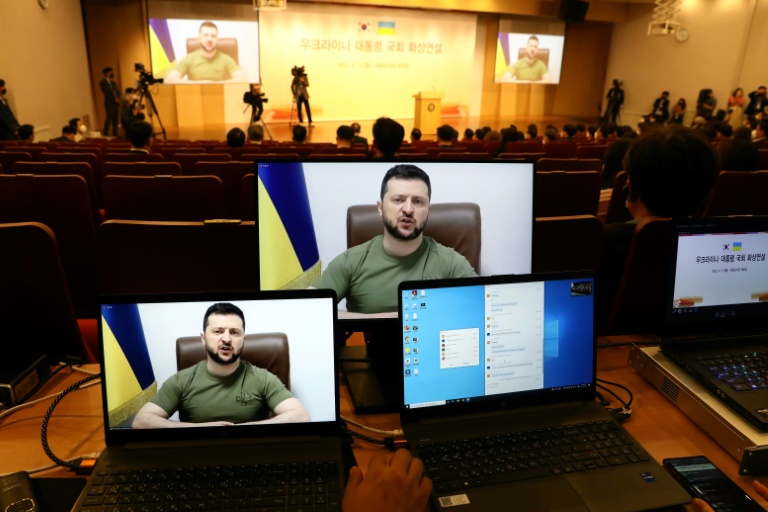
Speaking to South Korea’s National Assembly by video link, Zelensky said Russia had “completely destroyed” the besieged city of Mariupol.

“The Russians completely destroyed Mariupol and burned it to ashes. At least tens of thousands of Mariupol citizens must have been killed,” he said, speaking by video link to South Korean lawmakers. 

“But for Russia, Mariupol is just an example. Ladies and gentlemen, we’ve seen a lot of destruction like this in the 20th century.”

Zelensky said South Korea could help his country’s fight against Russia by providing military equipment from aeroplanes to tanks.

“If Ukraine receives such weapons, not only will they save the lives of ordinary people, but it will be a chance to save Ukraine,” he said.

South Korea has given Ukraine some one billion won ($800,000 USD) of non-lethal military equipment, such as bulletproof helmets and medical kit, Seoul’s defence ministry told AFP Monday.

But it turned down a recent Ukrainian request for anti-aircraft weaponry, saying that providing such weapons on the scale requested would impact South Korea’s own “military readiness posture”.

As a result of their own security situation, Seoul’s ability to provide “lethal weapons systems to Ukraine is restricted,” a defence ministry official told AFP.

The Korean War ended in a ceasefire and not a peace treaty, and the peninsula remains in a technical state of war.

Seoul is a close security ally of Washington, and the US stations around 28,500 troops in South Korea to help defend the country against the nuclear-armed North, which invaded in 1950.

Zelensky mentioned the Korean War during his address, saying that Ukraine should be given a similar level of international support as that which Seoul benefited from.

“South Koreans have endured a war in the 1950s and many civilians lost their lives,” he said. 

“But South Korea prevailed. At the time, the international community provided a lot of help.”

South Korean lawmaker Park Hong-geun of the Democratic Party said that it was painful to watch Ukraine “suffering”. 

“As the majority of the international community supports Ukraine, I believe peace will come,” he said. 

“In the hope for peace, there is no ruling or opposition party in the National Assembly of South Korea. The National Assembly will work together for peace in Ukraine.”

A number of South Korean politicians, including the president-elect Yoon Suk-yeol, made a number of gaffes over Russia’s invasion of Ukraine.

During the presidential campaign, Yoon deleted a “tone deaf” tweet on Ukraine which included a tangerine with an angry face on it — a bizarre reference to the country’s Orange Revolution. 

His rival at the time, the liberal Lee Jae-myung, also faced criticism after claiming the Ukrainian president provoked Russia, which eventually led to war.

Indonesia tech giant GoTo soars on market debut

Indonesia’s biggest tech firm soared on its market debut Monday after a billion-dollar IPO that was the world’s fifth-biggest this year, defying recent heavy weather for Asian tech stocks.

GoTo, the largest digital ecosystem in the archipelago nation of 270 million people, was formed by the merger of ride-hailing company Gojek and e-commerce platform Tokopedia in May 2021.

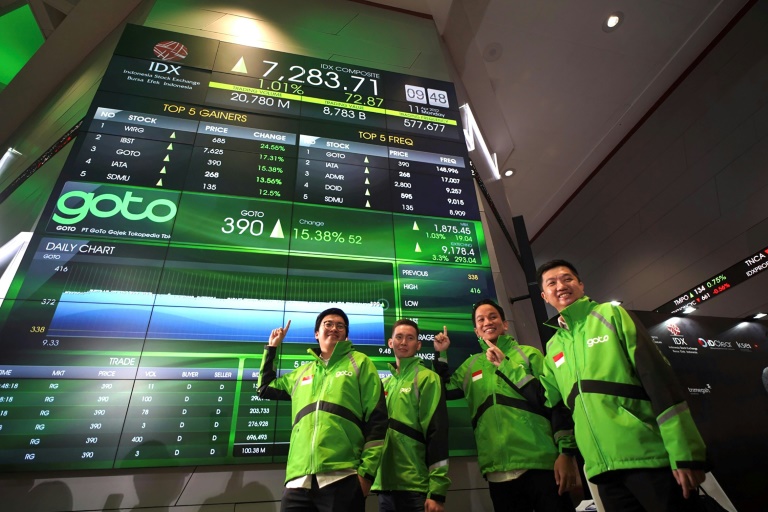
Clad in the signature black-and-green jacket of a Gojek driver, GoTo CEO Andre Soelistyo pressed the 9:00 am opening bell at the Jakarta stock exchange.

“Despite global market volatility, investor interest has been strong, reflecting the rapidly growing demand in Southeast Asia for our on-demand, e-commerce and financial technology services, as well as confidence in GoTo’s position as the largest digital ecosystem in Indonesia,” he said in a press release.

GoTo shares jumped as much as 23 percent in early trade before closing 13.02 percent higher at 382 rupiah. Overall, Jakarta stocks ended down 0.10 percent.

The company raised about $1.1 billion in its IPO that concluded last week, priced at 338 rupiah a share, representing a market value of about $28 billion, it announced.

It has sold shares for $954.7 million (13.7 trillion rupiah) plus $146.3 million from treasury shares for the purpose of over-allotment.

Based on the total funds raised, GoTo’s IPO is the third-largest in Asia and fifth-largest in the world this year, it said.

The company announced last week it would distribute shares worth about $21.6 million to hundreds of thousands of its drivers.

One of the lucky drivers was Ryan Supriandi, who has been a Gojek driver for nearly seven years. 

Supriandi was pleasantly surprised to receive a mobile notification saying the company had granted him 4,000 shares, worth about $90.

“I was happy and confused at the same time — what am I going to do with it? Many drivers don’t understand shares or markets,” the 34-year-old told AFP. 

– US listing planned –

President Joko Widodo congratulated GoTo on its debut.

“I hope GoTo IPO will motivate Indonesian youth to give new energy for the leap of our country’s economic development,” Widodo said.

But Reza Priyambada, a stock market analyst from CSA Research Institute, said that while it was still too early to judge how GoTo would perform, investors should proceed cautiously.

“While they do claim to be the biggest marketplace in Indonesia, they are still suffering losses at the moment,” Priyambada said.

“Right now investors are still under a euphoria, but we don’t know if they really understand how GoTo works, what are their prospects and how the management is run.”

GoTo has not published profits yet. The exchange reported that from January to July 2021 the company posted more than $556 million in net losses.

Last year, another Indonesian unicorn, Bukalapak, launched the biggest initial offering in the history of the country’s stock market, raising more than $1.5 billion.

However, shares in the online marketplace have since dropped by around 60 percent, instilling doubts in the Southeast Asian tech sector.

A successful IPO for GoTo could open the door to a string of listings in the country as several tech firms — including Traveloka, LinkAja, J&T Express, Tiket and Blibli — are also set to make their market debut, according to local media.

GoTo, whose main competitors in the region are SEA and Grab, has said previously that it was also planning a US listing.

In November it said it had raised $1.3 billion from various investors including Google, Singapore’s Temasek and China’s Tencent.

Close Bitnami banner
Bitnami