World

War in Ukraine: Latest developments

Here are the latest developments in the war in Ukraine:

– Austrian leader to meet Putin –

Austrian Chancellor Karl Nehammer is expected to raise alleged Russian war crimes in Bucha and other Ukrainian towns when he meets Russian President Vladimir Putin in Moscow.

Nehammer will be the first European leader to meet with Putin since the start of Russia’s invasion of Ukraine.

– Over 1,200 bodies found –

Ukraine says it has discovered 1,222 bodies in Bucha and other towns around the capital Kyiv from which the Russian army has retreated. 

At least two bodies were discovered in a manhole at a petrol station, an AFP reporter says.

– Kharkiv under attack –

At least 12 people were killed in bombardments around Kharkiv in eastern Ukraine over the weekend, according to regional governor Oleg Synegubov.

On Sunday, the United Nations says 4,232 civilian casualties had been recorded in Ukraine to date, with 1,793 killed and 2,439 injured.

– Evacuations from the east – 

Evacuations resume from Kramatorsk in eastern Ukraine, where a missile strike killed 57 people at a railway station Friday. 

Nearly 50 wounded and elderly patients are evacuated in a hospital train by medical charity Doctors Without Borders (MSF).

– Dnipro airport ‘destroyed’ –

The airport in the central Ukrainian city of Dnipro is “destroyed” by shelling, the head of the city’s military administration, Valentin Reznichenko, says on Telegram. 

Dnipro airport already suffered extensive damage in attacks in mid-March.

– Societe Generale leaves Russia –

Societe Generale says it is ceasing its activities in Russia and selling its majority stake in Rosbank, weeks after scores of multinationals withdrew from the country.

France’s third-largest bank estimates that pulling out of Russia will cost it 3.1 billion euros ($3.4 billion).

– Pope urges Easter ceasefire –

Pope Francis calls for an Easter truce in Ukraine to pave the way for peace through “real negotiation”.

“Let the Easter truce begin. But not to provide more weapons and pick up the combat again — no! — a truce that will lead to peace, through real negotiation,” he urges.

– Pro-Russia rally in Germany –

Hundreds of pro-Russia protesters demonstrate in the Germany city of Frankfurt against the “hatred and harassment” they say they have experienced since the war began.

Germany is home to 1.2 million people of Russian origin and 325,000 from Ukraine. 

– Biden, Modi to discuss Ukraine –

US President Joe Biden will meet virtually Monday with Indian Prime Minister Narendra Modi, weeks after saying New Delhi has been “shaky” in its response to the invasion of Ukraine.

– Sixth round of EU sanctions –

EU foreign ministers meet to discuss a sixth round of sanctions on Moscow.

EU members are divided on whether to impose the sanctions that would hurt Russia the most, a boycott of its oil and gas exports, but diplomats acknowledge there are discussions about the measures.

– Ukraine economy collapses –

The World Bank predicts that the war will cause Ukraine’s economy to contract by 45.1 percent this year.

– More than 4.5 million flee – 

More than 4.5 million Ukrainian refugees have now fled their country, the United Nations refugee agency says.

Ninety percent of those who have left are women and children.
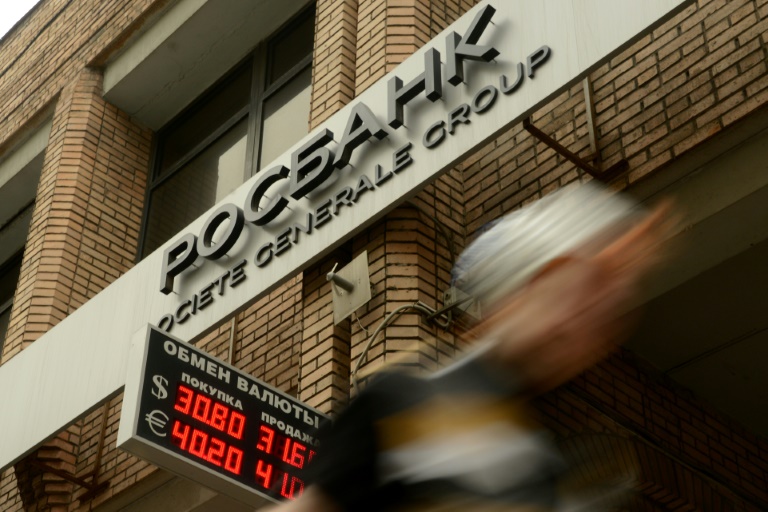
French bank Societe Generale to exit Russia

French banking group Societe Generale said Monday it was ceasing activities in Russia and selling its majority stake in Rosbank, weeks after Ukraine’s leader urged French firms to leave over Moscow’s invasion of the country.

Hundreds of foreign companies, ranging from financial firms to retailers and fast-food restaurants, have pulled out of Russia since the February 24 invasion.

But French firms, which are the biggest foreign employers in Russia, have been among the slowest to withdraw, prompting Ukrainian President Volodymyr Zelensky to urge them to leave during an address to the French parliament on March 23.

Societe Generale said in a statement that its withdrawal from Russia would cost it 3.1 billion euros ($3.4 billion).

“Societe Generale ceases its banking and insurance activities in Russia,” the firm said in a statement.

It also announced “the signing of a sale and purchase agreement to sell its entire stake in Rosbank and the Group’s Russian insurance subsidiaries” to Interros Capital, an investment firm founded by one of Russia’s richest oligarchs, Kremlin confidant Vladimir Potanin.

“With this agreement, concluded after several weeks of intensive work, the Group would exit in an effective and orderly manner from Russia, ensuring continuity for its employees and clients,” Societe Generale said.

The bank said it expects the deal to be completed in the coming weeks and that it was subject to approval from regulators.

Societe Generale shares were down by almost six percent following the announcement.

– ‘Great resistance’ –

In a separate statement, Interros said that “the conditions for the deal have been approved by the government commission on control over foreign investment in the Russia Federation”.

“Interros intends to do the maximum efforts to develop Rosbank,” Potanin said in his company’s statement.

“The main objective is to maintain the stability of Rosbank, as well as create new opportunities for its clients and partners,” he said.

In a statement, Rosbank said it was “certain” that the firm would maintain its stability thanks to its “expertise” and reliance on “international expertise”.

The Russian bank said it built “great resistance” to economic turmoil due to its “well-thought-out risk policy” as well as its balanced loan portfolio and diversified liquidity base.

Meanwhile, Societe Generale’s auto leasing subsidiary, ALD, said it would not enter into new commercial transactions in Russia, Kazakhstan and Belarus.

Since Zelensky’s speech to the French parliament, auto giant Renault suspended operations at its Moscow factory and hinted that it might divest its majority stake in domestic car giant AvtoVAZ, while French sports retailer Decathlon halted sales at its stores in Russia.

Another major French company singled out by Zelensky, supermarket chain Auchan, has decided to stay, citing the “human” cost of leaving.

The Western exodus followed the invasion and a slew of Western sanctions on Russia, including the freezing of $300 billion of the country’s foreign currency reserves abroad.

Russia has since faced the risk of defaulting on its debt.

Le Pen, Macron duel for French presidency

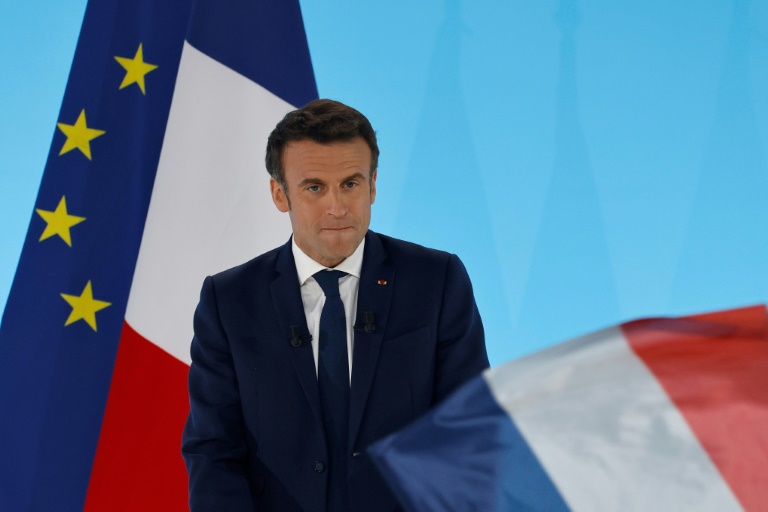
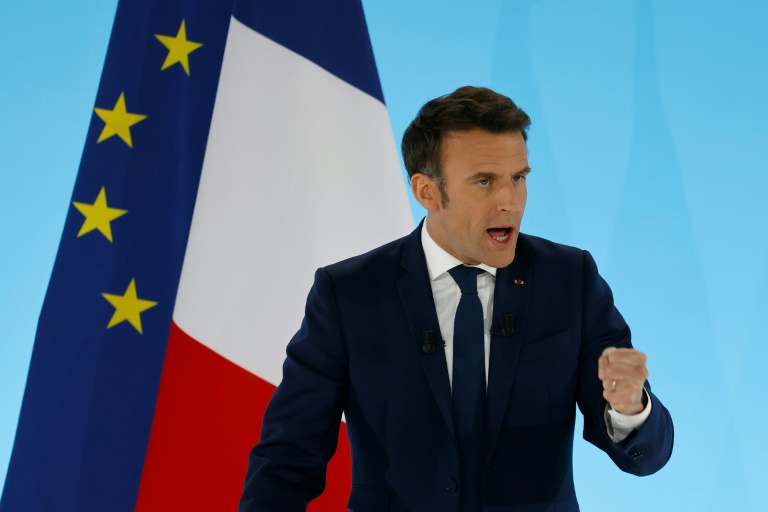
French President Emmanuel Macron and far-right rival Marine Le Pen Monday embarked on a final fortnight of bruising campaigning for a French presidential election run-off whose outcome is far more uncertain than their encounter five years ago.

With 97 percent votes counted, Macron came in first in Sunday’s first round of voting with 27.6 percent of the vote. Le Pen was second with 23.4 percent.

As the top two finishers, they advance to a second round on April 24.

Far-left candidate Jean-Luc Melenchon came close to beating Le Pen for the second spot, after a late surge gave him a score of just under 22 percent.

The duel between Macron and Le Pen is a re-run of the 2017 election final from which Macron emerged victorious with 66 percent. But this time polls predict a closer contest which will crucially hinge on voters who backed other candidates in the first round.

“Make no mistake: nothing is decided,” Macron told cheering supporters at his campaign headquarters Sunday night.

Le Monde daily headlined: “Macron-Le Pen — A more uncertain Act II.”

– ‘Really scary’ –

Macron said he would Monday be campaigning in northern France, while Le Pen is set to meet her campaign team before resuming her months-long grassroots efforts in small towns and rural France later in the week.

“A sad repetition,” left-leaning daily Liberation called the Macron-Le Pen duel on Monday, adding: “This time it’s really scary.”

Polls gauging second-round voting intentions mostly point to around 53 percent for Macron and 47 percent for Le Pen. One poll, however, by the Ifop-Fiducial group suggested Macron could have only a razor-thin win with 51 percent versus 49 percent.

“The second round is the hardest one,” said Finance Minister Bruno Le Maire on RTL radio. 

“Everything begins again with a new campaign.”

As well as campaigning on the merits of their respective programmes, both candidates will also scramble to woo voters of their defeated first-round rivals.

“We’re going to have to win over the French people who didn’t vote for Emmanuel Macron in the first round,” government spokesman Gabriel Attal told the France Inter broadcaster on Monday. 

“We’re going to have to fight for this election.”

– ‘Not us’ –

In an early boost for the president, Communist Party candidate Fabien Roussel, Socialist Anne Hidalgo, Yannick Jadot of the Greens and right-wing Republicans candidate Valerie Pecresse said they would vote for him to prevent the far-right leader coming to power.

Without directly backing Macron, Melenchon in a crucial move also told his supporters not to give a “single vote” to Le Pen.

Meanwhile Le Pen’s far-right rival Eric Zemmour, who garnered just over seven percent on Sunday, threw his weight behind her.

Le Pen, 53, said the run-off would present “a fundamental choice between two visions”.

A pivotal moment in the next stage of the campaign will come on April 20 when the two candidates are set to take part in a TV debate broadcast live on national television.

Part of the battle will be to mobilise the 25 percent of registered voters who abstained in the first round. 

The candidates from France’s traditional parties of government — the Socialists and the Republicans — suffered humiliating defeats.

Sunday’s vote spelled humiliation for Socialist Hidalgo, the mayor of Paris, who won only 1.7 percent, a historic low for the party which only a decade ago won the presidency.

The vote for the right-wing Republicans party, headed by nominee Valerie Pecresse, collapsed to 4.8 percent from 20 percent in 2017.

On Monday, Pecresse confessed her campaign finances, which included five million euros ($5.5 million) of her own money, were in a “critical” state, and called for donations from supporters.

– ‘New method’ –

The election has been overshadowed by the war in Ukraine, with surging prices of everyday goods making the cost of living a key issue.

The vote could have major implications for the European Union, which Le Pen says she wants to radically reform. She has also said she wants to pull out of NATO’s joint military command. 

Macron countered Sunday that he did not want a France which “once out of Europe, would only have the international alliance of populists and xenophobes as allies. That’s not us.”

While her opponents accuse her of being divisive and racist, Le Pen has sought to project a more moderate image in this campaign and has focused on voters’ daily worries over inflation.

But Macron is expected to target her past proximity with Russian leader Vladimir Putin, her policies on the EU, as well as the cost of her economic programme that includes massive tax cuts.

A win would give Macron, who came to power in 2017 aged 39 as France’s youngest president, five more years to push through reforms that would include raising the pension age and cutting taxes for businesses.

He also floated the idea Sunday night of a “large movement of political unity and action” and a “new method” of governing, which could see him invite rival parties to formally join his political movement. 

burs-jh/sjw/jv

Israel army in new operations around flashpoint W.Bank city

Israeli forces launched a third day of operations Monday around the flashpoint West Bank city of Jenin following heavy gun battles in recent days and 20 arrests overnight, the army said.

Tensions have soared since a spree of attacks in Israel left 14 people dead in the past three weeks, with Prime Minister Naftali Bennett warning the Jewish state is now “on the offensive”.

Four Palestinians were killed in separate incidents across the occupied territory Sunday, and militant groups in Jenin braced for more battles. 

The city as well as Bethlehem declared general strikes.

Thousands of mourners flooded the streets of Jenin on Monday for the funerals of those killed, many carrying Palestinian flags or rifles.

Abu Muadh, military spokesman of the armed factions in Jenin’s refugee camp, late Sunday called for “general mobilisation of our fighters to confront any incursion by the Zionist enemy”.

Israeli troops were targeting relatives of Raad Hazem, the 28-year-old Jenin man who last Thursday killed three Israeli civilians and wounded 12 at a Tel Aviv bar before he was shot dead following a massive manhunt.

Israeli soldiers Sunday engaged in an exchange of gunfire involving his brothers and also demanded the father hand himself in, ahead of the planned demolition of the family home.

A teen on a motorcycle who opened fire on the Israeli officers in that exchange, Mohamed Zakarneh, 17, was the latest fatality, succumbing to gunshot wounds overnight, the Wafa news agency said.

Another Palestinian from the Bethlehem area was shot dead Sunday after hurling a Molotov cocktail at Israeli troops, the army told AFP. 

The tensions have surged during the Muslim holy month of Ramadan, nearly a year after violence flared in the other Palestinian territory, the Hamas-ruled Gaza Strip, leading to 11 days of devastating conflict.

A total of 14 people in Israel have been killed in four attacks since March 22, including a shooting spree in Bnei Brak, an Orthodox Jewish city in greater Tel Aviv, carried out by a Palestinian from Jenin.

Over the same period, at least 14 Palestinians have been killed, including assailants, according to a count by AFP. 

Biden cracks down on hard-to-trace 'ghost guns'

President Joe Biden will announce new measures cracking down on so-called “ghost guns” on Monday, with an executive order set to increase restrictions on the weapons that can be assembled at home in minutes and are difficult to trace as they lack serial numbers.

The new rule, a year in the making, addresses a kind of weapon that law enforcement officials say has almost doubled in its appearance in police reports between 2020 and 2021.

“These are the criminal’s weapon of choice,” a Biden administration official, speaking on condition of anonymity, said.

The new rule states that weapons part kits that can easily be assembled into a working firearm will be subject to the same requirements as commercially available fully assembled guns, administration officials said.

Dealers selling these weapons parts kits will now be required to conduct a background check on prospective buyers, according to the new regulations.

Gun kit manufacturers must also include a serial number on key weapon components, while licensed dealers who take a “ghost gun” into their inventory must add a serial number, the US Justice Department said in a statement.

Finally, in order to boost tracing efforts, the new rule states that federally licensed dealers of firearms must keep records for as long as they are in business, rather than for a 20-year period as is currently the case.

“This rule will make it harder for criminals and other prohibited persons to obtain untraceable guns, will help ensure that law enforcement officers can retrieve the information they need to solve crimes, and will help reduce the number of untraceable firearms flooding our communities,” said US Attorney General Merrick Garland.

From January 2016 to December 2021, the US Bureau of Alcohol, Tobacco and Firearms (ATF) received approximately 45,240 reports of suspected privately made firearms recovered by law enforcement, the Justice Department said. Those reports were linked to at least 692 homicide or attempted homicide investigations, it added.

The use of such weapons has been increasing, with the number of reports nearly doubling to more than 19,000 from 2020 to 2021, it said.

Over the past five-year period, the ATF could only trace 0.98 percent of suspected “ghost guns” handed in by law enforcement to an individual purchaser, the department said.

On Monday, the White House said that Biden will also nominate Steve Dettelbach, a former US attorney from Ohio, to run the ATF after the president’s first nominee, a gun control advocate, ran into opposition from Republicans and some Democrats in Congress.

Abolish or rebrand? South Korea's 'feminist' ministry in crosshairs

South Korea’s anti-feminist president-elect has vowed to abolish the Ministry of Gender Equality. But actually getting rid of it will be tricky, experts say, and the incoming administration is already backing off its promise.

Since it was set up in 2001, the department has been a driver of social progress for South Korean women — for example, making it possible for single mothers to register their kids in their name.

Along the way, it has also become a flashpoint in South Korea’s increasingly bitter debates over sexism and gender, with detractors such as incoming President Yoon Suk-yeol claiming it is an obsolete backwater of “radical feminism”.

The ministry’s supporters, however, point to a track record of welfare policies that benefit a diverse cross-section of society — from teenage runaways to the children of North Korean defectors.

“My ex just moved out one day and never came back,” said single mother Jin Mi-ae, adding that her former husband refused to contribute financially to their child’s upbringing.

Failing to pay child support was criminalised in South Korea only last year. Many eligible parents — mostly women — still do not receive it but thanks to the ministry’s efforts, there are now mechanisms in place to help.

Jin filed a case with the Child Support Agency — set up by the ministry in 2015 — and said its assistance was crucial in her quest to get her ex-husband to help.

Yoon has said he will not renege on his abolition pledge, but last week, his transition team said they would keep the ministry for now.

Scrapping the ministry would require legislation to reorganise the government — a tricky ask as Yoon does not have a majority.

“The likely clash at the National Assembly may taint the new administration’s image,” Shin Yul, a political science professor at Myongji University told AFP.

With local elections coming up in June, he added, it is unlikely Yoon’s People Power Party would want to expend political capital on a bruising legislative fight and has put the issue “on hold”.

– ‘Symbolic target’ –

In recent years, South Korea’s #MeToo generation has mobilised on a host of issues, from legalising abortion to demanding prosecutions for “revenge porn”.

This has triggered online backlash against so-called “radical feminism”, with young South Korean men bemoaning their own lot — chiefly compulsory military service, from which women are exempt.

Yoon appealed to disgruntled male voters, branding himself an anti-feminist and pledging to abolish the ministry.

It became a “highly symbolic target” as the conservative candidate courted young men who felt the government was unfairly “privileging the interests of women”, Sharon Yoon, a Korean studies professor at the University of Notre Dame, told AFP. 

Yoon claimed South Korean women do not suffer from “systemic gender discrimination” — despite much evidence to the contrary on the gender wage gap and female workforce participation.

He won the election in March — but by the narrowest margin ever, after young women mobilised against him.

Even so, activists say his victory is a huge blow.

“It’s devastating to have a president-elect who actively spreads prejudice and hatred,” Yujin, a 26-year-old female voter and activist, told AFP.

– ‘We are the fire’ – 

With a budget of some 1.41 trillion won ($1 billion) — compared with 54.61 trillion won for defence spending — the ministry has the least funding of any government department.

Even so, it has introduced a slew of programmes that supporters say help the most vulnerable, from stipends to tackle “period poverty” to projects that assist victims of domestic abuse.

Its most defining achievement was its role in the abolition of South Korea’s “hoju” registry, the patriarchal family record system.

But this vital work is not recognised, activist Kim Do-kyung told AFP. Like domestic labour, “it’s a lot of real and important work, but no one really considers it work,” she said.

The ministry declined AFP’s request for comment.

Yoon’s battle cry against it appears to have galvanised women — the left-leaning Democratic Party said it has signed up thousands of new female members, and other activists have announced forays into politics.

“We are ready to be the leaders of this country,” activist Haein Shim told AFP.

“Yoon’s administration will do all they can to make us burn to keep our mouths shut, but we don’t burn because we are the fire.”

Many experts now expect Yoon to “rebrand” rather than abolish the ministry, pointing to how his victory has refocused global attention on sexism in the country.

“South Korea does not exist in a vacuum,” Linda Hasunuma, a political scientist at Temple University, told AFP.

“The world is watching how it treats its women and girls.”

Global stocks dip on Fed tightening, China prices

Asian stocks posted losses on Monday as unease lingered over tightening monetary policy by the Fed and rising prices in China.

The drop followed a negative lead from Wall Street. The S&P 500 and the Nasdaq retreated as the yield on the 10-year US Treasury note climbed above 2.7 percent — a signal markets are preparing for more tightening as the Federal Reserve battles inflation.

In Tokyo, the Nikkei closed 0.6 percent lower, while Hong Kong and Shanghai lost more than three percent and two percent respectively.

Taipei and Seoul were also down, while Sydney and Jakarta posted slight gains.

In early European trade, the Paris CAC 40 shed 0.6 percent and Frankfurt’s DAX slid 1.2 percent. London’s FTSE 100 index slid 0.6 percent on news that the UK economy had ground to a near halt.

“Stocks are soft at the Monday (Asian) open on increasing evidence the Federal Reserve will take a more committed approach to its monetary policy inflation-fighting stance,” said Stephen Innes at SPI Asset Management.

“However, markets have been surprisingly resilient as discussions under the surface debated whether this week’s US March CPI data will hint at the peak of the inflation cycle and help the Fed’s chance to better engineer a soft landing, however narrow that path may seem.”

The US central bank has recently taken a hawkish tone as it embarks on an aggressive tightening path, prompting traders to fret over the prospect of higher interest rates.

“Today, the mantra for many investors is ‘Don’t fight the Fed when it is fighting inflation’,” Ed Yardeni, president of Yardeni Research, wrote in a note.

In China, factory-gate inflation was higher than expected in March, official data showed, as Russia’s war on Ukraine pushes up oil prices while a domestic Covid-19 resurgence strains food supplies and consumer costs.

The producer price index — measuring the cost of goods at the factory gate — grew 8.3 percent on-year, National Bureau of Statistics (NBS) figures showed.

“It is China’s Covid situation that is making Asia nervous,” said Jeffrey Halley, senior market analyst with OANDA. “The weekend press was full of stories of locked down Shanghai residents unable to secure food supplies, with cases rising to 27,000 yesterday.”

“With China’s government doggedly sticking to its Covid-zero policy, fears are increasing that an extended lockdown in China, which may spread to other major industrial cities will darken an already cloudy outlook for China’s growth.”

– Indonesia’s GoTo soars on debut –

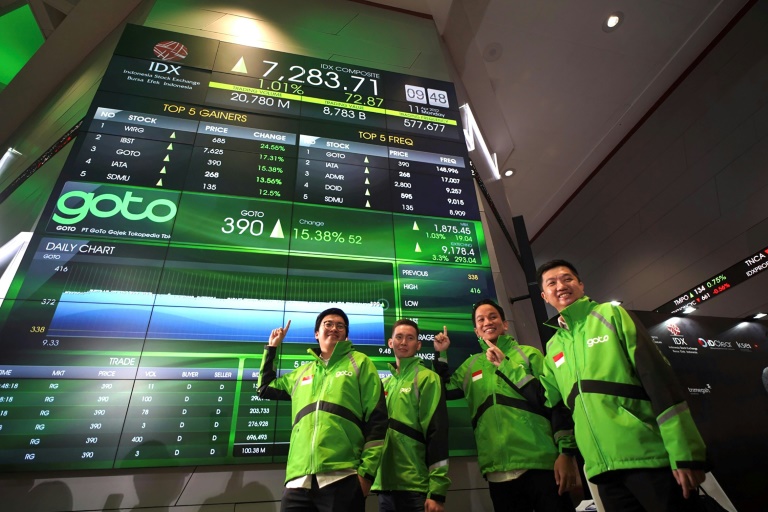
In Jakarta, Indonesia’s biggest tech firm soared on its debut after a billion-dollar IPO — the world’s fifth-biggest this year.

GoTo’s shares jumped by up to 23 percent in initial trading and hovered around 15 percent at 388 rupiah during the session.

“Despite global market volatility, investor interest has been strong, reflecting the rapidly growing demand in Southeast Asia for our on-demand, e-commerce and financial technology services, as well as confidence in GoTo’s position as the largest digital ecosystem in Indonesia,” CEO Andre Soelistyo said in a press release.

The euro climbed against the dollar over the course of the day, suggesting some relief over the French election.

Investors had fretted about the implications of a victory for President Emmanuel Macron’s nationalist rival Marine Le Pen in the midst of the war in Ukraine, given her long-standing sympathies for Russia.

Macron was set to beat Le Pen in the first round of elections Sunday by a larger-than-expected margin, the two candidates advancing to a run-off later this month.

“Make no mistake: nothing is decided,” Macron told supporters.

– Key figures around 0810 GMT –

Tokyo – Nikkei 225: DOWN 0.61 percent at 26,821.52 (close)

Hong Kong – Hang Seng Index: DOWN 3.03 percent at 21,208.30 (close)

Shanghai – Composite: DOWN 2.61 percent at 3,167.13 (close)

Brent North Sea crude: DOWN 1.61 percent at $101.05 per barrel

West Texas Intermediate: DOWN 1.91 percent at $96.38 per barrel

Euro/dollar: UP at $1.0882 from $1.0877

Pound/dollar: DOWN at $1.3002 from $1.3025

Euro/pound: UP at 83.69 pence from 83.51 pence

Dollar/yen: UP at 125.35 yen from 124.34 yen

New York – Dow: UP 0.4 percent at 34,721.12 (close)

— Bloomberg News contributed to this report —

Indonesia tech giant GoTo soars on market debut

Indonesia’s biggest tech firm soared in Jakarta trade Monday after a billion-dollar IPO that was the world’s fifth-biggest this year, defying recent heavy weather for Asian tech stocks.

GoTo, the largest digital ecosystem in the archipelago nation of 270 million people, was formed by the merger of ride-hailing company Gojek and e-commerce platform Tokopedia in May 2021.

Clad in the signature black-and-green jacket of a Gojek driver, GoTo CEO Andre Soelistyo pressed the 9 am opening bell at the Jakarta stock exchange.

“Despite global market volatility, investor interest has been strong, reflecting the rapidly growing demand in Southeast Asia for our on-demand, e-commerce and financial technology services, as well as confidence in GoTo’s position as the largest digital ecosystem in Indonesia,” he said in a press release.

His company’s shares jumped by up to 23 percent in the first exchanges and fluctuated around 15 percent at 388 rupiah during the trading session.

The company raised about $1.1 billion in its IPO that concluded last week, priced at 338 rupiah per share, representing a market value of about $28 billion, it announced Monday.

It has sold shares for $954.7 million (13.7 trillion rupiah) plus $146.3 million from treasury shares for the purpose of over-allotment.

Based on the total funds raised, GoTo’s IPO is the third-largest in Asia and fifth-largest in the world this year, it said.

The company announced last week it would distribute shares worth about $21.6 million to hundreds of thousands of its drivers.

One of the lucky drivers was Ryan Supriandi, who has been a Gojek driver for nearly seven years. 

Supriandi was pleasantly surprised to receive a mobile notification saying the company had granted him 4,000 shares, worth about $90.

“I was happy and confused at the same time — what am I going to do with it? Many drivers don’t understand shares or markets,” the 34-year-old told AFP. 

President Joko Widodo congratulated GoTo on its debut.

“I hope GoTo IPO will motivate Indonesian youth to give new energy for the leap of our country’s economic development,” Widodo said.

But Reza Priyambada, a stock market analyst from CSA Research Institute, said that while it was still too early to judge how GoTo would perform, investors should proceed cautiously.

“While they do claim to be the biggest marketplace in Indonesia, they are still suffering losses at the moment,” Priyambada said.

“Right now investors are still under a euphoria, but we don’t know if they really understand how GoTo works, what are their prospects and how the management is run.”

GoTo has not published profits yet. The exchange reported that from January to July 2021 the company posted more than $556 million in net losses.

Last year, another Indonesian unicorn, Bukalapak, launched the biggest initial offering in the history of the country’s stock market, raising more than $1.5 billion.

However, shares in the online marketplace have since dropped by around 60 percent, instilling doubts in the Southeast Asian tech sector.

A successful IPO for GoTo could open the door to a string of listings in the country as several tech firms — including Traveloka, LinkAja, J&T Express, Tiket and Blibli — are also set to make their market debut, according to local media.

GoTo, whose main competitors in the region are SEA and Grab, has said previously that it was also planning a US listing.

In November it said it had raised $1.3 billion from various investors including Google, Singapore’s Temasek and China’s Tencent.

Le Pen, Macron kick off battle for French presidency

French President Emmanuel Macron and his far-right rival Marine Le Pen on Monday kicked off a final fortnight of bruising campaigning for the French presidency in a run-off that polls predict risks being tight.

With 97 percent votes counted, Macron came in first in Sunday’s first round of voting with 27.6 percent of the vote. Le Pen was second with 23.4 percent.

As the top two finishers, they advance to a second round on April 24.

Far-left candidate Jean-Luc Melenchon came close to beating Le Pen for the second spot after a late surge gave him a score of just under 22 percent.

The duel between Macron and Le Pen is a re-run of the 2017 election final from which Macron emerged victorious with 66 percent. But this time polls predict a closer contest.

“Make no mistake: nothing is decided,” Macron told cheering supporters at his campaign headquarters Sunday night. “The debate that we are going to have over the next fortnight will be decisive for our country and Europe.”

Macron said he would be out campaigning on Monday in northern France, while Le Pen is set to meet her campaign team before resuming her months-long grassroots efforts in small towns and rural France later in the week.

“A sad repetition,” left-leaning daily Liberation called the Macron-Le Pen duel on Monday, adding: “This time it’s really scary.”

The candidates from France’s traditional parties of government — the Socialists and the Republicans — meanwhile suffered humiliating defeats.

Polls gauging second-round voting intentions mostly point to around 53 percent for Macron and 47 percent for Le Pen. One poll, however, by the Ifop-Fiducial group suggested Macron could have only a razor-thin win with 51 percent versus 49 percent.

– ‘Fundamental choice’ –

As well as campaigning on the merits of their respective programmes, both candidates will also scramble to woo voters of their defeated first-round rivals.

In a boost for the president, Communist Party candidate Fabien Roussel, Socialist Anne Hidalgo, Yannick Jadot of the Greens and right-wing Republicans candidate Valerie Pecresse said they would vote for him to prevent the far-right leader coming to power.

Without backing Macron, Melenchon in a crucial move also told his supporters not to give a “single vote” to Le Pen.

But Le Pen’s far-right rival Eric Zemmour, who garnered just over 7 percent on Sunday, has already thrown his weight behind her and while Macron can expect to pick up many centre-left and centre-right votes he may struggle to persuade Melenchon voters to back him, analysts said.

Le Pen, 53, said the run-off would present “a fundamental choice between two visions”. It would be a “choice of society and even of civilisation”, she said.

The election campaign has been overshadowed by the war in Ukraine, with surging prices of everyday goods making the cost of living a key issues.

The vote’s outcome will have major implications for the European Union, which Le Pen says she wants to radically reform. She has also said she wants to pull out of NATO’s joint military command. 

Macron countered Sunday that he did not want a France which “once out of Europe, would only have the international alliance of populists and xenophobes as allies. That’s not us.”

A pivotal moment in the next stage of the campaign will come on April 20 when the two candidates are set to take part in a TV debate broadcast live on national television which often has a crucial impact on the final outcome.

While her opponents accuse her of being divisive and racist, Le Pen has sought to project a more moderate image in this campaign and has focused on voters’ daily worries over inflation.

But Macron is expected to target her past proximity with Russian leader Vladimir Putin, her policies on the EU, as well as the cost of her economic programme that includes massive tax cuts.

– ‘New method’ –

A win would give Macron, who came to power in 2017 aged 39 as France’s youngest president, five more years to push through reforms that would include raising the pension age to 65 from 62 and enacting further tax cuts for businesses.

He also floated the idea Sunday night of a “large movement of political unity and action” and a “new method” of governing, which could see him invite rival parties to formally join his political movement. 

Among the other candidates, Sunday’s vote spelled humiliation for Socialist Hidalgo, the mayor of Paris, who won only 1.7 percent, a historic low for the party which only a decade ago won the presidency.

The vote for the right-wing Republicans party, headed by nominee Valerie Pecresse, also collapsed to an estimated 4.8 percent, down from 20 percent in 2017. 

“The traditional parties have been smashed,” said Jerome Jaffre, a political scientist at Sciences Po university in Paris.

burs-jh/sjw/yad

Veteran Hong Kong journalist arrested for 'sedition'

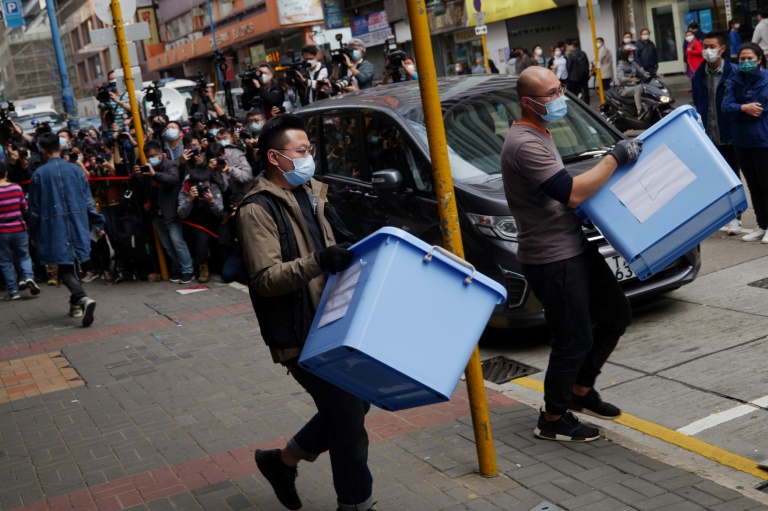
A veteran Hong Kong journalist was arrested by national security police on Monday for allegedly conspiring to publish “seditious materials”, police said.

The arrest is the latest blow to the local press in Hong Kong, which has seen its media freedom rating plummet as Beijing cracks down on dissent.

Allan Au, a 54-year-old reporter and journalism lecturer, was arrested in a dawn raid by Hong Kong’s national security police unit, multiple local media outlets reported. 

A senior police source confirmed Au’s arrest to AFP on a charge of “conspiracy to publish seditious materials”.

Police later confirmed the arrest of a 54-year-old male on the same charge in a statement that did not name Au, which is local practice.

“Further arrests may be made,” the statement warned.

Au is a former columnist for Stand News, an online news platform that was shuttered last December after authorities froze the company’s assets using a national security law.

Two other senior employees of Stand News have already been charged with sedition.

National security charges have also been brought against jailed pro-democracy media tycoon Jimmy Lai and six former senior executives of Apple Daily.

Once Hong Kong’s most popular tabloid, Apple Daily collapsed last year when its newsroom was raided and assets were frozen under the security law. 

Soon after Stand News was shut down, Au began to write “good morning” each day on his Facebook page to confirm his safety.

One of the city’s most experienced local columnists, he was a Knight fellow at Stanford University in 2005 and earned a doctorate from the Chinese University of Hong Kong.

In 2017 Au published a book about censorship in Hong Kong titled “Freedom Under 20 Shades of Shadow”.

Au spent more than a decade working for RTHK, Hong Kong’s government broadcaster, running a current affairs show.

But he was axed last year after the authorities declared a shake-up that began transforming the once editorially independent broadcaster into something more resembling Chinese state media. 

– Colonial legacy law –

First penned by colonial ruler Britain in 1938, sedition was long criticised as an anti-free speech law, including by many of the pro-Beijing local newspapers now praising its use.

By the time of the 1997 handover, it had not been used for decades but remained on the books.

It was dusted off by police and prosecutors in the wake of massive and sometimes violent pro-democracy protests in 2019. 

Over the last two years sedition has been wielded against journalists, unionists, activists, a former pop star and ordinary citizens.

Sedition is currently separate from the sweeping national security law that Beijing imposed on Hong Kong in 2020.

But the courts treat it as a national security offence, which means that bail is often denied for those charged.

Next month Hong Kong is expected to install a new Beijing-anointed leader, former security chief John Lee, who oversaw the police response to the 2019 democracy protests and subsequent crackdown.

Asked on Monday whether Au’s arrest would worsen press freedom, Lee declined to comment, only saying all investigations should be carried out independently.

Outgoing leader Carrie Lam also declined to comment on Au’s arrest.

Close Bitnami banner
Bitnami