World

Future in balance for German refinery fed on Russian oil

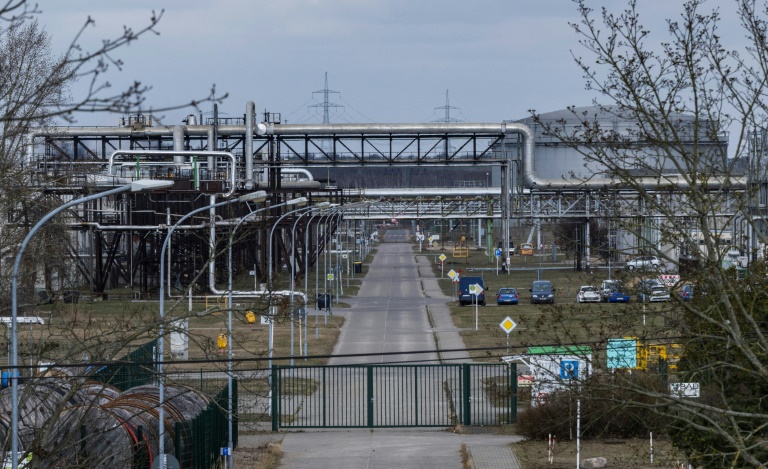
The PCK refinery in the German town of Schwedt has been processing crude oil from Russia since before reunification, but with a ban on Russian oil looming its future could be in doubt.

The mass of metal tubes and canisters in the former East Germany near the border with Poland employs 1,200 people, and many local businesses depend on the custom it brings to the area.

“The sense of not knowing what will happen tomorrow is very similar to how it felt after the fall of the Wall,” said Buckhard Opitz, 60, who has worked at the plant since 1977 and is a member of the local energy workers’ union.

Opitz has not forgotten the economic turbulence that came with reunification in 1990 — the dismantled industrial sites and painful wave of privatisations.

The Schwedt refinery survived, after a drastic restructuring, because “it was one of the most modern, because we were always on top”, Opitz said.

But since Russia invaded Ukraine on February 24, uncertainty has once again descended on the plant.

Although the PCK refinery supplies around 90 percent of the oil consumed in Berlin and the surrounding region, including Berlin Brandenburg airport, doubts still remain.

And the situation is complicated by the fact that Russian oil giant Rosneft, controlled by the Kremlin, is a majority shareholder in the site.

– ‘Friendship’ –

Though the EU’s latest package of sanctions agreed on Thursday was focused on coal, European Council President Charles Michel has said that the EU will have to impose oil and gas sanctions “sooner or later”.

Germany has ruled out an immediate embargo on all Russian energy, especially gas. But it aims to end Russian oil imports by the end of this year.

Oil pumped in from Russia is the lifeblood of the Schwedt refinery, which is serviced by a branch of the Druzhba pipeline, the world’s longest oil pipeline. 

The Druzhba project was commissioned in the 1960s to transport oil from the Soviet Union to Eastern Europe and remains a vital source of crude for many central European refineries. 

“Druzhba” means “friendship” in Russian.

In late 2021, Rosneft announced plans to increase its stake in the PCK refinery from 54 to 92 percent by buying shares from Shell.

Germany’s Federal Cartel Office approved the transaction a few days before the outbreak of the war but the Economy Ministry is examining whether it can still be stopped. 

Rosneft is chaired by Igor Sechin, an oligarch close to President Vladimir Putin and who has been the target of Western sanctions.

“The world was still normal then. There was no reason to refuse Russian involvement, just as there was German involvement in Russia,” Alexander von Gersdorff, a spokesman for the German oil industry association En2x, told AFP.

– ‘Pure speculation’ –

But Von Gersdorff now has a stark prediction: “Without oil from Russia, the Schwedt refinery would have to be shut down. There would be no petrol or diesel for Berlin, the surrounding region and western Poland.”

A spokeswoman for the refinery told AFP it was still examining the “feasibility of different logistical and technological scenarios as well as their operational feasibility”. 

Some media reports have proposed that Berlin temporarily take control of the plant —  a measure applied recently to Russian gas giant Gazprom’s German subsidiary.

But Opitz is convinced that alternatives to Russian oil can be found to keep the refinery alive.

Another pipeline ending in the German port city of Rostock could receive crude oil from other parts of the world, he said, and Poland could supply more via the port of Gdansk.

Von Gerstoff believes this is “unrealistic”.

Rostock cannot accommodate large enough tankers, he said, while Poland needs all its capacity to service its own energy needs. Plus the refineries in eastern Germany were specifically designed to operate with Russian crude oil.

But Opitz still has hope. “All this is pure speculation,” he said. “The final decision will be political.”

Elon Musk no longer joining Twitter board: CEO

Elon Musk is no longer joining the board of Twitter, the CEO of the social media company said late Sunday, in a reversal less than a week after announcing the Tesla and SpaceX chief would be appointed.

Musk was named to join the Twitter board after buying a major stake in the firm and becoming its largest shareholder.

“Elon has decided not to join our board,” Twitter CEO Parag Agrawal tweeted.

“Elon’s appointment to the board was to become officially effective 4/9, but Elon shared that same morning he will no longer be joining the board,” Agrawal said.

“I believe this is for the best.”

Currently the world’s richest man and with more than 80 million followers on the microblogging platform, Musk last week disclosed a purchase of 73.5 million shares — or 9.2 percent — of Twitter’s common stock. His announcement sent Twitter shares soaring more than 25 percent.

Agrawal had announced on Tuesday that Musk would be joining the board, describing him as “a passionate believer and intense critic of the service which is exactly what we need”.

Musk himself tweeted that he was “Looking forward to working with Parag & Twitter board to make significant improvements to Twitter in coming months!”

In his announcement Sunday, Agrawal shared a note he sent to Twitter, which said Musk’s appointment to the board would be contingent on a background check and that he would have to act in the best interests of the company once appointed.

“We have and will always value input from our shareholders, whether they are on our board or not,” he said.

“Elon is our biggest shareholder and we will remain open to his input,” Agrawal added.

Musk had agreed to limit his Twitter stake to a maximum of 14.9 percent while serving on the board but could now in theory increase his holding beyond that.

– Polarizing figure –

In an apparent reaction to the news, Musk tweeted a smirking emoji, without any other comment.

The billionaire tech entrepreneur is a frequent Twitter user, regularly mixing in inflammatory and controversial statements about issues or other public figures with remarks that are whimsical or business-focused. 

He has also sparred repeatedly with federal securities regulators, who cracked down on his social media use after a purported effort to take Tesla private in 2018 fell apart.

Musk’s decision not to take a seat on the Twitter board came after he tweeted Saturday asking whether the social media network was “dying” and to call out users such as singer Justin Bieber, who are highly followed but rarely post.

“Most of these ‘top’ accounts tweet rarely and post very little content,” the Tesla boss wrote, captioning a list of the 10 profiles with the most followers — a list which includes himself at number eight, with 81 million followers.

“Is Twitter dying?” he asked.

In other weekend tweets, Musk posted joke polls on whether to drop the “w” from Twitter’s name and on converting its San Franciso headquarters to a homeless shelter since no one shows up anyway”.

He also suggested removing ads, Twitter’s main source of revenue.

An outspoken and polarizing figure, the announcement of his appointment to the board had sparked misgiving among some Twitter employees, according to a Washington Post report.

Workers at the California-based social media company cited worries about Musk’s statements on transgender issues and his reputation as a difficult and driven leader, according to statements on Slack reviewed by the Post.

A California agency has sued Tesla, alleging discrimination and harassment against Black workers. The electric carmaker has rejected the charges, saying it opposes discrimination.

Elon Musk no longer joining Twitter board: CEO

Elon Musk is no longer joining the board of Twitter, the CEO of the social media company said late Sunday, in a reversal less than a week after announcing the Tesla and SpaceX chief would be appointed.

Musk was named to join the Twitter board after buying a major stake in the firm and becoming its largest shareholder.

“Elon has decided not to join our board,” Twitter CEO Parag Agrawal tweeted.

“Elon’s appointment to the board was to become officially effective 4/9, but Elon shared that same morning he will no longer be joining the board,” Agrawal said.

“I believe this is for the best.”

Currently the world’s richest man and with more than 80 million followers on the microblogging platform, Musk last week disclosed a purchase of 73.5 million shares — or 9.2 percent — of Twitter’s common stock. His announcement sent Twitter shares soaring more than 25 percent.

Agrawal had announced on Tuesday that Musk would be joining the board, describing him as “a passionate believer and intense critic of the service which is exactly what we need”.

Musk himself tweeted that he was “Looking forward to working with Parag & Twitter board to make significant improvements to Twitter in coming months!”

In his announcement Sunday, Agrawal shared a note he sent to Twitter, which said Musk’s appointment to the board would be contingent on a background check and that he would have to act in the best interests of the company once appointed.

“We have and will always value input from our shareholders, whether they are on our board or not,” he said.

“Elon is our biggest shareholder and we will remain open to his input,” Agrawal added.

Musk had agreed to limit his Twitter stake to a maximum of 14.9 percent while serving on the board but could now in theory increase his holding beyond that.

– Polarizing figure –

In an apparent reaction to the news, Musk tweeted a smirking emoji, without any other comment.

The billionaire tech entrepreneur is a frequent Twitter user, regularly mixing in inflammatory and controversial statements about issues or other public figures with remarks that are whimsical or business-focused. 

He has also sparred repeatedly with federal securities regulators, who cracked down on his social media use after a purported effort to take Tesla private in 2018 fell apart.

Musk’s decision not to take a seat on the Twitter board came after he tweeted Saturday asking whether the social media network was “dying” and to call out users such as singer Justin Bieber, who are highly followed but rarely post.

“Most of these ‘top’ accounts tweet rarely and post very little content,” the Tesla boss wrote, captioning a list of the 10 profiles with the most followers — a list which includes himself at number eight, with 81 million followers.

“Is Twitter dying?” he asked.

In other weekend tweets, Musk posted joke polls on whether to drop the “w” from Twitter’s name and on converting its San Franciso headquarters to a homeless shelter since no one shows up anyway”.

He also suggested removing ads, Twitter’s main source of revenue.

An outspoken and polarizing figure, the announcement of his appointment to the board had sparked misgiving among some Twitter employees, according to a Washington Post report.

Workers at the California-based social media company cited worries about Musk’s statements on transgender issues and his reputation as a difficult and driven leader, according to statements on Slack reviewed by the Post.

A California agency has sued Tesla, alleging discrimination and harassment against Black workers. The electric carmaker has rejected the charges, saying it opposes discrimination.

Austrian leader heads to Moscow as Ukraine prepares for eastern offensive

Austria’s chancellor on Monday will become the first European leader to visit Moscow since Russia’s invasion of Ukraine, as Kyiv prepares for a huge Russian offensive in the country’s east. 

Karl Nehammer said he would meet with Russian President Vladimir Putin, and is expected to raise alleged war crimes in devastated areas around Kyiv that were under Russian occupation, including the town of Bucha.

Ukrainian authorities say over 1,200 bodies have been found in the area so far and that they are weighing cases against “500 suspects” including Putin and other top Russian officials.

Russian forces are now turning their focus to the Donbas region in the east, where Ukrainian President Volodymyr Zelensky said Russian troops were preparing “even larger operations”.

Russia is believed to be seeking a link between occupied Crimea and Moscow-backed separatist territories Donetsk and Lugansk in Donbas.

“They can use even more missiles against us… But we are preparing for their actions. We will answer,” Zelensky said.

Lugansk governor Sergiy Gaiday warned that the region could suffer as badly as Mariupol, a besieged port city that even pro-Russian authorities say has been 70 percent ruined by fighting.

“The battle for Donbas will last several days, but during these days our cities may be completely destroyed,” Gaiday said.

In a later Telegram message, he said Russian troops knew that “there is no surviving critical or any other infrastructure in our area”.  

“Therefore, every shelling of the housing stock is a deliberate terrorist attack.”  

– ‘War on civilians ‘ –

Over the weekend, ongoing attacks on the region hampered evacuations, and 12 people were killed in and around northeast Kharkiv, regional governor Oleg Synegubov said.

“The Russian army continues to wage war on civilians due to a lack of victories at the front,” Synegubov said on Telegram.

In Dnipro, an industrial city of around a million inhabitants, a rain of Russian missiles nearly destroyed the local airport, causing an unknown number of casualties, local authorities said. 

Gaiday said a missile strike on a railway station in the city of Kramatorsk on Friday, which killed 57 people, had left many afraid to flee. Russia has denied involvement in the strike.

He estimated just 20 to 25 percent of the local population remained, with “fewer and fewer” now evacuating.

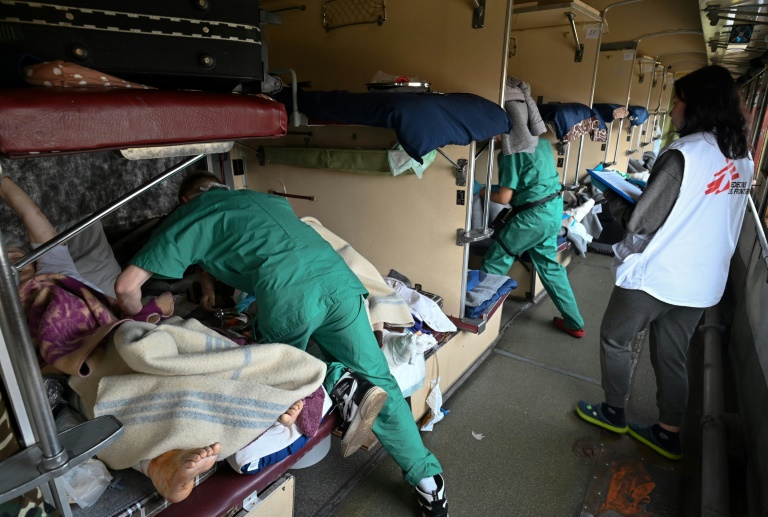
Over the weekend, nearly 50 wounded and elderly patients were transported from the east in a hospital train by medical charity Doctors Without Borders (MSF), the first such evacuation since the attack on the Kramatorsk station.

Electrician Evhen Perepelytsia was evacuated after he lost his leg in shelling in his hometown of Hirske in Lugansk.

“We hope that the worst is over — that after what I’ve been through, it will be better,” said the 30-year-old after arrival in the western city of Lviv.

On Monday, the Chairman of the Board of Ukrainian Railways Alexander Kamyshin said another railway station in the east had been attacked overnight. 

“They continue to aim at the railway infrastructure,” he wrote. 

– ‘Progress towards peace’? –

On the diplomatic front, EU foreign ministers meet Monday to discuss a sixth round of sanctions, with concerns that divisions over a ban on Russia gas and oil imports could blunt their impact.

Austria is an EU member, but does not belong to NATO, though Nehammer’s spokesperson said Brussels, Berlin and Kyiv had been informed about the trip to Moscow.

The chancellor decided to organise the meeting after he met Zelensky in Kyiv on Saturday, his office said.

He wants “to do everything so that progress towards peace can be made” even if the chances of success are minimal, the spokesperson added.

“We are militarily neutral, but have a clear stance on the Russian war of aggression against Ukraine,” Nehammer tweeted, calling for humanitarian corridors, a ceasefire and a full investigation of war crimes.

US President Joe Biden meanwhile will hold virtual talks on Monday with Indian Prime Minister Narendra Modi, just weeks after saying India had been “shaky” in its response to the invasion.

A US spokeswoman said the two leaders would consult on ways to offset the “destabilizing impact (of the war) on global food supply and commodity markets”.

The World Bank warned Sunday that Ukraine’s economy would collapse by 45.1 percent this year — a much bleaker outlook than it predicted even a month ago — while Russia would see an 11.2 percent decline in GDP.

– ‘Inciting hatred’ –

Ukraine’s allies have sought to pile pressure on Moscow over allegations its troops carried out war crimes in areas around Kyiv, and there has been little sign that intermittent peace talks are progressing.

The Pope has urged an Easter ceasefire, denouncing a war where “defenceless civilians” suffered “heinous massacres and atrocious cruelty.”

Ukraine’s Foreign Minister Dmytro Kuleba on Sunday accused the Kremlin and Russian media of laying the groundwork for war “for many years”.

“Russian political elites and propaganda have been inciting hatred, dehumanising Ukrainians, nurturing Russian superiority and laying ground for these atrocities,” he tweeted.

But in an interview with NBC’s “Meet the Press”, Kuleba said he was still open to negotiating with the Russians.

“If sitting down with the Russians will help me to prevent at least one massacre like in Bucha, or at least another attack like in Kramatorsk, I have to take that opportunity,” he said.

Bucha — where authorities say hundreds were killed, some with their hands bound — has become a byword for the brutality allegedly inflicted under Russian occupation.

But other villages, towns and roads on the northwest flank of Kyiv have their own tragedies.

An AFP reporter saw at least two corpses inside a manhole at a petrol station on a motorway outside Kyiv on Sunday, in a mix of civilian and military clothing.

A distraught woman peered in before breaking down, clawing at the earth and wailing: “My little son.” 

burs-reb/sah/je

Pakistan lawmakers to elect new PM after Khan ousted

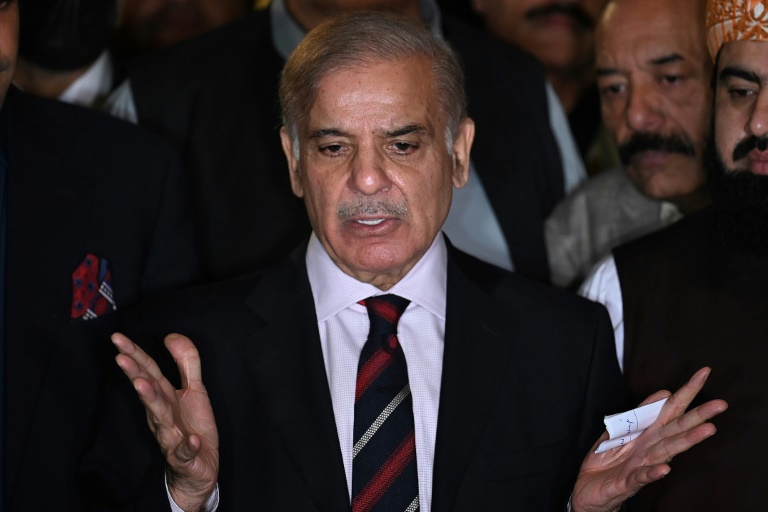
Shehbaz Sharif was set Monday to become Pakistan’s new prime minister, but the country still faces months of political crisis with ousted premier Imran Khan vowing disruption from the wings.

Khan was dismissed Sunday after losing a no-confidence vote, paving the way for an opposition alliance that faces the same issues that bedevilled the cricket star-turned-politician.

Sharif, leader of the centrist Pakistan Muslim League-N (PML-N) is certain to be chosen ahead of the token candidacy of Khan loyalist Shah Mahmood Qureshi, the former foreign minister.

Whether Khan’s Tehreek-e-Insaf (PTI) lawmakers even take part remains to be seen, with a party committee recommending they quit en masse to protest against what they say has been “regime change” by the United States.

Up to 20 of PTI’s 155 lawmakers had said they would cross the floor ahead of Khan’s no-confidence vote on Sunday, but in the end the defection of a coalition partner meant their support wasn’t needed.

Sharif’s first task will be to form a cabinet that will also draw heavily from the centre-left Pakistan Peoples Party (PPP), as well as find space for the smaller conservative Jamiat-ulema-e-Islam-F (JUI-F) group.

– Bitter rivals –

The PPP and PML-N are dynastic parties that have dominated Pakistani politics for decades — usually as bitter rivals — but their relations are sure to fray in the lead-up to the next election, which must be held by October 2023.

They need to tackle soaring inflation, a feeble rupee and crippling debt, while militancy is also on the rise — with Pakistan’s Taliban emboldened by the return to power last year of the hardline Islamist group in neighbouring Afghanistan.

Shehbaz Sharif is the younger brother of disgraced three-time prime minister Nawaz Sharif, and Pakistan media are already speculating the latter may soon return from exile in Britain.

The elder Sharif was dismissed in 2017 and later jailed for 10 years by an accountability court on graft charges after revelations from the Panama Papers, but was released to seek medical treatment abroad.

The younger Sharif is also mired in graft proceedings. In 2019, the National Accountability Bureau seized nearly two dozen properties belonging to him and his son Hamza, accusing them of money laundering.

He was arrested and detained in September 2020, but released six months later on bail for a trial which is still pending.

A seasoned politician in his own right, Sharif, 70, jointly inherited the family’s steel business as a young man and was first elected to provincial office in 1988.

He is known as a tough administrator, feared for his frequent “surprise visits” to government institutions as well as a penchant for quoting revolutionary poetry.

– Defeat not taken well –

No prime minister has ever served a full term in Pakistan, but Khan is the first to lose office via a vote of no-confidence — a defeat he has not taken well.

He tried everything to stay in power after losing his majority in parliament — including dissolving the assembly and calling a fresh election.

But the Supreme Court deemed all his actions illegal and ordered them to reconvene and vote.

Khan insists he has been the victim of a “regime change” conspiracy involving Washington, and has vowed to take his fight to the streets in the hope of forcing an early election.

Political analyst Talat Masood said Khan appears to want to “create problems” for the next government. 

“From what he has been saying, he seems to want to… pursue a kind of a policy of trying to sort of rebel rather (than) make things better for the country and society,” Masood, a former general, told AFP. 

Publicly, the military appears to be keeping out of the current fray, but there have been four coups since independence in 1947, and Pakistan has spent more than three decades under army rule.

Ukraine crisis, inflation risks loom over ECB meeting

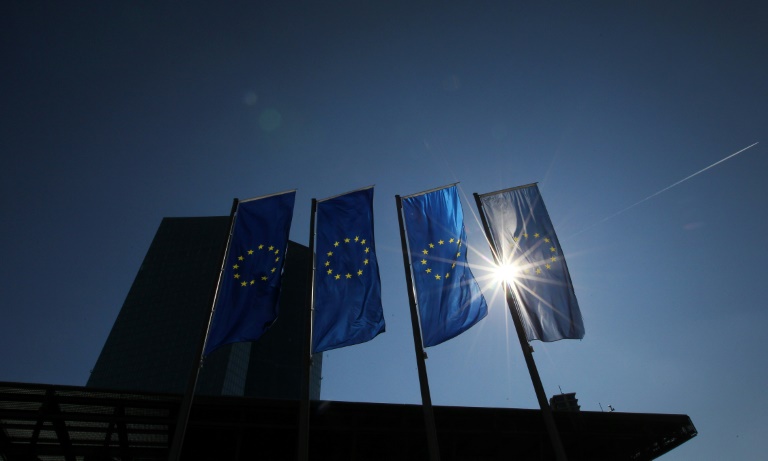
European Central Bank governors meet Thursday to ponder record-high inflation and fresh economic uncertainty caused by the war in Ukraine, with policymakers signalling a willingness to take action sooner rather than later.

At its last meeting in March, the ECB said it would accelerate the winding down of its bond-buying stimulus, with a view to ending the scheme in the third quarter.

An interest rate hike — the ECB’s first in over a decade — would follow “some time” after that, it said.

But since then prices have continued to spiral, with costs for energy, commodities and food surging in the wake of the war in Ukraine, adding to fears that the conflict will stunt a post-Covid recovery.

The US Federal Reserve and the Bank of England have already announced their first rate hikes to combat price pressures, leaving the ECB looking out of step.

Inflation jumped to a record 7.5 percent in the euro area last month, well beyond the ECB’s two-percent target.

Although no major policy changes are expected on Thursday, ECB chief Christine Lagarde’s press conference will be scoured for clues of the bank shifting into more aggressive inflation-fighting mode.

“In our view, policymakers are likely to bring forward their plans to raise interest rates,” said Capital Economics in a client note, “as inflation continues to surprise to the upside”.

Lagarde tested positive for Covid-19 last week but is still set to chair the meeting and take part in the virtual press conference afterwards.

– ‘Too late’ –

Central bankers use interest rate rises as a tool to tame inflation, but pulling the trigger too soon risks hurting economic growth.

The ECB’s dilemma has been complicated by Russia’s invasion of Ukraine and Western sanctions against Moscow, as the fallout from the upheaval to international trade and energy markets remains difficult to predict.

Minutes from the last ECB meeting revealed that many members of the 25-member governing council wanted “immediate further steps” to tackle inflation despite the darkening economic picture.

Some governors called for ending the bond purchases in the summer, opening the door to a rate hike in the third quarter.

The minutes showed that the ECB “has become more hawkish”, said ING bank economist Carsten Brzeski, describing those advocating for a tightening of monetary policy.

Joachim Nagel, the head of Germany’s powerful Bundesbank central bank, is among several ECB members who have said they expect the first rate rises this year.

He has cautioned against “acting too late”.

– Gloomy consumers –

The ECB has for years maintained an ultra-loose monetary policy, pushing interest rates to historic lows to stoke growth and drive up below-target inflation. 

It even set a negative deposit rate of minus 0.5 percent, meaning banks pay to park excess cash at the ECB.

It has also hoovered up billions of euros in government and corporate bonds each month to keep credit flowing in the 19-nation currency club. The massive stimulus is now being phased out, a move the ECB always said would come before any interest rate changes.

Capital Economics analysts said they now expect the ECB to raise the deposit rate as early as July, followed by two more hikes before the end of the year.

Lagarde recently warned that higher energy costs as a result of Europe’s reliance on Russian oil and gas would worsen Europe’s cost-of-living squeeze.

Households were becoming more pessimistic, she said, and could cut back further on spending.

“The longer the war lasts, the higher the economic costs will be and the greater the likelihood we end up in more adverse scenarios,” she said.

Lagarde, a former French finance minister, has urged European governments to help cushion the blow through fiscal policy.

France, Spain, Germany and other countries have already moved to ease the burden on households and companies, including through fuel tax cuts or subsidies for heating.

Mexican president wins recall vote marked by low turnout

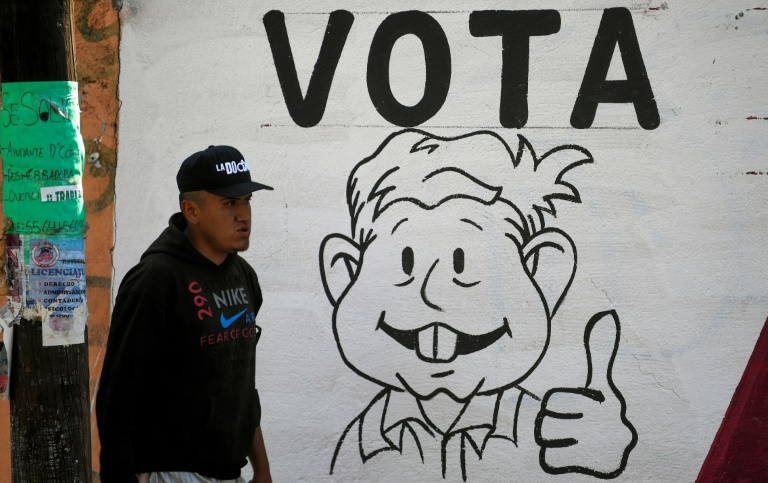
Mexican President Andres Manuel Lopez Obrador on Sunday easily won a divisive referendum he promoted on whether he should step down or complete his term — a vote marked by low turnout.

With an approval rating of nearly 60 percent, Lopez Obrador’s presidency had never appeared seriously at risk, and the left-wing populist was himself one of the vote’s biggest cheerleaders.

The 68-year-old president, elected in 2018 for a six-year term, won slightly more than 90 percent of votes in favor of his staying in office until 2024, according to an official initial count.

But the turnout rate was estimated to be no more than around 18 percent, well below the 40-percent level needed for the poll to be legally binding.

That means that even if Lopez Obrador had lost, he would not have been obliged to step down.

Lopez Obrador ruled out using the result to pursue a constitutional reform allowing him to seek another term, as some critics have accused him of planning to do.

“I’m going to continue serving until the last day of my term. I’m not going to go past that because I’m a democrat and I’m not in favor of re-election,” he said in a video message.

Supporters of the referendum — the first of its kind in Mexico — said it was a way of increasing democratic accountability, giving voters the opportunity to remove the president due to loss of confidence.

“Now we have the chance to change what’s not right. There have been presidents who, after being elected by the people, ended up serving other interests,” Benigno Gasca, a 57-year-old mathematician and musician, told AFP.

– ‘Useless exercise’ –

But critics saw the referendum as expensive propaganda and an unnecessary distraction from the many challenges facing the country, including drug-related violence, poverty and the rising cost of living.

“It’s a useless exercise — money thrown away,” said Laura Gonzalez, a 62-year-old retired teacher.

Mario Delgado, leader of the ruling party Morena, said voters had recognized Lopez Obrador’s “dedication to the most needy and the enormous moral authority with which he governs.

“Only an indomitable, unwavering democrat like him can subject himself to a recall process,” he added.

But Marko Cortes, of the conservative opposition party PAN, said the vote was marked “by illegality, lies, manipulation and the diversion of public resources.”

Alejandro Moreno of the PRI, which ruled Mexico for seven decades until 2000, tweeted that Morena had turned the referendum into a “mockery” to “satisfy its own ego and continue deceiving Mexicans.”

– ‘Political muscle’ –

Some 93 million voters were eligible to participate in the midterm referendum, which was incorporated into Mexico’s constitution in 2019 at Lopez Obrador’s initiative.

Most of the signatures that were collected in order for the vote to happen came from his supporters.

Experts had predicted that a win could give impetus to Lopez Obrador’s policy agenda, such as controversial energy reforms.

The president also has his eye on the 2024 elections and the prospects for his party and possible successors, including Mexico City Mayor Claudia Sheinbaum.

“We all knew that the president was not going to be removed and his opponents were not going to vote,” said political analyst Hernan Gomez Bruera.

Despite the high abstention rate, the referendum showed that Lopez Obrador and his followers have “political muscle” to mobilize support, he told AFP.

“The real litmus test will be in 2024 when he leaves, because no one seems capable of taking his leadership place,” Bruera added.

Lopez Obrador enjoyed an approval rating of 58 percent in March, although that was far below a peak of 81 percent seen in February 2019, according to a poll of polls by the Oraculus firm.

Carmen Sobrino, a 64-year-old housewife, said she heeded the call to vote because she was happy with Lopez Obrador.

“I hope he continues,” she said after casting her ballot in the capital.

The president accused the National Electoral Institute before the vote of sabotaging the exercise in collusion with his political opponents by failing to do enough to promote it.

Elon Musk no longer joining Twitter board: CEO

Elon Musk is no longer joining the board of Twitter, the CEO of the social media company said late Sunday, in a reversal less than a week after announcing the Tesla chief would be appointed.

Musk was named to join the Twitter board after buying a major stake in the firm and becoming its largest shareholder.

“Elon has decided not to join our board,” Twitter CEO Parag Agrawal tweeted.

“Elon’s appointment to the board was to become officially effective 4/9, but Elon shared that same morning he will no longer be joining the board,” Agrawal said.

“I believe this is for the best.”

Currently the world’s richest man and with more than 80 million followers on the microblogging platform, Musk last week disclosed a purchase of 73.5 million shares — or 9.2 percent — of Twitter’s common stock.

Agrawal had announced on Tuesday that Musk would be joining the board, describing him as “a passionate believer and intense critic of the service which is exactly what we need”.

Musk himself tweeted that he was “Looking forward to working with Parag & Twitter board to make significant improvements to Twitter in coming months!”

In his announcement Sunday, Agrawal shared a note he sent to Twitter, which said Musk’s appointment to the board would be contingent on a background check and that he would have to act in the best interests of the company once appointed.

“Elon is our biggest shareholder and we will remain open to his input,” Agrawal added.

– Polarizing figure –

In an apparent reaction to the news, Musk tweeted a smirking emoji, without any other comment.

The billionaire tech entrepreneur is a frequent Twitter user, regularly mixing in inflammatory and controversial statements about issues or other public figures with remarks that are whimsical or business-focused. 

He has also sparred repeatedly with federal securities regulators, who cracked down on his social media use after a purported effort to take Tesla private in 2018 fell apart.

Musk’s decision not to take a seat on the Twitter board came after he tweeted Saturday asking whether the social media network was “dying” and to call out users such as singer Justin Bieber, who are highly followed but rarely post.

“Most of these ‘top’ accounts tweet rarely and post very little content,” the Tesla boss wrote, captioning a list of the 10 profiles with the most followers — a list which includes himself at number eight, with 81 million followers.

“Is Twitter dying?” he asked.

An outspoken and polarizing figure, the announcement of his appointment to the board had sparked misgiving among some Twitter employees, according to a Washington Post report.

Workers at the California-based social media company cited worries about Musk’s statements on transgender issues and his reputation as a difficult and driven leader, according to statements on Slack reviewed by the Post.

A California agency has sued Tesla, alleging discrimination and harassment against Black workers. The electric carmaker has rejected the charges, saying it opposes discrimination.

Elon Musk no longer joining Twitter board: CEO

Elon Musk is no longer joining the board of Twitter, the CEO of the social media company said late Sunday, in a reversal less than a week after announcing the Tesla chief would be appointed.

Musk was named to join the Twitter board after buying a major stake in the firm and becoming its largest shareholder.

“Elon has decided not to join our board,” Twitter CEO Parag Agrawal tweeted.

“Elon’s appointment to the board was to become officially effective 4/9, but Elon shared that same morning he will no longer be joining the board,” Agrawal said.

“I believe this is for the best.”

Currently the world’s richest man and with more than 80 million followers on the microblogging platform, Musk last week disclosed a purchase of 73.5 million shares — or 9.2 percent — of Twitter’s common stock.

Agrawal had announced on Tuesday that Musk would be joining the board, describing him as “a passionate believer and intense critic of the service which is exactly what we need”.

Musk himself tweeted that he was “Looking forward to working with Parag & Twitter board to make significant improvements to Twitter in coming months!”

In his announcement Sunday, Agrawal shared a note he sent to Twitter, which said Musk’s appointment to the board would be contingent on a background check and that he would have to act in the best interests of the company once appointed.

“Elon is our biggest shareholder and we will remain open to his input,” Agrawal added.

– Polarizing figure –

In an apparent reaction to the news, Musk tweeted a smirking emoji, without any other comment.

The billionaire tech entrepreneur is a frequent Twitter user, regularly mixing in inflammatory and controversial statements about issues or other public figures with remarks that are whimsical or business-focused. 

He has also sparred repeatedly with federal securities regulators, who cracked down on his social media use after a purported effort to take Tesla private in 2018 fell apart.

Musk’s decision not to take a seat on the Twitter board came after he tweeted Saturday asking whether the social media network was “dying” and to call out users such as singer Justin Bieber, who are highly followed but rarely post.

“Most of these ‘top’ accounts tweet rarely and post very little content,” the Tesla boss wrote, captioning a list of the 10 profiles with the most followers — a list which includes himself at number eight, with 81 million followers.

“Is Twitter dying?” he asked.

An outspoken and polarizing figure, the announcement of his appointment to the board had sparked misgiving among some Twitter employees, according to a Washington Post report.

Workers at the California-based social media company cited worries about Musk’s statements on transgender issues and his reputation as a difficult and driven leader, according to statements on Slack reviewed by the Post.

A California agency has sued Tesla, alleging discrimination and harassment against Black workers. The electric carmaker has rejected the charges, saying it opposes discrimination.

War in Ukraine: Latest developments

Here are the latest developments in the war in Ukraine:

– Deadly weekend shellings –

Weekend bombardments around Kharkiv in eastern Ukraine have claimed at least 12 lives, according to regional governor Oleg Synegubov.

“The Russian army continues to wage war on civilians due to a lack of victories at the front,” he says on Telegram.

On Sunday, the United Nations says 4,232 civilian casualties had been recorded in Ukraine to date, with 1,793 killed and 2,439 injured.

– Kyiv readies for battles in east –

Ukraine is preparing for “important battles” against Russian forces in the east of the country, officials in Kyiv say, as thousands of civilians flee in fear of an imminent offensive.

Evacuations resume from Kramatorsk in eastern Ukraine, where a missile strike killed 52 people at a railway station Friday.

– More than 1,200 bodies found –

Accusing Moscow of war crimes, Ukraine says it has discovered a trail of more than 1,220 bodies outside Kyiv in towns where the Russian army has retreated.

“We have actually now, only for this morning, 1,222 dead people only in Kyiv region,” Prosecutor General Iryna Venediktova tells Britain’s Sky News in an interview, without specifying how many of those were civilians. 

She says 5,600 cases have been opened into alleged war crimes committed by Russian forces since the start of the February 24 invasion.

At least two bodies were discovered in a manhole at a petrol station west of Kyiv, an AFP reporter says.

– Pope calls for Easter ceasefire –

Pope Francis calls for an Easter truce in Ukraine to pave the way for peace through “real negotiation”.

“Let the Easter truce begin. But not to provide more weapons and pick up the combat again — no! — a truce that will lead to peace, through real negotiation,” the pontiff tells a public mass at Saint Peter’s Square.

– More than 4.5 million flee Ukraine war –

More than 4.5 million Ukrainian refugees have now fled their country, the United Nations refugee agency says.

Ninety percent of those who have left are women and children, as the Ukrainian authorities do not allow men of military age to leave.

– Pro-Russia rally in Germany –

Pro-Russia protesters rally in Germany, with the country’s significant Russian-speaking population demanding an end to the discrimination it says it has suffered since the war began in Ukraine.

Germany is home to 1.2 million people of Russian origin and 325,000 from Ukraine. Authorities fear the conflict could be imported into Germany and the protests used to promote Moscow’s war narrative.

Police have recorded 383 anti-Russian offences and 181 anti-Ukrainian offences since the Kremlin’s invasion started on February 24.

– Dnipro airport destroyed –

The airport in the central Ukrainian city of Dnipro has been destroyed in fresh Russian shelling, a local official says. 

“There has been another attack on Dnipro airport. There is nothing left of it. The airport itself and the infrastructure around it has been destroyed. Rockets keep flying and flying,” the head of the city’s military administration, Valentin Reznichenko, says on Telegram. 

Authorities were seeking to clarify information about victims, he adds.

– Biden, Modi to discuss Ukraine –

US President Joe Biden will meet virtually Monday with Indian Prime Minister Narendra Modi, weeks after saying New Delhi has been “shaky” in its response to the invasion of Ukraine.

– Austrian leader to meet Putin –

Vienna says Austrian Chancellor Karl Nehammer will visit Putin in Moscow Monday, the first European leader to meet him since the invasion.

– EU to discuss new Russia sanctions –

EU foreign ministers are to discuss Monday a sixth round of sanctions on Moscow.

Although the sanctions that would hurt Russia the most — an EU boycott of its oil and gas exports — are not on the table formally, European Union diplomats acknowledge there are discussions about them.

Ukrainian President Volodymyr Zelensky has repeatedly called for such EU embargoes, but the bloc remains divided over a ban on Russian energy imports.

– Bleak World Bank forecast –

Ukraine’s economy will collapse by 45.1 percent this year, the World Bank predicts, with the entire region suffering economic consequences from the war.

“Our forecasts show that the Russian invasion in Ukraine has reversed the region’s recovery from the pandemic,” said Anna Bjerde, World Bank vice president for Europe and Central Asia.

Should the conflict escalate, the Bank warned the region’s economy could contract by nearly nine percent — worse than the 2008 global financial crisis.

Close Bitnami banner
Bitnami