World

Asia tracks Wall St losses on Fed tightening concerns

Asian stocks opened with losses on Monday, as unease lingered over tightening monetary policy by the Fed and investors awaited earnings reports by retailers due this week.

Wall Street stocks mostly fell Friday. Both the S&P 500 and the Nasdaq retreated as the yield on the 10-year US Treasury note climbed above 2.7 percent, a signal markets are preparing for more tightening as the Federal Reserve battles inflation.

The losses continued Monday in Tokyo, as well as in Hong Kong and Shanghai where the main indexes lost more than two percent.

Taipei and Seoul were also down, while Sydney and Jakarta posted slight gains.

“Stocks are soft at the Monday open on increasing evidence the Federal Reserve will take a more committed approach to its monetary policy inflation-fighting stance,” said Stephen Innes at SPI Asset Management.

“However, markets have been surprisingly resilient as discussions under the surface debated whether this week’s US March CPI data will hint at the peak of the inflation cycle and help the Fed’s chance to better engineer a soft landing, however narrow that path may seem.”

And Takashi Hiroki, chief strategist of Monex, added: “Focus this week is on the US and Chinese consumer price indexes for March,” among other data, to glean clues on the Fed’s monetary policy and that of other central banks.

The US central bank has recently taken a hawkish tone as it embarks on an aggressive tightening path, prompting traders to fret over the prospect of higher interest rates.

The euro climbed as much as 0.7 percent against the dollar before paring the gain, suggesting some relief over the French election but ongoing wariness.

Investors had fretted about the implications of a victory for President Emmanuel Macron’s nationalist rival Marine Le Pen in the midst of the war in Ukraine, given her long-standing sympathies for Russia.

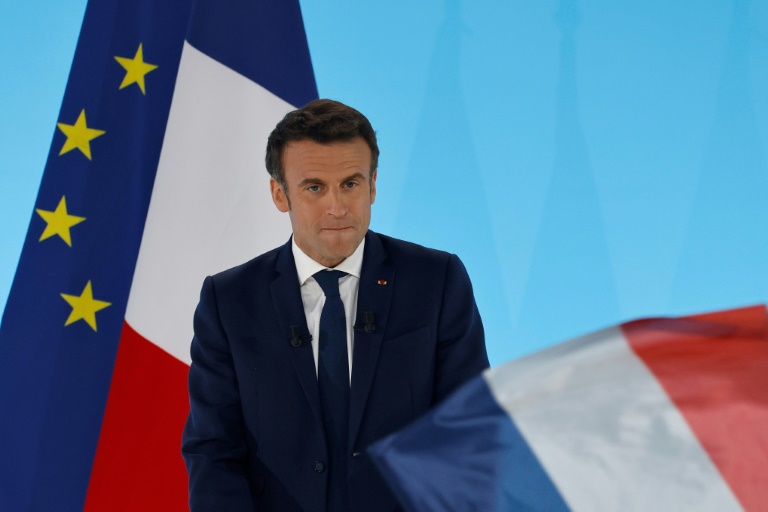
Macron was set to beat Le Pen in the first round of elections Sunday by a larger-than-expected margin, the two candidates advancing to a run-off later this month.

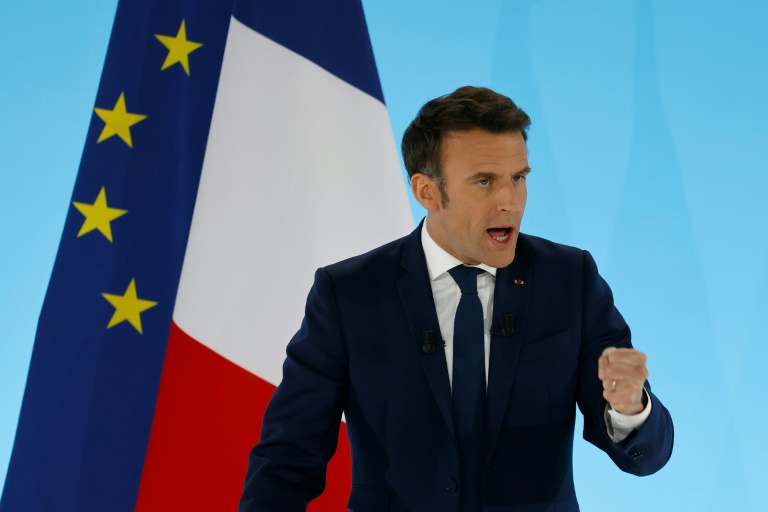
“Make no mistake: nothing is decided,” Macron told supporters.

– Key figures around 0230 GMT –

Tokyo – Nikkei 225: DOWN 0.71 percent at 26,793.46 (break)

Hong Kong – Hang Seng Index: DOWN 2.59 percent at 21,305.79

Shanghai – Composite: DOWN 2.38 percent at 4,129.91

Brent North Sea crude: DOWN 2.87 percent at $99.91 per barrel

West Texas Intermediate: DOWN 2.91 percent at $95.35 per barrel

Euro/dollar: DOWN at $1.0877 from $1.0910 Friday

Pound/dollar: DOWN at $1.3025 from $1.3081

Euro/pound: UP at 83.51 pence from 83.41 pence

Dollar/yen: UP at 124.34 yen from 123.63 yen

New York – Dow: UP 0.4 percent at 34,721.12 (close)

London – FTSE 100: UP 1.6 percent at 7,669.56 (close)

— Bloomberg News contributed to this report —

Veteran Hong Kong journalist arrested for 'sedition'

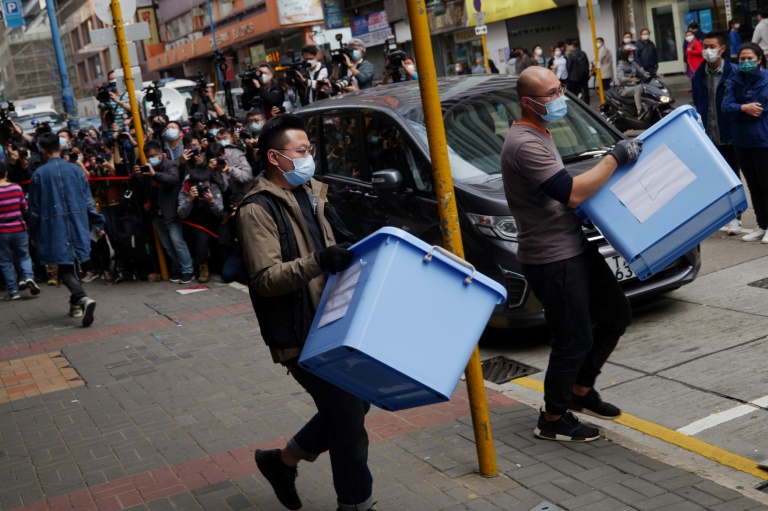
A veteran Hong Kong journalist was arrested by national security police on Monday for allegedly conspiring to publish “seditious materials”, a police source and local media said.

The arrest is the latest blow against the local press in Hong Kong which has seen its media freedom rating plummet as Beijing cracks down on dissent.

Allan Au, a 54-year-old reporter and journalism lecturer, was arrested in a dawn raid by Hong Kong’s national security police unit, multiple local media outlets reported. 

A senior police source confirmed Au’s arrest to AFP on a charge of “conspiracy to publish seditious materials”.

Police have yet to release an official statement. 

Au was a former columnist for Stand News, an online news platform that was shuttered last December after authorities froze the company’s assets using a national security law.

Two other senior employees of Stand News have already been charged with sedition.

National security charges have also been brought against jailed pro-democracy media tycoon Jimmy Lai and six former senior executives of Apple Daily.

Once Hong Kong’s most popular tabloid, Apple Daily collapsed last year when its newsroom was raided and assets were frozen under the security law. 

Soon after Stand News was shut down, Au began to write “good morning” each day on his Facebook to confirm his safety.

One of the city’s most experienced local columnists, he was a Knight fellow at Stanford University in 2005 and earned a doctorate from the Chinese University of Hong Kong.

In 2017 Au published a book about censorship in Hong Kong entitled “Freedom Under 20 Shades of Shadow”.

Au spent more than a decade working for RTHK, Hong Kong’s government broadcaster, running a current affairs show.

But he was axed last year after the authorities declared a shake-up that began transforming the once editorially independent broadcaster into something more resembling Chinese state media. 

– National security offence –

First penned by colonial ruler Britain in 1938, sedition was long criticised as an anti-free speech law, including by many of the pro-Beijing local newspapers now praising its use.

By the time of the 1997 handover, it had not been used for decades but remained on the books.

It was dusted off by police and prosecutors in the wake of massive and sometimes violent pro-democracy protests in 2019. 

Over the last two years sedition has been wielded against journalists, unionists, activists, a former pop star and ordinary citizens.

Sedition is currently separate from the sweeping national security law that Beijing imposed on Hong Kong in 2020.

But the courts treat it as a national security offence, which means that bail is often denied for those charged.

Next month Hong Kong is expected to get a new Beijing-anointed leader, former security chief John Lee who oversaw the police response to the 2019 democracy protests and subsequent crackdown.

Asked on Monday whether Au’s arrest would worsen press freedom, Lee declined to comment, saying that all investigations should be carried out independently.

Indian sari weavers toil to keep tradition alive

In a dim room near the banks of India’s Ganges river, arms glide over a creaking loom as another silken fibre is guided into place with the rhythmic clack of a wooden beam.

Mohammad Sirajuddin’s cramped studio is typical of Varanasi’s dwindling community of artisans painstakingly working by hand to produce silk saris, uniquely cherished among their wearers as the epitome of traditional Indian sartorial style.

The city he calls home is revered among devout Hindus, who believe that cremation on the banks of its sacred waterway offers the chance to escape the infinite cycle of death and rebirth. 

But Sirajuddin’s own reflections on mortality are centred on his craft, with competition from more cost-efficient mechanised alternatives and cheap imports from China leaving his livelihood hanging by a thread. 

“If you walk around this whole neighbourhood, you’ll see that this is the only house with a handloom,” the 65-year-old tells AFP.

“Even this will be here only as long as I am alive. After that, nobody in this house will continue.”

Varanasi’s hand-weavers have cultivated a reputation for excellence over centuries, specialising in intricate patterns, floral designs and radiant golden brocades. 

The Banarasi saris — so-called in reference to the city’s ancient name — they produce are widely sought after by Indian brides and are often passed on from one generation to the next as family heirlooms.

The elegant garments fetch handsome prices — Sirajuddin’s current work will go on sale for 30,000 rupees ($390) — but the cost of inputs and cuts taken by middlemen leave little left for weavers. 

“Compared to the hard work that goes into making the sari, the profit is negligible,” Sirajuddin says.

His neighbours have all switched to electric looms for their garments, which lack the subtleties of hand-woven textiles and sell for just a third of the price but take a fraction of the time to finish. 

– ‘Thriving industries got killed’ – 

The fortunes of India’s textile trade — historically a cottage industry — have long been subject to sudden and devastating upheavals from abroad.

Its delicate fabrics were prized by the 18th century European elite but British colonisation and England’s industrial-era factories flooded India with much cheaper textiles, decimating the market for hand-woven garments. 

Decades of socialist-inspired central planning after independence bought some reprieve by shielding local handicrafts from the international market.

But economic reforms in the early 1990s opened the country up to cheap goods just as the country’s northern neighbour was establishing itself as the globalised world’s workshop.

“Chinese yarn and fabric came in everywhere,” said author and former politician Jaya Jaitly, who has written a book on Varanasi’s woven textiles, adding that sari factories there had for years been emulating the city’s unique patterns and detail.

“All of these thriving industries got killed… through Chinese competition, and their ability to produce huge quantities at very low prices.” 

– ‘Tradition to be proud of’ –

Jaitly said local weavers needed urgent protection from government to preserve a wealth of artisanal traditions that otherwise risked disappearing. 

“We have the largest number of varieties of handloom, techniques, skills… more than anywhere else in the world,” she said. 

“I think that’s truly a tradition to be proud of.”

Demand for Banarasi saris, already limited to a select Indian clientele able to justify spending at a premium, has also suffered in the wake of the Covid-19 pandemic. 

The virus threat may have receded in India, but job losses and a big dent to the economy have taken their toll.

“The weavers are suffering a lot. They are not getting the right price for their products, payments are also coming late,” said local sari merchant Mohammad Shahid, his store empty but for sales assistants stacking silk garments on the shelves.

Shahid was nonetheless hopeful that well-heeled and discerning customers would return.

“Those who know the value of handloom will continue to buy and cherish our saris. The handlooms can dwindle but they will never go away,” Shahid, 33, told AFP.

Ukraine says 1,200 bodies found near Kyiv as east braces for onslaught

Ukraine said Sunday it had found more than 1,200 bodies in the Kyiv region, the scene of atrocities allegedly committed by Russian troops, as residents in the country’s east braced — or fled — ahead of an expected massive offensive.

Heavy bombardments hammered Ukraine through the weekend, adding to mounting casualties six weeks into Russia’s invasion of its neighbour.

Shelling claimed two lives in northeast Kharkiv on Sunday morning, regional governor Oleg Synegubov said, the day after 10 civilians, including a child, died in bombings southeast of the city.

“The Russian army continues to wage war on civilians due to a lack of victories at the front,” Synegubov said on Telegram.

In Dnipro, an industrial city of around a million inhabitants, a rain of Russian missiles nearly destroyed the local airport, causing an uncertain number of casualties, local authorities said. 

An AFP reporter saw black smoke in the sky above the facility, but a plane also took off later on Sunday, suggesting its runway was still functioning.

President Volodymyr Zelensky again condemned atrocities against civilians, and, after speaking with German Chancellor Olaf Scholz, said they had agreed “that all perpetrators of war crimes must be identified and punished”.

Ukraine’s Prosecutor General Iryna Venediktova said the country was examining the alleged culpability of 500 leading Russian officials, including President Vladimir Putin, for thousands of war crimes. 

And White House National Security Advisor Jake Sullivan pledged the US would “work with the international community to make sure there’s accountability” for what he called “mass atrocities”. 

At the Vatican, Pope Francis called for an Easter ceasefire to pave the way for peace, denouncing a war where “defenceless civilians” suffered “heinous massacres and atrocious cruelty”.

– ‘We will respond’ –

In his nightly address, Zelensky said Russian troops were about to launch “even larger operations” in the east of Ukraine. 

“We are preparing for their actions. We will respond,” he said. 

Residents have been fleeing in their thousands, but Lugansk governor Sergiy Gaiday said many were afraid to leave after a missile strike on a railway station in the city of Kramatorsk on Friday killed 57 people, according to a revised tally issued by local authorities. 

“We evacuated “2,700-2,500 people per day, but now there are fewer and fewer,” Gaiday said, adding he was “sure that 20-25 percent” of the region’s population was still there.

“Sometimes we just beg (them) to come out of hiding because we know what comes next,” he said, adding Russian forces would “destroy everything in their path”.

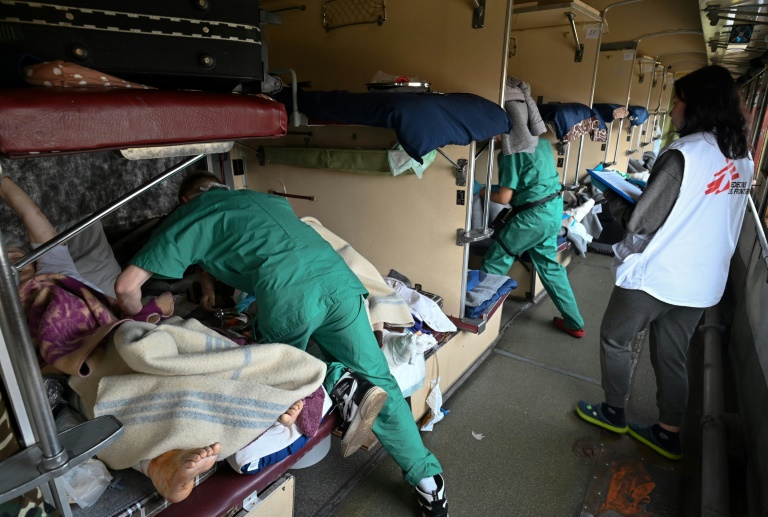
Almost 50 wounded and elderly patients were transported from the east in a hospital train by medical charity Doctors Without Borders (MSF) over the weekend, the first such evacuation since the attack on the Kramatorsk station. 

Electrician Evhen Perepelytsia was one of those evacuated after he lost his leg, and almost his life, to shelling in his hometown of Hirske in Lugansk.

“We hope that the worst is over — that after what I’ve been through, it will be better,” said 30-year-old after the train arrived in the western city of Lviv.

Russia’s defence ministry has denied carrying out the Kramatorsk attack. 

It said Kyiv and its western allies were continuing to stage “monstrous and merciless” provocations and murdering civilians in the self-proclaimed Lugansk People’s Republic, one of two pro-Russian separatist statelets in Ukraine’s eastern Donbas.

– ‘Inciting hatred’ –

Ukraine on Sunday hit out at the Kremlin and Russian media for laying the groundwork for war “for many years”.

“Russian political elites and propaganda have been inciting hatred, dehumanising Ukrainians, nurturing Russian superiority and laying ground for these atrocities,” Foreign Minister Dmytro Kuleba tweeted on Sunday.

But in an interview with NBC’s “Meet the Press”, Kuleba said he remained open to negotiating with the Russians.

“If sitting down with the Russians will help me to prevent at least one massacre like in Bucha, or at least another attack like in Kramatorsk, I have to take that opportunity,” he said.

Bucha — where authorities say hundreds were killed, some with their hands bound — has become a byword for the brutality allegedly inflicted under Russian occupation.

Ukraine’s prosecutor Venediktova said 1,222 bodies had been found there and in the broader region around Kyiv so far.

At least two corpses were found inside a manhole at a petrol station on a motorway outside Kyiv on Sunday, an AFP reporter saw.

The bodies appeared to be wearing a mix of civilian and military clothing.

A distraught woman peered into the manhole before breaking down, clawing at the earth and wailing, “My son, my son”.

The United Nations said on Sunday that 4,232 civilian casualties had been recorded in Ukraine to date, with 1,793 killed and 2,439 injured.

– Nehammer to Moscow –

Austrian Chancellor Karl Nehammer said he would meet Putin on Monday, which would make him the first European leader to visit the Kremlin since the invasion began on February 24. 

Nehammer met the Ukrainian leader in Kyiv over the weekend, and his spokesman said he had informed Berlin, Brussels and Zelensky of the trip to Moscow. 

Austria is a member of the European Union, but not of NATO.

EU foreign ministers will also meet Monday to discuss a sixth round of sanctions, even as divisions over a ban on Russia gas and oil imports threaten to blunt their impact.

In a bid to shore up international resolve against Moscow, US President Joe Biden is to hold virtual talks on Monday with Indian Prime Minister Narendra Modi, just weeks after saying India had been “shaky” in its response to the invasion.

A US spokeswoman said the two leaders would consult on ways to offset the “destabilizing impact (of the war) on global food supply and commodity markets”.

The World Bank on Sunday issued a dire forecast, saying Ukraine’s economy would collapse by 45.1 percent this year — a much bleaker outlook than it predicted even a month ago — while Russia would see an 11.2 percent decline in GDP.

burs-dlc/bbk/sw/reb/lb

Embracing Ukrainians at the US-Mexico border

Oleksii Yeromin stands at the gate on the US-Mexico border and calls to Ukrainian migrants crossing into America after fleeing the war in their home country, then wraps them in a hug on the other side.

“Come here, come, you see this line? Here there’s the last checkpoint to go through and you will be in the United States,” he said in English.

Wearing a hat and carrying a blue and yellow Ukrainian flag, the 43-year-old is the first face that many Ukrainians see as they cross into the United States. 

He has even marked that final step for them, tracing the letters “USA” on the ground in red tape.  

“Ukraine welcomed me, now Ukraine needed me here,”says Yeromin, who is originally from Uzbekistan and emigrated several years ago to Ukraine, where he married and had two daughters. 

Five years ago he decided to go to Chicago to seek a better future. This week he was reunited with his wife and daughters at the US-Mexico border. They, too, had fled the war.

Family is everything, he said. “Any money, any house, anything’s doesn’t matter. It’s zero.” He is red-eyed — likely from the exhaustion of not having slept more than four hours a night for days now.

Even after welcoming his family, the painter by trade decided to stay at the gate. 

“This is minimum. They travel long, they need a hug,” he said.

His eldest daughter, Katarina, 13, does not speak English, but she helps out at the care center that has been set up as part of a massive volunteer operation. 

“I’m very happy because I met my dad and also for helping here,” says Katarina with the help of Gisele, her new friend and interpreter. 

Soon, she is handing a phone battery to a young man and offering lollipops to a little girl.  

“I’m very excited. I’m privileged, lucky. I needed to give back,” adds the teenager with a shy smile.  

“You made it, you’re here. Come here, come here,” says Yeromin a few meters away, while giving out more hugs.

A massive US-Mexican effort to welcome Ukrainian refugees

Nadiya Ruyhynska had almost never left Ukraine, though her daughter lives in the US city of Seattle.

But with the war looming in her hometown of Lviv, the 55-year-old former nurse set off on the long journey to the Mexican city of Tijuana, where a massive operation is helping thousands of Ukrainian refugees cross the border to resettle in the United States.

Most arrive with mixed emotions. 

“I am 50-50,” said the former nurse as she stepped onto American soil.

“I have happiness” at the prospect of being reunited with her pregnant daughter Christina, who has a young son, but also sadness at having left her own mother behind, she said. 

Like Ruyhynska, hundreds of Ukrainians have reached the border town of Tijuana in hopes of crossing onto US soil — encouraged by a promise from Washington that it is prepared to welcome up to 100,000 Ukrainians who have fled the war.

Pavel Savastyanov, a Russian-born volunteer helping at a support center for Ukrainians in San Ysidro, California, just across the border from Tijuana, said every flight to the area is bringing more.

– ‘The first step’ –

The operation begins at Tijuana International Airport. The first thing passengers see when they pass through the arrival gate is a blue-and-yellow Ukrainian flag next to signs in Cyrillic reading “Welcome” and “Help.”

In a small office there, volunteers record the new arrivals’ names on a list — already bearing more than 2,300 names — for eventual transportation to the border. 

“This is the first step,” said Sergio, a 36-year-old Ukrainian volunteer who declined to give his last name. He and his cousin had traveled 500 miles (800 kilometers) from Sacramento, the California capital, to help the arriving refugees. 

One area in the airport is marked off with yellow tape. A sign in English and Spanish reads: “Ukrainian refugees only.”

There is food and drinks, and a play corner set aside for children with crayons and coloring books.  

From there, the refugees are taken to one of four housing centers that volunteers, with governmental and church support, quickly set up in this city that has long drawn thousands of Latin Americans hoping to reach the United States.

– ‘My dad had to stay’ –

“My dad had to stay behind,” said 15-year-old Ukrainian Anastasia Chorna, choking back tears. 

Sitting in a chair in the Benito Juarez sports complex, Tijuana’s largest refugee center for Ukrainians, she hugged the enormous stuffed gray shark she had brought when she and her mother left home. 

“It’s literally the only thing I could bring,” she said. 

Her father, who is 41, remains in Kyiv. “I feel bad because I wanted him to be here, with these volunteers, where everything is so peaceful,” Anastasia said, struggling to express herself in a language not her own.

She and her mother had passed through four countries on the long way to Mexico, where getting a visa for entry is comparatively easier for Ukrainians than to the United States.

Some men did flee Ukraine, in violation of a martial-law decree requiring all those aged 18 to 60 to stay and fight or face conscription.

“I know I committed a crime, but I didn’t want to fight,” said a 25-year-old engineer, who refused to give his name. 

He had left Ukraine with his partner, whom he married the day war broke out, and was now waiting for his number to be called for a bus to the US border.

“I’ve never picked up a gun… I couldn’t kill someone or watch them die. I couldn’t,” he said, crestfallen, in broken English.

For those who speak no English, an enormous network of volunteers is there to help.

– Growing numbers –

Twins Maria and Liza Melnichuk had emigrated with their family from Ukraine 20 years ago.

When the sisters, now 26, heard about the influx of refugees, they jumped into their car to drive the 540 miles to Tijuana to join an active rotation of volunteers working round-the-clock. As Ukrainian-speakers, they knew they could help.

“We’re glad to see the people arrive,” said Liza, who was able to welcome her cousins who had fled Bucha, the Ukrainian town now synonymous with charges of extreme brutality under Russian occupation.

Her sister Maria said the numbers of arrivals have been steadily growing. “On Wednesday we received some 300 people, and already today (Friday) there must have been 700.”

A coordinated effort between Mexican and US authorities made the so-called Ped West entrance at the border exclusively available for the arrivals.

Buses transport hundreds of people a day to a line where they are received by Mexican officials before crossing on foot to the US side.

Once on Californian soil, the tears flow — of joy and of sadness.

“I don’t think there are words to describe what has happened, and how hard it has been,” said Christina Ruyhynska after a long, emotional hug with her mother — their first in three years. 

The two women, wiping away tears, spoke briefly in Ukrainian. 

Then in English, Christina turned to her mother and asked, “Are you ready to go home?”

Speeding west, Ukraine hospital train ferries patients to safety

As the hospital train sped away from the frontline in war-torn Ukraine, electrician Evhen Perepelytsia was grateful he would soon see his children again after almost losing his life.

“We hope that the worst is over — that after what I’ve been through, it will be better,” the 30-year-old said, lying on a train carriage bed swaddled in a grey blanket.

He was among 48 wounded and elderly patients to be evacuated from embattled east Ukraine this weekend, pulling up in the western city of Lviv Sunday evening after a long trip overnight.

The evacuation was the first from the east since a Russian strike killed 52 people among thousands waiting for the train at the eastern railway station of Kramatorsk on Friday.

And it was the fourth to be organised by medical charity Doctors Without Borders (MSF) since Russia invaded Ukraine on February 24.

Inside one of the carriages turned ward-on-wheels, Perepelytsya recounted how he lost his leg to shelling in his hometown of Hirske in the eastern region of Luhansk.

He was standing outside, and had just discussed abandoning their home to join their children in the west of the country, he said.

“I took one step forward, and when I made the second, I fell,” he said.

“It turned out that it hit very close to me, hit a monument, and a fragment from it tore off my leg.”

– ‘We saved his life’ –

Sitting on the end of his bed, his wife Yuliya, 29, said she had been terrified she would lose him.

“He was unconscious twice in the intensive care unit,” she said.

“We couldn’t save his leg, but we saved his life.”

She said their three children were waiting in Lviv with their grandmother.

“We’re not going back,” she said.

The United Nations says at least 1,793 civilians have been killed and 2,439 wounded since Russia launched its invasion, but the actual tally is likely much higher.

More than 10 million people have been forced to flee their homes.

The Ukrainian authorities have in recent days urged all residents in the east of the country to flee westwards to safety as they fear Moscow will unleash the full force of its military there after setbacks around the capital Kyiv.

As the blue carriages pulled into Lviv, medics carried those who were unable to walk on stretchers into waiting ambulances, and helped the others on foot or in wheelchairs onto buses.

In one bus, 77-year-old Praskovya sat patiently with a large white bandage on her eye, and a net over her head to keep it in place.

“My eye hurts,” said the elderly lady from the village of Novodruzhesk in Luhansk, who did not give her second name.

“But the doctors on the train were great,” she added, of the 13 staff members on board, most of them Ukrainian.

– ‘Heading back tonight’ –

In front of her, a 67-year-old who gave his name as Ivan said he had to wait in a basement for two days after being shot in the street.

Neighbours in the town of Popasna, also in Luhansk, bandaged him up as best they could until the medics could arrive.

On the platform, MSF train hospital coordinator Jean-Clement Cabrol caught his breath.

The train had successfully ferried 48 people to safety, but still many more needed help, the doctor in a black beanie hat said.

Earlier in the war, a first train had travelled to Zaporizhzhia to pick up three families who were wounded while trying to flee the besieged port city of Mariupol.

After that, two operations whisked dozens of patients — mostly elderly people — out of Kramatorsk, leaving just days before the deadly Russian attack.

By the tracks on Sunday evening, the doctor said another train would soon depart to continue evacuations as long as it was possible.

“We are heading back tonight,” he said.

Le Pen, Macron prepare for tense French election duel

French President Emmanuel Macron and his far-right rival Marine Le Pen were on Monday preparing for two weeks of tough campaigning after they reached a run-off of presidential elections that promises to be far tighter than their encounter five years ago.

With more than 90 percent of the vote counted in the first round, projections showed Macron scoring 28-29 percent, with Le Pen on 22-24 percent.

As the top two finishers, they will progress to a second round on April 24. 

Despite entering the campaign late and holding just one rally, Macron performed slightly better than expected and won immediate support from most of his defeated rivals ahead of the run-off.

“Make no mistake: nothing is decided,” he told cheering supporters at his campaign headquarters. “The debate that we are going to have over the next fortnight will be decisive for our country and Europe.”

He added: “When the far-right with all its forms is so high in our country, you can’t say that things are going well.”

Far-left candidate Jean-Luc Melenchon came close to qualifying for the second round after a late surge gave him a projected score of around 21 percent.

The candidates for France’s traditional parties of government — the Socialists and the Republicans — were meanwhile on course for humiliating defeats and historic low scores.

Final results are expected Monday, while four new polls on Sunday night suggested a tight second round between Macron and Le Pen.

One by the Ifop-Fiducial group suggested Macron had a razor-thin winning margin of 51 versus 49 percent, but the average of them indicated a Macron victory by around 53 percent to 47 percent.  

Macron announced Sunday night that he would be out campaigning on Monday in northern France, while Le Pen is set to meet her campaign team before resuming her months-long grassroots efforts in small towns and rural France later in the week.

– ‘Fundamental choice’ –

Bidding to be France’s first woman president, Le Pen increased her first-round score from 2017 and she will pick up votes cast for her far-right rival Eric Zemmour in the second round. 

Zemmour, an anti-Islam newcomer who failed in his bid to outflank Le Pen with a more radical programme, was projected to win around 7.0 percent.

Le Pen, 53, said the run-off would present “a fundamental choice between two visions” with Macron representing “division, injustice and disorder… to the benefit of a few” against her plan for “social justice and protection” guaranteed by the nation state.

It would be a “choice of society and even of civilisation”, she said.

The election campaign has been overshadowed by the war in Ukraine, while surging prices of everyday goods have made the cost of living the overwhelming priority issue for voters.

The outcome of the two-stage election will have major implications for the European Union, which Le Pen says she wants to radically reform.

She has also said she wants to pull out of the joint military command of the US-led NATO military alliance. 

Macron said Sunday: “I want a France that places itself in a strong Europe, that continues to form alliances with the world’s democracies to defend itself.

“Not a France which, once out of Europe, would only have the international alliance of populists and xenophobes as allies. That’s not us.”

– Pivotal debate –

A pivotal moment in the next stage of the campaign will come on April 20 when the two candidates are set to take part in a TV debate broadcast live on national television and watched by millions.

The final debate often has a crucial impact on the overall outcome, including in 2017 when Macron was widely seen as bettering a flustered Le Pen.

While her opponents accuse her of being divisive and racist, Le Pen has sought to project a more moderate image in this campaign and has focused on voters’ daily worries over inflation.

But Macron is expected to target her past proximity with Russian leader Vladimir Putin, her policies on the EU, as well as the cost of her economic programme that includes massive tax cuts.

He also floated the idea Sunday night of a “large movement of political unity and action” and a “new method” of governing, which could see him invite rival parties to formally join his political movement. 

Among the other candidates, Sunday’s vote spelled humiliation for Socialist Anne Hidalgo, the mayor of Paris, who was projected to win 1.8-2.0 percent, a historic low for the party which held the presidency just five years ago.

The vote for the right-wing Republicans party, headed by nominee Valerie Pecresse, also collapsed to an estimated 4.3-5 percent, down from 20 percent in 2017. 

“The traditional parties have been smashed,” said Jerome Jaffre, a political scientist at Sciences Po university in Paris.

Greens candidate Yannick Jadot was also left disappointed with a projected score of under 5.0 percent.

– Tax cuts –

This marks the third time that a far-right candidate has made the run-off vote of a French presidential election, after Marine Le Pen’s campaign in 2017 and the breakthrough by her father Jean-Marie in 2002 that shocked France.

Macron, who came to power aged 39 as France’s youngest president, is bidding to be the first French president to win a second term since Jacques Chirac in 2002. 

If he does, he would have five more years to push through reforms that would include raising the pension age to 65 from 62 and enacting further tax cuts for businesses in a bid to further reduce unemployment, currently at a 14-year low.

He would also seek to consolidate his position as the most influential leader in Europe after the departure of German chancellor Angela Merkel. 

burs-adp-sjw/lb

Israel 'on offensive' after Tel Aviv attacks, Jenin camp on alert

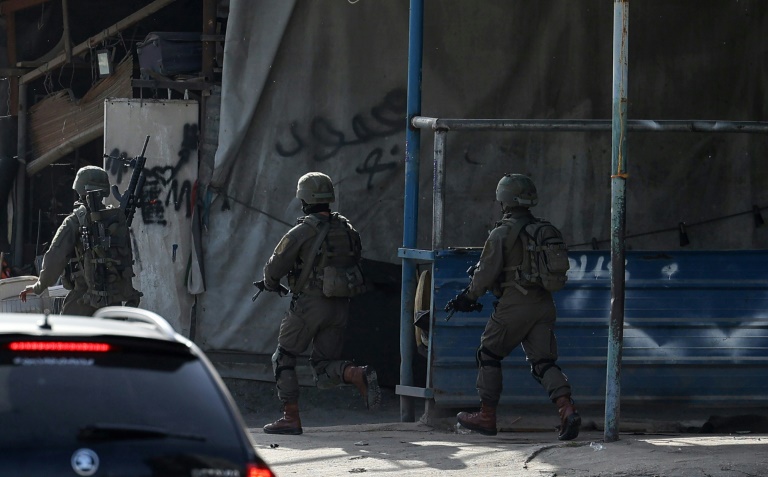
Israeli forces Sunday raided the flashpoint West Bank district of Jenin, home of gunmen who launched two recent deadly attacks in Tel Aviv, as Prime Minister Naftali Bennett warned the Jewish state had “gone on the offensive”.

The military operation entered its second day as Israel buried three civilian victims from last Thursday’s shooting spree and Palestinian militant groups in Jenin warned they were mobilising fighters.

Israeli authorities demanded that Fathi Hazem — the father of the late 28-year-old Tel Aviv shooter who killed three Israelis — turn himself in, Israeli and Palestinian media said, as the Jenin refugee camp girded for more battles.

Abu Muadh, the military spokesman of the armed factions in Jenin’s refugee camp, announced a “state of alert” and called for “general mobilisation of our fighters to confront any incursion by the Zionist enemy”. 

Mosques in Jenin told civilians to vacate the streets, according to local residents. Elsewhere in the West Bank, protests were held in solidarity with Jenin, a militant stronghold that saw a major battle against Israeli troops 20 years ago.

Tensions have surged in the West Bank during the Muslim holy month of Ramadan, nearly a year after violence flared in the other Palestinian territory, the Hamas-ruled Gaza Strip, leading to 11 days of devastating conflict.

Gun battles rocked the Jenin area for a second day Sunday, with at least 10 Palestinians wounded, according to the Palestinian health ministry, and more than 20 arrested, according to an Israeli military source.

– Separation barrier –

“The State of Israel has gone on the offensive,” Bennett said after a security cabinet meeting, which also approved a 360 million shekel ($112 million) plan to build an additional 40 kilometres (25 miles) of the separation barrier along the West Bank border.

The cabinet also agreed to evaluate a policy to strip the families of “terrorists who are residents and citizens of Israel” of state pensions and other benefits. 

In recent weeks, Israel has been stunned by a string of attacks — some carried out by Arab citizens of Israel linked to or inspired by the Islamic State group, others by Palestinians, and cheered by militant groups including Hamas and Islamic Jihad.

A total of 14 people have been killed in four attacks since March 22, including a shooting spree in Bnei Brak, an Orthodox Jewish city in greater Tel Aviv, also carried out by a Palestinian attacker from Jenin.

Over the same period, at least 13 Palestinians have been killed, including assailants, according to a count by AFP. 

The latest casualties were two Palestinian women and one man shot dead Sunday in the West Bank.

The army said one woman had failed to stop after soldiers fired warning shots near the southern city of Bethlehem. Ghada Ibrahim Sabatien was a widowed mother of six in her 40s, according to Palestinian official news agency Wafa. 

Further south in Hebron, a Palestinian woman stabbed and lightly wounded an officer before she was killed, according to border police. 

After night fell, a Palestinian man was shot dead near Bethlehem, said the Palestinian health ministry, which named him as 21-year-old Mohammed Ghnaim. 

The Israeli army told AFP that troops opened fire after the man was seen hurling a Molotov cocktail at passing cars.

– ‘Heart is bleeding’ –

In the Jenin area, Israeli forces confronted relatives of the Tel Aviv gunman, Raad Hazem, who was killed after an hours-long manhunt, and whose family home faces demolition under standard Israeli practice to deter such attacks.

The army said that when troops spotted two of his brothers in a car outside the house, they fired at its wheels. The car then sped off and soldiers also shot at another gunman who fired at them from a motorcycle, the army said.

The father, Fathi Hazem, wrote on Facebook that his wife and one son were in the car, charging that Israeli troops tried to “assassinate” them. 

In Israel, meanwhile, thousands of Israelis gathered Sunday to bury the victims of the Tel Aviv shootings.

In Kfar Saba, mourners wept for one of them, Tomer Morad, 27, as his girlfriend Ariel Weinblat spoke of her lost love. 

“You came to me yesterday in a dream and said it’s all a joke. I believed it. And then I woke up,” she said in her eulogy. “I love you so much my heart is bleeding.”

Eytam Magini, 27 and Barak Lufan, 35, were buried the same day.

France's political pillars teeter after presidential debacle

With humiliating eliminations from France’s presidential vote on Sunday, the historic rightwing Republicans party joins the Socialists in facing a moment of truth — rebuild a viable political project or risk consignment to the history books.

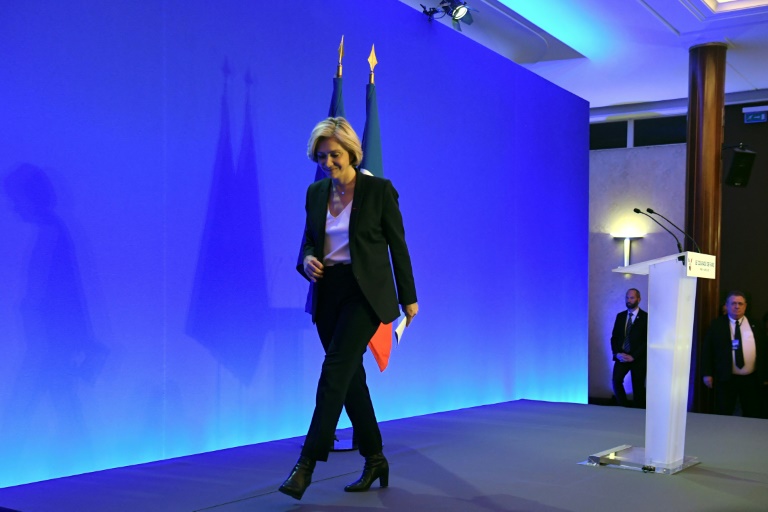
Republicans candidate Valerie Pecresse finished in fifth place according to projections after failing to woo back voters who turned to centrist upstart Emmanuel Macron or the far right of Marine Le Pen, who both advanced to the April 24 run-off.

The blow was all the more devastating as the Republicans party traces its roots to Charles de Gaulle, the revered World War II Resistance hero who built the foundations of the all-powerful French presidency.

“I had to fight a battle on two fronts, between the president’s party and the extremes that joined forces to divide and beat the republican right,” Pecresse said after her defeat.

“This result is obviously a personal and collective disappointment.”

– Changing political landscape –

With parliament elections looming in June, Republicans must now rethink their strategy and craft a conservative message in tune with voters expectations — and perhaps even drop their opposition to joining with far-right forces that have steadily gained traction in France.

“They’ve been in the opposition for 10 years now — that should have been enough time to have a programme and some strong candidates,” said Dominique Reynie of the Fondapol think-tank in Paris.

The party still has control of the Senate and of municipal councils across France, but its leaders appear unable to find a national heavyweight since Nicolas Sarkozy’s presidential defeat in 2012.

“We’re seeing a recomposition of French political life, with this new polarity between centrists and the far right,” said Gaspard Estrada, a political scientist at Sciences Po university in Paris.

“The traditional governing parties, the Socialists and Republicans, together got less than 10 percent of the votes — that speaks volumes about France’s political evolution,” he said.

Macron will be prevented from seeking re-election in 2027 under French term limits. His upstart centrist party has produced no obvious successors, meaning the jockeying has already begun to take his place.

Le Pen has said this is her last presidential campaign, but her strong showing makes it likely she will remain a powerful force to be reckoned with.

The Republicans will also have to contend with Macron’s former prime minister Edouard Philippe, whose popularity on the right has soared since taking over as mayor of Le Havre.

He has formed his own party, Horizons, and is widely expected to try to recruit more from Macron’s Republic on the Move party — a vehicle that has failed to establish any on-the-ground presence in city halls or regional councils.

– Socialists adrift –

The challenge is even more daunting for the leftwing Socialists, whose candidate Anne Hidalgo scored just barely two percent according to projections — below the five-percent threshold required to have campaign expenses reimbursed by the state.

“In 2017 we saw the Socialist party explode, and in this vote we’re probably going to see the explosion of the Republicans,” Remi Lefebvre, a political scientist at the University of Lille told the Grand Continent political journal.

The party’s ranks have dwindled for decades as France’s political landscape shifted to the right. More recently, leftwing voters backed Macron or embraced the revolutionary rhetoric of Jean-Luc Melenchon — who far outpaced the Socialists with a projected score of around 21 percent.

“The left has never been able to recover the working classes…,” said Reynie. “Instead of reinventing itself the party stuck with the bureaucratic middle classes and civil servants — It’s not necessarily bad, but it’s not enough.”

Yet neither Melenchon nor the Greens nor the Communist candidates — all of whom trounced Hidalgo on Sunday — have shown any interest in an alliance.

“Tonight I make a solemn call for leftwing and environmental forces, on social forces, on citizens ready to commit to build together a pact for social and environmental justice for the parliament elections,” Socialist Party leader Olivier Faure said Sunday.

If the Socialists again lose parliament seats in June — they currently have just 25 — state funding for their party will fall even more, putting them in dire financial straits just years after selling their iconic Paris headquarters.

“They tried to present themselves as a social-ecological party… but without clearly laying out an original doctrine,” said Frederic Sawicki, a political scientist at the Pantheon-Sorbonne University in Paris.

“If this very bad score for the presidency is followed by a debacle in the parliament elections, the party’s survival in its current form will be in question,” he said.

Close Bitnami banner
Bitnami