World

War in Ukraine: Latest developments

Here are the latest developments in the war in Ukraine:

– Kyiv readies for battles in east –

Ukraine is preparing for “big battles” against Moscow’s forces in the east of the country, officials in Kyiv say, as thousands of civilians flee in fear of an imminent Russian offensive.

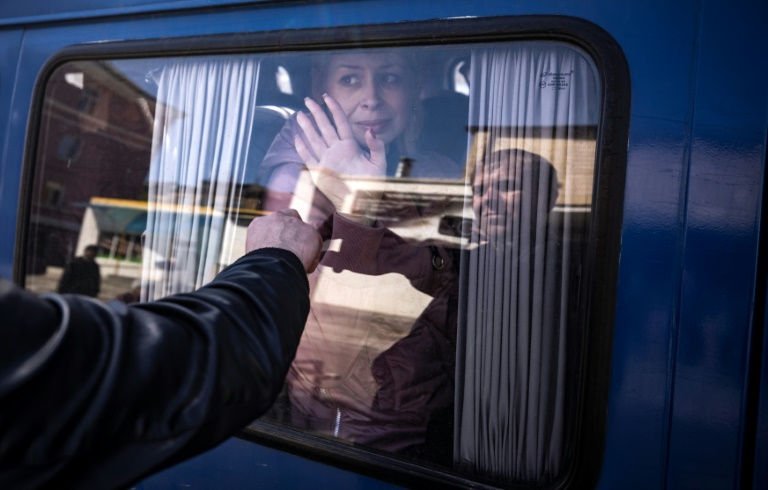
Evacuations resumed from Kramatorsk in eastern Ukraine, where a missile strike killed 52 people at a railway station Friday.

– Pope calls for Easter ceasefire –

Pope Francis calls for an Easter truce in Ukraine to pave the way for peace through “real negotiation”.

“Let the Easter truce begin. But not to provide more weapons and pick up the combat again — no! — a truce that will lead to peace, through real negotiation,” the pontiff tells a public mass at Saint Peter’s Square.

– Dnipro airport destroyed –

The airport in the central Ukrainian city of Dnipro has been completely destroyed in fresh Russian shelling, a local official says. 

“There has been another attack on Dnipro airport. There is nothing left of it. The airport itself and the infrastructure around it has been destroyed. Rockets keep flying and flying,” the head of the city’s military administration, Valentin Reznichenko, says on Telegram. 

Authorities were seeking to clarify information about victims, he adds. 

– Ukraine ‘must win’ in east before talks –

Ukrainian presidential adviser Mykhaylo Podolyak says Ukraine must score a victory in the Donbas region before any potential meeting between Zelensky and Putin.

“Ukraine is ready for big battles. Ukraine must win them, including in the Donbas. And once that happens, Ukraine will have a more powerful negotiating position, which will allow it to dictate certain conditions,” he said on national television, as quoted by Interfax-Ukraine.

“After that the presidents will meet. It could take two weeks, three,” he added.

– Five killed in Russian shelling –

Russian shelling killed five civilians and wounded five others in two eastern Ukrainian cities Saturday, the Donetsk governor says.

Four of them died in the city of Vugledar, and one in the town of Novomikhaylovka, Pavlo Kyrylenko says in a Telegram post.

– Two bodies found in manhole –

At least two bodies have been discovered in a manhole at a petrol station west of Kyiv, an AFP reporter says.

The bodies appear to be clad in a mix of civilian and military clothing.

Ukraine says it has discovered a trail of civilian bodies in towns outside Kyiv from where the Russian army retreated, accusing Moscow of war crimes. 

-‘Ukraine probes Russian war crimes’ –

Ukraine is examining the alleged culpability of 500 Russian leaders for thousands of war crimes, including President Vladimir Putin, a top official says.

Speaking on Britain’s Sky News, Ukrainian prosecutor general Iryna Venediktova also thanks Prime Minister Boris Johnson for his surprise visit to Kyiv on Saturday.

– Russian patriarch urges unity against ‘enemies’ –

Russia’s Orthodox Patriarch Kirill, a close ally of President Vladimir Putin, calls for supporters to rally to fight Moscow’s “external and internal enemies”. 

“In this difficult period for our fatherland, may the lord help each of us to unite, including around power,” the TASS news agency quotes him as saying.

Kirill, whose church has around 150 million followers, has repeatedly backed the Kremlin’s military operation in Ukraine in his sermons.

– Russian bank stripped of subsidiary –

Germany’s banking regulator says it has stripped Russia’s VTB of control over its European subsidiary as sanctions hit the second-biggest Russian bank over the war in Ukraine.

The Russian group “no longer has control” over its Germany-based subsidiary VTB Bank SE after a ban on exercising its right to vote, financial markets authority BaFin says in a statement.

The regulator says VTB can no longer access the financial assets of its subsidiary, which is now “completely isolated” from the Russian group.

– ‘Russians stole from Chernobyl’ –

Russian forces who occupied the Chernobyl nuclear plant stole radioactive substances from research laboratories that could potentially kill them, Ukraine’s State Agency for Managing the Exclusion Zone says.

Russian soldiers pillaged two laboratories in the area, the agency says on Facebook.
Crisis-hit Sri Lanka nearly out of medicine, doctors warn

Sri Lanka’s doctors warned on Sunday they were nearly out of life-saving medicines and said the island nation’s economic crisis threatened a worse death toll than the coronavirus pandemic.

Weeks of power blackouts and severe shortages of food, fuel and pharmaceuticals have brought widespread misery to Sri Lanka, which is suffering its worst downturn since independence in 1948.

The Sri Lanka Medical Association (SLMA) said that all hospitals in the country no longer had access to imported medical tools and vital drugs.

Several facilities have already suspended routine surgeries since last month because they were dangerously low on anaesthetics, but the SLMA said that even emergency procedures may not be possible very soon.

“We are made to make very difficult choices. We have to decide who gets treatment and who will not,” the group said Sunday, after releasing a letter they had sent President Gotabaya Rajapaksa days earlier to warn him of the situation.

“If supplies are not restored within days, the casualties will be far worse than from the pandemic.”

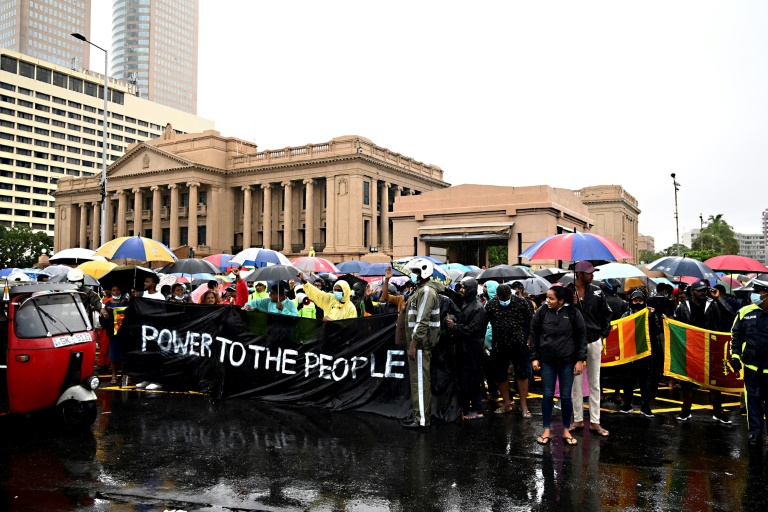
Mounting public anger over the crisis has seen large protests calling for Rajapaksa’s resignation.

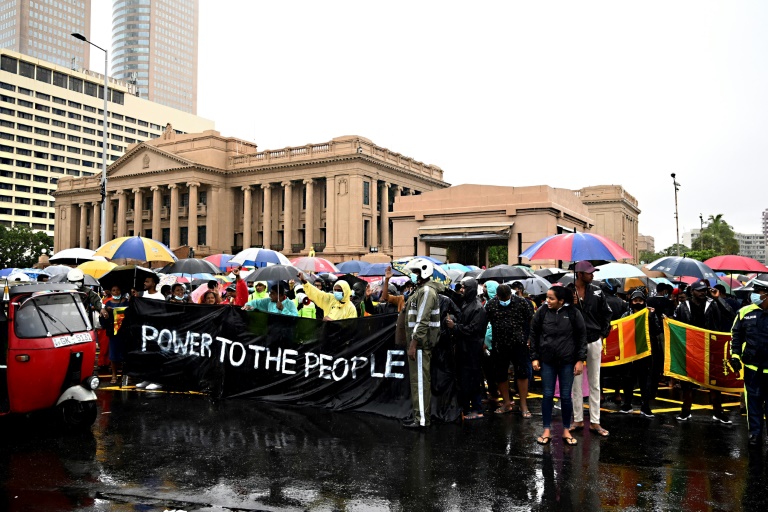
Thousands of people braved heavy rains to keep up a demonstration outside the leader’s seafront office in the capital Colombo for a second day.

Business leaders joined calls for the president to step down on Saturday and said the island’s chronic fuel shortages had seen their operations haemorrhage cash.

Rajapaksa’s government is seeking an IMF bailout to help extricate Sri Lanka from the crisis, which has seen skyrocketing food prices and the local currency collapse in value by a third in the past month. 

Finance ministry officials have said sovereign bond-holders and other creditors may have to take a haircut as Colombo seeks to restructure its debt.

New finance minister Ali Sabry told parliament on Friday that he expects $3 billion from the IMF to support the island’s balance of payments in the next three years.

A critical lack of foreign currency has left Sri Lanka struggling to service its ballooning $51 billion foreign debt, with the pandemic torpedoing vital revenue from tourism and remittances.

Economists say Sri Lanka’s crisis has been exacerbated by government mismanagement, years of accumulated borrowing and ill-advised tax cuts.

Crisis-hit Sri Lanka nearly out of medicine, doctors warn

Sri Lanka’s doctors warned on Sunday they were nearly out of life-saving medicines and said the island nation’s economic crisis threatened a worse death toll than the coronavirus pandemic.

Weeks of power blackouts and severe shortages of food, fuel and pharmaceuticals have brought widespread misery to Sri Lanka, which is suffering its worst downturn since independence in 1948.

The Sri Lanka Medical Association (SLMA) said that all hospitals in the country no longer had access to imported medical tools and vital drugs.

Several facilities have already suspended routine surgeries since last month because they were dangerously low on anaesthetics, but the SLMA said that even emergency procedures may not be possible very soon.

“We are made to make very difficult choices. We have to decide who gets treatment and who will not,” the group said Sunday, after releasing a letter they had sent President Gotabaya Rajapaksa days earlier to warn him of the situation.

“If supplies are not restored within days, the casualties will be far worse than from the pandemic.”

Mounting public anger over the crisis has seen large protests calling for Rajapaksa’s resignation.

Thousands of people braved heavy rains to keep up a demonstration outside the leader’s seafront office in the capital Colombo for a second day.

Business leaders joined calls for the president to step down on Saturday and said the island’s chronic fuel shortages had seen their operations haemorrhage cash.

Rajapaksa’s government is seeking an IMF bailout to help extricate Sri Lanka from the crisis, which has seen skyrocketing food prices and the local currency collapse in value by a third in the past month. 

Finance ministry officials have said sovereign bond-holders and other creditors may have to take a haircut as Colombo seeks to restructure its debt.

New finance minister Ali Sabry told parliament on Friday that he expects $3 billion from the IMF to support the island’s balance of payments in the next three years.

A critical lack of foreign currency has left Sri Lanka struggling to service its ballooning $51 billion foreign debt, with the pandemic torpedoing vital revenue from tourism and remittances.

Economists say Sri Lanka’s crisis has been exacerbated by government mismanagement, years of accumulated borrowing and ill-advised tax cuts.

Spain seizes hundreds of stuffed endangered animals

Spain said on Sunday it seized over 1,000 taxidermied animals, including hundreds of endangered or extinct species, in one of the largest hauls of its kind. 

The Civil Guard said the private collection, estimated to be worth nearly 29 million euros ($32 million), was discovered in a shed in Betera, near Valencia in eastern Spain.

Among the 1,090 animals seized, 405 are classified as protected, endangered or extinct, including the scimitar-horned oryx once found in parts of Africa. 

A stuffed Bengal tiger, considered near extinction, was also found, along with cheetahs, lynxes, polar bears, white rhinos and 198 elephant tusks. 

The Civil Guard said on Sunday it was the country’s “largest haul of nationally-protected taxidermied animals and one of the largest in Europe”. 

The owner of the collection is under investigation for smuggling and several environmental crimes.

Sharif set to become next Pakistan PM after parliament ousts Khan

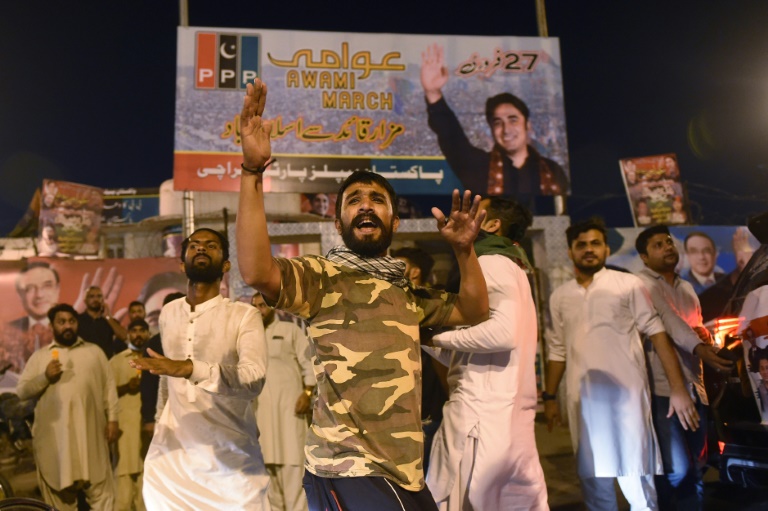
Imran Khan was dismissed Sunday as Pakistan’s prime minister after losing a no-confidence vote, paving the way for an unlikely opposition alliance that faces the same issues that bedevilled the cricket star-turned-politician.

A new premier will be chosen Monday, with centrist Pakistan Muslim League-N (PML-N) chief Shehbaz Sharif already anointed to lead the nuclear-armed nation of 220 million people.

His first task will be to form a cabinet that will also draw heavily from the centre-left Pakistan Peoples Party (PPP), as well as find space for the smaller conservative Jamiatul Ulema-e-Islam-F (JUI-F) group.

The PPP and PML-N are dynastic parties that have dominated Pakistani politics for decades — usually as bitter rivals — and their relations are sure to fray in the lead-up to the next election, which must be held by October 2023.

Shehbaz Sharif is the brother of disgraced three-time prime minister Nawaz Sharif, while PPP leader Bilawal Bhutto Zardari is the son of former president Asif Ali Zardari and assassinated ex-premier Benazir Bhutto.

– ‘Fight until last ball’ –

Khan’s exit was met with a mixture of glee and sympathy.

“Back to the pavilion,” screamed the influential Express Tribune newspaper, using a cricket metaphor headline writers have found difficult to resist during Khan’s tenure.

No prime minister has ever served a full term in Pakistan, but Khan is the first to lose office via a vote of no-confidence.

“Sad day for Pakistan… a good man sent home,” his former information minister Fawad Chaudhry said on Twitter.

There had been high hopes for Khan when he was elected in 2018 on a promise of sweeping away decades of entrenched corruption and cronyism, but he struggled to maintain support with soaring inflation, a feeble rupee and crippling debt.

Militancy is also on the rise, with Pakistan’s Taliban emboldened by the return to power last year of the hardline Islamist group in neighbouring Afghanistan.

Khan had vowed to fight “until the last ball”, and he certainly took his exit to the wire Sunday.

He tried everything to stay in power after losing his majority in parliament — including dissolving the assembly and calling a fresh election.

But the Supreme Court deemed all his actions illegal and ordered them to reconvene and vote.

Still, there was drama right until the midnight deadline ordered by the court, with the speaker of the assembly — a Khan loyalist — resigning at the last minute. 

The session restarted after midnight with a replacement, and the vote was finally held.

Khan’s Tehreek-e-Insaf (PTI) lawmakers stormed out, but the no-confidence motion passed with 174 votes in the 342-seat assembly.

– No vendettas –

New Pakistan governments frequently have a reckoning with those they replace, but Sharif said there would be no vendettas.

“We will put a balm on the wounds of this nation,” he said immediately after the result was announced.

Khan insists he has been the victim of a “regime change” conspiracy involving Washington, and he is certain to tap into anti-US sentiment from the opposition benches.

“Khan’s politics don’t stop here, his support base is intact,” said Zahid Hussain, a political analyst and author.

“His narrative of last few months, that he has been removed through a foreign conspiracy, has earned him some support.”

His party has called for mass protests to start after the Ramadan fast is broken Sunday evening, while Khan has vowed in his first tweet since being ousted that he would not give up. 

“Pakistan became an independent state in 1947; but the freedom struggle begins again today against a foreign conspiracy of regime change,” he said.

Political analyst Talat Masood said Khan appears to want to “create problems” for the next government. 

“From what he has been saying, he seems to want to… pursue a kind of a policy of trying to sort of rebel rather (than) make things better for the country and society,” Masood, a former general, told AFP. 

Former information minister Chaudhry, meanwhile, said the PTI leadership had recommended its representatives resign en masse from the national assembly.

But the party would also file papers nominating ex-foreign minister Shah Mahmood Qureshi for prime minister against Sharif, he said.

Publicly, the military appears to be keeping out of the current fray, but there have been four coups since independence in 1947, and Pakistan has spent more than three decades under army rule.

China slams US virus 'accusations' as Shanghai lockdown drags on

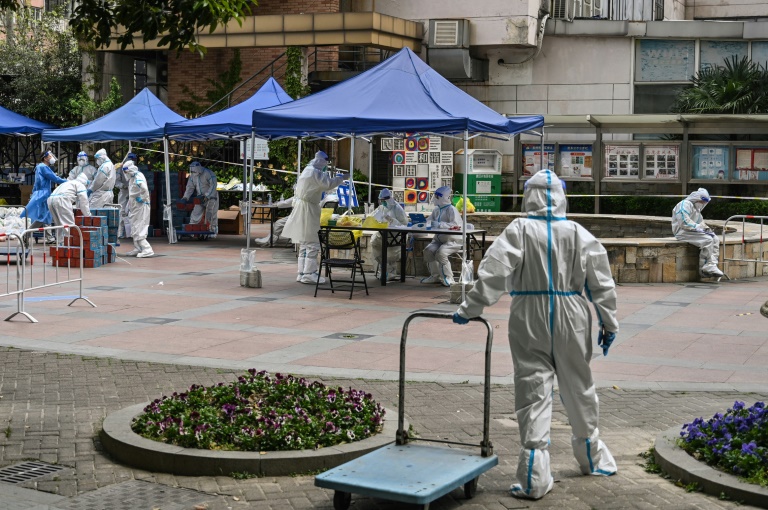
China blasted the United States for making “groundless accusations” about its Covid-19 policy, after surging cases in Shanghai prompted the American consulate to let some staff leave the locked-down megacity.

Beijing’s zero-Covid strategy has come under strain since March as over 100,000 cases in Shanghai have seen its 25 million inhabitants locked down in phases, inciting complaints of food shortages and clashes with health workers.

The US embassy said Saturday it would permit non-essential employees to leave its consulate in Shanghai due to the case surge, warning citizens in China they may face “arbitrary enforcement” of virus curbs.

In response, Beijing expressed “strong dissatisfaction and firm opposition to the US side’s groundless accusations about China’s epidemic control policy”, according to a statement issued Saturday on the foreign ministry’s website.

“This is the US’s own decision. However, it must be pointed out that China’s epidemic control policy is scientific and effective,” ministry spokesman Zhao Lijian said, adding that Beijing had lodged “solemn representations” with American counterparts.

“We have full confidence that Shanghai and other places will overcome this round of the epidemic.”

China is sticking fast to a policy of snap lockdowns, mass testing and travel restrictions to staunch the spread of the virus even as Shanghai’s daily case numbers have spiralled under an Omicron-fuelled wave.

The business hub reported a record 24,943 new infections on Sunday — mostly asymptomatic, accounting for over 90 percent of the national total.

Authorities have readied tens of thousands of new beds in over 100 makeshift hospitals as part of a policy of isolating every person who tests positive for the virus — whether or not they show any symptoms.

Locals have begun to chafe at lockdown restrictions with many taking to social media to vent anger at food shortages and heavy-handed controls — including the recent killing of a pet corgi by a health worker.

An unpopular policy of separating infected children from their virus-free parents — now softened — also triggered a rare show of public anger this week.

But officials are not budging on their zero-tolerance approach. 

City health official Wu Qianyu said during a Sunday press conference the city “would not relax in the slightest”.

Major online delivery platforms said they would bolster food stocks and draft in thousands of drivers to strengthen the supply of basic goods.

In an interview with a local news outlet on Saturday, Zhang Wenhong — a top doctor in Shanghai’s pandemic fight — acknowledged the impact on the healthcare system but said “realising dynamic zero … will help to resume normal medical order as early as possible”.

War in Ukraine: Latest developments

Here are the latest developments in the war in Ukraine:

– Kyiv readies for battles in east –

Ukraine is preparing for “big battles” against Moscow’s forces in the east of the country, officials in Kyiv say, as thousands of civilians flee in fear of an imminent Russian offensive.

Evacuations resumed from Kramatorsk, in eastern Ukraine, where a missile strike killed 52 people at a railway station Friday, as British Prime Minister Boris Johnson became the latest Western leader to visit Kyiv.

– Third prisoner swap underway –

Kyiv says 26 Ukrainians are returning home following a prisoner exchange with Russia.

“On the order of President (Volodymyr) Zelensky, the third prisoner exchange took place today. Twelve of our servicemen are returning home, including one female officer,” deputy prime minister Iryna Vereshchuk says on Telegram.

Fourteen civilians including nine women were also on their way home, she adds.

– Johnson offers more arms –

British Prime Minister Boris Johnson pays an unannounced visit to Kyiv and pledges armoured vehicles and anti-ship missiles to Ukraine.

“It is because of President Zelensky’s resolute leadership and the invincible heroism and courage of the Ukrainian people that (Russian President Vladimir) Putin’s monstrous aims are being thwarted,” Johnson says after meeting Zelensky, according to a Downing Street statement.

Zelensky in turn calls on the West to “follow the UK” in providing military aid to Ukraine and imposing sanctions on Russia.

– Ukraine ‘must win’ in east before talks –

Ukrainian presidential adviser Mykhaylo Podolyak says Ukraine must score a victory in the Donbas region before any potential meeting between Zelensky and Putin.

“Ukraine is ready for big battles. Ukraine must win them, including in the Donbas. And once that happens, Ukraine will have a more powerful negotiating position, which will allow it to dictate certain conditions,” he said on national television, as quoted by Interfax-Ukraine.

“After that the presidents will meet. It could take two weeks, three,” he added.

– Five killed in Russian shelling –

Russian shelling killed five civilians and wounded five others in two eastern Ukrainian cities Saturday, the Donetsk governor said.

Four of them died in the city of Vugledar, and one in the town of Novomikhaylovka, Pavlo Kyrylenko said in a Telegram post.

– Global event raises 10.1 bn euros –

A global pledging event for Ukrainian refugees called “Stand Up for Ukraine” has raised 10.1 billion euros ($11 billion), European Commission chief Ursula von der Leyen says in Warsaw. 

“The ‘Stand Up For Ukraine’ campaign has raised 9.1 billion euros for people fleeing bombs, inside and outside Ukraine, with an additional billion pledged by EBRD (the European Bank for Reconstruction and Development),” she says.

– Ukraine ‘still ready’ for talks –

Ukraine is “still ready” to continue negotiations with Moscow, which have stalled since the discovery of atrocities in Bucha and other areas near Kyiv, President Zelensky says.

“We are ready to fight and to look in parallel to end this war through diplomacy,” he says at a news conference.

– 4.4 million flee Ukraine war – 

More than 4.4 million Ukrainian refugees have fled their country since Putin ordered an invasion on February 24, the UN refugee agency says.

Ninety percent of those who have fled are women and children, as the Ukrainian authorities do not allow men of military age to leave.

– EU in talks with ICC prosecutor –

The European Union is to discuss its support for war crimes probes in Ukraine in meetings over the next two days with the International Criminal Court’s chief prosecutor, the European Commission says.

Karim Khan, of The Hague-based court, is to meet EU foreign policy chief Josep Borrell on Sunday in Luxembourg, then take part in a meeting of EU foreign ministers in the city on Monday.

– Germany reaches ‘limit’ in arms to Ukraine –

Germany has almost exhausted its ability to supply Ukraine with weapons from its army reserves, but is working on direct deliveries from the arms industry, German Defence Minister Christine Lambrecht says. 

“For deliveries coming from the Bundeswehr’s stocks, I have to say honestly that we have reached a limit,” she tells German daily Augsburger Allgemeine. 

– Berlusconi ‘disappointed’ in friend Putin –

Former Italian Prime Minister Silvio Berlusconi tells a public meeting of his right-wing Forza Italia party he is “deeply disappointed and saddened” by the behaviour of his old friend Putin over the Ukraine invasion.

Sharif set to become next Pakistan PM after parliament ousts Khan

Imran Khan was dismissed Sunday as Pakistan’s prime minister after losing a no-confidence vote, paving the way for an unlikely opposition alliance that faces the same issues that bedevilled the cricket star-turned-politician.

A new premier will be chosen Monday, with centrist Pakistan Muslim League-N (PML-N) chief Shehbaz Sharif already anointed to lead the nuclear-armed nation of 220 million people.

His first task will be to form a cabinet that will draw also heavily from the centre-left Pakistan Peoples Party (PPP), as well as find space for the smaller conservative Jamiatul Ulema-e-Islam-F (JUI-F) group.

The PPP and PML-N are dynastic parties that have dominated Pakistani politics for decades — usually as bitter rivals — and their relations are sure to fray in the lead up to the next election, which must be held by October 2023.

Shehbaz Sharif is the brother of disgraced three-time prime minister Nawaz Sharif, while PPP leader Bilawal Bhutto Zardari is the son of former president Asif Ali Zardari and assassinated ex-premier Benazir Bhutto.

– ‘Fight until last ball’ –

Khan’s exit was met with a mixture of glee and sympathy.

“Back to the pavilion,” screamed the influential Express Tribune newspaper, using a cricket metaphor headline writers have found difficult to resist during Khan’s tenure.

No prime minister has ever served a full term in Pakistan, but Khan is the first to lose office via a vote of no-confidence.

“Sad day for Pakistan… a good man sent home,” his former information minister Fawad Chaudhry said on Twitter.

There had been high hopes for Khan when he was elected in 2018 on a promise of sweeping away decades of entrenched corruption and cronyism, but he struggled to maintain support with soaring inflation, a feeble rupee and crippling debt.

Militancy is also on the rise, with Pakistan’s Taliban emboldened by the return to power last year of the hardline Islamist group in neighbouring Afghanistan.

Khan had vowed to fight “until the last ball”, and he certainly took his exit to the wire Sunday.

He tried everything to stay in power — including dissolving parliament and calling a fresh election — but the Supreme Court deemed all his actions illegal last week, and ordered the assembly to reconvene and vote.

Still, there was drama right until the midnight deadline ordered by the court, with the speaker of the assembly — a Khan loyalist — resigning at the last minute. 

The session restarted after midnight with a replacement, and the vote was finally held.

Khan’s Tehreek-e-Insaf (PTI) lawmakers stormed out, but the no-confidence motion passed with 174 votes in the 342-seat assembly.

– No vendettas –

New Pakistan governments frequently have a reckoning with those they replace, but Sharif said there would be no vendettas.

“We will put a balm on the wounds of this nation,” he said immediately after the result was announced.

Khan insists he has been the victim of a “regime change” conspiracy involving Washington, and he is certain to tap into anti-US sentiment from the opposition benches.

“Khan’s politics don’t stop here, his support base is intact,” said Zahid Hussain, a political analyst and author.

“His narrative of last few months, that he has been removed through a foreign conspiracy, has earned him some support.”

Khan says the PML-N and PPP conspired with the United States to bring the no-confidence vote because of his non-aligned international outlook and opposition to US foreign policy, particularly in Muslim nations such as Iraq and Afghanistan.

He vowed late Friday to never support any incoming new government and has called supporters for a rally in the capital later Sunday.

“From what he has been saying, he seems to want to create problems for the government and pursue a kind of a policy of trying to sort of rebel rather… make things better for the country and society,” said Talat Masood, a former general and now political analyst.

Publicly, the military appears to be keeping out of the current fray, but there have been four coups since independence in 1947, and Pakistan has spent more than three decades under army rule.

Voting starts as Macron seeks new term in tight French election

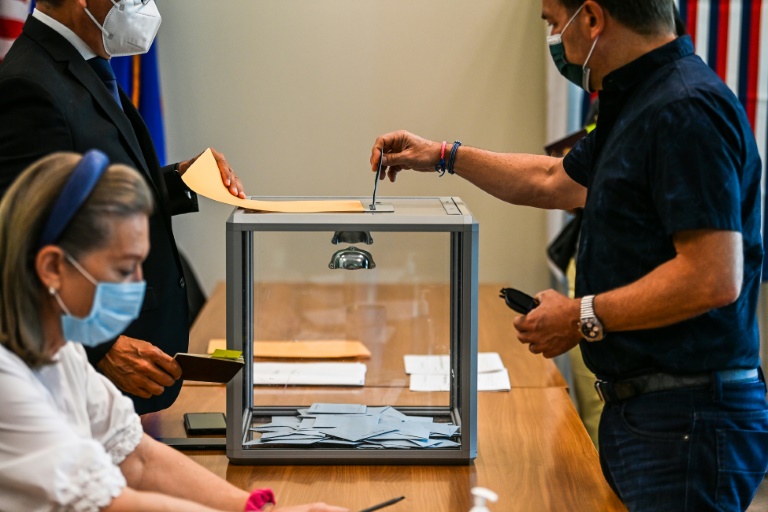
France voted on Sunday in the first round of a presidential election projected to produce a run-off rematch between incumbent Emmanuel Macron and far-right leader Marine Le Pen that will be far tighter than their duel five years ago. 

Polls opened in mainland France at 0600 GMT after an unusual campaign overshadowed by Russia’s invasion of Ukraine that analysts warned could lead to unpredictable outcomes with turnout a major factor.

French overseas territories already voted Saturday to take account of the time difference, starting with the tiny island of Saint Pierre and Miquelon off the coast of Canada and then territories in the Caribbean followed by French Pacific islands.

“It’s important to vote, that’s when you choose between the good and the bad. After all, the president will run your life,” said Annette Tehariki, a 57-year-old voting in French Polynesia.

Polls predict that Macron will lead Le Pen by a handful of percentage points in round one, with the top two going through to a second round vote on April 24. 

Far-left candidate Jean-Luc Melenchon is snapping at their heels in third place and still fancies his chances of reaching the second round at the expense of Le Pen or even — in what would be an extraordinary upset — President Macron himself. 

Although her opponents accuse her of being an extremist bent on dividing society, Le Pen has with some success during the campaign sought to show a more moderate image and concern with voters’ daily worries such as rising prices. 

Macron by contrast has campaigned relatively little, by his own admission entering the election campaign later than he would have wished due to the war in Ukraine. 

French television channels will broadcast projections of the final results, which are generally highly accurate, as soon as polls close at 1800 GMT Sunday.

– ‘Uncertainty’ –

If Macron and Le Pen as forecast reach the second round, analysts predict that their clash will be far tighter than in 2017 when the current president thrashed his rival with 66 percent of the vote.

“There is an uncertainty,” said French political scientist Pascal Perrineau, pointing to unprecedentedly high numbers of voters who were still undecided or who changed their minds during the campaign as well as absentee voters.

Analysts fear that the 2002 record of the number of French voters boycotting a first round of 28.4 percent risks being beaten, with the 2017 absentee rate of 22.2 percent almost sure to be exceeded. 

Some 48.7 million voters are registered across France to vote in this election. 

The stakes of the election are high for Macron, who came to power aged 39 as France’s youngest president with a pledge to shake up the country. 

He would be the first French president since Jacques Chirac in 2002 to win a second term and thus cement a place in the country’s history. 

If he wins, he would have a five-year mandate to impose his vision of reform which would include a crack at raising the pension age in defiance of union anger. 

He would also seek to consolidate his position as the undisputed number one in Europe after the departure of German chancellor Angela Merkel. 

A Le Pen victory would however be seen as a triumph for right-wing populism and send shockwaves across Europe and markets. 

For his European supporters, Macron is a centrist bulwark against populism, especially after election victories last weekend by the right-wingers Hungarian premier Viktor Orban and Serbian leader Aleksandar Vucic, who both have cordial ties with Putin.

– Republican front? –

The candidates of France’s traditional parties, the right-wing Republicans and the Socialists on the left, are facing a debacle on election night, continuing a shake-up of French politics that began when Macron took power.

Greens candidate Yannick Jadot, the Republicans’ Valerie Pecresse and the flagging Socialist nominee Anne Hidalgo appear certain to be ejected in the first round. 

Far-right former TV pundit Eric Zemmour made a stunning entry into the campaign last year but has since lost ground, and analysts say he has actually aided Le Pen by making her appear more moderate. 

Much attention is already turning to the second round and the question of who will win the backing of the defeated first-round hopefuls. 

Analysts question whether Macron would enjoy the same support from a broad anti-far right “Republican front” coalition that helped him win in 2017, and that had already allowed Jacques Chirac to demolish Marine Le Pen’s father Jean-Marie in 2002. 

“The Republican front hasn’t been what it used to be for a while,” the director of the Jean-Jaures Foundation, Gilles Finchelstein, told AFP. 

Iceland chilled by violence worthy of its noir novels

Long considered the “most peaceful country in the world”, Iceland’s tranquillity has been shattered by a spate of shootings and stabbings involving criminal gangs.

The country of only 375,000 people is more accustomed to reading about murders in its famed Icelandic noir novels than in its morning newspapers.

“A gun for Icelanders symbolises sports” or hunting, said sociologist Helgi Gunnlaugsson.

“It’s very alien to the Icelandic mind that you would use a weapon to protect yourself or to point at people,” he told AFP.

Iceland has topped the Global Peace Index ranking since 2008 thanks to its low crime, strong education and welfare systems, fair pay and an absence of tension between social classes.

Only four people have been shot dead in more than two decades. 

But four shootings have now taken place in a little over a year, one of which was fatal. 

In February 2021, a man was gunned down in a hail of bullets outside his home in a neighbourhood of the capital Reykjavik, a murder that shocked the nation.

The killing was linked to organised crime, police said.

“Criminal groups in Iceland are becoming more organised,” said criminologist Margret Valdimarsdottir.

“They have more ties to international groups than what we’ve seen before, which may be a challenge for our police force.” 

In February, two separate drug-related shootings took place in Reykjavik two days apart, one in the city centre.

The gang violence is similar to that already seen in other parts of Europe.

“It takes five to 10 years for what is trending in Europe to show up in Iceland,” said Runolfur Thorhallsson, superintendent of Iceland’s elite police unit, known as the Viking Squad.

“Of course this is a concern for us.”

– Unarmed police – 

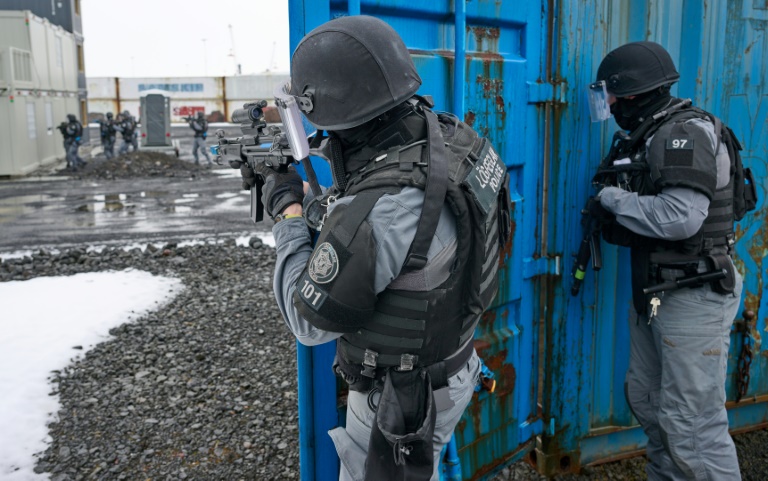
Iceland is one of the rare countries in the world where police are not armed in their daily duties.

However, patrol cars have been equipped with handguns in special safes since late 2015 after the bloody attacks by far-right extremist Anders Behring Breivik in Norway in 2011.

Only a small number of police officers — the Viking Squad — are permanently armed with semi-automatic weapons as well as bulletproof vests and ballistic shields.

The squad assists the police when weapons are reported, with the number of such incidents rocketing almost six-fold since 2014.

“We see indicators that maybe people are less hesitant in this criminal world to use weapons. We see more of an increase in knives than firearms,” Thorhallsson said.

While he doesn’t have an explanation for the rise in violence, the interior minister is considering equipping police with tasers. 

The head of the police union, Fjolnir Saemundsson, welcomed the idea but called for more recruits and training.

With 682 police officers in 2021, Iceland has one of Europe’s smallest police forces relative to its population, second only to Finland and almost half the European average, according to EU statistics agency Eurostat.

– A safe country –

Studlar, a government-run treatment centre for juveniles aged from 12 to 18, helps troubled youths with problems ranging from drugs to crime and behavioural issues.

Director Funi Sigurdsson said he has also seen a slight rise in violent incidents, with the centre confiscating an increasing number of knives.

He said with some of the young people it was often clear “when they were six years old that they would end up here. 

“If we would have intervened very well then, we could possibly have prevented them from ending up in this situation.”

Several of those involved in the score-settling between the gangs passed through the centre as juveniles.

While the rise in violent crime has caused concern, the situation is not alarming, experts insisted.

“It’s important to note that Iceland is still a country that has an extremely low crime rate,” Valdimarsdottir said.

Close Bitnami banner
Bitnami